




Abstract
This study examines an in-depth single case study of Nigerian e-commerce entrepreneurs in their natural learning setting. The study is nested principally within the experiential learning perspective, aiming to understand how they adapt and apply knowledge in their business practices. Interviews were conducted with 53 entrepreneurs selected via stratified purposive sampling, and the data were analyzed using content analysis. The findings reveal that, although many Nigerian e-commerce entrepreneurs possess some level of formal education, their primary learning occurs through hands-on experience. The study identifies distinct learning patterns among the entrepreneurs, influenced by personal agendas and external factors that shape their experiential learning outcomes. The research proposes a conceptual model highlighting four key propositions, derived from theme categories in the data, which emphasize factors that trigger learning experiences and critical events that initiate the learning process. These findings contribute to the literature by enhancing the understanding of how Nigerian entrepreneurs learn and adapt existing knowledge to their unique business contexts, allowing them to thrive in various countries. The study underscores the significance of both personal and external influences on learning, offering insights into the processes that drive entrepreneurial success in the e-commerce sector.
Plain Language Summary
This study looks closely at Nigerian e-commerce entrepreneurs and how they learn in their everyday environments. It focuses on experiential learning, particularly using social learning theory, to understand how these entrepreneurs adapt and use their knowledge in their businesses. The research involved interviews with 53 entrepreneurs chosen intentionally, and the information was analyzed to find common themes. The results show that, even though many entrepreneurs have some formal education, they mainly learn through real-life experiences. The study found different learning styles among the entrepreneurs, shaped by their personal goals and outside influences. It presents a conceptual model with four important ideas about what triggers learning experiences and key events that kick-start the learning process. These insights help to better understand how Nigerian entrepreneurs learn and adapt their knowledge in unique business environments, enabling their success in various markets around the world. The research highlights how both individual and external factors play a role in the learning process, shedding light on what contributes to success in the e-commerce industry.
Keywords
Introduction
Entrepreneurial Learning has become a critical driver of economic growth, competitiveness, and social development in recent years (Hunter & Lean, 2018; Smith, 2019). Despite the rapid growth of the e-commerce sector, there remains a paucity of knowledge regarding how entrepreneurs in this domain acquire and apply their expertise to navigate challenges in a dynamic, resource-constrained business environment (Helmy et al., 2024; Hisrich & Ramadani, 2017; Zhang & Chun, 2018). Entrepreneurship is widely recognized as an avenue to reduce unemployment and poverty, with governments and stakeholders providing tools and enabling environments to support entrepreneurial efforts (Brown, 2017; Ogbari et al., 2024). Consequently, experiential learning has emerged as a crucial process for entrepreneurs, allowing them to develop personally and professionally while navigating complex business challenges (Motta & Galina, 2023; Roberts, 2018). Consequently, it is essential to examine how Nigerian e-commerce entrepreneurs acquire knowledge, particularly through experiential learning, to identify the processes, stimuli, and contextual factors that influence their learning and impact their business performance.
Moreover, Entrepreneurial learning refers to the ongoing and dynamic process through which individuals acquire, comprehend, and use knowledge to identify opportunities, initiate action, and navigate uncertainty in business contexts (El-Awad, 2023). It encompasses both formal and informal education; nevertheless, experiential learning—acquiring knowledge via actions, mistakes, and real-world business challenges—is the most crucial component (Rao et al., 2024). Furthermore, Entrepreneurial learning is a dynamic process that occurs through hands-on experiences and reflection, often serving as a response to the fast-paced and turbulent nature of e-commerce (Jan, 2024; Osborne, 2008). Unlike traditional education methods, entrepreneurial learning through practical experiences equips individuals to make informed decisions, solve problems, and innovate (Johnson, 2020). Research suggests that the dynamic environment of e-commerce, characterized by rapid technological advancements and constant market changes, creates unique learning opportunities for entrepreneurs (Hong et al., 2024; Smith, 2015). Entrepreneurs’ dependency on their experiences in such environments has proven essential in shaping their decision-making and business strategies (R. Jones, 2017; Weerasekara & Bhanugopan, 2023).
Furthermore, experiential learning and the resource-based view (RBV) are important for understanding how individuals and organizations acquire, use, and sustain competitive advantages in e-commerce (Sukardi & Subhani, 2022). Kolb (1984) developed experiential learning, highlighting the importance of practical experience, reflective observation, abstract conceptualization, and active experimentation in gaining knowledge and skills. This approach is particularly useful in changing environments that require adaptation. Experience-based learning improves problem-solving, decision-making, and innovation within the workplace (Kayes, 2002). The resource-based view suggests that companies can maintain their competitive advantage by leveraging resources that are unique, valuable, and hard to imitate, including human capital and organizational expertise (Barney, 1991). When firms implement experiential learning in their processes, it strengthens their internal resources and supports the development of strategic skills aligned with the Resource-Based View (RBV). These theories highlight the importance of developing internal capabilities through experiential learning and resource acquisition. They provide a strong framework for assessing an organization’s performance and growth. Therefore, the research questions are based on experiential learning theory and explore how individuals and organizations learn from real-world challenges to improve their competencies in e-commerce. The resource-based approach also guides the methodological focus toward identifying and analyzing internal capabilities—such as knowledge, skills, and processes—as key factors of performance. These frameworks assist both research and the choice of data sources, emphasizing practical experience, and resource evaluation.
However, despite the growing body of research on experiential learning, existing studies fall short in addressing specific learning dynamics of entrepreneurs operating in the e-commerce sector (Monllor et al., 2024; Udeozor et al., 2025; Wu & Tien, 2024). Previous studies have largely generalized entrepreneurial learning without considering the unique challenges posed by e-commerce (Brown, 2019; Xie et al., 2022), such as the rapid pace of product innovation and the turbulence introduced by technological advancements (Arici & Gok, 2023; Smith, 2015). Furthermore, existing research often addresses entrepreneurship from a “how-to” perspective, emphasizing technical skills rather than the experiential learning processes critical for navigating the complexities of e-commerce (Johnson, 2020). Nonetheless, limited research has examined the entrepreneurial learning dynamics of Nigerians in the E-commerce industry.
Thus, this study aims to address this gap by exploring how entrepreneurs learn through their experiences in e-commerce and why experiential learning is essential for their success. Specifically, this research investigates the relationship between entrepreneurial learning, decision-making, and the adoption of e-commerce strategies. Guided by experiential learning theory and resource-based theory, the study provides insights into the unique learning processes of Nigerian e-commerce entrepreneurs. A qualitative approach was adopted, with in-depth interviews conducted among 53 Nigerian e-commerce entrepreneurs, offering a diverse perspective on their learning journeys.
The current research contributes to the existing literature by focusing on the experiential learning dynamics specific to e-commerce entrepreneurs, shedding light on the challenges and opportunities they face. It also highlights how entrepreneurs transform their practical experiences into actionable strategies that foster business growth. In view of this, the research questions guiding the study are as follows: (a) How do entrepreneurs learn through their experiences in e-commerce? and (b) How does experiential learning influence the adoption of e-commerce strategies?
Materials and Methods
A stratified intentional sampling technique (Onwuegbuzie & Collins, 2007) was used for the qualitative study based on the objectives and purpose of the research. To create a meaningful sample, the study focused on e-commerce entrepreneurs from Nigeria who have an online presence and have generated over $5,000 in revenue while being in business for more than 3 years. Stratification was conducted based on revenue and sector. The demographics of the respondents are essential in qualitative research, as they ensure diversity and depth of insight across various entrepreneurial profiles. The inductive qualitative technique was chosen as the appropriate research method, allowing the inquiry to focus on the participants’ learning experiences with the researcher’s sensitivity (Strauss & Corbin, 1990). The sectors selected for this study include business-to-consumer, business-to-business, consumer-to-consumer, and consumer-to-business (see Table 1).
The Summary of the Demographic Profile of the Participants.

Source. Authors.
Data Collection
The data of the study were collected through semi-structured interviews (Kvale, 1996), which are used to obtain descriptions of the life world of the interviewee and to better understand the experiences of the interviewed firms about the research objectives. The interviews took place from February to March same year. All 53 participants volunteered willingly and with full awareness of their actions. The interview guide inquired about the respondent’s background, the sector of their e-commerce enterprise, their overall experiences in gaining entrepreneurial knowledge, and key business decisions they have made. We used follow-up questions and probes to gather further information. At the end of each interview, the interviewer asked participants to share a preferred business quote or any other relevant information they considered important.
The study was designed to minimize any potential risk of harm to participants by selecting adult participants, communicating the purpose of the study clearly with them, ensuring they may withdraw from the study at any time they want, and maintaining participant anonymity and confidentiality. Informed consent was obtained from all study participants before the data collection process. The participants were informed that their participation is entirely voluntary and they can withdraw from the study at any point if they feel uncomfortable. They were also informed that they may decline to answer any question they do not wish to answer at any point during the interview.
Personally identifiable information, such as phone numbers is avoided during data collection. All study data were stored securely, and no names or identifying details were included in the research material or publication. Participants were informed that the study data collected would be used solely for academic purposes. Therefore, the study contributes to the understanding of entrepreneurial learning and provides practical insights to benefit small businesses, outweighing the minimal risks. High ethical standards were ensured to secure the dignity, privacy, and safety of the participants.
The participants were selected based on whether they had either owned or led an e-commerce business. Hence, 53 performing ecommerce businesses were selected, and data were collected through virtual interviews. Interviews are a common technique used for data collection and include open-ended questions, making them more amenable to detailed information gathering (Blaikie, 2000). A total of fourteen open-ended semi-structured questions were asked during data collection. Those interview questions were adapted from Wing Yan Man (2006) and Ekanem (2015) and aim to gather general information, the nature of the e-commerce businesses participants engage in, and the dynamics of the entrepreneurial learning process of the participants (Table 2).
Open-Ended Interview Questions.

Data Analysis
The interviews were collected and transcribed, and a thematic content analysis was conducted. The grounded theory approach (Glaser and Strauss, 1967) was used to code entrepreneurial learning dynamics through a continuous process of coding, conceptualizing, cataloging, re-coding, and evaluating the data until all behaviors were coded. The primary analysis in the study was thematic, and the grounded theory method was used to clarify the learning process. Thematic analysis reveals the insights gained by business owners. Grounded theory helped our understanding of the learning process through experiential insights. This led to the conceptual propositions. We employed grounded theory techniques such as open coding and continuous comparison within the thematic framework. These methods helped identify patterns and improved our understanding of real learning experiences. This study uses a qualitative approach to analyze textual data to understand the learning processes of chosen e-commerce entrepreneurs. The responses obtained from participants were coded manually using Microsoft Excel.
Results
The results revealed that the majority of the entrepreneurial ventures participants established (63.00%) focus on meeting the demands of ultimate customers (B2B), a sizable portion (31.00%) cater to other businesses (B2B), and only a small number of consumers (5.00%) incorporate electronic transactions aimed at consumers (C2C). Due to its ever-evolving nature and the features of a developing business, a company may operate various categories of e-commerce models. According to the “extended e-commerce model,” the majority of businesses (79.00%) operate simultaneously in B2B, B2C, C2B, and B2C.
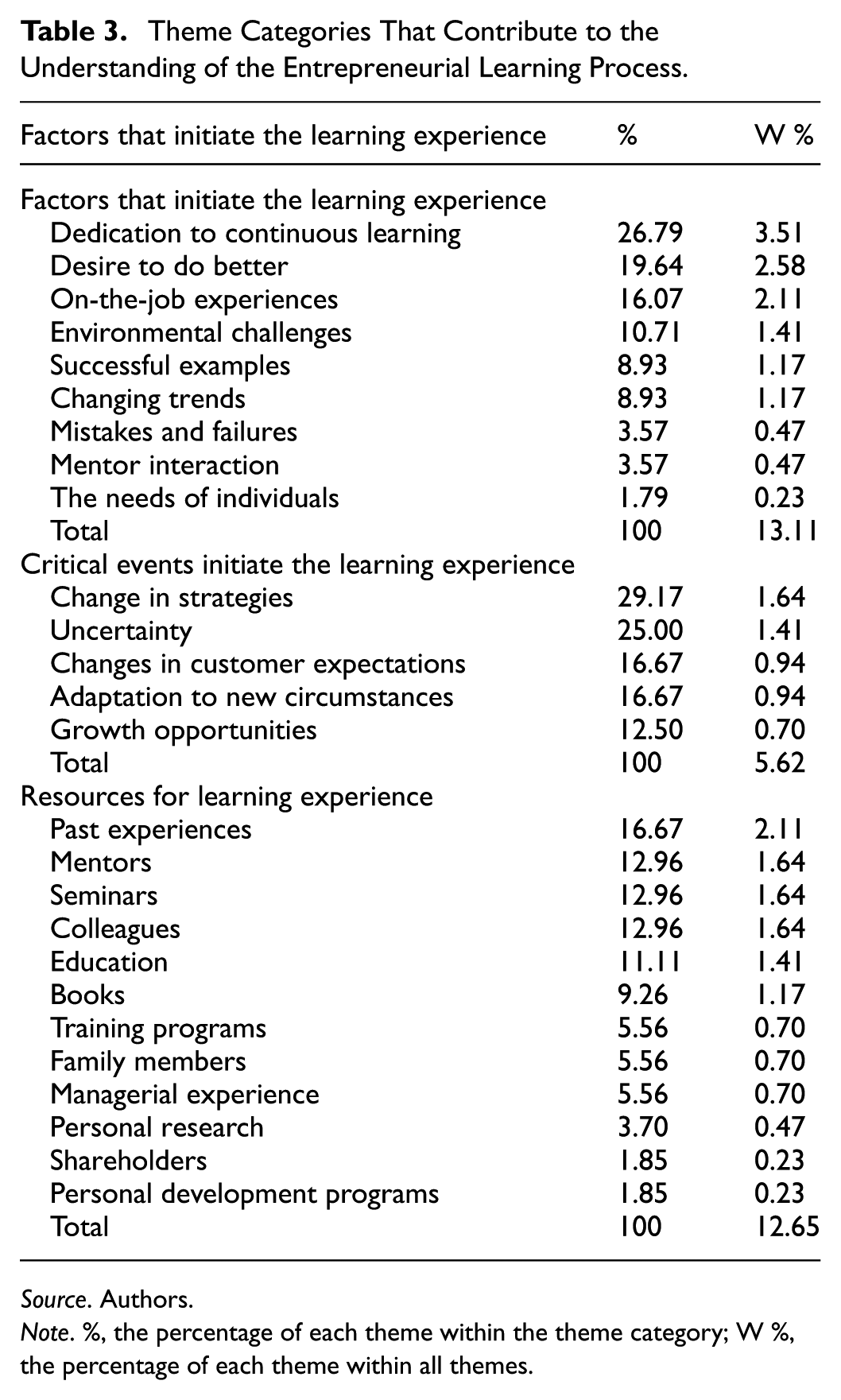
When the related themes derived from the interviews were grouped into categories, nine main theme categories were obtained. These categories are; (a) factors that initiate learning experience, (b) critical events that initiate learning experience, (c) sources of learning experience, (d) organizational practices and systems that support learning, (e) forms of learning, (f) factors contribute to entrepreneurial success, (g) how learning experiences translated into action, (h) learning outcomes, and (i) organizational outcomes. The first three theme categories derived from grouping the distinctive themes obtained are presented in Table 3.
Theme Categories That Contribute to the Understanding of the Entrepreneurial Learning Process.
Source. Authors.
Note. %, the percentage of each theme within the theme category; W %, the percentage of each theme within all themes.
Study participants emphasized themes that initiated the entrepreneurial learning process during the interviews. They defined some of these themes as factors that initiated the process, while conceptualizing others as critical events that initiated entrepreneurial learning. According to the research participants, the main factors that initiate the learning process are dedication to continuous learning (26.79%), desire to do better (19.64%), and on-the-job experiences (16.07%). Similarly, participants also highlighted critical events that initiated the entrepreneurial learning process, including themes such as change in strategies (29.17%), uncertainty (25.00%), and changes in customer expectations (16.67%). In addition, the study results showed that the participants also emphasized the sources that contribute to learning as the entrepreneurial learning process begins. The most emphasized themes among the sources that contribute to entrepreneurial learning are past experiences (16.67%), mentors (12.96%), seminars (12.96%), and colleagues (12.96%).
The factors that initiate the learning process (13.11%), the critical events (5.62%), and the resources used when the learning process begins (12.65%) indicate the situation in which the entrepreneur understands the need for learning. From this perspective, those theme categories generated from the study analysis fit into Kolb’s (1984) framework of different forms of learning. According to Kolb’s (1984) learning framework, learning occurs through two basic processes: prehension and transformation. The prehension process is shaped by understanding, which is based on conceptual analysis, and experience that can be felt through the senses (Kolb, 1984). According to Kolb (1984), learning is not limited to prehension alone; there is also a transformation process. The transformation process occurs internally, with the change of our mental image and emotional state, and also externally, by affecting and/or shaping the external environment through behavior (Kolb, 1984).
The percentages within the theme categories and the weighted percentages within all themes derived from the analysis under modes of learning (8.67%) and organizational practices and systems (5.15%) categories are presented in Table 4.
Theme Categories That Contribute to the Experiencing State of the Entrepreneurial Learning Process.

Source. Authors.
Note. %, the percentage of each theme within the theme category; W %, the percentage of each theme within all themes.
The study results revealed that the dominant learning mode of the entrepreneurs participating in the study is experiential learning (51.35%). Modes of learning, on-the-job training (16.22%), and social environment (13.51%) follow experiential learning. Study results indicated that participants emphasized a variety of organizational practices and systems that support the way entrepreneurial learning occurs. Among these, support systems (31.82%) appeared as the most emphasized theme. In addition, the themes of decision-making (22.73%) and value creation (18.18%) are also emphasized.
Theme categories, modes of learning (8.67%), and organizational practices and systems (5.15%) derived from the analysis appear to be similar to Kolb’s (1984) experience state of learning. The entrepreneur, who had realized the need to learn through the factors and critical events that initiated the learning process, has now begun to experience the situation. Full understanding is achieved when the entrepreneurs’ senses come into play. The entrepreneur takes action by taking advantage of the factors that contribute to the success of the entrepreneur (23.88%), which are necessary to achieve learning outcomes through mechanisms that translate learning experience into action (13.82%), and thus the transformation begins to be felt (Table 5).
Theme Categories That Contribute to the Internalization State of the Entrepreneurial Learning Process.

Source. Authors.
Note. %, the percentage of each theme within the theme category; W %, the percentage of each theme within all themes.
The study participants highlighted themes that can be categorized under the mechanisms that translate learning experiences into action. The results indicate that learning translates into action through improved business strategies (98.98%), restructuring (10.17%), and re-evaluation (8.47%), along with growth (8.47%) and better understanding (8.47%). Those mechanisms highlighted by the study participants fit into the internalization state of the forms of learning proposed by Kolb (1984), as it involves the transformation of the entrepreneurs’ conceptualization regarding the phenomenon. According to the study participants, during this process, factors such as persistence (29.41%), experience (28.43%), determination (12.75%), and curiosity (11.76%) contribute to entrepreneurial success. It was concluded from the participants’ statements that the factors contributing to the entrepreneur’s success also contribute to an internal transformation in the learning process, by affecting the entrepreneur’s subjective evaluation of the phenomenon, such as the mechanisms that translate learning experiences into action. One of the participants put forward this internalization by stating, “I didn’t only learn, I also unlearned and relearned new ways of doing business differently” (A20R29).
Finally, themes that emphasize learning outcomes (6.56%) and organizational outcomes (10.54%) are derived from the interview data. The percentages of these themes derived within the theme categories and the percentages within all themes derived are presented in Table 6.
Theme Categories That Contribute to the Externalization State of the Entrepreneurial Learning Process.

Source. Authors.
Note. %, the percentage of each theme within the theme category; W %, the percentage of each theme within all themes.
According to the study results, the most emphasized theme under the learning outcome theme category is customer interaction (17.86%), followed by business skills (14.29%), dedication to learning (10.71%), risk-taking (10.71%), and communication skills (10.71%).
Study participants also emphasized three major themes that stress organizational outcomes, such as improved quality of service (37.78%), value (35.56%), and awareness (15.56%).
A conceptual model was developed and proposed within the scope of the study by using the themes generated from the study results (Maxwell, 2005). This proposed conceptual model of the study is presented in Figure 1. Moreover, utilizing the themes generated from the study results and the relationships proposed in the conceptual model, some propositions have been proposed.

Proposed conceptual model of the study.
The theme categories in the proposed conceptual model were found to be compatible with Kolb’s (1984) learning styles, as mentioned earlier, and the first three theme categories were found to contribute to the understanding phase of learning. From these theme categories, the factors that trigger the learning experience and the critical events seem to initiate the learning process. In addition, the generated themes show that the factors that trigger the learning experience are supported by various sources.
These three thematic categories seem to enhance the entrepreneur’s understanding and make sense of the circumstances that suggest a need for knowledge generation. Therefore, it can be suggested that learning begins as the entrepreneur encounters a new, unexpected situation through critical events (such as; environmental challenges, changing trends, failures, etc.), whereas a learner entrepreneur experiencing the situation and feels the need for a transformation or recognizes the necessity for transformation through desire to do better, observing successful examples, and achieving personal needs and begins to seek new methods, approaches, and pursuits.
Lattacher et al. (2021) proposed that critical events serve as an important catalyst for entrepreneurial learning, which leads to revisiting and examining existing mental models and reflecting upon the circumstances. Researchers in the literature put forward that failures lead to uncertainties, and the search for eliminating these uncertainties stimulates learning (McGrath, 1999; Sitkin, 1992) and compelling entrepreneurs to search for new approaches (Sarasvathy, 2001).
Discussion
The discussion section of this study covers a wide range of ideas and goes into detail to help understand what the results mean. The findings show that there are different levels of how entrepreneurs learn, with hands-on experience being the most common type. However, this learning looks different for each person depending on their goals, past knowledge, and the market they work in. The study also offers new views on how culture, technology, and available resources affect learning. This makes the study useful for many different kinds of entrepreneurs. The analysis answers the main research question by showing how Nigerian e-commerce entrepreneurs gain and use knowledge through real experiences. This detailed look helps explain how entrepreneurs learn and grow, especially in a digital economy with limited resources.
The modes of learning mentioned by the study participants can be categorized under two main groups (a) utilizing existing knowledge from formal organizational learning through education and training programs (Sun, 2020) such as seminars highlighted by the study participants, and (b) learning by observing, and experiencing through experimenting, on the job training, observing the social environment and learning from failures. The study results point out that entrepreneurs learn not only through formal education (Shen et al., 2021) but also by benefiting from social networks (Mansoori, 2017; Shen et al., 2021) and experiencing (Lattacher et al., 2021; Sitkin, 1992). It can also be conceptualized as learning by doing (Corbett, 2005). The entrepreneur learns through trying and exploring in action (M. V. Jones & Casulli, 2014).
Similar to those conceptualizations in the literature, the study results suggest that the entrepreneurs’ learning process is supported by organizational practices and systems such as decision-making, value creation, outsourcing, and planning. Especially, decision-making and planning for international opportunities and internationalization lead entrepreneurs to experiential learning processes (Chandra et al., 2009; Corbett, 2005; M. V. Jones & Casulli, 2014). Chandra et al. (2009) put forward that international opportunity is an important source of learning while doing. Additionally, the use of organizational activities to expand into new markets (Bunz et al., 2017) and exploring new opportunities (Minniti & Bygrave, 2001) also supports learning. Based on these arguments in the literature and study findings, the following proposition has been developed.
Entrepreneurial learning is instrumental in developing new skills, attitudes, and beliefs (Harvey & Evans, 1995), and the process of utilizing new knowledge plays a crucial role in this learning (Cope, 2005). As pointed out in the literature, entrepreneurial learning is influenced by experiences and the exploration of new possibilities, where experimentation serves as a crucial learning technique (Minniti & Bygrave, 2001; Sitkin, 1992). Previous studies have identified three aspects for understanding how entrepreneurs transform their experiences into learning outcomes: (a) through prior entrepreneurial events (Cardon & McGrath, 1999; Minniti & Bygrave, 2001), (b) the entrepreneur’s reasoning and logic (Ravasi et al., 2004; Sarasvathy, 2001), and the enactment of the preexisting knowledge (McGrath, 1999; Minniti & Bygrave, 2001; Wright et al., 1998). Therefore, entrepreneurial learning positively impacts entrepreneurial outcomes by helping entrepreneurs accumulate and update their knowledge (Minniti & Bygrave, 2001).
According to the study results, entrepreneurs appear to utilize mechanisms that translate learning experiences into action through the evaluation of previous entrepreneurial events, such as strategy implementation, restructuring, and growth, and this leads to revisiting their preexisting logic and reasoning through re-evaluation and better understanding. Furthermore, study results indicate that certain factors such as persistence, previous experience, and determination contribute to the entrepreneur’s success. Following the discussion in the literature and based on the study results, the following proposition has been developed.
According to Crossan et al. (1999), organizational learning consists of four processes. It starts at the individual level by intuiting, and then the ideas are shared and interpreted at the group level. Those ideas interpreted at the group level are integrated into collective management systems serving as a link between the organization and the individual (Crossan et al., 1999). At that point, the collective learning from shared experiences emerges, and the initial knowledge is amplified and enriched through social interaction (Albrecht, 2003). Finally, at the organizational level, institutionalizing takes place where the shared understanding is embedded into the organizational systems, practices, routines, and strategies (Crossan et al., 1999).
It is generally accepted in the literature that entrepreneurial learning contributes positively to organizational performance and contributes to value creation (Sullivan et al., 2021). Additionally, research reveals that knowledge is of great importance for ventures and enterprises to gain a competitive advantage (Harrison & Leitch, 2005). It is understood from the study results that the learning outcomes are also reflected in positive organizational outcomes such as improved quality of service, increased value, customer satisfaction, efficiency, and awareness. Therefore, the following proposition is proposed.
Based on the study results and the insights discussed above, the conclusion section underscores the implications of the study and practical implications along with the potential avenues for future research.
Conclusions
According to the results of the study, a conceptual model has been proposed, and the theme categories generated from the study data were observed to be well aligned with Kolb’s (1984) learning styles. The study results suggest that the theme categories that emphasize the importance of factors that trigger the learning experience and critical events initiate the learning experience. Supported by various sources, these theme categories enable entrepreneurs to make sense of circumstances that necessitate knowledge generation that fits into the understanding phase of learning proposed by Kolb (1984). As entrepreneurs identify the need for transformation through experience, they seek new methods and approaches. The experiencing stage of entrepreneurial learning is facilitated by organizational practices and systems, supporting learning through decision-making, value creation, and planning for international opportunities. Study results also suggest that entrepreneurs transform experiences into learning outcomes through evaluating prior events, reasoning, and the enactment of preexisting knowledge. Internal reflection on entrepreneurial learning occurs through factors contributing to success and mechanisms translating these factors into actionable outcomes. Overall, entrepreneurial learning positively impacts organizational performance, contributing to value creation, improved quality of service, increased customer satisfaction, efficiency, and awareness. This study also reveals the important role of learning in driving entrepreneurial success and organizational growth.
Theoretical Contribution of the Study
In general, this study examines entrepreneurial learning of Nigerian e-commerce entrepreneurs by applying social learning theory. Therefore, the study contributes to entrepreneurial learning through the lens of social learning theory in a specific context. Although there are several studies that predominantly focus on entrepreneurial learning in developed and more formal business environments, such as Western countries, this study offers a context-specific lens by exploring how entrepreneurs in a developing economy acquire, adapt, and apply knowledge.
Another theoretical contribution of this study is that it demonstrates entrepreneurial learning in the Nigerian e-commerce context is highly experiential and influenced by both internal motivations and external socio-economic conditions. Furthermore, the findings of the study extend social learning theory by highlighting how entrepreneurs not only learn by observing others but also through engaging in communities of practice. Moreover, they adapt their learning based on personal agendas, while considering the market realities and cultural context. Furthermore, the study reveals how informal and adaptive learning processes can be just as significant as formal education for entrepreneurial performance. By linking experiential learning to outcomes such as improved service quality, customer satisfaction, and organizational performance, the study highlights the value of learning.
Consequently, this study enriches the understanding of entrepreneurial learning by adding an emerging-market perspective, highlighting how contextual and self-directed factors impact learning among e-commerce entrepreneurs. The study also offers a foundation for future studies that seek to examine how learning behaviors evolve across different cultures and socio-economic environments.
Practical Implications
The findings of this study had practical significance and are categorized as follows:
Researchers
(i) Cross-Industry Applications: Understanding entrepreneurial learning in e-commerce can provide insights applicable to other sectors, helping businesses formulate effective strategies to maintain competitive advantage.
Policy Makers
(ii) Enhanced Entrepreneurial Training Programs: Support institutions and incubators in emerging markets, like Nigeria, should implement training initiatives that prioritize practical learning experiences such as mentorship, business simulations, and real-world case studies, moving beyond theoretical instruction.
(iii) Customized Support Systems: This study notes that there is a need for tailored support systems that address individual entrepreneurs’ personal goals and learning experiences, acknowledging the diverse motivations and constraints they face.
(iv) Flexible Learning Frameworks: This study encourages policymakers and development organizations to create adaptable learning frameworks that facilitate reflective practice and problem-solving, enabling entrepreneurs to refine their business models and respond effectively to market changes.
Business Practitioners/Managers
(v) Integration of Entrepreneurial Mindset: Entrepreneurial training should focus on developing essential skills such as opportunity recognition, mentorship, pivoting, and equipping entrepreneurs with the tools to leverage technology for growth.
(vi) Organizational Learning Culture: Organizations should foster a culture of continuous learning, designing systems and practices that support the entrepreneurial learning process, which can lead to better performance and success outcomes.
By implementing these strategies highlighted above, stakeholders can strengthen the entrepreneurial ecosystem, contribute to a robust digital economy, and enhance any nation’s competitiveness in the global e-commerce landscape.
Limitations of the Study
The study presents some limitations that must be acknowledged. First, challenges were encountered during data collection due to the profile of participants required for the study. The time constraints associated with arranging interviews limited the number of participants, thereby impacting the breadth of perspectives gathered. These logistical challenges underline the difficulties inherent in qualitative research methods, which, while rich in insight, can be resource-intensive and time-consuming. Furthermore, the analysis was conducted manually, which increased the time invested and strain on the researchers, heightened by the lack of funding.
Potential Avenues for Future Research
The researchers highlight the need for further research into these areas. Future studies could explore:
A Broader Range of Nationalities
A wider spectrum of nationalities, encompassing the experiences of entrepreneurs from both developing and developed nations. Comparative studies that analyze different nationalities can lead to a better understanding of how diverse contexts influence entrepreneurial learning and the adoption of e-commerce.
Examining Gender Dynamics
A more nuanced understanding of entrepreneurial learning can be achieved by probing into gender dynamics within this field. Research could explore how cultural interactions shape the learning processes of entrepreneurs, along with an examination of how individual personality traits and cognitive styles impact these learning trajectories. The focus on gender dynamics will enrich our understanding of the subject.
Deep Learning
Explore theme categories identified in this research in greater depth, alongside an examination of the learning opportunities that stem from entrepreneurial failures. This exploration may highlight how deep learning contributes to resilience and adaptability on this subject.
Funding Opportunities
Addressing the constraints posed by funding limitations is crucial for advancing research in the field of entrepreneurship. There is a need to emphasize the development of innovative funding solutions that can support interdisciplinary research initiatives, fostering a more robust exploration of this dynamic field.
Entrepreneurial Education Programs
Interdisciplinary approaches that integrate psychology, education, and management can lead to a comprehensive understanding of successful entrepreneurial learning. Research into the effects of organizational support systems on learning within entrepreneurial contexts will also be pivotal in enhancing the practical implications of this subject.
Footnotes
Acknowledgements
Grammarly was used for writing assistance, providing support in refining the language and improving the clarity of the manuscript.

Ethical Considerations
The researchers confirm that this study complies with the Declaration of Helsinki (2013), ensuring voluntary, fully informed consent, confidentiality, and anonymity of all participants. Although a formal ethical approval letter was not required for individual cases, verbal approval was obtained from the ethical committee to proceed with the study.
Consent to Participate
Participants were given a written consent form explaining the purpose of the study and requesting their approval to participate. The identities of the participants remain anonymous throughout the study.
Consent for Publication
We obtained a written informed consent to publish. Participants were informed prior that the answers collected would be used solely for academic purposes, identifying information such as phone numbers was not collected, and any personal details would not be used or disclosed in any published material. Both authors have read and agreed to the published version of this manuscript.
Author Contributions
The contributions of the authors to this work are as follows: Conceptualization: Sirin Atakan-Duman and Precious O. Olusegun; Methodology: Sirin Atakan-Duman and Precious O. Olusegun; Software: Precious O. Olusegun; Validation: Sirin Atakan-Duman; Formal analysis: Sirin Atakan-Duman and Precious O. Olusegun; Investigation: Sirin Atakan-Duman and Precious O. Olusegun; Resources: Precious O. Olusegun; Data curation: Precious O. Olusegun; Writing—original draft: Precious O. Olusegun; Writing—review & editing: Sirin Atakan-Duman; Supervision: Sirin Atakan-Duman; Project administration: Sirin Atakan-Duman and Precious O. Olusegun; Revision: Precious O. Olusegun and Sirin Atakan-Duman.
Funding
The authors disclosed receipt of the following financial support for the research, authorship, and/or publication of this article: This research received no external funding; the authors received no financial support for the research, authorship, and/or publication of this article.
Declaration of Conflicting Interests
The authors declared no potential conflicts of interest with respect to the research, authorship, and/or publication of this article.
Data Availability Statement
The data presented in this study is available upon request from the authors.