



Abstract
Engaging with the nuanced intersection of cultural tourism and religious identity, this study probes the socioeconomic inequalities shaped by ethnic tourism within Pakistan’s Kalash community, where religious distinctions between Kafir Kalash and Muslim Kalash subgroups underlie unequal access to tourism-derived benefits. While tourism is often promoted as a tool for development, its role in reinforcing intra-community disparities in multi-religious settings remains understudied. Combining Bourdieu’s capital theory with household surveys from both tourism-active and non-tourism villages, we use stratified expenditure models to assess economic outcomes. Results show that Kafir Kalash households convert cultural capital into tourism income, while forest-reliant Muslim Kalash households remain economically marginalized. These patterns highlight tourism’s role in deepening internal stratification and seasonal environmental pressure. We recommend inclusive tourism policies, targeted training, and forest-conservation income pathways to address these disparities. The study contributes new insights into the intersection of cultural tourism, religious identity, and inequality in indigenous communities.
Keywords
Introduction
Anthropological research on tourism has primarily explored the nature of tourism itself and its socioeconomic impact on local communities (Kovačević & Banić-Grubišić, 2018). Tourism preserves cultural identity, including traditional medicinal practices, folk art, and locally produced crafts. Ethnic tourism is widely seen as a double-edged sword: it can revitalize traditional practices and stimulate local economies, but it also risks commodifying culture and exacerbating existing inequalities (Us Saqib et al., 2019; Van den Berghe, 1992; Yang & Wall, 2009b; Zhao, 2024). This study engages with these tensions by examining the Kalash community, where religious divisions intersect with tourism participation. Many countries strategically leverage cultural diversity to foster local economic development through ethnic tourism (Henderson, 2003; Zunaidi et al., 2022). However, while ethnic tourism has the potential to improve community well-being, it also poses risks to cultural authenticity, lifestyle, and social identity (Bhatta et al., 2023; Us Saqib et al., 2019; Yang, 2007). Despite growing attention, there is insufficient research addressing how religious diversity within ethnic groups shapes their representation in tourism (Yang, 2011). While some studies touch on cultural portrayal, few have explored how religious identity contributes to unequal access to tourism-related resources within the same ethnic group. This study addresses that gap. These mixed outcomes in the ethnic tourism literature reflect deeper theoretical debates. Critical work on cultural commodification and political economy cautions that markets appropriate minority symbols and concentrate benefits, while sustainable livelihoods approaches highlight tourism’s potential to diversify household assets when access is broad. A stratification and power perspective helps reconcile these strands by asking who controls valued cultural capital and exchange networks. We use this synthesis to examine how religious identity mediates access to tourism in the Kalash Valley.
This study examines these dynamics in the Kalash Valley of Chitral, Pakistan, home to the Kalash people, an ethnic group divided between followers of their traditional religion and Islam. While sharing a common language (Kalashamondr), these groups differ in religious practices and community participation in tourism. The Kalash people inhabit three valleys in Kalash valley, Birir, Rumbur, and Bomboret, approximately 35 km from Chitral City (see Figure 1). Past studies have documented the Kalash’s rich cultural and religious heritage (Ayub et al., 2015; Khan, 2023; Parkes, 1987; Robertson, 1896; Siiger, 1956). With sustainable tourism development, the Kalash valley could generate diverse livelihood opportunities, enhance cultural preservation, and contribute to regional economic growth. The Kalash Valley offers a rare, naturally occurring setting of intra-ethnic religious diversity, making it an ideal case for exploring how religious identity shapes access to tourism benefits, a pattern observable in other global contexts but rarely studied in such a clearly defined form.

Map of Pakistan, the study areas of Birir, Bumburet, and Rumbur.
Ethnic Tourism and Minority Communities: Empirical Gaps
While ethnic tourism is credited with revitalizing ethnic identity and improving livelihoods (Gajić et al., 2025; Greenwood, 1977; Ishii, 2012; Urry, 1990; Us Saqib et al., 2019), it may also reinforce internal inequalities and disrupt local norms (Li et al., 2021; Y. Wang & Tziamalis, 2023; Yang & Wall, 2009a). Still, many ethnic groups tolerate tourism’s drawbacks because they view its contribution to cultural preservation as outweighing its negative economic impacts (Thi et al., 2024; Van, 2024). These conflicting outcomes are particularly underexplored within multi-religious ethnic groups, where religious affiliation may shape who benefits and who is left out.
Existing literature primarily examines community-wide tourism participation (Lalicic & önder, 2018), often assuming ethnic communities are socially homogeneous. Studies in Pakistan (Andlib et al., 2021) and elsewhere reveal that tourism improves perceptions of cultural, economic, and environmental well-being, especially when residents actively participate. However, limited attention has been paid to intra-community inequalities, specifically, how religious diversity within an ethnic group influence who benefits from tourism.
The core-periphery model (Jordan, 2007), typically used to describe spatial or regional disparities, offers useful insights into how certain religious subgroups (e.g., Kafir-Kalash) become socioeconomically “central” by virtue of their visibility and proximity to tourism, while others (e.g., Muslim-Kalash) remain in a peripheral role(Klimczuk & Klimczuk-Kochańska, 2023). This internal stratification mirrors broader regional inequalities and provides a conceptual tool for analyzing intra-community differentiation in tourism contexts. In practice, this core-periphery dynamic is reinforced by the uneven distribution of cultural capital. Kafir-Kalash households, through their custodianship of sacred sites (e.g., Imra Temple) and performative traditions (e.g., Chaumos festivals), consolidate their position as the “core” by monopolizing tourism revenue streams. Meanwhile, Muslim-Kalash, excluded from these symbolic and economic resources, are relegated to the periphery, often relying on forest exploitation for subsistence. This mirrors global patterns where tourism exacerbates intra-group hierarchies (e.g., Hindu dominance in Bali’s tourism sector) (Picard, 2008), highlighting how religious identity mediates access to tourism’s benefits.
Previous studies have examined the socioeconomic effects of ethnic tourism on minority communities, but most have focused on inter-group differences or broad cultural impacts. However, limited attention has been given to intra-community differentiation, particularly within multi-religious ethnic groups, where tourism amplifies preexisting social or religious divides. To address this gap, the present study adopts a theoretical approach that connects religious identity with patterns of capital accumulation and social inequality.
Building on prior studies of ethnic tourism and minority livelihoods, this paper argues that tourism interacts with local social hierarchies, particularly religious identity, to shape access to different forms of capital and, consequently, household welfare outcomes. Rather than simply summarizing previous research, we synthesize these findings through Bourdieu’s lens of capital (economic, cultural, and social), conceptualizing tourism participation as both an economic opportunity and a means of converting cultural authenticity into symbolic and financial gains. Figure 2 presents the conceptual framework that guides this study, illustrating how religious identity, livelihood orientation, and contextual factors converge to influence food, non-food, and education expenditures. This integrative model sets the stage for the theoretical framework described next.
Theoretical Framework: Social Differentiation and Capital Accumulation
We adopt an integrative theoretical lens: Bourdieu’s capital and social differentiation framework, informed by scholarship on cultural commodification and sustainable livelihoods in unequal, post-colonial development settings. We treat ethnic tourism as a field where religiously marked cultural capital can be converted unevenly into economic advantage. This orientation guides variable selection and interpretation of Kalash household inequalities.
To interpret how religious identity shapes access to tourism-related opportunities within the Kalash community, this study draws on Bourdieu (1984) and social differentiation theory. These frameworks explain how economic, cultural, and social capital are unevenly distributed across religious groups and how these forms of capital influence household engagement in tourism (Tomić-Koludrović et al., 2022). Within multi-religious ethnic settings, religious affiliation acts as both a source of cultural capital and a constraint, thereby contributing to internal socioeconomic stratification. In this study, religion is conceptualized both as a marker of cultural identity and as a factor that shapes access to tourism-related resources. The distinction between Kafir-Kalash and Muslim-Kalash does not merely reflect belief systems but also reflects differing levels of integration into tourism networks, cultural visibility, and perceived authenticity in the eyes of visitors. Religious affiliation thus interacts with other forms of capital, particularly cultural and social capital, in shaping opportunities for tourism participation and economic differentiation. In practice, this manifests as exclusionary outcomes: Kafir-Kalash’s control of sacred sites and performative traditions (Bourdieu, 1984) directly increases tourism revenue, while Muslim-Kalash face barriers. Such commodification of religious identity risks marginalizing subgroups without policy safeguards (Picard, 2008). This theoretical approach supports the analysis of intra-community inequalities in tourism contexts, where development outcomes are mediated by intersecting cultural, social, and religious structures (Sevtiani & Abdullah, 2025).
Religious affiliation, however, mediates access to these forms of capital. For example, some religious doctrines discourage commercial interaction with tourists, limiting participation for certain groups. Conversely, communities that present their religious heritage as part of tourism activities transform their faith into a source of cultural capital. Tourism functions as a field of symbolic and economic exchange, where religious identity either enables or restricts individuals’ capacity to benefit economically.
Importantly, this framework applies to other multi-religious contexts. While developed for the Kalash context, this framework offers transferable analytical tools for studying tourism in other multi-religious ethnic communities. The concepts of religious identity as cultural capital and tourism as a field of symbolic exchange could be tested in cases ranging from Kerala’s (India) Hindu-Christian-Muslim dynamics to Native American cultural tourism, where performative authenticity and intra-group stratification similarly shape economic outcomes.
However, a key challenge lies in operationalizing intangible capitals empirically. While religion (RD) and tourism (TD) serve as measurable proxies for cultural and economic capital, their regression coefficients and model fit (R2) may understate the full scope of inequality. For example, a Kafir-Kalash household’s “religious identity” in surveys encapsulates not just belief but also unquantified advantages: ancestral ties to sacred sites, fluency in cultural performances for tourists, or tacit recognition by outsiders as “authentic” tradition-bearers. Thus, modest R2 values in quantitative models may reflect the latent role of these unobserved dimensions, which nonetheless critically shape resource distribution.
The literature on ethnic tourism performance and authenticity (Atasoy, 2021; Cohen, 1978; Genc & Gulertekin Genc, 2023; MacCannell, 1976, 1984; N. Wang, 1999) further suggests that ethnic and religious identities are not static. They are selectively performed and adapted to meet tourist expectations, sometimes privileging certain religious groups over others in representing community identity to outsiders.
Figure 2 illustrates the relationships we test: religious identity and livelihood orientation (tourism vs. forest) shape access to cultural, social, and economic capital, which in turn influence category-specific household expenditures under varying contextual conditions (season, location, household assets).
Research Questions:
How does religious identity relate to household engagement in tourism versus forest-based livelihoods?
Does tourism participation mediate the link between religion and per-capita expenditures (food, non-food, education, total)?
How do contextual factors (seasonality, village location, land/livestock, household structure, literacy) condition these relationships and reproduce stratification?
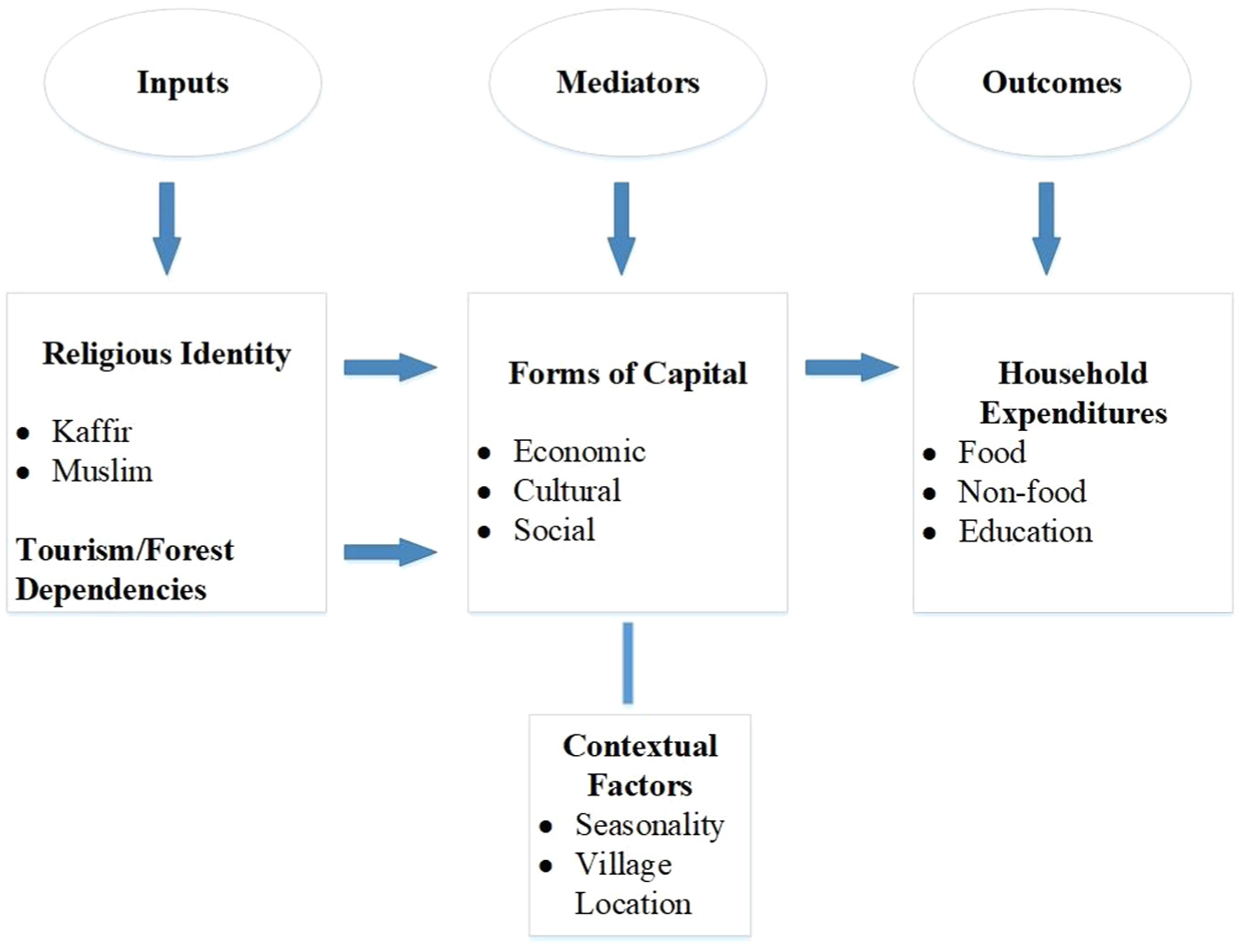
Theoretical framework: conceptualizing the relationship between religion, tourism, and socioeconomic differentiation.
Research Context and Methodology
Building on these theoretical foundations, this study examines the Kalash Valley, where tourism is concentrated in Bomboret and Rumbur, while Birir remains largely isolated. This design draws on Ishii (2012) and Guha and Ghosh (2007), which offer complementary approaches for analyzing tourism’s economic impact. Ishii provides a framework for assessing household-level differentiation in minority contexts, while Guha and Ghosh employ a control-treatment model comparing tourism and non-tourism villages to isolate tourism effects. Adapting these insights, we compare tourism-exposed villages (Bomboret and Rumbur) with a non-tourism control village (Birir), while incorporating religious segmentation within the Kalash ethnicity (Kafir-Kalash vs. Muslim-Kalash) as a critical lens for examining economic differentiation.
Inspired by Pauha (2018), who analyzed religious diversity’s effects on identity and socioeconomic outcomes, this study categorizes Kalash residents into religious groups to explore whether religious identity influences economic outcomes from tourism. The preliminary nature of this research aims to generate insights for future studies on religion-based socioeconomic stratification in tourism-dependent communities.
By integrating ethnic tourism studies, social stratification theory, and Bourdieu’s capital theory, this study contributes to understanding how religious diversity within ethnic groups shapes economic differentiation through tourism. Unlike previous research that treats ethnic minorities as homogeneous actors (Tepper & Gilovich, 2025), this study highlights the internal diversity and unequal access to tourism’s benefits. It offers a theoretically grounded explanation of intra-community inequalities, advancing debates on tourism, religion, and socioeconomic change in ethnic minority regions.
This study contributes primarily to the field of tourism studies, with important implications for development sociology and religious studies. It extends the literature on ethnic tourism by examining how religious pluralism within a single ethnic group shapes access to tourism-related benefits. While religious diversity is often framed as a cultural asset, it also reinforces intra-community inequalities in development contexts (Jamil & Firmansyah, 2025; Pauha, 2018). By linking this perspective with social differentiation theory and Bourdieu’s concept of capital, this study provides a theoretically grounded account of how tourism both reflects and reproduces internal socioeconomic divisions.
This paper reviews the relevant literature and theoretical framework, outlines the study area and methodology, presents the key findings, discusses them in light of theory, and concludes with policy and practice implications, theoretical contribution, limitations, and future research directions.
Methodology
This study used a structured questionnaire to gather total household spending data. Following the methodology of (Guha & Ghosh, 2007), total consumption was categorized into three distinct classes: Food expenditure, Non-food expenditure, and Education expenditure.
The questionnaire was adapted from validated instruments in tourism and livelihood studies of Andlib et al. (2021), Guha and Ghosh (2007), Haque et al. (2020), and Ishii (2012) to ensure content validity. It included variables such as household size, landholding, education, and tourism/forest dependence to capture socioeconomic differentiation, with expenditure categories following Guha and Ghosh (2007). A pilot test refined clarity and sequencing. As most questions collected factual data (e.g., expenditures), internal consistency tests were not applicable, though future research could expand to reliability analysis for perception-based items.
The study’s population consisted of residents of the Kalash Valley, specifically those living in the Birir, Rumbur, and Bomboret valleys. The household survey conducted for this study covered 1,072 households in Bomboret and Rumbur Valleys (study) and 225 in Birir Valley (control).
Given the defined target population and the equal probability of each household’s selection, probability sampling was deemed appropriate. The Kalash ethnic group is characterized by two primary religious affiliations, Muslim-Kalash and Kafir-Kalash. They are heterogeneous from each other but homogeneous within their respective groups. These conditions strongly suggest that stratified random sampling is the most suitable method. Strata were defined using two key criteria: village type (tourism-exposed vs. non-tourism) and religious affiliation (Kafir-Kalash vs. Muslim-Kalash), ensuring representation across both dimensions. Household size and other socioeconomic variables were not used as stratification criteria but were captured during data collection for analysis. Thus, the study’s sample size was determined to be 204 households: 67 from the control village and 137 from the study villages, which is further divided into 104 Muslim Kalash and 100 Kafir-Kalash households. For data collection, every selected household was visited twice, once during April and May 2024, the peak tourism season, and again during October and November 2024, the off-tourism season. Consequently, the total number of completed questionnaires is 408 (See Appendix A for a sample of the data collection instrument).
Given the two rounds of data collection, this research involved developing two distinct questionnaires. The variables used are detailed in Table 1. Spending data were collected in two formats; however, time-invariant variables (those unchanged within 6 months) were aggregated at the initial data processing stage to optimize analysis efficiency.
Study Variables and Their Description.

Subsequently, this study employs descriptive statistics, mean difference tests, and regression analysis. To understand the determinants of household financial behavior, this study examined how household characteristics impact per-person spending and different expenditure categories. Specifically, the analysis explored the relationship between individual consumption and several factors at the household level, including family size, land ownership per individual, religious affiliation, village location, engagement in tourism, reliance on forests, the time of year, educational attainment, number of livestock owned, and the proportion of dependents who are not children. Furthermore, the study also investigated the factors influencing three specific types of spending: food, non-food items, and education, by regressing these expenditure categories on relevant household attributes. To account for the potential interconnectedness of errors across these different spending categories, the SURE (Seemingly Unrelated Regression Equation) method was employed. The Seemingly Unrelated Regression Equation (SURE) method was used to jointly estimate multiple household-level outcomes (e.g., income, expenditure, livelihood source), which may share correlated error terms due to common unobserved household or village-level factors. This approach, based on (Guha & Ghosh, 2007), improves efficiency over separate regressions and assumes strictly exogenous explanatory variables, which are satisfied by pre-determined household and community characteristics in the Kalash Valley.
OLS was used to estimate total household expenditure because the outcome is modeled as a single dependent variable without a need for accounting for cross-equation error correlation. In contrast, SURE was used to jointly estimate disaggregated expenditure categories (e.g., food, clothing, education), where the error terms are likely correlated due to shared household-level influences. This dual approach allows for more precise estimation based on the structure of the outcome variables.
To ensure the robustness of the study’s conclusions, the regression analyses were conducted on a combined dataset encompassing all villages and a separate dataset focusing solely on the study villages.
Given the financial hardships faced by residents of the Kalash Valley during the severe winter snowfall in the off-season, this study aimed to determine whether income generated from seasonal tourism is used promptly or saved for later months. The investigation was motivated by the concern that immediate expenditure of tourism earnings might lead residents to resort to activities like deforestation through tree cutting during the lean off-season. To explore this, a follow-up survey was conducted in the off-season to contrast spending habits with those observed during the peak tourist season. The underlying assumption was that if household spending was notably greater in the off-season, it would indicate that tourism revenue is distributed and utilized throughout the entire year. A paired sample t-test was employed to statistically compare average spending levels between these two periods.
In addition to testing seasonal differences in expenditure, we also considered potential limitations related to model specification and estimation. We acknowledge potential econometric issues, including omitted variable bias, endogeneity, and multicollinearity. To minimize these risks, explanatory variables were selected based on theoretical relevance and empirical precedent. Variance Inflation Factors (VIF) were calculated and found to be below the acceptable threshold, indicating no severe multicollinearity. While religious affiliation may correlate with unobserved factors such as cultural capital or social networks, the inclusion of village-level controls helps mitigate endogeneity risks. Nonetheless, we recognize that unmeasured confounders may still influence the results and recommend further research using panel data or instrumental variables.
Ethical Considerations
This study was approved by the Academic Ethics Committee of Shandong Xiehe University, Jinan, Shandong, China (Approval No. EC240025). All participants provided written informed consent prior to data collection, in line with the ethical standards of the institution and the Declaration of Helsinki. Participants were informed about the study’s purpose, the voluntary nature of participation, data anonymity, and the absence of risks. Data collection took place during the peak (April–May 2024) and off-tourism (October–November 2024) seasons. No minors were involved.
Results
The Kalash Valley comprises 1,298 households, housing 10,090 Kalash individuals. Most of the Kalash population resides in the study villages, Bomboret and Rumbur, primarily due to the influx of tourism. However, as detailed in Table 2, the control village exhibits a higher concentration of Kafir-Kalash individuals than the study villages. This disparity is attributed to the control village’s Kafir-Kalash population adhering to stricter religious practices than their counterparts in the study villages, who perceive tourism as a threat to their religious traditions.
Demographic Profile of the Study Villages.
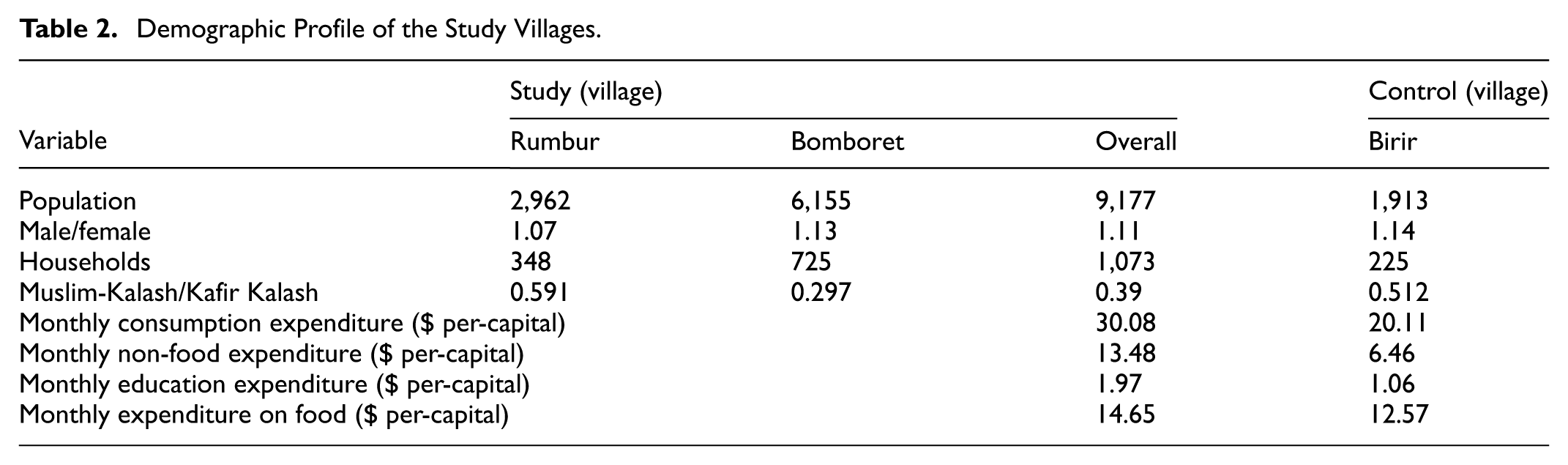
Expenditure levels are notably higher in the study villages compared to the control villages, a direct consequence of tourism. During the peak season, Kafir-Kalash women actively produce and sell traditional dresses and handicrafts, contributing significantly to this economic disparity.
The survey included a comparable number of Muslim-Kalash and Kafir-Kalash households. Both groups exhibited similar average family sizes. However, families in the control village were larger than those in the study village, possibly due to lower literacy rates and less awareness about family planning. While Kafir-Kalash literacy rates were consistent across both villages, the study village of Muslim-Kalash demonstrated significantly greater literacy compared with its control counterpart. The literacy disparity (44% among Muslim-Kalash in tourism-active villages vs. 32% in controls) reflects tourism’s uneven impact on human capital accumulation. Three mechanisms explain this gap: Proximity to tourist hubs grants Muslim-Kalash access to better schools funded by tourism revenues, economic incentives prioritize formal education for service-sector jobs, and religious norms impose fewer constraints on mainstream education. Conversely, Kafir-Kalash maintains deliberately lower literacy (30%–31%) to preserve indigenous education systems, sacrificing formal human capital for performative cultural capital (Bourdieu, 1984), a trade-off that enhances their authenticity as tourism attractions while constraining economic mobility.
Spatially, these inequalities compound: Kafir-Kalash control core valley lands (0.24 vs. 0.17 acres per-capita), transforming sacred sites into tourism infrastructure, whereas Muslim-Kalash’s peripheral holdings restrict both agricultural and tourist access. Similarly, livestock ownership (98% Kafir-Kalash vs. 90.4% Muslim-Kalash) reflects divergent capital conversion: Kafir-Kalash animals serve dual ritual-commercial roles (e.g., Chaumos festivals), while Muslim-Kalash livestock remains subsistence-oriented.
These multidimensional disparities, educational, territorial, and economic, culminate in differential resource reliance: Muslim-Kalash exhibit 42.3% forest dependence (vs. 30% for Kafir-Kalash), a gap attributable to exclusion from tourism networks (Table 3). Expenditure data further corroborate this divide: Kafir-Kalash in tourism villages spend 64% more than Muslim-Kalash ($35.41 vs. $25.14; p < .01), directly linking cultural capital (e.g., handicraft sales, guided rituals) to income generation. Conversely, Muslim-Kalash’s Forest reliance perpetuates a subsistence-poverty cycle, with off-season expenditures showing no significant savings (p = .546).
Comparative Analysis of Kalash Groups by Religious Identity.

Table 4 analyzes occupational disparities between Kafir-Kalash and the Muslim-Kalash communities. The data demonstrated a strong correlation between Kafir-Kalash affluence and tourism, with 81% of tourism-dependent households belonging to this group. This dominance stems from the Kafir-Kalash’s custodianship of culturally significant sites, many of which are inaccessible to Muslim-Kalash. Consequently, tourists rely on Kafir-Kalash guides to access these attractions. Conversely, 60% of forest exploitation is attributed to Muslim-Kalash, likely due to limited direct participation in tourism. The findings suggest that tourism-reliant households, predominantly Kafir-Kalash, enjoy higher living standards than those engaged in forest resource extraction, primarily Muslim-Kalash. Table 4 quantifies this stratification: 81% of tourism-dependent households are Kafir-Kalash, while 60% of forest-dependent ones are Muslim-Kalash. This occupational divide translates to stark income gaps; tourism households spend 64% more than forest-dependent ones ($36.79 vs. $22.37). Notably, Kafir-Kalash’s control of sacred sites (cultural capital) grants them exclusive access to guiding roles, whereas Muslim-Kalash’s Forest reliance reflects peripheral economic integration. However, households in both communities engaged in other occupations exhibit better livelihoods than those solely dependent on forest resources.
Comparative Analysis of Households Within Kalash Groups.

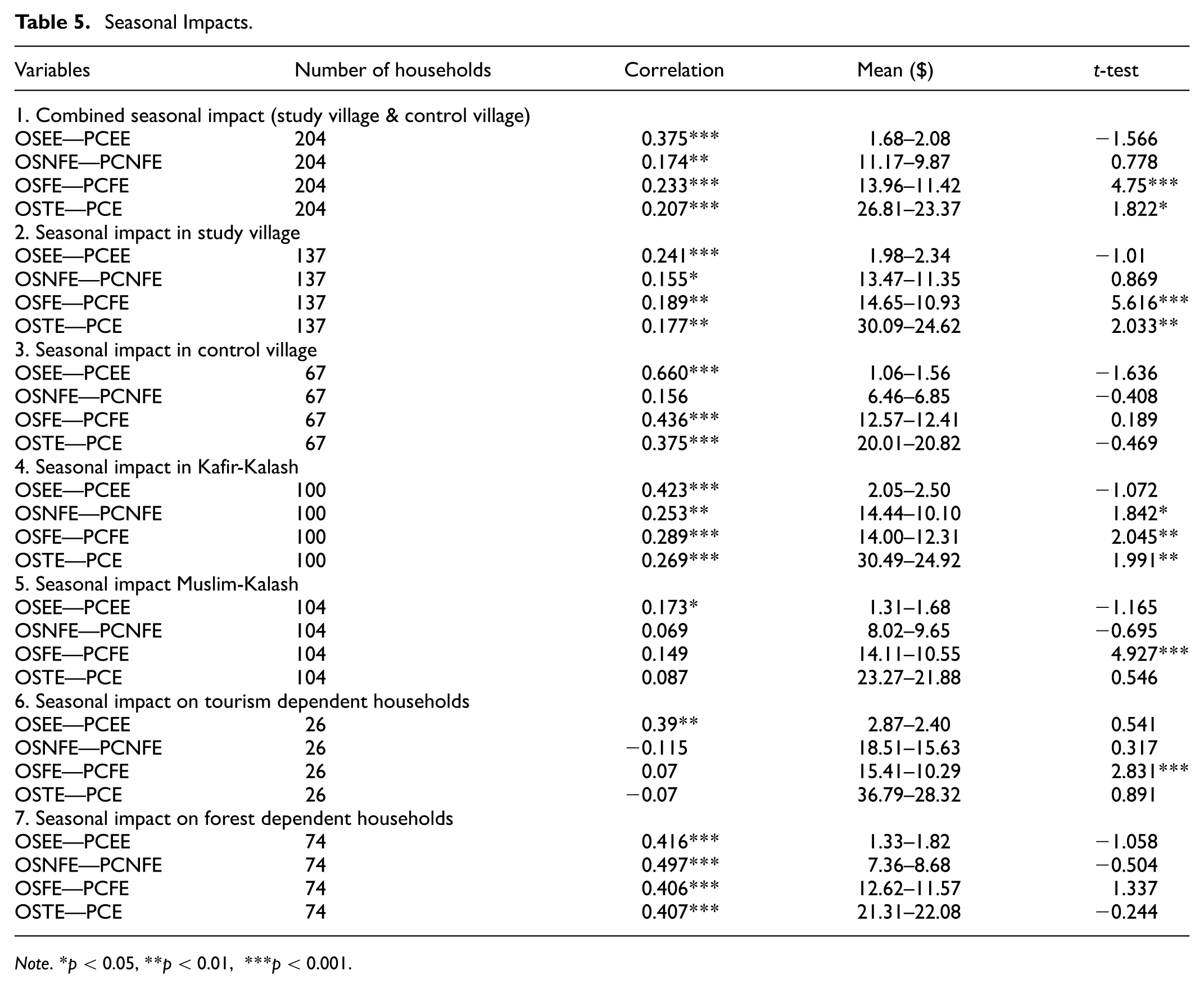
As previously described, data were collected biannually during both peak and off-seasons. A seasonal dummy variable was introduced to analyze seasonal variations. A paired sample t-test was then employed to examine mean expenditure differences across seasons, as presented in Table 5, considering religious affiliation (Kafir-Kalash and Muslim-Kalash), tourism exposure (study vs. control village), and occupation (forest-dependent vs tourism-dependent households).
Seasonal Impacts.
Note. *p < 0.05, **p < 0.01, ***p < 0.001.
The analysis encompassed all households to evaluate the overall seasonal impact on expenditures. Results indicate a significant positive correlation between peak and off-season expenditures, albeit with reduced intensity during the off-season (Table 5). However, not all t-test statistics were significant. Notably, per-capita education and non-food expenditures showed no significant seasonal variation, suggesting consistent spending across both periods. Conversely, per-capita total and food expenditures exhibited significant seasonal differences, indicating a substantial impact. This disparity reflects increased disposable income during the peak tourism season, as evidenced by higher mean expenditures.
The study separately examines the study and control villages to determine whether tourism drives expenditure differences. If the study village exhibits higher expenditures and the control village shows no significant change across seasons, tourism is inferred as the primary driver. In the study village, results mirror the findings: significant positive correlations exist between peak and off-season expenditures, particularly for total and food expenditures. This confirms the substantial impact of seasonality, influenced by tourism, on spending patterns, except for education expenses.
Conversely, the control village demonstrates consistent expenditures across seasons. All per-capita expenditure categories (total, education, food, and non-food) show insignificant t-test values, indicating no seasonal variation. This aligns with the lack of tourism opportunities in the control village, resulting in stable monthly expenditures.
Descriptive statistics revealed the Kafir-Kalash as the primary beneficiaries of Kalash Valley’s popularity. Paired sample t-tests further explore seasonal impacts on both Kalash groups. For Kafir-Kalash, all expenditure correlations are positively significant, with significant t-values across all categories except education. This highlights a strong seasonal influence attributed to increased non-food consumption during peak festival seasons and higher overall expenditures.
Given the larger Muslim-Kalash population, their seasonal expenditure patterns are examined. Results show no significant changes except in food expenditures. All other t-values are insignificant, confirming that the expenditures of Kafir-Kalash are more influenced by seasonality compared with the Muslim-Kalash expenditures.
To examine seasonal impacts on various occupations, the current study focused on tourism-reliant Kafir-Kalash (81%) and forest-reliant Muslim-Kalash (60%) households, as detailed in Table 5. The analysis of households depending on the forest revealed insignificant t-values and no variation in mean expenditures, indicating a lack of seasonal influence due to their non-participation in tourism. In contrast, tourism-dependent households demonstrated significant variations in mean expenditures, highlighting an apparent sensitivity to seasonal changes. While education expenditure correlations were positively correlated with seasonality, non-food and total expenditures showed negative correlations, suggesting higher spending during the peak season, followed by expenditure reduction in the off-season. This pattern indicates immediate consumption of peak season income and potentially a trickle-down effect that benefits individuals not directly involved in tourism within the valley. To explore this phenomenon further, the study proposes conducting a regression analysis. This pattern aligns with Table 4’s findings: tourism income is concentrated among Kafir-Kalash, with limited spillover to Muslim-Kalash. Seasonal volatility thus exacerbates existing inequalities, as shown next in the regression analysis.
The study utilized a set of regression analyses to achieve statistically robust results. The regression models incorporated previously defined variables, including a religion dummy, to examine differences between ethnic groups, tourism, forest dummies representing participation status, and season and village dummies to address relevant research objectives.
Table 6 details the regression analysis conducted to explain per-capita monthly expenditure. The model regressed expenditure against a range of variables, including demographic factors (family size, the proportion of non-children, and religious affiliation), human capital (literacy proportion), physical capital (per-capita land and livestock ownership), time-place indicators (season and village), and participation in economic activities (tourism and forest dependence). Ordinary Least Squares (OLS) regression with
Regression Analysis (Study and Control Villages).

Note. *p < 0.10, **p < 0.05, ***p < 0.01.
Robust standard errors were utilized to analyze total per-capita expenditures. But, for the three expenditure categories, food, non-food, and education, Seemingly Unrelated Regression (SUR) was applied. This approach was chosen to address the possibility of correlated error terms across these components while ensuring consistency in the regressor variables used.
The regression models revealed statistically significant relationships for key variables of interest, though the overall explanatory power was modest. The per-capita total expenditure model (OLS) explained 12.23% of the variance, while the SUR models for disaggregated expenditures explained 21% (food), 8% (non-food), and 8% (education). These R2 values, particularly for non-food and education expenditures, indicate that while our models capture significant predictors of economic differentiation, substantial unexplained variance remains. This aligns with Bourdieu’s framework, suggesting expenditure patterns are influenced by intangible forms of capital (cultural, social, symbolic) not fully operationalized in our quantitative measures. The low R2 values likely reflect unobserved factors such as household-specific preferences, intra-community social networks, or nuanced cultural norms governing resource allocation. Family size was a key predictor in regression analysis, except for the analysis concerning per-capita education expenditure, with a negative coefficient indicating that larger family sizes are associated with lower per-capita expenditures due to the calculation method.
Regarding other demographic factors, the proportion of non-children did not significantly influence expenditures, whereas religion did. The religion dummy variable for Kafir-Kalash, showed a positive effect on both per-capita total and education expenditures. This finding reinforces the differences in expenditure patterns between Kafir-Kalash and Muslim-Kalash, which were observed through descriptive statistics and paired sample t-tests. The observed differences are attributed to the Greek Foreign Ministry’s support for the Kafir-Kalash community, which includes funding for educational institutions, wellness facilities, and museums, based on the belief that the Kafir-Kalash are descendants of Greeks (Kalash, 2022; Khan, 2023; Parkes, 1991; Robertson, 1896).
The proportion of literate individuals within households significantly positively impacted per-capita education expenditure, implying that households with a higher percentage of literate members invested more in their children’s educational development. Households reliant on forest resources, as indicated by the forest dummy variable, demonstrated significantly lower per-capita food expenditures. This finding reinforces previous observations, obtained through mean difference analyses, that these households experience lower living standards. This is because of their limited alternative sources of income and challenging economic circumstances, forcing them to live hand-to-mouth.
In contrast, households benefiting from tourism, primarily Kafir-Kalash, exhibited significantly higher total and education expenditures, as evidenced by the positive coefficients associated with the tourism dummy variable. This indicates that tourism-related income contributes to increased overall spending and greater investment in children’s education. The village dummy variable, representing the study village where tourism activities are concentrated, was a significant positive predictor in all regression models except for food consumption per-capita. Based on this, households in the study village experience greater prosperity, enabling them to allocate more resources toward non-food items, such as clothing and medicine, and invest in their children’s education.
The season dummy variable, representing the peak tourism season, significantly positively affected per-capita total and food expenditures. This suggests that households spend more of their income during the peak season, coinciding with increased tourism activity, and do not typically retain these funds for the off-season.
To determine how robust the regression results are, the analysis was restricted to data from the study village, as presented in Table 7. The village and forest dummy variables were excluded due to overlapping occupational roles within households. The primary regression findings remained consistent but demonstrated increased significance compared to the entire dataset.
Regression Analysis (Study Village).

Note. *p < 0.10, **p < 0.05, ***p < 0.01.
The seasonal impact in the study village regressions closely mirrored the overall analysis, confirming the immediate expenditure of tourism income by tourism-dependent households. This pattern reveals two critical issues: First, it suggests economic precarity, as households lack savings mechanisms and resort to forest exploitation during off-seasons. Second, while tourism revenue benefits some through intra-village transactions (a robustness check of our findings), its unequal distribution risks exacerbating socio-environmental strains. Targeted interventions such as microloans or staggered income programs could mitigate these effects while preserving the observed trickle-down benefits.
While the primary analysis is based on stratified sampling across villages and religious groups, additional robustness checks were conducted by running separate models for the study village and comparing coefficients across subsamples. Results remained broadly consistent in direction and significance. However, more extensive sensitivity analysis, such as alternative model specifications or bootstrapping, was beyond the scope of this preliminary study and is recommended for future research.
Discussion
Our results show pronounced expenditure gaps structured by religion and livelihood orientation: Kafir-Kalash households, disproportionately integrated into tourism, display higher total and non-food spending, whereas Muslim-Kalash show greater forest dependence and lower expenditures. These patterns indicate that tourism operates as a field through which cultural and religious capital is converted into economic advantage for some but not for all community members.
Beyond the quantitative robustness, these findings also raise important cultural and social considerations regarding how tourism interacts with religious identity and intra-community dynamics. While the quantitative findings indicate that Kafir-Kalash households benefit more from tourism, this pattern reflects more than income differences. Field interactions suggest that tourism reinforces the public visibility of Kafir-Kalash religious and cultural identity, particularly through festivals, traditional dress, and rituals that attract tourists. These elements, tied to cultural capital, incentivize the performance and preservation of religious practices, leading to a feedback loop where tourism deepens the symbolic and economic value of identity expression. In contrast, some Muslim-Kalash households report limited access to tourism-related opportunities, partly due to perceived cultural incompatibility or exclusion from sacred spaces. These dynamics imply that tourism does not simply reflect pre-existing religious distinctions but actively shapes how those identities are practiced, valued, or marginalized within the community.
Several reinforcing mechanisms help explain why Kafir-Kalash households capture greater tourism benefits. Symbolic control: They hold custodianship over high-visibility ritual sites and festival calendars that anchor visitor itineraries, giving them privileged control over the sale, guidance, and staging of “authentic” experience-convertible cultural capital in Bourdieu’s terms. Spatial access: Tourism infrastructure and flows are concentrated in Bomboret and Rumbur, where many Kafir-Kalash households reside and where sacred spaces are accessible to visitors. Household-level income streams: Seasonal handicraft production and ritual performance generate direct cash returns concentrated in Kafir-Kalash households. External recognition/patronage: Investments such as Greek educational and heritage support amplify human and symbolic capital advantages. Boundary rules: Restricted Muslim-Kalash access to certain sacred spaces and roles limits their participation in core tourism value chains, pushing many toward forest extraction. Together, these pathways align with our capital conversion framework and help explain the strong religion and tourism effects observed in household expenditure models.
Our findings also suggest seasonal spillovers, but these “trickledown” effects appear limited. Peak-season expenditure surges among tourism households, and narrative evidence that earnings are spent quickly on goods, festival supplies, and local services indicates that cash from guiding, handicrafts, and ritual performance circulates within villages, reaching some non-tourism (often Muslim-Kalash) households through short-term transactions. Yet off-season expenditures in forest-reliant households remain flat and substantially lower, implying shallow, short-lived diffusion that neither builds assets nor narrows religion-linked welfare gaps. In our capital conversion view, those controlling high-value ritual and heritage capital capture first-round income; only modest second-round flows pass through routine purchases rather than redistributive transfers. Community revenue sharing, seasonal savings schemes, and cooperative procurement could deepen and extend these spillovers.
Our findings relate closely to prior ethnic tourism research, supporting observations by Yang and Wall (2009a, 2009b), Ishii (2012), and Li et al. (2021). Like these studies, we find that participation in tourism is strongly associated with improved household well-being (Li et al., 2021) and that tourism can both revitalize and stratify local communities (Yang & Wall, 2009a, 2009b). Similar to Ishii (2012) work on minority livelihood differentiation, we observe clear economic contrasts between households linked to tourism and those reliant on subsistence activities; however, our Kalash data extend these insights by demonstrating that intra-ethnic religious identity structures access to tourism value chains. Custodianship of ritual sites and festival performance, largely controlled by Kafir-Kalash, functions as cultural capital that can be converted into expenditure gains, while Muslim-Kalash remains more forest-dependent. In doing so, we move beyond community-level analyses and show how ethnic tourism debates about benefit distribution must account for religiously mediated internal hierarchies.
Similar patterns appear globally where tourism intersects with intra-community religious diversity. In Bali, Hindu communities have strategically commodified temple ceremonies for tourism, while Muslim minorities face exclusion from benefits (Picard, 2008, 2017). In Bosnia, ethno-religious tourism has exacerbated postwar divisions by privileging specific identities (Causevic & Lynch, 2011). The Kalash case thus contributes to a cross-cultural understanding of how tourism can simultaneously empower and marginalize subgroups within multi-religious communities, though its unique historical patronage (e.g., Greek support) distinguishes its trajectory.
This study demonstrates that ethnic tourism positively influences the socioeconomic well-being of Kalash Valley residents, though religious divisions within the ethnic group lead to notable disparities. The Kafir-Kalash, who actively participate in tourism and maintain traditional practices, enjoy higher living standards than the Muslim-Kalash. Therefore, transformative measures are critical: To counter fragmentation, policies should mandate Muslim-Kalash inclusion in tourism governance and subsidize cultural enterprises, aligning with SDG10 (reduced inequalities). While our findings suggest significant socioeconomic differences between Kafir-Kalash and Muslim-Kalash groups, religion also serves as a proxy for other structural and contextual factors. These include proximity to tourist centers, access to cultural capital (e.g., ritual practices that attract tourists), education levels, and historical patterns of external engagement. Therefore, religious affiliation should not be interpreted as a sole causal factor but rather as intertwined with broader social and economic dynamics that influence tourism participation and benefit distribution.
In the absence of tourism, as seen in the control village, both groups exhibit similar, lower expenditure patterns and greater dependence on forest exploitation. These findings highlight the role of tourism as a critical driver of economic differentiation within the community.
Critically, these findings reveal that tourism’s impact extends beyond economics into the realm of cultural identity. While the Kafir-Kalash have strategically leveraged their cultural visibility through festivals, crafts, and perceived authenticity to consolidate economic advantages, the Muslim-Kalash face systemic barriers, including exclusion from sacred spaces and limited access to commodified traditions. This dynamic suggests tourism doesn’t merely reflect existing religious divides but actively reshapes them, creating a self-reinforcing cycle of economic and symbolic marginalization. These patterns align with Bourdieu’s framework: Kafir-Kalash households convert cultural capital (e.g., ancestral ties to sacred sites, fluency in performative rituals) into economic gains, while Muslim-Kalash face exclusion from these symbolic resources. For example, Kafir-Kalash’s custodianship of Imra Temple and Chaumos festivals grants them monopolistic access to tourism revenue, whereas Muslim-Kalash’s religious identity lacks comparable commodification. This divergence is further exacerbated by external patronage (e.g., Greek funding for Kafir-Kalash education), which entrenches disparities. Thus, religious affiliation operates as both a marker of identity and a gatekeeper to the tourism industry.
In addition, future research should examine the role of religious institutions, both formal and informal, in shaping community narratives and regulating access to rituals, cultural performances, or sacred spaces relevant to tourism. These actors reinforce or challenge existing exclusions, influencing how tourism is embedded in local moral economies. More broadly, the findings raise ethical questions about distributive justice and cultural representation in tourism: Who gets to speak for the community? Whose traditions are commodified, and whose are overlooked? Engaging with these political dimensions would strengthen tourism governance and help ensure cultural sustainability in multi-religious contexts.
Conclusions, Policy and Practice Implications, Theoretical Contribution, Limitations, and Future Research Directions
Conclusions
This study examined how religious identity mediates access to tourism benefits and shapes household welfare in the multi-religious Kalash Valley. Using stratified household survey data and expenditure modeling, we find that integration into tourism concentrated among Kafir-Kalash households correlates with higher per-capita spending, while Muslim-Kalash households remain more forest-dependent and economically constrained. These results support the view of tourism as a mechanism of internal stratification, operating through the uneven conversion of cultural capital into economic returns. This study contributes to the literature by integrating Bourdieu’s capital framework with ethnic tourism debates, illustrating how cultural capital and religious identity shape household welfare in minority communities. Broader implications and policy recommendations are discussed in the following section.
Policy and Practice Implications
Tourism in the Kalash Valley currently distributes benefits unevenly: Kafir-Kalash households command culturally significant sites and festival performances that attract visitors and revenue, whereas Muslim-Kalash households, less embedded in tourism networks, rely more heavily on forest resources and exhibit lower per-capita expenditures. In our survey, forest dependence was markedly higher among Muslim-Kalash households (42.3% and 60% of forest-dependent households), and the non-tourism Birir valley showed lower and seasonally flat expenditures, underscoring the need to link tourism development and forest conservation in underserved areas.
Inclusive participation & governance. Establish multi-stakeholder tourism committees or cooperatives with guaranteed Muslim-Kalash representation in licensing, heritage access, revenue distribution, and market coordination (guiding, handicrafts, hospitality). Such arrangements broaden who can convert cultural and social capital into income.
Targeted skills, literacy, and enterprise support. Provide training in guiding, language/interpretation, accommodation management, and value-added craft production; pair with youth literacy and business skills where education gaps constrain entry into tourism labor markets.
Heritage revenue sharing. Because income linked to sacred sites and festivals currently accrues mainly to those who control them, negotiated visitor fee or event revenue mechanisms could channel a portion to community funds for schooling, health, and seasonal support across religious lines.
Smoothing seasonal income & reducing distress extraction. Peak-season expenditure surges and lean off-season outlays (see seasonal plateau in forest-reliant households) indicate weak savings buffers; community revolving funds, matched savings schemes, or micro-credit linked to tourism earnings could stabilize consumption and lessen off-season reliance on forest cutting.
Extend and diversify tourism geographically. Carefully scaling low-impact cultural or ecotourism in underserved areas (e.g., Birir, where forest use is comparatively high and tourism access is limited) can broaden benefit streams while reducing concentration risks; pairing expansion with forest stewardship incentives can align livelihood diversification and conservation goals.
Build conservation jobs into tourism. Training Muslim-Kalash and other underrepresented groups as eco-guides, heritage stewards, or community forest monitors links income generation to ecosystem protection and helps rebalance participation.
Monitor inequality outcomes. Routine tracking of household tourism participation, revenue flows, and expenditure patterns by religion, village, and livelihood type will allow authorities and partners to evaluate whether interventions narrow intra-community gaps over time.
Taken together, these measures can shift tourism from a driver of stratification toward an inclusive development pathway that supports cultural continuity, strengthens household resilience across seasons, and reduces environmental stress in marginalized segments of the Kalash population.
Theoretical Contribution
By integrating Bourdieu’s multidimensional capital and social differentiation framework with debates on cultural commodification and sustainable livelihoods, this study shows how religiously marked cultural capital conditions household entry into tourism value chains and, in turn, stratifies welfare outcomes within a single ethnic community. The Kalash case demonstrates that control over ritual performance, sacred sites, and visitor interfaces enables some households (predominantly Kafir-Kalash) to convert symbolic resources into expenditure gains, while others (Muslim-Kalash) remain peripherally positioned and more forest-dependent. Comparative references (e.g., Bali heritage tourism; post-conflict identity tourism) suggest that similar capital conversion pathways may operate in other multi-religious minority settings and warrant cross-case testing.
Limitations
This research has certain limitations. The analysis focused primarily on household expenditure as the key measure of socioeconomic well-being. Other important indicators, such as household income, employment rates, and wealth accumulation, were not included. Moreover, the cross-sectional design limits the ability to capture long-term effects of tourism on community livelihoods and cultural sustainability.
Second, the relatively low R2 values in our regression models (particularly SUR models explaining 8%–21% of variance) indicate limited explanatory power for household expenditures. While significant relationships between core variables (e.g., religious identity, tourism engagement) were robustly identified, these models likely omit critical determinants such as: informal income sources, household debt/savings patterns, access to credit systems, and qualitative aspects of cultural capital (e.g., ritual knowledge or social networks) that influence economic behavior but resist quantitative measurement. This limitation underscores the need for mixed-methods approaches to fully capture expenditure drivers.
While this study illuminates dynamics within the Kalash community, its single-case design limits direct generalizability. Future comparative research across different multi-religious tourism contexts could distinguish Kalash-specific phenomena from broader patterns.
Moreover, while expenditure data reveals economic disparities, it cannot capture the lived experience of these divides. A significant limitation is the lack of qualitative data, such as interviews with both communities, that could illuminate how tourism reshapes daily religious practices, perceptions of identity, and intergroup relations beyond what statistics reveal.
Future Research Directions
To address the boundaries of generalizability, we propose comparative studies across diverse multi-religious tourism contexts (e.g., Southeast Asia, the Balkans, Indigenous communities) to test the transferability of this study’s framework. Such work would clarify how variables like state policies, market forces, or colonial histories interact with religious identity to produce varying tourism outcomes.
Building on these macro-level comparisons, future studies could also broaden the scope by incorporating: longitudinal designs to examine evolving impacts of tourism over time, ethnographic documentation of how tourism incentivizes performative aspects of Kafir-Kalash identity while potentially eroding Muslim-Kalash cultural participation; and intersectional analyses of how gender and class mediate access to tourism benefits within both groups. Finally, action research is needed to test practical interventions (e.g., community tourism cooperatives) that might rebalance cultural and economic opportunities.
Additionally, advancing measurement approaches could address the explanatory gaps highlighted by our models’ low R2. Future work might: develop survey modules to quantify cultural capital (e.g., participation in rituals, language fluency in traditional narratives), map social networks to assess brokerage roles in tourism value chains, and integrate geospatial data on proximity to sacred sites or tourist hubs. Such innovations could improve model fit while better operationalizing Bourdieu’s capitals, offering a more granular understanding of how religious identity translates into economic advantage.
Supplemental Material
sj-docx-1-sgo-10.1177_21582440251386806 – Supplemental material for The Interplay of Tourism, Religion, and Socioeconomic Differentiation in Multi-Religious Ethnic Communities
Supplemental material, sj-docx-1-sgo-10.1177_21582440251386806 for The Interplay of Tourism, Religion, and Socioeconomic Differentiation in Multi-Religious Ethnic Communities by xxx Sadiq and Muhammad Salman Ahmed in SAGE Open
Footnotes

Ethical Considerations
Ethics Approval: All procedures involving human participants were conducted in accordance with the ethical standards of the institutional and/or national research committee and the Declaration of Helsinki. This study was approved by the Academic Ethics Committee of Shandong Xiehe University, Jinan, Shandong, China, on March 11, 2024 (Approval No. EC240025).
Informed Consent
Informed consent was obtained from all participants before data collection, with the consent process explained in the questionnaire. Participants were fully informed about the study's purpose, voluntary nature, anonymity, confidentiality, and the exclusive use of their data for academic research, with no associated risks. To ensure anonymity, data were coded numerically, and no personal identifiers were collected. Data were gathered during the peak tourism season (April–May 2024) and the off-tourism season (October–November 2024), and no minors participated in the study.
Author Contributions
Both authors, Sadiq and Muhammad Salman Ahmed, contributed equally but in distinct roles. Sadiq was primarily responsible for conceptualizing the study, designing the methodology, and conducting the data analysis. Muhammad Salman Ahmed, on the other hand, focused on literature review, data collection, and drafting the manuscript. Both authors collaborated on interpreting results, refining conclusions, and finalizing the paper. Their combined efforts ensured a balanced and comprehensive research output.
Funding
The authors disclosed receipt of the following financial support for the research, authorship, and/or publication of this article: This research was funded by the Shandong Xiehe University High-Talent Scientific Research Start-up fund project.
Declaration of Conflicting Interests
The authors declared no potential conflicts of interest with respect to the research, authorship, and/or publication of this article.
Data Availability Statement
Further data can be furnished upon request from the corresponding author.
Supplemental Material
Supplemental material for this article is available online.
References
Supplementary Material
Please find the following supplemental material available below.
For Open Access articles published under a Creative Commons License, all supplemental material carries the same license as the article it is associated with.
For non-Open Access articles published, all supplemental material carries a non-exclusive license, and permission requests for re-use of supplemental material or any part of supplemental material shall be sent directly to the copyright owner as specified in the copyright notice associated with the article.
