




Abstract
The present study aims to explore the linguistic vitality of the Tujia language in Hubei Province, China, and delve into the multifaceted factors contributing to its endangerment across micro, mezzo, and macrosystem levels from an ecological perspective. We assessed the vitality of the Tujia language using the nine indicators proposed by UNESCO and further explored the factors influencing its endangerment through Zastrow’s ecological systems framework. Drawing on a mixed-methods design, a total of 378 respondents participated in the study, while questionnaires and semi-structured interviews were utilized for data collection and interpretation. Research findings reveal that the Tujia language is facing severe endangerment in general. Based on these findings, the study suggests various strategies for protecting the Tujia language, emphasizing the importance of educational reforms, community initiatives, policy interventions, and socio-economic support in mitigating endangerment and fostering its revitalization. This research provides a novel perspective and a practical model for addressing language endangerment issues in minority language contexts.
Keywords
Introduction
The Tujia ethnic group, one of the largest ethnic minorities in China, is mainly distributed across the provinces of Hubei, Hunan, Guizhou, and Chongqing municipality. As an ancient ethnic group, the Tujia people possess their own Tibeto-Burman language, locally known as “pitsisa” (R. Z. Li & Wang, 2013), hereafter referred to as the Tujia language. Historically, the Tujia people did not speak Mandarin Chinese and relied exclusively on the Tujia language for daily communication. However, with the advancement of socioeconomic status, the number of Tujia language speakers has significantly declined. In this respect, most Tujia people choose to adopt Mandarin Chinese as their primary language (W. J. Li, 2016), thereby resulting in the gradual endangerment of this minority language. Geographically, Hubei province is one of the regions with a relatively high concentration of the Tujia ethnic group, with an estimated population of approximately 2.3 million, accounting for 23.84% of the total Tujia population (Hubei Government, 2024). In this juncture, exploring minority language status in this area needs urgent attention. Therefore, research on the endangerment of the Tujia language has come to the forefront in the field of sociolinguistics.
Within the global context, scholars have investigated endangered minority languages from various perspectives. It primarily includes the definition and classification of endangered languages (Bauman, 1980; Dai, 2015; Krauss, 1992), the crucial link between language diversity and biological diversity (Harmon, 1996; Maffi, 2001; Nettle & Romaine, 2000), linguistic vitality of specific endangered languages (Dagdeviren-Kirmizi, 2023; Gomashie & Terborg, 2021; Roche & Tsomu, 2018), the causes of language endangerment (Crystal, 2000; Zhu et al., 2018), language attitudes (An et al., 2017; J. Chen & Wang, 2020), and the protection of endangered languages (H. Li, 2023; Liu, 2021). Among these studies, research on linguistic vitality aims to assess the level of endangerment of a language by identifying factors essential to its maintenance, such as domains of use, functions, and intergenerational transmission (Brenzinger et al., 2003; Edwards, 1992; Fishman, 1991). Consequently, studies on language endangerment have prompted academic reflection on evaluating language vitality using diverse frameworks and approaches (L. Chen, 2023; Gobbo, 2021; Hu, 2008; Laleko, 2013; Schreiber & Sitaridou, 2018; C. Yang et al., 2017). To be specific, research on the language vitality of the Tujia language began in the 1980s, initially focusing on lexico-grammatical and ontological aspects. In recent years, however, the focus has shifted to the current status of the Tujia language and its preservation, including its dissemination in the digital era (Ajani et al., 2024; Meighan, 2021; Song et al., 2022; Tang, 2022) and the construction of the Tujia language corpus (Ma & Liu, 2021; Tan et al., 2023). Nevertheless, research on the Tujia language and how it gradually becomes marginalized in a multilingual world remains underexplored. For instance, empirical evidence is missing on how families actually formulate and implement language policies toward intergenerational transmission. Then, schools and communities lack systematic data on teachers, curricula, usage frequency, and community participation, making targeted educational interventions impossible. Last, national and local policies exist but are not subjected to rigorous on-the-ground evaluation. From this perspective, to figure out the causes for Tujia language endangerment, researchers have sought an ecological approach to investigate the reasons behind different levels, as they believe language is not isolated from social, cultural, and ecological factors (Grenoble, 2011). This approach allows for a deeper focus on region-specific language use and avoids overgeneralizing global phenomena, such as globalization, as sole explanations for language endangerment (Willans & Jukes, 2017). According to Zhao (2020), the concept of a language ecosystem, as a multidimensional system centered on languages, plays a crucial role in regulating language emergence, development, and extinction.
In this context, the present mixed-methods study aims to explore the linguistic vitality of the Tujia language and examine the factors contributing to its endangerment from an ecological perspective. While quantitative statistical analysis helps to reveal the current status of the Tujia language, qualitative semi-structured interview is employed to better unpack the reasons why the Tujia language is becoming endangered, which is also regarded as a supplement to the findings. We hope to provide a replicable ecological research paradigm and offer practical implications for protecting minority languages not only in China but also around the world. Specifically, the study addresses the following research questions:
(1) What is the current state of the Tujia language vitality in Hubei province of China?
(2) What are the underlying factors contributing to the endangerment of the Tujia language in this region?
(3) How can the Tujia language be protected from endangerment?
Literature Review
Linguistic Vitality and Endangerment
The study of linguistic vitality has become increasingly prominent as the global loss of minority languages accelerates, raising profound concerns for scholars and policymakers alike. Crystal (2000) underscores that languages are disappearing at unprecedented rates, estimating that nearly half of the world’s existing languages may vanish by the close of the 21st century. Krauss (1992) similarly identifies the world’s languages as being in a state of crisis, attributing this decline to the erosion of intergenerational transmission and the overwhelming dominance of national or global lingua franca(s). Responding to these warnings, the UNESCO Expert Meeting on Safeguarding Endangered Languages introduced a comprehensive framework for assessing language vitality and endangerment, emphasizing factors such as intergenerational language transmission, the absolute number of speakers, the proportion of speakers within the population, and community attitudes toward the language (Brenzinger et al., 2003). These indicators have since become central to most contemporary vitality assessments.
Within China, similar concerns arise as many minority languages face rapid declines in speaker populations and functional domains despite the country’s extensive ethnic recognition framework. Dai (2015) highlights how urbanization, population mobility, and assimilationist education policies intensify the vitality loss of minority languages, even as state policies ostensibly promote ethnic diversity. Xu (2003) attributes much of this decline to language contact, noting how the widespread adoption of Mandarin and regional lingua franca(s) restricts the communicative functions of local varieties. Zhao (2020) builds on these observations by analyzing the ecological environment of endangered languages in China, demonstrating how sociopolitical, economic, and cultural forces disrupt local linguistic ecosystems, accelerating processes of language shift and endangerment. These patterns also resonate with studies in a global context (e.g., Grenoble, 2011; Nettle & Romaine, 2000), situating China as a particularly significant context for exploring the intersection of micro-level community practices and macro-level sociopolitical change.
Beyond structural pressures, language attitudes and identity are pivotal to understanding vitality trajectories. Studies on the Pumi community in Yunnan province of China (An et al., 2017) and the Nubian language in Egypt (J. Chen & Wang, 2020) illustrate that positive language attitudes can sustain minority language use even under adverse conditions. Conversely, weak ethnic attachment or negative perceptions of a language’s socioeconomic value often expedite language shift. These insights underscore the importance of integrating sociopsychological dimensions into vitality assessments, particularly in contexts such as the Tujia language in Hubei province, where younger generations frequently perceive Mandarin as more advantageous for education and career prospects (R. Z. Li & Wang, 2013; Tang, 2022).
Ecological Perspectives for Assessing Linguistic Vitality
The ecological perspective has emerged as a productive framework for examining the dynamic, interdependent factors influencing linguistic vitality. Building on Haugen’s notion of “the ecology of language” and subsequent elaborations by Grenoble (2011) and Willans and Jukes (2017), ecological approaches conceptualize languages as components of complex systems shaped by social, cultural, economic, and environmental interactions. Harmon (1996) and Maffi (2001) further draw attention to the parallels between biological and linguistic diversity, positing that the loss of languages mirrors the loss of biodiversity, both indicative of broader disruptions in human-environment relationships. Such parallels highlight the necessity of addressing not only sociolinguistic dimensions but also the wider ecological conditions underpinning language endangerment and preservation.
Bronfenbrenner’s (1979) ecological systems theory offers an additional lens for analyzing endangered languages, emphasizing how human development is situated within nested systems, including microsystems (e.g., families and peer groups), mesosystems (e.g., community institutions), exosystems (e.g., regional structures), and macrosystems (e.g., national and global forces). Adapted to sociolinguistic research, this framework facilitates multi-layered analysis of endangerment, linking individual and household language practices to community, regional, and national contexts (S. Yang, 2020; Zastrow & Kirst-Ashman, 2004). Recent applications of ecological systems theory to language revitalization (e.g., Connell et al., 2021; H. Li, 2023) illustrate that sustainable interventions must operate across these multiple levels, from fostering family language planning and local education initiatives to advocating for supportive policy frameworks.
From a methodological perspective, approaches to vitality assessment have progressed from simple demographic measurements to more multidimensional models. Fishman’s (1991) Graded Intergenerational Disruption Scale (GIDS) remains influential, foregrounding intergenerational transmission as the cornerstone of vitality assessment. UNESCO’s (2003) nine-factor framework expands on this model by incorporating additional elements, including the extent of use across new domains, community and institutional attitudes, and the degree of governmental support. These frameworks have been widely applied, as evidenced by studies on Jejueo language (C. Yang et al., 2017), Russian as a heritage language in the United States (Laleko, 2013), and the Romeyka variety in Istanbul (Schreiber & Sitaridou, 2018). In China, similar approaches have been employed to evaluate minority and regional languages, such as the Arza dialect of the Yi language (Fan & Li, 2012), the Dapeng mixed dialect (L. Chen, 2023), and the Tujia language (W. J. Li, 2016; R. Z. Li & Wang, 2013). Nevertheless, scholars such as Gomashie and Terborg (2021) criticized that these indicator-driven assessments often neglect local sociocultural complexities and the agency of speaker communities. They advocated for mixed-methods approaches that integrate quantitative indicators with qualitative insights, ensuring more contextually grounded evaluations of language vitality.
Vitality, Challenges, and Preservation Efforts of the Tujia Language
The Tujia language, mainly spoken across Hubei, Hunan, and Chongqing, provides a salient case study of the multifaceted challenges confronting minority languages in China. Empirical studies document a steady contraction in both speaker numbers and the range of communicative domains where Tujia is actively employed (R. Z. Li & Wang, 2013; Tang, 2022). Mandarin has come to dominate most formal and informal settings, often replacing Tujia even within family contexts, particularly among younger cohorts. W. J. Li (2016) and Z. B. Yang (2011) identified intergenerational transmission as critically threatened, noting that younger speakers often possess only passive comprehension or have ceased using the language altogether. These findings parallel Krauss’s (1992) characterization of “moribund” languages, wherein the breakdown of intergenerational transmission signifies a near-terminal stage of vitality loss.
Despite these trends, several initiatives have sought to revitalize and safeguard the Tujia language. Digital and participatory strategies have emerged as key avenues for intervention. For instance, Song et al. (2022) advocated for community-driven digital conservation efforts, such as participatory documentation and online dissemination of oral traditions and narratives. Tan et al. (2023) reported advancements in the development of a multimodal Tujia language corpus, aimed at supporting both linguistic research and the creation of pedagogical resources. Ma and Liu (2021) similarly called for corpus-based approaches to systematically preserve and analyze linguistic data. These digital initiatives align with broader global practices, where technology is leveraged to create sustainable and accessible repositories for endangered languages (Connell et al., 2021; Gobbo, 2021).
Nevertheless, revitalization faces persistent structural and attitudinal barriers. While government policies acknowledge the importance of minority languages (State Council, 2001, 2005, 2018), the concurrent prioritization of Mandarin Chinese often reduces the functional domains available to local languages. Additionally, shifting community attitudes exacerbate vitality loss. As Tang (2022) observed, many Tujia parents deliberately promote Mandarin at home, viewing it as a prerequisite for their children’s educational and economic success. Lessons from other endangered language contexts, such as Gagauz (Dagdeviren-Kirmizi, 2023) and Manchu (H. Li, 2023), suggest that revitalization can only succeed when institutional initiatives are coupled with strong family and community engagement. Developing explicit family language policies and fostering collective pride in Tujia identity may be essential for counteracting broader assimilationist pressures (Wang, 2016).
Although previous scholarship has illuminated the sociolinguistic status of the Tujia language and highlighted emerging revitalization practices, most existing studies remain fragmented, often focusing narrowly on either demographic trends, attitudinal factors, or isolated preservation efforts. Few have adopted a holistic ecological perspective capable of integrating micro-level practices with meso- and macro-level influences. The present study seeks to address this gap by situating the Tujia language within a comprehensive ecological framework, examining how multiple systematic levels interact to shape its vitality, and proposing sustainable preservation strategies attuned to both community needs and broader societal dynamics.
Methodology
Analytical Frameworks
A Revised Ecosystems Framework
Ecological systems theory, also referred to as social ecosystems theory, conceptualizes the social environment in which humans exist, such as families, institutions, and communities, as a social-ecological system. This theory emphasizes the role of the ecological environment (the human survival system) in shaping human behavior, highlighting the dynamic interactions between individuals and various environmental systems. While Bronfenbrenner (1979) framed the ecological systems theory primarily as a developmental model that maps how nested contexts shape human growth over the life course, Zastrow and Kirst-Ashman (2004) later explicitly recast the four-tier schema into a three-layered framework, including micro, mezzo, and macrosystems that “are interrelated to make a functional whole” (p. 35). This is particularly crucial for endangered languages, as their fate is closely linked to the environments in which they are spoken (Xu, 2003). Therefore, ecological systems theory provides a valuable framework for studying endangered minority languages.
To address concerns regarding the vitality of the Tujia language, the present study adopts a revised ecological systems framework to examine the various factors that influence the Tujia language endangerment at the microsystem, mezzosystem, and macrosystem levels. The three-layered system are defined as follows: (1) the microsystem refers to an individual’s attitude toward their native language, including their level of acceptance and daily use of it; (2) the mezzosystem refers to the language environment that directly interact with individuals, such as family, school, workplace, community, and media; and (3) the macrosystem includes larger systems that individuals do not directly interact with, such as government policies, regulations, and socioeconomic factors (see Figure 1).

A revised ecosystems framework.
UNESCO’s Language Vitality Assessment Framework
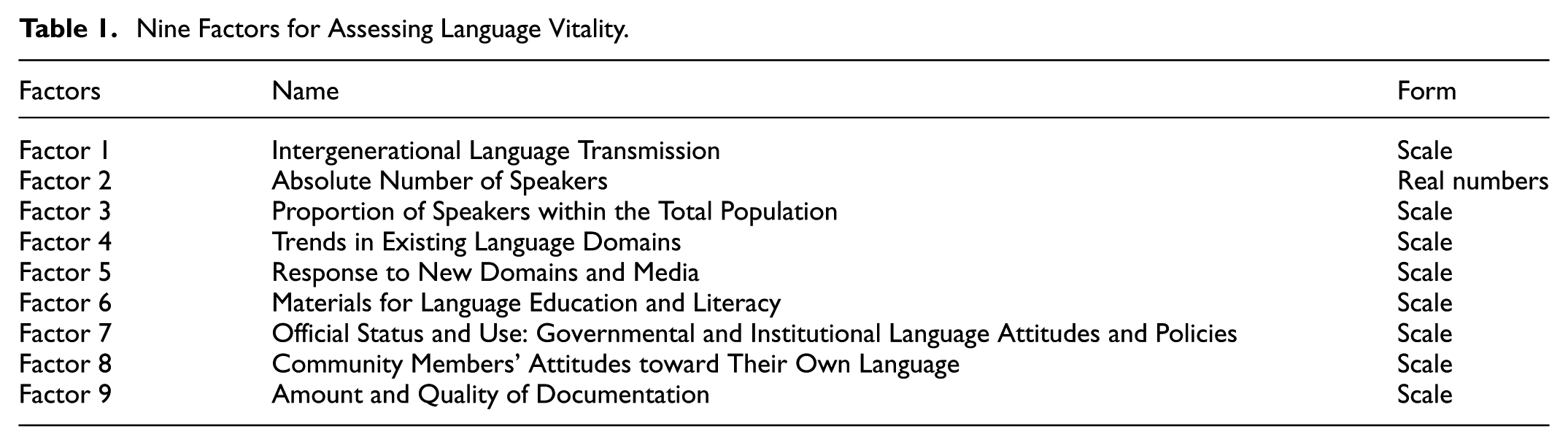
In this study, the authors adopted the evaluation criteria outlined by UNESCO (Brenzinger et al., 2003) to assess the linguistic vitality of the Tujia language. As shown in Table 1, this framework identifies nine factors contributing to language endangerment, with each factor assessed across six distinct levels of severity (see Brenzinger et al., 2003, pp. 7–19 for detailed information).
Nine Factors for Assessing Language Vitality.
Bridging Ecological Systems Theory with UNESCO Indicators
To comprehensively investigate the endangerment status of the Tujia language, this study integrates the revised ecological systems framework with UNESCO’s language vitality assessment framework to form a multi-dimensional analytical model. This integration is grounded in the recognition that language vitality is both a product of individual-level language practices and beliefs and a reflection of broader sociocultural, institutional, and policy-driven influences. From the ecological perspective, the microsystem, mezzosystem, and macrosystem levels correspond respectively to the individual, community, and institutional forces that shape language use and transmission. These ecological layers align well with UNESCO’s nine vitality factors. For instance, Factor 1 (Intergenerational Transmission) and Factor 8 (Community Attitudes) closely mirror the microsystem, as they reflect speakers’ personal attitudes and practices. The mezzosystem, such as family, school, community, and media, resonates with Factors 4 (Trends in Language Domains), 5 (Response to New Media), and 6 (Materials for Language Education and Literacy), which focus on the contextual domains where the language is (or is not) used. Finally, the macrosystem level aligns with Factors 7 (Official Status and Policies) and 9 (Language Documentation), both of which relate to broader socio-political structures and institutional support mechanisms.
By systematically mapping the UNESCO vitality indicators onto the revised ecological systems framework, this study not only ensures that the questionnaire captures both individual and structural dimensions of language endangerment but also reinforces the theoretical coherence of the research design. This combined framework enables a layered analysis of how the Tujia language is sustained, challenged, or marginalized across intersecting levels of society, thus offering a nuanced understanding of the forces contributing to its endangerment.
Research Design and Context
This study employs a mixed-methods design, integrating a questionnaire with semi-structured interviews to investigate the linguistic vitality of the Tujia language in Hubei province, China. This design is selected to capture both (1) quantitative patterns through standardized scales measuring UNESCO’s nine vitality factors, and (2) qualitative insights into intergenerational practices, attitudes, and revitalization strategies. The combination of methods allows for triangulation, strengthening the validity of findings by cross-verifying data sources.
The research was conducted within Hubei province, where Tujia remains variably spoken across generations. These areas were selected to reflect both rural and semi-urban contexts, as well as differences in language exposure and government-supported revitalization efforts.
Research Participants
The participants in this study were 378 individuals from the Tujia ethnic group in Hubei (131 males, 247 females). They have diverse educational and professional backgrounds, including students, teachers, farmers, workers, civil servants, company employees, and service industry workers. Detailed information about the participants is presented in Table 2.
Participants’ Demographic Information.

Research Instruments and Procedure
Questionnaire
The questionnaire was designed based on UNESCO’s nine factors (Brenzinger et al., 2003), with items mapped to the three ecological systems levels aforementioned. It consists of two sections: (1) biographical and background information (gender, educational level, and profession) and (2) 30 items, including Likert-scale questions rated on 4 or 5 scales that are related to key indicators of language vitality. These indicators include the current status of language use (items 1–13), language attitudes (items 14–26), response to media (items 28 and 29), and language policies (items 27 and 30). The current status of language use examines whether respondents spoke the Tujia language and the contexts in which it is used. Language attitudes assess their identification with their ethnic language, willingness to learn, and the necessity of Tujia language preservation.
The internal consistency and dimensional validity were tested using SPSS 26.0 during pilot administration to ensure the reliability of the protocol. Convenience sampling was utilized in this study due to the scattered distribution of the Tujia population. Taking into consideration the accessibility, the survey was mainly conducted among Tujia people in Hubei province, where the Tujia population is approximately 2.3 million, taking up 3.9% of the total population of Hubei province (58.44 million). In March 2023, questionnaires were sent to 400 Tujia people. Participants were informed that the results would be solely for academic research to ensure the validity and accuracy of their responses. Of the 400 questionnaires distributed, 378 were completed and deemed valid for analysis. Then, statistical analysis of the 378 valid questionnaires was conducted. Because the initial questionnaire for this study contained different sorts of items, to ensure the accuracy and consistency of the results, when conducting the reliability and validity tests, 15 items from the questionnaire (containing 9 Likert-4 scale questions and 6 Likert-5 scale questions) were extracted. To ensure comparability across instruments with different scale types, we transformed the original 4-point Likert scale into a 5-point scale based on established transformation procedures (Dawes, 2008). Specifically, we retained the extreme and adjacent values while introducing a neutral midpoint (Norman, 2010). This approach maintains ordinal consistency and facilitates integrated statistical analysis. As shown in Table 3, the reliability test yielded an overall Cronbach’s alpha coefficient of 0.730, indicating acceptable reliability for an exploratory survey.
Reliability Test.

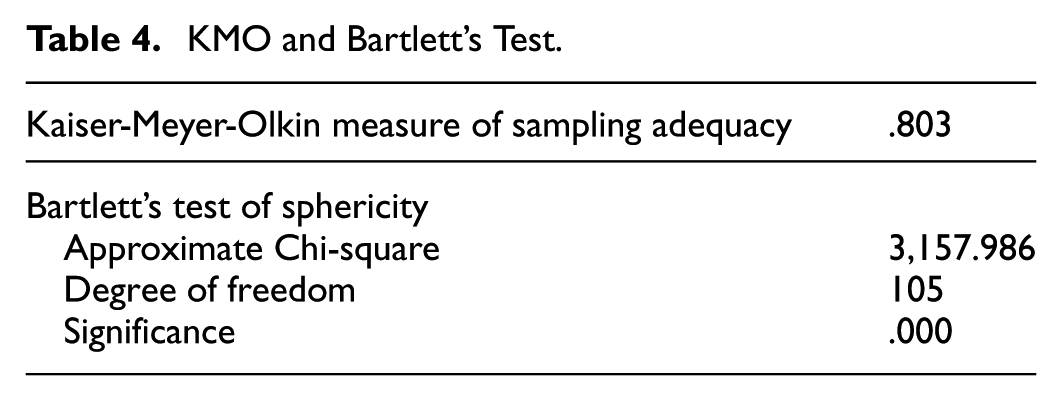
The results of the exploratory factor analysis, presented in Table 4, show a KMO value of 0.803 and a significance level of 0.000 < 0.001, indicating the suitability of the data for factor analysis.
KMO and Bartlett’s Test.
Semi-Structured Interviews
Semi-structured interviews were conducted to explore the reasons behind the endangerment of the Tujia language and participants’ attitudes toward its use and preservation. To ensure a broad representation of perspectives, 20 interviewees were selected from various professions, including Tujia intangible cultural heritage inheritors, local Tujia cultural scholars, teachers, students, farmers, and tour guides, ensuring perspectives across generational and social strata. Besides, the interview outline is as follows: (1) Do you think that the Tujia language is important to you, and why? (2) What kind of language is chosen for daily communication among your family members, and why do you choose this language? (3) Do you use the Tujia language in your work, and why? (4) What kind of reasons do you think contribute to the Tujia language endangerment?
In April 2023, semi-structured interviews were conducted face-to-face or via mobile phone with 20 participants personally. Detailed background information of interviewees is presented in Table 5.
Interviewees’ Demographic Information.

Then, interview data were transcribed verbatim and analyzed using thematic coding. Codes were derived inductively, and themes were consolidated into broader categories through iterative comparison. To enhance validity, two authors coded independently, with inter-coder reliability assessed via Cohen’s Kappa coefficient = 0.83. Thematic saturation was reached when no new codes emerged in subsequent interviews.
Ethical Considerations
This study followed the ethical standards of the host institution and relevant guidelines. All procedures were approved by [Hubei University Humanities and Social Sciences Ethics Committee, No. 2025001]. Written informed consent was obtained from all participants, who were informed of the study’s objectives, data usage, and their right to withdraw at any time. Data were anonymized and stored on encrypted devices accessible only to the research team.
Results
The results are organized into three sections: (1) descriptive statistics of Tujia language vitality across UNESCO’s nine factors, (2) factor analysis, and (3) thematic findings from qualitative interviews. Quantitative and qualitative findings are presented separately here and will be combined in the next Discussion section.
Assessment of Tujia Language Vitality
Factor 1: Intergenerational Language Transmission
Intergenerational language transmission is crucial for assessing a language’s vitality (Alisha & Rahman, 2017). To gain deeper insights into the transmission and use of the Tujia language in Hubei across generations, the questionnaire examined Tujia language proficiency among respondents (third generation), their parents (second generation), and their grandparents (first generation) (see Figure 2).

Tujia language mastery levels among different generational groups.
The findings show that 70.11% of respondents have no knowledge of or only a basic understanding of the Tujia language. Additionally, 17.99% reported moderate familiarity, while just 11.90% claimed fluency. Among the respondents’ parents, only 11.11% are proficient in Tujia, and this number slightly increases to 15.34% for their grandparents. These results highlight a clear decline in Tujia language proficiency across three generations, with generally low levels of mastery in all groups. Notably, there is a significant drop in language skills from the first generation to the next two, with a smaller difference between the latter two.
In light of these findings, as well as the scale of UNESCO in Table 6, it can be concluded that the intergenerational language transmission index for the Tujia language in Hubei indicates a severe endangerment (Grade 2).
Scale of Intergenerational Language Transmission.

Absolute Number of Speakers
In Hubei Province, the Tujia ethnic group comprises approximately 2.3 million individuals; however, the active use of the Tujia language in everyday communication remains extremely limited. Rather than functioning as a medium of daily interaction, the language is largely confined to restricted sociocultural domains, while the majority of community members predominantly adopt mainstream languages. Findings from the present survey indicate that only 19 participants, representing 5.02% of the total sample, reported using Tujia across diverse communicative settings, including the home, school, workplace, and neighborhood interactions. Given the modest sample size, these results cannot be extrapolated to the entire Tujia population with statistical certainty. Nevertheless, the very small proportion of active users is indicative of a critically reduced speech community, thereby reinforcing the language’s precarious status and justifying its classification as highly endangered (Grade 1).
Proportion of Speakers within the Total Population
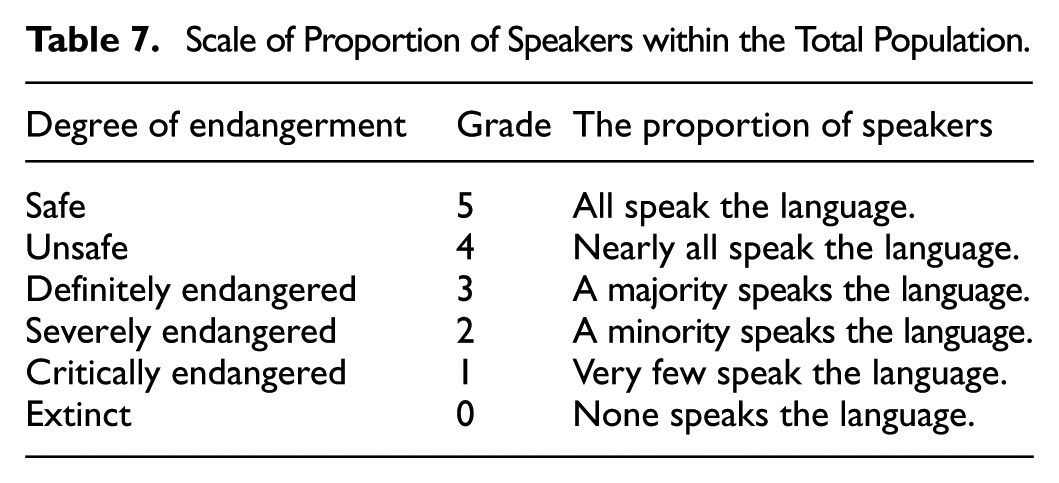
The relative proportion of speakers within the total population of an ethnolinguistic community constitutes a critical indicator in evaluating language vitality (see Table 7). Existing surveys demonstrate a troubling inverse trend that, while the overall population of the Tujia ethnic group has increased in recent decades, the number of proficient speakers of the Tujia language has markedly diminished. Findings from the present study corroborate this trajectory. Specifically, 70.11% of respondents reported either no proficiency or only limited competence in Tujia, whereas 29.89% indicated a moderate to fluent command of the language. More critically, the proportion of those employing Tujia in routine communicative practices is even smaller. As discussed in the previous section, only 5.02% of participants reported using the language across everyday contexts, including domestic, educational, occupational, and community interactions. Such patterns provide compelling evidence for the classification of Tujia as a severely endangered language (Grade 2), highlighting its precarious status within the broader sociolinguistic ecology.
Scale of Proportion of Speakers within the Total Population.
Trends in Existing Language Domains
Where, with whom, and the range of topics for which a language is used directly affect whether or not it will be transmitted to the next generation (Brenzinger et al., 2003). Figure 3 presents the status of language use by the Tujia ethnic group in different language domains, including family, education, and work settings.

Proportions of languages used by the Tujia people in different domains.
An intriguing trend emerges, revealing that the proportion of teachers using the Tujia language as a medium of instruction decreases as grade levels rise: 7.73% in elementary school, 6.13% in junior high school, and 5.15% in senior high school. In contrast, the use of Mandarin Chinese (Putonghua) as the medium of instruction increases significantly, from 83.2% in elementary school to 93.03% in senior high school. This trend highlights the shrinking space for the Tujia language within evolving language domains. In familial interactions, only 11.9% of respondents report using the Tujia language for daily communication, and merely 6.35% use it in the workplace. Overall, the scope of Tujia language use is limited and continues to contract, with individuals increasingly favoring other dialects or mainstream languages in professional and educational contexts.
According to Table 8, it indicates a language facing significant challenges in maintaining its presence and utility across varied spheres of life (Grade 1).
Scale of Trends in Existing Language Domains.

Response to New Domains and Media
Table 9 shows the scale for assessing people’s response to the use of the Tujia language in different domains. As societal dynamics evolve, communities may find themselves presented with fresh avenues for language expression. However, the reality often reveals that only a few language communities effectively integrate their language into these emerging domains. Institutions such as schools, workplaces, and contemporary media platforms like broadcast media and the Internet play key roles in expanding the influence of dominant languages, pushing endangered languages to the periphery. When communities fail to adapt their language to the demands of modernity, it often leads to its gradual decline and increased social stigma.
Scale of Response to New Domains and Media.

With the rapid development of society and the expansion of mass communication channels, diverse forms of media, including television, radio, newspapers, and digital platforms, have become deeply embedded in Tujia-inhabited regions. However, these outlets predominantly utilize Mandarin Chinese and local Chinese dialects as the primary mediums of information dissemination, thereby marginalizing the role of the Tujia language in public communication. Data from our questionnaire survey reveal that none of the respondents reported the presence of Tujia language radio stations or television channels within their locality. As illustrated in Figure 4, only 10.32% of participants noted that language-related programming was available on local media platforms. A key factor underlying this absence is the lack of a widely accepted and standardized orthographic system for Tujia, which severely constrains its representation in mass media. In light of these conditions, the degree of media presence for the Tujia language can be categorized as “minimal” (Grade 1), underscoring its highly vulnerable status in the modern communicative environment.

Response to Tujia language used in new domains and media.
Materials for Language Education and Literacy
Language education is essential for enhancing language vitality. In general, literacy is directly linked with social and economic development. Existing materials for language and literacy exert some extent of influence on the acquisition of the Tujia language (see Table 10).
Scale of Materials for Language Education and Literacy.
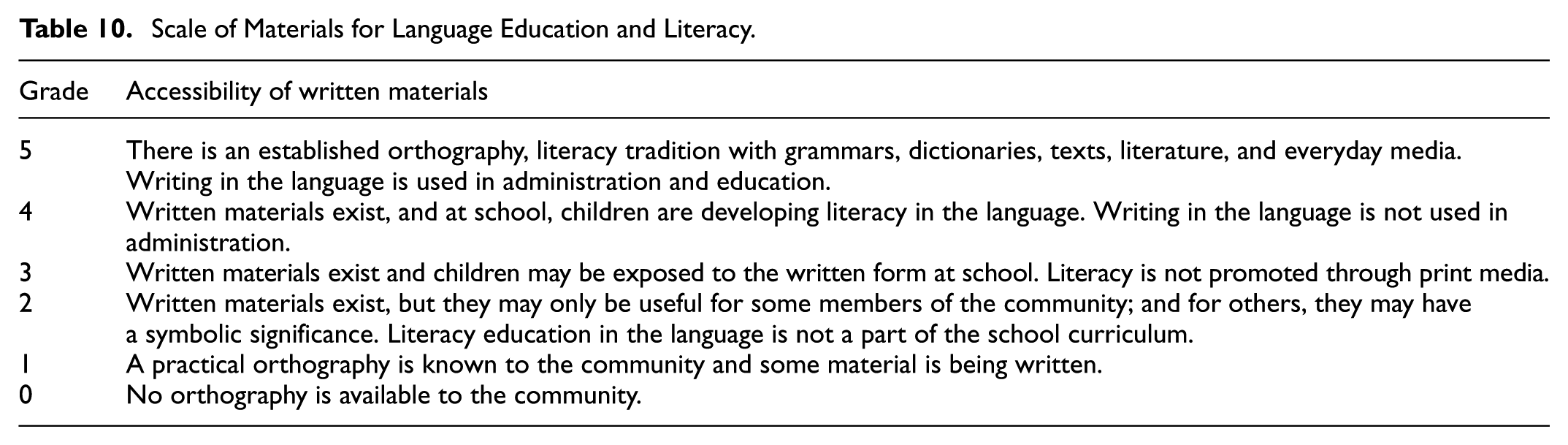
The Tujia community continues to rely almost exclusively on oral transmission, as the language lacks a standardized writing system of its own. Historically, Chinese characters have been adapted as phonetic symbols to approximate Tujia sounds, yet the resulting written records remain fragmentary and of limited functional value for the broader community. Compounding this challenge is the scarcity of educational and literary resources. There is a notable absence of textbooks, reference works, or creative literature available in the Tujia language. In Hubei Province, a small number of localized teaching materials, like The Tujia Language, have been developed, but their availability is extremely limited. Within the formal education system, their application is highly restricted, being confined primarily to special courses offered at Baifusi Ethnic Primary School in Laifeng County, Enshi. In most other schools across the province, particularly within the mainstream educational framework, Tujia language materials are virtually absent. On this basis, the indicator concerning the availability and institutional use of written resources can be assessed as Grade 1 (minimal), highlighting the precarious state of literacy support for the language.
Governmental and Institutional Language Attitudes and Policies, Including Official Status and Use
Governments and institutions have explicit policies and/or implicit attitudes toward the dominant and subordinate languages, as shown in Table 11.
Scale of Governmental and Institutional Language Attitudes and Policies.
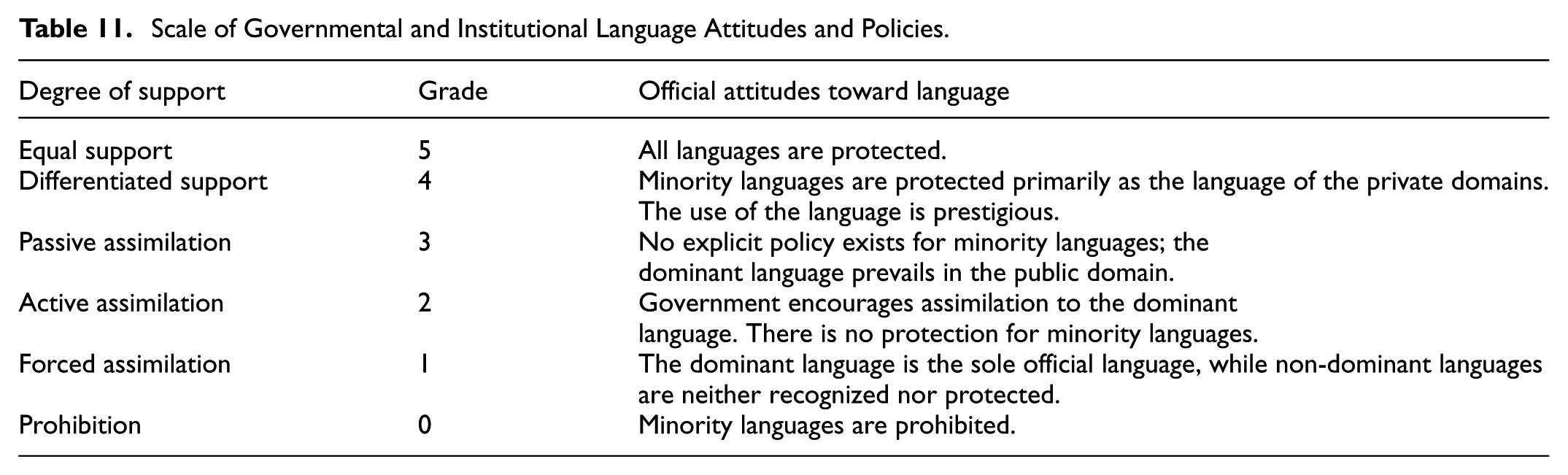
China has consistently prioritized the preservation of languages spoken in ethnic minority regions. For instance, the document Several Provisions of the State Council on the Implementation of the Law of the People’s Republic of China on Regional Ethnic Autonomy, issued by the State Council of the PRC (2005), explicitly guarantees the freedom of all ethnic groups to utilize and develop their language and script. Moreover, according to Article 10 of the Law of the People’s Republic of China on Regional Ethnic Autonomy, the autonomous organs of ethnic autonomous areas shall guarantee the freedom for all ethnic groups in the region to use and develop their own languages and scripts. This provision clearly establishes the equal linguistic rights of minority groups, ensuring the preservation and development of their language and culture. However, despite this recognition, local governments have rarely introduced specific local laws and regulations aimed at protecting the languages of dispersed ethnic minorities. Although local governments and relevant authorities in Hubei have organized many cultural events of the Tujia ethnic group, there is still a need for greater attention to the preservation of the Tujia Language (Grade 3).
Community Members’ Attitudes Toward Their Own Language
Factor 8 is linked to the community members’ language attitudes (see Table 12). As the ancestral language of the Tujia people, the Tujia language embodies the collective wisdom, experiences, and knowledge of the Tujia ethnic group, serving an indispensable role within their cultural fabric. To assess respondents’ attitudes toward the Tujia language, the questionnaire explored various aspects of their perspectives. Notably, when asked about whether speaking Tujia would be perceived as outdated, 70% of respondents disagreed, indicating a prevailing optimism within the Tujia community regarding the continued use of their language.
Scale of Community Members’ Attitudes Toward Their Own Language.

However, the questionnaire also delved into the perceived importance of the Tujia language in respondents’ lives, revealing a more complex perspective. While less than half (43.92%) considered the language to hold relative significance, a majority exhibited indifference, with 17.2% deeming it unimportant. Nevertheless, despite these shifting dynamics, the overall sentiment toward preserving and promoting the Tujia language remains largely optimistic. Consequently, as a collective, the Tujia people exhibit a profound emotional attachment to their language. This indicator is supposed to be in grade 4, reflecting the enduring emotional connection to the language.
Amount and Quality of Documentation
To assess the urgency of documenting a language, it is essential to first identify the type and quality of existing language materials (Table 13).
Scale of Amount and Quality of Documentation.

By visiting museums, bookstores, and libraries in the Tujia-inhabited areas of Hubei Province and consulting relevant experts, the authors find that although there are grammatical materials on the Tujia language, such as Grammatical Annotated Text of the Tujia Language (2017), the overall quantity is very small, and there is a lack of systematic and comprehensive grammatical works. There are also very few dictionaries. For example, the Enshi Prefecture Library houses the Tujia-Chinese Dictionary (2002). In addition, in 2012, The Great Dictionary of the Tujia Language, compiled under the lead of primary school teacher Chu Yongming, was introduced into the classrooms of Baifusi Ethnic Primary School in Enshi, Hubei Province, for daily teaching. In terms of long-form language materials, there is the Tujia Language, which is mainly used for classroom teaching at Baifusi Ethnic Primary School. Moreover, the Tujia language can hardly be found in daily media platforms such as radio, television, and newspapers. Although there are some audio and video materials of the Tujia language, they are not only limited in quantity but also vary greatly in quality, reflecting their inadequate nature (Grade 2).
Factors Influencing Tujia Language Endangerment
Factor Analysis
In the study, exploratory factor analysis was employed to investigate the factors influencing Tujia language endangerment. Through multiple iterations, several items that did not meet the criteria for factor extraction were subsequently removed. Ultimately, the analysis revealed four factors that collectively accounted for 69.45% of the variance. This finding justifies the categorization of all question variables into four factors (see Table 14).
Total Variance Explained.

Note. Extraction method: principal component analysis
Based on the variables contained in each factor, the four factors were designated with the following names: language environment, attitude toward language development and protection, emotional orientation, and guiding policies (see Table 15).
Factors Extracted from Rotated Component Matrix.

Note. Extraction method: principal component analysis. Rotation method: varimax with Kaiser normalization. Rotation converged in 6 iterations.
Thematic Analysis
Following the three-stage thematic coding procedure in grounded theory by Glaser and Strauss (1967), 92 discrete meaning units were extracted from the 20 verbatim interviews (Respondents A–T). Open coding generated 28 initial labels. Axial coding reduced these to six conceptual categories. Selective coding identified one overarching core category that integrates the entire dataset. A second independent coder applied the final code result to all 92 meaning units. Inter-rater agreement was achieved on 81 units. Cohen’s Kappa coefficient = 0.83, indicating good agreement.
Table 16 presents the final code result. Percentages indicate the proportion of meaning units assigned to each axial category (N = 92).
Factors Extracted from Thematic Coding.

Across respondents, the dominant driver of language endangerment is not overt linguistic stigma but a widely shared perception that Tujia lacks instrumental value in education, employment, and daily commerce. This perception suppresses parental transmission and legitimizes exclusive Mandarin use, thereby accelerating intergenerational shift.
Discussion
This chapter discusses the findings of the study in light of the three research questions, drawing on the ecological systems theory (Bronfenbrenner, 1979; Zastrow & Kirst-Ashman, 2004) and integrating both field data and existing literature. The results show that the Tujia language is undergoing rapid decline due to a complex interplay of sociolinguistic, cultural, economic, and institutional factors. These dynamics operate across the micro-, mezzo-, and macro-levels of society and collectively shape the language attitudes, use, and transmission practices among the Tujia people in Hubei.
The Current State of Tujia Language Vitality
Regarding the first research question on the current vitality of the Tujia language, the findings reveal that while a majority of respondents recognize the cultural significance of the language, actual usage in daily life is minimal. As highlighted by An et al. (2017), language attitude and usage are critical indicators of vitality. In this study, a discrepancy is evident that people value the symbolic role of Tujia but do not actively use or transmit it. Questionnaire data show that only 11.1% of respondents use the Tujia language in family interactions, reflecting a weakened intergenerational transmission, which is long considered a central indicator of language endangerment (Fishman, 1991). This aligns with Crystal (2000) and Krauss (1992), who noted that minority languages often decline when they lose functional relevance in family and educational domains. Echoing Fan and Li’s (2012) assessment of the Yi dialect, the Tujia language in this context appears to be shifting toward symbolic ethnicity rather than active communication, a trend intensified by social pressures and regional integration. Similar findings are reported by Huang and Liao (2023). They found that in Australian interlingual families, parents’ attitudes toward heritage maintenance did not necessarily lead to active use. Only consistent family language policies could secure intergenerational transmission. This underscores the gap between symbolic appreciation and practical usage in heritage language sustainability.
Factors Contributing to Tujia Language Endangerment
The second research question focuses on the factors contributing to the Tujia language endangerment. These factors are multifaceted and operate within an ecological framework. At the micro level, individual attitudes are shaped by instrumental considerations, namely, the perceived lack of economic or educational value of Tujia in contrast to Mandarin. Many respondents stated that Mandarin was more useful in securing jobs and accessing higher education, a finding consistent with J. Chen and Wang’s (2020) study on the Nubian language. Respondents also noted that the Tujia language was difficult to learn, which discourages voluntary acquisition, especially among younger generations.
At the mezzo level, the family, school, workplace, community, and media form interconnected spheres that reinforce Mandarin use while marginalizing the Tujia language. Interviews showed that many parents, even those fluent in Tujia, chose not to teach it to their children due to intermarriage, time constraints, or perceptions of irrelevance. This supports Wang’s (2016) findings on the influence of parental language awareness. Schools overwhelmingly use Mandarin for instruction, driven by state education policies and practical considerations of mixed-ethnic classrooms. This echoes Hu’s (2008) observation that educational systems often privilege dominant languages at the expense of minority ones. Community settings, too, are increasingly dominated by local dialects and Mandarin, with Tujia used only in restricted ceremonial contexts. Besides, media exposure is another challenge. Mandarin remains the dominant language in both print and audiovisual channels, while content in Tujia is scarce or nonexistent (R. Z. Li & Wang, 2013; Tang, 2022). This digital and communicative exclusion significantly reduces the language’s presence in the public consciousness. Besides, a similar pattern has been observed in a global context, where minority languages such as Punjabi and Setswana rely on social media platforms like Facebook and X (formerly Twitter) for visibility and intergenerational communication (Minhas & Salawu, 2024). These cases suggest that digital platforms could serve as alternative spaces for Tujia language promotion, particularly among youth.
At the macro level, national policies promote Mandarin as a unifying language, even while formally protecting minority languages (State Council of the PRC, 2001, 2018). This policy paradox results in top-down contradictions, where the Tujia language is legally protected but practically marginalized. As S. Yang (2020) and Edwards (1992) point out, such inconsistencies in policy often leave minority languages vulnerable in practice. The economic development and urbanization of Tujia communities further exacerbate language shift, as more individuals migrate for work and adopt Mandarin to integrate into urban environments (H. Li, 2023; Zhao, 2020). Interregional mobility and mixed-ethnic marriages also dilute language use in domestic spaces, undermining the possibility of stable transmission.
Strategies for Tujia Language Protection and Revitalization
The third research question explores strategies for revitalizing the Tujia language, which must address the above multi-level factors. Revitalization steps are supposed to begin by transforming public attitudes through awareness campaigns, community storytelling, and local cultural festivals where language, not just performance, takes center stage (Alisha & Rahman, 2017; Schreiber & Sitaridou, 2018). Reinforcing ethnic identity and language pride is a crucial step in reversing language shift. Family language policies should also be promoted through government-supported programs that encourage parents to speak the Tujia language at home. As Dagdeviren-Kirmizi (2023) argues, intergenerational language transmission is most successful when families are empowered with resources and incentives.
In the education sector, schools in Tujia-concentrated areas should implement bilingual education models or heritage language classes. Teacher training programs should prepare educators to integrate Tujia content in culturally relevant pedagogy, a strategy that has proven effective in other minority language contexts (C. Yang et al., 2017). Community-based initiatives such as Tujia language centers, weekend schools, and documentation projects, which are modeled on efforts described by Brenzinger et al. (2003) and Song et al. (2022), can serve both instructional and archival purposes. These initiatives can also support the construction of digital corpora and multimedia resources (Ajani et al., 2024; Meighan, 2021; Tan et al., 2023), which are crucial for language learning in the modern era. In addition, educational strategies rooted in translanguaging pedagogy have shown effectiveness in raising minority language awareness and promoting equitable multilingual practices. For instance, primary students in the Basque region developed critical language awareness when translanguaging strategies were integrated into Basque-Spanish-English instruction (Leonet et al., 2024). Similarly, training preservice teachers to design materials that incorporate translanguaging practices has proven effective in multilingual, minority-language contexts (Orcasitas-Vicandi & Perales-Fernández-de-Gamboa, 2022).
At the policy level, governments must not only reaffirm protection in principle but also ensure consistent funding and implementation. Local governments, especially in Hubei, should institutionalize the use of the Tujia language in public signage, administrative communication, and cultural programming (Hubei Government, 2024). As Gobbo (2021) emphasizes, official visibility of a language can positively influence its perceived value and increase its usage.
In summary, the decline of the Tujia language is not the result of a single cause but of interconnected pressures across ecological levels. The micro-level apathy, mezzo-level institutional exclusion, and macro-level policy contradictions collectively shape a sociolinguistic environment in which the Tujia language is losing ground. Revitalization efforts must therefore adopt a holistic approach that recognizes the embeddedness of language in cultural, educational, economic, and technological systems. As Maffi (2001) and Grenoble (2011) remind us, linguistic diversity is inseparable from cultural sustainability and human rights. The case of Tujia reflects broader global trends of language endangerment, but also opens up possibilities for targeted, context-sensitive intervention and renewal.
Conclusion
This study investigates the linguistic vitality and revitalization prospects of the Tujia minority language in Hubei province of China from an ecological perspective. Drawing upon both quantitative and qualitative data, we revealed that the Tujia language is facing critical challenges to survival, marked by low intergenerational transmission, restricted domain use, and declining speaker confidence. These symptoms of language shift are embedded in complex sociolinguistic dynamics across different levels.
Theoretically, the study contributes to a new eco-linguistic lens for researching minority languages, exploring reasons behind that may cause minority language endangerment. Practically, the study provides key implications for protecting the Tujia language. At the micro level, the weakening of intergenerational transmission is a direct consequence of changing language attitudes and diminished practical value attributed to the Tujia language. Many parents, concerned about their children’s academic and social mobility, prefer to use Mandarin at home. At the mezzo level, the lack of systematic integration of Tujia into school curricula, limited presence in local media, and absence of supportive community-based language spaces further contribute to its marginalization. As highlighted by Fan and Li (2012) and C. Yang et al. (2017), institutional neglect often accelerates language shift by reinforcing the dominance of majority languages in formal domains. Moreover, young speakers tend to associate the Tujia language with outdated traditions rather than a living cultural resource. At the macro level, although the government has articulated formal support for minority languages, actual implementation remains uneven and often superficial. The lack of localized, enforceable policy and adequate funding undermines community-led initiatives. Ultimately, the fate of the Tujia language hinges not only on top-down policy support but also on bottom-up community engagement and identity affirmation. A revitalization movement must be co-constructed by local speakers, educators, scholars, and policymakers, recognizing the Tujia language as a vital thread in China’s cultural and linguistic tapestry. As L. Chen (2023) asserts, the revitalization of endangered languages is not merely about preserving words, but about sustaining diverse ways of knowing, belonging, and becoming.
The study has some limitations, nonetheless. The sample size may not fully represent the entire Tujia-speaking population in Hubei because the Tujia ethnic group is widely dispersed across various locations, making it challenging to obtain large-scale data. Future studies would be strengthened to obtain a larger sample size for more extensive data support. Besides, although a mixed-methods approach was adopted, such as questionnaires and interviews, more in-depth ethnographic studies are still encouraged to fully unpack the status and reasons that endanger not only the Tujia language but also other endangered minority languages.
Footnotes

Ethical Considerations
This study followed the ethical standards of the host institution and relevant guidelines. All procedures were approved by [Hubei University Humanities and Social Sciences Ethics Committee, Approval No. HUBU-HSSEC-2025001]. Written informed consent was obtained from all participants, who were informed of the study’s objectives, data usage, and their right to withdraw at any time. Data were anonymized and stored on encrypted devices accessible only to the research team.
Funding
The authors disclosed receipt of the following financial support for the research, authorship, and/or publication of this article: The authors received financial support by Hubei Provincial-Level Teaching Research Project for Institutions of Higher Learning (Grant No. 2022195) and University-Industry-Research Collaborative Talent Cultivation Program (Grant No.1030017550).
Declaration of Conflicting Interests
The authors declared no potential conflicts of interest with respect to the research, authorship, and/or publication of this article.
Data Availability Statement
Data sharing not applicable to this article as no datasets were generated or analyzed during the current study.