




Abstract
University teachers face high risks of burnout, especially under increasing demands for educational quality. Burnout has been associated with poorer mental health, reduced teaching effectiveness, and lower student outcomes. Drawing on the Conservation of Resources Theory, this study explores the relationships among work-family support (WFS), occupational stress (OS), and burnout, with psychological capital (PsyCap) as a potential mediator. A total of 308 university teachers from China completed validated scales measuring WFS, OS, PsyCap, and burnout. Data were analyzed using SPSS 26 to test direct and mediating relationships. Results indicated that WFS was negatively correlated with burnout, while OS was positively correlated. PsyCap was found to be a significant statistical mediator in the relationships between WFS, OS, and burnout. Higher PsyCap was associated with lower levels of burnout. These findings suggest that WFS and OS are significantly associated with burnout among university teachers, and that PsyCap may function as a psychological resource related to reduced burnout. Enhancing PsyCap may provide a practical direction for mitigating burnout and developing sustainable and supportive academic environments.
Plain Language Summary
This study set out to understand why some university teachers feel extremely tired, lose motivation, and struggle to stay engaged in their work. We expected that when teachers receive more support from their workplace and family, they would feel less burned out, while high stress would increase burnout. We also thought that “psychological capital”—a personal resource that includes hope, confidence, resilience, and optimism—might be a key link between support, stress, and burnout. University teachers often juggle teaching, research, administrative work, and family responsibilities. While these roles can be rewarding, ongoing pressure can leave them exhausted. We surveyed 308 teachers from five universities in eastern China and found that more support was linked to less burnout, whereas greater stress was linked to more burnout. Psychological capital acted like a bridge, turning support into positive energy and reducing the harm caused by stress. These findings suggest that reducing burnout is not just about lowering stress but also about building personal strengths. Universities can help by offering flexible policies, creating a supportive environment, and providing training to boost teachers’ confidence and resilience, helping them thrive in both work and life.
Introduction
University faculty members in China are experiencing unprecedented psychological challenges due to the growth of higher education and heightened performance-based policy demands. As representatives of knowledge-intensive professions, university teachers are required not only to manage heavy teaching and research workloads, but also to fulfill multiple roles involving promotion evaluations, administrative duties, and public service obligations, all of which contribute to growing work intensity and complexity (T. Li et al., 2024; Xu & Wang, 2023). Within this high-pressure environment, occupational burnout has emerged as a prominent mental health concern among Chinese university faculty (Cao et al., 2024; Liang & Yin, 2025). Recent empirical studies conducted in China have indicated that the prevalence of burnout is relatively high among university teachers, with many also reporting symptoms of depression and anxiety, which may compromise both educational quality and career sustainability (H. Li et al., 2025; K. Li et al., 2024; Xu & Wang, 2023). In contrast to Western institutional systems, which often feature more flexible work arrangements and well-established support mechanisms, Chinese university faculty frequently lack effective resource compensation and organizational support. This structural gap contributes to the cultural and organizational distinctiveness of the burnout issue in China (Han et al., 2020; Koster & McHenry, 2023). Therefore, examining the mechanisms of occupational burnout among Chinese university teachers not only adds a culturally specific perspective to the international literature but also holds practical implications for optimizing institutional support systems and faculty development policies.
The psychological state of university teachers is largely shaped by the dynamic balance between resource acquisition and depletion in their work environment, a mechanism that is well explained by the Conservation of Resources theory (CORT) (Hobfoll, 1989). According to this theory, individuals strive to retain, protect, and build resources when facing stressful situations, and the actual or threatened loss of resources can lead to psychological strain. When external resources are abundant, individuals are more likely to activate positive psychological mechanisms; in contrast, resource scarcity tends to induce emotional exhaustion and maladaptive responses (Hobfoll, 2001). Specifically, WFS, as a key form of external resource, offers emotional comfort, time coordination, and role understanding, helping teachers alleviate role conflict and better cope with daily demands (Çankır et al., 2015; Y. Li et al., 2025). Conversely, OS represents a persistent resource threat that can continuously erode psychological reserves and lead to emotional strain and job burnout (Metrailer & Clark, 2024). At the same time, PsyCap—a developable and malleable positive psychological resource—serves as a crucial mediator linking the external environment to psychological outcomes. Studies have shown that higher levels of WFS can enhance teachers’ PsyCap, thereby reducing their levels of burnout (Toprak et al., 2022). Meanwhile, Liu and Du (2024) argued that OS may deplete PsyCap, indirectly weakening emotional regulation and resilience, and in turn exacerbating burnout.
Although earlier research has looked at the impact of OS and WFS separately on teachers’ psychological states, most have treated them as independent predictors and have overlooked their interaction within the dynamic balance of resources. There remains a lack of theoretical integration, especially in terms of using a unified framework to systematically analyze and explain the dual pathways of resource acquisition (such as WFS) and resource depletion (such as OS). In addition, PsyCap, as a crucial psychological resource that links external environments to mental health outcomes, has not been thoroughly explored as a potential mediating mechanism in this context.
To systematically examine how work-related resources are associated with occupational burnout among university teachers, this study adopts the CORT as its theoretical foundation. Within this framework, WFS is considered a key form of resource acquisition, while OS represents a sustained threat to resources. PsyCap reflects an individual’s internal psychological reserves and may serve a regulatory and buffering role between resource input and resource depletion. Based on this theoretical rationale, the present study proposes a dual-pathway mediation model to examine the potential mediating role of PsyCap in the context of concurrent work support and OS, and further investigates its association with teacher burnout. This model enhances theoretical insights into how university teachers adapt to occupational demands and offers preliminary guidance for developing resource-oriented psychological support and organizational intervention strategies.
This study follows a theory-driven approach and formulates directional hypotheses rather than null hypotheses. The hypotheses are grounded in extensive prior research and established theoretical frameworks, particularly the CORT (Hobfoll, 1989), which posits that the gain or loss of resources significantly influences individuals’ psychological states, such as burnout. Prior research has shown that OS has a positive correlation with burnout, but WFS has a negative correlation (Sarwar et al., 2021; Sperati et al., 2024). The hypothetical model of this study is shown in Figure 1.

Research model.
Literature Review
Theoretical Framework
Conservation of Resources Theory
This study is grounded in the CORT proposed by Hobfoll (1989) to examine how PsyCap functions as a key resource influencing burnout among university teachers in the context of WFS and OS. According to CORT, individuals endeavor to acquire, maintain, and protect resources they value, which may include external material and social support as well as internal psychological resources (Hobfoll, 2001). When resources are consistently gained, individuals are better able to resist stress and maintain psychological well-being. Conversely, actual resource loss, perceived threats to resources, or a lack of expected returns after investing resources can trigger stress responses (Jie et al., 2024). In the higher education context, WFS is considered an important external resource that provides emotional comfort, time coordination, and role understanding, thereby enhancing PsyCap (Ho & Chan, 2022). In contrast, OS represents a resource threat that can continuously deplete PsyCap and increase the risk of burnout (Keykha et al., 2025). As a malleable internal psychological resource, PsyCap can not only directly alleviate burnout but also mediate the relationship between external resources and burnout (Malak & Qassim, 2025). In recent years, CORT has been widely applied in education, organizational management, and occupational health (Chun et al., 2022; Egozi & Pardo, 2023; Maunz & Glaser, 2024). By developing an integrative model within the CORT framework, this study reveals how external resources and resource threats influence burnout through PsyCap, thereby enriching the application of CORT in the context of university teachers and other high-stress professions, and offering new theoretical insights and empirical evidence for targeted resource-based interventions.
Burnout
Teacher burnout refers to a condition in which teachers, under prolonged work-related stress, gradually develop emotional exhaustion, depersonalization, and a reduced sense of personal accomplishment (Freudenberger, 1974). Prior research has demonstrated that a variety of elements, such as personal characteristics, the workplace, organizational support, and social support, all have an impact on university instructors’ burnout. In terms of individual factors, insufficient PsyCap (encompassing elements like self-efficacy, resilience, and optimism), lack of effective emotional regulation, and weak self-regulation abilities can reduce the ability of teachers to confront stress, thereby heightening the risk of burnout (Yang & Du, 2024; Q. H. Zhang et al., 2024). Regarding the work environment, high-intensity teaching and scientific research tasks frequently result in emotional exhaustion, especially when role conflicts and heavy workloads are present (Çankır, 2017; Cao et al., 2024; Cheng et al., 2023). Additionally, lack of organizational resources, such as WFS, can further exacerbate burnout among teachers, whereas transformational leadership and organizational support from the university can effectively alleviate this phenomenon (Su & Jiang, 2023; Yang et al., 2023).
Work-Family Support
WFS encompasses the emotional, material, and social support that individuals receive from family members, colleagues, and the organization while balancing work and family obligations (Shahwan et al., 2024; Thomas & Ganster, 1995). As a multidimensional construct, WFS typically includes three major forms: emotional support, instrumental or material support, and social or informational support (Blom et al., 2025; Guo et al., 2024). The sources of WFS include both interpersonal-level relationships and organizational-level institutional arrangements (Karataş & Çankır, 2023; Neculman et al., 2025). Such support may come from family members who understand and accommodate work responsibilities, from coworkers who assist with tasks and provide emotional comfort, or from organizational policies and resources designed to support employees. In educational settings, especially among university faculty, the availability and perceived adequacy of WFS may be influenced by organizational culture, job roles, and role expectations (Y. Li et al., 2025). Moreover, Kossek et al. (2025) point out that WFS is highly context-sensitive and dynamic in nature, with its manifestations likely to fluctuate depending on an individual's career stage, level of work-related stress, and family structure.
Occupational Stress
OS refers to the responses experienced by individuals in specific professions when facing job demands that exceed their physical or environmental adaptability (Lazarus & Folkman, 1984). Ji et al. (2024) noted that stress arises from individuals’ subjective evaluations of situations. When a work situation is perceived as threatening, challenging, or beyond one’s control, it can easily trigger tension, anxiety, emotional exhaustion, and other adverse reactions. In higher education settings, university teachers are confronted with multiple challenges such as heavy teaching workloads, research performance pressure, academic evaluations, and uncertainty in career development, all of which contribute to sustained OS (T. Chen et al., 2024; Lee et al., 2022). Zhou et al. (2024) found that OS affects teachers’ emotional states and job satisfaction, which in turn are linked to burnout. Therefore, OS has been widely recognized as a key contextual factor for explaining the psychological health mechanisms of educators.
Psychological Capital
PsyCap refers to a set of positive psychological resources, including self-efficacy, hope, optimism, and resilience, that enable individuals to cope effectively with challenges and adversity (Luthans et al., 2007). Each of these four dimensions represents a distinct psychological function: self-efficacy is the belief in one's own ability to complete particular activities; hope reflects the motivational energy and planning required to achieve goals; optimism refers to a positive expectation for success in both the present and the future; and resilience denotes the ability to recover and grow from adversity (Youssef-Morgan, 2024). PsyCap is thought of as a state-like resource that is flexible and amenable to development through focused training or encouraging surroundings, in contrast to stable personality qualities (Milner & Criticos, 2023). In educational settings, PsyCap has received increasing attention in recent years as a critical protective factor, particularly among university teachers (L. Zhang et al., 2024). Ren et al. (2024) pointed out that teachers with higher PsyCap scores tend to exhibit greater work engagement, stronger adaptability, and lower levels of burnout.
Hypothesis Development
Work-Family Support and Burnout
WFS is exceptionally crucial in high-intensity professional groups, especially for university teachers, as it helps alleviate work-family conflicts, thereby reducing the occurrence of burnout (Stollberger et al., 2022; Su & Jiang, 2023; Yang et al., 2024). Empirical research by Su and Jiang (2023) found that workplace flexibility and family support can effectively alleviate emotional exhaustion caused by role conflict. With sufficient WFS, teachers can effectively manage their responsibilities, which significantly reduces burnout. WFS helps individuals cope with high-pressure situations at work, maintain work motivation, and improve job performance, thereby reducing the likelihood of burnout (Cheng et al., 2023; Sarwar et al., 2021; Stollberger et al., 2022). Cheng et al. (2023) found that teachers lacking WFS are more prone to burnout, whereas those who receive support exhibit higher levels of work engagement. Therefore, the following hypothesis is proposed:
Occupational Stress and Burnout
OS is recognized as a leading cause of burnout among university teachers and has become a prominent research focus in the fields of education and psychology (Cao et al., 2024; Liu & Ko, 2022; Mota et al., 2021). For university teachers, OS specifically refers to the tension caused by various factors in their daily work, including teaching workload, professional development needs, job expectations, and research responsibilities (Cao et al., 2024; Mota et al., 2021; Pinho et al., 2023). Lv et al. (2024) showed that increased OS among university teachers leads to emotional exhaustion, thereby raising the likelihood of burnout. Additionally, elevated OS can cause teachers to feel a diminished sense of personal accomplishment, significantly increasing the likelihood of burnout (Halat et al., 2024; Liu & Ko, 2022; Sperati et al., 2024). Sperati et al. (2024) found that when teachers face multiple challenges, such as teaching, research, and academic evaluations, the increased stress not only intensifies emotional exhaustion but also significantly worsens burnout. Therefore, the following hypothesis is proposed:
The Mediating Role of Psychological Capital
PsyCap influences emotional regulation, helping individuals better cope with stress, avoid negative emotions, and reduce the risk of burnout (Freire et al., 2020; Greenier et al., 2021; Ma, 2023; Xiyun et al., 2022). Research by Xiyun et al. (2022) indicates that among higher education teachers, PsyCap effectively enhances their sense of work competence and satisfaction with life arrangements, thereby mitigating burnout caused by teaching and research demands. Furthermore, teachers with higher PsyCap are more motivated to overcome challenges amid adversity, which further reduces burnout (Lupsa et al., 2020). Therefore, the following hypothesis is proposed:
Research has demonstrated that WFS can enhance teachers’ PsyCap, thereby reducing burnout (Li et al., 2021; Toprak et al., 2022). Specifically, teachers who receive higher WFS tend to develop stronger PsyCap. This sense of support helps enhance their recognition of their work competence and life arrangements, thereby reducing the risk of burnout. (Cheng et al., 2023; Sarwar et al., 2021; Yang et al., 2024). Sarwar et al. (2021) pointed that individuals with higher PsyCap are more equipped to confront stress from both work and family roles, thus preventing burnout. Yang et al. (2024) found that understanding and support from the work environment help teachers effectively cope with challenges in teaching and research, allowing them to better balance responsibilities, reducing burnout. Meanwhile, PsyCap serves as a significant mediating role in the relationship between OS and burnout (Liu & Du, 2024; Zhao et al., 2022). OS indirectly affects burnout through the mediating role of PsyCap (Bidi et al., 2024; Ma, 2023). Bidi et al. (2024) found that OS exacerbates the burnout by reducing teachers' PsyCap. Ma (2023) further suggests that OS influences PsyCap, which in turn enhances self-efficacy and hope, enabling teachers to better cope with the challenges posed by OS, thus indirectly reducing burnout. Therefore, the following hypothesis is proposed:
Methods
In order to investigate the connections between WFS, OS, and burnout and to assess the mediating function of PsyCap, this study used a cross-sectional research methodology. Cross-sectional designs are widely used in the fields of education and psychology, as they allow researchers to measure multiple variables at a single point in time without experimental manipulation (Bryman, 2016; Creswell & Creswell, 2018). The cross-sectional technique has a number of clear benefits in this study. First, it enables researchers to collect large-scale data from teachers in their natural work environments without interfering with their daily teaching activities. Second, this design is more time- and cost-efficient, making it particularly suitable for real-world educational settings where long-term tracking may not be feasible. Third, numerous studies on teacher burnout have adopted cross-sectional methods, providing theoretical and methodological comparability for the current research (Lammassaari et al., 2022; Li & Tsang, 2023). Therefore, the chosen design not only aligns with the study’s objectives but is also consistent with established standards in related research domains.
Data Collection
This study employed a random sampling method for questionnaire distribution and data collection, which took place from September 2024 to November 2024 from five universities in China. The research participants were university faculty members from these institutions. The specific selection process was as follows: First, five universities were randomly selected as the sample sources to ensure the diversity of the sample. Subsequently, 80 faculty members were randomly chosen from each university to participate in the questionnaire, ensuring that teachers of different professional titles, teaching experiences, and academic fields had the opportunity to participate, thereby enhancing the representativeness of the sample. This sampling strategy was informed by methodological recommendations in educational research. Prior studies have shown that when investigating complex and heterogeneous populations, multistage random sampling is a feasible and scientifically sound approach (Cohen et al., 2017). Given the practical constraints of obtaining a complete national sampling frame, this method strikes a balance between feasibility and methodological rigor. It also facilitates the systematic collection of valid data, enabling a more accurate examination of the psychological and organizational variables associated with burnout among university teachers.
The questionnaires were distributed online via the Wenjuanxing platform (https://www.wjx.cn/). All participants provided their informed consent prior to completing the questionnaire. Before starting the survey, the platform first presented participants with an informed consent form. Only those who carefully read the form and clicked the “I agree” button was able to proceed to the questionnaire; those who did not provide consent could not access the survey. Participation was entirely voluntary, and participants were informed that they could withdraw at any time without penalty. No personally identifiable information (e.g., names, employee IDs, contact details) was collected, and all responses were stored and analyzed in aggregated form to ensure anonymity and confidentiality. The study posed minimal risk to participants as it involved only self-reported perceptions and contained no sensitive or invasive questions. The potential benefits, including providing empirical evidence for improving university teachers’ psychological well-being and informing organizational support policies, were considered to outweigh the minimal risks involved. A total of 326 questionnaires were collected. After screening and excepting incomplete and carelessly answered questionnaires, 308 valid responses were obtained, achieving a response rate of 94.48% (Li, 2025). This response rate refers to the proportion of valid questionnaires among all online respondents, rather than the response rate for the entire target population. Of these, 179 were from male participants (58.12%) and 129 from female participants (41.88%). Demographic information is shown in Table 1.
Demographic Information.

Table 2 presents the results of the analysis of intergroup differences in work-related variables based on demographic characteristics. The results indicate that gender, years of teaching experience, and marital status have no significant impact on WFS, OS, PsyCap, or burnout. The number of children, however, has no significant impact on OS, PsyCap, or burnout, but it does have a significant effect on WFS.
Analysis of Intergroup Differences in Work-Related Variables Based on Demographic Characteristics.
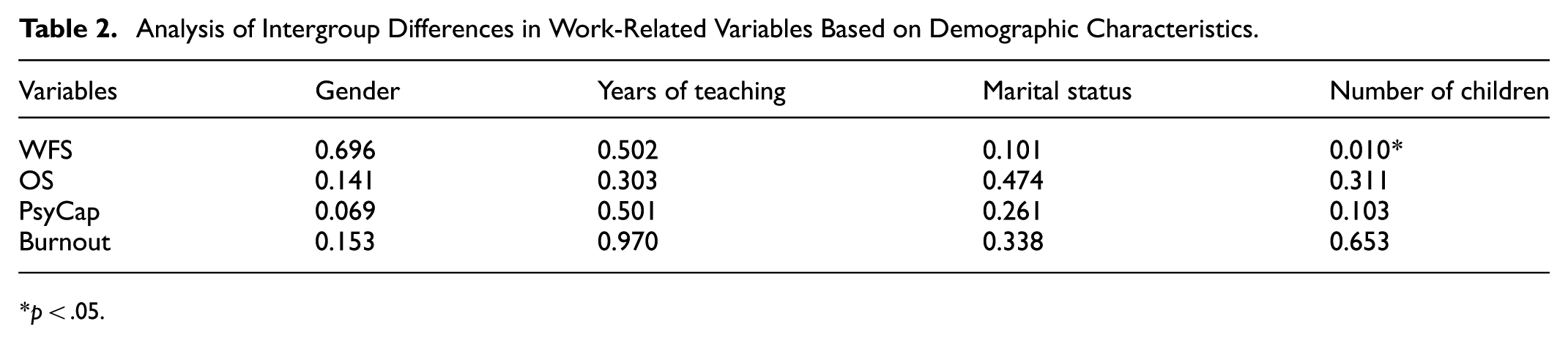
p < .05.
Measurement Tools
This study employed well-established and validated standardized scales, each measured using a five-point Likert scale, to ensure the reliability and validity of the results.
Burnout
To comprehensively assess the burnout status of higher education teachers, this study used the Maslach Burnout Inventory – Educators Survey (MBI-ES) developed by He et al. (2024). The Cronbach's α value of 0.956 indicates a very high level of reliability, confirming its internal consistency and applicability in educational research, ensuring the data's reliability and the scientific nature of the research findings. MBI-ES consists of 22 items, which are divided into three dimensions: emotional exhaustion, depersonalization, and personal accomplishment. Among these, the measurement of reduced personal accomplishment is scored reversely to ensure that the relationship between the dimensions and burnout is accurately reflected. Higher scores indicate greater burnout among higher education teachers.
Work-Family Support
This study used the WFSS developed by X. W. Chen et al. (2024) to comprehensively assess the support received by higher education teachers in both their work and family life. The Cronbach’s α value of .978 indicates very high internal consistency, confirming the reliability of the scale and ensuring its effectiveness and reliability in this study. WFSS consists of 30 items, covering two dimensions: work support and family support. It aims to reveal the types of support received by teachers and their impacts from different perspectives. Higher scores indicate greater WFS received by higher education teachers, which helps balance work and family responsibilities.
Occupational Stress
This study adopts the OSS developed by Ji et al. (2021) to assess the stress levels faced by university teachers in their professional environment. The Cronbach’s α value of .970 indicates very high internal consistency and reliability, further ensuring the reliability of the research data and the validity of the scale. OSS consists of 30 items, covering six dimensions: exam pressure, student factors, self-development needs, family and interpersonal relationships, workload, and career expectations, aiming to comprehensively reflect the multiple factors influencing teachers' OS. A higher score indicates greater OS among university teachers.
Psychological Capital
This study adopts the PsyCapS developed by S. X. Chen and Tang (2023) to comprehensively assess the PsyCap levels of university teachers. The Cronbach’s α value of .966 indicates a very high level of internal consistency, further validating the applicability and effectiveness of the scale in this study. PsyCapS consists of 24 items, covering four dimensions: self-efficacy, hope, resilience, and optimism, aiming to reflect the psychological resources and coping abilities of teachers in facing professional and life challenges from multiple perspectives. A higher score indicates that university teachers possess higher levels of PsyCap.
Data Analysis
Data analysis for this study involved comprehensive statistical procedures using SPSS Statistics 26 software. First, descriptive statistical analysis was conducted to outline the fundamental characteristics of the data, including mean values, standard deviations, and other indicators, for the purpose of a clearer understanding of the study sample’s overall profile. Next, reliability and validity tests were conducted on each scale to ensure their applicability within the study sample and to confirm the reliability of the data quality. Correlation analysis was also carried out to investigate the preliminary relationships among the study variables. To further analyze the proposed mediation model, we chose Model 4 to run the serial mediation analysis, WFS (X1) and OS (X2) as the independent variables, PsyCap (M) as intermediary variable, burnout (Y) as dependent variable, and demographic factors such as gender and years of teaching as covariates. To enhance the accuracy of the mediation effect analysis, this study employed the Bootstrap method with 5,000 resamples to test the mediation effect of the core variables, ensuring the robustness and statistical significance of the results. If the 95% confidence interval (CI) that did not include 0 indicated a significant mediation effect.
Result
Descriptive Analysis
Based on 308 valid responses, descriptive statistics and Pearson correlation analyses were conducted for WFS, OS, burnout, and PsyCap. As shown in Table 3, WFS was significantly negatively correlated with OS and burnout. In addition, WFS was strongly positively correlated with PsyCap. OS was significantly positively correlated with burnout and negatively correlated with PsyCap. Burnout was also significantly negatively correlated with PsyCap. It is worth noting that the correlation between WFS and PsyCap was particularly high, which may reflect a strong functional linkage between external and internal resources in high-demand professions like teaching. According to CORT, external support resources such as WFS may directly contribute to the accumulation of internal PsyCap, especially under high-stress occupational conditions. Despite the high correlations observed, each construct remains theoretically distinct and was measured using validated multi-item instruments, ensuring conceptual differentiation. In addition, through collinearity diagnostics, the VIF values for all variables were found to be below 3.3 (Hair et al., 2022), indicating that there is no multicollinearity issue in the regression analysis, thus providing a solid foundation for the subsequent regression analysis.
Means, Standard Deviations, and Correlation Analysis (r) of Variables.

N = 308, ***p < .001.
Common Method Bias Test
Exploratory factor analysis was used to evaluate Harman’s one-factor test for common method bias. Podsakoff et al. (2003) state that common technique bias may be an issue if one factor explains more than 40% of the variance. Only 38.98% of the variation in this study was explained by the first factor, which was one of four factors with eigenvalues larger than 1. Consequently, no discernible common method bias was found.
Reliability and Validity Testing
The scales used in this study demonstrated good content and construct validity (Table 4). The KMO values for the WFS, OS, burnout, and PsyCap scales were 0.987, 0.979, 0.975, and 0.983, respectively, indicating their suitability for factor analysis. Bartlett’s test of sphericity results was all significant (p < .001), confirming sufficient correlation among the variables to proceed with factor analysis. The confirmatory factor analysis (CFA) results showed that the range of factor loadings was between 0.577 and 0.845, χ2/DF = 1.463, CFI = 0.912, RMSEA = 0.039, IFI = 0.913 and TLI = 0.910, indicating a good model fit.
KMO Values and Bartlett’s Test of Sphericity for WFS, OS, Burnout, and PsyCap.

Mediation Effect Analysis
After adjusting for factors such as years of teaching, marital status, and number of children, the regression analysis results are shown in Table 5, Figures 2, and 3. First, WFS was positively associated with PsyCap (β = .980, p < .001) and negatively associated with burnout (β = −.275, p < .05). These results suggest that teachers who reported higher WFS tended to show greater levels of PsyCap and lower levels of emotional exhaustion. Second, OS was negatively associated with PsyCap (β = −.755, p < .001) and positively associated with burnout (β = .549, p < .001). This indicates that teachers experiencing greater OS may have lower PsyCap and higher burnout, possibly due to sustained resource depletion under stress. These findings provide an important empirical basis for the subsequent mediation analysis and offer preliminary insight into how contextual factors are related to teachers’ psychological states.
Regression Analysis Between Variables.

p < .01, ***p < .001.
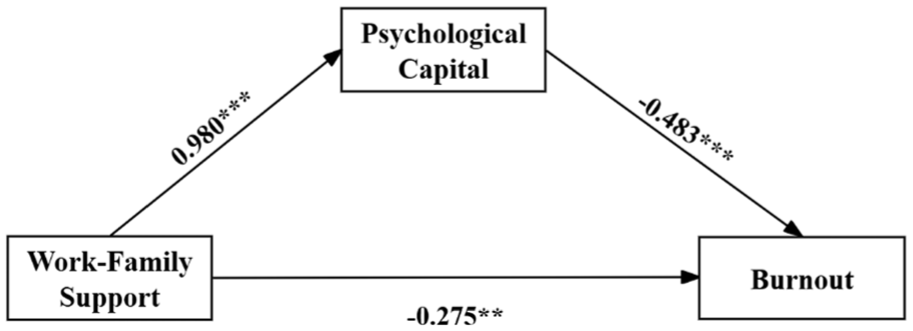
The mediating role of PC in the relationship between WFS and burnout.

The mediating role of PC in the relationship between OS and burnout.
Table 6 presents the results of the mediation analysis, further indicating that PsyCap may serve as a mediator in the relationships between WFS and burnout, as well as between OS and burnout. To evaluate the practical significance, standardized indirect effects were interpreted according to Cohen (2013) benchmarks (small ≈ 0.01, medium ≈ 0.09, large ≈ 0.25). Specifically, the indirect association between WFS and burnout through PsyCap was −0.473, accounting for 63.23% of the total association (β = −.748, 95% CI [−0.937, −0.446]), which represents a large mediation effect according to Cohen’s benchmarks. Similarly, PsyCap also showed a partial mediating role in the relationship between OS and burnout, with an indirect association of 0.365, accounting for 39.83% of the total association (β = .914, 95% CI [0.616, 1.205]), which also represents a large mediation effect. This indicates that higher levels of OS may be related to lower PsyCap, which in turn is associated with higher burnout risk. These results imply that PsyCap serves as a significant psychological mechanism that connects demands and outside resources to emotional outcomes in addition to acting as a statistical mediator. The relationships of WFS and OS with burnout are not limited to direct associations but are also substantially explained by individuals’ internal psychological resources.
The Effect of Each Path.

Discussion
This study examined the associations among WFS, OS, PsyCap, and burnout in university teachers. The results supported the proposed hypotheses, indicating that PsyCap served as a significant mediator in the relationships between both WFS and burnout, and OS and burnout.
The WFS for university teachers is significantly negatively correlated with burnout, aligning with the findings of Su and Jiang (2023), and supporting H1. When teachers receive adequate WFS, it can effectively alleviate emotional exhaustion caused by role conflict, thereby reducing the incidence of burnout. With support from both work and family, teachers not only gain greater flexibility in time management, allowing them to achieve a balance between work and life, but also receive significant emotional and psychological support, which helps mitigate typical burnout symptoms (Stollberger et al., 2022; Yang et al., 2023, 2024). Moreover, when teachers face heavy teaching loads, research pressures, and role conflicts, family understanding and support can strengthen their psychological resources, making it easier to cope with multiple roles demands. Therefore, university management should consider enhancing WFS through flexible scheduling, emotional counseling, and family-friendly policies to help reduce teacher burnout.
OS is significantly positively correlated with burnout, consistent with the findings of Liu and Ko (2022), and supporting H2. A prolonged high-pressure environment makes teachers more susceptible to fatigue while managing daily teaching and research tasks, adversely affecting their mental health and work motivation, thus increasing the risk of burnout (Cao et al., 2024; Lv et al., 2024; Mota et al., 2021), who noted that increased OS predisposes teachers to emotional exhaustion and depersonalization, leading to burnout. Prolonged exposure to high-stress environments can leave teachers feeling fatigued while managing daily teaching and research tasks, adversely affecting their mental health and work motivation, thus increasing the risk of burnout (Halat et al., 2024; Liu & Ko, 2022). Therefore, universities should reduce unnecessary burdens, optimize the allocation of teaching tasks, establish reasonable performance evaluation systems, and provide mental health services to effectively help teachers relieve stress, restore psychological resources, and enhance their occupational adaptation and teaching engagement.
PsyCap is significantly negatively correlated with burnout, aligning with the findings of Ma (2023), and supporting H3. Research has shown that teachers with higher PsyCap demonstrate greater resilience and stress tolerance in work-related pressure contexts, making them less likely to experience burnout (Greenier et al., 2021; Xiyun et al., 2022). Higher self-efficacy makes teachers more confident in handling teaching tasks and challenges, while hope motivates them to maintain professional enthusiasm. Resilience helps them quickly recover from setbacks, and optimism enables them to cope with stress more positively, preventing the excessive accumulation of negative emotions, thereby effectively reducing the incidence of burnout (Darvishmotevali & Ali, 2020; Lupsa et al., 2020). Thus, universities can enhance teachers’ PsyCap by providing psychological skills training, establishing faculty counseling mechanisms, and fostering a positive and supportive campus culture, thereby reducing the risk of burnout.
PsyCap serves as a mediating role between WFS and burnout, aligning with the results of Sarwar et al. (2021), and supporting H4. WFS is significantly positively correlated with PsyCap. Specifically, when teachers perceive understanding and support from both family and work, the various dimensions of their PsyCap, are also enhanced (Li et al., 2021; Toprak et al., 2022). Meanwhile, PsyCap is significantly negatively correlated with burnout, and PsyCap help alleviate teachers’ negative emotional responses and occupational fatigue (Greenier et al., 2021; Xiyun et al., 2022). According to the CORT (Hobfoll, 1989), external resources such as organizational and family support can be converted into internal coping capacity. In this study, WFS provides essential emotional and instrumental resources that help replenish teachers’ PsyCap, which in turn enables them to stay engaged, optimistic, and emotionally stable when managing multiple work and family roles. Therefore, universities should provide targeted emotional and instrumental support for teachers, to strengthen their PsyCap and mitigate burnout.
PsyCap plays a mediating role between OS and burnout, aligning with the findings of Liu and Du (2024), and supporting H5. Research has found that OS is significantly negatively correlated with PsyCap. OS may deplete teachers' internal psychological resources, making them tend to feel helplessness and negative emotions when facing work-related challenges. Meanwhile, when PsyCap declines, teachers find it more difficult to sustain a positive attitude and effective adaptation strategies when confronted with multiple work pressures such as teaching and research, which makes them more vulnerable to emotional exhaustion, maladaptive coping, and burnout (Ma, 2023; Zhao et al., 2022; Zhou et al., 2021). According to the CORT (Hobfoll, 1989), OS, as a resource-depleting condition, continuously erodes teachers’ PsyCap and ultimately leads to burnout. Therefore, universities can implement strategies to enhance PsyCap, which may help teachers maintain their physical and mental health and professional well-being in high-pressure environments, effectively reducing the occurrence of burnout.
The high correlation between WFS and PsyCap reflects the close relationship between the two. This strong correlation can be partly attributed to their overlapping functions in helping individuals cope with OS and promoting psychological well-being (Bai et al., 2023). WFS has the ability to enhance an individual’s self-efficacy, hope, and optimism, which are key components of PsyCap (Toprak et al., 2022). Additionally, the high correlation between WFS and PsyCap may be attributed to the characteristics of the sample group. In this study, the teaching population faces significant work-family pressures and strong psychological adaptation demands, with both WFS and PsyCap playing mutually reinforcing roles in such an environment. Statistical analysis did not reveal any multicollinearity issues, so we believe that this high correlation is a natural phenomenon in the data and does not adversely affect the robustness of the overall model.
This study indicates that the number of children a teacher has significantly influences their WFS, which aligns with Wang et al. (2023). Teachers, when facing family responsibilities, especially parenting pressures, tend to rely more on support systems provided by family members and the school to help them better balance work and family life (Muasya, 2024). Specifically, teachers who are responsible for child-rearing often need to adjust their work schedules or seek external help, thereby receiving more WFS, which may help alleviate the burnout caused by family responsibilities (Jia & Li, 2022). Therefore, educational institutions should implement more inclusive policies that offer flexible work arrangements to reduce their workload and improve overall work well-being.
Furthermore, although this study found that gender, years of teaching experience, and marital status had no significant differences in WFS, OS, PsyCap, or burnout, these nonsignificant results still hold theoretical value. The lack of significant effects may suggest that in the current educational system, these demographic factors are no longer primary sources of variance. For example, with increasing awareness of gender equality and the standardization of teaching roles, the differences between male and female teachers in perceived organizational support and PsyCap have gradually diminished (Afsar & Umrani, 2020). Meanwhile, marital status and teaching experience may be more closely associated with professional identity and career stage rather than directly influencing burnout or internal psychological resources (Erden et al., 2023; Lin et al., 2022). These nonsignificant results thus emphasize how crucial it is to avoid relying too heavily on demographic factors as direct predictors when analyzing the psychological mechanisms of instructors. Instead, future research should further examine how such variables interact with contextual and individual-level factors. As all participants were university teachers from institutions located in China, regional factors such as institutional culture, educational policy, and work–family norms may have influenced the observed relationships. Future studies should incorporate more diverse samples across different geographical and cultural settings to enhance the external validity of the results.
Implications
Theoretical Implications
First, this study proposes a comprehensive framework illustrating the interaction between WFS, OS, and PsyCap, revealing how these factors collectively impact burnout among university teachers, particularly the role of PsyCap as a buffering and mediating resource. This framework fills a gap in the existing literature and provides theoretical support for future research on multifactor models of burnout. Second, it validates the mediating role of PsyCap between WFS, OS, and burnout. The study demonstrates that WFS indirectly reduces the occurrence of burnout among teachers by enhancing PsyCap, while OS indirectly exacerbates burnout by lowering PsyCap levels. The study demonstrates that WFS indirectly reduces the occurrence of burnout among teachers by enhancing PsyCap, while OS indirectly exacerbates burnout by lowering PsyCap levels (Li et al., 2021; Toprak et al., 2022). Finally, the proposed comprehensive model explains the variance in burnout, with the combination of WFS and PsyCap explaining 65.8% of the variance, while the combination of OS and PsyCap explains 80.8% of the variance. This theoretical innovation enriches the research perspective on burnout, providing a more comprehensive theoretical framework for understanding and intervening in burnout.
Practical Implications
From a practical standpoint, this research provides valuable guidance for universities in developing teacher support policies. The research suggests that strengthening WFS and enhancing teachers’ PsyCap can effectively alleviate burnout, thereby improving their work motivation and mental well-being. Specifically, universities can adopt more flexible work arrangements to reduce conflicts between work and family roles, helping teachers manage burnout. For example, offering flexible working hours, family-friendly benefits, and understanding and accommodating leadership can help teachers strike a better balance between work and family pressures, reducing symptoms of emotional exhaustion and depersonalization. The study also highlights that by enhancing PsyCap, teachers can maintain a more positive emotional state when facing OS. To achieve this, universities can organize programs such as PsyCap development courses and mental health seminars to help teachers cultivate dimensions of PsyCap, including self-efficacy, resilience, and optimism, thereby strengthening their ability to confront OS. These training and support programs not only enhance teachers’ psychological resilience but also improve their sense of self-identity, which subsequently enhances overall work performance. Furthermore, the findings of this study provide specific recommendations for university administrators in creating a supportive work environment. By fostering a campus atmosphere of encouragement, support, and care, universities can offer comprehensive support to help teachers navigate challenges in high-pressure environments. This dual intervention of policies and PsyCap development not only increases teachers’ work engagement but also contributes to enhanced teaching effectiveness, ultimately promoting the overall quality of education.
Limitations and Future Research
This study has some limitations even if it offers some important findings. First, the data were collected exclusively from university teachers in China. As institutional cultures, work-family dynamics, and stress-related factors may differ across regions and educational systems, the applicability of these results may be constrained. Future research could apply this model across varied regions and institutional contexts to enhance the external validity of the results and examine how contextual differences may shape teacher burnout mechanisms. Second, the data in this study were primarily collected through self-reported questionnaires completed by university teachers, which may raise concerns about common method variance. Future research could incorporate multiple data sources, including peer evaluations, administrative records, or physiological indicators, to strengthen the robustness and ecological validity of the findings. Third, this study utilized cross-sectional data. While this design reveals the relationships between variables, it is limited in capturing the dynamic changes and long-term effects of burnout. Future research could use longitudinal or experience sampling approaches to capture within-person fluctuations in OS and personal resources over time. For instance, weekly diary studies or semester-based panel surveys could provide richer insights into how PsyCap evolves in response to varying levels of support and stress in academic environments. In addition, future studies could expand the theoretical model by incorporating potential moderators and mediators. For example, job autonomy, perceived organizational justice, or coping styles may buffer or intensify the effects of OS on burnout. PsyCap itself may operate as part of a broader chain mediation involving emotional regulation or work engagement. Finally, qualitative or mixed-method designs could uncover nuanced coping strategies and contextual factors that are not easily captured through structured questionnaires, especially in high-pressure educational settings.
Conclusion
This study examined the relationships among WFS, OS, PsyCap, and burnout in university teachers, emphasizing the statistical mediating role of PsyCap. The results indicated that WFS and PsyCap were significantly negatively correlated with burnout, while OS was significantly positively correlated with burnout. PsyCap also showed a significant statistical mediating effect between WFS, OS, and burnout, which implies that it may play an important role in the associations among these variables. By approaching burnout from the perspective of psychological resources, this study provides a multi-variable framework for understanding how WFS, OS, and PsyCap may be interconnected with burnout, particularly highlighting the potential linking role of PsyCap. In practice, the findings suggest that institutions may consider strengthening support systems, addressing sources of stress, and promoting internal psychological resources when supporting faculty well-being. Given the cross-sectional design of this study, the findings reflect statistical associations only. Future research is encouraged to adopt longitudinal or experimental designs to further investigate the temporal and explanatory relationships among these variables.
Footnotes

Ethical Considerations
The researchers confirms that all research was performed in accordance with relevant guidelines/regulations applicable when human participants are involved (e.g., Declaration of Helsinki or similar). This study was approved by the Ethics Committee of Fuzhou University of International Studies and Trade (Approval Number:2024-0031).
Consent to Participate
The participants received oral and written information and provided written informed consent before participating in the study.
Author Contributions
Conceptualization: Hanhui Li; Methodology: Hanhui Li; Formal analysis and investigation: Hanhui Li, Jinpeng Liu; Writing - original draft preparation: Hanhui Li; Writing - review and editing: Hanhui Li; Supervision: Hanhui Li. All the authors have read and agreed to the published version of the manuscript.
Funding
The authors received no financial support for the research, authorship, and/or publication of this article.
Declaration of Conflicting Interests
The authors declared no potential conflicts of interest with respect to the research, authorship, and/or publication of this article.