




Abstract
Using the research method of quantile regression, this paper empirically studies the impact of local social networks on the motivation system of employees in China. Empirical results show that closely connected local social networks can strengthen the bargaining power of employees. Specifically, closely connected local social networks can increase employees’ salaries, and the effect is more significant for employees with higher incomes. In addition, closely connected local social networks can also reduce employees’ pay-performance sensitivity, thus lowering the uncertainty of income. These effects can be more significant in firms with non-local chairmen, non-state-owned enterprises (Non-SOEs), and firms facing mild market competition. Besides, closely connected local social networks can also narrow the pay gap between senior executives and employees inside the firm. The research sheds light on the local social network’s positive effect on narrowing the pay gap and the negative effect of interest conflict it caused.
Introduction
What an effective motivation system should be like has always been a hot topic of significant importance in academics and practice (Chen et al., 2022; Francis et al., 2019). Prior literature has fully discussed the driving factors and economic consequences of the motivation design of senior executives (Lee et al., 2021; Pawliczek, 2021). Recently, some researchers also pay attention to the equity incentives for the core technicians who plays an important role in corporate innovation (Chang et al., 2015). However, research on the motivation design of ordinary employees is still insufficient. As the direct executor of all the firm’s production and operation activities, non-executive employees’ motivation design cannot be ignored either. Especially in emerging markets such as China, the high efficiency of ordinary employees is one of the reasons for rapid economic development.
Among the driving factors of employees’ salaries, the effect of local social networks is an important factor that cannot be ignored in emerging markets. On the one hand, closely connected local social networks can make it easier for ordinary employees to unite and fight for their economic interests (Li et al., 2019). That is, the local social connections can act as a substitution for a labor union to some degree and improve the bargaining power of employees as a group. On the other hand, local employees with rich social connections may gain an advantage in outside working chances. This can improve their bargaining power as well. Besides, the pursuit of equalitarianism rooted in Chinese history and culture can be more significant in areas dominated by local social networks, this may also influence employees’ salary design. On the whole, the strength of local social networks can have a significant impact on the motivation design of employees. However, there is little literature that pays attention to the role that local social networks play in a firm’s motivation system.
Based on this, using empirical data from China, this study examines the impact of local social networks on the motivation system of employees. Empirical results find that closely connected local social networks can be conducive to improving employees’ salaries. However, the positive effect mainly exists in the group of employees with higher incomes. Besides, closely connected local social networks can reduce employees’ pay-performance sensitivity as well, and the effect is more significant for employees with lower salaries. In addition, closely connected local social networks can narrow the pay gap between senior executives and employees inside the firm. Further analysis finds that the effect of local social networks on employees’ motivation system is more significant in firms with non-local chairman, Non-SOEs, and firms facing mild market competition. On the whole, the influence of local social networks does not fade with the development of marketization.
This study has the following contributions. First, prior literature on motivation systems mainly focuses on senior executives (Albuquerque, 2014; Firth et al., 2006; Hall & Liebman, 1998), and in recent years, the incentives for core technicians have attracted scholars’ attention as well (Chang & Fu, 2015). However, little attention has been paid to the motivation system of ordinary employees. As the most numerous group in the firm and direct participators in various production and operation activities, the employees should not be ignored in the motivation system, either. To fill the void in this regard, this paper studies the driving factors of the motivation of ordinary employees and enriches the research on motivation systems.
Second, from the perspective of employees’ salaries, this paper researches the impact of local social networks on economic behavior and decisions in emerging markets. Due to the specific social culture (Fei, 1992), the local social network has a specific influence on economic activities in addition to communicating information and building trust in China (Bian, 1973; Li et al., 2019). The research findings in this paper show that local social networks can be conducive to promoting equity in society. This also enriches the literature on social capital and social networks.
Third, in practice, this paper researches the bargaining power of employees and the motivation system under the specific social and cultural background of China. This paper finds that local social networks will decrease employees’ pay-performance sensitivity and increase employee salaries in firms faced with mild competition, indicating that local social networks may cause conflicts of interest and weaken the effectiveness of salary incentives and contract efficiency. This can be of reference value for decision-makers when promoting the motivation system and can be of reference value for job seekers as well.
Literature Review and Hypothesis Development
How to effectively motivate employees is a hot topic of significant importance in academics and practice. However, in emerging markets such as China, formal institutions are still in the developing process. The effect of traditional culture, such as local social networks, still commonly exists in economic practice in China, and has a profound and subtle impact on economic activities and decisions, including the motivation system design (Fei, 1992; Wong, 2016).
Closely connected local social networks can significantly influence employees’ salaries. On the one hand, as social connections can be conducive to communicating and building trust (El-Khatib et al., 2015; Houston et al., 2018; Li et al., 2019), it can be easier for the local employees to unite together and fight for their economic interest. That is, the local social connections can act as a substitution for a labor union to some degree, and greatly improve the bargaining power of employees as a group. According to social identity theory (Tajfel et al., 1971), this effect can be more significant when the key leaders of the firm are from other provinces. As salary is the core economic interest of employees, the strong bargaining power of employees can be helpful to increase the salary of employees directly.
On the other hand, from the perspective of personal bargaining power, local employees can gain more support from acquaintances outside the firm than peers from other areas (Bian, 1973). For example, a local worker probably has a lot of relatives and friends in the local area. This can bring the local worker more valuable information about working chances outside of the firm (Granovetter, 1973), and increase the bargaining power of the local worker. Besides, some of the local employee’s acquaintances may even have social connections with the senior executives of the firm, thus, the common ties may also pressure senior executives to pay more attention to the economic interest of local employees (Uzzi & Lancaster, 2003). This leads to the first hypothesis:
In addition to the salary, pay-performance sensitivity is an important aspect of the motivation system (Jensen & Murphy, 1990). Expectancy theory points out that to motivate employees, employers must clarify that payment is linked to employees’ performance. As long as they work hard, they can improve their performance and gain higher salaries (Vroom, 1964). However, local social networks may twist the motivation mechanism.
Economic contracts can be classified as market-based contracts and relation-based contracts (Williamson, 1979). Compared to market-based contracts, which rely on a series of sound formal institutions, relation-based contracts can be more suitable for a relationship-based economy such as China (Hung et al., 2015). The relation-based contracts cover a series of transactions over a long time rather than arm’s length transactions (Li et al., 2019). Then, firms in areas with closely connected social networks are more likely to adopt relation-based contracts. As a result, these firms may prefer a stable salary policy rather than adjusting employees’ salaries annually based on firms’ performance, that is, adopting a salary policy with lower pay-performance sensitivity of employees. This leads to the second hypothesis:
According to social comparison theory, employees will evaluate their abilities and salaries in social comparison (Festinger, 1954). The utility of employees not only depends on their salaries but also can be impacted by the pay gap inside the firm (Becker, 1974; Williams et al., 2006). Thus, the bargaining power based on closely connected local social networks will be reflected in the pursuit of fair distribution. Besides, the pursuit of equalitarianism is rooted in Chinese history and culture. For example, Confucius said in the Analects of Confucius:“He is not concerned lest his people should be poor, but only lest what they have should be ill-proportioned” (Confucius, 1997). These traditional concepts can also affect employees’ goal-setting (Locke & Latham, 2019). In salary incentives, in addition to the absolute amount of salary, pursuing a smaller pay gap can also become a part of employee goals. And closely connected local social networks will put public pressure on executives who pay too much for themselves. Thus, in an acquaintance society, to maintain their social reputation and motivate non-executive employees, senior executives have to narrow the pay gap between senior executives and non-executive employees. This leads to the third hypothesis:
Methods
Sample Selection and Data Sources
This paper takes Chinese A-share listed firms between 2010 and 2019 as initial samples and employs the following sampling procedures. First, this paper deletes financial company observations. Second, this paper deletes observations with missing data used in the empirical tests. Ultimately, 22125 observations are left in regression analysis. The demographic data used in the paper is from China City Statistical Yearbook, and all the other data used is from the CSMAR database. Besides, this paper winsorizes all the continuous variables at the bottom and top 1% percentiles to alleviate the undue influence of outliers.
Measures
Employees’ Salary
Following Lu et al. (2012), this paper employs the logarithm of the average salary of employees to measure the income of non-executive employees. Specifically, the average salary of employees is calculated as follows:

The Pay Gap Between Senior Executives and Employees
Following Eriksson (1999), this paper calculates the pay gap between senior executives and non-executive employees inside the firm as follows:
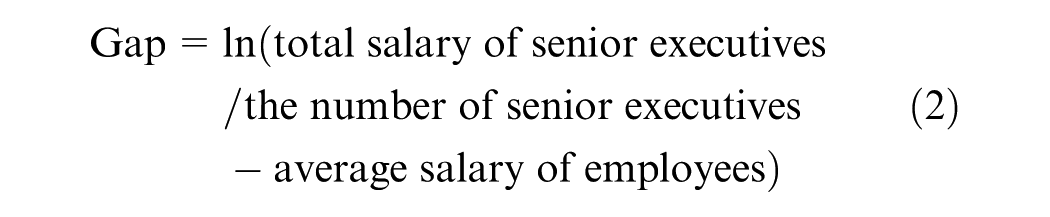
In Equation (2), the average salary of employees is calculated as in Equation (1).
The Strength of the Local Social Network
Following prior literature (Liu, 2022), this paper employs the local population density of the city in which a listed firm is located to measure the local culture that a firm faces. Specifically, the city’s local population density is measured by the ratio of the registered population to the resident population. The registered citizens have household registration permit belonging to the city. And resident population includes both the migrant resident population and the local resident population.
Control Variables
Following prior literature (Liu, 2024), this paper also controls other factors that may affect employees’ salaries. For firm characteristics, control variables include Size (natural logarithm of total assets), Lev (total liability divided by total assets ), Roa (return on assets), CI (capital intensity, i.e. total assets divided by sales), BM (book-to-market ratio), BoardSize (natural logarithm of one plus the total number of directors on board ), Dual (dummy variable that equals one if the chairman also acts as the CEO), Lshare (the shareholding ratio of the largest shareholder), and SOE (dummy variable equals one if a firm is state-owned enterprise). For the outside environment, control variables include HHI (Herfindahl-Hirschman Index), Marketization (Fan Gang marketization index), and LnGdp (natural logarithm of the gross domestic product of the city that the firm is located in). Besides, this paper also controls factors that may influence employees’ motivation, including Protection (employee protection, measured through whether the firm discloses employee protection terms in CSR report), and Remapp (dummy variable equals one if a firm establishes a remuneration committee).
Empirical Model
Following Lu et al. (2012), this paper conducts an ordinary least squares (OLS) regression as follows to examine the impact of local social networks on employees’ salaries.

In Equation (3), the subscripts i and t denote firm and year, respectively. The dependent variable is the average salary of employees measured by the variable LnPay, and the independent variable is the strength of the local social network of the firm’s headquarter, measured by the variable SN. Control variables include firm’s size (Size), asset-liability ratio (Lev), return on assets (Roa), capital intensity (CI), book-to-market ratio (BM), board size (BoardSize), Chairman-CEO duality (Dual), the shareholding ratio of the largest shareholder (Lshare), government ownership (SOE), industry concentration (HHI), degree of marketization (Marketization), local economic development (LnGdp), employee protection (Protection), and whether establish a remuneration committee (Remapp).
Regional factors such as the region’s economic development level may affect the social network and wage levels, forming a common factor influence and leading to endogeneity issues. To alleviate the endogeneity issues, this paper not only controls the level of regional economic development (LnGdp) but also adopts province-fixed effects. In addition, this paper also examines the endogeneity issues in robustness checks. Besides, this paper also adopts year-fixed and industry-fixed effects in Equation (3).
Following Chen et al. (2012), this paper conducts an ordinary least squares (OLS) regression as follows to examine the impact of local social networks on employees’ pay-performance sensitivity.

In Equation (4), the main independent variable of interest is the interaction of SN and Performance (SN*Performance). Its coefficient captures the impact of the strength of local social networks on employees’ pay-performance sensitivity. According to H2, a significantly negative coefficient is expected. The dependent and control variables in Equation (4) are the same as those in Equation (3).
To empirically test the impact of local social networks on the pay gap between senior executives and employees inside the firm, this paper employs Equation (5) as follows.

In Equation (5), the dependent variable is the pay gap between senior executives and employees, measured by the variable Gap. The independent and control variables in Equation (5) are the same as those in Equation (3).
Besides, to further examine the impact of local social networks on the motivation system of employees with different salaries, this paper also adopts quantile regressions to test the main hypotheses, and the regression model is specified as follows:

In Equation (6), the dependent variable is the kth percentile (k ∈{10, 25, 50, 75, 90}) of employees’ salary, and the independent variables are the same as the ones in Equation (2) and Equation (3) respectively.
Results
Descriptive Statistics
Table 1 presents descriptive statistics for the variables used in the paper. It can be seen from the statistical values of the variable LnPay that the average annual salary of employees in the sample is CNY91500 (exp(11.424) = 91500). The employees with the lowest salary only receive CNY26849 per year, while the highest salary can achieve CNY315211 per year, nearly twelve times the minimum value. The mean value of the variable Gap is 13.054, that is, on average, the salary gap between senior executives and non-executive employees is about CNY467000. The narrowest gap between senior executives and employees is CNY60900, while the largest gap can reach CNY3949100. That is, the motivation systems of employees of different firms can be quite different. The mean value of the variable SN is 0.765, that is, on average, the local population accounts for about 76.5% of cities in China. The city with the lowest local population ratio is Dongguan, where the local population accounts for only 25.3%. In such cities with weak local social networks, there will be more employees from other cities in listed firms as well. Besides, about 19.51% of the sample value of variable SN reaches 1, that is, in nearly 20% of the firms in the sample, their employees are mainly local citizens.
Descriptive Statistics.

The Impact of Local Social Networks on Employees’ Salaries
Table 2 reports the results of Equation (3) and Equation (6). In Column (1), the coefficient of variable SN is positive but not statistically significant. However, in the quantile regressions, in Column (2), the coefficient of variable SN is negatively significant at the 5% level. In contrast, in Column (5) and Column (6), the coefficients of variable SN are positively significant at the 10% level. The quantile regression results suggest that a closely connected local social network can increase the salaries of employees with higher income while decrease the salaries of employees with lower income. One possible reason for the negative effect of local social networks may be that a closely connected local social network may force the local firm to employ more low-skilled workers to solve their employment problem, this will lower the average salary of employees on the whole. While for the employees with higher income, the closely connected local social network can further strengthen their bargaining power and gain more payment.
The Impact of Local Social Network on Employees’ Salary.

Note. T-statistics are reported in parentheses.
p < .10, **p < .05, ***p < .01.
The Impact of Local Social Networks on Employees’ Pay-Performance Sensitivity
Table 3 reports the results of Equation (4) and Equation (6). In Column (1), the coefficient of the interaction term SN*Performance is significantly negative at the 1% level, suggesting that a closely connected local social network can decrease the pay-performance sensitivity of employees. In Column (2)-Column (4), the coefficients of the interaction term SN*Performance are all positively significant at 1% level, while at the 75th percentile and 90th percentile of employees’ salary, the coefficients of SN*Performance are not significant. That is, the negative effect of local social networks mainly exists among employees with lower incomes. The regression results suggest that due to concerns about mianzi (face) or interest conflicts that social network brought about, firms cannot adjust the salary policies efficiently. This may harm the improvement of the firm’s motivation system and long-term development.
The Impact of Local Social Network on Employees’ Pay-performance Sensitivity.

Note. T-statistics are reported in parentheses.
p < 0.10, **p < 0.05, ***p < 0.01.
The Impact of Local Social Networks on the Pay Gap Between Senior Executives and Employees
Table 4 reports the regression results of Equation (5). The coefficient of variable SN is negatively significant at the 1% level. That is, closely connected local social networks can significantly narrow the pay gap between senior executives and employees inside the firm. Strong local social connections can force managers to pay more attention to fairness inside the firm and actively avoid overpaying themselves to some degree. The regression results are consistent with the third hypothesis.
The Impact of Local Social Network on the Pay Gap Between Senior Executives and Employees.

Note. T-statistics are reported in parentheses.
p < .10, **p < .05, ***p < .01.
Robustness Checks
To make assurance of the robustness of the research findings, this paper also conducts a series of robustness checks as follows:
Instrumental Variable (IV) Approach
In addition to employing province-fixed effect in the models, this paper also adopts an instrumental variable approach to mitigate potential endogeneity. Following prior literature (Greif & Tabellini, 2017; Zhang, 2020), this paper employs the clan culture, measured by the number of genealogies per million people of the city, as the IV for SN. The local clan culture can form a closely connected social networks subtly influence local culture. The number of genealogies can reflect the strength of local clan culture. While genealogy is formed in a long history, thus it is unlikely to be related to employees’ salaries at present. The 2SLS regression results (see Table 5. Panel A) show that the main research findings are robust.
Robustness Checks.

Note. T-statistics are reported in parentheses.
p < .10, **p < .05, ***p < .01.
Drop Firms Implementing Equity Incentives Policies
As equity incentives can influence the pay gap between senior executives and employees, this can also directly influence employees’ salaries. Thus, in robustness checks, this paper drops the firms implementing equity incentives policies and re-regresses the main models. The sub sample regression results (see Table 5, Panel B) show that the main research findings are robust.
Drop Firms Located in the Political and Financial Center of China
To deal with the specialties of the political and financial center of China, that is, Beijing and Shanghai, this paper drops the firms located in Beijing and Shanghai and re-regresses the main models in robustness checks. The sub sample regression results (see Table 5. Panel C) show that the main research findings are robust.
Further Analysis
Local Chairman Versus Non-local Chairman
Against the bargaining power of employees, the local connections of the firm’s core leaders can also make a difference in employees’ salaries. Compared to a local leader, a non-local leader, such as the chairman from another province, may suffer information disadvantage and give in to his (or her) employees to some degree. Therefore, it is necessary to analyze the different impacts of local social network strength on employees’ motivation systems in firms whose chairman is a local citizen and those whose chairman is from other provinces. Thus in further analysis, this paper re-regresses Equation (3) - Equation (5) in sub samples of firms with local chairpersons and firms with non-local chairpersons, respectively.
Table 6 reports the sub sample regression results. In Column (1) and Column (3), the coefficients of key independent variables, SN and SN*Performance, are not significantly positive. While in Column (2) and Column (4), the coefficients of key independent variables, SN and SN*Performance, are significant at the 1% level. That is, in a firm with a non-local chairman, the power of local social networks can be stronger, and employees can be more powerful due to the closely connected local social networks.
Local Chairman Versus Chairman From Other Provinces.

Note. T-statistics are reported in parentheses.
p < .10, **p < .05, ***p < .01.
SOEs Versus Non-SOEs
Unlike Non-SOEs, which focus on maximizing shareholders’ profits, SOEs are required to maintain social stability and provide employment as the objective of governments (Ma et al., 2018). Besides, SOEs also pay more attention to fairness in the assignment and have a different salary system from Non-SOEs. For example, the government-imposed executive compensation limit regulation for the SOEs, which was issued and implemented in 2016, restricts SOE leaders’ basic annual salary to within twice the average salary of employees. Therefore, it is necessary to analyze the different impacts of local social network strength on employees’ motivation systems in SOEs and Non-SOEs. Thus in further analysis, this paper re-regresses Equation (3) to Equation (5) in sub samples of SOEs and Non-SOEs, respectively.
Table 7 reports the sub sample regression results. The difference between SOEs and Non-SOEs mainly reflects in the employees’ salaries. In Column (1), the coefficient of variable SN is negatively significant at the 1% level, while in Column (2), the coefficient of variable SN is positively significant at the 1% level. That is, closely connected local social networks can make a different impact on employees’ salaries in SOEs and Non-SOEs, and the strong local social network has a negative effect on employees’ salaries in SOEs. This can be partly explained by the high salary and excessive employment in SOEs.
SOEs Versus Non-SOEs.

Note. T-statistics are reported in parentheses.
p < .10, **p < .05, ***p < .01.
On the one hand, employees in SOEs are blessed with higher average salaries than Non-SOEs. In the sample used in this paper, the average annual salary of employees in SOEs is CNY113200, while the average annual salary of employees in Non-SOEs is CNY98700. That is, SOEs have provided higher salaries and the additional effect of social networks can be limited. On the other hand, due to the higher salary and stable career prediction, SOEs can be more attractive to potential employees. Then, closely connected local social networks may pressure acquaintances who are powerful in SOEs to employ them. At the same time, the leaders in SOEs can also gain personal social capital from employment. That is, closely connected local social networks may push the firm to employ excessive staff, thus lowering the average salary.
The Moderating Effect of Marketization
Traditional societal structure in China can interpret the great influence of local social networks in economic activities to some degree (Fei, 1992). However, the development of marketization has changed the traditional societal structure step by step. As a result, the power of local social connections may also fade in the areas that have been highly marketized. That is, in regions with different marketization levels, the influence of local social networks on economic behavior and decision, including the relationship between employers and employees, can be quite different. Thus, this paper takes the score of marketization in the Marketization Index of China’s Provinces: NERI Report 2021 (Wang et al., 2021) to measure the marketization level of different provinces. If a firm is located in a province whose marketization index is lower than the median value of the year, then the firm will be classified into the group of low marketization. And the others will be classified into the group of high marketization. Based on the level of marketization, this paper re-regresses Equation (3) to Equation (5) in sub samples, respectively.
Table 8 reports the sub sample regression results. In Column (2), Column (4), and Column (6), the coefficients of key independent variables are all significant at the 1% level. That is, the development of formal institutions cannot substitute for the effect of local social networks in a short time.
The Moderating Effect of Marketization.

Note. T-statistics are reported in parentheses.
p < .10, **p < .05, ***p < .01.
The Moderating Effect of Market Competition
For firms facing different strengths of market competition, their cost pressure and the employee motivation system can be quite different as well. For firms faced with fierce market competition, the market competition may overwhelm the social pressure, and weaken the effect of local social networks. Therefore, it is necessary to analyze the different impacts of local social networks on employees’ motivation in firms faced with fierce competition and those with mild competition. Following prior literature (Chen et al., 2020), I measure the market competition by Herfindahl-Hirschman Index and classify the firms with HHI lower than the median value of the year to the Low HHI group, which are reckoned to face fiercer competition, and those with HHI higher than the median value of the year are classified to the High HHI group, and based on this, this paper re-regresses Equation (3) to Equation (5) in sub samples, respectively.
Table 9 reports the subsample regression results. In Column (1), the coefficient of variable SN is not significant, while in Column (2), the coefficient of variable SN is positively significant at the 1% level. That is, the positive effect of local social networks on employees’ salaries mainly exists in firms faced with milder market competition. Besides, there is little difference between firms faced with fierce competition and those faced with mild competition when it comes to pay-performance sensitivity and the pay gap between senior executives and employees.
The Moderating Effect of Market Competition.

Note. T-statistics are reported in parentheses.
p < .10, **p < .05, ***p < .01.
Conclusions
Using empirical data from China, this study examines the impact of local social networks on employees’ motivation systems. The main findings are as follows: (a) Closely connected local social networks can strengthen the bargaining power of employees and improve the average salary of employees. This effect can be more significant in firms with non-local chairpersons, Non-SOEs, firms located in provinces with a lower level of marketization, and firms faced with mild market competition. (b) Closely connected local social networks can reduce employees’ pay-performance sensitivity. The effect can be more significant when the chairman is non-local. (c) Closely connected local social networks can narrow the pay gap between senior executives and employees inside the firm. This effect commonly exists in different sub samples.
Footnotes

Funding
The author disclosed receipt of the following financial support for the research, authorship, and/or publication of this article: This research was supported by NSFC grant 72121001, 72302067.
Declaration of Conflicting Interests
The author declared no potential conflicts of interest with respect to the research, authorship, and/or publication of this article.
Data Availability Statement
The data presented in this study are available on request from the corresponding author.