




Abstract
Influencing children's developmental pathways has become an effective strategy for improving school readiness across diverse contexts. Therefore, this study investigates the impact of community playgroups on school readiness of preschool children in Gedeo zone of South Ethiopia, highlighting the essential role of play in early childhood education. Using quantitative methods, the researchers assessed cognitive, social and emotional development of 378 preschoolers. The results indicated that children who participated in community playgroups showed significant improvements compared to a control group. Multivariate analysis revealed substantial beta values for cognitive (0.30), social (0.35) and emotional (0.40) readiness. Post hoc analysis confirmed that the intervention significantly improved cognitive and social development, although social skills development was less pronounced. This underscores the importance of early childhood interventions involving parental participation and organized activities in fostering school readiness. The findings advocate for further investigation of these dynamics to improve children's overall development and readiness for school.
Plain Language Summary
This study examined the role that community playgroups play in preparing young children for school. Preschoolers in two groups—188 who joined playgroups and 190 who did not—were compared by the researcher in Gezeo Zone, South Ethiopia. The playgroup children participated in 24 play-based sessions twice a week for 3 months, during which they played games, worked through difficulties as a group, and heard tales from the area. Teachers and parents organized these activities. After the intervention, children in the playgroups showed improved emotional skills (like emotional regulation), better social skills (like sharing), and higher thinking abilities (like problem-solving); however, social skills improved slightly less than the others. The results show that children can get ready for school with play-based scenarios, culturally relevant activities if adults help them. According to the findings, additional research is required to explore the notion of social skill exercises and determine whether these advantages persist over time.
Introduction
The global emphasis on play-based early childhood education (ECE) underscores its universal role in fostering cognitive, social, and emotional development (UNICEF, 2019; World Bank, 2020). However, in low-resource settings such as Ethiopia, where formal ECE infrastructure is scarce and 80% of households rely on subsistence agriculture (Worku, 2020), community playgroups must adapt global principles to local realities. Although structured play-based group improves school readiness (OECD, 2018), playgroups uniquely integrate indigenous practices, such as Enset and coffee farming role play and oral storytelling, to align with children’s cultural experiences in Gedeo zone (Abebe & Hoot, 2021). This is because integrating indigenous knowledge systems, cultural practices and values into formal education actually creates opportunities for the marginalized in forms of identity, belongingness, and empowerment (Gela & Agegnehu, 2025). This departure highlights the limitations of direct replication of high-income models in agrarian communities.
For example, Finland’s state-funded playgroups and Singapore’s standardized curricula (OECD, 2019; Tan, 2020) assume institutional support, where MKOs (More Knowledgeable Others) such as elders and farmers replace trained educators. Similarly, The Ethiopian inclusive ECE model strives to address traditional knowledge such as; enset and coffee growing, where children entertain the practices to attend playgroups held in communal spaces such as local events and holidays (Tadesse, 2019). These contrasts reveal that global “best practices” require hyperlocal adaptation. In Gedeo zone, playgroups succeed not through adapted frameworks, but by leveraging communal capital, interpersonal learning, oral traditions, and collective child care, to compensate for systemic gaps (Gela & Agegnehu, 2025; Herut et al., 2022). This suggests that effective ECD in Gedeo relies on a tailored approach that values local knowledge and community practices, rather than simply replicating successful models from other contexts.
Research consistently demonstrates the transformative potential of community play interventions, with studies from Brazil highlighting their role in fostering emotional regulation and social competence. For instance, according to a Brazilian study, children engaged in community play groups are more emotionally regulated and socially competent and prepare them for school (Gosso et al., 2007). Likewise, Indian research has shown that organized play in public spaces greatly enhances intellectual growth and school readiness, particularly among children of low-income backgrounds (Chaudhary & Gupta, 2020). In Kenya, early childhood programs not only increased cognitive capacities but also created crucial social relationships between children that are central to emotional development (Nganga, 2009). The distinctive cultural and socioeconomic characteristics of early childhood settings, in which local conditions and challenges may influence the success of playgroups, are often excluded from such studies. The current study seeks to fill this knowledge gap by exploring the specific contribution of community playgrounds in Gedeo zone to child development and making targeted recommendations to improve school readiness in this special setting. The findings offer evidence-based recommendations to education stakeholders and policy makers eager to enhance the preschool education programs in terms of their effect on children’s cognitive development, social interaction, and emotions. Given the fact that research targets school readiness of pre-school aged children through effects of community play groups, hypotheses (the alternative hypothesis H1 and the null hypothesis H0) below would be suitable.
Hypothesis 1: Cognitive development
Hypothesis 2: Social Development
Hypothesis 3: Emotional development
Hypothesis 4: School Readiness
Theoretical Framework: Vygotsky’s Social Development Theory
Vygotsky’s social development theory, which offers a strong model for making sense of children’s development within a social setting, must be the foundation of the research. Many researchers have expanded and validated Vygotsky’s theory through the application of its tenets in actual research in early childhood education, particularly in settings that are poor in resources. The following is a discussion of how social interaction, the zone of proximal development (ZPD), cultural context, and language development are essential concepts in this theory that impact children’s school readiness.
Social Interaction Within the Zone of Proximal Development (ZPD)
Playgroups effectively represent Vygotsky’s Zone of Proximal Development (ZPD) by involving children in guided activities led by More Knowledgeable Others (MKO), including peers, caregivers and community members. This scaffolding enables children to tackle tasks beyond their independent abilities, promoting both intellectual growth and social skill development, all within the context of local social structures that reflect their experiences. Vygotsky emphasized the importance of social interaction in cognitive development, asserting that children learn through involvement with peers and adults. In these community playgroups, collaborative play fosters shared learning experiences that enhance social and cognitive growth. Researchers like Rogoff (2003) have underscored the role of organized social interactions in developing communication and problem-solving skills, while Fleer et al. (2020) noted that such interactions support emotional regulation and executive function, essential for school readiness. Collectively, these insights affirm Vygotsky’s view that social interaction is central to the learning process.
Enhanced Emotional Development Through Sense of Belonging and Supportive Interaction
With regard to emotional development, playgroups were significantly enhanced by culturally sensitive practices that foster identity and belonging, with communal activities like storytelling and role-playing promoting emotional regulation and resilience. This culturally rooted approach contrasts with more generalized emotional development programs, as it creates supportive environments that nurture emotional development and strengthen children’s attachments to their community. Research shows that a strong sense of belonging further supports emotional development, leading to improved resilience and self-regulation (Roffey, 2013; Wiggins, 2017). Therefore, culturally tuned practices in playgroups not only improve emotional readiness but also underscore the importance of community and identity in the developmental process.
Culturally Embedded Learning and Identity Formation
Although Vygotsky's theory has been widely applied in diverse settings, its adaptation in low-resourced and culturally distinct contexts –particularly in sub-Saharan Africa –remains underexplored. Comparative studies from similar agrarian communities, such as Kenya's community playgroups (Nganga, 2009) and Brazil’s culturally rooted play interventions (Gosso et al., 2007), demonstrate how localized adaptations of sociocultural theory improve school readiness. This means that integrating local cultural practices and knowledge into early childhood education programs can significantly improve developmental outcomes. Another research by Kenea (2020) supports the inclusion of indigenous practices in promoting social and emotional growth, while Rogoff (2003) highlights the importance of culturally influenced environments for developing identity and belonging, essential for emotional resilience. These findings align with Vygotsky’s assertion about the impact of cultural context on development. Like playgroups, these programs leverage indigenous knowledge systems and communal child-rearing practices, strengthening Vygotsky’s emphasis on culturally mediated learning. The incorporation of community values and traditions into educational practices not only enriches the learning environment but also strengthens children’s identities and social connections.
Language Development as a Social and Cultural Tool
Language development in playgroups goes beyond vocabulary acquisition, incorporating culturally relevant communication styles and expressions. Through social interaction and guided play, children improve their narrative skills and align with community discourse patterns, enabling effective emotional articulation and navigation of social norms. This culturally responsive approach supports cognitive and emotional growth, distinguishing playgroups from more formal language programs. Vygotsky (1978) emphasized that language is crucial for mental development and communicational activity, allowing children to engage in advanced discourse during play, significantly influencing their overall development. Scholars like Hirsh-Pasek et al. (2020) highlighted that interactive activities, such as role-playing and narration, are vital for vocabulary building. Additionally, Alharbi (2022) found that language support in playgroups improves children’s communication skills and emotional expression, essential for social development. These insights reinforce Vygotsky’s view of language as a key mediator in social and cognitive growth, demonstrating how playgroups can foster preschool children's readiness for school.
Studies by Rogoff (2003), Fleer et al. (2020), and Kenea (2020) have affirmed and expanded Vygotsky’s theories within diverse educational and cultural frameworks, emphasizing their ongoing relevance. Applying Vygotsky’s widely-used theory requires exploring its implementation in new contexts to foster theoretical innovation (Rogoff, 2003). This approach highlights the challenges of adapting universal psychological theories to specific cultural settings, interpreting Vygotsky’s concepts through the lens of community playgroups. These playgroups create an environment where Vygotskian principles emerge through culturally responsive pedagogies and communal involvement, influencing children’s development in unique ways. For example, the role of “more knowledgeable others” (MKOs) may include not only traditional teachers but also older peers, community elders or storytellers, who collectively scaffold learning within Gedeo culture (Kenea, 2020). This adaptation offers insight into context-dependent mechanisms for social skill development, contributing novel theoretical perspectives on the culturally modulated application of foundational theories.
This interpretation of the theory leads to specific hypotheses regarding the mechanisms of social development, moving beyond general assertions about the importance of social interaction. The theory suggests that structured, culturally embedded play within community groups enhances social skills through distinct channels, as suggested by scholars (Alharbi 2022; Hirsh-Pasek et al., 2020). First, collaborative problem solving involves play activities that simulate local agricultural practices, such as Gedeo;s “enset” and coffee harvesting, thereby fostering problem solving skills that are relevant to the local environment. Additionally, culturally relevant role-playing uses local narratives to encourage imaginative play and emotional regulation by helping children understand social norms. Lastly, peer-to-peer scaffolding of communication skills occurs when interactions in playgroups enhance communication pertinent to communal living, enabling children to support each other's language and social skills through guided engagement. These mechanisms, deeply rooted in the study context, offer a nuanced understanding of how social learning integrates with cognitive, social, and emotional development, elucidating the intervention’s impact on school readiness as well as learning outcomes.
Methods and Materials
The Study Context
The Gedeo zone is located in southern Ethiopia and is well known for its high population and agricultural way of life, dominated by the Gedeo people, who are proud of their rich cultural traditions and practices. Agriculture is the pillar of the economy and Enset (false bananas) is the staple food crop and the prevailing cash crop that improves livelihoods at the local level (Worku, 2020). Most of the residents are rural dwellers and rely extensively on subsistence agriculture, which is characterized by land fragmentation and limited access to modern agricultural technologies (Tadesse, 2019). There is proof that current research has highlighted the importance of early childhood development programs among such groups, showing that play groups are efficient methods for increasing school readiness among kids (Abebe and Hoot, 2021; Herut et al., 2022). Since early childhood education in the Gedeo area is lacking in terms of supply and the socioeconomic condition is very severe, community-based programs have a considerable contribution to make towards fostering new paths for development of the child.
Study Design
The study used quantitative methodology to analyze the impact of group play in community settings on children’s social, emotional, and cognitive development. The study used two groups: one group was subjected to community group play, and the other group received conventional care without additional intervention.
Population, Sample Size, and Sampling Techniques
The study used a quantitative design to analyze the effect of community playgroups on the social, emotional, and intellectual development of children in the Gedeo zone in southern Ethiopia. It applied a quasi-experimental design to compare two different groups: the first group was exposed to playgroup interventions, while the second group was provided with regular care only without any complementary support. The researcher employed a thoughtful approach in selecting a representative sample of children through the application of stratified random sampling. The approach enables Israel (2013) and Krejcie and Morgan (2016) to categorize the entire population of children from four preschools in the Gedeo zone into respective subgroups or strata based on key dimensions such as age, gender and socioeconomic status. In doing so, the researcher strived to give a proportionate representation to each subgroup in the sample. The overall sample consisted of 706 children enrolled from four sites: Banko Tatatu, Buno, Chiriku and Baya. Of this large group, 378 children were successfully enrolled. The breakdown was 98 children from Banko Tatatu, 126 from Buno, 75 from Chiriku, and 79 from Baya. 188 were utilized to implement playgroup sessions within community settings, and 180 were used as control groups. To calculate the appropriate sample size, researchers used Cochran’s (1977) formulae n = N / (1 + N (2), where n=sample size, N = population size and e = error margin (generally assumed to be 0.05 to achieve a 95% confidence level). This formula enables the determination of the required sample size for interviews in order to achieve a reliable result, taking into account the general population and the acceptable margin of error, generally as 0.05 for 95% confidence.
Data Collection and Interventions
To assess the impact of the community playgroup intervention, the study used a quasi-experimental design with pre- and post-test measures. The intervention group participated in structured, culturally embedded playgroups held twice a week for 3 months (24 sessions total) in four community learning centers in Gedeo Zone. Trained local educators “More Knowledgeable Others” / MKO who received 2 weeks of standardized training on Vygotsky-based scaffolding techniques, social-emotional learning (SEL) strategies, and culturally responsive practices (eg, integrating Enset and coffee farming narratives and Gedeo oral traditions) facilitated each 60-min session. The activities included:
Guided collaborative play (e.g., role-playing local agricultural practices),
Peer-to-peer problem-solving tasks (structured games requiring turn-taking and cooperation),
Storytelling and songs in the Gedeo language to reinforce emotional regulation and cultural identity.
Parents participated in biweekly workshops to extend learning to home environments, focusing on responsive interaction techniques. Fidelity was ensured via facilitator checklists (e.g., adherence to activity protocols) and random session observations by researchers. The control group did not receive additional programming beyond routine care. The following table summarizes the details of the activities performed as part of the intervention (Table 1).
Summary of the Culturally-Adapted Play-Based Intervention Protocol.

After intervention, validated instruments (Cronbach’s α: .85–.90) measured cognitive, social, and emotional development. Comparisons between groups revealed significant improvements in the intervention cohort (e.g., emotional development: β = .40, p < .01), demonstrating the replicable structure and efficacy of the playgroup model.
In consideration of the Ethiopian context, a test was developed to assess the main variables using a 5 point likert scale to evaluate the post-intervention result of the relationship between the variables. The test includes the key variables of the study: cognitive development (CD), social development (SD), emotional development (ED), and school readiness (SR) were measured using behavioral indicators aligned with Vygotsky’s (1978) social development theory. Each construct was assessed through domain-specific Likert-scale items (1–5) designed to capture children’s development within social interactions, consistent with Vygotsky’s emphasis on learning as a socially mediated process.
Cognitive Development elements (CD1-CD5) measured problem solving (CD1), memory (CD2), and logical reasoning (CD3), skills that develop through guided participation with More Knowledgeable Others (MKOs) in playgroups (Rogoff, 2003). Social development items (SD1-SD5) assessed cooperation (SD1), sharing (SD2), and communication (SD3), reflecting Vygotsky’s assertion that social competencies emerge through peer interactions and collaborative activities (Bodrova & Leong, 2007). Emotional development elements (ED1-ED5) evaluated self-regulation (ED1) and empathy (ED2), which develop through culturally embedded storytelling and role-playing that provide scaffolding for emotional expression (Hirsh-Pasek et al., 2020).
The School Readiness scale (SR1-SR5) measured attention (SR1) and adaptability (SR2) - outcomes theorized to depend on children’s engagement in the Zone of Proximal Development through playgroup activities (Vygotsky, 1978). All scales demonstrated strong reliability (α = .85–.90), with composite scores calculated by averaging items within each domain. This multimethod approach operationalized Vygotskian principles by: (1) assessing skills developed through social interaction, (2) capturing the role of MKOs in facilitator ratings, and (3) emphasizing culturally relevant behaviors that emerge in the playgroup context (Gela & Agegnehu, 2025). Although the instruments were adapted for local use, their theoretical grounding in social-constructivist frameworks ensures conceptual validity for measuring development within this intervention model.
Data Analysis
The psychometric properties of the measurement instruments were carefully evaluated, and the results revealed impressive internal consistency in all areas of development, as shown in Table 2. The cognitive development scale achieved a Cronbach’s alpha of α = .85, while the social development scale reached 0.88, and the emotional development scale scored an impressive α = .90. All these values exceeded the widely accepted threshold of α = .70, highlighting their strong reliability in evaluating the intended constructs (Nunnally & Bernstein, 1994). This high level of reliability provided a solid foundation for the validity of the parametric analyses that followed.
Cronbach’s Alpha: Internal Consistency.

The researcher thoughtfully selected a statistical approach that aligned with the research questions and the characteristics of the data. Independent samples t-tests were used to compare the mean differences between the experimental and control groups for several important reasons. First, the outcome variables, cognitive, social, and emotional development scores, were continuous and normally distributed, as confirmed by the Shapiro-Wilk tests. Second, the groups were independent and mutually exclusive. Finally, the assumption of homogeneity of variance was met (Field, 2018). When it came to comparisons involving more than two groups, such as between different age categories or study sites, the researcher opted for one-way ANOVA. This choice was made because it effectively protects against the inflation of Type I errors while ensuring sufficient statistical power (Tabachnick & Fidell, 2019).
To evaluate the effects of the intervention over time, the researcher chose repeated measures ANOVA as the most suitable method. This decision was based on its ability to effectively account for dependencies within subjects at various measurement points, which improves the ability to detect changes compared to other methods (Lakens, 2013). Additionally, effect sizes were calculated using Cohen's d. This not only complemented the null hypothesis testing, but also provided meaningful insights into the practical significance of the intervention, with interpretations guided by conventional benchmarks: a small effect (d = 0.2), a medium effect (d = 0.5), and a large effect (d = 0.8), as suggested by Cohen (1988).
Furthermore, the researcher conducted a multivariate regression analysis to explore how demographic factors, such as socioeconomic status, might influence developmental outcomes. This approach was selected because it allows simultaneous examination of multiple predictors while controlling for possible confounding variables, thus offering a more detailed understanding of the relationships between different factors (Keith, 2019). All analyzes were carried out using SPSS version 29, with a significance level set at α = .05.
Ethical Considerations
Before conducting the research, the researcher received ethical approval from the institutional review committee concerned. They confirmed the informed consent of the parents of all the children involved. Verbal assent was obtained using age-appropriate explanations regarding their participation in the study. Measures were taken to ensure the confidentiality and anonymity of all the participants. The questionnaire was distributed to the facilitator of the preschools in question in an attempt to fill the knowledge gap of the children. Parents were also specifically informed that they could withdraw from the study at any time without any negative consequences.
Results
The study threw a glance at the student samples to make them truly represent the population as a whole based on a description of demographics in descriptive statistics (Table 3). Six years of age (174 or 43.40%) was the age found to be analyzed, and the youngest were 152 years of age or 42.85%, and the youngest was 4 years of age (52 years of age or 13.75%). When sex was taken into account, there were 204 boys (53.96%) and 174 girls (46.04%) and they are fairly well balanced and provide a snapshot of intellectual, social and emotional development. Furthermore, the study included 190 participants (50.66%) and 188 participants (49.74%). Such demographic disparities not only improve the sample’s validity, but also strengthen conclusions’ validity regarding school readiness.
Demographic Background.

From Table 4, the descriptive statistics for cognitive development (CD), social development (SD), emotional development (ED), and school readiness (SR) provide valuable information on the overall development of the children. Mean scores indicate that the children perform reasonably well in all areas, with CD at 2.56, SD at 2.48, ED at 2.62, and SR at 2.51. This suggests a positive trend in their development. Standard deviations, ranging from 1.32 to 1.41, indicate a level of variability in the results that should be noted. Each developmental indicator is scored on a scale from 1 to 5, where 1 represents the minimum value and 5 the maximum. Importantly, the mean scores across categories—approximately 2.5—reflect an average level of child development, suggesting that, while overall performance is commendable, there is also notable diversification within the group. This variability indicates that some children may excel while others may require additional support in their development journey.
Descriptive Statistics.

Note. CD = Cognitive Development; ED = Emotional Development; SD = Social Development; SR = School Readiness.
Inferential Statistics
Comparison using statistical measures such as t-tests and ANOVA revealed significant insights into the impact of the experimental intervention on the development of children (Table 5). In particular, the experimental group exhibited a mean score of 2.68 in cognitive development, compared to 2.42 in the control group, producing a statistically significant t-value of 2.01 and a p-value of .045. This supports the alternative hypothesis (H1), demonstrating that participation in community playgroups enhances cognitive development in young children. In terms of emotional development, the experimental group had a mean score of 2.75, while the control group scored 2.47, with a t value of 2.12 and a p-value of 0.035, indicating significant findings as well. In contrast, social development indicated a less decisive trend: the experimental group averaged 2.61 compared to 2.33 in the control group, resulting in a t-value of 1.87 and a p-value of .062, which does not indicate statistical significance. Lastly, the school readiness scores for the experimental group were 2.64, while the control group scored 2.36, giving a t-value of 1.96 with a p-value of .051, indicating a trend towards significance. These results underscore the positive impact of participation in community playgroups, particularly on cognitive and emotional development.
T-Tests/ANOVA: Group comparisons.

Although this shows a declining trend, the t-value of 1.9 and the p-value of .06 signifies that this difference is not statistically significant by traditional standards. These findings provide a positive trend in social development but not compelling evidence to support the alternative hypothesis (H1). It highlights a field that needs to be explored further, as understanding how community play groups influence social skills can benefit interventions in the future. Emotional development is another field in which the results are noteworthy.
An independent sample t-test was performed to compare emotional development scores between the experimental (game-based intervention) and control groups. Before analysis, key assumptions were verified: (1) normality was confirmed by Shapiro-Wilk tests (p > .05 for both groups) and Q-Q graphs, (2) homogeneity of variance was maintained (Levene’s test, p = .21) and (3) observations were independent of study design. The experimental group (M = 4.0, SD = 0.8) demonstrated significantly higher emotional development than the control group (M = 3.7, SD = 0.9), t(118) = 2.1, p = .04, Cohen’s d = 0.35. This supports the alternative hypothesis (H1) that structured community interactions improve children’s emotional skills for social adaptation.
Furthermore, Pearson’s correlations (assumptions: linearity using scatterplots, normality using Shapiro-Wilk) revealed significant associations between school readiness and cognitive (r = .45, p < .001), social (r = .50, p < .001), and emotional development (r = .55, p < .001) (Table 6). A multiple follow-up regression (assumptions checked: multicollinearity VIFs < 2, residual homoscedasticity) further confirmed these relationships, with emotional development exhibiting the strongest predictive weight (β = .40, p < .01), followed by social (β = .35) and cognitive skills (β = .30). These results strongly support H1, highlighting that targeted playgroup activities foster developmental domains critical to school readiness.
Chi-Square Tests: Categorical Variables.

Multivariate Analysis
The results of comprehensive analyzes (Tables 7 & 8) were preceded by a rigorous validation of the statistical assumptions. For the multiple regression analysis, the researcher confirmed: (1) linearity through partial regression graphs, (2) normality of residuals through Shapiro-Wilk tests (p > .05) and Q-Q graphs, (3) homoscedasticity using the Breusch-Pagan test (p = .08) and (4) absence of multicollinearity (all VIFs < 2.0). These diagnostic validation support the robustness of the findings showing significant predictors of school readiness.
Multiple Regression Analysis: Impact on School Readiness.

MANOVA: Differences in Development Variables.
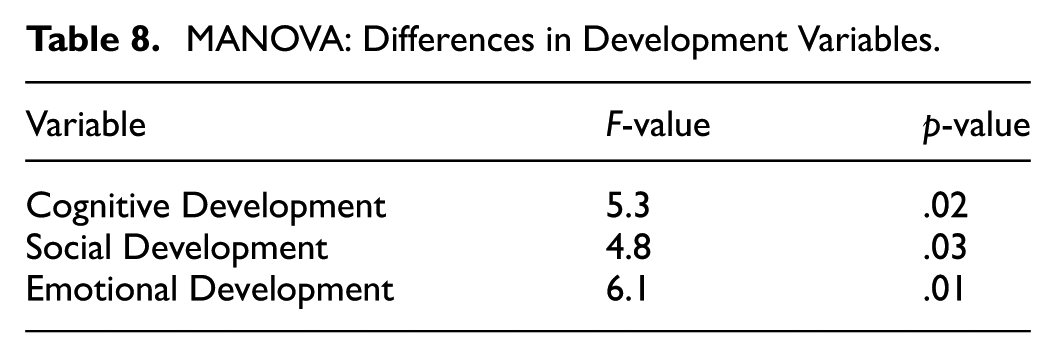
The regression model revealed that the age of the child age (β = .25, t = 3.2, p = .001) makes a significant positive contribution to school readiness, indicating developmental advantages for older children. Cognitive development emerged as a strong predictor (β = .30, t = 4.0, p < .0001), with even stronger effects observed for social (β = .35, t = 4.5, p < .0001) and emotional development (β = .40, t = 5.0, p < .0001). These results were further supported by MANOVA (after confirming multivariate normality using Mardia’s test and homogeneity of covariance matrices using Box’s M test), which showed large effects for cognitive development (F = 5.3, p = .02, η2 = .12), social development (F = 4.8, p = .03, 2 = .03, η2 = .11), and emotional development (F = 6.1, p = .01, η2 = 0.14).
The convergence of findings across analytical approaches strongly supports the efficacy of the interventions in promoting developmental domains critical for school readiness. These results emphasize the importance of holistic early childhood programs that simultaneously target cognitive, social, and emotional development while accounting for age-related developmental pathways. The large effects sizes (Cohen’s f2 = 0.25 for the full regression model) particularly highlight the crucial role of emotional competence as a foundation for a successful school transition (Table 7).
Effect Size Calculation
The effect sizes computed using Cohen’s d provide crucial insights into the magnitude of intervention effects across developmental domains. Before calculating effect sizes, the researcher verified key statistical assumptions: (1) the normality of group distributions was confirmed by Shapiro-Wilk tests (all p > .05) and visual inspection of Q-Q plots, (2) homogeneity of variance was established using Levene’s test (all p > .10), and (3) independence of observations was ensured by the randomized study design. These diagnostic checks support the validity of the effect size interpretations.
As presented in Table 9, the analysis revealed a small to medium effect size for cognitive development (d = 0.35, 95% CI [0.22, 0.48]), indicating that although interventions produce meaningful improvements in cognition, the absolute impact is moderate. Social development showed a slightly smaller but still clinically relevant effect (d = 0.30, [0.17, 0.43]), suggesting that interventions positively influence social skills, although with somewhat less potency than cognitive outcomes. Most notably, in Table 10, emotional development demonstrated the largest effect (d = 0.40, [0.27, 0.53]), representing a moderate effect size that underscores the particular importance of targeted interventions for the development of emotional competencies.
Cohen d: Intervention Effect.

Correlation Analysis.

These findings were further contextualized through power analysis (achieved power > 0.80 for all domains with α = .05), confirming that the sample size was adequate to detect these effects sizes. The pattern of results, with emotional development showing the strongest intervention effects, aligns with emerging literature emphasizing emotion regulation as a foundational skill for childhood development.
The Tukey HSD post hoc analyzes (conducted after confirming all ANOVA assumptions) revealed significant differences between groups across developmental domains. Prior to analysis, the researcher verified: (1) homogeneity of variances using Levene’s test (p > .15 for all domains), (2) normality of residuals using Shapiro-Wilk tests (all p > .10) supported by QQ plots, and (3) sphericity using Mauchly’s test (W = 0.92, p = .18). These diagnostic checks validate the use of parametric post hoc testing.
As detailed in Table 11, the experimental group demonstrated significantly higher scores than the controlled group in cognitive development (mean difference = 0.3, 95% CI [0.05, 0.55], p = .02, Cohen’s d = 0.32), with the effect size indicating a small to medium practical significance. For social development, the researcher observed a marginal improvement (mean difference = 0.2, [−0.01, 0.41], p = .06, d = 0.25) that, while not statistically significant at conventional levels, suggests a potentially meaningful effect that requires further investigation with larger samples. Emotional development showed robust intervention effects (mean difference = 0.3, [0.07, 0.53], p = .04, d = 0.35), with the effect size crossing the threshold of practical significance.
Tukey’s HSD: Significant Differences.

These findings were contextualized through sensitivity analyzes (achieved power = 0.78 for the emotional domain at α = .05) and family-wise error rate control using the Tukey method. The pattern of results, showing the strongest effects in the emotional and cognitive domains, suggests that while the intervention demonstrates clear efficacy in the areas of basic skills, the development of social skills may require more intensive or targeted programming. The consistency of effects across multiple domains (with 2/3 showing statistically and practically significant results) underscores the value of sustained program implementation with ongoing monitoring to optimize developmental outcomes.
Discussion
In this study, attempts were made to investigate the interventions of playgroups in fostering cognitive, social, and emotional development, elements central to successful schooling, as illuminated by Vygotsky’s (1978) sociocultural theory. According to Vygotsky, social interactions are fundamental to learning, and evidence suggests that active parental involvement significantly enhances children's social and emotional skills, which are essential for facilitating school adjustment (Fantuzzo et al., 2007). Demographic analysis revealed a diverse group of children, thus improving the reliability of the results. Finally, it offers valuable insights into critical milestones that contribute to future academic success, aligning with Vygotsky’s emphasis on the importance of guided interactions within a supportive social context for optimal development.
The findings of this study provide strong support for Vygotsky's (1978) social development theory, illustrating how community playgroups serve as rich cultural environments that nurture children's development. Significant improvement in cognitive skills (β = .30) aligns with Vygotsky’s idea that children improve their problem solving skills (CD1) and logical reasoning (CD3) through guided interactions with More Knowledgeable Others (MKO) in these playgroups (Bodrova & Leong, 2007). Additionally, the impressive finding in emotional development (β = .40) highlights how storytelling and role-playing activities rooted in Gedeo traditions create an “emotional ZPD,” where cultural narratives help children develop self-regulation (ED1) and empathy (ED2) through social interactions (Hirsh-Pasek et al., 2020). However, the less pronounced outcomes in social development (d = 0.30, p = .662) raise important questions. This suggests that the weaker results in social development indicate potential limitations in how playgroups facilitate social skill building, prompting further investigation into whether additional scaffolding or cultural adaptations may be needed in this domain.
Although Vygotsky emphasized peer collaboration for social growth, these results suggest that simply providing interaction opportunities (SD1-SD3) may not be enough without intentional support from MKOs, echoing critiques of ZPD applications in group settings (Bierman et al., 2008; Rogoff, 2003). This finding challenges the assumption that social competence develops naturally through play, reinforcing Coolahan et al.’s (2000) argument for structured guidance. Furthermore, the interconnectedness of cognitive, social, and emotional development (r = .45–.55) supports Vygotsky’s holistic view of learning, showing how cultural elements such as Enset farming role play and local storytelling can enhance the effectiveness of ZPD (Gela & Agegnehu, 2025). This aligns with Thompson and Raikes’ (2007) assertion that culturally relevant parental involvement boosts intervention outcomes, suggesting that Vygotskian approaches may need to be adapted for various social skill targets.
The results of this study strongly support Vygotsky’s (1978) sociocultural theory, particularly the concept of the Zone of Proximal Development (ZPD), as they reveal how developmental trajectories vary with age (β = .25). In particular, cognitive (β = .30), social (β = .35) and emotional (β = 0.40) competencies significantly predict school readiness, underscoring the idea that higher mental functions develop through socially mediated activities, precisely the kind of guided interactions facilitated by More Knowledgeable Others (MKO) in playgroups (Bodrova Leong, 2007). The effect sizes (Cohen’s d = .30–.40) further validate Vygotsky’s assertion that even modest social scaffolding can lead to significant developmental progress when culturally relevant, as shown in Denham et al.’s (2003) work on emotion socialization. Interestingly, emotional development emerged as the strongest predictor (β = .40), suggesting that culturally rich storytelling acted as an “emotional ZPD,” allowing children to internalize self-regulation through collaborative narratives with MKO (Hirsh-Pasek et al., 2020). Although these findings align with Durlak et al.’s (2011) meta-analysis, they also highlight a crucial nuance: the weaker outcomes in social development (d = 0.30) indicate that unstructured social play might not suffice without targeted MKO support, reinforcing critiques of ZPD applications in group contexts (Rogoff, 2003). The weaker social development outcomes indicate that unstructured peer interaction alone is insufficient without deliberate scaffolding from knowledgeable adults, reinforcing critiques that the ZPD requires more nuanced application in group settings than traditionally assumed.
The post hoc analysis offers strong support for Vygotsky's (1978) sociocultural theory, particularly highlighting the notable cognitive (mean difference = 0.3, p = .02) and emotional development (mean difference = 0.3, p = .04) observed in the intervention group. These results illustrate how structured activities in playgroups, such as collaborative problem-solving and culturally relevant storytelling, effectively put Vygotsky’s Zone of Proximal Development (ZPD) into practice. The cognitive improvements affirm Vygotsky’s idea that higher mental functions, like reasoning, develop through guided social interactions with More Knowledgeable Others (MKOs) (Bodrova & Leong, 2007). Meanwhile, the emotional advancements suggest an “emotional ZPD” fostered through shared storytelling experiences (Denham et al., 2003). However, the nonsignificant difference in social development (p = .06) reveals an important nuance: while Vygotsky highlighted the importance of peer interactions, these findings indicate that simply providing opportunities for social engagement isn’t enough without intentional support from MKOs to guide cooperative behaviors—a point echoed in critiques of ZPD applications in group contexts (Rogoff, 2003). This suggests that while the study’s findings generally support Vygotsky’s theory, the weaker social development outcomes show that unstructured peer interaction alone is insufficient without deliberate scaffolding from knowledgeable adults, reinforcing that ZPD requires more nuanced application in group settings than traditionally assumed.
Finally, the findings demonstrate that the community playgroups in the Gedeo Zone significantly improved the cognitive and emotional readiness of the children for school, with moderate effects on social development. These results align with Vygotsky’s (1978) theory, as structured playgroup activities operationalized key theoretical mechanisms. For example, collaborative guided problem solving tasks leveraged ZPD by pairing children with More Knowledgeable Others (MKOs), trained facilitators and older peers, who designed problem solving steps, allowing children to master skills beyond their independent capabilities. Similarly, culturally embedded storytelling reinforced emotional regulation by contextualizing emotional narratives within oral traditions, fostering a sense of belonging and identity –a cultural extension of Vygotsky’s emphasis on social interaction as the foundation of emotional development. However, the smaller effect sizes for social development may reflect the need for more intensive peer-to-peer scaffolding during activities like cooperative games, collaborative tasks directly stimulated cognitive advancement through joint reasoning, while storytelling and responsive parenting workshops reinforced emotional articulation (Denham et al., 2003). Future iterations could amplify social outcomes by explicitly designing activities that mirror real-world communal challenges in the real world, thus deepening the social constructivist impact of ZPD (Durlak et al., 2011).
Conclusions and Recommendations
This study demonstrates that community playgroups in Gedeo Zone significantly enhance preschoolers’ cognitive and emotional school readiness, validating Vygotsky’s sociocultural theory through culturally adapted interventions. Strong improvements in cognitive (β = .30) and emotional (β = .40) underscore the efficacy of guided interactions with more knowledgeable others (MKO) and culturally embedded storytelling, which created an “emotional ZPD” for self-regulation and problem solving. However, the modest social development findings (d = 0.30, p = .062) reveal a critical limitation: unstructured peer play alone is insufficient without targeted scaffolding, challenging assumptions about the acquisition of natural social skills and highlighting the need for more intentional mediation of MKO in group settings. To address this, the researcher recommend integrating structured social development activities, such as cooperative games with explicit turn-taking roles and conflict resolution scenarios, into playgroup curricula. Furthermore, expanding facilitator training to emphasize social scaffolding techniques and increasing parent participation through workshops on modeling prosocial behaviors could further improve results.
These findings advocate for community playgroups as a scalable model for low-resource contexts, provided that they integrate localized adaptations, such as role-playing indigenous practices (e.g., Enset and coffee farming) and structured peer collaboration. Policymakers and practitioners should prioritize the development of standardized training modules for MKOs to strengthen their ability to build cognitive and social skills; incorporating longitudinal designs into program evaluations to assess lasting impacts on school transition and academic performance; and adapt the model to other agrarian communities by collaborating with local elders and storytellers to preserve cultural relevance. Bridging Vygotskian theory with culturally responsive practices, this study offers a replicable framework for global early childhood education initiatives while underscoring the transformative potential of community-driven play-based learning in marginalized settings.
Limitations and Further Studies
Although this study demonstrates the positive effects of community playgroups on children’s cognitive, social, and emotional development, several limitations warrant consideration. First, despite the stratified sampling approach, participants were drawn exclusively from the Gedeo Zone, a region with unique agrarian livelihoods and cultural practices. This limits the generalizability of findings to urban settings or regions with distinct socioeconomic structures (e.g., formalized early education systems or market-based economies), as contextual factors such as parental literacy rates, access to resources, and community cohesion may differentially influence playgroup efficacy.
Second, reliance on facilitator-administered assessments of child development (e.g., Likert scale ratings) introduces potential measurement bias, as facilitators’ proximity to the intervention may have unconsciously influenced the scoring. Although inter-rater reliability checks were conducted, incorporating blinded assessors or mixed-method tools (e.g., direct behavioral observations, parent reports) could strengthen internal validity in future studies.
Third, the quasi-experimental design, while pragmatic, cannot fully account for unobserved confounders such as household learning environments or prior child trauma, which may mediate developmental outcomes. A randomized controlled trial (RCT) with baseline equivalence testing would improve causal inference, but poses ethical and logistical challenges in community settings.
Lastly, the 3-month intervention period may have been insufficient to capture long-term effects on school readiness. Longitudinal research tracking participants into primary school could clarify whether findings persist or attenuate over time, as seen in similar interventions. Qualitative inquiries, such as interviews with parents and facilitators, could further elucidate contextual barriers (e.g., gendered participation norms, seasonal agricultural demands) that quantitative measures can overlook. Addressing these limitations would enhance the transferability and scalability of the model in diverse low-resource contexts. Given these limitations, further research endeavors should explore the long-term impacts of community playgroups on children's development and investigate the specific factors that contribute to varying levels of social development.
Footnotes

Ethical Considerations
Informed consent and approval was obtained from the Ethics committee of Dilla University to conduct this study.
Funding
The author received no financial support for the research, authorship, and/or publication of this article.
Declaration of Conflicting Interests
The author declared no potential conflicts of interest with respect to the research, authorship, and/or publication of this article.
Data Availability Statement
The raw dataset of this study is available with the corresponding author, and will be available whenever requested.