



Abstract
The primary objective of this article is to create a conceptual Early Childhood Care and Education (ECCE) happiness framework for preschool children in India. Although happiness is regarded as one of the key elements that influence early childhood development, an effective happiness framework does not exist for preschools in rural and socio-economically disadvantaged areas in the state of Punjab in India. Therefore, based on research gaps and existing literature, a conceptual framework has been developed to promote social and emotional competence among preschool children through the happiness intervention. The article also discusses (a) the concepts of happiness, and social and emotional competence; (b) the importance of happiness in preschool; (c) the association between happiness and social-emotional competence of preschool children; and (d) the role of preschool teachers in implementing the framework. Future implementation of this framework in the preschools of India will help overcome the limitation that exists in regard to its validation.
Introduction
Every child is born and raised in different circumstances (Allen et al., 2015). Raising happy children and making their lives blissful and content is the earnest wish of all parents (Diener & Lucas, 2004). Childhood is a crucial stage of development that forms the foundation of holistic development and psychological well-being (UNICEF, 2018). Children should grow up feeling good about themselves and their surroundings. They should enjoy their lives and live in high spirits (Sylva et al., 2010). Happiness is one of the factors that affect a child’s creativity, cognitive development, and the development of a child’s social and emotional skills (Anand, 2016; Holder, 2012; Husted, 2017; Izzaty, 2018).
However, not all children experience happiness throughout their development due to increased emotional distress, abuse, neglect, violence, and instability in the current scenario (Luking et al., 2011; Sandstrom & Huerta, 2013; Tyrka et al., 2013). With these fast-changing, social-emotional, well-being dynamics, it has become difficult to visualize the sort of world wherein the children of tomorrow will live, grow, and survive. To help solve this issue, schools play an indispensable role in a child’s social and emotional competence development (Taylor et al., 2017). Schools are the vital platforms that aid children in learning various subjects, developing meaningful social connections, improving personal potential, and enhancing their social and emotional competencies under the guidance of teachers (Galindo & Sheldon, 2012; Jones & Bouffard, 2012; López-Pérez & Fernández-Castilla, 2018). A happy classroom environment in preschools can affect all the developmental aspects of a child’s life. Through the stages of Early Child Development (ECD), they can be taught motor, socio-emotional, cognitive, and language skills to become successful in elementary school (State Council of Educational Research and Training & Directorate of Education, 2019; UNICEF, 2018). Several developed nations including the United States, the United Kingdom, Hong Kong, and Australia have designed and implemented frameworks that promote happiness, and social and emotional competence in children through their K-12 school days (Yoder, 2014). Indian educationalists have also acknowledged the significance of social and emotional competence in the holistic development of preschool children in the National Education Policy (NEP) 2020 of India by stating that the education system needs to direct its focus to “develop good human beings capable of rational thought and action, possessing compassion and empathy” (Jha & Parvati, 2020). However, there is no clear happiness framework to initiate and promote social and emotional competence of 3- to 6-year-old children in the preschools of India, specifically those located in the rural and socio-economically disadvantaged areas in the state of Punjab.
Therefore, this study focused on the following objectives: (a) to conceptualize happiness and social-emotional competence, (b) to discuss the importance of happiness in preschool settings for preschool children, (c) to present the association between happiness and social-emotional competence among preschool children, (d) to present a conceptual Early Childhood Care and Education (ECCE) happiness framework for promoting social and emotional competence among children studying in preschools located in rural and socio-economically disadvantaged areas in the state of Punjab in India through a happiness intervention, and (e) to highlight the role of preschool teachers in implementing a conceptual ECCE happiness framework in preschools.
Literature Review
Conceptualizing Happiness
Happiness is a topic of universal interest, but what exactly is the concept of happiness among preschool children? It is seen as a powerful emotion represented by positive emotional states such as excitement, hopefulness, effective reasoning, joy, and the perception of one’s own well-being (Diener, 2000; Veenhoven, 2010). It is defined as a theory of subjective well-being (Diener et al., 1999; Musikanski et al., 2017; Uchida & Oishi, 2016). Operationally, happiness is one of the elements that impact a child’s development, however, no universally recognized meaning of happiness for children has been defined (Anand, 2016; Holder, 2012; Husted, 2017; Sheldon, Turner-Vorbeck, 2019). Based on the understanding of preschool children aged 3 to 6 years, happiness is regarded as the combination of positive emotions (such as happiness, excitement, cheerfulness, delight, joy), expression of feelings (such as laughter and smile), and the absence of negative feelings (such as sadness, crying, and anger; Izzaty, 2018; Lewis, 2008). In children, emotions are displayed and understood via facial expressions (De Haan et al., 1998). It has been reported that for some preschool children, happiness can be a state of joy that they experience while interacting with friends (Paulus & Moore, 2012), while for others, happiness can be felt on being praised by a teacher upon sharing a toy with peers or showing care and love for others (Broek, 2011; Brogle et al., 2013). See Figure 1.
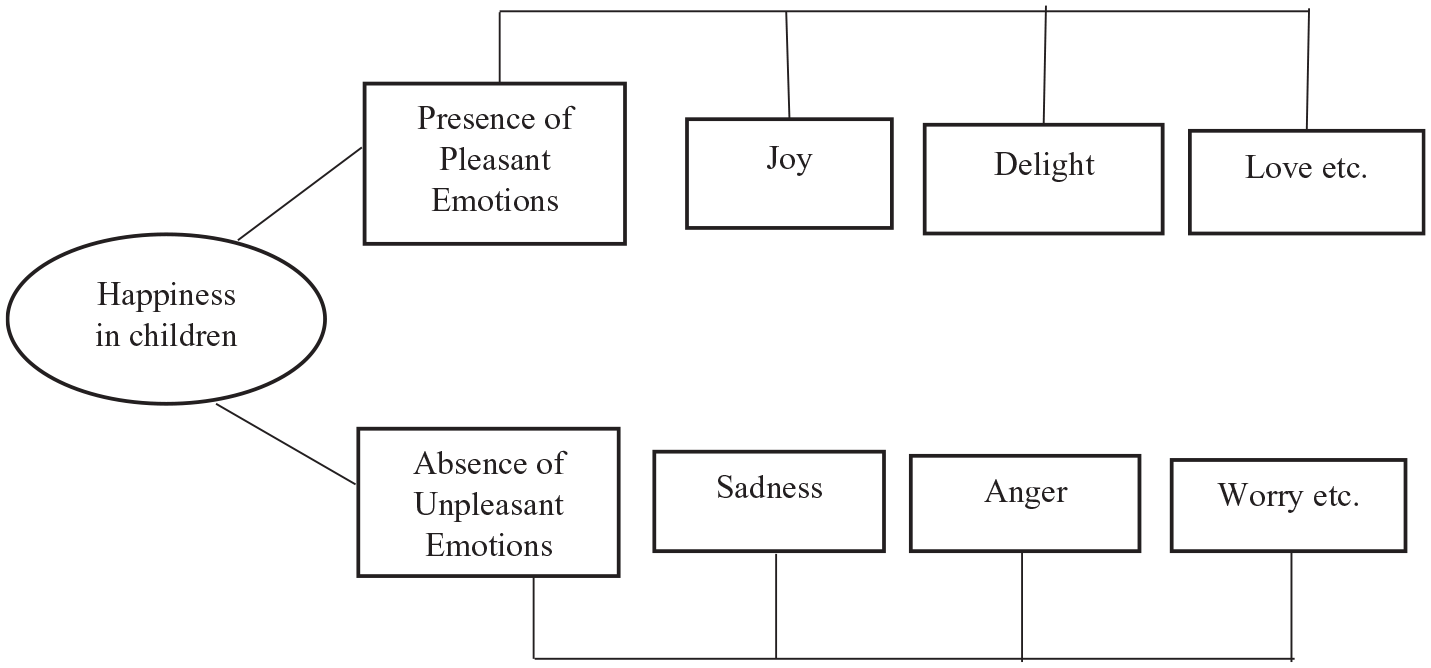
Meaning of happiness in preschool children.
Happiness is believed to be the state of psychological well-being of a child influenced by various classroom activities such as learning, playing, dancing, entertainment, reading comic books, sports, drawing, and so forth (Izzaty, 2018; Ogunyemi & Ragpot, 2015; Sharif, 2014). Thus, focusing on the happiness of children from early childhood is considered a crucial topic of research because a study has shown that happy children are expected to be more vigilant in recognizing and using their emotions in multifaceted social environments efficiently (Schultz et al., 2004).
Benefits of Happiness for Preschool Children
Benefits of happiness for preschool children include the development of consistent behavior and optimism (Talebzadeh & Samkan, 2011). The studies by Holder (2012), Husted (2017), and Izzaty (2018) have shown a compelling association between school-related happiness and social relationships. These studies have accentuated happiness as one of the factors that influence the psychological well-being of children, which further affects their creativity, motor skills, social and emotional competence, and maturity (Holder, 2012; Husted, 2017; Izzaty, 2018). Happiness in the life of preschool children plays a prominent role in their developing an understanding of their emotions, helping them in labeling their emotions and expressing their feelings with others, and also assisting them in developing friendship skills from early childhood (Alwaely et al., 2020). Happiness experienced through play-based learning activities in preschool provides multiple benefits to preschool children. It produces positive emotions, releases excess energy, optimizes brain growth, sharpens imagination and creativity, strengthens empathy and tolerance toward others in the class, and improves their cognitive, social-emotional, motor, mental health, and holistic development beginning from early childhood (Bell et al., 2010; Gleave & Cole-Hamilton, 2012; Goldstein, 2012; Singer, 2013; Whitebread et al., 2012). Therefore, happiness is considered to be one of the essential developmental aims in the life of children, which helps in improving their relationship with self and with their friends, making them socially active, less shy, and emotionally competent (Holder & Klassen, 2010).
Conceptualizing Social and Emotional Competence and Its Importance for Preschool Children
The preschool years are an essential developmental period wherein the growth of social and emotional competence is considered an important milestone in the lives of preschool children (Denham et al., 2014; Odom et al., 2008; Rose-Krasnor & Denham, 2009). Social and emotional competence in a preschool child refers to the way they feel and think of themself and others, and the way they experience, regulate, and express their emotions and develop close interpersonal relationships and security with those around them, all pertaining to family, society, and culture (National Scientific Council on the Developing Child, 2005). Research has shown the growing awareness about the significance of socio-emotional competence in the lives of preschool children (Collaborative for Academic, Social, and Emotional Learning [CASEL], 2018; Oberle et al., 2016). School-based interventions to foster social-emotional competence in preschool children have demonstrated improved sensory-motor skills, enhanced attention and concentration levels, better emotional expressiveness, positive perspective of themselves and others, constructive social behaviors, better relationships with peers, and reduction in conduct issues and the emotional misery among them (Ashiabi, 2000; Colwell & Hart, 2006; Durlak et al., 2011; Zhai et al., 2015). It has been reported that preschool children who lack socio-emotional competence have a high expectancy of facing transition issues during preschool years, poor relationships with peers, poor academic or developmental performance, and experiencing various social and behavioral issues and physical and mental health problems (Bornstein et al., 2010; Denham, 2006; Lancaster et al., 2004). Therefore, an increasing number of researchers and educators have called for an urgent focus on the social and emotional aspects of student development beyond academic mastery, in the hope of preventing serious psychopathological challenges in the future that children might encounter in grade school (Bornstein et al., 2010; Rose-Krasnor & Denham, 2009).
The Association Between Happiness and Social Competence in Children
Social competence in preschool children is one of the essential milestones during preschool age. It is documented as the child’s ability to understand the emotions of their friends and peers, deal with nonverbal skills, stress, and negative emotions, get along with peers and grownups, and nurture positive associations in the classroom (Ashiabi, 2007; Veiga et al., 2017). The terms social skills, social stability, and social competence are often used interchangeably, but social competence has been theorized as a broader aspect that includes not only the social skills, but also the neurological, temperamental, behavioral, and environmental features that together support and hinder a child’s growth (Kennedy, 2018; Odom et al., 2008; Whitehurst & Lonigan, 1998). Prior literature has highlighted the strong association between happiness and social competence by emphasizing the positive association of social support, social trust, and safe social relations with the happiness of children (Helliwell et al., 2013). Various studies have concluded that happiness in preschool children stimulates social competence, which allows children to interact openly with their friends, sustain positive relations with their peers and teachers, and resolve interpersonal conflicts (Backman, 2016; Kennedy, 2018). This association between happiness and social competence provides preschool children with greater opportunities to enjoy educational achievement, feel emotionally competent, and build safe and stable social relationships (Jones et al., 2015). Therefore, a happiness intervention can help to refine the ability of preschool children to establish positive interactions with peers, participate in interpersonal relationships, develop long-lasting friendships, and become associates of social groups (Kennedy, 2018; Lobo & Winsler, 2006).
The Association Between Happiness and Emotional Competence in Children
Emotional competence is documented as an ability of a preschool child to recognize and understand their feelings, gradually adding verbal labels to those feelings, managing their feelings by shaking off nervousness, sorrow, or frustration, learning to realize that others have feelings, too, and beginning to take others’ perspectives and empathizing with them (Goleman, 1995; McClelland et al., 2017; Rossouw, 2011; Salovey & Mayer, 1990). Building emotional competence in preschool children involves blending the competencies such as emotion awareness (the ability to precisely identify and name emotions), emotion regulation (manage emotions and control how and when they are expressed), perspective-taking (understanding the emotions of others), and empathy (Izard et al., 2001). Preschool children start to establish emotional connections outside the family during friendships developed in preschool (Hemmeter et al., 2006). They learn to distinguish between socially appropriate and inappropriate behavior and acquire important skills such as persistence, endurance, and the ability to solve social problems individually (Jones et al., 2015). Prior literature highlights the strong association between happiness and emotional competence, with the emphasis on attaining greater emotional stability through happiness (Bajaj et al., 2019, Chamorro-Premuzic et al., 2007; Hills & Argyle, 2001; Niramisa Sutta: Unworldly, 2010). Happiness and social-emotional competence are closely interrelated (Denham et al., 2003). For instance, during a dancing recreation class, a preschool child may feel happy and use emotional skills such as smiles and laughter to express their happiness, and social skills to support their friend in the dance. Furthermore, child development consultants from various disciplines (e.g., education, medicine, child welfare) have recognized the vital role of happiness and socio-emotional competence in the holistic development of a child (Darling-Churchill & Lippman, 2016; Greenwood et al., 2021; Isakson et al., 2009). For best results, it is believed that the preschool teacher can create a classroom setting where children can feel relaxed, happy, and secure with peers and can grapple with challenges more confidently, thus boosting their social and emotional competence (Merritt et al., 2012).
Happiness at Preschool
Preschool is regarded as one of the key spaces that promote happiness among preschool children by engaging them in their favorite play or activity, with their friends and peers, thus promoting positive social relationships and an emotional state of feeling glad, excited, and loved in a classroom (Chaplin, 2009; Hong et al., 2015; Kim, 2013). These are the vital platforms that focus on making children comfortable physically, mentally, socially, and emotionally (Hong et al., 2016). Past research has shown that a happy school environment is very helpful for boosting students’ energy, improving their learning experience, and empowering their talents (Al-e-Yasin, 2001). The advantages of happiness at preschool for children from 3 to 6 years old are not limited to the initial years of school (Gilliam, 2005). Besides influencing their academic performance, motor skills, and school adjustment, it also defines their social and emotional competence in later years (Gleave & Cole-Hamilton, 2012; Haney & Bissonnette, 2011; López-Pérez & Fernández-Castilla, 2018; Singer, 2013; Veitch et al., 2010; Whitebread et al., 2012).
Educators in developed nations have realized the relevance of social and emotional development vis-à-vis happiness promotion for successful child performance in preschool (Camilli et al., 2010; Denham & Weissberg, 2004; The NAESP Foundation Task Force on Early Learning, 2011; National Research Council, 2012). Many developed nations have designed frameworks and practices for boosting the happiness and social and emotional competence of children. For instance, CASEL, in its “CASEL Guide—Effective Social and Emotional Learning Programs—Preschool and Elementary School Edition” (2013), has provided a systematic framework for assessing the quality of classroom-based social and emotional learning (SEL) curriculums across the United States. Similarly, the American Institute of Research, in 2014, designed a module named “Teaching the Whole Child—Instructional Practices that Support Social and Emotional Learning” for children during the K-12 school experience (Yoder, 2014). Another development program “Social and Emotional Learning in Australia and the Asia-Pacific—Perspectives, Programs and Approaches” has outlined cross-country collaboration, facilitating a productive and promising foundation for social and emotional competence (Frydenberg et al., 2017). However, these frameworks and practices have been designed according to the psychological and social-emotional needs of children in those nations, which brings into light the need for a framework considering the geographical, psychological, social, and emotional needs of children living in the state of Punjab in India.
The above literature review reflects the bent of research, which is predominantly toward the happiness and development of social and emotional competence of preschool children in developed nations only. In the context of India, limited research has been done in regard to promoting the social and emotional competence of preschool children through happiness. As per the best knowledge of the author, the literature review, in terms of preschools known as Anganwadi and Balvatika in the Indian context, which are especially located in rural and socio-economically disadvantaged areas in the state of Punjab, shows that no such ECCE happiness framework has been designed and implemented for promoting social and emotional competence of preschool children through happiness intervention. Therefore, this study is an initiative toward filling that gap in the existing literature by proposing a conceptual ECCE happiness framework for preschool children studying in the preschools of Punjab (India).
Reasons Behind Developing Conceptual ECCE Happiness Framework
ECCE is regarded as key to achieving Sustainable Development Goals, but it has been negatively impacted by several adversities such as domestic violence, abuse, depression, and parental illness (Luking et al., 2011; Tyrka et al., 2013). At least 8% to 10% of children under the age of 5 are reported to have clinically significant and damaging mental health issues, including emotional, behavioral, and social relationship complications (Egger & Angold, 2006). The continued subjection to such stressors results in prolonged emotional and social distress, which drastically impedes a child’s long-term growth (Garner et al., 2012; Phillips & Shonkoff, 2000). Even the Good Childhood Report (The Children’s Society, 2015) showed that nearly 25% of the students investigated were unhappy in their school, and this unhappiness impacted their academic, social, and emotional development. The report highlighted that the major concern for children was to become happy at school. This reflects that one of the issues in the learning arrangement is the absence of happiness in schools (Guilherme & De Freitas, 2017; Salavera et al., 2017), which rings the alarm bell for educationalists to make dire efforts to bring about happiness in preschools where students begin to learn with keen interest (United Nations Educational, Scientific and Cultural Organization [UNESCO], 2016). The need of the hour is to address all these issues from the grass-roots level, where early learning begins for children. Therefore, the reason for choosing this specific age group (3 to 6 years) is the expeditious growth in the initial 6 years of a child’s life more than in any other stage of development, as confirmed by neuroscience (National Council of Educational Research and Training [NCERT], 2015; Nelson et al., 2013). The age band from 3 to 6 years is regarded as a significant period for both understanding and educating, which must include the development of social and emotional competence as a foundation for the holistic well-being of the child (Nelson et al., 2013).
India is regarded as the home for the Integrated Child Development Services (ICDS) program, which is one of the biggest and oldest public-sector projects for early childhood development worldwide. Many important plans, strategies, guidelines, and frameworks, including the National Education Policy (2019), which highlights the prominence of early childhood education and suggests a guiding principle for delivering quality pre-primary education in Indian preschools, have been developed (Jha & Parvati, 2020). However, the quality of delivery of early childhood schooling services in rural India remains a major stressor. Not much evidence is available on the record concerning whether preschool children are being assisted by preschools to gain the social-emotional competence that is fundamental to subsequent accomplishment in school and beyond (Minde et al., 2010). The current picture of the early education system in the state of Punjab in India, specifically in the rural and economically disadvantaged areas, seems to be out of focus. The challenges in the school system in Punjab (India) have gone way beyond low learning paradigms, social-emotional problems, and poor academic grades (State Council of Educational Research and Training [SCERT] Report by Sisodia et al., 2019). However, the ECCE policy of the state of Punjab in India has the vision to achieve holistic development, including social and emotional development of all children aged 3 to 6 years, through a multipronged approach. The approach aims to lay down norms and quality standards, develop a curriculum framework using appropriate and adequate play material, and conduct continuous assessments (Punjab State ECCE policy report). However, the gap between strategy and implementation within the preschools is clearly evident. The preschools (also known as Anganwadis) in the state of Punjab in India can be perceived as occupying a “see-saw.” A huge number of preschool children are registered in preschool. But these preschools do not give priority to early childhood social-emotional development due to the poor quality of the frameworks and curricula that are being implemented. Due to the scarcity of resources and skills required to foster happiness and social and emotional proficiencies, children enrolled in preschools located in rural and socio-economically disadvantaged areas are not being prepared for their upcoming grade schools (Jha & Parvati, 2020). While the importance of early years is appreciated, it has been witnessed that most of the ECCE frameworks are not developmentally appropriate for this age group (NCERT, 2015). Lack of a quality ECCE and happiness framework has resulted in either a low-quality program or making Early Childhood Education (ECE) a downward extension of the primary stage curriculum (NCERT, 2015). Therefore, on pedagogy, a reframing of course and practices is immediately required for the 3- to 6-years group, inclusive of all preschools, regardless of whether government organizations or private interventions take part.
Also, studies have affirmed that investment in social and emotional competence during the initial periods of child development is crucial as these early competencies develop progressively (Im et al., 2019). Children who have a higher level of social and emotional competence in early years are likely to have superior cognitive skills in the future (Denham & Brown, 2010; Jha & Parvati, 2020). However, when the developmental goals of social and emotional competence are not effectively addressed, preschool children are at threat of psychopathology, unhappiness, social-emotional problems, and academic failure, both now and in the future (Leerkes et al., 2008; Sroufe, 2005). The scarcities in the happiness and socio-emotional competence spheres are reported to be challenging for preschool children. For instance, preschool children who are bullied by peers, or are violent, have additional difficulty in managing their emotions, in attuning to routines and the school environment, and are at threat of a potential cascade of teething troubles, comprising academic complications, misbehavior, and substance abuse in future (Nagin & Tremblay, 2001; Raver, 2003; Tremblay, 2002). Considering all the developmental and mental well-being issues in preschool children, there has been a strong call for new mind-sets to promote children’s social and emotional health, happiness, and well-being in the face of everyday difficulty (Shonkoff et al., 2009).
All the issues related to happiness and social and emotional competence have compelled the policy makers to rethink the purpose behind educating preschool children, which should be more than merely improving their academic results. Policy makers have framed school and learning systems for children. However, how happy and emotionally competent are students within these systems? What do preschool children believe would make them merrier? Do these decisions relate to the preschool education? These questions necessitate policy makers to rethink the fundamental relationship between happiness and the current teaching practices in our education system (UNESCO, 2016). The above-highlighted gaps in the educational practices have paved a path for the preschools in India to develop and implement such a framework. The framework should be intended to support happiness, social competence, and emotional competence in preschool children, which is one of the aims of the National Education Policy 2020 of India (Jha & Parvati, 2020). Therefore, in response to the above reasons, challenges, and research gaps, the authors have proposed a conceptual ECCE happiness framework for preschool children aged 3 to 6 years in the state of Punjab in India, specifically focusing on those preschools that are located in rural and socio-economically disadvantaged areas of Punjab where children’s happiness and social-emotional competence are not taken into consideration.
Conceptual ECCE Happiness Intervention Framework for Preschool
Philosophy and Goals of Framework
The conceptual ECCE Happiness framework has been developed keeping in mind the psychological and social-emotional needs of preschool children in Punjab (India). The happiness framework is designed to root and uplift emotional competence and social skills in children from early childhood via happiness intervention. It focuses on making preschool children happy while learning in the classroom, reconsiders the teaching strategies used by teachers, and changes the preschool into a happy space for children.
Theoretical Foundation
The proposed framework for school children has been designed using the model known as “The Triad for Happiness,” proposed by A. Nagraj (1999). The model addresses four dimensions of human life as an assimilated form of the material, behavioral, logical, and pragmatic facets. These dimensions relate to our mind, emotions, learning, and consciousness, which result in happiness, peace, and satisfaction that together represent “human happiness,” as shown in Figure 2.

The Triad for Happiness by Nagraj, 1999.
Through the senses: The inputs via five senses of vision, hearing, touch, smell, and taste help one to feel pleasure. Preschool children can experience happiness through their senses by eating delectable foods, watching cartoon movies, or listening to pleasant music, which is considered to be highly enjoyable but shorter in terms of duration. Hence, this kind of happiness is described as Momentary Happiness.
Harmony in feelings: Children aged 3 to 6 years yearn for feelings like affection, attention, appreciation, and admiration in all their connections, regardless of whether they are friends, relatives, or preschool teachers. These feelings and emotions create the worth of a relationship, and one expects to achieve harmony in these feelings. Once achieved, one feels happy for a longer time compared with momentary happiness. Therefore, it is called Deeper Happiness.
Learning (changing behavior according to constructive understanding) and Awareness: This type of happiness arises from awareness of one’s thoughts, attention to one’s own actions, and freedom from internal conflict. A preschool child experiences this happiness through breathing exercises, learning something new, and understanding a concept or some meaning that they will remember for a long time, which is why this type of happiness is called Sustainable Happiness.
Nowadays, children experience a high level of sensory happiness of various kinds, which appears to have become their main goal in life (State Council of Educational Research and Training & Directorate of Education, 2019). However, the essential facets of harmony in feelings, and understanding in relationships are mainly overlooked in the existing education system in India. The current focus is thus partial, which emphasizes cognitive development only, neglecting the aspects of relationships and learning completely. The consequential happiness also tends to be incomplete and momentary. Therefore, the need to design a framework for promoting happiness that can be sustained, keeping in view the psychological, social, and emotional needs of preschool children studying in the rural and socio-economically disadvantaged areas of Punjab, is apparent. Based on the literature review and the Happiness Triad model given by A. Nagraj (1999), the conceptual ECCE happiness framework can be used for the creation of a happiness model in preschools.
Conceptual ECCE Happiness Framework
The overall aim of the conceptual ECCE framework is to assist preschool children in their journey toward happiness and attaining social and emotional competence, as shown in Figure 3. Therefore, happiness intervention is the proposed independent variable, and emotional competence and social competence are two dependent variables in the study.
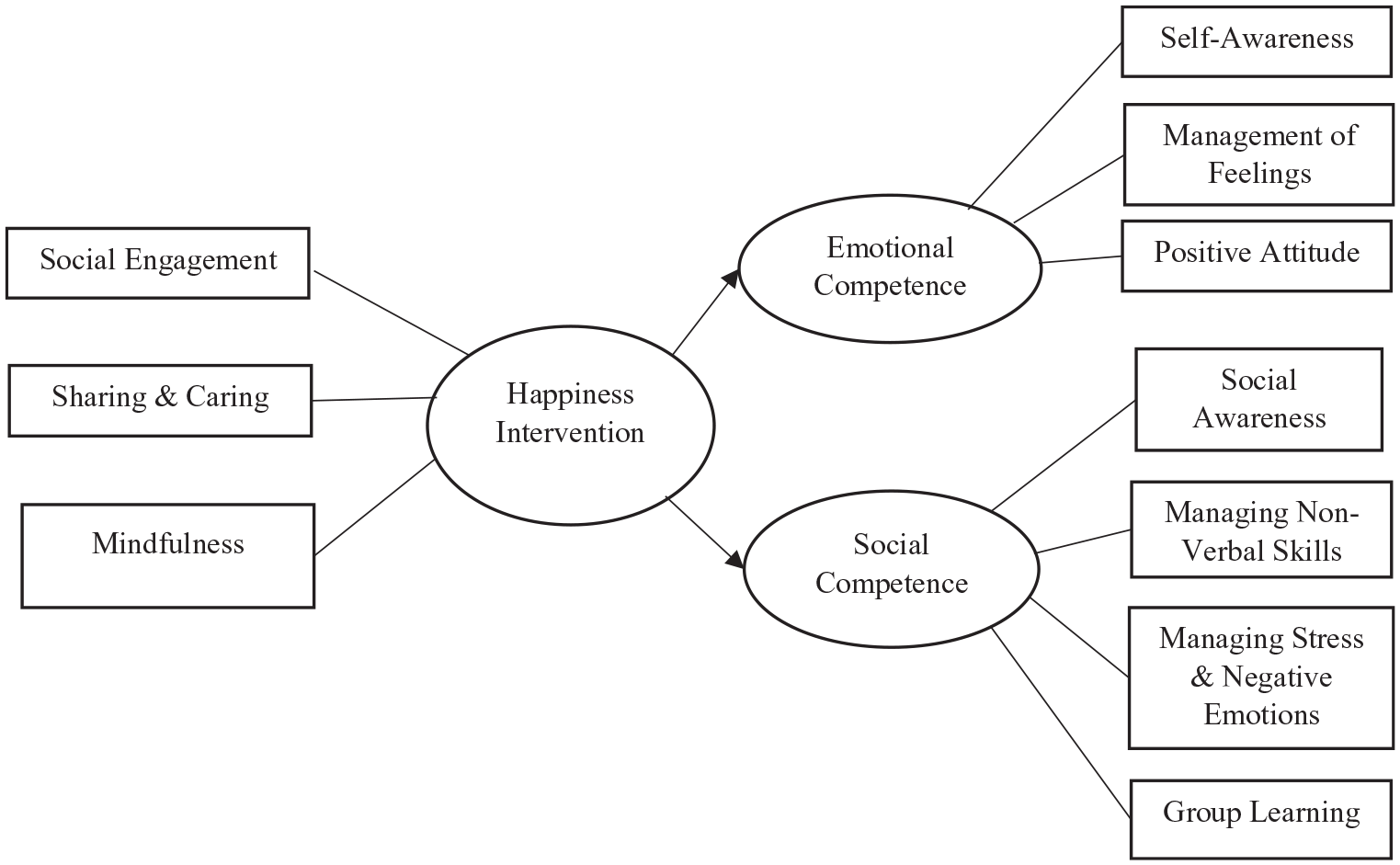
Conceptual ECCE happiness framework for preschool children.
Key Practices and Proposed Outcomes of Happiness Intervention
The framework proposes to initiate a happiness intervention program in preschools that focuses on three practices: social engagement, sharing and caring, and mindfulness in its curriculum. These practices have been chosen to allow preschool children to experience happiness through active participation, feeling, and learning in the classroom (Flook et al., 2010; Frey et al., 2014; Hall, 2020; NCERT, 2015).
Social engagement
Social engagement, also known as social involvement, social interaction, or social participation, is defined as “the degree to which a student participates in the classroom, community or society” (Berk, 2009). This practice can support preschool children to experience happiness through their senses via active participation in the classroom (Momentary Happiness in the Triad of Happiness by Nagraj, 1999). Happiness intervention in preschools can provide preschool children with numerous opportunities for social engagement. It can offer them a stage for learning: how to respond to praises by smiling, request assistance, work out play roles, help, work together, make eye contact, resolve conflicts, ask and reply to questions, and much more. Teachers can initiate positive social interactions among preschool children during their daily classroom activities, playtime, circle time, and story time, by targeting their social and emotional skills (such as expressing happiness while playing with friends, getting a friend’s attention, sharing objects, saying something nice to a friend, showing care for peers, asking peers to share toys, and providing a play idea to a peer; Sendil & Erden, 2012). The result of this practice can be seen in the level of attention, commitment, happiness, emotional response, and resilience among preschool children in the classroom (Schlechty, 2011). It can also help children in overcoming their social and emotional behavioral problems (Hall, 2020).
Sharing and caring
Another key practice in happiness intervention can be developing the social skills of sharing and caring among preschool children. This practice can help them to experience happiness in relationships through feelings (Deeper Happiness in the Triad of Happiness by Nagraj, 1999). Preschool children need to learn to share and take care to make and keep friends, play collectively, take turns, and negotiate and deal with disagreements and disappointments (Broadhead, 2004; Brogle et al., 2013). Research has revealed that many preschool children aged 3 to 6 years begin to understand sharing and caring skills, which help them in learning the value of fairness, compromise, and togetherness (Linke, 2011). This practice for children is a key part of getting along with others, in and out of the classroom, which impacts their happiness and their behavior with others around them (Ferreira et al., 2016; Smith et al., 2013). Preschool teachers’ part is essential, as they can build sharing and caring skills in children by providing them with opportunities to cooperate with their classmates and showing responsibility toward their classmates, starting from early childhood (Aknin et al., 2012; Frey et al., 2014; Lane et al., 2007). This proposed practice can be worked through role-playing, group-learning, playful activities, and sharing activities in the classroom (Ladd, 1999; Vaughn et al., 2003). For instance, teachers can build sharing and caring competencies by watching for and applauding actions, boosting impartiality, elaborating on sharing, sketching a picture together while sharing crayons, and choosing dress-ups together (Brogle et al., 2013; Ostrosky et al., 2007). For preschool children who face trouble in learning, a teacher can help them by motivating, so that they do not fail to share, by acknowledging their slightest sharing effort, by asking them how it would make them feel to have someone take their toys away, not invite them to play, or not allow them to have a turn, so that they can contemplate things from another’s viewpoint. Therefore, this practice can help in building social and emotional competence among children from the grass-roots level (Bovey & Strain, 2003; Ostrosky & Meadan, 2010).
Mindfulness
Mindfulness is defined as “an integrative process that promotes well-being in body, mind, and relationships” (Siegel, 2007). This practice can assist preschool children in experiencing happiness through learning and awareness (Sustainable Happiness in the Triad of Happiness by Nagraj, 1999). Preschool teachers can provide opportunities for practicing mindfulness in the daily classroom through activities, such as breathing, body awareness, body scan, listening, seeing, movement, slow walking, music, games, art forms, sensory-motor awareness activities, and focused listening classes, which support social and emotional competence, happiness, and positive attitude (Burke, 2010; Nieminen & Sajaniemi, 2016; Rempel, 2012; Schonert-Reichl & Lawlor, 2010; Zenner et al., 2014). Research has shown that mindfulness-based activities fascinate children, as these are self-management practices that play a fundamental role in their progress and development (Semple et al., 2005). Mindfulness yields increased attention, concentration, calmness, and self-control in preschool children (Lim & Qu, 2017; Schonert-Reichl & Lawlor, 2010). Furthermore, it promotes care and respect for others (Black & Fernando, 2014) and has an affirmative influence on the social and emotional competence of preschool children (Flook et al., 2010). Also, mindfulness-based practices help in dissipating the symptoms of disruptive behaviors, such as attention-deficit, anxiety, and anger in preschool children (Klatt et al., 2013; Semple et al., 2005), allowing them to manage undesirable emotional states, destructive thinking, and acknowledging self and others (Nieminen & Sajaniemi, 2016), thus enhancing their emotional self-control and instilling the understanding of emotions and empathy (Bakosh et al., 2016; Broderick & Jennings, 2012; Felver et al., 2013; Weare, 2013).
Seeing the prominence of social engagement, sharing and caring habits, and mindfulness practices in promoting happiness in the life of preschool children, in Table 1, the present authors have compiled goals and areas to be focused on while implementing the conceptual ECCE happiness framework in preschool in the state of Punjab (India).
Goals and Focus Areas Related to Key Practices in Conceptual ECCE Happiness Framework for Preschool Children.
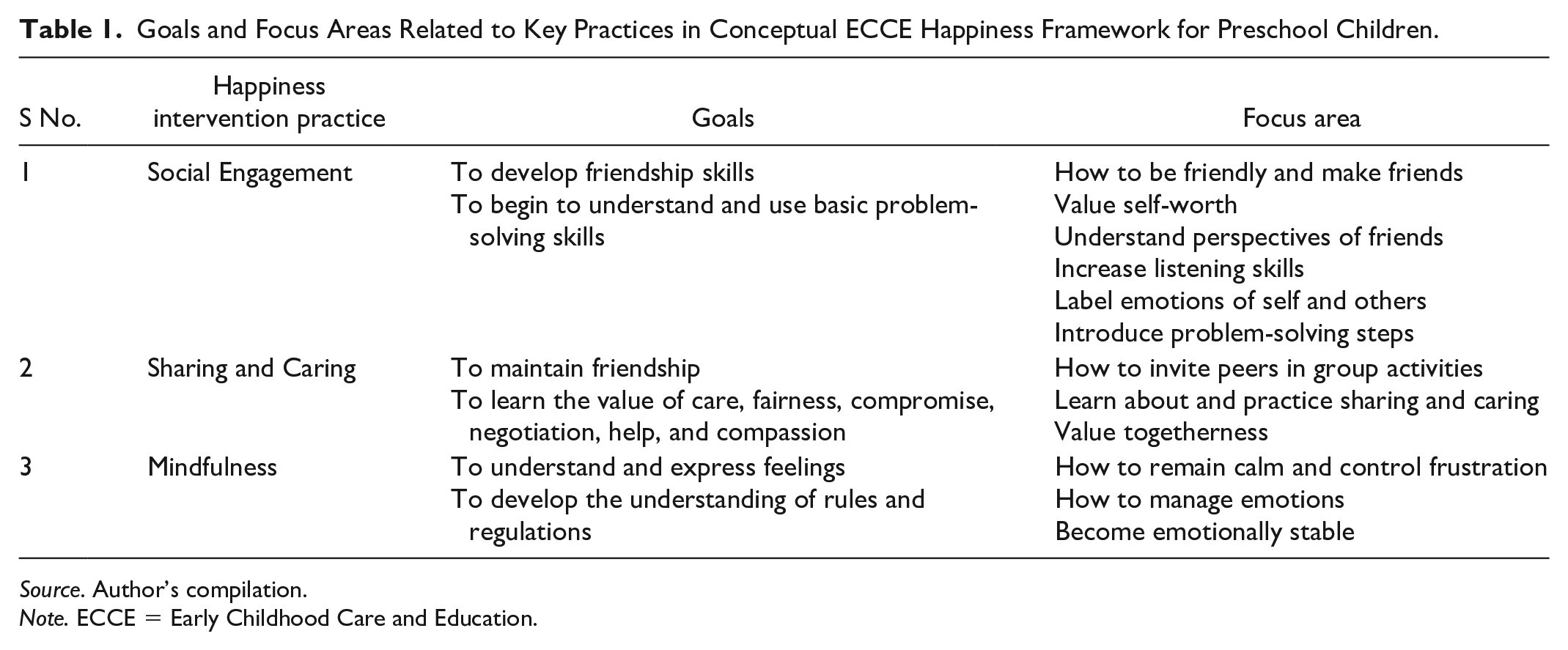
Source. Author’s compilation.
Note. ECCE = Early Childhood Care and Education.
The key practices of the happiness framework are chosen to impact the social and emotional competence of preschool children specifically. This is because the academic success of children without social and emotional competence could benefit them in the short run but will not provide effective results in the long run (Blair, 2002; Katz, 2015).
Emotional competence
A preschool child, under the guidance of their teacher, can refine their emotional competence. A child can learn self-awareness reflected in the ability to understand their feelings, thoughts, and emotions (such as happiness, sadness, love, pride, shame, curiosity, frustration, sadness, optimism); self-management reflected in the ability to regulate their feelings and controlling their emotions; and perspective-taking reflected in the capability to understand others and empathize with them (Colwell & Hart, 2006; Kostelnik et al., 2009). Three key practices in the proposed conceptual ECCE happiness framework are likely to impact the emotional competence of preschool children. Therefore, emotional competence is the dependent variable in the proposed framework. The first practice of social engagement aims at developing an understanding of emotions in children concerning their friends, managing their response toward them, taking the perspective of peers, showing a positive attitude, and empathizing with others in the classroom, thus impacting the emotional competence of children (Schlechty, 2011; Test & Cornelius-White, 2013). The second practice of sharing and caring aims to enable preschool children to make and keep friends, learn cooperation, and realize and regulate emotions of self and others, thus focusing on self-awareness and self-management aspects of emotional competence (Ostrosky & Meadan, 2010). Finally, the third practice of mindfulness is designed to focus on developing awareness, concentration, self-attention, self-control, and self-regulation abilities in preschool children, thus impacting their emotional competence (Lim & Qu, 2017).
Social competence
Apart from emotional competence, the proposed framework of happiness intervention aims to develop the social competence of preschool children. The key practice of social engagement aims at developing an understanding among preschool children with their peers. Participating in group learning activities, and creating and maintaining successful peer relationships, develops preschool children’s social competence (Test & Cornelius-White, 2013). The second practice of sharing and caring aims to enhance social skills such as cooperation, care, respect, negotiation, fairness, and togetherness among preschool children (Aknin et al., 2012; Frey et al., 2014). Also, the third practice of mindfulness aims to focus on self-management skills such as self-control, calmness, concentration, and attention among preschool children, which aim to promote care and respect for others (Black & Fernando, 2014; Lim & Qu, 2017; Schonert-Reichl & Lawlor, 2010).
Therefore, the proposed conceptual ECCE framework of the happiness intervention in preschools is an initiative to lay down the foundation for emotional competence and social competence in the initial years of the life of children. This framework is an endeavor to channel the awareness of preschool children toward discovering, feeling, and articulating happiness, not just in a transitory way, but also in a deeper and more sustainable way. The framework, in the context of Indian preschools, is an initiative that will allow preschool children to understand happiness within their own selves, in relationships, and in society. It is an initiative to bring about a paradigm shift in which a preschool child evolves from finding happiness externally to being able to experience it internally, within themselves, through learning and awareness, which may guarantee endurance of ethics starting from early childhood itself.
Executive Procedure of the Framework
The preschool teacher will facilitate the execution of the framework. They will create a special committee in the school for implementing the framework. They will prepare a happiness curriculum to develop social and emotional competence among preschool children. Using innovative teaching strategies in the classroom, they will create a happy classroom atmosphere where children feel free to express their emotions and maintain social relationships. For the practical implementation of the framework, they will need to modify their teaching practices based on feedback and performance, with continuous evaluation according to new findings.
Role of Preschool Teachers in Implementing the Conceptual ECCE Happiness Framework
Parents are the first and foremost teachers in the lives of children. Parents introduce them to the social world, where they further develop an understanding of themselves and their place and value in society (Harkness & Super, 2002). After parents comes the role of preschool teachers, who are regarded as one of the essential caregivers for preschool children (Denham et al., 2012; Schonert-Reichl, 2017). The thought of implementing any happiness intervention in a preschool brings into light the exemplary role of a preschool teacher because children in their foundational age of 3 to 6 years tend to copy their teachers (Jones et al., 2013). Previous research has documented the significance of the teacher’s contribution in addressing reform issues and efficacious school-based innovative progressions (Lieberman, 1986; McLaughlin & Talbert, 2006). Furthermore, it has been observed that the success of a new framework depends on what teachers feel about it, because they are the ones who normally execute it in the classroom (Jones et al., 2013). When it comes to the execution of the proposed conceptual ECCE happiness framework for preschool children, it is particularly pertinent that teachers educate, train, demonstrate, and empower children to practice their social and emotional skills in the class. The teacher-student relationship also plays an imperative role in the implementation process, as the behavior of the teacher toward the child creates their impression in the eyes of other students, which will indirectly affect their relationship with their classmates. Therefore, to build a secure relationship with children, the preschool teachers must grant special time to each child, irrespective of how big the group is, and try to understand their perspective with complete patience, care, empathy, love, and respect. Teachers should try to maintain consistency in their attitude while dealing with children, pay attention while listening to them, maintain eye contact, and then respond to them accordingly (Corso, 2007). The preschool teachers can play an important role in developing social and emotional competence in preschool children by encouraging interaction with their peers, and with those who display positive behaviors (Gest & Rodkin, 2011), and by offering assistance to preschool children to handle their strong feelings (Denham et al., 2012) and manage conflicting behaviors that can lead to anger and bullying (Farmer et al., 2011). Therefore, preschool and preschool teachers are important socializers in the lives of preschool children, which together can promote social and emotional competence in children via happiness intervention as shown in Figure 4.

The role of preschool teacher and preschool in the development of preschool children.
Using Innovative Teaching Practices for Implementation of Conceptual ECCE Happiness Framework in Preschools
Innovation is generally understood as “. . . the successful introduction and implementation of a new thing or method” (Brewer & Tierney, 2010). Innovation in teaching practices is seen as a necessary tool for positive change (Hoffman & Holzhuter, 2012). Preschool teachers can use adaptable, multifaceted, game-based, inquiry-based, activity-based learning strategies, which may comprise facial-expression recognition, colors, shapes, indoor and outdoor games, physical activity, peer-interactions, problem-solving in groups, circle-times, sketching, painting and other pictorial art, craft, music and movement, and drama and puppetry, for implementing the framework in the classroom (Caselman & Self, 2008; Jha & Parvati, 2020; NCERT, 2015). Table 2 is an example of teaching strategies that can be used for the practical implementation of the proposed conceptual ECCE happiness framework for promoting the social and emotional competence of preschool children.
Example of Teaching Practices That Can Be Used for Practical Implementation of Conceptual ECCE Happiness Framework in Preschools.

Source. Author’s compilation.
Note. ECCE = Early Childhood Care and Education.
For preschool children, teachers can use fun-based joyful activities for making their learning process easy and interesting. A few such innovative teaching practices that can be used by teachers for the implementation of the conceptual ECCE happiness framework in the preschools, located in rural areas of Punjab, are discussed in Table 3.
Various Innovative Teaching Practices, Tools, and Techniques for Preschool Children.

Source. Author’s compilation.
Thus, teachers can make whole-hearted efforts to help implement the conceptual ECCE happiness framework by using innovative teaching practices in the classroom, which would promote children’s happiness and social and emotional competence.
Conclusion
Happiness is a positive emotional state that is correlated to children’s socio-emotional competence (Holder & Klassen, 2010). The core subject of this study was the significance of happiness in preschools. This article has discussed the concept and meaning of happiness and social and emotional competence in the life of preschool children, and the relationship between happiness and social and emotional competence. Furthermore, this article has shown the rationale behind the focus on happiness and social and emotional competence of children at the elementary level in the preschool, which motivates the design of a conceptual ECCE happiness framework. The article proceeded to propose a conceptual ECCE happiness framework for preschool children of Punjab (India) based on local needs. The framework focused precisely on promoting the social and emotional competence of children, based on happiness intervention, which includes three key practices: social engagement, sharing and caring, and mindfulness. This happiness intervention has been designed in a way that develops the capability of preschool students to establish positive interactions with peers, participate in interpersonal relationships, develop long-lasting friendships, and become members of social groups, thus making them socially competent (Kennedy, 2018; Lobo & Winsler, 2006). Simultaneously, this happiness intervention is an initiative to help the children in understanding and managing their emotions and enhancing a positive attitude in them, making them emotionally competent (Bajaj et al., 2019; Chamorro-Premuzic et al., 2007; Hills & Argyle, 2001). Finally, this article discussed the role of preschool teachers in implementing the framework using play-based innovative teaching practices. This study does not attempt to generalize results for all. But this study focused upon the significance of happiness, and social and emotional competence among school children from very basic levels, especially in the rural and socio-economically disadvantaged areas in the state of Punjab in India.
Contributions
The present study is an attempt to propose a new conceptual ECCE happiness framework for generating happiness, as a goal for children to stay happy and positive from early on in their childhood. This article is a piece of original research in the areas of happiness and social and emotional competence in the context of Indian preschools, specifically for schools in backward and socio-economically disadvantaged areas in the state of Punjab. The article brings to light the need to focus on children’s happiness, and their social and emotional competence starting from early childhood, that is, preschool children aged 3 to 6 years. Finally, the article is an initiative to accentuate the part of preschool teachers in implementing this conceptual framework, using play-based teaching practices in the classroom.
Limitations
There are constraints to this study that warrant consideration. First, the proposed conceptual ECCE happiness framework has been developed specifically in the Indian context. The article focused on enhancing the social and emotional competence of preschool children in the state of Punjab in India, specifically in the rural and socio-economically backward areas of Punjab through a happiness intervention. Second, the article has been designed specifically for preschool children aged 3 to 6 years. Third, the article focused purposely on the social and emotional competence of preschool children as the outcome variable (dependent variables) only. Fourth, the article gives only a conceptual framework that needs to be implemented in the preschools of Punjab (India) for better practical outcomes.
Footnotes
Declaration of Conflicting Interests
The author(s) declared no potential conflicts of interest with respect to the research, authorship, and/or publication of this article.
Funding
The author(s) received no financial support for the research, authorship, and/or publication of this article.