




Abstract
Voluntary social insurance (VSI) is critical to extending social protection coverage to informal sector workers in developing countries like Vietnam, yet participation rates remain low. This study investigates the behavioral, social, and structural determinants influencing VSI participation, integrating the theory of planned behavior (TPB) and rational choice theory (RCT) into a comprehensive framework. Data were collected through a structured survey of 448 informal workers and analyzed using structural equation modeling (SEM). Results demonstrate that positive attitudes, supportive subjective norms, respected community figures, and community cohesion drive VSI participation, whereas financial incentives and flexible payment options alone do not. The study highlights the dominant role of internal motivations and social trust over purely economic considerations. Practical implications emphasize the need for communication strategies fostering positive perceptions, leveraging community leadership, and reinforcing institutional credibility. These findings provide valuable insights for policymakers aiming to design more inclusive, resilient social protection systems tailored to transitional economies like Vietnam.
Plain Language Summary
• Internal motivations and social trust outweigh financial incentives in driving participation in Vietnam’s voluntary social insurance (VSI).
• Positive attitudes, supportive norms, and respected community figures significantly influence informal workers’ decision to enroll in VSI.
• Flexible payment schemes and government subsidies alone are insufficient to boost VSI enrollment without addressing trust and awareness.
• Policy strategies must prioritize trust-building, community engagement, and reshaping public perceptions to expand social protection coverage.
Keywords
Introduction
The landscape of social insurance is undergoing a profound transformation globally, shaped by demographic shifts, the informalization of labor, and new socioeconomic vulnerabilities. International bodies, such as the International Labor Organization (ILO), warn that widening gaps in social protection coverage pose a significant challenge to building inclusive and sustainable welfare systems—particularly in relation to informal workers and the self-employed (ILO, 2021). In developing countries, the need to expand coverage is further complicated by fiscal constraints and institutional fragility, making the balance between accessibility and sustainability difficult to maintain (International Labour Organization, 2022).
Despite policy reforms in countries like India, Indonesia, and Vietnam, voluntary social insurance (VSI) schemes continue to experience low participation rates. This is often attributed to a combination of structural, informational, and behavioral barriers—including irregular incomes, lack of trust in institutions, and limited awareness of scheme benefits (Mitra, 2006; Paitoonpong et al., 2008). Recent research points to the growing importance of micro-level psychological and community-based mechanisms—such as social norms, trust, and the role of local actors—as critical determinants of insurance uptake behavior (Bilash et al., 2024; Mi et al., 2024).
Behavioral insights have gained traction in social policy scholarship, offering a complementary perspective to traditional economic and institutional approaches. Mi et al. (2024), for instance, highlight how institutional trust plays a central role in shaping individuals’ willingness to participate in formal welfare systems. Similarly, Bilash et al. (2024) demonstrate that trusted intermediaries—such as religious leaders and community figures—can positively influence decision-making in environments where formal systems are met with skepticism. These findings suggest that participation is neither purely rational nor structurally determined, but is instead embedded within social contexts and shaped by cognitive and cultural dynamics. Theoretical reflection on these behavioral mechanisms thus plays a critical role not only in empirical evaluation but also in understanding the legitimacy and long-term sustainability of social protection systems (Heydari et al., 2024).
In Vietnam, these challenges are particularly salient. While the government has made significant efforts to expand VSI coverage—including the introduction of partial subsidies and flexible contribution options—enrollment remains stubbornly low. As of 2023, only 2.5% of the eligible informal labor force was enrolled in VSI (General Statistics Office of Vietnam, 2023). This gap between policy design and behavioral response reflects an underlying disconnect that existing structural reforms have yet to address. Although previous research has focused on macro-level constraints, such as income insecurity or administrative inefficiencies, less attention has been paid to individual-level and community-level determinants, including perceived control, institutional trust, and prevailing social norms (Heydari et al., 2024; C. M. Nguyen et al., 2023). The heterogeneity of Vietnam’s informal sector—marked by varying occupational patterns, income volatility, and cultural norms—further complicates efforts to expand social insurance through conventional policy levers.
This study investigates the behavioral and structural determinants of VSI participation among self-employed and informal sector workers in Vietnam. To do so, it employs an integrated analytical framework that combines the Theory of Planned Behavior (TPB) and Rational Choice Theory (RCT). TPB focuses on individual behavioral intention as a function of attitudes, perceived behavioral control, and subjective norms (Ajzen, 1991), while RCT examines how individuals weigh perceived costs and benefits in a utility-maximizing framework (Mitra, 2006; Paitoonpong et al., 2008; Simon, 1982). This dual-theoretical lens offers a more comprehensive approach to understanding the complex and context-dependent nature of insurance decisions in informal settings. In Vietnam, where collectivist values intersect with uneven institutional trust and labor informality, such an approach is particularly relevant.
Accordingly, this study seeks to answer the following research question: What behavioral, institutional, and social factors explain informal workers’ decisions to participate in Vietnam’s Voluntary Social Insurance program, and how do TPB- and RCT-based constructs differentially predict participation?
This study offers three interrelated contributions. Theoretically, it extends the Theory of Planned Behavior by integrating meso-level referents—such as community figures and cohesion—as culturally situated dimensions of subjective norms, while also refining Rational Choice Theory with insights from behavioral economics, including bounded rationality, institutional trust, and informational asymmetries. Empirically, it applies Structural Equation Modeling (SEM) to data from 448 informal sector workers in Vietnam to disentangle the relative influence of attitudinal, normative, and instrumental factors on participation behavior. Practically, the study reveals the limitations of financial incentives alone and underscores the role of trust, localized communication, and intermediary actors in shaping voluntary social insurance uptake. Collectively, these findings inform national and international efforts to design more inclusive, behaviorally informed social protection systems for hard-to-reach populations.
Literature Review
Social Insurance and Voluntary Social Insurance
Social insurance is a central mechanism within social protection systems, aimed at mitigating life-cycle risks such as illness, unemployment, and old age through collective risk pooling and regular contributions (International Labour Organization, 2021). It functions as a social contract between the state and its citizens, fostering income stability and promoting economic inclusion. Typically, social insurance is divided into mandatory schemes—covering formal sector workers and co-financed by employers and the state—and voluntary schemes, which target self-employed and informal workers who are not legally obliged to participate (Mitra, 2006; Paitoonpong et al., 2008). Voluntary social insurance (VSI), however, faces structural challenges due to its self-financed nature, including issues of affordability, limited awareness, and low institutional trust (Bilash et al., 2024).
In developing countries with large informal economies, VSI plays a crucial role in extending social protection to excluded populations. Despite its potential, effective implementation of VSI requires more than policy availability—it demands attention to behavioral and social determinants of participation. While VSI offers financial security and healthcare access at the individual level, it also contributes to household resilience and societal cohesion (Heydari et al., 2024). Successful uptake is often driven by perceived trust in public institutions and the legitimacy of the system, rather than financial incentives alone (Mi et al., 2024). Therefore, expanding VSI is not only a welfare strategy but a structural investment in inclusive development and institutional credibility.
Vietnam’s Labor Market
Vietnam’s labor market is characterized by a pronounced dual structure, with a substantial informal workforce comprising 37.4% of total employment, primarily consisting of self-employed individuals lacking labor contracts and social protection (GSO, 2023). These workers, often concentrated in low-paid, precarious jobs such as street vending and domestic services, face systemic barriers to enrolling in voluntary social insurance (VSI), resulting in a low participation rate of only 8% (Vietnam Social Security, 2023). Compared to significantly higher VSI coverage in countries like South Korea (60%) and Thailand (45%), Vietnam’s informal workers encounter persistent challenges including income instability, limited policy awareness, and weak institutional trust.
In Vietnam, institutional trust has been shaped by historical and administrative experiences. The legacy of centralized governance has at times resulted in fragmented policy implementation and uneven enforcement (Malesky & London, 2014). Occasional delays in benefit distribution, shifting eligibility criteria, and bureaucratic inefficiencies have contributed to cautious attitudes toward the reliability of state-managed programs. Administrative complexity can further challenge informal workers, who often face barriers in navigating enrollment, contribution, and claims procedures due to limited institutional literacy. These dynamics help explain why financial incentives, such as subsidies, may not be sufficient on their own to motivate participation, as citizens weigh both economic benefits and perceptions of long-term program stability. The lack of a portable, decentralized insurance framework further impedes integration, indicating that without improved incentives, flexible contribution mechanisms, and targeted outreach, universal social protection in Vietnam remains out of reach.
Application of TPB and RCT in Social Policy Behavior
The integration of the Theory of Planned Behavior (TPB) and Rational Choice Theory (RCT) provides a comprehensive framework for analyzing behavior in social policy contexts by combining psychological intention with utilitarian decision-making. TPB emphasizes attitudes, subjective norms, and perceived behavioral control as predictors of behavioral intentions (Ajzen, 1991), while RCT conceptualizes individuals as rational agents who assess costs and benefits before acting (Coleman, 1990). Empirical applications across diverse domains—from waste management in rural China (Hao, 2025) to elderly care (Wu et al., 2022) and sharing economy services (Khan et al., 2024)—demonstrate the explanatory strength of this dual-lens approach. Studies further highlight that both rational evaluations and normative beliefs jointly influence participation in voluntary programs such as health and social insurance. Additionally, research warns of cognitive biases, bounded rationality, and information asymmetries that can distort decision-making (Ooi, 2025; Simon, 1982), prompting calls for trust- and ethics-based refinements to the TPB–RCT model (Pham et al., 2025). Collectively, this integrated framework offers policymakers a nuanced, multidimensional tool for designing behaviorally informed interventions in public policy.
However, prior integrations of TPB and RCT often neglect the broader sociocultural referents that mediate intention formation, particularly in collectivist or institutionally fragile contexts. This study addresses this gap by extending TPB through the incorporation of meso-level social constructs—community cohesion and respected community figures—as culturally embedded expressions of subjective norms. While conventional TPB research emphasizes proximal referents such as family and peers, our framework recognizes that in collectivist settings, subjective norms also operate through respected intermediaries and communal solidarity. This extension not only clarifies the theoretical distinction between supportive subjective norms (proximal, family-based influence) and broader community-level influences, but also explains why these constructs, though conceptually adjacent, can be modeled as distinct pathways in predicting participation.
At the same time, this research refines RCT by explicitly linking each construct to one of its four core decision-making dimensions: expected benefits, expected costs, risk perception, and opportunity structures (Coleman, 1990). State-subsidized contribution support reflects a reduction in expected costs (Mitra, 2006; Paitoonpong et al., 2008); flexible payment options represent opportunity structures to align with irregular cash flows (Mills et al., 2012); observed benefits from relatives or peers embody expected benefits, offering vicarious evidence of program utility (Dong et al., 2024); and perceived low risk of early withdrawal captures risk perception, signaling reversibility and reduced uncertainty (Wu et al., 2022). In contrast to classical RCT assumptions of stable utility maximization, this study integrates behavioral economics insights such as bounded rationality, loss aversion, and institutional trust. As Kahneman and Tversky’s (1979) Prospect Theory demonstrates, individuals often overweight potential losses relative to equivalent gains, which may explain why subsidies have limited motivational power under conditions of institutional skepticism.
By theoretically advancing both TPB and RCT in these directions, the study overcomes the limitations of prior models that treat behavioral intentions and rationality as independent or structurally neutral. Instead, it positions intention formation within a broader institutional and relational context, informed by bounded rationality and collective action dynamics (Ostrom, 1990). This allows for a more grounded understanding of why informal workers opt in or out of voluntary social insurance schemes, even when comparable financial incentives are available.
Hypothesis Development
Using the Theory of Planned Behavior—TPB
Positive Attitudes Toward VSI
A positive attitude toward VSI plays a vital role in influencing individuals’ willingness to participate, particularly when they believe the scheme offers tangible, long-term benefits such as financial stability in old age and access to essential services. According to the Theory of Planned Behavior, attitudes formed by outcome-based beliefs significantly shape behavioral intentions (Ajzen, 1991). In the context of VSI, individuals are more inclined to enroll when they perceive participation as a practical means of mitigating future income insecurity. Empirical evidence from countries like Ukraine and India supports this relationship, showing that voluntary pension enrollment increases when individuals understand and trust the value of long-term security (Bilash et al., 2024; International Labour Organization, 2022). Moreover, trust in the reliability and sustainability of benefits enhances these positive perceptions (Mi et al., 2024), while clear communication and transparent policies further reinforce confidence and engagement (ILO, 2021; Mitra, 2006; Paitoonpong et al., 2008). In developing countries with limited state welfare systems and a large informal labor force, cultivating positive attitudes through targeted awareness campaigns and benefit transparency can significantly improve VSI uptake. Based on the above evidence, we propose the following hypothesis:
Supportive Subjective Norms
Supportive subjective norms serve as a crucial social influence on individuals’ decisions to participate in VSI, particularly within collectivist societies where communal values and behaviors strongly shape individual choices. According to the Theory of Planned Behavior, subjective norms—defined as the perceived social pressure from significant others—affect behavioral intentions by signaling what is socially acceptable or expected (Ajzen, 1991). In many developing countries, where informal networks play a central role in information dissemination and norm-setting, observing peers, family members, or respected community figures enrolling in VSI schemes can generate a sense of social obligation and conformity. This dynamic fosters participation as a means of maintaining social inclusion and fulfilling perceived communal expectations (Heydari et al., 2024).
Empirical studies reinforce the importance of these normative pressures. Research in India and Ukraine shows that peer encouragement and visible enrollment among community members significantly increase participation in voluntary pension schemes (Bilash et al., 2024; International Labour Organization, 2022). These findings are echoed by the International Labour Organization (2021), which emphasizes the effectiveness of cooperatives and local associations in establishing participation as a community norm. Moreover, societal endorsement has been shown to enhance the perceived legitimacy of VSI, particularly in environments with low institutional trust (Mi et al., 2024). When social expectations align with visible benefits, individuals may internalize these norms, transforming external influence into intrinsic motivation (Mitra, 2006; Paitoonpong et al., 2008). Grounded in the empirical and theoretical insights presented, we posit the following hypothesis:
In this study, we distinguish between supportive subjective norms and the meso-level constructs of respected community figures and highly cohesive communities. In most applications of TPB, subjective norms are defined narrowly, often reflecting the influence of proximal peers, kin, or immediate social circles (Ajzen, 1991). However, in collectivist cultural contexts such as Vietnam, normative expectations extend beyond the household to encompass wider community referents and collective bonds. Respected community figures and highly cohesive communities can therefore be conceptualized as culturally embedded, situation-specific expressions of subjective norms. These constructs capture not only interpersonal approval but also the legitimizing role of trusted leaders and the binding force of community solidarity. By situating these variables within the TPB framework, the study broadens the conventional scope of subjective norms and highlights their contextual relevance in collectivist societies (Arpaci & Baloğlu, 2016; Triandis, 1995).
Respected Community Figures
Respected community figures—such as village chiefs, women’s union leaders, and heads of farmers’ associations—play a pivotal role in influencing participation in VSI, particularly in rural and collectivist societies where trust in formal institutions may be limited. These individuals act as informal policy intermediaries, disseminating information, legitimizing state initiatives, and encouraging collective action through their social authority (Heydari et al., 2024). Empirical evidence from India and Ukraine shows that endorsement by local leaders significantly increases enrollment in pension schemes by reducing skepticism and enhancing perceived credibility (Bilash et al., 2024; International Labour Organization, 2022). In communities where institutional trust is weak, the approval of these figures often serves as a proxy for state legitimacy (Mitra, 2006; Paitoonpong et al., 2008). Moreover, community institutions such as cooperatives and associations create supportive environments that facilitate group-based enrollment and reduce individual reluctance (ILO, 2021; Mi et al., 2024). Thus, mobilizing respected local leaders emerges as an effective and culturally grounded strategy for enhancing VSI participation.
Highly Cohesive Communities
Community cohesion is a key social determinant influencing participation in VSI, particularly in developing countries where formal communication and outreach mechanisms are limited. In tightly knit communities, strong interpersonal trust and social networks facilitate the informal diffusion of information about policy benefits, enhancing both awareness and perceived legitimacy of VSI schemes (Heydari et al., 2024). Such environments foster collective action and reinforce behavioral norms through peer modeling and communal dialogue, making participation a socially endorsed behavior (Haron & Kamaludin, 2025). Empirical studies show that trust-based networks and civil society groups within cohesive communities are often more effective than formal outreach in encouraging enrollment (Cho & Trevenen-Jones, 2024; Kazi & Moslehuddin, 2024). Additionally, shared cultural identity and informal support structures help bridge gaps in institutional trust and reduce the cognitive and logistical burdens of enrollment (Harel & Popper, 2024). These dynamics position community cohesion as an active facilitator of engagement with social protection programs. In light of the above findings, we advance the following hypothesis:
Using Rational Choice Theory—RCT
Stat-Subsidized Contribution Supporte
State-subsidized contribution support is a crucial policy lever for increasing VSI participation in developing countries, particularly among informal and low-income workers who face affordability constraints. By covering 10% to 30% of contribution costs, subsidies can lower financial entry barriers and enhance the perceived value of enrollment, thereby shifting the cost-benefit calculation in favor of participation (Gentilini et al., 2022). Empirical evidence from Senegal and Morocco shows that publicly funded pilot programs significantly increased enrollment among rural populations (Fonteneau et al., 2017), while historical cases in Europe highlight the effectiveness of generous co-financing in institutionalizing voluntary insurance schemes (Hu & Manning, 2010). Subsidies not only reduce immediate costs but also act as symbolic policy commitments, enhancing institutional trust and promoting social inclusion (Bloom & McKinnon, 2013; Gilbert, 2005). Thus, state-supported contributions serve both economic and behavioral functions in encouraging broader uptake of VSI.
Flexible Payment Options
Flexible payment options represent a key determinant of VSI participation in developing countries, where informal employment and income instability are widespread. Allowing individuals to choose alternative contribution schedules—such as quarterly, annual, or multi-year payments—can ease liquidity constraints and make participation more financially manageable, particularly for seasonal or self-employed workers (Vu, 2025). This approach aligns with behavioral economic insights, which suggest that rigid or frequent payment requirements deter enrollment among low-income earners. Empirical studies across Southeast Asia show that schemes offering flexible modalities experience higher uptake, especially among informal laborers (Alkenbrack et al., 2013; Nguyen et al., 2020). Moreover, such flexibility reduces both the financial burden and cognitive effort associated with frequent transactions, encouraging sustained participation over time (Ho et al., 2022; C. M. Nguyen et al., 2023). Therefore, flexible payment mechanisms not only enhance administrative accessibility but also function as a strategic tool for expanding social protection coverage in resource-constrained settings. We suggest that:
Observed Benefits From Enrolled Relatives or Peers
The decision to enroll in VSI schemes is significantly influenced by observed peer experiences, particularly in developing countries where institutional trust is often limited. Seeing relatives or community members receive tangible benefits—such as pension payouts or subsidized healthcare—can increase the perceived value and legitimacy of VSI participation. This demonstration effect raises expected utility and reduces skepticism surrounding abstract, future-oriented benefits (Dror et al., 2016; Giesbert & Steiner, 2011). In low-literacy and informal economic settings, such social proof is especially influential, as firsthand accounts of benefit realization provide credible evidence that the scheme works (Sarker et al., 2016). Additionally, peer behavior not only informs individuals cognitively but also creates normative pressure, framing enrollment as a socially responsible act (Smith et al., 2010). In Vietnam, where formal outreach is limited, the visibility of benefit receipt has proven more persuasive than top-down communication efforts (H. Nguyen & Knowles, 2010). Thus, observed peer benefits serve as both informational cues and social motivators in shaping VSI participation.
Perceived Low Risk of Early Withdrawal
In VSI, the perceived risk of early withdrawal is a significant factor influencing participation, particularly in low- and middle-income countries where individuals prioritize liquidity due to economic insecurity. When potential participants believe they can recover part of their contributions—through lump-sum refunds or benefit portability—the psychological barrier to long-term commitment diminishes, increasing their willingness to enroll (Do & Mai, 2023). Fear of “losing everything” upon early termination is a key deterrent, but policies that ensure partial recoverability or service recognition can mitigate this concern. Global evidence supports this view: Orszag and Stiglitz (2001) highlight that flexible withdrawal provisions enhance trust in pension systems, while Collins-Sowah et al. (2013) and Giesbert (2012) show that clear communication about withdrawal rights improves participation among informal workers. Moreover, risk perception, as framed by the Theory of Planned Behavior, directly moderates enrollment intentions, especially in environments with low institutional trust (Mai & Mai, 2021). These findings suggest that reducing the perceived irreversibility of VSI contributions can enhance both uptake and compliance.
Figure 1. Conceptual framework integrating the Theory of Planned Behavior (TPB) and Rational Choice Theory (RCT) in explaining VSI participation. Within TPB, psychosocial drivers include positive attitudes toward VSI, supportive subjective norms, respected community figures, and community cohesion. The RCT perspective emphasizes state-subsidized contributions, flexible payment options, observed benefits from peers or relatives, and perceived low risk of early withdrawal as instrumental cost–benefit considerations. Together, these constructs capture both psychological and rational dimensions of decision-making, shaping individuals’ intentions and actual participation in VSI.

The research model.
Methodology
Sampling and Data Collection
The research population in this study comprises informal sector workers in Vietnam who are either eligible for or currently participating in the VSI scheme. This group includes freelancers, agricultural laborers, self-employed individuals, and small household business owners, as defined by the Vietnam social security (VSS). The target population is all eligible informal workers nationwide; however, the accessible population was limited to individuals residing in selected provinces where data collection was feasible due to logistical constraints and resource availability (V. L. Bui et al., 2023). All procedures in this study adhered to ethical standards in line with the Declaration of Helsinki. Informed consent was obtained from all participants prior to data collection. Respondents were briefed on the study purpose, voluntary nature of participation, and their right to withdraw at any time without penalty. Data confidentiality was ensured by anonymizing responses, storing data on password-protected servers, and restricting access to the research team only. No personally identifiable information was collected.
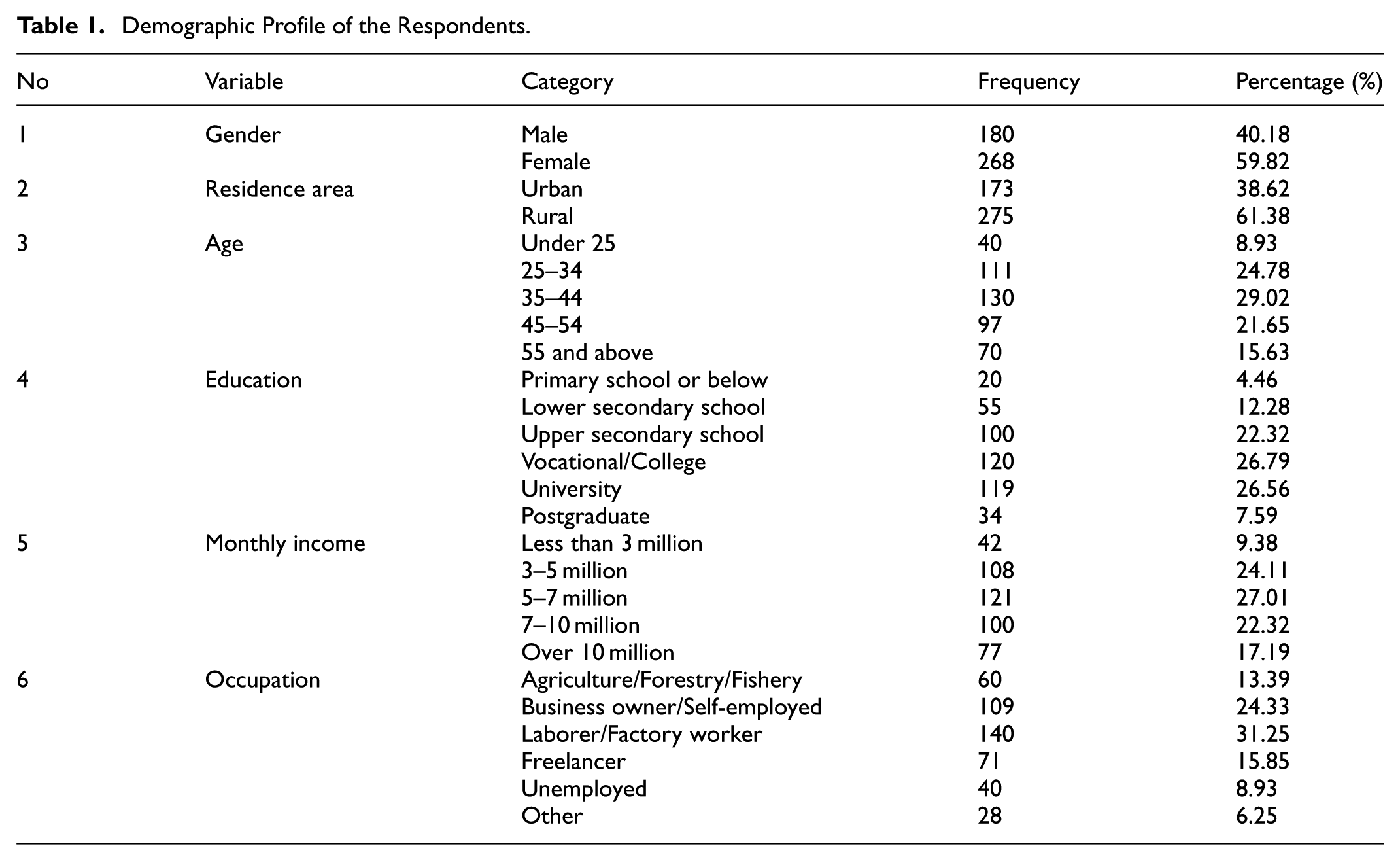
A sample size of 400 respondents was determined using Cochran’s formula for sample estimation, ensuring a confidence level of 95% and a margin of error of 5% (T. T. H. Bui & Mai, 2023). The sampling method adopted was non-probability convenience sampling due to the difficulty in accessing a comprehensive national registry of informal workers (Mai & Mai, 2021). Sampling criteria included individuals aged 18 to 60, not currently enrolled in compulsory social insurance, and with income sources qualifying them for VSI. These criteria ensured the relevance of the data to the policy context while acknowledging limitations in the generalizability of the findings. The demographic profile of the 448 respondents reveals a well-distributed and contextually representative sample reflective of Vietnam’s informal labor force (Table 1). These patterns collectively reflect a diverse but targeted respondent group, enabling robust analysis of behavioral tendencies toward VSI participation and facilitating generalization to similar labor segments in Vietnam.
Demographic Profile of the Respondents.
Scales and Measures
To examine determinants of VSI participation, the study employed a structured questionnaire with nine validated multi-item Likert scales adapted from prior behavioral and social policy research (see Appendix and Table 2 for full items). These constructs captured attitudinal, normative, community, structural, and risk-related factors, as well as intention to participate. All scales demonstrated strong internal reliability (Cronbach’s α = .800–.923), supporting the robustness of the measurement model.
Operationalization of Study Variables, Measurement Items, and References.

Analyses
To investigate the determinants of VSI participation in Vietnam, this study employs a structured quantitative approach using SPSS 22.0 and AMOS 22.0, following Anderson and Gerbing’s (1988) two-step method. First, the measurement model is tested using Principal Component Analysis (PCA) and Confirmatory Factor Analysis (CFA) to validate constructs such as attitudes, subjective norms, community cohesion, and state subsidies. Reliability and validity are confirmed using Cronbach’s alpha, Composite Reliability (CR), and Average Variance Extracted (AVE), based on criteria from Hair et al. (2016) and Fornell and Larcker (1981). In the second step, Structural Equation Modeling (SEM) assesses the causal relationships between psychological, social, and institutional variables and VSI participation. Model fit is evaluated using standard indices such as CFI, TLI, RMSEA, and χ2/df (Hu & Bentler, 1999). Hypotheses are tested through standardized path coefficients, enabling robust analysis of the factors shaping VSI enrollment and retention behaviors.
Results
Principal Components Analysis
To uncover the latent structure of determinants influencing VSI participation in Vietnam, Principal Component Analysis (PCA) with Promax rotation was conducted, appropriate for identifying correlated factors. The initial analysis extracted eight components explaining 66.83% of the variance, but scree plot inspection supported a refined nine-factor solution, increasing explained variance to 69.78%. This model more accurately captured the conceptual dimensions of the constructs. Two items—related to positive attitudes and respected community figures—exhibited cross-loadings and were excluded based on theoretical misalignment and best practice guidance. Specifically, one item initially designed to measure subjective norms showed high correlation with community cohesion, and another cost-related item loaded onto both perceived financial burden and trust. The decision to exclude these items was theoretically justified: TPB posits that subjective norms should capture normative pressure from important referents, while community cohesion reflects broader meso-level influences (Ajzen, 1991). Similarly, cost perceptions under RCT are analytically distinct from generalized trust (Simon, 1982). Therefore, retaining cross-loading items would compromise construct validity. The revised factor structure improved conceptual clarity and construct distinctiveness and was validated through Confirmatory Factor Analysis (CFA), providing a strong foundation for subsequent Structural Equation Modeling (SEM) analyses (Hair et al., 2016).
Common Method Variance (CMV)
To mitigate the risk of Common Method Variance (CMV) in self-reported survey data, this study employed both statistical diagnostics and procedural safeguards. Harman’s Single-Factor Test, conducted via Principal Component Analysis, showed that the first factor accounted for only 20.59% of the total variance (Table 3)—well below the 50% threshold suggested by Podsakoff et al. (2003) and Tehseen et al. (2017)—indicating minimal CMV influence. Additionally, procedural controls such as randomized item ordering, assurance of respondent anonymity, and the use of multi-item constructs were applied to reduce bias and enhance reliability. These strategies collectively support the validity and credibility of the findings on VSI participation in Vietnam.
Explained Variance Outcomes.

Confirmatory Factor Analysis (CFA)
To confirm the structural integrity of the refined measurement model for VSI participation in Vietnam, we conducted a Confirmatory Factor Analysis (CFA) using AMOS 22.0. CFA provides a stringent test of whether the proposed eight-factor structure—representing determinants such as positive attitudes toward VSI, supportive subjective norms, and flexible payment options—adequately fits the observed data. Our results demonstrated a robust model fit, with χ2 = 933.204, df = 696, χ2/df = 1.341, CFI = 0.977, TLI = 0.974, GFI = 0.909, IFI = 0.977, and RMSEA = 0.025. These indices exceed the conservative benchmarks recommended by Hu and Bentler (1999), suggesting that the specified measurement model reliably captures the latent structure of the constructs under study.
Importantly, the convergence of empirical fit indices with theoretical expectations reinforces the validity and stability of the measurement framework. This strong foundation allows us to proceed with hypothesis testing and structural model estimation with greater confidence in the reliability of the underlying constructs. In line with best practices in scale development and validation (Hair et al., 2016), these results assure that the measurement model is both statistically sound and conceptually coherent, thereby facilitating meaningful interpretation of the factors influencing VSI participation within the Vietnamese context.
Validity and Reliability
To ensure the psychometric validity of the measurement model for VSI participation in Vietnam, a series of reliability and validity tests were conducted. All constructs demonstrated strong internal consistency, with Cronbach’s alpha and Composite Reliability (CR) values exceeding the .70 threshold (Hair et al., 2016). Convergent validity was supported by Average Variance Extracted (AVE) values above 0.50, indicating that over half of the variance in observed items was explained by their latent constructs (Fornell & Larcker, 1981). Standardized factor loadings ranged from 0.570 to 0.977, confirming strong item-construct alignment (Table 4). Discriminant validity was verified using the Fornell-Larcker criterion, as each construct’s AVE square root exceeded its inter-construct correlations. These results affirm the reliability and distinctiveness of the measurement model, providing a solid foundation for testing the structural relationships influencing VSI participation in Vietnam.
Structural Features of the Measurement Instrument.

Note. Attitudes = Positive attitudes toward VSI; Norms = Supportive subjective norms; Figures = Respected community figures; Communities = Highly cohesive communities; Support = State-subsidized contribution support; Payment = Flexible payment options; Benefits = Observed benefits from enrolled relatives or peers; Withdrawal = Perceived low risk of early withdrawal; VSI = Voluntary social insurance; SD = Standard Deviation; CR = Composite Reliability; AVE = Average Variance Extracted.
Hypotheses Testing
Analysis of interrelationships among key variables reveals that psychological and experiential factors exert the strongest influence on VSI participation in Vietnam (Table 5). Positive attitudes toward VSI demonstrated the highest correlation with participation norms (r = .643, p < .01), emphasizing the importance of individual belief systems. Observed benefits from enrolled peers or relatives also showed a strong association (r = .487, p < .01), highlighting the role of social learning. In contrast, supportive subjective norms (r = .133) and community cohesion (r = .159) had weaker correlations, suggesting more diffuse social influence. Perceived low risk of early withdrawal was moderately associated with both VSI norms (r = .189) and subjective norms (r = .276), indicating the relevance of perceived flexibility and security. While state-subsidized contributions correlated modestly with both VSI norms (r = .205) and perceived risk (r = .323), flexible payment options showed only marginal effects. These results suggest that although structural supports matter, attitudinal and observational factors more directly shape engagement with VSI schemes.
Descriptive Statistics and Inter-Variable Correlations.

p < .01, *p < .05.
Structural Equation Modeling (SEM) was applied to test the hypothesized relationships among factors influencing VSI participation in Vietnam. SEM’s capacity to estimate complex interrelationships among observed and latent variables made it ideal for examining both direct and indirect effects. The theory-driven model incorporated constructs such as positive attitudes, subjective norms, community cohesion, perceived risk, and contextual supports. Model fit indices confirmed excellent fit: χ2/df = 1.341, CFI = 0.977, TLI = 0.974, GFI = 0.909, IFI = 0.977, and RMSEA = 0.025—surpassing established thresholds (Figure 2; Hu & Bentler, 1999). Standardized path coefficients validated the strength and direction of predicted associations, providing robust empirical support for the proposed framework. These results affirm that VSI participation is shaped by a dynamic interplay of individual beliefs, social context, and institutional design.
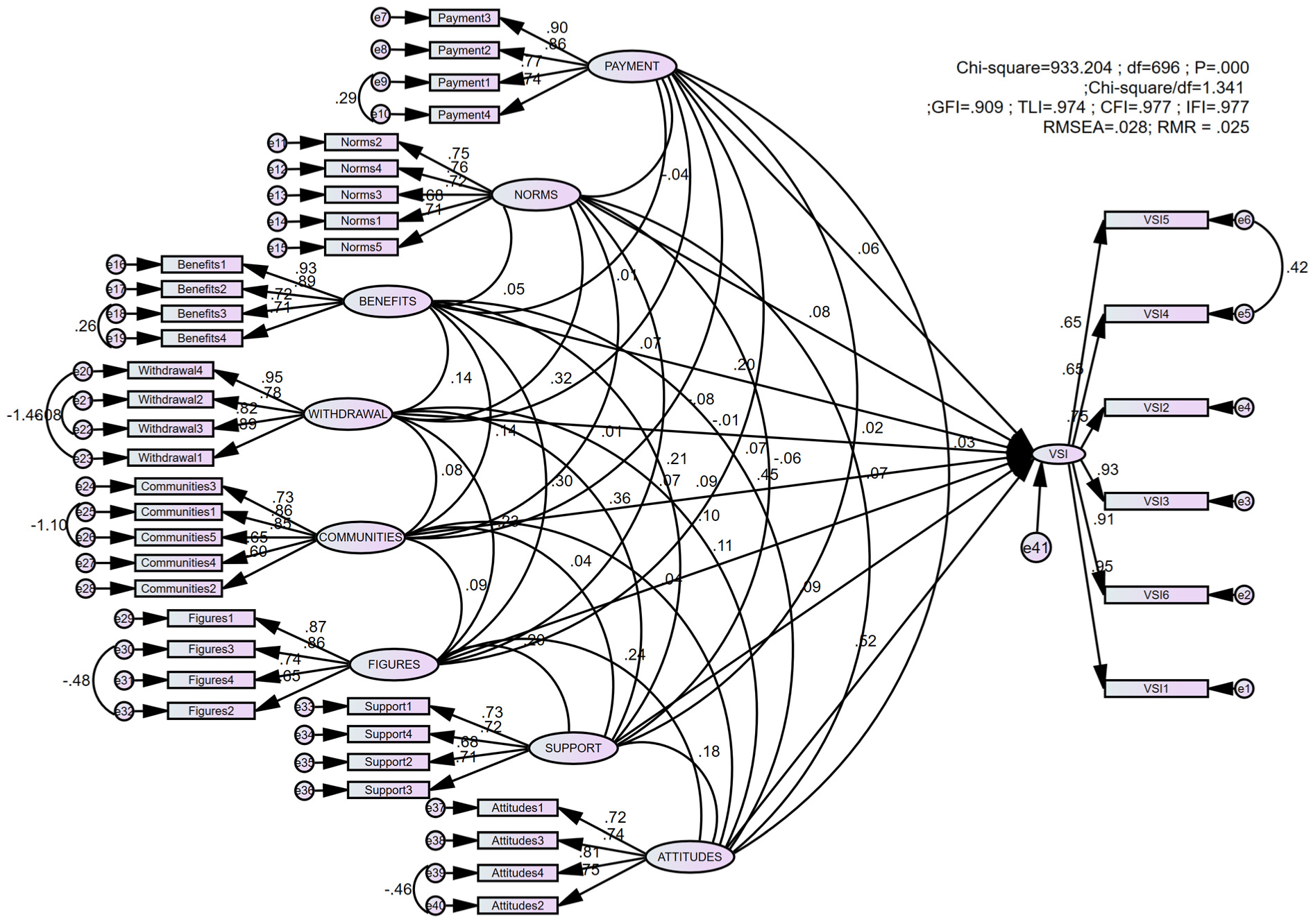
The estimated standardized coefficient in the structural model.
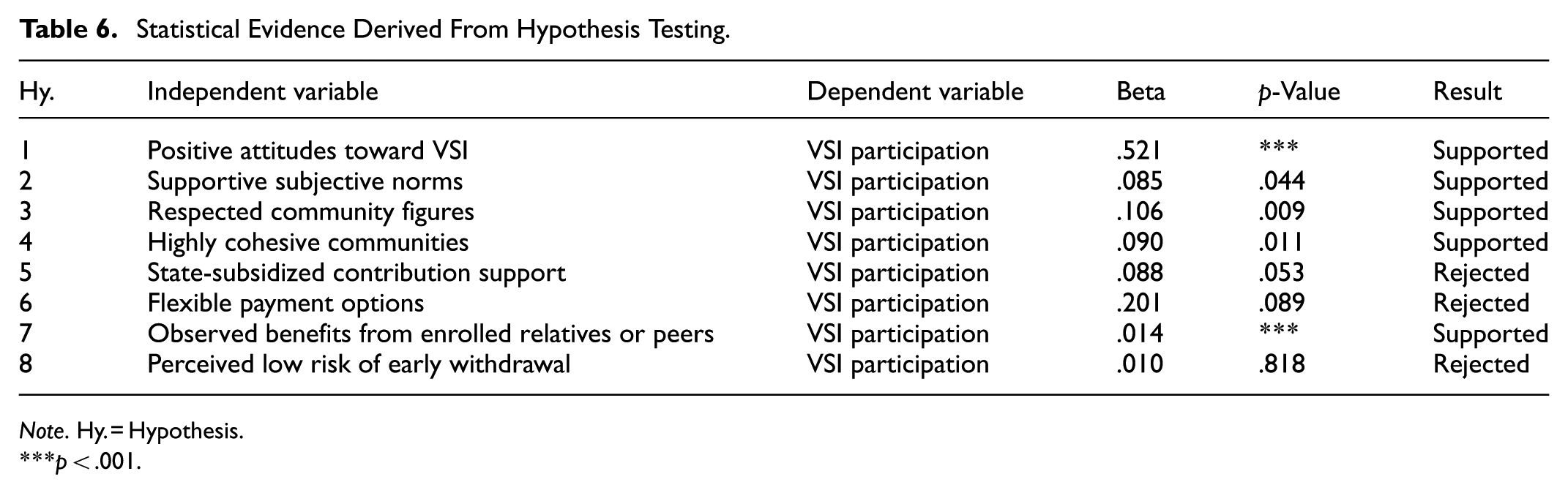
Table 6 outlines the statistical evidence from hypothesis testing regarding the factors influencing VSI participation. The results indicate that while several independent variables significantly predict participation, others show limited or no influence. Positive attitudes toward VSI emerged as the most influential factor (β = .521, p < .001), providing strong support for Hypothesis 1. This highlights the crucial role of individuals’ favorable perceptions in promoting participation. Supportive subjective norms were also positively associated with participation (β = .085, p = .044), supporting Hypothesis 2, although the effect size was relatively small, suggesting that social encouragement has a secondary role compared to personal attitudes.
Statistical Evidence Derived From Hypothesis Testing.
Note. Hy. = Hypothesis.
p < .001.
The analysis shows that respected community figures exerted a statistically significant influence on VSI participation (β = .106, p = .009), lending support to Hypothesis 3. This underscores the role of credible local leaders in endorsing and legitimizing voluntary insurance practices. Similarly, community cohesion had a positive and significant effect (β = .090, p = .011), confirming Hypothesis 4 and suggesting that strong social bonds and collective trust foster greater adoption of VSI. By contrast, not all structural hypotheses were supported. State-subsidized contribution support (β = .088, p = .053) fell just short of conventional significance levels, resulting in the rejection of Hypothesis 5. Flexible payment options, although showing a moderate coefficient (β = .201, p = .089), were likewise non-significant, leading to the rejection of Hypothesis 6. These results indicate that financial and logistical incentives, while valued, are insufficient on their own to motivate enrollment. Overall, structural factors such as subsidies and payment flexibility displayed weaker and statistically non-significant effects compared to attitudinal and normative determinants (see Table 5). This pattern suggests that informal workers may discount financial incentives due to limited awareness, irregular income streams, or low trust in state-managed programs. In contrast, psychosocial drivers—attitudes, subjective norms, and community influence—emerged as more robust predictors, highlighting the limited role of structural levers in isolation and the need for policy strategies that integrate behavioral and social dimensions.
Observed benefits from enrolled relatives or peers had a statistically significant, albeit small, positive effect (β = .014, p < .001), supporting Hypothesis 7. This suggests that even minimal exposure to successful experiences within social networks can promote acceptance of voluntary insurance. On the other hand, the perceived low risk of early withdrawal (β = .010, p = .818) showed no significant relationship with participation, resulting in the rejection of Hypothesis 8. This indicates that liquidity concerns are not a primary factor influencing participation decisions. In summary, the findings emphasize that individual attitudes and community-based social factors are more influential in encouraging VSI participation than structural incentives such as financial subsidies or flexible payment mechanisms. Future strategies should thus prioritize shaping positive perceptions, leveraging community leadership, and enhancing community cohesion to effectively promote voluntary insurance schemes.
Discussion
The analysis reveals that attitudinal and normative factors provide the strongest explanation for VSI participation, reinforcing the idea that decisions are deeply rooted in personal perceptions and social context rather than purely structural incentives. Consistent with prior work (Kianpour et al., 2017; Nduneseokwu et al., 2017), positive attitudes toward social insurance emerged as the most decisive predictor, reflecting the importance of perceived benefits such as protection from health shocks and old-age insecurity in shaping behavioral intentions. In the Vietnamese case, this is especially salient as informal workers increasingly face financial vulnerabilities without access to formal welfare (Nhan, 2023).
Beyond individual attitudes, social influences matter in culturally specific ways. Supportive subjective norms derived from family and peers play a role, albeit secondary to personal conviction (Chen et al., 2019; Zhou et al., 2020). More distinctive, however, is the influence of respected community figures and highly cohesive neighborhood ties. These act as powerful normative anchors in collectivist settings, where trust in local leaders and community solidarity legitimizes voluntary insurance schemes (Cong et al., 2024; Gurney et al., 2016; Home et al., 2014; Wu et al., 2022). Such findings extend the conventional TPB framework by demonstrating that subjective norms are not limited to close kin or peers but are amplified through broader communal authority and cohesion.
Another important contribution comes from observed peer benefits: even modest signals from relatives or acquaintances who have successfully enrolled can act as “social proof,” reinforcing intentions to participate (Dong et al., 2024). This suggests that VSI uptake is not only shaped by rational calculations but also by the informal circulation of testimonials and lived experiences within communities. Together, these results emphasize that psychosocial mechanisms—attitudes, norms, and trust-based influences—carry more weight than financial incentives, helping to explain the limited effectiveness of subsidy- and flexibility-driven reforms in Vietnam.
Flexible payment options did not significantly predict participation, leading to the rejection of Hypothesis 6. This suggests that, despite policy efforts, current schemes may not adequately address the realities of informal sector workers. As noted earlier, irregular and unstable incomes make individuals prioritize short-term liquidity over long-term commitments. However, an additional explanation may lie in the design of the “flexible” schemes themselves. Quarterly or semi-annual payment plans, while more convenient than annual contributions, may still appear rigid relative to the daily or seasonal income cycles of informal workers. In this sense, flexibility in name does not necessarily translate into genuine adaptability. Policies that allow on-demand or micro-contributions, possibly facilitated through digital payment platforms, may better align with workers’ financial rhythms (Mills et al., 2012).
The perceived low risk of early withdrawal (H8) was also non-significant, suggesting that liquidity concerns are less about withdrawal restrictions and more about broader skepticism regarding institutional reliability. In Vietnam, informal workers often view state-managed programs through the lens of administrative inefficiency or uncertainty about future payouts. This cultural and institutional context explains why even if workers believe withdrawal is possible, they may still refrain from enrolling due to doubts about whether benefits will materialize in practice. As Wu et al. (2022) highlight, confidence in institutional reliability outweighs concerns about liquidity in determining voluntary insurance uptake.
Similarly, the near-significant result for state-subsidized contributions (H5) warrants further reflection. While subsidies are designed to lower entry barriers, their limited influence may reflect institutional mistrust and perceptions of policy inconsistency. Workers may interpret subsidies as temporary, politically contingent, or insufficient to offset perceived risks of participation. It is possible that with a larger or more diverse sample, this effect could reach significance, but the weakness of the relationship underscores a more fundamental issue: structural incentives are unlikely to overcome cultural skepticism without parallel efforts to build legitimacy and trust (Dror et al., 2016; Mitra, 2006; Paitoonpong et al., 2008).
Taken together, these non-significant findings highlight the limited motivational power of structural levers in contexts where institutional trust is fragile and economic insecurity dominates. They reinforce a sharp distinction between attitudinal/normative factors—which consistently predicted participation—and structural incentives, which played only a marginal role. The Vietnamese case illustrates that subsidies, payment flexibility, and withdrawal assurances are not inherently ineffective; rather, their impact is muted when citizens doubt the fairness, sustainability, or accessibility of state programs. This suggests that future reforms should combine structural measures with behaviorally informed strategies that leverage trust in community figures, strengthen social cohesion, and address perceptions of institutional credibility.
Theoretical and Practical Implications
Theoretical Implications
This study makes several important theoretical contributions. First, it extends the Theory of Planned Behavior (TPB) by incorporating meso-level constructs—respected community figures and community cohesion—as culturally embedded expressions of subjective norms. This extension highlights that in collectivist societies like Vietnam, subjective norms are not limited to the expectations of family and close peers but are shaped by broader communal structures and trusted local leaders. This provides a more nuanced understanding of normative influence in non-Western contexts (Gurney et al., 2016; Home et al., 2014).
Second, the study refines Rational Choice Theory (RCT) by integrating behavioral economics perspectives such as bounded rationality, trust asymmetries, and collective risk perception. While classical RCT assumes stable preferences and complete information, these modifications acknowledge that individuals often operate under uncertainty, with limited information and varying levels of institutional trust (Dror et al., 2016; Mills et al., 2012). This makes RCT more applicable to informal labor markets where income is volatile and bureaucratic processes are complex.
Third, by situating both TPB and RCT within Vietnam’s institutional context, the study challenges their structural neutrality. It shows that attitudinal, normative, and rational factors are deeply intertwined with trust in governance and community-level dynamics. This adaptation provides a foundation for applying TPB and RCT to social protection studies in developing countries. Although grounded in Vietnam, the theoretical contributions have wider relevance. Other developing countries with large informal sectors, fragile institutional trust, and collectivist cultural traditions may find similar patterns of behavior. At the same time, the degree to which community leaders or state institutions play a role will vary across contexts, suggesting the need for context-sensitive adaptation.
Practical Implications
On the policy side, the findings indicate that attitudinal and community-based levers are more effective than financial incentives alone in promoting VSI participation. Awareness campaigns should focus on reshaping perceptions of VSI’s value and reliability, emphasizing security in health and old age. Success stories and testimonials can be used strategically to reinforce these positive attitudes and create social proof. Community-based strategies are also crucial. Respected community leaders and cohesive social networks should be mobilized to legitimize enrollment and foster group-based participation, particularly in rural areas. Programs that leverage existing community organizations could normalize insurance as a collective rather than individual choice.
By contrast, structural incentives such as subsidies and payment flexibility showed weak effects. Policymakers should therefore avoid relying on them in isolation. Instead, financial mechanisms should be redesigned to align with informal workers’ irregular income patterns, potentially through ultra-flexible, digital, or on-demand contribution models. Just as importantly, transparent governance and consistent benefit delivery are needed to counteract institutional mistrust. Finally, the non-significance of perceived withdrawal risks indicates that liquidity concerns are less pressing than broader issues of trust and legitimacy. Practical interventions should thus focus on strengthening institutional credibility and demonstrating the long-term reliability of VSI rather than emphasizing withdrawal flexibility.
To operationalize these insights, policymakers could design segmented awareness campaigns targeting distinct groups within the informal sector (e.g., market vendors, seasonal agricultural workers, gig economy participants) with tailored messages emphasizing long-term security and portability of benefits. Community-based strategies may be formalized through partnerships with mass organizations such as the Women’s Union, Farmers’ Union, or religious and cultural associations, which already command trust and can coordinate collective enrollment drives. To address skepticism toward state schemes, transparent digital platforms could be developed, enabling contributors to track payments and projected benefits in real time, thereby reinforcing perceptions of accountability. Policymakers might also experiment with pilot micro-contribution models (e.g., weekly or mobile money–based installments) to accommodate the highly volatile cash flows typical of informal work. Finally, peer-to-peer testimonials could be systematically integrated into campaigns, ensuring that observed benefits are not anecdotal but embedded in structured, state-supported communication initiatives.
Collectively, these strategies suggest that expanding VSI participation requires a dual approach: strengthening institutional credibility and leveraging psychosocial/community influences. While designed for Vietnam, these lessons are also relevant for other developing countries grappling with informality, income volatility, and fragile institutional trust.
Limitations and Future Research Orientation
Despite offering valuable insights, this study is subject to several important limitations that warrant careful consideration. First, the application of the Theory of Planned Behavior (TPB) and Rational Choice Theory (RCT), while analytically useful, provides only a partial framework for understanding VSI participation. TPB highlights psychological and normative factors but underrepresents broader structural constraints such as administrative complexity, policy inconsistencies, or volatile labor market conditions that often shape decision-making in transitional economies (Hao, 2025). Similarly, classical RCT assumes stable preferences and access to full information, yet in reality, informal workers may face information gaps, cognitive biases, and persistent distrust in institutions—all of which distort rational evaluation (Chen et al., 2019). These theoretical limitations underscore the need to integrate behavioral economics perspectives, institutional trust, and collective action frameworks into future models.
Second, the reliance on a cross-sectional design restricts the ability to establish causal relationships. Although structural equation modeling captures theoretically grounded associations, it cannot confirm whether attitudes, norms, or observed benefits drive participation—or whether participation itself reshapes these perceptions over time. Longitudinal or panel data would enable researchers to track changes in beliefs and behaviors dynamically, while experimental interventions (e.g., randomized trust-building or information campaigns) could provide stronger causal evidence. Third, the use of convenience sampling, while practical for accessing informal sector workers, limits representativeness. The sample is likely biased toward accessible subgroups, potentially underrepresenting harder-to-reach populations such as seasonal migrants or rural laborers. This constrains the generalizability of the findings, particularly to other developing countries with different institutional or cultural contexts (Dong et al., 2024). Future studies should employ probability-based or stratified sampling strategies to capture greater heterogeneity.
An additional limitation concerns the omission of potentially important control variables. Constructs such as trust in government institutions, prior insurance experience, and individual susceptibility to social desirability bias were not directly measured in this study. Their absence raises the possibility of omitted variable bias: for example, participants with prior negative experiences of insurance may be systematically less likely to enroll, while those more trusting of government might respond differently to subsidy incentives. Similarly, the use of self-reported surveys without controls for social desirability may have inflated positive responses to community or attitudinal measures. Fifth, reliance on self-reported data raises concerns about social desirability bias, especially for behaviors framed as socially responsible, such as insurance participation (Nduneseokwu et al., 2017). Complementary use of administrative enrollment records or experimental behavioral measures would reduce this bias and strengthen validity.
Finally, the study did not include several relevant constructs—such as perceptions of administrative burden, media influence, or trust in government institutions—which have been shown in prior research to play a role in shaping participation decisions (Dror et al., 2016; Home et al., 2014). Their exclusion narrows the explanatory scope of the model. Future research should therefore adopt a more holistic framework that integrates these institutional and informational dimensions. Taken together, these limitations do not diminish the value of the findings but highlight the importance of cautious interpretation. The results provide correlational evidence within a specific context, while pointing to avenues for more rigorous designs that can test causality, expand generalizability, and refine the theoretical models guiding research on voluntary social insurance.
Building on these limitations, several directions for future research can be proposed. First, theoretical frameworks explaining voluntary social insurance (VSI) participation should move beyond the partial perspectives of TPB and RCT. Future studies could incorporate behavioral economics approaches (e.g., Prospect Theory, bounded rationality), institutional trust models, and collective action theories to more fully capture the complexity of decision-making in transitional economies. This would allow scholars to account not only for individual-level attitudes and rational assessments but also for the broader institutional and socio-cultural forces that shape participation behavior. Second, to address the limitations of cross-sectional analysis, future research should adopt longitudinal or panel designs that can track how attitudes, subjective norms, and observed benefits evolve over time and interact with actual enrollment behavior. Similarly, experimental or quasi-experimental designs (e.g., randomized information campaigns, trust-building interventions, or pilot flexible payment schemes) would provide stronger causal evidence regarding the mechanisms influencing VSI participation.
Third, sampling strategies should be improved to strengthen representativeness. Rather than relying on convenience samples, probability-based or stratified sampling methods could be employed to capture a wider range of informal sector workers, including harder-to-reach groups such as seasonal migrants, rural laborers, or gig economy participants. Comparative studies across different regions of Vietnam—or even cross-country analyses—could also test the generalizability of the findings in contexts with varying institutional trust, cultural traditions, and policy environments. Fourth, future research should incorporate key control variables that were omitted in this study, including trust in government, prior experiences with insurance, and measures of social desirability bias. These additions would reduce omitted variable bias and provide a clearer picture of how personal history and institutional perceptions shape insurance uptake. Where possible, administrative records or behavioral data should be used to complement self-reported surveys, thereby reducing the risk of response biases.
Finally, the model should be broadened to include additional institutional and informational factors that are highly relevant in practice. For instance, perceptions of administrative burden, transparency of procedures, and the role of media or digital platforms in shaping public trust could be integrated into future analyses. Exploring these constructs would help policymakers better understand the barriers and facilitators of VSI enrollment in settings where institutional credibility and communication strategies are decisive. In summary, future research should pursue a more holistic and methodologically rigorous agenda, combining diverse theoretical frameworks, longitudinal and experimental designs, representative sampling, and broader sets of explanatory variables. Such approaches will not only enhance the validity and generalizability of findings but also generate actionable insights for designing sustainable social protection systems in Vietnam and comparable developing economies.
Conclusion
By integrating micro- and meso-level social determinants with rational choice considerations, this study provides a novel behavioral model of voluntary insurance participation that moves beyond Vietnam’s case. Theoretically, it advances TPB by broadening the scope of subjective norms in collectivist settings and refines RCT by embedding bounded rationality and trust into decision-making frameworks. Empirically, it demonstrates the value of disaggregating normative, attitudinal, and structural pathways using SEM in informal labor markets. Practically, it shows that building institutional trust and leveraging community figures can be as critical as financial incentives for policy effectiveness. Together, these contributions position the study as relevant not only for Vietnam but for any developing economy struggling to extend social protection to informal and hard-to-reach populations.
Footnotes
Appendix

Funding
The authors disclosed receipt of the following financial support for the research, authorship, and/or publication of this article: We would like to express our sincere gratitude to Vietnam Maritime University. This research was supported by Vietnam Maritime University.
Declaration of Conflicting Interests
The authors declared no potential conflicts of interest with respect to the research, authorship, and/or publication of this article.
Data Availability Statement
The data supporting the findings of this study are currently unavailable due to ongoing processing and validation.