




Abstract
Self-management is the main method of elderly to deal with chronic diseases, and effective self-management support should be designed according to their needs. Existing researches mostly focused on the elderly living in developed Western countries and did not consider the impact of daily activity ability on their self-management support needs. Adopting the qualitative method, 30 Chinese elderly were interviewed. And they were classed into three types named Energetic elderly, Self-care elderly, and Semi Self-care elderly, according to their daily activity ability. The interview data was coded through within-class induction analysis, and the elderly’s self-management support needs were summarized into Instrument Need, Information Need, Emotion Need, and Companionship Need based on the Framework of Social Support. In addition, the differences in needs among three types of elderly were analyzed through cross-class comparison analysis. It was found that as the elderly’s daily activity ability decreases, their Instrument and Information Need were disappearing, while the Companionship Need was emerging. This study gained more insights in self-management support needs of Chinese elderly and the impact of daily activity ability, which can help health professors, caregivers, social workers tailor support services precisely.
Plain Language Summary
Self-management is the main method of elderly to deal with chronic diseases, and effective self-management support should be designed according to their needs. Existing conclusions mostly focused on the elderly living in developed Western countries and did not consider the impact of daily activity ability. Adopting the qualitative method, 30 Chinese elderly were interviewed, and classed into three types according to their ADLs. Their self-management support needs were summarized into Instrument Need, Information Need, Emotion Need, and Companionship Need based on the Framework of Social Support, and the differences in needs among three types of elderly were analyzed. It was found that Chinese elderly experienced a need for communication tools between doctors and patients which was different from elderly living in developed Western countries. In addition, as the elderly’s daily activity ability decreases, their Instrument and Information Need were disappearing, while the Companionship Need was emerging. This study gained more insights in self-management support needs of Chinese elderly and the impact of daily activity ability, which can help health professors, caregivers, social workers tailor support services precise.
Introduction
Chronic diseases, such as hypertension, heart disease, and diabetes, are generally incurable and pose a substantial threat to public health due to their higher incidence and mortality rates compared to other illnesses (Reed et al., 2018). With the increase of age, the people’s probability of suffering from one or more chronic diseases is increasing significantly (Tian et al., 2023). How to manage chronic diseases and achieve healthy aging is not only an important part of the daily life of the elderly, but also the main goal of government health policies (Kong et al., 2022). In China, the largest developing country in Asian, over 75% of elderly aged 65 and above, nearly 190 million suffered from one or more chronic diseases at the end of 2022 (National Health Commission of the People’s Republic of China, 2023).
Self-management, as mainstream idea in the field of chronic disease management, refers that chronic patients manage their own medical and daily lives to achieve optimal chronic disease interventions and reduce complications (Liu et al., 2023; Wagner et al., 2001). Chronic patients are the main providers of care services, while the main responsibility of professional caregivers is to provide support to help patients better self-manage their diseases and lives (Bodenheimer et al., 2002; Boeykens et al., 2023). In practice, self-management programs implemented in many countries have shown good results, and patients have made improvements in physical and mental health, quality of life, care cost, and utilization of health resources (Feng et al., 2023; Musekamp et al., 2016; Udsen et al., 2023; Zimbudzi et al., 2018). However, effective self-management requires patients to have some skills and complete tasks (Sattoe, 2015; Schulman-Green et al., 2012), which is challenges for many chronic patients (Gudi et al., 2023). Therefore, self-management support is considered an important means to ensure effective self-management (Nightingale et al., 2022). Moreover, due to the significant decline in physical functions and cognitive abilities, elderly will face greater challenges in self-management and require more self-management support (Li et al., 2022). Because of the lower level of socio-economic development, poor family doctor system, and lower educational level, Chinese elderly face more serious challenges in self-management of chronic diseases comparing with those living in developed Western countries.
Clarifying the self-management support needs of the elderly is the foundation for designing and effectively providing self-management support (Howell et al., 2019; Hutting et al., 2022). Existing researches have explored obstacles of self-management perceived by patients, including a lack of information on diseases and services, challenges and dilemmas in daily life, multidimensional negative emotions, and customized support services (Huang et al., 2022; Koch et al., 2015). In the process of self-management, most elderly experienced the needs including knowledge of diseases and treatments, the ability of monitor physical signs independently, confidence in self-management, and the resolution of negative emotions (Dineen-Griffin et al., 2019; Dwarswaard et al., 2016). Supports were needed in areas such as social and relationship maintenance, mental health, self-care, and customized advice (Abdi et al., 2019; Wathne et al., 2023). Health professors also believed that patients may need supports in service information, prevention and treatment of health and complications, and nutritional intake (Adriaans et al., 2023). However, most of these conclusions have been drawn in the context of developed Western countries, such as America, Australia, Spain. As the largest developing Asian country, China’s economic and social development level, cultural environment, and other aspects differ greatly from them, such as the elderly living here have lower levels of education and face poor family system. Because of these factors’ impact on elderly’ self-management behavior, Chinese elderly may have some different self-management support needs from those living in developed Western countries (Kamillah et al., 2022; Kett et al., 2010). Regrettably, existing researches cannot provide adequate answers.
In addition, it has been found that the needs of patients in self-management are not fixed and will change with changes in patient’s personal conditions and disease-related conditions (Dwarswaard et al., 2016). Regarding disease-related conditions, existing researches have explored whether patients with different types of chronic diseases perceive the same self-management tasks (van Houtum et al., 2015). The developing patterns of self-management behavior among different disease stages have also been discussed (Audulv, 2013). Specially, the differences in prerequisites for using online self-management services have been identified (Vosbergen et al., 2013). Regarding patient’s personal conditions, existing researches have found the elderly with different age and gender had different self-management behavior and needs (Bell et al., 2010; Costantini et al., 2008). Similarly, as a factor belonging to personal conditions, daily activity ability also has impact on older patients’ self-management. In fact, the self-management behaviors of the elderly with different daily activity abilities are different, and they may experience different support needs (Kong et al., 2021). But these difference have not been explored clearly by existing researches.
Based on this, this study will answer the following research questions:
As the largest developing countries in Asia, what are the self-management support needs of elderly with chronic diseases in China?
What are the differences in self-management support needs among elderly with different daily activity ability?
Through qualitative method, this study try to answer above questions and gain more insights in self-management support needs of Chinese elderly and the impact of daily activity ability, which can help health professors, caregivers, social workers tailor support services precisely.
Methods
Study Design
This study was reported according to the consolidated criteria for reporting qualitative research (COREQ).
Firstly, the types of elderly were defined based on their daily activity ability. Existing researches generally categorized elderly by age, but their behavior and needs in self-management were largely influenced by their daily activity ability, not just age. Referring to the method of Kong (Kong et al., 2021), this study classified elderly into Energetic elderly, Self-care elderly, and Semi Self-care elderly based on their daily activity ability. The Activities of Daily Living scale (ADLs) provided by Lawton (Lawton et al., 1969) was adopted to evaluate elderly’s daily activity ability and classify them according to their ADLs’ scores.
Specially, Energetic elderly refers to elderly with high daily activity ability and can carry out various daily activities, whose ADLs’ scores were less than 14. For example, energetic elderly-5, a female elderly aged 77, can perform various daily activities and her ADLs’ scores was 6. Self-care elderly refers to elderly with average daily activity ability and can engage in basic daily activities, whose ADLs’ scores were between 15 and 21 and any single score was no more than 3. Semi Self-care elderly refers to elderly with poor daily activity ability and they cannot complete some daily activities independently, whose ADLs’ scores were between 22 and 40 and any single score was no more than 4. It should be noted that the elderly who cannot take care of themselves independently are not within the scope of this study, because they cannot self-manage their chronic diseases at all.
Secondly, the qualitative method was adopted to explore the needs of different types of elderly in self-management. And the difference of needs between three types of elderly were explored by comparative analysis.
Analysis Framework
The Framework of Social Support was used to identify the self-management support needs of elderly with chronic diseases. Social Support refers to the spiritual and material connections between individuals and various aspects of society, such as family, friends, organizations, etc., in order to slow down the occurrence and development of individual physical and mental illnesses (Barrera et al., 1983). According to the nature of the resources provided, social support can be divided into Instrument Support, Information Support, Emotion Support, and Companionship Support (Barrera et al., 1983). This framework has been used to analyze the support needs of specific populations, such as caregivers (Huang et al., 2006), left behind children (Cheng et al., 2015), minority population (Moore et al., 2021). In this research context, the elderly’ self-management support need refers to these social support that elderly need to better complete self-management behaviors, and the self-management support needs expressed by elderly with different ADLs will be induced based on this framework.
Participant
Using the principle of theoretical sampling (Eisenhardt & Graebner, 2007), representative elderly were selected as interviewees. Through a promotional program, the written information about the study was provided to elderly within their living community in the afternoon, when most elderly went out of their homes to social activities in China.
The elderly interested in the study were invited to participate. Participants were selected according to the following inclusion criteria: (1) age 60 or older, (2) suffering from one or more chronic diseases, and (3) having a certain level of daily activity ability. And they were asked to fill out the ADLs to evaluate daily activity ability. According their ADLs’ scores, the types they belonged to were determined.
Data Collection
Ethics approval was offered by Human Research Ethics Committee of the university with which the authors are affiliated. The data was collected using face-to-face Individual Interview from elderly who filled out the ADLs. The interviewees provided written informed consent and were given confidentiality agreement by the authors’ affiliation. Based on the research questions and existing study, an initial interview guide was formed. Two professors in the field of chronic disease self-management were invited to evaluate and revise the guide. And it’s ability of capturing information was tested through a pilot interview. The second author, a male associate professor in senior care, conducted all interviews using the interview guide (shown in Appendix 1) in Mandarin to ensure the reliability of data in different interviewees. The first and second authors consulted with each other when significance decisions had to be made. Each interview lasted 15 to 30 min. All interviews were recorded about 10 hr of recording and transcribed about 70,000 words of text. The interview data were processed anonymously before coded.
Thirty-six elderly filled out the ADL scale. The interview data of 30 participants (10 elderly in each types) who finished the interview were used to be analyzed. The demographics of these interviewees was shown in Table 1.
Demographics (N = 30).

The illness highlighted by elderly.
It should be noted that 23 participants (76.7%) have multiple chronic diseases, and the illness types in the Table 1 are the diseases most concerned by the elderly.
Data Analysis
Adopting inductive logic, the self-management support needs of elderly with chronic diseases were summarized based on the Framework of Social Support. Referring to the method of Kong (Kong et al., 2021), the first and second authors coded data independently through within-class induction analysis and cross-class comparison analysis. The agreement in coding was reached by consensus between the two authors. The processing flow was shown in Figure 1.
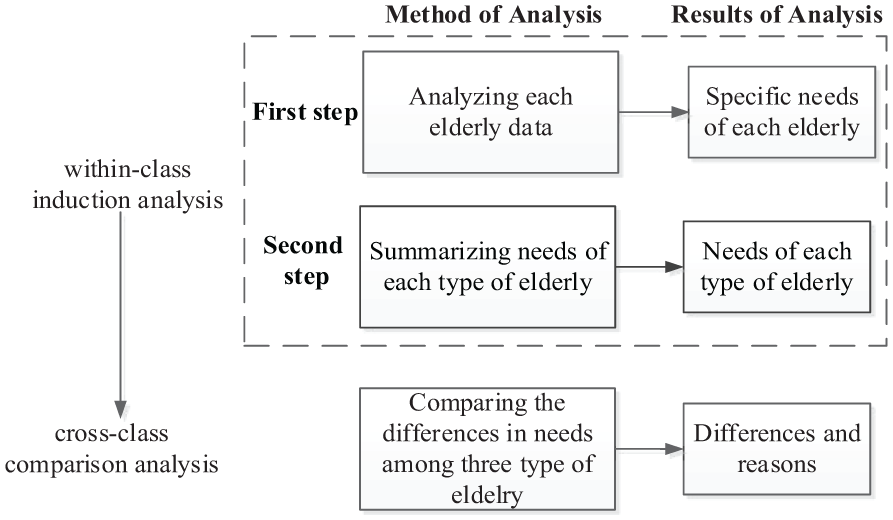
Flow chat of data analysis.
In within-class induction analysis process, the data of each elderly was coded sentence by sentence in first step. Then, the encoding results were summarized into low-order need and further classified into Instrument Need, Information Need, Emotion Need, and Companionship Need based on the Framework of Social Support for every types of elderly. During the process, there was no new self-management need appeared when we analyzed eight energetic elderly interviewees, and the same situation emerged when we analyzed eight self-care elderly and six semi self-care elderly. It meant that the self-management need of each type of elderly had reached saturation, which indicated that interviewing 10 elderly in each type was enough.
The data of energetic elderly was shown in Table 2 as an example.
Example of Self-Management Support Needs of Energetic Elderly (N = 10).

The specific needs mentioned by the elderly.
In cross-class comparison analysis process, the differences in self-management support needs among three types of elderly were compared, and the reasons for these differences were identified.
Results
Through the above analysis process, some insights have emerged.
The Self-Management Support Needs of Energetic Elderly
Instrument Need
Instrument support refers to the provision of financial resources, materials, tools, etc. by society to help individuals solve problems (Barrera et al., 1983). In this study context, Instrument Need refers to the financial, material and tools support that elderly need to better complete self-management behaviors.
Self-monitoring is a common self-management behavior (Kong et al., 2021). In order to facilitate the monitoring of physical signs, energetic elderly showed the Need for physical sign monitors with easy in use (16 quotes), such as blood pressure monitors, blood glucose meters, and household electrocardiogram measurement tools. For example, as one of the most widely used sign measurement tools, electronic blood pressure monitor is relatively easy in use, but it’s display screen is small, which is difficult to read for elderly with poor vision.
The display screen and number on the blood pressure monitor is too small to look clearly. [energetic elderly-2]
In addition, some blood pressure monitors display too many indicators, not only blood pressure indicators, but also heart rate, pulse and other indicators, which often cause trouble for the elderly.
In addition to blood pressure indicators, there are also other indicators. As users who measure blood pressure, we actually care about blood pressure. Other indicators are a kind of interference to us. [energetic elderly-5]
Self-evaluating is also a common self-management behavior to evaluate the health status and develop health plan (Kong et al., 2021).One Instrument Need experienced by energetic elderly is the Need for long-term trend analysis tool (9 quotes) . Elderly usually judges their health status by two methods of comparing the results of physical sign measurement, named normal comparison and stable comparison. Normal comparison refers to compare the measurement results with the normal range to determine whether it is currently normal, and Stable comparison refers to compare today’s measurement results with previous results, such as the previous week, to determine whether they are stable. However, both of these methods are short-term analysis, and the analysis on the long-term trend of physical signs is lack.
After measuring, I recorded the results. Usually, I also compare today’s blood sugar value with yesterday’s and a week ago’s to determine whether they are stable. But the long-term changes are not known, and tools are needed to help analyze these changes. [energetic elderly-1]
Self-intervening is the common self-management behavior (Kong et al., 2021). One Instrument Need experienced by energetic elderly in this behavior is Need for medication reminder tool (14 quotes). Because of the good control in chronic diseases and relatively rich social activities, energetic elderly often forget to take medication. The tool to remind them is needed when they forget to take medication.
I often forget to take my medicine due to a lot of things. It would be better if there is anything to remind me. [energetic elderly-4]
Another Instrument Need that energetic elderly experienced in this behavior is Need for doctor-patient communication tool (18 quotes). During self-management, elderly not only need doctors when their bodies are abnormal, but also need guidance and suggestion from doctors when their bodies are normal. However, in China, elderly and doctors mainly rely on face-to-face communication, and China’s medical resources are relatively scarce, which makes it difficult for the elderly to make appointments with doctors. Therefore, the elderly hope to have more convenient doctor-patient communication tools to support them.
In addition to seeking medical treatment, there are also many places that require the guidance and advice of doctors in daily life, but it is not very worthwhile to go to the hospital because of these needs. Currently, there seems to be no convenient way to communicate with doctors. [energetic elderly-8]
Information Need
Information support is the second type of social support, which refers to the support that is conducive to explaining, understanding, or responding to problems (Barrera et al., 1983). In this research context, Information Need refers to the need for this support to better complete self-management behaviors.
The Information Need of energetic elderly is mainly in self-evaluating behaviors as Need for disease-related knowledge (19 quotes). During self-management, the elderly need to know knowledge and information related to their illness, such as symptom knowledge, health knowledge, etc., in order to better evaluate their physical condition, set intervention goals, and choose intervention methods.
As the disease progresses and becomes more severe, knowledge about complications of diabetes need be learned. The support of information about how to intervene and control this illness is needed. [energetic elderly-9]
Emotion Need
Emotion support is the third type of social support, which refers to an individual being respected or accepted, their value being recognized, and thus can improve their self-confidence or self-efficacy (Barrera et al., 1983). In this research context, Emotion Need refers to the elderly’s need for the Emotion Support, such as encouragement and recognition, in order to better complete self-management behaviors.
The Emotion Need of energetic elderly is in self-evaluating behaviors, experienced as the Need for recognition and encouragement (15 quotes) in judging physical conditions, developing intervention plans. In order to conduct self-evaluating better and more confidently, the elderly need to be recognized and encouraged by their families and professionals.
Many patients are afraid to adjust medication dosage on their own, and if they have any problems, they have to seek help from doctors. I’m fine, I will adjust the dosage of my medication according to my physical condition. They mainly lack confidence and need encouragement. [energetic elderly-7]
Self-Management Support Needs of Self-Care Elderly
Through data analysis, we found that the self-management support needs of self-care elderly also included Instrument Need, Information Need, and Emotion Need. The detailed analysis was as follows.
Instrument Need
The Instrument Need of self-care elderly mainly in self-evaluating behavior, which is reflected in the Need for knowledge query tool (12 quotes). Judging the physical condition based on the results of physical sign monitoring, determining intervention goals, selecting intervention plans, and other self-evaluating behaviors require knowledge related to diseases. However, these knowledge are relatively scattered, which is inconvenient for the elderly to query. Therefore, a convenient knowledge query tool is needed.
I usually enjoy watching the “Health Preservation Hall” TV show and learned a lot of knowledge. But the TV was too fast to remember, and I couldn’t find these knowledge afterwards. Later, I asked my daughter to use computer to check it for me. But I don’t know how to use computer either. It would be great if there was something that could organize this knowledge and make it easy to search during use. [self-care elderly-2]
Information Need
The Information Need of self-care elderly only appears in self-evaluating behavior, which is reflected in the need for disease and health-related knowledge (19 quotes). This knowledge is needed when the elderly conduct self-evaluating behaviors, such as Judging the physical condition based on the results of physical sign monitoring, determining intervention goals, selecting intervention plans. The elderly may obtain this knowledge not only through online channels, such as television, internet, but also through the offline channels, such as the education of professional caregivers.
These self-evaluation behaviors need to be based on scientific knowledge, and relying solely on self-perception is not enough. But there are many essential knowledge we do not know, and what we know may not be accurate, so we need doctors’ advice and suggestions. [self-care elderly-5]
Emotion Need
The Emotion Need of self-care elderly also appears in self-evaluating behavior. In addition to knowledge from doctors, elderly also need encouragement and affirmation (18 quotes) from doctors, family members, and friends to increase self-confidence and self-efficacy when evaluating their physical condition, determining intervention goals, and formulating intervention plans.
Suffering from this disease for many years, I actually know when to take what medicine, but my family always says that medicine cannot be taken indiscriminately, and I dare not, so I often go to see doctors. I feel that if encouraged and supported by doctors, I would dare to adjust the type and dosage of medicine according my own physical condition. [self-care elderly-4]
Self-Management Support Needs of Semi Self-Care Elderly
The self-management support needs of semi self-care elderly are mainly reflected in Emotion Need and Companionship Need. The detailed analysis is as follows.
Emotion Need
The Emotion Need of semi self-care elderly appears in self-intervening behaviors. Semi self-care elderly often conduct rehabilitation training for body functions that have significantly declined, in order to restore these functions or delay further decline. But this kind of rehabilitation training is a long-term process, and with more pain at the beginning stage. Therefore, in order to persist well, the elderly need for continuous recognition and encouragement (18 quotes) from doctors and family.
I suffer from hemiplegia and my right hand and foot are not agile. Rehabilitation training is conducted every day, but it is not easy to persist and requires encouragement from doctors and family members. [semi self-care elderly-4]
Companionship Need
Companionship Support is the fourth type of social support, which refers to spending time with others. On the one hand, it can satisfy the needs of individuals to interact with others, transfer concerns about problems, or directly bring positive emotions. On the other hand, it helps individuals solve problems they cannot solve on their own (Barrera et al., 1983). In this research context, Companionship Need refers to the elderly’s need for someone to be by their side, providing positive emotions and solving problems that they cannot solve on their own in order to complete self-management behaviors.
The companionship need of semi self-care elderly mainly appears in self-intervening behavior, including companionship need in dietary control (16 quotes) and in rehabilitation training (14 quotes). In terms of dietary control, many semi self-care elderly are no longer able to cook independently, so they need someone to help solve this problem.
I have difficulty with my hands and feet, and my hearing and vision are also poor. There is a housekeeper taking care of my daily life. Many things are done by her, such as buying groceries, cooking, doing laundry, cleaning, etc. I can eat and move around independently. So an elderly person like me really needs someone to be by my side. [semi self-care elderly-3]
In terms of rehabilitation training, as mentioned above, rehabilitation training is a long-term process that requires family members to accompany the elderly and provide continuous emotion support to overcome the initial painful process together.
At the beginning of rehabilitation training, it was really uncomfortable. I couldn’t even walk the most basic path well, and had suicidal thoughts. If there weren’t my wife and son being by my side, I wouldn’t have been able to persevere. Many elderly people like me have this experience. [semi self-care elderly-7]
Comparison of Self-Management Support Needs
Based on the above analysis, the self-management support needs of three types of elderly were compared, and the result was shown in Figure 2.

The self-management support needs of three type of elderly.
In the figure, three different colors were used to represent energetic elderly, self-care elderly, and semi self-care elderly, respectively. The elderlies’ self-management behaviors were divided into self-monitoring, self-evaluating and self-intervening according to Kong et al. (2021). Their self-management support needs were divided into instrument need, information need, emotion need and companions need. The elderlies’ specific needs for three self-management behaviors were presented in the squares of the figure.
Energetic elderly experienced Instrument Need, Information Need and Emotion Need during self-management. The Instrument Need for easy-to-use sign monitoring tool appeared in their self-monitoring behavior, and Instrument Need for Long term sign data analysis tool appeared in self-evaluating behavior. The Information Need for disease-related knowledge also appeared in self-evaluating behavior. The Emotion Need for recognition and encouragement from doctors appeared in self-evaluating behavior.
Self-care elderly also experienced Instrument Need, Information Need, and Emotion Need during self-management, but these needs all appeared in self-evaluating behavior. The Instrument Need was need for disease-related knowledge query tool, the Information Need was need for disease-related knowledge, and the Emotion Need was need for doctors’ recognition and encouragement about judging the physical condition, determining intervention goals and selecting intervention plans.
Differently, semi self-care elderly experienced Emotion Need and Companionship Need during self-management, which both appeared in self-intervening behavior. The Emotion Need was the need for families’ and doctors’ recognition and encouragement about dietary control and rehabilitation training, and the Companionship Need was the need for caregivers (family members or housekeeper) to be around them, which can provide positive emotion and solve problems that the elderly cannot solve on their own.
Discussion and Conclusion
Based on the ADLs of elderly patients with chronic diseases, this study divided them into energetic elderly, self-care elderly, and semi self-care elderly. Then, according to the framework of social support, the interview data was coded and the self-management support needs of the these three types of elderly were separately summarized into Instrument Need, Information Need, Emotion need and Companionship Need. Finally, the differences in self-management support needs among these three types of elderly were analyzed.
Academic Contribution
This study was an extension and supplement to existing researches that mostly focuses on elderly living in developed Western countries, and also responded to the call for attention to elderly patients in developing countries (Mogueo et al., 2022) through exploring the self-management support needs of elderly with chronic disease in China, the largest developing country in Asia. Because of the significant differences in economic level, social culture, political system between China and developed Western countries, elderly patients in China experienced significantly different needs in self-management compared to Western elderly. On the one hand, Chinese elderly expressed the need for communication tools between doctors and patients, which has not yet appeared in existing researches (Huang et al., 2022; Koch et al., 2015). The possible reason is that compared to China, developed Western countries have a smaller population, more medical resources, more comprehensive family doctor system, which facilitates the communication between elderly and doctors. Contrarily, China has a large population, scarce medical resources, and an uncomprehensive family doctor system. The elderly must make an appointment with a doctor in hospital, which is both time-consuming and laborious. On the other hand, existing researches mostly mentioned the needs for maintaining social relationships and resolving negative emotions(Abdi et al., 2019; Adriaans et al., 2023; Wathne et al., 2023), which were not reflected in Chinese elderly. One possible reason is that compared to Western countries, China’s elderly have a more obvious sense of collectivism and frequent neighborhood interactions in the community. Moreover, under the influence of traditional Chinese culture, people have a strong sense of kinship and frequent interactions between relatives. This means that most elderly in China have rich social activities and stable social relationships, so there is no need to maintain social relationships or relieve negative emotions.
This study provided insights in corresponding relationship between self-management support needs and self-management behaviors, which enriched existing researches. Most of the self-management support needs proposed in existing researches were aimed at self-management as a whole, without in-depth analysis of the relationship with self-management support needs and behaviors (Abdi et al., 2019; Adriaans et al., 2023; Wathne et al., 2023). Deeply, this study analyzed the needs corresponding to different self-management behaviors. For example, in terms of Instrument Need, in self-monitoring behavior, the elderly need easy-in-use sign monitoring tools, In self-evaluating behavior, the elderly need trend analysis tools, and in self-intervening behavior, elderly need doctor-patient communication tools and medication reminder tools.
This study gained more insights in evolution of self-management support needs according to ADLs, which enriched the researches from a dynamic perspective. It is generally believed that the self-management behavior and support needs of the elderly will change with individual and disease-related factors (Bell et al., 2010; Costantini et al., 2008; Vosbergen et al., 2013), but the impact of the daily activity ability, as an important individual factor, on the self-management support needs has been unclear. Firstly, this study found that as the ADLs of elderly decreases, the Instrument Need becomes less apparent. Compared with more Instrument Need of energetic elderly, the self-care elderly only have a need for knowledge query tools, while semi self-care elderly people do not have Instrument Need. The reason is not that semi self-care elderly have no obstacles in using tools, but rather that they no longer use self-management tools at all due to their body functions and cognition limitations (Kong et al., 2021). Secondly, as the ADLs of the elderly decreases, their Information Need begin to disappear. This study found that both energetic and self-care elderly experienced significant Information Need, while semi self-care elderly did not. Similarly, the reason is not that semi self-care elderly have already sufficient health knowledge, but that they no longer engage in self-monitoring and self-evaluating behavior (Kong et al., 2021). Finally, as the ADLs of the elderly decreases, the Companionship Need begins to emerge. This study found that both energetic and self-care elderly did not show companionship need, while semi self-care elderly had. The reason is that energetic and self-care elderly can engage in rich social activities without obstacles, so they do not need additional family companionship. However, because of the limited abilities, semi self-care elderly have more difficult to engage in social activities (Kong et al., 2021), so they need more family companionship to obtain social support.
Practical Implication
Findings about the self-management support needs of elderly with chronic disease can help health professors, social workers, or caregivers understand Chinese elderly’s need clearly and design support model specially. Both online and offline channels can be adopted to provide support services. For example, appropriate intelligent hardware and software can be used to meet the Instrument Need and Information Need of the elderly. Furthermore, the findings about evolution of self-management support needs according to elderly’s ADLs are important to self-management supporter paying more attention to the impact of elderly’s daily activity ability.
Limitation
Firstly, 10 people for each type of elderly were interviewed and reached saturation during data analysis, but we cannot guarantee that the all self-management support needs are included. Future researches can interview more elderly to find new self-management support needs. Secondly, this study compared the needs verbally expressed by the elderly, which may not fully represent their needs. Future researches can adopt other methods to obtain data that reflects the potential needs.
Footnotes
Appendix 1

Ethical Considerations
This study was conducted with the approval of the ethics committees of Xinyang Normal University (202207026).
Consent to Participate
All participants provided written informed consent and were given confidentiality agreement by the ethics committees.
Funding
The authors disclosed receipt of the following financial support for the research, authorship, and/or publication of this article: This work was supported by National Philosophy and Social Science Foundation of China (Grant No. 23BGL301).
Declaration of Conflicting Interests
The authors declared no potential conflicts of interest with respect to the research, authorship, and/or publication of this article.
Data Availability Statement
Data sharing not applicable to this article as no datasets were generated or analyzed during the current study.