




Abstract
This article aims to examine the discrepancies between Chinese and Indian media in portraying “China-India border clash,” by comparing the multimodal discourse construction of news values in Chinese and Indian media in their respective 30 English-language news reports about the latest China-India border clash (the Clash) occurring on June 15, 2020. Based on discursive news values analysis framework, this study adopts corpus linguistic methods to investigate news values through key words, naming strategies, and news photographs in Chinese and Indian mainstream domestic news outlets. The results show that Chinese media highlights the construction of Personalization, by framing the Clash through the personal experience of the soldiers and the ordinary citizens’ sorrow in the aftermath; in contrast, Indian media establishes Eliteness as the dominant indicator of newsworthiness, by framing the Clash through the language of the Indian political authorities and demonstrating the subjects and modalities that mostly affect Indian elites. Consequently, the Clash has been packaged in discrepant ways: as a people-oriented social event by Chinese reporting and as a high-powered political/military event by Indian reporting. Such a discrepancy of Chinese and Indian media in construction of news values further exposes the ideological positioning of the two news media in terms of Civilianism and Elitism.
Keywords
Introduction
The border issues between China and India have lingered on for decades (since 1962), resulting in military clashes from time to time. Every clash was reported heatedly for a spell by both the Chinese and Indian media. It can be intuitively gathered that the news reports of the same clash were constructed very differently by the two countries, not only on the definitions of the fault maker, but also on the focus of the event, the selection of the information, etc. The most recent major border clash occurred on 15th June 2020 (the Clash), when soldiers on both sides suffered injuries and casualties. The media of the two countries criticized each other and denied the authenticity of the other’s news reports of the Clash (e.g., The Times of India, Jan 25, 2021; Global Times (China), Jan 26, 2021). Thus, it is noteworthy to dissect the different ways the Chinese and Indian news reports construct the Clash.
News values are disciplines that dominate the journalists in selecting, writing and organizing news reports (e.g., A. Bell, 1991; Palmer, 1998, 2000). They are constructed socially, “reflecting the values of the society about the role of a newsworthy entity” (Zhang & Caple, 2021, p. 71). With different standpoints in nationality, politics, cultures and sociality, the media of China and India ought to construct and present the news values of the Clash discrepantly in discursive ways (Bednarek, 2016), such as wording, selecting the news actor, and displaying photographs. Discursive news value analysis (DNVA) specializes in exposing the hidden news values within multimodal resources of news reports. Therefore, we adopt the DNVA approach in critical analysis of news discourse in the present study, to explore the different news values constructed by Chinese and Indian news discourse around the Clash, which may inform us how the event has been sold differently to the domestic audiences in the two countries.
On the other hand, news values are “filtered from the public perception through the mediated representations of journalists, editors or the selected news actors, working as delegates of the public perception” (Zhang, 2017, p. 42), so by examining the news values of the Clash construed by the media of the two countries, the present study also mirrors the values prevalent therein.
Literature Review
Studies of China-India Conflicts
As a series of scholars indicated that China-India border conflicts stemmed from the disputed borders, and demonstrated in competition for political influence, status, and militarization (Dutta & Dutta, 2023), most of the previous studies viewed China-India border conflicts as political events and examined them through political factor analyses. For example, Ali (2024) dissected the policies of new nationalist leaders Xi and Modi to provide a triangular interpretation of the recent China-India border clash. Li (2023) attributed China-India border clash to the recent U.S. factor that impacted China’s perception of India and India’s policy toward China. L. H. Chan and Lee (2023) analyzed China-India border conflicts by critically analyzing the alleged common identity of the two states. A meager amount studies focused on interpreting the political effect of China-India rivalry. For example, Verma and Papa (2021) assessed whether the conflict between China and India will render BRICS dysfunctional. Set and Pant (2023) revealed that the China-India clashes occurred on the Himalayan border in 2020 had the effect of reducing the residual doubts in India about the confrontational dynamics of the relation in both elite and public opinion and caused a change in India’s policy toward China.
The hostility between China and India has been consistently lasting for 80 years, which originated from border clashes and gradually permeated all level of the two societies, including business and economy, public voices, etc. Hitherto, China-India conflicts have not only been a political issue, but more of a social issue. In addition, social attitudes and viewpoints have been verified to perform a vital function in shaping a government’s views on political issues and heavily affecting institutional decision-making (Chen & Liu, 2023). However, the sociological analysis has rarely been concerned by the previous studies of China-India conflicts. Therefore, this study attempts to reveal the social attitudes toward the border clash in the Chinese and Indian societies through news coverage analysis. By this means, we are expecting to provide sociological interpretation for the previous politically centered studies.
Studies of News Coverage on Political Conflicts
The interrelationship between news coverage and political conflicts has attracted increasing attention in the fields of both journalism and politics. The existing studies of news coverage on political conflicts mainly focused on revealing the attitudes, values and positions of the media demonstrated by news content analysis approach. For example, Rafeeq (2023) conducted a news content analysis of the mainstream English daily newspapers (the Gulf News and Khaleej Times in the UAE) for the military conflict coverage beginning from February 25 to March 10, and revealed that both of the two newspapers leaned toward peace journalism in reporting conflict. Zollmann (2023) conducted a quantitative/qualitative news content study to examine how causes of Russia’s invasion of Ukraine (in 2022) were framed in the Western press. Koopmans (2018) investigated the interpretation of war stories in the news reporting of Dutch Republic, and disclosed the intention of the political authorities to regulate the activities of news writers and news publishers.
The results of these existing studies mainly lie in two folds. First, the news reporting was revealed as aggravated or alleviated the political conflicts. For example, Serrano (2016) analyzed the way that media incorporates the war communication of the armed groups, and uncovered that the factual and descriptive style of the news reporting made a contribution more to war than to peace building. Pandit and Chattopadhyay (2018) investigated the way that Indian news coverage conflated with the government policies, which aggravated the political rhetoric. Second, the political powers were disclosed as dominating the news reporting structure. For example, Livio and Cohen-Yechezkely (2019) examined the use of reported speech, transitivity and modality of the three Israeli online newspapers in terms of the 2014 Gaza War, and revealed how political authoritative voice was hided and embodied in the media discourse. Sacco and Gorin (2017) adopted an empirically-based research to examine the discourse frames of the crisis reporting constructed by Swiss media, and found how the military and political contexts influenced the news frame construction.
To sum up, the news content analysis approach adopted by the previous research as the mainstream methodology helped summarize the general semantic focus of the news reporting, but can hardly disclose systematically the news construction way.
In terms of the results, the previous studies mainly focused on exploring the direct link between the news coverage and the political powers, including how the news reporting aggravating or alleviating the political conflicts, and how the political powers dominating the news reporting structure. However, based on the viewpoints by scholars in media and communication, news discourse and social power are of a different nature and cannot be related directly; news values, defined as psychological model of the journalists in selecting news stories and constructing news discourse, act as intermediary to connect the two (Palmer, 1998; van Dijk, 2018).
To make up these deficiencies in the previous studies as discussed above, we will use a discursive news values analysis approach to examine the multimodal devices of the news discourse, reveal the news values constructed in the news discourse, and interpret the social powers that dominate the news values. We will introduce the discursive news values analysis approach in detail in the following section.
A Discursive News Values Analysis Approach
Originating from journalism studies, “news values” has been largely conceptualized as a key driver in the news content (story/event) selection process (Conley & Lamble, 2006; Palmer, 2000). Bednarek and Caple (2012b, 2013, 2014) combined the journalistic perspectives with linguistic views and put forward a discursive perspective on newsworthiness, which has progressed on two aspects: First, newsworthiness is seen as constructed through a set of multimodal news semiotic resources, and can be examined and revealed by news discourse analysis (Bednarek, 2016; Bednarek & Caple, 2012a). Second, newsworthiness describes the psychological status of the news writers or the journalists, and reflects the popular social values that dominated by the social power for a time (Bednarek & Caple, 2014). Consequently, a discursive approach to news values (nominated as “discursive news values analysis (DNVA)” ) concentrates on disclosing the news values and revealing the social power that dominates the news values through dissecting the construction of news discourse and examining multiple semiotic resources (Caple & Bednarek, 2016). By this means, the news discourse construction can be systematically analyzed and the hidden mental process of the journalists in news producing can be fully uncovered (Bednarek & Caple, 2012a).
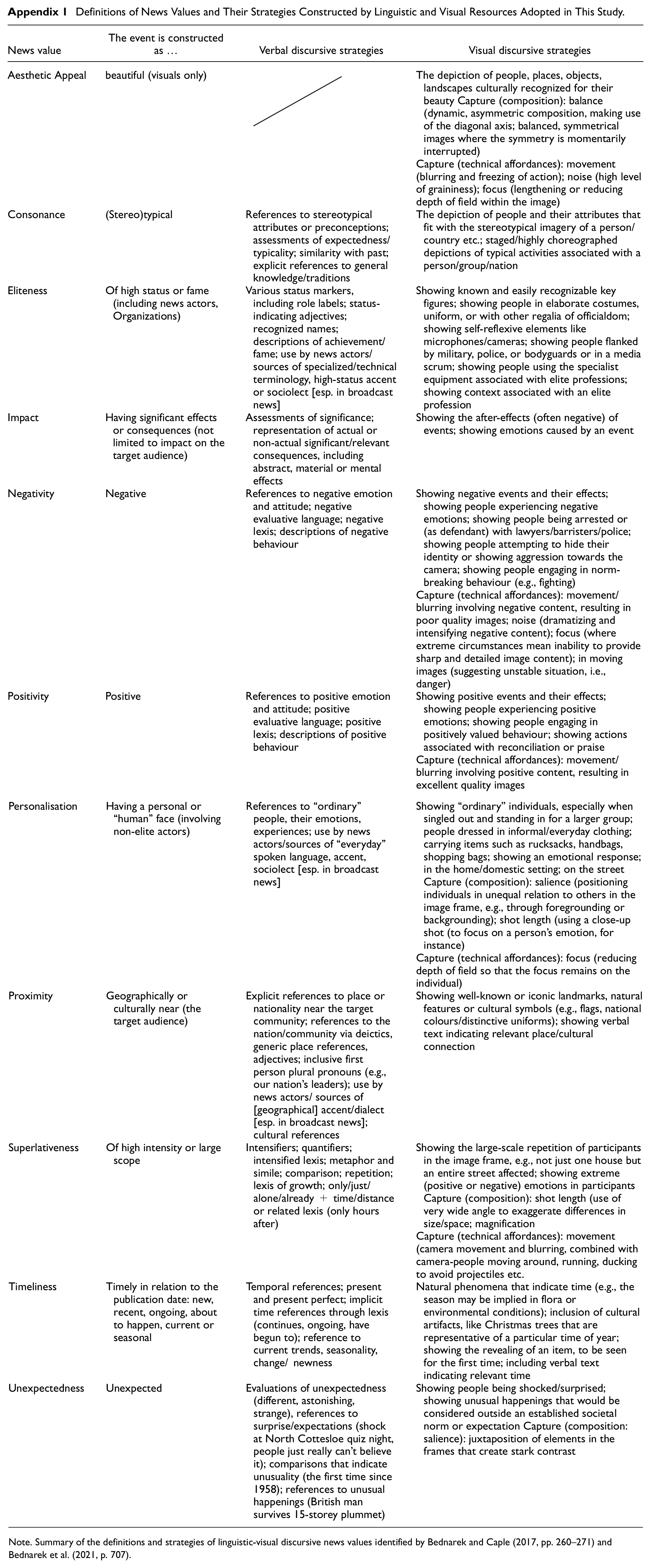
For helping researchers identify the news values through semiotic resources more effectively, the definitions of 11 news values have been illustrated, with the concern of both linguistic and visual signs (see Appendix 1). It is worth noting that these definitions also involve the cross-culture communication lens, by associating with publication time and publication’s target audience. For example, Proximity has been defined as “geographically or culturally near the target audience” (Bednarek et al., 2021, p. 707).
Corpus techniques have been widely adopted by researchers in DNVA studies to extract the saliency of the linguistic devices from a large amount of linguistic data that have the capability to shape marked newsworthiness (e.g., Bednarek et al., 2021; Zhang & Caple, 2021), and help researchers see “how happenings are sold to audiences as newsworthy” (Bednarek & Caple, 2014, p. 143). Thus, this study selects the corpus-based analysis approach to reveal the news values in Chinese and Indian media in their respective 30 English-language news reports, which expedites the research process.
Adapting DNVA in Critical News Discourse Analysis
Since the 1980s, a group of critical linguists have mentioned news values in their critical studies, and did see their cognitive nature and their connection with discourse. For example, van Dijk (1990) interpreted news values as constraints that underlie news discourse, and specified their cognitive conceptualization. Machin and Mayr (2012) presented the concepts of newsworthiness associated with crime constructed by media. Baker et al. (2013) referred to news values several times in their book as the media attitudes for producing news discourse. van Dijk (2021, p. 64) advocated that the news values should be taken seriously and put forward a sociocognitive approach which is characterized by the Discourse-Cognition-Society triangle (van Dijk, 2018). These perspectives propelled a series of recent critical news discourse analyses to focus on exploring the newsworthiness. For example, Martin and Fozdar (2022) disclosed and discussed the prominent racist value constructed by the Australian press through metaphor usage in reporting migration. By examining the Greek news discourse of the corruption scandal, Sakellariou and Goutsos (2021) revealed the prejudice of the accused’s discourse, and indicated that Greek media combines with political parties and the powers through an set of semiotic devices. The above studies did use the lens of news values to explain their results, but they have not employed a discursive approach to examine news values.
DNVA regards news values to be discursively foregrounded in news discourse and examines the interactions of the multimodal resources (Bednarek & Caple, 2014). The application of the DNVA framework will definitely help these critical discourse analyses (especially sociocognitive discourse studies) to explore a more systematic construction of news values, and reveal an overall relational process of discourse, cognition, and society.
The present study conducts an application of DNVA for critical news discourse analysis and compares the construction of newsworthiness in Chinese and Indian mainstream media in their multimodal English-language news reports on the Clash. We aim to explore the whole news production process in reporting the China-India border Clash by Chinese and US media, including the news discourse construction, the news values and the social powers. Empirically, we will answer the following research questions:
(1) In what ways has China-India border Clash been defined and described by news reporting of Chinese and Indian media?
(2) What news values were constructed by these definitions and descriptions of China-India border clash?
(3) What social powers dominate the Chinese and Indian media in their news values and news discourse construction?
Data and Methods
Data
The three combined search terms, including “China,” “India” and “clash,” were employed to select and retrieve online reports from the database from 15th June 2020 (when the 6.15 Clash happened) to 10th April 2021 (when the present study began).
As we concentrate on the news values framed for domestic audiences, the media that targets the national market has been selected. For Indian reporting, we chose The Times of India and The Indian Express, which are the most popular English newspapers in domestic India. To ensure that the Chinese reporting is comparable with the Indian media in language, we focused on the English version of Xinhuanet. Though the news reporting of the English version of Xinhuanet targets international audiences, it has synchronized news contents and reporting ways with the Chinese Xinhuanet version which serves as the most influential news outlet for the Chinese domestic audiences. In addition, to ascertain that the selection of the English news reporting from Xinhuanet on the Clash can reflect what the Chinese media has sold to the domestic audiences, we manually surveyed the Clash-centered English news reports in parallel with the Chinese domestic reporting version.
We collected the reports on the Clash and established two corpora, including the Chinese media corpus and the Indian media corpus. The statistics show that there are totally 34 reports in the Chinese newspapers while only 30 reports have been found in the Indian newspapers, so we decided to collect 30 reports from the newspapers of each country to ensure the comparability of the two corpora.
In view of the different lengths of the news reports of the two corpora (Table 1), we conducted the comparative analysis of the occurrence percentages of the keywords and nominations for ensuring the comparability. We focus on both textual and visual construction of newsworthiness in this study, so the total news photographs illustrated in the news reporting texts have been collected, including 28 from the Chinese media reporting and 34 from the Indian media reporting (Table 1). With the unequal quantities of the photographs in the Chinese media and the Indian media, we examined the visual devices also based on percentages, instead of numbers.
The Word Counts and Photograph Numbers of the Chinese Media Corpus and the Indian Media Corpus.

Procedures of Analysis
The present study used a set of corpus-based techniques to explore the news values constructed in three types of news devices, including (1) keywords which reflect the concentration of the combination of news reports (Baker, 2006); (2) nominations for referring the Clash, which reveal the most salient newsworthy features of the news entities defined by the media (van Dijk, 1990); (3) photograph contents and camera techniques associated with the textual reports, which demonstrate how the Clash event is presented to audiences visually (Kress & van Leeuwen, 2006). The analytical approaches are described in the following four steps.
Firstly, we retrieved the keywords by AntConc 3.5.8w, with each corpus set up as the reference corpus for the other to identify the differences between these two corpora. The keywords were analyzed based on their frequencies, keyness values and concordances to ascertain the most salient linguistic devices in the Chinese and Indian news corpora, and to further disclose the marked news values indicated by these linguistic devices (Bednarek & Caple, 2014).
Secondly, by AntConc 3.5.8w, we analyzed the collocations (5L & 5R) of the search term “clash” to select the nominations of “Clash” and disclose how the Chinese and Indian media refer to “Clash.” The concordance lines have also been analyzed to reveal the contexts of the nominations. These strategies that the news writers selected to refer to the newsworthy entity reflect how they define the news event (van Leeuwen, 2008).
Thirdly, we analyzed the visual content and the camera techniques of the news photographs to reveal the newsworthiness construction ways in images. Visual content includes the visual participants, their behaviors, the places and environments that the news events occurred (Kress & van Leeuwen, 2006). While, camera technique comprises “shutter speed (how fast), aperture (how much light), focal length (how much in focus), lens (how distorted/natural/condensed the shot), and angle (how high or low the angle)” (Bednarek & Caple, 2012b, p. 105).
Last but not least, the verbal and visual devices revealed by the previous three steps have been further examined based on the newsworthiness definitions (see Appendix 1), to identify the ways that they cooperate to highlight the news values of the event. With the cross-cultural concerns of the present study, we adopted the 11 news value categories and their definitions ( See Appendix 1, Bednarek & Caple, 2017) to examine the range of linguistic and visual devices constructing the Clash. In addition, several definitions of news values with a context-sensitive perspective updated by Caple et al. (2020) and Bednarek et al. (2021) were also adopted. Moreover, the social identities and journalistic ideologies framed in the news reports were examined by analyzing the political and social backgrounds of the two media.
Findings
News Values Constructed by Keywords in News Reporting
We used AntConc 3.5.8w to retrieve the keywords of the two corpora and finally obtain two keyword lists (Table 2). It should be noteworthy that the two keywords from the Chinese media and the ten keywords from the Indian media in Table 2 have covered all the keywords of the two corpora produced by AntConc 3.5.8w. Keywords are a cluster of words that are produced by the comparison of two corpora, and can distinguish one corpus from the reference corpus, so the quantities of keywords are usually limited (Anthony, 2022). Based on the parts of speech, we further categorized these keywords into four different groups.
The Keywords in Chinese Media Corpus and Indian Media Corpus.
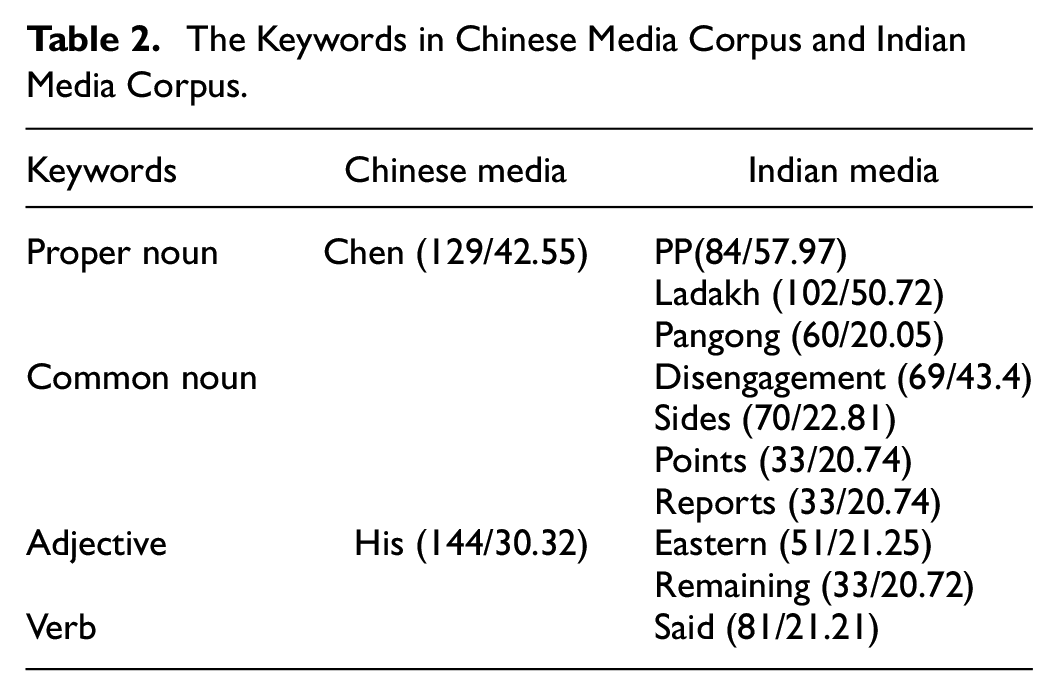
The two keywords for the Chinese media, “Chen” and “his,” unanimously focus attention on the identities of the martyrs (soldier) who died during the Clash. The collocations show that “Chen” and “his” both refer to the martyr Chen Hongjun, the commander of the battalion which confronted and got into conflict with the Indian troops. These two keywords most frequently (22 instances out of 43 total clauses for “Chen”; 36 out of 48 total clauses for “his”) appear together with the names or nominations of the other three martyrs by collocations of “his men,” “his comrades,” “his soldiers,” “Xiao Siyuan,” “Qi,” etc. (see Figures 1 and 2). Elicited by Chen Hongjun (identified by “Chen” and “his”), a series of soldiers or martyrs who participated in the Clash event have all been demonstrated in company as the themes. The concordance lines further reveal that these martyrs’ identities have been specified in the contexts of their personal experiences in the Clash, for example, the following paragraph (see Example 1) containing four instances respectively of “Chen” and “his,” narrates the Clash from the perspective of Chen and his soldiers’ confrontation with the Indian troops, their defense and mutual rescue, etc.

The concordances of “Chen.”

The concordances of “his.”
Example 1
…they bravely defended themselves in the face of the Indian troops’ steel bars, clubs and rocks before
(Xinhuanet, July 21, 2021)
The keywords and their contexts demonstrate that the Clash has been mainly constructed through personal experiences of the soldiers (mainly referred to as the “martyrs”), with an abundance of references to strong emotions and personal actions (e.g., “bravely,” “courageously,” “wish”; “protect,” “rushed to,” “cost his life,” etc.), which simultaneously construes the news value of Personalization (Bednarek & Caple, 2017; Zhang & Caple, 2021). Besides, Personalization is also established through the grieved emotions and experiences of the martyrs’ family members and citizens in mourning with the nominations collocated with “Chen” (e.g., “Chen Hongjun’s wife,” “Chen’s mother, etc.” ), and a variety of other collocations for emotional expressions (e.g., “teary eyes,” “miss,” “respect,” “grieve,” etc.).
In contrast, the Indian reports have been found with more diversified keywords in the use of proper nouns, common nouns, adjectives and verbs (Table 2). The three proper nouns focus attention on the geographical terminologies used by the military. For example, “PP” refers to the patrolling limit marks along the China-India border; “Ladakh” and “Pangong” are the two border regions where the clashes often occurred. The concordance lines show that the three proper nouns mostly attend to references to political and military border arguments, and usually co-occur with a large part of the keywords in common nouns and adjectives, including “disengagement,” “points,” “eastern,” and “remaining” (Table 2), for example, “the
The verb “said” has close association with the quotations. Their concordance lines show that the subjects of “said” are mostly Indian governmental or military officials, and their publicized reports, for example, “Principal Secretary (Forest) Anand Vardhan
News Values Constructed by Naming Strategies
In relation to naming strategies of the “clash” event, both Chinese media and Indian media strongly highlight the geographical aspects in which the clash happened, with 100% and 53% respectively in occurrence frequencies. The geographical references have been defined as the exclusive pointer to the news value of Proximity (Baker, 2006); it has also been pointed out that Proximity is context-sensitive and dependent on the news publications’ audiences (Bednarek et al., 2021). The closer the audience is to the specified place, the more the newsworthiness would be constructed through the place references. However, Table 3 shows that in the geographical nominations, the places attached to “clash” are all remote border regions which are sparsely populated, for example, “Galwan Valley clash,” “Ladakh clash,” “border clash.” The concordance lines show that these nominations frequently co-occur with indicators of margin areas, such as “on the Indian side of the LAC, at PP15 and PP17A (see Example 2)” and “the Chinese side of the LAC at the Galwan Valley (see Example 3).” Thus, these references are not constructed as geographically near the domestic audiences.
Nominations of “Clash” in Chinese and Indian Media.
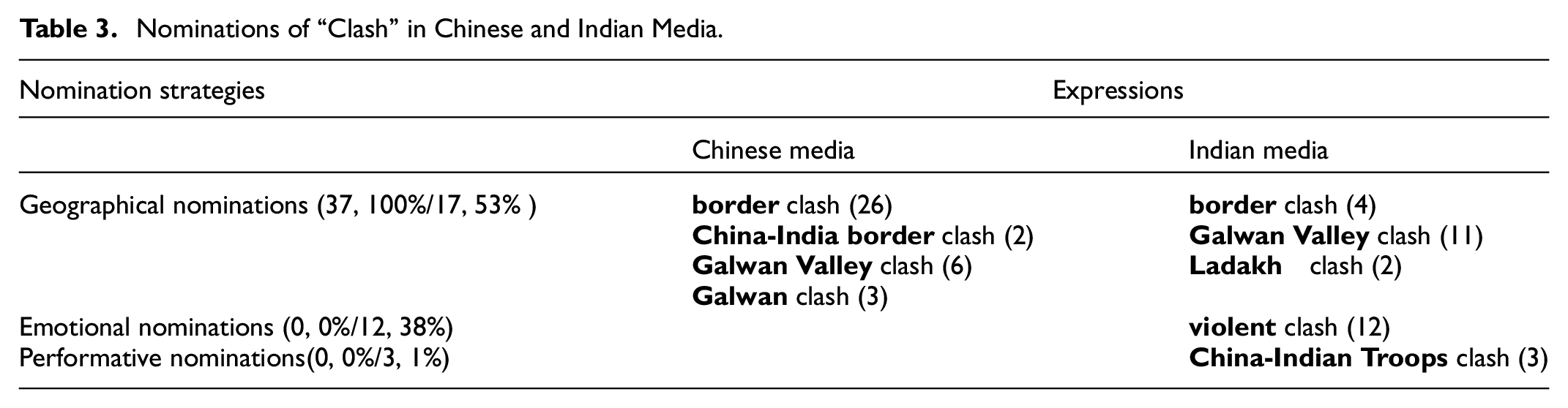
Compared with the Chinese media, for which geographicalization is the one and only nomination technique, greater variety can be found in naming strategies of the Indian media. “Violent clash” takes up 38% of all the naming strategies in the Indian news reports, whose contexts further demonstrate the negative happenings with bloodshed, casualties, and the deterioration of China-India relation. For illustration, the nominations of “violent clash” in Example 4 and Example 5 frequently co-occur with negative expressions including “death,” “killed,” “worst,” “disengaged,” etc. With its frequent occurrences (12/38%), the news value of Negativity has been prominently construed (Bednarek & Caple, 2014).
Besides, we have found 3 instances of “China-Indian Troops clash” through the Indian news reports, indicating the performers of the clash. This nomination constructs the news value of Proximity by referring to the nation (India) and thereby creating closer attachment with domestic Indian audiences (Bednarek, 2016; Bednarek et al., 2021). In spite of the low occurrences, Proximity has been constructed faintly through this performerized nomination.
Generally, in naming “clash,” only Indian media has prominently construed the news value of Negativity; we cannot find any newsworthy nominations through the Chinese news reports.
Example 2
Platoon-sized units have been present on the Indian side of the LAC, at PP15 and PP17A, since the
(Indian Express, August 3, 2021)
Example 3
Since the
(Xinhuanet, September 3, 2020)
Example 4
Forces from both sides have since disengaged from PP14 after the
(Indian Express, August 3, 2021)
Example 5
On June 15 last year, Ladakh’s Galwan Valley witnessed a
(Indian Express, August 9, 2021)
News Values Constructed by Photographs
We analyzed the news photographs of the Chinese and India news reporting based on news content and camera techniques. The frequencies of the news values constructed in each news photograph of the two media have been displayed in Figure 3.

The construction of news values in the news photographs by the Chinese media and Indian media (as percentages).
Figure 3 demonstrates that the photographs of Chinese media construe a much fuller range of news values, compared with the Indian news corpus. The news value of Personalization (86%) takes the lead in the newsworthiness constructed in the visuals of Chinese media, followed by Proximity (71%), Aesthetic Appeal (57%), Negativity (43%), Positivity (46%). The portraits of the four martyrs and the close-ups of the Chinese citizens in mourning dominate the content of photographs. Both the individuals and the small groups are focused on, and the mid-range shots are frequently taken from a frontal angle, with their faces and expressions clearly recognizable. For example, in Figure A1A and B (see Appendix 2), the vivid portraits of the two young martyrs Chen Xiangrong and Xiao Siyuan are highlighted from the blurry mountain background, with clear-cut and beautiful smiles. In Figure A1C (see Appendix 2), the four citizens offering condolences and focalized with a close-up of their sorrowful expressions, are singled out from the crowds whose faces are sheltered or obscured; while in Figure A1D (see Appendix 2), the woman alone who visited the martyr’s tomb and presented flowers is captured in close-up, with a marked mood of melancholy. These image attributes construe Personalization, based on the description by Caple et al. (2020: Section 1) and Caple and Bednarek (2016, p. 439). Simultaneously, when Personalization is constructed through individuals’ description, it is accompanied by the construction of Negativity, Positivity and Proximity. Positivity is established through the close-ups of the vivid smiles of the martyrs, and Negativity is constructed through the images of grieving ordinary individuals, both from the public and the families of the martyrs. These two opposite news values transform the military clash event, which occurred in a remote location, into a social funeral event depicting the soldiers as ordinary people, creating a closer emotional attachment with the audience and thereby construing the news value of Proximity. From another dimension, Positivity reinforces the news value of Negativity, as destroying such young and cheerful human beings underlines the cruelty of the Clash. We can see through the Chinese news photographs that the four different news values reinforce mutually in diversified ways.
The news value of Aesthetic Appeal in Chinese media is mainly realized technically through color contrast and mid-shot. For example, Figure A1A and B (see Appendix 2) portrait the two Chinese martyrs, in which the vivid green outfits of Chen Xiangrong and Xiao Siyuan versus the gray and foreshortened Tibetan mountains lend the image an artistic quality. As this type of technical contrast (used in 36% of photographs) highlights the portraits of the roles from the background, it can be explained as contributing to the construal of Personalization established by image contents. It is noteworthy that three photographs which construe Aesthetic Appeal, display the contrasting colors of the Chinese and Indian national flags, metaphorizing the conflicts between the two countries (see examples in Figure A2A and B in Appendix 2).
In summary, all the visual elements manipulated by the Chinese media working together would naturally lead to a prima facie impression of a sorrowful social event that widely affects the public. Such a way to create and manipulate images in the audiences’ mind has been defined as visual manipulation (Kress & van Leeuwen, 1998, 2001). Cheng and Cheng (2014) also specified that photograph as a constituent of feature articles should not be understood in isolation but in its multimodal contexts. Correlating with the textual context that has been revealed above (key words and naming strategies), it can be seen that both the visual manipulation and textual manipulation were employed by Chinese media as strategies to construct news values centered on Personalization.
Disparate from the Chinese media, Eliteness is constructed dominantly in 91% of the photographs in the Indian corpus, and it occurs with Negativity in 9% of cases and Aesthetic Appeal in 35%. Eliteness is mainly constructed through visual content in two ways. First, 79% of the photographs depict the Indian troops and Indian military convoys in uniform (see examples in Figure A4A and B in Appendix 2) and show powerful forces (Kress & van Leeuwen, 2006). Second, the Indian political elites are also photographed (12%) with their widely known authoritative identities, arrogant expressions, and appearance flanked by bodyguards, for example, the photograph of Defence Minister Rajnath Singh (see Figure A3A in Appendix 2), the photograph of the President of Congress Party Sonia Gandhi (see Figure A3B in Appendix 2), etc., which work together with the quotations of these authorities (as linguistic devices) to maximize the newsworthiness of Eliteness.
A long (telephoto) lens is frequently used in the photographs of the Indian troops and Indian military convoys (35%). This camera technique “captures the image and compresses the information in the image frame, making the elements look closer together than they are,” constructing Aesthetic Appeal (Caple & Bednarek, 2016, p. 444). In this way, the soldiers and the camions are compacted into a smaller space, and the extent of the military power is fully demonstrated, and this image capture technique helps construe Eliteness (see examples in Figure A4A and B in Appendix 2).
Negativity (9%) is construed through the depiction of conflicts between Chinese and Indian soldiers. For example, in the picture from the Indian news corpus (see Figure A5 in Appendix 2), the obstructive gestures of the Indian soldier, the serious expression of the Chinese soldier and the confrontational close body distance between the two, demonstrate the negative emotions and an omen of clash.
It is noteworthy that the Indian soldiers have rarely been captured in close-ups of the clear front face, which however, can be frequently seen in Chinese news photographs. Their faces mostly are obscured as a result of the long lens (see examples in Figure A4A and B in Appendix 2) or in the visual angle of the camera from the rear of the soldiers (see example in Figures A5 and A6 in Appendix 2), creating a perception of “distanciation” (van Leeuwen, 2008) Thus, we can infer from the Indian photographs that Indian soldiers are treated more as a military collective rather than individuals, and Personalization has been expressly weakened. In summary, the visual manipulation was employed by the Indian media to create an Eliteness-centered newsworthiness, which is in line with the effect of the textual strategies adopted by the Indian media.
Discussion
This corpus-based discursive news values analysis reveals how a set of multimodal semiotic devices combine together to deliver a synthesis of newsworthiness, which portray the clash events to audiences in different lights. As both the keywords and news photographs analyzed by this study were exhaustively collected by the corpus analysis tool, they can reveal an overall view of the news values. The results show that Chinese media prominently consists of the name and references of the martyrs as key words, and displays the photographs of the martyrs and the citizens in mourning as the dominant contents, etc., to highlight the construction of Personalization, which at the same time derives a series of other news values established by figure description, including Positivity, Negativity, and Proximity. In this way, the Clash has been framed through the personal experience of the soldiers (martyrs) and the feelings of loss and grief expressed by ordinary citizens in the aftermath of the event. Finally, the Clash has been packaged as a social event which easily aroused an echo in the public. It is noteworthy that a part of the derivative news values has shifted the focus away from the happenings of the clash event, and to the post-clash impact on the society and people (Personalization still mostly concentrates on the clash event itself). On the contrary, Indian media selected the military and political terminologies as key words, cited the sayings of the authorities frequently, and photographed powerful Indian troops and arrogant political elites, etc., to establish Eliteness as the dominant newsworthiness, which is further reinforced by Aesthetic Appeal and Negativity. All of these resources frame the Clash through the mouth of the Indian political authorities, with a focus on demonstrating the subjects and modalities of the elites. In addition, the Clash has been packaged as a high-powered political and military event. Moreover, the Negativity construed by the key themes of the reports, the “Clash” nominations, and the conflict-focused photographs shows that the negativity of the Clash has been more directly defined by Indian media, while Chinese media deliver the negativity euphemistically through the expressions and reactions of the ordinary Chinese people. The cooperation of these textual and visual resources displays the “context model” defined by van Dijk (2018), exercising the overall control in the news reporting production (Cheng & Cheng, 2014).
News values are not natural in the news events, but are assigned in news reporting based on media and journalists’ intentions (van Dijk, 1990). The discrepancies in the newsworthiness construed by Chinese and Indian media (revealed by this study) help disclose their different means of packaging and selling the “Clash” happenings to the public: the Chinese media lays stress on (Chinese) individuals’ perception and experience of the Clash, while the Indian media emphasizes the political and military authorities’ views and arguments. The news values constructed by Chinese media contribute to establishing a closer emotional connection with the audiences. As the border place where the clash occurred is remote, Proximity which indicates the geographical nearness can hardly be perceived by the domestic audiences (this has been analyzed in Part 4.2). With a variety of references to the emotions, responses, and experiences of the ordinary people, Chinese media transforms the distant military event into a social event, striking a chord with the public. By comparison, the Indian reporting draws very infrequently on the personal experiences of ordinary people whereas the political elites and issues remain the focus of attention. It can be inferred from the discrepant mental models of the two media in this news value analysis that Chinese media targeted the general public in reporting the Clash, while Indian media alienated the public readership and targeted the social and political elites more.
News values are defined as the intermediary links for social power to realize their influence on news discourse (Bednarek & Caple, 2014). In other words, it is the social structure that dominates the news values to affect news discourse (van Dijk, 2016). In the Chinese data, Personalization and its derivative news values are intensively construed, which can be seen as the outcome of Chinese journalism that is guided by the dominant social ideology of Civilianism. The concept of Civilianism, defined as dominance of civilian interests and their implementation over military force (Angle & Slote, 2015), was originated from Confucianism and dominated the political and social ideologies in China for thousands of years (Swain, 2017). The concept had been consistently taken as the governance strategy for national stability and prosperity (D. A. Bell, 2008). Civilianism also steers China’s media institutions toward public service-oriented functions (J. M. Chan, 2019, p. 66; Shirk, 2011, p. 9; Sun, 2012, p. 12). More specifically, sponsored or supported by the government, journalists are responsible to select news stories based on the ground rules of catering to the expectations of the public (J. M. Chan, 2019). On the other hand, in the Indian data, the dominance of Eliteness reflects the prevailing ideology of Elitism in the Indian society. It is defined by scholars (e.g., Cabaniss & Cameron, 2017; Sills, 2015; Sutoris, 2018) as the social consciousness of being or belonging to an elite, and taken as social doctrine rooted in the colonial-era and a key portion of the ideological foundation on which the modern independent Indian society was established. Elitism also dominates Indian journalism, by which Indian news reporting mainly speaks for social and political elites, telling the stories of the high-powered class and using highly educated languages, etc. (Markussen, 2011). As van Dijk (2021, p. 9) defined, “there are no individual languages, but only individual uses of languages.” The individual news agency involves the uses or application of socially shared cognition (van Dijk, 2021). Seeing through the differences of Chinese and Indian media in construction of news values, the ideological positioning of the Chinese and India media can be exposed as related with Civilianism and Elitism, respectively. This DNVA study fully uncovers all the aspects and their interlinks that comprise van Dijk’s sociocognitive approach (2016), including news discourse, the cognition of the journalists (news values), and social powers that dominate the journalistic cognition, helping us reveal an overall production and comprehension process of media discourse.
The results of this study offer the social grounds to China-India border clashes, and supplement all the previous politically centered studies with a sociological explanation. In this way, the long-term hostility between China and India has been explained with more social evidences.
Moreover, the results of the present study verified the viewpoint that the same resource can usually establish multiple news values (Bednarek & Caple, 2012b). Visual device has been found having more potential to construct multiple news values than linguistic devices, as an image has the capability to simultaneously carry enriched contents and display multiple camera techniques. For example, the photograph (see Figure A1C and D in Appendix 2) which portrays the Chinese citizens in mourning, not only highlights the Personalization by the close-up of the four individuals in the front, but also delivers Negativity by their sorrow expressions. In addition, the mid-shot taken from eye level to the image participants closes the distance between the image participants and audiences, establishing the newsworthiness of Aesthetic Appeal and Proximity. These news values constructed by the same resource also interrelate with each other in multiple relationships. For example, through the portraits of the young martyrs in Chinese media (see Figure A1A and B in Appendix 2), Positivity is construed by their bright smiles. Negativity is further established and reinforced by the association with Positivity, as the clash looks crueler against the portraits of these beautiful young lives that were lost. Moreover, the Aesthetic Appeal, construed by color contrast between the bright military green outfit of the soldiers (martyrs) versus the monotone gray color of the background mountains, highlights the individual figures and intensifies Personalization constructed by the constructed through individual soldiers’ description. We discovered that the construction of multiple new values by the same device had also been found more frequently in visual resource analyses by many previous DNVA studies (e.g., Bednarek & Caple, 2014; Caple et al., 2020; Caple & Bednarek, 2016), which is in accordance with the results of this study.
The contributions of this study lie on three folds. First, by revealing the news value construction of the Chinese and Indian media toward the border clash event, this study has demonstrated a fuller view of the social attitudes toward the conflict in these two societies. Compared with the previous studies which dominantly focused on conducting political factor analyses, this study helps readers understand the China-India conflicts more deeply through a sociological perspective.
Second, compared with the previous research on news coverage of political conflicts mainly with a news content analysis approach, the discursive news values analysis approach presented by this study has disclosed the construction way of the news reporting in a more systematic and comprehensive way. By this means, the present study has offered a new and effective method for scholars to investigate the interrelation between the news reporting and the political conflicts.
Third, by revealing the whole Discourse-Cognition-Society process (van Dijk, 2018) in reporting China-India border clash (including the construction of news discourse, the establishment of news values and the influence of Chinese and Indian social background), this discursive news values analysis demonstrated a more logical research framework than the previous studies of news coverage of political conflicts which focused on exploring the direct link between the news coverage and the political powers.
Conclusion
The present study has showed the powerful framework of DNVA in dissecting news reporting in critical news discourse analysis. First, by analyzing the construction of news values through a range of linguistic and visual devices, we have discovered how these different components of a news story interact with each other and compose as a functional system in the establishment of news values. For example, the name/references of the martyrs as key words, the portraits of martyrs and the citizens in mourning in the photographs, etc., combine together to highlight the construction of Personalization in Chinese reporting; while the military/political terminologies, the quotations of the authorities, and the portraits of powerful Indian troops and arrogant political elites work in tandem to establish Eliteness in Indian reporting. Second, we have also exposed how the same component derives different news values and how these news values interact with each other to highlight the theme (as mentioned in the previous Discussion part).
Findings from this study reveal wide ideological differences that dominate Chinese and Indian media in reporting the Clash, and further provide insights into their discrepancy in reader positioning and news market constructs (Caple & Bednarek, 2016). Meanwhile, the different social values inherent in the reporting of the “China-India clash” can also be inferred. We hope this article has helped the readers understand China-India border conflicts from the sociological perspective which is different from the lens of politics, and also demonstrated the potentials for applying DNVA framework to research of political conflicts, especially China-India border conflicts.
Footnotes
Appendix 2
Appendix 1
Definitions of News Values and Their Strategies Constructed by Linguistic and Visual Resources Adopted in This Study.
| News value | The event is constructed as … | Verbal discursive strategies | Visual discursive strategies |
|---|---|---|---|
| Aesthetic Appeal | beautiful (visuals only) | The depiction of people, places, objects, landscapes culturally recognized for their beauty Capture (composition): balance (dynamic, asymmetric composition, making use of the diagonal axis; balanced, symmetrical images where the symmetry is momentarily interrupted) Capture (technical affordances): movement (blurring and freezing of action); noise (high level of graininess); focus (lengthening or reducing depth of field within the image) |
|
| Consonance | (Stereo)typical | References to stereotypical attributes or preconceptions; assessments of expectedness/ typicality; similarity with past; explicit references to general knowledge/traditions | The depiction of people and their attributes that fit with the stereotypical imagery of a person/country etc.; staged/highly choreographed depictions of typical activities associated with a person/group/nation |
| Eliteness | Of high status or fame (including news actors, Organizations) | Various status markers, including role labels; status-indicating adjectives; recognized names; descriptions of achievement/fame; use by news actors/sources of specialized/technical terminology, high-status accent or sociolect [esp. in broadcast news] | Showing known and easily recognizable key figures; showing people in elaborate costumes, uniform, or with other regalia of officialdom; showing self-reflexive elements like microphones/cameras; showing people flanked by military, police, or bodyguards or in a media scrum; showing people using the specialist equipment associated with elite professions; showing context associated with an elite profession |
| Impact | Having significant effects or consequences (not limited to impact on the target audience) | Assessments of significance; representation of actual or non-actual significant/relevant consequences, including abstract, material or mental effects | Showing the after-effects (often negative) of events; showing emotions caused by an event |
| Negativity | Negative | References to negative emotion and attitude; negative evaluative language; negative lexis; descriptions of negative behaviour | Showing negative events and their effects; showing people experiencing negative emotions; showing people being arrested or (as defendant) with lawyers/barristers/police; showing people attempting to hide their identity or showing aggression towards the camera; showing people engaging in norm-breaking behaviour (e.g., fighting) Capture (technical affordances): movement/blurring involving negative content, resulting in poor quality images; noise (dramatizing and intensifying negative content); focus (where extreme circumstances mean inability to provide sharp and detailed image content); in moving images (suggesting unstable situation, i.e., danger) |
| Positivity | Positive | References to positive emotion and attitude; positive evaluative language; positive lexis; descriptions of positive behaviour | Showing positive events and their effects; showing people experiencing positive emotions; showing people engaging in positively valued behaviour; showing actions associated with reconciliation or praise Capture (technical affordances): movement/blurring involving positive content, resulting in excellent quality images |
| Personalisation | Having a personal or “human” face (involving non-elite actors) | References to “ordinary” people, their emotions, experiences; use by news actors/sources of “everyday” spoken language, accent, sociolect [esp. in broadcast news] | Showing “ordinary” individuals, especially when singled out and standing in for a larger group; people dressed in informal/everyday clothing; carrying items such as rucksacks, handbags, shopping bags; showing an emotional response; in the home/domestic setting; on the street Capture (composition): salience (positioning individuals in unequal relation to others in the image frame, e.g., through foregrounding or backgrounding); shot length (using a close-up shot (to focus on a person’s emotion, for instance) Capture (technical affordances): focus (reducing depth of field so that the focus remains on the individual) |
| Proximity | Geographically or culturally near (the target audience) | Explicit references to place or nationality near the target community; references to the nation/community via deictics, generic place references, adjectives; inclusive first person plural pronouns (e.g., our nation’s leaders); use by news actors/ sources of [geographical] accent/dialect [esp. in broadcast news]; cultural references | Showing well-known or iconic landmarks, natural features or cultural symbols (e.g., flags, national colours/distinctive uniforms); showing verbal text indicating relevant place/cultural connection |
| Superlativeness | Of high intensity or large scope | Intensifiers; quantifiers; intensified lexis; metaphor and simile; comparison; repetition; lexis of growth; only/just/alone/already + time/distance or related lexis (only hours after) | Showing the large-scale repetition of participants in the image frame, e.g., not just one house but an entire street affected; showing extreme (positive or negative) emotions in participants Capture (composition): shot length (use of very wide angle to exaggerate differences in size/space; magnification Capture (technical affordances): movement (camera movement and blurring, combined with camera-people moving around, running, ducking to avoid projectiles etc. |
| Timeliness | Timely in relation to the publication date: new, recent, ongoing, about to happen, current or seasonal | Temporal references; present and present perfect; implicit time references through lexis (continues, ongoing, have begun to); reference to current trends, seasonality, change/ newness | Natural phenomena that indicate time (e.g., the season may be implied in flora or environmental conditions); inclusion of cultural artifacts, like Christmas trees that are representative of a particular time of year; showing the revealing of an item, to be seen for the first time; including verbal text indicating relevant time |
| Unexpectedness | Unexpected | Evaluations of unexpectedness (different, astonishing, strange), references to surprise/expectations (shock at North Cottesloe quiz night, people just really can’t believe it); comparisons that indicate unusuality (the first time since 1958); references to unusual happenings (British man survives 15-storey plummet) | Showing people being shocked/surprised; showing unusual happenings that would be considered outside an established societal norm or expectation Capture (composition: salience): juxtaposition of elements in the frames that create stark contrast |
Note. Summary of the definitions and strategies of linguistic-visual discursive news values identified by Bednarek and Caple (2017, pp. 260–271) and Bednarek et al. (2021, p. 707).
Declaration of Conflicting Interests
The author(s) declared no potential conflicts of interest with respect to the research, authorship, and/or publication of this article.
Funding
The author(s) disclosed receipt of the following financial support for the research, authorship, and/or publication of this article: This study is supported by Philosophical and Scientific Planning Project of Zhejiang Province, No. 24NDJC128YB.

Data Availability Statement
All relevant data are within the paper.