



Abstract
Digital transformation is a critical tool driving enterprises’ innovation capabilities. This study investigates the nexus between the degree of digital transformation and sustainable innovation from dual perspective. It selects 805 listed manufacturing enterprises on the A-share from 2012 to 2021, categorizes sustainability innovation into exploitative sustainability and exploratory sustainability innovations, and empirically examines the impact of digital transformation on these innovation types. The results indicate that the effects of digital transformation on these two sustainability innovation types are significant, showing an inverted U-shaped relationship. The findings hold after robustness testing. Additionally, external resource acquisition and knowledge absorption abilities play an important role in the influence of digital transformation on the two sustainability innovation types. Further analysis reveals the differential moderating effects of the nature of firm ownership and regional resource differences between the east and the west on the above relationships. State-owned enterprises (SOEs), depending on policy support and resource scale advantages, are more strongly facilitated by digital transformation for exploitative sustainable innovation, while non-SOEs are more effective in driving exploratory sustainable innovation through flexible knowledge absorption mechanisms. The marginal effect of digital transformation on sustainable innovation tends to be significantly better in eastern than in western regions owing to the advanced degree of marketization and improved digital infrastructures.
Keywords
Introduction
Innovation serves as a vital engine for economic development and prosperity worldwide (Leng & Zhang, 2024). Currently, innovation has been a crucial tool for enterprises to maintain competitiveness, acquire competitive advantage, and achieve competitive results (Schepers et al., 1999). The emergence of digitalization has created conditions, such as big data, blockchain, and 5G, for enterprises in various industries to achieve innovation. The implementation of digital technologies reflects enterprises’ acceptance of digital transformation, which implies that the enterprise changes its productivity and operating model as a result of the implementation of new technologies (Yoo et al., 2010). Although the manufacturing industry is fundamental to China’s economy, its innovation-related ability is poor. Therefore, it is crucial to facilitate digital transformation in the industry to optimize operations and ensure sustainability. Notably, some enterprises blindly adopt digital technologies without assessing whether they are effective in ensuring digital transformation and increasing innovation (Tao et al., 2023). Therefore, enterprises must accurately ascertain and implement technologies that effectively ensure their transformation.
Research on the impact of digital transformation on enterprise innovation is categorized into three divisions. The first is innovation performance, which primarily focuses on the impact of digital transformation on enterprise innovation outcomes (Xing et al., 2023; Martin-Pena et al., 2020). Most scholars have concluded that digital transformation influences enterprise innovation performance positively (Lin & Mao, 2024). The second focuses on innovation efficiency, which examines whether digital transformation can lead to greater innovation efficiency within enterprises (Li, 2024). Innovation efficiency relates to the economic benefits generated from innovation inputs, including the efficiency of technological research and development (R&D) spanning innovation investments as well as outcomes and the efficiency with which innovations are transformed into economic outputs. The third examines the impact of digital transformation on enterprise innovation sustainability. Some scholars consider sustainability innovation as a whole, examining the impact of digital transformation on enterprise innovation in the long-term (María-Teresa et al., 2024). The impact of digital transformation on sustainable innovation has also been explored in terms of “revolutionary innovation” and “endogenous innovation” (Mao, 2023). Maria-Teresa et al. (2024) analyzed digital transformation’s direct and indirect links to sustainable development. While scholars constantly examine the impact of digital transformation on various aspects of innovation, enterprises vary in their level of digital innovation.
The traditional manufacturing industry faces a significant risk of elimination; hence, they should focus on digital upgrade and transformation (Butt, 2020). It must shift from closed innovation to open innovation, which involves prioritizing external resource acquisition and assimilating these resources into resources and capabilities available to the firm. This shift necessitates robust capabilities to leverage external ecosystems. Efficient access to complementary external resources enables firms to break through internal innovation bottlenecks and accelerate the adoption of digital technologies (Xie et al., 2024); therefore, it is necessary to emphasize the role of external resource acquisition capabilities for enterprise innovation. In dynamic competitive environments, external resource acquisition capabilities also help enterprises to match differentiated resource requirements at different stages of innovation by enhancing the flexibility of their resource orchestration (Boger et al., 2019). In part, it supports enterprises in dynamically adapting their innovations for sustainability (Liu et al., 2024). This study selects the ability to acquire external resources and the ability to absorb knowledge as moderating variables to investigate their role in the process of influencing the degree of digital transformation on sustainable innovation in manufacturing enterprises.
However, it is not enough to acquire resources from external sources, it is also necessary for an enterprise to internalize these resources effectively. Knowledge absorptive capacity is the counterpart of external resource acquisition capacity. The external resources available to enterprises depend on the amount of resources that can be transformed and absorbed (Xie et al., 2018). Knowledge absorptive capacity determines the effectiveness with which enterprises are able to transform external digital technologies into internal innovations. This optimizes the marginal returns of digital transformation on exploratory innovations by accelerating knowledge internalization and reconfiguration and weakening technology lock-in effects (Zahra & George, 2002). The introduction of knowledge absorptive capacity further explains its optimization through knowledge internalization and reconfiguration to mitigate the enterprise’s innovation threshold. External resource acquisition capacity and knowledge absorption capacity correspond to the contradiction between the type of resources and the demand for capabilities of dual innovation and provide practical value for “open collaboration” and the “internalization of technology” in the digital transformation for the enterprises. This study provides practical value for open collaboration and technology internalization in digital transformation. Compared with other potential variables, such as research on enterprise management structure, which may be too broad in scope to measure their direct impact, making it difficult to obtain better and more comprehensive research, this study chose external resource acquisition capability (ERA) and knowledge absorption capability (KA) as moderating variables. Two variables mitigate traditional literature’s over-reliance on static factors and provide a theoretical basis for cracking the “resource–capability mismatch” conundrum in digital transformation.
Based on the dual perspective, we divide enterprise sustainability innovation into exploitative and exploratory sustainability innovation. This perspective focuses on the impact of the degree of digital transformation toward these dual types on innovation, with this relationship being empirically analyzed using data from A-share listed manufacturing companies over the period 2012 to 2021. Moreover, it provides further revelations on the key moderating roles of external resource acquisition capability and knowledge absorption capability between digital transformation and corporate sustainability innovation. Based on resource base theory, the acquisition of external resources through external resource acquisition capability mitigates the marginal diminishing process in digital transformation and delays the threshold inflection point of digital transformation.
China’s uneven geographical development and diversified ownership structure provide an important backdrop for the innovation ecology of enterprises. Eastern regions tend to have an advantage in technology absorption and resource integration due to their higher degree of modernization and well-developed digital infrastructure, while the marginal effect of digital transformation in western regions are significantly weaker due to smaller resource endowments and more constrained institutional environments (Jiang & Zhang, 2023). At the same time, systematic differences exist within SOEs and non-SOEs with regard to resource acquisition mechanisms, policy responsiveness, and innovation risk appetite. For example, SOEs are more inclined to utilization-based innovation by virtue of policy support and scale advantages, while non-SOEs rely on flexible market mechanisms to promote exploration-based innovation (Di & Bu, 2021). However, the literature on the heterogeneous impact of digital transformation is incomplete and lacks a systematic test of regional and ownership differences. By incorporating analyses of the moderating effects of regional distribution and the nature of enterprise ownership, this study reveals the differentiated paths to sustainability innovation from digital transformation, providing a platform for policymaking and enterprise practice to be more focused.
This study makes three substantial contributions to the literature: First, examining enterprise sustainability innovation from a dual perspective enriches existing research on digital transformation for manufacturing enterprises. Second, the study investigates the impact of digital transformation on enterprises’ sustainability innovation in terms of its extent by identifying the impact of digital transformation on exploitative and exploratory sustainability innovation at different stages. Third, it selects external resource acquisition capacity and knowledge absorption capacity as the moderating impacts of digital transformation between explorative innovation and exploratory sustainability innovation in enterprises.
Literature Review and Research Hypotheses
What is Digital Transformation?
Digital transformation was first conceptualized by Negroponte (2000), who identified it as the digital penetration of a firm’s means of production, the digital reconfiguration of its production relations, and the digital innovation of its business activities. The deployment of digital technologies by an enterprise is considered digital transformation (Hess et al., 2016). It involves using various technologies including Big Data, for enhancing data-driven operation. This transformation allows enterprises to reconstruct their operational modes, frameworks, and work processes based on data, ultimately leading to changes in their production and operation methods (Adner et al., 2019). Digital transformation is extensively recognized as a key driver of value creation by enterprises (Chouaibi et al., 2022). Scholars provide different definitions of digital transformation based on their different research perspectives. From the perspective of strategic change, Verhoef et al. (2021) argue that the digital transformation of enterprise occurs in three stages. From the perspective of value creation, Pagani and Pardo (2017) argue that digital transformation involves creating and capturing value from new business logics and models. From the perspective of technological change, Legner et al. (2017) argue that an enterprise’s choice to transform and upgrade through information technology can be considered an undertaking of digital transformation.
Based on previous research on digital transformation, this study incorporates insights from Vial (2019) and Qi et al. (2020) and defines digital transformation as the process by which enterprises optimize production processes, reduce information asymmetry, and promote changes in organizational structure and governance mechanisms through the systematic application of emerging digital technologies and the in-depth fusion of existing businesses. Its essence is to achieve a two-way interaction between industrial digitalization and digital industrialization through technological empowerment and ultimately enhance the enterprise’s competition and sustainability.
Digital Transformation and Degree of Digital Transformation
Digital transformation is dynamic for manufacturing enterprises, with varying degrees and stages having different roles and impacts (Yang & Xu, 2024). Xie et al. (2024) note of processing and labor-intensive industries that are more pronouncedly to apply digital technologies than other manufacturing sectors. The innovation process of digital transformation in manufacturing is an evolutionary one (Jiang & Zhang, 2023), which cannot be achieved overnight. It is important to distinguish between the state and the degree of transformation. Digital transformation is concerned with whether an enterprise is digitally transformed, whereas the degree of digital transformation is concerned with the enterprise’s stage of digital transformation. In other words, compared to digital transformation, the degree of digital transformation differs in terms of how it is manifested and measured. This study treats digital transformation and the degree of digital transformation as two different concepts, focusing more specifically on enterprises’ ongoing phases of digital transformation.
Dual Sustainability Innovation
Sustainable innovation refers to the feedback, cumulation, and latch-on effects of a firm’s past innovation activities, which enable the firm to effectively explore innovation opportunities. This kind of innovation can dynamically cause self-reinforcement, realizing the continuous production of innovation results over time. Thus, it provides a basis for subsequent firm innovations to achieve success (Suárez, 2014). The concept of sustainability innovation was first proposed by Schumpeter (2002) and is divided into two main types: “revolutionary innovation” and “endogenous innovation.”
“Revolutionary innovation” involves disruptions to existing capital, technology, and other aspects, allowing enterprises to overcome challenges and improve their competitiveness. While this type of innovation can disrupt current decision-making processes, when effectively managed, it contributes to the sustainability of dual innovation. This, in turn, provides a continuous stream of innovation that fosters the development and advancement of manufacturing enterprises within their industry. “Endogenous innovation” tends to focus within the enterprise, and usually emphasizes the accumulation of innovations by the enterprise itself, which gradually lead to improvements in the enterprise’s technology and capabilities.
Dual innovation, a concept first proposed by March (1991), includes both exploitative and exploratory innovation. This approach relies on dual capabilities, which are synergistic in a firm’s management process and enhance operational efficiency (Duncan, 1976).
Exploitative innovation involves utilizing existing resources within an enterprise to enhance its current technologies and capabilities (Benner & Tushman, 2003). Such innovations can serve as bases for exploitative innovation. Conversely, exploratory innovation focuses on acquiring new knowledge and technology from external sources to improve and revolutionize existing technologies and capabilities (He & Wong, 2004). While exploitative innovation generally involves low risks and costs by leveraging existing resources, it may not yield breakthrough technologies and has limited potential for transformative development. Conversely, exploratory innovation can lead to significant technological breakthroughs and enhance competitiveness. However, it typically requires a longer R&D cycle, significant resource investment, and high risks.
For the study of dual innovation, most scholars agree that digital transformation is pivotal in dual innovation. Based on time-lagged, multi-sourced data in the pharmaceutical industry, Mandana et al. (2022) reveal the innovation-orientated enterprises tend to exploit dynamic capabilities to propel dual innovation. Li and Guo (2022) examine the effectiveness that digitalization brings to the total factor productivity of resource-based enterprises and identify a complementary effect of dual innovation.
Regarding perspectives on dual innovation, Mao et al. (2023) define enterprise sustainability innovation as comprising two dimensions: exploitative sustainability innovation and exploratory sustainability innovation. Exploratory innovation sustainability refers to the state in which enterprises move away from their current technological trajectory and successively focus their resources and efforts on new areas of opportunity not yet covered, launching and implementing innovation projects to achieve sustained exploratory innovation benefits. Exploitative innovation sustainability refers to the state in which firms successively focus and invest in launching and implementing innovation projects in existing technological areas based on their current knowledge base to achieve sustained output of exploitative innovation benefits. These two dimensions collectively transcend a single perspective and significantly expand the scope of the concept of sustainability innovation.
Hypothetical Development
Degree of Digital Transformation and Dual Sustainability Innovation
Although many enterprises have initiated digital transformation and achieved certain results, the extent of their transformation varies. While some enterprises have completed the basic digital transformation, others are at an initial level. The progress of digital transformation in these enterprises needs further assessment, with the degree of digitization serving as a key indicator of their transformation status.
Enterprises with a high degree of digitalization can use digital technologies to “connect everything” within the enterprise, create autonomous optimization that suits the enterprise’s situation, extend the capacity of enterprises to innovate, as well as improve the quality of enterprise innovation (Zhao et al., 2020).
Digital transformation plays three roles in exploitative sustainability innovation. First, it improves the transformation of enterprise innovation (Ganter & Hecker, 2013). Specifically, it enhances the efficiency of converting existing resources into innovation results and uses these outcomes for subsequent innovations. This continuous cycle adds significant value to the availability of enterprise technology and enhances economic efficiency. Second, digital transformation improves the utilization of an enterprise’s resources (Dong et al., 2023). By integrating and upgrading internal elements through digital technology, manufacturing enterprises can swiftly gather necessary knowledge and resources, optimize production technologies and processes, and reduce resource redundancy and misallocation. Third, digital transformation accelerates the integration within manufacturing enterprises (Chi et al.,2022). Through digital technology, enterprises can rapidly transfer innovation results across various departments, meet operational needs more effectively, and promote the rapid application of enterprise resources.
Similarly, when firms need to access state-of-the-art knowledge and technology externally, digital technology can facilitate this process, thereby driving exploratory sustainability innovation. First, digital transformation strengthens the willingness to pursue sustainability innovation. Firms with advanced digital transformation can swiftly identify gaps between their capabilities and those of external enterprises. This insight drives deeper research and helps acquire valuable knowledge from multiple platforms, thus fostering a constant demand for exploratory and sustainable innovation. Second, digital transformation allows enterprises to overcome their internal limitations and access external knowledge. By leveraging digital technologies, enterprises can explore beyond their existing boundaries and innovation ecosystem and achieve effective coordination of data, as well as knowledge with respect to resources in the process leading to innovation (Wang et al., 2021). This integration supports a robust exploratory sustainability innovation process. Third, digital transformation enables the strategic extension of manufacturing enterprises, and by enabling digital technology, enterprises can prioritize the rapid changes in the market and the industry’s growing tendency when acquiring resources externally. This enables enterprises to be sensitive to their strategic layout, thus accelerating the process of exploratory sustainable innovation, especially in manufacturing enterprises.
Digital transformation effectively promotes the sustainability innovation of manufacturing enterprises through digitalization phases. However, its overall impact on the enterprise is not always effective. In other words, the different degrees or phases of digitalization may not have a positive and effective overall impact on the enterprises or may even appear to inhibit the effect on sustainable innovation. For example, excessive digitization can lead to a redundant and wasteful use of digital technology, even to the extent that it affects the sustainability of innovation in an enterprise (Di & Bu, 2021). In addition, a high degree of digital transformation may make firms overly reliant on existing technological paths, creating a technological lock-in that disincentivizes breakthrough innovation (Schaltegger et al., 2020).
Overall, while digital transformation can enhance enterprise sustainability innovation, it may not always yield proportional returns once a certain threshold is reached. Thus, beyond this threshold, a higher degree of digitalization may not significantly boost exploitative sustainability innovation. Similarly, if digital transformation has not yet matured to a sufficient extent, it may not effectively promote exploratory sustainability innovation and can even hinder it. Therefore, the hypotheses in this study are presented as follows:
Moderating Role of External Resource Acquisition Capacity (ERA)
External resource acquisition capability represents the enterprise’s capacity to select external resources (Zhang & Zhang, 2018). It reflects the enterprises’ ability to fully and effectively acquire the corresponding resources for their use when there are external resources that can be used by manufacturing enterprises. Resource-based theory posits that sustained competitive advantage stems from valuable, rare, inimitable, and non-substitutable resources. Enterprises need to acquire and organize external resources in digital transformation to effectively maintain the sustainability of enterprise innovation and develop a competitive advantage over its rivals (Barney, 2001). The rapid evolution and inherent complexity of digital technologies often create significant internal resource gaps within manufacturing firms, which means that they rarely possess all the necessary resources internally to fully capitalize on digital transformation opportunities. Consequently, accessing complementary external resources becomes paramount to bridge these critical internal resource gaps and unlock the full potential of digital transformation. This imperative inherently drives a fundamental shift from closed to open innovation paradigms, and digital transformation has further accelerated this process for enterprises. In this case, the firm’s external resource acquisition capability emerges as a critical dynamic capability. The ability to access external resources is a key prerequisite for companies to engage in open innovation. It enables enterprises to overcome internal resource limitations and actively participate in the knowledge flows central to open innovation to obtain strategic resources and operational capabilities to realize innovation (Flatten et al., 2011).
External resource acquisition has two primary roles in exploitative sustainable innovation. First, the manufacturing enterprise’s ability to access external resources can supplement the lack of exploitative sustainable innovation. Owing to the limitations of their resources, enterprises cannot have all the resources to maintain their development of exploitative sustainable innovation, and the insufficiency of resources can be mitigated by acquiring the corresponding resources and knowledge outside the firm. Second, it can delay the arrival of the critical value of the digitization degree of the exploitative sustainability innovation of manufacturing enterprises. External resources and knowledge can enhance the quality and quantity of the enterprise’s resources to a certain extent, while the enterprise’s internal resources can satisfy the demands of digitization. This facilitates the development of exploitative sustainability innovation.
External resource acquisition can lead to efficiency and quality gains of exploratory sustainability innovation and reduce the digitalization requirements of exploratory sustainability innovation in manufacturing enterprises. First, exploratory sustainability innovation requires extensive research and experimentation and significant investment and development by enterprises. External resource acquisition can introduce advanced resources and knowledge, decreasing the loss of innovation trials and errors for enterprises, shortening the time and cycle of enterprises in the innovation process, and encouraging them to focus their attention and resources on front-end exploratory sustainability innovation activities. Second, manufacturing enterprises obtain the resources required for enterprise innovation from the outside, which can enable enterprises to effectively and timely establish the resource base required for their innovation to meet the corresponding resources required for digital transformation (Xu & Zhang, 2016). This enables enterprises to quickly meet the requirements of exploratory sustainability innovation and accelerate their embarkation on exploratory sustainability innovation.
In summary, when the enterprise achieves the ability to source resources externally, it can facilitate the identification of shortcomings and needs for innovation and obtain the corresponding external knowledge predictably according to the innovation of the enterprise, which will play a contributing role to the exploratory innovation of the enterprise. Therefore, this study proposes the following hypothesis:
Moderating Role of Knowledge Absorption Capacity (KA)
Cohen and Levinthal (1990) initially proposed the absorptive capacity concept in their study of the role of R&D in enterprises. The absorptive capacity of knowledge mainly includes knowledge acquisition, knowledge internalization, knowledge absorption, and knowledge utilization (Xie & Zuo, 2013). Therefore, the knowledge absorption capacity of an organization is a dynamic ability to continuously acquire, internalize, assimilate, and utilize knowledge (Zhang & Long, 2022). Knowledge absorption capacity determines whether an enterprise can transform external digital technologies into innovations and whether the technologies can be implemented in the digital transformation of the enterprise. Through knowledge absorption capacity, enterprises can continuously adapt towards gaining and maintaining a competitive position in a volatile and evolving market environment (Boger et al., 2019). To continuously gain competitive advantage, enterprises must have continuous innovation (Latukha & Veselova, 2019). Similarly, owing to the heterogeneity among enterprises, knowledge absorptive capacity is an important factor reflecting an enterprise’s innovative capacity. It is impossible to completely absorb all the knowledge, and it is more likely that not all can be transformed into the company’s resources and knowledge use (Liu et al., 2024). Therefore, in this process, the enterprise must leverage the existing or acquired knowledge for integration and digestion for relative innovation.
Knowledge absorptive capacity strengthens firms’ exploitative sustainability innovation. First, knowledge absorptive capacity accelerates firms’ efficiency in absorbing knowledge resources and facilitates knowledge utilization. Second, it fundamentally strengthens the role of digital transformation in exploitative sustainability innovation (Lane et al., 2006). Exploitative sustainability innovation is primarily founded by the acquisition and absorption of knowledge transformation to produce further innovations. Knowledge absorption ability fundamentally strengthens the foundation of enterprise exploitative sustainability innovation, provides enterprises with the impetus to produce sustainable innovation, and drives continuing enterprise digital transformation in exploratory sustainability innovation.
Knowledge absorption can strengthen an enterprise’s exploratory and sustainable innovation. First, knowledge absorption ability can accelerate the acquisition of knowledge and internalization and the accumulation of enterprises’ knowledge resources. Second, it can identify, acquire, digest, and absorb the technical knowledge of external partners promptly to expand their innovation path. Third, knowledge absorption ability can provide enterprises with stronger innovation adaptive capacity, which enables them to maintain sustainable innovation in a highly uncertain environment.
In summary, enterprises have more efficient resource absorption and integration and can continue in the innovation process to maintain enthusiasm and initiative. This will help them realize the sustainability of digital transformation on innovation. Whether for exploitative or exploratory sustainability innovation, the absorptive capacity of knowledge will have an effect. Therefore, the following hypotheses were developed for this study:
Research Methodology and Data Analysis
Sample Selection and Data Sources
Since 2012, China’s information-related policies have shown rapid growth, and the construction of digital information infrastructure and Internet technology has been applied and promoted in all aspects. Therefore, the sample selected for this study comprises A-share-listed manufacturing enterprises in China from 2012 to 2021. This study excludes the ST category, *ST category, and missing data. It processed a total of 805 enterprises after processing 7,774 valid observations. The index of the degree of digital transformation of an enterprise is measured using raw data from the financial annual reports of listed companies for the period 2012 to 2021. The patent data were obtained from the State Intellectual Property Office, and the remaining data were from the CSMAR database. Additionally, to protect against the samples’ abnormal value effects on the precision of model estimation, for all continuous variables, winsorization was performed at the top and bottom 1% quartiles of the rows.
Variable Measurement
Independent Variable: Degree of Digital Transformation (DDT)
In contrast to digital transformation, the degree of digital transformation is a dynamic process that is measured in a somewhat different way. Drawing on the research concept of digitization by Zhang et al. (2021), Zhao et al. (2021), and Qi et al. (2020), this study analyzes the percentage of intangible assets associated with digital transformation by assessing the degree of digital transformation in published company financial documents. The level of digitization of an enterprise is mainly measured using the financial reporting notes from public companies, particularly the disclosed year-end intangible asset line item linked to digital transformation. The procedure is as follows. First, the digital transformation evaluation keywords are constructed by drawing on the existing literature and this study’s search for digital technologies. Second, Python crawler is employed to scrape the financial reports of listed companies during the observation period of the sample enterprises, convert them into Excel, and then import them into the Stata tool. An intangible asset line item is defined as a “digital technology intangible asset” when it contains keywords related to digital transformation technologies and associated patents. The sum of several digital technology intangible assets for the same enterprise in a year is computed, and their proportion of intangible assets for the year is calculated as a proxy variable for the degree of digital transformation of the enterprise.
This study classifies digital transformation variable measures as four aspects, comprising 15 classifiers and 69 frequent text combinations. See the appendix for details on the classifications.
Dependent Variables exploitative sustainability innovation (USI) and exploratory sustainability innovation (ESI)
Sustainability Innovation. This study examines sustainability innovation through the perspective of innovation outcome outputs. According to He and Zhang (2017) and Mao (2023), patents are used to examine sustainability innovation. From a dual perspective, sustainability innovation can be categorized as exploitative and exploratory. Considering that current Chinese listed companies do not specifically disclose the specific input and corresponding use of R&D funds required for a company to sustain innovation and its innovation investment, and given that no citations exist for Chinese patent data, this study builds on the findings of Xu et al. (2017) by applying international patent classification (IPC) to the measurement. Herein, the employed patent data include invention patent and utility model patent data, based on the first 4 numerical digits from the IPC patent classification number. Subsequently, a 5-year window is selected. If the patents filed by an enterprise in the current year appear in the IPC classification number with the same patent classification number as the previous 5-year window period, we consider the patent counts of the enterprise’s current year filings with the repeated classifications as exploitative innovations. In the same IPC patent classes as in the previous 5 years, if no duplicates exist in the patent data submitted by the enterprise in the current year, we consider the patent counts of the patents with non-repeated classifications as exploratory innovation.
Based on the patent output, the formula is as follows:

where USIt and ESIt represent exploitative and exploratory sustainability innovations in year t, respectively; UIONT, UIONT − 1, and UIONT + 1 are the number of patents representing exploitative innovation in years t, t-1, and t+1, respectively; EIONT, EIONT − 1, and EIONT + 1 are the number of patents representing exploratory innovation in years t, t − 1, and t + 1, respectively; and TIONT, TIONT − 1, and TIONT + 1 are the sum of the number of patents representing exploitative and exploratory innovations in years t, t − 1, and t + 1, respectively. To avoid the effect of heteroscedasticity, the natural logarithm of exploratory and exploitative innovations is taken by adding 1 in the process of the above calculations.
Moderate Variables
External Resource Acquisition Capacity (ERA)
Given the significant role of the state in resource allocation within China’s policy-driven economy, government grants represent a major and legitimized channel for manufacturing firms to acquire crucial external financial resources. Crucially for empirical rigor, the amount of government grants received, as disclosed under the “non-operating income-government grants” account in financial statements, offers a highly standardized, objective, and quantitatively comparable metric. This stands in stark contrast to less structured or self-reported measures of external resource access, enhancing the reliability and cross-firm comparability of the study. Referencing the findings of Peng and Wei (2014), the “amount of government grants” under the account of “non-operating income government grants” in the financial statements of listed enterprises is used as an explanatory variable to reflect the measurement of the enterprises’ capability to acquire external resources. This variable reflects the enterprises’ capability to acquire external resources.
Knowledge Absorption Ability (KA)
Drawing on Wu et al. (2016), this study measures an enterprises’ knowledge absorptive capacity as the ratio of its R&D investment to the revenue generated from its operations.
Control Variables
Including asset-liability ratio (ASS), property rights (PRO), growth (GRO), fixed asset ratio (FIX), and age (AGE), as presented in Table 1.
Variable Definition

Model Setting
Based on these theoretical assumptions, the below models were structured to verify the impact of the degree of digital transformation on dual sustainability innovation:

To verify the moderating role of external resource acquisition and knowledge-absorption abilities, the following models were constructed:

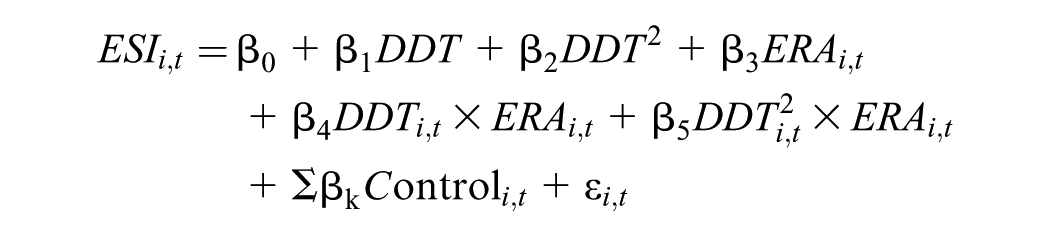

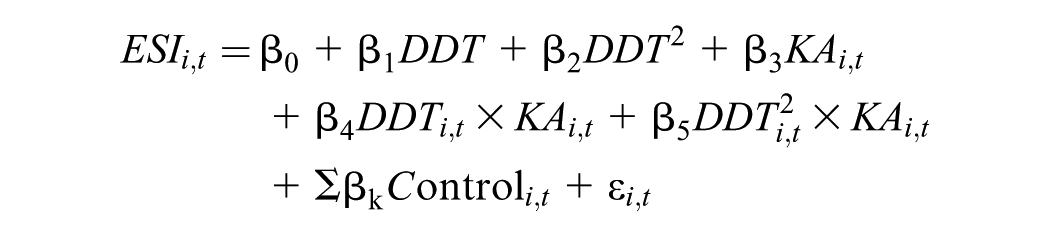
where i denotes the focal firm; t denotes time; USI and ESI denote exploitative sustained innovation and exploratory sustained innovation, respectively; DDT denotes degree of digital transformation; ERA denotes external resource acquisition capacity; KA denotes knowledge absorption capacity; Control represents the control variables mentioned above, including asset-liability ratio (ASS), property rights (PRO), and growth (GRO), fixed asset ratio (FIX), age (AGE); εi,s is a random perturbation term.
Results
Descriptive Statistics and Correlation Analysis
Table 2 shows that the maximum, lowest, and average scores of the degree of digital transformation (DDT) is 0.618, 0, and 0.0435, respectively, indicates the degree of digitization varies markedly from enterprise to enterprise. The explanatory variables have a maximum score of 8.390, minimum score of 0, median score of 4.187, and standard deviation of 1.865. The exploratory sustainability innovations have a maximum score of 5.520, minimum score of 0, median score of 2.569, and standard deviation of 1.303, indicating a significant difference between firms’ exploitative and exploratory sustainability innovations. According to Table 3, an obvious correlation exists among the ESI and DDT, moderating variables, and explanatory and interpreted variables; however, the exact relationship must be tested by regression. Moreover, the VIF values for each variable’s variance inflation factor are well lower than the critical 10 value, and no serious multicollinearity is present.
Descriptive Statistics.

Correlation Analysis

p < 0.1, **p < .05, ***p < .01.
Description and Analysis of Regression Results
The sample of the present study uses unbalanced panels as sample data, and a random-effects model was chosen to test the relevant theoretical hypotheses.
As shown in Table 4, Models 1 and 2 use exploitative and exploratory sustainability innovations as explanatory variables, respectively. Column (1) incorporates the degree of digital transformation primary term (DDT), whose coefficients are distinctly negative (b = 20.410, p\ 0.1) and (b = 20.578, p\ .05) at the 10% and 5% levels, respectively.
Benchmark Regression Test.

According to Haans et al. (2016), testing the inverted U-curve relationship must simultaneously satisfy the determination conditions of the sign of the coefficient, slope of the curve, and location of the inflection point. The squared variable for the degree of digital transformation (DDT2) has been added to Model 2.
Models 3 and 4 have exploitative and exploratory sustainability innovations as explanatory variables, respectively, and the coefficients on the main of the degree of digitization (DID) are significantly positive (β = 1.444, p < .01) and (β = 1.245, p < .05) at the 1% and 5% levels in Model 3 and 4, respectively. The coefficients of the squared term (DID2) are distinctly negative (β = −3.708, p < .01) and (β = −3.657, p < .01) at the 1% level, respectively.
Second, the slopes of the curves between the degree of digital transformation of exploitative and exploratory sustainability innovations are in the range of values of the degree of digitization [0, 6380]; where the curve inflection points are (0.195) and (0.170), respectively, and the two are within the range of values of the degree of digitization [0, 0.638].
The slopes to an extreme point’s left are (k = 1.444) and (k = 1.245); the slopes on the right side are (k = −3.286) and (k = −3.420); and the slopes on the two sides are different. Therefore, the outcomes of the regression indicated the existence of an inverted U-shaped relationship between enterprise digitization and exploitative and exploratory sustainability innovations. Thus, the regression results support H1 and H2, so H1 and H2 are valid.
Models 5 and 6 added the external resources’ ability to access as a moderating variable. Following the above test, the main collinear coefficients for digitization are both significantly positive ([β = 9.077, p < .05] and [β = 9.021, p < .05]); all the squares terms have significantly negative coefficients ([β = −16.454, p < .05] and [β = −16.708, p < .05]); the curve inflection points (0.2758) and (0.2699) are included in the interval; the slopes on the left side are adjusted to (k = 9.077) and (k = 9.021); the slopes on the right side are adjusted to (k = −11.919) and (k = −12.298); and the slopes on both sides become steeper and the extremes change to the upper right side changes. Therefore, the ability to acquire external resources in terms of the degree of digitization positively moderates the role of exploitative and exploratory sustainability innovation. Based on these regression results, H3a and H3b are supported.
Similarly, Models 7 and 8 add knowledge absorption ability as a moderating variable. The main collinear coefficients for digitization are both significantly positive ([β = 3.982, p < .01] and [β = 3.278, p < .01]) and all the square terms have significantly negative coefficients: (β = −8.812, p < .01) and (β = −8.215, p < .01). The curve inflection points (0.226) and (0.200) are included in the interval; the slopes on the left side are adjusted to (k = 3.982) and (k = 3.278); the slopes on the right side are adjusted to (k = −7.261) and (k = −7.204); and the slopes on both sides have become steeper and the extreme point has changed to the right side and upwards. Therefore, it can be inferred that knowledge absorptive capacity positively moderates the role of exploitative and exploratory sustainability innovations at the digitization level. These regression results supported H4a and H4b (Figures 1 and 2).

The moderating role of access to external resources.
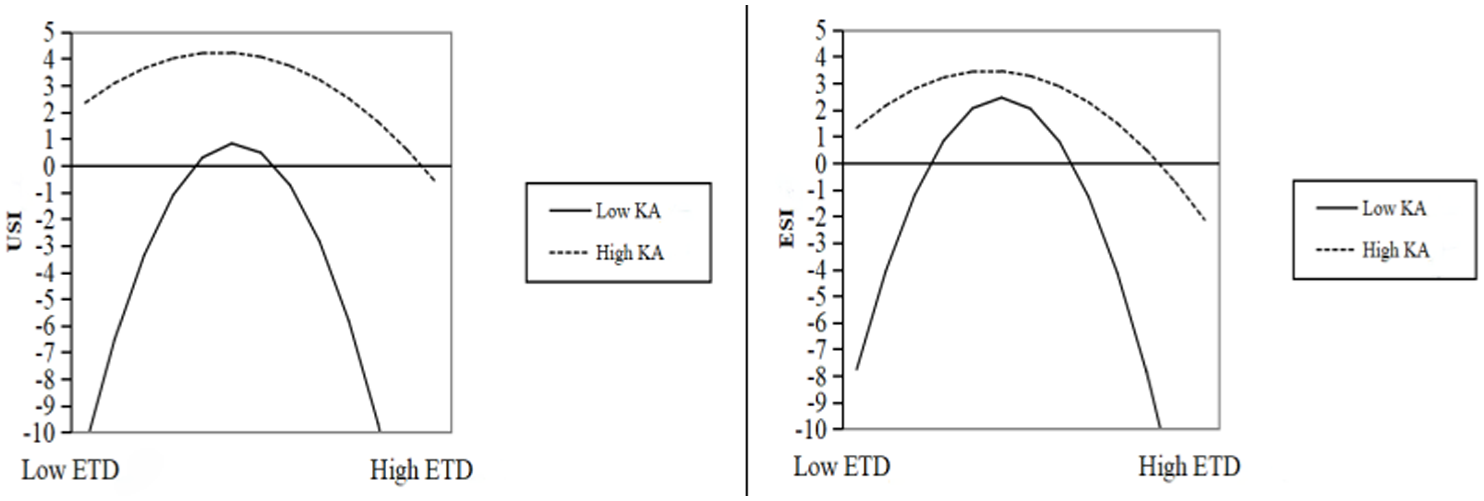
The moderating role of external resource acquisition capacity.
Robustness Test
Explained Variables Lagged One Period
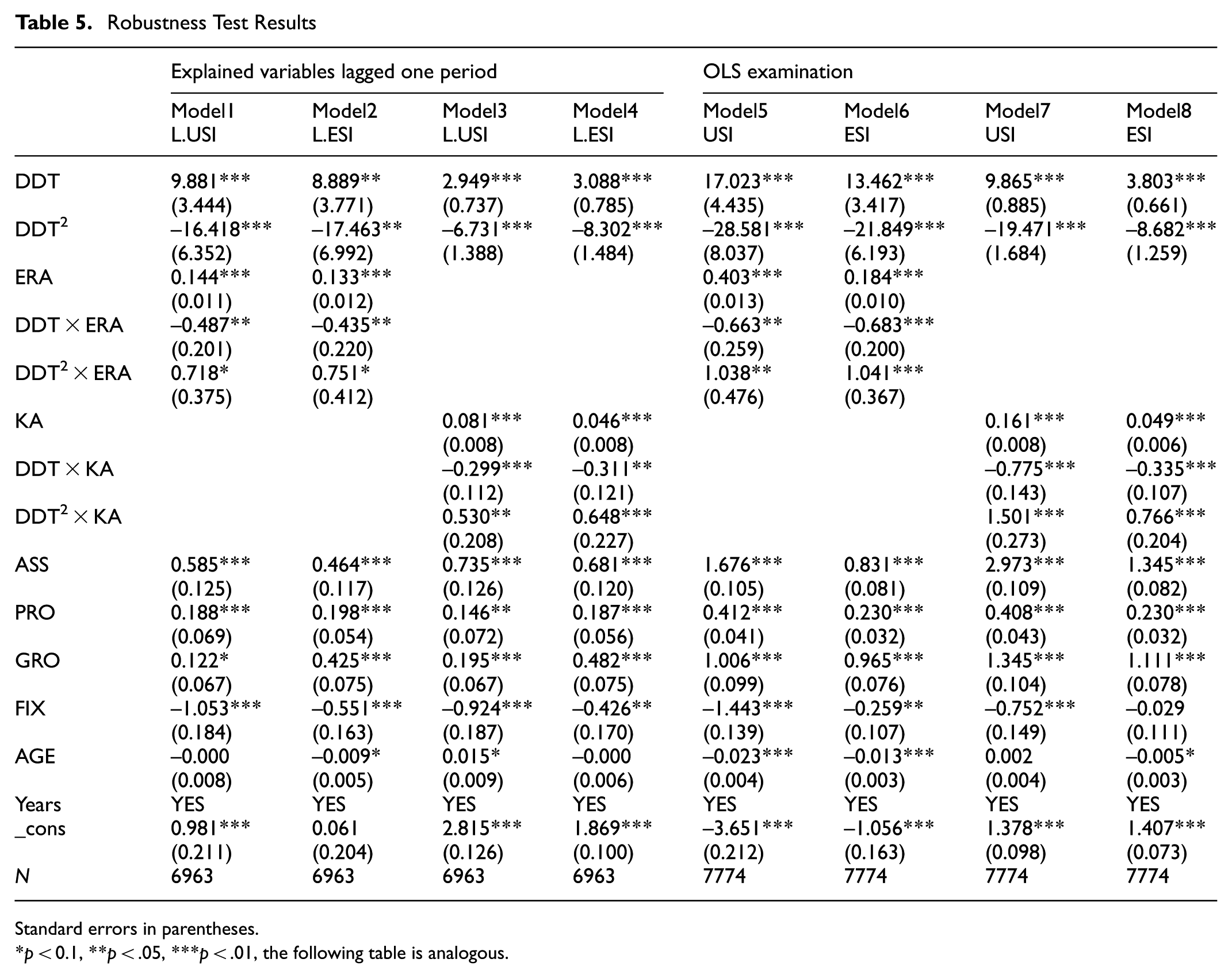
To prevent mutual causality between the degree of digital transformation and exploitative and exploratory sustainable innovation from affecting the regression results, exploitative sustainable innovation (t + 1) and exploratory sustainable innovation (t + 1), which are lagged by one period of the explanatory variables, are used as explanatory variables. These are presented in Table 5. The robustness test revealed that the signs and salience for the core variables are in line with the results in the previous section.
Robustness Test Results
Standard errors in parentheses.
p < 0.1, **p < .05, ***p < .01, the following table is analogous.
OLS Test
The OLS regression test suggests that the relationship remains significant for the explanatory variables and the explained variables, as shown in Table 5.
Further Studies
Given the profound influence of China’s institutional context, we conduct critical heterogeneity analyses based on firm ownership nature and regional distribution. The nature of equity ownership fundamentally shapes the institutional logic that governs resource acquisition. Similarly, regional distribution captures stark structural differences in regional innovation ecosystems. These factors are not merely control variables; they are pivotal, contextual, and theorized to significantly alter the digital transformation–innovation relationship. Furthermore, these dimensions offer practical advantages: data on ownership and location are highly standardized and readily available, and the findings hold direct relevance for policymakers seeking to tailor regional and ownership-specific digital transformation support strategies.
Ownership Property
Table 4 indicates the study results. The nature of equity is significant, and it can be found that the degree of digitalization will have different impacts on enterprises with different natures of equity. Therefore, for state-owned enterprises, the PRO takes the level of 1; otherwise, it takes 0.
Table 6 introduces the research results. Models 1 and 2 indicate that the degree of digital transformation significantly impacts exploitative sustainability innovation in state-owned enterprise types, moderated by the ability to access external resources. Conversely, the role of non-state-owned enterprises is insignificant. While the impact of SOEs’ exploratory sustainability innovation is insignificant, that of non-SOEs is significant. This suggests that state-owned enterprises are overall larger, rich in internal resources, and can mobilize existing and external resources combined with strong capabilities. In contrast, non-state-owned enterprises hold fewer resources. Hence, achieving sustainability innovation becomes challenging. For these enterprises, the process of innovation is cumbersome. In some cases, the leadership style is conservative or the exploratory sustainability of innovation is weak. Non-SOEs are forced to use their limited resources for sustainability innovation through digital transformation SOEs, however, have significant resources to gain competitive advantage and enterprise value through continuous exploratory innovation. Thus, they are more sensitive to the influences of digital transformation on exploratory sustainability innovation.
Heterogeneity Test for Ownership Property.

After adding the moderating effect of knowledge absorptive capacity, the degree of digital transformation displays a prominent impact in exploratory and developmental sustainability innovations in state- and non-state-owned enterprises. This indicates that knowledge absorptive capacity, as a means for enterprises to effectively internalize acquired resources and capabilities, can bring effective value to their innovation activities, which can enterprises’ operational and development and increase enterprise innovation value. These observations demonstrate that SOEs generally outperform non-SOEs in terms of the impact of the degree of digital transformation on exploitative sustainability innovation, while non-SOEs generally outperform SOEs in terms of the impact of the degree of digital transformation on exploitative sustainability innovation.
State-owned enterprises have a competitive advantage over non-state-owned enterprises. State-owned enterprises can easily garner support from the government, society, and other aspects of the tilt because they ensure the protection of social stability. Additionally, owing to the nature of the special property rights, several SOEs have occupied a monopoly position in the national or local market owing to the lack of adequate Competitive impetus (Di et al., 2021) and the conservative tendency of the risks associated with innovation. By contrast, non-state-owned enterprises often need to bear more risks, prompting the need for strong innovative behavior to capture that edge over the competition. This accounts for the significant differences in the innovation results of SOEs and non-SOEs.
Regional Distribution
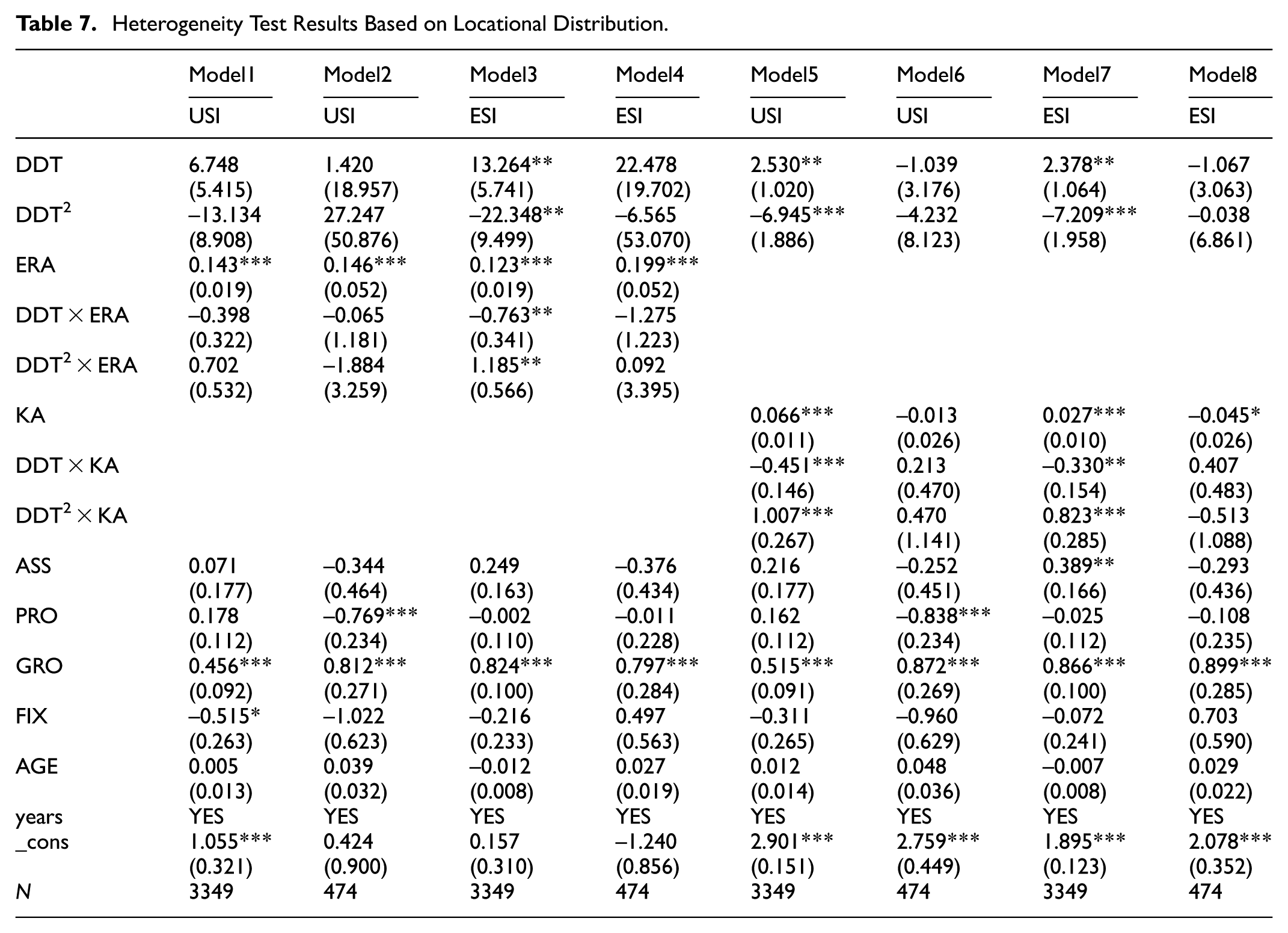
As the economic center of China, the eastern region surpasses the western region regarding human resources and infrastructure. To further analyze the impact of digital transformation on corporate sustainability innovations in different regions, enterprises are classified based on their location: eastern enterprises are coded as 1, and western enterprises are coded as 0, and the classification of the East and West regions is obtained from the National Statistical Office.
The results suggest that the impact of digital transformation on exploratory sustainability innovation—moderated by the external resources capacity to access those resources—is less pronounced in both the Eastern and Western regions. In the eastern region, the external resource acquisition capacity to moderate the degree of digital transformation has a remarkable impact on exploratory sustainability innovation, whereas in the western regions, it has no significant effect. This indicates that the external resource acquisition capacity in the eastern region acts on the enterprise, enabling enterprises to acquire more resources from the external environment. Concurrently, it serves the enterprise’s digital transformation by rapidly converting external resources into enterprise resources. The eastern region has abundant resources and excellent innovation ability. Hence, leveraging exploratory sustainability innovations from enterprises is proven to be more effective than in the Western region. Under knowledge absorptive capacity, In the East, the degree of digital transformation significantly affects both explorative and exploratory sustainability innovations, while the effect in the western region is negligible. This suggests that the eastern region is characterized by rapid technological development, fast updating cycles, rich content, and a strong innovation base. The degree of digital transformation significantly affects the performance of exploratory sustainability innovations in the eastern region, while a negative and insignificant impact is observed in the western region. This suggests that given knowledge absorption, the eastern region has a strong innovation ability and can effectively transform enterprise resources into exploratory innovations. In contrast, the western region lags in development, making it difficult for enterprises to facilitate exploratory innovations (Table 7).
Heterogeneity Test Results Based on Locational Distribution.
Discussion and Conclusion
This study extends research on innovation sustainability from a dual perspective. Based on this dual perspective, this study selected 805 A-share listed manufacturing enterprises to examine the impact of digital transformation on their sustainability innovation. The findings indicate that the relationship between digital transformation and enterprises’ explorative and exploratory sustainability innovation shows an inverted U-shaped result with an inflection point of impact. This suggests that digital transformation does not consistently and steadily influence innovation for sustainable enterprise development. Initially, sustainability innovation output grows rapidly; however, after the inflection point, the growth rate significantly declines. Specifically, digital transformation does not consistently ensure that the sustainability innovation of the enterprise is developed. Digital transformation does not always ensure sustainable innovation in enterprises. Most studies tacitly agree that digital transformation is a linear facilitator of sustainability innovation (María-Teresa et al., 2024; Xie et al., 2024) but neglect the fact that over-digitization may trigger resource redundancy and technological lock-in (Haans et al., 2016). The present study reveals an inverted U-shaped relationship between digital transformation and sustainability innovation, which further supports the U-shaped effect theory of Haans et al. (2016). Consequently, our results provide robust underscoring that more digitalization is not always better and highlighting the necessity for firms to find their optimal level of digital intensity.
Additionally, this study extends the dynamic capability-driven regulation mechanism and refines the “resource-capability” integration framework. External resource acquisition and knowledge absorption abilities positively moderate the impact of digital transformation on exploitative and exploratory sustainability innovation. The degree of digital transformation’s impact on exploitative sustainability innovation peaks at 0.1948, and on exploratory sustainability innovation, it peaks at 0.1703. When external resource acquisition capacity is added as a moderating variable, the impact on exploratory sustainability innovation is positively moderated by the effect of the degree of digital transformation on exploratory sustainability innovation. The impact of digital transformation on exploitative sustainability innovation peaks at 0.2758 and on exploratory sustainability innovation at 0.2699. This finding supports and develops Xu and Gong’s (2011) open innovation theory. When knowledge absorption ability is added as a moderating variable, the peak effect on exploitative sustainability innovation reaches 0.2259, while on exploratory sustainability innovation, it peaks at 0.1995. This result validates Zahra and George’s (2002) model of absorptive capacity dynamics. The above two results indicate that external resource acquisition capacity and knowledge absorption ability positively moderate the degree of digital transformation on exploitative and exploratory sustainability innovations in manufacturing firms. Furthermore, after further analysis, it is found that explorative and exploratory sustainable innovation in state-owned enterprises is facilitated by a stronger degree of digital transformation. This study’s heterogeneity analyses yield crucial insights into contextual influences. In the sample, test of ownership and regional distribution revealed that SOEs rely on policy resources to dominate exploitative sustainable innovation but are constrained by the rigidity of knowledge absorption and lag in exploratory sustainable innovation. In the eastern region, due to the perfection of the digital ecosystem, their digital transformation performs better for dual sustainable innovation and has higher marginal returns than the western region, which corroborates Xie et al.’s (2024) regional innovation system theory. Combining the two types of variables and cross-examining the role of the internal and external sustainability innovation of enterprises from two perspectives also makes up for the over-reliance on static factors in the traditional literature. It reveals how the nature of institutional industries and regional maturity fundamentally influence enterprises’ ability to transform digital resources into dynamic capabilities, and, ultimately, sustainable innovation outcomes. It provides a theoretical basis for the subsequent cracking of the “resource-capability mismatch” puzzle in digital transformation.
Practical Significance
First, enterprises should prioritize the timing of digitization, increase innovation investments, and focus on sustainable innovation.
According to the empirical results, the degree of digital transformation positively impacts exploratory and exploitative sustainable innovation. Thus, enterprises need to be well-aware of the role of fostering sustainable innovation in both areas. By leveraging the value of digitalization in enterprise innovation, enterprises can promote their long-term sustainability and future success.
According to the empirical results, external resource acquisition and knowledge absorption abilities positively moderate the nexus between the degree of enterprise digital transformation and both exploitative and exploratory sustainability innovation. Therefore, enterprises should fully leverage internal and external factors by utilizing existing internal resources while developing and exploring external resources. Continuously obtaining the required resources and momentum for innovation internally and externally improves the effectiveness of enterprise innovation and promotes high-quality and efficient development.
Enterprises should move towards adopting open innovation from closed innovation and prioritize acquiring resources to address internal limitations. Simultaneously, they should only focus on acquiring external resources and enhancing their ability to transform and absorb those resources, thereby strengthening the overall quality of the enterprise and building operational and coordination abilities that align with digitalization to promote the enterprise’s orderly and effective operation in continuous innovation.
Second, investors should prioritize the multiple values of digitization, grasp key timings, and invest in industries with in-depth digitization.
We analyze the role and impact of digital transformation mechanisms on enterprises’ sustainable innovation, seize the essence of sustainable innovation, and invest in high-tech and new-quality productivity enterprises.
Recognizing industry differences, valuing the importance of real enterprises in China’s economy, focusing on long-term value, maintaining investment patience, and prioritizing long-term cooperation with potential enterprises.
Limitation and Future Research
This study considers only A-share listed manufacturing enterprises to investigate the impact of the degree of digital transformation on enterprise sustainability innovation. Owing to industry specificity, the findings may not be generalizable to other industries. Digital transformation has long-term and multifaceted impacts. This study investigates its moderating effect on sustainability innovation from a dual perspective focusing on factors including external resources acquire and knowledge absorption. However, digital transformation may have other potential moderating impacts on sustainability innovation.
Further research should explore digital transformation and sustainability innovation. Additionally, the pathway of digital transformation to sustainability innovation remains an area of interest and will be investigated in more depth in subsequent studies
Footnotes
Appendix
Digital Transformation Keywords.

| Dimensions | Classifiers | Frequent text combinations | Segmentation lexicon |
|---|---|---|---|
| Digital technology applications | Data, numbers, digitization | Data management, data mining, data network, data platform, data center, data science, digital control, digital technology, digital communication, digital network, digital intelligence, digital terminal, digital marketing, digitalization. | Data management, data mining, data network, data platform, data center, data science, digital control, digital technology, digital communication, digital network, digital intelligence, digital terminal, digital marketing, digitization, big data, cloud computing, cloud T, cloud ecosystem, cloud service, cloud platform, blockchain, Internet of things, machine learning |
| Internet business models | Internet, computer | Mobile Internet, industrial internet, internet solutions, Internet technology, Internet thinking, Internet action, internet business, Internet mobility, Internet application, Internet marketing, Internet strategy, internet platform, Internet model, Internet business model, Internet ecology, e-commerce, e-commerce | Mobile Internet, industrial Internet, industrial Internet, Internet solutions, Internet technology, Internet thinking, Internet action, Internet business, Internet mobile, Internet application, Internet marketing, Internet strategy, Internet platform, Internet model, Internet business model, Internet ecology, e-commerce, e-commerce, Internet internet +, online and offline, online to offline, online and offline, 02O, B2B, C2C.B2C, C2B |
| Intelligent manufacturing | Intelligent, automatic, numerical control, integrated, centralized. | Artificial intelligence, high-end intelligence, industrial intelligence, mobile intelligence, intelligent control, intelligent terminal, intelligent mobility, intelligent management, intelligent factory, intelligent logistics, intelligent manufacturing, intelligent warehousing, intelligent technology, intelligent equipment, intelligent manufacturing, intelligent network, intelligent system, intelligent, automatic control, automatic monitoring, automatic supervisory, automatic inspection, automatic manufacturing, numerical control, integration, integrating, integrated solution, integrated control, integrated system | Artificial intelligence, high-end intelligence, industrial intelligence, mobile intelligence, intelligent control, intelligent terminal, intelligent mobility, intelligent management, intelligent factory, intelligent logistics, intelligent manufacturing, intelligent warehousing, intelligent technology, intelligent devices, intelligent manufacturing, intelligent network, intelligent system, intelligent, automated control, automatic monitoring, automatic supervision, automatic inspection, automated manufacturing, numerical control, integration, integrating, integration solutions, integrated control, integrated systems, industrial cloud, intelligent fault diagnosis of the factory of the future, life cycle management, manufacturing execution system, virtualization, virtual manufacturing |
| Modern information systems | Information, informatization, networking | Information sharing, information management, information integration, information software, information system, information network, information terminal, information center, informatization, networking | Information sharing, information management, information integration, information software information system, information network, information terminal, information center informatization, networking, industrial information, industrial communication |

Funding
The authors disclosed receipt of the following financial support for the research, authorship, and/or publication of this article: Sichuan Province Key Research Base for Philosophy and Social Sciences in Higher Education Institutions, Civil-Military Integration System and Mechanisms Innovation Research Center (JHRH2025-003). Sichuan Provincial Key Research Base for Philosophy Social Sciences, Sichuan Tourism Development Research Center(LY24-16). Sichuan Tourism University - Chengdu Green Low-Carbon Development Research Base Project (LD2024Z13). Resource-Based City Development Research Center Project (ZYZX-YB-2307). Key Laboratory of Strategic Vanadium-Titanium Resources Innovation Development and Decision Science Project (FTZDS-YB-2406). Tuojiang River Basin High-Quality Development Research Center Project (TIGZL2023-35).
Declaration of Conflicting Interests
The authors declared no potential conflicts of interest with respect to the research, authorship, and/or publication of this article.