




Abstract
Along with globalization, frequent and cross-regional transportation has driven the prosperity and development of cities worldwide. Nevertheless, the high density and concentration of urban activities also bring spatial heterogeneity to different cities. Previous research, focusing mainly on the impact of the financial crisis, has indicated that the characteristics of urban zones influence its performance of economic resilience. However, the development duration type and severity of various shocks may differ. This study, based on the perspectives of the COVID-19 pandemic, reviews the effect of various influencing factors, such as the ratio of manufacturing industry, population mobility, investment in R&D by the industries and the completeness of public facilities, on the effect of a shock on economic resilience. The economic resilience of each research target area during the pandemic of 2020 is calculated by applying the index of economic resilience estimated by the changes in consumptions and the analysis of Pearson product-moment correlation coefficient, revealing that a city with a higher ratio of manufacturing industry and investment in R&D has better economic resilience. Conversely, cities with greater population mobility and more areas of public facilities reveal the weakness of economic resilience during the pandemic. Researchers believe that the collapse in consumption of the cities caused by citizens avoiding exposure risks has influenced economic performance. This work shows that the factors of economic resilience vary from shocks. Consequently, policymakers must address the features of shocks when developing relevant policies in response to the shocks.
Introduction
The concept of resilience has recently been adopted in diverse fields. For urban studies, resilience depicts a city modifying its structure and function in response to shocks and recovering from shocks. Research into this concept helps identify the elements affecting urban resilience, which elements can be further incorporated into future urban planning to enhance the ability of a city to cope with future risks (Martin & Gardiner, 2019). In the discussion of economic resilience, some characteristics are considered beneficial for building economic resilience, including diversified economies, knowledge-intensive industry, good accessibility and high immigration (Giannakis & Bruggeman, 2017).
A city may encounter various shocks, with different development, duration, type and severity. Although the concept of resilience has recently received attention (Hu et al., 2022), previous studies of economic resilience concerned little about the deleterious effects of infectious diseases on urban economies, resulting in limited awareness of the urban characteristics that could unfold economic resilience effectively during the pandemic. However, the COVID-19 pandemic sweeping the world from the end of 2019 led to a transformation of lifestyle and consumer behavior causing the demand for tourism, entertainment and transportation to plummet. Moreover, government border control policies by and reduction of flight frequency deteriorated industrial production and even caused supply chain disruption. The described detriments caused by the pandemic indicate the significance of investigation in building economic resilience regarding various urban characteristics during the pandemic. Previous studies mostly focused on the effect of the financial crisis on economic resilience, and barely discussed or investigated influencing factors, such as COVID-19 and other epidemics. This study aims to detect the desirable attributes, such as the ratio of manufacturing industry, population mobility, investment in R&D by the industries and the completeness of public facilities, for economic resilience under Covid-19. This study aims to highlight differences in shocks and help policymakers avoid a one-size-fits-all policy.
To fill those gaps and determine the correlations between different characteristics of economic resilience during the pandemic, this study analyzes the economic resilience of Northern Taiwan by Pearson product-moment correlation coefficient supplemented with relevant information or documents. This study also examines the effect on economic resilience of different shocks and urban characteristics, such as the ratio of manufacturing industry, population mobility, investment in R&D by the industries, and completeness of public infrastructure.
Literature Review
Research Related to COVID-19
The transmission of COVID-19 emphasizes the uncertainty encountered by a city during urban development. Scholars have called for inclusion of epidemic risk in urban planning (Hong & Choi, 2021; Wu, 2021). The COVID-19 outbreak has also become an important research topic in academic disciplines. Scholars intended to determine the virus life cycle and its transmission through geographic and social environmental factors around the hotspots of COVID-19, as well as the level of impact of the pandemic (Zoran et al., 2020). This observation was further used for control measures, thus reducing the virus spread. Additionally, Chen et al. (2021) also found that in the case of an event such as the COVID-19 pandemic, different regions within the same country or system can experience varying degrees of economic impact due to differences in conditions.
Hong and Choi (2021) and Wu (2021) compiled investigations related to COVID-19, and Yip et al. (2021) identified the relationship between urban function and the COVID-19 transmission in Hong Kong. Their research results indicated that the locations of the clinic, restaurant, market and public transportation were correlated with the distribution of confirmed cases. A city with a higher risk of disease transmission had little benefit to its economic resilience. The demographic structure, population density, number of hospital beds and licensed physicians (Han et al., 2021) also determined the ability of a city to respond to COVID-19.
Regarding the economic aspect, scholars focused on the negative effects of COVID-19 on each country and regional economy. Transmission of COVID-19 caused somewhat unfortunate consequences to the world. It was harmful to international tourism, travel, transportation and oil and mining industries (Lee et al., 2025). In contrast, the manufacturing industry stayed relatively unaffected and had a better economic recovery than the service industry (Siu & Wong, 2004). Additionally, Siddik (2020) examined the impact of implemented policies on stock market volatility during the pandemic. Government restriction of commercial activities and voluntary social distancing significantly affected the economy led by the service industry (Siddik, 2020).
Du et al. (2020) pointed out that compared with the SARS pandemic, where the diagnosis could be determined by fever, COVID-19 has many different symptoms. In addition, several waves of economic shocks before the COVID pandemic, such as the financial tsunami, the Sino-US trade war, etc., all required high-frequency stimulus activities to revive the economy. However, the COVID-19 situation forces countries to interrupt many economic activities to prevent the epidemic from becoming uncontrollable. This is the biggest difference between COVID-19 and past epidemic events or economic shock events.
In terms of the social aspect, scholars were concerned mostly about issues caused by structural inequality, such as the opportunity of vulnerable groups, ethnic minorities, and low-income households to receive medical services as well as sanitary conditions (Wade, 2020). In some areas, lack of infrastructure resulted in difficulty in social distancing (Wasdani & Prasad, 2020), and further increased mortality and unemployment rates (Hu et al., 2023; Mishra et al., 2020). Some scholars intended to emphasize alleviating past inequality through COVID-19 policy, and helped improve the living environment for vulnerable groups. For example, Zhang (2023) argues that the impacts of events such as COVID-19 have exposed long-standing issues and concerns in areas such as the economy, environment, race, and education, all of which should be addressed in urban planning.
Economic Resilience and the Influencing Factors
The Content of Economic Resilience
The concept of resilience originated in the ecological field and was later expanded to the fields of psychology, engineering and evolutionary economic geography (Martin & Sunley, 2015; Pike et al., 2010; Simmie & Martin, 2010). The idea of engineering resilience in the early stage emphasized the ability of a system to recover to its original state when facing shocks. Conversely, ecological resilience is based on the principle that a system becomes resilient once it achieves a new equilibrium, even without recovering to the initial state. Later research proposed adaptive resilience from the evolutionary point of view, considering adaptability in measuring resilience (Hong & Choi, 2021).
Although resilience has been the focus of many previous studies, its meaning varies across different academic disciplines. Most studies in economic resilience incorporated the concept of adaptive resilience developed by Ron Martin in 2012. Adaptive resilience denotes the ability of urban economies to adjust their structures and functions and the process of recovering from shocks in the long term (Martin et al., 2016). This work adopts the energetical meaning of resilience, where future economic resilience is built through the construction or adjustment of effective urban characteristics (Blengini et al., 2025; Hong & Choi, 2021).
The concept of resilience refers to the ability of an entity or system to elastically recover its form and position after some disturbance or damage (Martin, 2012), and is divided into engineering resilience, ecological resilience, and adaptability resilience. The first two concepts of resilience emphasize returning to a balanced and stable state, while adaptability resilience includes the concept of continuous changes in response to changes in the situation. Corresponding to the fact that the global economy will change at any time due to the international situation, the economic resilience in this study will also Use this concept.
The Nature of Shocks
Shocks can take different forms and are likely to have various effect and therefore different implication for resilience. Martin and Sunley (2020) distinguish four kinds of shocks according to the spatial scales and the speed/duration of the events. Shocks originate from the global to the national and to the local. Most shocks are generally unpredictable. However, some authors extend the definition of shocks include how regions, localities and cities cope with “slow-burn” pressure.
Shocks may vary in both intensity and duration (Manca et al., 2017; Martin & Sunley, 2020). Notably, even a short shock may be so intense that it stimulates transformative change; or similarly, a low-intensity shock may be so cumulative that it eventually promotes structural transformation of the economic system (Martin & Sunley, 2020). As mentioned above, scholars have called for inclusion of epidemic risk in urban planning (Hong & Choi, 2021; Wu, 2021). This study emphasizes that different shocks may have different urban characteristics that are beneficial to economic resilience, reminding policymakers to avoid adopting one size fits all policies when facing shocks.
Urban Characteristics Influencing Economic Resilience, and the Hypotheses
This study referred to the influencing factors summarized by Pan et al. (2020), integrated with other viewpoints from relevant studies, and categorized factors that affected economic resilience into three categories, including the background and structure of industry and economy, human resources and innovation, and planning and governance. Hypotheses were further proposed based on the categories.
The background and structure of industry and economy evaluated economic resilience from the perspective of macroeconomics, such as employment, income distribution and growth, industrial clusters and gross domestic product (GDP) (Clark et al., 2009). Previous studies about the impact of the 2008 financial crisis demonstrated that the recession caused by the shock was more severe in areas with higher ratio of proportion of manufacturing industry. In contrast, areas with a higher proportion of service industry survived better from the shock. For instance, Lagravinese (2015), considering Italy as the research scope, examined the economic vulnerability by regional industrial specialization and structural differences. Holl (2018) observed that areas in Spain with a majority of activity in the manufacturing industry had below average economic resilience. The same pattern and result were obtained when observing the economic resilience of the EU to economic activities and changes in per capita income. According to the literature, areas more dependent on the manufacturing industry endured more negative effects from the shock (Holl, 2018). Marziali et al. (2022) used COVID-19 as an impact event and found that places with a higher proportion of manufacturing industries have a higher risk of infection, presumably because of the need for frequent contact. Based on that observation, this study presented Hypothesis 1, a negative correlation between the ratio of the manufacturing industry and economic resilience.
Human Resources and Innovation: Demographic structure and labor supply are closely related, with both affecting urban resilience. Employment opportunities offered by the economy and economic performance are critical to human migration (Chang et al., 2010; Martin & Gardiner, 2019). There have been some studies exploring the relationship between population and creativity, and found that age is not necessarily related to creativity, but immigrant populations tend to be more creative, possibly because of the twists and turns they have experienced and the opportunities they have encountered often fleeting (Dixon, 2003). An economic analysis of the relationship between the regional development of each state in the United States and population mobility performed in 2016 identified a positive correlation between productive efficiency and immigration (Ghosh & Mastromarco, 2018). Relevant studies have also revealed a positive correlation between urban resilience and immigration (Giannakis & Bruggeman, 2020). Therefore, the study raised Hypothesis 2, a positive correlation between population mobility and economic resilience. Conversely, Martin et al. (2016) proposed that areas with more innovative resources and knowledge-intensive industries have better economic resilience. The knowledge-intensive industry is capable of innovating and reorganizing, and can pay higher wages to attract knowledge- and technology-intensive talents (Chan et al., 2019). Brenner (2004) pointed out that the resources of the innovation environment can promote the evolution of the regional economy through local education systems, knowledge levels, public research, and cultural and historical resources. Well-educated talents are more creative and innovative during recessions, consequently promoting the economic resilience and production capability of a city. Consequently, Hypothesis 3 was proposed, a positive correlation between investment in R&D and economic resilience.
Planning and Governance: According to Giannakis and Bruggeman (2017), cities with higher accessibility generally have better economic resilience. The infrastructure completeness of a city stimulated knowledge-intensive talents to immigrate and further enhances the economic resilience of the city. In addition, policy promotion affects planning governance and the perfection of urban infrastructure, such as the promotion of science and technology and expenditure on public services (Martin & Sunley, 2015). Accordingly, this study hypothesizes that the completeness of infrastructure is positively associated with economic resilience (Hypothesis 4).
Research Design and Data Collection
Subjects
The economic development of Taiwan revolves around Northern Taiwan. Taoyuan International Airport connects Taiwan to the rest of the world. Hsinchu Science Park, the hub of knowledge and innovation, is the technology corridor of West Taiwan. Nonetheless, the high level of internationalization and high population density of Northern Taiwan became its weakness and the hotspots of virus transmission during the COVID-19 pandemic. Hence, this study selected seven special municipalities and cities located in Northern Taiwan, namely Taipei City, New Taipei City, Keelung City, Yilan County, Taoyuan City, Hsinchu County and Hsinchu City, as the research subjects, and collected information on the level of township, city and district. Owing to the limited industrial scale in 12 of the townships or districts in Northern Taiwan and some data privacy issues, the final research scope only covered 77 cities, townships or districts.
Research Period
Different from the impact of the global financial crisis from the middle of 2007 to the beginning of 2009 when Taiwan’s economy showed a distinguishable period of resistance and recovery, the effect of COVID-19 turned out to be more complicated. The economy appeared to be resistant and recovered, but then receded again. Virus transmission continued even after improved vaccination coverage. Considering the complexity of COVID-19 transmission and the difficulty of defining clear resisting and recovering periods, this study chose the 12 months when the first impact of COVID-19 occurred on Taiwan’s economy, that is, January to December 2020, as the research period.
Method
The Pearson Product-Moment Correlation Coefficient
To summarize the factors and characteristics that were considered to help in building economic resilience in the past studies and further connect to the establishment of economic resilience during the COVID-19 pandemic, this study applied the indexes of economic resilience to calculate the performance of resilience in each research target area. The Pearson product-moment correlation coefficient was then incorporated to evaluate the correlation between economic resilience and each factor, and further validated the hypotheses proposed based on the literature. The following equations briefly describe the calculation of indexes of economic resilience and Pearson product-moment correlation coefficient.
The index of economic resilience: The index is the ratio of changes in the economy of each township, city or district over the anticipated changes. The estimated changes in each township, city or district can be derived by Equation 1.

In Equation 1,

Pearson product-moment correlation coefficient, which the ratio of the covariance of two variables and the product of their standard deviations, is used to measure the degree of linear correlation between the variables, for example, X & Y, from two sets of data. It reflects the degree of linear dependence of two variables.
Multiple Regression Analysis
To explore the interaction between multiple independent variables such as economic resilience and the ratio of manufacturing industry, population mobility, investment in research and development and completeness of public facilities, multiple regression is used to predict the explanatory power and significance of independent variables for dependent variables. The equation looks like this:

In formula (3),
Research Material
Table 1 lists the variables adopted in the four hypotheses presented in this study, along with the definitions and references. The table also shows predictions for the relationships between the primary and dependent variables.
Explanation and Definition of the Variables and the Predicted Trend for the Variables.

Overview of the Effect of COVID-19in Taiwan
Some COVID-19 confirmed cases appeared in Wuhan, China in December 2019, and the COVID-19 pandemic spread out from the end of January 2020. Given the previous experience of the severe impact of SARS from China back in 2003, the Taiwan Government decided to take the Taiwanese people trapped in Wuhan, back by chartered flight in early February 2020. Thus, the confirmed cases stayed relatively stable and controllable in the early stage of the pandemic, compared to countries with collapsed healthcare systems. However, some confirmed cases without traveling history appeared in neighboring countries in East Asia and some locally transmitted confirmed cases in Taiwan caused people to panic and change consumer behavior. Most people began to reduce their traveling and consumption or to work from home to avoid possible infection. The service industry, such as restaurant, airline, tourism, transportation and retail business, was severely impacted at first moment. Figure 1 shows the monthly consumption trend in various regions of Taiwan in 2020, revealing that consumer spending began to decline in all areas of Taiwan from January or February 2020. Consumption then gradually recovered from June 2020. Analysis of the significance of the COVID-19 effect by regions reveals that East Taiwan was least affected by the shock, whereas Northern Taiwan experienced the most critical influence.

The monthly consumption trend in various regions of Taiwan in 2020.
In March 2020, many countries reported COVID-19 confirmed cases and the number of confirmed cases worldwide increased significantly. Europe, the United States and Taiwan began to lock down or introduce border controls. Many overseas citizens returned to Taiwan, resulting in a significant rise in imported cases. A cluster infection broke out in the naval fleet of the Republic of China Navy (ROCN) on April 18th, 2020. Due to the team members were traveling around Taiwan, experts and citizens both worried about local transmission. Fortunately, local virus transmission was successfully stopped. The Central Epidemic Command Center began to navigate through COVID-19 prevention on April 30th, 2020. The epidemic prevention policy and control were finally untightened on June 7th, bringing a revival and recovery of industrial and economic activities in Taiwan. According to the monthly consumption trend in various regions of Taiwan in 2020, consumer spending in Northern and Southern Taiwan gradually grew and recovered from March to October 2020. The pandemic has resulted in the transformation of consumer behavior and manufacturing process in which enterprises with business models based on instant supply and no inventory suffered significantly from the supply chain disruption. Some companies started to introduce remote operation or unmanned manufacturing systems. Regarding consumers, the so-called contactless economy was initiated.
On December 21, 2020, a captain employed by an airline was confirmed to have COVID-19, breaking the record of no local transmission in the long term. Later, on January 12, 2021, Taoyuan General Hospital had an incident of cluster infection of COVID-19. The hospital established an incident command system promptly and took immediate and emergent action, which caught lots of attention from citizens. The events and incidents perturbed society and brought a second impact of COVID-19 on Taiwan.
The Performance of Economic Resilience in Northern Taiwan and Hypotheses Validation
Economic Resilience of the Selected Townships, Cities, and Districts
This study accumulated the number of confirmed cases in the selected townships, cities, and districts and calculated the economic resilience under the impact of COVID-19 based on the indexes mentioned in the research design (Figures 2 and 3). According to Figure 2, maximum confirmed cases appeared in Luzhu District of Taoyuan City and Xindian District of New Taipei City at the time of data collection. The surrounding areas, namely Linkou District and Zhonghe District, also had comparably high numbers of confirmed cases.
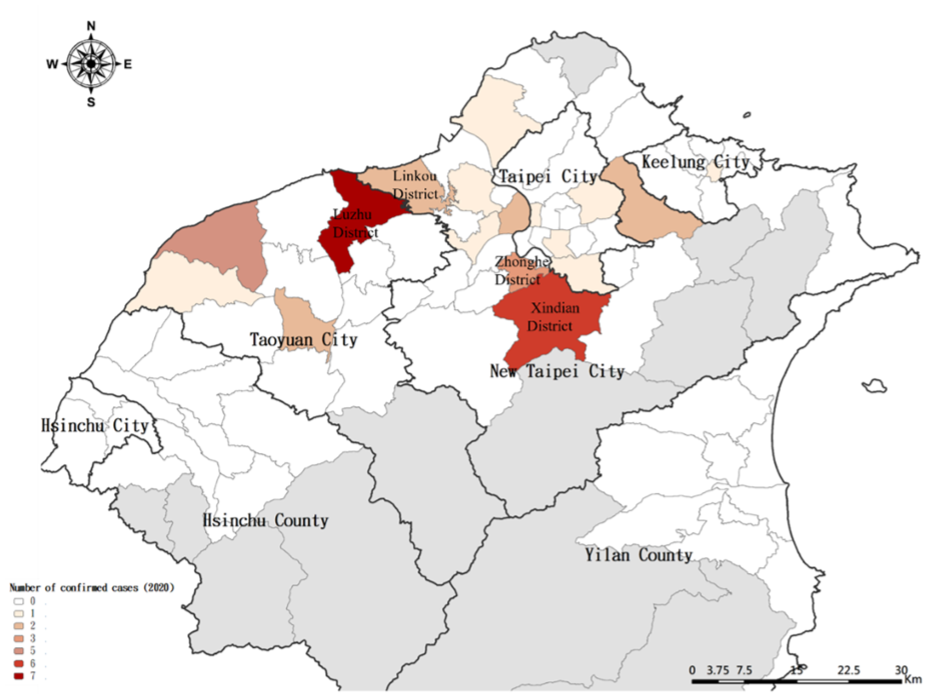
Distribution of confirmed cases by townships, cities, and districts.

The economic resilience of each township, city, and district.
However, a comparison of Figures 2 and 3 in parallel shows that the number of confirmed cases in a region was not necessarily associated with its impact. In contrast, New Taipei City, even with more confirmed cases at the time of data collection, ended up with a total of NT$6.664 billion in consumption in 2020. The actual growth in consumption, NT$ 0.593 billion, was much higher than the expected growth of NT$ 0.111 billion. Although New Taipei City has many people commuting from to other cities daily and is connected with Metro Taoyuan, it did not have a financial deficit like Taipei City, but instead had a significant increase in consumption. Taoyuan City, despite being a major transportation hub in Taiwan, was less influenced by the impact of COVID-19. Even with a higher number of confirmed cases in Luzhu District, the recession in Taoyuan City was not as great as in Taipei City.
The total consumption in Taipei City was NT$14.211 billion in 2020, the highest amount of consumption among seven cities or counties in Northern Taiwan. Taipei City, with abundant resources of research and development, innovation and talents, was relatively vigorous in economic development. Past studies considered it to be most beneficial for demonstrating its economic resilience. However, the calculated economic resilience of Taipei City in the impact of COVID-19 was −3.47, which was the worst among all cities. The anticipated consumption growth was NT$ 0.272 billion, whereas the actual consumption appeared to be NT$ 0.674 billion. Areas in Taipei City with the maximal impact were Wanhua District, Datong District and Zhongzheng District.
The expenditures of Xinyi District and Zhongzheng District in Taipei City were 3.6 and 1.4 billion dollars, respectively. The indexes of economic resilience were calculated to be −4.69 and −11.69 for the two districts. Only one confirmed case appeared in Xinyi District and no confirmed case was observed in Zhongzheng District. Similar circumstances, which showed repeatedly, indicated that the impact of COVID-19 did not necessarily result in recession. Nevertheless, a large number of COVID-19 confirmed cases or suspected cases observed in the surrounding areas could cause panic among residents and the transformation of consumer patterns of daily commuting or consumption. The number of tourists traveling to the regions would also decline. Consequently, a recession might occur even without any confirmed cases occurring in the area. Analytical results reveal how an epidemic like COVID-19 could affect the economies.
Hypotheses Validation
Past investigations about economic resilience found that production capacity in the manufacturing industry took a relatively long time to recover from shocks compared to the service industry. Hence, areas with higher proportions of manufacturing industry were considered to be less resilient in the economy. Accordingly, this study proposed Hypothesis 1 that the economic resilience was poorer in areas with a higher proportion of manufacturing industry.
This study further explored the correlation between the ratio of the manufacturing industry and economic resilience in 77 townships, cities and districts of Northern Taiwan. The equation of the trend line for the proportion of manufacturing industry and economic resilience was y = 1.8658x + 7.1595, for which the correlation coefficient was 0.1527. Namely, the ratio of the manufacturing industry positively associated with economic resilience did not comply with the hypothesis. Therefore, hypothesis 1 was rejected (Figure 4).

The scatter plot of the proportion of manufacturing industry and economic resilience.
A further investigation of the development of the manufacturing industry in Northern Taiwan indicated that the top three dedications of the total production of the manufacturing industry in cities or counties other than Yilan County were from the key material in the high-tech industry chain, including electronic components, computer and electronic products, and optical products. Yilan County, different from the other cities and counties, has a high proportion of the processing and manufacturing industry. Because of the outbreak and transmission of COVID-19, contactless and long-distance business models became popular, leading to the development and flourishing of home intelligence. Additionally, the United States limited sales of high-tech software, such as artificial intelligence, to China to keep China from diverting it to military end-use in 2020. The China–United States trade dispute became a technology conflict, prompting the high-tech industry chain of Taiwan to reform and reorganize. The increase in international demand for electronic components exported from Taiwan has driven the rapid development of electronic components and of information and communication products in Northern Taiwan. The export of electronic components rose by 20.7% in 2020, compared to the previous year. Conversely, the export of plastics, metals and minerals was reduced by approximately 10% by the quick drop in oil prices and demands.
The observation results from the case study demonstrates that COVID-19 had a limited impact on primary industry. Consider Baoshan Township, located in the southwest of Hsinchu County, as an example. Baoshan Township includes Hsinchu Science Park, while 19% of Baoshan Township was used for the manufacturing industry. It also includes the primary and processing industry, such as that for citrus, olive and brown sugar. The economic resilience of Baoshan Township was reported as 10.74, owing to its industrial structure. Conversely, Dayuan Industrial Park, located in Dayuan District of Taoyuan City, consists of optoelectronics, aerospace, machinery, biotechnology and traditional industries. The aerospace and aviation industry in the industrial park encountered a large shock, resulting in a sharp drop in revenue and recession, due to the outbreak of COVID-19. The economic resilience was −21.7. Xindian District of New Taipei City benefited the most from the pandemic, although identifying six confirmed cases, grew against the national trend despite identifying six confirmed COVID-19 cases,. Baogao Industrial Park in Xindian District, composed of artificial intelligence, green energy, financial technology and the biotech industry, had a calculated economic resilience of 14.6. Thus, COVID-19 and previous shocks had different effects, and areas with a higher ratio of manufacturing industry did not necessarily end up with worse economic resilience (Figure 5).
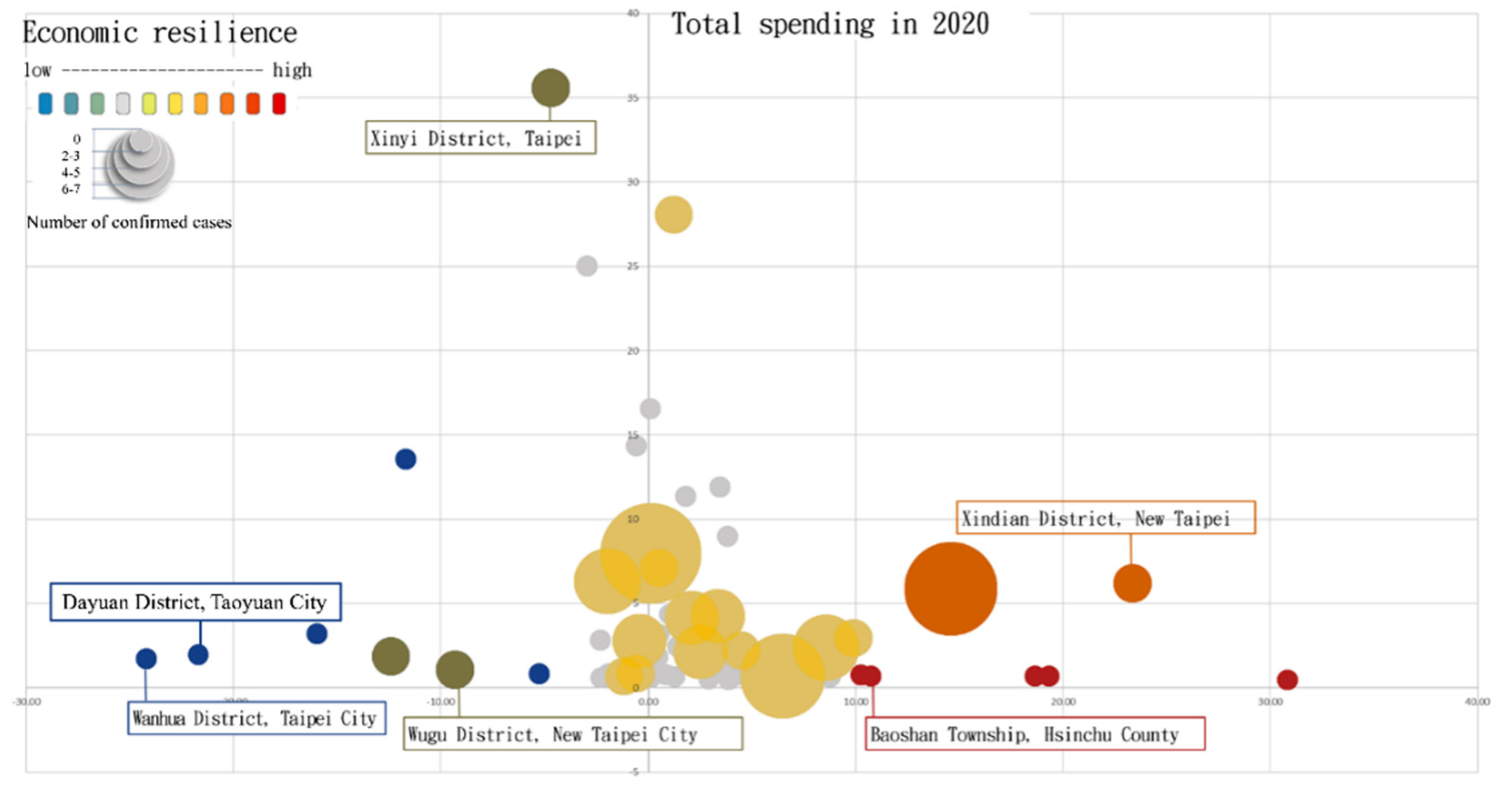
The analysis of industrial structure under the impact of COVID-19.
Population size, structure and immigration rate were the measures and indexes for evaluation of regional activity, workforce and employment opportunities of an area, and therefore would, affect its ability to resist shocks (Faggian et al., 2018; Martin & Gardiner, 2019; Giannakis & Bruggeman, 2020). Most investigations indicated a positive correlation between immigrants and production capacity or urban resilience (Ghosh & Mastromarco, 2018; Giannakis & Bruggeman, 2020). This investigation hypothesized better economic resilience in an area with higher population mobility and more resources, in terms of the aspect of talent and innovation.
The study considered the population difference between daytime and nighttime accumulated from Telecom Signaling Demographic Data by the Ministry of the Interior, as population flow was difficult to identify from migration and migrant population statistics in the selected areas for the case study. Figure 6 presents the population mobility of the selected areas. Figure 7 displays the analysis of the relationship between population flow and economic resilience by Pearson product-moment correlation coefficient, where the trend line equation was y = 1.8658x + 7.1595 with a correlation coefficient of −0.1383. This equation demonstrates a negative correlation between population mobility and economic resilience, not matching the hypothesis. Consequently, hypothesis 2 was refuted. Areas in Northern Taiwan with higher population mobility showed worse economic resilience during the influence of the COVID-19 pandemic.

Population mobility of each township, city, and district.

The scatter plot of population mobility and economic resilience.
Past works concluded that cities with more knowledge-intensive industries were more flexible and adaptable (Hu, 2017). Cities with more energy for learning, creativity and innovation had more potential for diversity and flexibility when encountering external shocks (Sunley et al., 2022). Investment in research and development represented the ability to innovate in an area. Accordingly, Hypothesis 3, better performance in economic resilience for areas with more input in research and development, was developed.
This study employed the ratio of R&D expenditures over the number by the industries investing in R&D, obtained from the factory operation census, as the variable to evaluate the investment in R&D. Further analysis of the result and the economic resilience obtained above indicated a positive correlation between the two. The correlation coefficient was 0.1516. In other words, more the investment in R&D in a city was correlated with better economic resilience during the COVID-19 pandemic (Figure 8). Hypothesis 3 was confirmed.
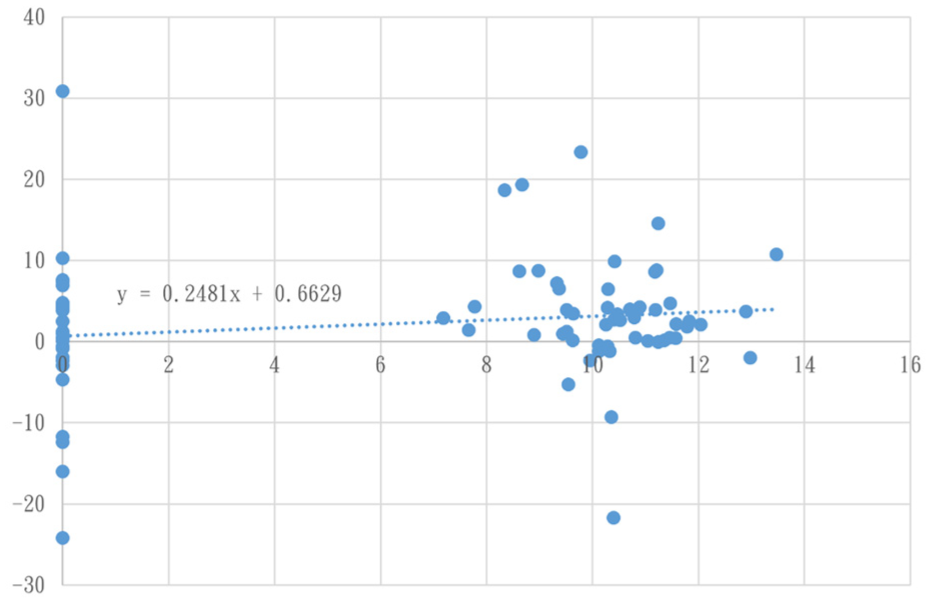
The scatter plot of R&D expenditures and economic resilience.
Even though Taipei City has many R&D resources, it had lower than expected economic resilience during the pandemic. This study incorporated the innovative incubation organizations in Northern Taiwan listed by the Small and Medium Enterprise Administration, Ministry of Economic Affairs, and the capacity of innovative incubation published in the Geographic Information System of the Ministry of Economic Affairs, to analyze the distribution of innovative incubation centers and the startups. Figure 9 shows that most of the innovative incubation centers are located in the surrounding areas of major industrial parks or science parks. The analysis revealed an unequal distribution of innovative incubation centers and organizations. The 23 innovative incubation centers in Taipei City were mostly located in Zhongshan, Datong, Zhongzheng and Daan Districts, where relatively few COVID-19 confirmed cases were found. Conversely, most confirmed cases were observed in Xindian, Zhonghe and Sanchong Districts in New Taipei City. Since these districts are within commuting distance of the districts where most of the innovative incubation centers are located, the impact of the pandemic was not mitigated by the low number of confirmed cases in the locations with innovative incubation centers.

Distribution of innovative incubation centers and COVID-19 confirmed cases in each township, city or district.
Good planning and governance, such as institutional reform, resource allocation and public participation, helps a city to resist shocks and promotes economic resilience (Hill et al., 2008), and further completed the infrastructure, established sound institutions, and built innovative energy with uncertain risks. Restate, a city can provide opportunities for knowledge exchanges, academic research and technology innovation through urban planning and construction, and thus improve its economic resilience. This study thus proposed Hypothesis 4, completeness of infrastructure was beneficial for urban development and economic resilience.
Regarding the evaluation of urban planning and governance, the areas reserved for public facilities were used to calculate the area ratio of public facilities in the selected townships, cities and districts. The result was used for the assessment of the completeness of infrastructure. The completeness of infrastructure and the results of economic resilience were further analyzed, showing a negative correlation with a correlation coefficient of −0.2203. Hypothesis 4 was rejected accordingly. That is, a higher ratio of areas used for public facilities was not necessarily associated with better economic resilience (Figure 10).

The scatter plot of the ratio of infrastructure area and economic resilience.
This investigation ranked the area ratio for public facilities from the selected 77 townships, cities, and districts, with the top ten summarized in Table 2. Among the selected cases, Songshan District of Taipei City, with 72.23% of areas for public facilities, ranked first because it contains several public facilities, such as Taipei Songshan Airport, junior and senior high schools, and parks. The economic resilience of Songshan District was reported at −15.97 during the research period. Datong District of Taipei City, containing 47.70% area for public facilities, had reported economic resilience of −12.40. The evidence from the two districts demonstrates that a higher proportion of areas used for public facilities did not necessarily lead to better performance in economic resilience under the impact of COVID-19. Zhongzheng district of Keelung City, which ranked 2 in the area ratio for public facilities (68.29%), contains a large area of conservation areas, parks, and schools, and had a calculated economic resilience of −1.92.
Township, City or District With Top 10 Ranking of Area Ratio for Public Facilities.

Source. Web portal of land use planning by Urban and Rural Development Branch, Construction and Planning Agency, Ministry of the Interior.
Although the Pearson product-moment correlation coefficient showed no relationship between the area ratio of public facilities and economic resilience, the summary from Table 2 indicates that are in the top 10 ranking for public facilities tended to have negative values for economic resilience. Worse performance in economic resilience of these townships, cities or districts could result from higher risks of virus transmission with more public facilities and spaces, and therefore caused unwillingness of public participation.
In addition, this study tested collinearity for each variable, and the results are summarized in Figure 11. It can be seen that there is no excessive overlap between various variables and the total consumption, which represents economic resilience.

Collinearity results for each variable.
Multiple Regression Analysis
After completing the Pearson analysis and verifying the hypotheses established by this study, this study further examines various factors through multiple regression analysis, namely the ratio of manufacturing industry, population mobility, investment in research and development, and completeness of public facilities. The impact on the total consumption amount in the research target area during the period.
As can be seen from the Table 3, the R2 of the equation is .941, indicating that 66.7% of the total variation in the regression can be explained by independent variables; after adjustment, R2 is .938, which avoids the possibility of overestimation of the coefficient of determination due to more independent variables; The F value of the significance test of the regression model is 338.1363, and the significant value <0.001 indicates that the regression model has the predictive ability.
Summary of Multiple Regression Analysis.

Source. This study.
As can be seen from the Table 4, among the four variables constructed in this study, the population mobility has the greatest impact on consumption during the pandemic, followed by the investment in research and development, completeness of public facilities, and the ratio of manufacturing industry.
Summary of Multiple Regression Model Coefficients.
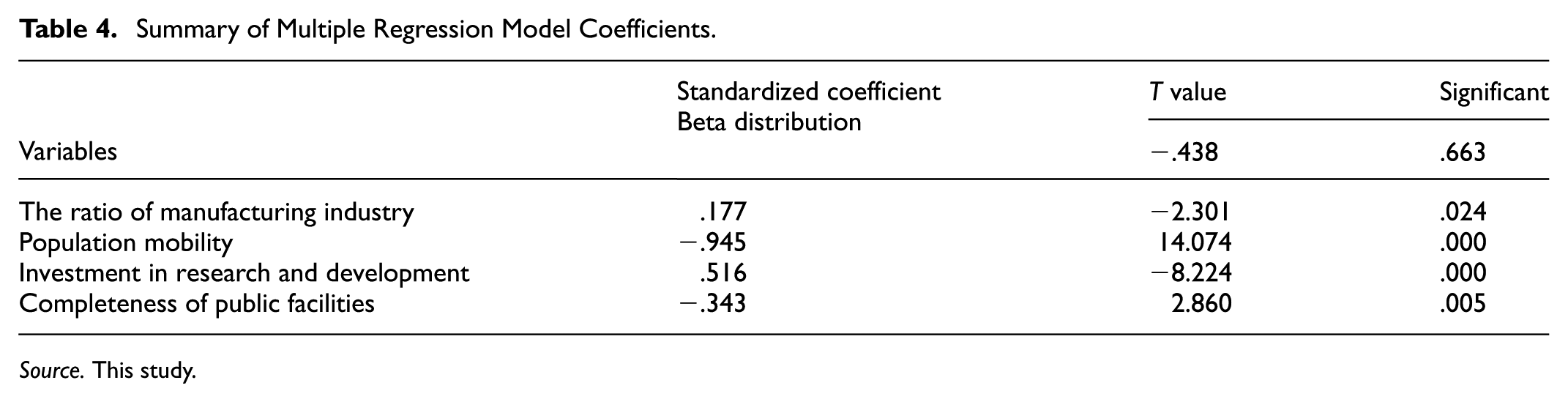
Source. This study.
Conclusion and Suggestion
Conclusion
The subject of economic resilience has been of interest of scholars ever since the financial crisis of 2008 (Pan et al., 2020). However, previous studies mostly focused on the impact of the financial crisis on economic resilience, and barely discussed or investigated influencing factors, such as COVID-19 and other epidemics. However, the characteristics of different kinds of shock events or shock determine the factors that affect economic resilience. To clarify the impact of pandemic on economic resilience, this study completed the literature review and made some assumptions and hypotheses based on different categories, including the ratio of the manufacturing industry, population mobility, investment in R&D, and completeness of infrastructure. The indexes of economic resilience and the real impact of the pandemic on Northern Taiwan in 2020 were then analyzed by the Pearson product-moment correlation coefficient to identify whether the selected factors assisted in the economic resilience of a city under the COVID-19 outbreak.
The results of this study confirmed that the features of various shock influence different factors of economic resilience. First, a high ratio of manufacturing industry in the local economy, a factor acknowledged to be detrimental to economic resilience in the past, was beneficial during the pandemic due to social distancing. For instance, working from home and telehealth triggered a rise in revenue for the manufacturing industry, such as electronic components and computers, in Taoyuan City and Hsinchu County and City, further transforming economic resilience. Thus, COVID-19 had different effects from previous shocks, meaning that areas with higher ratios of manufacturing industry did not necessarily have worse economic resilience. It is estimated that this may be because the epidemic has stimulated remote business opportunities at home, and since the US-China trade war has gradually turned into a technology war since 2018, international demand for electronic products exported from Taiwan has increased.
Second, population mobility, which was found to have increased economic resilience in past studies, was unfavorable for economic resilience during the COVID-19 pandemic, in which high population mobility led to virus transmission. Areas in Northern Taiwan with higher population mobility showed worse economic resilience during the COVID-19 pandemic. Especially Taipei City, New Taipei City and Keelung City. It is speculated that because the economic activities and living circles of these three cities are particularly close, the impact of this epidemic was very serious.
Third, this study evaluated the investment in R&D as the ratio of R&D expenditure over the number by the industries investing in R&D. Further analysis of the result and the economic resilience obtained above indicated a positive correlation between the two. Past works concluded that cities with more knowledge-intensive industries were more flexible and adaptable. Previous investigations have found that cities with more energy for learning, creativity and innovation had more potential for diversity and flexibility when encountering external shocks (Sunley et al., 2020). Research results of this work reveal that this correlation is also true in the pandemic. The analysis also revealed an unequal distribution of innovative incubation centers and organizations. Since these districts are within commuting distance of the districts where most of the innovative incubation centers are located, the low number of confirmed cases in the locations with innovative incubation centers did not mitigate the impact of the pandemic.
Finally, completeness of public facilities, which past studies found to increase economic resilience in past studies, was unfavorable for economic resilience during the COVID-19 pandemic. More COVID-19 confirmed cases were observed in areas with more social activities and entertainment. To reduce the risk of infection, citizens reduced visits to public places such as parks. The higher risks of virus transmission with more public facilities and spaces led to unwillingness of public participation. In addition, the difference between urban and rural areas will affect the budget and quantity of public construction. Therefore, it can also be found that the closer to the capital and the more prosperous the area is, the more public facilities it has. However, during the impact of this epidemic, it may increase the risk of virus transmission.
Overall, this study highlights the difference between the impact of the pandemic and the financial crisis by studying the economic resilience performance of Northern Taiwan under COVID-19. By analyzing various factors and economic resilience, this study provides ways to deal with the pandemic in the future, helping policymakers avoid a one-size-fits-all policy.
Suggestion
Analytical results of this study indicate that the characteristics of an event or shock determine the factors that affect economic resilience. For example, consider Taipei City, which has the highest consumption and scale of wholesale and retail activity. The vigorous business activities and gathering of knowledge-intensive talents in Taipei City satisfy the conditions considered beneficial for economic resilience. Nevertheless, Taipei City performed worse than anticipated under the impact of the pandemic was not as. Consequently, policymakers under a shock or event must think carefully about the characteristics and features of the shock in addition to the intrinsic conditions of the city.
Regarding The aspects represented by each variable, suggestions are made as follows: Regarding the ratio of the manufacturing industry, considering that it is impossible to predict the type of future impact events, it should be maintained at a certain ratio and the assistance needed by manufacturers should be confirmed from time to time. In the context of the population mobility, enhanced mastery of technological skills can be encouraged to avoid unnecessary movement. In the investment in research and development section, provide the resources needed by the R&D unit as much as possible. Finally, in terms of completeness of public facilities, electronic systems can be established for these facilities to instantly confirm usage status and other information online.
Moreover, many innovative incubation centers established in Taipei City have increased the achievements of research and development and further enhanced economic resilience. However, these centers are primarily located in industrial and science parks with high population densities, resulting in spatial heterogeneity. The service provided that the centers was limited to users in the surrounding areas. Accordingly, a diversity of infrastructure and incorporation of contactless services are suggested for future urban planning.
This investigation of economic resilience under the impact of the COVID-19 pandemic is based on economic and social development data for Northern Taiwan. The research period only covers 2020 due to the deferred timeline and limit of data availability caused by the pandemic. In addition, Taiwan’s health authorities adopted different epidemic prevention policies at the peak of the second wave of the epidemic, and different methods may be needed to assess economic resilience during this period. This is also the reason why this study decided to focus on the first wave of the epidemic. We recommend extending the research period extended to 2022 or later to study the recovery of the economy from the COVID-19 pandemic. Conversely, the statistics of the financial subsidies and bailouts from the government only ranked at the city or county level and so could not be used for the examination. Therefore, we recommend gathering more detailed, thorough and real-time statistics.
In addition, information on variables such as the population mobility, the investment in research and development, completeness of public facilities, and the ratio of manufacturing industry are only available in Taiwan’s official statistics in units of counties, cities or administrative districts, and there is almost no private information. The department specializes in collecting these data, so it is difficult to have a more detailed research scale, which is one of the limitations of this study.
Finally, the purpose of this study is preliminary to highlight that different shocks may have different urban characteristics that are beneficial to economic resilience, so as to provide suggestions to policymakers to avoid adopting one-size-fits-all policy policies when facing shocks like COVID-19 pandemic. Therefore, this study highlights the difference between the impact of the pandemic and the financial crisis by studying the economic resilience performance of the research area and performing Pearson correlation analysis on the economic resilience indicators we set. It is suggested that follow-up research can use multiple regression methods to provide more detailed connotations for related issue.
Footnotes
Acknowledgements
The authors would like to thank the Ministry of Science and Technology of Taiwan, for partially financial supporting this research under contract MOST 108-2410-H-006-090.

Ethics Considerations
There are no human participants in this article and informed consent is not required.
Consent to Participate
There are no human participants in this article and informed consent is not required.
Funding
The authors received no financial support for the research, authorship, and/or publication of this article.
Declaration of Conflicting Interests
The authors declared no potential conflicts of interest with respect to the research, authorship, and/or publication of this article.
Data Availability Statement
Data sharing not applicable to this article as no datasets were generated or analyzed during the current study.