




Abstract
This research integrates the theoretical strands of crisis management and organizational agility to improvise a process in which organizations expedite their IT-based solutions to cope with mega disruptions, carried out through two studies. Using corpus linguistics as an analytical approach with data collected from press releases from 10 US retail conglomerates, our findings point to the transition from a business-as-usual business model to the incubation of a work-at-home retail model that is infused by technology innovations. In making such a transition, organizations exercise agility through rapidly responding to a multitude of environmental jolts. The contribution of the present article lies in illuminating the role of IT innovations and digitization efforts that lay the necessary organizational capabilities to stay abreast with market opportunities amid extenuating circumstances. This research provides an empirical articulation of the importance of IT-based crisis responses to help scholars better understand the nature of crisis management and organizational agility.
Plain Language Summary
The objective of this study was to explore the crisis response mechanism from major retailers in the US. Using data from press releases collected from 2020 to 2022, the present inquiry illuminates how retail firms have handled the pandemic from a business-as-usual approach to harnessing IT to improve organizational agility with solutions tailored to the urgent needs of the consumers and other stakeholders. Using corpus linguistics as an analytical approach, our findings point to the transition from a business-as-usual model to a work-at-home retail model that is infused by technology innovations.
In a time of rapid change and unprecedented complexity, only the nimble survive! (McKinesey & Company, 2018, p. 1)
Introduction
The COVID-19 pandemic not only poses global health and humanitarian challenges to cities and healthcare systems, it also has caused unprecedented disruptions to organizations around the world (Theberath et al., 2022; Wong et al., 2023). As the crisis continues to bring catastrophic consequences to humanity, service companies such as retailers like Walmart, Home Depot, Publix, JC Penny, TJX, GNC have been facing a plethora of inconceivable events that weaken their industry legitimacy and taken-for-granted bricks-and-mortar business models and hence, threatened their very existence (Pantano et al., 2020). The retail industry is facing its apocalypse as store after store are closing for good (Business Insider, 2020), leaving people to wonder what is next for the retail business. Although this situation has gradually been mitigated, it poses an opportunity to investigate how firms response to acute organization weakening in extenuating circumstances (Mahmud et al., 2021; Ou et al., 2021).
The extant literature on crisis management has explained how organizations respond to disruptions and challenges. While some scholars view crisis as an isolated event, others have conceived it as a process in which organizations continue to align their capabilities and resources to adjust and reframe their business models (James et al., 2011; Reeves et al., 2020). By actively managing risk to system stress and vulnerability, organizations gain resilience in the face of adversity (Williams et al., 2017). Yet, risks exposed through a crisis could ultimately impel organizations to tap into new opportunities that transform their existing business models to better retain industry legitimacy and improve their competitive advantage over rivals (Damodaran, 2008; Pearson & Clair, 1998). However, the body of literature on crisis management primarily focuses on crisis response, recovery, and resilience; hence, crisis-as-opportunity and its transformation trajectory has received relatively little attention (Devece et al., 2016; Pearson & Clair, 1998).
In light of the aforementioned research gap, this study seeks to illuminate how a crisis presents opportunities for the service industry to develop technological capabilities as innovations that can cope with business disruptions from environmental jolts. More importantly, it articulates a coercive technical transformation based on the crisis-as-process tradition (Z. Lin et al., 2023; Williams et al., 2017) one which reflects the rapid evolution of a techno-centric approach in departure from the traditional bricks-and-mortar business model, to expedite fulfillment of needs of employees and consumers. This inquiry draws on theories pertaining to the organizational agility (Chakravarty et al., 2013; J. Lin et al., 2020; Lu & Ramamurthy, 2011) and crisis management (Coombs, 2018; Williams et al., 2017) research streams with data collected from press releases from 10 US retail conglomerates and analyzed through a corpus linguistics approach. Two studies were conducted, with the first assessing rapid crisis responses during the incubation and acceleration of a mega crisis, and the second examining crisis responses and organizational stability in the aftermath of the crisis. It contributes to the literature not only by heeding the call from researchers (James et al., 2011; Pearson & Clair, 1998) to reframe the role of crisis in organizations, but also by highlighting the crisis-induced evolutionary process entailed by the rapid technological transformation in the retail sector. It further adds to the organizational agility literature (Kalaignanam et al., 2021) by showcasing a model that could aid scholars and practitioners alike to better understand expedited information technology (IT)-based organizational transformation.
Theoretical Background
Crisis Management
Crisis management represents “a set of factors designed to combat crises and to lessen the actual damage inflicted” (Coombs, 2018, p. 21). It seeks to mitigate challenges and negative outcomes from adversity and therefore, protect an organization and its stakeholders (Coombs, 2018). However, there is still a debate on conceptualization of a crisis. While some scholars define it as an event that occurs in isolation that can neither be planned nor be conceivable (Topper & Lagadec, 2013), others describe it as a process that falls into stages of incubation and aftermath (Pearson & Clair, 1998; Roux-Dufort, 2016).
This study adopts the crisis-as-process view to gage its evolutionary features (Williams et al., 2017). The process tradition of crisis and its management comprises four interrelated factors including prevention, preparation, response and revision (Coombs, 2018). In order to understand the complex process in circumventing crises, scholars propose various frameworks and models to capture tenets of crisis management. Early work from Pearson and Mitroff (Pearson & Mitroff, 1993) acknowledges a five-stage model: (1) signal detection: detecting warning signals left by crisis; (2) preparation/prevention: searching for potential breaks to fix; (3) containment/damage limitation: limiting the effect of the damage; (4) recovery: recovering to conduct normal business; and (5) learning: reflecting and examining the lessons from the crisis. In this model, Stages 1 and 2 fall into the pre-crisis phase, Stage 3 reflects the during-crisis phase, and Stages 4 and 5 represent the post-crisis phase. James et al. (2011) argue that efforts should be devoted to assess crisis responses, which consist of emotional responses and behavioral responses. The first enactment points to organizational strategies in dealing with employees, customers, and other stakeholders with respect to malaise and apprehension caused by shattered assumptions and changed world views; whereas the second is germane to means of ameliorating the corporate images [see also 18], enacting solutions to mitigate system stress, and realigning organizational goals from environmental uncertainty (see also Williams et al., 2017).
The recent work from Williams et al. (2017) unites crisis management and resilience literature to integrate a rather comprehensive framework for handling adversity. The central premise of their proposal rests on an organization’s continuous endeavors to organize, adjust, and restore itself from organizational weakening, misalignment, and isolated events triggered by extenuating circumstances (Ou et al., 2021). While the firm galvanizes efforts (e.g., economic, cognitive, behavioral, emotional, and relational capabilities and resources) in responding to disturbances [see also (Garcia Martinez et al., 2019)], the firm gains resilience by enhancing perseverance and reliability in the face of various challenges. Importantly, although a crisis is primarily viewed as an anomaly that entails adverse or even devastating impacts, organizations that succeed in gaining resilience from such an event are able to thrive and hence, a crisis could be reframed as an opportunity rather than a threat (James et al., 2011; Ou & Wong, 2021; Pearson & Clair, 1998; Williams et al., 2017). In this study, we focus on organizational agility as a principal capability and information technology as a primary resource for organizations to gain resilience and afford business opportunities in the face of the COVID-19 pandemic.
Organizational Agility and Information Technology
As a crisis entails properties that superimpose companies’ immediate enactment to areas that lead to organizational weakening and disruption impel decision makers to stay abreast with various options and solutions and to be flexible with organizational models that could cope with the rapid changes from environmental jolts (Ou & Wong, 2021). The term organizational agility refers to the “ability of an organization to renew itself, adapt, change quickly, and succeed in a rapidly changing, ambiguous, turbulent environment” (McKinesey & Company, 2018, p. 1). It extends organizational flexibility to denote a firm’s capability in dealing with unexpected adversity and risks that arise from extenuating circumstances through “innovative responses that exploit changes as opportunities to grow and prosper” (Lu & Ramamurthy, 2011, p. 933). This very definition echoes the premise that a crisis entails opportunities that are commonly unexploited (James et al., 2011; Pearson & Clair, 1998). This paradox of crisis (i.e., crisis as risk vs. crisis as opportunity) rests on an organizations ability to exercise ambidexterity and to harness the power of information technology (IT) to improve organizational agility (Tallon & Pinsonneault, 2011).
As the marketplace is changing at a constant pace, companies are striving to maintain a high level of agility in order to be more dynamic, to move fast and to be responsive to consumer needs, competitor offerings, and environmental uncertainty (McKinesey & Company, 2015). A recent McKinsey report reveals that companies that attain a high level of agility realize higher return on investment and shareholder values due to better employee and customer satisfaction as a result of greater benefits from their offerings (McKinesey & Company, 2018). Although IT is not the only means to attain agility, as there are other avenues that could improve a company’s responsiveness to market volatility and other adverse circumstances (Nijssen & Paauwe, 2012; Singh et al., 2013), technological innovations have often been on the center stage for corporations to capitalize environmental volatility as a momentum to grow and excel (Tallon & Pinsonneault, 2011). Yet, usage of IT presents its own paradox as it can also impede innovation and company performance due to issues pertaining to system integration and other agency problems (Brynjolfsson, 1993; Lu & Ramamurthy, 2011). Hence, organizations that seek to leverage IT to improve agility need to embrace the technology through strategic planning (Bernardi et al., 2019; Teece et al., 2016), while others propose to focus on systems thinking to understanding the reciprocal relationship between IT and organizational/human actors (Lamb & Kling, 2003; Orlikowski, 1992).
There are generally two primary categories of agility within the institutional context (Lu & Ramamurthy, 2011). The first is market capitalizing agility, which reflects a company’s ability to sense and react quickly with environmental changes to embrace strategic directions that focus on growth (J. Lin et al., 2020). Such ability often allows firms to capitalize on emergent needs from customers through new offerings. The second is operational adjustment agility, which points to a company’s operational procedures that allow the firm to cope with changes and disturbances through internal adjustments (Rialti & Marzi, 2020). Empirical evidence further suggests that a firm’s IT capabilities related to infrastructure, business spanning, and proactive stands are antecedents to these two agility domains (Lu & Ramamurthy, 2011). IT infrastructure capability orients toward a firm’s sharable platform and facilities, such as database management system, network communication, and e-commerce interfaces that lay the necessary foundation for IT-enabled offerings. IT business spanning capability reflects a synergy between IT and other organizational functions. Finally, proactive IT stance refers to a firm’s endeavors to seek IT innovations to better exploit business opportunities (Lu & Ramamurthy, 2011; Rai, 2012).
Tallon and Pinsonneault (Tallon & Pinsonneault, 2011) took a different approach to gage agility through the lens of strategic IT alignment and IT flexibility. Their arguments centered on the importance of knowledge management, with shared understanding between IT and business executives in order to reach organizational objectives. Hence, alignment of business strategy and the functional role of IT could facilitate innovation and firm performance. Flexible IT infrastructure also plays a role here as scalability and adaptability can foster a higher level of technology usage that can suit various needs within the firm. Although technology is the primary means to enhance agility, McKinsey suggests additional conduits to reach this organizational goal, including setting a clear objective, creating cross-functional teams that adhere to the objective, working in rapid iterations in product development, and using a bottom-up approach to empower teams (McKinesey & Company, 2018).
Although these options are critical, the present study focuses on IT-infused transformation that is facilitated through organizational agility to cope with rapid changes in the time of the COVID-19 pandemic. As IT-based agility and crisis management are two distinct camps of research, this inquiry will provide empirical evidence that brings these two areas into understanding of how retailers gain resilience through strategic innovations amid unprecedented circumstances.
Study 1
Methods
This investigation employed corpus linguistics, which is a sub-field within the paradigm of modern linguistics, as a methodological approach to analyze lexical meanings embedded from a large corpus of press releases from major retailers. Different from other sub-fields in linguistics, it does not study any particular aspect of language but rather “focuses upon a set of procedures, or methods, for studying language” (McEnery & Hardie, 2011). As a methodological technique, it analyzes language from a computerized collection of texts, in a highly quantitative manner through some well-established corpus linguistic procedures (McEnery & Hardie, 2011).
Compared to other computer-aided approaches for text analysis, corpus linguistics goes beyond the focus on category of meaning, which instead is taken as the starting point for more thorough textual analysis on a lexical level in order to understand how text is used in context (i.e., concordance) (McEnery & Wilson, 2001). It could be used to analyze the diachronic evolution of language within a certain timeframe (Gabrielatos et al., 2012). Corpus linguistics is a powerful tool that has been used in management research by scholars in different disciplines (Lewis & Young, 2019; Pollach, 2012). As such, we utilized this method to gage the evolutionary process of retailers as an ongoing organizational adjustment.
This research takes a corpus linguistics approach to assess the diachronic change of lexical items in textual big data analysis. It consists of two studies. For Study 1, ten American-based retail companies listed in the 2019 Fortune 200 list were chosen for data collection, including Walmat, Costco Wholesale, Home Depot, Target, Publix Super Markets, Macy’s, Best Buy, TJX, Dollar General, and Dollar Tree. Press releases of these companies during the period of February to April 2020 were collected. The data set consists of 161 press releases which equate to 84,154 words. The data were then complied into three corpora: February Press Release Corpus (45 press releases, 22,840 words); March Press Release Corpus (71 press releases, 36,165words); and April Press Release Corpus (45 press releases, 25,149 words). Two types of corpus analysis, keyword analysis and concordance analysis, were conducted via two corpus tools—Wmatrix (Rayson, 2008) and LancsBox—respectively (Brezina et al., 2018).
In Study 1, by comparing the March corpus to the February corpus (underused vs. overused keywords presented in Tables 1 and 2), and the April corpus to the March corpus (underused vs. overused keywords presented in Tables 3 and 4), statistical significance was obtained. Stop words and company names were excluded from keyword analysis to reduce bias from the data. The keywords were then selected and sorted at a Log-likelihood (LL) value of 15.13 (p < .001) as further detailed in the tables below. Concordance (keyword-in-context) lines of each of the keywords were read through manually to develop themes along with the associated keywords. Exemplary statements were selected to show readers how different keywords and the corresponding themes were manifested in the corpora (i.e., corporate press releases), in Table 6.
Underuse Keywords of March Relative to February.
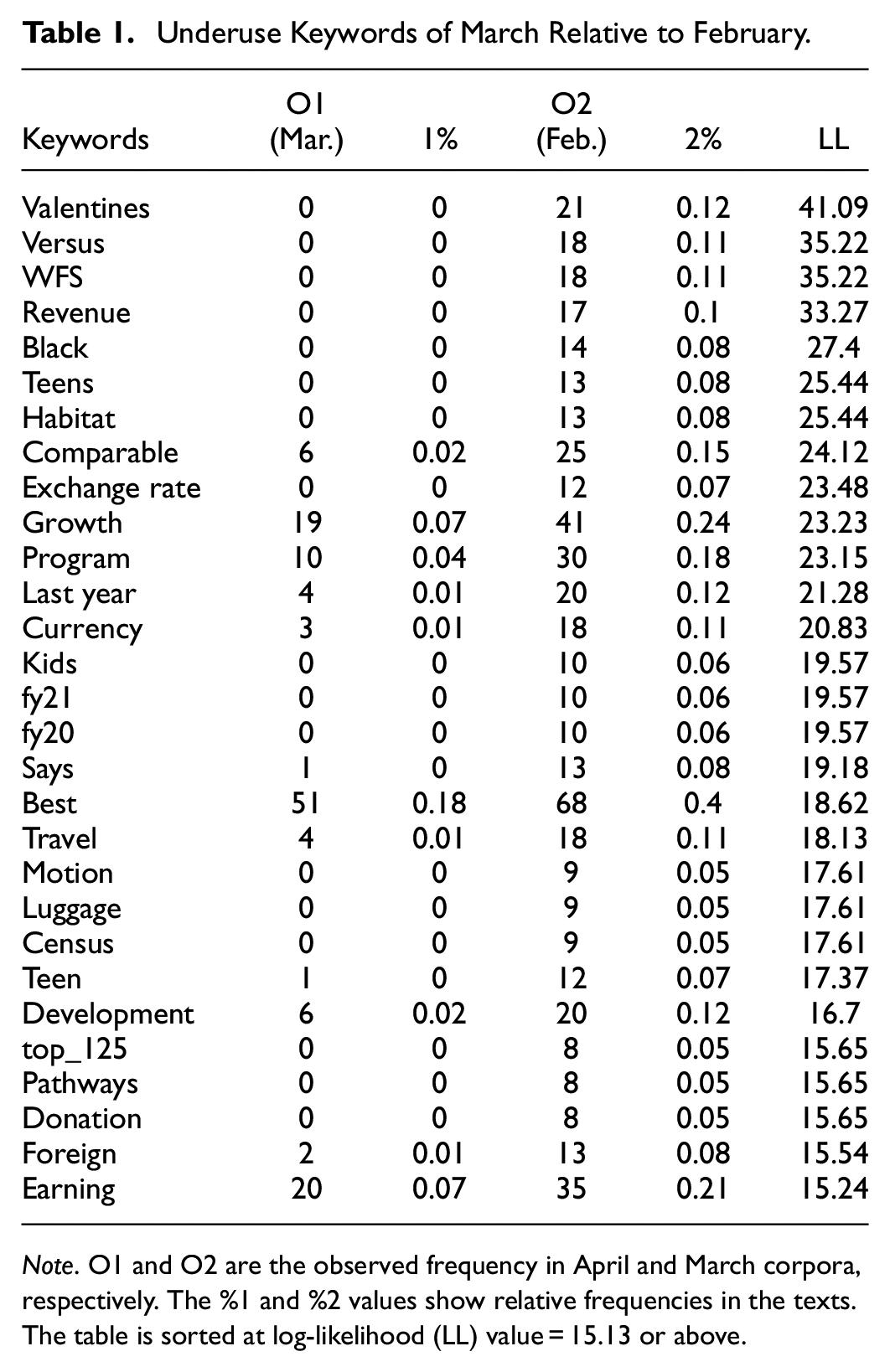
Note. O1 and O2 are the observed frequency in April and March corpora, respectively. The %1 and %2 values show relative frequencies in the texts. The table is sorted at log-likelihood (LL) value = 15.13 or above.
Overuse Keywords of March Relative to February.

Note. O1 and O2 are the observed frequency in April and March corpora, respectively. The %1 and %2 values show relative frequencies in the texts. The table is sorted at log-likelihood (LL) value = 10.83 or above.
Underuse Keywords of April Relative to March.

Note. O1 and O2 are the observed frequency in April and March corpora, respectively. The %1 and %2 values show relative frequencies in the texts. The table is sorted at log-likelihood (LL) value = 15.13 or above.
Overuse Keywords of April Relative to March.
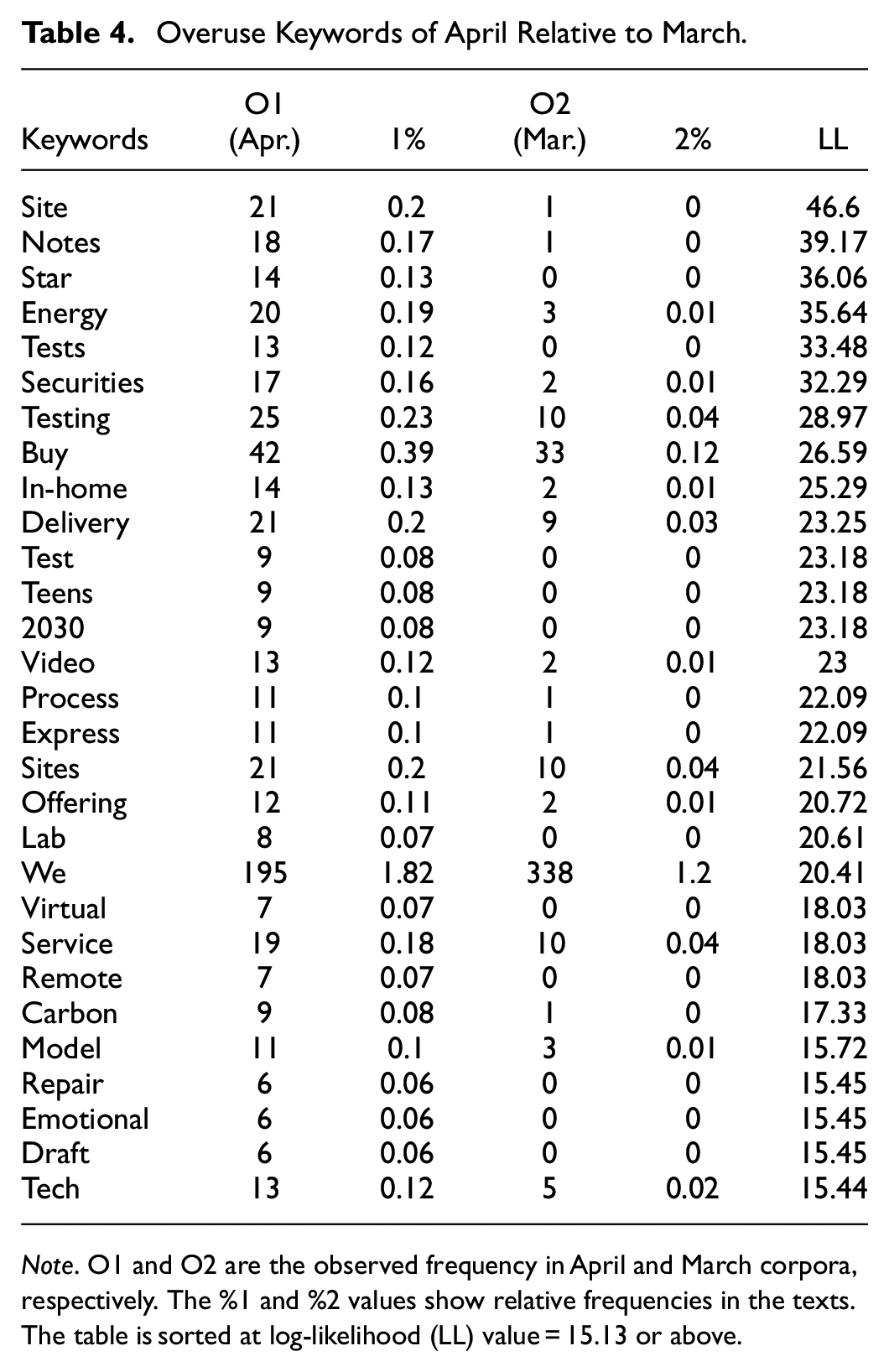
Note. O1 and O2 are the observed frequency in April and March corpora, respectively. The %1 and %2 values show relative frequencies in the texts. The table is sorted at log-likelihood (LL) value = 15.13 or above.
Findings
Keywords Analysis
Compared to February, underused keywords in March are summarized in Table 1. These keywords characterize the linguistic features that were emphasized in the February corpus. In February, COVID-19 was not apparent in United States except for limited cases reported toward the end of the month; therefore, no keywords related to the pandemic with statistical significance were obtained in the keyword lists. Semantically, profit and development marked the business theme of the February corpus with keywords such as “revenue,”“currency,”“exchange-rate,” and “earning” that were significantly overused in February relative to March. Also significantly more frequent keywords such as “growth,”“development,”“comparable,”“fy21,”“fy20,” and “best” were utilized to manifest a sense of business growth in different fiscal years. As the last month under the rubic of “business-as-usual,” February witnessed the celebration of Valentine’s Day and therefore “valentine” occurred most frequently in February.
With the gradual spread of coronavirus in March in the US, it began to generate negative sentiment and public worries throughout the country. Press releases in March mirrored this media attention, as summarized in Table 2. Coronavirus-related keywords were significantly overused, including “covid-19,”“times,”“cleaning,”“unprecedented.” These keywords foregrounded coronavirus as a highly infectious disease and highlighted the importance of cleaning in response to the health crisis. Even though business operations of retailers were disrupted by the outbreak, by and large, business functions remained the same at least until the end of the month, before city lockdown and stay-at-home orders. As such, business was another theme for the March corpus and service-related keywords such as “store,”“food,”“same-store,”“serve,”“hour,”“customers,” and “guests” dominated this theme, indicating business as usual for the industry. Keywords related to business development also occurred frequently in the March corpus, including “fiscal,”“quarter,”“fourth,”“companies,” and “2019.”
As the coronavirus pandemic continued to gain momentum in the US in April amid prolonged city lockdowns and social distancing measures, the retail industry underwent a painstaking process to confront operational adversity due to acute fluctuation in demand, while also realizing the opportunity for salient business growth due to high demand for online alternatives (Kaplan, 2020). Comparing the corpora between March and April, keywords clustered in business themes, like “fiscal,”“fourth,” guest,”“quarter,” and “2019,” were significantly underused in April, but were overused in March. This phenomenon points to the marginalized business theme in April.
Table 4 presents the overused keywords in April relative to March, where a sharp difference is demonstrated. The business theme completely vanished, whereas digitalization emerged as the dominating feature in the April corpus. Technology to support the surging needs of online orders was developed in computer laboratories and was being thoroughly tested and implemented, as indicated by a list of technology keywords such as “site,”“lab,”“virtual,”“remote,”“tech,” and “securities.” These online infrastructures help ensure a satisfactory service experience as customers would normally enjoy in the bricks-and-mortar physical stores. It is important to note that while terms such as “testing” were used by some retailers (e.g., Kroger, Walgreens, Walmart, and CVS Health) that participated in the community-based COVID-19 testing program (Department of Health & Human Services, 2020), the usage of online booking systems was involved as well as other technologies to oversee the entire process.
Responding to the digitalized shopping practice, an emphasis on swift delivery of online orders was highlighted through such keywords as “express,”“delivery,” and “service.” The coronavirus also impacted work–leisure practices through implementation of stay-at-home orders. Keywords like “in-home,”“video,” and “process” reflect a transformation to work-at-home practices such as working and exercising at one’s residence. Interestingly, the transition to this new work-at-home business model also offered opportunities for retailers to further enact eco-friendly corporate social responsibility (CSR) measures. For example this IT-based new business model contributed to the community by saving “energy” and reducing “carbon” emissions, as shown in Tables 4 to 6.
Major Themes.

Keyword-in-Context: Exemplary Statements for the Themes.

Concordance Analysis
Keywords were obtained and then analyzed through a qualitative approach. Taking the interpretive paradigm, the authors read through each press release line-by-line (Strauss & Corbin, 1998) with the assistance of LancsBox, which is a multi-platform language analytic tool, to identify keywords along with their associated frequencies (not shown in the present study) in the corpora. Themes then emerged and were organized from the most dominant theme (at the top of the corresponding time period) to the least dominant. Salient linguistic themes foregrounded in the keyword lists from February to April are summarized in Table 5.
Overall, five pivotal themes occur in the corpora: business (as usual), coronavirus, technological innovation, work-at-home model, and eco-friendly. They do not gain dominance at the same time; rather these themes take center stage in the corpus at difference stages. Diachronically, the themes change along with the timeline of the development of coronavirus and reflect changes in the shifting focus of the retail industry. The business theme was the only theme in February when coronavirus was yet to hit the US (at least for most of the month). Companies were still looking back, celebrating past success and setting goals for the year 2020. For example, Best Buy announced that “For the 15th year, we achieved a 100% rating, earning Best Buy the distinction of a Best Place to Work for LGBTQ Equality.” The conglomerate also emphasized that in 2020, the corporation was “expect[ed] to deliver full-year comparable sales growth in the range of flat to 2%” (see Table 6) amid better than expected sales performance in 2019.
March marked the incubation of the crisis in the US as the outbreak worsened, which led to the emergence of a new theme—coronavirus—in competition with the business theme. Health-concern issues were brought up into the spotlight. In the meantime, business operations were not yet severely disrupted, at least until the end of month; hence, the business theme was still dominant in the March corpus. For example, Target announced that their “check lanes will be cleaned after each guest transaction, and dedicated team members will guide guests in line while that happens.” Dollar General only made minor amendments to their operations as “all stores plan to close one hour earlier than current close times to allow employees to clean and re-stock store shelves, as well as for their health and wellbeing” (see Table 6). This period was the time when “business as usual” and coronavirus managed to co-exist without major disturbance to the taken-for-granted business models and their operations.
However, moving into April, the COVID-19 outbreak eventually swept through the entire country, with reported cases surging drastically, forcing store closures and city lockdowns across the country. As this phenomenon became the “new normal,” putting the entire economy on hold, the conventional retailers (e.g., JC Penny, Zara, Pier 1 Imports, Gap, Walgreens, Victoria’s Secret, and many more) that heavily rely on physical store distribution were forced to close their outlets and switch to online alternatives. This phenomenon reflects a rapid transformation that has led to a wider prevalence of digital sales channels catering to consumer needs. Coercive forces from environmental jolts thus pushed these retailers to utilize digitalization to replace physical interactions with their clienteles. This evolution points to a rise in ad hoc capabilities through technological innovations. For example, Target was geared with 3D-printing technology to create new face shields “for healthcare facilities across the country.” Best Buy came up with the remote repair protocol to allow patrons to “install and repair in homes” while harnessing their abilities to “troubleshoot and repair [customers’] technology remotely, using virtual tools that allow us to help from afar” (see Table 6).
In a similar vein, retailers’ technological transformation was a big step forward to prepare their employees to work at home, while galvanizing customers to stay abreast with their product offerings when staying at home. As such, the work-at-home theme renders a new social phenomenon in which consumers and employees alike are reluctant to embark on activities outside of their shelters due to an array of public safety and enforced/voluntary stay-at-home advocacy. Walmart, for example, has launched a series of strategic initiatives geared to assist patrons to receive medical/health consultations through telehealth options, via phone or video conferencing. To expedite their services, the world’s largest retailer has transformed its delivery system to a new level that taps into the urgent needs of their clienteles with “Express service, a new service that delivers more items from the store than ever before to customers’ doors in less than two hours” (see Table 6). In sum, digitalization efforts along with other environmental greening initiatives were strategically repositioned to adjust to changes in consumer behaviors and to realign the old business model with new business opportunities.
Study 2
Methods
Study 1 provided an in-depth analysis of the linguistic features of press releases from March to April 2020. Study 2 was conducted to gain breadth in the linguistic features by tracking the diachronic language use over a 2-year period, from March 2020 to March 2022. In Study 2, data was collected on a periodic basis. Press releases of the aforementioned retail companies during the five periods of March 2020, September 2020, March 2021, September 2021, and March 2022 were collected. The data were then complied into five corpora: March 2020 (71 press releases, 36,165 words), September 2020, March 2021, September 2021, and March 2022 Press Releases.
In Study 2, keyword analysis was conducted by comparing the September 2020 corpus to the March 2020 corpus, the March 2021 corpus to September 2020, the September 2021 corpus to March 2021, and the March 2022 corpus to the September 2021 corpus. Statistical significance was obtained. Stop words and company names were also excluded from keyword analysis to reduce bias from the data. The keywords were then selected and sorted at a Log-likelihood (LL) value of 15.13 (p < .001). Overused keywords were presented in Tables 7 to 9 respectively to show linguistic trends from 2020 to 2022 on a periodic basis. No keywords at a LL value of 15.13 (p < .001) were obtained when comparing the March 2022 corpus to the September 2021 corpus.
Overuse Keywords of September 2020 Relative to March 2020.

Note. O1 and O2 are the observed frequency in September and March corpora, respectively. The %1 and %2 values show relative frequencies in the texts. The table is sorted at log-likelihood (LL) value = 15.13 or above.
Overuse Keywords of March 2021 Relative to September 2020.

Note. O1 and O2 are the observed frequency in March and September corpora, respectively. The %1 and %2 values show relative frequencies in the texts. The table is sorted at log-likelihood (LL) value = 15.13 or above.
Overuse Keywords of September 2021 Relative to March 2021.
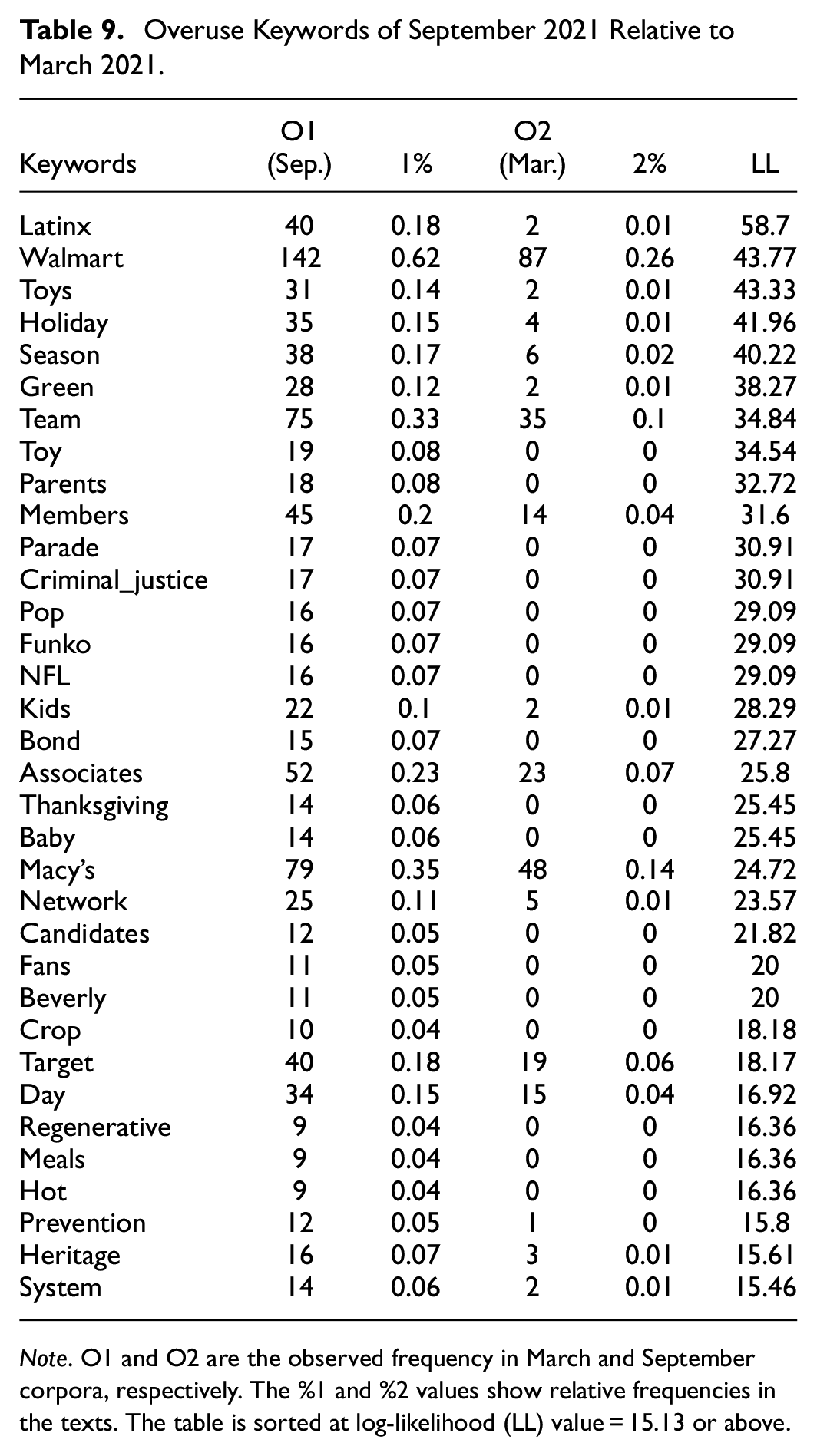
Note. O1 and O2 are the observed frequency in March and September corpora, respectively. The %1 and %2 values show relative frequencies in the texts. The table is sorted at log-likelihood (LL) value = 15.13 or above.
Findings
Keywords Analysis
Compared to March 2020, overused keywords in September 2020 are summarized in Table 7. A “business-as-usual” theme took center stage with keywords like “holiday,”“season,”“deals,”“thanksgiving,”“exclusive,”“toys,”“diverse,”“global” being significantly overused, indicating that retail companies were preparing for the upcoming holiday season. Keywords related to “technology” were not explicitly used, but implied through the use of other keywords. For example, “Walmart+” was used in the context of the technology-fused shopping experience like no other retailers, as Walmart claimed: Walmart+ uses the company’s unique assets to make life easier for busy families. Along with the power of its online presence, Walmart+ has the reach of more than 4,700 stores, including 2,700 stores that offer delivery as fast as same day.
As the COVID-19 pandemic continued in September 2020, it was also touched upon in the September 2020 corpus through the overused keywords such as “flu” and “shot.” Prevention of COVID-19 was again emphasized. Corporate social responsibility was another theme, focusing on environment and sustainability with keywords such as “climate,”“sustainability,” and “farmer” being overused in the September 2020 corpus.
Compared to September 2020, overused keywords in the March 2021 corpus are provided in Table 8. Keywords clustered mostly within the theme of business, indicating “business-as-usual” mode. Keywords such as “offer,”“sales,”“purchase,”“same-store,”“expenses,”“collect,” and “expiration” were prevalent, indicating the daily operation of the retail companies. While the fourth quarter financial report of 2020 was just released in March 2021, keywords such as “fourth,”“gross,”“holders,”“operating,”“profit,”“earnings,”“net,”“early,” and “year 2020,” are heavily overused in the March 2021 corpus. Two other themes—“sustainability” and “COVID-19”—were slightly touched upon. For example, the keyword “vaccine” was used to refer to the prevention of COVID-19, while “pain” was used to refer to the aftermath of the COVID-19 crisis. Keywords such as “water” and “energy” were used to refer to the sustainability theme of the retail companies.
Compared to March 2021, overused keywords of September 2021 are summarized in Table 9. The most prevailing theme still centered on business. This was shown through the overuse of the keywords “holiday,”“season,”“toy,”“parents,”“parade,”“thanksgiving,” and “baby.” These keywords not only mirrored the recurring theme of the “business-as-usual” mode as captured in the March 2021 corpus and the September 2020 corpus in general, they also indicated the preparation of the retail companies for the upcoming Thanksgiving holiday of 2021 in particular. Again, the use of technology was mentioned through keywords such as “system.” The March 2022 corpus was compared to the September 2021 corpus. No keywords were obtained with statistical significance at log-likelihood (LL) value of 15.13 or above. Therefore, we assumed no linguistic difference between March 2022 and September 2021.
In summary, findings in Study 2 show the linguistic trend of the press releases from March 2020 to March 2022. The most significant linguistic feature is the recurring “business-as-usual” theme throughout the four waves. Due to the timely adoption of technology by the retail companies in the midst of COVID-19, business was not disrupted by the pandemic but remained as usual. Other linguistic features to a large extent mirrored the theme of Study 1. The themes sustainability, COVID-19, and technology that emerged in Study 1 remained highly prevalent in Study 2. Accordingly, whereas Study 1 identified how retailers made acute changes to their corporate strategy by incorporating IT to maintain their business during the incubation of the COVID crisis, Study 2 showcases the evolution of these companies with evidence pointing to organizational stability over the course of the 2 years.
Discussion
COVID-19 has impacted the service sector in different ways. While brands that carry mainly non-essential items have witnessed an off-the-cliff decline, stores that carry necessities and groceries are experiencing growth. Regardless of the nature of the business, coercive forces have changed the way consumers make purchases as well as how employees, suppliers, and parts of the organization operate in the value chain. The objective of this study was to explore the crisis response mechanism from major retailers in the US. Using data from press releases collected from more than 2 years, this longitudinal inquiry illuminates how retail firms have handled the pandemic from a business-as-usual approach to harnessing IT to improve organizational agility with solutions tailored to the urgent needs of the consumers and other stakeholders.
To provide a better understanding of retailers’ crisis response in light of the COVID-19 outbreak, we developed a conceptual framework as depicted in Figure 1. The figure combines findings from the current study, anecdotal evidence collected from practitioner journals (McKinsey & Company, 2020; Reeves et al., 2020), IT-infused organizational agility (Lu & Ramamurthy, 2011; Tallon & Pinsonneault, 2011), and a crisis-as-process view (Williams et al., 2017) to improvise a recursive mechanism for how firms could leverage IT as the basis to achieve organizational agility and hence, more effective and rapid crisis response solutions.

IT-based organizational agile crisis response.
The COVID-19 outbreak created two categories of coercive forces. The first comprises geo-political coercive forces that are largely unprecedented in the retail sector including compliance with health and safety standards imposed by CDC, social distancing, enforced or voluntary stay-at-home orders, and full or partial lockdown of cities. The second reflects coercive forces from the value chain including acute fluctuations and changes in consumer demand, employee reallocation and support, and challenges along the entire supply chain to cope with the sudden surge/slash in demand and disrupted logistics systems. These volatile forces combined to weaken the taken-for-granted operations and business model, causing misalignment and system stress. To cope with these circumstances and to gain resilience, firms have needed to act fast to expedite solutions and make necessary changes to their organizational systems. Whereas some retailers focused on financial maneuvers such as liquidation and closing stores, others put earnest endeavors into harnessing technologies to innovate and develop new business models within weeks, as demonstrated in the findings. This process necessitates an organization’s ability to be agile with market capability and operational adjustment agility capabilities. Firms such as Bust Buy and Walmart that already have strong IT system capabilities, flexibility, and alignment will prevail. Finally, strategic responses will feed back to the organization to help adjust and restore the system from adversity. It must be emphasized that this is a recursive process in which an organization must continue “organizing efforts related to reliability and risk reduction” [10, p. 750]. The agile IT-based organizational crisis response mechanism further displays an array of opportunities with new business models and practices that could guide the firm through the crisis. Implications germane to theory and practice are presented below.
Theoretical Implications
This study integrates the theoretical strands of crisis management (James et al., 2011; Williams et al., 2017) and organizational agility (Lu & Ramamurthy, 2011; Teece et al., 2016) to articulate a process in which service providers can expedite IT-based solutions to cope with mega disruptions. Using corpus linguistics as an analytical approach, our findings point to the transition from a business-as-usual model to a work-at-home retail model that is infused by technology innovations. In undergoing such a transition, organizations have exercised ambidexterity (i.e., adjusting weakening operations and restoring them from system stress, while looking forward to new business opportunities to cater to consumer demands) through rapid responses to a multitude of environmental jolts. Hence, the contribution of the present article lies in illuminating the role of IT innovations and digitization efforts in supporting the necessary organizational capabilities to stay abreast with market opportunities amid extenuating circumstances. More importantly, the technology itself does not necessarily confer strategic advantage; rather, our findings suggest that firms that act fast and are able to cultivate an organizational environment that embraces change (such as Walmart, Target, and Best Buy) can manage to thrive in the face of a prolonged crisis. As Williams et al. (2017) assert, “An entity does not survive merely because of inner resources; rather it survives and thrives on the basis of its ability to adapt and/or dynamically relate to its environment” (p. 742). This study thus provides an empirical articulation of the importance of IT-based agility in crisis response that can help scholars to better understand the nature of crisis management and organizational agility. In doing so, it bridges the research divide of these two areas with a focus on the role of IT-based organizational agility.
This study also unpacks the notion of technology-infused crisis response. The framework presented in Figure 1 summarizes an evolution of this mechanism leading from geo-political and value chain coercive forces to IT-based crisis management; whereby businesses heavily rely on the role of information technology to cultivate the new work-at-home business model that addresses challenges from these coercive external factors. The study thus adds to the literature on organizational responses to environmental disturbance beyond mimetic (Rosenbaum et al., 2016) and normative forces (Durand et al., 2019). Coercive forces rendered from environmental jolts lead to an urgent need for organizations to embark on technologies and isomorphic changes (DiMaggio & Powell, 1983; Krause et al., 2019) that could ultimately lead to industry homogenization. Under this notion, all services may finally converge into a strong omnipresence of online sales channels, though many of the bricks-and-mortar retailers are still operating mainly offline. The present inquiry offers a glimpse into the future of the work-at-home retailing model, at least in its embryonic stage. Such a model allows retail firms to gain resilience and to cope with extreme adversity during a crisis.
More importantly, this research allows us to demonstrate that risk exposure through a crisis could ultimately encourage organizations to reap new opportunities that transform their existing business models to better retain industry legitimacy and improve their competitive advantage over rivals. This crisis-as-opportunity concept is illuminated in the present research with evidence showcasing a transformation trajectory leading from incubation and acceleration through the stability stage of a crisis. In this sense, a crisis can be viewed as a driver for organization rapid change and innovation, rather than a nuisance that hinders organizational growth.
This study fuses information systems research (Lee et al., 2015; Teece et al., 2016) with crisis management and the resilience stream of work (Coombs, 2018; James et al., 2011) to add new nuances to the literature. While each of the two research camps entail a useful perspective on changes in organizations, they do not suffice to explain the complex synthesis between technology and crisis response. Using a longitudinal approach with data stemming from four crisis stages—pre-crisis, incubation of crisis, acceleration of crisis, and stability of crisis—the present inquiry advances prevailing theoretical accounts of organizational transformation and agile business model incubation.
Managerial Implications
COVID-19 has bought unprecedented challenges not only to the health system of humanity, but also to the service industry, with its drastically disrupted supply chain, and hence, the status quo. There is certainly an urgent need to reframe our understanding of how businesses should operate under the “new normal” with emphasis on social distancing, health and safety priorities, and stay-at-home advocacy. KPMG warns that there is no going back to the “old normal,” as there is no evidence to suggest how long the COVID-19 pandemic will last (Vader et al., 2020), while others believe that the virus will coexist with humans for years to come (World Economic Forum, 2020). Therefore, it is time to rethink how the retail business should unfold in the future to face additional unexpected circumstances. KPMG recommends that retailers manage the fluctuation of demand while keeping a good relationship with their customers, as well as keeping people safe and thinking about means to address challenges from the supply chain (Vader et al., 2020). These suggestions echo findings of the present study to reveal how large retail conglomerates circumvent duress and extenuating situations through IT-based solutions. By harnessing IT innovations, firms are able to rapidly cope with adversity and transform the business model into new value propositions.
In response to the need for effective means of COVID-19 containment, mobility and physical interactions among consumers have significantly been reduced. Such restricted movement of people, however, renders a golden opportunity for astute operators to tap into the stay-at-home market. As demonstrated in our findings, retailers are improvising an array of ingenious solutions, such as 3D printing, 2-hour expedited delivery, in-home advisory service, phone and video conferencing, live streaming, virtual repair tools, remote learning kits, and more, to meet consumer demands. For example, Walmart became the first bricks-and-mortar merchant that “debuts new service that puts customers’ orders on their doorstep in less than two hours” (Walmart, 2020, p. 1). It has become clear that a new economy that rests on work-at-home logic has emerged; as such, the future of retailing may need to invest further into technology, at the center stage for future growth. While a crisis may cast major disruptions to organizations, agile decision makers take it as an opportunity that could lead their firms, and even the entire industry, into the future with ingenuity in the face of major constraints (Lampel et al., 2014). In sum, the present article offers practitioners a better understanding of how this agile and transformational IT-based techno-centric approach is turning adversity from coercive forces into trajectories for future growth.
Massive store closure does not necessarily mark the apocalypse of the bricks-and-mortar retail industry; rather it may only reflect a tipping point to the dawn of an evolution of the work-at-home economy. Different from the conventional online business model, the work-at-home model goes beyond mere online searching and shopping to delve into the era of virtual solutions such as online repair, online health advice, and other virtual tools. Also, the model not only offers customers solutions, it also provides employees the necessary avenue to engage in on-the-job tasks from afar. Despite being still in a rudimentary stage, resurgence of the COVID-19 outbreak along with improved technological innovations will continue to lead broader convergence to this work-at-home business approach as social distancing and work in isolation remain as the new normal that further uplifts digital adoption (McKinsey & Company, 2020).
Limitations and Future Research Directions
We examined strategic crisis responses based on press releases from major retailers from 2020 to 2022 in the US. Although the sample is fairly representative and statistical comparisons of changes in lexical items are informative, the results do not capture the full evolutionary course of actions undertaken by small retailers. In other words, more data are required to fully capture the technological transformation process for small and medium-sized enterprises.
Likewise, future research is encouraged to further explore the work-at-home model, as it provides a whole new user/customer experience while shopping, entertaining, working, and relaxing at home, amid efforts to keep the coronavirus at bay. Finally, the proposed framework provides new insights into the role of IT and organizational ability in coping and responding to rapid changes in the marketplace. Yet, we acknowledge that additional data may be needed to validate the proposed model. In view of this limitation, we encourage future work to expand the model along with empirics justifying the proposed mechanism.
Footnotes
Declaration of Conflicting Interests
The author(s) declared no potential conflicts of interest with respect to the research, authorship, and/or publication of this article.
Funding
The author(s) disclosed receipt of the following financial support for the research, authorship, and/or publication of this article: This research is supported by the National Natural Science Foundation of China (No. 72074230), Featured Innovative Project of Guangdong University of Foreign Studies (No. 22TS 20).

Data Availability Statement
Data sharing not applicable to this article as no datasets were generated or analyzed during the current study.