




Abstract
This study explores the role of parental identity in shaping teacher identity within a Chinese community language school in Scotland, using the Dynamic Systems Model of Role Identity (DSMRI) framework. Through purposive sampling and semi-structured interviews with Mandarin teachers, the research identifies the dual roles of teachers as parents and educators align in terms of beliefs, goals, and action possibilities further fostering their professional identity development. The findings reveal that teacher identity in community language schools is emergent, non-linear, and highly contextualised, reflecting the dynamic nature of identity formation. Moreover, the development of teacher identity involves the intricate interplay and restructuring of multiple role identities through both intra- and inter-personal processes, which are mediated by socio-cognitive, cultural factors, and individual dispositions within the specific context. For instance, the school functions as both a community and a Community of Practice (CoP), fostering identity formation through shared values, goals, and collaborative actions. Key challenges, such as limited peer interaction and marginalisation within the broader educational landscape, are also discussed.
Plain Language Summary
This study looked at how being a parent influences the way community school teachers see themselves as educators. It focused on Mandarin-speaking teachers in a Chinese weekend school in Scotland. The research found that their experiences as parents helped shape their teaching style, goals, and confidence. Support from the school and the community also played an important role. The study highlights the need for more recognition and support for teachers in community-based schools.
Introduction
Community language schools are known by various names in different countries or regions. In the UK, they are commonly referred to as complementary or supplementary schools, in the US as heritage schools, in Australia as community language schools, and in Africa as extension schools. These names reflect the historical and political contexts in which these schools operate (Hancock & Hancock, 2021; Nordstrom et al., 2024). Researchers also choose to name these schools based on the focus of their studies. For instance, Francis et al. (2010) refer to them as complementary schools since language teaching is the primary focus, while Maylor (2020) uses supplementary schools in research on Black school leadership. In this paper, the term “community language school” is employed to emphasise the significant role these schools play in shaping and developing teacher identity through their community functions.
Community language schools are grassroots, volunteer-run institutions established by immigrant communities to meet the needs of their families and preserve their heritage. These schools typically operate outside mainstream school hours, such as on weekends or weekday evenings, with the goal of teaching language and cultural knowledge to younger generations and other interested students. They are often non-profit organisations managed by parents and community members (Evans & Gillan-Thomas, 2015; Maylor, 2020; Nordstrom, 2020).
These schools are not only widespread in number but also hold significant societal value. It is estimated that around 2 million students and 150,000 teachers are involved in these schools worldwide (Cruickshank & Wahlin, 2024). In South Australia, approximately 9,000 students attend about 90 schools offering community language programs, covering 50 different languages (Scarino & Kohler, 2024). In England, there are an estimated 3,000–5,000 such schools (Evans & Gillan-Thomas, 2015). It is widely recognised that community language schools serve to teach language, culture, and heritage to the descendants of immigrants, providing a safe space for minority children (Nwulu, 2015). These schools are closely linked to the heritage language proficiency and social identity of minority children (Husain & Lam, 2023). However, these schools should not be seen merely as supplementary services or ethnic enclaves. From an international perspective, they are vital language education institutions, unique providers of language education, and connecting points for transnational communities (Cruickshank & Wahlin, 2024; Nordstrom, 2020; Nordstrom et al., 2024). For example, student populations in these schools are far more diverse than the teaching profession itself (Cranitch et al., 2024). Community language schools not only meet the needs of students from diverse backgrounds but also foster future citizens with multilingual and intercultural competencies at minimal social cost, generating immeasurable social benefits (Cruickshank & Wahlin, 2024).
Another potential contribution of community language schools is their role in alleviating the global teacher shortage. UNESCO (2024) in its report on Addressing Teacher Shortages and Transforming the Profession highlights that an additional 44 million teachers will be required by 2030 to achieve universal primary and secondary education. The global teacher shortage is already endangering the future of education. Community language schools bring many teachers and professionals with overseas qualifications into the education sector. These teachers have teaching experience and expertise in high-demand disciplines such as mathematics and languages (Cranitch et al., 2024; Cruickshank & Wahlin, 2024). Despite this, due to issues with qualification certification, teachers in community language schools have not been recognised by governments or mainstream educational institutions, revealing the vulnerable status and challenges these teachers face.
Despite their multifaceted contributions, community language schools remain marginalised within the broader educational landscape (Nordstrom et al., 2024). For example, there is little government data collected on community schools globally (Cruickshank & Wahlin, 2024). Their marginalised status is also evident in their dependence on mainstream school facilities, limited use of resources from these schools, and challenges in teacher recruitment, retention, and financial stability (Hancock, 2014; Nordstrom & Jung, 2022). Although research on community language schools is increasing, studies on teachers remain limited (Cruickshank & Wahlin, 2024), and there is a lack of research focusing on teacher identity (Cho, 2014). In particular, little is known about how parental role identity actively contributes to the construction of teacher identity in supplementary or community language school contexts. Most existing literature tends to emphasise external influences, such as cultural capital, student performance, or institutional policy (e.g. Cho, 2014; Nordstrom, 2020), while overlooking the dynamic interplay between personal (e.g. parent) and professional (e.g. teacher) roles.
This gap is especially salient in community language schools, where teachers often operate simultaneously as both caregivers and educators within the same social field. The present study addresses this gap by exploring how parental role identity functions not merely as background context but as a dynamic, co-constructive force shaping professional self-understanding, motivation, and pedagogical practice.
To examine this interplay, we adopt the Dynamic Systems Model of Role Identity (DSMRI), which offers a processual and integrative framework for understanding how beliefs, goals, self-perceptions, and perceived actions evolve in tandem within specific socio-cultural contexts. Unlike sociocultural identity or narrative approaches that foreground external interactions or biographical structure, DSMRI provides a fine-grained analytical lens for mapping internal change mechanisms in identity formation. This choice allows us to contribute both theoretically and contextually to identity research in community language schooling. The following research question guides this study:
How does parental role identity impact the formation of teacher identity in the context of community language schools?
Literature Review
The Scottish Context
Scotland provides a unique setting for studying community language practices, policies, and planning. For example, it is home to multicultural areas with significant ethnic minority populations, the largest being Polish, Pakistani, and Chinese (Hancock, 2014). The EU expansions in 2004, 2007, and 2013 led to increased immigration from countries such as Poland and Romania, further diversifying the linguistic landscape (Kay & Trevena, 2019). In addition, refugees from countries like Ukraine and Syria have also sought refuge in Scotland, with community language schools providing crucial social and psychological support to these populations, demonstrating the rapid adaptability of these schools to new challenges (Hancock & Hancock, 2024).
The Scottish Government’s 1+2 Language Strategy, introduced in 2012, has close ties to Chinese community language schools, especially in Recommendations 2 and 33 (Scottish Government, 2012). For example, Recommendation 33 states “the further development of links involving cultural organisations, local authorities, language communities, and schools” (Scottish Government, 2012). However, the 1 + 2 strategy has faced some criticisms, such as its stipulation that the second language chosen must be one that children can continue to study to a national qualification level in secondary school. This excludes languages like Urdu and Chinese, which are often overlooked in community language education (Hancock & Hancock, 2021, 2024). In the context of this study, although the participating Chinese community school appears to closely align with the descriptions provided in Recommend 2 and 33 (e.g. the community language spoken by students and the language community itself), the teachers surveyed consistently reported having no interaction with mainstream schools or their teachers. Therefore, despite the apparent relevance of the 1 + 2 Language Strategy to Chinese community school, its implementation remains inadequate in practice.
The Chinese Community Schools in Scotland
Chinese community schools (CCSs) have a long-standing history in the UK, emerging in the 1970s to teach British-born Chinese children about Chinese language and culture (Li, 2006). The first CCS in Scotland was established in Glasgow in 1973, followed by schools in cities such as Edinburgh, Aberdeen, and Dundee (Hancock, 2014). CCSs reflect the British Chinese community’s dedication to preserving their self-help traditions while highlighting gaps in the local education system’s ability to meet the needs of ethnic minority communities (Li, 1993). The status of community languages in the UK has evolved over time due to shifting socio-political and economic ideologies, often mediated through changes in power dynamics along the continuum of biliteracy (Hancock, 2014). Early CCSs primarily focused on teaching Cantonese, reflecting the origins of early Chinese immigrants from Hong Kong and southern China (Francis et al., 2010; Li, 2006). However, in the past two decades, with the economic rise of mainland China and increased immigration from the region, most British CCSs have shifted to teaching Mandarin (Huang, 2020). CCS students now come from diverse linguistic backgrounds, including Mandarin speakers, Cantonese speakers, and local children learning Chinese as a foreign language (Hancock & Hancock, 2021).
CCSs serve multiple purposes. They aim to preserve heritage culture, foster Chinese students’ language proficiency to facilitate communication with relatives, and open doors to cultural and economic opportunities globally (Francis et al., 2009; Lu, 2001). They also help build social capital by engaging students in cultural activities and connecting them with role models, fostering a sense of cultural identity and community. Furthermore, CCSs provide a platform for parents to share information, influence their children’s education, and create mutual support within an enclave-like setting (Francis et al., 2009, 2010). More broadly, CCSs contribute to multilingualism and multiculturalism, thereby enriching the political, social, and economic life of the wider community (Yiakoumetti, 2022).
However, CCSs face significant challenges. Geopolitical factors and changes in immigration trends have led to the transition from teaching Cantonese to Mandarin in most CCSs, reshaping their role as “safe spaces” (Li, 2006) or “small social conjunctions” (Huang, 2020). This shift creates barriers for students whose families speak other dialects or Cantonese, limiting intergenerational communication. Internal challenges include a textbook-centred curriculum, a shortage of qualified and experienced teachers with limited involvement in decision-making, and a reliance on traditional teacher-centred methods such as dictation and memorisation (Ganassin, 2019; Hancock, 2012). CCSs also face external challenges, including a lack of funding and policy support, as well as practices that differ from mainstream schools, often not being recognised or valued (Hancock, 2012, 2014; Hancock & Hancock, 2019). Despite their significance, CCSs have not received sufficient attention in academic research (Archer & Francis, 2006; Francis et al., 2010). While interest in CCSs is growing in England and internationally, Scotland remains relatively underexplored in this context (Hancock, 2012, 2014).
Teacher Identity and Context
Teacher identity significantly influences the professional development and well-being of preservice teachers, novice teachers, and experienced teachers (Izadinia, 2013; Nazari et al., 2023; Richards, 2023). However, a fixed definition of teacher identity remains elusive, as scholars have offered various perspectives on the concept. For example, Akkerman and Meijer (2011) argue that teacher identity can be understood as both singular and multiple, continuous and discontinuous, as well as individual and social. They also offer a definition as follows: Teacher identity is an ongoing process of negotiating and interrelating multiple I-positions in such a way that a more or less coherent and consistent sense of self is maintained throughout various participations and self-investments in one’s (working) life (Akkerman & Meijer, 2011, p. 315).
Hong et al. (2024) take a slightly different view, describing teacher identity as “teachers’ understandings and beliefs about themselves as teachers in relation to other multiple intersecting identities, shaped through ongoing goal-focused, agentic regulating processes that facilitate the interpretation and re-interpretation of personal and professional experiences, which are situated within multilayered, social-cultural-historical contexts.” (p.4)
Despite the fact that teacher identity development is influenced by various factors such as personal experiences, personality, and socio-historical-cultural context, these two definitions emphasise that “teacher identity is constructed and reconstructed within specific contexts and through interaction”. Contexts often make certain roles and identities more salient than others, and can be categorised into macro, meso, and micro levels. For example, Buchanan (2015) explores how accountability in the U.S. education reform affects teacher identity and agency at the macro level, while examine the same issue from the perspectives of school culture, leadership (meso level), and classroom practices (micro level). Teacher identity may shift in response to changes in environment, such as when newly graduated students from teacher education programs find themselves at the boundary between student and teacher life, which causes their identity to shift continuously (Beauchamp & Thomas, 2011).
Nordstrom (2020) used narrative inquiry to examine teacher identity in a Swedish community language school in Australia, revealing how identity is negotiated amid power dynamics, language ideologies, and stakeholder expectations. Teachers faced limited recognition, scarce resources, and varied student proficiency, leading to marginalisation and dissatisfaction, highlighting the need for institutional support and professional development. Similarly, Yang and Tochon (2022) investigated identity formation in a U.S.-based heritage language school, emphasising how biographical experiences, sociocultural contexts, and ideological tensions shape teacher identity. Despite marginalisation and limited support, teachers showed resilience through reflective and adaptive practices. Together, these studies—though conducted in different countries—underscore the contextual nature of teacher identity and the common challenges of marginalisation, offering valuable insights for this research.
Theoretical Framework
The Dynamic Systems Model of Role Identity (DSMRI), developed by Kaplan and Garner (2017), is a metatheoretical framework designed to capture the intricate interplay of content, structure, and process in the formation of identity within diverse socio-cultural contexts. This model emphasises that teacher identity is shaped by an individual’s interpretation of their role within their lived context (Garner & Kaplan, 2018).
According to Kaplan and Garner (2017), Garner and Kaplan (2018), DSMRI consists of four central components that are conceptually constructed, highly interdependent, and partially overlapping (see Figure 1): (a) Ontological and epistemological beliefs refer to the individual’s knowledge of the world related to their role, including their perception of certainty, complexity, and the credibility of the sources of their knowledge. It also encompasses the emotions connected to these beliefs. (b) Purpose and goals include the individual’s understanding and support for the overarching purpose of their role, along with the emotions linked to these purposes and goals. (c) Self-perceptions and self-definitions encompass the individual’s understanding of their personal and social attributes that they deem relevant when assuming the role, along with the emotions connected to these self-perceptions and definitions. (4) Perceived action possibilities refer to the strategies and behaviours that individuals perceive as available to them in order to pursue their goals within their role. DSMRI also includes four control parameters, namely social context, domain, culture and dispositions. For more information see Kaplan and Garner (2017).
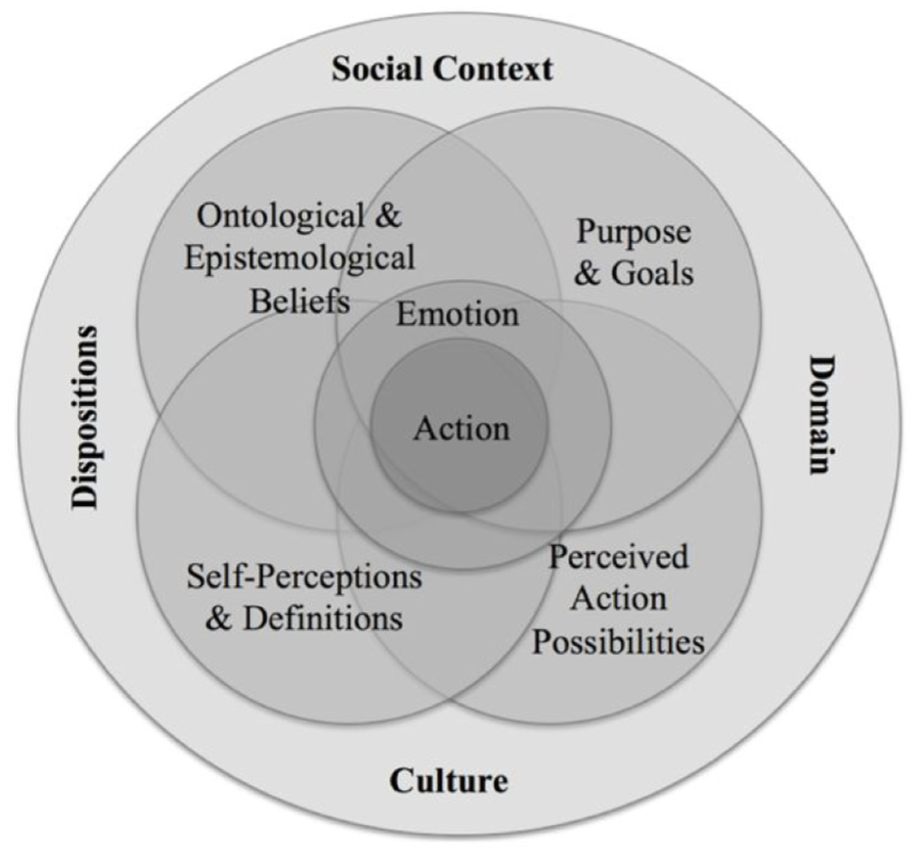
The dynamic systems model of role identity (DSMRI), Kaplan and Garner (2017).
The DSMRI emphasises three comprehensive aspects of the role identity system: content—the quantity, type, and complexity of elements such as knowledge, beliefs, goals, and self-perceptions; structure—the degree of harmony, alignment, integration, and tension within and between components; and process—the dynamic nature of change in the content and structure of the role identity components (Kaplan & Garner, 2017).
In addition to Kaplan and Garner’s foundational work, DSMRI has been adopted in diverse fields such as mathematics education (Heffernan & Newton, 2019), translation studies (Chen & Huang, 2022), and science teaching (Hathcock et al., 2020). Yang et al. (2021), for instance, used DSMRI to trace identity development in three experienced EFL teachers in China, identifying shifts from “companion” to “motivator” to “life coach” across career stages. Focusing on a novice teacher, Wang et al. (2021) applied DSMRI to chart identity construction from pre-practicum to the first teaching year, revealing dynamic changes in beliefs, goals, and self-perceptions—highlighting DSMRI’s strength in capturing professional growth.
Positioning DSMRI Within Broader Identity Theories
Understanding teacher identity as a dynamic and multidimensional construct necessitates a theoretical framework that captures both internal psychological processes and external contextual influences. This study adopts the DSMRI framework to explore how parental role identity intersects with teacher identity in community language schools. The DSMRI model conceptualises role identity as the dynamic interplay among four key components: beliefs, goals, self-perceptions, and perceived action possibilities. These are embedded within a broader set of control parameters, such as domain specificity, personal dispositions, sociocultural context, and institutional structures, all of which shape identity expression over time.
Unlike static or linear conceptions of role identity, DSMRI views identity formation as a constantly evolving process shaped by interactions between internal components and contextual constraints. This systems-thinking approach is particularly suited to the community language school context, where individuals often occupy multiple intersecting roles—such as parent, teacher, immigrant, and volunteer—simultaneously. These roles are not merely additive but form a dynamically negotiated identity ecology, where one role may reinforce, conflict with, or transform another over time.
In addition to DSMRI, this study draws on narrative inquiry and figured world theory to enrich our understanding of identity processes. Narrative inquiry foregrounds the temporal and storied nature of identity (Clandinin et al., 2007), allowing us to trace how participants interpret past experiences (e.g. as students or parents) to shape their current teacher identities. Figured world theory (Holland et al., 1998) further highlights the social and cultural contexts within which roles and identities are made meaningful. These perspectives help us situate DSMRI within a broader identity framework, enabling a multi-layered analysis that bridges internal role dynamics and external cultural positioning.
This integrated theoretical foundation allows the study to examine teacher identity formation not only as a personal psychological process but also as a socially situated, narratively structured, and culturally embedded phenomenon. In doing so, it offers both theoretical depth and contextual relevance in analysing identity development in community language schooling.
Methodology
The research design and methodology were approved by the Ethics Committee of the Institute of Education at the University of Strathclyde (Approval Number: 290823). All participants provided informed consent before taking part, voluntarily engaging in the study with a full understanding of their rights and responsibilities.
Setting and Participants
Based on the research question, this study employed purposive sampling to select a large, long-established Chinese community language school in Scotland (anonymised as CCSS). The choice was guided by both its relevance and the financial vulnerability of such institutions (Hancock & Hancock, 2024), ensuring the school’s continuity throughout the research period. In other words, the decision to focus on a single, stable site was both strategic and pragmatic. CCSS offered an established institutional environment with a sufficiently large pool of Mandarin-speaking teachers. Given that Mandarin was the dominant language of instruction and administration, focusing on Mandarin teachers enabled consistency in exploring identity formation within a shared linguistic and cultural framework. While the site-specificity limits generalisability of the findings, it allows for in-depth contextual analysis that is well suited to the study’s exploratory purpose.
CCSS, a registered charity, holds classes every Saturday for 2.5 hr. Classes are grouped by Chinese proficiency rather than age: Grades 1 to 6 in the morning and 7 to 12 in the afternoon. Although CCSS offers both Cantonese and Mandarin instruction, this study focused exclusively on Mandarin-speaking teachers, who constituted the majority teaching group during the research period. Due to the limited interaction between the Mandarin and Cantonese departments, the researcher was unable to establish contact with Cantonese instructors. This exclusion is acknowledged as a limitation and is discussed in Section “Data Collection and Analysis.”
CCSS operates within a local vocational school and uses institutional facilities such as computers and whiteboards. Its funding sources include tuition fees, local government subsidies, Chinese government grants, and private donations. Teachers receive no fixed salary but are compensated through a tiered hourly pay system (£11.44–£17.44) and an annual £50 bonus for perfect attendance. However, only teaching hours are paid, preparation time is not compensated. The curriculum covers major exams like GCSE, A-Level, National Five, and HSK, with lesson plans based on textbooks imported from China.
Table 1 presents anonymised background information about the 15 teacher participants. For confidentiality, all data have been de-identified and slightly adjusted. For example, participants are referred to as T(eacher)-1, T-2, and so forth. When citing their comments, the pronoun “they” is used to conceal gender. Additionally, we refer to their assigned teaching levels as “lower-grade” and “upper-grade” classes to protect personal identities.
Participants’ Information.

Among the 15 participants, only three held academic qualifications in education. The majority held a master’s degree (8), followed by a bachelor’s (5), and two held doctorates. Notably, thirteen participants had over 5 years of teaching experience, reflecting a strong commitment to their educational roles. In terms of teaching credentials, over half (8) lacked formal teaching qualifications. Only two possessed locally recognised teaching certificates, others held Chinese language teaching certifications not officially recognised by the local authorities. Most interviews (10) were conducted online, while five took place face-to-face—likely due to the convenience, flexibility, and comfort associated with the online format.
Researcher Positionality and Ethical Consideration
The researchers acknowledged their multiple roles throughout the research process, including being the authors of this paper, a teacher at CCSS, and a colleague of the participants. These overlapping identities may raise concerns regarding potential bias or power dynamics in participants’ responses. To address these ethical considerations, the researchers maintained a reflective stance throughout data collection and data analysis. This included keeping analytic memos and holding regular team meetings to critically reflect on assumptions and findings. At the same time, the researchers’ insiders position offered unique advantages-facilitating rapport, deepening contextual understanding, and enabling more nuanced interpretations of participants’ experiences. Rather than attempting to erase their positionality, the researchers sought to critically examine its influence and use it as a lens to enhance authenticity and transparency. Participants were informed of the researchers’ multiple roles, and voluntary informed consent was obtained without coercion.
Limitations
This study has several limitations. First, the small sample size and limited duration may affect the generalisability of the findings. Second, the study focuses exclusively on Mandarin-speaking teachers, without incorporating the perspectives of Cantonese-speaking educators. As a result, the findings reflect the identity construction of Mandarin teachers within a specific community language school and do not capture the broader linguistic and cultural diversity present in such setting.
These limitations also offer pathways for future research. For example, including Cantonese or multilingual teachers could facilitate comparative analysis of identity construction across linguistic groups. Additionally, a longitudinal design may offer insights into how role identities evolve over time. Further research in other community school contexts—such as Arabic or Polish schools—could further enhance the transferability of findings and contribute to a broader understanding of multiple-role identity formation in diasporic educational settings.
Data Collection and Analysis
In this cross-sectional study, recruitment information was distributed to CCSS teachers, and a snowball sampling method was employed, with participants recommending others. A total of 22 individuals were recruited, comprising 15 parents and 7 international students. This paper focuses on the perspectives of parents who also served as teachers in the community language school. Data were collected through semi-structured interviews, each lasting 60–90 min. Topics included life histories (e.g. experiences as students and immigrants), teaching methods at CCSS, encountered challenges, and personal reflections.
Data analysis began with close reading and familiarisation with transcripts, followed by the identification of key words and phrases. These were initially categorised according to the four core dimensions of the DSMRI framework—beliefs, goals, self-perceptions, and perceived action possibilities—as well as its contextual control parameters, including culture, social context, domain, and dispositions. Thematic analysis proceeded in two structured stages. In the first cycle, a deductive approach was used to organise data under the DSMRI categories. In the second cycle, inductive coding was applied to identify emergent subthemes reflecting participants’ lived experiences and internal negotiations.
To ensure analytic rigour, three researchers collaboratively undertook the coding process. The first author conducted the initial round of coding, which was independently reviewed by the second and third authors. Coding discrepancies were resolved through iterative team discussions and negotiated consensus, rather than relying on statistical intercoder reliability measures. Theoretical saturation was observed after 15 parent-teacher interviews, as no substantially new themes emerged during the later phases of coding and recoding. This aligns with Guest et al. (2006), whose analysis of sixty interviews found that most metathemes emerged by the sixth interview and saturation was typically reached by the twelfth in relatively homogeneous samples—a pattern that supports our decision to halt data collection after 15 interviews.
To enhance trustworthiness, member checking and bilingual validation were implemented. The first author conducted and transcribed all interviews in Mandarin and translated them into English. The second and third authors independently reviewed the English translations, and discrepancies were resolved through discussion. Throughout the process, the team engaged in reflexive dialogue regarding their positionality and conducted repeated verification to ensure data authenticity and minimise translation bias. Table 2 illustrates the coding structure, with participants anonymised as “T-1,” “T-2,” and so forth.
DSMRI Codebook Excerpts (More Examples See Garner & Kaplan, 2018).

Findings
Identity Formation through Community Participation
The findings reveal that CCSS functions as a critical space where community, cultural belonging, and professional identity intersect. For many participants, their arrival in Scotland was marked by limited social networks. CCSS provided a culturally familiar environment where they could access local information, meet others with shared backgrounds, and re-establish a sense of social embeddedness. As T-15 shared, they knew no one upon arrival and relied on CCSS to navigate their new environment. T-12 echoed this by saying:
When I just came (to Scotland), it was just my child and me. I was looking for a Chinese community, and I have met a lot of Chinese here. It’s nice when you get together and talk with each other.
This communal environment extended beyond social support—it shaped how participants understood themselves as teachers. The act of participating in a school that serves their community, and children gave teachers a strong sense of purpose and emotional investment. For example, T-6 and T-7 explained that CCSS helped reduce feelings of isolation, while T-1 and T-5 emphasised that shared cultural experiences allowed students to feel accepted and make friends more easily, especially for newcomers who might otherwise struggle to integrate into local schools.
The community’s shared language and values facilitated a deeper relational orientation to teaching. Rather than positioning themselves strictly as knowledge transmitters, teachers viewed their role as including emotional support, guidance, and cultural transmission. This aligns with the DSMRI’s emphasis on the alignment of beliefs and goals, suggesting that CCSS supports identity formation by grounding participants’ actions in culturally resonant practices.
Yet, the community-based nature of CCSS is not without challenges. Participants noted that since the COVID-19 pandemic, opportunities for teacher interaction—such as shared lunches—have diminished. T-3 described how such informal gatherings used to foster collegiality, but now teachers often leave immediately after class. Others, like T-2 and T-10, echoed this concern, noting that the school’s physical expansion and facility constraints have limited staff-wide events. These structural barriers risk weakening engagement and alignment within the community, particularly for new teachers.
Parental Role Identity as a Driver of Teacher Motivation and Practice
Parental role identity emerged as a central motivator for teaching at CCSS. Many participants first became involved in order to support their children’s heritage language development. Some, like T-15, described initially volunteering because they needed to wait while their children were in class. CCSS’s tuition discount for teachers’ children further incentivised participation. This reflects a blend of practical, familial, and emotional motivations unique to community school settings.
Participants’ goals as parents and teachers often overlapped. T-2 explained that helping children learn Chinese facilitates their communication with grandparents who stay in China, reminding them of their Chinese heritage. T-11 emphasised the future benefits of bilingualism, such as expanding children’s future career options. These shared beliefs about the value of Chinese education link parental goals to classroom teaching, illustrating how identity components within the DSMRI framework—particularly beliefs and goals—are closely intertwined.
Interestingly, while many teachers were motivated by parenting, their specific teaching priorities varied. Lower-grade teachers tended to focus on fostering students’ interest in Chinese, whereas upper-grade teachers prioritised academic achievement, especially for exams like the GCSE. This divergence reflects how teachers’ actions are shaped by contextual demands and student needs, aligning with the DSMRI’s Domain component.
Parental experiences also informed participants’ pedagogy. T-5 adjusted their teaching approach after witnessing their own child lose interest under a strict teacher, opting instead for interactive and student-centred strategies. T-13 emphasised the need to localise teaching methods based on knowledge of children’s learning contexts in Scotland. These examples show how the parental role identity provides experiential knowledge that influences classroom decision-making, or what DSMRI terms perceived action possibilities.
Beyond pedagogy, the parental role identity enhanced participants’ empathy and communication with students’ families. Teachers like T-9 and T-10 established WeChat groups to maintain open communication with parents, citing their own experiences navigating their children’s education. However, others, such as T-3, were more reserved, often due to previous negative experiences with students’ parents. These variations reveal how emotional histories, and personal dispositions shape the enactment of the parental-teacher identity. As T-10 put it:
I am also a parent, so I especially understand the difficulties that students and parents face. I do my best to meet their needs, and I think this also increases my sense of responsibility.
Negotiating Professional Identity: Role Conflict, Recognition, and Resilience
While parental role identity enhanced motivation and empathy, it also introduced tensions around legitimacy and professionalism. Some participants, like T-7, felt uncertain about their teacher identity due to a lack of formal qualifications. In contrast, T-11 believed that commitment and care—not credentials—define a teacher. T-14 expressed both views, acknowledging their contribution in the classroom but also questioning their professional legitimacy without a professional graduate diploma in education (PGDE).
These reflections point to the complex and sometimes contradictory self-perceptions held by community school teachers. The DSMRI’s self-perception component is especially salient here: participants simultaneously view themselves as caregivers, educators, and cultural custodians, but grapple with societal standards that define teaching through certification. Furthermore, structural constraints further complicated identity formation. Participants worked without contracts or formal recognition, with limited preparation time and no institutional support. These working conditions, coupled with the racialised invisibility of community schools in Scottish policy, created a sense of marginalisation. As T-7 remarked, “I’m not a teacher because I don’t have a PGDE.” This professional misrecognition creates a stratified hierarchy where community school teachers are rendered invisible or “unqualified,” regardless of their actual contributions.
Despite these challenges, many participants expressed a strong commitment to teaching, often framed around their child’s educational journey. Teachers like T-1 and T-9 stated they would remain at CCSS until their children graduated. This personal stake in the school’s future not only enhances teacher retention but also embeds their identity within the collective purpose of the school.
In sum, teacher identity at CCSS is dynamically shaped by overlapping roles, contextual demands, and systemic constraints. The DSMRI framework allows us to map these shifts across beliefs, goals, self-perceptions, and action possibilities, highlighting the complex interplay between personal motivation, cultural belonging, and professional recognition in shaping who these teachers become.
Discussion
Identity Formation in Community Language Teaching
Nordstrom (2020) highlights that the concept of teacher identity has not received substantial attention in the field of community language schools. This study contributes to filling this gap by exploring how parental role identity intersects with teacher identity in Chinese community language schooling. Participants in this study embodied multiple, overlapping role identities—such as spouse, parent, immigrant, teacher—illustrating that identity formation is emergent, non-linear, and contextual (Hong et al., 2024; Kaplan & Garner, 2017). This suggests that the community language teacher role identity itself constitutes an element within a multi-level hierarchical structure, which, at the individual unit of analysis, reflects a complex dynamic system comprising multiple role identities (Kaplan & Garner, 2017).
Drawing on the DSMRI framework, this study shows how current identities (e.g. parent, teacher) are shaped by past experiences (e.g., student) and imagined future selves (e.g. ideal teacher). Identity construction emerged as a dynamic negotiation process, influenced by personal reflection and interactions with students, colleagues, and broader social structures (Pennington & Richards, 2016; Sachs, 2005). The DSMRI’s emphasis on the interplay between beliefs, goals, self-perceptions, perceived action possibilities, and broader contextual control parameters (e.g. social norms, cultural context, domain expectations) provided a nuanced lens for analysing these processes.
Teacher identity is influenced not only by past experiences, teacher education, and language proficiency (Richards, 2023) but also by interactions and relationships with students, educational institutions, and the community, as well as the impact of social, cultural, political, and historical forces (Hong et al., 2024; Rodgers & Scott, 2008). For instance, while Scotland’s inclusive social environment supported CCSS’s development (Hancock & Hancock, 2024), the lack of formal recognition for community language teachers contributed to a sense of marginalisation. Some teachers (e.g. T-7, T-14) expressed doubts about their legitimacy due to the absence of professional qualifications, mirroring broader systemic exclusions. Gu (2023) notes that school-level support is crucial in shaping sustainable teacher identity; CCSS’s community orientation and leadership support were seen by participants as beneficial, although decreased peer interaction and cross-grade teaching posed identity-related challenges.
While parental role identity motivated initial participation, it also had deep pedagogical consequences. Participants often drew on parenting experiences to enact “pedagogical empathy,” adjusting instruction in ways that were student-centred, flexible, and emotionally responsive. This reflects Noddings’ (2005) care ethics, where teaching is grounded in attentiveness to others’ needs. At the same time, managing the dual roles of parent and teacher—especially when children were also enrolled at CCSS—created complex emotional demands. Emotional labour became a key feature of identity work. Recent research (e.g. Horner et al., 2020; Kariou et al., 2021) shows how surface acting, deep acting, and modulated emotional strategies influence teacher well-being and classroom effectiveness. These findings update and extend Goode’s (1960) theory of role strain, highlighting how emotional tension is exacerbated in dual-role contexts. Thus, parental role identity should be recognised not just as motivational, but as an active identity dimension that informs teachers’ pedagogical choices, emotional regulation, and professional boundary-setting. To effectively teach students, CCSS teachers must first acquire critical language awareness and sociolinguistic knowledge (Becker, 2024), as native speaker proficiency does not inherently provide an advantage in language teaching (Pennington & Richards, 2016).
Furthermore, the variation in participants’ self-perception (such as whether they view themselves as teachers, not teachers, or unsure) reflects the diversity and complexity of teacher identity (Beijaard et al., 2004) and also suggests that community language teaching is a marginal profession (Cruickshank et al., 2018). In line with Nordstrom (2020), we also emphasise that community language schools are important providers of language education and call for increased support for the professional development of community language school teachers to solidify their roles as legitimate and valuable contributors to education (p. 8). Furthermore, this study seems to touch upon the essential nature of teachers as human beings (Nias, 1987), rather than empty vessels (Kanno & Stuart, 2011), as they possess independent awareness and practical needs. In the context of their multiple intersecting identities, the role of teacher can meet their needs as parents. This finding may provide insights for other community schools and even mainstream education in addressing teacher recruitment and retention.
Expanding Theoretical Dialogue: Beyond DSMRI
While DSMRI served as the primary analytical framework for this study, the findings also intersect with broader theoretical traditions, which extend and enrich our understanding of identity formation in community language schooling. This reflects not a limitation of DSMRI, but rather the multi-layered complexity of dual-role identities in immigrant educational contexts.
First, participants’ navigation between parental and teaching roles generated significant emotional labour, particularly when their children were students at the school. In these situations, teachers engaged in constant affective regulation to balance professional expectations with parental instincts. This echoes insights from emotional labour theory, which has evolved since Hochschild (1983) to include more recent frameworks such as Horner et al.’s (2020) “modulated acting” model. As Kariou et al. (2021) note, the emotional demands on teachers—especially those operating within culturally marginalised settings—can intensify burnout and strain. These insights align with DSMRI’s emphasis on the emotional dimensions of role identity.
Second, the motivational progression many participants experienced—from extrinsically motivated involvement for their children to intrinsically driven teaching—echoes the principles of Self-Determination Theory (SDT) (Ryan & Deci, 2024). Participants’ internalisation of teaching as meaningful work reflected a growing sense of competence, autonomy, and relatedness—three psychological needs central to SDT. This trajectory reinforces DSMRI’s emphasis on dynamic alignment among beliefs, goals, and perceived actions, while also situating motivation in a broader psychological framework.
Finally, the pedagogical strategies participants employed—such as storytelling, emotional scaffolding, and informal mentoring—draw from their lived experiences as parents. These illustrate how familial cultural capital is transformed into classroom practice, echoing Bourdieu’s (1986) theory of cultural capital. In this way, home-based parenting skills become educational assets, blurring the line between domestic and professional knowledge domains.
In summary, these theories do not replace DSMRI but extend its analytical reach, helping us articulate the emotional, social, and ideological dimensions of identity formation. Together, they present a holistic account of how dual-role teachers in community language schools navigate identity construction at the intersection of care, culture, and institutional constraint.
Structural Constraints, Policy Silences, and the Politics of Recognition
While participants’ narratives conveyed personal growth and community support, their professional identity construction unfolded within a broader context shaped by structural constraints and policy neglect. One salient example is the absence of recognised certification pathways for community language educators. Despite extensive teaching experience and domain expertise, most participants lacked formal qualifications acknowledged by mainstream institutions, resulting in persistent professional misrecognition (Fraser, 2000). As T-7 noted, “I’m not really a teacher because I don’t have a PGDE.” This lack of institutional validation reinforces a stratified educational hierarchy in which community school teachers are rendered invisible or “unqualified,” regardless of their actual contributions.
Although participants rarely articulated it explicitly, racialised dynamics were implicit in their marginalisation. The cultural and linguistic expertise of Chinese heritage teachers remained largely unrecognised within dominant education policy frameworks, such as Scotland’s 1 + 2 Language Strategy. While community language education is nominally supported, the support is largely symbolic rather than material. This reflects Fraser’s (2000) concept of the tension between recognition (symbolic inclusion) and redistribution (material support).
Taken together, these findings suggest that teacher identity in community language schools is shaped not only by pedagogical or interpersonal factors but also by broader ideological, racialised, and policy-driven structures. A more equitable educational system must address these structural silences by establishing mechanisms for certification recognition, equitable funding, and policy inclusion that validate the contributions of community language educators.
Conclusion
This study, framed within the Dynamic Systems Model of Role Identity (DSMRI; Kaplan & Garner, 2017), examined how parental role identity shapes teacher identity among Mandarin-speaking educators in a Chinese community language school in Scotland. The findings revel that personal, professional, and contextual factors are dynamically interconnected in shaping identity development (Day et al., 2006; Flum & Kaplan, 2012; Pennington & Richards, 2016). For example, the children’s role as the link between parental and teacher identities strengthens alignment in beliefs, goals, and action possibilities. The community school’s unique context—characterised by its grassroots structure, supportive leadership, and function as a community of practice—provided an enabling environment for identity negotiation and professional growth. Furthermore, contextual elements such as institutional domain (e.g. mainstream schools versus community schools), cultural influences (e.g. Chinese versus Scottish education systems), and personal dispositions (e.g. a belief in being “naturally suited” to teaching) significantly contributed to identity formation. These factors illustrate the complex and situated nature of teacher identity in community-based educational contexts.
This research enriches the existing literature by offering a nuanced understanding of how multiple role identities intersect in the context of community language teaching. It also expands theoretical conversations by showing how personal roles (such as parenting) actively shape professional development, beyond traditional teacher education trajectories. Further research could explore how the intersection of these identities plays out in different cultural contexts or investigate the impact of institutional support on teachers’ sense of professional legitimacy. These findings suggest that community language schools, as well as broader educational institutions, may benefit from providing more robust support for teachers’ professional development to enhance identity construction and retention.
Footnotes
Acknowledgements
We sincerely thank all anonymous reviewers for their constructive feedback, and we are deeply grateful to all participants for their support and involvement in this study.

Ethical Considerations
We hereby declare that research/publication ethics and citing principles have been considered in all the stages of the study. We take full responsibility for the content of the paper in case of dispute. This design and method were approved by the Ethics Committee of the Institute of Education at the University of Strathclyde (Approval Number: 290823).
Funding
The authors received no financial support for the research, authorship, and/or publication of this article.
Declaration of Conflicting Interests
The authors declared no potential conflicts of interest with respect to the research, authorship, and/or publication of this article.
Data Availability Statement
While the primary datasets utilised in this study are not publicly accessible due to certain constraints, they are available to researchers upon a formal request. The authors have emphasised maintaining the integrity of the data and its analytical rigor. To access the datasets or seek further clarifications, kindly reach out to the corresponding author. Our aim is to foster collaborative academic efforts while upholding the highest standards of research integrity.