




Abstract
This article demonstrates the advantages of combining hermeneutic phenomenology and narrative inquiry to examine the professional identity formation of English language teachers in Australia from non-native English-speaking immigrant backgrounds. By exploring the lived experiences of 16 teachers from 10 countries, this study foregrounds individual and shared trajectories, moving beyond the binary categories of native and non-native English-speaking teachers (NESTs and NNESTs) and capturing the evolving nature of identity formation over time. The study unravels the spatial-temporal and corporeal-relational dimensions that shape the identities, spanning from early lived experiences to current professional roles and future imaginations. Employing a recursive methodological orientation, this research emphasizes broad-based engagement with the phenomenon, framing critical questions, dialogic data generations, iterative interpretation, and reflective depth, facilitating an in-depth analysis of professional identity development. The integration of hermeneutic phenomenology and narrative inquiry offers holistic insights into the fluid processes underpinning identity construction, contributing to academic discourse on qualitative methodologies and offering practical implications for educational policy, teacher education, and support systems. This methodological approach demonstrates how such methods unveil the dimensions and layers of teacher professional identities, providing nuanced perspectives that can inform intercultural educational strategies and interventions.
Plain language summary
This article demonstrates the advantages of using both hermeneutic phenomenology and narrative inquiry to explore the professional identity formation of English language teachers in Australia from non-native English-speaking immigrant backgrounds. By examining the lived experiences of 16 teachers from 10 countries, this research foregrounds and investigates their individual and shared experiences over time, moving beyond the fixed identity of binary categories of native English-speaking speakers and non-native English-speaking teachers (NESTs—NNESTs) and narrow dynamic snapshots of their identity formation. The study aims to unravel the spatial-temporal and corporeal-relational dimensions that shape the identities from early childhood through their current roles and future imaginations. Using a recursive methodological approach, the research encompasses a holistic orientation to the phenomenon, critical question framing, dialogic data gathering, incisive interpretation, and profound reflection, enabling an in-depth examination of professional identity development. The dual application of the methodologies offers holistic insights into the fluid processes underpinning professional identity construction. This innovative methodological approach advances academic discourse on qualitative research and has practical implications for educational policy, practice, and teacher education. It demonstrates how the methodologies can unravel the complexities of teacher professional identities, providing insights that enhance educational strategies and interventions.
Keywords
Introduction
This paper highlights the substantial affordances of employing both hermeneutic phenomenology and narrative inquiry (Nigar, 2020; Patterson, 2018) within a single study to explore the professional identity formation of English teachers in Australia, particularly those categorized as non-native English-speaking teachers (NNESTs). Building on Nigar’s (2020) initial research, which was expanded in her recent doctoral study lauded for its methodological innovation (Nigar, 2024, Nigar & Kostogriz, 2025), this paper draws upon the interwoven methodological model of hermeneutic phenomenology and narrative inquiry to delve deeply into the lived experiences of NNESTs, revealing the concept of “hybrid professional becoming.” Hybrid professional becoming is the evolving process by which NNESTs navigate and enfold diverse cultural, linguistic, and professional influences to transcend native-speakerist norms and form cosmopolitan teaching identities (Nigar, 2024; Nigar & Kostogriz, 2025).
The employment of hermeneutic phenomenology and narrative inquiry in tandem is intentional and methodologically justified. Hermeneutic phenomenology, rooted in the works of Heidegger (1962) and Gadamer (1989), offers a way to interpret the meaning-making process of identity formation by centering on the depth of lived experiences and the temporal, spatial, corporeal and relational aspects of these (Nigar, 2019, 2024; Jones, 1975; Kakkori, 2009; van Manen, 1990). Narrative inquiry, on the other hand, emphasizes the storied nature of experience and enables the formation of identity through personal and professional narratives (Clandinin & Connelly, 2000). This methodological combination allows for a nuanced exploration of both the what (lived experiences) and the how (interpretive processes) in identity formation, aligning well with the study’s aim to capture NNESTs’ professional identities as embodied, fluid, evolving, and socio-historically situated.
This unique approach provides a holistic understanding of how NNESTs transition from a deficit-based perspective to a cosmopolitan identity as English teachers, navigating multi-dimensional and multi-layered historical-political and socio-cultural terrains alongside institutional narratives often dominated by native-speakerism and adjacent discourses. This hegemonic dominance emphasizes notions of professional legitimacy, linguistic superiority, and cultural ownership (Nigar et al., 2024a; Dovchin & Wang, 2024; Holliday, 2006, 2018; Houghton & Rivers, 2013), as well as neoliberal structures of accountability, quality control, and the commodification of English education (Kostogriz, 2020; Diamond & Bulfin, 2023; Sachs, 2016). The dual methodology, therefore, enables a deeper examination of the overlapping relations that shape NNESTs’ professional realms.
By framing professional becoming as “hybrid,” the study (Nigar, 2024; Nigar & Kostogriz, 2025) highlights the unfolding interplay of epistemological and ontological dimensions in teachers’ identity development. This process captures not only the neocolonial forces and systemic constraints NNESTs face in educational landscapes but also their internal drive for knowledge (epistemology) and a profound sense of self (ontology) as they strive for professional legitimacy and relationality. Native-speakerism, which privileges NESTs as inherently superior, reinforces a binary and deficit view of NNESTs, often marginalizing and discriminating them within educational frameworks. The study (Nigar et al., 2024a) examines how the native-speakerist ideologies intersect with neoliberal educational policies—marked by accountability, standardization, and quality control—to impact the professional identities of NNESTs, pressuring them to conform to rigid standards and reinforcing cultural hierarchies that label them as “lesser” professionals.
Through hermeneutic phenomenology and narrative inquiry, the study reveals how teachers’ professional identities are shaped by temporal, spatial, corporeal, relational, and socio-cultural vectors (Creswell, 2007; Denzin & Lincoln, 1994; van Manen, 1990), emphasizing how NNESTs actively reconstruct their professional identities beyond the native/non-native binary, ultimately embodying cosmopolitan teaching identities that challenge deficit-based ideologies and the binary logic of NEST versus NNEST. Additionally, this study addresses how teacher professional identity develops within stratified socio-cultural and educational settings, influenced by factors such as linguistic background, transcultural experiences, and institutional dynamics (Nigar & Kostogriz, 2025; Kostogriz, 2020; Beauchamp & Thomas, 2009; Clandinin & Connelly, 2000; Diamond & Bulfin, 2023). The interwoven lens of “hybrid professional becoming” situates NNESTs as cosmopolitan teachers, cultivating fluid, inclusive practices that foster cross-cultural competence and a commitment to diversity. Through the engagement with critical reflection, desire, and agency, the educators actively resist marginalization by engaging in continuous professional learning, networking, building solidarities, and advancing innovative practices that challenge native-speaker norms.
Moreover, the principles of the “hybrid professional becoming” model illustrate how market-oriented dynamics—including evaluation protocols, compliance standards, and fiscal prioritization—actively shape processes within diverse educational domains. The forces impose assimilative pressures and frequently marginalize NNESTs, profoundly shaping their path of professional identity development. By examining NNESTs’ narrative responses to the constraints, the study uncovers how they construct fluid identities that bridge roles as learners and educators, showcasing resistance and agency within a profession shaped by surveillance and standardization (Nigar & Kostogriz, 2019; Guba & Lincoln, 1994; Sikes & Gale, 2006; van Manen, 1990). The interpretive bricoleur metaphor, which likens professional identity formation to piecing together interconnected identity narratives (Denzin & Lincoln, 2005), reflects the evolving nature of NNEST professional identity as both a personal and communal experience, shaped by cumulative past experiences and forward-looking projections.
Overall, by combining hermeneutic phenomenology and narrative inquiry, this research provides a broad-based account of NNESTs’ professional identity constitution, calling for a paradigm shift those values migrant teachers’ unique contributions and supports their development needs. This culturally responsive approach enhances inclusivity in English language teaching and learning, endorsing systemic changes in teacher education to foster the “hybrid professional becoming” of immigrant English teachers in Australia and beyond. The study thus contributes to a more inclusive, interculturally capable English teaching profession that embraces diverse, cosmopolitan identities.
Hermeneutic Phenomenology: The Historical Background
In this study, hermeneutic phenomenology offers a rich orientation to explore the historical and philosophical foundations underpinning teacher identity and professional formation. Originally conceptualized by Husserl (1970), phenomenology sought to systematically study consciousness and experiences as they appear through perception. Husserl (1970) believed that reality could be accessed only through intentional study of lived experiences, free from mechanistic causality (Polkinghorne, 1989). To achieve this, he emphasized “bracketing” (epoche), a process whereby researchers suspend preconceptions to approach phenomena afresh (Kakkori, 2009; Laverty, 2003). By directing consciousness toward objects, Husserl (1970) believed, phenomenology could reveal hidden truths embedded in daily life (Creely, 2018). However, Heidegger (1962) shifted phenomenology from Husserl’s transcendental approach to a hermeneutic one, where understanding is inherently interpretive, embedded in historical and situational contexts, and inseparable from the “being” of the individual (Heidegger, 1977).
Heidegger’s (1962) concept of “Dasein” emphasized the relational, interconnected nature of human existence, countering the dualism of mind and body that underpins Cartesian thought (van Manen, 1990). Rather than an isolated consciousness, Dasein refers to the way individuals exist within, relate to, and are shaped by their worlds (Jones, 1975; Stumpf, 1966). Heidegger (1962) proposed that understanding arises not by suspending biases, as Husserl (1970) suggested, but through acknowledging and interpreting preconceptions and lived experiences. Language, he argued, is intrinsic to this understanding, famously stating, “language is the house of being” (Heidegger, 1977, p. 217). van Manen (1994) supports this view, suggesting that suppressing preconceptions may inadvertently cause them to resurface unexamined. For Heidegger (1962), understanding requires continual reflection within a “hermeneutic circle,” where one oscillates between the whole and parts of experience to grasp its full meaning. This recursive process is central to hermeneutic phenomenology as applied in this study, especially in the context of interpreting English teachers’ professional identities.
Gadamer (1989) expanded on Heidegger’s (1962) ideas, arguing that understanding inherently involves prejudice, which enables interpretation rather than obstructing it. Rather than attempting to exclude preconceived notions, Gadamer (1989) emphasized reflecting on them to reveal hidden insights. Ricoeur (1976) further argued that all human actions could be interpreted as texts, with human experience open to analysis much like language. Ricoeur (1976) saw hermeneutics as a tool to illuminate concealed meanings within texts, thus aligning with Gadamer’s view that dialogue between the interpreter and text uncovers new understandings (Langdridge, 2004). Ricoeur (2008) further extends hermeneutics from textual interpretation to practical philosophy, underscoring how understanding texts informs ethical action and shapes individual and collective identities. Both Gadamer and Ricoeur share the belief that phenomenological research gains depth when preconceptions are acknowledged critically, and meanings emerge through layered, recursive interpretation.
Building on this theoretical base, Merleau-Ponty’s phenomenology (1962) positions the body as essential to understanding, emphasizing the intertwined nature of consciousness and physical presence. This perspective is crucial for examining how English teachers’ bodily experiences shape their professional identities and practices, as their physical presence and sensory interactions in classrooms are integral to their identities (Green, 2015). Body memory encompasses both explicit recollections and implicit dispositions, skills, and habits formed by physical experience, allowing for adaptation to diverse social and natural contexts and supporting self-identity (Fuchs, 2012). Heidegger’s (1962) differentiation between the “ontic” (the concrete, specific aspects of existence) and the “ontological” (the deeper existential meanings) further guides this study in understanding how teachers’ day-to-day interactions and embodied presence influence their self-perception and professional identity formation.
This research aims to apply the phenomenological insights to examine the experiences of NNESTs in Australia, particularly how their bodily engagement within educational environments influences their professional identities and practices. It will address how factors like classroom dynamics, spatial navigation, and interactions with students shape their onto-epistemological development (Heidegger, 1962). The study foregrounds the embodied nature of teaching and demonstrates how sensory, physical, and spatial elements inform pedagogical decisions and relational interactions, thereby enriching our understanding of NNESTs’ professional identity formation (Nigar et al., 2024a; Morgan, 2004; Nziba Pindi, 2018). Through this integrated phenomenological approach, the analysis reveals how the lived, bodily, and relational dimensions of teaching practice intertwine, shaping English teachers’ identity within the complex socio-cultural landscapes of contemporary education.
Methodological Approaches: Hermeneutic Phenomenology and Narrative Inquiry
This study employs hermeneutic phenomenological and narrative inquiry approaches to deeply explore the lived experiences and professional identities of immigrant NNESTs in Australia. Drawing on van Manen’s (1990) approach, the approaches view identity as a relational, culturally embedded construct shaped by embodied and affective experiences. By crafting hermeneutic phenomenology’s interpretive depth with narrative inquiry’s structural insights (Labov, 1972; Polkinghorne, 1995; Riessman, 2008), the study provides a nuanced perspective on identity that captures both personal and universal dimensions.
In hermeneutic phenomenology, the focus is on “pre-reflective” or “pre-predicative” lived experience (van Manen, 2016, p. 26), encompassing ordinary and intricate aspects of professional practice. Aligned with van Manen’s “phenomenology of practice,” this method extends phenomenology beyond abstraction to understand how socio-historical forces shape teaching in real-life arenas (van Manen & van Manen, 2021, p. 1071). For NNESTs, professional identity formation occurs within socio-cultural pressures, including market-driven reforms and affective labor, leading to unique challenges and high attrition rates, especially within the ESL/EAL sectors impacted by neo-colonial and commodifying forces (Nigar et al., 2024a; Kostogriz, 2012; Oliver et al., 2017).
Guided by van Manen’s six research activities, this study captures the richness of lived experience:
Turning to the Phenomenon: By engaging deeply with the lived experiences of immigrant NNESTs, the study centers their lived experiences, concerns, and identities within linguistically diverse educational spaces (van Manen, 1990, pp. 30–31).
Investigating Experience as Lived, Not Conceptualized: Focusing on experiences “as we live them” (van Manen, 1990, p. 31), the study explores NNESTs’ identities through migration, language learning, and teaching. Reflective journaling, experiential accounts, and narrative prompts address existential themes like “lived space, lived body, lived time, and lived human relations” (van Manen, 1990, p. 101).
Reflecting on Essential Themes: Themes such as relationality, spatiality, temporality, and corporeality reveal the impact of the NEST/NNEST binary in various educational settings. Using the hermeneutic circle, understanding oscillates between individual stories and relational patterns, uncovering the cultural tensions that NNESTs navigate as they construct professional identities (Dreyfus, 1990; Polkinghorne, 1983).
Describing the Phenomenon through Writing and Rewriting: Through iterative writing, the study captures insights that emerge organically. van Manen (1990) describes phenomenological writing as “the bringing to speech of something” (p. 32), where narratives resonate universally, reflecting NNESTs’ negotiations of cultural expectations and personal agency.
Maintaining a Pedagogical Orientation: Emphasizing professional relevance, this study explores implications for teacher development and support systems, fostering a more inclusive educational context that respects diverse linguistic backgrounds.
Balancing Parts and Whole: An ethical, holistic approach situates participants’ narratives within broader cultural and institutional contexts, allowing for a composite understanding of NNESTs’ professional identities and avoiding reductionism. This aligns with the “minded act of writing,” encouraging sustained reflection and empathy (van Manen, 1990, p. 124).
Nevertheless, phenomenological research faces significant challenges related to both methodology and researcher positionality. A core challenge in phenomenological research is Gadamer’s (1989) assertion that understanding should not be confined to rigid methods or techniques, an idea supported by Heidegger (1962), who argued that such constraints limit access to a phenomenon’s true form (van Manen, 1990). Despite this stance, both philosophical and practice-based phenomenology have drawn on social science empirical methods, though not without issues (van Manen, 2016). One significant challenge is the researcher’s role as either an insider or outsider (Braun & Clarke, 2013; Pringle et al., 2011). Researchers often inhabit a blurred space between the positions, as demonstrated in this study, where shared experiences as immigrant non-native English teaching professionals offer insider insight, though this may differ from participants’ unique perspectives. Another challenge involves bracketing pre-understandings to view the phenomenon in its authentic form, especially when researchers are personally connected to it. The hermeneutic phenomenological approach addresses this by fostering an attitude of wonder and openness while reflexively managing pre-understandings that persist (Finlay, 2008). In response to the critique of rigid methods, van Manen (1990) suggests a “principled form of inquiry” that neither blindly follows nor dismisses tradition, allowing for a balanced, nuanced approach to understanding.
Narrative inquiry complements this methodology by structuring teachers’ stories to emphasize the situational richness and temporality of their experiences, enabling an in-depth examination of how pivotal moments shape professional identity over time (Gadamer, 1976; Ricoeur, 1992). This approach allows teachers to revisit and reflect upon their narratives, fostering new insights into their evolving roles within educational contexts marked by cultural biases and institutional constraints. Through this process, teachers gain agency and redefine their unique contributions within a field that often prioritizes native-speaker norms (Clandinin, 2006). By iteratively revisiting narratives, teachers experience regeneration and reaffirm their professional identities, drawing strength from past experiences and the insights these reveal.
In this study, narrative inquiry was adopted as an affordance (Patterson, 2018) to sequence and interpret the contextual details within individual teachers’ stories. While narrative inquiry provides access to the heterogeneities of lived experiences (Josselson, 2006), merely recounting the experiences does not align with the hermeneutic phenomenological method, which seeks to uncover the nuanced patterns within phenomena (van Manen, 2016). Narrative research not only gathers human experiences but examines their construction: who shapes the stories, their components, purposes, and the discourses they reflect (Riessman & Speedy, 2007). It also helps understand how people reinterpret their existence through temporal and social interactions (Clandinin, 2006). The storytelling process enables English teachers to comprehend phenomena in novel ways, as they interpret and discover how challenging moments influence their professional identity formation, thus empowering them to shape their own narratives (Clandinin et al., 1999).
NNESTs’ stories, shared throughout the research, iteratively contribute to shaping their future narratives and perceptions of socially constructed identities. Gadamer (1976) and Ricoeur (1992) propose that identity evolves through repeated narrative interpretations, balancing stability and change. This iterative process integrates narrative meanings into consciousness (Squire, 2008) until new meanings emerge. Through narratives, we not only construct our identities but also shape how we wish to be recognized (Riessman, 2008) and assign identities to others in our stories (Menard-Warwick, 2011). Our study aims to capture the essential traits of English teachers’ professional identity over time by interpreting individual narratives and identifying common themes. Rather than merely detailing experiences, the study seeks to uncover the significance of the experiences for professional identity. In sum, this combined methodology embraces the authenticity of lived experience, offering hybridity and interpretive depth to examine NNESTs’ identities as relational, embodied, and culturally situated. The continuous reflection and interpretation reveal the defiance and fluidic strategies the teachers use to navigate biases, underscoring the relevance of “Hybrid Professional Becoming” within global educational backdrop (Nigar & Kostogriz, 2025). This process demonstrates how hermeneutic phenomenology and narrative inquiry together can illuminate manifold identity dynamics in diverse teaching environments.
Phenomenological studies are crucial for uncovering the original meanings of experiential phenomena, particularly within professional settings (van Manen & van Manen, 2021). The “phenomenology of practice” approach delves into both professional and daily life events, offering insights beyond philosophical exegesis alone (van Manen & van Manen, 2021, p. 1071). In exploring the evolving professional identities of immigrant NNESTs, hermeneutic phenomenology illuminates how market-driven ideologies and socio-historical oppressions and cultural hegemonies impact the teaching profession, their sense of self. Teachers are subject to constant monitoring through standards, reforms, and affective labor, which contributes to professional strain (Kostogriz, 2012; Diamond & Bulfin, 2023; Johnson, 2016; Lewis et al., 2020; Owen, 2019) and is further exacerbated by the global teacher shortage. In Australia, teachers contend with overwork, fatigue, societal disrespect, and relatively low pay, with alarming attrition rates across sectors (Longmuir et al., 2022; McDonnell, 2023).
The challenges are tied to market-driven ideologies emphasizing self-maximization and commodification, affecting educational institutions and leaving ESL/EAL sectors and their learners particularly vulnerable to neo-colonial and intersectional impacts (Nigar et al., 2024a; Oliver et al., 2017). While the “whole child” and “whole teacher” approaches (Nigar, 2024; Nigar & Kostogriz, 2025; Butler, 2017) strive to enhance educational practices, they often clash with market-oriented neo-colonial strategies that prioritize accountability and reform. However, an practice-ontological perspective (Heidegger, 1962) that centers on the lived experiences of English teachers reveals a more nuanced understanding of their professional identities, transcending binary classifications (Nigar & Kostogriz, 2019). This research explores the professional identities of immigrant NNESTs in Australia, tracing their lived experiences since childhood. Guided by the action-oriented ethos of the phenomenology of practice, this study aims to capture the real-world experiences of English teachers through a hermeneutic lens. The study aims to uncover patterns in the participants’ professional development, illustrating how the educators navigate the complex intersections of context, culture, and identity across diverse temporal, spatial, and sociocultural landscapes.
In sum, combining hermeneutic phenomenology and narrative inquiry offers a nuanced approach to explore identity as a relational, culturally embedded construct (Gadamer, 1989; Heidegger, 1962; van Manen, 1990, 2016). Hermeneutic phenomenology provides interpretive depth, viewing identity as an embodied, affective experience, while narrative inquiry organizes the insights into cohesive accounts, enhancing methodological rigor (Labov, 1972; Polkinghorne, 1995; Riessman, 2008). This dual approach upholds the authenticity of lived experiences and broadens its relevance beyond NNEST-centered research. Ultimately, it captures the richness of lived experience, revealing how NNESTs employ tenacious, adaptive strategies to navigate power hierarchies, highlighting the relevance of “Hybrid Professional Becoming” within the global educational context. Together, hermeneutic phenomenology and narrative inquiry illuminate transcultural identity dynamics in diverse teaching environments.
Application of Hermeneutic Phenomenology and Narrative Inquiry: A Methodological Approach
In this section, we outline the data generation process, with a primary emphasis on the interpretive and analytical processes that underpin this study. Specifically, we detail the methodological assemblage of hermeneutic phenomenology and narrative inquiry, selected for their ability to provide a nuanced orientation for examining the lived experiences and professional identity development of NNESTs. While data generation over time included key steps such as ethical compliance, participant selection, and data gathering, our focus here is on how hermeneutic and narrative approaches informed the interpretive depth of the analysis. Drawing from Heidegger’s (1962) and Gadamer’s (1989) foundational principles of hermeneutic phenomenology, alongside narrative inquiry approaches developed by Labov (1972), Labov and Waletzky (1967), and Polkinghorne (1995), we chose the methods to capture the layered complexity of NNESTs’ professional trajectories. Future research will delve further into the data generation techniques and the broader applications of these methodologies.
The study rigorously adhered to ethical and procedural standards. Following institutional guidelines, ethical approval was obtained from the University Human Research Ethics Committee (TUHREC [Pseudonym]) on 6 May 2019 (Project ID 00000) under the title “Non-native English teachers in Australia: Storying professional identity.” Informed consent was obtained from all participants, ensuring they understood the study’s objectives, procedures, and their right to withdraw, along with options for further information or objections. Anonymity was safeguarded through pseudonyms, and any identifiable information was removed from the findings. All data, including interview transcripts, consent forms, and participant correspondence, were securely stored on a password-protected Google Drive, preserving confidentiality and aligning with research integrity standards.
By combining hermeneutic phenomenology, which seeks to uncover the essence of lived experiences (van Manen, 1990), with narrative inquiry, which organizes the experiences into well-defined, meaningful stories (Riessman, 2008). The resulting modus operandi highlights the fluid interplay between subjective experience and narrative structure, illustrating how NNESTs continuously and dynamically reconfigure and project their professional identities in response to the evolving challenges and possibilities within their work environments. Building on this, the study offers a holistic interpretive methodology that reveals non-linear patterns in NNESTs’ professional identity trajectories. The methods complement each other: hermeneutic phenomenology adds depth to subjective experiences, while narrative inquiry provides the structured continuity necessary to capture the evolving processes of identity development within diverse socio-cultural and educational milieus. This crafted approach enabled an exploration of both individual narratives and broader themes of resilience, adaptation, and agency, characterizing NNESTs’ professional trajectories within the Australian educational terrain. Through this dual lens, we could examine the nuanced relationship between personal experience and professional identity, aligning with the study’s aim to portray NNESTs as active agents in their professional formation, shaped by critical reflections and socio-cultural forces.
The Participants: Selection, Access, Backgrounds
To ensure a thorough and representative examination of the diverse experiences of English language teachers in Australia, this hermeneutic phenomenological study employed purposeful random sampling and criterion sampling, as outlined by Crotty (1998), Patton (1990), and Creswell (2007). Participants were required to have experienced migration, English language teaching in Australia, and learning/teaching English as a second language, in diverse educational settings. The study included 16 teachers (Table 1), including the first author, who migrated to Australia from various regions including Southeast Asia, the Middle East, Eastern Europe, and South America, under different migration backgrounds like international students, individual spouses, or full families. Between 2020 and 2023, the participants were engaged in teaching English across various Australian sectors, with some holding roles such as program coordinators and administrators. Their backgrounds were diverse, encompassing experiences of teaching English in their home countries and abroad, and exposure to the English language and culture from early childhood. Many participants were multilingual, speaking several languages and dialects, some learning new languages too.
Participant Profiles.

The participants’ educational backgrounds were equally diverse. All had completed English-teaching-related degrees or qualifications in their countries of origin, and many had pursued further postgraduate education or obtained sector-specific professional qualifications in Australia. This varied educational and cultural exposure contributed rich, layered perspectives to the study’s focus on the professional identity of immigrant English teachers in Australia.
Crafting and Conducting Interviews
To delve into the temporal aspects, the 16 comprehensive interview questions and reflective prompts were developed through an ordered process informed by the study’s theoretical frame. First, Heidegger’s (1962) concept of time and van Manen’s (1990) ontological themes (lived time, space, body, and relationships) provided foundational insights, ensuring that the questions could capture the evolving, multi-dimensional nature of professional identity.
The process began with identifying core areas of exploration based on the existential themes and the overarching research aims. Each question was crafted to elicit detailed, multi-layered narratives that would allow participants to reflect on past experiences, current identity, and future aspirations. This included focusing on mindfulness, memory, and recollection to encourage deeper introspection.
Examples of the interview questions developed through this process include:
Describe your journey to becoming an English language teacher.
Reflect on how your experiences have shaped your professional identity in Australia.
Imagine your professional identity in the future. How do you see it evolving?
The questions were also systematically grouped into weekly thematic categories to promote an arranged narrative flow and cover the key dimensions of their professional lives. The themes included:
Background and experience in English teaching
Narratives on professional self
Reflections on professional experiences
Employment experiences in Australia
Challenges faced as a non-native English-speaking teacher
To further deepen reflection, specific reflective prompts were added to encourage participants to pause and re-evaluate their responses. An example prompt was: “After completing this writing, take a short break, then reflect on your text. Offer a commentary on which influences were most significant in developing your teaching self so far.” This organized, reflective process was essential for ensuring that the interview questions effectively captured the nuanced and evolving nature of the participants’ professional identities.
The narrative interview process was central to this hermeneutic phenomenological study, fostering dialogic collaboration between the researcher and participants, a hallmark of interpretive research (Creswell, 2007). This approach enabled a co-construction of meaning through reflective, negotiated exchanges (Josselson, 2011; Schulz et al., 1997), allowing for deep exploration of participants’ past experiences, current realities, and future aspirations (Polkinghorne, 2010). For instance, in response to a follow-up during COVID-19, Jasha shared, “Good to hear from you. I hope COVID hasn’t been too hard on you and your loved ones. Yes, I still teach English to international students and have done this through the pandemic, both online and F2F, the latter when allowed (for example, at present).”
A variety of technology-assisted methods facilitated dialogical communication and research participation. The methods included Google Suite, mobile phones, messaging apps, and video conferencing platforms. The interviews and narrative writing sessions were conducted in diverse settings such as homes, offices, classrooms, cafes, libraries, and online media, allowing for a flexible and accessible approach to data generation. Sessions were primarily scheduled after or between the participants’ work hours to ensure their convenience and comfort.
For instance, Author 1 met with May at a community library and followed up with her on Zoom twice, maintaining communication through emails, Messenger, and text messages. On December 4, 2019, May replied to a message on Messenger, stating: … I’m terribly sorry for not having the time to write for your prompts. As you probably saw on Facebook, I was very busy the past months preparing for the International Research Forum in the Philippines. It took a lot of work to bring all those Filipino participants to Melbourne. I also started a Tagalog Language Maintenance program in our community. I’ll try to catch up. (May)
The pilot phase of the study, conducted with Thi and encompassing all 16 prompts, was instrumental in identifying potential themes, such as affect, as Thi reflected, “The first few days at the centre changed my life forever as I felt energized working with young children and a mix of local and expatriate teachers every week.” This phase also allowed for refining the research methodology (Maxwell, 2008) and establishing a contingency plan to shift from written responses to face-to-face interviews if necessary. Most participants engaged with the prompts over 8 weeks, dedicating at least half an hour weekly. Some participants faced challenges in maintaining consistent engagement due to their personal and professional commitments. To support them, regular communication was maintained to encourage and motivate, ensuring that the reflective writing process remained both interactive and enjoyable.
Our daily engagement with participants included reviewing their reflections on Google Docs and connecting with them through enthusiastic, playful comments and questions (Nigar, 2024; Laverty, 2003). This interactive approach not only clarified their narratives but also sustained motivation and interest throughout the study. For example, Carlos initially hesitated to discuss his experiences in a follow-up phone interview during COVID-19, but after being reassured of the study’s anonymity, he shared more openly, particularly about accent discrimination, explaining, “… some clients complained to my boss that my accent wasn’t really intelligible. In fact, for that reason, my boss asked me to do something about it, and I took a course on Pronunciation at TAFE …”. Participants engaged in the writing process in diverse ways: while many provided written responses to prompts over several months, others preferred face-to-face interviews for prompts they found challenging to write about. Janaki reflected, “It has also given a platform for me to think and pen down some of my experiences which are very personal.” Interviews and follow-up communications were tailored to participants’ preferences, conducted both in person and online via platforms such as WhatsApp, Facebook Messenger, and Zoom.
The narrative interviewing process in this study was rooted in ethical considerations, emphasizing respect, trust, and genuine care in researcher-participant relationships (Clandinin et al., 2007; Guba & Lincoln, 1994; Josselson, 2007; Schulz et al., 1997; van Manen, 1990). To ensure the trustworthiness of qualitative research, Lincoln and Guba (1985) introduced the criteria of credibility, transferability, dependability, and confirmability as qualitative equivalents to the traditional quantitative measures of validity and reliability. Given the complex power dynamics and the need for mutual trust in the research process, a collaborative approach was prioritized, with an emphasis on respectful engagement and ethical sensitivity (O’Toole & Beckett, 2010). Hermeneutic phenomenological research places the researcher-participant relationship at the heart of exploring meaning, requiring the researcher to approach each interaction with empathy and attentiveness to avoid any form of exploitation (van Manen, 1990).
In sum, the research process in this study was a deeply engaging, ethical, and collaborative quests, allowing for a profound exploration of the professional identities of the English teachers. The methodology employed enabled the participants to reflect on and articulate their lived experiences, contributing significantly to the understanding of their professional identity construction within the contexts of their past, present, and anticipated future.
Iterative Analysis of the Data
While analyzing the hermeneutic phenomenological data, our focus was on a continuous, reflective engagement with our phenomenological questions to uncover the evolving “essence”—understood as the key characteristics—of English teachers’ professional identity development over time, as recommended by Creswell (2007). This process involved exploring the emergence of themes, which van Manen (1990) describes as intrinsic urges to understand, interpretive encapsulations of events or situations, markers of receptivity, and a blend of insight, revelation, and realization. The themes, woven into the lived experiences, were organized into meaningful patterns related to the phenomenon of teacher professional identity. van Manen (1990) metaphorically describes themes as “knots in the webs of our experiences.” Identifying the thematic patterns required an iterative analysis approach, sequencing each participant’s narratives and interpreting their situational elements to reveal the primary layers of meanings in the English teachers’ professional identities.
Narrative interpretive analysis, as outlined below, was instrumental in identifying the temporal sequence of narratives (Labov & Waletzky, 1967) and exploring meanings embedded in their immediate socio-cultural, interpersonal, and embodied contexts (Foste, 2018; Josselson, 2007; Labov, 1972; Patterson, 2018; Polkinghorne, 1995; Riessman, 2008). Riessman (2003) emphasizes that narrative data analysis extends beyond understanding the content of language to interpreting the cultural milieus it reflects. Thus, participants’ stories required further thematic clustering and hermeneutic phenomenological interpretation in the backdrop of wider institutional and cultural discourses (Riessman, 2005). The analysis process involved drawing temporary themes from interpreted individual narratives in light of four ontological themes, followed by iterative phenomenological reading, reflection, and interpretation to uncover central themes. This recursive process of reflection and writing about the themes led to the emergence of the larger, relational lens of English teachers’ professional identity over time. Figure 1 illustrates the holistic approach to this thematic analysis process.

Hermeneutic phenomenological narrative analysis of English teachers’ professional identity interrelations.
Narrative Analysis: Tracing Temporal and Socio-Cultural Dimensions of Identity
The narrative analysis in this study explored participants’ oral and written stories on two levels, shaped by three primary research questions. First, each participant’s story was considered individually to uncover personal insights about their lived experiences as English teachers, focusing on how the stories aligned with the research questions. Secondly, the individual stories were interwoven into a broader narrative using a hermeneutic lens, enabling a deeper interpretation of how personal experiences reflect broader socio-cultural milieus. This dual-level approach was essential to answer the temporal research questions, particularly the first one about how participants initially became English language teachers, and subsequently for Research Questions 2 and 3, as guided by principles for narrative inquiry, such as the ones of Polkinghorne (1995), Labov (1972) and Labov & Waletzky (1967).
The process began with a holistic reading of individual narratives, viewing them as historical continuums that span the participants’ past, present, and imagined future experiences informed by the three research questions. This approach aimed to extract pertinent information about their educational, socio-cultural, and professional backgrounds. Mandy’s narrative, for example, vividly illustrates how her parents’ emphasis on learning English—shaped by historical factors like Western, Spanish and American, colonization in the Philippines—profoundly influenced her family’s values and her own professional path. Her story exemplifies the “complexity of human experiences” that Polkinghorne (1995) describes, where historical and cultural forces mold individual lives and career trajectories.
The analysis followed Labov’s (1972) and Labov & Waletzky’s (1967) classical narrative sequence, which organizes stories into six stages: abstract, orientation, complicating actions, evaluation, resolution, and coda. Figure 1 illustrates how each narrative component—abstract, orientation, complicating actions, evaluation, resolution, and coda—interconnects to capture the all-inclusive development of English teachers professional identities, shaped by both individual agency and historical-political and socio-cultural backdrops.
In this study, the abstract was framed by the research questions themselves such as the research question 1—how the participants became English teachers before migrating to Australia. The orientation stage involved detailing key people, places, and times in each participant’s story, while the complicating actions included pivotal turning points or crises that influenced their decision to pursue teaching. For instance, Mandy’s father’s belief that learning English “would take [her] places” reflects the socio-cultural influences that guided her journey toward becoming teaching English and her eventual migration to an English-speaking country.
In the evaluation phase, I interpreted the underlying dynamics in participants’ narratives, such as their socio-culturally situated “affect” and their “desire” for and investment in English language and culture. For example, Mandy’s narrative shows how her role as a NNEST in Australia involved overcoming “otherning” experiences from students who doubted her language proficiency due to her accent. Mandy described her response to this challenge as adopting a “super teaching” approach, stating, “I have to ‘super teach’… making sure my voice is lively, my lesson is on point.” Natalie echoed this sentiment, saying, “I am tested both by the colleagues and the students, and I cannot make mistakes.” This emphasis on proving her capabilities illustrates her future-oriented vision to redefine English teaching inclusively, an approach rooted in resilience and dedication.
The resolution stage of each narrative highlighted the participants’ decision to remain in the English teaching profession, driven by their deep commitment to the language, their aspirations within an English-speaking environment, and their tenacity in sustaining their careers despite enduring professional marginalization and misrecognition over time at the axes of race, language, culture, and gender. Mandy’s story, for example, not only underscores her intentionality but also her defense for linguistic diversity. She encouraged her students to embrace diverse English forms, saying, “For this test, try your best with my accent … But outside, speak in whatever English you’re comfortable with.” Her narrative embodies an intercultural and cosmopolitan teaching worldview and professional vision that values linguistic diversity and challenges traditional native-speaker norms. When asked about her future professional identity, she responded, “I also want to imagine myself, of course, as being an English teacher. And that’s because that is my career—English, that’s my language; that’s my career, that’s my job.”
Finally, the coda tied back to the abstract, underscoring the lasting significance of each participant’s career decision. In Mandy’s case, her lifelong engagement with English is intertwined with her identity as an educator committed to inclusive, global perspectives on language. Her narrative reflects a transformation from a non-native English-speaking teacher to just a universal “English teacher,” a cosmopolitan educator, actively challenging and redefining the boundaries of English teaching through an inclusive, an unfinalized hybrid professional identity.
The narrative analysis also involved contextual analysis, revealing the socio-culturally produced desires and investments that impacted participants’ quests to becoming English teachers. By employing a hermeneutic phenomenological approach/framework within narrative analysis, the study highlighted that participants’ decisions to teach English were often driven primarily by affective dimensions than by purely rational considerations (Nigar et al., 2024b). This analysis addressed the NEST and NNEST binary, showing how this binary logic played different roles in participants’ careers, even impacting them psycho-emotionally. For example, Mahati’s story illustrates the respect she commanded as an English teacher and lecturer in both India and Africa, where her non-native background was sometimes an asset that enhanced her authority and influence in her professional settings. However, when she began teaching in Australian high schools to native English-speaking students, she felt petrified: “I was mortified by the fact that here I was, an Indian with an Indian accent, teaching English to native speakers—I was teaching Year 7 and Year 9 students.”
Recurring motifs of events, actions, and affective dimensions emerged from the narratives, revealing patterns in participants’ desires for English, teaching aspirations, and plans for migration. Through this thematic clustering, the study produced a coherent, plausible story of how participants became English teachers in their home countries, following a chronological sequence from early childhood influences to their decision to migrate to Australia and remain in the profession despite facing hurdles over time. The narrative analysis thus provided a broad view of participants’ professional identity formation, demonstrating how socio-cultural influences, lived experiences, and aspirations hybridized to shape their identities, in alignment with Polkinghorne’s (1995) approach to narrative inquiry.
This narrative sequencing was systematically applied across all research questions, capturing the entangled and layered nature of participants’ experiences. For instance, in answering the first research question on becoming English teachers in their countries of origin, Quang’s story stands out. He describes his early English language experiences in Vietnam, where he started learning English intensively when he was in primary school. Quang reflects, “I have always had a passion for languages … an English teacher I had was caring and knowledgeable; she most certainly fit into our Vietnamese vision of a teacher: wise, strict but caring.” His account highlights the significant role that early teachers played in shaping his ambition to pursue English teaching. This early desire reflects how socio-cultural expectations and personal influences directed him toward a path in English teaching, capturing Polkinghorne’s (1995) idea of the complexity of human experiences by showing how his initial exposure in Vietnam laid the foundation for his professional identity formation.
In response to the second research question about constructing professional identities in Australia, Quang’s narrative emphasizes the professional challenges of being a NNEST. When he first began teaching, Quang recalls, “I was very conscious about the fact that I’m not a native speaker, and constantly apologized for various shortcomings I attributed to that status.” He initially struggled with feelings of inadequacy but began to overcome these doubts by focusing on his professional development, embracing his role as a cosmopolitan English teacher, and fostering imagination in his professional identity formation.
He shifted his aim toward being comprehensible rather than striving for nativeness. He developed a hybrid teaching approach that embraced his lived experiences, aiming to help students find their own voice in English. This narrative not only highlights his dedication to professionalism but also reflects his inclusive vision, challenging traditional native-speaker norms by emphasizing his identity as an intercultural and ethical teacher.
For the third research question, regarding envisioning a future professional identity, Quang’s commitment to endorsing linguistic diversity is clear. He emphasizes his belief in the importance of embracing diverse English accents and styles, often advising his students, “Don’t worry about sounding like me. Speak the English that feels right for you.”
Quang elaborates on his perspective: I would imagine myself to be an English as a global language teacher. My experience as a NNES living and working in multicultural Australia, as well as my postgraduate studies, have taught me that English cannot simply be defined by terms such as American, British, or even Australian English. To believe that there is a specific register of English that everyone should speak and write in is troublesome, as it alienates speakers in countries where English was adopted but nevertheless used on a daily basis. It also misleads people to believe that, for instance, people living in the UK only speak the Queen’s English and so on. Therefore, my aim in teaching students has now focused on being comprehensible rather than striving for ‘nativeness’. (Quang)
This inclusive perspective embodies a cosmopolitan approach to language teaching, where linguistic diversity is celebrated as a strength rather than a limitation. His narrative demonstrates a shift from a deficit-based identity as a non-native speaker to that of a cosmopolitan educator, where his multilingual background becomes an asset in his professional practice. This evolution reflects Quang’s transformation toward viewing himself as an “English as a global language teacher,” dedicated to promoting an inclusive and diverse language learning environment.
Using a sequenced narrative orientation of abstract, orientation, complicating actions, evaluation, resolution, and coda, this analysis offered a nuanced view of each participant’s professional identity formation within intersecting postcolonial contexts. Thematic clustering revealed how individual stories of resilience, agency, and resistance connect to broader institutional and socio-cultural discourses (Riessman, 2005), reflecting colonial legacies that shape educational spaces and professional identities. For example, Mahati’s and Oksana’s narratives illustrated resilience and agency in challenging norms that often privilege native speakers, aligning with White and Drew’s (2011) emphasis on how stories negotiate identity and critique cultural relations. Recurring motifs of events, actions, and emotions mapped participants’ journeys to becoming English teachers and adapting within an Australian setting influenced by colonial histories. This approach, grounded in Labov’s (1972) narrative order and Polkinghorne’s (1995) narrative inquiry, highlights how socio-cultural influences, intentionality, and professional aspirations intersect with postcolonial structures, showcasing the participants’ capacity for agency and reconfiguration within the landscapes.
Hermeneutic Phenomenological Analysis: Deepening Interpretation Through Lived Experience
Following the narrative analysis, a hermeneutic phenomenological approach was applied to provide interpretive layers that capture the deeper meanings embedded within participants’ lived experiences. Drawing on van Manen’s (1990) phenomenological themes—lived time, space, body, and relations—this analysis illuminates the multiplicity of interactions between race, language, culture, gender, and institutional structures in shaping the binary and intersecting identities of NNESTs within the Australian context (Nigar et al., 2024a). By exploring these lived aspects, we uncover how dominant ideologies, such as neo-colonialism, neo-racism, multiculturalism, and neoliberalism, manifest in participants’ professional environments and how they navigate these forces to evolve into “Hybrid Professional Becomings.”
The concept of “lived space,” or “felt space” as van Manen (1990) describes, facilitates an exploration of how the physical and social environments of classrooms and staffrooms influence participants’ professional identities. These spaces were sometimes experienced as inclusive, while at other times they reinforced exclusionary native-speaker biases. For instance, Laura’s account of mentorship exemplifies how lived space can serve as a supportive environment that bolsters professional development. She remarked, “My colleagues have been very helpful in my career. Two of my co-teachers … were my best mentors in Australia.” She added, “Preparation, listening to feedback—especially from my students—and getting support from my managers and colleagues are the best ways I handle some difficulties in my role.” Here, the workplace became a site of relational support and self-improvement that affirmed Laura’s professional agency and identity development, illustrating the empowering potential of lived space.
Conversely, Raphael’s experience reflects the exclusionary impact of spatial dynamics. He described the alienation he felt due to accent-based discrimination, stating, “One wouldn’t set a good model because of lack of pure ‘Australian’ pronunciation.” Raphael’s account reveals how lived space can amplify native-speakerism, positioning NNESTs as outsiders within institutional environments that prioritize certain linguistic norms. This juxtaposition of inclusion and exclusion within shared spaces highlights the dual nature of lived space as both a site for relational and agentic amplification and a potential barrier to identity affirmation and generation.
The theme of lived body examines how participants experience their own embodiment within professional roles, especially in response to the hegemony of native-speakerism. For NNESTs, their bodies often become sites where identity is affirmed or contested. For example, Becca experienced a heightened sense of bodily awareness in her interactions with students, conscious that her accent might undermine her perceived credibility. In response, she adapted her teaching style to become more dynamic and engaging, stating, “It was boring! So I started being more creative.” Becca’s actions exemplify a proactive embodiment of agency, as her lived body navigates both internal challenges, such as embodied self-consciousness and imposter syndrome, and external marginalization, underpinned by the discourse of native speakerism. By redefining her teaching practices, she not only counters these inhibitions but also fosters affective connections with her students, establishing her credibility in ways that transcend linguistic hegemonies (Nigar, 2024; Nigar & Kostogriz, 2025).
Similarly, Jigna’s bodily awareness during job interviews illuminated her struggle with internalized cultural hegemonies. She reflected, “Why is she being preferred over me? What exactly does she know more?” Jigna’s narrative highlights her fluidity and self-reflective approach in confronting power hierarchies, transforming her embodied self-consciousness into a source of strength, critical reflection, and agency. By questioning normative control, Jigna reclaims her authority and reshapes her identity, using moments of self-doubt as catalysts for personal and professional empowerment.
Lived time considers how past experiences, present realities, and future imaginations interact in shaping NNESTs’ evolving professional identities. Participants frequently referenced formative moments from their past that sparked a passion for teaching and later aspirations for inclusive practices. Jasha, for example, vividly recalled an adorable moment with her schoolteacher in a bookshop: “I consider this the beginning of MY English … To this day I don’t dare to re-read The Picture of Dorian Gray in fear that the magic will disappear.” This memory of encountering English as a living language encapsulates how past experiences leave a lasting imprint on NNESTs’ identities, linking their histories to a sustained vision of personal and professional development.
Jigna’s reflections further demonstrate how lived time encompasses both multiplicity to past challenges and aspirations for future equity. Questioning why native-speaking applicants were prioritized in job interviews, she critically asked, “Why is she being preferred over me? What exactly does she know more?” Her reflection underscores resistance and negotiation of identity over time, where each encounter with marginalization reinforced her resolve to challenge the implicit control imposed by native-speakerism, shaping her exploration toward a more inclusive vision of English teaching as a bilingually cosmopolitan teacher of English.
The theme of lived relations highlights the dynamics that inform participants’ professional identities, where connections with supportive colleagues often counterbalance feelings of marginalization. Janaki’s narrative reflects a relational approach to teaching, emphasizing empathy for migrant and refugee students: “This background makes it easier for students to connect.” Her approach illustrates how relational bonds within the classroom foster a sense of solidarity, enabling her to draw on her lived experiences to cultivate a supportive learning environment.
This sense of relational responsibility toward “the Other” extends beyond teaching English. Janaki envisions broader applications of her role, stating: I want to explore other venues of teaching, perhaps cultural training to people in other sectors. In my role as a Program Leader, I have come across people working in other organisations who are quite unaware of what it means to be a refugee and how it is different from being a migrant. (Janaki)
Her aspirations demonstrate how lived relations inspire her to address wider social issues, using her position to foster understanding and inclusivity beyond the classroom.
Simultaneously, lived relations between NNESTs and native-speaking colleagues revealed a nuanced milieu of both support and isolation. While some participants, like Laura, found allies who appreciated their unique perspectives, others encountered cultural biases that reinforced their “outsider” status. One participant described students’ confusion upon hearing her accent, as if “my English wasn’t good enough for them.” This illustrates how relational networks can either reinforce agency or challenge NNESTs’ sense of belonging, depending on the openness and inclusivity of the institutional culture.
The synthesis of these lived themes—space, body, time, and relations—led to an interconnected aspiration among participants to cultivate cosmopolitan and inclusive educational spaces that resonate with their own experiences of linguistic and cultural diversity. For instance, like Quang Mandy’s teaching philosophy directly challenged linguistic hierarchies, as she encourages students to “speak in whatever English you’re comfortable with” outside the classroom. By promoting an inclusive view of English, Mandy embodies the ethos of “Hybrid Professional Becoming,” where teaching is not only about language instruction but also about empowering students to embrace their own linguistic identities. As illustrated in Figure 2, the trajectory of “Hybrid Professional Becoming” encompasses this dynamic interplay of affect/desire, agency, solidarity, imagiantion and socio-cultural forces, continuously shaping and expanding their professional identities.
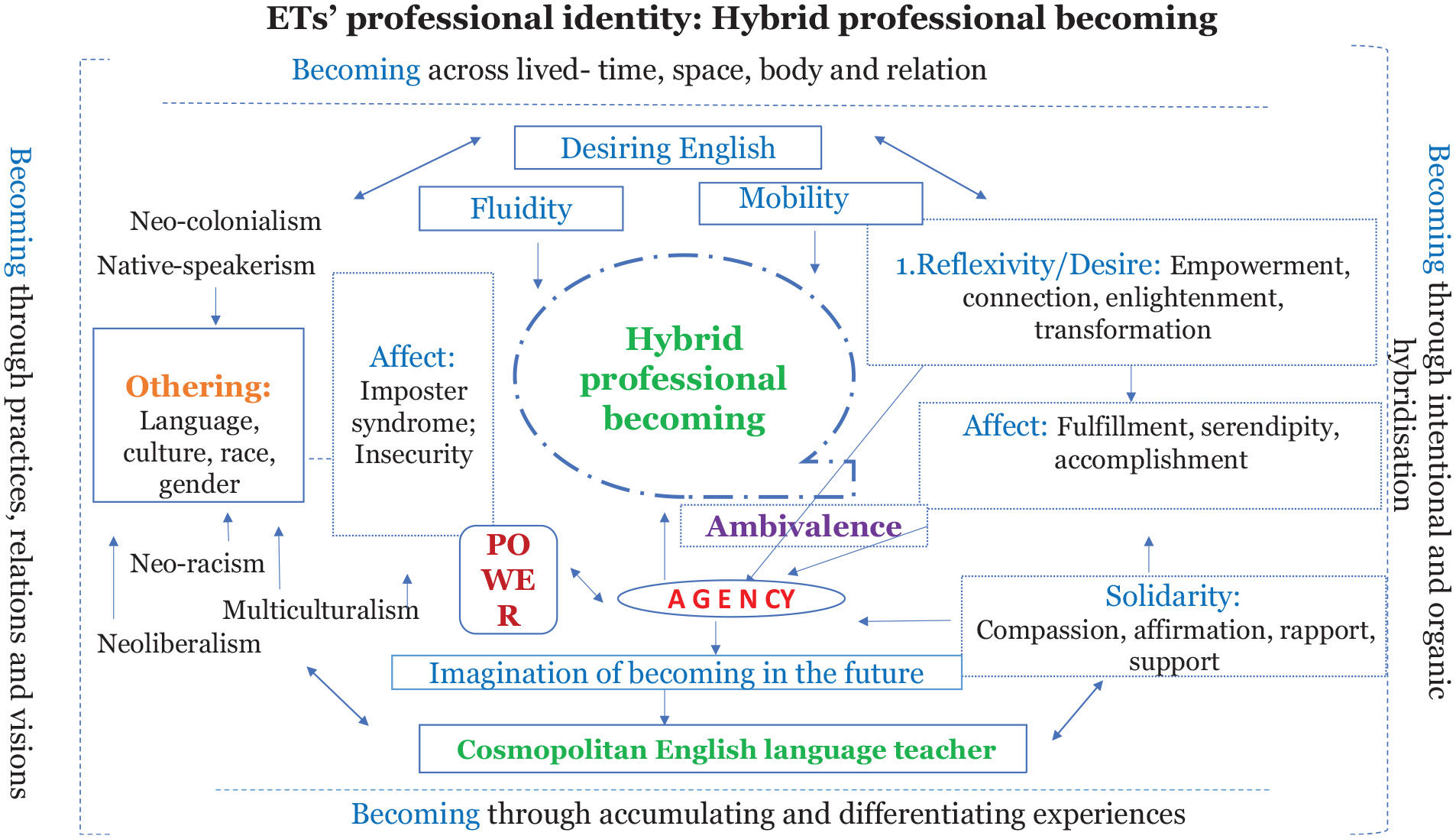
English teachers’ professional identity: Hybrid professional becoming.
The participants’ experiences also reflect a strong commitment to fostering cosmopolitan teaching practices that embrace diversity, relational agency, and solidarity. Their approach is marked by a dedication to cultivating inclusive learning environments that prioritize intercultural capabilities and ongoing personal emergence. For instance, Raphael and other participants expressed a deep sense of professional fulfillment derived from collegial solidarity, stating, “I’ve met some teachers of similar mind, and they’ve really influenced me.” This relational agency fosters a collaborative spirit that transcends traditional native-speakerist boundaries, as teachers innovate in their practice to support diverse linguistic identities. By actively reimagining their teaching practices, participants build educational spaces that allow students and teachers alike to develop an inclusive, culturally enriched understanding of English. This relational aspiration is fueled by the agency participants derive from shared experiences, the empathy nurtured within these interactions, and a vision to create an equitable educational assemblage that celebrates linguistic diversity.
Despite their aspirations for inclusive and cosmopolitan identities, participants also conveyed varied degrees and scales of ambivalence tied to institutional and socio-cultural constraints. Some participants, like Becca and Laura, voiced concerns about the limitations they face in environments that do not fully embrace diversity, leading to occasional tension within their professional roles. Laura remarked as an example, I imagine still being a global language teacher. I have always been a fan of world Englishers. I respect each language, but love English as a universal language connecting every individual. However, I think based on my personality, I will always consider myself as a non-native [emphasis added], striving to improve and be better like others who are very effective and seasoned in this profession. (Laura)
Janaki, Natalie, Ling Ling, and Hein, for instance, faced and anticipated challenges when working in predominantly native-speakerist or monolingual environments where inclusivity efforts are met with skepticism (Nigar et al., 2024a; Holliday, 2018). In an Independent school, Ling Ling expressed, “I sometimes find myself confused in aspects of my professional identity.” These reflections underscore a theme of ambivalence within the hermeneutic phenomenological analysis, revealing how the pursuit of “Hybrid Professional Becoming” involves dilemmas, vacillating in-between spaces of both empowering encounters, challenging negotiations. This duality highlights the participants’ survivance as they strive to navigate and reform spaces that often privilege native-speaker norms while acknowledging the persistent constraints that shape their professional identities.
These multifaceted lived experiences underscore the participants’ commitment to “Hybrid Professional Becoming,” where the dynamic interplay of agency, solidarity, imagination, and socio-cultural forces continuously shape and expand their professional identities in both actual and potential ways. Despite the persistent challenges of native-speakerism, these NNESTs aspire to create an educational setting that embraces diversity and cultivates a strong sense of belonging, paving the way for more cosmopolitan and adaptable identities within the field of English teaching.
In essence, this study highlights the transformative potential of embracing hybrid professional identities. The participants’ dedication to fostering inclusive and cosmopolitan teaching practices not only enriches their own professional development but also contributes to a more equitable and diverse educational context. By acknowledging and validating the diverse linguistic and cultural backgrounds of NNESTs, educational institutions can better support these educators in their journey towards professional fulfillment and efficacy. This research contributes to a deeper understanding of the complexities inherent in the professional identities of NNESTs. It underscores the need for ongoing efforts to challenge native-speakerist ideologies and to promote practices that value diversity and inclusivity within English language teaching. Ultimately, the participants’ lived experiences and imagination offer valuable insights into how educators can collaboratively navigate and reshape the evolving terrains of global education.
Discussion, Implications, and Suggestions
This study, grounded in hermeneutic phenomenology and narrative inquiry (Nigar, 2020, 2024; Patterson, 2018; van Manen, 1994), examines the evolving professional identities of NNESTs within Australia’s dynamic educational landscape. Employing these methodologies brings forth the concept of Hybrid Professional Becoming, illustrating how NNESTs navigate cultural, linguistic, and professional discourses to transcend native-speakerist norms and develop hybrid identities as cosmopolitan teachers of English. Although the data from 16 participants presents certain limitations in terms of voice representation, the convergence of hermeneutic phenomenology and narrative inquiry offers a richly layered understanding of NNESTs’ professional identity formation, capturing both the interpretive depth of individual experiences and a holistic view of broader professional settings. By enabling an interpretive exploration of lived experiences—such as embodied practices and socio-professional positioning—hermeneutic phenomenology complements narrative inquiry, which organizes these experiences into coherent stories, revealing patterns within wider milieus. This interwoven approach offers a nuanced understanding of identity as an ever-emergent process, encompassing both individual and multiple intersecting dimensions, thereby enriching the analysis and strengthening the study’s methodological contribution.
Integrating these methodologies into teacher education programs has significant practical implications. The combined approach fosters relational and reflective practices, encouraging teachers to engage with cultural and linguistic diversity meaningfully. For example, narratives like those from Quang underscore the value of prioritizing communicative negotiation and productivity over adherence to native-speaker norms, supporting intercultural pedagogy that respects teachers’ diverse backgrounds and supports hybrid professionalism in English language teaching (Nigar et al., 2024a; Butler, 2017).
From a policy perspective, this dual-method approach endorses an inclusive view of teacher identity, aligning with the multicultural realities of today’s classrooms. Policy suggestions include incorporating intercultural curricula and professional development programs focused on hybrid identities. Such initiatives could empower educational institutions to better support immigrant teachers, enhancing students’ learning experiences through the integration of diverse perspectives.
The hybridized use of hermeneutic phenomenology and narrative inquiry enriches the interpretive depth of the study, though it also introduces challenges in maintaining balanced representation across participant voices. The narrative-driven approach can limit the extent to which each participant’s perspective is fully explored, and interpretations based on specific prompts may not fully capture every aspect of individual experiences. Expanding this research across various regional and institutional situations in future studies could yield broader insights into immigrant teacher identities, offering a more encompassing analysis of the professional identity formation process among NNESTs.
Additionally, this study’s focus on teachers within multicultural institutions limits the generalizability of findings to more homogeneous educational settings. Future research could adopt a comparative approach, examining identity formation across different institutional types to validate the dual-methodology’s applicability and provide a more generalizable understanding of NNESTs’ professional identities.
This study highlights the value of employing hermeneutic phenomenology with narrative inquiry together to explore identity as a layered, relational construct. Hermeneutic phenomenology offers interpretive depth, capturing the embodied, affective dimensions of identity, while narrative inquiry organizes these insights into assembled accounts that reveal personal and relational themes. For future researchers, qualities like responsiveness, reflexivity, dialogic engagement, insight, passion, imagination, and openness to iterative interpretation are crucial for authentically engaging with participants’ lived experiences (Nigar, 2024; van Manen, 1990).
This study’s inclusion of hermeneutic phenomenology and narrative inquiry offers a methodological innovation in language teacher identity research, traditionally reliant on autoethnography, case studies, and narrative analysis alone (e.g., Pinho & Andrade, 2015; Riordan & Farr, 2014; Tsui, 2007; Yazan et al., 2023). By adopting an episto-ontological lens (Heidegger, 1962), this research uniquely captures identity formation as a dynamic, relational process rather than a static outcome. The dual-method approach reveals the concept of “Hybrid Professional Becoming,” where professional identity is continuously reshaped through self-reflection, interpersonal relationships, and societal perceptions (Kostogriz, 2020). This approach captures how NNESTs navigate de-centered intercultural terrains, attune to diverse contexts, build solidarities, and generate possibilities, shaping their identities through relational transcendence that moves beyond traditional binaries.
Concluding Remarks
The inclusion of hermeneutic phenomenology and narrative inquiry in a single study provides a nuanced and holistic methodological approach for understanding identity as a dynamic and relational construct shaped by social interactions, personal reflection, and cultural engagement. Hermeneutic phenomenology, with its emphasis on lived, embodied experiences, enables interpretive depth and experiential insight, offering a profound engagement with identity as a spatial-temporal, affective, and relational process (van Manen, 1990). Narrative inquiry complements this by bringing malleable order to these insights, weaving them into cohesive accounts that reveal broader themes and patterns within entangled social milieus. This assemblage enhances the study’s methodological rigor by enabling a layered analysis that captures both the intra-active depth and breadth of lived experiences and the relational dimensions of professional identity. Together, these methods reveal identity as both deeply personal and universally relevant, presenting an open-ended methodological process responsive to diverse educational and professional terrains. This approach holds promise for future studies on professional identity, especially in settings where cultural and relational dimensions play a central role.
This study demonstrates the meaning-making potential of combining hermeneutic phenomenology and narrative inquiry within a single research project, contributing to ongoing discussions on methodological diversity (Nigar, 2020; Greene, 2005; Patterson, 2018). The narrative inquiry lens provides descriptive inquiry frameworks to explore, interpret, and translate individual experiences, creating rich professional learning narratives that illuminate the learning trajectories of the teachers involved. Narrative modes of interpretation deepen understanding of unique teacher experiences, highlighting the importance of situational determinants that shape personal and professional development.
In closing, this dual-methodological approach lays a dynamic foundation for exploring professional identity across varied contexts, underscoring the value of cultural attunement, relational assemblages, and critical reflexivity in studying teacher identity and professional becoming. This convergent approach promotes transversality and depth in understanding identity as a multi-layered, evolving process that adapts fluidly to diverse educational settings and resonates within both personal and shared experiences.
Footnotes

Ethical Considerations
The study involving human participants was reviewed and approved by the Ethics Committee of Monash University (Approval No. 19107).
Consent to Participate
Written informed consent to participate in this study was provided by the participants.
Funding
The author(s) received no financial support for the research, authorship, and/or publication of this article.
Declaration of Conflicting Interests
The author(s) declared no potential conflicts of interest with respect to the research, authorship, and/or publication of this article.
Data Availability Statement
The data that support the findings of this study are available from the corresponding author upon reasonable request.