




Abstract
From the perspective of neoclassical economics, this study incorporates the concept of new-quality productivity to develop an evaluation indicator system. Using panel data from 139 Chinese cities between 2008 and 2021, a quasi-natural experiment is constructed to examine the combined effects of low-carbon policies and science and technology finance policies. A regression control method grounded in counterfactual thinking is employed to evaluate their influence on new-quality productivity. The analysis further investigates heterogeneity across labor force quality, financial development level, and geographic location, as well as the transmission mechanisms via technological innovation and industrial structure. The results indicate that policy synergies significantly enhance new-quality productivity, a finding that remains robust under multiple tests. These synergies drive improvement through technological innovation and industrial structure optimization. The positive effect is more pronounced in regions with higher labor force quality and financial development, and in eastern China, whereas it is negligible in other regions. This study offers theoretical support and policy guidance for fostering new-quality productivity across regions.
Plain Language Summary
From a neoclassical economics perspective, this study develops an evaluation system for new-quality productivity. Using 2008 to 2021 data from 139 Chinese cities, it examines how low-carbon and science-tech finance policies work together via a quasi-natural experiment and counterfactual-based regression control. It explores differences by labor quality, financial development, location, and transmission through tech innovation and industrial structure. Results show policy synergies significantly boost new-quality productivity, robust in tests, by driving innovation and industrial optimization. The effect is stronger in eastern China, areas with better labor and financial development, but negligible elsewhere. It offers theoretical and policy guidance for regional new-quality productivity growth.
Keywords
Introduction
With the ongoing advancement of the new round of scientific and technological revolution and industrial transformation, the traditional mode of economic growth and productivity development can no longer meet the demands of contemporary economic and social progress (F. Xie et al., 2025). The global industrial and supply chains are undergoing accelerated restructuring, making the innovation of the economic development model a central consensus for promoting economic transformation and sustainable growth (Ding et al., 2024). Against this backdrop, China has proposed the development of new-quality productivity (NQP) to establish an advanced productivity model that aligns with the requirements of high-quality development. This objective is pursued through revolutionary technological breakthroughs, innovative allocation of production factors, in-depth industrial transformation and upgrading (L. Yu & Zhang, 2024), and comprehensive institutional innovation. In March 2024, the Government Work Report released by the State Council of the People’s Republic of China clearly outlined specific measures to accelerate the development of NQP. Central to this strategy is the reshaping of the economic development paradigm and the achievement of productivity leapfrogging and upgrading, with green and low-carbon initiatives as the guiding force, science and technology innovation as the driving engine, and financial support as the enabling mechanism (Xue & Chen, 2025). Low-carbon policies and science and technology finance (sci-tech finance) policies are therefore considered essential for enhancing both the quality and efficiency of the economy, making them key drivers in the formation of NQP. Yet, whether these two policy domains have acted synergistically to promote NQP in China, and through which mechanisms, remains an important question that warrants in-depth investigation.
Research on NQP can be broadly categorized into three strands. The first focuses on the conceptualization and measurement of NQP (Fu & Zhao, 2025; Y. Liu & Lin, 2025; H. Zhang & Chen, 2025). The second examines the economic and social impacts of NQP development (Dai, 2024; Y. Liu & He, 2024). The third investigates the drivers of NQP formation (Ren et al., 2025; J. Wang et al., 2025), including the role of major policies. For example, some scholars have applied the difference-in-differences (DID) method to evaluate the impacts of the carbon emissions trading scheme and the comprehensive innovation reform pilot policy on NQP (Lv et al., 2025; J. Zhang et al., 2025).
Although this literature provides a valuable foundation for understanding the meaning and development of NQP, systematic analyses of how cross-cutting policies interact to stimulate NQP growth remain scarce. Specifically: (i) most studies approach NQP from a political economy perspective when defining and measuring it (Zhu et al., 2025); (ii) there is limited discussion of how low-carbon and sci-tech finance policies influence NQP; and (iii) existing research tends to examine individual policy effects rather than their synergistic effects. This paper differs from previous studies in three main respects. First, from a research perspective, it adopts the neoclassical economics framework, providing a micro-foundation for constructing the NQP evaluation indicator system. Second, in terms of research content, it focuses on the synergistic effects of low-carbon and sci-tech finance policies. Third, from a methodological standpoint, it employs the regression control method (RCM) to conduct the empirical analysis.
From a policy perspective, the green and low-carbon orientation of NQP means its development must be guided by environmental constraints and green priorities, while its innovation-driven nature requires the financial support provided by science and technology finance. Since 2010, 71 Chinese cities have implemented low-carbon policies aimed at reducing carbon emissions and advancing green development by encouraging green technological innovation. Although the effects of environmental policies, such as those implemented in low-carbon policy pilot cities, remain debated in academia, these cities have emerged as the most dynamic markets for green technology innovation and green finance in China (L. Cheng & Tang, 2024). At the same time, science and technology finance, as a critical driver of technological innovation and industrial upgrading, plays an irreplaceable role in advancing NQP and building a modern industrial system (D. Liu & Wang, 2024). In October 2015, the State Council of the People’s Republic of China released the National Science and Technology Innovation Plan of China for the 13th Five-Year Plan Period, emphasizing the need to strengthen the integration of science and technology with finance to support national innovation and the development of related industries. Likewise, In December 2022, the Central Economic Work Conference, jointly convened by the Communist Party of China (CPC) Central Committee and the State Council, explicitly called for fostering a virtuous cycle of “technology–industry–finance”. Between 2011 and 2016, China designated 50 cities as sci-tech finance policy pilot cities to accelerate the development of science and technology finance. However, a standalone low-carbon policy may increase short-term cost pressures on enterprises, while a standalone sci-tech finance policy without a green orientation may lead to resource misallocation. When implemented synergistically, low-carbon and sci-tech finance policies can reinforce each other. Low-carbon policies expand application scenarios and market demand for sci-tech finance, promoting deeper integration of financial capital with scientific and technological innovation. Conversely, sci-tech finance provides diversified and targeted financial services that can support low-carbon policies, fostering the development of green industries. This synergy creates the potential for a qualitative leap in China’s productivity. Accordingly, this study examines the mechanisms and effects of policy synergies between low-carbon and sci-tech finance policies in shaping NQP. The analysis aims to provide theoretical guidance for policy practice, enrich the literature on NQP drivers, and offer empirical insights for future research.
A new round of technological revolution is driving global industrial transformation, and China is at the forefront of this shift. Data from the Fifth National Economic Census, released by the National Bureau of Statistics of China in December 2024, shows that in 2023, the added value of new industries—including strategic emerging industries, high-tech industries, and the core sectors of the digital economy—accounted for more than 13% of GDP. These industries, shaped by disruptive and cutting-edge technologies, are central to NQP development. As a pioneer in exploring and developing NQP, China shares the general characteristics of productivity and economic development with other nations but also exhibits unique features. It is a vast country with diverse geographical units, different natural conditions, and significant regional differences in economic development, resource endowment, and capacity for NQP growth. Summarizing China’s historical experience with NQP provides theoretical insights for further liberating and developing productive forces, achieving high-quality growth domestically, and contributing to global prosperity. Furthermore, studying the impacts of China’s low-carbon and sci-tech finance policies on NQP holds relevance for multiple stakeholders, offering reference points for policymakers as well as strategic guidance for enterprises and social organizations.
The remainder of this paper is structured as follows. First, the relevant literature is reviewed to clarify the significance of the topic and highlight its marginal contribution. Second, the theoretical framework is developed by analyzing the key elements influencing NQP and constructing an evaluation indicator system for its development level. Third, the empirical research design is presented. This study applies the RCM, which offers advantages over the DID approach by avoiding the correlation issues between treatment group assumptions and results, and over the synthetic control method by using linear regression to determine weights, improving realism and economic interpretability. Fourth, the baseline regression, robustness, placebo test results, and heterogeneity analysis results are reported, followed by an examination of the transmission mechanisms of policy synergies on NQP. Finally, the paper concludes with policy implications drawn from the findings.
Literature Review
Meaning and Measurement of New-Quality Productivity
Existing research provides a foundation for studying the synergies between low-carbon policies and sci-tech finance policies in shaping NQP (D. Liu & Wang, 2024; Zhao et al., 2025). Scholars have examined its connotation, characteristics, and essence (Zhu et al., 2025), as well as its theoretical innovations and underlying logic (Meng & Meng, 2024). NQP is generally defined as productivity primarily driven by scientific and technological innovation, breaking away from traditional growth paths and meeting the requirements of high-quality development. It is characterized by deeper integration within the digital economy, higher efficiency, and the embodiment of new development connotations. Its core hallmark is a substantial increase in total factor productivity (TFP; L. Yu & Zhang, 2024). Several studies have constructed regional NQP evaluation indicator systems, often from a political economy perspective. For example, Fu and Zhao (2025) developed a framework based on three dimensions: laborers, labor materials, and labor objects. Y. Liu and Lin (2025) measured NQP development and regional differences across China’s provinces using three dimensions: scientific and technological productivity, green productivity, and digital productivity. H. Zhang and Chen (2025) used provincial panel data to assess NQP development, focusing on both physical and pervasive factors.
Impacts of Low-Carbon Policies on New-Quality Productivity
A low-carbon transition is intrinsic to NQP development. The theoretical basis for implementing low-carbon policies rests on three hypotheses: the Pollution Haven Hypothesis, the Green Paradox, and the Porter Hypothesis (Porter, 1991; Sinn, 2008; Walter & Ugelow, 1979). Empirical evidence shows that low-carbon policies can improve energy efficiency through technological and structural effects (Q. Wang et al., 2024), stimulate technological innovation (H. Yu et al., 2023), promote industrial upgrading, and alleviate energy shortages (Zheng et al., 2021). These effects contribute to significant TFP gains, aligning closely with the goals of NQP (C. Liu et al., 2020). Beyond direct productivity gains, low-carbon policies can foster sustainable development models, create employment, stimulate the growth of the tertiary sector, and achieve a dual goal of environmental protection and economic development (Chen et al., 2021).
Impacts of Science and Technology Finance Policies on New-Quality Productivity
Financial support for science and technology provides a critical pathway to accelerating NQP. Studies show that sci-tech finance policies can reduce urban carbon intensity (X. Cheng et al., 2023), drive manufacturing transformation and upgrading, and raise regional TFP (Zhong & Jin, 2024). These effects, in turn, enhance NQP development. In addition, sci-tech finance can promote industrial upgrading and economic structure optimization (Su, 2024) through mechanisms such as the innovation-driven effect (Gao et al., 2022) and the industrial agglomeration effect (H. Hu et al., 2025), further influencing NQP growth.
In summary, theoretical and applied studies on NQP have made initial progress, but literature addressing the effects of low-carbon and sci-tech finance policies, particularly their synergies, remains scarce. Although some scholars have examined their intrinsic connections and interaction mechanisms (D. Liu & Wang, 2024; J. Zhang et al., 2025), few have provided in-depth analyses of their joint influence on NQP. This study addresses this gap by focusing on the synergistic effects of low-carbon and sci-tech finance policies on NQP. Its contributions are fourfold. First, it investigates policy drivers that accelerate NQP formation during its early development stage, offering targeted and practical insights. Second, it integrates the connotation of NQP with economic theoretical models, providing a micro-level theoretical basis for constructing an NQP evaluation indicator system and offering a new approach for subsequent measurement studies. Third, it applies the RCM, which better reflects real-world conditions, avoids the stringent assumptions of DID, and more accurately identifies policy effects, thereby supporting robust policy recommendations. Finally, it reveals the mechanisms through which policy synergies affect NQP, offering guidance for regions seeking to strengthen these synergies and accelerate NQP development.
Theoretical Analysis and Research Hypothesis
Policy Synergies and New-Quality Productivity Development
NQP refers to advanced productivity attributes that are innovation-led, independent of traditional economic growth models and development paths, and characterized by high technology, high efficiency, and high quality, in line with the new development concept. It is driven by revolutionary technological breakthroughs, innovative allocation of production factors, and comprehensive industrial transformation and upgrading, representing a new stage in productivity development (L. Yu & Zhang, 2024).
During the transition from traditional productivity to NQP, low-carbon policies and sci-tech finance policies act as core drivers for technological breakthroughs, innovative factor allocation, and industrial transformation. First, both policy types promote revolutionary technological advances. Low-carbon policies guide green technological innovation (Z. Zhang et al., 2025), while emerging technologies such as cloud computing, blockchain, and biometrics enable new industrial forms that can accelerate productivity growth (Z. Wang & Chu, 2024). Sci-tech finance policies complement this by providing life-cycle financial support for technological breakthroughs through science-and-technology credit, venture capital, and equity financing, thereby expediting the commercialization of technological innovations and establishing the material foundation for NQP (Shao et al., 2025). Second, low-carbon and sci-tech finance policies facilitate the innovative allocation of production factors. Low-carbon policies reshape market rules and economic incentives, shifting production from a high-carbon path toward an efficient, clean, and sustainable model. This reorganization of factors such as capital, labor, technology, land, and data is an important driver for accelerating NQP formation (P. Zhang et al., 2024). Sci-tech finance policies, by reforming financial service models and resource allocation mechanisms, channel production factors efficiently toward strategic emerging and future industries. This enables breakthrough restructuring and upgrading of production factors, fostering progressive productivity gains (Du et al., 2025). Finally, both policy types support deep industrial transformation and upgrading. Low-carbon policies break high-carbon technological lock-in, reconfigure energy and manufacturing systems, and accelerate high-carbon industry substitution through measures such as carbon-cost internalization, green finance, and carbon taxation. They also reduce industrial chain coordination frictions via institutional buffer mechanisms, advancing the transition to a zero-carbon production paradigm and promoting NQP (Pan et al., 2023). Sci-tech finance policies leverage social capital through risk-sharing mechanisms, address barriers to technological transformation via multi-level capital markets, and rebuild industrial risk-control systems using data-element empowerment. This facilitates the upgrading of traditional industries toward high technology and high value-added segments, contributing to sustained productivity improvement (C. Hu et al., 2025).
Notably, implementing low-carbon policies alone may increase short-term cost pressures on enterprises, potentially hindering NQP formation, while sci-tech finance policies alone may result in resource misallocation without the guidance of green policy. However, their combination can establish a dual mechanism of “low-carbon constraint + financial incentive,” simultaneously stimulating demand for green technological innovation and ensuring precise, efficient capital supply. This synergy provides strong momentum for overcoming bottlenecks in NQP development.
The Transmission Mechanism of Technological Innovation and Industrial Structure
Low-carbon policies can enhance the cultivation of scientific and technological talent, increase capital investment, and stimulate technological innovation within a region, thereby providing a robust talent base and technological support for the development of NQP (L. Xie & Hui, 2025). The motivation of innovation actors can be strengthened through targeted financial subsidies (Z. Zhang et al., 2024). Furthermore, low-carbon policies can drive the green transformation and upgrading of industrial structures (Pan et al., 2023). First, by imposing strict carbon emissions constraints on high-energy and high-emission sectors, these policies promote technological upgrading or relocation of sectors with low carbon-efficiency, supporting regional industrial transformation and upgrading (K. Li et al., 2023). Second, low-carbon policies reshape factor input structures, industrial investment patterns, and factor allocation efficiency, guiding industries toward green and low-carbon development (Y. P. Li et al., 2014).
Sci-tech finance policies complement this process by alleviating local financing constraints and optimizing the allocation of financial resources, thereby facilitating technological innovation and industrial structure upgrading. Technological innovation requires sustained financial support (Neff, 2003). The implementation of sci-tech finance policies accelerates the integration of science, technology, and finance by providing convenient financing channels, optimizing financial resource allocation, and directing funds toward regions with high development potential. This, in turn, promotes technological innovation and the transformation of scientific and technological achievements (Sheng et al., 2021). In addition, sci-tech finance policies can guide financial resources toward high-efficiency science and technology enterprises, thereby compelling the transformation and upgrading of traditional enterprises and advancing local industrial structure upgrading (Luo et al., 2022). Based on these considerations, the following hypothesis is proposed:
Productivity reflects the capacity to transform and utilize nature through the integration of human labor and material means of production. Technology, talent, and capital are its three core components (Huang et al., 2025). First, the level of production technology determines the marginal output of production factors. Technological innovation introduces new dynamics, models, and industries, serving as key drivers of NQP development (J. F. Zhang et al., 2025). Second, human talent is the decisive force in productivity development, with high-quality labor being the foremost driver (Tran, 2024). Finally, capital, second only to human resources in importance, provides essential inputs, and high-output, high-quality capital investment remains a critical guarantee for NQP growth (L. Q. Liu et al., 2025).
Industrial structure represents the integration of local production factors and production relations. Its upgrading entails not only changes in production objects and factors, but also transformations in production relations (Gai et al., 2025). This upgrading can affect the output level of local production factors and thus the development of NQP. First, industrial structure upgrading facilitates the shift from traditional industries to high-technology, high-efficiency, and low-energy sectors, directly improving regional TFP (Zhong & Jin, 2024). Second, it is inevitably accompanied by employment structure upgrading—from labor-intensive traditional industries toward knowledge- and technology-intensive sectors (H. Liu et al., 2025). This transformation reshapes the labor market, fostering conditions favorable to NQP development. A more flexible and adaptive labor market, supported by highly skilled and cross-disciplinary talent, can better meet the demands of diverse industries, encourage cross-industry knowledge exchange, and accelerate NQP growth (T. Z. Zhang et al., 2025). Therefore, this paper proposes research hypotheses 3 and 4. The specific impact mechanisms are shown in Figure 1.

Mechanisms of the impact of synergies between low-carbon and science and technology finance policies on new-quality productivity.
Research Design
Regression Control Method
This study employs the RCM to analyze policy effects. Compared with the DID approach, the RCM estimates correlations based on common underlying factors that vary across cross-sections, rather than relying solely on differences. This avoids the issue of correlation between group assumptions and results, making it more applicable to real-world conditions (Hsiao et al., 2012). Compared with the synthetic control method, the RCM calculates weights using linear regression, which offers greater interpretability in terms of economic significance.
Selection of Treatment and Control Groups
To promote low-carbon economic and social development and address financing challenges for science and technology enterprises, the Chinese Government designated 71 low-carbon policy pilot cities in three batches (2010, 2012, and 2017), based on principles of scientific merit, operational feasibility, and demonstration potential. In parallel, 50 pilot cities for sci-tech finance policies were selected in two batches (2011 and 2016). The selection of both policy types emphasized regional representativeness and potential synergy, with the primary objective of identifying and disseminating successful practices. Table 1 lists the pilot cities for both policies by year. To ensure a precise construction of the “synthetic” unit, the analysis uses a sufficient pre-intervention interval so that the control group can accurately match the development characteristics of treatment group cities before the policy synergy took effect. The treatment group consists of cities with overlapping policy designations in 2016, including 24 cities such as Tianjin, Chongqing, Shenzhen, Hangzhou, Beijing, Shanghai, and Suzhou. To maintain group homogeneity, four municipalities directly under the central government (Tianjin, Chongqing, Beijing, and Shanghai) and six provincial capitals (Hangzhou, Wuhan, Guangzhou, Xi’an, Nanchang, and Guiyang) are excluded. Huaian is also excluded due to incomplete or unreliable data. Additionally, Ningbo and Xiamen, both non-provincial capitals newly added in 2016, are excluded because policy synergies are unlikely to have taken effect in the same year. Given that the RCM requires a unique treatment unit, the 11 remaining treatment group cities are averaged to create a single virtual treatment city. For the control group, cities must not have participated in either policy pilot. Provincial capitals and county-level cities are excluded to ensure homogeneity, yielding 128 control cities.
Low-Carbon and Science and Technology Finance Pilot Cities by Year.
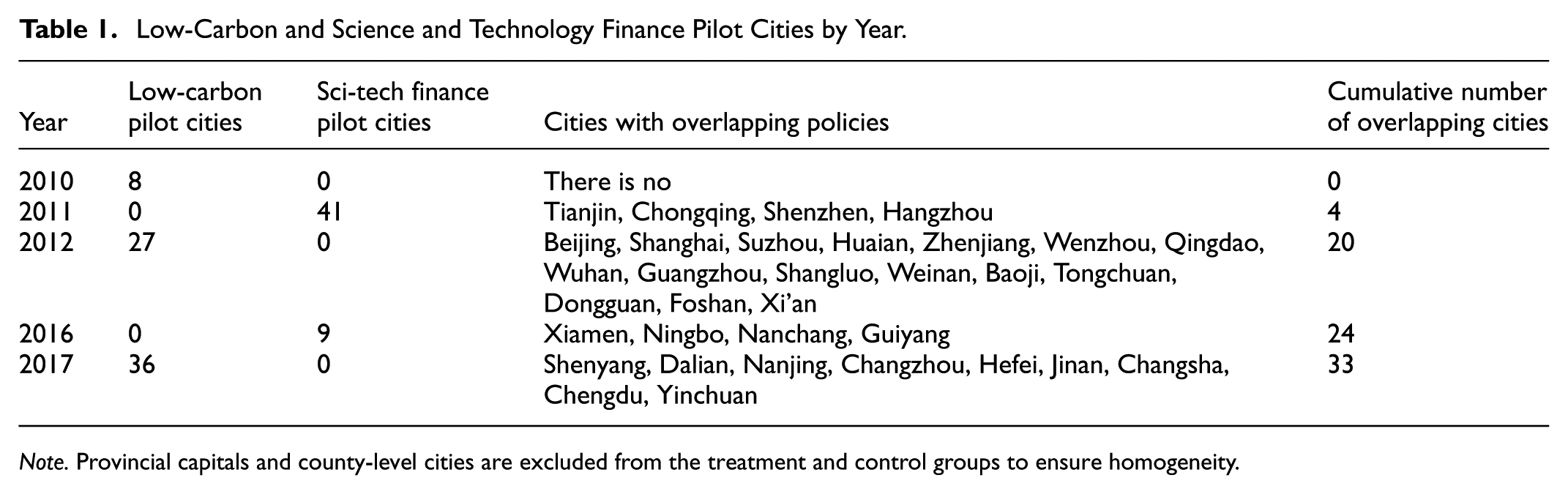
Note. Provincial capitals and county-level cities are excluded from the treatment and control groups to ensure homogeneity.
Model Setting
Let
To address this, the RCM is applied to construct a suitable control group to simulate the experimental group. Under the assumption of no implementation of low-carbon and sci-tech finance policies, the counterfactual development level of NQP is estimated to assess the synergistic effects of the two policies. In this framework,

In Formula 1,
For the specified period t, the equations for all cities are stacked. Under certain regularity conditions, appropriate transformations eliminate the unobserved common factors, yielding the time series regression equation:

Where the results and control variables of all control group individuals are included

Equation 3,

When estimating Equation 2 with pre-policy data, the “optimal subset” of explanatory variables is selected using information criteria to prevent “overfitting” due to an excessive number of control group individuals and variables. To ensure that the predicted NQP development level closely matches the observed level before the joint implementation of low-carbon and sci-tech finance policies, the RCM is chosen based on the cross-validation (CV) criterion and the Lasso algorithm (K. T. Li & Bell, 2017). In addition, other optimal subset selection criteria (AIC, AICC, and BIC) are employed as robustness tests.
Variable Selection and Data Source
Three dimensions of NQP, namely human, capital, and technology, are selected, comprising 9 secondary and 20 tertiary indicators, to evaluate the development level of NQP (np) in the study areas. The construction of specific indicators is detailed in the Appendix 1.
To more precisely estimate the effects of the synergies (pc) between low-carbon policies and sci-tech finance policies on NQP, additional factors that may affect NQP are controlled for. Specifically, these include: population scale (ps), measured as the logarithm of the year-end total population; city economic density (ce), measured as the ratio of regional GDP to the administrative region’s land area; urbanization level (ul), measured as the proportion of the permanent urban population to the total permanent population; degree of fiscal decentralization (fd), measured as the ratio of general government revenue to general government expenditure; industrialization level (il), measured as the proportion of industrial value added to gross regional product; and infrastructure level (in), measured as the ratio of fixed asset investment to regional GDP.
The dataset is a balanced panel for 139 cities, including the virtual treatment city, covering the period 2008 to 2021, yielding 1,806 observations. The year 2016 is designated as the start of the treatment period. Data are sourced from the EPS database, the Energy Statistical Yearbook of China, the Urban Statistical Yearbook of China, and other official publications. Descriptive statistics for the relevant variables are presented in Table 2.
Descriptive Statistics.

Empirical Results
Regression Results of Regression Control Method
The effects of policy synergies on the level of NQP development are represented by the difference between the actual and counterfactual predicted values after 2016. In this study, 2016 is selected as the time point for the policy synergy impacts, and the model estimation is implemented using the RCM proposed by Fang and Chen (2021). According to Equations 1 and 2, Table 3 presents the OLS regression results of the optimal subsets selected based on CV information criteria. The coefficient of determination (
OLS Regression Results for Selecting Optimal Subsets Using CV Criteria (

The “counterfactual result” of NQP development is calculated according to Equations 3 and 4. Comparing the observed and counterfactual predicted values before and after the policy synergies of low-carbon and sci-tech finance policies allows assessment of their effects. Figure 2 illustrates this comparison. To avoid the dotted line obscuring the treatment effect in the base period, it is shifted to the period immediately preceding 2016 (the treatment year). In the figure, the solid line represents the observed value and the dotted line the fitted counterfactual prediction. A close overlap before the treatment year indicates that the optimal control group reproduces the trend of the virtual treatment group accurately; a divergence after the treatment year reflects the impacts of policy synergies. The greater the divergence, the stronger the policy effects.
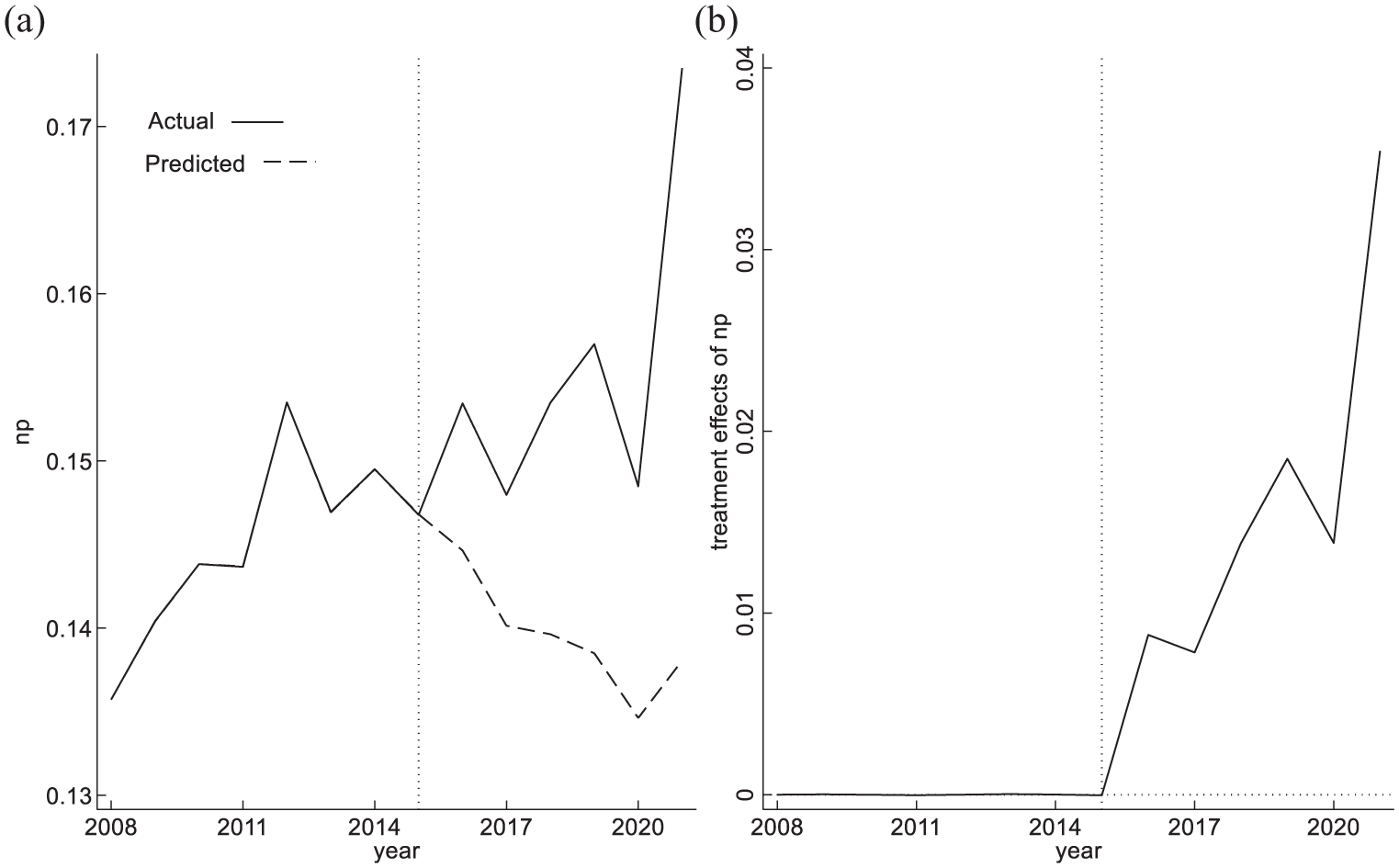
Treatment effects of policy synergies: (a).Observed value and counterfactual prediction of NQP (using CV criteria), (b). Actual effect of policy synergies.
As shown in Figure 2a, during 2008 to 2015, prior to the policy synergy shock, the counterfactual predicted and observed NQP development levels coincide almost perfectly, indicating that the optimal control group closely replicated the pre-treatment trend. After the 2016 policy synergy, however, the predicted and observed values diverge, with the gap widening over time. This supports Hypothesis 1.
A marked divergence between predicted and observed values is also visible between 2015 and 2016. One possible explanation is that the initial treatment group comprised 24 cities with 2016 as the base period, including 20 policy-overlap cities from 2012 and four newly added in 2016. Four municipalities and six provincial capitals were excluded to ensure homogeneity among treatment units. Additionally, three cities were excluded due to data validity issues and policy lag effects. Four of the excluded cities, namely Xiamen, Ningbo, Nanchang, and Guiyang, were among those added in 2016. Therefore, all 11 virtual treatment cities were from 2012, which may account for the observed–predicted separation. This reasoning need not be repeated for subsequent analyses.
Further, by subtracting the counterfactual predicted value from the observed NQP development level, the treatment effect of the policy synergies is obtained (Figure 2b).
Figure 2b shows that, compared with cities unaffected by either low-carbon or sci-tech finance policies, the effects of policy synergies on NQP development generally increased exponentially, with particularly pronounced effects after 2020. This again supports Hypothesis 1. The likely explanation is that low-carbon policies channeled social resources into clean energy, energy conservation, and environmental protection, while sci-tech finance policies provided financial support for technological innovation in these fields. This combination accelerated the transformation and application of technological achievements, enabling leapfrog growth in NQP. After 2020, low-carbon industries such as new energy vehicles, photovoltaics, and energy storage entered a phase of rapid expansion, with a heightened demand for technological innovation. Sci-tech finance policies offered strong financial backing for research, development, and large-scale production in these industries through venture capital, science and technology credit, and related mechanisms. Concurrently, low-carbon policies created substantial market opportunities via the carbon trading market, environmental protection standards, and other instruments. The synergy between these policies facilitated efficient alignment of capital, technology, and market forces, significantly boosting the growth of emerging industries and thereby upgrading the overall level of NQP.
Robustness Test
The robustness of the above counterfactual analysis is examined in three ways. First, the optimal subset is selected using alternative information criteria: Akaike information criterion (AIC), corrected AIC (AICC), and bayesian information criterion (BIC). Second, to enhance the homogeneity of the control group, 18 cities in the same provinces as the 11 virtual treatment cities are excluded. Third, the impact time of policy synergies is adjusted according to Table 1 to re-evaluate their effects on NQP development.
Using the AIC, five cities are included in the optimal subset, identical to those selected under the CV criterion. Figure 3 shows the observed and counterfactual predicted NQP values using the AIC, demonstrating results fully consistent with those under the CV criterion. This again confirms that the policy synergies between low-carbon and sci-tech finance policies exert a notable positive impact on NQP development.

Observed value and counterfactual prediction of NQP (AIC criterion).
When applying the AICC and BIC, the results remain robust. The AICC, which imposes the strongest penalty for model complexity, selects only one city (Dazhou), leading to a weaker model fit (
To address potential bias in counterfactual forecasts, where treatment group effects might be influenced by control cities in the same province, the CV criterion is reapplied after excluding such control cities. The resulting optimal subset consists of three new cities: Siping, Ningde, and Ziyang. Although the composition changes substantially, the estimated policy synergy effects remain robust (Figure 4a).
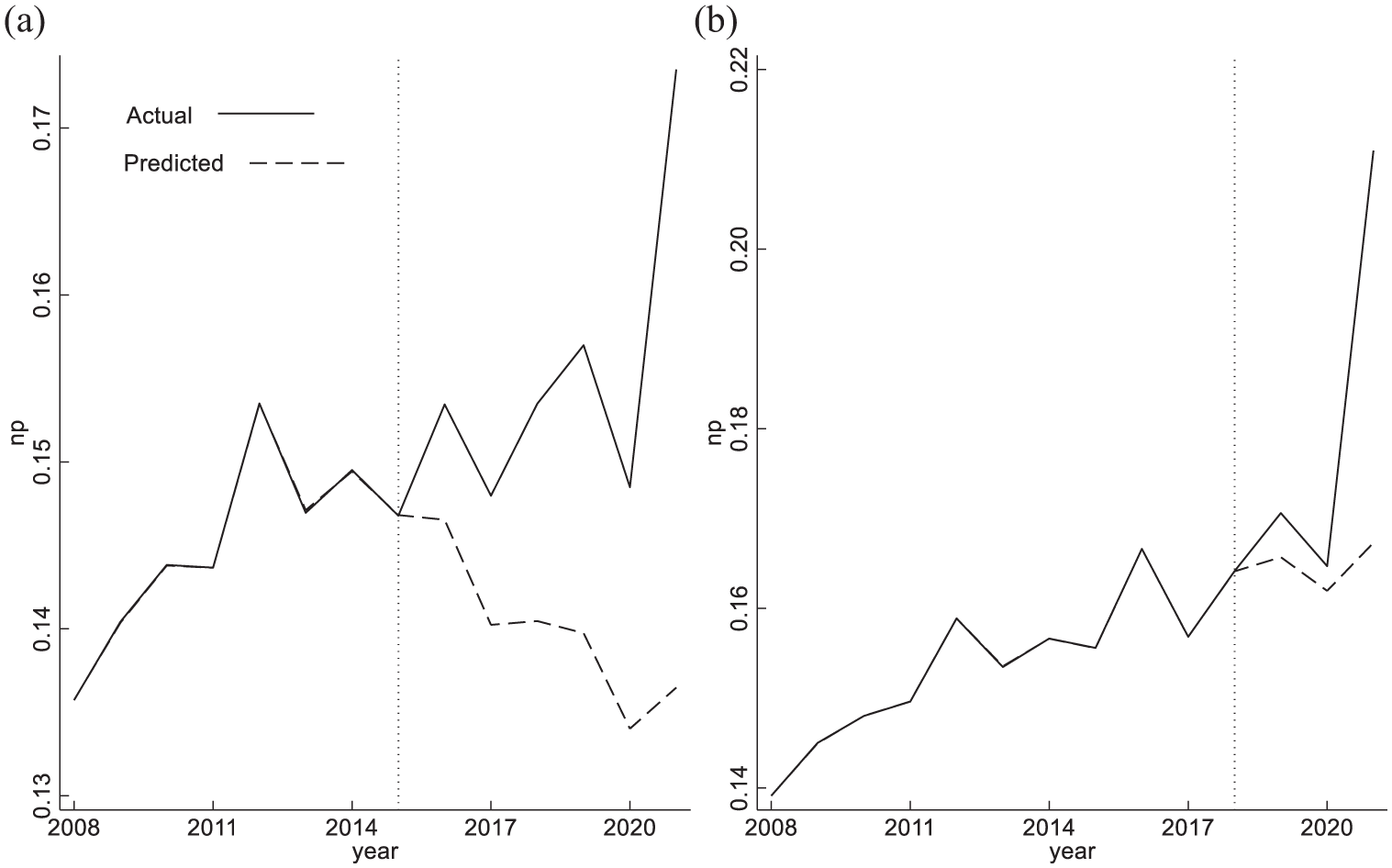
Robustness test results for excluding certain control cities versus adjusting the policy impact year: (a). Observed value and counterfactual prediction of NQP (excluding control group cities in the same province as the treatment group cities), (b). Observed value and counterfactual prediction of NQP (simultaneously changing processing unit and policy processing time).
The baseline policy effect year is set to 2016. However, given potential policy implementation lags, the effects for cities added in 2016 may not be fully realized in that year. Because the virtual treatment city is calculated as the average of 11 cities, excluding newly added 2016 cities may affect the accuracy of the baseline. To test this, Ningbo and Xiamen, added in 2016, are included in the treatment group, and the policy effect time is shifted to 2019. Using the CV criterion, nine control cities are selected: Hengshui, Wulanchabu, Songyuan, Yancheng, Dezhou, Yueyang, Huaihua, Guigang, and Dazhou. Even with these adjustments, the robustness results (Figure 4b) confirm that the estimated policy synergy effects remain stable.
Placebo Test
A placebo test is conducted using two approaches: a false treatment unit and a false treatment time. In the first approach, a city from the control group that has not implemented either policy is randomly assigned to the treatment group, assuming it is affected by both low-carbon and sci-tech finance policies. The RCM is then used to estimate the policy synergy effects. If the actual estimated effect is consistently larger than the effects for most placebo treatment units, the result is deemed robust. In the second approach, the policy synergy start year is advanced from 2016 to a year before the actual implementation. If the estimated effects are not significant under this false treatment time, it suggests that the observed effects are indeed due to policy synergies rather than other factors.
All 128 control cities are tested as placebo treatment units to improve reliability. Figure 5a shows the distribution of policy effects for the virtual treatment cities compared with the placebo units. Before 2016, there is no significant difference between the observed and counterfactual NQP values for treatment and control cities. After 2016, however, the treatment cities exhibit substantial effects, with most control cities showing smaller values. This indicates that the policy synergies have a clear positive effect on NQP development.

Placebo test results: (a). Placebo test using fake treatment units. (b). Placebo test using false policy impact time (false treatment time is 2015).
Figure 5b presents the results for the false treatment time test, where the base year is shifted from 2016 to 2015. From 2008 to 2014, the counterfactual predictions closely match the observed NQP values, indicating a good model fit before the false treatment period. After 2015, with no actual policy synergy in effect, the observed and predicted values show no significant divergence, confirming that the previously estimated effects are not driven by other systematic differences between treatment and control groups.
Endogeneity Test
Cities with higher NQP development levels may be more inclined to implement low-carbon or sci-tech finance policies. To test for potential endogeneity caused by reciprocal causation, a lagged period of NQP development levels (

Endogeneity test: (a). Observed value and counterfactual prediction of a lagged period of NQP (using CV criteria). (b). Actual effect of policy synergies.
Heterogeneity Analysis
Given the potential heterogeneous effects of labor force quality, financial development level, and geographical location on NQP development, a DID approach is applied for further analysis. The sample is grouped according to the mean values of labor force quality and financial development level. Regions above the mean are classified as having higher labor force quality or higher financial development, whereas those below the mean are classified as having lower levels. In addition, the sample is divided into eastern and central–western regions based on China’s economic and social development patterns. The results are presented in Table 4. As shown in Table 4, in regions with higher labor force quality, higher financial development, and in the eastern region, policy synergies between low-carbon and sci-tech finance policies exert a significant positive effect on NQP development. In contrast, in regions with lower labor force quality, lower financial development, and in the central–western region, the effect is not statistically significant. Two main factors may explain this disparity. First, regions with a highly skilled labor force and well-developed financial markets provide the essential conditions for low-carbon and sci-tech finance policies to exert their intended guiding and stimulating roles. These regions facilitate the efficient aggregation and innovative allocation of innovation and production factors, thereby accelerating NQP development. Second, compared with the central–western regions, the eastern region has stronger scientific and technological capabilities, more advanced industrial foundations, and well-established innovation ecosystems, which collectively enhance the effectiveness of synergistic policy implementation.
Heterogeneity Analysis.
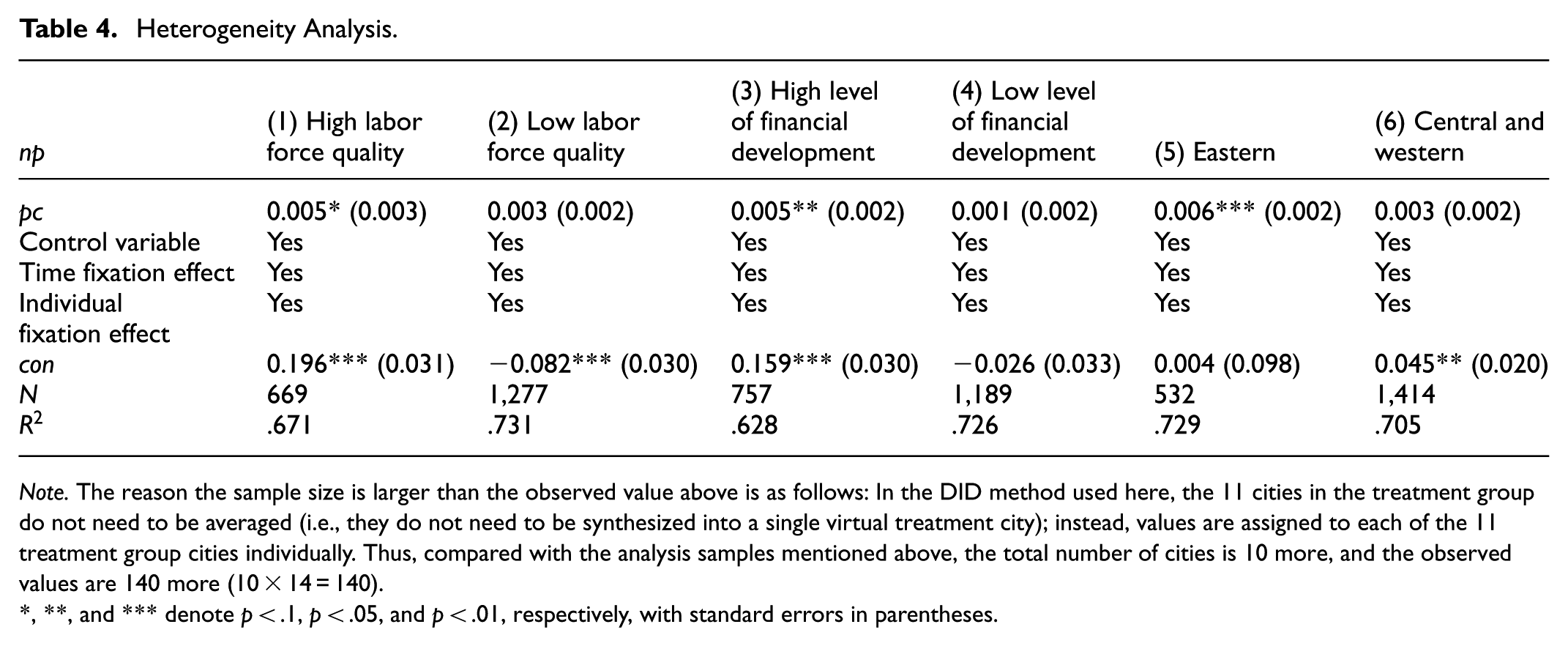
Note. The reason the sample size is larger than the observed value above is as follows: In the DID method used here, the 11 cities in the treatment group do not need to be averaged (i.e., they do not need to be synthesized into a single virtual treatment city); instead, values are assigned to each of the 11 treatment group cities individually. Thus, compared with the analysis samples mentioned above, the total number of cities is 10 more, and the observed values are 140 more (10 × 14 = 140).
, **, and *** denote p < .1, p < .05, and p < .01, respectively, with standard errors in parentheses.
Further Analysis
Strengthening synergies between low-carbon policies and sci-tech finance policies can support technological advancement and industrial structure upgrading, thereby promoting the development of NQP. To test this hypothesis, two empirical analyses were conducted. First, the RCM was applied to examine the impacts of policy synergies on technological innovation and industrial structure upgrading. Second, the DID method was used to assess the mediating role of these two variables in the relationship between policy synergies and NQP.
Regression Control Method Estimation
The RCM was applied to evaluate the effects of policy synergies on technological innovation and industrial structure upgrading. Specifically, Lasso OLS screening and CV based on the CV information criterion were used to select the optimal control group. Technological innovation (ti) was measured by the logarithm of the number of utility model patents granted in a given year, focusing on innovation achievements and differing from the NQP indicators. Drawing on Pan et al. (2023), industrial structure upgrading (is) was measured as the product of the proportional share of each of the three industries and their respective labor productivity:
The RCM results show that the counterfactual predicted values and the observed values for both technological innovation and industrial structure upgrading overlapped prior to the introduction of policy synergies. After policy implementation, however, the effects diverged. In the current year, policy synergies exerted a particularly strong effect on technological innovation, with an average treatment effect of 0.3771. This positive effect persisted and increased over the treatment period, except in 2016, with a doubling trend observed from 2017 to 2021. For industrial structure upgrading, the average treatment effect was 0.1150, and although the effect remained positive during the treatment period, it exhibited considerable fluctuations. These results indicate that while policy synergies have a notable and sustained effect on technological innovation and industrial structure upgrading. Hypothesis 2 is thus supported. This may be because technological innovation is more directly related to policy synergies, can take effect quickly through resource integration, and its impact continues to grow. In contrast, industrial structure upgrading involves the adjustment of deep-seated factors, takes longer to yield results, and is susceptible to external variables. Thus, its effect is weaker and fluctuates significantly, which is associated with the differences in the development laws and policy mechanisms of the two.
Difference-in-Differences Model Estimation
To examine the transmission mechanisms, a sample of 11 treatment cities and 128 control cities was analyzed. A dummy variable for policy synergies (pc) was generated based on the timing of implementation. The DID model was then used to test the mediating effects of technological innovation and industrial structure upgrading in the relationship between policy synergies and NQP.


Where,
The mediating effect results are presented in Table 5. Column (1) shows that the policy synergy dummy variable is significantly positive at the 1% level, confirming its strong positive effect on NQP, consistent with the RCM results. Columns (2) and (3) indicate that policy synergies significantly promote both technological innovation and industrial structure upgrading, with the effect being stronger for technological innovation. Columns (4) and (5) show that both mediators significantly promote NQP, supporting Hypothesis 3. Combining results from columns (2) and (3) with those from columns (6) and (7) demonstrates that both technological innovation and industrial structure upgrading play a significant mediating role in the policy synergy–NQP relationship, supporting Hypothesis 4. These findings suggest that low-carbon and sci-tech finance policies form a mutually reinforcing cycle of “low-carbon constraints + financial incentives.” From the technological innovation perspective, low-carbon policies push firms toward green technology R&D, while sci-tech finance policies address financing barriers for technology-based firms, accelerating innovation and diffusion and thereby linking policy synergies to NQP. From the industrial structure perspective, low-carbon policies channel resources toward emerging low-carbon industries, while sci-tech finance policies improve resource allocation, facilitating the green transformation of traditional industries and advancing structural optimization. Moreover, technological innovation and industrial structure upgrading reinforce one another, creating an upward spiral that amplifies their combined effect on NQP.
Test Results of the Transmission Mechanism of New-Quality Productivity Under Policy Synergies.

, **, and *** denote p < .1, p < .05, and p < .01, respectively, with standard errors in parentheses.
To validate the robustness of these mediation effects, the Sobel method was applied (Table 6). The coefficients for the mediation effects of both technological innovation and industrial structure upgrading were significantly positive in the current year and passed the Goodman 1 test, confirming their mediating roles. Overall, the Sobel test results reinforce the conclusion that both mechanisms significantly mediate the relationship between policy synergies and NQP.
Sobel Method Test (

and *** denote p < .05 and p < .01, respectively.
Conclusions and Policy Recommendations
Drawing on counterfactual thinking, this study integrates panel data from 139 prefecture-level cities in China and applies the RCM to construct a quasi-natural experiment examining the synergistic effects of low-carbon and sci-tech finance policies on NQP. The analysis further investigates the transmission mechanisms of technological innovation and industrial structure upgrading. The key findings are as follows. First, synergies between low-carbon policies and sci-tech finance policies significantly promote NQP development, and the results remain robust after multiple verification tests. Second, these policy synergies foster NQP primarily by enhancing technological innovation and optimizing the industrial structure. Third, the positive impact of policy synergies on NQP is particularly evident in regions with higher labor force quality, stronger financial development, and in eastern China. By contrast, in regions with lower labor force quality, weaker financial development, and in central and western China, the effect is less pronounced.
Based on these findings, the following policy recommendations are proposed.
First, the synergistic advantages of low-carbon and sci-tech finance policies should be leveraged by actively promoting pilot programs for low-carbon and sci-tech finance cities. This approach can simultaneously advance NQP development, environmental protection, and high-quality financial growth. Policy measures should: (1) Optimize the allocation of production factors and financial resources, guiding capital, technology, and talent toward low-carbon, environmentally sustainable, and innovation-driven sectors through coordinated market mechanisms and policy incentives. (2) Strengthen the synergy mechanism between the two policy domains to enhance the specificity and effectiveness of implementation, ensuring alignment in objectives, measures, and effects. (3) Improve the policy design in pilot cities to create replicable and scalable models that accelerate NQP formation and support high-quality economic development.
Second, policy synergies should be used to drive technological innovation and industrial structure upgrading. Targeted support for technological innovation will improve the transformation of research achievements into productive capacity. Innovation resources, including talent, capital, and technology, should be concentrated in sectors with the highest potential for breakthroughs, thereby improving regional productivity. Policy guidance should also encourage new business forms and models, facilitate the upgrading of traditional industries, and advance industrial structure optimization, continuously injecting momentum into economic growth.
Third, technological innovation and industrial structure optimization should be harnessed to sustain NQP development. This requires: (1) Transforming production methods by shifting from traditional to low-carbon and smart production modes, thereby enhancing the quality and efficiency of economic growth through innovation. (2) Optimizing the spatial distribution of major productive forces under the guidance of low-carbon and sci-tech finance policies to establish a more advanced, efficient, and regionally complementary economic structure that broadens development space and strengthens growth drivers for NQP.
This study’s research perspective, content, and methodology differ from those of existing literature, complementing and expanding current research. Unlike similar studies, the present analysis finds clear evidence that the synergy between low-carbon and sci-tech finance policies promotes NQP and that labor force quality, financial development level, and geographical location contribute to heterogeneous effects. Consistent with prior studies, it also confirms that technological innovation and industrial structure optimization are critical drivers of NQP. However, the study has limitations. First, as in most previous research, NQP development is measured using a constructed indicator system rather than direct theoretical metrics. Second, due to data constraints and the absence of established measures for the innovative allocation of production factors, the study does not examine how such allocation accelerates NQP development. Addressing these gaps will require further research.
Footnotes
Appendix 1
Acknowledgements
The authors are grateful for the financial support from the National Natural Science Foundation of China (23CJY083).

Ethical Considerations
All procedures performed in this study were in accordance with the ethical standards of the university.
Consent to Participate
Informed consent was obtained from all individual participants included in the study.
Author Contributions
Conceptualization, H.Y.P and R.Y.Y; methodology, H.Y.P; software, R.T.T; validation, R.Y.Y; writing—original draft preparation, H.Y.P and R.T.T; writing—review and editing, H.Y.P and R.Y.Y. All authors have read and agreed to the published version of the manuscript.
Funding
The authors disclosed receipt of the following financial support for the research, authorship, and/or publication of this article: This research was funded by the National Social Science Foundation of China grant number [23CJY083].
Declaration of Conflicting Interests
The authors declared no potential conflicts of interest with respect to the research, authorship, and/or publication of this article.
Data Availability Statement
Data will be made available on request.