




Abstract
This study aims to explore the topical growth, patterns, and trends of importance in tourism research over the past three decades (1990–2019). By leveraging a large corpus of 18,725 abstracts from 20 leading tourism journals, we employ latent Dirichlet allocation (LDA) to identify, quantify, and semantically interpret the predominant research themes and their evolution within the tourism discipline. The analysis reveals topic distributions across journals, highlighting focused areas as well as diverse topic coverage. Temporal analyses uncover the changes in the popularity of different topics, shedding light on emerging areas –topics that have gained increasing scholarly attention over recent years, indicating their growing significance and influence in the field of tourism research. The study reveals that while certain topics, such as consumer experience, digital innovation, risk behaviors, sustainability, and social media, have drawn more attention recently, others, such as marketing communication and e-tourism, have cooled down over time. Journal-level insights suggest that Visitor Studies and Event Management focus on themes related to visitor engagement and event tourism, whereas journals such as Tourism Economics and Tourism Management continue to emphasize economic growth and demand forecasting. The study provides valuable insights into the research landscape and offers implications for scholars, journal editors, and practitioners. It highlights the importance of fostering collaboration to address future challenges in the multidisciplinary tourism field.
Keywords
Introduction
Tourism is widely recognized as one of the fastest-growing industries globally, providing numerous economic opportunities for developing nations, small island economies, and local communities (Durbarry, 2004; Lean et al., 2014; Peterson, 2023; Rehman et al., 2020). The rapid development of tourism can be attributed to several factors, such as urbanization, advancements in transportation technologies, sustained economic growth initiatives, and increased disposable income (C. C. Lee & Chang, 2008). These factors have collectively contributed to transforming tourism into one of the most significant industries worldwide. As a multidisciplinary field, tourism encompasses various aspects of society, including physical, economic, social, and cultural aspects. Consequently, there has been a growing emphasis on interdisciplinary collaborations, academic conferences, and journals dedicated to tourism research (Bhatt et al., 2024; Cheng et al., 2011; S. H. Chen & Tham, 2019; Jamal et al., 2008; Racherla & Hu, 2010; Xiao & Smith, 2006). This emphasis denotes the increasing recognition of tourism as a subject of scholarly interest and the need for a comprehensive understanding of its complexities. Given this trend, the volume of academic papers published in tourism literature has experienced an exponential surge over the past few decades. Researchers from diverse academic backgrounds have contributed to this growth, enriching the knowledge base within the field (Buhalis et al., 2023; S. H. Chen & Tham, 2019; Valeri & Baggio, 2021). These contributions have helped advance the research and understanding of tourism, providing insights into various dimensions of the industry and contributing to its sustainable development.
Scientific publications serve as a core indicator of knowledge transfer, discovery, and intellectual challenge, reflecting the process of experimentation and validation (Sun & Yin, 2017). Understanding the evolution of tourism research through scientific publications is essential, as these works reflect the intellectual development of the field. The publication not only disseminates key findings but also informs real-world decision-making in areas such as public policy, industry strategy, and community development. Analyzing research trends through published work allows scholars and practitioners to identify emerging challenges, evolving interests, and future research directions in a structured, evidence-based manner (Kunisch et al., 2023). Over the years, tourism research has expanded its breadth and depth, moving beyond a uni-disciplinary focus to include a much more diverse scope of topics. These areas of interest often address relevant and pressing questions related to our society and environment. For instance, exploring sustainable eco-tourism management not only uncovers strategies to develop tourism but also demonstrates a commitment to upholding and promoting environmental conservation (Buckley, 2005; Diamantis, 1999; C. Liu et al., 2013; Paul & Roy, 2023). Understanding tourism carbon footprints supports efforts to mitigate climate change while researching the sustainability of environments and ecosystems ensures that development aligns with environmental preservation (Puri et al., 2019). Further pushing the boundaries of tourism research, scholars are increasingly interested in the cultural aspects of tourism. Cultural tourism is significant as it can stimulate cultural exchange, bring economic benefits, and contribute to the protection of cultural heritage (Kastenholz & Gronau, 2022; Noonan & Rizzo, 2017). The intersection of themes such as cultural consumption, motivations, and the economics of cultural tourism demonstrates the dynamic complexity that this sub-field presents (H. Chen & Rahman, 2018). Moreover, medical tourism has emerged as an intriguing area attracting investor interest. Studies by Al-Talabani et al. (2019), de la Hoz-Correa et al. (2018), Ghosh and Mandal (2019), and Taheri et al. (2021) highlight the economic potential of this sector and the possible implications for healthcare systems around the world.
As an interdisciplinary field, tourism research includes a vast array of subject matters and continually evolves over time. Given the breadth, diversity, and increasing complexity of the field, systematically reviewing tourism research is both important and challenging. Researchers often rely on methodological techniques such as scientometrics and bibliometrics, which enable a comprehensive investigation of trends over specified periods (de Oliveira et al., 2019; Pollack & Adler, 2015). Scientometric and bibliometric analyses, in essence, function as quantitative methods for exploring and interpreting the impact and trend developments in academic literature. Fang et al.’s (2018) scientometric analysis of the connection between climate change and tourism research is a good example. This study provided novel insights into the most significant global trends and directions, facilitating an understanding of the evolving tourism research landscape. These methods offer an effective lens through which time-based research trends can be identified and examined. Ochoa Jiménez et al. (2022) conducted a bibliometric analysis of entrepreneurship in tourism by examining 268 documents sourced from the Web of Science (WoS) and Scopus databases. León-Gómez et al., (2023) conducted a bibliometric review of 113 academic publications focused on sustainability education within tourism universities, examining how this theme has evolved in the context of higher education. The use of these methods allows researchers to evaluate the influence and relevance of authors, and their works based on citation data and provides a valuable means of understanding research trails and tracing the evolution of ideas. However, while scientometrics and bibliometrics can serve as powerful tools for trend detection and research evaluation, their capacity to examine specific topic-relevant information is limited (Hannigan et al., 2019; Sun & Yin, 2017). These methods only highlight how frequently a topic has been addressed or who the primary contributors are; they often fall short of revealing the underlying semantic structures, such as how topics are framed, theorized, and interconnected across different studies. This limitation can limit our understanding of research content, particularly in a field as complex and interdisciplinary as tourism. Moreover, these analyses often rely on the manual review and interpretation of abstracts, keywords, or citation patterns, making the process time-consuming and challenging to scale when dealing with large datasets—a growing concern given the accelerating volume of tourism research.
In response to these limitations, recent computer science and natural language processing (NLP) advances have led tourism scholars to adopt topic modeling methods to gain deeper insight into thematic developments. By applying probabilistic models such as Latent Dirichlet Allocation (LDA), researchers can uncover latent thematic structures, identify interdisciplinary linkages, and detect overlooked subfields within large textual corpora (Ali et al., 2022; Y. J. Jung & Kim, 2023). For example, LDA might help reveal studies discussing ‘smart tourism’, ‘digital platforms’, and ‘personalized experiences’ share a common semantic foundation related to technology-driven service innovation, offering connections that might not be evident through traditional citation analysis and can be uncovered in a scalable manner.
Our study explores the topical growth, patterns of research themes, and trends of importance in the tourism discipline spanning the period from 1990 to 2019 using LDA topic modeling. This exploration is conducted by leveraging publication metadata, specifically the abstracts of scientific research articles, obtained from 20 well-established scientific journals in the tourism field. Given the significant and unprecedented impact of the COVID-19 pandemic on global tourism (Assaf et al., 2022), we have intentionally limited our analysis to publications prior to 2020 to avoid potential distortions in identifying long-term research trends. By excluding post-2019 publications, we aim to capture pre-pandemic developments consistently and uninterruptedly, allowing for a clearer understanding of how tourism research evolved under typical, non-crisis conditions. The study seeks to identify, quantify, and semantically interpret prominent research themes and trends within the tourism discipline, with the ultimate goal of stimulating more meaningful discourse on the current state of tourism research (e.g., as exemplified by a recent discussion in McKercher, 2018). To achieve this objective, this study adopts a quantitative, data-driven approach by applying an innovative and transformational computational text analysis method, LDA topic modeling, to classify major research themes and trends of importance. Through a comprehensive analysis of publication metadata, our study aims to provide a deep and high-level understanding of the tourism research landscape—capturing its intellectual structure and evolution over time. This understanding is intended to guide future research directions and foster collaborative efforts to address emerging challenges and opportunities within the field. Specifically, we aim to answer the following three research questions:
(1) What are the predominant topics and research themes of interest in tourism research?
(2) How have tourism research topics evolved over the years to address the key challenges that face the tourism industry?
(3) What topics of interest have gained or lost interest in the past 30 years?
We aggregated the results at the journal level, assessed the temporal behavior of topics over time, and provided several insightful analyses. The study findings offer several important directions for future research.
This study contributes to the theoretical understanding of tourism by introducing a novel, content-driven perspective on the field’s thematic development. By applying a probabilistic topic modeling approach to a large corpus of article abstracts, we aim to provide a deeper understanding of how research themes have evolved over time. This method not only complements traditional scientometric and bibliometric tools but also addresses their key shortcomings by offering a scalable and semantically driven approach for analyzing tourism research at the thematic level. This approach enables scholars to identify theoretical developments, uncover knowledge gaps, map interdisciplinary connections, and formulate targeted research agendas to address emerging challenges within the tourism discipline.
The remainder of this paper is organized as follows. Section 2 provides a description of our methodological approach. In Section 3, we provide an overview of our data collection procedures and present the major research topics and themes in tourism, their trends over time, the topical distributions across various journals, and other insightful analyses. Lastly, in Section 4, we provide concluding remarks and discuss future research opportunities based on the insights uncovered and presented in the current study.
Methodology
In this section, we first present an overview of the latent Dirichlet allocation (LDA) model we use for topic modeling and then describe detailed analytics that we perform based on LDA. LDA is a generative probabilistic model introduced by Blei et al. (2003) and is a widely used topic modeling technique that identifies latent semantic structures in large text corpora. LDA considers each text document to be a mixture of topics, and each topic is characterized by a distribution of words, making it particularly effective for discovering hidden themes within unstructured text data (Blei, 2012; Blei & Lafferty, 2009). LDA has been extensively applied across various domains. For instance, it has been used to explore customer satisfaction in restaurants (Karmakar et al., 2023), analyze economic discourse in newspapers (Ahmed et al., 2022), and identify topics in telemedicine conversations on social media platforms (Martín et al., 2025). In tourism research, LDA has played a significant role in identifying emerging travel trends, understanding destination preferences, and analyzing traveler sentiments based on online reviews and social media posts (Ali et al., 2022; Saragih et al., 2024).
In our study, we chose LDA for multiple reasons: (1) LDA is a widely used generative probabilistic model for analyzing discrete data (Blei et al., 2003). LDA is well known for its flexibility, allowing adaptation to various datasets, parameter adjustments (e.g., number of topics) for optimization (Griffiths & Steyvers, 2004), and integration with machine learning and NLP methods like sentiment analysis (Ali et al., 2022) and network analysis (Butar et al., 2024). This adaptability makes LDA a powerful tool for extracting structured insights from unstructured text. (2) As an unsupervised learning method, LDA is well-suited for uncovering latent thematic structures in large text corpora without labeled data (Blei et al., 2003). This aligns with the exploratory nature of our study, as there are no predefined categories. LDA automatically identifies topics based on word co-occurrences, offering greater flexibility in detecting hidden patterns and relationships within the data. (3) While various topic modeling methods exist, LDA remains a preferred choice. Unlike Non-negative Matrix Factorization (NMF), which relies on matrix factorization and may struggle with generalizing to unseen data (Arora et al., 2012), or Latent Semantic Analysis (LSA), which depends on Singular Value Decomposition (SVD) and often produces overlapping topics, LDA’s probabilistic framework assigns topics to documents as distributions, allowing each document to represent multiple topics in varying proportions. This provides clearer topic separation and better scalability (Griffiths & Steyvers, 2004). While BERTopic achieves higher topic coherence using deep learning-based embeddings, it is computationally demanding, whereas LDA is easier to implement and more efficient for large-scale datasets (Grootendorst, 2022). Overall, LDA’s probabilistic nature, scalability, and efficiency make it particularly effective in identifying complex research themes and their relationships across documents, especially in interdisciplinary research, where diverse topics frequently intersect.
In our study, we followed a similar framework that has been used by Gatti et al. (2015) and Sun and Yin (2017) to provide analysis and insights with a focus on tourism research.
We select all journals that are rated as A* or A in the ABDC journal quality list (Australian Business Deans Council, 2025) under the tourism field of research (field 1,506). The ABDC list is a widely recognized benchmark for academic journal quality in business and management disciplines, with A* and A ratings known for their rigorous peer-review processes, methodological robustness, and strong citation performance. This provides us with 20 journals (see Table 1). These journals are also indexed in the ‘Social Sciences Citation Index’ (SSCI) within the category of ‘Hospitality, Leisure, Sport & Tourism’, which further ensures their scholarly relevance and impact. To maintain consistency and comparability across the dataset, we limited our analysis to English-language articles, as English remains the dominant language in top-tier tourism research and facilitates broader international accessibility. We also exclude gray literature, such as conference proceedings and industry reports, due to their variable quality and lack of consistent peer-review processes. This targeted selection ensures that our dataset reflects high-quality, influential scholarship and enhances the reliability and interpretability of our topic modeling results over the past three decades. The abstract metadata of each selected journal was extracted using a free and open-source reference management software called Zotero. Scraping script applications embedded within the software are used to mine and extract the necessary metadata for further topic modeling experimentation. Using Zotero, we gather information about the articles’ year of publication, the name of the journal, and the articles’ abstracts. With the aid of the Natural Language Toolkit (NLTK), we remove the standard stop words list from the pre-processing stage of our data analysis since stop words do not carry meaningful information. The NLTK list allows us to further define the descriptive keyword content residing within the extrapolated abstract metadata by removing non-descriptive and commonly referenced keywords such as ‘paper’, ‘document’, ‘abstract’, ‘time’, ‘study’ to ensure that the assembled corpus is free from non-descriptive keywords that would not add much meaning to our topic modeling analysis. Therefore, we aim to retain only descriptive, relevant, and semantically related keywords to ensure optimal topic inference. The rationale for including article abstract metadata was that an abstract is largely considered to represent a condensed, compact, and holistic representation (i.e., noteworthy content) of the entire research paper (Sun & Yin, 2017; Zhong et al., 2016). Abstracts are widely regarded as reliable proxies for full-text articles in large-scale textual analyses. Typically, an abstract captures the research objectives, problem statement, major findings, expected benefits, and future directions of the study, providing a condensed yet informative overview (K. Lee et al., 2016). An abstract typically contains sufficient descriptive content to establish and disseminate an accurate understanding of the thematic information and key phrases from each extracted article (Anupriya & Karpagavalli, 2015; Syed & Spruit, 2017). Upon completion of the data pre-processing stages, we obtain a collection of 18,725 abstract metadata from highly representative journals in tourism research, spanning 30 years (1990–2019) of academic research publication content in the tourism discipline. Table 1 shows the number of abstracts collected for each journal. We focus on papers published before 2019 to reduce the impact of COVID-19 on tourism research. In Figure 1, we present an area-line chart visualization illustrating the total abstract count collected from each of the referenced tourism journals. The numbers on the Y-axis depict the total number of abstracts extracted from each journal. The numbers on the X-axis represent the observed time period of reference. There has been a substantial and steady increase in tourism research output over the past three decades, indicating the field’s progression and wider academic recognition. This upward trend became more significant in recent years, with a particularly notable surge beginning around 2012.
Journals Used in this Study. Abstracts are Collected from 1990 to 2019.


Number of abstracts extracted from each journal between 1990 and 2019 in the processed dataset.
Results
This section presents the primary topic modeling visualizations and interprets the uncovered trends. Overall, we estimate the temporal behavior in topic distributions over time, perform topic distributional analysis experiments on a per-journal basis, and analyze variance in topic popularity through hot/cold topic assessments and various other insights.
Topic Distributions
We have identified 30 prominent topics (determined by coherence and perplexity measures) discussed across a span of 30 years among 20 top-tier journals in the field of tourism, where each topic defined in the LDA model can be expressed as a probabilistic distribution over words (Zhao et al., 2015). We capture this distribution using word cloud diagrams. We limit ourselves to presenting keywords and key phrases with the highest posterior probability within each generated word cloud. This concept of posterior probability refers to the individual size or saliency (i.e., frequency of occurrence) among each generated keyword in the word cloud and can also be inferred as the ‘converged distribution of words among each topic’ (K. Chen et al., 2015, p. 60). Thus, in each topic, the top 20 words are presented as word clouds in Figures 2 and 3.
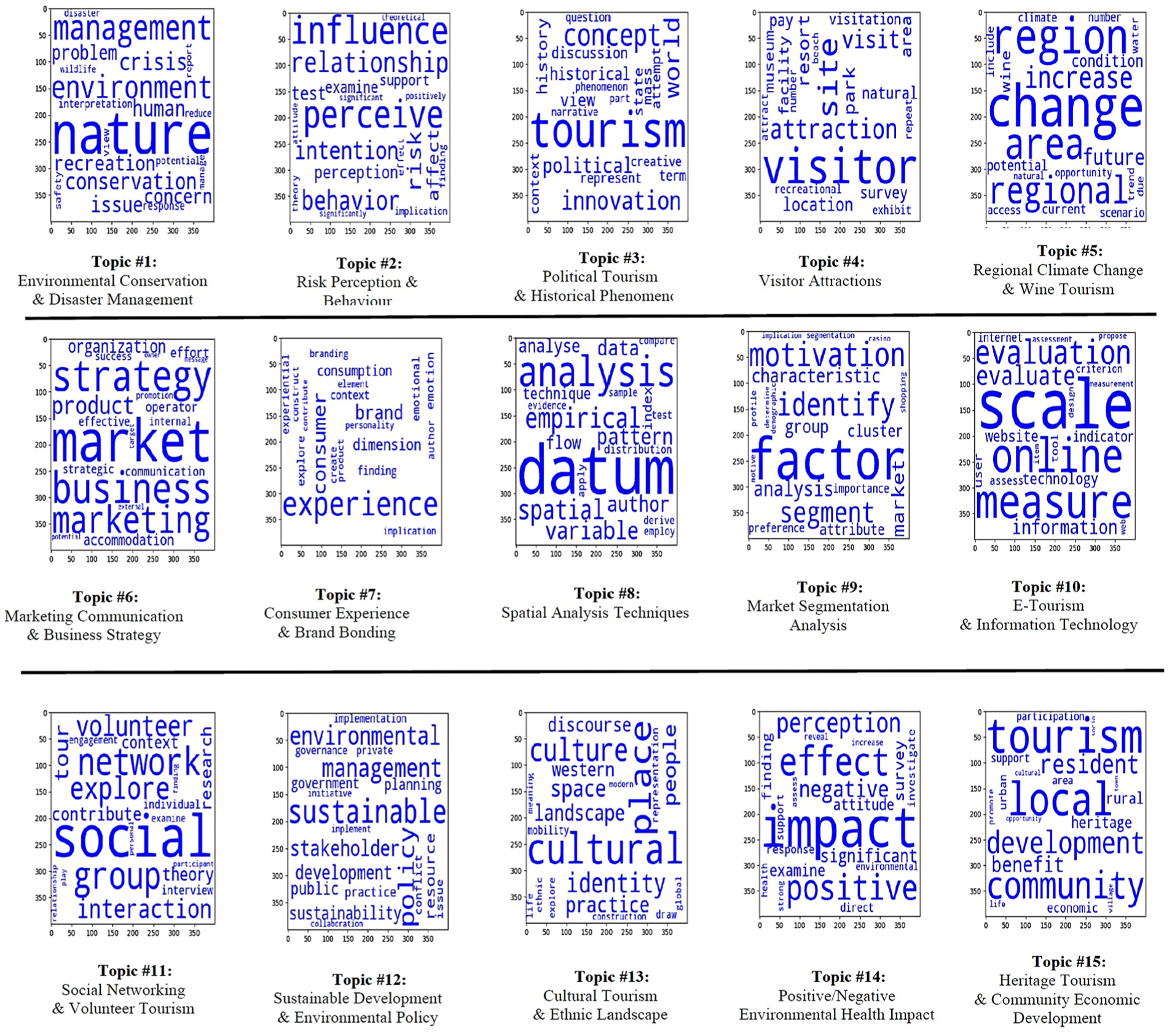
Word cloud of Topic #1 to Topic #15.

Word cloud of Topic #16 to Topic #30.
The 30 topics provide a content ‘landscape’ of reference in determining predominant research themes and trends of research interests (i.e., to answer research questions 1, 2, and 3). It helps to understand where major research gaps lie among representative topic areas that have been uncovered. The identified topic areas correlate well with established and interconnected subfields within the tourism discipline. For instance, Topic #16: ‘ecotourism, knowledge, education, student, program, responsibility, skill, …’ discusses knowledge of ecotourism and promotes ecotourism as an educational and professional-pedagogical experience. Topic #27: ‘Chinese, traveler, trip, holiday, characteristic, agency, Japanese, leisure, transport, outbound, …’ largely discusses the characteristics of Chinese travelers and Chinese outbound tourism. The emergence of this particular topic is consistent with the phenomenon that Chinese tourists are steadily becoming an increasingly substantial segment of the global tourism market in recent years (Dai et al., 2017; Li, 2017; Suntikul et al., 2020; Zhu et al., 2021). Given the interdisciplinary nature of tourism, our findings reveal how the field integrates knowledge from multiple academic domains. While assessing interdisciplinary linkages is beyond the formal scope of this study, our analysis of thematic diversity across top-tier journals serves as an important first step toward understanding tourism’s broad intellectual structure. For example, Topic #12: ‘Environmental, sustainable development, policy, resource management, sustainability, government, issue’ relates to environmental governance and sustainability, integrating concepts from environmental science and public policy. Topic #18: ‘Service, quality, airline, industry, loyalty, customer, satisfaction, relationship, trust, managerial,…’ focuses on service quality and customer satisfaction in the airline industry, related to both marketing and management. Topic #21: ‘Destination, image, marketing, medium, medical, analysis, attractiveness,…’ addresses destination image and attractiveness, intersecting with psychology, media studies, and communication research.
As demonstrated from our word-distribution analysis of the generated topics, based on the diverse representation of various research area classifications that emerge from our topic modeling assessment, we can attest that our operationalized LDA model is able to successfully discriminate between various interconnected sub-fields in tourism research, which helps to categorize the emerging topic areas of interest on a more semantically meaningful basis.
To further understand the thematic structure of tourism research, we have created a table (see Table 2) that compiles the top duplicate words that appear across multiple topics, suggesting common research themes and concepts in the tourism literature. By analyzing these duplicated words, we can identify dominant themes that guide researchers in tracking research interests and focusing on key areas of study. Additionally, practitioners can rely on these insights to inform strategic decision-making, plan for industry developments, and address challenges in the tourism sector. These research themes can be broadly categorized into the following areas, offering a structured perspective on the development and trends within tourism research.
(1) The
(2) The
(3) The
(4) The
(5) The
(6) Lastly, the
Word Analysis: Overlapping Terms Across Tourism Research Topics.

Temporal Behavior of Topics over Time
To answer research question 2, upon completion of the documentation and classification of the posterior word distribution of each topic (i.e., word cloud analysis), we assess the temporal behavior of each topic over time (see Figures 4–6). In these figures, the Y-axis displays the LDA probabilities (or expected topic proportions) for each topic, while the X-axis represents the years from 1980, illustrating the temporal evolution of each topic’s prevalence over time. The labels for both axes are also shown in the figures. A larger probability would indicate that the topic is gaining much traction or relevancy in that given year, whereas a lower probability would indicate a decline in topic relevancy or importance. Overall, across our 30 topics, we can see that the distribution among topics has been fairly erratic over the period. For instance, Topic #7 (see Figure 4): ‘consumer, brand, experience, emotional, emotion, experiential, personality, product, explore, branding, …’ which is about consumer experience and brand bonding, has been growing steadily in topic importance over the past few decades in response to challenges related to rising consumer expectations and the demand for personalized experiences (Yang et al., 2024). Additionally, Topic #21 (See Figure 6): ‘destination, image, marketing, medium, medical, analysis, attractiveness, …’ about destination image has been increasing in topic importance. Moreover, we find that Topic #2 (See Figure 4): ‘risk, perception, behavior, attitude, relationship, influence, support, theory, affect, finding, …’ about tourism risk perception and risk-taking attitude effects/influence on tourist behavior has also been growing exponentially in the past few years. This aligns with increasing the challenges of tourism risks, such as those arising from health crises and global disruptions (Fuchs et al., 2024; W. Liu et al., 2023). There is also some evidence indicating the increasing influence of technological advancements on the evolution of tourism research. For example, Topic #10 (see Figure 4), ‘information, technology, website, scale, measure, online, evaluation, indicator, user, …’ which reflects research related to digital platforms and information technology, has shown gradual growth over time. Topic #11 (See Figure 5), ‘social, group, network, explore, volunteer, interaction, tour, contribute, theory, research, …’ which centers on social media and engagement, emerges as one of the most active and rapidly growing themes in recent years. This pattern aligns with broader industry trends, where technology and social media have played vital roles in shaping tourists’ decision-making journeys and promoting tourism experiences (Pop et al., 2022; Zheng, 2023). On the other hand, Topic # 6 (See Figure 4): ‘organization, strategy, marketing, business, market, communication, effort…’ related to marketing strategy in tourism, and Topic # 16 (See Figure 5): ‘ecotourism, opportunity, work, member, knowledge, education, guides,…’ associated with ecotourism and education showed significant relevance during the initial decade. However, their importance has witnessed a gradual decline in recent years.

Temporal behavior of topics over time (Topics #1–10).

Temporal behavior of topics over time (Topics #11–20).

Temporal behavior of topics over time (Topics #21–30).
In our study, we do not explicitly model the causal impact of global events; however, such events are often indirectly reflected in the abstracts we analyze. For example, Topic #22 (see Figure 6), characterized by keywords such as ‘event, city, festival, host, examine, sport, religious, game, attendee, participant, …’ shows a noticeable increase in prevalence during years that coincide with major global events, such as the 2010 FIFA World Cup. This suggests an increasing academic interest in tourism related to large-scale events, aligning with the growing scholarly engagement with event-related challenges, particularly in the areas of economic development and tourism planning (Al-Muhannadi et al., 2024) Similarly, Topic #23 (see Figure 6), which includes keywords like ‘growth, investment, country, foreign, European, trade, nation, capital, national, …’ rises significantly around 2010, following the global financial crisis of 2007 to 2009—a period when economies began to recover. This aligns with a growing number of studies on tourism’s role in economic development and shifts in international demand (Khalid et al., 2020).
Popularity Based Topic Distribution
In addition to assessing the temporal behavior of each topic, we have also found topics that have been gaining or losing in popularity over the years (see Figures 7 and 8) to answer research question 3. To analyze temporal variations amongst hot/cold temporal topic distributions, we define the following measure:

Where

Four coldest topic distributions over time based on popularity metric (HCt).
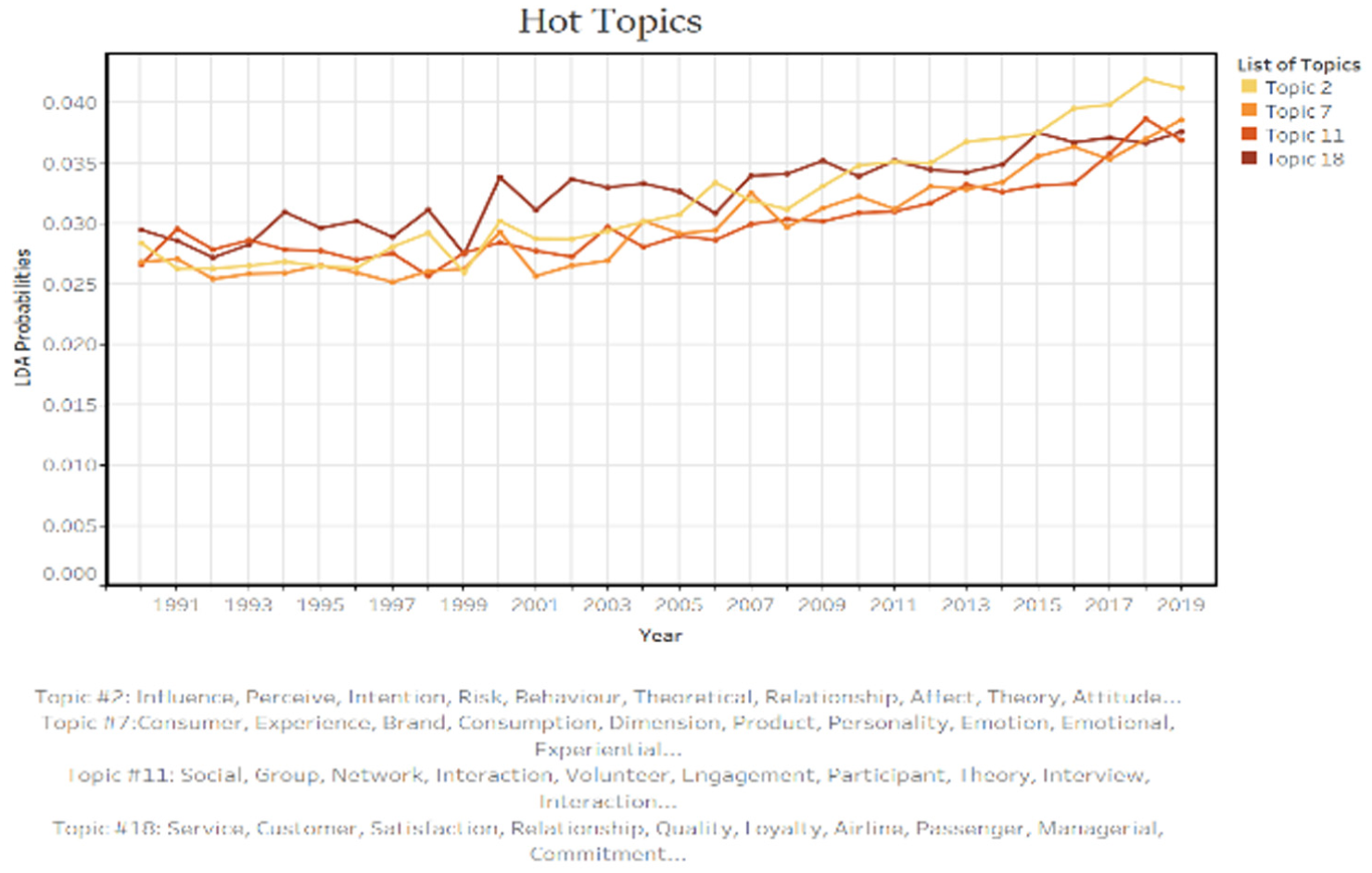
Four hottest topic distributions over time based on popularity metric (HCt).
The coldest topics are Topics #6, #16, #23, and #24, which correspond to marketing strategy in tourism, ecotourism, tourism and economic growth, and the economic contribution of the cruise industry within the Australian tourism sector. The hottest topics are Topics #2, #7, #11, and #18, which correspond to a diversity of trending topic areas and research themes, such as the level of risk perception among tourists and the influence of risk-taking attitudes on tourists’ behavior, consumer experience tourism, and brand bonding, social media networking, and customer service satisfaction and loyalty programs in the airline industry. In general, the trends and topic proportions associated with traditional concepts and research areas in tourism are decreasing, such as marketing strategies in tourism research and the relationship between tourism and economic growth. Conversely, there is a growing emphasis on topics such as consumer behavior research, risk-perceptive behavior exercised by tourists, travel safety/and travel risk management factors, social networking, and improving various dimensions of customer service and satisfaction levels within the airline services industry.
To effectively illustrate vocabulary changes over time, we analyzed the dominant topics (top 4) for each year and aggregated them to identify the dominant topics in three decades: 1990 to 1999, 2000 to 2009, and 2010 to 2019. We then examined how topics emerged, persisted, or disappeared across these decades. Table 3 presents this analysis.
Evolution of Dominant Topics over Time.

As shown in Table 3, some dominant topics became less prominent in later decades, indicating shifts in research focus. For instance, Topic 5, which addressed regional climate change and wine tourism, and Topic 16, related to ecotourism, were no longer dominant after 1999. Similarly, Topic 6, which covered marketing communication and business strategy, lost prominence after 2009. On the contrary, new topics, such as Topic 2 on risk management, Topic 7 on customer experience, Topic 8 on spatial analysis, Topic 11 on social networks and volunteer tourism, and Topic 18 on customer service and the airline industry, gained importance during the 2010 to 2019 period. These shifts align with broader trends in the field, as evidenced by the topics that gained or lost popularity over the years, as shown in Figures 7 and 8.
Next, based on the dominant topics from each decade, we aggregated the key vocabulary associated with these topics. This allowed us to identify unique words that were specific to each decade. Table 4 presents this word-level analysis, helping to track the evolution of terminology and research interests over time. The period from 1990 to 2000 emphasized education, sustainability, and climate-related terms, such as ‘student, program, ecotourism, education, and climate,…’ Between 2000 and 2010, research shifted toward tourism experience and travel-related terms, including ‘museum, traveler, decision, attraction, destination, transport, …’ The decade from 2010 to 2019 showed a growing focus on consumer engagement, digital transformation, and branding, with keywords such as ‘airline, service, brand, engagement, customer, network, loyalty, experiential, trust…’ These findings highlight the evolving landscape of tourism research, reflecting changing industry priorities, technological advancements, and consumer behaviors.
Unique Words in Each Decade Based on Dominant Topics.

Topic Distributional Behavior Among Journals
To further distinguish the main themes and topics among different journals to enhance research question 1, we visualize the aggregated topic distributions amongst each of the respective journals in Figures 9 to 11. The X-axis indicates the list of cited journals, whereas the Y-axis represents the list of major topics associated with each journal. In some cases, the frequency ranges ‘peak,’ indicating instances where journals contribute a larger percentage of concentration (i.e., research interest) toward specific topics. This analysis reveals that different journals tend to emphasize different research themes, reflecting certain journals may consistently prefer or prioritize specific topics.

Journal topic distributions (Topics #1–10).

Journal topic distributions (Topics #11–20).

Journal topic distributions (Topics #21–30).
As an example, for the Journal of Hospitality and Tourism Management, we find that there is a substantive frequency percentage count toward Topic #28 (see Figure 11) on green hotel/restaurant management and various impacts on firm performance: ‘performance, hospitality, hotel, green, restaurant, industry, financial, firm, management, corporate…..’Visitor Studies was found mainly to concentrate on Topic #16 (See Figure 10), ecotourism and its implications within higher education/student program curriculums: ‘ecotourism, knowledge, education, program, student, work, training, opportunity, professional, report, ….’ Additionally, the Journal of Hospitality and Tourism Research was found to pay special attention toward the Topic #18: Customer service satisfaction and loyalty in the airlines industry: ‘customer, service, satisfaction, relationship, airline, loyalty, quality, trust, influence, passenger….’
Based on the distributive spread of expected topic proportion values amongst various journals, we can define and categorize generative probabilistic instances wherein particular journals focus on specific topics of interest. Because of this, we not only observe instances in which journal topics are widely distributed, but we also find additional support to suggest that journals exhibit sparse patterns in topical foci, and thereby focus on a set of specific research topics. Table 5 presents a summary of topic distribution proportions across each of our respective journals. The results are consistent with our journal topic distribution analysis presented in Figures 7 to 9. For example, within Annals of Tourism Research, there is more emphasis attributed to Topic #13 (cultural and ethnic tourism), with the highest reported probability (.05217). Whereas on the other hand, the lowest reported topic distribution value for Annals of Tourism Research, is centered around Topic #28 (green or sustainable hotel and restaurant management practice effects on financial firm performance). Similarly, within Tourism Recreation Research, the most reported topic is found to be Topic #30 (emerging issues in academic tourism), with the highest reported probability of .0481. Whereas Topic #18 (customer service satisfaction and loyalty in the airline industry) is reported to have the lowest thematic importance, with a probability of .02286. The topics with the highest probability of being the most popular within the corresponding journals, reflecting areas of significant interest and research activity within those publications. Conversely, the lowest probability topics suggest that the journal explicitly includes research in relatively rare or less explored areas, implying the tendency of journals to concentrate on specific sets of research topics and showing editorial or thematic preferences. By understanding these patterns, researchers can gain insights into the editorial priorities of journals and make informed decisions regarding the submission and dissemination of their work. Furthermore, this awareness contributes to a deeper understanding of the scholarly landscape, which helps identify gaps and opportunities for further exploration within academic discourse. Thus, based on the summary of topic distributions (topics with highest vs. lowest probability) presented across each journal, we report and identify instances where specific journals tend to prioritize certain topics of interest over others.
Summary of Topic Distribution over Journals for Each Journal.

We also examine the similarities among the journals to gain insights into the thematic relationships and potential overlaps between different publications. The approach involves clustering each pair of journals based on topic similarity and shared topic foci across journals, considering shared distance and mutual coverage among topics. The similarity groupings among representative tourism journals—based on Euclidean distance—are then visually expressed through ‘Dendrograms’ to cluster each of them using Hierarchical Clustering (Contreras & Murtagh, 2015). A dendrogram is a diagram that illustrates the hierarchical relationship shared between various objects (Caliński, 2005). In our case, the objects represent our list of journals. The height of the connecting links/branches (i.e., the clade) serves as an important ‘goodness-of-fit measure’ for assessing the closeness of objects represented within the dendrogram (Mérigot et al., 2010). In essence, a smaller branch height between connecting objects would suggest a higher degree of similarity, whereas larger distances would indicate a larger dissimilarity in topic foci between journals, and therefore, their relationship would not be labeled as close-knit on the dendrogram.
As shown in Figure 12, several clusters of journals share similar research interests, as indicated by the dendrogram. For instance, we can clearly identify several pairs of journals with small Euclidean distances, indicating close-knit relationships. For example, the Scandinavian Journal of Hospitality and Tourism and Annals of Tourism Research are grouped in the orange cluster, with an Euclidean distance of around 0.03. The pair of both the Journal of Hospitality and Tourism Management and the Journal of Hospitality and Tourism Research in the green cluster, with a distance slightly over 0.03. The Tourism Analysis and International Journal of Tourism Research form a particularly close pair in the red cluster, with a distance of just 0.01. Visitor Studies and Event Management appear in the blue cluster with a distance of around 0.13. However, it is worth noting despite their internal similar research interests with each other, this pair has one of the greatest distances from other journals in the set, suggesting that Visitor Studies and Event Management have unique and separate areas of focus compared to other journals in the set.

Hierarchical clustering of journals based on measures of topic similarity.
Temporal Topic Distributional Behavior Among Journals
We aggregated temporal topic distributions for each respective journal to show dominant topics in each journal through time to address research question 2 further. The results are shown in Figures 13 and 14, which show each journal’s top five dominant topics. This indicates the temporal distributional behavior of journal topics, illustrating how the dominance of key themes evolves over time. Interestingly, there are instances where some journals expressed an overlap in topics of interest. For example, the Journal of Hospitality and Tourism Management mainly covered Topics #2, #16, #18, #28, and #30. Similarly, the dominant topics expressed in the Journal of Hospitality and Tourism Research were Topics #2, #10, #16, #18, and #28. As such, the significant convergence of mutual topics of interest shared between the two journals could explain their closely clustered relationship as displayed on the dendrogram (see Figure 12). On the other hand, the dominant topics from Visitor Studies (Topics #4, #10, #16, #17, #30) and Event Management (Topics #9, #11, #12, #22, #30) only share one topic and are distinct in others. This confirms that while these journals may exhibit some similarities, they each have separate focus areas.

Temporal topic distributional behavior among journals (top five topics of each journal are presented).

Temporal topic distributional behavior among journals (top five topics of each journal are presented).
The journal temporal variation analysis revealed instances wherein certain topics had grown considerably within particular journals. For example, Topic #22, which is about research in event tourism is a central topic of interest for the journal Event Management. Similarly, Topic #1 which relates to environmental conservation and disaster management in tourism, and Topic #12 which is about environmental governance and sustainability policy planning in tourism research, have become two central topics of importance within the Journal of Sustainable Tourism (see Figure 13). Moreover, there are patterns of temporal anomalous behavior amongst representative/dominant topics within journals. We define our understanding of anomalous behavior as observed instances where certain topics within a particular journal suddenly receive a sharp transition in topical focus and, therefore, become more prominently referenced during that period of time. For example, the Journal of Sustainable Tourism had a sharp transition in the year 1999, wherein Topic #12: (Government planning/environmentally sustainable development policy) suddenly received a lot of priority and prominence during the journal’s publication history at that time. We traced the publication metadata for that particular journal during the observed time period of reference and noticed that 1999 was a special year that focused on the topic of sustainable development policy and environmental management in the tourism industry. In fact, several special issue papers were published to address growing academic interests in the topic at that time (see Bahaire & Elliott-White, 1999; Holden, 1999; Parker, 1999; Ritchie, 1999; Robinson, 1999; Sindiga, 1999; Tyler & Dangerfield, 1999). As a result, keywords and phrases such as ‘sustainable, development, policy, ecotourism, government, resource, collaboration, governance, sustainability, planning…’ were heavily referenced among the papers published during the 1999 issues. Thus, since Topic 12 also contained several semantically related keywords, ‘environmental, management, sustainability, policy, governance, planning, conflict, resource, development…’ the thematic importance of Topic 12 became more substantially referenced as growing academic research interests influenced the development of the topic during that period.
Discussion and Conclusion
Main Findings
Growth and Thematic Scope of Tourism Research
We investigate a 30-year span of tourism research (1990–2019), focusing on publications prior to the COVID-19 pandemic, across 20 top-tier journals in the field. Our findings reveal a substantial and steady increase in tourism research output over the past three decades, indicating the field’s growth and increasing academic recognition. This upward trend has become especially significant since 2012. Using Latent Dirichlet Allocation (LDA) topic modeling, we identified 30 distinct topics that span a wide range of interconnected subfields. Many of these topics exhibit a clear multidisciplinary nature, drawing on areas such as economics, environmental science, marketing, public policy, health, and technology. The most commonly discussed themes, based on keyword analysis, relate to (1) research and methodology, (2) geography and environment, (3) economics and policy, (4) marketing and business, and (5) information and data. In addition to these core areas, several specialized or emerging topics were also identified, including health tourism (Topic #14), risk and safety (Topic #2), gender equality (Topic #19), and event tourism (Topic #22).
Summary of Temporal Trends in Topics in Different Decades
To track the evolution of research themes over time, we conducted a temporal analysis of each topic and identified several significant trends across the three decades.
A number of topics showed significant increases, particularly Topic #2 (risk perception and behavior), Topic #7 (consumer experience and brand bonding), Topic #11 (social networks and volunteer tourism), and Topic #18 (customer service satisfaction and the airline industry) all of which became dominant themes during the 2010 to 2019 period.
In contrast, some topics showed a clear decline or failed to remain dominant within tourism research over time. For example, Topic #16 (eTourism) and Topic #6 (marketing communication and business strategy) declined steadily and were no longer dominant themes by the second decade (after the 2000s) and the third decade (after the 2010s), respectively. Topic #24 (Australian cruise activity) also exhibited a consistent downward trend throughout the study period. These topics are considered among the ‘coldest,’ reflecting a decrease in scholarly attention.
Interestingly, certain themes remained relatively stable across all decades. For instance, Topic #23 (tourism and economic growth) persisted as a consistent focus, indicating sustained interest in tourism’s role in macroeconomic development. Similarly, Topic #12 (sustainability development and environmental policy) and Topic #20 (tourism demand forecasting and explanatory variables) remained moderately active throughout the study period, suggesting their long-term importance within the research community.
Overall, the thematic emphasis in tourism research has evolved significantly over time—shifting from early focuses on education, ecotourism, and climate change in the 1990s, to travel decision-making and cultural experiences in the 2000s, and more recently to consumer engagement, branding, loyalty, and digital transformation in the 2010s. These evolving priorities reflect broader societal changes, technological advancements, and the dynamic nature of traveler behavior.
Summary of Journal-Level Insights
We also examined the prominence of topics within individual journals. Our topic modeling and hierarchical clustering (Figure 12) reveal both specialization and thematic overlap, allowing us to group journals with shared topical interests while also highlighting their unique focuses. Based on Figure 12, we summarize the following:
Visitor Studies emphasizes Topic #4 (visitor attraction) as a long-term dominant theme, with Topic #16 (etourism) gaining prominence over time. In parallel, Event Management is centered on Topic #22 (event tourism), with a strong and consistent focus. These journals collectively support research related to visitor engagement, digital tourism, and event-based experiences.
Journal of Vacation Marketing, Journal of Travel and Tourism Marketing, and Journal of Destination Marketing and Management share a common focus on Topic #9 (market segmentation analysis), Topic #18 (customer service satisfaction and airline industry), and Topic#21 (destination image). These journals provide opportunities for the publication of studies on consumer targeting, service quality, and destination branding.
Tourism Analysis, Journal of Travel Research, Tourism Management, and Tourism Economics all emphasize Topic #20 (tourism demand forecasting and explanatory variables). Tourism Management and the International Journal of Tourism Research also increasingly focus on Topic #2 (risk perception and behavior). Additionally, the Asia Pacific Journal of Tourism Research focuses on Topic #18 (Customer Service Satisfaction), which is receiving growing attention. Tourism Economics further stands out by integrating Topic #23 (tourism economy and growth) into its scope, highlighting its expanding focus on economic performance, and industry dynamics. Together, these journals form a comprehensive outlet for research that spans from forecasting and travel analytics to behavioral modeling and economic development. Complementing the demand-focused journals, Tourism Management Perspectives highlights Topic #12 (sustainable development and environmental policy), while Current Issues in Tourism emphasizes Topic #29 (island tourism and economic development). These journals reflect growing attention to sustainability, governance, and regional planning within tourism.
Journal of Hospitality and Tourism Management and Journal of Hospitality and Tourism Research both focus on Topic #28 (green hotel and restaurant management and firm performance). While the former has maintained a steady interest in this topic, the latter has shown a slight decline in interest. These journals are key venues for research on sustainability practices within the hospitality sector.
A final group of journals highlights themes of sustainability, culture, regional change, and emerging issues. Journal of Sustainable Tourism leads with Topic #12 (sustainable development and environmental policy), while Annals of Tourism Research and Tourism Geographies emphasize Topic #13 (cultural and ethnic tourism). The Scandinavian Journal of Hospitality and Tourism contributes through Topic #5 (regional climate change and wine tourism), and Tourism Recreation Research focuses on Topic #30 (academic tourism). These journals support a broad range of work addressing culture, identity, regional adaptation, and innovative directions in tourism research.
Future Research Theme Recommendations
Based on our previous findings, we recommend the following research topics for future exploration:
Focus on Interdisciplinary Innovation in Tourism
As tourism increasingly draws from multiple domains, there is a need to systematically map how different disciplines contribute to innovation in tourism. This might suggest an exploration of the intersections of technology adoption, data science, behavioral economics, and policy design, as well as how these interactions influence both academic and industry practices. These frameworks can be utilized to address complex societal challenges, including global mobility, sustainable development, and crisis resilience related to tourism (Gühnemann et al., 2021; Ketter, 2022).
Focus on Popular and Significant Topics and Their Integration
From our analysis, we found risk perception, consumer experience, brand bonding, social networks, and customer service satisfaction have attracted increasing scholarly attention. Moreover, economic growth, sustainability and policy, as well as tourism demand forecasting, have maintained a steady focus over time. Therefore, future research can especially investigate these themes through interdisciplinary integration. Specific research directions can be:
Researchers could investigate the risks associated with social networks in tourism, such as privacy concerns or misinformation, driven by user-generated content. Understanding the long-term effects of these changes can be beneficial, particularly in an era where travelers rely heavily on digital platforms for information, planning, and social validation (Armutcu et al., 2023) and their expectations continue to evolve in a digital-first world (Dubey & Guleria, 2025).
Another promising direction is to develop integrated models that capture the relationships between risk perception, brand trust, and social validation. These models could be particularly useful in high-uncertainty contexts, such as post-disaster recovery or special event tourism, helping businesses better understand how external events affect traveler behavior and how to restore or maintain customer trust and loyalty in uncertain times (Sobaih et al., 2025).
Future research could focus on integrating sustainability policies with technological innovation, examining how digital tools and social media can help destinations adopt greener practices and communicate environmental responsibility to tourists.
Revisiting ‘Cold’ Topics
Some topics, such as marketing communication, business strategy and e-tourism, have seen a decline in scholarly attention in recent years. However, these areas should not be simply overlooked, as they may have evolved or integrated with other research topics.
A potential research direction is to investigate how traditional marketing communication strategies have evolved in response to the rise of social media and digital platforms. Specifically, scholars could examine how e-tourism platforms have incorporated emerging technologies, such as mobile apps, virtual reality (VR), augmented reality (AR), and real-time data integration to enhance user experiences and improve destination marketing (Leung, 2022).
Journal-Specific Suggestions for Paper Submissions
For research on visitor attraction or e-tourism, Visitor Studies is the primary journal, with Event Management as an alternative, given their shared focus on visitor experiences and event-based tourism.
The Journal of Vacation Marketing is the go-to for tourism marketing, consumer satisfaction, and destination branding, with alternatives like the Journal of Travel and Tourism Marketing and Journal of Destination Marketing & Management for related topics.
For tourism demand forecasting or economic development in tourism, Tourism Analysis and Journal of Travel Research are ideal choices, with Tourism Economics and Tourism Management also suitable due to their thematic similarities.
The Journal of Sustainable Tourism is the top journal for research on sustainability, environmental policy, and climate change. Tourism Management Perspectives is a great complementary venue, particularly for research on sustainability and tourism development policies. For research on regional climate change and local tourism adaptation, the Scandinavian Journal of Hospitality and Tourism is recommended.
The Journal of Hospitality and Tourism Management and Journal of Hospitality and Tourism Research are suitable for research on sustainability practices, especially within the hospitality sector.
Implications for Research and Practice
The findings of this study have significant implications for both tourism research and industry practices.
For researchers, identifying key topic areas helps scholars better understand and define the evolving academic landscape of tourism research. This can assist researchers in understanding and disseminating the predominant inter-topic research areas found in the literature, as well as highlighting which topics might need further investigation. While certain topics, such as customer experience, brand bonding, and destination images, have shown steady growth over time, others, like marketing communication, business strategy, and ecotourism, initially gained popularity before stabilizing. This suggests that researchers can focus on topics that build on steadily growing topics while exploring innovative angles in mature fields. For instance, topics like digital transformation and sustainable tourism could offer new perspectives by integrating them with existing research on consumer behavior or destination branding, which continues to grow in prominence. Additionally, journal-level insights and temporal variations in topic emphasis enable researchers to strategically target journals most closely aligned with their work, therefore improving their chances of publication success. For example, if a researcher focuses on sustainability in tourism, journals such as the Journal of Sustainable Tourism or Tourism Management Perspectives would be ideal venues, as they have consistently engaged with these topics over time. Journal editors can benefit from our study when considering strategies for their journal’s aims and scope. For instance, the journal editorial committee could leverage the obtained journal topic distribution trends as a means for ‘knowledge discovery and dissemination,’ thereby fine-tuning the scope of topics presented in their journals. Additionally, editors can utilize these insights to create special issues centered on trending or underexplored topics, hence promoting innovation within the academic community.
For practitioners, the insights from this study can inform strategic decision-making and assist in industry planning. For example, the growing emphasis on sustainability in tourism, as identified in the research, can guide businesses and policymakers in creating eco-friendly tourism offerings that align with the increasing demand for sustainable travel options. Additionally, the focus on customer service satisfaction in recent studies can help businesses in the hospitality sector improve their service quality, resulting in enhanced customer retention and a stronger brand reputation. The growing interdisciplinary nature of tourism research, identified in our analysis, also promotes cross-sector collaboration, encouraging businesses and policymakers to work together to address the complex challenges facing the tourism sector. For instance, combining research on economic growth, sustainability policies, and digital transformation can enable tourism destinations to develop more resilient and sustainable strategies in response to global challenges like climate change and crisis events.
Limitations and Conclusion
The basic LDA model utilized in the current study considered all identified topics and research themes as static variables and, therefore, did not capture the evolutionary and dynamic nature of each individual topic, as this is beyond the scope of the current study. Future research may attempt to capture the evolutionary nature of each topic by utilizing more sophisticated topic models, for example, the author-based topic modeling techniques proposed by S. Jung and Yoon (2020) or the Temporal-Author-Topic (TAT) approach (Daud, 2012). Another limitation of LDA is that it relies on word co-occurrence rather than contextual meaning, which can lead to the clustering of studies with similar terminology but different research contexts. For example, a topic labeled ‘Tourism Policy’ may group together studies analyzing government policy frameworks with studies surveying public attitudes toward tourism policies simply because both frequently use terms like ‘policy,’‘regulation’, and ‘governance.’ However, the first type of research focuses on policy formulation and implementation, while the latter examines public perception and acceptance of policies. Since LDA does not capture semantic relationships or sentence structure, it struggles to differentiate between these distinct research contexts, leading to potential misclassification and interpretation challenges. Furthermore, as LDA assigns probabilities of topic membership to each document, some overlap between themes is expected. This may lead to overlap keywords between closely related topics. Future research can enhance LDA’s effectiveness through model modifications. For instance, incorporating context-aware models such as word embeddings (e.g., Word2Vec, BERT) can help analyze semantic relationships rather than relying solely on frequency-based clustering. This hybrid approach would better distinguish topics by capturing conceptual variations within research themes, improving theme accuracy and interpretability. Given its flexibility and adaptability, LDA can be applied to tourism research to further explore dynamic changes in traveler behavior by analyzing user-generated content from social media and online reviews to track evolving tourist expectations and preferences. Additionally, LDA can be used to examine the role of digital platforms in destination marketing, identifying key themes in traveler discussions, sentiment trends, and engagement patterns. These applications demonstrate LDA’s potential to uncover emerging trends in tourism discourse and inform data-driven decision-making in the industry. Future work can also adopt a mixed-methods approach by integrating qualitative analysis with our quantitative framework, allowing for a more comprehensive and context-rich understanding of research themes and their development within the tourism literature.
In addition, while our study adopts abstracts as the primary unit of analysis—given their concise summary of key elements such as research objectives, findings, and thematic focus—we acknowledge that abstracts may not fully capture the theoretical depth, methodological detail, or contextual richness found in full-text articles. Full-text analysis can be incorporated to enhance the depth, interpretability, and contextual understanding of thematic insights in tourism literature.
While our approach prioritizes research integrity and data quality by including 18,725 abstracts from 20 leading tourism journals, it may not fully capture the knowledge produced across different formats and disciplines. We acknowledge the potential bias in our journal selection, as we focused solely on tourism journals and may have excluded relevant work from related fields such as marketing, geography, sustainability, and public health. We also limited our analysis to English-language publications, which may exclude valuable insights from non-English research communities. Additionally, by excluding gray literature—such as industry reports, government publications, and conference proceedings—we may have missed practice-oriented insights on emerging issues like crisis management, technology adoption, and tourism policy responses. In future work, we plan to expand the scope to include interdisciplinary journals, non-English studies, and selected gray literature. Additionally, we aim to employ causal inference techniques or event-based analyses to examine direct linkages between global events and tourism research trends, thereby offering a more diverse, inclusive, and comprehensive understanding of the evolution of tourism research. Furthermore, variations in research quality may exist across journals due to differences in citation rates, editorial policies, or methodological practices. Future studies could incorporate bibliometric indicators—such as h-index, citation counts, article-level metrics, journal scopes, and the presence of special issues—to more precisely assess how these differences in journal quality may influence the thematic composition, visibility, and overall impact of tourism research. Moreover, in our study, we intentionally excluded publications from 2020 onward to avoid potential distortions in identifying long-term research trends, given the disruptive impact of the COVID-19 pandemic. In future research, we plan to incorporate more recent publications and conduct a comparative analysis with pre-COVID-19 studies to explore how the pandemic has influenced tourism research. This comparison will help determine whether COVID-19 has led to significant shifts or transformations in research focus and scholarly discourse within the tourism field. A comparative analysis with other disciplines—such as management, environmental studies, or cultural studies—incorporating variables like co-authorship patterns, funding acknowledgments, and the geographic distribution of research contributions can also be valuable for understanding how collaboration, institutional support, and regional context influence the development of research themes.
Footnotes
Acknowledgements
Not applicable.

Ethical Considerations
There are no human participants involved in this article, and as such, informed consent is not required.
Consent to Participate
Not applicable.
Consent for Publication
Not applicable.
Author Contributions
Yazwand Palanichamy: Conceptualization, Methodology, Data Curation, Writing – Original Draft. Mehdi Kargar: Supervision, Writing – Review & Editing, Project Administration. Zhibin Lin: Supervision, Formal Analysis. Xingwei Yang: Visualization, Validation, Writing – Review & Editing, Corresponding Author.
Funding
The authors received no financial support for the research, authorship, and/or publication of this article.
Declaration of Conflicting Interests
The authors declared no potential conflicts of interest with respect to the research, authorship, and/or publication of this article.
Data Availability Statement
The data supporting the findings of this study are available from the corresponding author upon request.