




Abstract
Electronic peer feedback (e-PF) has offered a number of benefits to English as a foreign language (EFL) students’ academic writing competence and reflective thinking. However, little research has been conducted to examine whether e-PF can be incorporated in Confucian heritage culture (CHC) contexts. With a sample of 40 Vietnamese university students, the purpose of this study was threefold: (a) to explore whether e-PF improved students’ global and local features of EFL academic writing; (b) to investigate whether e-PF provoked students’ reflective thinking; and (c) to determine whether the two core principles of Confucian values, namely, the concept of face and power distance influenced the implementation of e-PF. Data were collected through pre- and post-questionnaires, e-PF content, and reflective logs. The qualitative and quantitative results showed that e-PF improved the quality of global and local writing aspects. Using e-PF also espoused both e-PF providers and receivers to develop reflective thinking by heightening their cognitive processes. Students were found to overcome the Confucian cultural barriers to get engaged in giving and receiving critique from their peers. The study, therefore, adds to the existing knowledge about the significance of e-PF in improving students’ writing skills and nurturing reflective thinking in CHC cultures.
Keywords
Introduction
Perceived as a powerful variable influencing learning, peer feedback enables students to improve writing capabilities and efficacies, express critical thoughts, reflect upon and build up knowledge, and accelerate deeper learning (Noroozi & Hatami, 2019; Tian & Li, 2018). This student-led learning practice is also endorsed as positive for students to take the roles and responsibilities of assessors; hence, students might attain the levels of higher-order thinking skills, particularly reasoning and argumentation (Lin & Xiang, 2019; Lu & Xie, 2019). Despite the potential benefits of peer feedback, accumulated empirical evidence has arisen a number of problems related to the hesitations of incorporating peer feedback into the instructions and learning process (Panadero, 2016; Zhao, 2018; Zhu & Carless, 2018). A key challenge lies in trust issues associated with peers’ abilities because peer comments merely highlight surface problems (e.g., idea development, essay structure) rather than yielding marked learning improvements (e.g., vocabulary richness, grammar accuracy). Students, concerning the notions of “given” and “received” in peer feedback, are doubtful about their counterparts as they do not devote serious attention and sustained efforts to build content-oriented responses. This is because there is a consensus that mixed levels of English proficiency in class influence the levels of contribution and motivation using peer feedback (Allen & Mills, 2016; Wu, 2019). Students with high proficiency feel poorly motivated due to little confidence in the comments made by low proficiency peers, whereas those with limited English abilities are insufficiently knowledgeable to rectify language problems and encounter difficulties in providing such constructive comments as higher English proficiency students expect. Consequently, students with under-developed English competence seem to be marginalized and passively take the role of receiving feedback.
To compensate for the doubts over the traditional pen-and-paper feedback, much of the literature has addressed the conversion to a digital written peer feedback thanks to the emergence of the dynamic nature and social aspect of Web 2.0 authoring tools (e.g., blogs, wikis, and podcasts) (Ma, 2019; Noroozi & Hatami, 2019; Shang, 2019; Xu & Yu, 2018). These tools have smoothened the process of creating and sharing texts, which potentially offers great opportunities for collaborative and interactive learning. Students are able to see themselves actively engaged in knowledge construction by sharing their pieces of work with a wider audience, managing their own learning, and refining what they have previously acquired through their critical reflection (Faizi, 2018). Against the face-to-face mode and paper-based feedback, e-PF not only facilitates argumentative interaction (Cheng et al., 2015; Ebadi & Rahimi, 2018; Noroozi & Hatami, 2019) but also increases the levels of validity and reliability of peer comments (Shang, 2019; Wu, 2019; Xu & Yu, 2018). E-PF creates a non-threatening environment where students with lower levels of proficiency are able to equally engage and contribute to the process of peer comments (Wu, 2019). There are no differences between lower and higher English proficiency students regarding the amount and quality of e-PF they provide to each other, which reveals that lower English proficiency students can not only offer constructive comments but also become the meditators of higher English proficiency students in their own learning process. Those with higher English levels, on one hand, reap additional benefits to improve their writing performance from making observations and comparisons with the same English-proficient peers (Yang, 2016) and become more self-regulated from their roles of reading and reviewing their peers’ pieces of work (Wu, 2019).
The effectiveness of using e-PF, however, has been questioned concerning the cultural impacts when raised in the CHC contexts (Ma, 2019; Zhan, 2019). The two core principles of Confucian values, namely, the concept of face and power distance, are regarded as incompatible with the implementation of e-PF. CHC students exhibit strong avoidance to comment and assess their peers’ work due to the fear of destroying the harmonious relationship, provoking conflicts and hurting their friends (Chiu, 2009). For example, face culture hinders the provision of negative comments to peers among Chinese students, particularly voicing criticism and expressing disagreements (Luo & Liu, 2017; Wang, 2016; Zhan, 2019). In addition, CHC students prefer and respect feedback from teachers who are deemed to have a reliable source of knowledge and absolute authority (Li et al., 2010; Pham, 2010). Their previous learning experiences with heavily teacher-driven approach erect cultural barriers in which they cannot initiate and facilitate their own learning process. Recent studies have highlighted a dearth of empirical evidence about the impacts of e-PF in English as a foreign language (EFL) writing performance with the Confucian cultural influences and called upon more attention for further investigations (Sawaya & Yokoyama, 2013; Wakabayashi, 2013).
The advent of e-PF has indeed provided the potential for reflection (Boud & Molloy, 2013; Nicol et al., 2014; Noroozi & Hatami, 2019; Xu & Yu, 2018; Yang, 2016), which is considered as a prerequisite for having deep and meaningful learning. The activities of rereading, monitoring, evaluating, and revising their own and peers’ pieces of work have not only aroused and promoted reflection but also enabled students to externalize their reflective thinking. However, growing up in an authoritarian teaching and learning environment, CHC students are characterized to prefer surface learning approach, rote memorization, and group harmony (Loh & Teo, 2017; Xu & Carless, 2017; Zhan, 2019). This has built cultural barriers for their reflective thinking practice (Zhan & Wan, 2016) that students might demonstrate their inabilities and unwillingness to get engaged in e-PF.
As writing has been a difficult skill for Vietnamese EFL students on the basis of transforming their thoughts into words and having limited exposure to writing, e-PF might be an effective instructional approach to develop students’ writing ability ranging from word usage, grammatical accuracy to sentence structure. For Vietnamese EFL teachers, integrating e-PF is potential to reduce their workload and enhance student engagement in learning because large size of class is underlined as a formidable barrier for teachers’ evaluations of student writing. In an attempt to explore the effectiveness of online peer comments using Facebook, Ho et al. (2020) find out that e-PF enhances the overall writing quality and might replace the existence of traditional paper-based feedback; however, details on how students develop their writing skills and which aspects of writing students make more improvements are not covered in the study. As Confucian intellectual content has been deeply embedded in the teaching and learning in Vietnam (Pham, 2010; Pham & Bui, 2019; Truong et al., 2017)—for example, the high social status of teachers still abundantly remains high and students prefer obeying what teachers impart without addressing questions, it is important to explore the benefits of e-PF in writing and the opportunities for reflective thinking under the influence of Confucian values.
Aims of the Study
Involving 40 Vietnamese university students, the purpose of this study was threefold: (a) to explore whether e-PF improved Vietnamese students’ writing performance, particularly global and local aspects of writing; (b) to investigate whether e-PF provoked Vietnamese students into reflection and deep thinking; and (c) to determine whether the two core Confucian aspects (i.e., the concept of face and the power distance) influenced the incorporation of e-PF. This cross-sectional study, similarly, employed mixed methods like the previous studies (e.g., Ma, 2019; Xu & Yu, 2018; Zhang & McEneaney, 2020), for instance, quantitative methods (i.e., questionnaire, pre- and post-tests) have been mixed with qualitative methods (i.e., peer comments). In addition, this study collected students’ reflective logs that they wrote during their participation in the e-PF process. This helps to profoundly understand how the reality is reflected (Fraser, 2004) and how cultures shape participants’ world (Lawler, 2002).
The following research questions (RQs) were formulated to address the afore-discussed gaps and fulfill the aims of the study:
Literature Review
E-Peer Feedback and Confucian Values in Vietnam
In Vietnam, Confucianism has exerted a long-standing influence on the society. Dao Duy Anh, a well-known Vietnamese historian and lexicographer, stated that
For more than two thousand years . . . one breathed a Confucian atmosphere, fed on the milk of Confucianism, and even died with Confucian rites . . . Nothing escaped the control of Confucian philosophy and ritual teaching. (Cited in McHale, 2002, p. 422)
In a similar vein, Dam (1999, p. 440) posits that
Regardless of the inexistence or collapse of the temples or literature or the shrines of Confucius; regardless of the disappearance of “Confucian associations,” Confucianists or “teachers of Confucianism,” the [Vietnamese] society will retain its Confucian relevance, morality, doctrine, and approach.
Confucian values, in relation to the form and content of education system in present-day Vietnam, have still remained clearly evident (Pham, 2010; Pham & Bui, 2019; Truong et al., 2017). The influence of Confucian values is found through the acquisition of information when students passively receive transmitted knowledge from their teachers and do not take initiatives in taking responsibilities for their own learning. The image of “passive, reproductive and surface” learners (Jones, 1999, p. 3) in a teacher-dominated class, consequently, has received massive criticism in the literature because they typically display quietness, shyness, and reticence, leading to the lack of expressing opinions and emotions. This leads to students’ hesitation and lack of respect for formative assessment in general and peer comments in specific (Li et al., 2010) even though the adoption of formative practice has recently gained recognition (Lee & Coniam, 2013; Wicking, 2016).
The mismatch between the benefits of e-PF and students’ attitudes toward e-PF reflects how Vietnamese students perceive face—commonly understood as their public image. Involving different processes ranging from cognition, motivation, affection to behaviors, this might explain why Vietnamese students are afraid of receiving negative judgments on their pieces of writing. This serious personal damage can demotivate how students engage in the e-PF process because they do not want to be considered as silly. Juxtaposed with their concerns about losing the individual self, Vietnamese students do not express any interests in giving peer comments or carrying out peer assessment if they are aware that their honesty in evaluation and feedback provision might hurt their friends or wreck the friendship (Nguyen, 2008; Thanh Pham, 2013). Typical collectivist classrooms in Vietnam normally witness the supremacy of the virtue of harmony, which means that it is ideal to avoid provoking conflicts, criticizing their friends, and affecting group interactions.
Furthermore, Vietnam is listed as a large power distance country in which students are not engaged in reflecting and respecting others’ point of views (Nguyen et al., 2006). The concept of power distance, defined as the extent to which individuals accept the inequalities (e.g., the teacher–student dyad), indicates students’ preferences for teacher feedback rather than valuing their peers’ views. In addition, power distance in a student–student dyad, in a study conducted in the context of China by Yu et al. (2016), can be caused by the disparity in their English language proficiency and writing abilities.
Nevertheless, recent studies have suggested conflicting views about the biases toward CHC students’ learning styles. Even though they have been probably found to be passive and obedient, they have attempted to escape from the prejudice of passively receiving information (Littlewood, 2000; Xu, 2019). Accordingly, CHC students in Littlewoods’s (2000) study argue that the passive learning is a consequence of their education context, which does not represent their inherent dispositions and the developmental process in learning. Xu (2019) shows an argument against the oversimplification of Chinese students as rote learners because they make efforts to show a higher level of reflective learning and engage with a deeper understanding of knowledge. Vietnamese students, in accordance with this change, attempt to become more engaged and demonstrate autonomy in learning when they are given these educational opportunities (Dao & McDonough, 2018; Pham & Iwashita, 2018).
E-Peer Feedback, Global and Local Aspects of EFL Academic Writing
The employment of e-PF is related to the theories of Vygotsky’s (1978) sociocultural theory (Villamil & de Guerrero, 1996), which further explains that students possess new language skills within their respective zone of proximal development (ZPD) through social interactions. The interpretation of ZPD suggests that students’ engagement in meaningful discussions with their peers (e.g., exchanging and negotiating ideas) enables them to acquire linguistic knowledge and foster writing skills (Yu & Lee, 2016). This is because “both peers may give and receive help, both peers may ‘teach’ and learn how to revise” (Villamil & de Guerrero, 1996, p. 69).
With regard to the application of sociocultural theory in computer-mediated learning, e-PF is considered as a communication vehicle facilitating the process of exchanging ideas and articulating language problems (Bradley, 2014; Chang, 2012; Saeed & Ghazali, 2017). Therefore, its emergence provides a number of benefits for the second language (L2) students to tackle both global (e.g., content development, essay organization) and local (e.g., vocabulary and grammar usage, punctuations) concerns in writing (Biber et al., 2011). However, some studies indicate different reports toward the priorities and focus of peer comments on the two mentioned aspects of writing. For example, Chang’s (2012) study reveals that the participants devote attention to vocabulary and grammar problems prior to commenting on global issues such as organization, flow of ideas, or clarity of contents, whereas students in the studies (e.g., Suzuki, 2008; Tsui & Ng, 2000) are likely to bring content and idea development into principal focus. This could be explained by students’ linguistic abilities, the strong emphasis of writing teaching and learning on local aspects (Hanjani & Li, 2014), students’ knowledge of global issues and essay topics (Liang, 2010), and the easiness in making comments on local aspects. Regardless of whether global aspects or local aspects are placed centrally in e-PF, this process is deemed to aid students in producing better piece of writing (Crossman & Kite, 2012; Lai, 2010). Without the mediation of peer comments, it may not be easy for each individual student to fully understand and improve such writing issues (Bradley, 2014; Chang, 2012; Liang, 2010).
E-Peer Feedback and Reflective Thinking
Reflective thinking is often considered as a synonym of critical thinking; however, reflective thinking places a stronger emphasis on how students get involved in making decisions and expressing their own opinions about what has happened (Schön, 2017). In particular, students are able to develop their reflective thinking skills through various activities including constructing new knowledge based on their previous understanding, adopting specific learning strategies to fulfill new tasks, and scrutinize their own ideas and thoughts.
The incorporation of e-PF espouses students to reflect upon and validate their experiences, dispel misconceptions, and bounce ideas around on a process of discovering and expanding new knowledge (Xu & Yu, 2018). Rather than passively receiving knowledge, they take the lead in their knowledge-constructing activities and become autonomous in their own learning process, whereas teachers only play the role as facilitators (Lowenthal & Muth, 2008). After searching, exploring, evaluating, and analyzing their own and peers’ pieces of work, both e-PF providers and receivers have critical overviews and accumulate more understandings of their strengths and the areas of much-needed improvements. These careful thinking actions of contextualizing thinking push them into the higher-order thinking skills and give them a direct control of their own learning process (Boud & Molloy, 2013; Ebadi & Rahimi, 2018).
For e-PF providers, this method makes students’ cognition more positive through their exposure and practice of analysis and reflection (Nicol et al., 2014; Noroozi & Hatami, 2019; Xu & Yu, 2018; Yang, 2016). By making evaluative judgments, e-PF providers need to go through the processes of having interactions with the text content, identifying any errors, regulating their thinking, comparing them with alternative suggestions, and constructing peer comments. They also articulate their thinking and understanding to consider their peers’ text quality and the assessment criteria they use to evaluate their peers’ work. In doing so, they get familiar with reflective thinking and apply what they have learnt into their critical evaluation (Ching & Hsu, 2016; Nicol et al., 2014). However, CHC students show reluctance to oppose, disagree, and criticize their peer; consequently, there is avoidance of providing critical and evaluative comments. Due to this reason, e-PF providers might make comments at a superficial level that does not facilitate their own growth of reflective thinking (Li et al., 2010).
For those receiving e-PF, effective e-PF not only generates their learning motivation but also provides them helpful guidance to identify the gaps between their own current learning abilities and their outcome expectations (Yang, 2016). From the identifications of both strengths and weaknesses in their own texts as well as the reflection on suggested concrete ideas to produce better pieces of work, they broaden and deepen their own thinking (Ebadi & Rahimi, 2018). The development of reflective thinking among e-PF receivers is facilitated when they reflect on their peers’ suggestions and make decisions on whether accepting or rejecting these revisions (Ching & Hsu, 2016; Novakovich, 2016). On the other hand, not all students place trust in the ways their peers evaluate their work (Kaufman & Schunn, 2011), particularly in CHC contexts where teachers’ comments are more valued. This can evoke negative psychological and emotional responses, reducing the engagement of learning motivation and preventing the practice of reflective thinking (Cheng et al., 2015).
Despite being acknowledged to foster reflective thinking among both e-PF providers and receivers, the endeavor to implement e-PF appears difficult because there are some cultural barriers that hinder the employment of this instructional method. This empirical study conducting e-PF activities in writing would investigate whether Vietnamese students having experiences in Confucian principles were able to develop their reflective thinking.
Based on the literature review on the benefits of e-PF on global and local aspects, and the potential opportunities for reflective thinking under the substantial influences of Confucian values (i.e., the power distance and the concept of face), the following diagram sums all of the aspects in one framework (Figure 1).

Research framework.
Method
Research Context, Participants, and Procedure
Data were collected from 40 university students (19 male and 21 female students) enrolling in an intensive International English Language Testing System (IELTS) preparation course at an English language center in Ho Chi Minh City, Vietnam. The age range of this sample varied from 18 to 25; the mean age for the sample was 21.02 years (SD = 1.475). At this language center, these students progressed through five IELTS courses with the first course corresponding to IELTS foundation and the fifth course to IELTS 6.5. The research was conducted as part of the fourth course designed for students to achieve IELTS 5.5 to 6.0. All of them had passed the previous course prior to participating in this course, which meant that they were of intermediate proficiency (Common European Framework of Reference for Languages level B1).
This 15-week course was offered in a combination of both offline learning (4 hours per week in class) and online learning (2 hours per week via Skype). The online learning focused only on writing skills to provide more opportunities for the mastery of IELTS writing tasks 1 and 2. Concerning IELTS writing task 1, the lessons on Skype were the extensions to supply in-depth instructions on analyzing and reporting data related to graphs (i.e., bar graphs, line graphs, tables, and pie charts), process diagrams, and maps. In a similar vein, the online lessons covered five different types of essays in IELTS writing task 2 including discussion, compare and contrast, opinion problem and solution, and two-part question (Figure 2).

Research design and online course content.
Prior to embarking on the course, they sat for a pre-writing test including tasks 1 and 2. On the fifteenth week, a post-writing test in both two tasks was also administered in class. The instructor was not involved in marking pre- and post-writing tests to avoid any biases and ensure the reliability of writing scores. Two independent teachers were then invited to evaluate the writing performance of the participants. These two teachers were native speakers of Vietnamese, getting IELTS 8.5, and having experiences in teaching IELTS as well as marking students’ writing essays for more than 5 years. Participants, upon the completion of each online lesson, were required to submit a weekly journal and post it on Google Docs. The rationale behind the selection of Google Docs for writing practice and e-PF activities is that this digital tool facilitates peer editing and allows students to edit their documents simultaneously and receive immediate e-PF (Alharbi, 2019). They were also asked to provide e-PF to other three peers. As the lessons were delivered weekly, participants normally had 2 or 3 days to complete their pieces of work, 2 or 3 days to get involved in the provision of e-PF, and 1 or 2 days to reflect upon their writing performance (Figure 3).

The process of e-PF.
Every 2 weeks, they produced a personal reflective essay and uploaded on Google Docs. Also called as reflective journals, these reflective essays are “written documents that students create as they think about various concepts, events, or interactions over a period of time for the purposes of gaining insights into self-awareness and learning” (Thorpe, 2004, p. 328). The incorporation of reflective essays helped these Vietnamese students to self-reflect and voice their opinions on any strengths, weaknesses, skills, problems, and outcomes they would identify during the e-PF process.
Training Procedure for e-PF
The successful incorporation of e-PF, to a great extent, depends on whether students are able to make judgments on their peers’ pieces of writing; therefore, training is a prerequisite for the valuable e-PF process (Alharbi, 2019; Shang, 2019; Q. Xu & Yu, 2018). As participants were not familiar with e-PF activities, they were required to undergo training under the teachers’ instructions at the beginning of this IELTS course. The training aimed to fulfill three goals: (a) providing a comprehensive explanation for the IELTS assessment criteria, (b) introducing steps for assessors to provide peer comments on their partners’ essays and for assessees to reflect upon and identify their strengths and weaknesses, and (c) highlighting the differences between global and local aspects of writing.
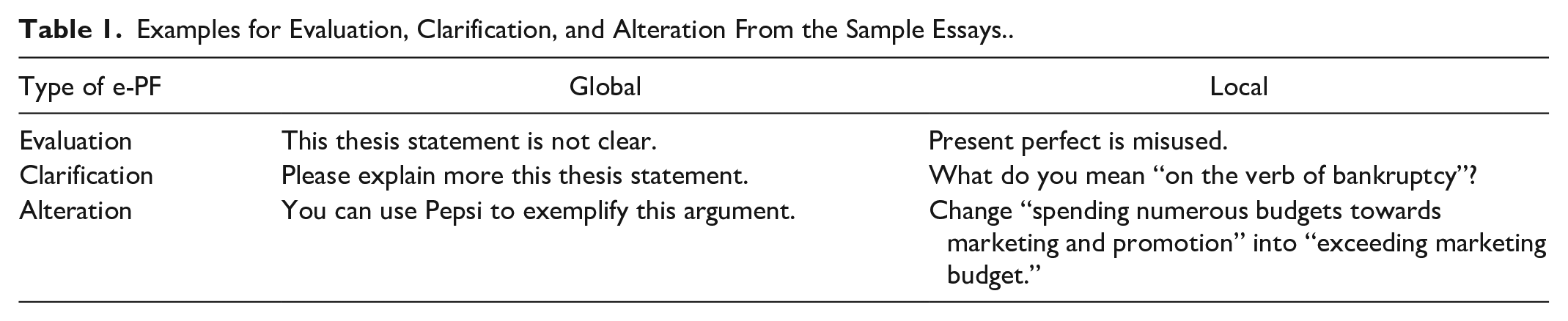
In the first week, explicit guidance was provided to participants on Skype to ensure that they fully understood how their IELTS writing tasks 1 and 2 were assessed related to the global (i.e., task achievement, coherence, and cohesion) and local (i.e., lexical resource, grammar range, and accuracy) aspects of writing. They were encouraged not to focus on local aspects merely, but also on global aspects. The training session, furthermore, introduced and underlined the differences in three types of e-PF including evaluation (evaluating whether the writing features are good or bad), clarification (asking for further explanation and justifications), and alteration (giving specific changes). Then, students were given two sample essays to practice providing e-PF and reflecting upon the comments they received from their counterparts (Table 1). After receiving this systematic training activity, participants were expected to acquire critical assessment skills form accurate judgments as “peer comments were frequently revision-oriented, engaging writers in clarifying intentions, reflecting on ideas, and puzzling out meanings in collaboration with peer reviewers” (Min, 2008, p. 301).
Examples for Evaluation, Clarification, and Alteration From the Sample Essays.
Instruments and Data Analyses
Several sources of data were collected in the study: students’ writing scores through pre- and post-writing tests, pre- and post-questionnaires on students’ perceptions of e-PF, the e-PF content, and reflective logs.
Regarding the writing tests, the two independent raters marked 160 IELTS essays including tasks 1 and 2. Students’ scores were then computed to obtain descriptive data, Pearson’s bivariate correlations for all variables (pre-writing task 1 as PT1, pre-writing task 2 as PT2, post-writing task 1 as ET1, and post-writing task 2 as ET2), and paired sample t-test results.
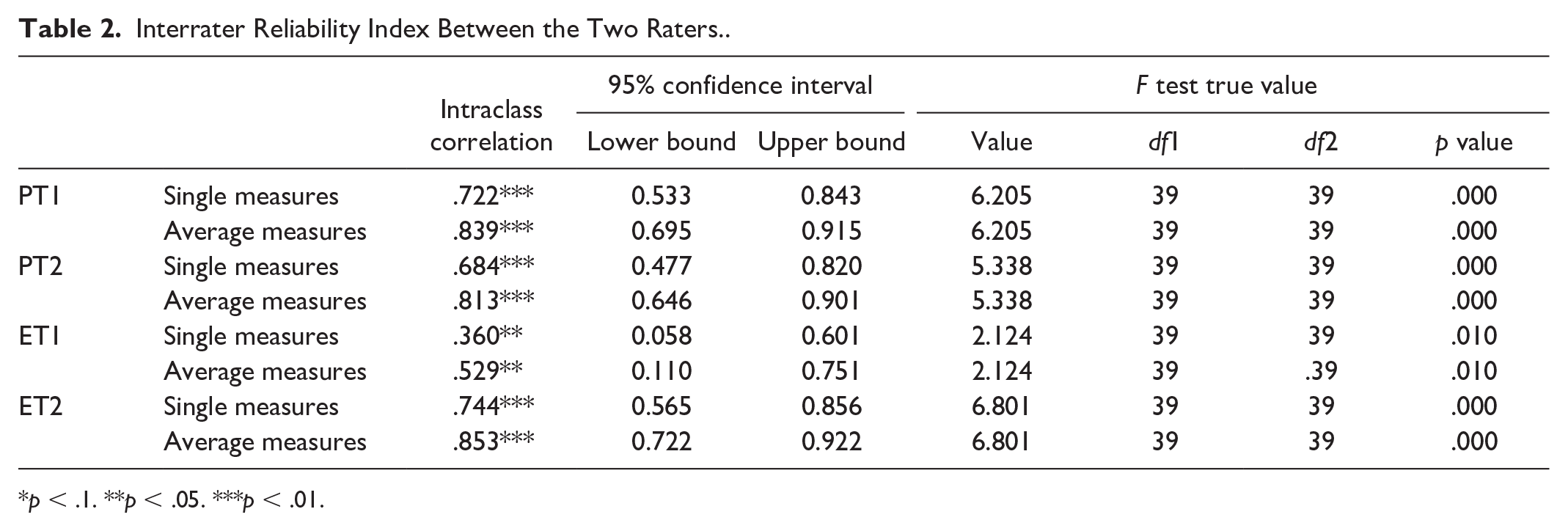
To measure the degree of similarity between the two raters, interrater reliability expressed as intraclass correlation coefficients was calculated. Table 2 reveals the intraclass correlations of PT1, PT2, ET1, and ET2: PT1 (r = .839, p = .000); PT2 (r = .813, p = .000); ET1 (r = .529, p = .010); ET2 (r = .853, p = .000). Based on these results, the ratings given by the two raters in students’ writings reached the statistically significant interrater reliability, indicating that the scoring could serve as a good source of analyzing how participants improved their writing skills.
Interrater Reliability Index Between the Two Raters..
p < .1. **p < .05. ***p < .01.
With regard to students’ perceptions toward the benefits they gained and the challenges they encountered in the e-PF process, a survey questionnaire was employed. This 5-point Likert-type scale questionnaire ranging from strongly disagree (1 point) to strongly agree (5 points) was both adapted from a previous study conducted by Altstaedter and Doolittle (2014) and self-developed by the principal investigator, focusing on how students would perceive the benefits of e-PF on global and local features of writing, the learning opportunities for reflective thinking, and the impacts of Confucian values. These 12 items also served for the purpose of collecting and identifying students’ attitudes before and after the e-PF process. The questionnaire was initially piloted with a small group of 10 students who took an IELTS course at the language center and did not get involved in the main data collection. In response to feedback from this pilot group, some questions were altered to ensure the content clarity and validity. For example, “reading my peers’ compositions will help (helped) me to understand my mistakes in writing” was changed into “reading my peers’ compositions will help (helped) me to reflect on my limitations and improve my own writing.” For another item, “providing e-PF to my peers on their writing will help (helped) me to identify my weaknesses and improve my writing” was revised from the original one “providing e-PF to my peers on their writing will help (helped) me to identify what I should practice more for my writing.” The two teachers participating in marking the essays also helped to finalize the revised questionnaire. The pre-questionnaire was sent to the participants on the day they underwent the training session, whereas the post-questionnaire was administered after the course completion. In sum, responses from 80 questionnaires were gathered back. Paired sample t-tests with equal variances were conducted on the students’ responses in pre- and post-questionnaires to compare their perceptions toward the incorporation of e-PF over time.
Concerning the qualitative analysis of e-PF content, peer comments were individually re-examined by the instructor and the two independent raters prior to being coded (i.e., global aspects of PT1 as GLO/PT1, global aspects of PT2 as GLO/PT2, local aspects of PT1 as LOC/PT1, local aspects of PT2 as LOC/PT2, global aspects of ET1 as GLO/ET1, global aspects of ET2 as GLO/ET2, local aspects of ET1 as LOC/ET1, local aspects of ET2 as LOC/ET2). They checked grammar mistakes, word choice, and structures. Then, they coded the peer comments and put them into specific categories based on the IELTS writing assessment criteria. Together the instructor and the two independent raters were in charge of double checking, suggesting changes if needed and reconciling any differences. They reached saturation when they could produce no new codes from the available e-PF content.
In terms of reflective logs, students were asked to write 100-word reflective logs every 2 weeks to report how they reflected upon e-PF, what they found interesting in their peers’ suggestions, and what they found challenging while getting involved in the process of e-PF. In total, 240 reflective logs were collected. The contents of these reflective logs were highlighted based on the following themes: global aspects, local aspects, reflection, and challenges.
Results
RQ1: What Are the Effects of e-PF on Students’ Local and Global Features of Writing?
Global aspects
Table 3 reports means, standard deviations, and Pearson’s bivariate correlations of four variables: GLO/PT1, GLO/ET1, GLO/PT2, and GLO/ET2. Regarding students’ performance in global aspects of tasks 1 and 2, the correlations among two data sets (GLO/PT1-GLO/ET1, GLO/PT2-GLO/ET2) were all related to each other: GLO/PT1 correlated with GLO/ET1 (r = 0.362, p = .022) and GLO/PT2 correlated with GLO/ET2 (r = .667, p = .000). Table 3 also reports the results of two sample t-tests with equal variances. These results revealed that students’ scores in global aspects in the two data sets (GLO/PT1-GLO/ET1, GLO/PT2-GLO/ET2) were significantly different: GLO/PT1-GLO/ET1 (t = −14.708, p = .000); GLO/PT2-GLO/ET2 (t = −14.626, p = .000), indicating that the post-test performances of global aspects in tasks 1 and 2 were higher than those of the pre-test.
Correlations and Two-Sample t-Tests in Global Aspects of Pre- and Post-Writing Tests.

p < .1. **p < .05. ***p < .01.
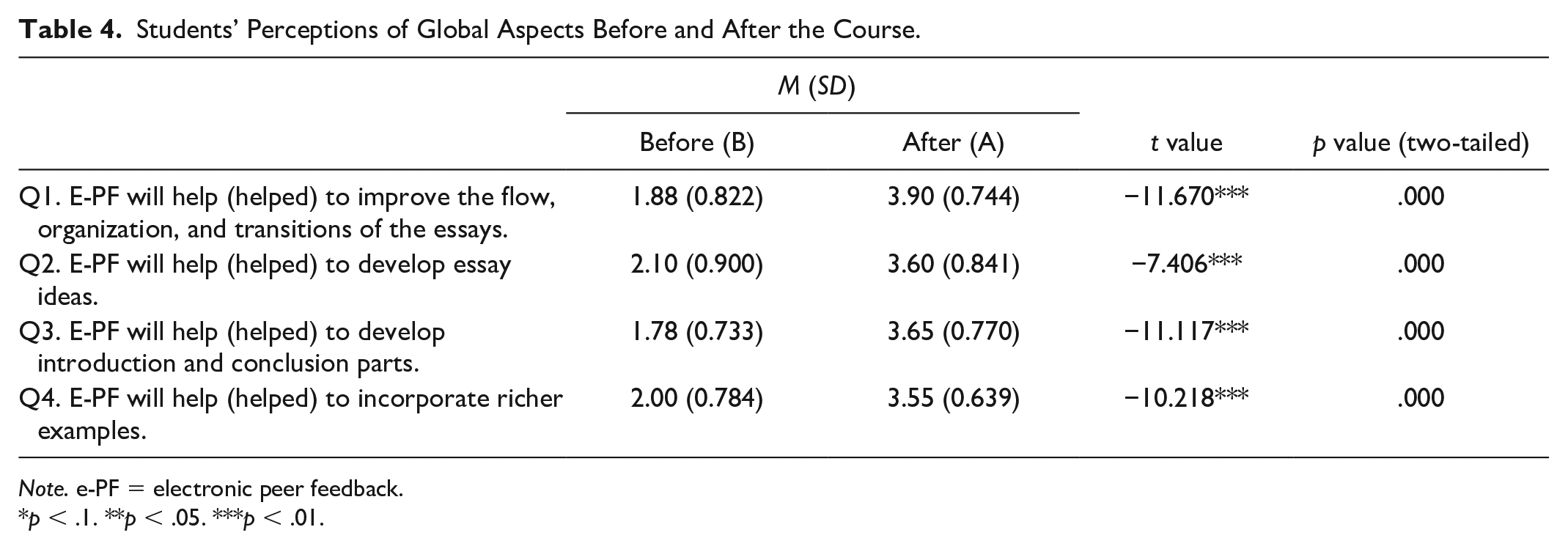
Furthermore, there were significant differences in students’ perceptions toward the four indicators of global aspects of writing (i.e., flow, organization, and transitions; idea development; introduction and conclusion developments; and richer examples) before and after the incorporation of e-PF (Table 4). From the data, it is apparent that the means for items Q1A, Q2A, Q3A, and Q4A were in the mid to high neutral range on the post-questionnaire, ranging from 3.55 to 3.90. The t-tests assuming equal variances exhibited significant differences in how students perceived the useful impacts of e-PF on global aspects between the pre- and post-questionnaires: Q1B-Q1A (t = −11.670, p = .000); Q2B-Q2A (t = −7.406, p = .000); Q3B-Q3A (t = −11.117, p = .000); and Q4B-Q4A (t = −10.218, p = .000). That is, after taking the 15-week IELTS course with e-PF practice, students agreed that their peers gave them useful comments which helped them to organize the essays, develop topics and ideas, enhance introduction and conclusion parts, and incorporate richer examples in supporting their arguments.
Students’ Perceptions of Global Aspects Before and After the Course.
Note. e-PF = electronic peer feedback.
p < .1. **p < .05. ***p < .01.
The qualitative data analysis of e-PF content and reflective logs also revealed that participants exhibited significant improvements in the global aspects of writing by giving and receiving a range of e-PF. In the first journal, a few peer comments related to global aspects were made by the assessors. Only six students mentioned organization and ideas, but their contributions seemed general. For instance,
This idea is not clear. (S10, E1)
1
You need to consider four paragraphs for this essay. (S22, E1)
In a similar vein, most of the participants were concerned with their lack of knowledge and experience in critically commenting on coherence and cohesion as well as task achievement. Consequently, students were tentative to provide e-PF on global aspects of writing at the early stage of e-PF. For example,
I even have no ideas on this topic. How could I help my friends? (S13, R1)
2
I am very bad at structuring essays and brainstorming ideas. That’s why my teachers in the previous courses told me that my essays were messy . . . To be honest, I only cared about avoiding grammar mistakes and learning more vocabulary in the previous courses. (S24, R1) It is extremely difficult to make comments on task achievement and essay structures. I am not the teacher. I am totally lost for what to do next. (S3, R1) To give my peers some ideas for their essays is not easy at all. In the first journal, I hesitated to suggest changes. I was afraid that my ideas were not better than theirs. And finally, I only focused on correcting grammar mistakes. More simple! (S17, R1)
Nevertheless, the following weeks witnessed a growing number of e-PF on global aspects rather than providing general comments. This depicted that e-PF senders made a start to making judgments, seeking justification, and suggesting changes for their peers’ performances in task achievement and coherence and cohesion. They commented,
Data interpretation about the number of rivers having good water quality is wrong. (S6, E4) Where’s your overview sentence? Take my sentence as an example: Overall, it can be seen from the line graph that three kinds of demographic trends experienced a decline during the years. (S29, E5) Introduction part with one sentence is short . . . Follow three steps to write an introduction that we just learnt: state what your essay is about, state your opinion, and outline what you are going to write? (S10, E6) Overuse the pronoun [it] to replace [university education] → Meaning is unclear! Repeat key nouns for coherence. (S27, E6) The topic sentence [Doing volunteer has several benefits] is not clear → When taking part in voluntary activities, students can gain essential skills for their resumes and future jobs. (S12, E9) To tell the changes in this map → describe how the buildings and shopping centres changed. (S22, E10) Summarise main features of line graph [visits to Disneyland and visits to Sea World] and bar graph [rides at Disneyland] before giving details for each chart. (S19, E13)
Voices raised from students’ reflective logs additionally marked gradual shifts in both e-PF senders and receivers toward their understanding and practice of global aspects. They wrote,
My friends’ ideas were unclear, so I attempted to give them my ideas for their reference. (S11, R2) The feeling of changing my friends’ ideas was not as terrible as I thought. I think they would be happy to read my suggestions. (S8, R3) I am always worried about my task 1 writing. Even though I have tried my best to learn structures and vocabulary, I could not use these structures and words logically in describing data. But my peers helped me to select relevant data, arrange them logically and report them with academic words. For example, they suggested including Sweden, France, and Canada in one paragraph because they shared a similar pattern of car thefts in the first five years. I did not think about this at first. (S36, R3) I improved writing my topic sentence. I changed my way of thinking generally when I wrote the topic sentence. My friends helped me to narrow the topic sentence. (S28, R4) I saved much time to write an introduction. My friends’ comments helped me to write a specific topic sentence. (S4, R4) I like this activity so much. I received different ideas from my friends. I wrote about the uses of robots in the future and my friends gave me more ideas of robots in medicine, militaries and dangerous jobs. I also had no ideas of negative development of robots, but later I got the idea of unemployment rate and laziness from my friends. They were so interesting. (S33, R5)
Local aspects
Table 5 reports that the scores students achieved in tasks 1 and 2 of pre- and post-writing tests related to local aspects were all correlated: LOC/PT1-LOC/ECT1 (r = .397, p = .011); LOC/PT2-LOC/ECT2 (r = .344, p = .030). Paired t-tests with equal variances, as described in Table 7, surmised significant differences in the two mentioned pairs of data: LOC/PT1-LOC/ECT1 (t = −11.281, p = .000) and LOC/PT2-LOC/ECT2 (t = −10.014, p = .000).
Correlations and Two-Sample t-Tests in Global Aspects of Pre- and Post-Writing Tests.

p < .1. **p < .05. ***p < .01.
Data from students’ perceptions toward the effectiveness of e-PF on local aspects regarding grammar, structure, and vocabulary revealed that the overall trend of three items Q5, Q6, and Q7 in the post-questionnaire was in the opposite direction compared to the pre-questionnaire (Table 6). The means for items Q5, Q6, and Q7 were all in the mid to high neutral range after the incorporation of e-PF in this IELTS course. The t-tests with equal variances further pointed out significant differences in students’ opinions about local aspects before and after the e-PF process: Q5B-Q5A (t = −9.561, p = .000), Q6B-Q6A (t = −9.104, p = .000), and Q7B-Q7A (t = −9.026, p = .000). These results demonstrated that students’ perceptions of their improvements in local aspects were much more positive. They realized the progressive development of grammar accuracy, the flexibility of using different syntactic structures, and widening more academic words.
Students’ Perceptions of Local Aspects Before and After the Course.

Note. e-PF = electronic peer feedback.
p < .1. **p < .05. ***p < .01.
The analysis of e-PF content reported positive changes in which students started evincing their intense interests in suggesting and making comments on academic words or synonyms to replace their peers’ vocabulary. For instance,
Don’t use the phrase: according to the graph. (S22, E2) Don’t repeat the word dramatic → dramatic/dramatically = marked/markedly, significant/ significantly, considerable/considerably. (S31, E5) Use skyrocket or a surge in to show the rapid increase. (S20, E5) Reveal some striking similarities. (S39, E5) Remain stable = remain static, remain constant. (S16, E5) A less competitive workforce. (S30, E6) Increase job prospects. (S25, E6) “Sharply = rapidly, exponentially,” “Clear = apparent, evident” (S13, E7) There is a decrease in the number of accident accidents in dangerous hazardous working environments. (S27, E12)
Besides the benefits in vocabulary, the qualitative changes in students’ comments on grammar were also found. Compared to the first essays, e-PF providers showed their efforts to comment on grammar and punctuation mistakes (e.g., subject-verb agreement, sentence fragments, run-on sentences, no comma in a compound sentence, definite and indefinite articles, gerunds or to-infinitive, verb tenses, prepositions):
The There are more and more people Some people think Although taking part in voluntary activities It has a significant effect Robots is are known as a product of artificial number amount of water decreased dramatically. (S17, E4)“Water increased slowly in 1997 and 1998, but it started decreased slowly later”→ “In both 1997 and 1998, there was a slight increase in the amount of poor water, but it then gradually decreased until 2002.” (S24, E4)“Car thefts in Great Britain were higher than the other three countries.” → “Car thefts in Great Britain were higher than those of other three countries.” (S7, E5)decide deciding to study at university. (S13, E6)to earn of earning more money if they can graduate from the a famous university in Vietnam; but, but this is totally a wrong idea. (S11, E6)are is a meaning meaningful activity, but some parents in Vietnam some Vietnamese parents don’t do not let their children do join. (S29, E9)to on the rapid growth of societies but the sustainable development will be threatened if human being no longer be master of them human beings are no longer their masters. (S35, E12)intelligent intelligence. (S35, E12)
In response to reflective logs asking students to reflect upon the benefits they reaped regarding local aspects, e-PF receivers succinctly pointed out:
I have got some new words from my friends, for example, economic instability, high longevity, existential threats. I noted them down, so I will try to use them in future essays. These words will make my essays more interesting and academic. (S1, R3) My friend was very helpful because she not only gave me two new words to paraphrase the sentences but also made sentences using them. Learning words in this way is effective, I think. (S11, R4) It is an effective way to learn vocabulary. When giving suggestions to my friends, I also searched new words to help my friends and make sure what I suggested was correct. I improve myself as well. (S22, R5) I made mistakes in tenses quite often, but now I make less mistakes, especially relative clauses. My friends helped me understand the ways to omit relative pronouns. (S4, R6) It is a good way to remember and practise more vocabulary, especially in task 1. I learnt a lot of academic words before but I could not use them in my essays. My friends suggested some words that were very appropriate in the context. (S23, R6) My friend gave me the word “indispensable,” so I used it to replace the word “important” in my essays. I know that vocabulary plays an indispensable role in learning English. (S36, R6)
For those responsible for providing e-PF, they also expressed that the process of making evaluation and specific suggestions related to grammar, vocabulary, and punctuation helped them widen their vocabulary repertoire and reflect on their existing grammar knowledge. They wrote,
When I read my peers’ writing, I copied the words I found useful. They had vast vocabulary knowledge. (S22, R4) My friend used inappropriate punctuation and I was not sure either. I reviewed the grammar before giving comments to my friends, which helped me improve my knowledge about punctuation as well. (S17, R5) I understand what I have to do to achieve my expected IELTS score and improve my English. My friends gave me more motivation because when I read their essays I felt really impressed with academic words they used to express ideas. (S22, R6) There is no need to read sample essays on the Internet. Reading my friends’ essays is enough for me to get more new words and new structures. (S35, R6)
RQ2: How Do Vietnamese Students Using e-PF Conceive of and Experience Reflective Thinking?
With regard to students’ attitudes toward the reflective effects that e-PF exerted on their learning before and after incorporating e-PF, the results of four items (Q8, Q9, Q10, and Q11) reported marked changes when the level of agreement rapidly increased from “strongly disagree” or “disagree” levels in the pre-questionnaire to the high neutral range in the post-questionnaire (Table 7). The t-test with equal variances further reflected statistically significant differences: Q8B-Q8A (t = −20.156, p = .000); Q9B-Q9A (t = −17.209, p = .000); Q10B-Q10A (t = −14.113, p = .000); Q11B-Q11A (t = −11.490, p = .000).
Students’ Perceptions of Reflection and Comfortability Before and After the Course.

Note. e-PF = electronic peer feedback.
p < .1. **p < .05. ***p < .01.
The qualitative analysis of students’ reflective logs, furthermore, indicated that following instructions and getting involved in e-PF generated their reflective thinking and helped them improve their own writing abilities. These can be the identifications and corrections of mistakes, the minimization of weaknesses, and the applications of peers’ suggestions for future essays. Besides the aforementioned examples of students’ reflective logs on global and local aspects of writing, more students also mentioned the reflective benefits in their essays:
In the past weeks, I worked with two excellent friends. Their writing abilities were better than mine and I admired their knowledge of vocabulary and grammar. After reading their comments, I learnt some structures and new words to describe trends in the graphs. I also spent time rewriting my essay after receiving all the comments. I corrected all the mistakes that my friends told me and used the words and structures I learnt or they recommended in my essay. (S15, R3) I am not confident of my writing skills. Sometimes it is a nightmare whenever my teachers ask me to write anything. I am scared of writing because my vocabulary is very poor. There are so many ideas in my mind but I cannot express them in the writing. However, I feel that my writing gets improved now after working with my peers and getting useful comments from them. I spend time working on their comments to overcome my weaknesses. I appreciate their efforts and support. (S27, R3) I received comments from teachers before but I didn’t spend much time on them. But things have changed now because I spend more time reading my friends’ comments. I know how hard they were to read and give comments for my low-quality essays. If I do not look at the comments carefully and try to learn from them, I will feel very ashamed. (S30, R4) I never believe that I can write an essay with many interesting academic words and complex structures like that. My peers’ suggestions helped me to know what I needed to improve. This course is really good. I want to have more feedback in the next course. (S14, R6)
Interestingly, some students also reported how they evaluated their peers’ comments before accepting and dismissing the suggestions. For example,
In the essay about water quality, there were some suggestions I didn’t take for my revision. I think the ideas and the ways I analysed the data were good enough. I only needed to correct some minor grammar mistakes. (S11, R2) I always consider carefully my peers’ comments because I don’t agree with all suggestions. Some gave ideas on using more academic words and complex structures, but I only took some words to revise my essays, not all of them. (S40, R6)
In addition to evoking reflection among students, the e-PF process also provides both e-PF providers and receivers the opportunities to understand the marking criteria clearly. For instance,
I didn’t care much about criteria before. I only know that I didn’t have to use simple words, simple structures. But this activity helped me to know exactly what I needed to get high scores. Whenever reading my friends’ essays and giving them comments, I would look at the rubrics and decide the scores myself. I think it is good because I can predict my scores too. (S17, R5) So far, I understand clearly how my writing is marked. It not only focuses on having a lot of academic words than what I thought before. I will try to improve how I develop ideas and connect ideas because they are very important to get more than band 6. (S18, R5) My teachers used to mention cohesion and coherence but I understand more clearly in this course. I have a habit of reading the assessment description very carefully to give useful comments for my friends. (S28, R6)
RQ3: What Are Students’ Perspectives Regarding the Influence of the “Face” Concept and the Power Distance on Their e-PF Practice?
Question 12 in both pre- and post-questionnaires aimed at asking students whether they felt comfortable in case of getting and/or giving critique from or to their peers (Table 7). The results revealed that students held negative attitudes toward the comfortability at the beginning as most of them agreed or strongly agreed that giving and receiving e-PF made them uncomfortable (M = 4.05, SD = 0.749). However, there was a shift in their attitudes to positive level after the course (M = 1.97, SD = 0.8649) when they disagreed or strongly disagreed that the e-PF led to uncomfortable feelings. The t-test with equal variances showed a statistically significant difference: Q12B-Q12A (t = 11.490, p = .000).
The qualitative analysis of students’ reflective logs indicated that students suffered from the cultural impacts of Confucian values in the process of providing and receiving comments in the first weeks. They had initial hesitations to get engaged in this activity because they were scared of hurting their friends:
I read the essay written by my close classmate this week. Her essay was not good with a lot of grammar mistakes and inappropriate word choices. Her essay was a bit messy with illogical ideas. I was worried that my comments would hurt her and she would be angry when receiving my comments, so I just made simple and general comments. (S2, R1) It’s hard to require me to comment my friends. I am confused with this way. (S27, R1) When I knew that I have to write comments to my friends every week, I felt very uncomfortable because my writing was not good and I never did that before. I don’t want to make anyone feel sad. (S34, R1) I felt sad when receiving comments from my friends for my two first essays. Looking at my essays with so many comments made me feel that my essay was so rubbish. (S39, R1)
Some students did not prefer e-PF as they placed more trust on teacher feedback than e-PF. For example,
Sorry teacher if I say this, but I honestly don’t believe my friends’ writing. I look forward to your comments. I feel a bit uncomfortable if someone reads my essay and comments on it. This is ok if you do it. (S18, R1) My English is better than the others because I learnt together with them in last three courses. I am not sure if I can improve my writing from their peer comments. (S34, R1)
However, there was a significant change in students’ attitudes toward the relationship between e-PF and cultural barriers in the following weeks’ reflective logs. For instance,
At first I thought I would lose my face and confidence by receiving comments from my friends. It was totally true for the first two weeks when I felt terrible to get my essays highlighted with different colours. But now I feel it’s normal. I overcome my shyness because I can’t improve my writing if I still hesitate to learn from my friends. (S24, R3) I extremely appreciate my friends’ suggestions. They are better than me, so why I don’t learn from them? (S6, R3) I don’t know what the others think but I feel good to receive peer comments, even they are sometimes negative. We have known each other for a period of time and I am aware that their comments are good for me. No pain no gain. (S23, R4) I were so surprised. One of my peers replied to my comments on Google Docs and told me that she was happy and grateful for my comments. She liked my ideas and my recommendations. Learning this way is great because there is no distance between us. All of us know what we should do to get IELTS. (S7, R5) I still prefer teacher feedback, but peer comments are good as well. I learn so many new things. (S29, R6) I don’t think I lost my confidence and even felt embarrassed if my friends read my essays and commented on them. Their comments were informative and good, so I improved my weaknesses. (S17, R6) I didn’t believe my friends before, but I changed my mind. (S23, R6)
Discussion
RQ1: What Are the Effects of e-PF on Students’ Local and Global Features of Writing?
Overall, the results obtained from students’ peer comments, reflective logs, and writing tests echo the previous studies’ findings that integrated e-PF contributes to students’ writing abilities (Ma, 2019; Noroozi & Hatami, 2019; Wu, 2019; Yang, 2016). Noticeably, the empirical results not only reaffirm the benefits of e-PF on Vietnamese students’ writing competence in Ho et al.’s (2020) study but also offer detailed explanations for which writing features that they could make significant improvements.
With the implementation of e-PF, students were also able to have better performances in global features of writing as demonstrated in the comparison between the pre- and post-tests, e-PF content, and reflective logs. The findings are broadly consistent with previous studies conducted by Liang (2010) and Yang (2016) and confirm the consensus that e-PF helps students not only have an intense awareness of global features (e.g., essay organization, task achievement, and idea development) but also adequately address these features in their own writing. In contrast to the studies undertaken by Yu and Hu (2017) and Saeed et al. (2018) that teacher feedback would be the main source to facilitate global aspects, the results of e-PF highlight the potential for reducing students’ uncertainty about global issues. Vietnamese students gained detailed insights about arranging information and ideas logically and coherently, using cohesive devices effectively to signal the relationships between different sentences and clauses, and fulfilling the task requirements. Past research has suggested that students normally have the most global-revision-oriented comments in the traditional peer feedback because students are under pressure to carry out this urgent task during the intense class time (Chang, 2012). Yet, Vietnamese students, in the role of e-PF providers, reported that they were able to learn from the merits and errors related to their peers’ global-oriented features. These peer comments on Google Docs in turn significantly influenced e-PF receivers’ positive perceptions of the quality of global-oriented aspects when they could trigger and strengthen their pieces of work.
Regarding local aspects of writing, the findings show that Vietnamese students were able to widen their lexical source, identify and correct common grammar mistakes (e.g., subject-verb agreement, sentence fragments, run-on sentences, no comma in a compound sentence, definite and indefinite articles), and use a variety of complex structures. Even though they might still produce a few errors in selecting appropriate words, making complex sentences, and spelling words, they encountered no difficulties in conveying precise meaning for their essays. The outcomes, therefore, confirm the contention by Li et al. (2010), Ellis (2011), and Diab (2016) that students produce a higher quality of products because a substantial percentage of explicit e-PF contains a wide lexical range and facilitates the grammar acquisition.
In the first weeks, not surprisingly, more students preferred focusing on local features than global features. This is because the correctness of punctuation or spelling, grammatical accuracy, and vocabulary appropriateness have been still placed centrally on the teaching and learning of writing skills (Hanjani & Li, 2014). However, the results from students’ writing tests, e-PF content, and reflective logs further support the idea of Rahimi (2013). EFL learners, according to the training, instructions, and practice of e-PF, shift their foci to improve such global aspects, such as constructively responding to the essay question, creating a coherent structure with smooth flow, and supporting their arguments with straightforward examples.
In relation to the IELTS learning, incorporating e-PF stimulates the processes of transforming and constructing the IELTS writing knowledge. In both tasks 1 and 2, students’ writing abilities are assessed on grammatical range and accuracy, lexical range and accuracy, arrangements of ideas for essays, and communicative quality (Shaw & Falvey, 2008). In this study, Vietnamese students were gradually open to the persuasion of the value of e-PF from reading their peers’ writings and providing e-PF. This might, in a similar vein, reduce prejudice among Vietnamese students that only IELTS teachers could offer insightful global- and local-oriented comments for their writing. The collaborative and interactive learning opportunities of giving and receiving e-PF were facilitative of Vietnamese students’ growth in IELTS writing practice, particularly their significant improvements in the language use, content, and structure at the end of the research.
RQ2: How Do Vietnamese Students Using e-PF Conceive of and Experience Reflective Thinking?
Dewey (1933) states that a reflective thinker should possess three essential attributes including open-mindedness, responsibility, and wholeheartedness. In relation to learning, open-mindedness means that students should find their own interests in seeking and listening to alternative viewpoints; responsibility refers to how students passionately devote their meticulous attention to the consequences of a course of an action; and wholeheartedness indicates the abilities that students overcome the fear of critically self-evaluating their performances. These three attributes were found in the findings obtained from the qualitative data.
Extended analysis supports the assumption that e-PF espouses students to use different cognitive processes in both providers and receivers. Perhaps for those whose roles are e-PF providers, the greatest potential benefit lies in their growth of cognitive process, particularly reflective thinking. The findings corroborate the ideas of previous studies (e.g., Ma, 2019; Q. Xu & Yu, 2018; Yang, 2016), in which e-PF triggers students’ reflection upon their prior learning experience and fosters their critical reflective thinking. Rather than only reading peer’s essays, the learning mechanisms including the activities of highlighting peers’ weaknesses and making constructive comments further challenge students to form a judgment, offer an explanation, and make an alternation in their e-PF. The more problems the assessors identify, and the more suggestions and corrections they make, the better they become in reflective thinking. Vietnamese students sharing the same characteristics and learning styles with other CHC students, in this study, went beyond the semantic level or lower-order thinking skills and achieved the meaning level or higher-order thinking skills. They were motivated and responsible for searching linguistic knowledge to make substantial alternation, for example, content constructions, idea expressions, paragraph organizations, grammar and vocabulary choices, and sentence sequences. Therefore, being exposed to the work of peers helps students possess diagnostic, evaluating, and reflective thinking skills (Ebadi & Rahimi, 2018; McConlogue, 2015; Nicol et al., 2014). In other words, they were able to develop their reflective thinking when they placed responsibilities for what they were doing.
By judging and commenting on the quality of their peers’ products, e-PF providers might have the chance to play the role of assessors. According to G. Y. Lin (2016), students encounter difficulties fully understanding the assessment criteria; however, the results show that the practice of e-PF broadened the level of clearer and deeper understandings of writing assessment criteria. The benefits of gaining reflective thinking reinforced Vietnamese students’ familiarity with the assessment criteria; therefore, they were triggered to fully comprehend how their essays are normally marked and how the marking descriptions can be interpreted (C. L. Lai & Hwang, 2015; Reinholz, 2016).
For those receiving e-PF, the results accord with the previous observations (e.g., Ching & Hsu, 2016; Nicol et al., 2014; Novakovich, 2016), indicating that their cognitive awareness is heightened. Rather than just passively receiving the comments, students were deeply engaged in clarifying, evaluating, and reflecting on the comments. By forcing students to critically approach the e-PF they received, their reflective thinking ran parallel to how they strengthened their understanding of weaknesses, how they improved their writing performance, and how they deepened their learning process. They transferred the knowledge they gained from their peers (e.g., structuring the essay organization, developing ideas logically, using formal words and complex structures) and applied to their future essays.
RQ3: What Are Students’ Perspectives Regarding the Influence of the “Face” Concept and the Power Distance on Their e-PF Practice?
The last research question that this study aimed to probe is whether the two core principles of Confucian values, namely, the concept of face and power distance posed any cultural barriers for the incorporation of e-PF. As can be seen from the findings, students were hesitant in proving and receiving e-PF at the beginning of the course. This is because they do not consider e-PF providers as “knowledge authority” (Gielen et al., 2011) and they are influenced by the concept of face (Luo & Liu, 2017; Wang, 2016). Contrary to the results of Cheng et al. (2015) that e-PF evokes negative psychological and emotional responses, the results show that Vietnamese students were found to become more comfortable in case of giving and receiving critique from their peers. They realized the benefits of e-PF and gained higher degrees of learning motivation, which is consistent with Chen’s (2016) study. Despite coming from high power distance, Vietnamese students did not show ignorance or unwillingness to participate in the e-PF process at the end of the course. The practice of giving and receiving critique helped them realize that each individual peer had abilities to correct their mistakes and make alternative suggestions for their essay including any aspects related to global and local features. Students, therefore, embarked on working collaboratively and moving away from dependence on their teachers as the main source of information. Even though Vietnamese students are the representatives of collectivist cultures and care about the relationship maintenance and harmony, they still expressed their satisfaction and comfortable feelings when being asked to provide e-PF. This means they understood the importance of reflection and collaboration to minimize their weaknesses and foster their own learning (Ciftci & Kocoglu, 2012).
Conclusion
This study expands our understandings of the effects of e-PF on EFL learners’ writing abilities and reflective thinking in a CHC context. The scarcity of previous empirical evidence about e-PF and students influenced by the core principles of Confucian values makes this study become a significant contribution. It proposes a comprehensive explanation for the benefits that Vietnamese students reap from the incorporation of e-PF, particularly improving global and local features of writing, developing reflective thinking, and overcoming the cultural barriers of the concept of face and power distance. With regard to global and local writing aspects, e-PF helps students to not only gain insights about arranging information and ideas logically and coherently, using cohesive devices appropriately and accurately addressing the tasks, but also widen their sources of vocabulary and correct their grammar and punctuation mistakes. For both e-PF providers and receivers, the implementation of e-PF facilitates their growth of cognitive and metacognitive processes. Students are able to reach higher-order thinking skills, specifically reflective thinking through various e-PF activities, for instance, highlighting weaknesses, forming judgments, making suggestions and corrections, and reflecting upon strengths and weaknesses. Regarding the cultural barriers of Confucian values, e-PF generates learning motivation and creates a comfortable learning environment where students overcome the challenges of psychological and emotional responses. They show willingness to participate in the e-PF process for their successful learning outcomes.
Limitations and Pedagogical Implications
The relatively small sample size (40 Vietnamese EFL students in an IELTS course) is one limitation of this study. There is a need to carry out replication studies that increase the sample size of participants in the context of Vietnam or the other CHC contexts to ascertain the generalizability of the findings. In addition, this study did not examine whether English proficiency might impact on students’ improvements of global and local writing features, or whether English proficiency would be a barrier for reflective thinking and Confucian values. Therefore, future researchers can attempt to explore the proficiency gap of the participants, which would maximize the learning potential in e-PF. Even though Google Docs is a potential tool to facilitate and support students’ writing practice, there are some doubts that students will not devote attention on the spelling accuracy in the submitted essays when the mistakes will be autocorrected. Future studies can consider asking students whether they make use of this function when they are writing their essays.
There was inconclusive evidence about how the weekly assigned task impacted on the process of giving and receiving e-PF, and the reflective learning as well. However, future studies might consider assigning bi-weekly tasks, which lightens students’ workload and provides more opportunities for their engagement and self-reflection.
Our findings have several implications for teachers and educational researchers integrating e-PF into the teaching and learning of writing skills. First, IELTS courses have gained popularity in CHC settings because of both a deluge of international students planning to study abroad and the importance of this standardized English proficiency test for job competitiveness. Therefore, our positive results suggest that e-PF can be considered as a pedagogical merit to improve students’ local and global IELTS writing knowledge and facilitate their critical reflective thinking. This approach also helps increase learner autonomy and generate learning motivation as students gain new learning experiences by taking the roles of assessors and assessees. Second, this study reaffirms the needs for teacher guidance and e-PF training including step-by-step instructions on providing and reflecting upon e-PF through the sample essays. This helps enhance the quality of e-PF that students are able to achieve positive learning results. Third, the dynamic and fluid challenges in this process assist students in fully comprehending the assessment criteria. Their clear and deeper understandings of the assessment criteria are beneficial for ensuring the quality and trustworthiness of e-PF as well as foster the growth of cognitive processes.
Footnotes
Appendix
Please rate how strongly agree or disagree with each of the following statements by ticking (√) the appropriate number (1 = strongly disagree, 2 = disagree, 3 = neutral, 4 = agree, 5 = strongly agree).
Declaration of Conflicting Interests
The author(s) declared no potential conflicts of interest with respect to the research, authorship, and/or publication of this article.
Funding
The author(s) received no financial support for the research, authorship, and/or publication of this article.
