




Abstract
Intersectional research into disability in disasters reveals a complex human phenomenon. Following interviews with local government, religious institutions and other stakeholders involved in disaster response, we have concluded that inclusive disaster response is still far from well-developed in South Lampung district. Using the 2018 tsunami as a case study, our analyses have argued that the response to disasters in South Lampung has not been conducted in a systematic and comprehensive way, in particular when dealing with disabled persons. Therefore, our paper has attempted to answer two critical questions: what is the appropriate and contextual, inclusive disaster response model for South Lampung? and what are the factors that need to be considered in developing the model? By using a qualitative interview approach, we have identified several problems around realizing the inclusive disaster response: lack of capacity of local government; lack of human resources; lack of technology; and lack of a disability database and information. Through the application of Ansell and Gash) collaborative governance theory, we offer a model showing that collaborative governance disaster response can be reached through fulfilling several conditions. Those conditions are increasing the disabilities participation in the decision-making process that related to disaster response, local government creating more initiatives to begin the collaborative work, and demanding NGOs and religious institutions play a more active role.
Introduction
Surviving in a disaster needs several conditions, from the preparation to a systematic post-disaster mechanism. Several locations in Lampung, in particular, such as Tanggamus, West Lampung, and West Pesisir and including South Lampung district, are located in the disaster-prone area. South Lampung is an area prone to several types of disaster, such as earthquake, tsunami, volcanic eruptions, and flood (Samson & Warganegara, 2021). As the result, these disasters would severe damage to property and infrastructure, loss of lives, and significant economic losses. Although various efforts have been made to increase preparedness and responsiveness regarding disaster emergencies, there are still significant gaps in terms of accessibility and equality in the service for vulnerable groups, such as people with disabilities, the elderly, women, and children. Involving people with disabilities in disaster management is important to ensure social justice and resiliency to disaster.
According to data from BPBD (Regional Disaster Management Agency) Lampung Selatan, there are several known types of disaster and losses from these disasters. Furthermore, citing data from the Central Statistics Agency (BPS), in 2022 there were 16,700 people with disabilities in the South Lampung region (BPS, 2022). This data shows that the number of people with disabilities in South Lampung is quite high, but the reality is that the local government often neglects to consider the impact the disaster could have for the disabled people within the South Lampung district, as a result of several limitations such as authority, human resources, and financial support. For example, in the context of disaster infrastructure, evacuation routes and assembly points are not disability-friendly (Prayoga et al., 2023) and the stakeholder participation in local disaster forums are still rare (Chrismawati, 2021).
Table 1 shows the official collected data. From 2020 to 2022 the number of fatalities as a result of flood was18 while there were 22 landslide victims and three fatalities resulting from earthquakes. This does not including the total number of injuries. This number may appear insignificant but this is a problem with official data collection, and we believe that the actual numbers of events, fatalities, and injuries are more than in the official record.
Type of Disaster and Total Injuries in South Lampung.

Source. BPBD (2023).
In term of the ideal conditions, there are still many problems on the ground, particularly in South Lampung, where the lack of disaster infrastructure for disabled people, insufficient human resources, and other issues have resulted in a disaster response for disabled individuals that is far from comprehensive and systematic. This situation represents the potential for a huge number of fatalities and injuries once disaster hits particular areas in South Lampung in the future.
Furthermore, disaster governance in Global South countries in which there is a lack of technical and human resources has, typically, become the most demanding challenge at grassroots level. As a result, disaster response, especially from officials at the district level, is likely to follow a business-like approach, which means that they will be late in responding to the impact of the disaster, resulting in a bigger number of victims on the ground. Therefore, the capacity for responding to and anticipating the impact of disasters must be improved. The case of South Lampung’s local government has provided a clear narrative of this situation.
The involvement of non-governmental or faith-based organizations like Muhammadiyah is one of the interesting narratives around disaster response in Indonesia. In addition, the role of NGOs and faith-based organizations represents a positive effort and impact upon the local government performance in accelerating and assisting a complex disaster response in Indonesia. The role of the Muhammadiyah Disaster Management Centre (MDMC) offers a real example of the potential for collaborative action between government and non-governmental institutions, whether those organizations are secular or religious (Bush, 2014).
The case of South Lampung has also revealed the role of religious organizations in assisting much of the overall process of disaster response in South Lampung in 2018. What we see happened on the ground shows a separating line between the local government disaster response activity and that of the NGO. The lack of coordination between government and non-government institutions and the inability of local government to become the disaster response catalyst have resulted in an unsystematic disaster response on ground. This kind of problem has also been identified by several researchers such as Kusumasari et al. (2010), Baker (2014), and Espia and Fernandez (2015).
The case in many Global South countries, illustrated by South Lampung’s case, is that effective institutions are needed to deal with inclusive disaster governance. This is also supported by Twigg et al. (2018, p. 1), who state that “Effective institutions with supportive attitudes, structures and systems, backed up by good evidence, are key to meaningful disability inclusion.” Most of the problem around creating a better and more effective response to complex disaster situations concerns financial support, logistical coordination, and the lack of human resources. To deal with this, “Disability inclusion cannot be achieved without challenging the societal and institutional discrimination, marginalisation and exploitation experienced by people with disabilities in disasters and at other times” (Twigg et al., 2018, p. 1). Therefore, creating a more inclusive disaster response is a difficult task for officials in Global South countries such as Indonesia. A comprehensive assessment of the technical and substantial problems on the ground is needed. Traditionally, the problem centers on the lack of financial support, poor quality of human resources, and the lack of common vision among institutions involved in responding to the disaster. The case of South Lampung reveals a similar problem, but the involvement of the faith-based organization such as the MDMC accelerates the disaster response.
This paper has endeavored to reveal several problems and challenges regarding inclusive disaster response in South Lampung, but in order to deal with this situation, we also offer a model of inclusive disaster response, with the aim of creating a better disaster response. In order to accommodate all those conditions, this research will answer two questions: What is the appropriate and contextual inclusive disaster response model for South Lampung? and What are the factors that need to be considered in developing the model?
Literature Review
Disaster governance is a multifaceted and dynamic field. Therefore, we need more than one approach in order to understand its complexity, especially when looking at the impact of disaster on humanity. Pertiwi et al. (2022) reveal that the study of this particular issue has been done for more than decade but only a limited number of studies have focused on particular issues, such as people with disabilities in Indonesia, for example.
Smith et al. (2012, p. 1) argue structural factors have created impact by increasing the vulnerability and inequality of disabled people during disaster. Their research has revealed that there are four factors that make a situation worse: “(a) lack of information and knowledge of disability issues among governments and relief organisations; (b) exclusion of people with disabilities from disaster management and relief; (c) inaccessibility of physical environments, preparedness measures, shelters and relief aid; and (d) stigma and discrimination.” Moreover, a research from University of Leeds has explained that the impact of disaster has been “realized disproportionately” for disabled people, in particular those in poor communities, this research has recommended that “social model approaches and strong disabled people’s organisations are key to building greater resilience to disaster amongst ‘vulnerable’ communities in both high-income and low-income countries” (Hemingway & Priestley, 2006, p. 1).
Meanwhile, an inclusive approach in disaster management requires and must emphasize the active participation of all people, including people with disabilities, in all stages of disaster management (Hore et al., 2020; Tuhkanen, 2023; Wester et al., 2017). This argument is supported by Ton et al. (2021, p. 1), who conclude that participation means that disabled individuals need to be involved in the decision-making process, and that this stage is important in order “to achieve their valuable capabilities for their safety in times of disaster.” It is indeed a difficult task to actively involve disabled people in every stage of a decision-making process, especially if they have limited support from their families and communities. In this sense, in a Global South country like Indonesia, where the community has been an integral part of family, involving disabled people in the decision-making process would be easier to implement. The case of South Lampung, for example, demonstrates that community-based disaster risk reduction that puts family in the front line has been informally implemented at the village level.
Furthermore, Quaill et al. (2018) study is important for better understanding of the research into disability-inclusive disaster risk reduction (DiDRR). Their research brings to the table several important studies on intersectional research looking at disaster and disability, arguing that none of the research reveals anything about the lived experiences of disabled persons facing disaster in the Australian context. However, a study by Malpass et al. (2019, p. 60) has emphasized the need for “internationally standardised shelter,” while also providing for the “specific needs of individuals with disabilities during disaster and promoting universal access to evacuation vehicles, resources and emergency shelters.” In addition, this study also reveals a lack of research in Australia focusing on individual lived experiences in an emergency shelter during a disaster, as it is very important to know the specific needs of disabled people in terms of the ideal functions of emergency shelter for them. Interesting research done by several academics at Queensland University of Technology in Australia on the relations between what we call the confidence of people with disability (PWD), their level of awareness, and their chances of survival and better outcomes for them during disaster (King et al., 2019).
In terms of more specific PWD research, (Ronoh et al., 2015) has researched the involvement of children in activities on disaster risk reduction (DDR) schemes, claiming that the varying definitions of disability have resulted in children on DDR schemes being treated differently. Furthermore, this research has also argued that “For children with disabilities, an opportunity for their inclusion in DRR initiatives would enhance their participation and their capacity to face and contribute during a disaster” (Ronoh et al., 2015, p. 46). In recent intersectional studies on children with disability and DDR, (Ronoh, 2017) has identified problems and offered four recommendations to encourage greater involvement of children with disabilities in DDR:
First, incorporate continuous access and safety in the design and construction of school facilities for children, parents, and adults with disabilities who visit or work in school. Second, involve children with disabilities in DRR planning and initiatives including consensus-based DRR messages. Third, incorporate a shift in attitude to children with disabilities as active participants in DRR, and use participatory approaches/tools that engage, give voice to support children’s empowerment, and enhance DRR that reflects the needs of children with disabilities. Fourth, establish a platform and a network of collaborators: the school, stakeholders, and government policy makers empowered to coordinate DRR activities where children with diverse abilities are included in decision-making process. (Ronoh, 2017, p. 116, Ronoh et al., 2017)
Chang et al. (2023) include an argument similar to our research. Within the context of Australia, they reveal that in making a proper pre and post inclusive disaster responses, it should be firstly identifying the basic need and all support needed by people with disabilities. In this sense, learning about the lived experiences of people with disabilities would be beneficial, giving a fuller and comprehensive understanding of dealing with disaster for disabled persons. Li et al. (2024) has revealed that PWDs are negatively correlated with level of preparedness. For people with disabilities, the effectiveness of preventive behaviors, disaster risk reduction education, empowering self-efficacy and developing inclusive and targeted intervention strategies for PWDs could potentially increase their level of preparedness when facing disaster. A study by Phibbs et al. (2015) supports the whole discussion above, claiming that in order to reduce the impact of disaster on people with disabilities and making sure inclusive disaster response is more effective, it is mandatory to involve and engage with the needs of disabled persons.
One of the important studies on disaster governance in South Lampung was conducted by Warganegara and Samson (2021). Although it is focused more on disaster response for the non-disability person group, the study concludes that local government is unable to act as the catalyst and effective coordinator of any response to ensure that every decision taken is carried out as planned. In short, after reviewing several previous studies and finding that there are many inclusive disaster response studies globally, there is no disaster research found that focuses on disabilities in South Lampung. Therefore, the inclusive disaster response model that we propose in this study is a new one. This research also aims to provide a solution to overcome gaps and ensure accessibility and equality, which are often neglected during attempts at fulfilling the needs of vulnerable groups, especially people with disabilities.
Methods and Case Selection
The problem-solving in this research focuses on expanding our recognition of our surroundings, without directly focusing on the practical application. Therefore, the problem-solving for this research started with literature studies about practical application of inclusive disaster management in Indonesia and other countries. None of the research focuses on the intersectional studies on disaster and vulnerability in the context of South Lampung, and our investigation has therefore endeavored to analyze this context.
There are many more recent cases of disasters across the globe, but there are two reasons for choosing South Lampung. First, Lampung, especially South Lampung, is a disaster-prone area that potentially could face three types of disaster at once. In 2018, South Lampung experienced three disasters simultaneously: earthquake, tsunami, and flooding. Second, this research is a continuation of research conducted in 2020 that focused on post-disaster response. In this study, we have a different focus, looking more at inclusive disaster response.
This is a case study research that focuses on a particular area. According to Gerring (2006, p. 27), the a single case study approach has focused on a particular case without “…the addition of within-case observations offers no evidence whatsoever of a causal proposition.” In this sense, we have used the 2018 tsunamis in South Lampung as the case subject so that our investigation would not look outside the South Lampung context. We also applied a qualitative method, alongside analyzing the literature to review concepts and theories related to inclusive disaster response policies, and conducted a regulations review related to preparedness and disaster response in Indonesia. We also conducted field research in South Lampung in order to (a) identify the gaps and barriers faced by vulnerable groups, (b) collect data on factors that support and hinder the implementation of an inclusive disaster response model, and (c) develop an inclusive disaster response model. Data collection was carried out by observation, documentation and interviews to provide more in-depth information about the various efforts and actions undertaken to deal with inclusive groups managing with disaster risks.
Geographically, the research was conducted in several locations hit by the 2018 tsunami in South Lampung, the Rajabasa and Kalianda sub-districts (please see Figure 1). Regarding the interview method, we chose the elite interview model in combination with interviewing the grassroots people. The participants were selected using purposive sampling methods based on several criteria such as their position, knowledge, and role. We interviewed 18 participants from various professions, such as local government officials, village officials, and representation from disabled persons from two villages in South Lampung.
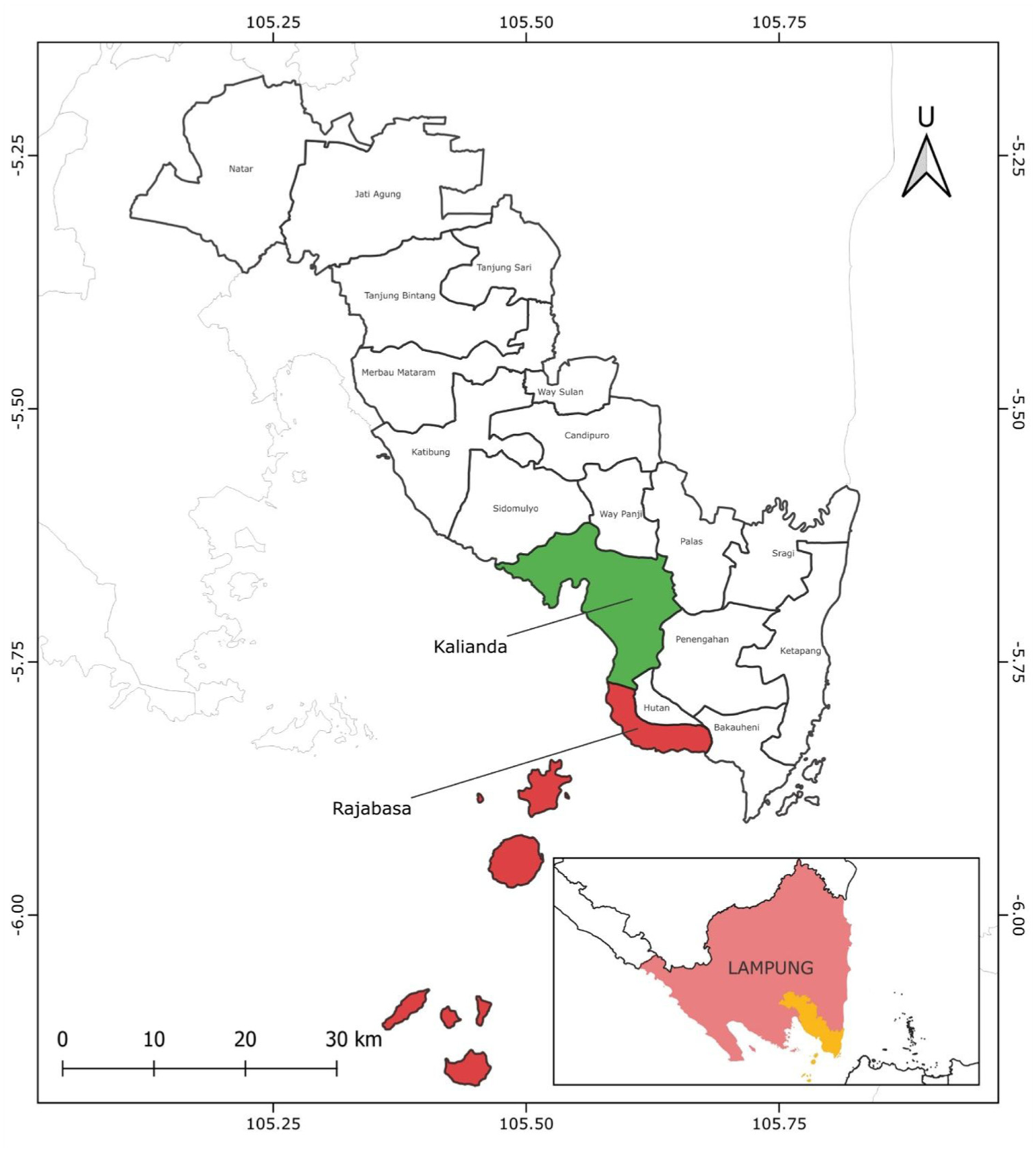
Map of research locations.
Therefore, several officials in the local government, community leaders and disability communities were identified as key informants. We also interviewed the head of the BPBD office and village heads relevant to the research topic to get a more balanced opinion regarding the role of local government and other actors in taking care of people with disabilities during disaster. Therefore, we were able to make a full and clear assessment of the services provided by local government and other actors to people with disabilities. Ethical clearance has been granted by LPRA Laboratory of Department of Government, Lampung University.
Every participant involved in this project was given a code, and we had two clusters of participants: a cluster of non-disabled participants and one of disabled participants. Having applied purposive sampling methods, the selection of participants was based on assessment of their suitability when answering our questions. Based on that, we could ensure that we obtained proper information from the ground level, which was important for supporting our inclusive disaster model.
During the data analysis stage, after the interview data was obtained, it was processed into the form of interview transcripts and then analyzed using thematic analysis. After completing the information obtained from fieldwork and reading the interview transcripts, we began to code the data and divide it into topics before analysis using a narrative approach. For the interview data, the coding itself was based on thematic analysis, it was used to help categorize each of central ideas within the data gathered from the ground. Based on this, the analysis was the result of contextualizing the data with the information taken from the interviews and the document analysis. Finally, the overall stage of data analysis was carried out simultaneously using interactive data analysis so that in the end it could produce a clear and in-depth narrative regarding the data discussion.
Result and Discussion
Disaster Governance in South Lampung: A Complex Problem
Two perspectives can be taken when analyzing the complexity of disaster studies. First, disaster studies form a perspective on the disaster itself, looking at how to evacuate the disaster victims, how to recover the situation post-disaster, etc., while the second perspective examines this phenomenon with a knowledge-based approach, for example, applying the disaster governance approach. In this context, this study will analyze the disaster cases using a disaster governance approach.
Although South Lampung in Lampung Province is one of the more disaster-prone areas in Indonesia, there is only limited research into disaster governance that focuses on this district, and the research into how those with disabilities, children, and women deal with disaster in this district is particularly limited. This limited research has therefore made the situation on the ground very complicated, and dealing with disaster in South Lampung is not easy as it should be. The problem of capability of local government in terms of becoming catalyst and coordinator of stakeholders is exacerbated by the low level of knowledge in the community regarding dealing with disaster and the lack of strategy and funding.
Furthermore, limitation of research is on the case study, this study relies on a single case that potentially left lack of deep research and comparative perspective. In the future, this is also important and valuable to make a cross regional studies on this type of study. As the result, the research and model created will be more comprehensive and will be resulted in a more complex problems and challenges identified taken from several locations. In that sense, the modeling that has been created is more applicable in various context and regions across Indonesian archipelago and potentially in another global south countries that has a similar type of demographics and geographic factors like Indonesia such as the Philippines.
Daryono, an official from the Indonesian Meteorology, Climatology, and Geophysics Agency (BMKG), revealed to the media that Nankai megathrust earthquakes could reach and risk Indonesian territory: “If a massive earthquake on the Nankai megathrust does occur and generates a tsunami, we need to be vigilant, as a large tsunami in Japan could potentially reach Indonesian territories” (Antara, 2024). In this sense, the local level of the disaster agency needs to respond immediately to this situation. We discussed this situation with some of the South Lampung’s BPBD officials and found that the fundamental problem is that they lack financial support from the local government and that they do not have the flexibility to propose the program. One of the official argued that,
When I meet with Bappeda [Regional Development Planning Agency], I am usually… I tend to be quiet, not proposing any programme, because I know, I have many programmes in mind but [they will] never be realized due to the lack of funding […] at the moment, we do have a programme but it focuses on the socialization of vulnerable people, just that. (Local Official )
The official also clearly revealed that the lack of funding became a major problem that contributed to the unsystematic response and poor preparation for disaster mitigation in South Lampung. This problem not only occurs in South Lampung but is indeed a national problem when considering that disaster mitigation and responses are not included in primary local government programs. As a result, there is a limited budget or financial support from local governments to realize the program. One BPBD official argued for the need for collaborative working among stakeholders: “we believe that through collaboration, we will be ready to face the disaster in the future” (BPBD). In this sense, we understood that the need for conducting collaborative work was already understood by the official, but we reached a conclusion that the local official still experienced a lack of direction in how to start or take any initiative to work more collaboratively with stakeholders.
Our observation also found that the disaster resilience is not uppermost in the minds of local government leaders. For example, in every local election debate broadcast live on television, almost none of the local leader candidates have mentioned any plans to eradicate the risk of disaster especially in areas in Lampung province like South Lampung, West Lampung, West Pesisir and Tanggamus. This is further evidence that disaster resiliency is not a priority program.
The local official of the MDMCalso supported this situation:
In general, Lampung has so many places that could potentially be hit by earthquake. We [Lampung] have a record of being hit by earthquakes. But, in reality, we are not aware of this situation. In my opinion, very few activities are initiated by local government to mitigate the disaster, in fact, Lampung is a disaster-prone area. For us [MDMC], we have focused on Muhammdiyah’s school, to teach and prepare students for the disaster. We have conducted training and socialization at Muhammadiyah’s school continuously in almost every area that faces a potentially big risk of disaster. (MDMC)
The results of the interview also revealed that local government lack the capacity to deal with disaster, including low levels of participation and education in the community regarding disaster preparedness and response. In this sense, we could then draw an early conclusion that disaster resiliency is purely dependent on the capacity of leadership, and policy innovation regarding disaster governance relies on the capacity of each local leader and bureaucrat. For example, the case of Sukaraja village has provided a real example of how leadership is important when it comes to deal with disaster preparedness. The head of village revealed to us that,
We have disaster mitigation programmes, such as we were planting trees to divide the sea wave [tsunami]. This is purely a village initiative, and this is our routine activity. We have many forums, especially, to provide information about disaster preparedness we asked our community about this, and I think our community is more aware about disaster and how to deal with disaster. They already know where to go when the disaster [tsunami] is coming. (Head of Village)
This argument is also in line with a statement from one Banding Village official, who revealed that:
In our village, we do prepare for the disaster, we have lumbung pangan, which is located in the evacuation zone/location. We also have several tents provided by the government so that we could put all we needed inside then, when there is a disaster. Initiative has also been taken by individuals in this village. For example, one morning when the tsunamis happened, there was a store that was not impacted by the tsunamis, which provided necessities for the victims and their families, but we needed to go to hospital for the medicine. We also have a traditional way of making announcements when tsunamis are coming by using kelentongan. (Village Official).
The case of Sukaraja village has revealed that the initiative to deal with disaster could come from the lower level of government such as the village level of government (VLG). The main problem is that the VLG has limited resources and authority compared to the upper level of government and local government. In this sense, the personal initiative of a particular leader was crucial in ensuring that the process of disaster response and preparedness ran smoothly.
Factors and Challenges of Implementing Inclusive Disaster Response in South Lampung
The intersectional studies on vulnerability and disaster represent a complex field, globally. According to Pertiwi et al. (2022, p. 2) “the discourse on the vulnerability of people with disabilities in natural hazard emergencies has been occurring for more than a decade.” Even though these studies are quite old, the complexity of facing and handling disasters, especially in the Global South, has led to a failure to respond to disasters in a systematic way: for example, in the case of the tsunamis in South Lampung in 2018. The formal institution that needed to take responsibility was unable to act as a coordinator and catalyst for the stakeholders involved in the process of post-disaster recovery.
This has been confirmed by one of the officials heading the MDMC, one of the non-governmental institutions that are actively involved in several disaster preparedness and recovery initiatives in Lampung. In conversation with us, he argued that “I don’t see any of the activity initiated by local government to deal with disaster preparedness, if there is an initiative, it is following instruction from the central government. In this sense, I see that is the reality on the ground. Local government has failed to be catalyst for disaster preparedness and response” (MDMC).
In order to make a proper collaborative work at the local level, local government needs to be a proper catalyst and an effective coordinator for the stakeholders involved in disaster preparedness and response. In this sense, the lack of ability to initiate would increase the difficulty of handling the disaster properly. As a result, the community-based disaster response seems the only solution for dealing with disasters like in South Lampung. The concept of participation is another factor found in established inclusive disaster response, as Ton et al. (2021, p. 1) note:
…in most cases, people with disabilities need to participate in decision-making processes in order to achieve their valuable capabilities for their safety in times of disaster. This process of participation can be seen as both an end and a means. As an end, it refers to involvement in decision-making processes.
Initiative and policy innovation delivered by local government and involving the person with disability in the process of decision making are the two keys to establishing a more inclusive disaster response in South Lampung. On this matter, our FGD result with people with disabilities have raised several questions. One participant revealed that “we didn’t know there was a tsunami; no early warning et all. If there had been a warning, I think many could have survived, and as far as I remember, we never had a forum to listen to our voices, and, once more, I think we need a special vehicle in order to evacuate us when tsunamis happen, for example” (PWD). Another PWD raised the idea that “there is a need to learn about disaster mitigation. For example, there is an evacuation zone already in Kuntjir Village but I think we need to practice what should we do during the disaster, we have to be given a proper understanding on the use and function of the evacuation zone” (PWD).
In this context, our investigation on the ground has revealed that there are several challenges to implement this inclusive response in South Lampung, and we have observed that the challenge of implementing inclusive disaster response comprises four clusters: local government, human resources, technology, and databases of information on disable people. The absence of these four clusters have contributed to the unsystematic responses toward disaster in South Lampung, as in the case of the 2018 tsunamis.
The first factor is the lack of local government support and initiative. Local government leaders should increase their understating of the cultural aspects and issues brought on by disaster (Hutagalung et al., 2023) are the roles that should be fulfilled by local government leaders in order to avoid a lack of initiative in local government. The lack in local government capacity was revealed by some of the interviewees, and the real problem and challenge to develop a more inclusive disaster response is based on the lack of capability and initiative in local government to become a catalyst and coordinator for the stakeholders local government in disaster response process.
The second factor is the lack of human resources. This is also a problem in most of the Global South countries, but in the context of Indonesia, there few people well-trained in the field of disaster response. Although there is a special body that focuses on dealing with disaster in every district and city, the lack of human resources is the main source of problems with the disaster mitigation process. As Indonesia is a huge and geographically complex country, properly fulfilling human resource requirements in every district that specializes in disaster response is a quite difficult task. One official from the BPBD office revealed the situation: “for example, the fast response team [TRC] that aims to provide a quick response to disaster within 24 hr, we believe this task force will be an important body in providing a fast disaster response, but in reality we have a lack of human resources, including limited numbers in the TRC” (Kabid).
Thirdly, technology plays an important role in the process of supporting the disaster response, as the impact of disaster can be mitigated through a proper and well-equipped technology. Based on our interviews with several local government officials, it is clear that the lack of financial support for disaster preparedness and response makes it difficult for them to provide proper technology to mitigate the impact of disaster. Officials have revealed that “Indeed, we have lack of financial support. If I meet another official from a local government programme planning office, I can’t hope too much. I know it is indeed difficult to finance several of our proposed programmes because of budget limitations” (Kabid, similarly to Kasubid). Furthermore, the lack of local government ability to mitigate the disaster was also revealed by an official from MDMC: “in some part of Indonesia cities, there is a regulation that every building is certified with the earthquake-resistant construction (ERC). But, I don’t see it is a must here in Lampung, for example” (MDMC).
Fourth, there is a lack of a database and information on disabled people, and there is no information about how many disabled individuals are in a particular area, how they are treated by their families and communities, or any data on their general health conditions. All these databases should be stored in an official office and be accessible to support South Lampung’s disaster management and preparedness efforts in the future, and the ability to identify how many disabled people need assistance is crucial in a particular village, for example, when dealing with a disaster; this is the kind of data that is needed to ensure assistance can be provided by the government and stakeholders. In addition, the local government needs to identify them through the village-level government. One of the officials at the village level answered precisely when we asked him how many disabled people were in the village (Sekdes Banding), which is an example of how, with proper coordination between the villages and local government, this database could be compiled effectively.
Discussion: Creating an Inclusive Disaster Response
As inclusive disaster response model is a complex mechanism that needs collaborative work among the stakeholders involved, and in order to deal with disaster response in the future, we offer a model that can be used to realize inclusive disaster response in South Lampung. This model involves three institutions – local government, religious institutions and NGOs – each of which have a particular duty that can be encouraged to work together on collaborative work. The Sendai Framework of Disaster Risk Reduction 2015–2030 (SFDRR), adopted in 2015, has recommended that it is a state’s responsibility to decrease substantially the potential for fatalities and impacts on livelihood and health in the context of socio-economics, including the physical impact of any disaster. Moreover, SFDRR also urges the completion of disaster risk reduction through collaborative works with stakeholders, which is a difficult task, in particular in Global South countries like Indonesia. Therefore, we employed a suggestion by Ansell and Gash (2008, p. 547), who said that making a good model requires that “stakeholders be directly included in the decision-making process,” and that collaborative works need several preconditions. Ansell and Gash (2008) also argued that collaborations will be realized as a result of several factors, such as power balance among stakeholders, and that participation needs an incentive, leadership, and direct dialog.
Using Ansell and Gash’s (2008) collaborative governance theory, we have identified several problems to manage in order to realize an inclusive collaborative disaster response in South Lampung. For example, we found that there is no power balance among the stakeholders, as the local government still becomes the dominant agent, and that there is no incentive given to those who participate in the process of disaster response, especially the disabled people. The dialog process is not on an equal basis among the stakeholders involved, with one-way dialog becoming the dominant activity instead. For example, the local government provides some training for the community, including the disabled individuals, on surviving in a disaster, but the training is still dominated by the local government, and the lack of dual communication and dialog, especially between the government and the disabled people, has therefore meant the establishment of collaborative work seems a long way off.
The process of collaborative work can be maximized through (1) participatory inclusiveness, (2) forum exclusiveness, (3) clear ground rules, and (4) process transparency (Ansell & Gash, 2008, p. 550). In this context, building a more inclusive participation among those involved in disaster response would be beneficial for both sides, local government and the disabled people. In addition, based on our fieldwork, several conditions need to be prepared to establish an inclusive disaster model. The main point that is the disabled people need to be involved in the process of decision-making from the early stage of disaster response. This argument is relevant to Ansell and Gash (2008) collaborative governance theoretical approach, in a specific context, and is supported by research by Prayoga et al. (2023) and Sagala et al. (2024).
Figure 2 shows that every agency involved in this model has a distinct role. For example, the role of local government is more to focus on the creating an initiative and providing an incentive to those who participate in and support disaster responses. The result of observation on the ground reveals that South Lampung’s local government lacks initiative and fails to provide an incentive to those who might be involved and impacted by disasters. Furthermore, religious institutions have capacity to legitimate what the government has done. This is rhetorical, but the case of Indonesia shows that religious institutions are still among the most trusted formal institutions in Indonesia, even though it is indeed a secular country, as most Indonesian people are religious. Meanwhile, the role of NGOs is also important, as they advocate for and educate the people, especially on how they could survive disasters.

Inclusive disaster response model, modified from Ansell and Gash’s (2008) theory of collaborative governance.
Involving and encouraging people with disabilities to be part of the decision-making process for disaster response is important, as this means ensuring social justice and resiliency, and this process should be supported by local government. The local government needs to take the initiative in realizing the collaborative work and provide an incentive to those who participate in disaster response. The initiative should be taken by local government because this institution has the necessary resources, and the lack of this initiative would mean that the collaborative process fails to get proper funding, which would impact on the overall process of collaboration. The role of NGOs as educational and advocating agencies for the disabled is vital, and NGOs play an important role in balancing the interests of various stakeholders. This is important as any power imbalance will detract from the overall process of collaborative action. Religious institutions play a role in providing support to formal state agencies that work in disaster response, and support from religious institutions is an important route to legitimization among the people.
Finally, the limitation of the research is that the case study that only includes a single case. In the future, it will be important and valuable to undertake cross-regional studies so that the research and model created will be a more comprehensive approach to more complex problems and challenges identified in another region. As the result, the modeling created would then be more applicable across various contexts and regions across the Indonesian archipelago.
Conclusion
As a multifaceted environmental and human phenomenon, inclusive disaster response is a one of the most challenging forms of response to disaster to achieve. The intersectional research into disaster and disability has attracted many Global North scholars to conduct intensive research, but nothing has been researched in the Global South context. Our research found that the process of creating an inclusive disaster response in South Lampung is still far from reality. The complex problem on the ground, the lack of initiative of local government to act as the catalyst for disaster preparedness and response and other barriers meant the situation was more complex that initially thought.
Our research tried to capture the problems and challenge of disaster response in South Lampung. By applying Ansell and Gash (2008) collaborative theory, we offered a model on inclusive disaster response that can be used to create a more collaborative response in South Lampung. In order to make this model operative, we have suggested the necessary pre-conditions of each institution, such as demanding more initiative from local government to conduct collaborative works with stakeholders and increasing the participation of disabled individuals in the process of disaster response. Each institution or agency has their own roles and duties; for example, the role of NGOs is to be educational and advocate agency for the disabled people, while religious agencies such as MDMC can play a greater role in providing legitimation for the overall process of disaster response. This also provides evidence that in the context of Indonesia, neither disaster preparedness nor response are only dominated by secular institutions (Samson & Warganegara, 2021; Tomalin, 2020). Finally, we believe that this collaborative model would be beneficial and could decrease the basic problems confronting inclusive disaster response in South Lampung.
Footnotes

Funding
The authors disclosed receipt of the following financial support for the research, authorship, and/or publication of this article: BIMA research scheme 2024, The Indonesian Ministry of Education, Culture, Research, and Technology.
Declaration of Conflicting Interests
The authors declared no potential conflicts of interest with respect to the research, authorship, and/or publication of this article.
Data Availability Statement
The data used in this research is available upon a request to the researchers.