




Abstract
Entrepreneurship education (EE) exerts a profound impact not only on the individuals’ career trajectories and entrepreneurial activity, but also on organizational innovation and competitiveness, thus being needed to grasp its meaning and consequences further. Drawing on the theory of planned behavior, this study explores the relationship between EE and proactive behavior by examining the mediating role of career attitudes and moderating role of perceived organizational support (POS). Quantitative data were collected from a time-lagged survey of 331 employees in China. Hypotheses were tested via hierarchical regression analysis, following a series of preliminary checks, including common method variance test, analyses of confirmatory factor, reliability, validity, and correlation. The findings indicated that (1) EE is positively related to proactive behavior; (2) two distinct career attitudes, namely, boundaryless and protean, both mediate this relationship; (3) POS enhances both the direct relationship between these career attitudes and proactive behavior, and the indirect effects of EE on proactive behavior via these attitudes. Finally, the theoretical and practical implications for EE and proactive behavior are discussed, and suggested directions for future research.
Plain language summary
The study aims to investigate the impact of entrepreneurship education (EE) on employees’ proactive behavior through the lens of the theory of planned behavior. Data were collected from 331 employees in China, where the EE activities are enjoying a boom. The findings indicated that the EE directly enhances proactive behavior. Boundaryless and protean career attitudes play a mediating role in the relationship between EE and proactive behavior. Furthermore, the perceived organizational support strengthens both the relationship between these career attitudes and proactive behavior, and the indirect effect of EE on proactive behavior via boundaryless and protean career attitudes.
Keywords
Introduction
Over the past two decades, entrepreneurship education (EE) has gained increasing global attention and significance (Cui et al., 2021; D. Parker et al., 2025). This growing emphasis stems from EE’s vital role in promoting socio-economic development and well-being (Saadat et al., 2022), fostering innovation and sustainable growth (Soares et al., 2021), and nurturing individuals’ career attitudes and competencies (Alakaleek et al., 2023). Colin Bohr, in his report Learning to Care: A Roundtable Report on Education for the 21st Century, presented to the Organization for Economic Cooperation and Development (OECD), described EE as the “third passport” essential for the future of humanity. Furthermore, in 2017, China’s policy initiative of “mass entrepreneurship and innovation,” was formally incorporated into the United Nations resolution. This shift reflects the growing scholarly and policy-oriented recognition of EE’s multifaceted contributions across educational, economic, and innovation domains.
Existing research has extensively examined the impact of EE across three domains: (1) cognitive features: entrepreneurial mindset (Cui et al., 2021; Saadat et al., 2022), alertness (Saadat et al., 2022), critical thinking (Igwe et al., 2021), identity (Gómez-Jorge et al., 2025) and self-efficacy (Kariv et al., 2025; Martínez-Gregorio et al., 2021); (2) competency factors: entrepreneurial knowledge (Alakaleek et al., 2023) and skills (Branca et al., 2025; Hahn et al., 2020); and (3) entrepreneurial outcomes: entrepreneurial intention (Martínez-Gregorio et al., 2021; Patra & Kumari, 2025), behavior (Alakaleek et al., 2023; Patra & Kumari, 2025), and startup performance (Eesley & Lee, 2021). Despite the rising interest in EE, a critical gap remains. Most prior studies emphasize its role in promoting entrepreneurial activity, particularly new venture creation (Branca et al., 2025; Kariv et al., 2025). However, evidence shows that the majority of EE recipients don’t pursue entrepreneurship; in high-income countries, fewer than 10% of adults engage in entrepreneurial activity (Dana et al., 2021; Rauch & Hulsink, 2015), with most entering employment within established organizations (Bhatta et al., 2024). This discrepancy highlights a crucial yet underexplored issue: while EE aims to cultivate entrepreneurial capacities (Gómez-Jorge et al., 2025; Suguna et al., 2024), how do these capacities translate into value within traditional employment settings (Bhatta et al., 2024). Specifically, what happens to the entrepreneurial mindset and skills cultivated through EE once individuals enter corporate or institutional employment (Suguna et al., 2024)? Therefore, it is crucial to examine the lagged impact of EE on a broader employee base and to uncover the mechanisms.
Among various work behaviors, proactive behavior refers to employees’ voluntary efforts to improve their work environment or role, often involving idea implementation and problem-solving (Gomes et al., 2025; S. K. Parker et al., 2006). In today’s dynamic and fragmented environment, a key managerial challenge lies in effectively leveraging the positive impact of such behavior on individuals and organizations (Anthonysamy et al., 2025). While the direct link between EE and proactive behavior has not been thoroughly examined, related constructs have received attention. For instance, Mensmann and Frese (2019) conducted a randomized controlled experiment on proactive behavior training, and found that individuals who received entrepreneurship training exhibited more proactivity, leading to increased success and well-being. These findings suggest that EE may exert broader behavioral influence beyond entrepreneurship, providing a theoretical and empirical foundation for further exploration of its effects in organizational contexts.
Against this backdrop, this study examines whether and how EE fosters proactive behavior. Drawing on the Theory of Planned Behavior (TPB), it investigates the impact of EE on Chinese employees’ proactive behavior, with particular attention to the mediating mechanisms and boundary conditions underlying this relationship. According to TPB, individuals’ attitudes toward behavior, constitute critical determinants of behavioral intentions and subsequent actions (Ajzen, 1991; Murad et al., 2025). EE contributes to the formation of self-directed, value-driven attitudes that align with subjective career success (D. Parker et al., 2025). Specifically, boundaryless and protean career attitudes, marked by autonomy, flexibility, and personal values, are central to shaping employee behavior (Boucif et al., 2025). These attitudes enable employees to reinterpret career paths, engage in role reinvention and upgrading (Kundi et al., 2021), thereby facilitating proactive behavior in the workplace (Gomes et al., 2025). Understanding how EE cultivates such career attitudes and, in turn, enhances employee proactivity offers valuable insights into their relationship.
Furthermore, TPB posits that subjective norms and perceived behavioral control, alongside behavioral attitudes, jointly shape individuals’ behavioral actions (Aman et al., 2025). In line with this, prior research on proactive behavior highlights the importance of social context (Cai et al., 2019; Gomes et al., 2025). Perceived organizational support (POS), defined as an employee’s perception of the extent to which their organization, including leaders and colleagues, values their work and interests (Jeong & Kim, 2022), can offer both instrumental and socio-emotional support (Ma et al., 2024; Mcmillan, 1997). Even when employees exhibit similar levels of boundaryless and protean career attitudes, those with higher organizational support perceive greater resource availability and a stronger sense of “insider” status (Georgiadou et al., 2024). Such perception directly enhances their agency in the organization (“I am allowed to do it,” reflecting subjective norms), and indirectly strengthens their confidence in their ability (“I can do it,” reflecting perceived behavioral control). Therefore, POS functions as a critical contextual factor that facilitates the translation of career attitudes into proactive behavior.
In summary, this study makes several contributions to the literature stream on EE and proactivity. First, by designating EE as a key predictor of proactive behavior, it bridges the gap between these two constructs. The findings suggest that employees exposed to EE are more likely to engage in proactive behavior. It deepens the understanding of the practical usefulness of EE, and enriching the literature on its behavioral outcomes. Second, drawing on TPB (Ajzen, 1991), this study demonstrates that EE fosters proactivity by shaping boundaryless and protean career attitudes. It clarifies the cognitive pathway through which EE influences proactive behavior, thereby unlocking the “black box.” In doing so, this study responds to calls for deeper exploration of EE’s internal impact process (Martínez-Gregorio et al., 2021). Third, by examining the moderating role of POS, this study broadens the understanding of the boundary conditions of the career attitudes. It highlights how organizations can leverage EE and career attitudes to maximize employees’ proactive behavior. The theoretical model is shown in Figure 1.

The theoretical model in the research.
Literature Review and Hypotheses
Theory of Planned Behavior
The TPB posits that individuals act rationally, with behavior as a deliberate and planned outcome (Ajzen, 1991). Behavioral intention, a direct determinant of behavior, is influenced by attitude, subjective norms, and perceived behavioral control (Ajzen, 1991). Among them, attitude reflects an individual’s evaluation of a behavior; subjective norms encompass perceived social pressures; and perceived behavioral control denotes the perceived difficulty of executing the behavior. Positive attitudes, stronger subjective norms, and greater perceived control increase the likelihood of action. It is worth noting that the TPB evolved from the Theory of Reasoned Action (TRA), proposed by Fishbein and Ajzen (1975). TRA posits that behavioral attitude and subjective norms are key determinants of behavioral intention. Recognizing that many behaviors are not entirely under volitional control, Ajzen (1991) extended the model by incorporating perceived behavioral control. This addition enhances the explanatory power of the theory, making TPB a more comprehensive framework for understanding and predicting human behavior.
In recent years, the TPB has been widely adopted across disciplines, demonstrating strong theoretical robustness and adaptability in explaining both behavioral intentions and actual behaviors. Within organizational settings, Chouchane et al. (2023) investigated how organizational support influences intrapreneurial behavior, identifying key mechanisms and boundary conditions. In academic entrepreneurship, Murad et al. (2025) found that entrepreneurial networks affect scientists’ intentions and behaviors through the mediating roles of attitude, subjective norms, and perceived behavioral control. Similarly, Hinterhuber and Khan (2025) applied an extended TPB model to sustainable procurement, confirming behavioral intention as the strongest predictor, shaped by attitudes, control beliefs, and CSR perceptions. In education, Ma et al. (2024) used TPB to explain students’ critical thinking behavior, emphasizing the positive roles of attitude and perceived control. Relente and Capistrano (2024) expanded TPB by integrating innovation self-efficacy and entrepreneurial knowledge to predict entrepreneurial intentions among Filipino students. In the consumer domain, TPB has been effectively applied to green banking (Jain et al., 2025), green consumption, and technology adoption, often incorporating antecedents such as environmental concern. Collectively, these studies suggest that TPB possesses robust structural validity and predictive power, while remaining flexible across diverse behavioral settings.
Overall, the TPB provides a robust framework for understanding the relationship between EE and proactive behavior. First, TPB has been widely employed to elucidate mechanisms in EE-related studies (e.g., Rauch & Hulsink, 2015; Tseng et al., 2022). Second, proactive behavior is characterized as proactive, future-orientation, and change-orientation (Parker et al., 2010), which suggests it as a behavior controlled by individual will, and consistent with the basic logic of TPB. Third, meta-analytic evidence shows that TPB has a high predictive and explanatory power for individual intentions and behaviors, with the explained variance ranging from 39% to 59% (Kautonen et al., 2015).
Entrepreneurship Education and Proactive Behavior
Proactive behavior refers to spontaneous, future-oriented, problem-solving actions to change the current situation or oneself (S. K. Parker et al., 2006). Such behavior may involve organizational-level changes (e.g., introduction new work methods or transforming strategies) or individual-level initiatives (e.g., learning new skills to cope with future; Gomes et al., 2025). Prior research identifies two main categories of antecedents: (1) individual differences, such as proactive personality (McCormick et al., 2019), self-construal (C. H. Wu et al., 2018), responsibility for change, and role breadth self-efficacy (Gomes et al., 2025), and (2) contextual conditions, including work characteristics (C. H. Wu et al., 2018), leadership styles, and team climate (Cai et al., 2019). While existing research has delved into a wide range of individual differences and contextual conditions that influence proactive behavior, emphasizing the impact of the entity’s “stable traits,” such as demographic attributes, personality, and work characteristics, but ignoring the dynamic process by which specific experience affects employees. The first aim is to examine the role of EE as a particular experience in shaping proactive behavior, thereby shedding light on its malleability (S. K. Parker et al., 2010).
First, in terms of cognitive perspective, EE fosters employees’ autonomy in exploring, analyzing, and solving problems (Hamrick et al., 2025), by developing entrepreneurial mindset (Cui et al., 2021) and critical thinking (Igwe et al., 2021). In doing so, EE shapes distinctive cognitive maps and information-processing modes, equipping individuals with cognitive tools essential for proactive behavior. Second, in terms of information and knowledge acquisition perspective, with the help of creative and practical EE, employees can continually obtain specialized knowledge across domains. This facilitates a comprehensive understanding of the dynamic business environment (Ratten & Usmanij, 2021), enriches knowledge-based resources, and enhances confidence in decision-making and action (Alakaleek et al., 2023). Consequently, employees become more capable of addressing challenges and uncertainties in daily work, and are more likely to engage in proactive behavior (S. K. Parker et al., 2006). Third, EE establishes a robust competency foundation for recipients (Hahn et al., 2020). These include the ability to learn from mistakes (Branca et al., 2025; Pittaway & Cope, 2007), apply established knowledge to new problems (Pittaway & Cope, 2007), acquire new knowledge and change behavior (Branca et al., 2025), cope with uncertainty and ambiguity (Lackéus, 2014; Pittaway & Cope, 2007), and recognize and exploit opportunities (Hahn et al., 2020; Kubberød & Pettersen, 2018). These capabilities are particularly strengthened through experiential learning approaches (Alakaleek et al., 2023), which enhance the effectiveness of EE in shaping individual competencies. Based on the above analysis, employees with EE experience are more likely to perceive current problems or future opportunities in their work, and proactively address them through spontaneous actions. According to the TPB, EE enhances employees’ proactive behavioral intention by influencing their behavioral attitude, subjective norms, and perceived behavioral control, which predict the emergence of proactive behavior. Hence, the hypothesis can be proposed as follows:
Entrepreneurship Education and Career Attitudes
The concept of career, rooted in management literature, is defined as “an individual’s work-related and other relevant experiences, both inside and outside of organizations, that form a unique pattern over the individual’s life span” (Sullivan & Baruch, 2009, p. 1543). In the contemporary context, the notion of career includes not only physical movement across levels, occupations, and industries, but also psychological perception of career events, choices, and outcomes. As research has become more in-depth, two new types of careers, boundaryless career attitude (Lo Presti et al., 2025; Mazzetti et al., 2024) and protean career attitude (Hall, 2004), have begun to emerge in the scholarly landscape. The former is the tendency to seek career opportunities beyond the boundaries of a single employment setting, and the latter is the tendency to pursue a career that is internally driven by the individual rather than specific organization or career path.
EE and Boundaryless Career Attitude
EE, in contrast to vocational education that prepares individuals for specific occupations, is a form of liberal education that fosters open-ended and non-linear career development (Killingberg et al., 2021; Martínez-Gregorio et al., 2021). Without a predefined career path, EE encourages individuals to leverage entrepreneurial thinking, knowledge, and skills to pursue careers aligned with their personal interests and values, thereby promoting a boundaryless and open-minded career orientation (Jones et al., 2017). From the modules of EE, EE includes not only traditional one-way lectures, but also entrepreneurial experience, sand table simulations, entrepreneurs’ face-to-face, and competitions. Notably, entrepreneurial experience helps to develop students’ entrepreneurial identity by refining their identity-matching process (Hamrick et al., 2025). Entrepreneurship simulations empower individuals to explore possible selves through hands-on and action-oriented learning (Baron & McCormack, 2024), fostering a propensity to choose careers consistent with their entrepreneurial identity (Hamrick et al., 2025). Consequently, employees exhibit heightened sensitivity to opportunities when faced with career decisions and are willing to undertake substantial career challenges. From a relational perspective, EE often involves intensive interaction with external stakeholders (Killingberg et al., 2021; Pittaway & Cope, 2007), enabling participants to develop interpersonal and networking skills. These competencies lay the groundwork for building and maintaining relationships across departments or organizations. Research has also shown that well-educated individuals are more inclined to choose a boundaryless career attitude (Lo Presti et al., 2025).
EE and Protean Career Attitude
According to Hall (2004), self-awareness and adaptability constitute the two core foundations of a protean career attitude. Self-awareness entails a one’s capacity to form an accurate perception of personal interests, attributes, and values, influencing career decision-making and behavior (Tee et al., 2022). Adaptability reflects the ability to respond effectively to the demands of new environment (Hall, 2004). From the self-awareness perspective, EE aims to disrupt the traditional educational socialization by enhancing individual’s perceived accuracy of their abilities, strengths, and entrepreneurial potential (Eesley & Lee, 2021). This process contributes to the development of self-awareness and basic values. The “sorting effect” of EE emphasizes its primary goal of assisting individuals in discerning whether entrepreneurship suits them (von Graevenitz et al., 2010), which in turn helps them clarify their entrepreneurial identity (Hamrick et al., 2025), self-efficacy (Lackéus, 2014; Martínez-Gregorio et al., 2021) and entrepreneurial attitude (Rauch & Hulsink, 2015). Ultimately, these elements provide a guiding framework for individual career choices and evaluations of job opportunities, contributing to the cultivation of protean career attitude. From the adaptability perspective, EE enhances individual capacity for lifelong learning and dynamic work environments. The adaptability not only contributes to task efficiency (Rongpipi & Sharma, 2024) but also promotes psychological thriving (Gubler et al., 2014). By equipping individuals with the competencies required to navigate diverse roles and contexts, EE becomes a key enabler of the protean career orientation. Hence, the hypotheses can be proposed as follows:
Mediating Effects of Boundaryless and Protean Career Attitude
The concept of new career attitude refers to an individual career orientation characterized by instability, unpredictability, and multidirectional development in a fast-changing environment, which mainly includes boundaryless and protean career attitudes (Boucif et al., 2025). According to the TPB, attitudes are evaluations of performing a particular behavior, contingent on how good or bad the expected behavioral outcome is. The more positively an individual expects the behavioral outcome, the more positive the related attitude and the higher the likelihood of engaging in the behavior (Ajzen, 1991). Research suggests that the psychological flexibility created by boundaryless and protean career attitudes helps employees exhibit proactive behavior (Kuo et al., 2018).
Boundaryless Career Attitude and Proactive Behavior
Boundaryless mindset, a core dimension of boundaryless career attitude, emphasizes the creation and maintenance of interpersonal relationships across organizational boundaries (Mazzetti et al., 2024). Individuals with this mindset are more inclined to collaborate with diverse departments and external organizations, thereby expanding their social networks accessing greater instrumental and emotional career support (Boucif et al., 2025), providing for proactive behavior. Furthermore, such networks provide access to novel information and opportunities (Lo Presti et al., 2025), enabling individuals to act proactively in navigating and leveraging these resources. In addition, the boundaryless career attitude is closely linked to proactive personality, and openness to experience (Boucif et al., 2025). Individuals with the mental or physical ability to “cross boundaries” inherently manifest a drive for autonomy (Lo Presti et al., 2025), which intrinsically motivates them to structure their work proactively and adaptively in dynamic environments, that is, an driver for proactive behavior.
Protean Career Attitude and Proactive Behavior
Protean career attitude denotes an internal tendency toward career development, motivating individuals to manage themselves and pursue self-worth through proactive orientation, attitudinal change, and work behavior (Tee et al., 2022). Individuals with this attitude tend to form a clear professional identity, self-direction, and personalized goals (Boucif et al., 2025), which predispose them to engage in consistent, goal-oriented activities (Hirschi et al., 2017), thereby fostering proactive behavior. Moreover, protean career attitude enhances self-efficacy in daily work (Hirschi et al., 2017). Even when external conditions diverge from personal objectives, strong self-efficacy serves as a motivational resource, sustaining proactive efforts. This aligns with the role of perceived behavioral control in the TPB (Ajzen, 1991). Existing research also suggests that protean career attitude is positively related to employees’ proactive behaviors including career management (Haenggli et al., 2021) and organizational citizenship (Joshi et al., 2021). Combining Hypothesis 2, the hypotheses can be proposed as follows:
Moderating Effects of Perceived Organizational Support
Perceived Organizational Support (POS) refers to employees’ perception that the organization values their contributions and cares about their well-being (Jeong & Kim, 2022). POS also influences employees’ sense of legitimacy as organizational members (Peña et al., 2024; Shen & Benson, 2016). According to the TPB, behavior is driven not only by individual attitudes, but also by perceived social norms from the external environment (Ajzen, 1991). Previous research has indicated that higher POS is associated with greater engagement in proactive behaviors, including extra-role helping (Georgiadou et al., 2024), pro-environmental actions (Karatepe et al., 2022), and intrapreneurial initiatives (Chouchane et al., 2023). Thus, POS is expected to moderate the relationship between boundaryless and protean career attitudes and proactive behavior.
First, high POS enhances employees’ perceived legitimacy and organizational identity (Georgiadou et al., 2024), enhancing their sensitivity to external organizational challenges and strengthening the positive influence of boundaryless and protean career attitudes on proactive behavior. Second, as a crucial provider of workplace resources, POS mitigates resource-related constraints that may hinder proactive engagement (Karatepe et al., 2022). With an organizational support, employees gain access to instrumental (e.g., information, equipment, training) and socio-emotional (e.g., psychological need fulfillment) resources (Ma et al., 2024), such as empowerment, feedback, and information sharing—critical enablers of proactive behavior. Finally, organizational support acts as a high-cost and high-value signals of expected reciprocity (Lin et al., 2023). When employees perceive that their extra-role efforts are recognized and valued, they are more likely to invest further in work engagement and proactive actions aligned with their boundaryless and protean career orientations. Hence, the hypotheses can be proposed as follows:
Based on Hypotheses 2 to 4, this study proposes the moderated mediating model, that is, the POS moderates both the direct effects of boundaryless and protean career attitudes on proactive behavior, and the indirect pathway from EE to proactive behavior via these career attitudes. In short, under high POS, individuals are more likely to internalize their entrepreneurial experience into boundaryless and protean orientations, fostering a more open, autonomous career perspective that promotes proactive behavior. Therefore, it’s predicted that POS reinforces the path from EE to proactive behavior through career attitudes.
Method
Participants and Procedures
This study targeted Chinese full-time employees who had previously received formal EE during their academic studies, including but not limited to classroom-based lectures, entrepreneurship simulations, and startup competitions. To ensure a clarity in defined sample, participants were required to meet the following criteria: (1) currently employed full-time in an organization (excluding self-employed individuals); (2) completion of at least one structured EE module during formal education, verified via self-report and screening questions; and (3) not currently engaged in entrepreneurial activity (i.e., not business owners or freelancers). To enhance generalizability, a random sampling approach was adopted, and a professional online survey platform (akin to M-Turk) was utilized for designing the electronic questionnaire and enlisting participants. The questionnaire link was dispatched to participants via email. Throughout the data collection process, the research objectives and procedures were carefully introduced, and the confidentiality of personal information and responses was ensured. Participants were also informed that they would receive an escalating cash reward upon completing each survey wave (Sobolewski et al., 2024): RMB 20 for the first wave, RMB 30 for the second, and RMB 40 for the third (approximately USD2.80–US$5.60).
A multi-wave data collection approach was employed over 2 months. To better match the responses across time points, unique identity codes were assigned to each participant. At Time 1, 459 employees were invited to provide demographic information (gender, age, education, and tenure), position, and organizational nature, and their EE, POS, with other control variables (proactive personality and perceived family support). 412 valid questionnaires were obtained (a response rate of 89.76%). One month later, at Time 2, these 412 employees were asked to rate their two attitudes toward boundaryless and protean careers, with 359 completed questionnaires received, a response rate of 87.14%. At Time 3, another month later, those employees who had completed the second-round questionnaire were tasked with rating their proactive behavior, with 331 valid responses obtained (a response rate of 92.20%).
Of this final sample, 47.43% were men, 83.38% had attained a college education. On average, the age was 34.61 years (SD = 6.41), and their tenure in the organization was 8.35 years (SD = 5.28). In terms of the work position, 64.65% were frontline employees, 23.87% held junior management roles, and 11.48% were in middle and senior manage. In terms of the organizational nature, private enterprises accounted for the largest proportion (45.62%), followed by foreign-funded enterprises (25.08%), state-owned enterprises (13.29%), public institutions (7.55%), and others (8.46%). In addition, a multivariate analysis of variance (MANOVA) was conducted to examine systematic differences across the three groups (n = 412, 359, 331). The results revealed no significant differences in demographic variables among the three data sets.
Measures
To ensure the validity and reliability of the measurements, all instruments were selected based on theoretical alignment with the TPB (Ajzen, 1991) and their proven reliability and validity in prior peer-reviewed research. The selection criteria included theoretical relevance, empirical robustness (e.g., high Cronbach’s alpha), and consistency with the key constructs in the proposed model. A “back-translation” procedure was initially conducted by a professor specializing in innovation and entrepreneurship management, along with three doctoral candidates. This procedure involved translating the original English scale into Chinese, ensuring that any comprehension bias was minimized. Subsequently, feedback was collected from one HR director and eight employees of a company to assess the linguistic clarity of the questionnaire, further enhancing the authenticity of the measurements. All variables were measured using a 5-point Likert scale, with responses ranging from “1 = strongly disagree” to “5 = strongly agree.”
Entrepreneurship Education
A four-item scale developed by Walter and Block (2016) was used to measure entrepreneurship education (Nguyen & Nguyen, 2023; Porfírio et al., 2023). A sample item is “My school education gave me skills and know-how that enable me to run a business.” (Cronbach’s alpha = .898).
Career Attitudes
Career attitudes were measured using the scale developed by Briscoe et al. (2006), including thirteen boundaryless items and fourteen protean items (Lo Presti et al., 2025). Sample items were “I like tasks at work that require me to work beyond my own department” (boundaryless career attitude), and “Freedom to choose my own career path is one of my most important values” (protean career attitude). Cronbach’s alpha of boundaryless and protean career attitude were .953 and .942, respectively.
Proactive Behavior
A three-item scale developed by Griffin et al. (2007) for the individual dimension was used to measure proactive behavior, which focuses on capturing proactive work behaviors in the workplace (López-Cabarcos et al., 2022). A sample item is “I often come up with ideas to improve the way in which my core tasks are done.” (Cronbach’s alpha = 0.837)
Perceived Organizational Support
An eight-item scale developed by Shen and Benson (2016) was used to measure perceived organizational support (Chen & Eyoun, 2021). A sample item is “My organization cares about my opinions.” (Cronbach’s alpha = .909)
Control Variables
Drawing on existing research on proactive behavior (S. K. Parker et al., 2006; X. Wu et al., 2018), this study incorporated demographic variables, position, and organizational nature, into the analysis to mitigate potential effects. Proactive personality, which captures individual differences in proactive behavioral tendencies (C. H. Wu et al., 2018), was included as a control variable, measured using a 10-item scale developed by Seibert et al. (1999; Cronbach’s alpha = .916). Furthermore, perceived family support was also controlled to underscore the significance of organizational support in driving employees’ proactive behavior rather than other external support. This variable was measured using a four-item scale from the family dimension of Zimet et al. (1988)’s perceived social support scale (Cronbach’s alpha = .888).
Results
To test the proposed relationships and theoretical mechanisms, we conducted hierarchical regression, mediation, and moderated mediation analyses using the PROCESS macro (Hayes, 2017). These approaches are well-established in psychological and organizational behavior research to examine indirect and conditional effects, particularly within the TPB framework (Ajzen, 1991). Additionally, the multi-wave survey design and bootstrapping techniques were employed to mitigate common method bias and enhance causal inference, ensuring the robustness and credibility of the findings. The specific contents are as follows.
Common Method Variance (CMV)
Given that data on EE, boundaryless career attitude, protean career attitude, proactive behavior, POS, proactive personality, and perceived family support all come from the same source, the concern of CMV remains, even with multiple time points of data collection (Podsakoff et al., 2003). To test the potential effects of CMV, several widely recognized strategies were adopted. First, Harman’s one-factor test indicated that the first factor explained only 20.422% of the variance, well below the threshold. Second, a one-factor confirmatory factor analysis model showed a significantly poorest fit (χ2 [df = 1,484] = 9,953.873, CFI = 0.295, TLI = 0.268, SRMR = 0.176, RMSEA = 0.131). Third, a new common method factor was added to the baseline model, but no significant improvement in model fit was observed (ΔCFI = 0.002, ΔTLI = 0.003, ΔRMSEA < 0.001, ΔSRMR = 0.002). Hence, the CMV problem was not serious.
Confirmatory Factor Analysis
A series of confirmatory factor analyses were conducted using Mplus 8.3. As shown in Table 1, the Baseline seven-factor model fitted the data well (χ2 [df = 1,463] = 2,550.083, CFI = 0.910, TLI = 0.905, SRMR = 0.044, RMSEA = 0.047). Furthermore, it significantly outperformed alternative models, such as six-factor (2,961.772 ≤ χ2 [df = 1,469] ≤ 5,198.994) and one-factor (χ2 [df = 1,484] = 9,953.873), which supported the distinctiveness of the variables. In addition, Table 2 presents the reliability and validity.
Results of the Confirmatory Factor Analysis.

Note.
Results of the Reliability and Validity Analysis.
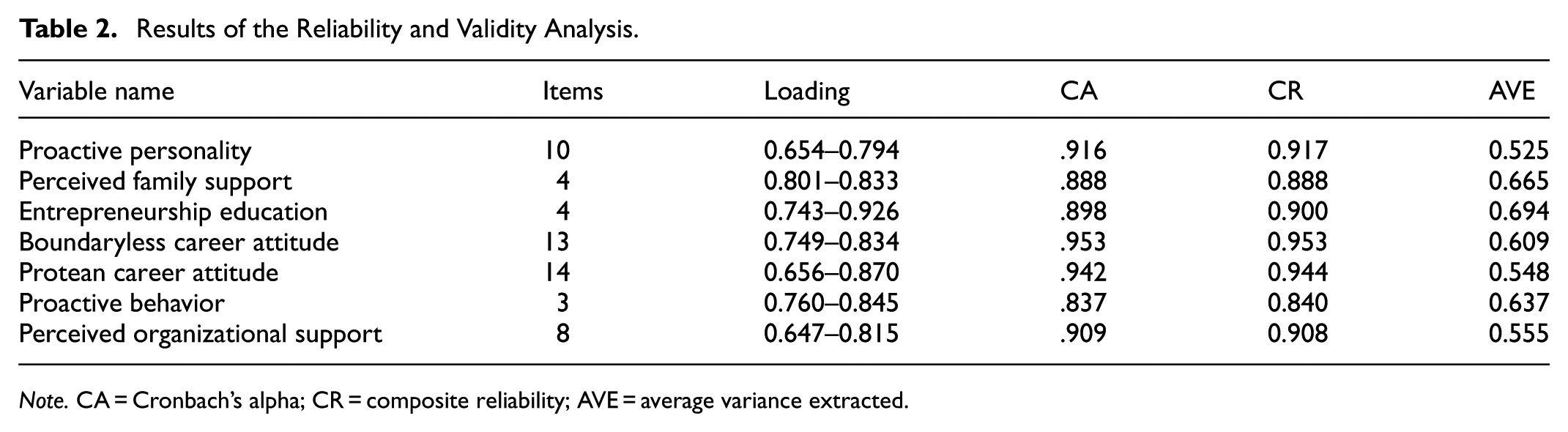
Note. CA = Cronbach’s alpha; CR = composite reliability; AVE = average variance extracted.
Descriptive Statistics
Table 3 presents the Means, SDs, and correlations. The results indicate that EE is positively related to boundaryless career attitude, protean career attitude, and proactive behavior (r = .194, .199, .241, respectively, p < .01). Furthermore, boundaryless and protean career attitude were related to proactive behavior (r = .195, .271, respectively, p < .01). These results provide initial support for the hypotheses.
Means, SDs, Reliabilities, and Correlations.

Note.N = 331. The internal reliability coefficients appear in the main diagonal brackets.
*p < .05; **p < .01.
Hypothesis Testing
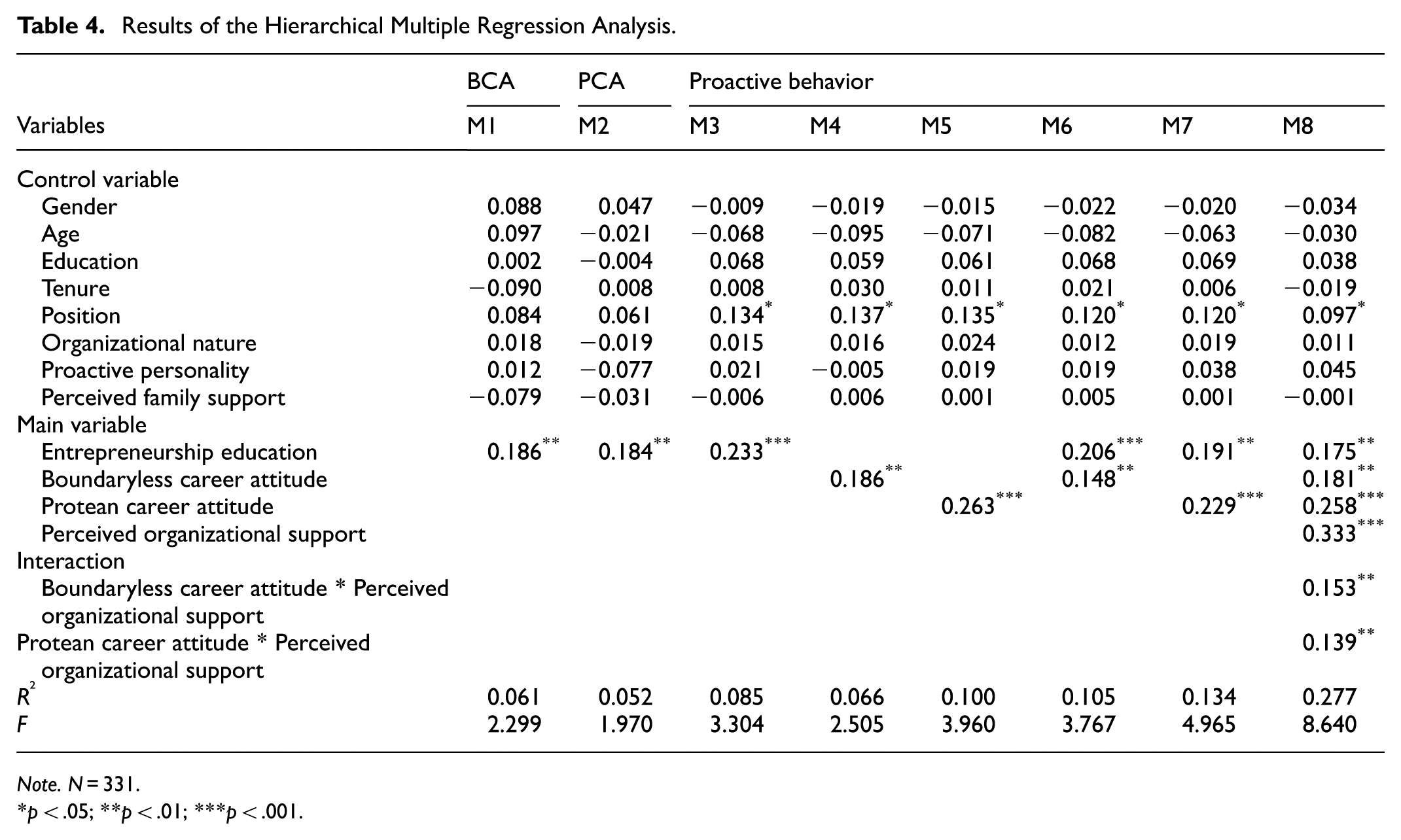
We conducted a hierarchical regression analysis to test Hypothesis 1, which explores the influence of EE on proactive behavior. As shown in Table 4, EE was positively and significantly associated with proactive behavior, after controlling for demographic variables, organizational nature, proactive personality, and perceived family support (β = .233, p < .001, M3). Hence, Hypothesis 1 was supported.
Results of the Hierarchical Multiple Regression Analysis.
Note.N = 331.
p < .05; **p < .01; ***p < .001.
Hypotheses 2a and 2b proposed that boundaryless and protean career attitudes positively predict proactive behavior. As shown in Table 4, both boundaryless (β = .186, p < .01, M1) and protean career attitudes (β = .184, p < .01, M2) were significantly related to proactive behavior, supporting Hypotheses 2a and 2b. Furthermore, Hypothesis 3a and 3b predicted the mediation roles of boundaryless and protean career attitudes. When both EE and boundaryless career attitude were entered simultaneously, the effect of boundaryless career attitude remained significant (β = .148, p < .01, M6). Utilizing the PROCESS macro (Model 4, 5,000 bootstrap samples) developed by Hayes (2017), the indirect effect of EE via boundaryless career attitude was 0.026 (p < .001), with 95% CI = [0.007,0.057], excluding 0, thus confirming the mediating role and supporting Hypothesis 3a. Similarly, when EE and protean career attitude were included, protean career attitude remained a significant predictor (β = .229, p < .001, M7). The indirect effect through protean career attitude was 0.039 (p < 0.001), with 95% CI = [0.012,0.080], excluding 0. Therefore, the mediation of protean career attitude was significant, providing support for Hypothesis 3b.
Hypotheses 4a and 4b predicted that POS strengthens the association between these career attitudes and proactive behavior. As shown in Table 4, the interaction between POS and both boundaryless career attitude (β = .153, p < .01, M8) and protean career attitude (β = .139, p < .01, M8) were significant, indicating a moderating effect of POS. When POS is high, boundaryless and protean career attitude become more strongly related to proactive behavior. Interaction effects were further plotted, where high and low levels of POS were obtained based on M ± SD. Figure 2 shows that the positive relationship between borderless career attitudes and proactive behavior is significant among employees with high POS (β = .400, p < .001), and insignificant among those with low POS (β = .090, ns). Similarly, Figure 3 shows that the relationship between protean career attitude and proactive behavior is more positive when POS is high (β = .493, p < .001) but not when it is low (β = .151, ns). Hence, both Hypothesis 4a and 4b were supported.

The moderating effect of POS between boundaryless career attitude and proactive behavior.

The moderating effect of POS between protean career attitude and proactive behavior.
To examine the moderated mediations predicted by Hypotheses 5a and 5b, the Bootstrap method was used. As shown in Table 5, the conditional effect of EE on proactive behavior through boundaryless career attitude was significant when POS was high (+1SD, Indirect effect = 0.073, SE = 0.025, 95% CI = [0.030,0.129]), but not significant when POS was low (−1SD, Indirect effect = 0.003, SE = 0.012, 95% CI = [−0.021,0.026]). And the moderated mediation was significant (Index = 0.039, SE = 0.015, 95% CI = [0.015,0.072]), supporting Hypothesis 5a. On the other hand, the mediation of protean career attitude between EE and proactive behavior was significant at both low (−1SD, Indirect effect = 0.017, 95% CI = [0.003,0.053]) and high (+1SD, Indirect effect = 0.084, 95% CI = [0.027,0.150]) POS. And the moderated mediation was significant (Index = 0.037, SE = 0.016, 95% CI = [0.011,0.076]). Hence, Hypothesis 5b was also supported.
The Mediation Effect at Different Levels of Moderator Value.
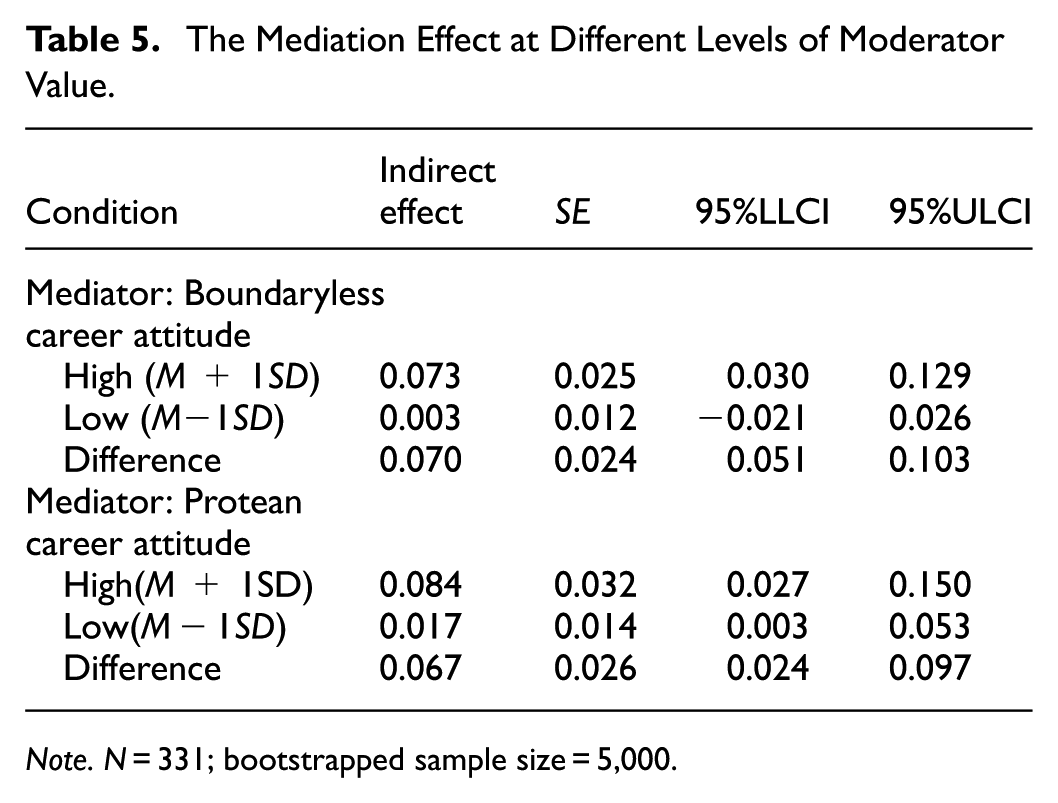
Note. N = 331; bootstrapped sample size = 5,000.
Discussion
Drawing on the TPB, this study constructs a theoretical model centered on career attitudes and situational factors (i.e., POS) to elucidate the mechanisms and boundary conditions through which EE influences proactive behavior. Consistent with recent literature that emphasizes the broader relevance of EE beyond entrepreneurial intention and new venture creation (Alakaleek et al., 2023; Ripollés & Blesa, 2023), this study identifies EE as a critical antecedent in shaping employees’ boundaryless and protean career attitudes. These modern career orientations—marked by autonomy, adaptability, and value-driven self-direction—equip individuals to reinterpret their professional roles and proactively acquire information, knowledge, and skills that contribute to organizational development.
Recent research (Chouchane et al., 2023; Haenggli et al., 2021) suggests that such attitudes increase employees’ likelihood of engaging in discretionary behaviors, such as challenging the status quo, initiating constructive change, and proposing novel solutions—particularly under conditions of strong organizational support that reinforce behavioral intentions. The consistency of our findings across a three-wave dataset lends empirical robustness to this mechanism. Moreover, this study extends the application of TPB into organizational settings, contributing to the evolving understanding of employee proactivity as a behavioral outcome of EE. In doing so, it not only addresses Fayolle’s (2013) call for evaluating the broader societal utility of EE, but also aligns with contemporary perspectives that view EE as a lifelong competency relevant to diverse work contexts (Cui et al., 2021; Martínez-Gregorio et al., 2021).
Theoretical Implications
This study makes several theoretical contributions to the EE literature. First, broadens the theoretical scope of entrepreneurship education by shifting the focus from entrepreneurial entry to employee behavior within organizations. Unlike previous studies, which often focused narrowly on new venture creation, this investigation explores the effects of EE on employees’ work behavior. While existing literature has primarily concentrated on entrepreneurial attitude (e.g., Martínez-Gregorio et al., 2021; von Graevenitz et al., 2010) and entrepreneurial behavior (e.g., Alakaleek et al., 2023; Rauch & Hulsink, 2015), the influence of EE on proactive behavior remains an under-explored. In alignment with the TPB, this study provides insights into the potent role of EE in driving employees’ proactive behavior, an extra-role behavior that facilitates organizational change and growth. By demonstrating that EE promotes individual proactivity through attitudinal and competence-based transformation, this research complements and extends the behavioral outcomes stream of EE literature. It also helps bridge the divide between entrepreneurship and organizational behavior research, providing a promising integrative lens for future inquiry.
Second, this study reveals the double-mediation mechanism through which EE influences proactive behavior and opens the “black box” between them. By introducing the TPB (Ajzen, 1991), the study highlights how EE shapes behavioral outcomes through the cognitive pathway of career attitudes—namely boundaryless and protean orientations. Specifically, employees who receive EE are more inclined to engage in proactive behavior when motivated by these career attitudes. Consistent with previous studies (e.g., Rauch & Hulsink, 2015), this study reaffirms the indispensable role of TPB, which contributes to the theoretical framework of EE. It also further confirms the effect of EE in shaping and nurturing employees’ career attitudes to effectively predict their behavioral intentions and outcomes (Ajzen, 1991). This model offers a refined understanding of how personal career capital, built through EE, translates into value-creating behavior in organizational settings, thereby answering recent scholarly calls (e.g., Martínez-Gregorio et al., 2021) for deeper investigation into EE’s internal impact mechanisms.
Finally, this study looks at the important role of contextual factors, namely POS, as a moderator of the impact of EE. While previous research has explored the moderating effects of curricular attributes at the school level (Cui et al., 2021; Hahn et al., 2020) and learning characteristics at the individual level (Ripollés & Blesa, 2023), it has largely overlooked how organizational contexts amplify or constrain the behavioral consequences of EE. As aforementioned, under a high perception of organizational support, employees interpret proactive behavior as aligning with organizational norms and expectations. In such a scenario, aided by external beneficial resources and supportive climates, the boundaryless and protean career attitudes shaped by EE are more likely to catalyze subsequent proactive behavior in employees. These findings extend the TPB by situating the individual-level mechanisms of behavior within enabling or constraining organizational environments, and respond to the call for more multi-level theorization in EE research. Thus, this study enriches the theoretical understanding of “when” and “under what conditions” EE leads to meaningful behavioral change in employees (Ajzen, 1991; Murad et al., 2025).
Practical Implications
In the contemporary workplace, proactive employees are vital to organizational survival and growth. These findings highlight two pathways for fostering employee proactivity. First, organizations should emphasize the role of EE by implementing robust recruitment and screening processes, alongside evaluation tools to identify individuals with entrepreneurial potential. Intra-organizational training, an important form of EE (Schmelter et al., 2010), enables organizations to complement university education by designing targeted programs and increasing investment to support proactive behavior in everyday work. It is essential to note, organizations also should foster an open culture of innovation and entrepreneurship. Mere encouragement of EE may not be enough to stimulate proactive behavior among employees without the above culture.
Second, enhancing employees’ POS emerges as another critical pathway. As a pivotal contextual factor, POS shapes employees’ positive work attitudes and behaviors (Chouchane et al., 2023; Shen & Benson, 2016). Organizations, therefore, should establish a fair and reasonable management framework that addresses both the material and spiritual dimensions (Ma et al., 2024), to create a good organizational atmosphere. This may encompass nonmonetary benefits and transparent mechanisms of compensation and promotion. In addition, leaders also play a pivotal role, given their control over key resources and influence on workplace dynamics. They should respect and trust employees, empower employees, and give them more autonomy in daily work, to meet their basic psychological needs (Ding & Kuvaas, 2025), which helps to promote employees’ perception of organizational support and subsequent proactive behavior.
Third, EE serves not only as a catalyst for individual career development but also as a strategic lever for national economic growth and innovation. Recent studies emphasize that EE fosters a culture of innovation and adaptability, which is essential for nations aiming to enhance their global competitiveness (Alakaleek et al., 2023; Ripollés & Blesa, 2023). Governments can capitalize on EE by integrating it into national education policies and economic development strategies. By embedding EE within the educational curriculum, countries can cultivate a workforce equipped with entrepreneurial skills, critical thinking, and a proactive mindset. By prioritizing EE at the national level, governments can nurture a dynamic entrepreneurial ecosystem that contributes to sustained economic development and societal well-being.
Limitations and Future Research
This study has several noteworthy limitations. First, although data on EE, boundaryless career attitude, protean career attitude, proactive behavior, and POS at three time points in accordance with Podsakoff et al.’s (2003) suggestion, and several test strategies were adopted, all data were sourced from the same source (i.e., self-reported). Hence, the CMA may persist within the findings. Future research could use a follow-up or experimental design to mitigate CMA.
Second, the incorporation of proactive personality provides an important safeguard to the understanding of the unique impact of EE. However, new career attitudes and proactive behavior may be influenced by other types of education (e.g., academic education) and individual differences (e.g., positive emotion, locus of control, psychological security, role breadth self-efficacy, achievement motivation, and expertise). It is unclear whether and how these variables influence the relationship between EE and proactive behavior. Future research should further examine the role of these variables to expand the understanding of EE.
Third, this study focused on the boundaryless and protean career attitudes as mediators. While these are core constructs aligned with TPB’s attitudinal pathway, EE may also shape proactive behavior through additional mechanisms. For instance, entrepreneurial identity (Hamrick et al., 2025), innovation self-efficacy (Alakaleek et al., 2023), and job crafting capability are plausible mediators that remain untested. Future research can adopt a multiple mediation framework or explore sequential mediation (e.g., EE→identity→ career attitude→behavior) to reveal deeper influence pathways.
Finally, although POS was incorporated as a moderator representing social-contextual support, the TPB also includes perceived behavioral control as a direct antecedent to behavior. Future work may explore other moderators such as leadership style, organizational culture, or psychological empowerment, to examine how different forms of support or constraint influence the EE to proactive behavior pathway. Additionally, longitudinal studies could test the durability of these relationships over time.
Conclusion
In the VUCA (volatile, uncertain, complex, and ambiguous) era, proactive behavior is critical for individual career success and organizational sustainability. This study developed a model of attitude formation in EE, highlighting the mediating roles of boundaryless and protean career attitudes in the relationship between EE and proactive behavior, with POS as a moderator. The moderated mediation model addressed a key question: Why do modern society and organizations need EE, particularly when most recipients opt for employment rather than entrepreneurship? Drawing on multi-wave survey data from 331 Chinese employees, this study utilized preliminary analyses and hierarchical regression to test the proposed model and hypotheses. These findings extended the EE and proactive behavior literature by uncovering previously overlooked consequences of EE, as well as the mediating and moderating mechanisms. This study also laid a foundation for future research to explore the differential impact of EE on different proactive behaviors, such as voice, innovation, feedback inquiry, and taking charge. Furthermore, the conclusions offered practical insights for organizations and managers, emphasizing the role of EE programs and organizational support in fostering employee proactivity, thereby obtaining competitive advantages and improving performance.
Footnotes

Ethical Considerations
The study was conducted in accordance with the Declaration of Helsinki, and approved by of the Ethics Committee of Xiamen University (China).
Consent to Participate
Written informed permission was obtained from all participants involved in the study.
Funding
The authors disclosed receipt of the following financial support for the research, authorship, and/or publication of this article: This research is supported by funding from the National Social Science Foundation of China (23BGL083).
Declaration of Conflicting Interests
The authors declared no potential conflicts of interest with respect to the research, authorship, and/or publication of this article.
Data Availability Statement
The data are not accessible through a public archive, but they can be provided upon request if the request is deemed reasonable and complies with the study’s requirements for the protection of human participants. All questions should be sent through email to the corresponding author.