




Abstract
This research aims to analyze the regulations and laws that promote economic opportunities for women at an international level, predict their impact on income levels, and estimate when legal gender equality will be achieved across different regions. The countries are compared over time, based on their income levels and regional locations, considering regulatory indicators on mobility, workplace, pay, marriage, parenthood, entrepreneurship, assets, and pensions. The methodological strategy was based on machine learning methods. The results indicate a positive trend in the average scores of all regulatory indicators, revealing significant differences across groups of countries and suggesting more egalitarian regulatory frameworks for developed countries, as well as more imbalanced and less progressive frameworks for underdeveloped and developing countries. The regulatory axes that better predict a country’s income level were parenthood, analyzing laws affecting women’s work after having children; assets, which consider gender differences in ownership and inheritance; and marriage, related to the legal constraints on women affected by marriage and divorce. However, the paternity axis is the last to be achieved.
Introduction
There is a growing demand for greater economic inclusion of women, constituting a complex and multidimensional problem. Even though many countries have made efforts to reform their laws and policies in this direction (European Institute for Gender Equality [EIGE], 2013; United Nations, 2018, 2022; World Bank, 2022, 2023, 2024), there are still severe discrepancies in the rights of men and women, evidenced by legal, socioeconomic, cultural, and religious imbalances (Benavente & Valdés, 2014), which end up generating differences in the economic and legal opportunities that women enjoy compared to men (World Bank, 2022, 2023, 2024).
This gender gap is fueled by gender stereotypes and discriminatory practices driven by gender belief systems about the expectations of what women and men can or should do in and outside the labor and family environments (Tonoyan & Strohmeyer, 2021). These gender belief systems are strongly influenced by cultural aspects, including, among others, issues related to parenthood and the unequal share of unpaid care work among children and the elderly, as well as other family responsibilities, which ultimately lead to labor and organizational restrictions for women (World Bank, 2022).
According to the Organization for Economic Cooperation and Development (OECD, 2012, 2019), equality between women and men in all spheres of political, economic, and social life is a moral imperative, constituting a fundamental human right, considering all forms of gender discrimination as human rights violations. It is also essential for building a more peaceful, prosperous, and sustainable world. UNESCO (2022) considers that addressing gender inequality is a prerequisite for building a sustainable future for all people and an essential strategy for achieving the 2030 Agenda for Sustainable Development.
Gender equality also has essential implications in the economic sphere due to its positive effects on the quality of life for families, communities, countries, and society as a whole. A large number of studies indicate that reducing inequality between men and women could yield significant economic benefits, as it has deleterious effects on development and economic efficiency (Dollar & Gatti, 1999; Hyland et al., 2021; United Nations, 2022; World Economic Forum [WEF], 2022). In addition, the United Nations pointed out that the low economic performance of a country is strongly linked to gender inequality (United Nations, 2022), calculating that the cost of the lack of gender-equal rights worldwide reaches 6 trillion USD, which is equivalent to 7.5% of world GDP (OECD, 2019). On the other hand, according to Woetzel et al. (2015), global GDP could increase by USD 12 trillion by 2025 if greater gender equality is achieved.
The development of regulations and laws that foster economic activities and opportunities for women is a signal of the fight against gender discrimination and the achievement of greater equality (Benavente & Valdés, 2014; United Nations, 2018). The regulatory framework for improving women’s economic opportunities can be defined as the legal model applied at the national level that aims to foster greater participation of women in the economy and to eliminate discrimination (Christopherson et al., 2022; EIGE, 2013). That is, in the legal and practical environments that enable women to participate equally in the economy, access resources, and benefit from economic activities (Loayza et al., 2025; World Bank, 2025a). These regulations include the implementation of laws that promote a more significant presence and permanence of women in leadership roles and protect them from workplace discrimination, sometimes motivated by natural conditions associated with their sex, such as pregnancy and childbirth.
However, regulatory frameworks favorable to gender equality vary across countries and regions, and significant discrepancies persist. These imbalances across regulatory frameworks contribute to differences in gender equality levels across regional contexts and explain the need to explore how these regulations have evolved and their effects on greater levels of gender equality and economic wealth. This study aims to explore the regulatory framework for economic opportunities for women worldwide, analyze the influence of regulations and laws on countries’ income levels, and estimate the achievement of regulations linked to the highest levels of gender equality across different nations. Therefore, the objective of this study is two fold: (1) to explore the regulatory axes that better predict the regional income levels; (2) to analyze the regulatory framework that affects the economic opportunities of women through longitudinal analyses conducted on different groups of countries, previously clustered by their similarities, and how long it would take to achieve equality in gender regulations in these different groups of countries. These analyses will provide valuable insights into the types of regulations that require reform in various regional contexts to promote economic opportunities for women.
The following sections are structured as follows. The following section outlines the theoretical framework, highlighting how regulations impact women’s economic opportunities. It also describes Amartya Sen’s capability approach and proposes the guiding questions for this research. This is followed by the Materials and Methods section, which outlines the machine learning techniques employed in the study and the data sources utilized in the research. The results of the Random Forest Model and Data Clustering are then presented. Finally, the study’s discussions and conclusions are presented. This section highlights the contributions and limitations of the research.
Theoretical Framework of the Effects of Regulations on Women’s Economic Opportunities
The last century has witnessed profound social transformations that have significantly impacted the role of women in economic and social structures. These changes have generated, among other things, greater flexibility in the labor market and a more active incorporation and inclusion of women in economic activity (Klasen, 2018; Pollack, 1997; World Bank, 2019).
This new role of women in different spheres of the economy contributes significantly to regional economic development at a macro level, as well as to better performance and results of companies at a micro level, as shown by some research that links the presence of women in corporate governance structure bodies, such as top management teams and boards of directors, with more significant innovation, organizational profitability, and return on assets (Hernández-Lara et al., 2021).
Despite these advances, the situation of women in the economic and labor sphere still presents challenges and specific disadvantages, which end up reducing gender equality, producing severe inequalities that translate into wage gaps and fewer permanent or full-time contracts for women, more accentuated labor instability, especially in the poorest or least developed regions, greater female dependence on financial aid and subsidies from governments, inequitable distribution of unpaid work especially linked to family care and domestic responsibilities, and situations of discrimination, job insecurity, underemployment, and even violence or sexual harassment against women in the workplace (Aspiazu et al., 2015; Velázquez Narváez & Díaz Cabrera, 2020).
These gender biases and discriminatory practices point to the prevalence of gender stereotypes that still associate economic empowerment with masculinity (Gupta et al., 2019), producing career hindering and discrimination that hamper the more substantial economic participation of women. These assumptions, based on the social-psychological theories of gender stereotypes, emphasize gender belief systems about the different behaviors, characteristics, and roles of women and men in and outside of job settings. These beliefs act as descriptive and prescriptive stereotypes (Eagly et al., 2020) about what traits men and women possess or should possess, linked to appropriate gender-based expectations.
A common theoretical framework to assess gender inequality is Amartya Sen’s capability approach (Robeyns, 2003), which provides an alternative to development theories in welfare economics—primarily based on income, postulating that the focus should be on what people can be and do, named functioning’s and capabilities (Sen, 1995). The capability approach contends that people’s freedom to advance and carry out what they value (like being well nourished, escaping morbidity, communicating, and taking part in social life) represents their quality of life, and at the end, the real wealth of a society, postulating them as the primary criterion for normative evaluation (Sen, 1995). Therefore, individual freedom and dignity (regardless of class, gender, race, or ethnicity) should be the central focus of policy and regulations (Robeyns, 2003).
From a gendered perspective, the capability approach offers enormous potential for addressing feminist concerns, as far as they go further than just financial welfare, also including the fight for political and economic rights, eradication of domestic violence, or the improvement of education and social status for women (Vijay & Yadav, 2022). Gender inequality can be understood through the lens of the capability approach as far as it hampers those things that, like a society, intrinsically matter, causing absurd freedoms, exemplified by the unequal treatment of women at work, their suffering in terms of physical integrity and safety, their limitations to access to primary healthcare, education or political rights (Vijay & Yadav, 2022). The capability approach considers gender justice and women’s empowerment as the axis of development and the realization of peaceful, fair, and inclusive societies, stressing the role that law and regulations should exert in ending these inequalities and fueling women’s capabilities (Mirvasinik, 2015).
Within the capability approach perspective, gender justice should be promoted with the assistance of policy and legislative reforms that address biased norms and detrimental gender prejudices and stereotypes (Robeyns, 2003) that are widespread, existing not just in less developed nations but also in the majority of developed nations (Vijay & Yadav, 2022).
In this context, gender inequalities have prompted the development of regulatory frameworks aimed at correcting the imbalances and the significant disadvantages they pose for women and society (Aspiazu et al., 2015). In this way, regulatory frameworks to foster women’s economic opportunities could be understood as a way to promote the notion of doing gender, coined in entrepreneurship and feminist constructionist studies, including ways and processes through which gender could be socially constructed and negotiated, using discursive and social practices, fostered in this case by the law (Constantinidis, 2021).
The entire development and scrupulous application of these legislative frameworks, including the specific regulations that enable their execution, are essential to achieving the full rights of women in the economic and labor spheres (Galiano & Arekapudi, 2021). These regulatory frameworks aim to address aspects that restrict women’s economic opportunities. Among these aspects, those related to the role of women at home stand out in particular. Parenthood and marriage determine the role traditionally exercised by women and their economic opportunities (Aspiazu et al., 2015; Stein et al., 2021), explaining some legal restrictions faced by women related to their marital condition and the inequitable distribution of domestic and care work (Aspiazu et al., 2015; Nautet & Piton, 2021), as well as the penalties that women suffer in the labor market when their domestic responsibilities limit their dedication and opportunities for promotion in the workplace (Nautet & Piton, 2021).
These regulatory frameworks also address the promotion of entrepreneurship, frequently conditioned by gender stereotypes, which emphasize the differences between women and men, underlying the most outstanding managerial skills of men, against psychological and behavioral components of women related to their managerial and leadership styles (Sánchez Tovar et al., 2021; Terán-Bustamante et al., 2024).
Likewise, pensions are another element that limits women’s economic opportunities, especially in specific environments and regions, related to women’s risks of poverty and financial insecurity in old age (Joubert & Todd, 2020). This is especially true if the calculation of pensions penalizes short work activities and reduced contribution bases, both issues that are more characteristic of women’s work activity (Marco, 2004).
The regulatory framework also addresses mobility-related issues essential to economic development. The status and economic role of women often limit their mobility and the positive effects associated with it, which are based on promoting the transfer of dynamics and practices between regions, which have been effective in specific contexts, favoring the development of capacities and aptitudes to respond to challenges at the local and global level (Hanson, 2010; Maza-Avila & Agámez-Arias, 2012).
All these statements suggest that, with an adequate regulatory framework and specific development that enables its application and implementation, it will be possible to move toward equitable participation of women in the labor force and greater equality in their economic opportunities (Galiano & Arekapudi, 2021). With this purpose, the World Bank has been reporting on an annual basis an evaluation of the regulatory frameworks that affect women’s economic opportunities worldwide over the years, considering various legislative axes that include mobility, workplace, pay, marriage, parenthood, entrepreneurship, assets, and pension (World Bank, 2022). The reports primarily focus on describing the main changes observed in the regulatory frameworks of the analyzed countries over the years, as well as those that are best aligned with the greater economic empowerment of women.
However, these reports, which are mainly descriptive, have yet to conduct detailed exploratory analyses, considering the evolution of the regulatory frameworks of different countries, not only over time but also between groups of countries. On the other hand, the United Nations has already stated that the negative influence on the countries’ incomes is provoked by gender inequality (United Nations, 2022). However, there are no detailed analyses of the influence of the different regulatory axes on national economic performance. Finally, and more importantly, there is a general lack of previous studies that attempt to offer prospects on when it reaches equalitarian regulatory frameworks worldwide, aligned with the purpose of gender justice in the capability approach. These voids justify the following research questions:
The World Bank categorizes economies into four income groups for analytical purposes: low, lower-middle, upper-middle, and high-income. For this purpose, it uses gross national income (GNI) per capita data in U.S. dollars, converted from local currency using the World Bank Atlas method (World Bank, 2025a, 2025b).
Literature Review
Women’s economic development has been limited by structural barriers, especially in labor force participation, access to credit, and leadership roles, according to the OCDE (2021). Some research has shown that legal frameworks can help improve women’s economic well-being, as demonstrated by Hallward-Driemeier and Gajigo (2015) and Deininger et al. (2011). Gender equality can enhance countries’ economic development, leading to increased GDP and foreign investment (Fluchtmann et al., 2024; Girón et al., 2024; Sever, 2022). However, there are still factors that jeopardize the positive effect of these legal frameworks, such as cultural or social norms or the implementation of these frameworks, specifically corruption, lack of resources, and their management (Alesina et al., 2013; Hyland et al., 2021; UN Women, 2020).
The traditionally imposed role of women as unpaid household managers hampers their educational and employment opportunities due to limited time and decision-making capacity (DiRienzo, 2019; Ferrant et al., 2014). Furthermore, in specific contexts, cultural norms dominated by men restrict women to certain types of work, which affects their employment opportunities (Chamlou & Muzi, 2009; Martínez-Velasco et al., 2024, 2025). For example, marine fishery workers in China have been underappreciated, despite representing a significant percentage of the workforce. However, with a regulatory market imposed in 2017, they have managed to have their rights protected (He & Chang, 2020). Furthermore, cultural norms often place women in a vulnerable position, making them susceptible to corruption, which in turn limits their access to essential services such as health, education, and employment (Camacho, 2021; Peiffer, 2025).
Under conditions of corruption in countries that permit it, regulatory frameworks tasked with protecting and improving women’s well-being are often ineffective and male-dominated, which discourages women’s participation in economic and political activities (Boehm & Sierra, 2015; Forgues-Puccio & Lauw, 2021). Corruption can undermine the positive impact of regulatory frameworks and public management, as well as hinder the effectiveness of these frameworks due to a lack of resources, often resulting from inadequate funding and insufficient monitoring (Camacho, 2021; Peiffer, 2025).
Materials and Methods
This research is quantitative. The dataset used for the analysis was the Women, Business, and the Law (WBL) database (World Bank, 2023), which focuses on collecting data from the formal legal and regulatory environment to analyze the laws that affect women’s economic inclusion and whether women can start their businesses or work (World Bank, 2024). The data pre-processing and machine learning modeling were coded in Python 3.10.12, using pandas 1.5.3, scikit-learn 1.2.2, and seaborn 0.12.2, for data analysis, ML modeling, and visualizations, respectively. Our code is available online as a Jupyter Notebook for reproducibility: (https://github.com/vladoxNCL/WBL_paper/blob/main/WBL_Analysis.ipynb).
Machine learning techniques were applied because they allow the identification of complex patterns and trends in large volumes of data that may not be evident at first glance, which is crucial for understanding gender equity dynamics in different contexts and sectors. Furthermore, machine learning algorithms can predict future changes in the gender equity index using historical data, enabling researchers and policymakers to anticipate potential problems and design more effective interventions. Although data can contain biases, advanced machine learning techniques can help identify and mitigate them, providing more accurate and fair analyses.
Data Description and Pre-Processing
Dataset
The WBL dataset comprises data for 190 economies spanning the period from 1971 to 2023. The variables are grouped into ten categories or dimensions (World Bank, 2024, 2025a, 2025b). Each category is divided into three pillars: legal frameworks, supportive frameworks, and enforcement perceptions. For this research, eight dimensions of gender equality were considered: mobility, workplace, pay, marriage, parenthood, entrepreneurship, assets, and pension. These are described below (Loayza et al., 2025):
Mobility focuses on limitations on a woman’s freedom of movement, including gender-based barriers and barriers to children.
Workplace focuses on measuring the degree of legal enforcement related to a woman’s decision to enter and remain in the workforce.
Pay measures the laws, regulations, and perceptions of legal enforcement that affect occupational segregation and the gender pay gap.
Marriage assesses the legal frameworks for restrictions related to marriage and divorce.
Parenthood focuses on measuring the framework related to women’s work during and after pregnancy.
Entrepreneurship measures women’s ability to establish and run a business.
Assets measure gender differences in property and inheritance law.
Pension measures the framework related to the size of a woman’s pension (Loayza et al., 2025; World Bank, 2024, 2025a, 2025b).
It is worth mentioning that, in the 2024 report, the dimensions were expanded to ten, adding two critical dimensions: Women’s Safety and Quality Childcare (World Bank, 2024). However, these will not be published until 2026. Furthermore, as part of the strategy to strengthen progress in this area, the World Bank considers three indices in this report. Legal indices 1.0 and 2.0 are based on an analysis of national laws and regulations that affect women’s economic opportunities, supported by expert opinion and tools for implementing laws (World Bank, 2024). Additionally, two dimensions, Women’s Safety and Quality Childcare, have been added:
The Women’s Safety dimension is a new indicator that broadens the focus by examining laws that address child marriage, sexual harassment, domestic violence, and femicide (World Bank, 2024, 2025a). The Quality Childcare dimension, in turn, evaluates the provision of childcare services for children under 3 years of age, as well as the policy frameworks that support these services (Loayza et al., 2025; World Bank, 2024, 2025a).
However, the report did not include these two indicators because they are relatively recent, covering only 95 countries, and historical data have not yet been generated, unlike the other dimensions included in the analysis (Loayza et al., 2025; World Bank, 2024).
Data Pre-processing
For our experiments, we removed the dataset’s aggregated columns (WBL Index, mobility, workplace, pay, marriage, parenthood, entrepreneurship, assets and pension), the identifier columns (Economy, Economy Code, ISO Code), as well as Year and Region, in order to keep only the raw data on the regulatory indicators. The country’s income level was chosen as our target variable and binarized for some of our analyses (such as income prediction), with Low and Lower Middle income countries re-encoded to 0 and Upper Middle and High income countries re-encoded to 1. The columns on regulatory indicators—all being No-Yes questions—were re-encoded to 0 to 1, respectively.
Experiments
Two separate experiments were performed on the data. The first experiment addressed our first research question. It consisted of a classification task applied to the dataset, with Income as the target and all regulatory indicators as predictors, to determine the regulatory axes that better predict the regions’ income levels. The second experiment addressed the second research question. It consisted of applying clustering techniques to the raw regulatory indicators to analyze the similarities and differences across countries beyond their income group and geographical locations, analyzing the development of the regulatory framework in those groups, and predicting when they could be expected to achieve egalitarian regulations. The descriptions of both experiments are followed in the subsequent sections.
Supervised Machine Learning Technique: Income Prediction With Random Forest Model
For the first experiment, a classifier was fitted on the regulatory indicators (0–1 encoded) as predictors and income level as the target. As indicated, the target was binarized for this experiment, with Low and Lower Middle re-encoded to 0 and Upper Middle and High incomes re-encoded to 1. A random forest classification model was fitted to the data because this technique yields the best predictive performance among several models tried out and provides an interpretability layer through the fitted model’s Gini feature importance. Gini importance indicates how often a particular feature was selected for a split and how significant its overall discriminative value was for the classification problem under study, providing an important metric used as a general indicator of feature relevance.
In order to prevent overfitting, the model was tested using 10-fold cross-validation, resulting in a mean accuracy of 70.4% and a standard deviation of 9.7%. Finally, the variables were grouped by their WBL assigned category (mobility, workplace, pay, marriage, parenthood, entrepreneurship, assets, and pension). The sum of the Gini importance for each group’s predictors was averaged across the cross-validation folds to detect the most relevant gender-related regulatory indicators in predicting an economy’s income level.
No Supervised Machine Learning Techniques: Data Clustering
For the second experiment, the identifier Economy aggregated the dataset across the recorded years (1971–2023). The data dimensions were reduced by applying a multiple correspondence analysis (MCA) transformation, which enables the study of associations between qualitative variables, thereby reducing data complexity and improving performance (Greenacre, 2017). Finally, the K-Means algorithm was tested using K values ranging from 2 to 8 to determine the optimal number of clusters.
K-means clustering, while widely utilized for its computational efficiency and simplicity, exhibits some limitations that constrain its applicability in complex real-world scenarios. It presumes that clusters are spherical, equally sized, and linearly separable, which may not reflect the intrinsic distribution of many datasets. The algorithm is sensitive to initial centroid placement, often resulting in convergence to suboptimal local minima. Additionally, k-means requires the number of clusters (k) to be predefined, which may lead to arbitrary or ill-suited segmentation if not empirically determined. Its reliance on Euclidean distance also renders it ineffective for categorical data and vulnerable to the influence of outliers, which can distort cluster formation and compromise interpretability. To mitigate the inherent limitations of the k-means algorithm, several improvements are possible. The k-means++ initialization technique improves cluster quality through the strategic selection of initial centroids, while multiple restarts can help avoid convergence to local minima. Techniques such as the elbow method or silhouette analysis help empirically determine an adequate number of clusters. Preprocessing steps, including normalization and outlier removal, improve robustness. In the present case, applying techniques to determine the initial number of clusters was sufficient; the initial centroids proposed by K-means yielded good clustering results. Where preliminary data preprocessing was also performed.
There are techniques to address the problem of the number of clusters, such as the elbow method, the silhouette method, gap statistics, information criteria, etc., where it is not necessary to specify the number of clusters in advance.
The elbow method involves running k-means for a range of k values and plotting the within-cluster sum of squares against the number of clusters. The elbow point, where the rate of decrease sharply changes, suggests a suitable number of clusters. The advantages of this method are that it provides a clear graph, helping to identify a point where adding more groups produces diminishing returns, it is easy to calculate and interpret, especially for small to medium data sets, it is often used as a quick diagnostic to limit the range of reasonable k values.
The silhouette method evaluates clustering performance for various values of k by measuring how similar a data point is to its own cluster compared to other clusters. A higher average silhouette score indicates a better-defined clustering structure. The advantages of this method are that it not only considers cluster compactness but also separation—essentially, how distinct each cluster is. The silhouette score provides a numerical value (from -1 to 1), allowing easy comparison between different k values and helping to assess whether the data have a strong tendency toward clustering.
We apply the elbow and silhouette methods because these two methods complement each other: the elbow method helps narrow down the choices, while the silhouette method helps validate the choice by measuring how well the data points fit within the assigned groups.
In this way, we applied both methods so that the inertia elbow point (Syakur et al., 2018) was graphically determined, and the Silhouette score (Shahapure & Nicholas, 2020) was calculated for each K. Additionally, these clusters were compared by grouping the countries by Income and Region, to determine the most similar groups of countries. To improve the statistical significance of the experiment, the clusters were randomly generated 100 times for each K and then averaged out.
The generated cluster labels were then used to perform an exploratory analysis of WBL data. Specifically, the clusters’ WBL Index was plotted across the recorded data’s time lapse.
Results
Income Prediction With Random Forest Model
Responding to the first research question, we employed a random forest model to identify the regulatory axes that countries should prioritize for acceleration to improve their income levels. The higher the Gini significance, the more important the characteristic is to the model. Therefore, the variables are listed in descending order of importance below. The Gini importance for the fitted random forest model, in Figure 1, indicates the most relevant regulatory indicators in predicting an Economy’s income level. As can be seen, legislation regarding parenthood is by far the most important predictor of income, accounting for almost 30% of the predictions, followed by regulations on assets (roughly 15%), and laws related to marriage (14%). Interestingly, regulations related to entrepreneurship were those that accounted for predicting regional income (Figure 1).

Gini importance for the different variable groups in predicting an economy’s income level.
Data Clustering
Our second experiment addresses the second research question, predicting when egalitarian regulations could be expected to be achieved egalitarian regulations, and determining the WBL Index behavior across time, in different groups of countries, in terms of:
Income Level and Geographical Region
Clusters learnt through K-Means clustering
WBL Indicators and Index by Income Level and Geographical Region
We first analyzed the trends by Income and Region for the different WBL indicators, shown in Figures 2 and 3. A positive trend was observed for most categories, with relatively clear group separations in most cases and a positive linear trend for the Income grouping (Figure 2). Pension and mobility were the regulatory indicators where the most overlap was observed across groups of countries, even though positive trends were noted. For the Region grouping (Figure 3), separation by specific regions was observed in certain regulatory indicators, particularly for the Middle East and North Africa in the case of mobility and marriage, or East Asia and the Pacific in the case of assets; however, the trends were less pronounced. The region rankings varied significantly across regulatory indicators, with frequent overlap among the Region groupings.
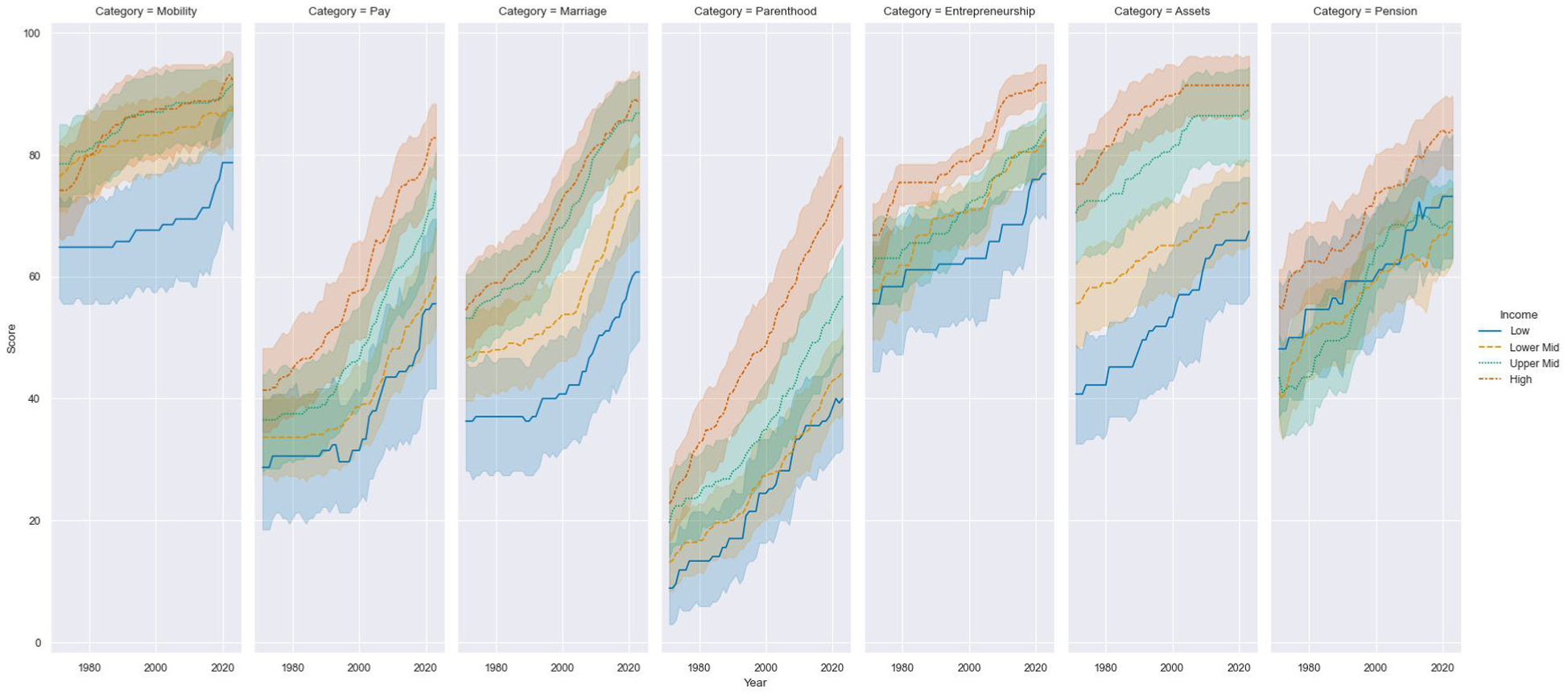
WBL-Indicators scores by Income across time with 95% confidence intervals.
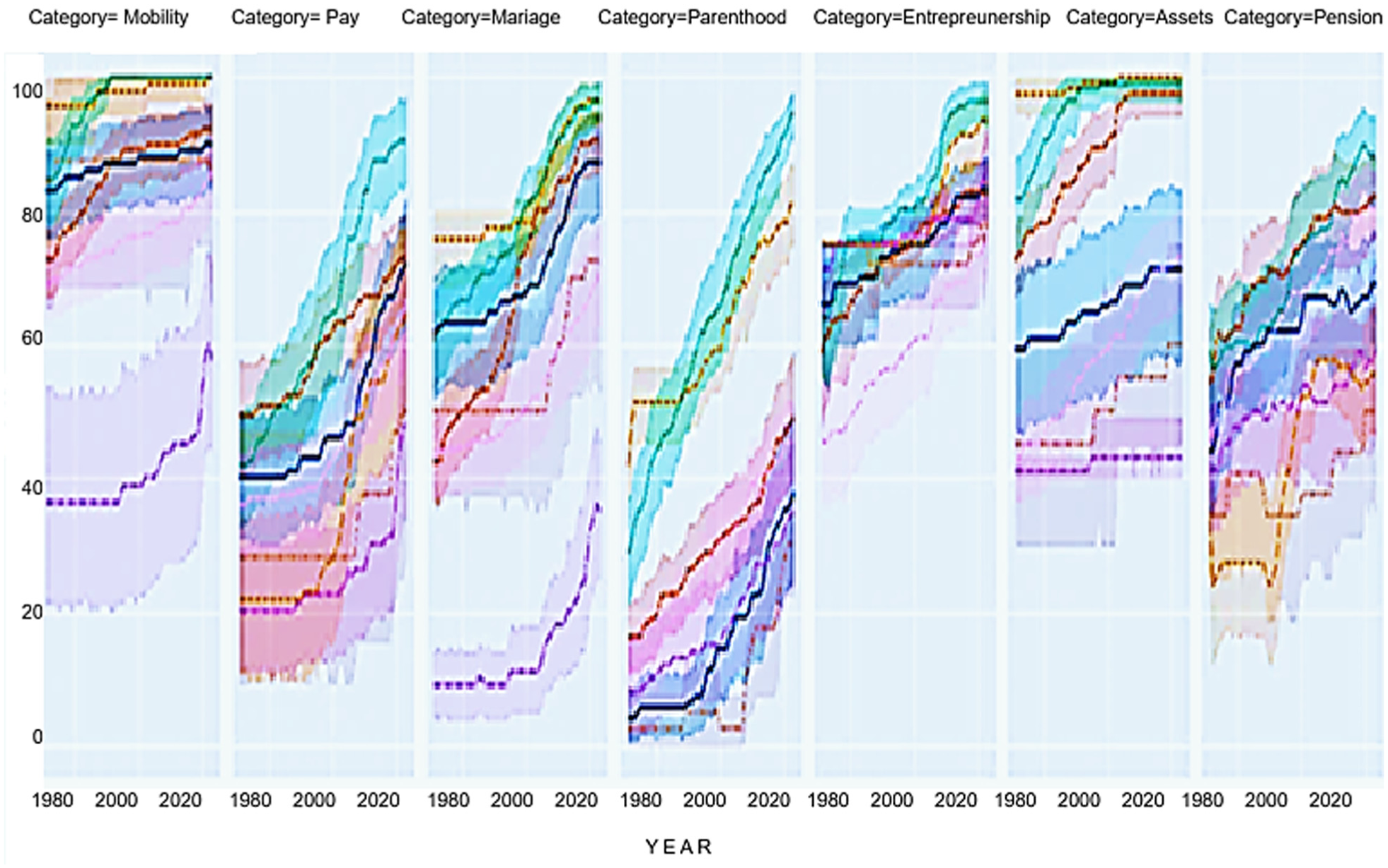
WBL-Indicators scores by Region across time with 95% confidence intervals.
The positioning of groups in Figure 2 also showed that, typically, the group of countries with the highest incomes occupied the top positions, while those with the lowest incomes were the furthest behind. Likewise, at a regional level, as Figure 3 displays, OECD countries and those in Europe and Central Asia were typically at the top, while the Middle East and North Africa were generally at the bottom, excluding specific regulatory indicators. A closer look, especially at Figure 2, allows us to conclude that mobility seemed the indicator with the highest scores, while parenthood had the lowest (Figures 2 and 3).
The results were similar when we focused on the overall WBL Index rather than the individual regulatory indicators. As Figure 4 shows, when grouped by Income, the different groups of countries followed almost the same trajectory in their WBL Index, with an increasing vertical offset proportional to the income level. A one-way ANOVA analysis showed that the income groups were indeed well separated from each other, with an F-statistic of 617.385 and a p-value << .001 (Figure 4).
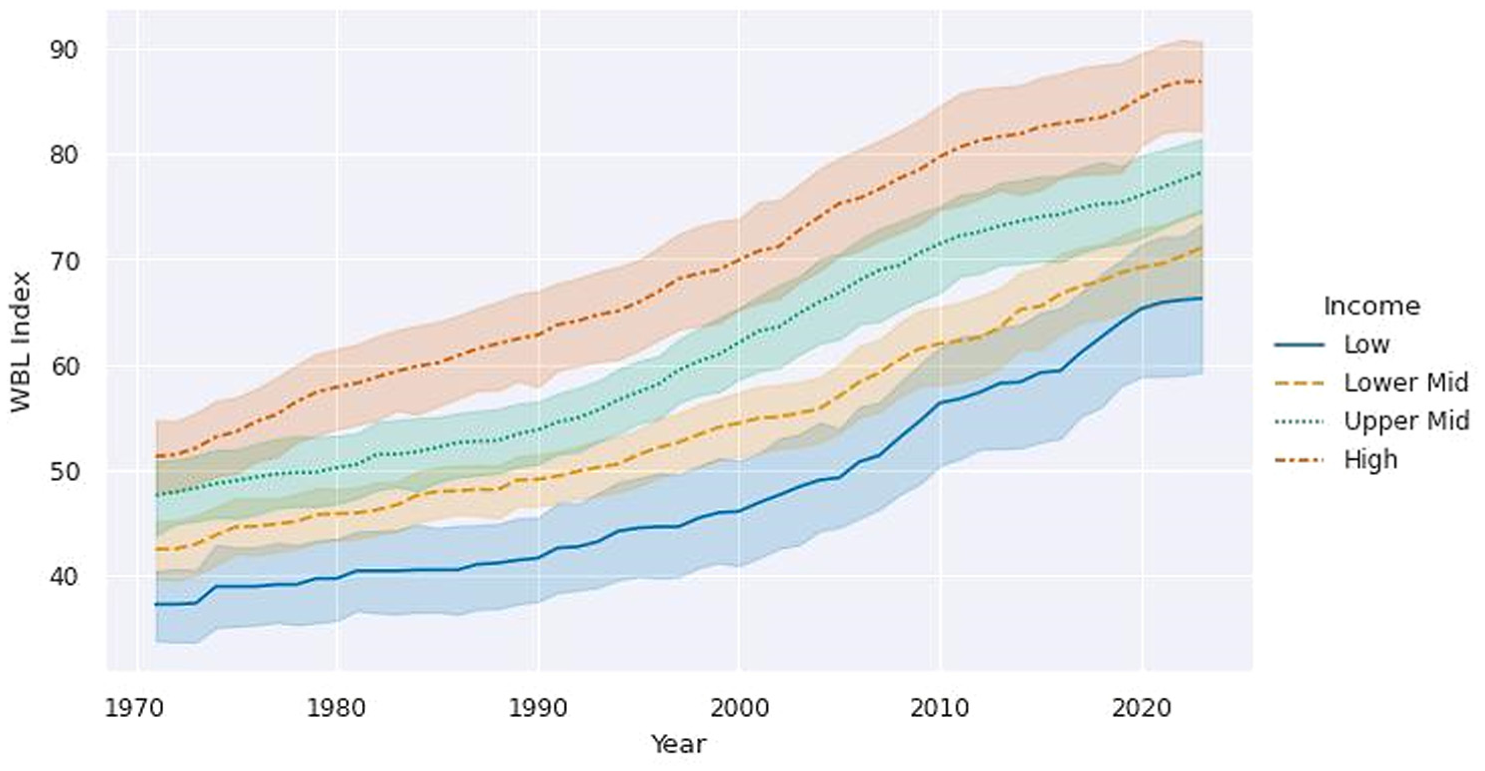
WBL Index by Income across time with 95% confidence intervals.
When grouping by Region, the differences were not as evident. Figure 5 shows that while the High Income: OECD economies displayed the most progressive laws of all regions and Middle East & North Africa was the most lagging region in this regard, the trends for Europe & Central Asia and Latin America & Caribbean were easily confounded, as is the case for the Sub-Saharan Africa and East Asia & Pacific regions. In this case, the F-statistic for an ANOVA one-way test was even larger, at 1,184.69, and a p-value << .01. However, this test only determines that at least two real groups exist, not that all groups are well separated (Figure 5).
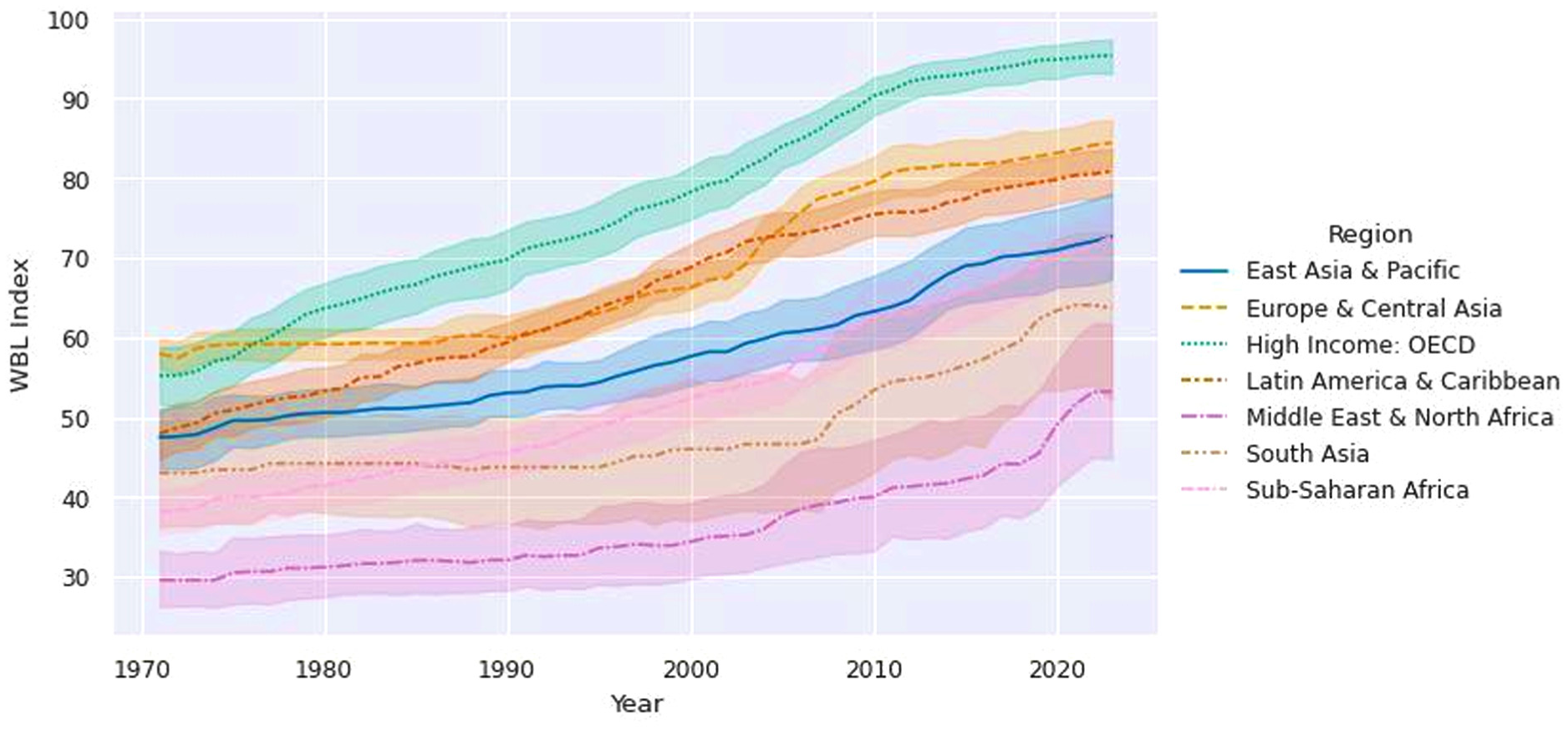
WBL index by Region across time with 95% confidence intervals.
K-Means Clustering
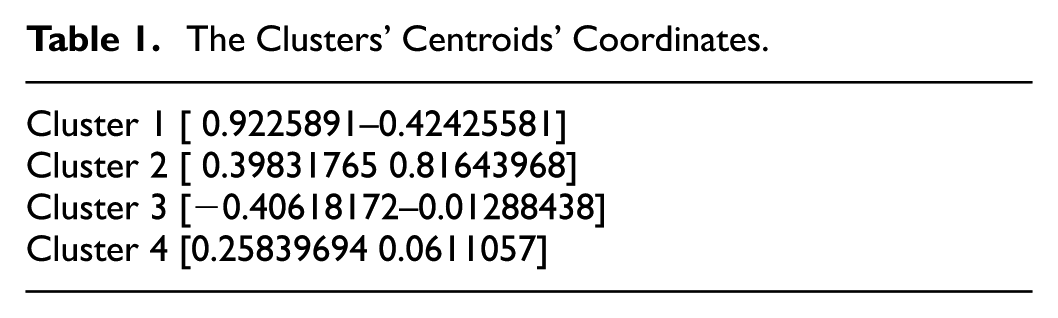
To determine the best way of grouping countries, we compared the groups in terms of income levels and regional locations against learnt clusters of varying sizes generated via the K-Means clustering algorithm. The centroids’ coordinates for each cluster are listed in Table 1. The centroids represent the average point of all the data points that belong to that cluster, helping to understand the data structure and identify groups with similar characteristics (Table 1).
The Clusters’ Centroids’ Coordinates.
To decide the best number of clusters, we measured the group’s inertia (the sum of the distances from an economy to its cluster centroid), displayed in Figure 6. This indicates that even two clusters provide better separation than income grouping, while three or more clusters already prove better than separation by regional location.

Inertia and Silhouette scores for Income and Region grouping versus K-means clustering for different K values.
Figure 6 also shows the silhouette score—a method to validate coherence within-group analysis, measuring in a range from −1 to +1, how similar an object is to its cluster (cohesion) compared to other clusters (separation). The results indicate that both income and region grouping yield a negative score, indicating poor separation across groups. In contrast, K-Means provides positive silhouette scores for every K. Analysis of the silhouette score plot indicated that the optimal number of clusters is K = 3, but the K = 2 and K = 4 cases were also analyzed in our experiment as the elbow point for inertia was not located at K = 3 (Figure 6).
Given the K-Means clustering’s improved cohesion and separation over Income and Region grouping, we analyzed the resulting clusters’ behavior. When looking at the regional composition of the clusters, shown in Figure 7, it became immediately apparent that the High Income: OECD economies and the Middle East & North Africa economies always ended up in different clusters, regardless of K. Europe & Central Asia economies were clustered together with High Income: OECD countries in every case. East Asia, the Pacific, Latin America, and the Caribbean were clustered for K = 2 and K = 3. Interestingly, the fourth cluster in the K = 4 case consisted almost entirely of Sub-Saharan African countries (Figure 7).
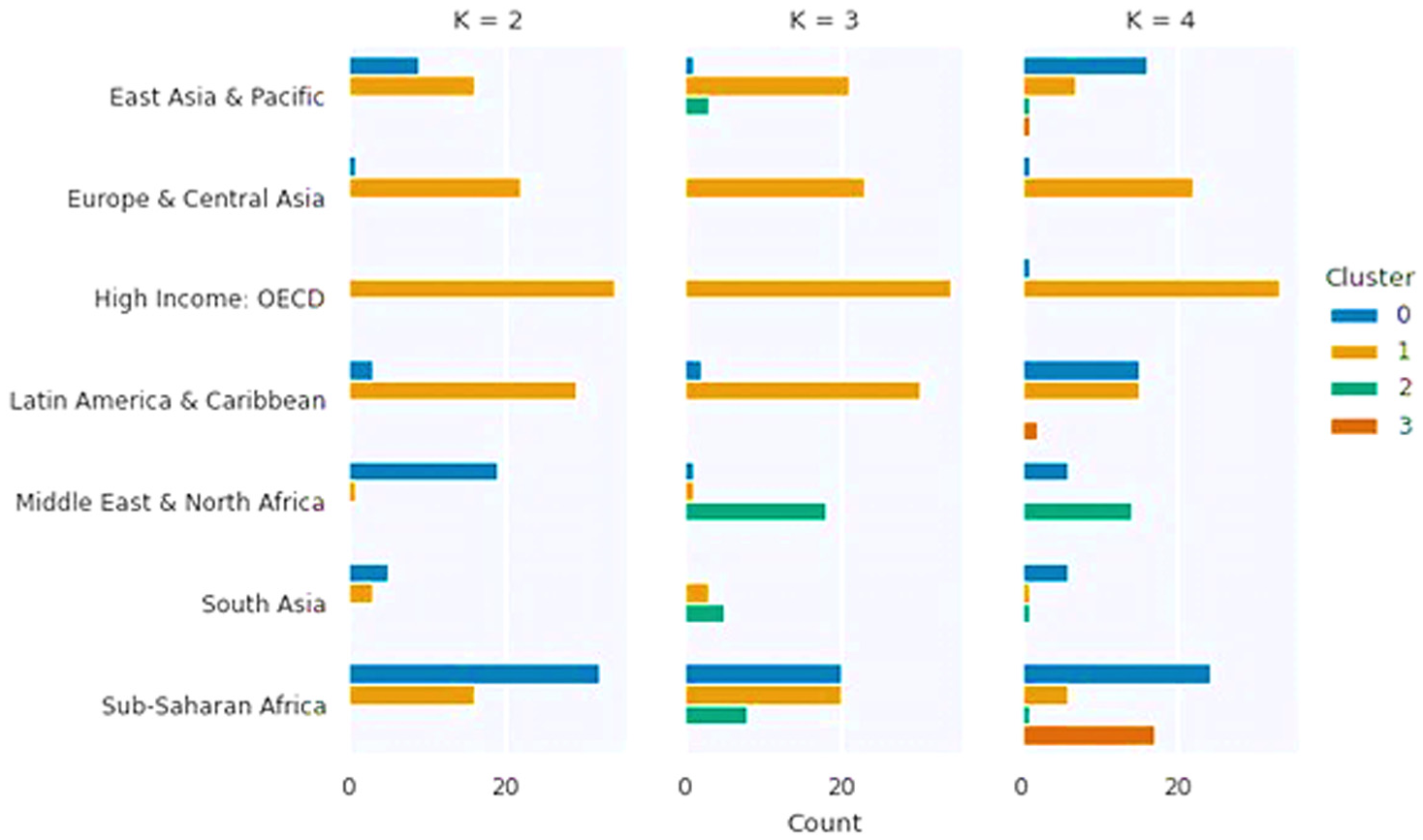
Regional composition of clusters for K = 2, K = 3, and K = 4.
When looking at the temporal trends of the different clusters, shown in Figure 8, we can see that the curves were separated for all three K-values, with even the confidence intervals being disjoint most of the time. The resulting one-way ANOVA F-statistics for K = 2, K = 3, and K = 4 were 5,847.44, 2,937.81, and 2,602.6, respectively. In every case, the p-value << .001 (Figure 8).

WBL Index by cluster across time with 95% confidence intervals.
Cluster 1, composed of OECD and European countries in all the clustering analyses, always occupied the top position in the WBL Index, while cluster 2, mainly including Middle East and North Africa (when K = 4) and South Asia (when K = 3), showed the lowest scores in the WBL Index (Figure 8).
In order to further understand the temporal cluster trends, a simple linear regression of WBL Index ~ Year was performed for each cluster, resulting in the lines shown in Figure 9. These lines allowed us to predict the year by which each cluster will achieve the optimal WBL Index score of 100. The resulting predictions are presented in Table 2. As may be seen, there are significant differences in the time windows by which this optimal condition may be expected. A similar analysis was performed when the economies were grouped by income and region (Figure 9) for completeness.

Linear regression fits WBL Index ~ Year for each cluster.
Year prediction for each cluster to achieve the WBL Index = 100.

The resulting predictions are again vastly different across groups and may be seen in Tables 3 and 4 for Income and Region, respectively.
Year prediction for each income level to achieve the WBL Index = 100.

Year prediction for each region to achieve the WBL Index = 100.

The results in Table 2 showed that Cluster 1, including the OECD and European countries, would achieve the target value for the WBL Index independently of the number of clusters considered. Cluster 2, including the Middle East and North Africa, would be the group achieving the target WBL Index later on, independently of the K (Table 2).
Likewise, Table 3 shows how high-income countries would arrive at the maximum score in the WBL Index within two decades, while for Lower-Middle and Low-Income countries, it will take almost 40 and 50 years more, respectively (Table 3).
Finally, Table 4 orders the Regions expected to achieve the highest score in the WBL Index, indicating that High-Income OECD countries are almost there. They are followed by Latin America and the Caribbean and Europe and Central Asia, which are expected to arrive at the same time. The furthest behind, as expected, are the Middle East, North Africa, and South Asia (Table 4).
Discussion and Conclusions
This research aims to analyze international regulations and laws on economic opportunities for women, focusing on two research questions.
The first one proposes to explore the essential regulatory axes that countries should accelerate to achieve gender equality to improve their income level. The results from the random forest model determine that parenthood regulations are the most crucial predictor, and it is the dimension that takes the longest to reach by laws related to assets and marriage. These results emphasize that, regardless of the specific level of development of every regulatory axis (e.g., parenthood is the least developed one worldwide), the regulations that better identify the wealthiest and most economically developed countries include advanced laws related to women’s work after having children, establishing paid leaves and leave benefits not just for mothers, but also for fathers, and prohibiting discriminations against pregnant workers. According to our results, advanced laws to ensure equality on property and inheritance and reduce legal constraints related to marriage also identify the economic development degree of the regions. Previous research had theoretically stated the positive benefits of these specific regulations (Aspiazu et al., 2015; Deininger et al., 2013; Nautet & Piton, 2021; Stein et al., 2021), following the capability approach perspective that states that gender justice should be promoted with the assistance of policy and legislative reforms that address detrimental gender prejudices and stereotypes (Robeyns, 2003). However, these previous studies had not empirically predicted their effects on the regional income level.
The second research question proposes to analyze the degree of development of laws toward gender equality, considering different groups of countries and determining when an equalitarian regulatory framework could be achieved in each case. We conducted these analyses by comparing three countries, grouping them by income and Region, and clustering the countries according to their regulatory similarities.
The results show clear group separation, which is more evident for income grouping than for region segmentation, as the K-means algorithms provide the best separations. These separations always pointed out that the High-Income OECD countries and Europe and Central Asia are close in terms of their more equalitarian regulatory frameworks, the Middle East and North Africa furthest behind, meaning that these regions need more efforts in terms of advancing their regulations and laws to improve gender equality. East Asia, the Pacific, Latin America, and the Caribbean are close regions in terms of how advanced their regulations and laws are. At the same time, Sub-Saharan African countries are quite singular in this regard, being the Region with a higher probability of being clustered alone.
These results on the more developed regulatory framework of some countries compared with others do not neglect the fact that biased norms, gender prejudices, and stereotypes are widespread. Although women have better access to resources and education in developed nations, prejudices and stereotypes about their roles in the family and at work still exist, restricting women’s economic, social, and political opportunities (Vijay & Yadav, 2022).
The longitudinal analyzes affirm that the average scores of all the regulation indicators evolve positively over time, including the aggregate WBL Index, which summarizes the entire regulatory framework associated with women’s economic opportunities. These results underline the improvements incorporated toward more equalitarian regulatory frameworks, especially in recent years. The improvements are observed, regardless of the group the countries belong to, although the positioning across groups of countries does not change. A more individualized analysis of the indicators highlights that mobility regulation has the highest average score, and parenthood is the lowest.
This result proves that the regulatory framework is not identical if we compare its different indicators, and these differences are observed over time; they were observed 50 years ago, determining a heterogeneous starting point for the indicators on the regulation of female economic opportunities, and despite the progress, they are still observed now. Thus, indicators such as mobility are highly evolved, partly reflecting the current globalized world and the advantages associated with the transfer and extrapolation of experiences, knowledge, and skills that such mobility facilitates (Hanson, 2010; Maza-Avila & Agámez-Arias, 2012). Other indicators, on the contrary, are more anchored in aspects related to culture, religion, or ways of life, such as the regulations that affect family and paternity conditions (Aspiazu et al., 2015; Nautet & Piton, 2021; Stein et al., 2021), these being the ones that still have a considerable range of improvement.
These results confirm the need emphasized by the capability approach perspective to continue working for higher gender justice through regulations and norms because, despite the general improvement, biased norms and gender prejudices and stereotypes are widespread, and although in developed nations, women have better access to resources or education, prejudices, and stereotypes about their roles in the family and at work still restrict economic, social and political women’s opportunities (Vijay & Yadav, 2022).
As part of the second research question, we also wondered how long it would take to achieve gender equality in the different regional contexts. The findings confirm that the more advanced OECD economies already enjoy quite equalitarian regulatory frameworks, followed by other developed regions like Europe and Central Asia. In contrast, the least developed regions, such as the Middle East and North Africa, could take around two centuries to achieve this target. This result agrees with previous studies indicating that progress continues to be slow in some regulatory areas due to legal loopholes, implementation deficiencies, and social norms perpetuating social and cultural practices and uses that are the basis of discrimination and the lack of gender equity (Durojaye & Adebanjo, 2014; Koburtay et al., 2020; Prenzler, 2004; Smith & Sinkford, 2022).
Specifically, the OECD (2019) affirms that despite the growing investments and efforts in improving regulatory frameworks and practices to promote gender equality, it would take at least two centuries (nine generations) to achieve a real-world change. This statement also aligns with our results. However, the significant disparity among regions and the value of making these predictions in further detail on a regional basis are worth noting.
As can be seen, the global gender gap in women’s economic opportunities is significantly larger than expected. While significant progress has been made in several countries in enacting laws that provide equal opportunities for women (World Bank, 2024, 2025a), by 2024, only 14 countries had achieved 100% of the laws; however, these have not yet been fully implemented. Therefore, strategies and programs are still lacking in fully implementing them (World Bank, 2024).
Contributions and Limitations
This research provides some theoretical contributions. It supports the assumptions of the social-psychological theories of gender stereotypes and their adverse effects on egalitarian economic opportunities for men and women. This study also supports the advice of Amartya Sen’s capability approach about the positive impact of achieving gender equality to improve income and, in the end, the wealth of a society, as well as the assistance of policy and legislative reforms to promote this desired gender justice.
Women must have the same rights as men worldwide since this represents an obstacle undermining countries’ capacity to promote sustainable and inclusive development, making the role of policies and regulations crucial. In this regard, policymakers need to systematically consider mechanisms that guarantee the development of each individual’s capabilities within their long-term public policy reforms. They also need to consider transparency in managing these policies and oversee mechanisms for their implementation.
This study also contributes at a political and public level, emphasizing the relevance of the regional and cultural context and the need to adapt the different regulatory frameworks to the specific conditions of women in every region, taking especially into consideration the aspects more rooted in culture, religion or ways of life, like paternity, marriage and pay conditions, that are those with more range for improvement. These specific regulations and laws on assets significantly impact countries’ income levels, supporting the need to review and improve them. While it is necessary to maintain a regulatory framework that safeguards the rights and responsibilities of citizens regardless of their gender, it is also necessary to consider the cultural framework in public policy reform and promote awareness-raising campaigns in the media and educational programs with a gender perspective to highlight the benefits of women’s economic empowerment. In this sense, it is vitally important to demystify women’s role solely as caregivers in the home and position them as prominent figures in political and professional leadership positions who contribute significantly to the economy of countries.
However, pursuing equal conditions for women should not limit men’s capabilities but rather guarantee what they can be and do regardless of gender, based on Amartya Sen’s capability approach. Given that the gender equality approach should not privilege or favor only one group of people, in this same vein, public policies must consider the rights and responsibilities of all citizens without favoring any group based on their gender. Instead, reforms must be implemented to guarantee their capabilities without disadvantaging any group.
From this perspective, we identify the need for future research to answer the following questions: How can women’s empowerment be strengthened in different cultural contexts? How do cultural norms intersect with other factors that limit women’s capabilities? How can institutions promote lifestyles that guarantee the capabilities of all citizens for their economic development?
This research also has limitations, especially in terms of its objective scope, which is determined by the nature of the data. In future research, collecting additional information on female business economic activity and other socioeconomic data would facilitate the development of more explanatory research on the impact of the regulatory framework on female economic activity and opportunities in different countries and regional contexts.
Footnotes
ORCID iDs

Institutional Review Board Statement
Not applicable.
Author Contributions
Funding
The authors disclosed receipt of the following financial support for the research, authorship, and/or publication of this article: This research is part of the Grant PID2021-122575NB-I00 funded by MCIN/AEI/ 10.13039/501100011033/ by “ERDF A way of making Europe.”
Declaration of Conflicting Interests
The authors declared no potential conflicts of interest with respect to the research, authorship, and/or publication of this article.