




Abstract
While reshaping the production methods and business models of enterprises, information technology (IT) has also brought great challenges to enterprise management. Will the use of enterprise IT with high skill requirements have an impact on the stability of their employees? Will this impact be transmitted through the corporate governance level and the fairness of employee compensation and be impacted by factor intensity and employee position. And it subsequently has a negative impact on the enterprise? To answer these questions, this study investigates the impact of firm IT penetration on employee stability based on data of Chinese A-share listed companies from 2013 to 2022. First, this research finds a negative association between firm IT penetration and employee stability. Second, the penetration of firm IT affects the corporate governance level and the fairness of employee compensation, leading to changes in employee stability. Third, IT penetration has a significantly negative impact on employee stability in labor-intensive enterprises and among executives. Forth, the decline in employee stability brought about by corporate IT penetration has a negative impact on corporate risk-bearing capacity. This study contributes to theory and practice by deepening the understanding of firm IT investment and use in the context of enterprise IT governance and enterprise stability.
Plain language summary
First, this research finds a negative association between firm IT penetration and employee stability. Second, the penetration of firm IT affects the corporate governance level and the fairness of employee compensation, leading to changes in employee stability. Third, the decline in employee stability brought about by corporate IT penetration has a negative impact on corporate risk-bearing capacity.
Introduction
In today’s world, as one of the engines of global economic growth, information technology (IT) is regarded as an important factor of production. Thus, the IT industry has become a core component of almost all major industries and is considered one of the most active and dynamic industries (Sagala & Öri, 2024). With the transformation of IT, the enterprises are facing comprehensive impacts and challenges in both internal management and external competition. In this context, enhancing the penetration of IT has become a crucial strategic choice for the survival and development of enterprises. For enterprises, IT is a tool to help them provide better products and services for their customers to gain a competitive advantage, which can enhance communication efficiency and delivery speed (Ghali & Habeeb, 2018). Furthermore, it can improve the management efficiency of the enterprises, thus increasing corporate productivity and market share (Agwu, 2018).
Although the widespread application of IT has provided enterprises with unprecedented convenience, it has also brought management challenges. Firstly, the penetration of IT has impacted traditional business management concepts, leading to a series of management ethics issues. For instance, the quality of executives and internal management systems in enterprises can’t keep up with the development of IT (Gacanin & Wagner, 2019; Lu et al., 2025; Miller, 2018). Secondly, the existence of information technology hasn’t made management systems more efficient and flexible, but rather more complex (Chen & Zhang, 2024). The penetration of IT will generate quantities of storage data, resulting in the information overload (Graf & Antoni, 2021). Employees in enterprises have difficulties in dealing with and analyzing them. Therefore, the problem of information overload not only hinders decision optimization but can also make decision-making difficult and inappropriate (Sui et al., 2024). Finally, as the penetration of IT increases, information security risks also enhance. Cyber-attacks, data leaks, and other information security threats can undermine IT adoption processes and corporate reputation (Van Hoang et al., 2025). This affects customers “and employees” recognition of the potential value of the enterprises (M. J. Kim & Yoo, 2018).
Employee stability typically refers to the characteristics of employees continuously retaining their positions over a certain period, maintaining low turnover rates and low mobility. It encompasses not only actual resignation behaviors but also manifests as commitment to their positions and a sense of belonging to the organization (Costa et al., 2024; Veglio et al., 2025; Yang et al., 2024). Among a series of management challenges, it is important for enterprises to adjust their employees to adapt to IT penetration, which may have a certain impact on employee stability (Moore, 2000; Niederman & Sumner, 2003). On the one hand, employees may passively resign, due to the displacement effect of IT. On the other hand, they may voluntarily leave, because of work pressure resulting from job changes brought about by IT. So, what is the impact of IT penetration on employee stability? What is the mechanism by which this impact is transmitted? How will the change in employee stability brought about by IT affect the organization? Currently, there is no definitive answer provided in academic research. Existing research exhibits several shortcomings. Firstly, a substantial body of literature focuses on the positive effects of IT on corporate performance or production efficiency (Brynjolfsson & Hitt, 2000; Liang & Tian, 2024), while paying less attention to its impact on employee behavior and psychological aspects. Secondly, some studies concentrate on IT-induced changes in job skill requirements (Autor et al., 2003; Babashahi et al., 2024), overlooking the dynamic processes of employee mobility and stability. Thirdly, research on the impact of IT permeation on turnover rates is often confined to specific industries or high-skilled positions (Fossen & Sorgner, 2021), lacking a systematic examination of its effects on employees in ordinary positions. Fourthly, while certain empirical studies (Tahir & Ashraf, 2024) have identified correlations between IT investment and workforce restructuring, they have not delved deeply into the mediating pathways affecting employee stability, such as changes in corporate governance or shifts in pay equity.
Within the framework of this study, corporate governance level and employee pay equity are positioned as the two key mediating variables through which IT permeation influences employee stability. Firstly, IT penetration is often accompanied by the digitization of decision-making processes and increased transparency in information disclosure. While this may enhance management efficiency, it can also lead to a high concentration of decision-making power among a few senior executives (Jiang & Li, 2024; Sun et al., 2023). Such centralization can restrict employees’ channels for expression, diminishing their sense of participation and belonging. Consequently, by reducing employees’ trust in the organization and their perception of fairness, it indirectly increases turnover intention (Moon et al., 2024). Secondly, the impact of IT permeation on compensation structures is also widely documented: digital transformation increases the premium demand for highly skilled talent, while wage growth for employees in routine positions tends to lag, leading to widening internal pay disparities (Arnold et al., 2024; Ye et al., 2022). When employees perceive unfairness in pay distribution, their organizational commitment and willingness to stay decline significantly (Card et al., 2012; Kenelak et al., 2016). This study will empirically test the mediating effects of these two mechanisms at the level of Chinese listed companies, thereby addressing the gap in existing research concerning the lack of systematic empirical investigation into mediating pathways.
In exploring the heterogeneous effects of IT permeation on employee stability, we introduce two moderating variables: factor intensity and employee position. Factor intensity reflects a firm’s relative reliance on labor versus capital inputs: in labor-intensive enterprises, high levels of IT permeation may trigger greater substitution risks for low-skilled employees through large-scale automation, whereas in capital-intensive firms, this effect might be buffered by equipment upgrades and economies of scale (Autor et al., 2003; Fossen & Sorgner, 2021). Employee position distinguishes between managerial and non-managerial roles: existing research indicates that managers face greater information processing and decision-making pressures, and their adaptability to IT tools and psychological expectations differ significantly from those of frontline employees (Henderson & Fredrickson, 1996; Schmitt, 2024). This study will examine how these two moderating variables alter the strength and direction of the relationship between IT permeation and employee stability, thereby revealing the differential responses of various enterprise types and employee groups during the digital transformation process.
Based on the relationship between the penetration of IT and employee stability, this study explores the impact of corporate IT penetration on employee stability, its transmission mechanism, and the potential effect of this impact on the enterprise. Specifically, this study aims to accomplish four core objectives: first, to empirically examine the direct effect of corporate IT permeation on employee stability, encompassing both its strength and direction; second, to reveal the underlying mechanisms through which IT permeation influences employee stability; third, to investigate the differential effects of IT permeation on employee stability across various types of enterprises and employee groups; and fourth, to assess the potential effects of IT-induced changes in employee stability on firms’ risk-taking capacity. The innovation of this study is as follows. First, this study contributes to a deep understanding of the “IT productivity paradox” phenomenon from the perspective of enterprise employee stability. The IT productivity paradox refers to the phenomenon whereby an organization’s IT investments do not yield a commensurate return on performance, or even have a detrimental impact on the organization (Sagala & Öri, 2024). Although most of the existing research supports the transformation of enterprise digital intelligence or enterprise IT investment and construction, the phenomenon of “IT productivity paradox” has always existed in academic research (Dos Santos & Sussman, 2000; Iacovone et al., 2023). At present, there is still no unified opinion on the cause of this phenomenon. This study reconsiders the “IT productivity paradox” and its causes from the perspective of the change of employee stability and enterprise stability caused by corporate IT construction. It is of great significance to deeply understand the corporate IT construction. Second, we expand the scope of research on IT investment. The studies on the impact of enterprise digitalization and IT investment primarily focus on aspects of enterprise performance, such as enterprise output (Ho et al., 2011), enterprise innovation (Sutrisno et al., 2023), and enterprise operations (Nicolas et al., 2021), etc. This study analyzes the unstable factors that IT construction may bring to enterprises from the perspective of employee stability Thus, it broadens the research scope of existing enterprise IT investment studies. Third, this article holds significant value in enriching the relevant research on factors affecting employee stability. Most of the existing literature studies focus on the impact of employee compensation (Ghani et al., 2022), job effectiveness, employer brand (Padhi & Joshi, 2022) on employee stability. Therefore, our focus extends to the penetration of IT, broadening the scope of research on factors influencing employee stability.
Background Literature and Hypothesis
IT Penetration and Employee Stability
IT penetration is defined as the extent to which IT is embedded within an organization’s strategic, managerial, and operational work systems (Zmud et al., 1987). With the rapid development of computers and the Internet, it plays an important role in various industries in social life (Gonzalez-Varona et al., 2024). At the same time, as the penetration of IT in the enterprise has increased, it has changed the mode of the corporate operation. As a result, the investment and utilization of IT in the enterprises have brought new challenges to corporate management. Among them, relatively less attention has been paid to the changes in employee stability resulting from the “substitution effect” and “creation effect” of corporate IT.
The relevant literature can be developed from four perspectives. First, the “substitution effect” of IT. The “substitution effect” of IT is indicated by production automation, which reduces the demand for low-skilled employees (Kaplan & Haenlein, 2020; Salunkhe et al., 2024). Employees may feel anxious about the potential adverse effects of IT on themselves due to the uncertainty of being replaced (Dwivedi et al., 2021). Second, the “creation effect” of IT. The “creation effect” of IT is indicated by the demand of employees with high digital skills. Employees are required to be proficient in digital skills which lead higher levels of occupational stress to them (Harahap et al., 2023). Third, the work pressure. With the continuous influx of email, messages, data, and other digital communications, employees are facing the problem of information overload. Employees will find themselves expected to process a large amount of information in a short period of time (Ausat et al., 2022). So it increases the time pressure of employees (Tarigan et al., 2023). Employees can swiftly and efficiently communicate with colleagues and clients because IT tools such as email, instant messaging, and social media are not limited by time or location (Ausat & Suherlan, 2021). But the unrestricted accessibility of certain IT tools may lead employees to feel obligated to respond to messages and emails in time, even outside of regular work hours. Consequently, this blurs the boundaries between work and personal time, making it difficult for employees to differentiate between their work hours and leisure time (Konca, 2022). Forth, the decreased performance. Employees may find it difficult to effectively utilize IT to process data and obtain information due to a lack of knowledge and skills in IT (Prastyaningtyas et al., 2023). The inability of employees in IT to meet job requirements can lead to a decline in their performance (Astika & Dwirandra, 2020; Hama & Qurochman, 2022).
Therefore, based on the “substitution effect” of IT, “creation effect” of IT, work pressure, and decreased performance, employees may reduce their job satisfaction and develop a tendency to resign.
Mediating Role of the Corporate Governance Level
Within the context of IT penetration, corporate governance models are also undergoing transformations, a phenomenon explored in existing literature from various dimensions. Some scholars, focusing on organizational structure, point out that IT infiltration often tends to promote the centralization of decision-making (Pick, 2015). The decision-making power is concentrated at the top of the organization in highly centralized organizations (H. Kim, 2018; Sun et al., 2023). So employees may not express their ideas or disagreements because of differences in their status and power in the organization (Bisel et al., 2012; H. Kim & Leach, 2020). This leads to a decline in employee voice and influence, restricting their space for expressing opinions and innovation (Hirst et al., 2009; Maynes et al., 2024). Insufficient voice and autonomy, coupled with the constraint to realize innovative ideas, lead them to a decreased sense of belonging to the organization (H. Kim & Leach, 2020).
Another strand of literature concentrates on the impact of IT on organizational security. Studies indicate that information technology heightens a company’s exposure to security risks such as cyberattacks and data breaches (Bustami & Bahri, 2020). When companies become overly reliant on IT, there is a significant risk of data leakage due to technical vulnerabilities (Juma’h & Alnsour’, 2020). The leakage of important data can cause huge losses to businesses, such as financial losses, customer satisfaction, corporate image, employee trust, and other long-term, intangible damage. (Gwebu et al., 2018; Hui et al., 2019; Liu et al., 2020; Martin et al., 2017; Paramita & Winata, 2023; Zhang et al., 2022). Information leakage is related to corporate governance (Stoel & Muhanna, 2011), and employees are inclined to resign due to increased internal governance risks in the company.
In summary, existing research primarily reveals the negative impact of IT penetration on corporate governance from two perspectives: the centralization of decision-making and information security. The weakening of corporate governance may, in turn, affect employee stability.
Mediating Role of the Fairness of Employee Compensation
Compensation is the remuneration received by an employee in return for their contribution to the organization (Reddy, 2020). The amount of compensation represents the value of their position (Mappamiring et al., 2020; Quintana-Déniz et al., 2007; Stone et al., 2015). Employee compensation gap refers to the difference in the salary level between different employees in the same enterprise. It reflects the fairness and rationality of the salary distribution in the enterprise. If employees recognize the company’s compensation policy, it possibly improves their job satisfaction and organizational performance (Kenelak et al., 2016; Praveena et al., 2017; Rouen, 2020). Employee compensation gap typically make low-wage employees feel unfair. So they probably decrease on and take actions detrimental to organizational performance (Akerlof & Yellen, 1990; Card et al., 2012). Under the background of IT investment, the employee compensation gap shows an expanding trend (Moll et al., 2022).
On the one hand, employees who are responsible for different job tasks can receive different compensation. According to the type of work tasks, it can be divided into conventional task roles and non-conventional task roles (Acemoglu & Restrepo, 2018). The former is mainly responsible for simple work, while the latter is mainly responsible for complex work, such as developing software, equipment maintenance, etc. On the other hand, under the context of the enterprise digital transformation, the needs of enterprises for employees have changed. With the penetration of IT, companies reduce the demand for positions involving simple tasks, leading to a decrease in both the quantity and compensation level of such employees. On the contrary, companies increase the demand for high-quality digital talents because of the upgrading of production equipment brought by the penetration of IT. Therefore, wages for high-skilled employees significantly increase (Ye et al., 2022). Meanwhile, the compensation of executives is expected to increase as the enterprise need to deal with more complex management issues (Henderson & Fredrickson, 1996). So, the salary of other employees will be lower than the technical personnel and executives. The fairness of employee compensation is related to employee compensation gap, and employees are inclined to resign due to the expand of this gap.
In summary, previous studies indicate that IT penetration has led to significant differentiation in internal compensation structures within enterprises. Moreover, the widening pay gap has been shown to adversely affect employee stability.
Research Data
Sample Selection and Data Sources
This study takes Chinese A-share listed companies from 2013 to 2022 as the research objects to analyze the impact of enterprise IT penetration on employee stability. The selection of 2013 as the baseline year is grounded in the systematic enhancement of IT-related disclosure quality by China’s A-share listed companies from that period onward. This improvement, encompassing key indicators such as digital transformation initiatives and cloud computing investments, was driven by revisions to the China Securities Regulatory Commission’s (CSRC) Information Disclosure Reporting Rules. Concurrently, 2022 was selected as the endpoint as it provides the most recent complete audited annual data, thereby avoiding the temporal limitations associated with unaudited reports. Based on the initial samples, we have excluded samples such as ST and *ST, financial industries, and missing data. Finally, 2,861 companies and 17,128 observations were selected for this study. The original data measuring enterprise IT penetration, employee stability and control variables are all from the Chinese Securities Market and Accounting Research (CSMAR) Database. In this study, we perform data tail reduction by 1% and 99% for continuous variables to minimize the disturbance of outliers. In addition, we use Stata 17 statistical software to analyze the empirical results.
Variable Definitions
IT Penetration
IT Penetration is treated as an independent variable in this study. We use the e-commerce sales (10 million yuan per 10,000 people; ECsale) and the number of computers in use (one unit per 100 people; computer) as the indicators of corporate IT penetration. The e-commerce sales (ECsale) and the number of computers in use (computer) at the enterprise level are difficult to obtain. So referring to the research conducted by Bartik (1991), we use the e-commerce sales (ECsale_indu) and the number of computers in use (computer_indu) at the industry level to construct firm-level indicators of IT penetration. The annual industry employment figures may be affected by time changes and IT development trends. Therefore, we adjust for potential endogeneity and simultaneity biases by using the proportion of the previous year’s enterprise employment to the total industry employment as a weight. The specific formula is as follows.

Where,
Employee Stability
Employee stability is treated as a dependent variable in this study. We use the employee turnover rate as a reverse substitute indicator of employee stability. Specifically, based on the number of employees disclosed in the annual reports of listed companies, we calculate the employee turnover rate by comparing the number of employees at the beginning and end of each year. In order to enhance the comprehensibility of the empirical results, this study multiplies the employee turnover rate by −1 as the indicator of employee stability. A higher value of this variable indicates better stability of the enterprise’s employees.
Mediation Variables
For Mediation variables, we have designed two indicators to explore the influential mechanism effect of IT Penetration, that is, the corporate governance level and the fairness of employee compensation.
Corporate governance is primarily measured through three dimensions: shareholder, board, and incentive mechanisms. Principal component analysis (PCA) is employed to evaluate nine indicators across these dimensions, with the first principal component serving as the key metric. First, four indicators are selected at the shareholder level: shareholding ratio of the largest shareholder, equity balance ratio (comparing the shareholding ratios of the second to tenth largest shareholders against that of the largest shareholder), ownership structure and institutional investor participation. Second, three indicators are selected at the board level: independent director representation (as a percentage of total directors), Board size and Dual leadership (1 for combined roles, 0 otherwise). Third, three indicators are selected at the board level: Executive shareholding ratios, Compensation packages for the top three executives and Executive stock ownership.
We take the internal compensation gap as the inverse alternative index of Fairness of employee compensation. It is measured by the ratio of average compensation of management to average compensation of employees. The calculation method for average compensation of management involves dividing the total annual salaries of senior executives, directors (excluding independent directors), and supervisors by the management team size. For average employee compensation, the calculation method first combines the change in “total employee compensation payable” with “cash payments to employees,” then subtracts the total annual salaries of directors, supervisors, and senior executives (as defined above), and finally divides this figure by the total number of employees.
Moderation Variables
For Moderation variables, we have used two indicators to explore the heterogeneity of IT Penetration, namely, the factor intensity and employee position. We think that the factor intensity is an indicator of the enterprise level, while the employee position is an indicator of the employee level.
At the corporate level, labor-intensive enterprises impose higher staffing requirements compared to capital-intensive ones. Consequently, employees in labor-intensive sectors face greater unemployment risks due to lower workforce stability. To test this idea, we measure factor intensity by taking the logarithm of the ratio of net fixed assets to employment. Samples with factor intensity above the median are classified as capital-intensive enterprises, while others are categorized as labor-intensive enterprises.
At the employee level, compared with senior executives, non-executives employees are less important, so they face greater unemployment risks. We assign senior executives a value of 1 and non-executives 0.
Control Variables
To improve the research accuracy, in the regression model, we controlled aseries of company characteristic variables. We have selected indicators of asset-liability ratio (Lev, total assets/total debt), institutional investor shareholding ratio (Ins, number of shareholdings of institutional investor to total shareholdings), total asset growth rate (Growth, (total assets t − total assetst−1)/total assetst−1), size (Size, ln(total assets)), return on equity (ROE, net income/average equity), research and development expenditure (R&D, ln(research and development expenditure)), book-to-market ratio (BM, total assets/market value), equity balance (Balance, number of shareholdings of the 2nd to 5th largest shareholders/number of of shareholdings of the first largest shareholder), management shareholding ratio (Mshare, number of shareholdings of executives/total shareholdings) to represent the possible influences of corporate organization characteristics on IT Penetration and employee stability.
The variables of this study are displayed in Table 1.
Variables List.

Estimation Models
We construct the panel regression model to explore how IT penetration influences employee stability. The two-way fixed effect in year and firm are employed for the following analysis. The specification of the empirical model is designed as follows:

where i denotes firm; t denotes year; Controls denotes control variables; δYear denotes year fixed effect; ηFirm denotes firm fixed effect; Stability, IT, and control variables are defined as mentioned before. α1 represents the effect of IT penetration on employee stability, and the cluster-robust standard error is used in the following analysis. It is also used for our robustness check.
Results
Descriptive Statistics
Table 2 reports the descriptive statistics. We can observe that the average of employee stability (Stability) is 0.038, indicating that the employee stability performs well in samples. Additionally, the average of e-commerce sales (ECsales) is 0.012, with a median of 0.001, a minimum of 0, and a maximum of 0.237. Similarly, the average of number of computers in use (computer) is 0.010, with a median of 0.001, a minimum of 0, and a maximum of 0.237. This suggests that there are certain individual differences in the e-commerce sales and number of computers in use.
Descriptive Statistics.

Correlation Analysis
To analyze the correlation between core variables, we performed a Pearson correlation test. The results are presented in Table 3. The correlation coefficients between e-commerce sales (ECsale) and the number of computers in use (computer) on employee stability (Stability) are significantly negative (−.058, significant at 1%; −.036, significant at 1%). These results indicate that there is a significant negative correlation between IT penetration and employee stability.
Correlation Analysis.

Represent the significance level at 1%.
Baseline Regression Results
Table 4 reports the baseline regression results of IT penetration on employee stability. We can observe that the regression coefficient of the e-commerce sales (ECsale) in Column 1 and the number of computers in use (computer) in Column 2 are both significantly negative (−.579, significant at 1%; −1.551, significant at 1%). These results indicate that there is a significant negative correlation between IT penetration and employee stability. So, hypothesis 1 was proved that the IT penetration negatively impacts the employee stability.
Baseline Regression Results.

Note. Cluster-robust standard errors are presented in parentheses.
Represent the significance level at 1%.
Represent the significance level at 5%.
Impact Mechanism Analysis
As stated in the research hypothesis, the logic behind the idea that IT penetration inhibits employee stability is: firstly, IT penetration reduces employee stability through the corporate governance level; secondly, IT penetration reduces corporate employee stability through the fairness of employee compensation. To ascertain the validity of these two mechanisms, this study constructs the empirical model as follows to explore the impact mechanism of IT penetration on employee stability.

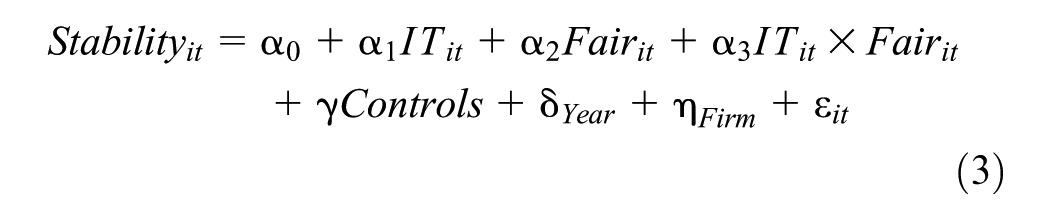
Where, Govern denotes the corporate governance level; Fair denotes the fairness of employee compensation; other variables are consistent with those in the baseline regression model.
Corporate Governance Level
Table 5 reports the impact mechanism result of IT penetration on employee stability from the aspect of the corporate governance level. As shown in Column 1, the regression coefficient of the e-commerce sales (ECsale), and the interaction term between the e-commerce sales and the corporate governance level (ECsale_Govern) are both significantly negative (−.703, significant at 1%; −.271, significant at 1%). As shown in Column 2, the regression coefficient of the number of computers in use (computer), and the interaction term between the number of computers in use and the corporate governance level (computer_Govern) are both significantly negative (−1.673, significant at 1%; −.256, significant at 10%). These results indicate that the IT penetration negatively impacts the employee stability through the corporate governance level. So, hypothesis 2 was proved that the corporate governance level has mediating effect toward the impact of IT penetration on employee stability.
Mediation Effect Result of the Corporate Governance Level.

Note. Cluster-robust standard errors are presented in parentheses.
Represent the significance level at 1%.
Represent the significance level at 5%.
Represent the significance level at 10%.
Fairness of Employee Compensation
Table 6 reports the impact mechanism result of IT penetration on employee stability from the aspect of the fairness of employee compensation. As shown in Column 1, the regression coefficient of the e-commerce sales (ECsale), and the interaction term between the e-commerce sales and the corporate governance level (ECsale_Govern) are both significantly negative (−.336, significant at 5%; −.610, significant at 5%). As shown in Column 2, the regression coefficient of the number of computers in use (computer), and the interaction term between the number of computers in use and the corporate governance level (computer_Govern) are both significantly negative (−1.274, significant at 1%; −.477, significant at 10%). These results indicate that the IT penetration negatively impacts the employee stability through the fairness of employee compensation. So, hypothesis 3 was proved that the fairness of employee compensation has mediating effect toward the impact of IT penetration on employee stability.
Mediation Effects Result of the Fairness of Employee Compensation.

Note. Cluster-robust standard errors are presented in parentheses.
Represent the significance level at 1%.
Represent the significance level at 5%.
Represent the significance level at 10%.
Heterogeneous Analysis
Factor Intensity
Table 7 reports the moderation effect result of IT penetration on employee stability from the aspect of the factor intensity. As shown in Column 1 and Column 2, the regression coefficient of the e-commerce sales (ECsale) in labor-intensive enterprises is significantly negative (−.663, significant at 1%), but in capital-intensive enterprises, it is insignificantly negative (−.254). As shown in Column 3 and Column 4, the regression coefficient of the number of computers in use (computer) in labor-intensive enterprises is significantly negative (−1.763, significant at 1%), but in capital-intensive enterprises, it is insignificantly negative (−.875). These results indicate that the IT penetration has a significantly negative impact on employee stability in labor-intensive enterprises, but insignificantly in capital-intensive enterprises.
Moderation Effect Result of the Factor Intensity.

Note. Cluster-robust standard errors are presented in parentheses.
Represent the significance level at 1%.
Represent the significance level at 5%.
Represent the significance level at 10%.
Employee Position
Table 8 reports the moderation effect result of IT penetration on employee stability from the aspect of the employee position. As shown in Column 1 and Column 2, the regression coefficient of the e-commerce sales (ECsale) on executives is significantly negative (−.533, significant at 1%), while on non-executives, it is insignificantly negative (−.038). As shown in Column 3 and Column 4, the regression coefficient of the number of computers in use (computer) on executives is significantly negative (−1.887, significant at 1%), while on non-executives, it is insignificantly negative (−.167). These results indicate that IT penetration has a significantly negative impact on executives, while it has an insignificant influence on non-executives.
Moderation Effect Result of the Employee Position.

Note. Cluster-robust standard errors are presented in parentheses.
Represent the significance level at 1%.
Represent the significance level at 5%.
Represent the significance level at 10%.
Robustness Tests
Instrumental Variable Method
To alleviate the endogeneity issue arising from bidirectional causality, our first test focuses on the instrumental variable least squares method (IV-2SLS) to prove the robust relationship between IT penetration and employee stability. The penetration of enterprise IT will be affected by the IT environment of the city and industry in which the enterprise is located. However, IT penetration of individual enterprises is unlikely to influence the overall level of IT at the city and industry levels. The impact of time changes is also considerable. So, we use the IT penetration of other companies in the same city, industry, and year as instrumental variables to explore the impact of IT penetration on employee stability.
Table 9 reports the empirical results of the instrumental variable method. In the first stage, we observe that the regression coefficient of the e-commerce sales of other companies in the same city, industry, and year (medianECsale) in Column 1 and the number of computers in use of other companies in the same city, industry, and year (mediancomputer) in Column 3 are both significantly positive (.916, significant at 1%; .929, significant at 1%). In the second stage, We discover that the regression coefficient of the e-commerce sales (ECsale) in Column 2 and the number of computers in use (computer) in Column 4 are both significantly negative (−.233, significant at 1%; −.293, significant at 1%). These results indicate that there is a significant negative correlation between IT penetration and employee stability.
Robustness Test of Instrumental Variable Method.

Note. Cluster-robust standard errors are presented in parentheses.
Represent the significance level at 1%.
Represent the significance level at 10%.
Alternative Measures of the Independent Variable
To overcome measurement bias in the independent variable, our second test focuses on alternative measures of the independent variable to prove the robust relationship between IT penetration and employee stability. In a previous section, we use the number of websites in use (computer) and the e-commerce sales (ECsale) as the indicators of corporate IT penetration; here we use the number of owned websites (one unit per 100 people; Web) and the mobile internet access traffic (1 GB per people; Traffic) as the indicators of corporate IT penetration.
Table 10 reports the empirical results of the alternative measures of the independent variable. We observe that the regression coefficient of the e-commerce sales (ECsale) and the number of computers in use (computer) are both significantly negative (−.045, significant at 1%; −.131, significant at 5%). These results indicate that there is a significant negative correlation between IT penetration and employee stability.
Robustness Test of Alternative Measures of the Independent Variable.

Note. Cluster-robust standard errors are presented in parentheses.
Represent the significance level at 1%.
Represent the significance level at 5%.
Replacement of Fixed Effects
Although we control for year-firm fixed effect, we do not consider industry and province fixed effects. Such factors could also be time-variant at the same province and industry (Zhou et al., 2021). Therefore, our third test focuses on the replacement of fixed effects to prove the robust relationship between IT penetration and employee stability. In a previous section, we use the year-firm fixed effect; here we use the year-industry fixed effect and the year-province fixed effect.
Table 11 reports the empirical results of the replacement of fixed effects. We observe that the regression coefficient of the e-commerce sales (ECsale) in Column 1 and the number of computers in use (computer) in Column 2 are both significantly negative (−.156, significant at 1%; −.272, significant at 1%). This shows that there is a significant negative correlation between IT penetration and employee stability with the year-industry fixed effect. In addition, we discover that the regression coefficient of the e-commerce sales (ECsale) in Column 3 and the number of computers in use (computer) in Column 4 are both significantly negative (−.114, significant at 1%; −.142, significant at 5%). These results indicate that there is a significant negative correlation between IT penetration and employee stability with the year-province fixed effect.
Robustness Test of Replacement of Fixed Effects.

Note. Cluster-robust standard errors are presented in parentheses.
Represent the significance level at 1%.
Represent the significance level at 5%.
The Lag of the Independent Variable
The impact of IT penetration on employee stability may have a certain time lag, and there may be an endogeneity issue between the two factors. Therefore, our fourth test focuses on the lag of the independent variable to prove the robust relationship between IT penetration and employee stability. In a previous section, we explored the impact of IT penetration on employee stability during the same period; here we lag the independent variable by one period.
Table 12 reports the empirical results of the lag of the independent variable. We observe that the regression coefficient of the e-commerce sales (ECsale) in Column 1 and the number of computers in use (computer) in Column 2 are both significantly negative (−.614, significant at 1%; −1.447, significant at 1%). These results indicate that there is a significant negative correlation between IT penetration and employee stability even when the independent variable is lagged by one period.
Robustness Test of Lag of the Independent Variable.
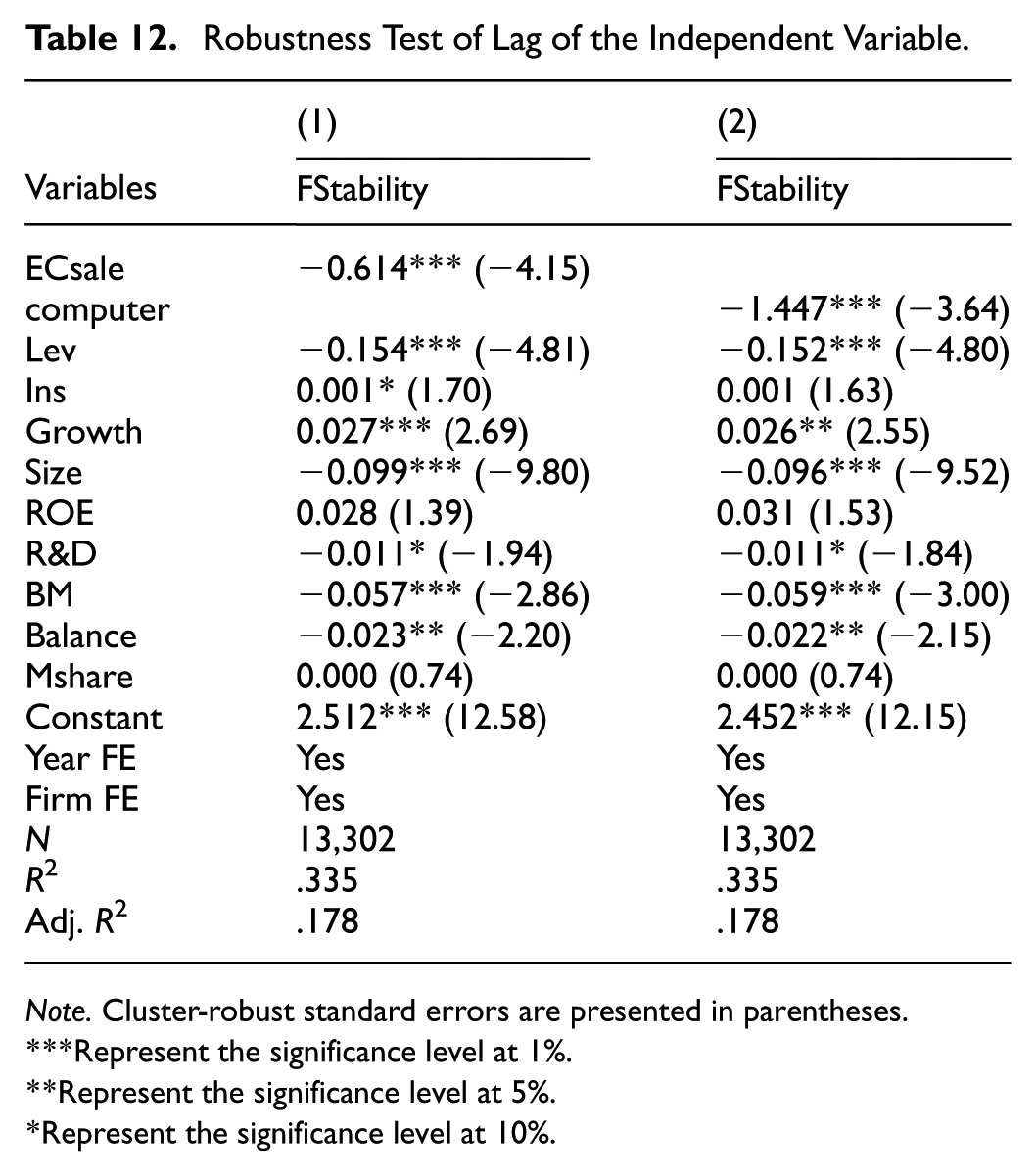
Note. Cluster-robust standard errors are presented in parentheses.
Represent the significance level at 1%.
Represent the significance level at 5%.
Represent the significance level at 10%.
Exclusion of Samples From the Core Industry of Digital Technology
The enterprise in the core industry of digital technology has advantages in both the application of IT and the reserve of digital talents. Therefore, our fifth test focuses on the exclusion of samples from the core industry of digital technology to prove the robust relationship between IT penetration and employee stability. In a previous section, we explored the impact of IT penetration on employee stability using full samples; here we exclude the samples from the core industry of digital technology, based on the latest “Statistical Classification of Digital Economy and Its Core Industries (2021)” promulgated by the National Bureau of Statistics (Zhao et al., 2023).
Table 13 reports the empirical results of the exclusion of samples from the core industry of digital technology. We can observe that the regression coefficient of the e-commerce sales (ECsale) in Column 1 and the number of computers in use (computer) in Column 2 are both significantly negative (−.447, significant at 1%; −1.206, significant at 1%). These results indicate that there is a significant negative correlation between IT penetration and employee stability even when samples from the core industry of digital technology are excluded.
Robustness Test of Exclusion of Sample.

Note. Cluster-robust standard errors are presented in parentheses.
Represent the significance level at 1%.
Represent the significance level at 5%.
Represent the significance level at 10%.
Economic Consequence Analysis
This study further explores whether IT penetration can influence corporate risk-bearing capacity by affecting employee stability. Employee stability is crucial for the corporate risk-bearing capacity. On the one hand, when employees leave, the enterprise may face knowledge loss (Calo, 2008). The knowledge loss has the most negative impact on organizational problems, such as decreased work quantity and quality, customers mistrust, and much learning cost, etc (Massingham, 2018) . On the other hand, employee turnover leads to inefficient teamwork, hindering the achievement of team goals (Assbeihat, 2016). Therefore, the loss of a employee poses a risk to the enterprise survival (Durst & Wilhelm, 2011).
This study measures the corporate risk-bearing capacity using the volatility of ROA and examines the effect of the relationship between IT penetration and employee stability decoupling on the corporate risk-bearing capacity (Risk). Specifically, three indicators are constructed. The first (Risk1) is the 3-year volatility of ROA, calculated as the standard deviation of t − 2 years to t years. The second (Risk2) is the 3-year volatility of the industry-adjusted ROA, calculated as the standard deviation of t − 2 years to t years. The third (Risk3) is the 3-year volatility of the industry-adjusted ROA, calculated as the standard deviation of t years to t + 2 years.
Table 14 reports the economic consequence analysis result. We can observe that the regression coefficient of the corporate risk-bearing capacity (Risk1) in Column 1 is significantly negative (−.007, significant at 1%). Similarly, in Column 2, the regression coefficient of Risk2 is significantly negative (−.007, significant at 1%), while in Column 3, the regression coefficient of Risk3 is also significantly negative (−.010, significant at 1%). These results indicate that IT penetration can influence corporate risk-bearing capacity by affecting employee stability.
Economic Consequence Analysis Result.

Note. Cluster-robust standard errors are presented in parentheses.
Represent the significance level at 1%.
Represent the significance level at 5%.
Discussion
This research focuses on the impact of IT penetration on employee stability. There are several limitations in this research.
First, the explanatory power (R2) of the baseline regression model is relatively limited, indicating that employee stability is influenced by complex factors beyond the model’s scope. This suggests that future research can further explore the direction. We need to consider more potential complex factors, such as individual heterogeneity, environmental factors, and unobserved variables, in order to improve the overall explanatory power of the model. Nevertheless, this limitation does not compromise the estimated effects or statistical significance of IT penetration.
Second, the enterprises analyzed in this study are exclusively A-share listed companies in China. While this sample selection possesses inherent rationality and representativeness within the Chinese context, the findings may not fully or universally reflect the overall conditions of all countries or regions across different economic development stages, institutional environments, and cultural contexts. This points to an important direction for future research: incorporating samples with broader geographical coverage, diverse market types, and non-listed companies into samples to validate the external validity (generalizability) of the research conclusions and enhance understanding of global phenomena.
Third, the dataset employed in this study encompasses the period from 2013 to 2022. While this extended temporal coverage affords a relatively long-term observational perspective, it does not encompass earlier critical phases of IT infrastructure deployment and technological adoption. This limitation points to a valuable avenue for future research: Incorporating panel data with extended historical depth or utilizing methodological approaches such as historical case analysis would enable rigorous examination of IT penetration’s complete evolutionary trajectory and the dynamic evolution of its underlying drivers. Such methodological extensions would facilitate a more comprehensive understanding of the longitudinal patterns governing technological transformation.
Practical Implications
Drawing on the findings above, we put forth the following insights. First, enterprises should be alert to a series of management problems caused by IT penetration, especially the decline of employee stability. In the construction of IT, enterprises should strengthen refined management and strategic guidance of IT penetration. Additionally, targeted staff training initiatives should be carried out to improve the digital literacy and technical skills of employees, so that they can better adapt to and integrate into the information working environment. Second, enterprises should enhance the improvement of the level of corporate governance and the optimization of compensation systems. The degree of improvement in corporate governance and the fairness of compensation systems has significant impacts on employee stability. Therefore, in terms of the level of corporate governance, enterprises should optimize the governance environment, establish rational decentralization mechanisms, and promote the diversification and innovation of the decision-making process. In addition, it is necessary to enhance cyber security management to effectively prevent potential risks such as cyber-attacks and data leakage. In terms of compensation systems, enterprises should design and implement fair and reasonable compensation systems, so as to improve employees’ job satisfaction and loyalty. Third, enterprises should fully consider the impact of IT penetration on employee stability under different types of enterprises and job positions. Employees in different types of enterprises and various positions may exhibit different reactions and levels of adaptability when facing the penetration of IT. Particularly for employees in labor-intensive enterprises and executives, enterprises should pay more attention to enhancing the digital skills of these employees to meet the requirements of digital transformation. Fourth, when facing risks, enterprises should recognize that talent is a core competitive advantage. By enhancing the employee cohesion and stimulating their collective wisdom and innovation strength, enterprises can more effectively respond to various challenges, thus improve their risk-bearing capacity.
Conclusion
Based on a sample of A-share listed companies during 2013 to 2022, this study examines IT penetration on employee stability and finds that IT penetration can significantly reduce employee stability. This relationship still holds after a series of robustness tests. Impact mechanism analysis find that IT penetration decreases employee stability through the corporate governance level and the fairness of employee compensation. In addition, heterogeneous analysis verify that IT penetration’s negative effect on employee stability mainly exists among labor-intensive enterprises and non-executives. Finally, the economic consequences analysis finds that IT penetration declines corporate risk-bearing capacity by reducing employee stability.
Footnotes

Ethics Considerations
This article does not contain any studies with human or animal participants.
Consent to Participate
There are no human participants in this article and informed consent is not required.
Consent for Publication
All authors approve the manuscript and give their consent for submission and publication.
Funding
The authors disclosed receipt of the following financial support for the research, authorship, and/or publication of this article: This work was supported by the National Natural Science Foundation of China under Grant No. 72201117, 72302111. Scientific Research and Innovation Cultivation Project for University Students of the School of Management, Lanzhou University under Grant No: 2024052.
Declaration of Conflicting Interests
The authors declared no potential conflicts of interest with respect to the research, authorship, and/or publication of this article.
Data Availability Statement
Data available from the corresponding author on reasonable request.
Research Involving Human Participants and/or Animals (If Applicable)
Not applicable.