




Abstract
The rapid development of digital information technology and e-government has drawn increasing attention to public digital literacy and e-government participation in China. This study investigates the impact of digital literacy on e-government usage behavior among rural women by extending the Technology Acceptance Model (TAM). A robust survey was conducted with 1,082 valid questionnaires collected from rural women in Shaanxi Province, China, and the data were analyzed using partial least squares structural equation modeling (PLS-SEM). The results reveal that digital literacy significantly enhances perceived usefulness (PU) and perceived ease of use (PEU) of e-government services, which in turn strengthen both usage intention and actual behavior. Specifically, PU and PEU mediate the relationship between digital literacy and e-government usage intention, and multigroup analysis indicates that education level moderates the influence of PU and PEU on e-government usage intention. These findings underscore the importance of improving digital literacy among rural women to facilitate effective e-government participation, and they provide practical policy recommendations to support the digital transformation of rural public services.
Plain language summary
This study investigates how digital literacy influences rural women’s participation in China’s e-government services by extending the Technology Acceptance Model (TAM). Through a survey of 1,082 rural women in Shaanxi Province, China, this study found that higher digital literacy strengthens perceived usefulness (PU) and perceived ease of use (PEU) of e-government services, which in turn drive both intention to use and actual adoption of these services. Education level further shapes this relationship: women with more education rely more heavily on their perceptions of PU and PEU when deciding to engage with e-government. The findings highlight the urgent need to improve rural women’s digital literacy through targeted training and user-friendly platform designs, ensuring equitable access to digital public services and supporting China’s broader rural digital transformation goals.
Introduction
Digital gender divides remain a significant challenge in many developing countries, with evidence showing that the gap has widened in recent years (Galperin & Arcidiacono, 2021; United Nations, 2019). The Mobile Gender Gap Report 2022 by the Global System for Mobile Communications Association further highlights this trend, showing that the gender gap in mobile internet access has increased since 2021, partly due to slower growth in mobile internet usage among females in low- and middle-income countries (LMIC; Global System for Mobile Communications Association, 2022; Sun & Zhou, 2022). Previous studies have also revealed substantial gender inequalities in the use and accessibility of e-government services (Acilar, 2020; Choi & Park, 2013; Macaya et al., 2021), emphasizing the importance of examining how digital literacy affects e-government usage behavior.
Electronic Government (E-government) aims to utilize information and communication technologies (ICT) to improve government operations and public services, thereby enhancing government effectiveness, service delivery, and promoting social development and democratic governance (Yan & Lyu, 2023). In China, significant progress has been made in e-government, as reflected in the United Nations e-Government Survey, which shows China’s rise in e-government ranking from 78th in 2012 to 43rd out of 193 United Nations Member States in 2022 (United Nations Department of Economic and Social Affairs, 2022). Government information and public services in China have been integrated through strengthened digital infrastructure and the creation of a comprehensive national government service platform. This platform enables citizens and businesses to complete administrative procedures online (Zhu et al., 2024). Consequently, government services have become more accurate and efficient, information disclosure and transparency have increased, and the business environment has improved (Magalhaes & Roseira, 2020).
Nevertheless, China’s e-government development continues to face challenges (Bisogno & Donatella, 2022; Ma & Wu, 2020). Disparities in internet access and digital technology utilization persist across regions and demographic groups, and rural residents generally have lower digital literacy compared to urban areas (Sun & Zhang, 2023). Vulnerable groups also face barriers in accessing e-government services (Wang & Chen, 2012). Multiple factors, including technological foundations and digital literacy, affect the utilization of e-government (Li et al., 2021). Rural residents’ insufficient knowledge, habits, and skills regarding internet-based township government services hinder their effective use of e-government services, presenting obstacles to the digital transformation of rural public services (Salemink et al., 2017). Thus, improving rural residents’ willingness and ability to engage with e-government requires a focus on their digital literacy (Duan & Dong, 2025).
Digital literacy is a crucial skill for adapting to the rapid transformations of the digital era (McGinty et al., 2024). According to the 51st Statistical Report on Internet Development in China by the China Internet Network Information Center (CNNIC), rural internet users comprised only 28.9% of the total urban and rural internet user population by December 2022, significantly affecting farmers’ awareness and ability to use e-government services. Existing literature has explored the interaction between digital literacy and e-government usage behavior (Abdulkareem & Ramli, 2021; Perez-Morote et al., 2020), but there is a dearth of empirical research analyzing the mechanisms by which rural women’s digital literacy affects their e-government usage behavior from the perspective of the gender digital divide.
Based on the above analysis, this study investigates whether and how digital literacy affects e-government usage intention and behavior. Anchoring our investigation in the Technology Acceptance Model (Davis, 1989), we focus on rural women as the subjects of interest. Through questionnaires collected in the western provinces of China, we examine the relationship between rural women’s digital literacy and their e-government usage behavior, explore the mediating role of perceived usefulness and ease of use, construct a theoretical model and research hypotheses, and conduct empirical tests.
Following this introduction, the next section provides a comprehensive literature review and theoretical framework. The subsequent section outlines our research model and hypotheses. Section “Research Method” describes the questionnaire design and data collection process. Section “Results of Data Analysis” presents the data analysis outcomes, structural modeling, and exploration of mediating effects and multi-group analyses. Finally, our findings, theoretical contributions, policy recommendations, and opportunities for future research are discussed.
Literature Review and Theoretical Background
Rural Women’s Digital Literacy
Digital literacy is the skill to comprehend and utilize information in various formats from diverse sources (Asmayawati et al., 2024). Recent research has expanded from focusing on individuals’ basic digital skills, digital socialization, and creativity to specialized literacy across specific subject areas and security ethics (Su & Peng, 2022). The term “digital literacy” was first introduced by Israeli scholar Yoram Eshet-Alkalai in 1994, who defined it as “the reading and writing abilities required to comprehend digital information resources” (Lankshear & Knobel, 2008). Subsequently, many scholars have enriched the concept. Gilster (1997) described it as the ability to retrieve, understand, apply, and critique digital information. Tabusum et al. (2014) further expanded it to include digital communication and social literacy.
The digital literacy framework encompasses a range of competencies and skills necessary for educational and professional life in a digital society. Eshet-Alkalai (2004) developed a digital literacy framework encompassing five major aspects: photo-visual literacy, reproduction literacy, branching literacy, information literacy, and socio-emotional literacy. In 2006, the European Union identified digital competence as a key skill for citizens, leading to the development of the DigComp framework (Ferrari, 2013). This framework was introduced in 2013 and refined into DigComp 2.0 and 2.1 in 2016 and 2017 (Carretero et al., 2017; Ferrari, 2013). UNESCO developed the Digital Literacy Global Framework to establish a standardized methodology for measuring digital literacy skills worldwide, particularly in support of Sustainable Development Goal (SDG) Indicator 4.4.2, which focuses on the proficiency of youth and adults in digital literacy (Law et al., 2018).
The concept of farmers’ digital literacy includes their ability and inclination to engage with new digital media, emphasizing the use of digital tools in agriculture and daily life (Duan & Dong, 2025; Jang et al., 2021). Studies indicate that farmers’ digital access remains limited, and their digital awareness and literacy levels are generally low in many countries, including China (Duan & Dong, 2025; Marshall et al., 2020). Enhancing digital literacy has shown significant positive effects on farmers’ participation in digital governance and entrepreneurial activities, thereby reducing relative poverty (Bai et al., 2023; Li et al., 2023). Efforts to improve farmers’ digital literacy emphasize the importance of digital education and the collaborative participation of government, operators, internet enterprises, and social organizations (Long et al., 2023).
Mobile and internet usage can significantly benefit women, particularly in education, health, and public participation (David & Phillips, 2023). For rural women, digital literacy empowers them through information technology in production, reproduction, and social development (Bu & Cai, 2023), and serves as a key factor in stimulating their intention and behavior to use e-government services (Duan & Dong, 2025).
E-Government Usage Behavior
Although e-government services are widely accessible, limited understanding of the factors restricting their use, prevents citizens and governments from fully benefiting from their potential (Nguyen et al., 2024). Some scholars suggest that organizational characteristics affecting e-government adoption include red tape and corruption (Barki & Titah, 2006). Dimitrova & Chen (2006) examined the factors affecting e-government usage behavior among the U.S. public, categorizing them into four dimensions: demographic characteristics, psychological dispositions, civic awareness, and information channels. Shareef et al. (2011) examined the influencing factors of different types of e-government adoption across five dimensions: attitude towards use, ability to use, security of use, continuous use, and adaptability to use. Liang and Lu (2013), and Susanto and Goodwin (2013) categorized respondents into existing users (including early and recent users) and potential users (those who have never used the system), exploring how innovation characteristics and social norms influenced the online tax filing system among Taiwanese individuals. Additional research has focused on identifying motives that result in acceptance and intention to use e-government services (Seo & Bernsen, 2016).
Until now, the factors influencing citizens’ acceptance of e-government services in developing countries have received insufficient attention (Nguyen et al., 2024). China’s urbanization process has enhanced internet access for rural residents, enabling rural women to engage more actively in digital life and e-government services through information technology and mobile government platforms (Duan & Dong, 2025; Liu et al., 2024). Online social media have provided rural women with communication channels, enhancing their voice in public affairs and participation in digital rural governance (Zhu et al., 2022). It is urgent to explore how rural women’s digital literacy affects their digital government usage behavior.
Technology Acceptance Model
The research on the adoption of IS and IT traces its origins to the Theory of Reasoned Action (TRA). Building upon the constructs established by TRA, Davis (1989) developed the Technology Acceptance Model (TAM). TAM places a strong emphasis on the pivotal roles of perceived usefulness (PU) and perceived ease of use (PEU) in determining users’ acceptance of new technology. PEU indicates how simple a person considers a specific system to operate, and PU indicates how much a person believes utilizing a particular system will enhance his or her performance at work (Davis, 1989). The TAM suggests that system using behavior is influenced by intention to use. Their attitude toward using and PU determine this intention to use, while PU and PEU collectively shape their attitude toward using, and PU is jointly determined by PEU and external variables, while PEU is determined by external variables (Figure 1).

Technology acceptance model.
The TAM has received widespread attention since its proposal, with many scholars extending and validating the initial technology acceptance model, and some scholars have noted the TAM’s limitations in terms of scalability and explanatory power (Benbasat & Barki, 2007). For example, that external variables enhance the ability of the TAM to predict technology acceptance by expanding external factors by combining other factors, including the target technology, users, and the environment (Moon & Kim, 2001), which sheds light on the research in this article.
Research Model and Hypotheses
In light of the TAM, we incorporated digital literacy (DL), perceived usefulness (PU), perceived ease of use (PEU), e-government use intention (YX), and e-government usage behavior (EGUB) into the theoretical framework, where digital literacy was used as an external variable, and attitudes toward using and intention to use were incorporated into e-government use intention (behavioral intention), which in turn led to the theoretical analysis framework and research hypotheses of this study (Figure 2).

Theoretical analysis framework.
Direct Effect
E-government contributes to transparency, accountability, and good governance (Lin et al., 2011). China has vigorously promoted e-government construction over the past few years, and e-government services have become increasingly prevalent in areas such as medical care and community services, better responding to citizens’ needs through online channels (Chen et al., 2023). Despite the digital maturity achieved in public services, the extent to which people can harness the benefits of the digital era hinges on their knowledge and ability to use digital services, that is, individual digital literacy (Abdulkareem & Ramli, 2021; Idoughi & Abdelhakim, 2018). Research has shown that low digital literacy, often triggered by the generally low education level of rural residents, is a primary obstacle to the digital transformation of rural public services in central and western China (Duan & Dong, 2025). Rural women are a key group in the construction of digital villages. As digital government initiatives progress, the digital literacy level of rural women significantly influences their participation in e-government, playing a crucial role in achieving the objectives of digital government (Duan & Dong, 2025). Consequently, we posit the following hypothesis:
Hypothesis 1. Rural women’s digital literacy has a positive effect on their e-government usage behavior.
Theoretically, the TAM explains user behavior through PU and PEU (Davis, 1989). PU describes how rural women perceive the usefulness of e-government in their productive lives. E-government can provide rural women with facilitated online public services related to maternity policy, insurance assistance, employment training, and more (Soni & Mitchell, 2022). The construction of digital villages also offers them more opportunities for role change (Huang et al., 2024). However, this requires rural women to actively integrate into the digital era, and use the internet to improve their digital literacy and skills in accepting e-government, thus enhancing their perception of the usefulness of e-government (Duan & Dong, 2025). Research has demonstrated that individual’s self-efficacy, perceived usefulness, perceived trust, and subjective norms significantly contribute to their willingness to use e-government (Alruwaie et al., 2020; Susanto & Aljoza, 2015). Therefore, a heightened perception of the usefulness of e-government services among rural women translates into a stronger intention to use these services. Thus, we posit the following hypothesis:
Hypothesis 2a. Rural women’s digital literacy has a positive effect on their PU.
Hypothesis 2b. Rural women’s PU has a positive effect on their intention to use e-government.
PEU refers to the degree of difficulty rural women perceive in using e-government platforms. The digital era requires rural women to improve their digital literacy and acquire basic knowledge of digital tools and technologies to better operate digital software, use digital public services, and participate in digital activities (Duan & Dong, 2025). The higher the digital literacy of rural women, the greater their PEU of using e-government will be. Moreover, the development of digital government services, such as government APPs and government WeChat apps, has made it easy for rural women to handle relevant matters quickly and conveniently. This user-friendliness enhances their PU of e-government (Singh & Sinha, 2020). As technical barriers to e-government access diminish, individual’s experiences with e-government improve, thereby increasing their PEU (Khan et al., 2021; Nguyen et al., 2024). This subjective perception affects their inclination to use e-government and their corresponding behavior (Susanto & Aljoza, 2015). Therefore, rural women’s intention to use e-government platforms is positively correlated with their PEU of e-government, and we posit the following hypothesis:
Hypothesis 3a. Rural women’s digital literacy has a positive effect on their PEU.
Hypothesis 3b. Rural women’s PEU has a positive effect on their PU of e-government.
Hypothesis 3c. Rural women’s PEU has a positive effect on their intention to use e-government.
According to the TAM, system usage behavior is contingent upon behavioral intention (Davis, 1989). E-government usage behavior involves a dynamic process encompassing users’ initial willingness to accept e-government systems, their actual usage behavior, and their continued willingness to use these systems. Many e-government adoption studies consider willingness to use as an endpoint because the intention to use e-government is easier to measure (Hooda et al., 2022; Huang & Kao, 2015). However, users’ intention to use e-government is not equivalent to actual usage behavior. It may be influenced by digital literacy, digital skills, and other factors, and may not directly translate into actual usage behavior (Duan & Dong, 2025). The value of e-government services is realized through actual usage behavior (Hooda et al., 2022). Therefore, this study considers rural women’s e-government usage behavior as the endpoint, with intention to use as a robust predictor of actual usage behavior (Venkatesh et al., 2003). Based on this, we assume the following hypothesis:
Hypothesis 4. The intention of rural women to use e-government has a positive effect on their actual usage behavior.
Mediating Effect
According to the TAM and the direct relationships among the variables, rural women’s perceptions and intention to use digital technology and e-government are essential prerequisites for adopting e-government services. When rural women perceive e-government as useful, their willingness to use these services increases (Duan & Dong, 2025). Digital literacy influences their intention to use e-government through PU. As rural women’s digital literacy improves, their PEU of e-government interfaces and functionalities also enhances, leading to increased usage of e-government services. Additionally, digital literacy indirectly affects intention through PEU. A greater perception of ease of use boosts individual’s confidence in utilizing e-government services (Susanto & Aljoza, 2015). If rural women believe that e-government is user-friendly and can effectively address their needs, their intention to use it is strengthened. Essentially, rural women’s PEU impacts their intention to use e-government through PU. Furthermore, digital literacy affects PU via PEU, and PEU influences e-government intention through PU. Therefore, we propose the following hypotheses:
Hypothesis 5a. PU mediates the association between rural women’s digital literacy and their e-government use intentions.
Hypothesis 5b. PEU mediates the association between rural women’s digital literacy and their e-government use intention.
Hypothesis 5c. PEU mediates the association between rural women’s digital literacy and their PU.
Hypothesis 5d. PU mediates the association between PEU and e-government use intention.
Hypothesis 5e. PEU and PU act as chain mediators between rural women’s digital literacy and e-government use intention.
Research Method
Research Instrument and Data Collection
This study adopts a cross-sectional survey approach to examine all target constructs within a specific timeframe (Maier et al., 2023). The target population comprises women aged 18 to 60 who have resided in rural areas for an extended period. A combination of stratified and non-probability sampling was used, with convenience sampling as the primary method for participant selection. The use of convenience sampling was primarily driven by the practical constraints of accessing a dispersed rural population. This method allowed for efficient data collection within the timeframe and resource limitations, facilitating a broad and diverse representation of rural women across different regions. However, as a non-probability sampling technique, it may limit the generalizability of findings due to potential selection bias (Bornstein et al., 2013; Jager et al., 2017). To mitigate this concern, stratified sampling was incorporated to enhance sample representativeness, and efforts were made to include participants with varying demographic and socioeconomic backgrounds (Bornstein et al., 2013). This approach aligns with established methodological recommendations for balancing feasibility and validity in rural field research (Ong et al., 2023).
Field surveys were conducted between June and August 2023 in multiple locations across Shaanxi Province, including Weinan, Xi’an, Yan’an, Hanzhong, and Xianyang. Data were collected through structured questionnaires and semi-structured interviews. Additionally, focus group discussions were held with rural women, village (community) women’s federation chairs, township (street) officials, and women’s federation cadres at various administrative levels. Interviews supplemented the questionnaire survey. The survey covered personal demographics, digital literacy, perceived usefulness, perceived ease of use, e-government use intention and behavior. A total of 150 individuals were interviewed, and 1,200 questionnaires were distributed, resulting in 1,145 completed responses. After data cleaning, 1,082 valid questionnaires were retained for analysis.
This study considers demographic characteristics such as age, education level, political status, and occupational status as control variables. Younger women are generally more receptive to digital technologies, possess higher digital literacy, and are more inclined to embrace e-governance compared to their older counterparts (Duan & Dong, 2025). Rural women with higher educational attainment tend to exhibit greater digital literacy and proficiency, increasing their likelihood of utilizing e-government services (Duan & Dong, 2025). Furthermore, this study examines the variations in the impact of rural women’s digital literacy on their e-government use behavior based on their political status (e.g., membership in the Communist Party of China) and occupational status (e.g., cadres of the Women’s Federation versus ordinary rural women). The Women’s Federation is a national organization in China dedicated to promoting women’s rights and social welfare, with its cadres playing a key role in policy implementation and community engagement. Compared to ordinary rural women, these cadres have greater exposure to e-government platforms, as they frequently use them to fulfill tasks assigned by superiors and enhance their service to the public. Similarly, the Communist Party of China (CPC), as the ruling party, influences various aspects of social governance. Rural women who are CPC members often engage with digital platforms for educational purposes, such as acquiring the Party’s theoretical knowledge, which may also contribute to their e-government engagement.
Questionnaire Formulation and Scale Development
After establishing the research framework, an initial version of the questionnaire was developed by drawing upon relevant literature and utilizing established scales. The measurement items for the study variables were primarily adapted from established research scales. Digital literacy was assessed based on the study by Su et al. (2021), with additional references to Wu and Wang (2023), Ali et al. (2023) and Soni and Mitchell (2022). This assessment covered five dimensions: digital access literacy (HQ), usage literacy (SY), social literacy (SJ), innovation literacy (CY), and security literacy (AQ). E-government usage behavior was measured using items adapted from Wu and Wang (2023), supplemented by references to Falco and Kleinhans (2018) and Hujran et al. (2023). These measurements focused on three aspects: participation in digital government activities (SH), rural digital governance (XC), and agriculture-related government services (ZW). Measurement items for perceived usefulness, perceived ease of use, and behavioral intention were modified from Chen et al. (2002) and Lin et al. (2011). The adapted items for measurement, derived from past studies, are presented in Table 1. A seven-point Likert scale, ranging from strong disagreement (1) to strong agreement (7), was used to score each item.
Items for Measuring.
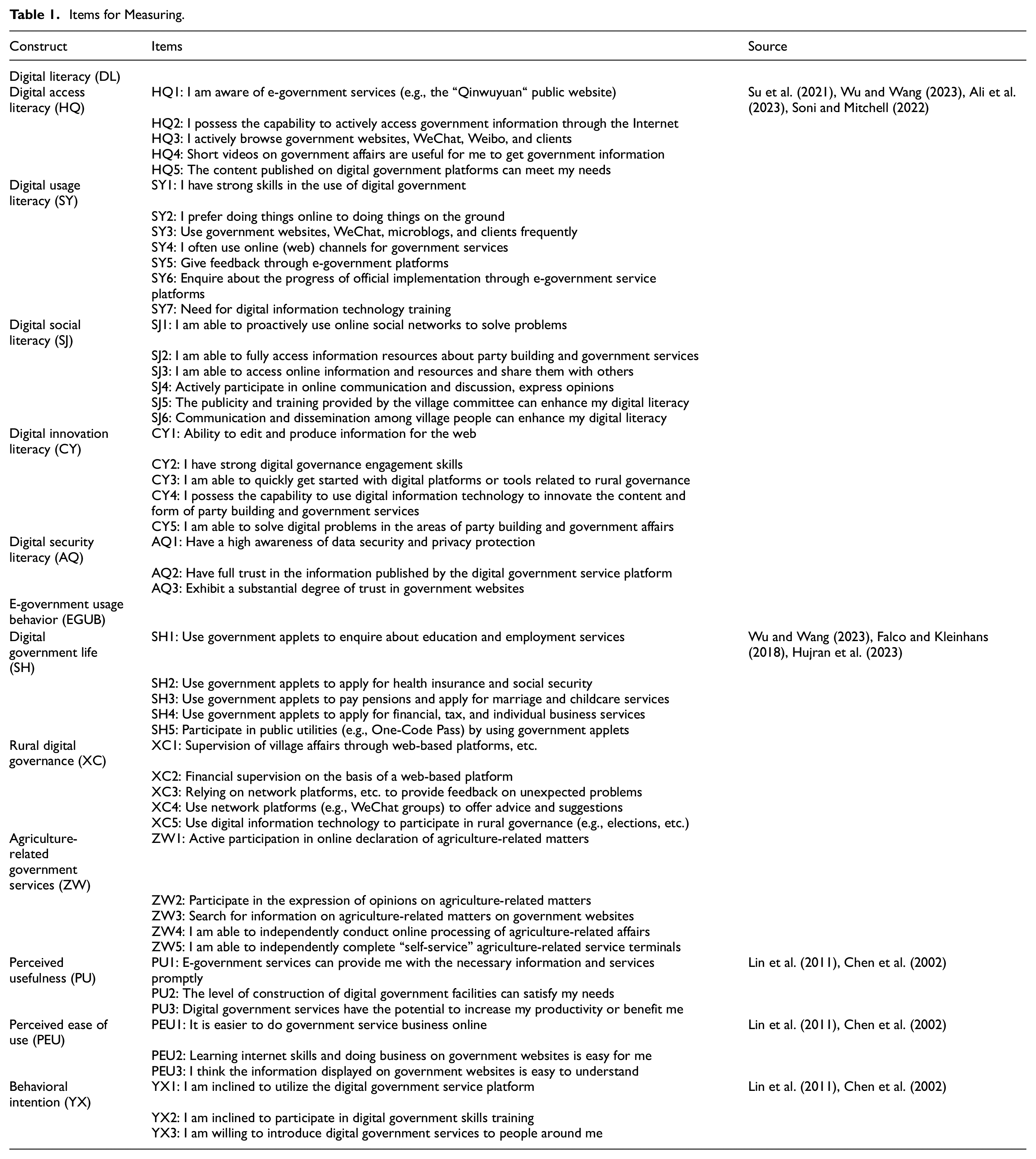
The measurement items were evaluated by five independent researchers specializing in technology acceptance research. Feedback from these experts was incorporated to refine the items. The questionnaire was then further refined through extensive pre-testing by 15 academics and cadres of the Women’s Federation with expertise in e-government operations, as well as 15 ordinary rural women. The pre-testing results affirmed the comprehensiveness of the questionnaire.
Respondent Profile
The initial section of the questionnaire gathered demographic data from respondents, including age, political status, educational attainment, and monthly income. Table 2 reports the basic characteristics of the respondents. 66% were rural women aged 31 to 50, 71.2% had an education level of high school or above, 37.1% were CPC Party members, and 40.2% were cadres in the Women’s Union.
Demographic Characteristics of Respondents.

Results of Data Analysis
The acquired data underwent comprehensive analysis using a two-stage approach involving PLS-SEM, executed through SmartPLS 3.0. This method effectively predicts intricate linear relationships within the model but may not detect potential non-linear relationships (Leong et al., 2020). To address this limitation and ensure a thorough assessment, ANOVA was employed in the second phase. This additional step aimed to identify any possible non-linear effects within the framework and to assess the robustness of the PLS-SEM path model (Sarstedt et al., 2020).
Common Method Bias (CMB)
Three methods were employed to assess the degree of CMB and ensure the trustworthiness of the results. First, independent and dependent variables were segregated by administering two surveys at different times, reducing the possibility of overt correlations between them (Liu et al., 2020, 2022). Second, Harman’s one-factor test, using principal component analysis on the five essential variables (DL, PU, PEU, YX, and EGUB), confirmed that the connections between variables were not excessively close, with the maximum variance explained not exceeding 22.99%. Finally, a common method factor test was performed, converting the model’s variables into second-order constructs (Liang et al., 2018). This test aimed to appropriately assess CMB by correlating single-indicator constructs and the method factor. The results in Table 3 indicated that all Ra2 items demonstrated statistical significance, and substantive variance greatly outweighed method variance. Consequently, CMB does not appear to be a major concern.
Common Method Variance (CMV).

Model of Outer Measurement
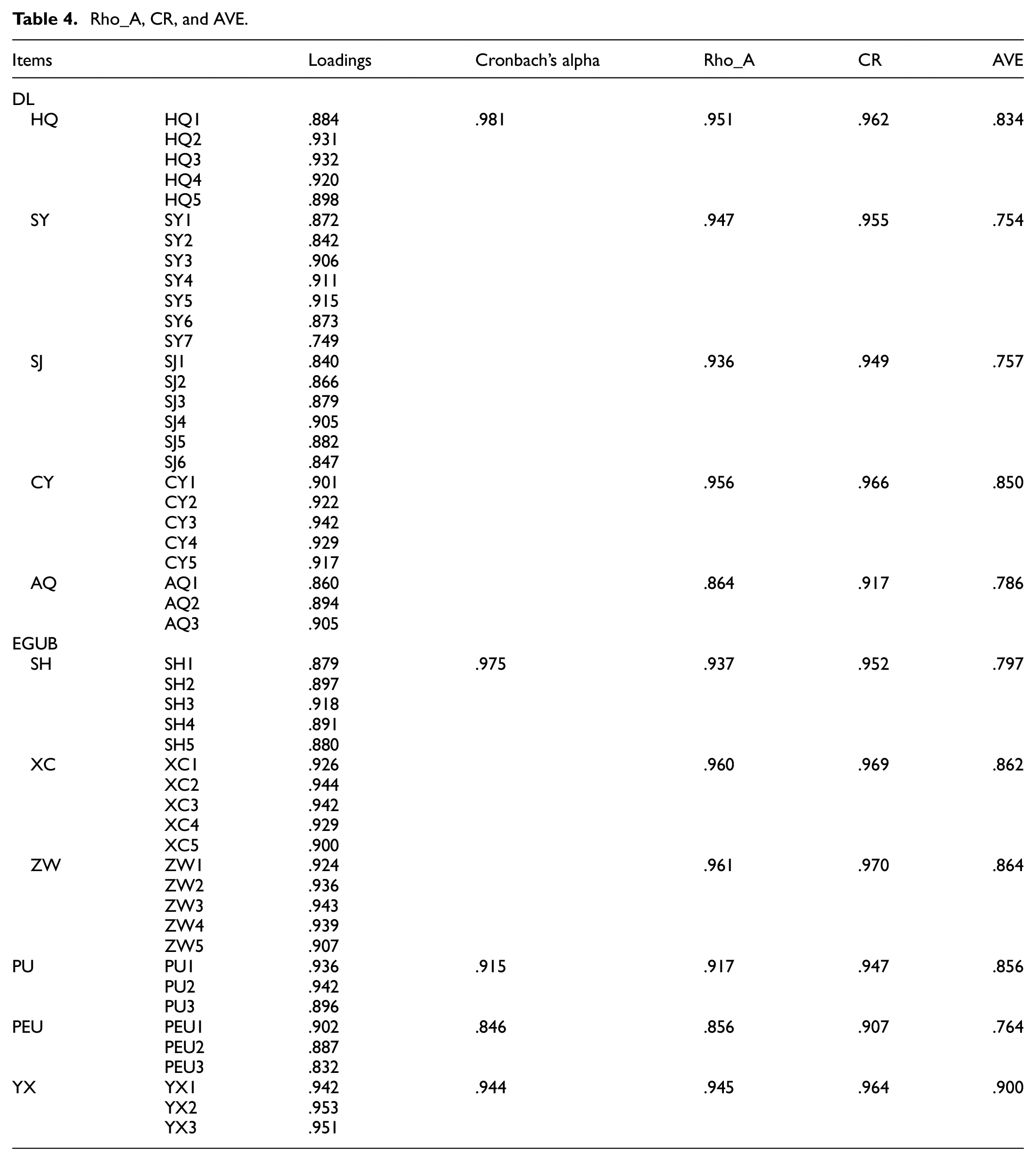
Composite reliability (CR) and Dijkstra-Henseler’s rho (rho_A) were used to assess the dependability of the external measurement model. As shown in Table 4, all scales exhibited Cronbach’s Alpha values exceeding .8, and both rho_A and CR values exceeded the minimum critical level of .7, indicating satisfactory reliability for all measures in this study (Dijkstra & Henseler, 2015). Additionally, to evaluate convergent validity (CV), external loadings and Average Variance Extracted (AVE) were examined. As presented in Table 4, all variables had an external loading greater than .7 and an AVE greater than .5. These results meet the criteria for CV (Loh et al., 2022).
Rho_A, CR, and AVE.
Henseler et al. (2015) have argued that Fornell and Larcker’s (1981) approach may lack discriminant validity (DV) in common research situations, despite its typical use in technology acceptance studies. Therefore, this study employed the Heterotrait–Monotrait (HTMT) ratio to assess DV, as shown in Table 5. Hair et al. (2017) suggested a threshold for HTMT inference values of 1. The results indicate that all DV values were below 1, providing empirical support for the discriminant validity of all variables in the research model.
HTMT Inference.

Evaluation of the Inner Structural Model
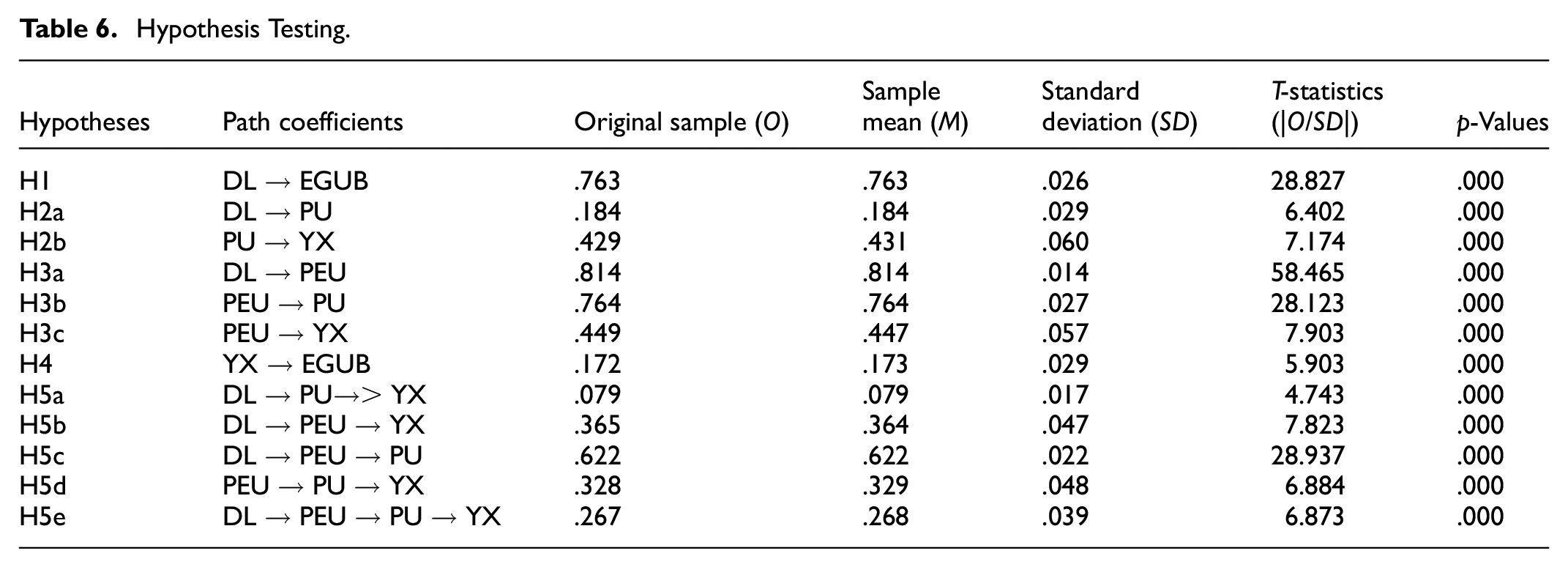
The evaluation of the inner structural model presented in Table 6 and Figure 3 by examining path coefficients using BCa bootstrapping with 5,000 subsamples at .05 two-tailed α. The data indicate that all hypotheses received support. Digital Literacy (DL) exhibited a significant correlation with E-Government Use Behavior (EGUB; β = .763, p < .001), and e-government use intention (YX) is also significantly associated with EGUB (β = .173, p < .001), hence supporting H1 and H4. Meanwhile, both DL (β = .184, p < .001) and PEU (β = .764, p < .001) demonstrated significant correlations with PU, and DL (β = .814, p < .001) is significantly associated with PEU correlated, hence supporting H2a, H3b, and H3a. PU (β = .429, p < .001) and PEU (β = .449, p < .001) showed a substantial effect on YX, hence supporting H2b and H3c. Additionally, Table 6 also presents the findings of the mediating effects, H5a, H5b, H5c, H5d, and H5e were supported. It shows that the development and enhancement of rural women’s digital literacy can significantly increase their PEU and PU, resulting in a heightened intention to utilize e-government.
Hypothesis Testing.

Structural model test.
Effect sizes of the outcome variables were assessed using the f2 metric (Table 7). Thresholds of .35, .15, and .02 signify large, medium, and small path effects, while values below .02 are deemed negligible (Cohen, 2013). Every variable exhibited discernible effects, PEU and PU had effect on YX and YX had effect on EGUB. Furthermore, the PLSpredict technique was employed to confirm the model’s out-of-sample predictive capability (Shmueli et al., 2016). As presented in Table 8, all DP metrics demonstrated positive Q2 predictive values. However, all root mean square error (RMSE) values exceeded the RMSE values under the linear benchmark, suggesting that this model has relatively limited predictive power.
Effect Size (f2).

PLS Predict Results.

Multi-Group Analysis
To examine whether the path model, tailored for the entire sample, is also applicable to specific sample groups and explore group differences, this study selects age, education level, political status, occupational status, as the basis for grouping. It then conducts a multi-group analysis of the effect of rural women’s digital literacy on their e-government usage behavior. Initially, measurement invariance was tested using MICOM, which follows a three-step procedure: evaluating configuration invariance, assessing compositional invariance, and verifying equality of composite mean values and variances. The first stage established configuration invariance by using the same measurements, data processing, and algorithm setup for each value. The two subsequent phases of MICOM were developed with compositional invariance and similar average outcomes, which is illustrated in Table 9.
MICOM.

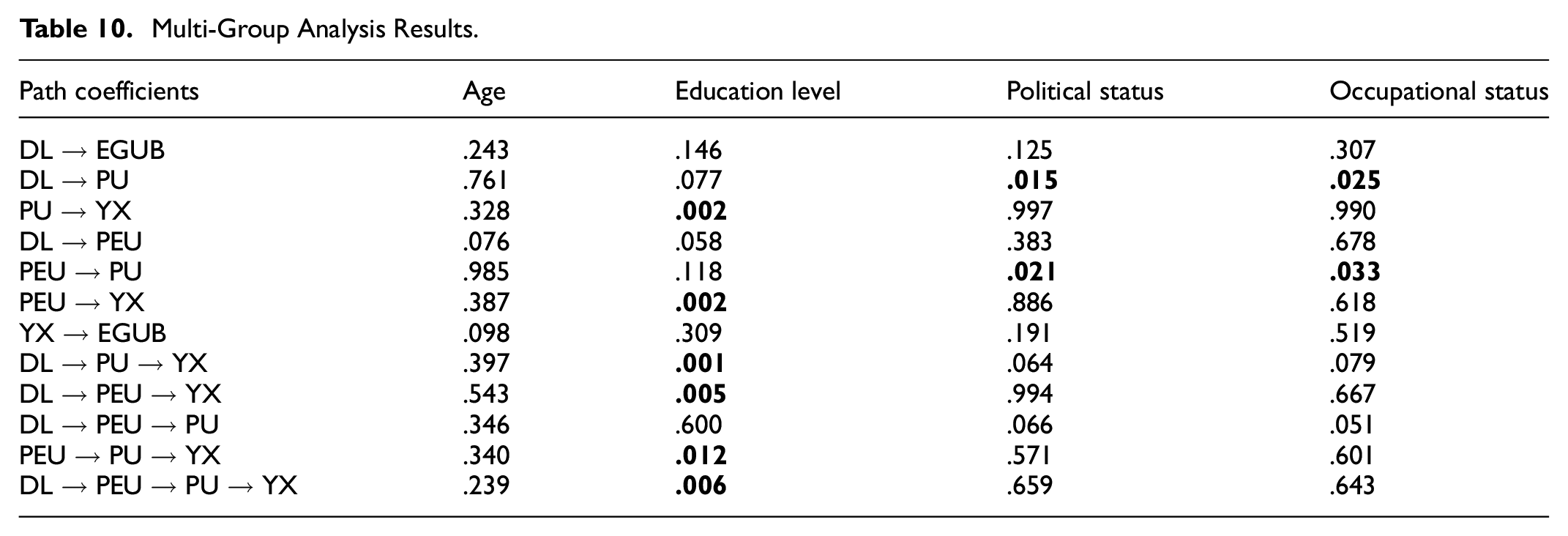
Following the results of MICOM, it was found that partial measurement invariance was supported. Subsequently, comparisons of standardized path coefficients between groups were conducted using MGA within PLS. Table 10 illustrates the final findings of the multi-group structural equation modelling tests were obtained.
Multi-Group Analysis Results.
(1) Multi-group analysis based on age differences. The study categorized participants into two age groups: 20 to 39 and 40 years and older, consisting of 539 women in the former group and 543 in the latter. The analysis revealed that the effect of age difference between rural women’s digital literacy and their e-government use behavior is not significant.
(2) Multi-group analysis based on education level. Participants were divided into two education groups: high school and below, and college and above, with 607 women in the former group and 475 in the latter. The findings indicated a substantial difference across different education levels in the impact of PU and PEU on YX, but different education levels are not significant in the impact of DL on EGUB.
(3) Multi-group analysis based on political status. The study categorized participants into two political status groups: Chinese Communist Party members and non-Chinese Communist Party members, with 468 in the former group and 614 in the latter. The results showed a significant difference between political status groups in the influence of DL on their PU, as well as in the impact of PEU on PU. There was no substantial variation in the influence of DL on EGUB based on political status.
(4) Multi-group analysis based on occupational status. Participants were divided into two occupational status groups: ordinary women and women’s federation cadres, with 647 in the former group and 435 in the latter. The analysis demonstrated a significant difference between different occupational status in the impact of DL and PEU on their PU, but different occupational status are not significant in the influence of DL on EGUB.
Discussions
This study explored the influence of digital literacy on rural women’s e-government usage intention and behavior by applying the Technology Acceptance Model (TAM). The results reaffirm the model’s robustness in explaining technology adoption, while also offering important insights into how foundational digital competencies shape user perceptions and behavioral responses in underrepresented populations.
The findings confirm that higher levels of digital literacy significantly enhance rural women’s perceptions of both the usefulness (PU) and ease of use (PEU) of e-government platforms. This is consistent with the assertions of Duan and Dong (2025), who emphasized the importance of digital skills in facilitating meaningful interaction with e-government services. However, while previous study employed an extended UTAUT-2 model to broadly examine factors influencing rural women’s e-government use intention, it did not specifically analyze the internal mechanisms of digital literacy’s influence. This study addresses that gap by focusing on digital literacy within the TAM framework, providing a more detailed examination of how PU and PEU mediate its effects on use intention and actual behavior. The positive effect of PEU on PU also corroborates Davis’s (1989) classical TAM proposition, reinforcing the idea that systems perceived as easy to use are also deemed more valuable. Furthermore, the positive association between PU, PEU, and behavioral intention aligns with a broader body of literature affirming the central role of cognitive perceptions in digital technology adoption (Khan et al., 2021; Susanto & Aljoza, 2015). This study also found that e-government use intention (YX) is significantly associated with e-government usage behavior (EGUB). This result aligns with the core assumptions of the TAM, which posits that behavioral intention is a direct antecedent of actual usage behavior (Venkatesh et al., 2003). The significant relationship between YX and EGUB further validates the sequential pathway from perception to intention and, ultimately, to behavior in the context of rural e-government adoption.
Beyond reaffirming the TAM pathway, this study expands the model by introducing digital literacy as an external antecedent variable. The mediation analysis revealed that PU and PEU serve as mediators between digital literacy and usage intention, offering empirical support to the proposition that digital literacy facilitates more confident and competent interaction with technology (Isabella et al., 2025; Nguyen et al., 2024). In this context, digital literacy extends beyond technical skills, serving as a cognitive foundation that shapes rural users’ perceptions, interpretations, and interactions with technology. This supports the perspective of Soni and Mitchell (2022), who advocate for the integration of foundational competencies into classical TAM to reflect the real-world barriers faced by marginalized groups.
Moreover, this study contributes to ongoing scholarly efforts to bridge the gap between digital divide research and technology acceptance theory. While early digital divide literature focused primarily on access-related disparities (van Dijk, 2006), more recent studies have emphasized second- and third-level divides, particularly disparities in digital skills and usage outcomes. By confirming that digital literacy indirectly shapes behavioral intention through PU and PEU, this study aligns with and extends the evolving understanding of digital inequalities. It echoes findings from Abdulkareem and Ramli (2021), who argue that digital competencies mediate the relationship between access and meaningful use, and complements literature highlighting how cognitive and skill-based disparities, rather than access alone, determine effective engagement with digital technologies. These insights strengthen the theoretical linkage between digital literacy and technology adoption, providing further empirical grounding for integrating digital divide perspectives within established technology acceptance frameworks.
The multi-group analysis adds further nuance by showing that the relationship between digital literacy and e-government usage behavior is broadly consistent across demographic groups such as age, education, political status, and occupation. This uniformity underscores the pervasive role of digital literacy as a foundational enabler. However, the discovery of subgroup variations in the mediating pathways—specifically, that education level moderates the influence of PU and PEU on behavioral intention—reveals subtle forms of digital inequality. This finding resonates with studies on differentiated digital engagement (Helsper, 2012), suggesting that even when baseline digital literacy exists, education affects how individuals cognitively process and apply digital tools. Similarly, the moderating effects of political and occupational status on the links between digital literacy, PU, and PEU suggest that social capital and role-based exposure may influence how users perceive and internalize digital government services.
These findings extend the discussion on digital inclusion by demonstrating that uniform interventions may not suffice. While digital literacy programs are needed for all rural women regardless of age, there is a pressing need for more tailored and context-sensitive strategies that consider the diverse socio-political and educational contexts of target groups. As Warschauer (2003) notes, digital inclusion is not simply about providing access but about embedding digital tools within broader social systems of education, culture, and participation. Thus, policymakers and practitioners must design inclusive e-government systems that address not only technical barriers but also cognitive, motivational, and structural factors affecting user engagement.
In summary, the findings of this study not only validate the extended TAM model but also offer a theoretically enriched and contextually grounded understanding of how digital literacy shapes e-government adoption among rural women. The results underscore the importance of integrating digital competencies into mainstream adoption models, while also pointing to the necessity of differentiated strategies that acknowledge the layered nature of digital inequalities.
Theoretical Contribution
This study makes significant contributions in several key areas. It advances the understanding of e-government adoption by integrating digital literacy into the TAM as an external variable, offering a more comprehensive framework for analyzing rural women’s e-government usage intentions and behaviors. While TAM has been widely applied in various technology adoption studies, its extension to include digital literacy provides a new theoretical lens to explain how foundational digital competencies influence the perceived usefulness, perceived ease of use, and subsequent adoption of e-government services (Soni & Mitchell, 2022). By empirically validating this extended model, this study contributes to the refinement of TAM and broadens its applicability to populations affected by the gender digital divide.
Furthermore, this study provides empirical evidence supporting the role of digital literacy in shaping technology adoption behaviors. It highlights how digital literacy not only directly influences e-government usage behavior but also indirectly affects adoption through PU and PEU. These findings reinforce and expand existing digital literacy theories by demonstrating its mediating role in technology acceptance, thereby bridging gaps between digital divide research and e-government adoption models (Abdulkareem & Ramli, 2021; Isabella et al., 2025).
From a practical perspective, the findings underscore the necessity of policy-driven digital literacy initiatives to foster e-government adoption among rural women (Duan & Dong, 2025). The results suggest that improving digital literacy can enhance both the perceived benefits and usability of e-government services, ultimately driving higher engagement levels. Additionally, the multi-group analysis reveals disparities in education levels, political status, and occupational backgrounds, emphasizing the need for tailored interventions that address specific barriers to digital engagement. These insights provide actionable recommendations for policymakers to design targeted training programs that enhance digital skills, promote inclusive e-government adoption, and bridge the gender digital divide in rural areas.
Policy Recommendations
The study’s findings hold significant policy implications for enhancing digital literacy to promote e-government use. Firstly, improving rural women’s digital literacy requires enhancing their knowledge, willingness, and ability to acquire digital skills. This can be achieved through extensive public education and training programs. Diversified social forces should be encouraged to participate in educational activities to improve rural women’s digital literacy. Families play a crucial role in this, and “digital feedback” within the family should be vigorously advocated.
Secondly, enhancing rural women’s willingness to use e-government should be pursued through various channels. Increasing the supply of rural women’s education and activating their educational potential can improve their sense of participation and experience in e-government. Exhibitions, displays, and real-life experiences can enhance rural women’s perceptions of e-government’s usability and simplicity.
Finally, addressing the gap between the willingness to use e-government and actual utilization is critical. Efforts should be made to expedite the enhancement of digital infrastructure and services in rural regions, especially in remote villages. The needs and habits of rural residents should be considered when developing, promoting, and utilizing e-government applications. This would ensure that e-government is user-friendly and make it simpler for rural residents to utilize by integrating pertinent e-government platform features and simplifying operational processes.
Shortcoming and Outlook
This study has several limitations that should be noted. Firstly, a cross-sectional research design was used to assess current digital literacy and e-government use among rural women. Given that digital literacy is still emerging among rural residents, and their exposure to it varies, these findings may evolve over time. Future research should employ longitudinal studies to gain a deeper understanding of these dynamics.
Secondly, the study focused exclusively on rural women in Shaanxi Province, China. This regional focus may limit the generalizability of the findings, as variations could exist in other regions. Future studies could benefit from expanding the sample size and including a broader geographical scope to examine differences in digital literacy, willingness, and e-government usage behaviors.
Thirdly, while this study concentrated on rural women, future research could include diverse demographic groups, such as urban residents and the elderly, to provide a more comprehensive perspective. Additionally, incorporating variables beyond digital literacy could enhance the understanding of e-government usage intentions and behaviors.
Conclusion
This study examined how digital literacy influences rural women’s e-government usage intention and behavior by applying the Technology Acceptance Model (TAM) with empirical data from Shaanxi Province, China. The findings confirm that digital literacy plays a crucial and direct role in enhancing rural women’s engagement with e-government services. Specifically, higher levels of digital literacy improve perceptions of both perceived usefulness (PU) and perceived ease of use (PEU), while PEU further enhances PU. These improved perceptions lead to stronger behavioral intentions to adopt e-government services. Furthermore, the mediating effects of PU and PEU between digital literacy and e-government use intention highlight the importance of improving digital competencies to strengthen users’ positive perceptions and drive adoption. The multi-group analysis reveals that age does not significantly moderate these relationships, underscoring the universal importance of promoting digital literacy among rural women of all ages. However, education, political status, and occupational status influence the pathways through which digital literacy affects PU and PEU, and subsequently, e-government usage intention. These findings suggest that while digital literacy is foundational, social factors continue to shape how individuals perceive and engage with e-government platforms. Overall, this study emphasizes the necessity of targeted digital literacy initiatives that consider the diverse educational and social backgrounds of rural women to ensure more inclusive and effective e-government adoption.
Footnotes

Ethical Considerations
This study involved human participants and was conducted in accordance with the ethical principles outlined in Xi’an Jiaotong University institution’s ethics policy. Ethical approval was obtained from Iqra University. The study design minimized risk to participants by using anonymous surveys, excluding sensitive questions, etc. All participation was voluntary, and participants were informed of their right to withdraw at any time without consequence. Informed consent was obtained prior to participation, either in written or digital form. Participants were assured of confidentiality and anonymity throughout the research process. The potential benefits of this study were deemed to outweigh any minimal risks posed to participants, which were mitigated through anonymity and voluntary participation.
Author Contributions
Yongbiao Duan: Conceptualization, Data curation, Writing – original draft, Writing – review & editing, Investigation, Software. Xinyu Dong: Conceptualization, Methodology, Supervision, Validation, Writing – review & editing.
Funding
The authors disclosed receipt of the following financial support for the research, authorship, and/or publication of this article: This work was supported by the National Natural Science Foundation of China (grant number 71573204), Philosophy and Social Science Research Special Foundation of Shaanxi Province (grant number 2023HZ1661).
Declaration of Conflicting Interests
The authors declared no potential conflicts of interest with respect to the research, authorship, and/or publication of this article.
Data Availability Statement
The data that support the findings of this study are not publicly available, and restrictions apply to the availability of these data.