



Abstract
Prefecture-level cities play a crucial role in China’s economic development, with their party secretaries, as the chief officials, wielding significant resource-allocation and decision-making power. In recent years, the chief officials of prefecture-level city concurrently holding multiple political positions at different levels of government—“cross-level political positions”—has become increasingly common. Therefore, this study aimed to reveal how the cross-level political positions of chief officials (CLPPCO) affect urban public service delivery. Based on an analysis of panel data from 218 prefecture-level cities in China gathered from 2014 to 2022, this research employed a multi-period difference-in-differences (DID) model to empirically examine the impact of this special arrangement on the provision of urban basic public services. The findings revealed that, compared to cities without CLPPCO, cross-level political appointments led to a significant decline in basic public service performance. Government investment served as an important mediating mechanism in this relationship. Furthermore, these effects varied across cities of different sizes, with medium-sized cities experiencing the most significant inhibitory effect, while the impact on large and small cities was relatively weaker. Heterogeneity analysis indicated that the fiscal self-sufficiency rate, local government debt ratio, and types of public service combinations all influenced the negative effect of CLPPCO on basic public services in medium-sized cities. This research not only provides new perspectives for understanding the relationship between incentives for chief officials and urban development but also offers empirical evidence for optimizing these incentives for urban chief officials while balancing economic development with the provision of public services.
Keywords
Introduction
Since the reform and opening up, China’s urban economy has developed rapidly, with city governments playing an indispensable role. Under China’s centralized system, a hierarchical administrative model of “province-city-county-township” has formed that is centered on the central government. Within this structure, prefecture-level city governments play a crucial intermediary role that connects provincial and county governments. In prefecture-level city governments, the municipal party secretary occupies the core position. This individual plays a vital role in arranging key personnel, making major decisions, approving important projects, and coordinating substantial funds (Yin & Sun, 2019). This has led to an academic trend that explains China’s economic growth from the perspective of performance incentives for government officials, especially those of chief officials (H. Li & Zhou, 2005; Su et al., 2012).
In practice, as national development goals have changed, the cadre personnel system has undergone corresponding adjustments, with cadre performance evaluation standards continuously innovating. After the 19th National Congress of the Communist Party of China (CPC), a phenomenon became increasingly prominent: municipal party secretaries of prefecture-level cities (and mayors in some cities) concurrently holding deputy positions in provincial governments (such as standing committee members of the provincial party committee; Bulman & Jaros, 2019). These concurrently held positions have higher administrative ranks than the officials’ primary positions. This study refers to this phenomenon as “cross-level political positions of chief officials” (CLPPCO).
After achieving CLPPCO, officials can participate in major provincial government decisions and meetings while providing more political resources for their cities to negotiate with higher-level bureaucratic systems. At the same time, CLPPCO facilitates the establishment of regular network relationships with superior governments. Compared to the time before the emergence of CLPPCO, prefecture-level city chief officials now command significantly more political resources.
From a policy-objective perspective, local governments adopt CLPPCO as a personnel measure to both empower officials to promote urban development and to evaluate the chief officials’ performance for future personnel decisions. Under this incentive structure, to achieve their goals for promotion, city chief officials actively mobilize the additional political resources gained through CLPPCO and direct them toward urban development. However, urban development is multidimensional. Generally, the economic dimension shows quick results and is favored by traditional evaluation systems. In comparison, basic public services show results more slowly but have far-reaching impacts. Faced with this difference, how do city chief officials make decisions? What impact do their decisions have on urban development?
Academic research related to the promotion incentives of Chinese local officials is abundant. It reveals the significant impact of officials’ personal characteristics and behaviors such as age, education, and relational backgrounds on economic and social development (Meng et al., 2019). However, these studies have paid less attention to the impact of officials holding concurrent cross-level positions (Sheng, 2009).In reality, the frequency of CLPPCO at the prefectural level has increased significantly. Additionally, the existing literature primarily focuses on the impact of local chief officials’ decisions on economic growth, with relatively insufficient attention to public service provision (Y. Li et al., 2024). However, with rapid urbanization, basic public services, as crucial guarantees of residents’ well-being, have become key indicators of urban development. At the same time, the provision of basic public services strongly depends on government fiscal support. Compared to the officials of ordinary prefecture-level cities, the chief officials with CLPPCO can often leverage their higher-level positions to secure greater fiscal autonomy and more transfer payments that potentially directly affect the provision of public services. This makes understanding the mechanism between the incentives offered to chief officials and public service provision particularly important. Yet, the specific functioning of this mechanism lacks systematic research and empirical support. Therefore, this research focused on the impact of CLPPCO on the provision of basic public services to reveal how this incentive shapes the behavior of local government officials.
Meanwhile, this research offers two marginal contributions in terms of observing the net benefits of CLPPCO on basic public services. First, unlike economic growth, basic public services are responsibilities that local governments must fulfill; the government’s leading role is indisputable. This research holds important theoretical value for verifying whether chief officials can direct the resource flows of government. Second, in the government-led urban development model, superior-subordinate relationships become particularly important. That is, a significant portion of prefecture-level cities’ fiscal revenue comes from higher-level transfer payments. CLPPCO serves precisely as a key personnel measure connecting the two levels of government. By observing the impact of this measure on urban development, empirical support can be provided for optimizing the incentive system for officials.
Background, Literature Review, and Research Hypotheses
Background: China’s Urban Hierarchy and the Vertical Concurrent Appointments of Officials
China’s urban administrative system and the concurrent appointment system of officials exhibit unique hierarchical structures and governance characteristics. The actual urban administrative hierarchy consists of three levels: provincial, prefectural, and county. This refined hierarchical division reflects the stratification and complexity of China’s administrative system.
The phenomenon of concurrent positions being held by Chinese officials is common within the political system. Concurrent appointment refers to a single cadre simultaneously holding two or more leadership positions. Vertical concurrent appointment refers to holding cross-level positions within the same system at different hierarchical levels. This phenomenon of vertical concurrent appointment is characterized by spanning different administrative levels, forming clear relationships between primary and secondary positions, and integrating decision-making and implementation functions (He, 2016). Specifically, CLPPCO spans different administrative levels, with higher-level positions reflecting political status and lower-level positions reflecting cities that superiors want to focus on, thereby enabling the appointees to simultaneously undertake both superior decision-making and subordinate policy implementation functions.
Literature Review
The question of the dominant force in Chinese urban development represents an important academic topic, with a basic consensus having formed around government-led development. Some scholar has argued that government has led urbanization (Ong, 2014). Others have maintained that China follows dual-track urbanization: on one hand, the state leads the urbanization track by promoting infrastructure prosperity, public goods provision, and urban expansion through land requisition and land financing. On the other hand, an informal urbanization track exists based on collective ownership and rural autonomy (S. Liu & Zhang, 2020). However, few scholars contend that China’s urban development is completely market-driven. This indicates that academia has formed a basic consensus on the significant role of government in urban development, making an in-depth understanding of the micro-mechanisms of government behavior an important perspective for explaining variations in urban development.
Regarding whether local government behavior aligns with officials’ motivations related to their governance, academia presents both personification and non-personification perspectives. Some researchers believe that local governments can be regarded as personified entities, that is, government actions align with the governance motivations of key officials? They argue that in administrative contract outsourcing, officials possess actual control over local affairs (X. Zhou, 2016). Additionally, as a key component in local government power structures, the staff (i.e., the officials and local personnel) to some extent dominates the operation of the entire local government (B. Zhou, 2009). The objections raised by opponents are not without merit. They argue that the power structure within local governments is highly complex, with different departments and systems having varying interest orientations and game-theoretic relationships. This is particularly evident in the Chinese bureaucratic system, where the phenomenon of separation between officials and civil servants has persisted over time. Compared to officials, civil servants, as crucial links in the local government power structure, constrain the flexibility of officials' actions (Zhou, 2016). However, this study contends that opponents have overstated the network characteristics of Chinese local government power structures while overlooking their hierarchical, territorial, and centralized nature. In fact, “central government delegation of power to local authorities enables local officials to control substantial resources and lead regional development” (Wu, 2013). Scholars who share similar views with this research have produced numerous findings on the interaction between the individual characteristics of officials and urban development. Particularly in economic research, the education, age, and personal background of officials have been shown to profoundly influence local economic development (Y. Shi et al., 2018; H. Shi et al., 2022).
Based on the specific content of urban development, research on the relationship between the officials’ characteristics and urban development can be categorized into two domains: economic development and non-economic areas. First, economic development has two subdivisions, the first being the impact of the characteristics of officials on economic development. The traits related to officials that are favored by academia include promotion and turnover (Ji et al., 2022; Yu et al., 2021), connections (Jia et al., 2015), and performance incentives (Rochlitz et al., 2015). These scholars’ conclusions generally support the hypothesis that the attributes of officials influence economic growth.
The second subdivision of economic development relates to its impact on the promotion of officials. The “promotion tournament” theory suggests that the likelihood of a local official being promoted to a higher position increases with the improved economic performance of the area (H. Li & Zhou, 2005). This phenomenon exists at both the provincial and municipal levels (Rochlitz et al., 2015; Y. Shi et al., 2018).
However, Wong and Zeng (2018) defined boundaries for the “promotion tournament” theory’s applicability. They argued that this theory only applies below the provincial level, while at the provincial level, relative economic performance has minimal, if any, significant impact on the probability of provincial officials being promoted.
The second domain of research on the relationship between officials’ characteristics and urban development relates to non-economic issues in urban areas. Upon entering the new century, especially after the 18th National Congress of the CPC, the Chinese government gradually increased fiscal investment and policy support in areas such as public services and environmental protection. Concurrently, the performance evaluation criteria for officials were expanded to include public service and environmental protection indicators. However, scholars have noted that fundamental differences exist between basic public service indicators, environmental protection indicators, and economic indicators, with the former two being difficult-to-quantify “soft indicators” and the latter being easily identifiable “hard indicators.” Consequently, the promotion incentives for officials are more constrained by economic indicators, with economic performance consistently dominating the influence on promotion probability (Jiang et al., 2020). Facing such incentive structures, rational officials tend to invest in infrastructure to facilitate economic development rather than provide welfare services for regional residents (Y. Wang et al., 2007). This choice leads to distortions in basic public services and environmental degradation (K. Li et al., 2023). Does this logical inference align with empirical reality? To answer this question, verification through empirical research is necessary.
Furthermore, promotion incentives play a crucial role in the mechanism through which the characteristics of officials affect urban development. These promotion incentives motivate local officials to vigorously promote urban development to fulfill the criteria of their performance evaluations (Ji et al., 2022). Yet, local officials’ promotion incentives are not only strongly driven by performance evaluations but are also influenced by political considerations (Chen et al., 2016). These studies form a localized theoretical foundation for understanding the behavioral incentives of Chinese officials.
Nevertheless, beyond China, similar research on incentive mechanisms for government officials exists internationally. For instance, after Brazil’s fiscal decentralization reforms in the 1990s, municipal governments gained greater autonomy, thereby strengthening their leading role in urban construction (Mora & Varsano, 2015). This experience provides a valuable international comparison for understanding the behavioral patterns of Chinese local officials in urban development.
Overall, the existing research has overly focused on economic development while relatively neglecting to study the provision of basic public services. Although some studies have logically implied that incentives for officials may lead to public service distortions, they lack empirical support. Meanwhile, the existing research has not adequately considered the influence of complex power dynamics within local governments. Therefore, conducting research on the impact of cross-level political position concurrent appointments in prefecture-level cities on basic urban public services may provide a valuable supplement to existing research.
Research Hypotheses
In the late 20th century, China began focusing on building a service-oriented government. The Third Plenary Session of the 18th Central Committee defined the scope of public service responsibilities that local governments should undertake. In March 2021, the National Development and Reform Commission, together with 20 departments, issued national basic public service standards, thus further clarifying specific items of basic public services and expenditure responsibilities at various levels of government. Under these guidelines and specifications, local governments have increased the work requirements for residents to receive basic public services as well as increased fiscal investment in such services. However, the core status of economic indicators in the performance evaluation system for government officials has remained unchanged (Tang et al., 2021).
Chief officials with CLPPCO can command more political resources, participate in major provincial-level decision-making, and possess distinct advantages when negotiating with higher authorities. Theoretically, this enhancement of resource endowment could bring more opportunities for urban development. However, because the promotion incentive structure has not fundamentally changed, and local chief officials have limited capacity to address every issue, they must allocate their finite attention to areas that can generate the most performance achievements (Jones & Baumgartner, 2005). Investments in economic domains have higher efficiency and more easily presentable data compared to basic public services (Zeng & Zhou, 2024). Therefore, chief officials with CLPPCO are more likely to direct these additional resources toward economic construction sectors. Consequently, basic public service investments in these regions may relatively decline. Based on this, this research proposes the following hypothesis:
Officials with CLPPCO can participate in provincial-level decision-making, directly engage in provincial policy formulation, and take the initiative to secure special funds and major projects, thereby attracting more government investment (Bulman & Jaros, 2019). Under budget constraints, local governments tend to prioritize investments in areas with faster economic returns, such as transportation and development zones, while neglecting long-cycle basic public services, such as education and healthcare (Mukmin et al., 2020; Murray, 2018). Chief officials with CLPPCO can garner more attention from higher authorities. They are more inclined to transform government investments into economic development achievements to pursue their own further promotion. Consequently, basic public service investments face additional compression. Therefore, this research proposed the following second hypothesis.
City size heterogeneity also moderates the impact of CLPPCO on public service performance. Small cities have relatively fewer public service resources and potentially weaker fiscal capacity to improve public services (L. Wang & Zhang, 2021). Medium-sized cities have medium scale with relatively limited resources but face fewer difficulties in terms of improving public services (Xiao, 2021). Large cities, with their substantial populations, may experience reduced public service efficiency due to congestion and pollution (Frick & Rodríguez-Pose, 2018). The challenges inherent to providing basic public services and the capacity to enhance service levels vary significantly across cities of different sizes.
Yet, after obtaining CLPPCO, officials can secure more resources and authority, thereby objectively enhancing their ability to improve public service levels. However, officials with CLPPCO, subject to greater attention from superiors and stronger promotion expectations, often tend to pursue short-term economic achievements rather than long-term public service improvements (Murray, 2018). This incentive structure may manifest differently across cities of various sizes due to differences in governance challenges, thereby generating differential impacts on basic public service performance. Therefore, we proposed the following third hypothesis.
Medium-sized cities face both pressures related to development and the need to balance public services with economic growth (Ma et al., 2021; Post & Kuipers, 2023). In such cities, CLPPCO more easily leads to policy distortion due to conflicts between political incentives and fiscal constraints. High fiscal self-sufficiency indicates stronger fiscal independence and autonomous decision-making capacity (Lu, 2015). The additional resources and authority that CLPPCO brings to medium-sized cities’ development affects public services; comparatively, medium-sized cities without CLPPCO but with high fiscal self-sufficiency can narrow the gap in terms of resources and authority. Therefore, this research proposed the following second hypothesis.
Local debt levels determine fiscal flexibility, while the types of public services provided reflect the priorities of the local government (Garay Canales et al., 2024). High debt ratios indicate significant debt pressure, with fiscal resources constrained by rigid expenditures, thereby reducing the flexible funds available for public services (Grewal et al., 2015). Under various combinations of local debt ratios and public service types, officials exhibit different trade-off logics in terms of resource allocation. When local officials obtain CLPPCO, their promotion expectations increase while they simultaneously gain more political and economic resources, the utilization of which is influenced by the city’s existing fiscal conditions and service levels. Therefore, we proposed the following third hypothesis.
Research Design and Analysis
Sample Selection and Data Sources
This study selected ordinary prefecture-level cities in China from 2014 to 2022, covering a 9-year period, as research samples. First, based on the 287 prefecture-level cities listed in the China City Statistical Yearbook 2022, cities with chief officials holding cross-level positions were identified as research subjects. The sample screening process and criteria are shown in Figure 1.
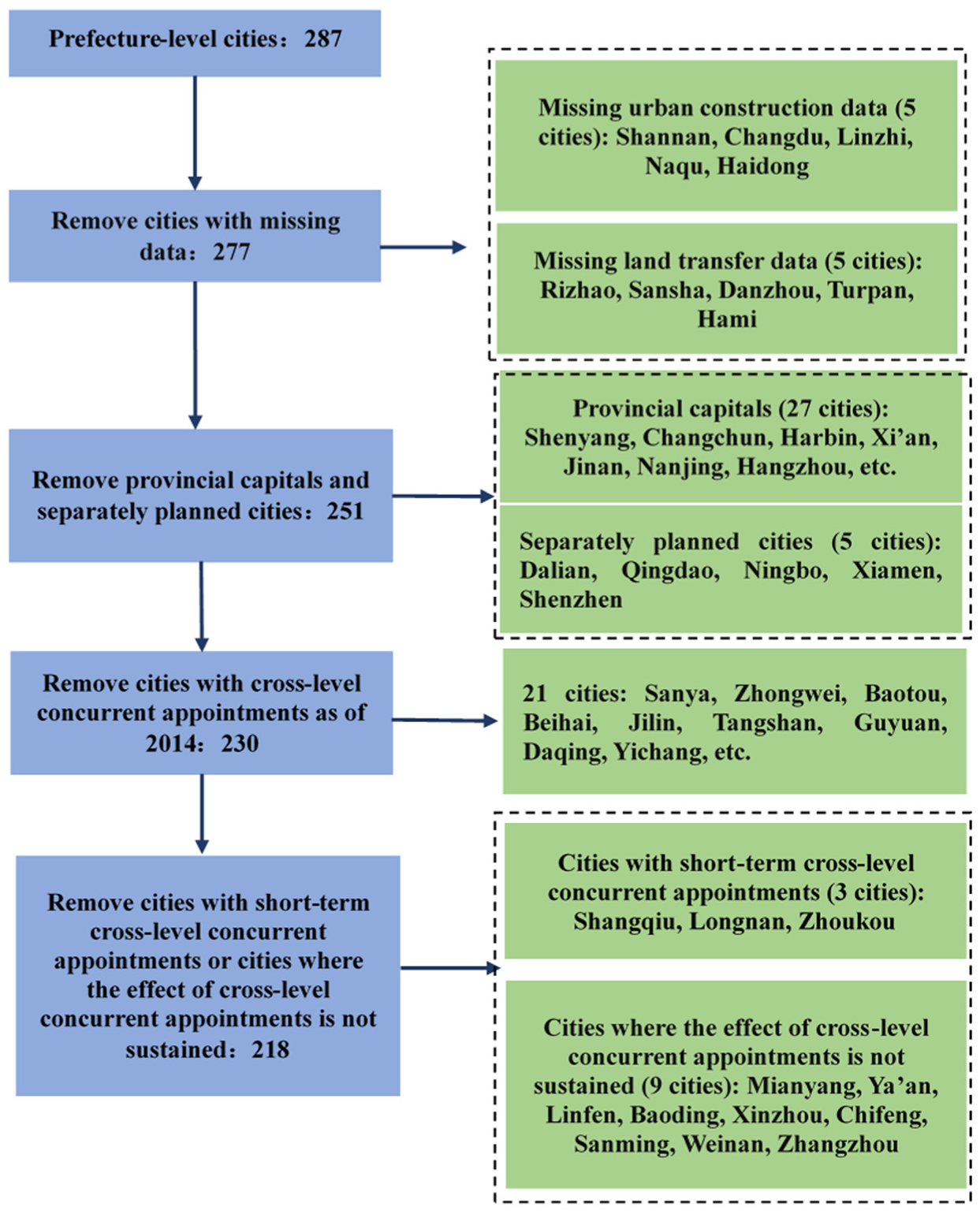
The sample selection process.
Ultimately, this study obtained 27 cities for the treatment group and 191 cities for the control group, totaling 218 cities. The CLPPCO status of the control group cities is detailed in Table 1. There are four types of superior positions: standing committee of the CPC Provincial Committee (1), vice governor (2) vice Chairman of the Standing Committee of the Provincial People’s Congress (3), and vice chairman of the Provincial Committee of the Chinese People’s Political Consultative Conference (4). It should be noted that due to changes in chief officials in some cities during the research period, there were a total of 32 instances of CLPPCO.
Position Information of CLPPCO in the Treatment Group.

The appointment and transfer information of these prefecture-level city chief officials was gathered from multiple authoritative sources, including People’s Daily Online (local leadership database, personnel column), Xinhua News Agency (personnel section), and pre-appointment announcements from various provincial governments. City-related data were primarily sourced from the China City Statistical Yearbook and the China Urban Construction Statistical Yearbook. Land transfer income data were obtained from the China Land and Resources Statistical Yearbook. Particulate Matter (PM) 2.5 concentration data were sourced from NASA’s PM2.5 estimation dataset, from which this study selected monthly PM2.5 concentration data for prefecture-level cities between 2014 and 2022, calculating annual averages as the mean PM2.5 data for each prefecture-level city.
Econometric Model
This research employed a multi-period DID model to investigate the impact of CLPPCO on basic public service performance in prefecture-level cities. The empirical model was specified as follows:

Where
Variable Selection and Construction
Dependent Variable: Basic Public Service Indicator System for Prefecture-Level Cities
The National Basic Public Service Standards (2023 version) clearly outlines nine aspects of basic public services: childcare, education, employment, healthcare, elderly care, housing, support for the vulnerable, the military service guarantee, and the cultural and sports service guarantee. However, not all domains were suitable for inclusion in this study’s indicator system, which required targeted selection or expansion based on the research objectives and practical considerations. First, based on the principle of subjectivity, this research focused on public service matters for which prefecture-level cities bear primary responsibility. Therefore, domains such as pension insurance, which have gradually achieved national coordination and where expenditure responsibilities are primarily borne by central or provincial finances, were excluded.
Second, based on the principle of targeted applicability, although childcare and military service guarantees fall within the scope of national basic public services, their influence on policy implementation and resource allocation in a prefecture-level city is relatively small. Therefore, they were not included in the indicator system for this study. Third, based on practical needs, this study expanded the indicator system. Given the increasing importance of environmental protection in local governance and performance assessment in recent years and the direct relationship between urban municipal infrastructure construction and urban livability and quality of life, it was necessary to add environmental protection and municipal construction indicators to the system to more comprehensively and accurately evaluate the level of public services in prefecture-level cities.
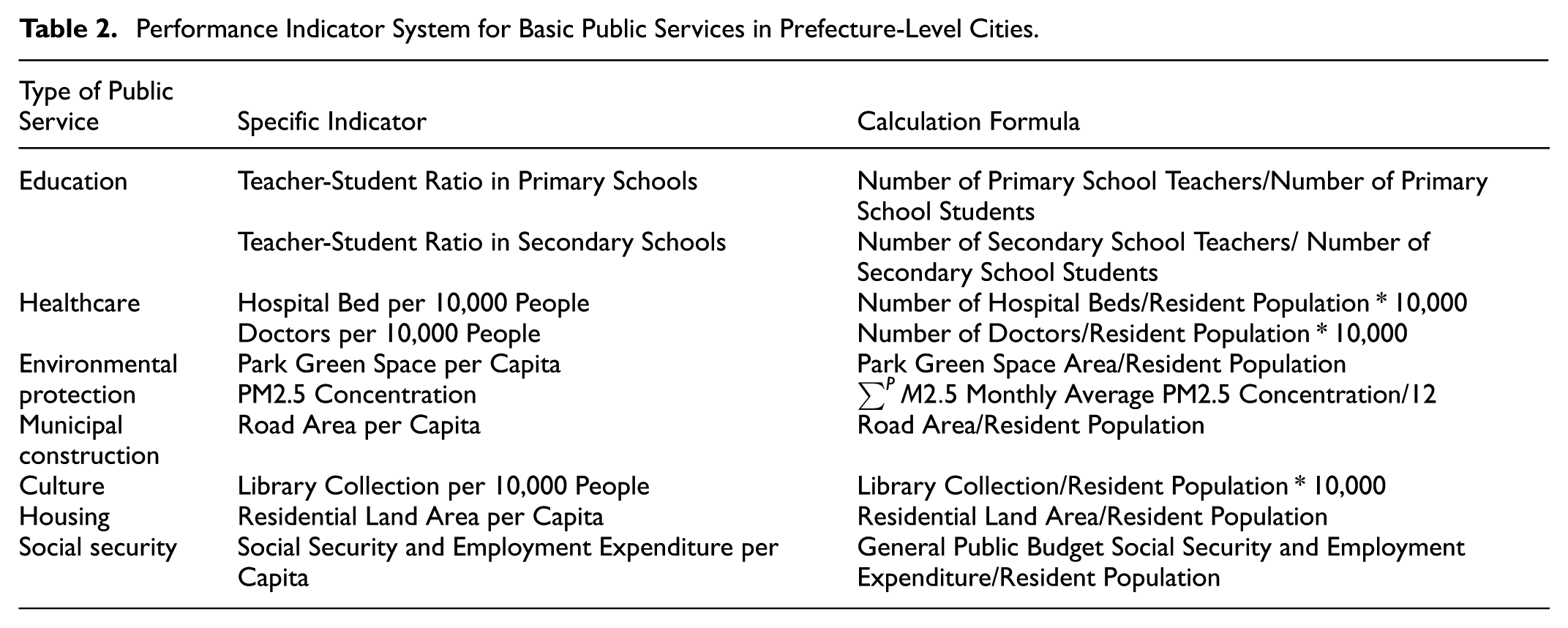
In the process of indicator construction, it was essential to recognize that basic public service performance involves not only the supply side but also the effective satisfaction of the demand side. Therefore, the selected indicators should reflect a certain supply-demand correspondence. However, constrained by the existing data and research conditions, it was impossible to comprehensively and precisely measure demand-side situations. Against this background, this research selected per capita indicators, or per 10,000 people indicators, as approximate reflections of supply-demand balance. For example, in the education domain, the teacher-student ratio reflects to some extent the relationship between educational resource allocation and educational demand; in the healthcare domain, the number of doctors and hospital beds per 10,000 people similarly reflects the satisfaction of medical resources relative to population needs.
Ultimately, this research established a basic public service performance indicator system for prefecture-level cities covering seven dimensions: education, healthcare, environmental protection, municipal construction, cultural services, housing conditions, and social security, with a total of ten specific indicators. The details of each indicator and their calculation formulas are shown in Table 2.
Performance Indicator System for Basic Public Services in Prefecture-Level Cities.
To comprehensively and objectively evaluate the basic public service performance of prefecture-level cities, this research first employed principal component analysis (PCA) to reduce the dimensionality of the previously determined seven dimensions and ten indicators and constructed a composite index. PCA extracts common features among multiple variables and transforms them into a few uncorrelated principal components, effectively reducing multicollinearity and avoiding biases in subjective weight setting (Jolliffe, 2002). The specific implementation steps were as follows.
First, the Kaiser-Meyer-Olkin (KMO) test and Bartlett’s sphericity test were conducted. The test results showed that the KMO statistic value of this research sample data was 0.734, which was greater than the critical value of 0.6. The p value of Bartlett’s sphericity test was .000, which indicated that the original indicator data were suitable for PCA. Second, principal components were extracted. The correlation matrix of indicator data was decomposed into eigenvalues, and principal components with eigenvalues greater than 1 were selected to ensure that the extracted principal components effectively explained most of the information in the original data. Third, the number of principal components to retain was determined. Figure 2 displays the scree plot of the indicator data. Therefore, this research chose to retain the first four principal components, with a cumulative variance contribution rate of 72.51%, which was sufficient to reflect the main content of the indicator information. Fourth, the scores of each prefecture-level city on each principal component were calculated. The principal component scores were weighted and summed using the principal component variance contribution rate as weights, which formed the basic public service composite index for prefecture-level cities. Finally, because the calculated composite index values included negative values, this research further standardized the composite scores and transformed them into standardized composite indices with values ranging from 0 to 1.

Principal component scree plot.
Additionally, referencing Q. Liu et al. (2017) on constructing urban municipal public infrastructure, this research adopted the entropy method to construct a basic public service index as a method for robustness testing. The entropy method determines the weight of each indicator by calculating information entropy (S. Wang et al., 2015). The specific steps were as follows. First, Data standardization of the original data to eliminate the impact of different measurement units. Second, Calculate the proportion of each indicator, information entropy, difference coefficient, weights. Third, calculate the composite score through the weight of each indicator and standardized data.
Explanatory Variable: CLPPCO
This study employed a multi-period DID approach to identify the impact of CLPPCO on basic public service performance. The core explanatory variable was constructed as follows.
First, the policy time variable (time): For prefecture-level cities in the treatment group, time was assigned a value of 0 before the CLPPCO began and 1 after the policy implementation. Table 3 displays the years and lists of CLPPCO implementation for each treatment group city. For the control group cities, time was consistently assigned a value of 0. Second, the treatment variable (treat). If a prefecture-level city belonged to the CLPPCO treatment group, treat was assigned a value of 1; otherwise, it was 0. Third, the interaction term (did). The interaction between time and treat constituted the core explanatory variable of this study and reflected whether prefecture-level city i had a chief official with cross-level political positions at time t.
Years and List of CLPPCO in the Treatment Group.

Control Variables
To better identify the genuine impact of CLPPCO on basic public service performance in prefecture-level cities, this study selected a series of control variables. (1) Economic development level. Generally, better economic development corresponds to higher public service performance. (2) Government size. Government plays a crucial role in basic public service provision. (3) Public fiscal revenue. Public fiscal revenue indicates the local government’s capacity to provide public goods and is positively correlated with local public service levels. (4) Local government debt ratio. This reflects the government’s capacity for financing public service investments and its debt burden status. (5) Land finance dependency. Fiscal structure significantly influences local government spending decisions (Wu & Wang, 2013), such as investment intensity in public services. (6) Industrial structure. Industrial structure directly relates to the degree of urban economic transformation, thereby affecting public service demand and allocation. (7) Transportation infrastructure level. Improved transportation infrastructure can significantly enhance the accessibility of public service resources. (8) Population density. Population density reflects the complexity of spatial governance and has a significant impact on basic public service performance. (9) Youth index. Residents of different age structures have significant variations in terms of basic public service demands (Voicu et al., 2023). Due to data limitations, this study indirectly measured the youth level of cities through the proportion of primary and secondary school students to permanent residents. (10) Unemployment rate. The unemployment rate reflects labor participation; higher unemployment may indicate weaker resident income and consumption capacity, consequently altering dependency on public services. (11) Financial institution deposits. Higher deposits can reflect local economic strength and a better financing environment, thereby indirectly indicating higher public service levels. (12) Employee wages. Higher average wages of employed workers indicate stronger overall social consumption capacity and greater demands for public services.
Finally, it should be noted that due to the evident skewed distribution of economic and social indicators and significant scale differences between indicators, this study applied natural logarithmic transformation. Logarithmic transformation effectively reduces variable volatility and heteroscedasticity, improves the statistical characteristics of data, and more clearly reflects elasticity relationships between variables, thereby facilitating model analysis and result interpretation.
The Mediating Variable
This study selected government investment as the mediating variable, which was measured by total real estate investment. This measurement approach was determined primarily because, during the 2014 to 2022 research period, real estate investment occupied an extremely important position in Chinese local government fiscal expenditures and investment activities. Government investment in real estate typically reflects local governments’ economic development priorities, especially in terms of promoting urbanization and infrastructure construction, where real estate investment has become a key area of local government development focus.
Finally, Table 4 presents the measurement methods and descriptive statistics of the main variables.
Descriptive Statistics of the Variables.

Empirical Results
Baseline Regression
This study employed a DID model to examine the net effect of the CLPPCO. The specific results are presented in Table 5. Model 1 in Table 5 represents the regression results without control variables, while model 2 includes the control variables. Both models control for individual and time effects. The results showed that, without considering the control variables, the regression coefficient for the impact of CLPPCO on basic public service performance was −0.002. After adding the control variables, the coefficient for the impact of CLPPCO on basic public service performance changed to −0.008, which passed the 5% significance test. These results indicated that CLPPCO significantly suppressed the performance of basic public services in prefecture-level cities, thereby supporting hypothesis 1.
Net Effect Test of Concurrent Cross-Level Political Appointments for City Leaders.

and ***Significance levels of 5% and 1%, respectively.
Parallel Trends Test
The correct application of the DID method requires meeting the common trends assumption, which states that in the absence of policy intervention, the trends of the treatment and control groups should be consistent prior to policy implementation. To this end, this study conducted dynamic tests and estimations of policy effects before and after implementation to ensure the common trends assumption was satisfied.
First, it is important to clarify that the CLPPCO in prefecture-level cities in this study have certain particularities and were not suddenly implemented. Statistics show that approximately 90% of chief officials with cross-level political positions in prefecture-level cities were promoted from within their original positions rather than being suddenly transferred from external sources. Therefore, chief officials may have already gained knowledge of local economic and social development prior to the formal implementation of the policy, thereby potentially exerting policy influence on basic public service performance in advance. To capture the policy impact more accurately, this study set the policy implementation time point 1 year earlier. Additionally, this study uniformly designated periods more than 3 years before policy implementation as the pre-3 period (pre_3). Similarly, periods more than 3 years after implementation were uniformly designated as the post-3 period (post_3), with pre_3 serving as the base reference group and being excluded from the regression analysis.
Based on the above treatment, Table 6 presents the estimation results of the basic public service performance before and after the implementation of cross-level political positions. As shown in the table, there were no significant differences between the treatment and control groups during the two periods prior to the officials assuming cross-level political positions (with only marginally significant differences at the 10% level in the pre_1 stage). This indicated that the overall trends in basic public service performance between the treatment and control groups of prefecture-level cities were relatively close before the officials assumed cross-level political positions, which was consistent with the common trends assumption. However, starting from the year the officials assumed cross-level political positions (current), the difference in basic public service performance between the treatment and control groups showed statistically significant negative effects, which indicated that CLPPCO had a significantly negative impact on basic public service performance in prefecture-level cities.
The Effects of Basic Public Services Before and After CLPPCO.
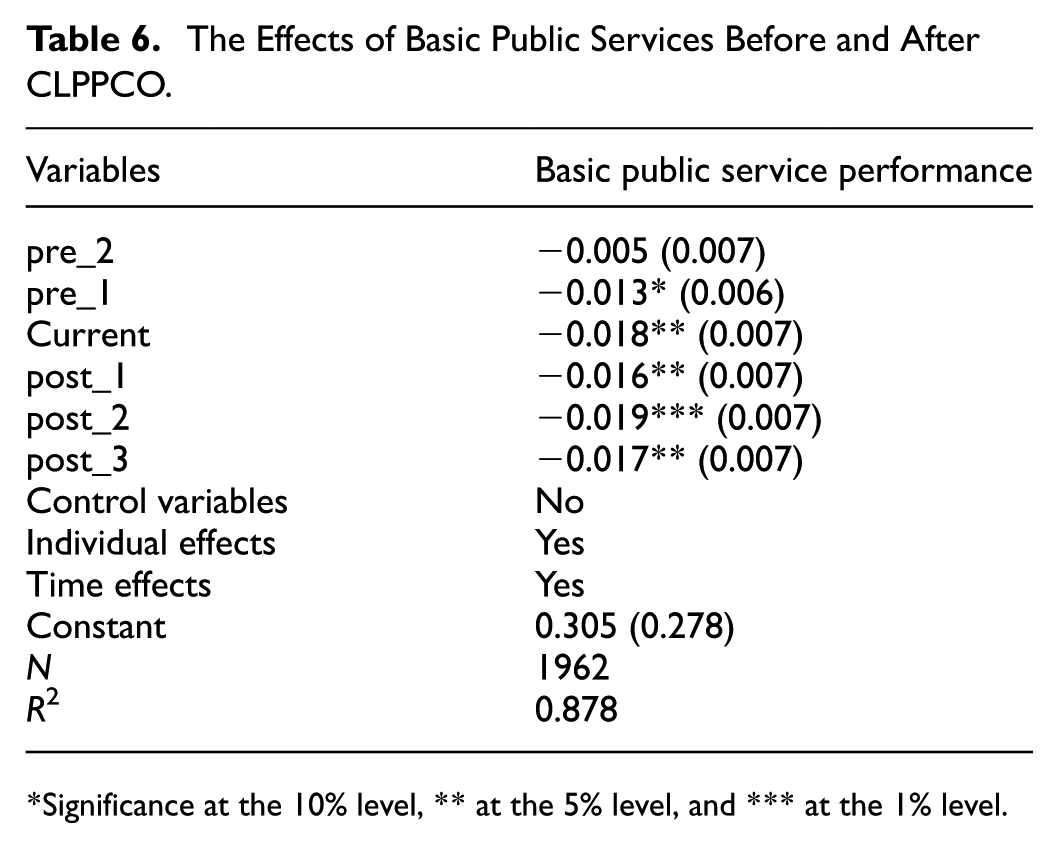
Significance at the 10% level, ** at the 5% level, and *** at the 1% level.
To more intuitively illustrate the dynamic impact of CLPPCO, this study further plotted the 95% confidence intervals (CI) of the policy effects for each stage before and after policy implementation (see Figure 3). From the figure, it can be clearly observed that the confidence intervals of the estimated coefficients for each stage before policy implementation all contain zero, indicating that trend differences before policy implementation were not statistically significant. In contrast, the confidence intervals of the estimated coefficients for stages after policy implementation were primarily below zero, which reaffirmed that CLPPCO significantly reduced basic public service performance levels.

Confidence interval plot for the parallel trend test.
Additionally, this study conducted F-tests on trends before and after policy implementation to verify the joint significance of the dynamic effects. The test results showed that the F-value for the joint test of coefficients in the pre-implementation period was 2.27 (p value of .104), which failed to reject the null hypothesis that pre-implementation coefficients are jointly zero. This indicated no significant differences between the treatment and control groups before policy implementation, thus providing statistical support for satisfying the parallel trends assumption. The joint significance test results for the post-implementation period yielded an F-value of 2.13 (p value of .075), which was significant at the 10% level and indicated that significant dynamic effect changes after policy implementation indeed existed.
Robustness Tests
Alternative Calculation Method for Basic Public Service Performance
To further verify the robustness of the baseline regression results, this study first employed the entropy value method to reconstruct the basic public service performance index for prefecture-level cities and then re-estimated the policy effect of CLPPCO.
Table 7 presents the DID estimation results after constructing the basic public service performance index using the entropy value method. The results showed that without the control variables (model 1), the policy effect coefficient was negative but not statistically significant. When further introducing various control variables (model 2), CLPPCO demonstrated a significant negative impact on basic public service performance. This result was consistent with the baseline regression conclusion, thus confirming that CLPPCO significantly reduced local basic public service performance levels and verifying the robustness of the aforementioned analytical conclusions.
Basic Public Service Performance—Entropy Method.

and ***Significance levels of 5% and 1%, respectively.
Propensity Score Matching (PSM)-DID Test
Considering that CLPPCO generally occurs in cities with greater development potential, this personnel decision may not fully comply with randomness principles. Consequently, directly applying the DID method might cause selection bias. In light of this, the study further implemented PSM-DID testing. The basic approach involved first using propensity score matching to identify a control group that was as similar as possible to the treatment group based on the characteristics of cities with CLPPCO. The DID method was then applied to the matched sample.
It should be noted that the reliability of propensity score matching requires the sample to satisfy the “ignorability” assumption, meaning there are no significant differences in observable variables between the treatment and control groups after matching. Therefore, a balance test must be conducted before analysis. The results showed that, the absolute standardized differences for all variables after matching were less than 10, and t tests showed that none of the matched variables passed significance tests. This demonstrated that the treatment and control groups had good comparability after matching.
After conducting propensity score matching and passing the balance test, this study re-estimated the effect of CLPPCO on basic public services, with specific results shown in Table 8. It can be observed that the DID coefficient was significantly negative, and the results after matching were consistent with the DID estimation. In other words, even when considering sample selection bias, the impact of CLPPCO on basic public service performance in prefecture-level cities remained significant. This further verified the reliability of the empirical results in this study.
The PSM-DID Test.
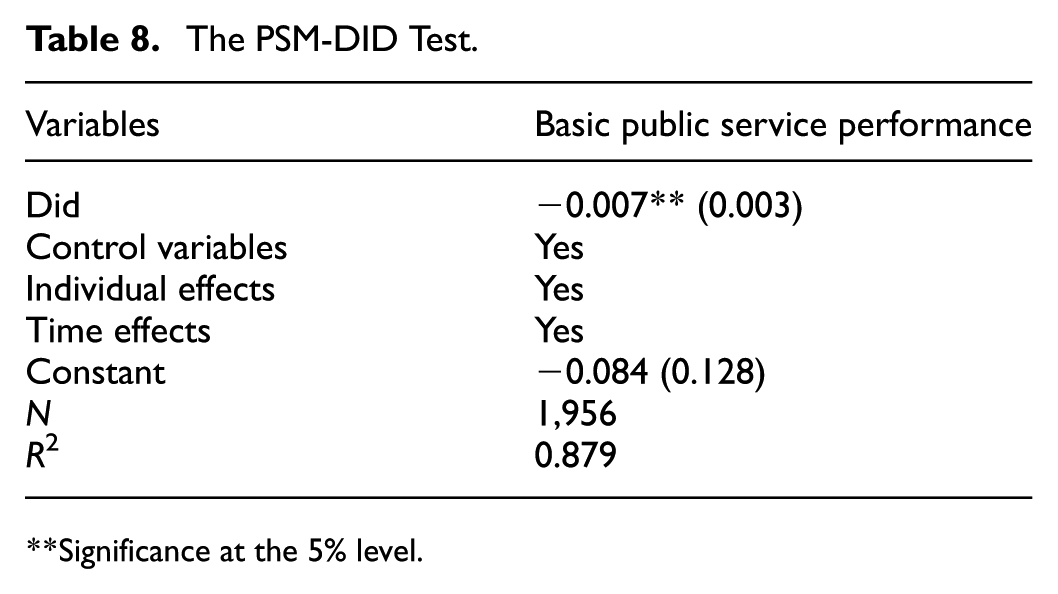
Significance at the 5% level.
The Heckman Selection Model
In the baseline regression, this study excluded provincial capital cities and separately planned cities to avoid “political status bias” caused by differences in administrative levels. However, provincial capital cities and separately planned cities typically have stronger fiscal capacity and higher levels of public service provision. Directly excluding these cities may have led to sample selection bias, thus affecting the validity of the estimation results. Therefore, this study employed the Heckman selection model for supplementary analysis to correct potential selection bias and verify the robustness of the research findings.
First, the Heckman selection model comprises two stages. In this study, the first stage used a probit model to estimate the probability of a prefecture-level city being included in the policy treatment group, that is, the selection probability of CLPPCO. The key to this stage was finding at least one instrumental variable that influenced policy selection but did not directly affect public service performance to ensure the validity of the Heckman estimation. This study selected terrain ruggedness as the instrumental variable. On one hand, terrain complexity may affect local governments’ demand for chief officials. For example, regions with complex geographical environments may tend to appoint experienced officials with cross-level political positions. On the other hand, terrain ruggedness does not directly affect basic public service performance. Therefore, it satisfied the exogeneity requirement for instrumental variables. The second stage estimated the impact of CLPPCO on basic public service performance while controlling for selection bias by incorporating the inverse Mills ratio (IMR) to correct for potential selection bias.
Table 9 presents the estimation results of the Heckman selection model. Column 1 shows that terrain ruggedness had a significant positive impact on the selection probability of CLPPCO. This result validated the rationality of the instrumental variable. Column 2 indicates that CLPPCO still exerted a significant negative impact on basic public service performance after controlling for selection bias. This result was consistent with the baseline regression analysis, thereby further enhancing the robustness of the research findings. Additionally, the coefficient of the inverse Mills ratio was not significant, which suggested minimal influence of sample selection bias on the estimation results. This implied that even in the absence of provincial capital cities and separately planned cities, the estimation results still possessed strong external validity and were not severely affected by selection bias.
Heckman Selection Model Results.

and ***Significance at the 5% and 1% levels, respectively.
Permutation Test
To further verify the robustness of the impact of CLPPCO on basic public service performance in prefecture-level cities and enhance the causal identification of policy effects, this study conducted supplementary analysis using permutation tests. The core idea of the permutation test is to randomly reassign the treatment variable did construct an estimation distribution with no policy effect and compare the actual estimated value with this distribution. If the actual estimated value fell far from the central region of the permutation distribution, it would indicate that the significance of the policy effect was not randomly generated but possessed strong causal explanatory power.
Table 10 displays the Monte Carlo statistical results of 1,000 permutation tests. It can be observed that in 1,000 random permutations, not a single DID estimate was lower than T(obs; p = .0000), which indicated that under the hypothesis of no policy effect, it was almost impossible to randomly generate an estimate more negative than T(obs). The two-sided permutation test p value of .0000 further confirmed that the negative impact of CLPPCO on basic public service performance was not randomly generated but had strong causality.
Permutation Test Results.

Moreover, Figure 4 shows the density distribution of the estimated coefficients from 1,000 permutations. From the figure, it can be observed that the permutation estimates followed a normal distribution, with most values concentrated around 0. The actual DID estimate is located at the extreme left side of the distribution, thereby further verifying that the significance of the policy effect was not a coincidental result.
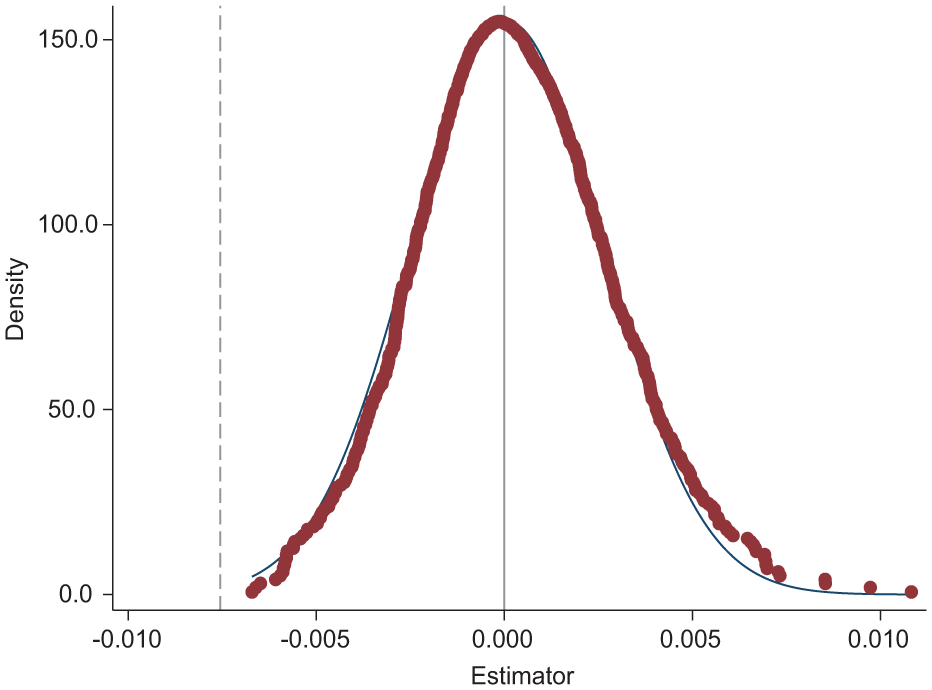
Distribution of the estimated coefficients from the permutation test.
The Mediating Mechanism
The above results indicate that CLPPCO had a significant inhibitory effect on basic public service performance. To further explore the internal mechanism of this effect, the study examined how CLPPCO indirectly suppressed the improvement of basic public service performance by influencing government investment. Table 11 presents the relevant regression results.
Mediation Mechanism Analysis of Government Investment.

and ***Significance at the 5% and 1% levels, respectively.
Column 1 indicates that CLPPCO had a significant inhibitory effect on basic public service performance. Column 2 examines the impact of CLPPCO on government investment. The regression results showed that CLPPCO had a positive impact on government investment, and it was significant at the 1% level. This indicated that CLPPCO prompted local governments to place greater emphasis on economic performance. Finally, column 3 examines whether government investment played a mediating role in the impact of CLPPCO on basic public service performance. The regression results showed that after adding government investment, the inhibitory effect of CLPPCO on basic public service performance remained significant. In other words, government investment played a negative mediating role in the relationship between CLPPCO and basic public service performance. This validated hypothesis 2.
Heterogeneity Analysis
The baseline regression results indicated that CLPPCO had a significant inhibitory effect on the basic public service performance of prefecture-level cities. However, considering differences in fiscal capacity and debt burden across various city types, the policy effects may exhibit heterogeneous characteristics among different city categories. Therefore, this study further explored the differential impacts of CLPPCO on public service performance across two dimensions: urban population size differences and debt-service differential.
Analysis of Basic Public Service Performance Differences Across Cities of Various Sizes
To analyze the impact of CLPPCO on public service performance in cities of different sizes, this study categorized prefecture-level cities into three types based on urban population: small cities (urban population less than 500,000), medium-sized cities (urban population greater than or equal to 500,000 but less than or equal to 1,000,000), and large cities (urban population exceeding 1,000,000). Moreover, considering that cities of different sizes may have significant variations in fiscal structure, and the availability of fiscal resources may influence local governments’ spending decisions relative to basic public services, this study further introduced the fiscal self-sufficiency rate as a key factor to explore its role in the process of CLPPCO affecting basic public service performance.
The fiscal self-sufficiency rate reflects the extent to which local governments’ own fiscal revenues cover their expenditures, measured by the ratio of local general public budget revenue to expenditure. A higher fiscal self-sufficiency rate typically indicates that local governments have lower dependence on superior fiscal support and greater fiscal autonomy, which may affect the intensity of CLPPCO’s impact on basic public service performance. Therefore, this study constructed an interaction term between did and the fiscal self-sufficiency rate in the regression model to identify the differential effects of the fiscal self-sufficiency rate on CLPPCO’s impact across cities of different sizes.
Table 12 reports the estimation results for cities of different sizes. First, the policy effect was most significant in medium-sized cities, while it was insignificant in both small and large cities. This indicated that the inhibitory effect of CLPPCO on public service performance was primarily manifested in medium-sized cities. Second, the direct impact of the fiscal self-sufficiency rate on basic public service performance was minimal, with its coefficient being insignificant across all three city categories. Finally, the interaction term between did and the fiscal self-sufficiency rate was significantly positive in medium-sized cities, which suggested that in medium-sized cities with higher fiscal self-sufficiency rates, the negative impact of CLPPCO on basic public service performance was mitigated. This validated hypothesis 3.
Differences in Basic Public Service Performance Across Cities of Different Sizes.

and ***Significance at the 5% and 1% levels, respectively.
Analysis of Basic Public Service Performance Differences Across Cities With Varying Debt-Service Levels
Considering that different cities’ fiscal pressures and public service provision capabilities may lead to variations in the extent to which CLPPCO affects basic public service performance, this study employed K-means cluster analysis to classify prefecture-level cities based on local government debt ratio and the basic public service performance index. Four city types were identified: medium debt-medium service, high debt-high service, low debt-low service, and low debt-high service. Based on this classification, the study estimated the impact of CLPPCO across cities with different debt-service levels, with the results shown in Table 13.
Basic Public Service Performance Across Cities With Different Debt-Service Levels.

and ***Significance at the 5% and 1% levels, respectively.
The results indicated that, first, in cities with medium debt-medium service levels, the policy effect of CLPPCO was positive but insignificant. Second, in cities with high debt-high service levels, CLPPCO exhibited the strongest negative impact on basic public service performance. This suggested that even in cities with high service levels, if their debt burden was significant, CLPPCO may still have exerted a substantial inhibitory effect on public service performance. Finally, in cities with low debt-low service and low debt-high service levels, the policy effects of CLPPCO showed negative impacts but lacked statistical significance.
Discussion
Research Findings and Their Interpretation
This study verified the aforementioned hypothesis: facing promotion pressure, prefecture-level chief officials tend to prioritize enhancing economic performance in their jurisdictions, which resulted in the suppression of local basic public service development. This study also identified the mediating role of government investment between CLPPCO and urban basic public service performance. Under the promotion incentive structure for Chinese local officials, promotion probability is directly influenced by economic performance, especially explicit indicators such as GDP data (A. Liu et al., 2025; Zeng & Zhou, 2024). Moreover, limited by officials’ finite attention and age restrictions for promotion, local governing officials must allocate their limited resources to economic sectors with faster performance outcomes and higher investment returns rather than basic public service sectors (Jones & Baumgartner, 2005; Zhu et al., 2024). Chief officials with CLPPCO can acquire more political and economic resources and decision-making participation rights, which enable them to secure greater government investment. They have stronger promotion expectations. This means they can not only obtain more government investment but also have the willingness to allocate more government investment to economic sectors, which results in further compression of investment in basic public services, thereby inhibiting the development of basic public services.
Furthermore, the impact of CLPPCO on basic public services in prefecture-level cities of different sizes exhibited heterogeneity. Small cities’ basic public service construction is still in the foundational phase, and the chief officials of these cities must maintain or even strengthen investment in basic public services to avoid social instability caused by insufficient public services. Therefore, small cities with CLPPCO did not show significant differences in basic public service investment.
The public service foundations of medium-sized cities are already relatively stable, regional competition intensifies, and economic indicators become the core measurement standards for urban strength and officials’ performance. When chief officials of medium-sized cities obtain CLPPCO, they have both the existing public service system as a basic guarantee for urban operation and can leverage the political resources and promotion expectations gained from CLPPCO to direct more resources toward economic construction areas that produce visible achievements. This indicates that compared to medium-sized cities without CLPPCO, chief officials of medium-sized cities with CLPPCO have stronger motivation and greater space to prioritize allocating new resources to economic construction, thereby reducing their focus on basic public services.
However, competition among large cities has entered a new stage (Cheng et al., 2011). Large cities typically possess higher political importance and resource endowments, with more diverse interest demands. This complexity makes it difficult for CLPPCO to fundamentally change existing resource allocation patterns. Meanwhile, competition among large cities increasingly focuses on urban soft power and comprehensive competitiveness. To attract talent and labor force, developing superior basic public services becomes an important element of leverage (Zhao & Zhou, 2021). Therefore, even with CLPPCO, chief officials of large cities find it difficult to significantly reduce public service investment without damaging the city’s long-term competitiveness.
This study found that the higher the fiscal self-sufficiency rate of medium-sized cities, the smaller the negative impact of CLPPCO on basic public services. This may be because cities with high fiscal dependency have relatively less autonomy in fiscal allocation, which results in relatively limited autonomy in fiscal allocation and compressed public service expenditures (Skauronė et al., 2020). In this context, the political resources brought by CLPPCO may further reinforce the tendency to “prioritize construction over services.”
Meanwhile, chief officials in cities with high fiscal self-sufficiency rates possessed greater decision-making authority over expenditures, which allowed them to flexibly adjust the proportion of public service investments and resist higher-level policy interventions in local budgets (Mai et al., 2024). The negative impact of CLPPCO on basic public services may be mitigated by high fiscal self-sufficiency rates.
Finally, this study also revealed that in medium-sized cities, different local debt ratios and public service types influenced the inhibitory effect of CLPPCO on basic public services. For medium debt-medium service cities, which face neither severe debt risks nor extreme service gaps, chief officials with CLPPCO can balance the development of various affairs. Low debt-low service cities had less debt pressure but lower basic public service levels, the level of basic public services is a fundamental indicator that influences promotion decisions (H. Li & Gore, 2018).
Therefore, even after assuming cross-level political positions, chief officials are more likely to address the shortcomings in basic public services. For cities with low debt-high service, there is already limited marginal improvement space under their high service levels, the impact of CLPPCO on public service levels was relatively small. In high debt-high service cities, the high levels of service were more likely achieved through high debt, making them more dependent on resources from higher levels. However, if debt exceeds the safety threshold, it may damage officials’ career and promotion opportunities, thereby requiring local chief officials to reduce the scale of debt by lowering high service levels whenever possible (Z. Li et al., 2024). CLPPCO had higher promotion expectations and could obtain more resources and authority to control fiscal expenditures, thus prompting them to focus on reducing the scale of debt through basic public service adjustments.
Policy Recommendations
Based on these conclusions, this study proposes the following recommendations to the relevant departments of the CPC and the government:
First, enhance the weight and binding force of basic public services when evaluating the performance of officials. In both theoretical and practical terms, there has been a significant call for the construction of a comprehensive indicator system. However, basic public services are more difficult to quantify compared to economic activities. For instance, educational equity is often reflected in the subjective perceptions of the public. It is ambiguous, volatile, and sometimes generated through comparison. Specifically, a dual evaluation system of “hard indicators + satisfaction” should be constructed. Regarding hard indicators, quantifiable metrics, such as the proportion of education expenditure in fiscal spending, the number of hospital beds per 10,000 people, and per capita public cultural facility area should be incorporated into the assessment with increased evaluation weight. For satisfaction, a normalized evaluation mechanism should be established to conduct quarterly stratified sampling surveys of residents in the jurisdiction, with the results serving as important references for assessment. Most importantly, it is recommended to link basic public service evaluation results with official appointments and promotions.
Second, improve the personnel regulations and supporting incentive rules for CLPPCO. Although research has confirmed that CLPPCO has an inhibitory effect on basic public services, this does not warrant a complete rejection of CLPPCO itself. As previously indicated, CLPPCO is an important personnel measure for higher-level governments and even the central government to implement preferential strategies. Abandoning this policy tool would be detrimental to the realization of the new urbanization strategy. The key to resolving this issue lies in constructing compatible incentive mechanisms. Specifically, differentiated evaluations should be implemented for CLPPCO, with a transition period set for public service assessments in CLPPCO cities, while providing a 3- to 5-year policy buffer period. For medium-sized cities, comprehensive consideration should be given to fiscal self-sufficiency rates and CLPPCO arrangements.
Third, use city type as a decision-making basis for whether to implement CLPPCO. The original intention of CLPPCO may be to promote faster development in the relevant cities. However, from this research, CLPPCO has had a significant negative impact on basic public services in medium-sized cities. Therefore, implementation of CLPPCO in similar cities should be approached with great caution. Hence, it is recommended to establish and improve a comprehensive urban evaluation system to thoroughly assess cities proposed for CLPPCO implementation to consider dimensions such as economic foundation, industrial structure, fiscal self-sufficiency rate, and public service levels. For such cities that have already implemented CLPPCO, it is suggested that provincial governments organize annual performance evaluations that focus on examining the effectiveness of development for improving people’s livelihoods. If the evaluation results fall below the provincial average for two consecutive years, relevant personnel arrangements should be adjusted promptly.
Limitations and Recommendations for Further Research
Given that policy effects for most basic public service initiatives require extended operational periods to manifest, and the most recent authoritative data available is from 2022, it becomes necessary to conduct longitudinal tracking research as newer data becomes available. Furthermore, the specific mechanisms through which CLPPCO influences corruption risks and incentive structures merit thorough investigation. Due to data constraints, these mechanisms have not yet been directly empirically verified; thus, they represent important directions for future research.
Finally, in non-economic domains, ecological and environmental protection have increasingly become focuses of national and public attention. Various levels of government have introduced numerous regulations and policies while strengthening their assessments of urban officials’ performance relative to their environmental responsibilities. Whether similar issues exist in this field as they do in basic public services warrants continued attention.
Footnotes

Author Contributions
Conceptualization: LH, JYW; Methodology: LH, JYW; Formal analysis and investigation: JYW, LH; Writing - original draft preparation: JYW, YY; Writing - review and editing: JYW, ZYS, JML; Resources: JML; Supervision: LH.
Funding
The author(s) disclosed receipt of the following financial support for the research, authorship, and/or publication of this article: This paper is funded by Teaching Reform Project of Hubei University of Economics (Project No. YB202428).
Declaration of Conflicting Interests
The authors declared no potential conflicts of interest with respect to the research, authorship, and/or publication of this article.
Data Availability Statement
The data used in this study was obtained by applying to the China City Statistical Yearbook. Please contact the corresponding author if necessary. Email: