




Abstract
Understanding the decision-making process behind international student mobility requires an integrated analysis of both external and internal drivers. This study examines the pivotal role of self-efficacy—a student’s belief in their ability to succeed—in shaping the intention of Chinese students to study in Malaysia, a rising education destination in Southeast Asia. Using a cross-sectional, quantitative design, data were collected from a stratified sample of 377 Chinese students, enabling robust analysis of psychological and contextual factors. Employing Structural Equation Modeling (SmartPLS 4), the study tested a model integrating Push-Pull Theory with Social Cognitive Theory, specifically focusing on self-efficacy as a mediating variable. Findings reveal that while financial affordability is the most influential pull factor, self-efficacy significantly enhances the effect of affordability, cultural familiarity, and perceived quality of education on students’ intention to study abroad. The model demonstrates strong predictive accuracy and theoretical relevance, offering practical insights for Malaysian higher education institutions seeking to refine their international recruitment strategies and student support systems. This study contributes to a more holistic understanding of international student mobility by foregrounding the role of psychological readiness alongside structural motivators.
Keywords
Introduction
International education has become increasingly dynamic and competitive, with over 6.5 million students studying outside their home countries in 2022, a significant rise from 4.8 million a decade ago, reflecting the rapid expansion of global student mobility (UNESCO, 2023). This surge is driven by a blend of “push” factors, such as limited access to quality education in home countries, and “pull” factors, including superior academic opportunities, economic advantages, and cultural familiarity offered by host countries (Ke et al., 2022). In countries like China, where the higher education system faces severe capacity constraints and intense competition—exemplified by the Gaokao, where only 10% of students gain admission to top universities—many students are compelled to seek alternatives abroad (James-MacEachern & Yun, 2017). In response, emerging education hubs like Malaysia are strategically positioning themselves to attract these students, recognizing the academic, cultural, and economic benefits they bring.
Despite extensive research on the economic, cultural, and institutional drivers of international student mobility (Brooks & Waters, 2022; Kamal Basha et al., 2016; Snijders et al., 2020; Soong & Maheepala, 2023), there is a critical oversight of the influence of individual psychological traits, particularly self-efficacy, on these decisions (Nastjuk et al., 2020; Tang & Zhang, 2023). Self-efficacy, defined as a student’s belief in their capacity to succeed, significantly shapes how students perceive and respond to opportunities and barriers in foreign education (Shiau et al., 2020). This factor is especially relevant for Chinese students, who represent the largest group of international students globally, with over 1.06 million studying abroad in 2022, contributing more than $30 billion annually to host economies (ICEF Monitor, 2023).
Although substantial research has explored push and pull factors influencing international student mobility, the role of self-efficacy remains underexplored (Aziz et al., 2025), especially in the context of less traditional study destinations such as Malaysia. Most studies focus on established destinations like the US, UK, and Australia, which host over 40% of the world’s international students (ApplyInsights, 2024). These studies highlight economic benefits (Tran et al., 2020), institutional prestige (Shen & Jiang, 2023), and post-study work opportunities (Nachatar Singh & Jamil, 2021) but often fail to capture the psychological dimensions of decision-making in newer, less-established markets. Malaysia, which aims to attract 250,000 international students by 2025 (Ebrahimi & Yusoff, 2020) as part of its strategic education blueprint, has seen a 30% increase in international enrollments over the past 5 years, driven largely by affordability, cultural proximity, and supportive visa policies (Yee et al., 2018). Despite these efforts, there is limited empirical research explaining why Chinese students are increasingly choosing Malaysia, a country with a relatively modest global academic reputation compared to traditional destinations.
Research indicates that students with high self-efficacy are more likely to perceive new environments positively, view challenges as manageable, and proactively engage with academic opportunities (Fatima et al., 2020; Ummu et al., 2024). However, the lack of targeted research examining how self-efficacy interacts with traditional push-pull factors leaves a significant gap in understanding the full spectrum of motivations driving Chinese students to Malaysia. This gap is crucial as it fails to address how personal resilience and confidence might influence the impact of perceived educational quality, affordability, and cultural alignment, especially in a rapidly growing education market like Malaysia (Alam et al., 2024; Tang & Zhang, 2023).
The absence of focused insights into self-efficacy’s role also overlooks how these psychological traits could be harnessed to enhance Malaysia’s appeal (Niu et al., 2024; Zhang et al., 2023). While factors like affordability, cultural familiarity, and strategic location are acknowledged as key draws (Almanwari et al., 2024), understanding how students’ self-beliefs shape their responses to these factors is essential. This is particularly important given that students with higher self-efficacy are drawn to environments that offer both academic support and personal growth, aligning well with Malaysia’s strengths of diverse and accessible education (Wong et al., 2024). Without these targeted insights, Malaysian institutions and policymakers may struggle to refine their recruitment strategies effectively, missing the opportunity to differentiate themselves from more established study destinations.
This study aims to address this critical gap by examining the role of self-efficacy in influencing Chinese students’ decisions to study in Malaysia, integrating psychological variables with traditional push-pull dynamics. While existing literature acknowledges factors such as affordability, perceived academic quality, and cultural familiarity as key motivators, their explanatory power remains incomplete without considering students’ cognitive self-assessments. Students with higher self-efficacy may not only be more confident in managing academic and cultural transitions, but may also assign greater value to emerging destinations that offer accessible, supportive environments. As Malaysia lacks the prestige of traditional study destinations like the US or UK, yet continues to attract Chinese students, this context presents an ideal case to explore how individual psychological readiness interacts with structural motivators. Thus, this study asks: To what extent does self-efficacy influence Chinese students’ intention to study in Malaysia, and how does it mediate the relationship between push-pull factors and destination choice?
Malaysia’s Educational Strategy
Malaysia’s strategic policies aimed at enhancing its status as an international education hub provide crucial context for understanding trends in student mobility, particularly from China. The Malaysian Education Blueprint 2015 to 2025 outlines ambitious goals to attract 250,000 international students by 2025, supported by initiatives such as streamlined visa procedures through the Education Malaysia Global Services (EMGS), which allows online visa applications to simplify the process significantly (Walker, 2025).
Moreover, Malaysia has increased the English language proficiency requirements set by the Malaysian Qualifications Agency (2018) to ensure that graduates are globally competitive, which is a critical factor in attracting international students. The establishment of international branch campuses, such as those from the UK, Australia, and China, further diversifies Malaysia’s educational offerings. As of 2020, there are 10 international branch campuses in Malaysia (Chin, 2019), which attract students seeking quality foreign degrees at lower costs.
The effectiveness of these policies is reflected in the rising numbers of international students: from approximately 127,583 as of March 2019 (Ishak, 2019), with 70% enrolled in private institutions, to a range of 130,000 to 170,000 in 2022 (Education Malaysia Global Services, 2022). Notably, there were about 39,000 Chinese students in Malaysia in 2022, highlighting the country’s appeal in the region (Statista, 2023).
These students have significantly contributed to the Malaysian economy; in 2018 alone, international students contributed about RM1.12 billion (around USD 270 million) in visa and educational fees (Bernama, 2019). The academic landscape has also improved, with five Malaysian universities ranked in the top 300 in the QS World University Rankings in 2021, up from just one in 2012 (Quacquarelli Symonds, 2022).
Despite these achievements, challenges remain in areas such as cultural integration, accommodation standards, and particularly in creating viable post-study work opportunities, which are essential for retaining international graduates. Addressing these issues is crucial for sustaining Malaysia’s appeal as a study destination. Overall, Malaysia’s comprehensive approach to international student recruitment underscores its commitment to becoming a leading global education center, balancing ambitious policy initiatives with ongoing improvements in student services and academic quality.
Self-Efficacy in International Student Mobility
Self-efficacy, conceptualized by Bandura (2015) as individuals’ belief in their ability to achieve goals under challenging conditions, plays a critical cognitive role in shaping international student mobility decisions. While push-pull models focus on structural motivations—economic constraints, educational quality, and cultural appeal—these models insufficiently account for the individual psychological mechanisms that enable or constrain action. Self-efficacy bridges this gap, functioning as a mediator between external opportunities and internal readiness, influencing how students interpret and respond to their environment (Haryokusumo et al., 2024; Lin & Chekal, 2023).
In particular, self-efficacy determines how students perceive academic risks, linguistic barriers, and cultural adaptation, which are core components of international study (Nguyen, 2016). Those with high self-efficacy are more likely to persist in the face of challenges, set ambitious goals, and actively seek out adaptive strategies (S. Wang et al., 2018; Yusoff Mohd, 2012). Haryokusumo et al. (2024) further demonstrate that self-efficacy mediates the relationship between cultural intelligence and academic engagement, underscoring its foundational role in successful adaptation abroad.
The influence of self-efficacy is not uniform across contexts. Kalypso (2019) notes that self-efficacy varies by nationality, educational background, and academic discipline, while Lin and Chekal (2023) suggest that open, supportive education systems tend to nurture higher self-efficacy. These dynamics are particularly relevant in the context of Malaysia, a non-traditional but rapidly emerging study destination. Unlike traditional hubs such as the US or UK, Malaysia lacks globally dominant university rankings but compensates through affordability, proximity, cultural familiarity, and moderate English requirements. Such conditions may appear uncertain to students prioritizing prestige; however, to students with high self-efficacy, these characteristics present a manageable and opportunity-rich environment.
In this context, self-efficacy becomes even more decisive. Malaysian universities often attract Chinese students not through global recognition, but through regional accessibility and pragmatic alignment with their goals (Wawrosz & Jurásek, 2021). This alignment becomes meaningful only when students are confident in their ability to adapt, succeed, and extract value from environments perceived as less conventional. As such, self-efficacy transforms Malaysia from a backup destination into a strategic choice. Barańczuk (2021) also show that personality traits like openness and extraversion—traits often linked with higher self-efficacy—predict international mobility engagement, further supporting the notion that psychological readiness is critical in emerging markets.
Moreover, training interventions to increase self-efficacy have been proposed (Wirawan & Bandu, 2016), reflecting its malleability and policy relevance. In Malaysia, where internationalization efforts are accelerating, understanding how to support self-efficacy development can help enhance recruitment, retention, and academic outcomes.
Theoretical Foundation
The decision-making process of international students seeking education abroad is a complex and multifaceted phenomenon, requiring an in-depth understanding that draws upon multiple theoretical frameworks. Traditionally, the Push-Pull Theory has been central to explaining the dynamics of international student mobility. This theory suggests that “push” factors, such as economic conditions, educational opportunities, and political relations in students’ home countries, act as catalysts for their decision to study abroad. These factors create a perceived need or desire to seek education elsewhere, driven by limitations or constraints in the home environment (Mazzarol & Soutar, 2002). Conversely, “pull” factors, such as the reputation of educational institutions, the availability of scholarships, and cultural appeal in host countries, attract students by offering perceived advantages or benefits that align with their educational and personal goals (Mazzarol & Soutar, 2002).
While the Push-Pull Theory provides a robust framework for understanding the external forces influencing student mobility, it does not fully account for the internal, psychological factors that mediate these external influences. This is where Bandura’s Social Cognitive Theory, particularly the concept of self-efficacy, becomes crucial. Self-efficacy, defined as an individual’s belief in their ability to perform tasks and achieve goals, plays a significant role in shaping how students perceive and respond to both push and pull factors (Bandura, 2015). High levels of self-efficacy are associated with greater academic engagement, resilience, and success, which in turn can influence students’ decisions to pursue education abroad (Fatima et al., 2020).
Critically engaging with the existing literature, it becomes evident that while the interaction between push-pull factors and self-efficacy is acknowledged, it has not been sufficiently explored in the context of international student mobility, particularly in non-traditional destinations like Malaysia. Previous studies have highlighted the importance of push-pull factors (Chang et al., 2017; Y.-H. Chen & Keng, 2019; X. Cheng, 2020), but the mediating role of self-efficacy has often been underexamined. This study uniquely contributes to the theoretical narrative by integrating these two frameworks, offering a more holistic understanding of the decision-making process. By examining how self-efficacy moderates the impact of push-pull factors, the study sheds light on the psychological underpinnings that drive students’ intentions to study abroad.
Furthermore, this study extends the application of Social Cognitive Theory within the context of international education by demonstrating how self-efficacy not only influences students’ decisions but also shapes their interpretation of the push-pull factors. This interaction suggests that students with higher self-efficacy are more likely to view challenges as opportunities and are more confident in their ability to navigate unfamiliar environments, thereby amplifying the “pull” of studying abroad (Bandura & Locke, 2003; Shiau et al., 2020). This perspective shifts the focus from viewing international education solely through the lens of external factors to considering the internal, cognitive processes that contribute to student mobility.
Conclusively, the integration of Push-Pull Theory with Bandura’s concept of self-efficacy provides a more nuanced understanding of international student mobility. This study’s theoretical contribution lies in its ability to bridge the gap between external motivators and internal psychological factors, offering new insights that can guide the development of strategies and policies to enhance student recruitment, retention, and overall satisfaction in higher education. By critically engaging with and expanding upon existing literature, this research not only fills a gap in the theoretical framework but also provides a foundation for future studies to further explore the complex interplay between external and internal factors in international education.
Hypothesis Development
The Push-Pull Theory (Mazzarol & Soutar, 2002) provides a robust framework for comprehending the crucial factors shaping international student mobility. Concurrently, the construct of self-efficacy (Bandura, 2015) offers valuable insights into how personal beliefs can moderate the effects of these factors. This study aims to intertwine these theories to produce a more nuanced understanding of international student mobility, specifically focusing on Chinese students who elect to study in Malaysia. Through the examination of this interaction between external factors and internal beliefs, this study aims to enrich the corpus of literature on international education and generate valuable insights that are beneficial for higher education institutions worldwide (Figure 1).

Research model.
Push Factors: High Competition and Limited Educational Opportunities in China
The intention to pursue tertiary education abroad is a multifaceted process that is influenced by several factors (Hà & Fry, 2021). This decision-making process can be particularly complex for students originating from highly competitive home countries such as China, where limited opportunities for high-quality education and intense competition for university spots can push students to seek education abroad (Musiał, 2023). Limited opportunities for high-quality higher education in the home country can act as a significant push factor (Tight, 2022). In countries where domestic universities cannot accommodate all applicants due to capacity constraints, studying abroad becomes an attractive alternative (S. Z. Ahmad & Buchanan, 2016; Srimarut & Sittisom, 2020).
The perceived quality of education abroad also plays a pivotal role in this decision-making process (Sittisom, 2020a). International rankings and reputations of foreign universities can be particularly attractive to students from highly competitive home countries, who view these institutions as offering superior educational experiences (Marshall et al., 2022). The potential career prospects that an international degree can provide significantly influence students’ choice of studying abroad. Given the competitive job market, an international degree is often seen as a way for graduates to differentiate themselves and increase their employability (X. Cheng, 2020).
The exposure and diverse experiences offered by studying abroad can also motivate students to opt for foreign education (Dou et al., 2023). These include cultural exposure, gaining a global understanding, and experiencing educational settings different from their home country, which can be seen as valuable assets in competitive societies (Huang & Teo, 2020; Lyttle et al., 2011). The pedagogical approaches used in foreign universities, which often emphasize practical learning and critical thinking, more appealing to students from highly competitive education systems that focus on rote learning (Bodycott & Lai, 2012). From a societal perspective, studying abroad can be seen as a status symbol in certain societies. This perception can further motivate students to pursue foreign education, particularly in the context of high competition in their home country (R’boul, 2022).
In the context of China, the intense competition due to the large number of students competing for limited spots in universities, especially prestigious ones, is particularly pronounced (Wen & Hu, 2019). The Gaokao, or the Chinese National Higher Education Entrance Examination, is a prime example of this intense competition. Each year, millions of students take this high-stakes exam, which largely determines their university admission prospects (C. Li et al., 2022). However, due to limited places in top universities, many students are unable to secure admission in their preferred courses or institutions, despite performing well in Gaokao (Gao & Liu, 2020). Therefore, the fierce competition for university places can act as a push factor, motivating students to seek less competitive environments for higher education, such as Malaysia.
The limited availability of high-quality educational resources and opportunities in the home country often drives students to seek education abroad (Bodycott & Lai, 2012; Tamtik, 2019). In China, while there has been a significant expansion of higher education in recent decades, issues such as uneven distribution of educational resources and disparities in the quality of institutions persist (A. B. Ahmad & Shah, 2018; Wen et al., 2017). Many students, especially those from less developed regions, don’t have access to the same level of educational opportunities as their counterparts in more prosperous regions. This inequity pushs students to seek more and better educational opportunities abroad (Wen & Hu, 2019). Furthermore, certain fields of study have not been as developed or available in Chinese universities, limiting students’ options. For example, courses in fields like liberal arts, creative industries and certain niche areas of technology could be more developed in Malaysian universities. This factor can also motivate students to study in Malaysia.
Given the aforementioned factors, this study proposes the following hypothesis:
H1: Chinese students facing high competition in China are more likely to consider studying in Malaysian universities.
H2: Chinese students facing limited educational opportunities in China are more likely to consider studying in Malaysian universities.
Pull Factors: Quality Education, Financial Affordability, and Cultural Similarities in Malaysia
The perceived quality of education in the host country has been identified in numerous studies as a decisive factor in the choice of destination (Daradjat, 2020). In this context, Malaysia has consistently been enhancing the quality of its higher education (Yuanyuan, 2022). With many of its universities gaining international recognition and achieving high rankings, and an expansive portfolio of programs across various disciplines, Malaysia’s education sector showcases a strong commitment to academic excellence (Saengchai et al., 2020). Furthermore, the country’s focus on research and innovation could be particularly appealing to students drawn to these aspects of the study (J. Li & Xue, 2022). The implementation of rigorous quality assurance practices and accreditation systems by the Malaysian government also underscores the high standard of education provided by its institutions (Sittisom, 2020b). Accordingly, the perceived high standard of education in Malaysia can act as a substantial pull factor for Chinese students.
H3: The perceived quality of education in Malaysia is a motivating factor for Chinese students.
The financial affordability of studying in Malaysia has been suggested as another significant attraction factor for Chinese students. The literature has shown that the cost of education and living expenses in the host country substantially influence international students’ choice of study destination (Koryak et al., 2015). Compared to traditional study destinations such as the United States, the United Kingdom, or Australia, Malaysia offers a more affordable alternative (Mujani et al., 2016). The tuition fees for most programs at Malaysian universities are relatively lower, and the cost of living in Malaysia is significantly more manageable than in many western countries (Ab Mumin et al., 2021; van Dongen, 2022). Furthermore, the availability of scholarships and financial aid options from the Malaysian government and universities can further increase its attractiveness as a study destination (Md Zabri & Haron, 2019).
H4: The financial affordability of studying in Malaysia is a significant attractor for Chinese students.
Cultural and social factors are also significant determinants influencing international students’ destination choices (Hardy et al., 2022). Malaysia, being a multicultural and multilingual society, shares several cultural elements with China (Qihong, 2020). The presence of a substantial Chinese community in Malaysia could provide Chinese students with a sense of familiarity and social support, thus mitigating potential cultural shock and facilitating easier adaptation (H. Wang & Jia, 2020). Furthermore, Malaysia’s geographical proximity to China, the widespread use of Mandarin, and the availability of Chinese cuisine can further strengthen Malaysia’s cultural appeal to Chinese students. These cultural similarities could potentially lower psychological and social barriers for Chinese students contemplating studying abroad (Lynn-Sze, 2021).
H5: The cultural similarities between China and Malaysia serve as a driving factor that attracts Chinese students to study in Malaysia.
Self-Efficacy and Its Mediating Role
Self-efficacy, defined as an individual’s belief in their capabilities to achieve specific goals, has been widely studied and shown to influence various aspects of students’ academic behaviors and decisions, including the intention to study abroad (Chang et al., 2017).
Chinese students with high self-efficacy levels are more inclined to consider studying in Malaysian universities due to their confidence in successfully adapting to and overcoming the challenges of studying in a foreign country. These students are more likely to perceive themselves as capable of handling the demands and uncertainties associated with living and studying in a new environment (Chang et al., 2017; Fatima et al., 2020).
Furthermore, literature supports the significant role of self-efficacy in students’ educational decisions and outcomes. Research has shown that people with high self-efficacy tend to set higher goals, exert more effort in pursuing their objectives, and demonstrate greater persistence in the face of challenges (Shiau et al., 2020).
Therefore, considering the specific context of Chinese students who opt to study in Malaysia, those with high levels of self-efficacy are more likely to perceive Malaysia as an attractive destination, as they feel confident in their ability to thrive academically and personally in a new environment. This aligns with the hypothesis that Chinese students with high self-efficacy are more inclined to consider studying in Malaysian universities.
H6: Chinese students with high self-efficacy are more likely to consider studying in Malaysian universities.
High competition and limited educational opportunities in China can create push factors for Chinese students to consider studying abroad (Lee, 2017). However, without a strong sense of self-efficacy, students lack confidence to overcome the challenges associated with studying in a foreign academic environment (Hayat et al., 2020). Therefore, self-efficacy serves as a mediator between the push factors and the probability that Chinese students considering studying in Malaysian universities.
On the other hand, the factors of quality education, financial affordability, and cultural similarities in Malaysia can attract Chinese students (Hayat et al., 2020; Jungert & Rosander, 2010). However, these factors are more effective in influencing the decision-making process of students who possess a high sense of self-efficacy. Individuals with high self-efficacy are more likely to perceive themselves as capable of succeeding academically and adapting to a new cultural environment, making Malaysia a more appealing choice (Morelli et al., 2022; Mutiu et al., 2021).
By considering self-efficacy as a mediating variable,
H7a: The high self-efficacy mediates the push effect of High Competition in China towards the likelihood of considering studying in Malaysian universities.
H7b: The high self-efficacy mediates the push effect of limited educational opportunities in China and the likelihood of considering studying in Malaysian universities.
H7c: The high self-efficacy mediates the pull effect of quality education from Malaysia and the likelihood of considering studying in Malaysian universities.
H7d: The high self-efficacy mediates the pull effect of financial affordability from Malaysia and the likelihood of considering studying in Malaysian universities.
H7e: The high self-efficacy mediates the pull effect of cultural similarities from Malaysia and the likelihood of considering studying in Malaysian universities.
With these hypotheses, we are addressing both the direct effects of the push-pull factors and the potential mediating role of self-efficacy, which aligns well with the Stimulus-Organism-Response (SOR) framework.
Research Methodology
This study adopts a cross-sectional design using a quantitative approach to investigate the factors influencing the intention of Chinese students to study in Malaysia. The study utilizes Structural Equation Modeling (SEM) with SmartPLS 4 software to test the hypothesized relationships among multiple independent and dependent latent constructs, including mediation effects (Ringle et al., 2022).
The target population for this study comprises Chinese students who are considering studying abroad, including those who are undecided, those exploring options, and those specifically interested in Malaysian universities. This broader target population allows us to capture a more diverse range of perspectives and factors influencing their study decisions.
To enhance the representativeness of the sample and ensure that findings are generalizable to the broader population, this study employs Stratified Random Sampling. This sampling method divides the target population into distinct subgroups (strata) based on specific characteristics relevant to the study. Random samples are then drawn from each stratum to create a sample that mirrors the target population’s diversity.
We used historical data from 2012 and 2019 to estimate the population size in 2023. The Compound Annual Growth Rate (CAGR) was calculated based on this historical data, and the projected number of Chinese students studying in Malaysia in 2023 was estimated to be approximately 23,889 (Statista, 2021). The sample size was then determined using the formula for finite populations (Farnando, 2023) for a 95% confidence level, the required sample size was estimated to be approximately 377. So, we have surveyed 377 Chines students to estimate the characteristics of this population with a 95% confidence level. In the initial phase of data collection, the research team approached 650 potential respondents through various social media platforms. Of these, 439 individuals consented to participate in the study. The objective was to garner 377 usable responses; ultimately, 376 complete responses were obtained and deemed suitable for subsequent data analysis. The population was stratified based on key characteristics that influence students’ decision-making processes for studying abroad (Table 1).
Stratification Criteria.
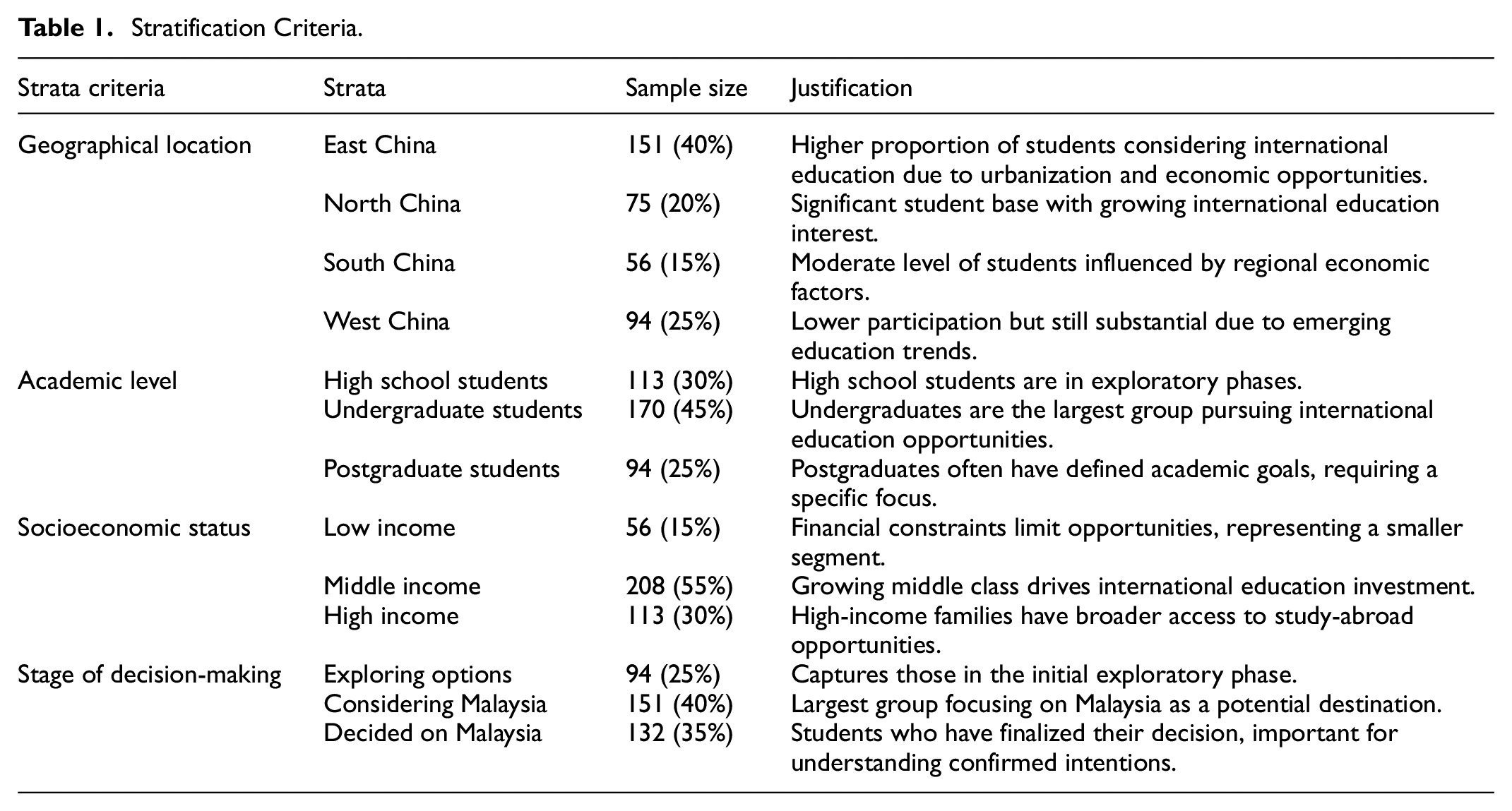
To ensure meaningful representation, the sample was stratified based on geographical and socioeconomic categories that reflect key variations in educational access, mobility trends, and decision-making processes across China. Geographically, China is commonly segmented into four macro-regions—East, North, South, and West—each with distinct socio-economic and educational characteristics (M. Li et al., 2018). East China includes economically developed provinces like Jiangsu, Zhejiang, and Shanghai, where high urbanization and global exposure have contributed to a strong inclination toward overseas education. North China, including Beijing and Tianjin, represents a region with significant government investment in education and a mature outbound student market. South China, encompassing Guangdong and Fujian, is influenced by regional economic integration and exposure to Southeast Asian networks. West China, which includes less developed provinces such as Sichuan and Yunnan, reflects growing but still nascent trends in international education participation, often driven by emerging policy support and rising aspirations.
The economic stratification was based on students’ self-reported family income levels and aligned with conventional income thresholds used in Chinese socioeconomic studies (J. Chen & Shen, 2015). Low-income households were defined as those earning below RMB 60,000 annually, typically facing significant financial constraints in pursuing overseas education. Middle-income households (RMB 60,000–200,000 annually) represent the fastest-growing segment of outbound students, often balancing affordability with aspirations. High-income households, with earnings above RMB 200,000 annually, have greater flexibility in financing international education, often prioritizing global ranking and program prestige over cost.
Data were collected using an online survey distributed through various platforms frequented by Chinese students, including social media (WeChat, LinkedIn, Facebook) and educational forums. To reach students at different stages of their decision-making process, data collection also targeted education fairs and consultancy websites where students typically explore their study-abroad options.
Informed consent was obtained online, and participants completed a survey comprising several items designed to measure the constructs in our study, including factors influencing their intentions to study in Malaysia. Data collection was conducted between 18th September 2023 and 17th December 2023.
Collected data were analyzed using SEM with SmartPLS 4 software, which allows simultaneous analysis of relationships among multiple independent and dependent latent constructs. Mediation effects were tested to explore the indirect relationships between various influencing factors and students’ study intentions.
Measurement of Variables
All constructs in this study were measured using multiple items on a 5-point Likert scale (ranging from 1 = Strongly Disagree to 5 = Strongly Agree). These items were adapted from scales that have been previously validated in the literature, ensuring the reliability and applicability of our measures to the current study’s context.
High Competition and Limited Educational Opportunities in China: These constructs are measured based on individual perceptions of competition and educational opportunities within China. Items were adapted from Mazzarol and Soutar (2002) and Mehar Singh (2016), reflecting personal assessments of the educational landscape students face in their home country.
Quality of Education, Financial Affordability, and Cultural Similarities in Malaysia: These constructs capture individual beliefs and perceptions regarding various aspects of the educational environment in Malaysia. The measures are based on scales from Lyttle et al. (2011) and Mazzarol and Soutar (2002), which assess personal viewpoints on the quality of education, the cost of studying, and the cultural environment in Malaysia.
General Self-Efficacy: This scale measures individuals’ confidence in their own ability to achieve intended results and cope with a variety of situations. The General Self-Efficacy scale by Schwarzer and Jerusalem (1995) is used to evaluate personal efficacy beliefs.
Foreign University Admission Intention: The intention to study abroad is measured using items that reflect personal plans and desires to pursue education outside one’s home country (Malaysia). These items were also adapted from Mazzarol and Soutar (2002), focusing on individual-level intentions to study in Malaysia, which encompasses the decision making indicated by Nolte et al. (2022).
This approach emphasizes that our analysis is rooted in individual-level data, reflecting personal beliefs, perceptions, and intentions. Each construct’s measurement aligns with micro-level theoretical frameworks, which consider the direct experiences and psychological states of individuals. By ensuring that our constructs are accurately presented as reflecting individual rather than macro-level data, we enhance the validity and credibility of our findings. This clarification also aligns our methodology with standard practices in the field, which differentiate between individual perceptions and broader societal or economic indicators.
Furthermore, filtering questions such as Nationality (to ensure target population representation), foreign education intention (to identify the respondents education intention), history or consideration of application to Malaysian university (to identify respondents who have recently applied or want to apply to Malaysian Universities).
Data Analysis
Measurement Model Evaluation
The measurement model evaluation confirms the reliability and validity of the constructs used to assess the factors influencing Chinese students’ intentions to study in Malaysia, including financial affordability, cultural similarities, quality of education, and self-efficacy (Figure 2).

Correlation, loading, alpha.
As shown in Table 2, the reliability of the constructs is supported by high outer loadings, all exceeding the recommended threshold of 0.6 (Hair et al., 2022), indicating that each item reliably measures its respective construct. For instance, items measuring Financial Affordability (AFF) show strong outer loadings ranging from 0.805 to 0.887, reinforcing the construct’s reliability in capturing perceptions of affordability among Chinese students.
Construct Reliability.

Note. HC = High Competition in China; LEO = Limited Educational Opportunities in China; QE = Quality of Education in Malaysia; AFF = Financial Affordability in Malaysia; CS = Cultural Similarities between China and Malaysia; SE = Self-Efficacy; FUAI = Foreign University Admission Intention.
The Cronbach’s alpha values for all constructs are above .7, ranging from .741 (Cultural Similarities) to .910 (High Competition in China), demonstrating adequate internal consistency across items (Hair et al., 2022). Composite reliability values (rho_a) also exceed .7, confirming consistent measurement within each construct. For example, the composite reliability for Quality of Education (QE) is .906, indicating that the construct reliably captures students’ perceptions of educational quality in Malaysia.
The Average Variance Extracted (AVE) values, ranging from 0.591 to 0.847, exceed the minimum threshold of 0.5, confirming good convergent validity (Fornell & Larcker, 1981). This suggests that constructs like Financial Affordability (AVE = 0.747) and Self-Efficacy (AVE = 0.779) effectively capture the variance explained by their respective items, reflecting students’ perceptions and beliefs accurately. This is critical in understanding how affordability, cultural similarities, and self-beliefs contribute to students’ intentions to study in Malaysia.
The discriminant validity of the constructs was assessed using the Heterotrait-Monotrait Ratio (HTMT), as presented in Table 3. Most HTMT values fall below the threshold of 0.85, indicating that the constructs are sufficiently distinct from each other within the context of international student mobility decisions (Henseler, 2017). For instance, the HTMT value between Quality of Education (QE) and Financial Affordability (AFF) is 0.841, suggesting that although related, students perceive these constructs as distinct factors influencing their decision-making process.
Heterotrait-Monotrait Ratio (HTMT)—Matrix.

Note. HC = High Competition in China; LEO = Limited Educational Opportunities in China; QE = Quality of Education in Malaysia; AFF = Financial Affordability in Malaysia; CS = Cultural Similarities between China and Malaysia; SE = Self-Efficacy; FUAI = Foreign University Admission Intention.
However, some HTMT values are close to the threshold, such as between Financial Affordability (AFF) and Cultural Similarities (CS) at 0.831, indicating a potential overlap. This suggests that while affordability and cultural familiarity are key motivators, they may interact closely in the decision-making process, highlighting the nuanced considerations Chinese students weigh when choosing Malaysia as a study destination.
The Fornell-Larcker criterion, shown in Table 4, further validates the discriminant validity of the constructs by comparing the square root of the AVE of each construct with its correlations with other constructs. The square root of the AVE for each construct is higher than its correlations with other constructs, confirming that each construct captures unique variance not shared with others (Fornell & Larcker, 1981). For example, the square root of the AVE for Financial Affordability (0.864) is higher than its correlation with Cultural Similarities (0.569), indicating that affordability remains a distinct factor even when students also consider cultural aspects.
Fornell-Larcker Criterion.

Note. HC = High Competition in China; LEO = Limited Educational Opportunities in China; QE = Quality of Education in Malaysia; AFF = Financial Affordability in Malaysia; CS = Cultural Similarities between China and Malaysia; SE = Self-Efficacy; FUAI = Foreign University Admission Intention.
Similarly, the Quality of Education (QE) shows a square root of the AVE of 0.883, which exceeds its correlations with other constructs, such as Financial Affordability (0.850), reinforcing the distinct perception of educational quality among Chinese students considering Malaysia. This finding is crucial in the study context, as it highlights that while factors such as affordability and quality are interconnected, they individually contribute to students’ intentions to study abroad.
Overall, the measurement model demonstrates robust reliability and validity, supporting the study’s investigation into the multifaceted factors influencing Chinese students’ choices of Malaysia as a study destination. The strong construct measures confirm that the hypothesized relationships are grounded in reliable data, providing confidence in the study’s findings and implications for enhancing Malaysia’s appeal as an international education hub.
Hypothesis Testing Results and Discussion
This study proffers valuable insights into the factors influencing Chinese students’ intention to study in Malaysia, providing both empirical evidence and theoretical nuances that extend our understanding of international student mobility patterns.
The results of Hypothesis 1, which examined the relationship between high competition in China and the inclination to study in Malaysia, revealed a weak and statistically insignificant effect (Path coefficient = 0.041; T statistic = 1.817; p = .069). This outcome suggests that while academic competition, such as the Gaokao, is a recognized stressor, it does not strongly drive Chinese students to choose Malaysia as a study destination. This finding highlights the complexities of student decision-making, where factors beyond competition, such as personal aspirations, family influence, and perceived post-graduation opportunities, play a more significant role (S. Z. Ahmad & Buchanan, 2016). Many students prioritize destinations that align with their career goals and offer recognized qualifications, rather than simply escaping a competitive environment (Musiał, 2023). Cultural and psychological factors also dilute the impact of competition; Malaysia’s cultural similarities and supportive environment may appeal more than merely avoiding competition. Additionally, high self-efficacy can moderate responses to competitive pressures, suggesting that students confident in their abilities are less deterred by high competition (Chang et al., 2017). This underscores the need for more targeted strategies that resonate with diverse student motivations, emphasizing not just the affordability and quality of education but also post-study opportunities and cultural fit.
Supporting Hypothesis 2 (refer to Table 5 and Figure 3), the findings significantly affirm that limited educational opportunities within China are a major driver for students seeking education in Malaysia (Path coefficient = 0.151; T statistic = 2.531; p = .011; f2 = 0.023). This aligns with previous observations that disparities in the quality of educational resources across different regions in China compel students to look for better opportunities abroad (Bodycott & Lai, 2012; Tamtik, 2019). For Chinese students, Malaysia offers a broad range of developed programs in fields that are underrepresented in Chinese higher education, such as certain arts and creative industries, which makes it a highly attractive option (Saengchai et al., 2020). The attractiveness is enhanced by Malaysia’s relatively lower cost of living and tuition fees compared to traditional Western destinations, aligning with the economic considerations important to many Chinese families.
Direct Relation.

Note. HC = High Competition in China; LEO = Limited Educational Opportunities in China; QE = Quality of Education in Malaysia; AFF = Financial Affordability in Malaysia; CS = Cultural Similarities between China and Malaysia; SE = Self-Efficacy; FUAI = Foreign University Admission Intention.

T-statistics, p-value and R2.
Hypothesis 3 robustly confirmed that the perceived quality of education in Malaysia is a significant attractor for Chinese students (Path coefficient = 0.182; T statistic = 2.356; p = .019; f2 = 0.022). The results are consistent with previous research emphasizing the importance of educational quality, evidenced by international rankings and the reputation of universities, in attracting international students (Daradjat, 2020; Sittisom, 2020b). Malaysia’s strategic focus on enhancing the quality and international standing of its higher education institutions aligns well with the academic aspirations of Chinese students, particularly those from highly competitive educational backgrounds (J. Li & Xue, 2022; Marshall et al., 2022). Furthermore, Malaysia’s multicultural environment and the widespread use of English in higher education also contribute to its appeal, offering a conducive academic and social environment for Chinese students.
While fierce competition in China’s educational system is acknowledged, it does not singularly dictate the choice of study destination. Instead, the combination of limited educational opportunities in China and the superior perceived educational quality in Malaysia form a compelling rationale for these students. The analysis suggests that Malaysian educational institutions and policymakers should continue to enhance their educational offerings and actively communicate these improvements to attract international students.
The results from Hypothesis 4 clearly demonstrate that financial affordability is a pivotal factor for Chinese students (refer to Table 5 and Figure 3) when choosing Malaysia as their study destination (Path coefficient = 0.312, T statistic = 5.881, p = .000, f2 = 0.106). This finding aligns with existing literature which emphasizes the significance of the cost of education in the decision-making process for foreign university admission intention (Ab Mumin et al., 2021; Mujani et al., 2016). Given the socio-economic backdrop of China, where many families face significant financial pressure, Malaysia’s lower tuition fees and cost of living present a compelling alternative to more expensive Western countries. Additionally, the presence of scholarships and financial aids specifically targeted towards international students further enhance Malaysia’s attractiveness as a cost-effective option (Md Zabri & Haron, 2019). This aspect is crucial, considering the value placed on education in Chinese culture, coupled with the economic considerations that often guide educational pursuits.
The findings of Hypothesis 5 (refer to Table 5 and Figure 3) reinforce the importance of cultural similarities in influencing the intention of Chinese students to study in Malaysia (Path coefficient = 0.131, T statistic = 4.500, p = .000, f2 = 0.056). Malaysia’s significant Chinese community, shared cultural elements, and linguistic overlaps create a comforting and familiar environment, reducing the psychological and social barriers often associated with studying abroad (Lynn-Sze, 2021; H. Wang & Jia, 2020). This cultural congruence is particularly relevant for Chinese students, who might find the transition less daunting in a country that mirrors aspects of their own culture. This aspect of cultural familiarity facilitates not only easier adaptation but also provides a sense of community and support, which are crucial for international students navigating a new academic and social landscape.
Hypothesis 6 highlights the role of self-efficacy (refer to Table 5 and Figure 3) in influencing Chinese students’ intentions to pursue education in Malaysia (Path coefficient = 0.211, T statistic = 4.480, p = .000, f2 = 0.053). The belief in their ability to successfully manage and adapt to new academic challenges is a significant motivator for Chinese students, who often come from highly competitive educational environments (Chang et al., 2017; Fatima et al., 2020). Self-efficacy not only impacts their perceptions of academic success abroad but also shapes their overall willingness to engage with different educational systems and cultures. For Chinese students, higher self-efficacy might be linked to better psychological preparation for the challenges of studying abroad, making destinations like Malaysia, which offer supportive environments for international students, particularly appealing (Shiau et al., 2020).
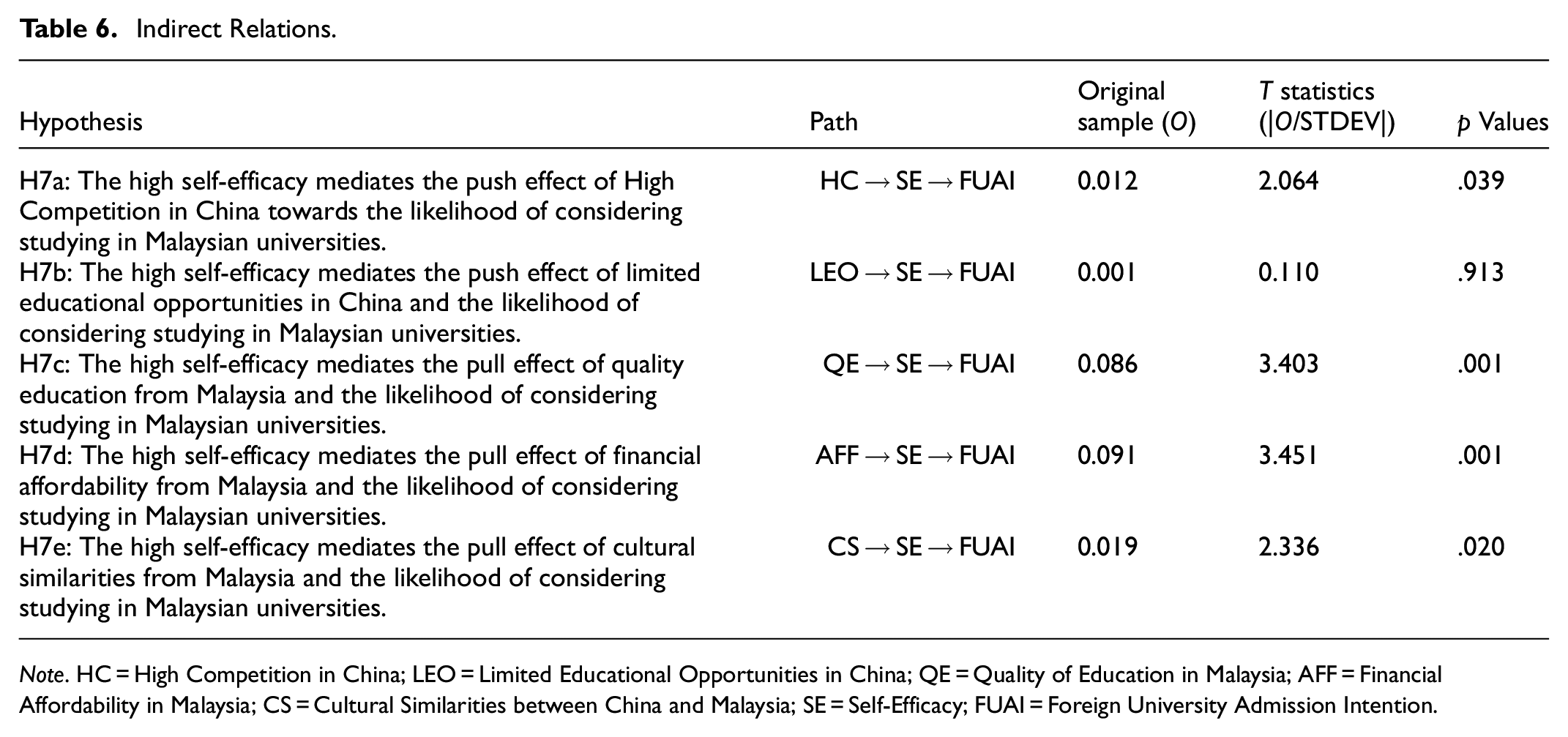
Our additional hypotheses (H7a to H7e) examined the mediating effect of high self-efficacy (SE) in the relationship between various factors and the likelihood of considering studying in Malaysian universities (refer to Table 6).
Indirect Relations.
Note. HC = High Competition in China; LEO = Limited Educational Opportunities in China; QE = Quality of Education in Malaysia; AFF = Financial Affordability in Malaysia; CS = Cultural Similarities between China and Malaysia; SE = Self-Efficacy; FUAI = Foreign University Admission Intention.
The significant mediation effect of self-efficacy on the relationship between high competition in Chinese education and the inclination to study in Malaysia (Path coefficient = 0.012; T statistic = 2.064; p = .039) reveals a nuanced aspect of how Chinese students respond to their highly competitive educational environment. In China, where academic pressure and competition are pervasive, particularly due to the Gaokao (the national university entrance examination), students often face immense stress to succeed academically (Lee, 2017). The finding that self-efficacy slightly increases the likelihood of considering study opportunities in less competitive environments like Malaysia suggests that students with higher self-belief are more equipped to see these competitive pressures as surmountable challenges rather than insurmountable obstacles (Hayat et al., 2020). This perspective is crucial for understanding why some students choose to leave a high-pressure environment in search of one that might offer not only different but potentially more supportive educational experiences.
The unsupported hypotheses highlight the complex nature of student decision-making, where factors extend beyond simple push-pull dynamics. The weak impact of high competition in China on students’ decision to study in Malaysia suggests that escaping competition is not the primary motivator. Instead, students often prioritize personal aspirations, family guidance, and perceived post-graduation opportunities, focusing on destinations that align with their academic and career goals rather than merely avoiding competitive environments (S. Z. Ahmad & Buchanan, 2016; Musiał, 2023). Similarly, the minimal mediation effect of self-efficacy on the relationship between limited educational opportunities in China and the choice of Malaysia indicates that personal confidence alone is insufficient to overcome significant educational barriers, particularly in less developed regions (Path coefficient = 0.001; T statistic = 0.110; p = .913). This reinforces the idea that systemic constraints, such as inadequate access to quality education, significantly drive students to seek better options abroad, where Malaysian universities offer more accessible and diverse programs (Bodycott & Lai, 2012; Hayat et al., 2020). Cultural familiarity also plays a crucial role, as Malaysia’s shared cultural aspects with China, including language and community presence, reduce psychological barriers and provide a sense of comfort, often outweighing competitive pressures. This highlights that cultural and social alignment can be more influential than academic factors alone in students’ decision-making (R’boul, 2022). Overall, these findings suggest that student choices are influenced by a complex interplay of aspirations, structural limitations, and cultural factors, emphasizing the need for strategies that address these diverse motivators to better attract and support international students.
The strong mediation effect of self-efficacy on the perceived quality of education in Malaysia (Path coefficient = 0.086; T statistic = 3.403; p = .001) further illustrates that students who are confident in their abilities are more likely to be attracted to high-quality educational systems. Malaysian universities are increasingly recognized for their educational standards, which include accreditations from international bodies and English as a medium of instruction, aspects that are highly valued by Chinese students seeking to enhance their global competitiveness (J. Li & Xue, 2022; Mutiu et al., 2021). For these students, the combination of Malaysia’s educational quality and a more accommodating academic environment can be a significant draw, particularly for those who feel they can thrive and take full advantage of such opportunities.
The analysis shows that self-efficacy significantly mediates the relationship between financial affordability and the intention to study in Malaysia (Path coefficient = 0.091; T statistic = 3.451; p = .001). This finding underscores that Chinese students are not merely driven by financial considerations but also by how these economic factors empower them to achieve their educational and personal goals. In the context of Chinese families, where educational investment is often seen as a paramount family commitment, the ability to afford education is perceived not just in terms of cost but as a strategic investment in future career success (Jungert & Rosander, 2010). Malaysia, offering a combination of lower cost and high-quality education, aligns well with the aspirations of Chinese students who are financially prudent yet ambitious. This insight is particularly relevant when considering the large middle-class population in China, which, while cost-sensitive, highly values the quality and international recognition of the education system.
Furthermore, the moderate mediation effect of self-efficacy on how cultural similarities between China and Malaysia influence the intention to study abroad (Path coefficient = 0.019; T statistic = 2.336; p = .020) illuminates another critical aspect of the decision-making process for Chinese students. The shared cultural elements, such as linguistic similarities and social norms, significantly lower the psychological and social barriers to adaptation, which is crucial for students from a country where cultural familiarity is highly valued. This cultural congruence makes Malaysia particularly appealing, as it promises a smoother transition and integration into the host country, reducing the fears associated with cultural assimilation and isolation often experienced in more culturally distant countries (Hayat et al., 2020).
Incorporating these findings, it is clear that the intention for Chinese students to study in Malaysia is not a straightforward outcome of one or two factors but a complex interplay of financial considerations, cultural familiarity, and personal beliefs in one’s capabilities. These factors do not exist in isolation but are deeply intertwined within the broader socio-economic and cultural fabric of Chinese society. The discussion of these results thus highlights the importance of understanding the broader context in which Chinese students and their families evaluate educational opportunities abroad.
Table 7 provides an in-depth examination of the statistical metrics derived from the structural equation modeling conducted in this study, assessing both the robustness and predictive accuracy of the model in relation to the self-efficacy of students and their intentions to study in Malaysia.
R2, Q2.

Note. SE = Self-Efficacy; FUAI = Foreign University Admission Intention.
The coefficient of determination (R2) for the model predicting students’ intentions to study in Malaysia (FUAI) is notably high at .832, suggesting that the model accounts for approximately 83.2% of the variance in this outcome. The adjusted R2 value of .830 corroborates the robustness of the model, indicating minimal risk of overfitting and confirming the generalizability of the model. Similarly, self-efficacy (SE) shows a strong R2 value of .800, which implies that 80% of the variance in self-efficacy is effectively explained by the predictors included in the model. The adjusted R2 for self-efficacy stands at .797, further validating the model’s effectiveness and the appropriateness of the variable selection.
The predictive relevance of the model, as indicated by Q2 values, is also substantial, with a Q2 predict of 0.817 for FUAI and 0.793 for SE. These values affirm that the model possesses a strong capacity to predict both the intention to study abroad and the self-efficacy of the students based on the factors identified.
Moreover, the model’s precision is evaluated through the Root Mean Square Error (RMSE) and the Mean Absolute Error (MAE). For FUAI, the RMSE is 0.430 and the MAE is 0.330, indicating a moderate level of prediction error which is acceptable within the realm of social science research. For SE, the values are slightly higher, with an RMSE of 0.457 and an MAE of 0.340, suggesting a reasonable but slightly less precise prediction capability concerning self-efficacy.
Overall, the statistical analysis underscores the model’s capacity to elucidate a significant portion of the variability in the targeted outcomes, demonstrating its utility in academic and practical applications. The findings underscore the model’s ability to provide actionable insights into the factors influencing Chinese students’ intentions to pursue higher education in Malaysia, with a particular focus on the role of self-efficacy in mediating the effects of various educational push and pull factors. This robustness and predictive accuracy suggest that the model can serve as a valuable tool for future research in the field of international education, aiding educational institutions and policymakers in designing effective strategies to attract and support international students.
Implications of the Findings
Theoretical Implications
This study makes several important contributions to the body of literature on international student mobility, particularly in the context of Chinese students considering studying in Malaysia.
First, our study extends previous work on push-pull factors influencing study abroad intention by incorporating individual-level psychological characteristics, specifically self-efficacy, into the analytical model. While the role of macro-level factors such as competition in domestic education, limited educational opportunities, quality of education abroad, financial affordability, and cultural similarities, is well-established in the literature (S. Cheng et al., 2019; X. Cheng, 2020), our study underscores the importance of considering micro-level factors as well. Our findings suggest that self-efficacy not only influences study abroad intention directly but also mediates the relationships between various push and pull factors and the likelihood of studying abroad. This highlights the need for a more holistic approach to understanding international student mobility, one that takes into account both external factors and individual student characteristics.
Second, our findings challenge some established notions in the field. For instance, we found that high competition in China’s education system, contrary to prevailing assumptions, does not necessarily drive students to seek educational opportunities abroad. This finding suggests that the relationship between domestic competition and study abroad intention may be more complex and context-dependent than previously thought and calls for further research to unravel these complexities.
Third, our study highlights the role of self-efficacy in enhancing the attractiveness of quality and affordability aspects of international education for potential students. This aligns with and extends the literature on the role of self-efficacy in educational choices (Chang et al., 2017; Susanty et al., 2020), suggesting that self-efficacy may shape how students perceive and respond to different aspects of international education. This opens up new avenues for research on how individual-level psychological factors interact with macro-level educational factors to shape study abroad intentions.
Furthermore, the robustness and predictive accuracy of our model underscore its utility as a foundational tool for future inquiries. By incorporating individual characteristics, the model provides a detailed framework for predicting study abroad intentions. Future research could refine this model by including additional variables, applying it in different contexts, or targeting various student demographics, thereby deepening our understanding of international student mobility.
Overall, our study enriches the understanding of the factors influencing study abroad intentions, emphasizing the significance of individual psychological traits and offering a robust, predictive model for subsequent research in this field.
Practical Implications
In light of the findings from the study and supported by relevant literature on international student mobility, Malaysia can enhance its educational appeal and effectiveness of recruitment strategies targeted at Chinese students by implementing several nuanced approaches.
The significant influence of financial affordability on the decisions of Chinese students to study in Malaysia, as highlighted in the study, suggests the need for Malaysian educational institutions to develop targeted marketing campaigns. These campaigns should emphasize the comparative cost advantages of studying in Malaysia, including detailed cost comparisons of tuition, living expenses, and scholarships available relative to other popular study destinations such as the USA, UK, or Australia. Additionally, promoting financial aid packages specifically designed for Chinese students—featuring scholarships and grants—could alleviate the economic burdens these students face and make Malaysian universities more appealing.
Furthermore, the role of cultural similarities in attracting Chinese students, as evidenced by the research findings, indicates the importance of integrating comprehensive orientation programs that help students from China adjust to life in Malaysia by highlighting cultural similarities. Organizing cultural exchange events that showcase elements from both Malaysian and Chinese cultures could foster a stronger community feeling and support cultural integration.
Enhancing the perceived quality of education is also crucial. Malaysian universities could benefit from continuous improvements in their academic standards and global standings. This could involve forming partnerships with renowned universities worldwide, obtaining accreditation from internationally recognized bodies, and promoting these achievements in outreach efforts to prospective students. Investing in faculty development to ensure that educators are not only highly qualified but also equipped to deliver education that meets international standards using innovative teaching methods would also attract more students.
Addressing the importance of career prospects for students, Malaysian universities and policymakers should work together to simplify work visa policies for international graduates and integrate them into the local economy. This could be supported by promoting internships and part-time work opportunities with Malaysian companies as part of university curricula, enhancing students’ practical experience and employability post-graduation.
Lastly, the positive impact of self-efficacy on student decision-making underscores the value of programs aimed at building confidence among students. Universities should consider implementing workshops that focus on developing personal efficacy and academic success skills, complemented by robust support systems that include tutoring, counseling, and mentoring tailored to the needs of international students.
By adopting these comprehensive strategies, Malaysian universities can not only attract a larger number of Chinese students but also significantly enhance their educational experiences, thereby reinforcing Malaysia’s position as a favored global education hub. These efforts require a coordinated approach that aligns academic offerings with the personal and professional aspirations of students, ensuring sustained growth and satisfaction among the international student population.
Conclusion and Future Directions
In conclusion, this study offers a comprehensive and novel understanding of the factors influencing Chinese students’ intentions to study in Malaysia by integrating macro-level (push-pull factors) with micro-level (self-efficacy) determinants. Unlike prior research that primarily emphasized structural motivators or institutional attractiveness, this study uniquely demonstrates that self-efficacy significantly shapes how students interpret and act upon both push and pull factors. Notably, we found that financial affordability is the strongest direct predictor of study intention, but its influence is substantially amplified when mediated by self-efficacy—a finding that challenges the prevailing view that economic factors operate independently in international student decision-making.
Another key contribution lies in our finding that self-efficacy mediates the relationship between perceived educational quality, cultural similarities, and intention to study in Malaysia, thus positioning it as a core psychological enabler. Interestingly, high competition in China—commonly assumed to push students abroad—was not a strong direct predictor, suggesting that psychological readiness (self-efficacy) may override structural pressure in determining student action. This reframing of self-efficacy from a peripheral trait to a central moderating mechanism is a distinct theoretical contribution, particularly relevant to emerging destinations like Malaysia.
Theoretically, this study advances the field by embedding Social Cognitive Theory within the push-pull framework, offering a multidimensional model of student mobility that accounts for both external constraints and internal capacities. Practically, the findings highlight the need for Malaysian institutions and policymakers to not only market affordability and accessibility, but also to foster environments that support confidence-building, academic self-regulation, and cross-cultural adaptability—factors that resonate with high self-efficacy students.
Despite these contributions, limitations exist. The study focuses solely on Chinese students, which may restrict generalizability. Moreover, variables such as personal networks, bilateral political relations, or disciplinary preferences were not included. Future research should test the model across different nationalities and regions, include qualitative components to uncover deeper motivational layers, and explore longitudinal changes in students’ psychological and contextual orientations.
Ultimately, international student mobility is driven not just by structural inequalities or educational market dynamics, but also by students’ belief in their own capability to thrive abroad. By illuminating this often-overlooked dimension, this study not only expands the theoretical lens through which student mobility is understood but also provides strategic direction for education hubs like Malaysia aiming to differentiate themselves in an increasingly competitive global education landscape.
Footnotes
Appendix: List of Measurement Items

Ethical Considerations
This study adhered to the principles of the declaration of Helsinki and following strict ethical standards. Participation was anonymous, and confidential. All authors have read and agreed to the published version of the manuscript.
Consent to Participate
Informed consent was obtained through chat features of the social media platform or email where chat isn’t available.
Author Contributions
Conceptualization: Mazzlida Mat Deli; Data curation: Ummu Ajirah Abdul Rauf; Formal analysis: Ummu Ajirah Abdul Rauf and Meng Na; Investigation: Meng Na; Software: Ummu Ajirah Abdul Rauf and Meng Na; Supervision: Mazzlida Mat Deli; Visualization: Mazzlida Mat Deli; Writing—original draft: Meng Na; Writing—review and editing: Meng Na. All authors have read and agreed to the published version of the manuscript.
Funding
The author(s) disclosed receipt of the following financial support for the research, authorship, and/or publication of this article: This article is supported by Graduate School of Business, Universiti Kebangsaan Malaysia, Research grant UKM-GSB (GSB-2024-017and GSB-2024-019).
Declaration of Conflicting Interests
The author(s) declared no potential conflicts of interest with respect to the research, authorship, and/or publication of this article.
Data Availability Statement
The data presented in this study are available on request from the corresponding author.