




Abstract
Offender history often predicts risk of recidivism, creating guidelines for sentencing recommendations and decisions. Individual-level variables also predict risk for failure in pretrial programs, guiding recommendations for conditions of pretrial release. This study aims to determine the extent to which judges follow recommendations of conditions for release from pretrial services program staff, and if any departure from recommendations affects outcomes in failure to appear and new charges. Using bivariate and logistic regression analyses, results indicate that judges agree with the recommendations of pretrial most of the time. Additionally, departures from recommendations do not increase the risk of failure in a pretrial release program. The use of supervision with monitoring based on offense, not risk, is a potential explanation for these results. Judges should be provided with as much validated information on a defendant’s pretrial risk as possible to help inform their bond decision-making processes. Relying only on criminal history and current charges can result in the assignment of bond conditions that do not promote the best outcomes for defendants. Utilizing evidence-based practices and encouraging judges to follow data-driven bond recommendations can help promote equitable bond reform and pretrial release success.
Introduction
One of the earliest and most important decision-making steps in the criminal justice system is the judicial decision to either detain the defendant, grant and set bail, or release the defendant on a bond, including personal recognizance (PR) while awaiting trial. The judicial pretrial decision-making process remains largely unexplored empirically, leaving questions about how judges review and determine a defendant’s bond eligibility. This article reviews how personal recognizance bonds are determined and set by judges in a Southeastern Colorado County, to help provide some context to considerations judges make in these cases. PR bonds are considered a non-monetary method of release, where the defendant does not have to secure or pay any funds to attain release. The process of providing a bond allows a defendant to be released from jail until the case is completed. A bond’s purpose is to make sure that the defendant attends all required court appearances without further law enforcement engagement and often times bonds are supervised by pretrial services staff to ensure compliance.
The pretrial release decision process and pretrial services programs in the United States balance defendant rights and limit detention while promoting appearances at trials and protect public safety. Many jurisdictions in the United States, including the Southeastern Colorado County that is the focus of this analysis, have pretrial services programs and staff who complete risk assessments and interviews to determine the likelihood a defendant will appear in court as ordered or if they pose a risk of failing to appear or even reoffending while released pretrial on bond. Appropriate conditions of release and supervision for a pretrial bond can be set by courts to help mitigate these risks. The sample county’s Pretrial Services Program supports community safety efforts by providing information to the judicial system for release decisions and provides supervision of defendants released on supervised personal recognizance (PR) bonds.
While there has been considerable scholarship around bail mechanisms, risk assessment tools, and their outcomes, less research has focused on the role of judges to act on recommendations for setting bonds, when they are available, through pretrial services staff and risk assessments. Many jurisdictions are looking to pretrial monitoring as an alternative to pretrial incarceration. With counties expanding pretrial services, technology to utilize GPS tracking and remote alcohol monitoring becoming more common, and growing community collaborations in drug testing and treatment recommendations, courts now have a broader range of pretrial conditions to consider as options for maintaining defendant release compliance (Hopkins et al., 2019). More jurisdictions are moving away from money bail and are adopting risk assessment tools and other additional forms of conditional release for people released on recognizance. Present research reviews the information judges in a large jurisdiction in Southeastern Colorado consider when making pretrial release decisions. It is important to assess to what degree they consider risk assessment tool results and pretrial service program staff recommendations on setting appropriate conditions for supervising defendants released on personal recognizance bonds. This process helps ensure court appearance and public safety. The present research also reviews how divergence from recommendations impacts pretrial outcomes.
Literature Review
The Importance of Providing Pretrial Release Options
Pretrial release is the decision to release or detain a defendant pending trial and setting terms and conditions for release (VanNostrand et al., 2011) and is important for a number of reasons, including allowing the defendant to maintain community responsibilities, reducing unintended negative consequences beyond punishment for the arresting offense, and reducing the number of unsentenced people being held in custody (Scott-Hayward & Ireland, 2022). Extant research focuses on a defendant’s pretrial status and how it shapes judicial perceptions during the sentencing phase, as well as consideration for whether defendants who have been jailed prior to trial are perceived as inherently more dangerous than those who have been released (Williams, 2003). According to Van Brunt and Bowman (2018), the decision to release a defendant prior to trial is the most consequential ruling that will happen in the case as far as its effects on the defendant’s life, family, and future prospects. During the pretrial stage, VanNostrand et al. (2011) explains that judges are tasked with identifying and giving the least restrictive release terms and conditions that will not result in unnecessary detention and can reasonably assure a defendant will appear for court and will not present a danger to the community.
There are many adverse case outcomes for defendants held in pretrial detention. Defendants detained prior to trial are usually unable to afford monetary bail, and therefore are unable to afford representation, and lawyers usually spend less time with their detained defendants than with those released on bail (Allan et al., 2005). Detention prior to trial and a defendant’s inability to fully participate in their own defense can negatively affect the outcome of a case (Sacks & Ackerman, 2014). The longer defendants are held in pretrial detention, the less likely they are to have their case dismissed. Pretrial detention has been found to significantly predict guilty pleas (Dobbie et al., 2018; Kellough & Wortley, 2002), is linked with increased rates of conviction (Cohen & Reaves, 2007; Dobbie et al., 2018), and with increased probability of a prison sentence (Harrington & Spohn, 2007). A study of the New York City Criminal Justice Agency found that detention prior to trial increased the odds of conviction, the probability of incarceration, and the length of imprisonment (Phillips, 2008). Individuals not released pretrial were approximately 9.6 times more likely to be convicted than their released counterparts. This study echoed findings of the Manhattan Bail Project study conducted in the 1960s, so results regarding pretrial detention have been stable for decades (Ares et al., 1963; Rankin, 1964). Longer pretrial detention has also been found to be associated with increased sentence lengths, as well (Clarke & Kurtz, 1983; LaFrentz & Spohn, 2006; Oleson et al., 2014; Sacks & Ackerman, 2014). It has been suggested that judges treat defendants who are released prior to trial more leniently than those who could not afford bail, as those detained may be viewed as more dangerous (Sacks & Ackerman, 2014). Judges might perceive pretrial incarceration as a measure taken to protect the community rather than detention before trial as an unfortunate result of a lack of financial resources for release. Those released on bail have the opportunity to demonstrate they do not pose a danger to the community, and in general may have more favorable outcomes due to their lives not being interrupted by pretrial incarceration. Federal defendants who are detained before trial have been found to be twice as likely as released defendants to fail on post-conviction supervised release (Cadigan & Lowenkamp, 2011).
It is also important to consider the impacts of incarceration itself when evaluating the effect of pretrial detainment on post-sentencing outcomes. A substantial body of research has found incarceration to be correlated with several detrimental effects, including decreased employment rates, lower wages, restriction of government benefits, physical and psychological conditions, damaged familial bonds, and higher rates of recidivism, which can be experienced by defendants held in pretrial detention (Allan et al., 2005; Dobbie et al., 2018; Schlesinger, 2005; Travis, 2005; Western, 2002, 2006). Additionally, detention can be expensive to taxpayers, where pretrial release offers an average cost saving of over $60/day for each defendant released (Oleson et al., 2014).
Factors Judges Frequently Consider in Pretrial Release Decisions
Judges consider many factors in the pretrial release decision including bail schedules, prior failures to appear, seriousness of the charged offense, and ties to the community to name a few (Ottone & Scott-Hayward, 2018). At bail hearings, pretrial officers and attorneys make recommendations on the release or detention of defendants pretrial. These recommendations, heavily weighted by current charges, can influence the decision to release a defendant. Criminal history and the seriousness of the offense are the strongest predictors of sentencing decisions (Gottfredson & Gottfredson, 1988; Neubauer, 2002; Steffensmeier & Demuth, 2006), so it stands to reason these are the mostly widely regarded considerations for pretrial decisions. Austin and Cohen (2018) stated that “four-fifths of defendants charged with financial crimes were released pretrial” with the rate remaining relatively steady over the last decade (p. 7). In comparison, about a third or less of defendants charged with weapons/firearms or violent crimes were released pretrial during the study period.
According to Milgram et al. (2015) pretrial decisions have two purposes: one, to prevent any new criminal activity by the defendant during pretrial release, and two, to ensure the defendant’s court appearance; this seems to be reflected in the data showing non-violent defendants are released at higher rates than violent, as the risk for absconding or to public safety is higher among those accused of violent charges (Austin & Cohen, 2018). Austin (2017) highlights certain factors a judge may consider when making pretrial service release decisions. These factors include (1) the nature and circumstances of the offense charged, including if the offense is violent, a federal crime of terrorism, involves a minor victim, controlled substance, firearm, explosive, or destructive device; (2) the weight of the evidence against the defendant; (3) the history and personal characteristics of the defendant, including his or her charter, physical and mental condition, family ties, employment history, financial condition, community ties, past criminal history, and behavior; and (4) the nature and seriousness of the danger to any person or community posed by the defendant (Austin, 2017). Moore et al. (2023) echo the types of considerations policymakers make when legislating the burden of proof for establishing “dangerousness” in order to detain a defendant pretrial is similar, including current charges and past convictions, failures to appear or violations of conditions of release. However, they find the overwhelming majority of defendants presumed as violent or dangerous are considered false-positives, and in fact are not charged with any new crime pretrial, making a case for net widening that is resulting in “the recommended detention for many pretrial defendants who do not pose a danger to the public” (Moore et al., 2023, p. 378). This illustrates the importance of developing a pretrial system that allows judges to review the most evidence-based information to evaluate and justify detention if release is to be denied, or to set the most appropriate conditions for pretrial release compliance and success for the defendant and public safety.
Very frequently, this information is compiled on behalf of the court by pretrial services programs, who also make recommendations for appropriate conditions of release based on assessment of these various factors to help promote a successful pretrial release period. Schaefer and Hughes (2019) found that being black, having higher level offenses, and higher risk assessment scores, all correlated with the likelihood of a judge deciding to issue a monetary requirement to attain pretrial release, while being female decreases the odds of receiving a financial burden for release. Although research on judges following pretrial recommendations is limited, various studies on probation recommendations also find judges typically follow these recommendations. Leifker and Sample (2010) determined that there is a strong association between pre-sentence investigation (PSI) recommendations and actual sentences received. The study conducted in a small jurisdiction in California across a 3-year period from 2004 to 2006 randomly selected 500 cases to determine if judges follow probation recommendations. Leifker and Sample’s (2010) results suggest that probation reports are important and useful in sentencing decisions and can give the “big picture” to the court with a summary of information, as judges followed the probation recommendation 79% of the time (p. 140). Ultimately, judges are responsible for sentencing, and the research suggests that probation recommendations do in fact influence judges’ decisions when sentencing (Leifker & Sample, 2010). Additionally, Leiber et al. (2018), which focused on decision-making in an Iowa district court, found outcomes similar to Leifker and Sample’s (2010) results when considering judicial decisions following probation recommendations. For cases where a probation officer recommended community sanctions, 78% of all cases received a similar judicial sentence. For sentences that resulted in incarceration, 62% of the cases aligned with probation officer recommendations (Leiber et al., 2018).
As jurisdictions continue to expand pretrial services, especially to offer options for indigent defendants who would otherwise be detained due to inability to afford bail, the opportunity for offering judges recommendations during the pretrial period is growing, and more options of conditional release will be available. Conditions of release include but are not limited to maintaining employment, electronic monitoring, alcohol and drug testing, travel restrictions, curfew, and pretrial supervisor check-ins (Bechtel et al., 2017; Hopkins et al., 2019). With many conditions being relatively inexpensive, there is a risk that judges will consider imposing conditions of release on people who previously would have qualified for release on their own personal recognizance without supervision (Hopkins et al., 2019). This could result in unnecessarily using valuable resources to supervise low-risk defendants, which some research has shown can also result in the unintended consequence of increasing risk of program failure due to over supervision; especially for defendants with substance use concerns mandated to drug testing, which is a very common practice that has not been empirically found to improve pretrial outcomes (Advancing Pretrial Policy and Research, 2021; Bechtel et al., 2017; VanNostrand & Keebler, 2009; Zettler & Martin, 2022). This high level of supervision may be unnecessary for low-risk defendants, especially when there are other opportunities to help ensure defendants appear in court, including court reminder notifications sent to defendants when their court hearings are approaching, and reducing the time between pre-trial release and initial hearings (Foudray et al., 2023). Employment, mental health diagnoses, and supervision for specific, higher-risk characteristics such as alcohol use, violence, and sex-related charges have also been found to act as protective factors to decrease the odds of pretrial failure (Zettler & Martin, 2022).
Risk Assessments, Including the Colorado Pretrial Assessment Tool (CPAT)
As research around evaluating pretrial release decision-making grows, it is important to review how data can guide recommendations and help judges identify the most important factors to consider when attempting to minimize defendant risk of failure to appear or public safety issues. Several risk assessment tools have been developed and implemented nationwide to help judges make these decisions. Judges have not traditionally made pretrial detention decisions with the review of risk assessment tools, instead relying on legal knowledge, cultural determinates, courtroom norms, and their own intuition, which can lead to erroneous associations and potential stereotyping, with major implications for defendants (DeMichele et al., 2019, 2021). Evidence-based risk assessments are another tool for judges to utilize when making pretrial release decisions, as the assessment is an instrument used to accurately sort defendants by the likelihood of making all court appearances and abstaining from reoffending while released (Ottone & Scott-Hayward, 2018), and reduces the likelihood of inconsistent and flawed outcomes of unstructured human judgment (DeMichele & Baumgartner, 2021). Similar to pre-sentence investigations, pretrial assessments provide judges with summary information on the defendant’s criminal history, community responsibilities, and stability and risk factors. Pretrial risk assessment tools provide judges and other court stakeholders with an evaluation of the level of risk a defendant poses during pretrial release and supervision conditions to mitigate this risk. Lattimore et al. (2020) reviewed the prevalence of local criminal justice practices through a stratified random sample of 1,600 US counties with populations above 25,000, finding about 48% utilize pretrial risk assessments where the use of these types of tools is more likely in larger jurisdictions.
Data-driven strategies are believed to reduce unnecessary pretrial detention and the quality of data-oriented bail reports, violation reports, and pretrial supervision has been highly rated by judges nationwide (Vance, 2018). IBM Consulting Services issued a report commissioned by the Administrative Office of the U.S. Courts, highlighting several positive indicators of performance in the federal pretrial services system. The report recommended that the probation and pretrial services system become a “results-driven system” that develops and maintains an infrastructure and management approach focused on collecting, analyzing, and acting on outcome data (Vance, 2018). Defendants assessed with these tools have been found to be more likely to receive non-financial release, like PR bonds, with defendants spending less time in pretrial detention and having higher overall rates of pretrial release than those whose pretrial decisions were not guided by risk assessment (Lowder et al., 2021).
Some research, however, has found that the adoption of risk assessment tools and the recommendations relating to release and bond type have not influenced judicial decision-making. Copp et al. (2022) found judges continued to utilize more punitive alternatives and financial conditions around release in an effort to obtain defendant compliance when believing the risk assessment tool underestimates defendant risk. Unfortunately, this exercise of discretion to depart (typically upwardly) from the tool’s recommendations (more than half the time) was found to be linked to longer pretrial detention rates and greater odds of pretrial failure, including failure to appear and rearrest (Copp et al., 2022). Potential policy implications include raising awareness of how recommendations generated through evidence-based tools designed to address pretrial populations efficiently and equitably should be considered to help eliminate bias and promote structured decision-making (Lowder, Diaz, et al., 2023). Encouraging stakeholder buy-in to consider a new decision-making tool may be an important piece of pretrial process reform, as negative perceptions of risk assessment tools can result in misuse of the tool as intended and validated or undervalue the tool’s appropriate applications to guide pretrial release recommendations (Terranova et al., 2020). To best contextualize this process around this study’s sample, it is first necessary to understand the risk assessment tool utilized by the county of focus in Southeastern Colorado at the time this study was conducted, which was the Colorado Pretrial Assessment Tool (CPAT). (The Colorado Pretrial Assessment Tool Revised (CPAT-R) began to be utilized in 2022. The process and use of the CPAT are used for the purposes of this study as it was the standard and protocol during the last full fiscal year of data collected (FY 2018–2019) before COVID-19 pandemic disruption of pretrial services.)
The Colorado Pretrial Assessment Tool (Pretrial Justice Institute, 2013) is used in many jurisdictions in the state to gauge a defendant’s level of risk for failing to appear in court or incurring a new arrest while on pretrial release and help inform bond decisions. The tool is comprised of 12 questions reflecting a defendant’s risk and protective factors, such as general characteristics, criminal history, current criminal circumstances, and social environment. Each factor has an assigned numerical risk score that is empirically derived, where the maximum high-risk score that can be obtained is 82 points, with an overall score falling into one of four risk level categories which highlight the defendant’s probability of pretrial release compliance (see Tables 1 and 2). The tool requires an interview with the defendant, which is typically conducted by local Pretrial Services Program staff, which is the case in this study’s Southeastern Colorado county sample.
Colorado Pretrial Assessment Tool (CPAT) Items and Scoring.

CPAT Risk Categories.

A 2020 review to validate the CPAT’s predictive accuracy found the tool to assign an accurate assessment of risk of new arrest and failure to appear at about 60%, with a validation score – area under the curve (AUC) – of 0.58 (Terranova & Ward, 2020). Pretrial assessment tools with fair performance have AUC scores ranging 0.55 to 0.63, good 0.64 to 0.70, and excellent 0.71 or higher (Desmarais & Singh, 2013). Reviews comparing various risk assessment tools have found the CPAT to perform “especially well at predicting new criminal activity and failure to appear” (Desmarais et al., 2021). Additionally, a review of pretrial assessment and interview practices in this study’s sample jurisdiction has been previously conducted. By analyzing correlates and predictors of failure to appear or rearrest, authors found defendants who failed to complete their pretrial release period had significantly higher CPAT scores than defendants who successfully completed the program (Clipper et al., 2021). These results indicate the pretrial assessment tool is predictive of failure among this local pretrial program population, and therefore release recommendations resulting from the consideration of the CPAT should be considered reliable. The study also identified various other factors, outside the CPAT but also collected during the pretrial interview, that successfully predict pretrial outcomes. For example, being married, the primary caregiver of children, or full-time employed/attending school are all significant protective factors that reduce risk for pretrial release failure (Clipper et al., 2021). The research highlighting other factors that should be considered in the pretrial decision-making process has helped to promote local policy change in the Southeastern Colorado county, whereby Pretrial Services Program staff include reviews of these factors in recommendations to judges during bond hearings to improve bond decision guidance. However, many studies have reviewed potential bias among pretrial risk assessment tools (DeMichele et al., 2021; Desmarais et al., 2021; Zottola et al., 2023), and there is an awareness that these tools are not all encompassing of the many factors judges consider, and as such, risk assessment tools should be considered as just that, a tool, and not the sole source for decision-making.
Reasons for Departing From Recommendations and Present Research
Judges enjoy a considerable amount of discretion in the operation of their courtrooms and, as such, often have the option to follow a recommendation or depart from it. According to Kaiser and Spohn (2018), for sentencing purposes “the U.S. Sentencing Guidelines Manual does provide provisions for when a departure may be warranted” (p. 47). Judges may use these provisions to justify their departure, to be more punitive or lenient, when determining sentencing. Understanding how and why judges depart when sentencing can provide an insight into pretrial decision-making.
Kaiser and Spohn (2018) found various primary themes by departure type. Judges justified their decisions to depart from sentencing guidelines in ways relating to their specific philosophy of punishment, perceptions focused around the defendant, victim, or offense, interests in correcting guideline issues, and other system contexts. Philosophy of punishment included retribution, deterrence, restoration, and rehabilitation. Defendant-focused reasons included circumstances related to the defendant’s history or character, health, drug or alcohol abuse, employment or education, kids or family, community ties, life circumstances, and behavior or conduct. Victim-focused reasons included injury or harm, and character or conduct. Offense-focused reasons for departures included the violent nature of the offense and use of a weapon, role in the offense, motive and intent of the defendant, and the seriousness of the offense. Departure reasons related to interests in correcting guideline issues included disparity and policy disagreement, and concerns around court and correctional contexts and constraints that do not promote sentencing outcomes most appropriate for offenders and their crimes; this departure reason made up over 20% of the downward, or more lenient departures within this study, where many judges felt the need to compensate for inherent disparity within sentencing guidelines (Kaiser & Spohn, 2018).
These results have helped provide understanding around how judges interpret recommended sentencing guidelines, where guideline reform or revision may be necessary, and highlights the various factors they consider that may lead to a departure from recommended guidelines. Reviewing information of this nature can help refine guidelines to better specify when departures are warranted and raises awareness of the highest-priority factors that should be considered during decision-making processes. Afterall, these decisions impact the justice-involved individual immensely, which may influence their compliance and better mitigate risk of recidivating.
In order to extend research on judges’ decisions to depart from recommendations during the pretrial phase, present research seeks to determine the degree to which judges in a Southeastern Colorado county follow the recommendations around PR bond issuance and conditions of supervision provided by Pretrial Services Program staff. Prior research in this jurisdiction has shown that the information reviewed to make PR Bond decision recommendations, including CPAT score and other community stability factors, is valid and predictive of pretrial release outcomes, so judges are encouraged to follow the evidence-based recommendations (Clipper et al., 2021). But when judges do depart from recommendations, there is potential that pretrial outcomes can be impacted, changing the rate of defendant failures to appear in court or new arrests from what evidence-based tools like the CPAT are calibrated to estimate.
Methodology/Data
The current study addressed two research questions. First, to what extent do judges follow the recommendations of the Pretrial Services Program regarding pretrial release and conditions of release? Second, is there an impact on program outcome, either failure to appear or new charges, when judges depart from these recommendations? To address these questions, data were analyzed from a large southeastern county in Colorado, collected by the county’s Pretrial Services Program, through the application of criminal history reporting methods (described below) and often using the Colorado Pretrial Assessment Tool (CPAT), to use in the decision-making process to release defendants via a personal recognizance (PR) bond and set appropriate conditions of release.
The data for this analysis were collected during fiscal year 2018/2019 which remains relevant to current pretrial research questions regarding judicial discretion and consideration of risk assessment tools and provides sufficient time for cases to be completed prior to COVID-19 related disruptions and policy changes. The Pretrial Services Program generates criminal history reports for all defendants and when able, conducting more in-depth assessments through interviews with defendants eligible for PR bonds. Eligibility for bond and whether full interview-based assessments are conducted is based on current charges and criminal status and history. There are several situations within this county in which a defendant is deemed ineligible for PR bond consideration, including any defendant charged with a “crime of violence” under Colorado Revised Statute § 18-1.3-406(2)(a)(II) or more an offense seriousness classification of drug felony 1 or 2 (Colorado Title 18 Criminal Code, 2024; El Paso County, Colorado, 2019). These data allow Pretrial Services staff to make recommendations and judges to make decisions relating to pretrial release. When staff are able to complete full interviews with defendants, the interviews include the Colorado Pretrial Assessment Tool (CPAT), questions related to general criminal history, community stability factors such as employment and dependents, and demographics. The sample includes defendants for whom a recommendation to the court regarding release via a PR bond was made, either through a general assessment of current charges and criminal history, or through a full interview. Only defendants released via PR bond are included in models measuring program outcomes of success or failure while on pretrial release, as these are the only defendants served by this county’s Pretrial Services Program staff.
The analysis plan for the current study varies between research questions. For research question 1, the analysis plan will consist of univariate and bivariate statistics as appropriate to explore the extent to which judges follow the recommendations of the pretrial release program. For research question 2, bivariate tests and logistic regression models are used to determine the effect of departures on program success.
Variables
Dependent
Program Failure: An unsuccessful pretrial release period is defined as arrest for new charges or failure to appear for court while released on bond. These two measures were combined as the CPAT is designed to predict risk for failure as defined in this way, which indicates a risk to public safety or court appearance. Approximately, 26.5% of the defendants included in this sample failed the pretrial program either due to a failure to appear in court and/or being charged with a new offense. Of the defendants that failed the program, 80.3% failed to appear in court, 18.4% received a new charge while on pretrial release, and 1.3% had both a new charge and failed to appear in court. It is important to note that while the percentage that failed to appear seems high it is only the 26.5% of the sample that failed, not of all program participants, and are based on data collected by officials employed by the study county. The distribution of program failure is addressed further in the limitations section of the discussion.
Independent
Recommended Bond Type
The type and conditions of bond the county’s pretrial services program recommended be set by the judge. Recommendations include release on unsupervised PR bond (0), release on supervised PR bond (1), release on supervised PR bond with additional conditions or monitoring (2), or denying release (3). The number following the categories identify the numerical values used to calculate departures. This is explained in further detail below. Supervised PR bonds require defendants to periodically check-in with pretrial services program staff, and additional conditions typically include substance use monitoring. GPS monitoring is not utilized in the county of study.
Imposed Bond Type
The type and conditions of bond a judge issued the defendant. There were four possible imposed bond categories in this study: unsupervised release (0), supervised release without monitoring (1), supervised release with monitoring (2), and detained (no bond) pretrial (3). Examples of each of these categories are identical to the description to the recommended bond type above. Defendants in the last category were excluded from analyses assessing program failure though these defendants are discussed descriptively relative to the first research question.
Departures From Recommendations
There were several measures for departures from recommendations. The first is an ordinal measure based on the difference between the recommendation from pretrial and the release type ordered by a judge (departures = recommended bond type − imposed bond type). Due to the nature of the values of the source variables, the departures from recommendations variable ranged between negative two and positive three; zero occurs when judges followed the recommendations of pretrial. Negative values represent increases in supervision over recommendations (e.g., a defendant receiving a bond with monitoring when an unsupervised bond was recommended by pretrial). Conversely, positive values of departures occur when release conditions are more severe than recommended by pretrial. For clarity, these departures are referred to as levels in subsequent tables.
Decreases From Recommended Supervision
A second variable was calculated to act as a dichotomous flag for a downward departure from recommended release conditions. This has a value of 1 for any positive value of the departures from recommendations variable and a 0 when recommendations were followed or were more severe than recommended. There were three benefits to this variable, which is used in multivariate analyses for research question 2. First, the extreme values of departures are very infrequent. Grouping these decreases in supervision together helps ensure sufficient number of departures for analysis. Second, preliminary analyses indicate that increases in release severity were not related to the pretrial outcome. By grouping these increases with the reference group, the sample size can be maximized where increases would otherwise need to be dropped from the analysis. Third, a series of models were run with both increases and decreases considered as dummy variables with no departures as a reference group. The findings were substantively similar. To maintain model parsimony, the models with only decreases are considered here.
CPAT Score Total and Risk Levels
The cumulative total of the 12 items listed in the CPAT (See Table 1). Ranging between 0 and 82 points, the CPAT score total predicts the level of risk a defendant poses to public safety or court appearance. CPAT Score Totals are then divided into Risk Levels, which are the four categories ranging from 1 to 4 with 1 being the lowest risk and 4 being the highest, where each risk level has a designated rate of court appearance and public safety as predicted by the risk assessment tool (See Table 2). These are standard measures of the CPAT Tool. Average CPAT Score Total in this analysis is 26.31.
Percent of Defendants Interviewed
Due to limited resources within the sample pretrial services program, pretrial interviews are not able to be conducted for all defendants. Due to the exploratory nature of the first research question, the current study considers the percent of the sample for which full interviews were conducted. This variable is not considered in analyses for the second research question because it would be a constant when considering CPAT Score Total; only defendants that were interviewed by pretrial services have a CPAT Score Total.
Controls
The current study also considers several control variables, including defendant’s gender, race, and age in multivariate models. Gender and race were coded as binary variables, female (0) and male (1), and white (0) and non-white (1), respectively. Approximately 64% of the sample self-identified as male and 75% self-identified as white. Age is a continuous variable measured in years at the time the pretrial interview was conducted. The average age of the sample is just under 34 years old, with the youngest defendant being 18 and the oldest being 78.
Results
The first part of the analysis explores the extent to which judges follow recommendations. Univariate statistics, presented in Table 3, begin exploring this research question. Overall, judges followed the recommendations of pretrial services 79.72% of the time. Of the departures, 7.24% were increases in supervision level and 13.04% were decreases in supervision level. Regardless of whether the departure constituted an increase or decrease in supervision level, most departures were only by one level. This suggests that, when judges depart from recommendations, they are only increasing or decreasing supervision level to an adjacent level of supervision.
Descriptive Statistics.

It is important, however, to contextualize this outcome with information on local procedural nuances. For instance, not all defendants are interviewed by the pretrial release program. In the study sample, 48.60% of the sample were interviewed by pretrial. Of the defendants that are interviewed, 87.71% are recommended for some sort of release, the majority of these were recommended to be released via supervised release (53.53%) followed by supervised release with monitoring conditions (20.96%) and unsupervised release (13.21%). Of the individuals interviewed by pretrial, the majority were released via supervised release without monitoring (56.12%), followed by supervised release with monitoring (28.55%), and unsupervised released (13.96%). Of those interviewed by pretrial, only 1.38% were denied pretrial release. Overall, these findings suggest that divergence from recommendations can occur in several ways.
Table 4 presents a detailed view of these analyses. By presenting a crosstabulation of recommended release conditions and imposed release conditions containing frequencies, as well as row and column percentages in each cell, this table further parses the relationship between recommendations by pretrial and release conditions imposed by a judge. Of the 24 defendants that were denied bond (see last row in first cross tabulation), 22 defendants (91.67%) were recommended to be detained pretrial. Of the 214 defendants that were recommended to be detained (right column in first crosstabulation), only 10.28% were detained by a judge. Instead, the majority of those recommended to be detained were released by a supervised bond without monitoring (45.33%), followed by supervised bond with monitoring (28.04%) and unsupervised bonds (16.36%). Overall, results indicate that judges assign the same mechanism of release recommended by pretrial most of the time. When judges depart, many of these departures involve decreasing the level of supervision in defendants that were recommended to be detained pretrial to other forms to release. These departures did not occur in the same frequency or degree of departure when judges increased the level of supervision compared to recommendations. Table 4 also provides the rate of release types by risk level, to illustrate that lower risk individuals typically receive the lowest release restrictions, an unsupervised bond, where higher risk individuals in category 4, have higher levels of supervision imposed. It is important to note that the imposition of supervision with and without monitoring is relatively evenly distributed among risk levels 2 and 3.
Cross Tabulation Between Recommended and Imposed Bond Conditions.
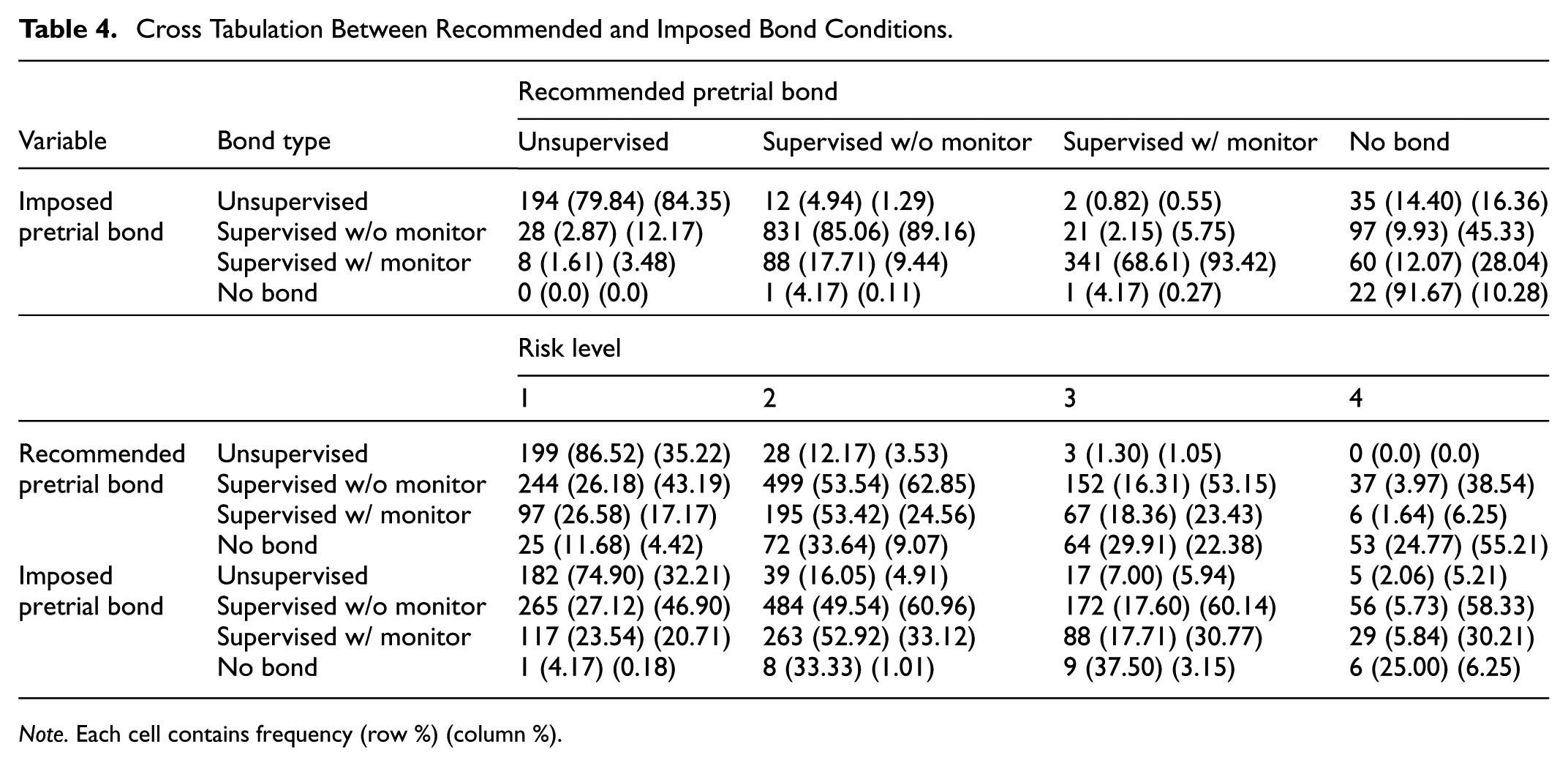
Note. Each cell contains frequency (row %) (column %).
The second set of analyses explores the effect of these departures on pretrial program outcomes. Only defendants released on a PR bond are included in models measuring pretrial program outcomes. To address this question, a X2 and Cramer’s V was calculated to assess the relationship between departures and program failure, presented in Table 5. Results indicate that departures from recommendations do not affect program failure when measured across multiple categories or when reductions in supervision are dichotomized. These results, presented in Table 5, demonstrate that, even when isolated into just decreases, departures do not affect program failure.
Bivariate Statistics.

Logistic regression models, presented in Table 6, were used to help assess the relationship between departures from recommendations while controlling for demographic characteristics and relevant covariates. Like the bivariate models, results from the logistic regression models 1 and 2 suggest that departures are not significantly related to pretrial program failure. This is true for the bivariate regression as well as models that control for demographic and other covariates.
Logistic Regression Models.
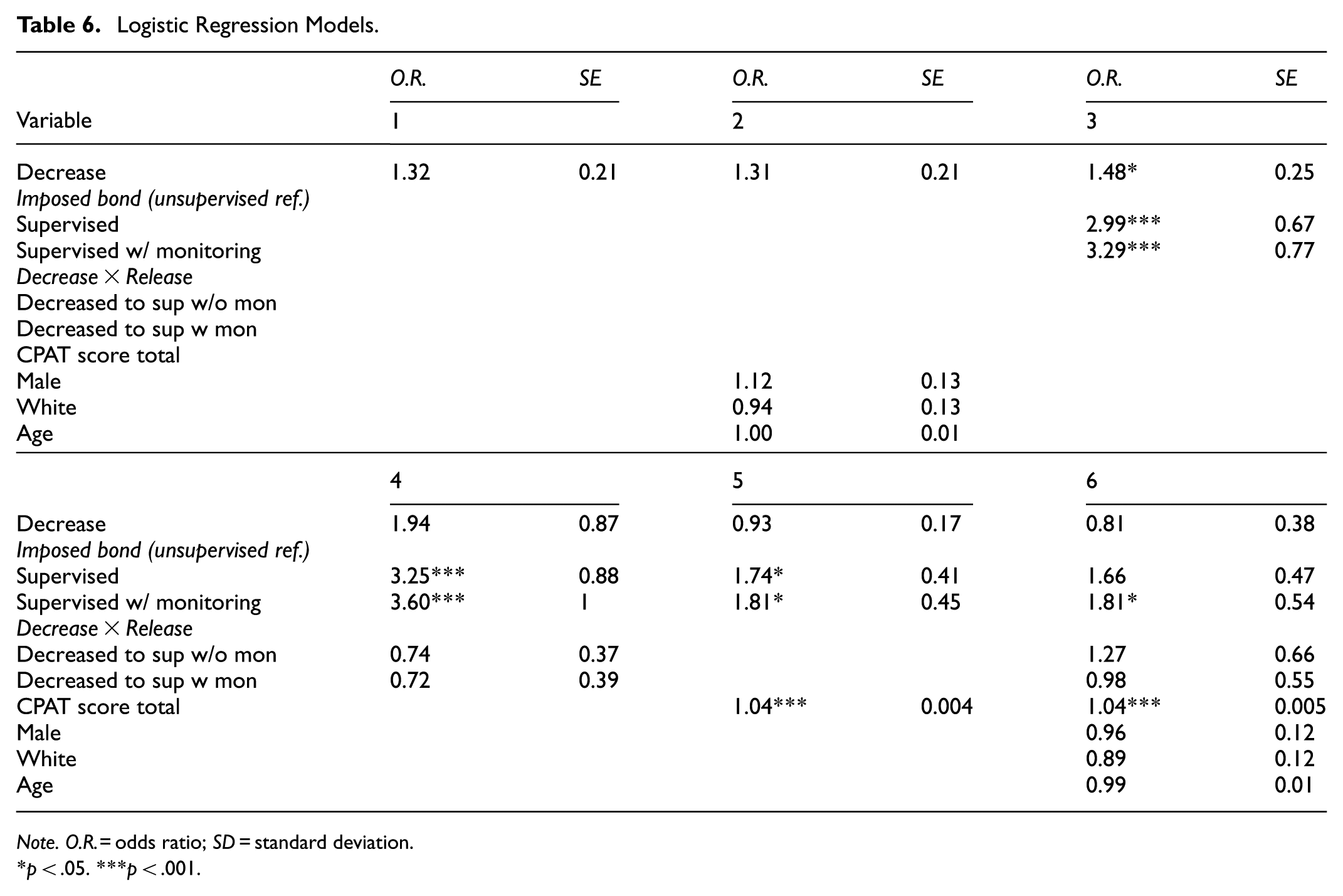
Note. O.R. = odds ratio; SD = standard deviation.
p < .05. ***p < .001.
Model 3 considers the effect of decreases in release supervision with the release type. In this model, both supervised releases and supervised releases with monitoring increase the odds of program failure compared to unsupervised release as a reference group. When considering the release type with unsupervised release as a reference category, decreases from recommendations increase the odds of program failure to a statistically significant degree. This would suggest that defendants that are decreased to a lower supervision level than recommended are at a higher risk of program failure than defendants that are released in accordance with the recommended release type. Additionally, defendants released via a supervised bond with or without monitoring are at a higher risk of program failure compared to defendants released via unsupervised release. Model 4 presents the results including an interaction effect between imposed bond type and decrease from recommendation. This model was included to better explain the suppression effect that occurred when release type was added in model 3. Results indicate that decreases are not significant in either direct or interaction effects. Instead, it is the release type that is affecting program failure.
While the decrease variable in model 3 is significant, it is not significant when CPAT Score Total is considered, as demonstrated by model 5. In the fully specified model, model 6, only CPAT Score Total, and release conditions imposed by a judge were significantly associated with program failure. It is expected that CPAT Score Total would be highly predictive of risk, as this is the purpose of the validated risk assessment tool. However, the CPAT does not consider factors relating to drug use or drug charges, which is the defining factor leading to the recommendation for and imposition of a supervised PR bond with monitoring. Drug use monitoring is the primary monitoring condition assigned (86.53% of all monitoring conditions), where 83.62% of those assigned to drug use monitoring had a drug related charge. The imposition of a supervision condition that is not predicted by the CPAT is significant beyond the CPAT’s predictability, and does seem to increase the risk of failure rather than achieve compliance as intended. Overall, these results suggest that while relatively infrequent, departures from recommendations by judges do not significantly affect pretrial program failure, but there are other considerations relating to how certain supervision conditions do affect pretrial program failure.
Discussion/Conclusion
Ultimately, the results of this analysis show that judges follow the recommendations provided by local Pretrial Services Program staff as they relate to release decisions, level of supervision, and conditions for release in the overwhelming majority of cases. This is consistent with the degree to which judicial decisions follow recommendations of other supervision officers, such as probation officers (Leiber et al., 2018; Leifker & Sample, 2010). Additionally, low risk individuals have high rates of success during pretrial release on a PR bond without supervision. These results do not support the notion that it is necessary to increase supervision for low or moderate risk individuals as this may increase their risk for failure through net widening and over supervision (Advancing Pretrial Policy and Research, 2021; Bechtel et al., 2017; VanNostrand & Keebler, 2009). Unnecessary over supervision could also be a misuse of valuable resources and staff time better allocated to higher risk individuals. Higher risk individuals who were recommended to be detained were often provided with a release option revolving around some form of supervision to help mitigate their risk. These departures from recommendations to detain were not found to increase risk for failure for these defendants who were released pretrial. These results do not support the notion that pretrial detention rather than release on a personal recognizance bond is overall more beneficial, especially considering the costs to the defendant and community.
Unfortunately, it does seem as though the imposition of a supervision condition requiring drug use monitoring contributed to pretrial release failure. The CPAT predicts a public safety rate of 80% and court appearance rate of 85% for defendants scoring in risk category 2 (see Table 2), which is the category, on average, defendants in the sample fell into. The overall pretrial release program success rate defined as public safety and court appearance for the jurisdiction in this study is 73.5%. This monitoring condition was observed to be potentially leading to over supervision of relatively average risk defendants, where this net widening effect is resulting in the monitoring itself increasing risk for program failure, rather than the defendant’s inherent risk.
The distribution of defendants to supervision with and without monitoring was relatively equal between risk level 2 and 3 defendants, where the primary determining factor for monitoring being imposed was whether the defendant was facing drug related charges. Being put in the highest release supervision category due to drug related charges, rather than assigning supervision as a result of the CPAT Score, is in opposition to the intent of the risk assessment tool, which does not consider implications for drug use or charges. While only a tool and one of many factors judges should consider when making release decisions, implications of these results act as a cautionary tale to prevent artificially inflating risk for some defendants based on perceptions, which actually inflates risk for pretrial program failure, due not to the defendant’s discretion, but the judge’s. It is likely that defendants in risk level categories 2 and 3 would do as well on supervised PR bonds as Table 2 indicates for court appearance and public safety rates, and in fact it is the imposition of monitoring that raises this risk beyond the CPAT’s predictions.
Pretrial services staff, judges, and other criminal justice system stakeholders should be aware of how even the best intended recommendations and discretion can impact defendant outcomes and increase risk for defendant failure. The criminal justice system should avoid mechanisms that create additional barriers for justice-involved citizens in order to decrease pretrial populations in local jails and the number of days spent in pretrial detainment due to inability to pay monetary bail. Utilizing validated risk assessment tools, personal recognizance bonds, and evidence-based practices that promote defendant success by addressing their risks and needs and can improve court appearance, public safety, and result in more equitable and beneficial outcomes.
As with all scientific exploration, this study encountered a few limitations. First, this analysis is limited to a single county within a single state in the western region of the United States. Pretrial Services programs and protocols vary widely across the state and nation, and therefore the operations, recommendation processes, and outcomes within this county in Colorado cannot be generalized to other jurisdictions. Additional research is needed to evaluate the relationship between risk assessment, recommendations, imposed conditions, and outcomes.
The Pretrial Services Program within the study jurisdiction only provides recommendations for and supervises personal recognizance bonds, so data are limited to this bond type, and do not review releases attained through cash/surety/property or other financial/monetary bonds, bail, or any other release type. This bond type also excludes defendants with serious and violent felony charges, as they are ineligible for PR bond consideration, so these types of charges are not captured within these data or this study. These factors are a likely source of the distribution of program failure. As noted in the methodology section, most defendants that failed the pretrial services program did so for failing to appear in court. This is likely due to the sample that consisted primarily of defendants charged with minor crimes and with minimal criminal histories that could not bond out through monetary/commercial mechanisms. The former, minor charges and minor criminal histories likely suppressed the rate of arrest for a new offense while on bond. The latter, that these defendants could not afford to bond themselves out via a commercial or cash, likely also affected the defendant’s ability to return to court.
Since the current study is limited to recommendations based upon pretrial service reports and the release decision imposed by a judge, it is possible that the recommendations from pretrial were the source of variation from best practices and departures from recommendations by judges served to improve the outcomes. The CPAT score can only serve to guide the recommendation decision in this instance because it only yields a risk level for the defendant, not preferred release conditions. Instead, these decisions are left to the discretion of a judge.
Additionally, it is unclear the extent to which judges use the information from pretrial interviews including, when available, a CPAT score to make their ruling on imposed release conditions or how this might vary between judges. More recent research has suggested that the use of risk assessments in informing release and supervision decisions varies widely between jurisdictions, even within a single state in the United States, but charges are more heavily weighed (Lowder, Kamara, & Kent, 2023). Future research should further explore how judges exercise their discretion when risk assessment information is available. As noted in the study, drug related factors such as drug charges were the primary reason for recommending and imposing supervision with monitoring conditions for pretrial release. These types of considerations are not captured within the use of the CPAT and cannot be controlled for as risk factors by that particular risk assessment, but these, among others, are very important considerations. For example, it was observed locally that judges frequently consider victim impact statements when making release decisions, and this is another example of a factor that cannot be captured through the use of the risk assessment tool, and therefore requires review through alternative methodologies.
Footnotes
Acknowledgements
The authors would like to thank the Pretrial Services Program in Colorado featured in this research for their dedication to supporting and growing research and evidence-based practices. We greatly appreciate their willingness to collaborate, share program data, experience, and knowledge, and utilize outcomes to adapt their program for the benefit of the citizens they serve and to promote public safety. The authors would also like to thank the other experts who helped foster and support this research and these researchers.

Ethical Considerations
Not applicable. Ethical considerations were not relevant for this study type as this is a non-interventional study analyzing retrospectively obtained and anonymized/de-identified data which was not/will not be shared with third parties.
Consent to Participate
Not applicable. Consent to Participate was not relevant for this study type as this is a non-interventional study analyzing retrospectively obtained and anonymized/de-identified data which was not/will not be shared with third parties.
Funding
The authors received no financial support for the research, authorship, and/or publication of this article.
Declaration of Conflicting Interests
The authors declared no potential conflicts of interest with respect to the research, authorship, and/or publication of this article.
Data Availability Statement
The data that support the findings of this study were used under license from the Colorado county included in the study, and are restricted from being made publically available.