




Abstract
Recognizing children at risk of social exclusion (RSE) is one of the key prerequisites for providing direct and appropriate support to children and their families. Timely and proper identification of children at RSE requires collaborative and team-based assessments that include standardized procedures outlined in protocols to accommodate child personality, family factors, and other needs. The objective of the research is to analyze the capacities of early childhood education and care (ECEC) teachers to assess the RSE of children by comparing their assessment with the assessment of parents. We used the data about 443 children between 5 and 7 years of age who were attending 10 ECEC institutions in Croatia. Children were assessed with two versions of the questionnaire. Data were analyzed on a descriptive level, and Cohen’s kappa coefficient was used to determine the agreement between parents’ assessments and ECEC teachers’ assessments. It was found that at least 30% of children in Croatian ECEC institutions had one or more RSE. The results indicate a low proportion of children at RSE recognized both by parents and by ECEC teachers. The Croatian ECEC teachers are not familiar with information that is important for a child’s development, such as poverty, quality of family relationships, and involvement in specialized treatments. These data highlight the need to improve the capacity of Croatian ECEC teachers to participate in the process of assessing the RSE of children.
Keywords
Introduction
Early childhood education and care (ECEC) institutions are uniquely positioned to provide preschool-age children with appropriate support by promptly identifying children at risk of social exclusion (RSE), ensuring conditions for preventing the unwanted consequences of social exclusion, and providing direct support to children and their families (Gambaro et al., 2014; Smith, 2020). However, little research has been conducted regarding the capabilities of ECEC teachers to adequately respond to the needs of these children in Croatia. Existing findings show the persistence of unequal education opportunities for children at RSE compared to their peers (Manning et al., 2019) and a lack of appropriate capabilities of ECEC teachers to recognize the RSE of children (Münger & Markström, 2018; Taresh et al., 2020). Not identifying children at RSE in due time significantly reduces the possibility of ensuring appropriate interventions, which has an unfavorable effect on the education and development of those children (Mozolic-Staunton et al., 2020). Since ECEC teachers play an important role in this process, the question arises of whether they are successful in identifying and responding to these children’s needs. The capacities of ECEC teachers to assess the RSE of children are also important due to the modern approach to the identification of children in need of early childhood intervention, which involves the cooperation of experts and people who are in daily contact with the child. Such an assessment is intertwined with the intervention itself. Contemporary literature considers it a desirable assessment model because it is carried out without removing children from their natural environment, and it provides for dynamism and continuity and for assessing a child’s natural and spontaneous reactions (Koller-Trbović et al., 2017). However, very little is known about the preparedness of ECEC teachers to respond to these requirements and about the possibility of early identification of the RSE of preschool-age children, although different methods of assessing the development and social functioning of children have been developed in the last few decades (Howard & Melhuish, 2017).
The objective of the research presented in this paper is to analyze the capacities of ECEC teachers to participate in the process of assessing the RSE of children by comparing the assessment of the RSE conducted by parents with that of ECEC teachers. The paper is based on a survey carried out as part of the science project entitled “Models of Response to Educational Needs of Children at Risk of Social Exclusion in ECEC Institutions” (MORENEC), which has been conducted since 2020 with the financial support of the Croatian Science Foundation. The main aim of the MORENEC project is to systematize the current knowledge and to create new, scientifically founded knowledge on the etiological, phenomenological, and intervention aspects of RSE of preschool-age children in Croatia. The purpose of this paper is to contribute to the achievement of the project’s aim. It is expected that the results of the research will help the scientific community, practitioners within ECEC, and policymakers in further advancements of the support system for preschool-age children at RSE.
The research objectives are to compare the assessments of children at RSE conducted by parents with those carried out by ECEC teachers and to determine the types and levels of RSE of preschool-age children that participate in Croatian ECEC institutions.
The study is based on the hypothesis that the assessments of the RSE of children by parents and ECEC teachers will provide different insights into the RSE of children, as concluded by previous research (Achenbach & Ruffle, 2000; Glascoe & Kevin, 2011; Gritti et al., 2014). It is expected that the number of children included in ECEC will decrease with the level and complexity of the RSE (McCoy et al., 2016; Navarro et al., 2019; Oberklaid et al., 2013).
The Theoretical Framework of the Study
Risks of Social Exclusion of Preschool-Age Children
Social exclusion is a complex and multidimensional process that reduces the opportunities of individuals or social groups for social participation in activities typical for most people in a society. It is the consequence of structural and institutional inequality factors (Loktieva, 2016). The social exclusion of children can be prevented by identifying risks and planning interventions that reduce their potential current and future negative effects.
RSE is related to a child’s innate characteristics (e.g., developmental disabilities, chronic diseases), family situation (e.g., abuse and neglect of the child in the family, poverty), and the characteristics of the broader social community (e.g., inaccessible social protection or education), which can threaten a child’s well-being (Lindon & Webb, 2016). Thus, compared to most of their peers, children with higher RSE require more complex types of support (Krauter et al., 2017). However, many children with problems affecting their development, learning progress, and social interactions remain unidentified at an early age (Khalfaoui et al., 2021; Peleman et al., 2020).
No isolated disadvantaged situation by itself tends to lead to unfavorable outcomes; most often, this involves a very complex interrelationship of an indefinite number of related risk and protection factors, which are sometimes difficult to identify (Ajduković et al., 2015). Khan et al. (2015) highlighted the connection between the assessment of social exclusion and its definition. This involves the identification of individual characteristics and social circumstances that increase the probability of favorable or unfavorable developmental outcomes. The term “children at RSE” is often equated with concepts such as children in vulnerable situations (Radcliff et al., 2012), disadvantaged children (Schober & Spiess, 2013), marginalized children (Hussain & Warr, 2017), and other related terms that, despite their wide use, are relatively rarely defined and specified (Bouillet & Domović, 2021). The authors agree that the dimensions of RSE are comprehensiveness, multidimensionality, relativity, and dynamic character (Giambona & Vassallo, 2014; Liming & Grube, 2018), but unique and widely accepted classifications and categorizations of RSE in childhood have not been developed (Jopling & Vincent, 2016; Tobia et al., 2017).
In this paper, the RSE of preschool-age children is understood as a possible consequence of unfavorable circumstances arising from the characteristics of the child (status of development and health), the family (unfavorable characteristics of the parents and/or care of the child), and the community (inadequate support systems for children and/or their parents). They range over a continuum from low to very high risks. Examples of RSE in children are presented in Figure 1.

Examples of the RSE of children.
Oberklaid et al. (2013) claimed that approximately 12% of children in Australia had two different risks before starting school. Other authors reached similar conclusions. McCoy et al. (2016) established that 14.6% of children aged 3 to 4 experienced cognitive difficulties and 26.2% had social-emotional developmental difficulties, based on the Early Childhood Development Index data collected in 35 low- and middle-income countries. Navarro et al. (2019) found that up to 10.5% of young and preschool children in Barcelona, Spain, were affected by behavioral problems, while according to Wichstrøm et al. (2012), this rate for children of preschool age in Trondheim, Norway, amounted to 7.1%. Studies have also confirmed that 3% to 10% of children in ECEC institutions in different countries have behavioral problems (Mikas, 2007; Navarro et al., 2019; Paulus et al., 2015; Vlah et al., 2018; Wichstrøm et al., 2012).
In general, existing research provides different insights into the prevalence of RSE in preschool-age children because identification of all children with RSE is challenging (the reasons for this include the different criteria and visibility of some children). Moreover, it is well known that ECEC institutions are less available to children at RSE (West et al., 2020). That is why this research does not cover all possible RSE of children but is directed toward RSE that are expected to be presented in ECEC institutions and available for assessment to ECEC teachers (e.g., developmental disabilities, risk of poverty, and parent–child relationships).
Importance and Purpose of Assessment of RSE of Preschool-Age Children
There is agreement among researchers (Ajduković et al., 2015; Archambault et al., 2020; Mozolic-Staunton et al., 2020) that the purposes of assessing the RSE of children are contribution to the planning of appropriate interventions, interpretation of data to establish the type and intensity of risk, and identification of the opportunities and needs of children.
In assessing RSE, a child is not observed in isolation “but in the context of the social, and especially, microsocial environment” (Koller-Trbović et al., 2017, p. 12). This involves a process of determining the probability of the unfavorable development of the child to acquire a clearer picture of the needs of children and their families. Assessment is considered the essential link in the chain of securing appropriate and prompt intervention. Assessments may be based on previously defined social group categories (e.g., living in a rural area, belonging to an ethnic minority, developmental difficulties) or on assessments of the level of social exclusion (e.g., participation in education, employment status, access to healthcare). This leads to the conclusion that there is no unified group of indicators of RSE, which would be equally relevant in all contexts. The process is based on a constructive assessment approach that is reflective and relative and includes risk assessment and a contextual assessment of the functioning of the child and the family.
It is important to ensure that the identification and assessment of children at RSE are not focused on labeling and removing children from the regular ECEC environment but on providing adequate support in this context. Grouping children into categories is justified when the purpose is to select appropriate interventions for the children and their families. The few studies devoted to this topic show that ECEC teachers do not feel competent enough to participate in assessing RSE (Keary et al., 2020), and what is particularly emphasized is the lack of standardization of the assessment process in the ECEC environment (Nah & Kwak, 2011). For example, Münger and Markström (2018) stressed that ECEC teachers themselves do not tend to identify children exposed to domestic violence.
The experience of parents participating in the RSE assessment process shows that parents are prone to underestimating their children’s problems, which can be explained by the possible fear that parents may have of their child being stigmatized. Parents can also believe that their child’s problems are their own failures or that the child will overcome these problems himself or herself (Brauner & Stephens, 2006). Gimpel Peacock and Collett (2010) explained the unequal assessments by parents compared to those carried out by experts with differences in experiencing individual difficulties and with the context in which the child was assessed (family or institution). Parents observe the child in a family environment and often do not notice the child’s developmental deviations, while ECEC teachers monitor the child in an institutional environment, within a group of children of the same or similar age. Therefore, it is recommended that assessments of children be based on information from both sources (Achenbach & Ruffle, 2000). Gritti et al. (2014) established in their research that the assessments of children’s problems by their parents significantly matched those of experts. It has also been found that, when they obtain a careful analysis and interpretation of data from the parents, experts can adequately recognize and identify the needs of children and their families (Glascoe & Kevin, 2011). It is thought that the differences in assessments of the needs and difficulties of children by different actors do not reveal who is right or who is wrong but jointly contribute to the appropriate planning of interventions focused on children and their families.
The assessment of the RSE of children is the first step to ensuring access to programs devoted to children at RSE in the form of a range of services and activities focused on stimulating the personal development of children, strengthening their resilience, improving the relevant competencies of family members, and promoting the social inclusion of families and children (Philips, 2012). These programs and services should be provided as part of ECEC, based on the needs of children at RSE and their families (Campbell-Barr & Nygård, 2014; Pölkki & Vornanen, 2016).
Prevention of RSE in ECEC Institutions
ECEC teachers should make a positive contribution to the development of children in preparation for subsequent educational experiences. Where children at RSE are concerned, ECEC institutions have the function of prevention and/or rehabilitation and thus contribute to the learning and development of the capacities of all children (Underwood et al., 2012). Previous longitudinal studies showed that attending a high-quality ECEC may significantly improve the quality of a child’s learning and development in the present and have a favorable effect on his or her future quality of life (Melhuish et al., 2019; Sammons et al., 2015; Sylva et al., 2004). However, in European countries, children at RSE still have significantly limited access to ECEC (Archambault et al., 2020; Cloney et al., 2016; Oberhuemer, 2011; Peleman et al., 2020; Thomson et al., 2020; Vandenbroeck & Lazzari, 2014). “Providing sufficient places and extending the coverage is the first issue to be solved, but reducing tendencies of selective use that places disadvantaged children in lower quality provisions is equally important” (Leseman & Slot, 2014, p. 319). The positive effects of an ECEC on children at RSE significantly depend on its quality, and the effect of a good-quality ECEC is greater in the case of children with a larger number of risks or more complex risk factors (Sylva et al., 2008).
The MORENEC project is conducted in Croatia. Croatian ECEC system is regulated by the Preschool Education Act (1997) and by accompanying secondary legislation and include the upbringing, education, and care of preschool-age children. It is carried out through education, healthcare, nutrition, and social care programs for children from the age of 6 months to the beginning of elementary school. ECEC is the initial level of the education system, and, except for the preschool program (a program that is compulsory for children 1 year before starting elementary school), it is not compulsory for all children. It is divided into two education and care cycles: (1) the crèche cycle (6 months–3 years) and (2) the kindergarten cycle (3–7 years).
Increasing the accessibility of a high-quality ECEC system and securing quality standards and resources to support children at RSE is one of the strategic goals the Republic of Croatia aims to achieve by 2030 (National Development Strategy of the Republic of Croatia until 2030, 2021). The first step to achieving this goal is to determine the prevalence and types of families and children at different RSE in Croatian ECEC institutions as the basis for planning support for these children. Such research studies are lacking in Croatia, and this paper offers an analysis of how ECEC teachers and parents assess the RSE of children in the Croatian ECEC system. The analysis is based on the comparison of the assessments of children’s RSE conducted by parents and ECEC teachers, which can provide insight into the types and levels of RSE of children of early and preschool age that participate in the Croatian ECEC institutions. This is the first attempt to assess the RSE of children in the Croatian ECEC system.
Research Methods
Participants
This research used the data about 443 children between 5 and 7 years of age who were included in 10 ECEC institutions in Croatia. These institutions represent a diversity of the Croatian ECEC system in terms of regions (7 of 21 Croatian counties), the size of the institutions (from 75 to 3,000 enrolled children), the size of the place where they operate (six towns and four municipalities), and the founders (eight public and two private institutions). The ECEC institutions were included in the research based on their motivation to participate in the study. This means that non-probability sampling research was used, but it covered a wide spectrum of ECEC institutions in Croatia.
The average age of the children included in the research was 5.83 (min = 5, max = 7.4), with 222 girls (49.4%) and 221 boys (50.1%). The RSE of the children was assessed by 380 mothers (85.8%) and 55 fathers (12.4%), while eight children (1.8%) were assessed by others (carers, foster parents, or grandparents). A total of 49 ECEC teachers participated in the study, and they assessed the RSE of approximately nine children each.
Instruments
This is exploratory research, which is conducted because of the need for a better understanding of the RSE of children in the Croatian ECEC system. The Questionnaire to assess the etiological and phenomenological aspects of the RSE of children at early and preschool age (version for ECEC teachers) and the Questionnaire to assess the etiological and phenomenological aspects of the development of children at early and preschool age (version for parents) were developed and piloted in the frame of the MORENEC project.
These questionnaires are designed for the assessment of etiological and phenomenological aspects of RSE in children. The items are divided into six content groups:
− the child’s demographic data (e.g., sex, age, education level of the parent/guardian);
− information on the length and characteristics of the child’s attendance at the ECEC institution (e.g., year of enrollment, type of education group);
− family circumstances of the child (family structure, content of parental care);
− health status of the child (according to the International Classification of Functioning, Disability and Health of the World Health Organization, 2001);
− assessment of the child’s social functioning within the ECEC institution and family; and
− estimation of the frequency of behavioral issues (internalized and externalized behavior problems).
Both versions of the questionnaire are directed toward the same areas of a child’s development and learning, but questions differ between versions considering the differences in the assessments’ context (family or ECEC institutions). Most of the variables in the questionnaires are dichotomous or categorical, and few rating scales are included (e.g., assessment of child’s behavior, parent–child relationships). The variables used in this research are presented in Table 1. Some of them were used in their original form, while some variables were created as composites of two or more variables.
The Variables Used in the Research: Assessments by Parents and ECEC Teachers.

Data Analysis
All nine variables used in this research are designed as dichotomous items, according to the obtained results of each child on a particular RSE (absence or presence of RSE). The groups of children at RSE consist of children:
− who are involved in any kind of specialized treatment and have severe or moderate developmental difficulties;
− who manifest internalized or externalized behavioral problems once a week or more often;
− whose parents have only completed or not completed elementary school;
− who live at risk of poverty;
− whose parents are divorced;
− whose parents manifest inappropriate behavior toward the child several times a week or more often; and
− whose parents need the support programs of the ECEC or welfare system but do not have access to them or do not use the available support provided within the ECEC institution.
Data were analyzed on a descriptive level, and Cohen’s kappa coefficient was used to determine the agreement between parents’ assessments and ECEC teachers’ assessments because of the nominal/binary and ordinal scale properties of the RSE variables (Cohen, 1960; Kraemer, 1979). For the interpretation of Cohen’s kappa coefficients, the Landis and Koch (1977) degree of beyond-chance agreement classification was used (i.e., kappa < .2, “poor” agreement; kappa .21–.40, “fair” agreement; kappa .41–.60, “moderate” agreement; kappa .61–.80, “substantial” agreement; kappa > .81, “almost perfect” agreement).
Procedure
ECEC institutions included in this research agreed to participate after the presentation of research aims and objectives. Each ECEC institution appointed one ECEC professional to be a coordinator of the process of data collection within the institution. Before data collection, principals and ECEC professionals within the ECEC institution were thoroughly informed and educated on topics related to key research concepts (e.g., RSE), methods and procedures of data collection, and procedures for assuring the anonymity of participants. These seminars were organized in collaboration with the Croatian Training Agency. Each member of the research team was assigned to one ECEC institution. They collaborated during the whole data collection process, which was the prerequisite for ensuring standardized processes and procedures. Within each ECEC institution, the sample of children between ages 5 and 7 was defined. In the next step for each child, the parent’s informed consent was obtained. The final sample was determined according to the parents’ informed consent. For each child, a set of instruments was prepared: the Questionnaire to Assess the Etiological and Phenomenological Aspects of the RSE of Children at Preschool Age (version for ECEC teachers) and the Questionnaire for the Assessment of Etiological and Phenomenological Aspects of the Development of Children at Preschool Age (version for parents). The instruments were linked by the same identification code (county code–ECEC institution code–educational group code), which ensured anonymity and the possibility of data linkage. Data collection was conducted in the spring of 2020, from March to April. Each ECEC institution sent all the materials back to the research team, who checked the received materials and entered the data. All the materials were safely stored.
The research has the approval of the Ethics Committee of the Faculty of Teacher Education, University of Zagreb and complies with ethical standards outlined in the Ethical Code of the University of Zagreb, as well as with other applicable regulations. This means that the research is founded on principles of conscientiousness, responsibility, transparency, equality, and mutual respect for everyone involved (including participants and researchers) and that the research activities are executed responsibly, consciously, ethically, and professionally. Data were collected according to professional standards, and participation in the research was voluntary and anonymous. Respect for all the regulations of the EU General Data Protection Regulation was ensured. The data collected in this research were stored, maintained, and used within reasonable limits, alongside preserving confidentiality, through means of restricting unauthorized access, loss, or misuse. The Code of Ethics for Research Involving Children was also followed, which involves a guarantee of the participation of each child in the research based on informed consent from their parents and protection of each child’s anonymity.
Findings
The first research objective was to compare the assessments of children at RSE conducted by parents with those carried out by ECEC teachers. Table 2 shows the comparison of the assessment of types of RSE of children who were enrolled in Croatian ECEC institutions conducted by parents and ECEC teachers.
Types of RSE According to Assessments of Parents and ECEC Teachers (n = 443).
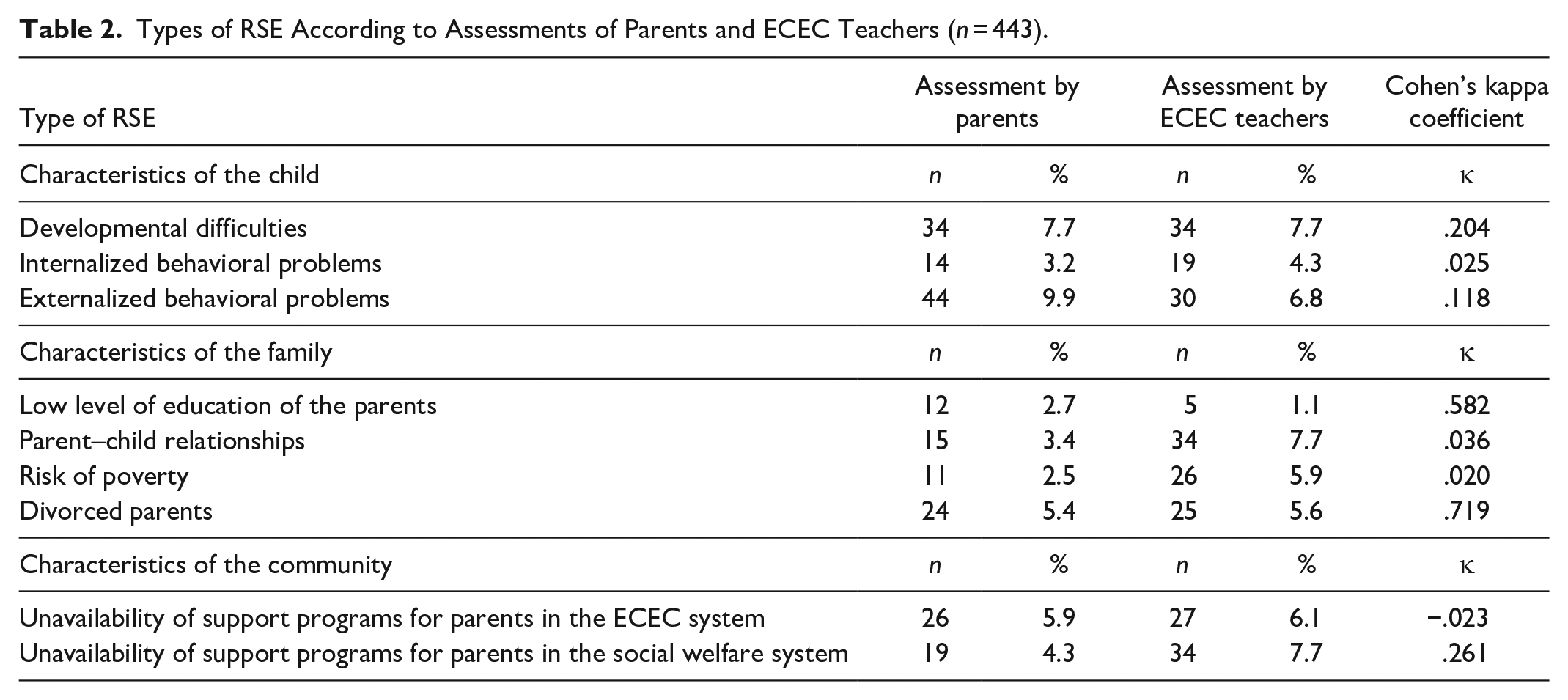
The data in Table 2 show that for most of the tested variables, there was “poor” agreement between parents’ assessment and ECEC teachers’ assessment. “Fair” agreement was found in assessing the unavailability of support programs for parents in the social welfare system as a risk related to characteristics of the community (κ = .261). A higher level of agreement was found in the assessment of risk-related characteristics of the family. “Moderate” agreement was found between parents’ assessment and ECEC teachers’ assessment of risk related to the low level of education of the parents (κ = .582), and “substantial” agreement was found in the assessment of risk related to family structure (κ = .719).
Even though parents and ECEC teachers recognized the same prevalence of children at particular RSE that arose from developmental difficulties, based on the value of Cohen’s kappa coefficient, it can be concluded that the assessments are not congruent for specific children.
A low share of children at RSE was recognized both by parents and by ECEC teachers. The higher level of agreement in assessing RSE between parents and ECEC teachers was determined in the case of objective characteristics (level of education and marital status of parents), while subjective assessments of the children’s and families’ characteristics differed significantly between parents and ECEC teachers. In general, parents assessed more children at RSE that arose from externalized behavioral problems, while ECEC teachers more often assessed other analyzed RSE.
Disagreement in the assessment of children’s RSE could be a consequence of the insufficient cooperation of ECEC professionals with the children’s family members, which has been highlighted by several studies (Granata et al., 2016; Kultti & Pramling Samuelsson, 2016). Additionally, differences in assessments may result from different patterns of behavior in the institutional and family environment, and certain behaviors can be interpreted in different ways by parents and ECEC teachers, giving them different meanings (Panić & Bouillet, 2021).
However, non-recognition of RSE can lead to the absence of proper support for children in ECEC settings, communities, or families. That is why both perspectives should be considered in the process of identification of children at RSE, keeping in mind their multidimensionality, interdependence, and cumulative effect on the quality of life and development of children (Farkas, 2014).
The second research objective was to determine the types and levels of RSE of preschool-age children that participate in Croatian ECEC institutions. The distribution of children according to the number of RSE that affected them in three different areas is presented in Table 3.
Distribution of Children According to the Number of RSE that Affect them in Three Different Areas: Assessments by Parents and ECEC Teachers (n = 443).

According to the results presented in Table 3, according to the parents, 18.3% of children had one or more RSE due to the characteristics of the child, 12.6% had one or more RSE due to the characteristics of the family, and 10% of children had one or more RSE due to the characteristics of the community. Meanwhile, according to ECEC teachers, 16.3% of children had one or more RSE due to the characteristics of the child, 17.7% had one or more RSE due to the characteristics of the family, and 13.1% of children had one or more RSE due to the characteristics of the community. For all analyzed areas of RSE related to the number of RSE that affected children, there was “fair” to “moderate” agreement between parents’ assessment and ECEC teachers’ assessment. “Fair” agreement was found for RSE related to characteristics of the child (κ = .221) and characteristics of the community (κ = .233). “Moderate” agreement between parents’ assessment and ECEC teacher assessment (κ = .494) was found for RSE related to the characteristics of the family. In general, parents recognized more RSE in the area of the child’s characteristics, while ECEC teachers recognized more RSE concerning the family and community of the child.
The results indicated a high risk of non-recognition of children that need additional support, especially keeping in mind that more than 30% of children had at least one RSE (Figure 2).

Prevalence of children at RSE in all areas (%).
Analysis of the cumulative number of RSE that affected children regardless of the specific RSE area (all three areas were included) (Figure 2) showed that the number of children included in ECEC decreased with level and complexity of the RSE (i.e., no risk, one risk, two or more risks). In this case, the complexity of RSE was defined by the cumulative number of RSE, which was consistent with the theoretical framing of the multidimensionality of RSE (it should be noted that risk intensity was not included; i.e., in some cases, one risk could be more significant than two or more risks of low intensity). Analysis of the cumulative number of RSE showed that there were slightly more children recognized as children at RSE (i.e., one or more risks) by ECEC teachers than by parents. The difference between parents’ assessment and ECEC teachers’ assessment differed with the complexity of RSE (i.e., cumulative number of RSE). The level of agreement between the parents’ assessment and ECEC teachers’ assessment of the level/complexity of RSE (i.e., no risk, one risk, two, or more risks) was “fair” (κ = .221), which was consistent with previous findings regarding the level of agreement. These findings additionally confirm the need to use and combine data/information from different sources to ensure that all children at RSE, especially those with multiple risks, are recognized, that their needs are met, and that additional support is provided for those children and their families.
Discussion
The objective of this research was to analyze the capacities of ECEC teachers to participate in the process of assessing the RSE of children by comparing the assessment of RSE conducted by parents with that conducted by ECEC teachers. The results confirm the hypothesis that the assessments of the RSE of children by parents and ECEC teachers provide different insights into the RSE of children, and that the number of children included in ECEC decreases with the level and complexity of the RSE. Our data suggest that parents and ECEC professionals are reliable sources of information on the RSE of children, but a more open exchange of information between them is needed. ECEC teachers and parents assessed the RSE of children in different ways due to their different relationships with the children and different understanding of the children’s abilities, behavior, and experiences. It has been found that ECEC teachers are well informed about some objective characteristics of children and their families, but their insight into family socioeconomic status and relationships is insufficient. To be able to assess RSE, ECEC teachers should develop an appropriate partnership with parents and overcome the reasons for insufficient cooperation (Bricker et al., 2022; Sevcan Hakyemez-Paul et al., 2018). This is important because RSE is a highly complex concept that should be understood and analyzed from different perspectives and in different social contexts. As Marbina et al. (2015) highlighted, valuing parental input in the assessment of a child’s well-being is important in terms of continuity of experiences for children and because of the additional expertise that parents have about their children’s learning.
The objective of the assessment is to plan and ensure effective individualized programs and offer support to children at RSE, instead of labeling young children in “deficit” terms (Keary et al., 2020), which often render children at RSE unable to achieve significant positive progress in their development (Tayler et al., 2015).
In this research, ECEC teachers and parents assessed children’s RSE through observation of children’s behavior in two different contexts and according to available information about the circumstances of children’s lives. The results indicate that Croatian ECEC teachers are not familiar with information that is important for a child’s development, such as poverty, quality of family relationships, and involvement in specialized treatments. It is expected that ECEC teachers are informed about the cognitive, socioemotional, motor, and adaptive skills of children, as well as about information related to their medical history, family background, demographics, and other relevant characteristics, because each child should be assessed by professionals before entering in ECEC system. As Moran Finello (2011, p. 442) stressed, “high-quality, comprehensive assessment and diagnostic batteries for very young children require significant time, particularly when it is the first time the child is being assessed.” ECEC institutions are often the first place where children are assessed, and ECEC teachers should be a significant source of information in this process because they have many opportunities to communicate with the children and their parents and to observe the children in different activities and relationships. This means that ECEC teachers and parents should participate as partners with other professionals who are specialized in different kinds of interventions for children in RSE. Timely and proper identification of children at RSE requires collaborative and team-based assessments that include standardized procedures outlined in protocols to accommodate child personality, family factors, and other needs. In this research, one kind of such protocol was developed and used. According to our questionnaires, at least 30% of children in Croatian ECEC institutions need additional support to prevent social exclusion and educational inequality in their future education and lives. This data highlights the need to improve the capacity of Croatian ECEC teachers to participate in the process of assessing the RSE of children. It is a complex and challenging process that is needed because the conventional, norm-referenced testing practices are not appropriate for use without “the natural developmental ecology for children” (Neisworth & Bagnato, 2004, p. 198).
Limited research studies have been conducted on the efficacy of different approaches to the assessment of RSE in children at young and preschool ages. However, the researchers agree that collaboration is essential in this process (Bricker et al., 2022; Correia et al., 2021). It is a precondition to improving the status of the ECEC system in the prevention of RSE and intervention directed at children in disadvantaged positions. To reach this goal, many changes in the Croatian ECEC system should take the place. The most important is to improve the competencies of ECEC teachers to collaborate with parents, develop a standardized procedure for the assessment of children’s RSE in ECEC settings, and ensure proper support for ECEC teachers in the understanding and interpretation of different children’s characteristics.
Limitations of the Research
The results of the research presented in this paper were not obtained from a sample that is representative of the Republic of Croatia, and the assessments of the RSE of children have not been additionally verified through diagnostic instruments. Therefore, additional surveys should be conducted to verify the assessments. However, this is the first research on the assessment of RSE of children at young and preschool ages carried out in Croatia comparing the insights of parents and ECEC teachers.
Conclusions
Our findings show that at least 30% of children in the Croatian ECEC system are at RSE, according to the assessment of parents and ECEC teachers. The assessments of parents and ECEC teachers differ significantly, and both perspectives should be used in planning support for children. The potential of the ECEC system to prevent the future social exclusion of children should be improved in Croatia.
Supplemental Material
sj-docx-1-sgo-10.1177_21582440221126636 – Supplemental material for Risks of Social Exclusion Among Children in ECEC Settings: Assessments by Parents and ECEC Teachers
Supplemental material, sj-docx-1-sgo-10.1177_21582440221126636 for Risks of Social Exclusion Among Children in ECEC Settings: Assessments by Parents and ECEC Teachers by Dejana Bouillet and Sandra Antulić Majcen in SAGE Open
Footnotes
Declaration of Conflicting Interests
The author(s) declared no potential conflicts of interest with respect to the research, authorship, and/or publication of this article.
Funding
The author(s) disclosed receipt of the following financial support for the research, authorship, and/or publication of this article: The authors gratefully acknowledge the funding provided by the Croatian Science Foundation through Project IP-2019-04-2011.

Supplemental Material
Supplemental material for this article is available online.
References
Supplementary Material
Please find the following supplemental material available below.
For Open Access articles published under a Creative Commons License, all supplemental material carries the same license as the article it is associated with.
For non-Open Access articles published, all supplemental material carries a non-exclusive license, and permission requests for re-use of supplemental material or any part of supplemental material shall be sent directly to the copyright owner as specified in the copyright notice associated with the article.
