




Abstract
Accurate measurement of key constructs is essential to the continued development of Rational-Emotive Behavior Therapy (REBT). The General Attitude and Belief Scale (GABS), a contemporary inventory of rational and irrational beliefs based on current REBT theory, is one of the most valid and widely used instruments available, and recent research has continued to improve its psychometric standing. In this study of 544 students, item response theory (IRT) methods were used (a) to identify the most informative item in each irrational subscale of the GABS, (b) to determine the level of irrationality represented by each of those items, and (c) to suggest a condensed form of the GABS for further study with clinical populations. Administering only the most psychometrically informative items to clients could result in economies of time and effort. Further research based on the scaling of items could clarify the specific patterns of irrational beliefs associated with particular clinical syndromes.
Keywords
Self-report inventories of irrational beliefs identified and targeted by Rational-Emotive Behavior Therapy (REBT) practitioners are potentially invaluable in clinical assessment for initial problem formulation and monitoring the effects of treatment, provided that they possess adequate psychometric properties (Malouff, 2009; Terjesen, Salhany, & Sciutto, 2009). Reviewers have argued that the continued development of psychometrically sound inventories of irrational beliefs is essential to advancing research and practice in the field (McDermut & Haaga, 2009). Contemporary inventories draw from current REBT theory in assessing both unhelpful thought processes, such as “awfulizing,” and irrational themes or thought content, such as exaggerated preoccupations with a need for approval from others (Bernard, 1998; Macavei & McMahon, 2010).
The General Attitude and Belief Scale (GABS)
The GABS (Burgess, 1986; DiGiuseppe, Leaf, Exner, & Robin, 1988) reflects current REBT theory, and its psychometric status has continued to improve as researchers have developed newer iterations of the test and its subscales to produce greater internal consistency and a less ambiguous factor structure (Bernard, 1998; Bridges & Harnish, 2010; Lindner, Kirkby, Wertheim, & Birch, 1999; Shaw, 1989). The GABS and an abbreviated version, the Shortened General Attitude and Belief Scale (SGABS; Lindner et al., 1999), both appear in a list of the six “most valid, up-to-date, and widely used self-report instruments for measuring irrational and rational beliefs in adults” (Macavei & McMahon, 2010, p. 118). The GABS is of particular interest because of its structure—its items do not conflate cognition and emotion; there are separate scales for rational and irrational beliefs, and both cognitive processes and thought content are integral to the instrument’s items (Davies, 2008; Macavei & McMahon, 2010).
The GABS includes the subscales Rationality, Self-Downing, Need for Achievement, Need for Approval, Need for Comfort, Demands for Fairness, and Other-Downing. It has been shown to demonstrate satisfactory internal consistency as well as discriminant and construct validity, correlating strongly with inventories of commonly presented mental health problems and distinguishing clinical from nonclinical respondents (Davies, 2008; Lindner et al., 1999; Macavei & McMahon, 2010; Wertheim & Poulakis, 1992).
Rationale for the Present Study
Study Objectives
The aims of this study were to evaluate the GABS using the methodology of item response theory (IRT), and in the process (a) to identify the most informative item in each irrational subscale of the GABS, (b) to determine the level of irrationality represented by each of those items, and (c) to suggest a condensed form of the irrational subscales of the GABS for further evaluation.
With its 9 items, the Rationality subscale of the GABS can stand alone as a convenient measure of that construct, and it is not considered in detail in this article. The 46 items of the irrational subscales are the focus of attention as the possibility of abbreviating this large section of the GABS, without loss of information, could increase the convenience of use in clinical settings. Also, as shown in the following review, the irrational statements in beliefs inventories generally show greater discriminant validity than rational statements in differentiating nonclinical from clinical samples.
Evaluating the GABS using IRT methods (Baker, 2001; DeMars, 2010; Embretson & Reise, 2000) can reveal which test items are the most discriminating and informative, can assess the utility of the Likert-type scale response format for each item, and can scale critical test items for the level of irrationality they represent. There has been no clear consensus among clinicians or researchers about the hierarchical structure of irrational beliefs (DiGiuseppe, 1996), and disagreement persists (David, Lynn, & Ellis, 2010). Identifying and scaling the most psychometrically sound items in the GABS could be constructive in revealing the irrationality levels of specific unhelpful beliefs and in focusing the assessment process.
Previous research on various measures of irrational beliefs suggests that some irrational content areas are more valid than others in discriminating clinical from general population samples. For example, on the Common Beliefs Survey (Bessai & Lane, 1976), psychiatric inpatients showed significantly higher scores than hospital staff members and students on a self-downing subscale, and inpatients had significantly higher scores than mental health outpatients and the nonclinical samples on perfectionism, whereas there were no differences between these samples on such other scales as need for approval or blame-proneness (Thorpe, Parker, & Barnes, 1992). On another inventory, a subscale on rational thoughts or self-statements did not differentiate clients from students, whereas significant group differences were seen in subscales on irrational thought content (Thorpe, Barnes, Hunter, & Hines, 1983). On the GABS, maritally distressed couples scored higher on Self-Downing and Need for Comfort than nondistressed couples, and distressed couples receiving counseling also had higher scores on Need for Approval than those not receiving counseling (Addis & Bernard, 2002).
Such findings do not directly address the possibility that, independent of the sample under study, some beliefs may be more irrational than others—in the sense that making global ratings of oneself and others, for example, may indicate a more extreme position on the implied general trait of irrationality than, say, unrealistic demands for fairness.
Processes and Themes in Assessing Irrational Beliefs
Essential to contemporary REBT theory is a set of four evaluative irrational beliefs: “demands, awfulizing, low frustration tolerance, and global evaluations of human worth” (Walen, DiGiuseppe, & Dryden, 1992, p. 17), all four of which are assessed by items (though not necessarily subscales) in the GABS. There is disagreement on their relative importance (O’Kelly, Joyce, & Greaves, 1998). The primacy of demandingness (thinking in terms of “shoulds,” “oughts,” and “musts”) was cited in many early writings, but factor analytic research on the original GABS items failed to support this (DiGiuseppe, 1996; DiGiuseppe et al., 1988), and there are conceptual and measurement difficulties (DiGiuseppe, 1996; O’Kelly et al., 1998). Instead, low frustration tolerance and self-downing have emerged as more fundamental constructs. Improvements on ratings of those constructs following parent education interventions were associated with beneficial change on emotional measures (O’Kelly et al., 1998), and in psychometric research on the GABS, self-downing was the only evaluative belief category to appear as a distinct single factor (DiGiuseppe et al., 1988). Davies (2008) has reported that the GABS subscales Self-Downing, Need for Achievement, and Need for Approval are all strongly and negatively correlated with unconditional self-acceptance.
Davies (2008) has noted that the GABS takes account of the four evaluative beliefs or irrational thinking processes (demandingness, awfulizing, low frustration tolerance, and self-downing) as well as the four content domains or themes (needs for achievement, approval, and comfort, and demands for fairness). Arguing that each irrational belief includes both a process and a theme, he pointed out that such combinations are represented in all 46 irrational GABS items. For example, GABS Item 35 (“It’s awful to have hassles in one’s life and it is a catastrophe to be hassled”) combines the awfulizing process with the Need for Comfort theme or content area. Davies concluded that it is difficult at the present state of knowledge to separate processes from themes in irrational beliefs inventories. Accordingly, the focus of this study is on representative items drawn from the irrational subscales of the GABS, each item representing a process/theme combination.
In this study of the GABS, the most representative items from each of the irrational subscales as identified by Bernard (1998), and from each of the processes and themes noted by Davies (2008), were evaluated for their position on the broad scale of irrationality in a convenience sample of student respondents. The study was approved by the Protection of Human Subjects Review Board at the University of Maine.
Method
Participants
The GABS was administered to 544 college students (393 female, 148 male, and 3 who did not indicate their gender) taking courses in general psychology. They received course credit for their participation. The mean age of the sample was 20.18 years (SD = 5.17).
Materials
The 55-item GABS described by Bernard (1998) was administered. The GABS consists of seven subscales: Rationality (9 items), Self-Downing (9 items), Need for Achievement (9 items), Need for Approval (7 items), Need for Comfort (9 items), Demands for Fairness (9 items), and Other-Downing (3 items). Respondents rate each item on a 5-point Likert-type scale to indicate level of agreement (1 = strongly disagree, 2 = disagree, 3 = neutral, 4 = agree, 5 = strongly agree). Agreement signals rationality for the 9 items of the Rationality scale and irrationality for the 46 items of the other six scales, which taken together form a Total Irrationality scale. Additional questionnaires that were not the focus of this article were administered to some of the respondents together with the GABS.
IRT Methodology
The research protocol called for the use of IRT programs suitable for analyzing data from Likert-type scales (Ostini & Nering, 2006). Data were analyzed using the Graded Response Models (GRM) in MULTILOG 7 (Thissen, Chen, & Bock, 2003) and PARSCALE 4 (Muraki & Bock, 2003).
Models in IRT for analyzing dichotomous data (e.g., with “true or false,” “agree or disagree” response options) include the two-parameter logistic (2PL) IRT model, which estimates item discrimination (designated by a) and item location or difficulty (designated by b) parameters for each item within a test (du Toit, 2003; Kline, 2005). The 2PL program in MULTILOG estimates each test respondent’s trait level, designated as θ, from performance on all test items, then progresses through an iterative process in which the trait levels of respondents and the item parameters are estimated progressively more precisely. Items with poor discrimination (those that do not effectively differentiate respondents with higher vs. lower trait levels) are automatically given low weightings in estimating respondents’ θ values (Baker, 2001; Embretson & Reise, 2000).
MULTILOG and similar programs produce item characteristic curves (ICCs) to depict the functioning of each test item with respondents with varying levels of θ. In MULTILOG, the x-axis of the ICC indicates increasing levels of θ from left to right on an arbitrary z-score metric ranging from −3.00 to +3.00. The y-axis of the ICC indicates the probability of a response to the item in the designated direction (e.g., a correct response to an item assessing factual knowledge or agreement on an attitude survey item). The trace line of the graph, modeled from an S-shaped logistic function or growth curve, indicates the probabilities with which respondents with varying trait levels will endorse the correct response (or the response signifying agreement). The difficulty level of an item is arbitrarily set as the point on the x-axis at which the trace line crosses the .5 probability value on the y-axis. Item information is inversely related to the standard error of measurement; in practice, highly discriminating items show high values for information. This methodology is described in detail in Thorpe and Favia (2012) and Thorpe et al. (2007).
Figure 1 presents the ICC and Figure 2 the item information curve as generated by the MULTILOG 2PL model program for Item 37 of the GABS: “It is frustrating to be hassled but I can stand the frustration of being hassled.” This is Item 7 in the Rationality subscale, scored by creating a false dichotomy in which response options 1, 2, and 3 were recoded as 1, and response options 4 and 5 were recoded as 2, so that 2 signified agreement with this “rational” item. With a value for a = 1.73, Item 37 is very highly discriminating (Baker, 2001), as gauged by the steepness of the graph at its midpoint; this item sharply separates respondents with trait levels a little above and a little below the item’s low “difficulty” of b = −0.88. As this is an “easy” item, respondents do not have to show a very high level of rationality to register agreement.

Item characteristic curve for GABS Item 37 (Item 7 on the Rationality subscale; scoring recoded dichotomously); MULTILOG 2PL Model.

Item information curve for GABS Item 37 (Item 7 on the Rationality subscale; scoring recoded dichotomously); MULTILOG 2PL Model.
Results
Original Irrational Subscales
Respondents’ scores on the 46 items of the six irrational subscales of the GABS were evaluated via the methodologies of classical and modern test theory. In classical test theory, obtaining high values for internal consistency in the items within each subscale could help to justify selecting a single item to represent each subscale. In IRT, establishing the unidimensionality of the subscales is important; “a scale is unidimensional when a single latent trait accounts for all the common variance among item responses” (Morizot, Ainsworth, & Reise, 2007, p. 413). The issue is “unidimensional enough” (M. Linacre, personal communication, June 4, 2011). Suitable methods for assessing unidimensionality include conducting an exploratory factor analysis (e.g., Funk & Rogge, 2007) and inspecting factors’ eigenvalues, the ratio of the eigenvalue of the first factor to the second and subsequent factors, and the “knee” in scree slopes (Ruscio & Roche, 2012). Turk et al. (2006) suggested “the use of factor analysis to examine patterns of covariation among responses, and if multidimensionality is found, then each factor can be used as a unique scale if doing so would be consistent with the overall theoretical approach” (p. 214).
Using these methods, identifying the most representative item within each GABS subscale would allow further analysis of those six items so as to reveal the relative levels of irrationality that they represent.
Internal Consistency Analyses
Table 1 presents the results of internal consistency analyses for each of the GABS subscales. For the following subscales, none of the constituent items, if deleted, would have resulted in an increase in the value obtained for Cronbach’s alpha as shown in Table 1: Self-Downing, Need for Achievement, Need for Approval, Need for Comfort, and Demands for Fairness. For the three-item Other-Downing subscale, deleting GABS Item 18 would have increased the value marginally from α = .70 to α = .71 (this relatively low value for alpha is directly attributable to the small number of items in this subscale).
Mean Scores per Item, Standard Deviations, Number of Respondents, and Coefficient Alpha Values on the GABS Subscales.

Note: GABS = General Attitude and Belief Scale.
The generally high degree of internal consistency shown by the items within each subscale provided justification for selecting the most representative item from each subscale for further analysis.
Comparison of Subscale Scores Across Studies
Table 2 presents the mean scores per item in our sample for each of the six irrational subscales of the GABS. Also included in Table 2 are the corresponding data from four previous studies from Australia and the United Kingdom published from 1992 to 2008. The degree of concordance in the ordinal rankings of the six subscale scores in these five studies was high (Kendall’s W = .873, k = 5, N = 6, p < .01). In fact, the studies showed perfect concordance in ranking the mean subscale item scores for Demands for Fairness, Need for Achievement, Need for Approval, and Self-Downing in that order from highest to lowest.
Mean Scores per Item (and Rank-Ordering) on the Six Irrational GABS Subscales in Five Studies With Nonclinical Participants.
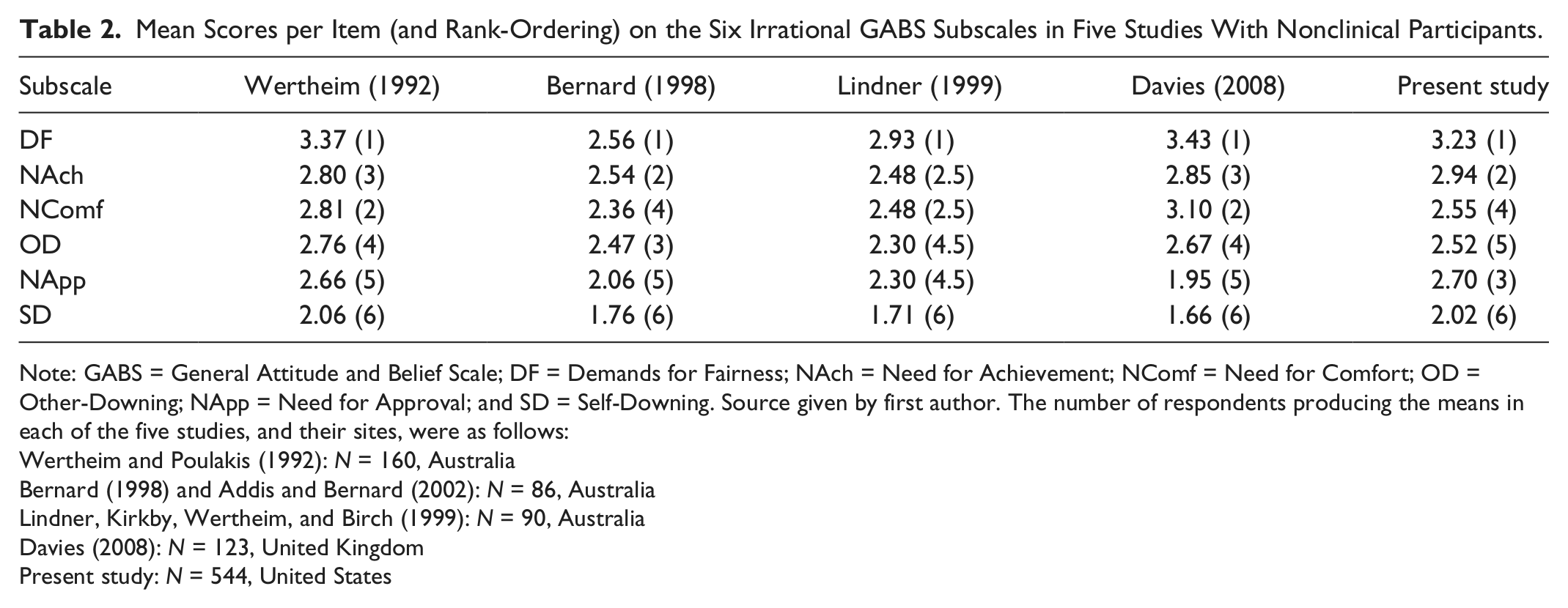
Note: GABS = General Attitude and Belief Scale; DF = Demands for Fairness; NAch = Need for Achievement; NComf = Need for Comfort; OD = Other-Downing; NApp = Need for Approval; and SD = Self-Downing. Source given by first author. The number of respondents producing the means in each of the five studies, and their sites, were as follows:
Wertheim and Poulakis (1992): N = 160, Australia
Bernard (1998) and Addis and Bernard (2002): N = 86, Australia
Lindner, Kirkby, Wertheim, and Birch (1999): N = 90, Australia
Davies (2008): N = 123, United Kingdom
Present study: N = 544, United States
Analyses Using IRT Methodology
The irrational subscales were subjected to separate exploratory factor analyses (principal components analyses) to assess the degree of unidimensionality. Self-Downing produced two factors, the first including seven items and the second the remaining two. Need for Achievement produced two factors, with six items in the first and three in the second. The remaining four subscales—Need for Approval, Need for Comfort, Demands for Fairness, and Other-Downing—each produced a single factor (only one component was extracted).
The GABS irrational subscales were evaluated separately using the GRM in MULTILOG. The GRM is very similar to the 2PL model, but it is a polytomous model that can accommodate the five Likert-type scale response options for each test item. The ICCs from the GRM program provide a trace line for each response option, as in Figure 3 (GABS Item 48, from an analysis of a very brief test consisting of six items: 46, 35, 48, 30, 45, and 44, the most informative items from each subscale, listed in order of increasing difficulty). For each item, the printed output provides a value for slope (a, equivalent to discrimination in the 2PL model) and four values for location (b1, b2, b3, and b4), the thresholds between the five response options. Item information in the GRM model is calculated from the value of the slope parameter “and the spread of the category thresholds” (Embretson & Reise, 2000, p. 185), such that higher values for information are given with steeper slopes and when the between-category threshold parameters for an item are distributed fairly evenly.
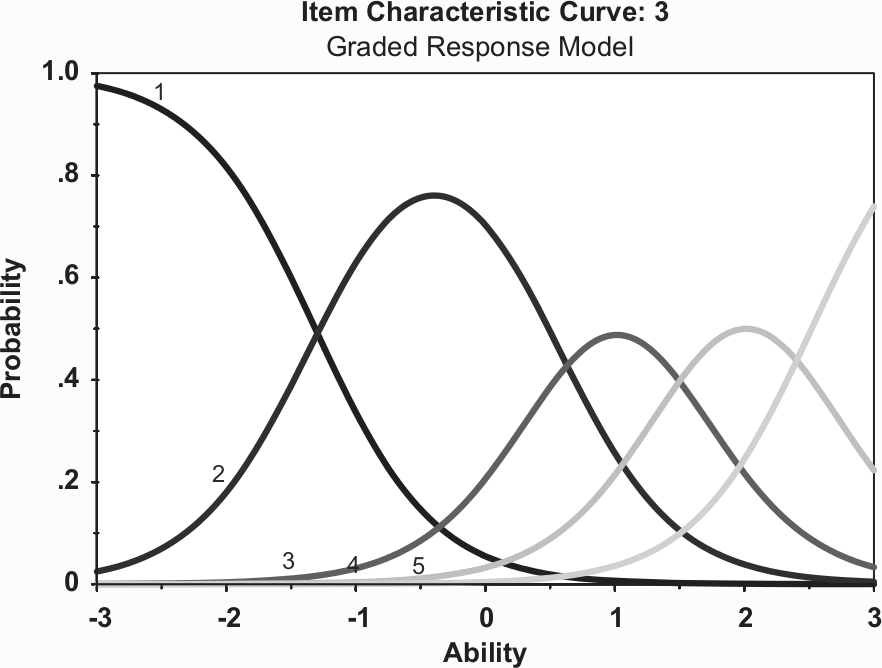
Item characteristic curves for GABS Item 48 (Need for Approval subscale); polytomous scoring (five-item Likert-type Scale), MULTILOG Graded Response Model.
Within each subscale, the item with the highest value for information was selected. The resulting six items form a very brief scale for further study. A principal components analysis of that scale led to only one factor being extracted. Table 3 presents the values for the slope and threshold parameters for the six items selected to represent the subscales. The overall location (or “difficulty”) value for each item as estimated by PARSCALE is also included. It can be seen from Table 3 that the values for location range from +0.194 (Item 46, representing Demands for Fairness) to +1.999 (Item 44, Self-Downing). Item 46 has the lowest value and is located at approximately the midpoint of the x-axis on an ICC; this item therefore functions among respondents with medium trait levels for irrationality. Item 44 has the highest value and is located toward the right on the x-axis; this item functions among the respondents with the highest trait levels for irrationality. The intervening four items have broadly similar values for location and are most helpful in assessing respondents with moderate trait levels. In the student respondents, only those with the highest levels of irrationality endorsed a Self-Downing item. However, even those with the lowest trait levels often agreed with a Demands for Fairness item.
The Most Informative GABS Items Representing the Six Irrational Subscales: Slope (a) and Between-Category Thresholds (b1, b2, b3, b4) from MULTILOG, and Location from PARSCALE.

Note: GABS = General Attitude and Belief Scale.
The values for slope, category thresholds, and location in this table were estimated from participants’ responses to a very brief test consisting of the six items listed.
Processes and Themes
Davies (2008, Table 7, p. 115) provided a matrix that illustrated how particular GABS items could each be placed at the intersection of one of the four irrational processes and one of the four themes. Extending this matrix, we divided all 46 irrational items of the GABS into scales representing either the irrational processes or the irrational themes. We added the 3 items from the Other-Downing subscale to the 9 Self-Downing items to create a “global rating” scale of 12 items. Because the 3 Other-Downing items all combined the elements of (a) damning other people because they (b) treat one unfairly, these items were also added to the Demands for Fairness subscale to create a 12-item theme “fairness.” Treating other items similarly led to two separate divisions of the 46 irrational items in the GABS. One of these divided the 46 items into four processes (demandingness, 12 items; global rating, 12 items; low frustration tolerance, 12 items; and awfulizing, 10 items), and the other divided the items into four themes (achievement, 12 items; approval, 10 items; comfort, 12 items; and fairness, 12 items).
Two raters, both advanced undergraduate research assistants earning course credit, independently assigned each of the 46 irrational GABS items to one of the four processes and to one of the four themes, and their agreement was assessed by kappa coefficients (processes: κ = .942; themes: κ = .884). Those kappa values represent “almost perfect agreement” (Elder, Pavalko, & Clipp, 1993, p. 43).
Internal Consistency Analyses
Table 4 indicates the mean score per item (with standard deviation) in each of the new scales, and the internal consistency values for each scale. It can be seen that the values for coefficient α are uniformly high, ranging from .84 to .89.
Mean Scores per Item, Standard Deviations, and Coefficient Alpha Values on the Four Irrational Processes Scales and the Four Irrational Themes Scales (n = 486).

Analyses Using IRT Methodology
Table 5 provides parameter values from MULTILOG and PARSCALE for the most informative items from the scales representing each process and each theme. The values for slope are all very high, indicating that these items are extremely informative.
The Most Informative GABS Items Representing the Four Irrational Themes and Four Irrational Processes: Slope (a) and Between-Category Thresholds (b1, b2, b3, b4) From MULTILOG, and Location From PARSCALE.

Note: GABS = General Attitude and Belief Scale.
Discussion
Completing the 55 items of the GABS by rating each of them on a 5-point Likert-type scale is demanding of respondents’ time and effort, and this concern may be particularly pertinent in a clinical setting. Distilling the instrument into its most informative items, as indicated above, could save examinees’ time without loss of essential information. But there are other compelling reasons for examining the GABS scales item by item. A concern arising from classical test theory methods is that items within a scale are treated as if they were interchangeable. For example, scoring the GABS Self-Downing subscale in the traditional way involves aggregating a respondent’s scores from each of the 9 items as if each has equal weighting, typically an untested assumption in respect of both the item itself and the Likert-type scale of measurement (Bond & Fox, 2007). There is only one way of attaining the lowest possible score on the subscale (endorsing “strongly disagree,” or 1, for each item), and only one way of obtaining the highest score (recording “strongly agree,” or 5, for each item). But total scores intermediate between 9 and 45 can be arrived at in many different ways. The number of possible response patterns on a 9-item subscale, each item rated on a 5-point Likert-type scale, is 59, or 1,953,125.
In fact, the GABS subscales all show high internal consistency, indicating that respondents are unlikely to produce a very wide range of the possible response patterns. Yet respondents with the same Self-Downing score (for example) could show many different patterns of specific item endorsements, and thus could have varying perspectives on self-criticism and self-abasement. Selecting and scaling the most informative items with IRT methodology and presenting only such items to respondents can guarantee that similar scores represent similar item endorsements.
The data from the six irrational subscales of the GABS in our study were highly consistent with those from four other student samples responding to the GABS in Australia and the United Kingdom (Table 2). The overall concordance of the rankings of the six mean subscale item scores across the five studies was very high; all studies produced the same rankings for Demands for Fairness, Need for Achievement, Need for Approval, and Self-Downing. Thus, nonclinical samples produce an impressive degree of consistency in displaying a shared ordering of GABS irrational subscale scores.
The IRT analyses of the data from this study produced results consistent with the rankings of subscale scores, but placed the items on a more secure psychometric foundation and a more dependable metric (Bond & Fox, 2007; Dumenci & Achenbach, 2008). Each subscale showed satisfactory unidimensionality, as determined by the exploratory factor analyses—the results of which are consistent with the factor structure of the GABS as identified by its originators and developers. The PARSCALE GRM estimates for item location are well grounded in that difficulty levels are drawn from all five response options in each item. Polytomous items provide “more information over a wider range of the trait continuum than . . . dichotomous items” (Ostini & Nering, 2006, p. 8).
The most informative items from each of the irrational subscales of the GABS form a unidimensional six-item scale suitable for further study with respondents in clinical settings. Table 3 identifies Self-Downing (represented by Item 44) as the most irrational of the original subscales, and Demands for Fairness (Item 46) as the least, in that Item 44 functions among respondents with the highest trait levels for irrationality, and Item 46 among those with the lowest. Many respondents will endorse an item from the Demands for Fairness subscale, but only those with high levels of irrationality agree with a Self-Downing item. Consistent with that, Table 1 reveals that respondents show low mean subtest scores for Self-Downing and high mean subtest scores for Demands for Fairness. The location values for the processes and themes indicate that the low frustration tolerance item is lowest for irrationality among the processes, whereas the global rating item is highest. Among the themes, achievement is lowest and comfort is highest for irrationality. This signifies that respondents with relatively low trait levels for irrationality may readily agree with items revealing low frustration tolerance and concerns about achievement. Only respondents with the highest trait levels for irrationality endorse items reflecting global ratings of worth and extreme preoccupations with comfort.
The MULTILOG and PARSCALE analyses were also helpful in indicating items for which the five response options on the Likert-type scale were all operating optimally. For example, the ICCs for Item 48 in Figure 3 reveal that the transitions between all five response options are clear and informative; most respondents chose options 1, 2, or 3, and only those with the highest trait levels for irrationality chose options 4 or 5 to register “agree” or “strongly agree” with this irrational item. Table 3 shows that some items produced high values exceeding +3.00 for response option 5 (strongly agree), especially Item 30. Future work on the GABS could focus on the utility of the five-item Likert-type scale for all items. For example, possibly options 4 and 5 in Item 30 could be collapsed into a single category for agreement without loss of information.
Consistent with the results of other recent studies, Self-Downing emerged as the most irrational of the six original irrational beliefs scales measured by the GABS in our student sample. Among the irrational appraisal mechanisms, demandingness is viewed as primary while awfulizing, low frustration tolerance, and self-downing are regarded as secondary; and demandingness and self-downing are seen as schemata, whereas awfulizing and low frustration tolerance are cast as propositional networks (David & Lynn, 2010). Thus self-downing, linked with a pattern of evaluating human worth in global terms, is given prominence both as an irrational secondary appraisal mechanism and as a schema.
Demandingness has been associated with several clinical conditions, including anger, depressed mood, and anxiety; self-downing is correlated with depressed mood. Further research on the irrational beliefs assessed by the GABS could help identify with greater precision and clarity the specific patterns associated with particular disorders commonly presented in outpatient mental health settings (David & Lynn, 2010).
Limitations
Because REBT is applied in clinical settings, our use of a student sample in this research may be questioned as limiting the generality of our findings to clients and patients. Further research with clinical populations is indicated before we can recommend an abbreviated form of the GABS for professional use.
In general terms, there is no impediment to using data from respondents with low trait levels for irrationality to inform test development and refinement because of the predicted group invariance in the item parameter estimates produced by modern test theory methodology (Baker, 2001). In IRT, estimates of item characteristics hold true regardless of the “abilities” of the group being tested; a group of respondents with low trait levels will produce the same ICCs as a group with high trait levels. In other words, “the item parameters are not dependent upon the ability level of the examinees responding to the item” (Baker, 2001, p. 51). If nonclinical and clinical respondents differ only in the degree to which they endorse irrational beliefs, then generalization from students to patients can be justified. However, that assumption will have to be tested empirically in prospective research with clinical samples.
One hypothesis for future research is that clients or patients may be less preoccupied than the student respondents were with irrational beliefs about the importance of being treated fairly by others (e.g., demanding that others must treat one fairly) and personal achievement (e.g., seeing achievement as a dire necessity rather than a strong preference). The Demands for Fairness and Need for Achievement subscales were the “easiest” in terms of irrationality in our study; in other words, students who were practically at the median for irrationality were still likely enough to endorse irrational items from those subscales. The Self-Downing items, by contrast, produced relatively few endorsements from our sample but a prediction is that people receiving mental health services may be far more likely to agree with such items. The results of future research on the GABS with clinical samples will no doubt improve assessment practices and advance the further development of REBT interventions.
Footnotes
Acknowledgements
We are very grateful to Dr. Michael E. Bernard for making the GABS available to us, to Dr. Helen Lindner for providing a copy of the SGABS and related materials, and to Elisha Beal, Merrick Blaisdell, Pamela Bouman, Connor Moody, Sean O’Mara, and Michelle Ouellette for their technical assistance.
We are also indebted to Gayle Jones and the members of the Protection of Human Subjects Review Board at the University of Maine for their help in the initial research review process.
Authors’ Notes
Portions of this paper were presented by Dr. Owings at the 115th. Convention of the American Psychological Association, San Francisco, August, 2007, and at the 41st. Annual Convention of the Association for Behavioral and Cognitive Therapies, Philadelphia, November, 2007.
Lindsay R. Owings is now Drug Abuse Program Coordinator for the Federal Bureau of Prisons at the United States Penitentiary, Marion, Illinois.
Elaine S. McMillan is now on the psychology staff at the VA Palo Alto Health Care System, Palo Alto, California.
Declaration of Conflicting Interests
The author(s) declared no potential conflicts of interest with respect to the research, authorship, and/or publication of this article.
Funding
The author(s) received no financial support for the research and/or authorship of this article.
Author Biographies