




Abstract
This study examines the status of children’s rights and interests in China’s personal bankruptcy laws through analysis of academic literature, legislation, and landmark cases. Findings highlight significant gaps, as the laws focus on protecting “honest but unfortunate” debtors and mitigating punitive measures against dishonest debtors, with limited attention to children’s welfare. Current frameworks lack provisions, and some related provisions are vague such as child-related exemptions, stay protections, and prioritization of children support debts. Future reforms should incorporate explicit safeguards for children’s rights and interests, balancing debtor accountability and creditor’s rights with social responsibility to ensure the welfare of vulnerable groups.
Plain Language Summary
This study examines the status of children’s rights and interests in China’s personal bankruptcy laws through analysis of academic literature, legislation, and landmark cases. Findings highlight significant gaps, as the laws focus on protecting “honest but unfortunate” debtors and mitigating punitive measures against dishonest debtors, with limited attention to children’s welfare. Current frameworks lack provisions and some related provisions are vague such as children-related exemptions, stay protections, and prioritization of children support debts. Future reforms should incorporate explicit safeguards to children’s rights and interests, balancing debtor accountability and creditor’s rights with social responsibility to ensure the welfare of vulnerable groups.
Keywords
Introduction
The core objectives of personal bankruptcy laws are to protect “honest but unfortunate debtors” (bankrupts) by providing them with a fresh start and ensuring the equitable distribution of assets among creditors (Baird, 2006; Moringiello, 2011; Skeel, 2018). These goals reflect the need for relief, fairness, and the balanced objectives of the system (Warren, 1997). However, although the principle of equitable distribution originated with the emergence of bankruptcy law, it has not consistently remained its central tenet, often yielding to other priorities-such as the protection of vulnerable groups, including children (Skeel, 2018).
The protection of children’s rights and interests has become an important principle in personal bankruptcy laws across various jurisdictions. However, its implementation differs between countries. Recent years have seen increasing legislative attention to personal bankruptcy laws in China. Exploring the status of children’s rights and interests within China’s personal bankruptcy framework can offer insights valuable not only for domestic reforms but also for developing countries and jurisdictions drafting their bankruptcy laws. In this context, “children” includes both minors whom the debtor is legally obligated to support, and individuals classified as children under relevant legislation.
Why is It That the Personal Bankruptcy Laws Protect Children’s Rights?
Personal bankruptcy laws, traditionally seen as a form of social insurance, help individuals manage unexpected financial shocks (Feibelman, 2005; Landry & Yarbrough, 2007; Spooner, 2017; Van & George, 2013; Zywicki, 2005). For instance, the U.S. system views personal bankruptcy as a private market solution to welfare challenges (Tabb, 2005). It is widely accepted that creditors should share some responsibility when a debtor faces bankruptcy (Adler, 1991; Ayotte & Morrison, 2009; Baird & Rasmussen, 2001; McCoid, 1996;Silberglied, 2015; Thomas, 1985).
This principle justifies the discharge of debtors through bankruptcy proceedings rather than imposing punitive measures (He, 2024; Howard, 1997; Hynes, 2004; Kadens, 2010). Personal bankruptcy law has evolved from prioritizing creditors’ rights to simultaneously emphasizing debtor survival and societal welfare (Bufford & Chemerinsky, 2008; Skeel, 2001). Personal bankruptcy laws should not only ensure the survival of the debtor but also protect broader social interests (Ben-Ishai & Schwartz, 2007; Frost, 1995). Specifically, they should help mitigate the societal burdens caused by a debtor’s financial failure, requiring creditors to share the responsibility (Oei, 2014; Simon et al., 2017). Dependents, such as children, are directly impacted by financial insolvency, necessitating their inclusion within bankruptcy protections (Chow, 2006; Johnson & Wright, 2007; Nguyen, 2008; Warren, 2002, 2004a). This progression in legal theory and practice highlights the transition of bankruptcy laws from focusing solely on individual debtors’ survival to addressing and mitigating broader societal burdens (Brunstad, 2000; Dickerson, 2001, 1999; Ramsay, 1997; Spreng, 2004).
Therefore, while the protection of children may not feature explicitly in business contracts or debt settlements, personal bankruptcy laws must address their welfare to align with the broader principle of mitigating societal burdens. Established practices in jurisdictions like the U.S. offer valuable lessons on integrating children’s welfare into bankruptcy law frameworks.
Why Should Bankruptcy Laws Take Responsibility for Children’s Rights?
Children’s rights are addressed through various non-bankruptcy laws, such as social security and education policies, which aim to ensure their welfare and developmental needs (De Francis, 1963; Garda, 2006; Valverde et al., 2011; Zeng, 2022). However, these frameworks are not designed to resolve conflicts between creditors and debtors in financial distress.
A key principle of bankruptcy law is that it should align with the provisions of non-bankruptcy laws whenever possible, except in cases where bankruptcy law pursues specific values unique to its domain (Hummelen, 2014; Hynes & Walt, 2014; Jackson, 1982; Plank, 2007; Van & Heather, 2000). This principle ensures coherence in the legal system while allowing for necessary exceptions to address the unique challenges posed by insolvency (Casey & Macey, 2022; Plank, 2001; Warner, 2001). Social security laws prioritize equitable resource access and uphold children’s rights as a priority (Cornett, 2009; Polonko et al., 2016; Redleaf, 2021; Thoreson, 2015), while bankruptcy laws balance debtor relief with creditor protection (Martin, 1981; Peitzman & Smith, 1977; Srbinovski, 2024). Social security laws prioritize children’s immediate welfare, which does not require addressing complex financial risks or liabilities (Davidson, 2006; Doel, 2019; Mandlate, 2014; Smith & Sood, 2023). Bankruptcy law often prioritizes creditor protection and economic stability, which may not align perfectly with broader welfare laws (Dickerson, 1999, 2001; Efrat, 2002; Garcia, 2021). Incorporating bankruptcy-specific concerns, such as debtor relief or creditor protection in social security laws, would undermine their primary purposes and create impractical conflicts (Jackson, 1982; Scheinbaum, 2018; Scott, 1955). This divergence means social security frameworks cannot address the financial liabilities and moral hazard issues unique to bankruptcy (Kato, 1991; Medill, 2007; Vitt & Smith, 2022). Their purpose is distinct, as they focus solely on securing children’s rights rather than managing financial liabilities (Caplan, 1980; Codiga, 2002). However, it not only involved protecting of children’s rights but also financial liabilities, when debtors go into bankruptcy. Legislators must recognize that debtors with young children face specific challenges, such as reduced access to relief and correlations between medical insurance coverage and bankruptcy outcomes (Greene et al., 2017).
Bankruptcy law should balance these competing objectives while minimizing the unintended harm to vulnerable groups like children (Littwin, 2011; Ramsay, 1997; Spreng, 2004). This balancing act highlights the tension between financial and social welfare within the legal framework. By focusing on creditor protection and debtor accountability only, bankruptcy law may risk neglecting the social consequences of insolvency on dependents, including children (Chincheck, 1983; Healy, 2005; Throne, 1988). Personal bankruptcy laws must align with broader welfare principles while addressing these nuanced challenges. Failure to include children-focused protections within bankruptcy frameworks risks legal inconsistencies and inefficiencies (Dabera, 2022; Healy, 2005; Poon, 2024). Incorporating these protections will ensure coherence across the legal system.
Protecting Children’s Rights Within Personal Bankruptcy Laws
Why should we pay attention to the protection of children’s rights in personal bankruptcy proceedings? Because the presence of dependents in the household necessarily entails a diversion of financial resources that may ultimately contribute to bankruptcy. For example, at the time that the undue hardship debtors sought to discharge their student loans, most debtors (56%) had a least one dependent, and within this group, the average debtor had two dependents, and the average age of each debtor’s dependents was approximately 10 years old in the United States (Pardo & Lacey, 2005). That is why the U.S. Bankruptcy Code lists numerous debts that qualify as priority unsecured claims, such as unpaid child support payments, and those priority unsecured claims must be paid in full over the life of the debtor’s Chapter 13 plan (Johnson, 2023).
We believe that the issue of protecting children’s rights and interests in personal bankruptcy law encompasses two primary aspects: first, identifying which children’s rights and interests should be prioritized within personal bankruptcy frameworks; and second, determining the mechanisms that should be adopted to ensure their protection.
The Key Children’s Rights and Interests That Need Protection in Personal Bankruptcy Laws
Regarding the first aspect, based on legislative practices in China and internationally, we identify children’s rights to survival, health, and education as the principal areas that require protection in personal bankruptcy laws.
Many countries, including China, recognize the importance of protecting the rights to survival, health, and education for dependents in bankruptcy laws (Hagedorn, 1980; LoPucki & Doherty, 2015; LoPucki, 2015; Ondersma, 2022; Shen, 2020). These laws reflect societal values of compassion, charity, and forgiveness (Block-Lieb, 1998; Efrat, 1999; Gotberg & Miller, 2024; Minow, 2015; Zywicki, 2005). However, the extent of these protections varies globally.
These three rights are essential to a child’s overall development. Among them, the rights to survival and health are particularly foundational, as they underpin all other aspects of a child’s well-being. As such, we emphasize that these two rights deserve heightened attention when designing and implementing legal protections in bankruptcy proceedings involving dependent children.
The Key Mechanisms Within Personal Bankruptcy Laws That Serve to Protect These Rights and Interests
Key mechanisms in personal bankruptcy laws include prioritizing children-related debt repayment, exempting children-support-related assets from creditor claims, and making children-support obligations non-dischargeable (Burns, 2002; Cecil, 2001; Foohey et al., 2022; Leach, 2005; Nowak, 2020; Riley, 2016; Tuskey, 1982). Additionally, stay relief provisions ensure creditor actions do not undermine children’s welfare (Warren, 2004b; Wellman, 2002).
In China, the Personal Bankruptcy Ordinance of the Shenzhen Special Economic Zone (PBOS), introduced in 2020, marked a significant step forward. However, this and other quasi-personal bankruptcy laws in provinces like Zhejiang have yet to fully address children’s rights. This study evaluates the status of children’s rights under China’s personal bankruptcy laws, analyzing academic research, legislation, and judicial judgments. It also explores the legal and societal contexts driving the current framework while proposing directions for reform.
Although the PBOS and other quasi-personal bankruptcy regulations are technically local rules rather than national laws in the strict legal sense, we refer to the PBOS and similar regulations collectively as “law” throughout this paper for the sake of clarity and from a broader legal perspective.
The Limitations of Current Research and Important Gaps
The research on personal bankruptcy law in Chinese academic circles mainly focuses on the basic issues, and there are few studies on the protection of children’s rights and interests. Scholars’ views on this issue can be summarized as follows: (1) Children support obligation should not be exempted (He, 2021; Liu, 2022; Ma, 2019; Wang, 2020; Xu, 2021); (2) Property whose purpose is to pay domestic support obligations shall be treated as exempt property (Ma, 2019; Xu & Han, 2021); (3) There is an important relationship between personal bankruptcy and the protection of children’s rights to education and health (Bai, 2021; Yi & Wan, 2019). The neglect of the protection of children’s rights in the personal bankruptcy law will hinder social development. We find that the research of scholars on this issue is relatively general and cannot provide targeted guidance for legislators and judges. This paper will be devoted to summarizing the understanding of Chinese scholars, legislators and judges on this issue, and finally put forward targeted suggestions.
We believe that future research should more fully explore the ideal standards for children’s rights protection within personal bankruptcy systems and develop legislative recommendations that are informed by both contemporary social needs and evolving legal frameworks. Importantly, such protections must go beyond health and subsistence to also encompass the child’s right to education, which is critical for their long-term development and well-being.
We will offer a comprehensive examination of the status of children’s rights and interests within China’s evolving personal bankruptcy framework in this work. It integrates a multi-dimensional research approach-comprising doctrinal analysis, legislative review, and typical judicial cases study-to assess the extent to which existing laws and practices safeguard children’s welfare. The paper is structured in five sections. The first provides theoretical and normative foundations for integrating child protection into personal bankruptcy law. The second outlines the research methodology, including sources of legislation, academic literature, and representative court cases. The third presents the findings, highlighting systemic deficiencies in academic engagement, legislative clarity, and judicial application. The fourth section explores the cultural, institutional, and policy-related causes of these gaps and advances targeted reform recommendations. Finally, this work concludes by summarizing the challenges and advocating for a more inclusive, child-sensitive personal bankruptcy regime. This research contributes to China’s legal modernization efforts and offers insights for similarly positioned jurisdictions.
Materials and Methods
This study explores the status of children’s rights and interests in China’s personal bankruptcy laws through three primary methodologies: a literature review, an analysis of legislative practices, and an examination of judicial decisions. The literature review focuses on scholarly perspectives, while the legislative and judicial analyses investigate the application of these rights within Chinese laws and landmark judicial cases.
We acknowledge that the methodologies employed in this study do not align with conventional empirical standards that rely on large datasets or statistical modeling. However, the methods adopted are purposefully designed to suit the research objectives and enable the development of contextually grounded and analytically sound conclusions. Introducing a more data-intensive empirical framework in this context could risk compromising the study’s conceptual depth and internal coherence. As detailed in sections “Children’s Legal Protections in Personal Bankruptcy Proceedings: A China-U.S. Comparison” and “Unresolved Issues Concerning the Rights and Interests of Children in Personal Bankruptcy Laws,” a significant practical constraint in jurisdictions such as China is the limited public availability of litigation records in personal bankruptcy proceedings, many of which are resolved through non-litigious mechanisms. These limitations necessitated a methodological focus on landmark cases-particularly those adjudicated by the Shenzhen Bankruptcy Court-that exemplify broader legislative and judicial trends. While this approach does not involve large-scale data analysis, it offers a structured and illustrative form of empirical inquiry that is well-suited to the legal and institutional context, even if it differs from the empirical standards commonly observed in other disciplines represented in SAGE Open.
To ensure the comprehensiveness and credibility of our research data, we utilized China’s most authoritative and comprehensive academic and institutional sources, including the China National Knowledge Infrastructure (CNKI) and official government websites such as the website of Shenzhen Bankruptcy Administration.
In terms of methodology, this paper primarily adopts a text analysis approach, which involves systematically reviewing and synthesizing relevant documents to identify patterns, similarities, and divergences related to the core issues of this study. We believe that this method allows for a clearer presentation of the current legal and practical landscape, while also offering a foundation upon which future researchers can build more detailed, empirical studies.
Literature Review
China’s first bankruptcy with a market-economy nature was promulgated in 2006 and individuals couldn’t file for bankruptcy, which contributed to the shortage of research related to personal bankruptcy. The promulgation of China’s first personal bankruptcy law, the Personal Bankruptcy Ordinance of the Shenzhen Special Economic Zone (PBOS), in August 2020 marked a significant milestone in this legal domain. As such, August 2020 serves as a critical reference point for this study. Based on the above historical context, this research scope spans from 2002 to 2023, as academic publications on personal bankruptcy law, particularly those addressing children’s rights, were virtually nonexistent before 2002.
In our view, “consumer bankruptcy” and “personal bankruptcy” are closely related terms, but they have slightly different focuses depending on the legal and financial context. In simple terms: (1) all consumer bankruptcies are personal bankruptcies, but not all personal bankruptcies are consumer bankruptcies; (2) if an individual files for bankruptcy primarily due to personal or family debts, it is classified as consumer bankruptcy; and (3) if an individual files for bankruptcy-whether for personal or business-related debts-it falls under personal bankruptcy. Given that the Chinese academic community does not consistently differentiate between “consumer bankruptcy” and “personal bankruptcy,” and to maintain the completeness and clarity of the research, we have chosen not to distinguish between these two concepts in this article.
To gather relevant academic literature, we used the China National Knowledge Infrastructure (CNKI) database, widely regarded as the most authoritative and comprehensive repository of academic publications in China. The database provided extensive access to studies focusing on the protection of children’s rights and interests in personal bankruptcy laws. The search employed keywords such as “personal bankruptcy (
The academic literature provides an essential foundation for understanding the state of children’s rights and interests in the context of personal bankruptcy law, but it leaves a gap in this topic. Practice is always ahead of the theory and academic perspectives alone cannot fully capture the practical realities of this issue, necessitating complementary analysis of legislative developments and judicial practices.
Legislative and Judicial Review
To analyze legislative developments, we relied on the Peking University Law Database, a premier legal resource in China. This database facilitated a comprehensive review of relevant statutes and legislative commentaries.
How do we select cases? The PBOS remains China’s only bankruptcy law and is exclusively implemented in Shenzhen. It serves as a model for the anticipated national personal bankruptcy legislation, which will apply to the entirety of China (Cao et al., 2022). Based on a comparative analysis of Chinese legislation in section “Insufficient and General Legislation for Protecting Children’s Rights,” the PBOS demonstrates similarities to other quasi-personal bankruptcy frameworks, particularly in its provisions for protecting children’s rights and interests. For judicial analysis, we focused on the Shenzhen Bankruptcy Court, which has adjudicated over 500 personal bankruptcy cases since the PBOS was enacted. Using the Shenzhen Personal Bankruptcy Case Information Network (https://birp.szcourt.gov.cn/pcczajxxw/), we selected landmark cases that illustrate the status of the protection of children’s rights within the personal bankruptcy framework. These include:
The first bankruptcy reorganization case.
The first personal bankruptcy settlement case.
The first personal bankruptcy liquidation case.
These landmark cases have influenced societal and legal perceptions of personal bankruptcy in China. They were recognized as annual typical bankruptcy cases (https://mp.weixin.qq.com/s/XjleiZ5c71h1-bZ3VMVitA). They represent broader trends and pivotal developments in China’s personal bankruptcy jurisprudence. Besides, they offer valuable insights into the protection of children’s rights and interests. Detailed discussions of these cases are presented in the subsequent section “Children’s Legal Protections in Personal Bankruptcy Proceedings: A China-U.S. Comparison.”
In conclusion, this study evaluates the status of children’s rights in personal bankruptcy cases in China from multiple dimensions. Each methodology plays an indispensable role in achieving a comprehensive understanding of this issue. This study will inform future research, legislative reforms, and judicial practices related to children’s rights and interests. Besides, it might inform policy development or international comparisons in personal bankruptcy laws.
Results
Insufficient Research on the Protection of Children’s Rights in China’s Personal Bankruptcy Laws
A search of Chinese Social Sciences Citation Index (CSSCI) journals identified 173 articles related to “personal bankruptcy” and “consumer bankruptcy.” Among these, 54 articles were published from 2002 to 2018, while 119 appeared between 2018 and September 2023. The noticeable increase aligns with the promulgation of China’s first personal bankruptcy law in 2020, demonstrating a growing academic focus on this subject. However, the total volume of research remains limited compared to jurisdictions such as the United States, indicating a considerable gap in the study of personal bankruptcy in China. Figure 1 can tell us about the above conclusion.

Annual trend of publication on personal bankruptcy laws in China.
A closer analysis of these articles highlights the scarcity of studies addressing children’s rights in personal bankruptcy. There’s a growing interest in personal bankruptcy post-2018, but children’s rights remain severely underrepresented.
A search for “minors” yielded only one article, which observed that minors and long-term incapacitated adults are rarely involved in bankruptcy cases (Zhang & Wang, 2023).
Only five articles included the term “dependents.”
A search for “children” returned 16 articles, 7 of which explicitly addressed the protection of children’s rights.
No articles included “children” in their titles or abstracts.
Only 12 articles specifically analyzed the status of children in China’s personal bankruptcy laws.
Most research centers on foundational issues, such as the legitimacy of personal bankruptcy legislation (Li & He, 2004; Li, 2002; Liu, 2019; Wang, 2002, 2019; Xu, 2020; Yang & Chen, 2017; Zhao & Gao, 2014) and principles of bankruptcy exemptions (Xu, 2011). These priorities leave children’s welfare in bankruptcy proceedings underexplored. Table 1 summarizes these findings.
The Viewpoints on the Protection of Children in China.
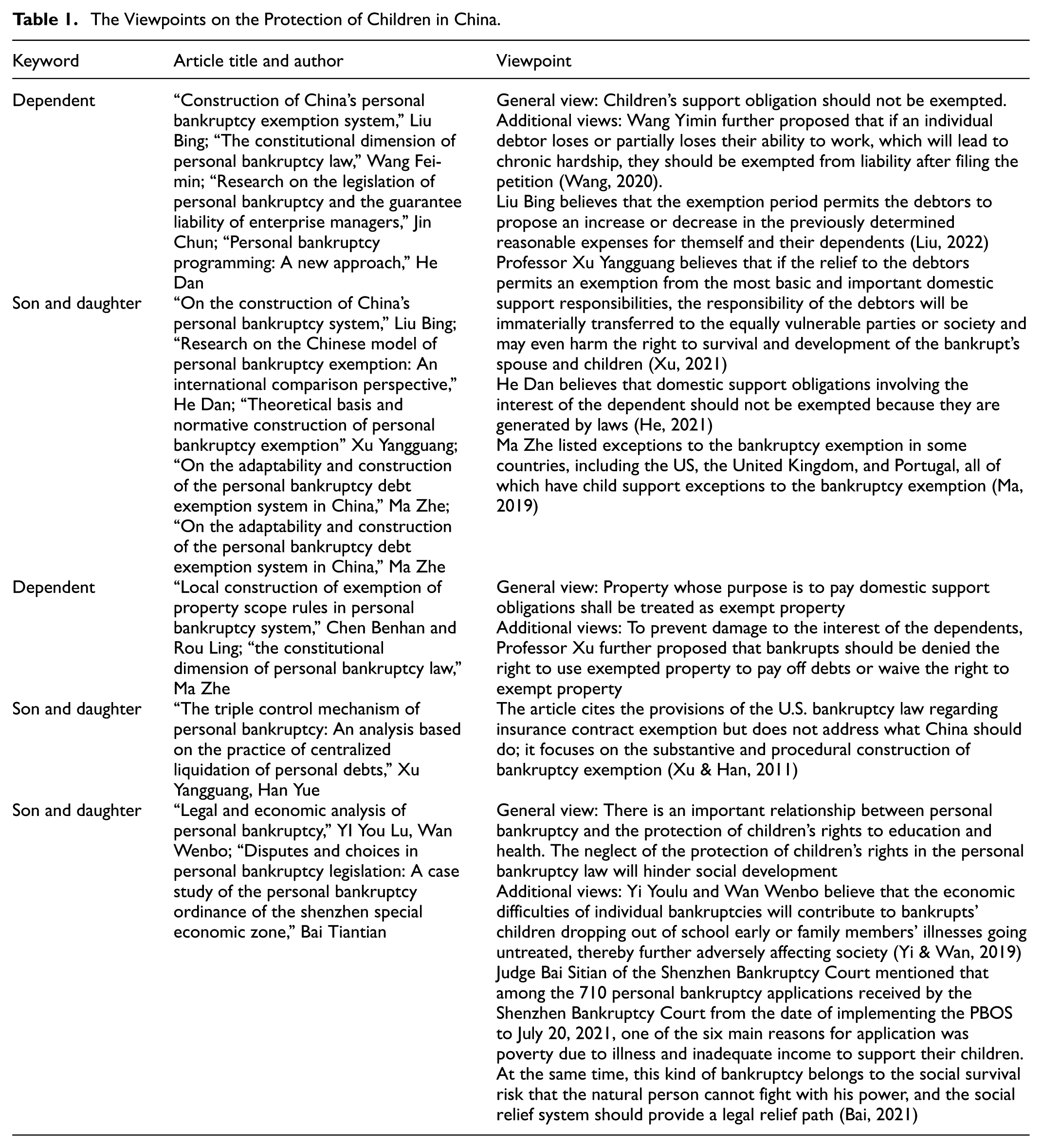
Based on Table 1, we found that Chinese scholarship addressing children’s rights in personal bankruptcy has concentrated on two areas:
The non-dischargeability of children support obligations (Hornstein, 2003; Riley, 2016).
The exemption of property used for children support from bankruptcy estates (Dickerson, 2004; Fibich & Floyd, 1988; Johnson, 2023; Russo, 2004).
Despite these contributions, broader, systematic research on protecting children’s rights in personal bankruptcy contexts remains a significant gap in academic inquiry. This leaves children’s welfare in personal bankruptcy largely unexplored.
Insufficient and General Legislation for Protecting Children’s Rights
The Wenzhou City “Centralized Liquidation of Personal Debts (Trial)” introduced in 2019 marked the beginning of China’s quasi-personal bankruptcy laws. Before 2020, several Chinese media outlets, including those in Wenzhou and Zhejiang Province, described the rule for handling debts as China’s personal bankruptcy rules (Gu, 2019; Li & Zhu, 2019; Shi, 2019).
Quasi-personal bankruptcy laws only take the form of personal bankruptcy and do not have the essence of personal bankruptcy (it lacks rules such as “exemption effect,” “automatic stay effect,” and “minority obedience to majority efficiency”), and relies on the negotiations between creditors and debtors and the efforts of the court (Yin, 2022). The rules also concern the protection of children’s rights and interests. Thus, researching these rules is necessary, and we get Table 2.
The Provisions About the Protection of Children in China’s Personal Bankruptcy Laws.

We do compare specific provisions regarding children’s rights in the PBOS and quasi-personal bankruptcy rules in Table 2. According to Table 2, these laws remain insufficient and overly general. Judges must interpret the relevant provisions based on legislative purposes, which makes it prone to dispute in practice. For example, article 97 of the PBOS: Debtors may apply for exemptions from maintenance fees if they face “undue hardship.” The undefined nature of this term leaves its interpretation to judicial discretion, risking inconsistent rulings. Worse yet, problems of uncertain treatment of debtors will inevitably proliferate (Pardo & Lacey, 2005).
To make it clear that China’s personal bankruptcy laws are inconsistent, lack enforcement standards, and leave children’s welfare subject to judicial interpretation, we draft Table 3.
The Differences in the Protection of Children Between China’s Personal Bankruptcy Laws.

Other critical issues remain unaddressed, such as:
Whether education savings for children are part of the bankruptcy estate.
Whether maintenance creditors can claim post-bankruptcy income or abandoned property.
Moreover, the absence of stay exception rules (allowing children support claims to bypass bankruptcy proceedings) and preference exception rules (protecting bona-fide children support payments from avoidance actions) leaves significant gaps in legislative protections for children.
Besides, under the current framework of the PBOS and the quasi-personal bankruptcy laws adopted in some regions in China, bankruptcy protections are restricted to individuals who hold Hukou (household registration) within the specific jurisdictions where such regulations exist. At present, Shenzhen remains the only region in China with a fully enacted Personal Bankruptcy Law, while a few other areas have implemented partial or quasi-personal bankruptcy mechanisms. This fragmented legislative landscape results in debtors-and critically, their dependent children-living in regions without such laws being excluded from the protections offered under personal bankruptcy frameworks. This disparity not only reflects a legal inconsistency but also raises serious concerns regarding equity and the protection of vulnerable populations (Chen, 2022). To address this issue, we advocate for the establishment of a unified, nationwide Personal Bankruptcy Law that ensures consistent protection across all regions. Such legislation should include explicit provisions aimed at safeguarding the rights and welfare of children, particularly in cases where a parent is undergoing bankruptcy proceedings.
Children’s Legal Protections in Personal Bankruptcy Proceedings: A China-U.S. Comparison
In contrast to only 10 years of development of personal bankruptcy legislation, the American personal bankruptcy law protects children’s rights and interests comprehensively with hundreds of years development. We do compare the U.S. Bankruptcy Code with China’s personal bankruptcy laws based on Table 4.
The priority of Children’s support. (1) Priority of domestic support obligations (DSOs) to support children:
In the U.S., domestic support obligations (DSOs) have high priority under §507(a)(1) of the U.S. Bankruptcy Code, paid after administrative expenses of the trustee but before any other claims.
In China, DSOs rank lower, with community liabilities and administrative expenses having higher priority.
(2) Government unit’s role in domestic support obligations:
U.S. laws include payments by government units as trustees of DSOs within their scope, ensuring children’s rights are protected when the government acts as the dependent’s caretaker [§101(14A) (A)(ii)].
Chinese legislators do not consider the role of government units in performing the obligations of dependents, leaving a gap in protection for children.
2. Exemptions and deductions for children’s support in bankruptcy. (1) Means Testing in the U.S.:
The Bankruptcy Abuse Prevention and Consumer Protection Act (2005) introduced a means test under Chapter 7 [§707(b)(2)(A)]. It is a gatekeeper of the Chapter 7 discharge (Westbrook, 2002).
Debtors can deduct actual expenses related to child support, such as health insurance, disability insurance, and health savings accounts. That is when determining whether a debtor has abused bankruptcy proceedings, judges must consider the debtor’s child support obligations. In view of the need to protect the rights and interests of children, if a debtor’s child support burden is excessively heavy and impairs their ability to repay debts, the debtor should be recognized as an appropriate candidate for personal bankruptcy protection. For example, under Section 707(b)(2)(B) of the U.S. Bankruptcy Code, a debtor may rebut the presumption of abuse by demonstrating the existence of “special circumstances.” In the case of In re Liatman, 370 B.R. 820 (Idaho, 2007), the court found that a child support debt constituted such a special circumstance, thereby affording better protection to the rights of children.
In China, there is no means test, and only Yibin City permits exemptions for expenses related to physical defects or diseases. Other regions lack clear provisions for such deductions, undermining the health rights of children during bankruptcy.
(2) Exempt property and education accounts:
In the U.S., under §522(c)(1), exempt property can be used to pay DSOs, ensuring financial security for children.
Funds in education individual retirement accounts are excluded from bankruptcy estates [§541(b)(5)], protecting children’s education.
China lacks equivalent protections, leaving children’s education and welfare unshielded in bankruptcy proceedings.
Furthermore, in order to strengthen the protection of children’s rights, many U.S. states explicitly provide that child maintenance and support obligations may be enforced against a debtor’s otherwise exempt property. Examples include Alaska Stat. §09.38.065(1)(A), N.C. Gen. Stat. § 1C-1601(e)(1)(9), and R.I. Gen. Laws § 9-26-4.1(a)(4).
3. Protection of children support payments in the U.S.
(1) Bona fide payments:
Bona fide domestic support payments are protected from avoidance actions under §547(c)(7) in the U.S., ensuring settlements like children support and spousal support after divorce are not disrupted.
Such protections are absent in Chinese law, increasing the vulnerability of child support payments to creditor claims.
(2) Automatic stay exceptions:
In the U.S., DSOs are exempt from the automatic stay rule under §362(b)(2)(B), allowing support payments to continue despite bankruptcy proceedings.
China does not provide similar exceptions, potentially causing undue hardship for children reliant on these payments.
In conclusion, China’s personal bankruptcy laws fail to address critical aspects of children’s rights:
Lack of provisions for exemptions related to children’s health and education expenses.
No priority or special protection for DSOs in bankruptcy estates.
Absence of clear definitions and mechanisms to protect bona fide children support payments from avoidance or interruption.
Comparison of U.S. Bankruptcy Code and China’s Personal Bankruptcy Laws.
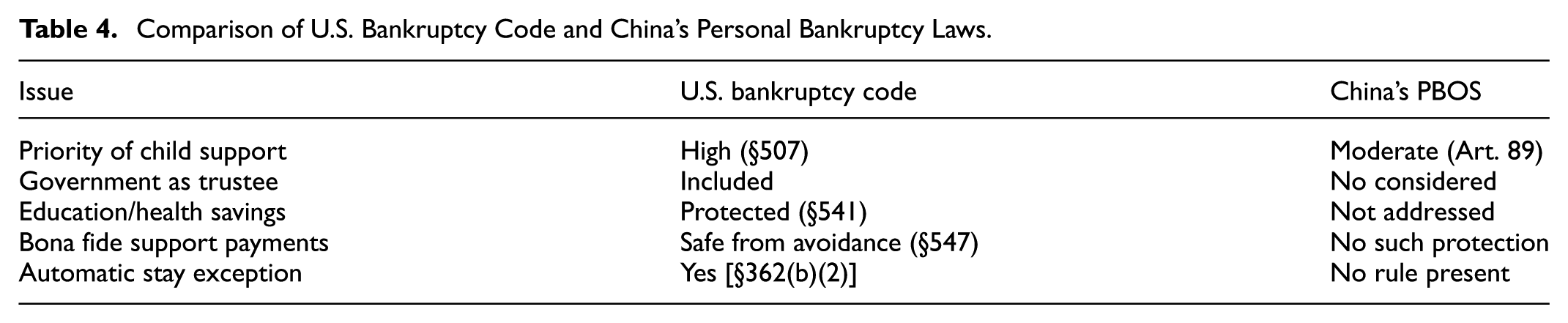
While we maintain that there are valuable norms in U.S. bankruptcy law that China could draw upon, we also recognize that the U.S. system is not universally ideal. For China, the optimal approach is to develop a system that aligns with its unique national conditions.
Safeguarding Children’s Rights and Interests in Personal Bankruptcy Laws: A Regional Study of the EU
In fact, the protection of children’s rights and interests in personal bankruptcy law has drawn attention not only from American legislators, but also from lawmakers across various countries and regions.
Notably, the European Union emphasizes the need to safeguard children’s rights within bankruptcy and bankruptcy frameworks. Article 24 of the Charter of Fundamental Rights of the European Union (2012/C 326/02) enshrines the principle of the best interests of the child, stating that in all actions concerning children—whether undertaken by public authorities or private institutions—the child’s best interests must be a primary consideration.
Further, Directive (EU) 2019/1023 on preventive restructuring frameworks reinforces this principle. Article 1 specifies that maintenance claims-particularly those arising from family relationships, parentage, marriage, or affinity-are excluded from the scope of discharge or restructuring measures under the directive. Moreover, Article 23 allows member states to exclude specific categories of debt from discharge, limit access to debt relief, or extend the discharge period, provided these measures are duly justified. Among the justified exclusions are debts related to maintenance obligations based on familial or marital relationships. These provisions collectively reflect the EU’s strong commitment to upholding children’s rights and ensuring that their welfare remains a priority in personal bankruptcy proceedings.
Inadequate Judicial Attention to Children’s Rights in Bankruptcy Cases
Since China is not a common law country, it does not require judicial documents to be made public (Huang, 2022). In recent years, the level of transparency in China’s judicial documents has been lower than before, making it more difficult to obtain relevant cases. Moreover, bankruptcy proceedings in China are non-litigious procedures, while publicly available judicial documents mainly consist of those formed during litigation processes, which further complicates the acquisition of such documents. Therefore, this study employs the typical case study method rather than a large-scale case study approach, which is one of the limitations of this research, and an unavoidable shortcoming. However, the selected typical cases are sufficiently representative and can reflect the thinking on this issue in individual bankruptcy trials in China. We also attempted to collect related cases from other regions in China, but unfortunately, no relevant precedents were obtained. At the same time, it should be pointed out that the cases used in this study and judicial reports can be obtained from public sources. If readers or reviewers want to obtain relevant information, we can provide relevant channels or directly provide the original documents.
China’s personal bankruptcy proceedings resemble execution proceedings rather than trial-based processes (Xu, 2017), limiting transparency and access to judicial documents. However, landmark cases from the Shenzhen Bankruptcy Court shed light on judicial attitudes toward protecting children’s rights:
Liang Wenjin’s Bankruptcy Reorganization Case (2021): The first personal bankruptcy reorganization case in Chinese history.
Zhang Yuansheng’s Bankruptcy Settlement Case (2021): The first personal bankruptcy settlement case in China.
Hu Xuhui’s Bankruptcy Liquidation Case (2021): The first personal bankruptcy liquidation case in China. (3) Analysis of these cases reveals: In Zhang Yuansheng’s case, the court excluded the debtor’s life security account (may apply to the support of children) balance from exempt property and used it to pay creditors. In Hu Xuhui’s case, insurance policies purchased for the debtor’s daughter were included in the bankruptcy estate to pay creditors. In Liang Wenjin’s case, the court didn’t mention any estates to ensure children’s rights and interests.
These rulings demonstrate a judicial tendency to prioritize creditors’ rights and disregard children’s welfare. Courts often apply business bankruptcy principles, such as maximizing the interests of the creditors, to personal bankruptcy cases (Hynes, 2004), disregarding the social and moral considerations unique to personal bankruptcy.
Through the analysis of typical judgments issued by Chinese courts, we observed that although China’s personal bankruptcy law formally prioritizes claims involving children’s rights for repayment, in practice, judges have not consistently taken the underlying legislative intent into account. As a result, the protection of children’s rights is often insufficiently addressed in actual proceedings. This disconnect between legal provisions and judicial implementation underscores the need for stronger mechanisms to ensure that children’s rights are fully safeguarded in China’s personal bankruptcy framework.
General Conclusions on the Status of Children’s Rights and Interests in China
The findings of this study highlight several key issues:
Research gap: Scholarly attention to children’s rights in personal bankruptcy is limited, with only 12 articles explicitly addressing this topic in China.
Legislative deficiencies: Existing laws are vague and lack detailed protections for children, such as stay exception and preference exception rules.
Judicial inadequacy: Judicial practices reveal courts frequently disregarding children’s welfare.
Discussion: Causes and Recommendations for Legal Reform Regarding the Status of Children’s Rights in China’s Personal Bankruptcy Laws
Examining the factors behind the inadequate protection of children’s rights in China’s personal bankruptcy laws reveals key insights. Addressing these deficiencies can not only guide China’s legislative reforms but also provide valuable lessons for other jurisdictions designing similar legal frameworks.
Legislative Purpose and Its Limitations
China is undergoing social transformation, and the social credit system has not been fully established (Krause et al., 2023). China’s personal bankruptcy laws and quasi-personal bankruptcy frameworks were primarily designed to counterbalance the negative consequences of punitive credit enforcement mechanisms. The Provisions of the Supreme People’s Court on Restricting the High Consumption of Persons Subject to Enforcement (
Challenges Posed by the Provisions
(1) Barriers to recovery for debtors: The absence of a personal bankruptcy system exacerbates the challenges faced by debtors. If a debtor’s business fails, it is nearly impossible for them to recover under the current regulatory framework. Honest debtors are deprived of developmental opportunities, and in severe cases, their fundamental right to livelihood is impacted.
(2) List of dishonest debtors and credit punishments: If a person subject to enforcement fails to fulfill their obligations and meets certain criteria, they are added to the list of dishonest debtors.
Inclusion in this list triggers a cascade of penalties:
Restrictions are imposed on government procurement, bidding processes, administrative approvals, and market access.
The Courts will inform relevant government departments, financial regulators, and industry associations, which then implement further sanctions, significantly limiting the debtor’s rights. (3) Irreversible consequences for “honest but unfortunate” debtors:
The introduction of stringent enforcement measures, combined with the lack of a personal bankruptcy framework, creates an environment where recovery becomes nearly impossible for genuine debtors. This contributes to a high number of unenforceable cases, further burdening the judicial system (Yin, 2022).
Based on the above summary, it can be concluded that the core intent of these regulations is punitive toward debtors, potentially depriving them of the opportunity for financial recovery. In response to the challenges posed by such rules, Chinese legislators have increasingly emphasized the need for comprehensive personal bankruptcy legislation. However, the objective of personal bankruptcy law extends beyond merely offering debtors a chance to restart their lives; it also encompasses the protection of fundamental rights, including those of dependent children. If the legislative focus is narrowly confined to safeguarding only the debtor’s developmental rights, it risks overlooking the essential interests and well-being of their children.
Calls for Reform
The lack of a personal bankruptcy system has been identified as a critical weakness in China’s current judicial framework. Recognizing this, the Supreme People’s Court of the PRC has emerged as a strong advocate for reform. It is the official institution to propose establishing a personal bankruptcy system, emphasizing the urgent need for legislative advancements to address these challenges.
While the current provisions have improved enforcement rates, their rigidity and lack of a personal bankruptcy system create significant barriers for honest debtors seeking recovery. The Supreme People’s Court’s advocacy for reform underscores the pressing need for a balanced approach that addresses these gaps. By implementing a comprehensive personal bankruptcy framework and revising the existing punitive measures, China can foster a fairer and more sustainable judicial system.
From the perspective of the legislative purpose and background of China’s personal bankruptcy laws, the current personal bankruptcy rules in China should be more similar to those that applied to businessmen in the US from 1570 to 1841, restricting bankruptcy eligibility to merchants (Tabb, 2007). These laws are currently designed to address the issue of excessive debt among business-related individuals. However, as highlighted in the EU’s Directive on Insolvency Proceedings (2019), it is often difficult to clearly distinguish between debts incurred by entrepreneurs during their trade, business, craft, or profession and those incurred in a personal capacity. Entrepreneurs cannot truly benefit from a second chance if personal bankruptcy legislation focuses solely on the repayment of commercial liabilities while neglecting the protection of children’s rights and interests, such as the maintenance obligations owed to children.
Through the above research, we conclude that the purpose of China’s personal bankruptcy laws differs significantly from the objectives of general personal bankruptcy legislation in other jurisdictions. This divergence has directly resulted in the inadequate reflection of the protective functions that personal bankruptcy laws typically provide for children’s rights and interests.
Influence of China’s Debt Culture
Cultural norms in China perpetuate a rigid “debt must be repaid” philosophy, rooted in centuries of tradition, which makes it very difficult for the Chinese to treat bankruptcy as a form of social insurance. This culture continues to influence contemporary legal frameworks:
Moral hazard concerns: Legislators fear that granting expansive protections, such as exemptions for children-related debts, may encourage moral hazard and debtor fraud (Yin, 2018). That is why the judiciary in China tends to favor the protection of creditors.
Incomplete legal ecosystem: A lack of supporting rules and mechanisms, such as debtor accountability safeguards, exacerbates the tension between creditor rights and the welfare of dependents.
These factors collectively hinder the development of children-focused protections within personal bankruptcy laws, perpetuating a legal environment that prioritizes creditor claims over the broader social responsibility of protecting vulnerable groups.
Outline of Legal Reform Recommendations
If children’s rights and interests are given sufficient consideration within bankruptcy laws, it may lead to the scenario described by Xu and Han, where debtors might deliberately acquire assets that can be classified as exempt property prior to bankruptcy, thereby facilitating malicious indebtedness. To address this risk, if a general legislative approach is adopted, the resulting ambiguity in legal provisions may grant excessive judicial discretion, inevitably leading to disputes between creditors and debtors regarding the scope of exempted assets. Therefore, adopting a legislative model that explicitly enumerates the types of exempted assets, and their value limits would better align with practical needs and minimize potential conflicts (Xu & Han, 2011).
Personal bankruptcy legislation cannot be draconian for those financially vulnerable “fragile middle-class” debtors who have been the most in need of bankruptcy relief, in the future (Tabb, 2001). The formulation of personal bankruptcy protection rules in China should primarily serve two purposes: protecting the basic livelihood of the debtor so they do not lose their basic living conditions due to bankruptcy and become a burden on society especially the right to survival (Austin & Cheng, 2021), and enabling them to recover financially, especially the right to development (Gao, 2024). It is inappropriate to narrowly limit the protection of debtors in personal bankruptcy law to natural persons applying for personal bankruptcy protection (Wang, 2024).
The protection of children’s rights within personal bankruptcy laws requires balancing debtor accountability, creditor rights, and social responsibility. This study primarily aims to reveal the current status of children’s rights and interests in China’s personal bankruptcy laws, rather than to propose specific recommendations for their revision. The article’s discussion of Chinese academic research, court judgments, and the current legislative landscape forms the foundation of our proposed policy recommendations and intervention strategies. Building on this analysis, and drawing from relevant provisions in U.S. bankruptcy law, we conclude by proposing six key areas for legislative improvement in China’s personal bankruptcy framework-each aimed at enhancing the protection of children’s rights and addressing the structural shortcomings identified throughout the study.
Prioritizing children support obligations:
Children support debts should receive absolute priority, ranked above most other claims except administrative expenses related to estate management.
2. Expanding exemptions for children welfare:
Legislators should explicitly exempt a broader range of children-related assets, such as education savings and medical expenses, from bankruptcy estates.
3. Non-dischargeability of children support:
Clear guidelines should ensure that children’s support obligations cannot be discharged, with detailed provisions to avoid ambiguity.
4. Introducing stay and preference exceptions:
Laws should incorporate stay exception rules, allowing uninterrupted children support payments during bankruptcy proceedings.
Exceptions to stays may be justified through evidence of enforcement challenges, particularly in rural courts, in cases where the debtor has not yet entered personal bankruptcy proceedings. Once a debtor formally enters such proceedings, the provisions of the Personal Bankruptcy Law should take precedence. However, if the Personal Bankruptcy Law does not explicitly regulate certain enforcement matters and instead defers to the Enforcement Law, the concurrent application of both legal frameworks during bankruptcy may lead to procedural conflicts-especially considering that bankruptcy law inherently contains enforcement functions.
Preference exception rules should safeguard bona fide child support payments from creditor avoidance actions.
5. Clarifying eligible estates:
Rules should specify that debtor-exempt property and abandoned property can be utilized for child support, ensuring financial security for dependents.
6. Strengthening judicial oversight:
Courts should adopt clear guidelines to ensure consistent application of sanctions and provide pathways for debtors to appeal unjust penalties or seek exemptions in specific cases.
By adopting these reforms, China may align its personal bankruptcy framework with global best practices, such as those established under the U.S. Bankruptcy Code.
Considering the uneven development among different regions in China, legislators should grant local legislative bodies a degree of legislative authority when formulating a unified national personal bankruptcy law. This approach would better protect children’s rights and interests while simultaneously mitigating the risk of debtor fraud.
Conclusion
A Summary of the Personal Bankruptcy Laws of China and the United States
Existing research in China largely focuses on the foundational theories of personal bankruptcy in China, overlooking the protection of vulnerable dependents, particularly children. The study highlights the neglect of children’s rights within China’s personal bankruptcy laws, underscoring significant gaps in legislative, judicial, and academic attention. While China’s existing frameworks aim to balance debtor accountability with creditor recovery, they fail to provide sufficient safeguards for vulnerable dependents such as children. This absence leaves children’s welfare inadequately protected in bankruptcy proceedings, exposing them to financial and developmental risks.
The findings of this study emphasize the need for reforms that prioritize child support obligations, clarify exemptions for children’s welfare-related assets, and establish consistent judicial interpretations to address ambiguities. By learning from international best practices, such as those enshrined in the U.S. Bankruptcy Code, China can adopt measures to balance social responsibility with creditor recovery effectively.
China’s personal bankruptcy legislation is primarily designed to address excessive debt incurred by commercial natural persons. It also seeks to prevent abuse of the bankruptcy system by debtors who overspent for consumption purposes and attempt to shield their future income from creditors. In the United States, lawmakers have addressed this issue through the implementation of a means test. In contrast, China has relied on strict judicial control over eligibility criteria, allowing, in principle, only individuals whose debts stem from business operations to apply for personal bankruptcy. This reflects an underlying assumption in China’s legislative and judicial approach-that personal debt typically arises from endeavors to expand one’s opportunities and resources. However, this perspective overlooks an important reality: not all consumer debt is incurred for entrepreneurial purposes. In many cases, individuals accrue debt merely to satisfy basic survival needs. Furthermore, marginalized borrowers are particularly vulnerable to predatory lending practices and may be forced into debt simply to survive. Consequently, personal bankruptcy laws risk perpetuating marginalization and exacerbating social inequality (Ondersma, 2022). Based on these findings, unless fundamental changes are made to the broader legislative framework (Ondersma, 2022), it is crucial that greater attention be given to basic survival needs within legislative provisions-including those of children.
Although China’s personal bankruptcy legislation initially aimed to address excessive debt incurred by natural persons in business, and the debts discharged were primarily commercial in nature, it is important to acknowledge that bankruptcy has a particularly significant impact on vulnerable populations-especially women-which underscores that bankruptcy remains a women’s issue (Foohey et al., 2022). In the U.S., Black households file for bankruptcy at more than twice their proportion in the general population, with Black single women constituting a prominent subset of filers (Foohey et al., 2022). While China does not experience racial disparities comparable to those in the United States, it is still evident that personal bankruptcy may disproportionately affect vulnerable groups. Consequently, legislators should take special care to address the needs of these populations in the design and implementation of personal bankruptcy laws. In the Chinese context, children serve as a clear and pressing example of such vulnerable groups deserving focused legislative attention.
Unresolved Issues Concerning the Rights and Interests of Children in Personal Bankruptcy Laws
However, critical questions remain unanswered, such as whether China’s cultural and legal context introduces unique challenges in protecting children’s rights within personal bankruptcy frameworks. Additionally, how can legislators design rules to prevent debtors from abusing children-focused protections while ensuring children’s welfare? In this study, we examine the factors that shape the status of children’s rights and interests in China, offering insights that may inspire other countries. However, how do similar or differing factors influence these rights in other nations? Considering that numerous political and economic elements play a crucial role in shaping policies, how can countries effectively learn from one another? The adaptation of international legislative experiences, such as those from the United States to China’s unique context warrants further in-depth exploration.
Besides, most of the authors are affiliated with institutions located in the Northern Hemisphere, primarily in China. This geographic concentration may introduce a degree of bias into our analysis and limit the global applicability of our findings. To address this, we have explicitly stated our hope that scholars from other regions-particularly from the Global South and underrepresented jurisdictions-will engage with this topic and consider collaborating with us in future research efforts. We believe that such international cooperation is essential to developing more inclusive, comparative, and well-rounded perspectives on children’s rights in personal bankruptcy systems.
The primary focus of our article is on China’s approach to addressing these issues and the challenges it encounters, rather than providing a direct discussion on how other low-income countries might resolve similar problems, but we believe this study may offer certain insights for these countries. The empirical basis would be improved with current data on child welfare outcomes in bankruptcy cases worldwide, especially from jurisdictions with comparable socio-economic issues. However, in many of these countries, limited information disclosure presents a significant barrier, underscoring the need for broad, cross-border research initiatives. So, we warmly welcome researchers and institutions from other countries to contact the authors for potential collaborative projects upon reading this work. We believe that one of the core purposes of this work is to inspire scholars in these countries to further explore and address these pressing issues.
This study primarily analyzes the current status of children’s rights within China’s personal bankruptcy laws and examines the underlying reasons for the observed gaps. Its findings not only provide insights into China’s legal framework and contribute to future legislative development in the country but also offer valuable guidance for the legislation of other nations, particularly developing countries, seeking to address similar challenges. While it provides preliminary recommendations for legislative reforms, the detailed design and implementation of these reforms warrant further research. We will continue to investigate these critical issues to contribute to a more equitable and robust personal bankruptcy system in China and other countries.
Footnotes
Acknowledgements
This article has greatly benefited from the support and contributions of many individuals and institutions throughout its development-from topic selection and conceptualization to writing and revision. We would like to extend our sincere gratitude to the Chongqing Insurance Society for funding the 2022 research project titled “Research on the Disposal of Insurance Products in Personal Bankruptcy Procedures,” which laid the groundwork for this study. Special thanks go to President Xi Zhang of Jilin University for his insightful comments and constructive suggestions, which significantly enhanced the quality of the article. We are also deeply grateful to Professor Sida Liu of the University of Hong Kong and Director Liansheng Yu of Jilin Zhengji Law Firm for their valuable guidance and encouragement. Finally, we gratefully acknowledge the School of Law at Chongqing University for its supportive research environment, which was instrumental in the completion of this work.
Ethical Considerations
These considerations were not relevant for this study type.
Author Contributions
Chaoyi Huang: Conceptualization, Data curation, Writing-original draft, Writing-review and editing, Formal analysis, Methodology, Supervision, Project administration. Jie Liu: Data curation, Formal analysis.
Funding
The authors disclosed receipt of the following financial support for the research, authorship, and/or publication of this article: Key Research Topic of Chongqing Insurance Society of China in 2022: Research on the Disposal of Insurance Products in Personal Bankruptcy Procedure. 2022 Chongqing Social Science Planning Project/Annual Project of Chongqing Law Society: Research on the Role of “Linkage between Government and Government Institutes” in the Efficiency Optimization of China’s Enterprise Bankruptcy System. Item Number: 2023FX25. The 2023 Central University Basic Research Project of China “Research on Some Major Issues Concerning the Reform of the Rule of Law in the New Era.” Item Number: 2023CDSKXYFX009.
Declaration of Conflicting Interests
The authors declared no potential conflicts of interest with respect to the research, authorship, and/or publication of this article.
Data Availability Statement
Data sharing is not applicable to this research as no data were generated or analyzed. All proof can be found in https://www.cnki.net/ (China National Knowledge Infrastructure) https://www.pkulaw.com/ (Peking University Magic Weapon), and  (Shenzhen Personal Bankruptcy Case Information Network).
Declaration of Generative AI and AI-Assisted Technologies in the Writing Process
During the preparation of this work, the author used ChatGPT in order to polish some sentences. After using this tool, the author reviewed and edited the content as needed and takes full responsibility for the content of the publication.