




Abstract
Schadenfreude is an emotional reaction that adversely affects social relationships. Self-esteem is a main factor affecting this reaction. The present study sought to identify the nature of self-esteem in women experiencing Schadenfreude using a qualitative and thematic analysis approach. The research population included women aged 20 to 35 living in Tehran in 2022. The participants were selected using purposive sampling. The data were collected through semi-structured interviews and saturated by 20 women. The main themes were personal perception, developmental experiences, and presenting factors affecting self-esteem, which included 15 subthemes. The participants’ self-perception about self-esteem revealed some definitions and misconceptions of self-esteem, which reflected low awareness of self-esteem, confirming the need for more training and awareness-raising interventions. Developmental experiences showed that the failure to satisfy some types of developmental needs in both childhood and adolescence might have a major impact on the formation of self-esteem in the participants. The data also showed that some factors may contribute to fluctuating the participants’ self-esteem.
Introduction
Schadenfreude is the experience of pleasure, joy, or satisfaction that comes from learning of or witnessing the troubles, failures, or humiliation of another (Van Dijk et al., 2011, 2012). Schadenfreude is mostly considered socially unacceptable (Pietraszkiewicz & Chambliss, 2015) and is an expression of latent violence that can harm and prevent social relations (Cerit, 2023; Van Dijk et al., 2012) by causing people to behave in negative ways such as refusing to help others, hiding valuable information, and abusing and harming others (Li et al., 2019) and, as a result, it can endanger a person’s mental health (Yee & Lee, 2022). Therefore, experiencing Schadenfreude can be a threat to both individual and social dimensions and, as a result, steps must be taken to prevent or reduce the emergence of this emotion by identifying and addressing the factors leading to the expression of Schadenfreude (Cerit, 2023).
Based on previous studies, people with dark triad personality traits (James et al., 2014; Yee & Lee, 2022) and people with low empathy and low agreeableness are more likely to enjoy the failure and suffering of others (Greenier, 2018). Depression and feelings of inadequacy may intensify the experience of enjoying other people’s failure (Pietraszkiewicz & Chambliss, 2015). Reactive relational aggression has a mediating role between personality traits (agreeableness, dark triad personality traits, and hostility) and Schadenfreude (Erzi, 2022). High levels of stress or anxiety are associated with tendencies toward Schadenfreude (Atak et al., 2024; Smith & Turner, 2018). Furthermore, individuals who often experience Schadenfreude may encounter mental health challenges, including emotional burnout, depression, and anxiety (Abraham & Windmann, 2016).
Schadenfreude may occur to satisfy certain psychological needs in humans. For example, comparing oneself with a failed person (Abell & Brewer, 2018) and experiencing emotional improvement as a result, especially in competitive situations and when evaluating the failure of another person in our favor (Smith & van Dijk, 2018), leads to a more positive self-evaluation. This helps in maintaining and improving a positive view of oneself, as well as a greater sense of self-sufficiency and self-worth (Brambilla & Riva, 2017; Gao et al., 2014; Smith & van Dijk, 2018). Indeed, people with low self-esteem often compensate for it by observing others’ failures and expressing Schadenfreude (Van Dijk et al., 2011), and Schadenfreude is more common in individuals with low self-esteem and/or damaged or threatened self-evaluation (Smith & Van Dijk, 2018; Watanabe, 2019). Based on previous studies, self-esteem is considered one of the most important individual characteristics associated with Schadenfreude (Gao et al., 2014; Van Dijk & Ouwerkerk, 2014; Van Dijk et al., 2011; Watanebe, 2019). For example, it has been found that the experience of Schadenfreude increases people’s state self-esteem (Watanabe, 2019). Additionally, low state self-esteem is associated with higher levels of Schadenfreude (Van Dijk et al., 2011). Moreover, individuals with higher levels of contingent self-esteem are likely to express more Schadenfreude because they require more self-enhancement (Nagel, 2010).
Several factors contribute to the formation of self-esteem according to different theories. Adler considered birth order and interaction with parents and the community (Abramson, 2015), Bowlby considered safe emotional bonds (Bowlby & Ainsworth, 2013). Rogers believed that when children internalize their parents’ standards of judgment, they begin to see themselves as worthy or unworthy (Schultz & Schultz, 2016). Allport (1937) believed that self-esteem is formed from the time a child can do things independently under the influence of social interaction with parents. Maslow believed that self-esteem appears when a person feels loved and has a sense of belonging (Schultz & Schultz, 2016). Social learning theory consider the child’s early experiences of developing personal efficiency as an important factor and believe that self-esteem is affected by social skills and the desire for friendship and communication with others (Bandura, 1992). Epstein (2008) believed that self-esteem functions to stabilize personality. Leary’s sociometer theory considers the development of self-esteem as a factor to help regulate social behavior and suggests that self-esteem is created based on social feedback (Perinelli et al., 2022). In the literature on self-perceptions, a general approach to self-esteem (Orth & Robins, 2014) has been differentiated on how this arises from specific appraisals of different relevant areas for the person (Shavelson et al., 1976), such as family (Martinez et al., 2021), academic, social, and physical (Shavelson et al., 1976) domains of self. Family and parenting styles, school (Pinquart & Kauser, 2018), and peers are relevant contexts in which child development takes place (Lamborn et al., 1991).
Parenting is defined by the combination of two dimensions: responsiveness and demandingness (Climent-Galarza et al., 2022; Lamborn et al., 1991). Responsiveness refers to parental warmth and involvement to support and reinforce the developing child’s individuality (Palacios et al., 2022). By contrast, demandingness refers to parental strictness, imposition, and demandingness to make the child conform to societal and family expectations (Reyes et al., 2023). In general, studies have shown that demandingness combined with responsiveness is the optimal strategy related to greater child and adolescent development (Steinberg et al., 1994), including self-esteem and self-concept (Steinberg, 2001). Most studies relate parenting to psychosocial adjustment during the socialization years, mainly childhood, and adolescence. Although parenting ends when children reach adulthood, their development may also be related to the parenting they had during the socialization years (Climent-Galarza et al., 2022). Recent studies show that development differences in adults and children are theoretically consistent with parenting captured based on responsiveness and demandingness (Palacios et al., 2022; Villarejo et al., 2023).
Schadenfreude, as an emotion, is expressed and constructed differently in different cultures and societies; therefore, it can be interpreted and fully understood only in reference to the social and cultural context in which it occurs (Belli, 2023; Harre, 1998). Various cultures may reveal that cross-cultural differences in emotional experiences align with variations in morality and concepts of self. Fundamental human emotions can differ in nuance, influenced by specific patterns of socialization, such as culture and gender (Parrott & Harre, 1996). However, cultural applicability of the theories may be challenging. Harré’s theoretical framework might address this limitation.
Since emotions are socially produced, they have a close relationship with language and communication (Belli, 2023; Belli et al., 2010). We can express emotions through language (Belli et al., 2010), and understanding them as social constructions is possible only through linguistic expression (Harre, 1998). The processes, causes, and consequences of emotions depend on how language is used (Belli et al., 2010).
Narratives are instruments for understanding emotions, aiming to describe one’s own world and provide insight into the expresser’s experiences and appraisals of situations (Belli, 2023). Analyzing anecdotes and stories told by subjects using their native vocabulary is essential for understanding the expression and construction of Schadenfreude in another language and culture (Harre, 1998), in this case, among residents of Tehran. Understanding human behavior as involving interpretation and empathy rather than prediction or control makes the self-reports of those being studied very important in psychological research (Belli et al., 2010). The complexity of studying emotions arises from considering personal experience as a rich and sometimes chaotic source of data (Belli, 2023). Depending on the culture, it focuses on whatever is associated with those raw experiences necessary for emotions (Parrott & Harre, 1996).
Most studies have investigated the correlation between Schadenfreude and self-esteem using a quantitative approach, and have relied on researcher-made scales. However, no study has yet examined the factors that impact and shape self-esteem in individuals who experience Schadenfreude based on their life experiences. Therefore, in order to gain an understanding of the experiences of women with Schadenfreude residing in Tehran, and to educate them and help them increase their self-esteem, it is necessary to investigate the factors that influence and shape their self-esteem, as well as their definitions and misconceptions about it. Therefore, this study aimed to identify the potential factors contributing to Schadenfreude, by examining the individuals’ definition of self-esteem and the factors underlying the formation and fluctuations of their self-esteem using qualitative approach.
The incidence of Schadenfreude is slightly different in women and men because women typically form more intimate relationships and, unlike men, are more willing to express their emotions (Vigil, 2007). As a result, to enhance clarity, it might be more effective to examine women and men with Schadenfreude separately.
Studies indicate that individuals with higher levels of education often report greater self-esteem (Crocker & Wolfe, 2001). Educated women may have different experiences and perceptions regarding self-esteem compared to those with lower educational levels. They often encounter diverse life experiences, including professional, social, and educational challenges, all of which can significantly impact their self-esteem. Consequently, educated women may develop a broader perspective on the factors that impact their self-esteem compared to less-educated women. Highlighting these factors enriches the findings of this research, and is valuable for advocacy and educational programs aimed at empowering girls and young women.
Overall, this study mainly aimed to identify the nature of self-esteem experienced by women with Schadenfreude, by pursuing three specific objectives: identifying women’s perception of self-esteem, identifying the development process of their self-esteem, and identifying the presenting factors affecting their self-esteem.
Materials and Methods
This study used a qualitative research method to investigate the views, experiences, and approaches of women with the experience of Schadenfreude about self-esteem.
The participants in this study were 20 women aged 20 to 35 living in Tehran, Iran, who were university students or had academic education. The participants were selected using purposive sampling with maximum variation (in terms of age, education, occupation, marital status, urban area, birth order, and economic status) from those with a score above 60 (mean of the items) on the Schadenfreude Scenarios Scale and with a high score (above 12) in at least three scenarios. The exclusion criteria were unwillingness to cooperate and no signs of Schadenfreude in the process of interviewing. Some qualitative studies have been conducted using similar procedures (Yousefian & Khodabakhshi-Koolaee, 2023). The data were saturated with 17 interviews, and to ensure data saturation, 3 additional interviews were conducted, which did not add new information to the findings, and the sampling ended after interviewing 20 participants.
The experience of Schadenfreude was evaluated using the Schadenfreude Scenarios Scale developed by several studies. This scale consists of five scenarios and the respondent is asked to read each scenario and rate their agreement with the statements: “What happened to this person was fun and interesting for me,” “I was pleased with what happened to this person,” and “I was happy about what happened to this person” on a 7-point Likert scale from 1 (strongly disagree) to 7 (strongly agree). The minimum and maximum scores on this scale are 15 and 105, with higher scores confirming a higher level of Schadenfreude. This scale combines two groups of scenarios from similar studies (Abell & Brewer, 2018; Greenier, 2018; James et al., 2014). The Cronbach’s alpha values for the first scenario were reported to be .74 and .76 in previous studies (Greenier, 2018; James et al., 2014). Cronbach’s alpha for the second scenario was reported to be .82 (Abell & Brewer, 2018). Moreover, Cronbach’s alpha values for the third scenario were reported to be .82 and .81 in previous studies (Greenier, 2018; James et al., 2014). In addition, the corresponding values for the fourth scenario were estimated as .87 and .82 in previous studies (Abell & Brewer, 2018; James et al., 2014). Finally, Cronbach’s alpha values for the fifth scenario were reported to be .82, .73, and .82 in previous studies (Abell & Brewer, 2018; Greenier, 2018; James et al., 2014).
First, a questionnaire was designed electronically, including demographic information questions as well as a Schadenfreude scenarios scale, and distributed among Iranian women through online social groups and channels of universities in Tehran. After completing the questionnaire, the researcher talked to the volunteered respondents who met the inclusion criteria and provided them with the information about the research process and ethical considerations. They were informed about their option to withdraw from the study at any time. The researcher also arranged the time and place of the interviews.
Instruments
The data in this study were collected through semi-structured interviews with open-ended questions designed by the authors and participant observations. First, written consent to conduct and publish the study was obtained, and demographic questions were asked. All the participants’ information had been anonymized. Each interview began with a general question, “What comes to your mind when I say self-esteem?” followed by other questions, such as “What role do you think family and the surrounding environment played in the formation of your self-esteem?” During the interviews, several probing and follow-up questions were also asked for further clarification, depending on the participants’ responses. A verbal screening was also conducted by the researcher. To do this, the participants were asked to give examples of occasions where they felt extreme happiness when someone had experienced a failure or misfortune, to ensure the accuracy of their answers to the questionnaire. Some respondents attempted to talk about others’ experiences of Schadenfreude and avoided narrating their own experiences, so the data from their interviews were excluded. At the end of each interview, the participants were asked to add any further information if necessary. The interviews were conducted face-to-face in the classrooms of the universities and open places such as parks from late September to late November 2022. The average time for conducting the interviews was 55 min. The participants received no compensation for their participation. All interviews were audiotaped and transcribed word-by-word.
Data Analysis
The collected data was analyzed using the six-step thematic analysis method (Braun & Clarke, 2006) separately by the authors of this study. To do so, the recorded interviews were transcribed. Before analyzing the data, the text of each interview was given to its interviewee to confirm the accuracy of the content. Then, the transcript of each interview was read several times to gain an understanding of its content. Furthermore, the interesting and significant statements in each interview were identified and highlighted line-by-line. In the second step, the significant statements were given a code. The transcript was checked again and any phrases and sentences that matched the codes were added to the extracted codes or new codes were created for them. Then, all the data were collated together into groups identified by the codes. In the third step, the codes were analyzed and reviewed, patterns among them were identified and themes were extracted by grouping relevant codes. In this stage, some codes that were not relevant enough or did not appear very often in the data were discarded. In the fourth step, the themes were checked against each other and against the whole dataset to see if they were compatible with the data set and if they represented the whole dataset accurately. In this stage, the dataset and themes were compared to check if anything was missing and if any changes needed to be applied. After confirming the extracted themes and providing a list of themes, in the fifth step, the themes were examined again, defined, and named. In the last step, the findings were reported. To check the validity of the findings, the content of the interviews and the findings were reviewed by the participants and the researchers to confirm the accuracy of the content and to provide any comments.
Findings
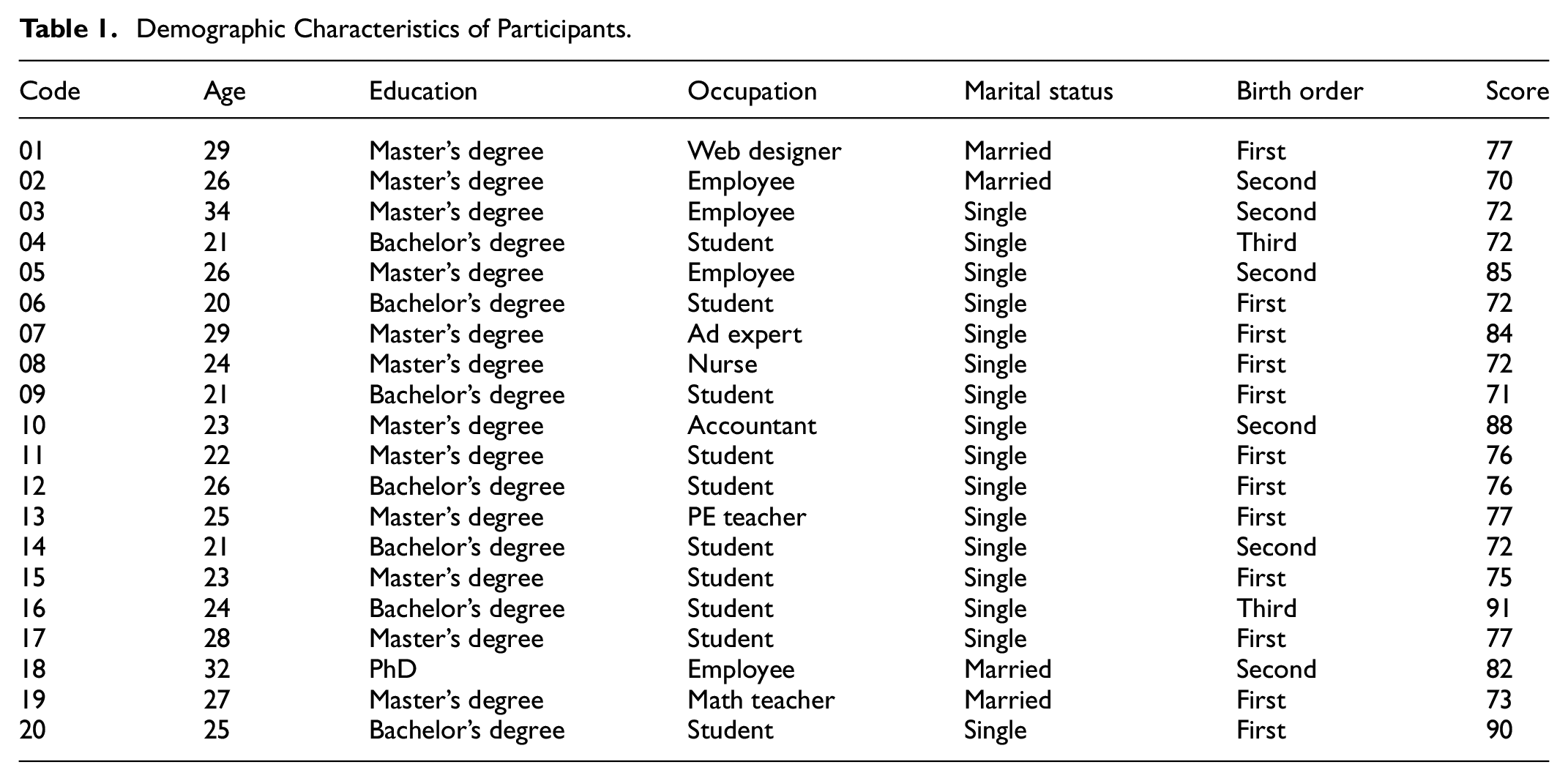
The mean age of the participants was 25.3 years. The mean score of the participants’ Schadenfreude was 77.6. Table 1 shows the participants’ demographic characteristics.
Demographic Characteristics of Participants.
According to the thematic network extracted in the present study (Figure 1), the nature of self-esteem of women in this study consisted of three main themes: personal perception, developmental experiences, and presenting factors affecting self-esteem. Each of the three main themes included five subthemes. Under the main theme of personal perception, the subthemes identified were existence, self-confidence, maintaining values, relationships, and capabilities. The subthemes related to developmental experiences included the need for independence and freedom, the need to be valued, the need for respect, the need for balance and compatibility, and the need for communication and intimacy. Presenting factors affecting self-esteem included psychological issues, behavioral characteristics, social and economic factors, acquired and situational factors, and attributive and cultural factors. Each theme and its subthemes will be explained in more detail later.

The thematic network extracted in this study.
Personal Perception
The thematic analysis revealed that for most participants, self-esteem was an unfamiliar concept. However, all the participants considered self-esteem to be an effective and positive characteristic. Some participants had come to a better understanding of it through studying and searching online. The following themes reflect the participants’ perceptions of self-esteem:
1. Existence: Existence refers to self-worth, self-acceptance, and autonomy. The participants explained having self-worth, accepting oneself, and being autonomous as the meaning of having self-esteem. One participant stated, “When a person has a high level of self-esteem, she can better manage her mind to make more effective decisions because she knows that she has the knowledge and information and can make the right choice, but when she doesn’t have a high self-esteem, she tends to rely on other people’s opinions” (P #16, 24 years old).
2. Self-confidence: This theme includes “opposite to self-confidence” and “equivalent to self-confidence.” Two groups of participants were identified based on their responses to the question, “What comes to your mind when I say self-esteem?” Both groups associated the term “self-confidence” with self-esteem, but they differed in their understanding of the concepts. One group viewed self-esteem and self-confidence as equivalent, finding it confusing to distinguish between the two. They primarily defined self-esteem as the belief in oneself and one’s abilities, which aligns more closely with self-confidence. The other group recognized that self-esteem is different from self-confidence. They defined self-esteem as the extent to which one appreciates and values oneself. For example: “I rarely consider myself worthless. Maybe my self-confidence is low, but my self-esteem is high” (P #13, 25 years old).
3. Maintaining values: Maintaining values refers to “the preservation of moral and personal values,” as well as “the preservation of pride and dignity.” Most of the participants believed that breaking morals and values or allowing others to belittle them means not having self-esteem and can make them feel bad about themselves. One participant said, “Self-esteem means not letting someone humiliate you and your values or treat you as if you are inferior to them, and not letting someone question you or insult you in different situations” (P #2, 26 years old).
4. Relationships: This theme accounted for proper behavior with others and the ability to interact. Some participants believed self-esteem means being able to socialize and behave well with others. For example, one participant stated, “A person should communicate well with others, not be too shy, and be able to express themselves. Self-esteem means engaging in social activities, expressing yourself in gatherings, and not being too shy” (P #14, 21 years old).
5. Capabilities: The participants defined this theme by referring to responsibility, crisis management, and persistence. According to them, taking responsibility, having the ability to manage difficulties, and persisting in goals mean having high self-esteem. For example, one participant said, “I think people who do sports, that is, athletes, have high self-esteem. I think having good self-esteem means being able to keep trying and persevere, even when facing failure, and fight again. People who exercise and keep trying even when they fail have a high level of self-esteem” (P #4, 21 years old).
Developmental Experiences
The participants reported some developmental experiences and believed that they have contributed to the formation of their self-esteem. The experiences took place in contexts such as family and school, where the children spend most of their time. They are related to some basic needs of children and adolescents. The participants contended that some of their psychological needs were not met when they were children and adolescents. The following themes show the participants’ developmental experiences that have a major effect on the formation of their self-esteem:
1. The need for independence and freedom: The need for independence and freedom includes the experiences in childhood and adolescence that deprived the participants of their needs of being independent and free, such as following mandatory orders from parents and mandatory school rules. For example, one of them said, “My father is a very rigid person and we cannot criticize him at all. He is a dictator and makes all the decisions. His authoritarian character adversely affected me because I never had any power of choice when I was a child” (P #4, 21 years old). Another participant stated, “In Iranian schools, disciplinary problems and some trivial rules make school children develop personality problems. I remember I was the top student in the class, but the school officials did not allow me to attend the exam session because of my long nails. Thus, I got anxious and started crying” (P #11, 22 years old).
2. The need to be valued: The participants stated that in order to have a sense of self-value, they need to “instill a sense of self-value,” receive “verbal support from parents,” and not be exposed to “comparison by parents and teachers.” They narrated that they had not experienced the above-mentioned experiences in their developmental stages, and they believed that these factors had an impact on their lack of self-esteem. For instance, one of them said, “For me to succeed, my mom used to compare me more with the people around me. If she did not do that, I could have had better performance and self-esteem” (P #19, 27 years old).
3. The need for respect: The need for respect is affected by teachers’ inappropriate behavior, reprimanding siblings, and harassing peers. Most of the participants stated that facing the inappropriate behavior of others harmed their self-esteem; however, their expression of those behaviors in front of others and in public places affected them more severely. One of them narrated, “If I had a weakness, especially in math, I was always scolded, insulted, and humiliated. Not only me, but also everyone in that class was admonished for their poor performance in both middle school and high school. Thus, I was completely depressed because of the teachers’ insults and I decided not to go to school anymore” (P #16, 24 years old).
4. The need for balance and compatibility: This theme was defined by strict parental expectations, academic pressures, and parental conflicts, which caused the participants too much stress, leading to their low self-esteem. All the women stated that these factors had disturbed their lives during their childhood and adolescence and made them feel unworthy. A participant declared, “Parents who complain a lot affect children’s self-esteem. My mother was very strict. Once I spilled some pieces of my crayons on the carpet. My mom got mad and threw all my crayons in the dustbin. Or even when I got a good grade, say, 19.75 out of 20, she blamed me. Thus, I always tried hard to keep my mom happy” (P #8, 24 years old).
5. The need for communication and intimacy: This theme was influenced by the lack of communication with peers and lack of intimacy with parents, which had a major impact on the participant’s self-esteem. One of them mentioned, “Children at school are very sensitive. The smallest thing can bring down their self-esteem. The three of us were friends and we were very close to each other. Then, my two friends stopped having any relationship with me and this affected me a lot. I thought that I was lost in school because I only had contact with them and I could not make new friends. It affected me a lot” (P #9, 21 years old).
Presenting Factors Affecting Self-Esteem
The participants stated that various factors were involved in causing their self-esteem to fluctuate. Some factors highlighted by them improved their self-esteem and some others decreased it. The following themes display the presenting factors affecting their self-esteem:
1. Psychological issues: The psychological issues were defined by five factors, including self-blame, fear of failure, inadequacy, feelings of inferiority, and negligence, which severely affect participants’ self-esteem. They stated that these factors lower their self-esteem. One participant stated, “There is a person inside me who criticizes me. I think that if there is no self-blame, one’s self-esteem will increase” (P #8, 24 years old). Another participant said, “When I enter a place, I feel that others are better than me now and they understand much more, and this lowers my self-esteem” (P #6, 20 years old).
2. Behavioral characteristics: The participants highlighted two behavioral characteristics: “perfectionism” and “selfishness,” which could negatively impact their self-esteem. All participants identified perfectionism as their defining characteristic. They expressed a strong desire to be the best and struggled to accept when someone surpassed them. For example, one participant stated, “I always like to be better than others, and it makes me nervous when someone talks about how talented and good someone else is. I don’t like someone to be superior to me and this is very terrible. It makes me nervous” (P #15, 23 years old).
3. Social and economic factors: The participants reported several social and economic factors that affected their daily lives, including communication, public attitudes and judgments, belongingness, social competitiveness, and social and economic class. However, the most frequently reported factor by the participants was social competitiveness, indicating that they constantly compare themselves with others. They stated that these factors have an impact on their self-esteem. One participant shared, “I compare myself a lot, especially with people who are in a position that I would like to achieve, are the same age as me, or have a relationship with me, and it makes me feel bad” (P #5, 26 years old). Another participant expressed, “It is important to me what other people think about me. They comment on the smallest things like clothes, appearance, face, and character. Thus, when they say something about me, I quickly try to address that issue, and it significantly affects my life” (P #10, 23 years old).
4. Acquired and situational factors: This theme refers generally to the changeable situations and temporary conditions that can impact participants’ self-esteem. These conditions may have been created by the individuals themselves or they may have found themselves in them temporarily. This theme included achievements and losses, changes, cyberspace, and freedom and independence. One of the participants stated, “I have low self-esteem when I think that I don’t have the things I want, or I want to be in a certain position at this age, but I’m not, or when I think about my failures in love” (P #3, 34 years old). Another participant stated, “Cyberspace is poisonous. Especially on Instagram, you see a bunch of people who are all perfect, but you aren’t even one percent as good as they are. This makes you unhappy with yourself” (P #14, 21 years old).
5. Attributive and cultural factors: This theme refers to the factors that the participants are born with and recognized by, which are not easily changeable and influence participants’ self-esteem. Nationality, gender, and appearance are the attributive and cultural factors mentioned by participants that affect their self-esteem. They believed that feeling insecure about their appearance, the country they were born in, and being a woman per se reduced their self-esteem. However, “appearance” was the most frequently reported factor by the participants. One of them stated, “When a person is born in a country like Iran, it may be strange, but they are constantly humiliated. When you communicate with people from other countries, you are constantly humiliated and this reduces your self-esteem” (P #16, 24 years old). Another one said, “I feel that women fail more often which means their self-esteem is lower. They react more emotionally. When they behave more emotionally, I think their self-esteem is lower” (P #17, 28 years old).
Discussion
The present study adopted a qualitative thematic analysis method to gain a deep understanding of the misconceptions surrounding self-esteem and the factors influencing its formation and alteration by exploring the lived experiences of educated Iranian women who experience Schadenfreude. Since the incidence of Schadenfreude differs between women and men—women typically form more intimate relationships and are generally more willing to express their emotions (Vigil, 2007)—it may be more effective to examine women and men with Schadenfreude separately for enhanced clarity. This study focused on women; therefore, it is important to note that the findings cannot be generalized to men. Additionally, research indicates that individuals with higher levels of education often report greater self-esteem (Crocker & Wolfe, 2001). Educated women may have different experiences and perceptions regarding self-esteem compared to those with lower educational levels. They often encounter diverse life experiences, including professional, social, and educational challenges, all of which can significantly impact their self-esteem. Consequently, educated women may develop a broader perspective on the factors that influence their self-esteem compared to less-educated women. Highlighting these factors not only enriched the findings of this research but is also valuable for advocacy and educational programs aimed at empowering girls and young women.
The thematic network extracted involved three main themes that shed light on the nature of self-esteem in women with Schadenfreude in this study. The main themes were personal perception, developmental experiences, and presenting factors affecting self-esteem, which included 15 subthemes.
A. Personal perception: The findings indicated that some participant’s perceptions of self-esteem aligned with the definitions provided by experts (Orth & Robins, 2014). They defined self-esteem as the extent to which one appreciates and values oneself, but they also highlighted additional aspects such as independence from others. For some participants, the distinction between self-esteem and self-confidence was unclear. They defined self-esteem as the belief in oneself and one’s abilities, which aligns more closely with self-confidence. It is important to keep this in mind when examining the next two themes. The overlap of these two concepts, combined with the lack of effective training programs on self-esteem may contribute to the difficulty in distinguishing between them. The subtheme “Maintaining Values” aligns with Branden’s concept of personality integrity (Branden, 2001), while the subtheme “Capabilities” corresponds to the conceptualization of personal responsibility and purposeful life mentioned by Branden (2001). Most of the participants perceived their self-esteem as low. This finding supports the notion that low self-esteem contributes to the development of Schadenfreude (Van Dijk et al., 2011).
B. Developmental experiences: Developmental experiences included five themes: the need for independence and freedom, the need to be valued, the need for respect, the need for balance and compatibility, and the need for communication and intimacy. The results indicate that failing to meet certain developmental needs can significantly impact the formation of self-esteem. The findings are consistent with Adler’s theory (Abramson, 2015), the social learning theory (Bandura, 1992), and previous research documenting the important role of family context (Martinez et al., 2021) and years of socialization on damaged self-esteem (Chen et al., 2024; García et al., 2024). The results are also consistent with studies highlighting the connection between early family experiences—specifically parental responsiveness and demandingness—and psychosocial adjustment during young adulthood (Reyes et al., 2023; Villarejo et al., 2023). Constant exposure to negative evaluations, lack of parental love, affection, support and responsiveness could contribute to diminished self-confidence and abilities, resulting in low self-esteem (Chen et al., 2024; García et al., 2024; Schultz & Schultz, 2016),According to the present study, and contrary to some previous work (Dwairy et al., 2006), women in this study appeared to have been raised by authoritarian parents who were characterized by being very uninvolved, uncaring, and unreasoning (low responsiveness), as well as being strict, controlling, and using guilt as a corrective strategy (high demandingness) so they seem to struggle with a lack of warmth, support, and love (Reyes et al., 2023; Villarejo et al., 2023). In this context, individuals may compensate for the psychological pain associated with feelings of worthlessness—resulting from neglect and comparison—by deriving happiness from the failures and pain of others, viewing it as a salve that alleviates their suffering (Epstein, 2008).
Additionally, according to Allport (1937), a child needs independence to grow and prosper; however, if this need is unmet, they may become insecure and jealous, hindering their self-esteem development (Allport, 1937). Beyond adolescence, adult children must confront adult responsibilities, such as university studies, without parental supervision and support (García et al., 2024; Máñez et al., 2024), while strict family and school rules may stop a child’s flourishing and creativity. Consequently, a person who has faced failure may wish for others to fail, as well, experiencing pleasure from their misfortunes. The results also showed that women in this study may fear of facing negative evaluations in front of others such as peers. Consequently, witnessing others’ failure may provide them with a sense of companionship in suffering, leading to feelings of Schadenfreude. On the other hand, women in this study reported lacking a sense of belonging to people or groups, which might be due to the insufficient affection and intimacy during their development, which hinders their ability to express empathy. As a result, they tend to express higher levels of Schadenfreude (Greenier, 2018).
C. Presenting factors affecting self-esteem: Presenting factors affecting self-esteem included five themes: psychological issues, behavioral characteristics, social and economic factors, acquired and situational factors, and attributive and cultural factors. The findings are consistent with Branden’s (2001) suggestion about how self-criticism harm self-esteem and contradict the findings of Erzi (2022), James et al. (2014), and Yee and Lee (2022) on the relationship between dark triad personality and self-esteem. The findings of this study imply that these women may have faced blame, fear of failure, feelings of inadequacy and inferiority, as well as neglect and inattention. Consequently, they struggle to meet their needs for self-esteem, a sense of mastery and belonging, and a meaningful life, leading them to seek satisfaction through Schadenfreude (Brambilla & Riva, 2017). Schadenfreude may also signal that the threat posed by rivals is lowered (Abell & Brewer, 2018).
The present study indicated that “social and economic factors” influence the self-esteem of women in this study, as supported by social learning theory and Leary’s sociometric theory (Bandura, 1992; Perinelli et al., 2022). Expressed Schadenfreude appears to disrupt the participants’ social relationships (Pietraszkiewicz & Chambliss, 2015). Furthermore, they may encounter communication difficulties that reduce empathy and increase schadenfreude (Greenier, 2018). Additionally, low economic status limits access to resources and hinders the fulfillment of biological needs. Consequently, individuals become trapped at the physiological needs stage of Maslow’s Hierarchy of Needs and struggle to progress to higher stages, such as fulfilling the need for self-esteem (Schultz & Schultz, 2016).
According to the findings “acquired and situational factors” impact the self-esteem of women in this study. Participants may experience a decrease in self-esteem due to a lack of independence and freedom, which hinders their ability to develop capabilities and leads to Schadenfreude (Van Dijk et al., 2011). Moreover, observing the luxurious lives of others on online platforms poses a threat to one’s self-concept and results in decreased self-esteem (Van Dijk et al., 2012). Consequently, individuals may compensate for lower levels of self-esteem by developing Schadenfreude towards others’ failures in both online and real-life settings.
Attributive and cultural factors also seem to influence participants’ self-esteem. In terms of gender, it can be suggested that women, compared to men, tend to be less supportive and more critical of their same-sex others, leading to higher levels of relational aggression (Mavin et al., 2014). Therefore, reactive relational aggression could be a cause of Schadenfreude (Erzi, 2022).
Finally, participants did not view self-esteem as a fixed characteristic. Instead, their self-esteem depended on the presence or absence of certain factors and the achievement of specific values and criteria. Hence, their self-esteem appeared to be state self-esteem (Watanabe, 2019; Van Dijk et al., 2011) or contingent self-esteem (Nagel, 2010). Overall, it can be suggested that the potential psychological benefits associated with Schadenfreude may serve as a defense mechanism activated by a damaged self in individuals with low self-esteem, although research is needed to investigate this suggestion
Conclusion
Overall, the findings of this study indicate that individuals have varying perceptions of self-esteem shaped by their mental frameworks. However, there is a lack of understanding regarding the concept of self-esteem, necessitating education and awareness initiatives led by professionals, educational institutions, and mass media. Policymakers should consider funding programs that promote mental health awareness and resilience-building in schools and communities. By prioritizing mental health education, we can equip individuals with tools, such as emotional regulation skills, to effectively manage negative emotions.
The unmet developmental needs of participants highlights the need for teachers and parents to be aware of the developmental requirements of children and adolescents. Training workshops for educators and parents can focus on fostering inclusive environments that celebrate individual achievements while promoting collaboration and support among students, thereby reducing competitive feelings that often lead to Schadenfreude.
The findings of this study can be used to raise awareness among the general population and to develop effective interventions that address the factors contributing to the reduction or prevention of Schadenfreude. Cognitive-bahavioral therapy techniques can be employed to help individuals recognize and reframe their thoughts associated with Schadenfreude. Therapists can guide clients in developing healthier coping strategies and fostering a more positive self-image.
It is important to note that this study did not include men and the participants were selected from educated women in Tehran, so the results cannot be generalized to the whole population. Future studies may consider men, individuals without academic education or people in different regions and cultures.
Footnotes
Acknowledgements
The authors would like to express their gratitude to all the participants who contributed to completing this research project.
Ethical Considerations
This study was approved by the Research Ethics Committee of Shahid Beheshti University (Approval no. IR.SBU.REC.1401.074) on September 10, 2022. All methods were carried out following this ethical approval.
Consent to Participate
Participants gave written consent for review and signature before starting interviews. All the participants’ information had been anonymized.

Funding
The authors received no financial support for the research, authorship, and/or publication of this article.
Declaration of Conflicting Interests
The authors declared no potential conflicts of interest with respect to the research, authorship, and/or publication of this article.
Data Availability Statement
Data sharing not applicable to this article as no datasets were generated or analyzed during the current study.