




Abstract
This study aimed to explore the direct effect of emotional intelligence on the meaning in life from the positive psychology perspective and to verify whether the sense of security and self-esteem can improve the meaning in life based on Maslow’s hierarchy of needs theory. It involved 599 undergraduates selected randomly from four universities located in Wuhan, Hubei Province, China. The study applied structural equation modeling to illustrate the mediating and chain-mediating effects of the sense of security and self-esteem on the relationship between emotional intelligence and meaning in life. Notably, the results showed a strong mediating effect of a sense of security. These findings provided a new perspective and theoretical model for positive psychology to improve the meaning in life among undergraduates.
Introduction
Positive psychology is the scientific research of positive experiences and emotions and promotes personal development (Seligman & Csikszentmihalyi, 2014). Positive psychology explores individuals’ positive psychological qualities and helps them pursue a positive, meaningful, and happy life (Compton, 2005).
Frankl (1984) indicated that human beings are motivated primarily by the search for life’s meaning and goal. Meaning in life provides a sense of significance that extends beyond the individual, encompassing both the pursuit of meaning and its presence (Steger et al., 2006). The absence of meaning in life represents a unique form of emotional, cognitive, and spiritual suffering, which can impair individuals’ ability to study, work, and create (P. T. Wong, 2016). For undergraduates, it’s important to have high intelligence quotients (IQ), aspirations, and self-esteem, and to believe that life holds meaning (Lew et al., 2019). Undergraduates should establish life goals, actively seek and experience the meaning of life, and realize their self-worth (Hughes & Lomas, 2021). However, a significant amount of research data indicates that 9.7% to 22% of undergraduates worldwide have had suicidal ideation because of the absence of meaning in life (e.g., a survey in April 2020 found that 12.8% of Bangladeshi undergraduates had suicidal ideation; in a study in Northwest Ethiopia, 14% of medical students reported suicidal ideation; Desalegn et al., 2020; Rentería et al., 2021; Tasnim et al., 2020; Veloso et al., 2019). Furthermore, a meta-analysis has reported that the overall prevalence of suicidal ideation among undergraduates in China was 10.72% (Z. Z. Li et al., 2014). Lew et al. (2020) have recognized that meaning in life can serve as a strong defensive factor against suicidal behaviors. Therefore, it is crucial to study how to improve undergraduates’ meaning in life.
Emotional intelligence (EI) is vital important to positive psychology (Bar-On, 2010). EI significantly impacts happiness, well-being, and the exploration of a more meaningful life, which are important research topics in positive psychology (Seligman & Csikszentmihalyi, 2014). Goleman (2020) even suggests that the key to a person’s success is EI rather than IQ. EI refers to the ability to adaptively appreciate, regulate, and utilize emotions in oneself and others (Schutte et al., 1998). Individuals with high EI have stronger abilities to integrate emotional information, pursue higher life goals, facilitate meaningful lives, and are more likely to succeed in learning (Estrada et al., 2021; C. S. Wong & Law, 2017). This study proposes Hypothesis 1: EI positively predicts meaning in life.
Furthermore, people’s sense of security have been diminished by climate change in recent years and the frequent occurrence of global public health crises (Chakraborty & Maity, 2020; Clayton, 2020). If individuals lack the sense of security, high EI can assist them in promptly dealing with negative emotions and effectively managing external risks (Koole, 2009). Cong and An (2004) discovered that a sense of security is the anticipation of potential physical or psychological dangers or risks, influencing an individual’s perceived ability to cope with and address these threats. People with a strong sense of security can better reduce negative emotions, approach life more positively, and find meaning in life (Feng & Zhong, 2021; Goodman et al., 2018). Therefore, this study posits Hypothesis 2: Sense of security can mediate the relationship between EI and meaning in life.
People with high EI could better understand and manage their emotions, resulting in a more positive self-evaluation and higher self-esteem (Rey et al., 2011; Schutte et al., 2002). Self-esteem refers to an individual positive or negative attitude towards himself/herself (Wang et al., 2010). Schutte et al. (2002) state that self-esteem is the product of an emotional process of understanding, and regulating the emotional component, which may contribute positively to self-evaluation. According to the meaning maintenance model, self-esteem indicates individuals’ meaning in life, as individuals acquire self-esteem to uphold their meaning in life (Heine et al., 2006). High self-esteem enables individuals to evaluate themselves positively, tolerate their own and others’ shortcomings, seek personal change, respond flexibly to events, and feel more in control of their lives, enhancing their meaning (M. Chen, 2022). Consequently, this study puts forward Hypothesis 3: Self-esteem can mediate the relationship between EI and meaning in life.
Given Maslow’s Hierarchy of Needs theory, when individuals’ sense of security needs are met, they can fulfill the need for self-esteem, ultimately experience meaning in life, and achieve self-actualization (Wu, 2016). With this in mind, this study presents Hypothesis 4: The sense of security and self-esteem play a chain-mediating role in the relationship between EI and meaning in life.
To sum up, positive psychology proposes that by cultivating the self-emotional management ability of individuals in distress, it is possible to effectively prevent mental illness and enable individuals to face life more positively (X. Li et al., 2021). As a result, the study aims to examine the direct effect of EI on the meaning in life and the mediating and chain-mediating effect of the sense of security and self-esteem on the relationship between EI and meaning in life, given the positive psychology perspective. By examining these relationships, the study intends to improve undergraduates’ meaning in life and assist them in recognizing their self-worth. Furthermore, the research model is illustrated in Figure 1.

Research model.
Literature Review
EI and Meaning in Life
EI influences people’s subjective well-being and perception of the meaning in life; people with high EI have a stronger perception of meaning in life (Vess et al., 2018). People with high EI can better manage their emotions, form positive relationships, and pursue more meaning in life (Bar-On, 2010). EI is a form of social intelligence that predicts success in specific areas such as education and job performance; it can ensure a person’s sense of achievement, meaning in life, and well-being (Adetula, 2016).
EI and Sense of Security
Individuals with high EI can adjust their emotions when they encounter external stimuli in order to regain a sense of security (Koole, 2009). According to Manoj and Prasad (2017), individuals with high EI are adept at processing emotional information, maintaining happiness, and boosting their self-confidence and sense of security. Additionally, when a person feels frustrated and wronged, appropriate emotion regulation and effective use of emotions can help restore the lost sense of security (Knopp, 2016). Furthermore, high levels of appraisal and expression of emotion can improve intimacy with others, enhance individual sense of security, and reduce feelings of fear and loneliness (Reis, 2018).
EI and Self-Esteem
EI is associated with positive emotional states and high self-esteem (Gao et al., 2021). Martín et al. (2021) recognize that adolescents with high scores in all aspects of EI experience more positive emotions and can effectively manage negative emotions in challenging situations, thereby facilitating healthy self-concept and self-esteem development. Additionally, Yıldırım et al. (2017) find that effectively coping with and resolving external conflicts through rational emotion management is associated with good self-esteem.
Sense of Security and Meaning in Life
The sense of security is a feeling of stability and peace, essential for understanding the meaning in life and finding happiness (Jin & Tao, 2018). Goodman et al. (2018) suggest that when adolescents feel insecure, they may not explore their future purpose and the meaning in life. Individuals in safety can fully unleash their potential, create more wealth, experience more meaning in life, and gain more happiness (Feng & Zhong, 2021). People with a strong sense of security usually retain stable and positive intimacy with others, experience less isolation and abandonment from the world, and feel more meaning in life and well-being (Greco & Polli, 2021).
Self-Esteem and Meaning in Life
Individuals with low self-esteem often experience health and psychological disorders, lack a sense of purpose in life, and have a negative worldview (Cameron & Granger, 2019; Trani et al., 2020). Individuals have ways of interpreting their achievements and failures; individuals with high self-esteem perceive things more positively and rationalize things, and they have a greater aspiration to find meaning in life than those with low levels of self-esteem (Heine et al., 2006). Additionally, people with healthy self-esteem tend to be more open, understanding, and empathetic toward others, which can enhance their meaning in life by fostering deeper connections with them (Huang et al., 2019; Walsh, 2020).
Sense of Security and Self-Esteem
Given Maslow’s Hierarchy of Needs theory, some researchers propose that safety is a basic need, and individuals who have a sense of security that is met can work toward the fulfillment of needed self-esteem (Tahir, 2021; Wu, 2016). An insecure person shows low self-esteem and might be reluctant to interact with or compliment others (Taaffe & Taaffee, 2022). A person with a high sense of security believes that he/she can handle all challenges, readily accept themselves, show high self-esteem and self-love, and bravely pursue well-being and realize self-worth (Wu, 2016).
Methods
Participants
This study’s participants were undergraduates from four universities in Wuhan, Hubei Province, China. These universities are the top four universities in Wuhan in China in the 2022 Nature Index, including Wuhan University (WHU) at 37th, Huazhong University of Science and Technology (HUST) at 51st, China University of Geosciences (CUG) at 170th and Wuhan University of Technology (WUT) at 296th, there are five wide fields of biological sciences, chemistry, Earth and environmental sciences, health sciences, and physical sciences in Nature Index (2022). In addition, the Department of Education of Hubei Provincial also attaches great importance to all statistics published by the Nature Index (Department of Education of Hubei Provincial, 2023). Therefore, this study randomly selected 32 undergraduates from each of the five majors in these four universities and sent questionnaires to him/her; that is, 160 undergraduates were selected from each university, and a total of 615 questionnaires were returned (25 questionnaires were not returned within the specified time). In addition, by removing invalid questionnaires, 599 valid questionnaires were finally retained, with a recovery rate of 93.6%. The guidance instructions for each questionnaire were consistent, and we emphasized to the participants that they answered truthfully according to their circumstances and promised to the participants that their personal information would be kept confidential and would never disclose personal information. All the participants answered an informed consent in which they were granted permission to use the information collected through this study only for scientific and academic purposes. The specific demographics of participants are shown in Table 1.
Demographics of Participants.

Measures
The Meaning in Life Questionnaire (MLQ; see Appendix A) developed by Steger et al. (2006) consisted of two dimensions, including the Search for Meaning in Life (SML) and the Presence of Meaning in Life (PML). MLQ is reliable and valid when applied to Chinese adolescents (Wang & Dai, 2008). Each dimension of MLQ had five items. The items were rated along a 7-point Likert-type scale (from 1 = absolutely untrue to 7 = absolutely true). Responses across items were calculated mean after reverse coding to compute the dimension score, with higher scores indicating a stronger search for or presence of meaning. In this study, Cronbach’s α was respectively .92 and .94 for the SML and PML dimensions, and the overall Cronbach’s α was .93. Moreover, the average variance extracted (AVE) and construct reliability (CR) of the MLQ were explored using confirmatory factor analysis (CFA). AVE of two dimensions was from 0.701 to 0.763, and CR was from 0.920 to 0.941.
Schutte et al. (1998) developed the EI scale, which has been revised by Liu (2008). When applied to Chinese undergraduates, the revised EI scale shows good reliability and validity (C. Chen et al., 2021). Liu (2008) indicates that EI includes five dimensions (see Appendix B), which are Appraisal and Expression of Emotion in the Self (AEES) and Others (AEEO), Regulation of Emotion in the Self (RES) and Others (REO) and Utilization of Emotions in Solving Problems (UESP). There are 21 items in the EI scale, of which AEES has four items, AEEO has five items, RES has three items, REO has six items, and UESP has three items. The items are rated along a 5-point Likert-type scale (from 1 = strongly disagree to 5 = strongly agree). Responses across items are calculated mean to compute the dimension score, with higher scores indicating higher EI. In this study, Cronbach’s α is respectively .89, .91, .86, .88, and .81 for the AEES, AEEO, RES, REO, and UESP dimensions, and the overall Cronbach’s α is .94. In addition, AVE of five dimensions is from 0.531 to 0.678, CR is from 0.816 to 0.910.
The Sense of Security Scale (SSS; see Appendix C) consists of two dimensions, including a sense of certainty and control (Cong & An, 2004). Each dimension of SSS has eight items. The items are rated along a 5-point Likert-type scale (from 1 = absolutely true to 5 = absolutely untrue). Responses across items are calculated by mean to compute the dimension score, with higher scores indicating a stronger sense of certainty and control. In this study, Cronbach’s α is respectively .89 and .91 for the sense of certainty and control dimensions, and the overall Cronbach’s α is .92. Furthermore, AVE of two dimensions is from 0.486 to 0.558, CR is from 0.882 to 0.909.
The Self-Esteem Scale (SES; see Appendix D) for this study is developed by Rosenberg (1989) and revised by Wang et al. (2010). When applied to Chinese undergraduates, the revised EI scale shows good reliability and validity (Gao et al., 2021). SES is composed of five positively items and five negatively items. The items are rated along a 4-point Likert-type scale (from 1 = strongly disagree to 4 = strongly agree). Responses across items are calculated mean after reverse coding five negatively keyed items to compute the dimension score, with higher scores indicating stronger self-esteem. In this study, Cronbach’s α is .92. Additionally, AVE is 0.518, and CR is 0.904.
In summary, all the Cronbach’s α > .70, reaching the expected value (Nunnally & Bernstein, 1994). Fornell and Larcker (1981) illustrate that when AVE is higher than 0.50, CR is more significant than 0.70, the data is suitable, but if AVE is less than 0.50 and greater than 0.40, CR should be more than 0.60, the convergent validity of the construct is still accepted. As a result, all the measurement indicator variables can effectively reflect their corresponding latent variables.
Procedure
The questionnaire survey in this study was carried out 1 week (December 26th, 2022–December 31st, 2022) after the end of the final exam of undergraduates. As undergraduates did not have academic pressure, they will complete the questionnaire survey more effectively. Additionally, the collected data was analyzed by SPSS23.0 and AMOS24.0 in this study.
Results
Descriptive Statistics
This study measured the maximum, minimum, means, standard deviations, skewness, and kurtosis on the main variables. The details are shown in Table 2.
Statistical Results of Variables.
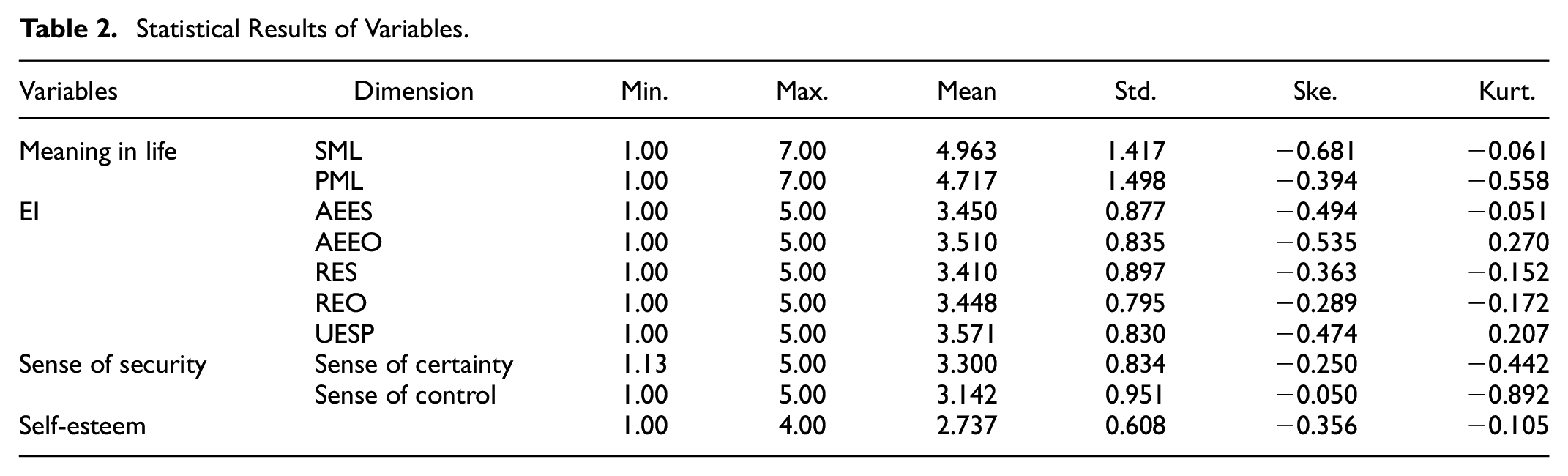
According to the basic principle of normal distribution, the absolute skewness value of the sample data was less than 3, the absolute kurtosis value was less than 7, the sample data was normally distributed (West et al., 1995). In addition, for meaning in life, mean of SML was 4.963, higher than PML (mean = 4.717); for sense of security, mean of sense of certainty was 3.300, mean of sense of control was 3.142.
Correlation
Pearson’s correlation analysis found that AEES, AEEO, RES, REO, and UESP were significantly connected in the five dimensions of EI, sense of certainty and control in sense of security, self-esteem, and SML, PML for meaning in life. As shown in Table 3, the highest correlation is observed between AEEO and SML (r = .371, p < .01), AEEO in EI has the highest correlation with sense of certainty (r = .264, p < .01), sense of control (r = .307, p < .01), and self-esteem (r = .351, p < .01).
Correlations Among Variables.
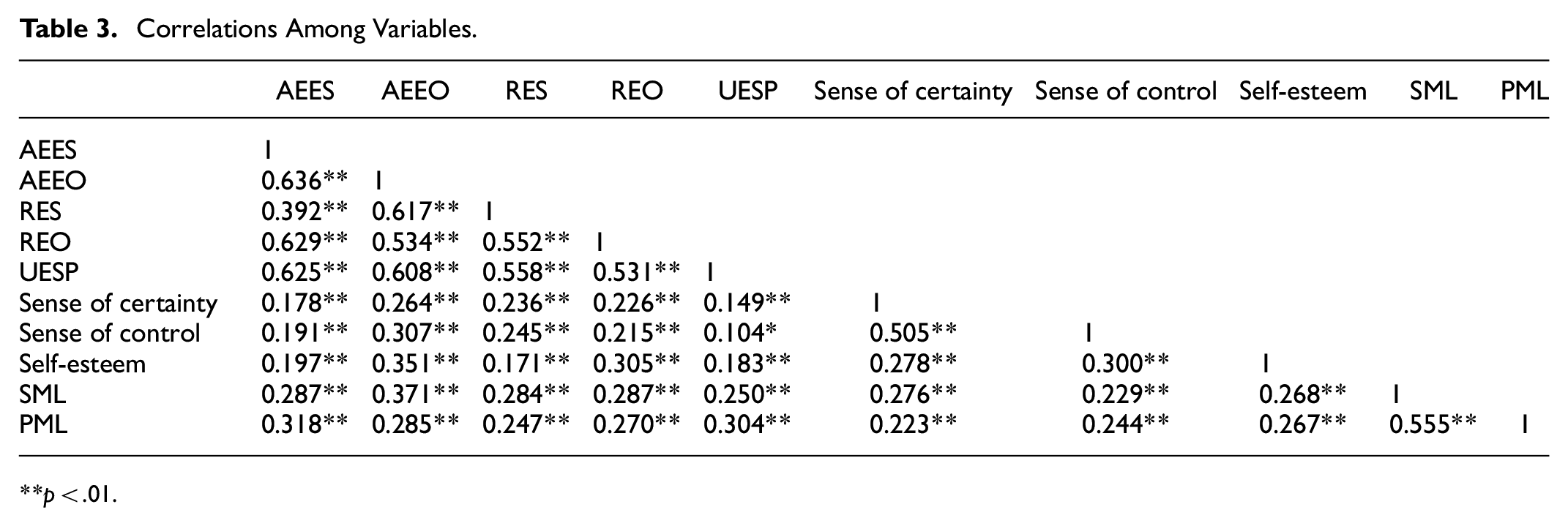
p < .01.
Research Model Test
This study utilized structural equation modeling analyses to illustrate the mediating effect and chain-mediating effect of the sense of security and self-esteem. It can be seen from Table 4, the fit of the research model for all the samples was χ2/df = 2.543 < 3 (p = .000), CFI = 0.923 > 0.90, TLI = 0.905 > 0.90, RMSEA = 0.051 < 0.08, which met the acceptance criterion (Steiger, 1998).
Fit Indices for the Research Model.

p < .001.
As shown in Table 5, all the path coefficients were significant. Specifically, EI had a significant positive direct effect on meaning in life (β = .339, p < .001), and had a significant positive predictive effect on sense of security (β = .379, p < .001), self-esteem (β = .152, p < .01). Furthermore, sense of security had a significant positive predictive effect on self-esteem (β = .334, p < .001), meaning in life (β = .268, p < .001) and self-esteem had a significant positive predictive effect on meaning in life (β = .179, p < .001).
Significance Verification for the Research Model.

p < .01. ***p < .001.
This study applied bootstrapping to test the mediating effect and chain-mediating effect of the sense of security and self-esteem on the relationship between EI and meaning in life, and the sampling times were 2,000. As seen in Table 6, the total indirect effect of self-esteem and sense of security on the relationship between EI and meaning in life was 0.762. Two indirect paths were significant when examining the mediating effects for the sense of security and self-esteem separately: EI → sense of security → meaning in life (Estimate = 0.158, p < .01, 95% CI [0.088, 0.287]) and EI → self-esteem → meaning in life (Estimate = 0.042, p < .01, 95% CI [0.017, 0.105]). When examining the chain-mediation effect of the sense of security and self-esteem, the path was also significant (Estimate = 0.035, p < .01, 95% CI [0.016, 0.076]). The confidence interval did not contain 0, indicating that the sense of security and self-esteem were key mediator between EI and meaning in life.
Mediation Effect Test of Structural Model.

Discussion
This study analyzed the effect of EI on the meaning in life. It expanded previous research by exploring the potential mediating and chain-mediating roles of self-esteem and the sense of security in this relationship.
Firstly, Hypothesis 1 was verified that EI positively predicted meaning in life. The finding that higher EI predicted higher meaning in life was consistent with the ones of C. S. Wong and Law (2017). EI is a concept within positive psychology, emphasizing the use of emotions in problem-solving, or emotional regulation. Zeidner and Matthews (2017) note that emotional management is at the core of EI. Besides, Salovey et al. (2008) suggest that “effective emotion regulation strategy includes physical exercise, listening to music, social interaction, cognitive self-management (e.g., giving oneself a pep talk), pleasant distractions (errands, hobbies, fun activities, shopping, reading, and writing).”
Moreover, in this study, AEEO was most correlated with SML. The appraisal and expression of emotion is very important to the survival and development of human beings; it enables people to understand each other, live in harmony with each other, and make people feel that life is meaningful (Vess et al., 2018). Therefore, universities should incorporate positive psychology into the compulsory courses for students to teach them the skills of effective emotional management, appraisal, and expression. In addition, universities can also carry out more outdoor fitness activities and social practice activities to improve students’ EI. Individuals must be optimistic and positive and use their emotions effectively to more fully realize their potential and experience a higher meaning in life (Bar-On, 2010).
Secondly, Hypothesis 2 and 3 verified that the sense of security and self-esteem separately mediated the relationship between EI and meaning in life. The results showed that the sense of security and self-esteem played a partial mediating role between EI and meaning in life; that was, EI could improve the meaning in the life of undergraduates by improving the sense of security (or self-esteem). As shown in Table 6, the mediating effect ratio of sense of security was 20.73%, and the mediating effect ratio of self-esteem was 5.51%; this result reported that the mediating effect of sense of security on the relationship between EI and meaning in life was much greater than that of self-esteem. Webster et al. (2017) indicate that although self-esteem might fluctuate throughout life due to specific daily experiences, it usually remains stable for a long period. Therefore, it is more effective to cultivate the EI of undergraduates through positive psychology to progress their sense of security, and then enhance their meaning in life.
Specifically, the sense of security among undergraduates in this study is not high and is at a medium level, which may be related to COVID-19 in the past 3 years. Numerous studies have found that COVID-19 reduced undergraduates’ sense of security, disrupted their daily lives, and caused academic delays (Hagedorn et al., 2022; Watermeyer et al., 2021). Reis (2018) finds that by managing one’s emotions and expressing more positive emotions, the individual can lessen the impact of negative emotions, become more optimistic, resilient, friendly, tolerant, and more likely to pursue purposeful life goals, for instance, with a spouse or friends having a good conversation could make one feel loved and secure. Cultivating appraisal and expressing personal emotion can enhance mutual intimacy and sense of security.
In addition, in this study, AEEO in EI correlates highest with self-esteem. Branden (2021) illustrates that individuals can improve self-esteem by listening to and understanding the emotions of others and being able to accept and affirm themselves. At present, China has returned to life before COVID-19. Thence, universities should organize more students to participate in social activities. Through effective communication, social activities can suppress undergraduates’ negative emotions, allowing everyone to understand each other, cultivate their awareness of empathy, improve their sense of security and self-esteem, and motivate them to pursue their life goals.
Finally, Hypothesis 4 verified that a sense of security and self-esteem played a chain-mediating role in the relationship between EI and meaning in life. Through the cultivation of EI, undergraduates meet their security needs, then their self-esteem needs, and finally seek personal development and experience the meaning in life. These results support Maslow’s hierarchy of needs theory. In this study, the meaning in life of undergraduates is not high and is at a medium level. Xie et al. (2022) indicate that after the Nationwide Unified Examination for Admissions to General Universities and Colleges (NUEAGUC), many undergraduates in China had a reduced meaning in life and lost their purpose and direction. Chinese social environment has increased everyone’s attention to the NUEAGUC, and many families even set the NUEAGUC as their children’s learning goal (Yu et al., 2018). Therefore, society, schools, and families should pay more attention to the current needs of each student, meet these needs, and make them feel enough sense of security, self-esteem, and motivation to pursue the meaning in life at their current stage.
Conclusion
As anticipated, EI, sense of security, self-esteem, and meaning in life are closely related. In addition, a sense of security and self-esteem play a mediating role and a chain-mediating role between EI and meaning in life. Notably, the mediating effect of a sense of security is very strong. The study validates Maslow’s hierarchy of needs theory and provides a new perspective and research theoretical model for positive psychology. In addition, people with positive self-esteem are more inclined to exhibit empathy toward others; when a person feels secure in their worth and has positive self-esteem, they tend to be more open to understanding and relating to the emotions and experiences of others (Talaifar et al., 2021). When individuals feel empathy, they are more inclined to engage in prosocial behavior (Lim & DeSteno, 2016). This behavior, in turn, can foster cooperation, creating a positive social environment. The combined effect of these factors can lead to a heightened meaning in life as individuals experience their positive impact on others and the larger community. As the OECD emphasizes in the OECD Learning Compass 2030, future education requires cooperation (OECD, 2020).
Moreover, the study has important significance for the intervention of undergraduates’ meaning in life. Universities should strengthen the cultivation of students’ EI and carry out courses on the meaning in life. Schools and families should listen more to the needs of students, communicate more effectively with students, and try their best to meet their needs so that they can pursue and achieve their personal goals at the current stage. Society should create an atmosphere for all students to study happily and pursue their dreams freely; at the same time, we will also be fully prepared for the OECD 2030 Learning Framework.
Footnotes
Appendix
Self-Esteem Scale.

| Items | Strongly disagree | Disagree | Agree | Strongly agree |
|---|---|---|---|---|
| 1. I feel that I’m a person of worth, at least on an equal plane with others. | 1 | 2 | 3 | 4 |
| 2. I feel that I have a number of good qualities. | 1 | 2 | 3 | 4 |
| 3. All in all, I am inclined to feel that I am a failure. | 1 | 2 | 3 | 4 |
| 4. I am able to do things as well as most other people. | 1 | 2 | 3 | 4 |
| 5. I feel I do not have much to be proud of. | 1 | 2 | 3 | 4 |
| 6. I take a positive attitude toward myself. | 1 | 2 | 3 | 4 |
| 7. On the whole, I am satisfied with myself. | 1 | 2 | 3 | 4 |
| 8. I wish I could have more respect for myself. | 1 | 2 | 3 | 4 |
| 9. I certainly feel useless at times. | 1 | 2 | 3 | 4 |
| 10. At times I think I am no good at all. | 1 | 2 | 3 | 4 |
| Reverse-coded: 3, 5, 8, 9, and 10 | ||||
Declaration of Conflicting Interests
The author(s) declared no potential conflicts of interest with respect to the research, authorship, and/or publication of this article.
Funding
The author(s) received no financial support for the research, authorship, and/or publication of this article.
Ethical Approval
This study’s participants were undergraduates from four universities in Wuhan, Hubei Province, China. The guidance instructions for each questionnaire were consistent, and we emphasized to the participants that they answer truthfully according to their personal circumstances, and promised to the participants that their personal information would be kept confidential and would never disclose personal information. All of the participants answered an informed consent in which the participants granted permission to use the information collected through this research only for scientific and academic purposes.

Data Availability Statement
The data used in this research are available upon reasonable request. For access to the data, please contact Nan Luo at luonan206@163.com.
The data are stored securely and will be provided to qualified researchers who demonstrate a legitimate need. Any use of the data should be properly cited and acknowledged.
We are dedicated to promoting transparency and reproducibility in our research and look forward to collaborating with the scientific community.