




Abstract
Low levels of reading self-efficacy and motivation among secondary school students influence their reading engagement and ultimately affect academic performance. The present study investigated the effects of an integrated reading approach on these factors over 16 weeks. The study was conducted at Bariso Dukale Secondary School in Bule Hora Town, involving 106 Grade 11 students who were assigned to the experimental group (n = 54) and the comparison group (n = 52) using convenient sampling through a quasi-experimental design, along with an explanatory mixed-methods approach that uses qualitative data to support the quantitative results. The experimental group received 40 min of weekly integrated reading instruction encompassing an integrated reading approach with exposure to a varied range of reading materials. The comparison group continued with usual reading practices based on classroom textbooks. The effects were measured using pre-and post-tests of questionnaires on reading self-efficacy and motivation, and qualitative interviews. According to the analysis, significant improvements occurred in the reading self-efficacy and motivation of the experimental group (p = .000). Qualitative feedback revealed that students appreciated their experiences with the integrated approach. Overall, the results imply that the integrated reading instruction can build students’ reading self-efficacy and motivation, with future research required across different contexts.
Plain language summary
Self-efficacy and motivation in reading have proven to be a low light among the secondary school students and have a greater impact on the overall performance of these students, rendering them unable to meet the expected interest in reading. The study thus investigated how an integrated reading approach is expected to mitigate the highlighted problems. It was conducted at Bariso Dukale Secondary School in Bule Hora Town among 106 Grade 11 students for 16 weeks. The students were then divided into an experimental group (54 students) and a comparison group (52 students). The experimental sample had classes of 40 min every week by combining both extensive and intensive reading; these further equipped students with various reading materials to keep them engaged. In contrast, the comparison group continued with traditional reading methods, where reading was done, focusing much on texts in class. Pre- and post-tests, questionnaires, and interviews were used to test their impact on reading self-efficacy and motivation in students. The experimental group showed significant improvement regarding self-efficacy and motivation in reading, besides statistical analysis confirming a positive effect (p = .000). In addition to that, students’ feedback through interviews suggested that these activities carried out in an integrated reading approach improved student confidence and participation, rather than being seen as making reading activities enjoyable. These results indicate that the adoption of as wide a range as possible in reading activities within traditional instruction assists in improving the reading ability and motivation of students. The importance of going for such practices in other educational scenarios to understand their benefits better is what the study emphasizes.
Keywords
Introduction
English reading is the central aspect of academic success, particularly in countries like Ethiopia, where English is used officially as a medium of instruction at secondary and tertiary levels (Ministry of Education, 2018). Developing a solid reading proficiency is the most important step toward achieving language ability, developing vocabulary, and understanding academic texts in various subjects (Snow, 2002). Low readers distort information, fall behind in classes, and emerge as non-achievers. Experts not only define reading as the mechanical process of decoding texts but also as the complex action of constructing meaning through various modalities of cognition (Grabe, 2009). In literary contexts, reading becomes a dialogic interaction where readers relate the author’s message to their own beliefs and prior knowledge, making reading a personalized and interpretive experience (Gebremedhin, 1993).
Reading involves an intricate blend of visual decoding, auditory processing, memory retrieval, and sensory engagement. Dictionaries and educational sources describe it as the ability to recognize symbols and understand them through sensory input (Driscoll, 1994; Merriam-Webster, 2021). However, effective reading extends beyond symbol recognition, it requires readers to synthesize information from multiple sources, critically evaluate content, and form new understandings. This higher-order processing fosters personal development, intellectual growth, and independent thinking (Pang et al., 2003). As the learners progress academically, the capacity to read critically and intentionally becomes ever more necessary for continued learning.
Reading and comprehension skills are critical, but students continue to struggle in many lower-income contexts like Ethiopia. A lot of students are not doing well on reading tests, which impacts their education and future opportunities (World Bank, 2019). Some reasons for this include poverty, not enough chances to use language, and weak instructional methods (Melani & Zaim, 2017). While some researchers have looked into how Extensive Reading (ER) and Intensive Reading (IR) each help students, there is not much information on how combining both methods work in Ethiopian schools (Ambatchew, 2003). This shows a need for a new teaching strategy that brings together the best of ER and IR.
Therefore, this study presents the Integrated Reading Approach (IRA), an instructional practice that draws on the advantages of Extensive Reading (ER) and Intensive Reading (IR) to achieve two goals: increasing students’ reading ability and developing a desire to read. The IRA strategy is designed to cultivate Reading Self-efficacy (RSE), students’ self-beliefs of their competence to achieve in reading tasks, and Reading Motivation (RM), students’ desire and enjoyment for reading (Guthrie & Wigfield, 2000). In essence, the research examines the impact of the IRA on Grade 11 students, who are often challenged in reading due to limited independent reading experiences not supported by personalized instruction (Day & Bamford, 2002). Prior research indicated that little to no use of strategic reading practices corresponds with low motivation and poor academic progress (Gambrell et al., 2011; Zimmerman & Schunk, 2011). Furthermore, research indicated that student-centered motivational reading programs are connected to increased student engagement and achievement in secondary school education (Taboada et al., 2009; Wigfield et al., 2004), which justifies employing an active and holistic reading stance such as the IRA.
Literature Review
Integrated Reading Approach and Its Effects on Literacy Development
The integration of intensive and extensive reading forms the integrated reading approach, which enhances learners’ reading proficiency. By balancing deep, focused reading with broad, enjoyable exposure to texts, IRA allows students to develop accuracy and fluency. While IR emphasizes detailed comprehension and vocabulary analysis, ER builds reading strengths, interest, and language learning through context (Grabe & Stoller, 2011). The synergy of these methods addresses literacy needs and creates a foundation for sustainable reading growth.
Krashen’s comprehension hypothesis highlights that language acquisition thrives on comprehensible input, meaningful, understandable language exposure through reading and listening (Krashen, 2003). This theory underpins the value of ER, which immerses students in rich language environments without pressure for immediate mastery. Programs such as “Drop Everything and Read” (DEAR) operationalize this concept by promoting silent, sustained reading for pleasure (Extensive Reading Foundation, 2011). This voluntary engagement helps students absorb vocabulary and grammatical structures naturally, laying the groundwork for more advanced literacy skills.
Extensive reading provides numerous benefits. It improves vocabulary acquisition, reading speed, fluency, and reading confidence (Day & Bamford, 2002). Unlike conventional approaches that emphasize careful analysis, ER encourages a broader engagement with texts, promoting autonomy and enjoyment. Porkaew and Fongpaiboon (2018) noted that ER reduces the instructional burden on teachers while fostering improved outcomes. However, its success depends on resources and motivation, challenges especially noted in Ethiopian studies (Ambatchew, 2003; Endris, 2018; Tekle, 2016). International findings (Bogen, 2019; Suk, 2015) confirm ER’s efficiency, particularly when paired with IR, although consistent implementation requires planning and support (Hanslo, 2016).
On the other hand, Schema theory sheds light on how IR functions. McCormick and Pressley (1997) explain that learners interpret texts by activating prior knowledge, which enhances understanding and memory. IR supports this by encouraging close reading of shorter texts, allowing detailed examination, comprehension exercises, and vocabulary (Aslam, 2003; Nation, 2009). However, IR can fall short if applied in isolation. Melesse (2015) found IR strategies limited in Ethiopia due to poor supervision and insufficient reading skills. Similarly, Erickson (2013) saw small gains in U.S. middle schools. These results imply that while IR promotes focused reading, it requires change and is most effective when complemented by ER.
The dual use of IR and ER creates a dynamic reading environment where structured instruction and autonomous exploration reinforce each other. According to Melani and Zaim (2017), Bogen (2019), and Maipoka and Soontornwipast (2021), an integrated reading model that supports IR learning objectives with ER is recommended. When learners apply skills from IR to independently chosen texts in ER, they experience greater fluency and enjoyment. This cycle not only enhances reading outcomes but sustains learner interest. Studies from Ethiopia (Ambatchew, 2003; Tekle, 2016) suggest that treating ER as complementary to IR helps establish a more motivating, holistic reading program.
Empirical studies substantiate the benefits of the IRA. Al-Homoud and Schmitt (2009), Erfanpour (2013), and Ibrahim and Rawian (2018) found that integrating ER and IR improved vocabulary acquisition, comprehension, and motivation. Rashidi and Piran (2011) emphasized the balance between structured instruction and freedom in reading, while Mart (2015) and Suteja (2019) proposed IRA as a comprehensive model for language learning. Because the methods work well together, students are guaranteed to acquire the analytical skills necessary to decode texts as well as the innate desire to read for pleasure.
A key factor in reading development is the psychological constructs of self-efficacy and motivation. These constructs determine how students engage with texts and surpass challenges in reading. Bandura (2010) argues that self-efficacy determines whether students believe they are capable of achieving reading tasks, while Ryan and Deci (2000) argue that intrinsic motivation cultivates genuine interest and effort. When students are confident in their reading abilities and find reading activities valuable, they work harder at it and therefore perform better. The interplay of motivation and self-efficacy forms a reinforcing cycle, encouraging learners to persist and grow as readers.
An important aspect of successful IRA implementation is establishing the RSE of students. Bandura (2010) defines self-efficacy as one’s expectation of achieving success, which in turn influences their response to challenges. Krashen’s (1982) affective-filter hypothesis holds that self-confidence dampens emotional filters against learning. Students who believe in their reading ability tend to explore texts with more curiosity and perseverance. This study investigates how reading instruction can build RSE, enabling learners to manage reading tasks independently, create optimal reading environments, and enhance comprehension through deliberate strategy use.
Motivation is equally vital in shaping reading behavior and performance. Krashen (1982) highlights the role of motivation in lowering the affective filter and achieving successful language acquisition. Motivated students react more strongly to texts, thus reinforcing reading capability and stimulating interest in reading further. The research assesses whether quality instruction increases comprehension and intrinsic motivation, creating a self-sustaining cycle of growth. When learners associate reading with positive emotions and achievements, they become more willing to explore new material.
Eventually, RM is multifaceted. Ryan and Deci (2000) distinguish between extrinsic motivation, which is connected to outside rewards like grades, and intrinsic motivation, which occurs when reading is done for its own sake. Long-term literacy development depends on intrinsic and integrative motivations, such as the desire to share knowledge or be a part of a culture, even though extrinsic motivators may help one get started (Hairul et al., 2012). Nardos (2016) found that even students who liked reading struggled with engagement due to instruction that lacked a motivational focus. This finding supports Grabe’s (2009) claim that reading programs must integrate motivational strategies to develop sustained reading habits.
Addressing Gaps in the Integrated Reading Approach
Despite the significant body of international evidence testifying to the success of the IRA, its application in low-resource settings like Ethiopia is patchy and under-empirical scrutiny. Studies like those of Ambatchew (2003) and Tekle (2016) highlight systemic constraints, including limited access to reading materials, inadequate teacher training, and weak institutional support. These constraints hinder the full realization of both IR and ER strategies. While international research (e.g., Bogen, 2019; Suk, 2015) has confirmed the complementary benefits of combining ER and IR, it is clear that such models must be contextually adapted to suit local educational infrastructures. Ethiopia, for example, requires localized frameworks in the context of linguistic diversity, cultural relevance, and material scarcity. Again, future studies can focus on the development of contextually suitable IRA models that are practicable, feasible for scaling, and culturally sensitive to the realities under which such under-resourced schools operate.
Another key gap lies in the lack of longitudinal evidence examining the sustained impact of the IRA on reading proficiency and learner motivation. While short-term interventions have shown promising outcomes (Al-Homoud & Schmitt, 2009; Erfanpour, 2013), little is known about how these gains evolve or diminish over time. Longitudinal studies are essential to understanding whether IRA fosters enduring literacy habits and long-term motivational shifts, especially as students transfer through different educational stages. Furthermore, the implementation fidelity of IRA largely depends on teacher readiness, yet studies focusing on teacher perceptions, training, and instructional constraints are notably scant. Research such as Hanslo (2016) suggests that limited teacher preparation time and a lack of professional development opportunities can severely undermine IRA’s effectiveness. Understanding how teacher beliefs, classroom practices, and institutional support intersect is crucial to ensuring that both ER and IR methods are effectively integrated and sustained.
Equally important but less examined are the affective and psychological dimensions of reading instruction. While intrinsic and extrinsic motivation are thoroughly debated (Ryan & Deci, 2000), few studies explore how instructional strategies can transition students from extrinsically motivated readers to intrinsically motivated readers, particularly in test-based systems. Moreover, student activity and voice, including students’ internal representations of their reading experiences, students’ self-efficacy, and IRA applicability, are also understated in the literature. As noted by Bandura (2010) and Krashen (1982), students’ perceptions of their reading ability highly affect their performance. More qualitative and participatory research is therefore needed to provide learners with more voice and to allow reading instruction to be more autonomous, confident, and enjoyable for learners.
By integrating IR and ER, therefore, the study seeks to determine whether the IRA can significantly boost students’ reading confidence and willingness to read. IR helps students develop detailed comprehension through structured analysis, while ER fosters enjoyment and fluency through student choice and large amounts of reading (Aslam, 2003; Day & Bamford, 2002). When used in an integrated way, these approaches may enhance students’ perceptions of reading as both achievable and enjoyable. This study explores whether the IRA can stimulate a more active and motivated reading culture, leading not only to academic improvement but also to the development of positive, lifelong reading habits. To guide this investigation, thus, the study addresses two primary research questions:
Does using an IRA impact students’ reading self-efficacy compared to a conventional reading approach?
Does using an IRA affect students’ motivation to read compared to a conventional reading approach?
In addition to the research questions, the study proposes the following hypotheses to test the effects of the IRA on students’ RSE and RM:
○ Null hypothesis (H0): The IRA does not significantly help improve students’ reading self-efficacy and motivation more than a conventional reading approach.
○ Alternative hypothesis (H1): The IRA does significantly help improve students’ reading self-efficacy and motivation more than a conventional reading approach.
Methodology
Design of the Study
The study is grounded in the post-positivist paradigm, which embraces a critical and reflective approach to knowledge where observations are inherently influenced by researchers’ subjectivity, their theoretical assumptions, or even contextual factors. As against classical, unquestioned empiricism, post-positivism sees knowledge as provisional, fallible, and influenced by prior belief systems and values (Denzin & Lincoln, 2005). This view results in more distinguished engagement with reality, which recognizes equally both empirical evidence and interpretive scopes of human experience. Hence, the study involves quantitative and qualitative approaches, since both are important to capture educational phenomena’s complexity (Taylor & Lindlof, 2011). Specifically, to weigh the targeted interventions’ efficiency, the quasi-experimental design would allow for the statistical comparison of pre- and post-test scores of intervention and comparison groups under limits such as non-random assignment (Thomas, 2020). The choice of this method reflects the ideals behind rigorous causal inference and those of real-life situations in which educational research is conducted. Therefore, in the long run, the study aims to unravel the impact of any intervention and contribute towards theoretical development by bridging empirical results with context-sensitive interpretation (Bogen, 2019).
Within this theoretical and methodological framework, the study adopts an explanatory mixed-methods design, which unfolds in two deliberate phases to strengthen the depth and validity of the findings. The first phase requires gathering and analyzing quantitative data to detect those patterns, relationships, or changes that can be attributed to the intervention (Creswell & Plano Clark, 2018). The study, therefore, does not rest fully on the numerical findings but proceeds to a second qualitative phase to explain or expand upon them; especially where statistical trends trigger questions of what drives the mechanisms, participants’ perception, and the context (Ivankova et al., 2006). And through methods, such as interviews, the researcher collects narrative data elucidating the human experiences behind the numbers (Plano Clark & Ivankova, 2016). Such an interpretation layer becomes necessary for pairing outcome and explanation, thereby legitimizing the findings not only in statistics but also in meaning for the participants’ lives. Integration may also happen in the interpretation phase, whereby qualitative data serve to localize and shed light on quantitative data, ultimately enabling the research to produce in-depth, pragmatic conclusions (Tashakkori & Teddlie, 2010). This design is especially useful in research related to education, wherein both measurable outcomes and subjective experiences are to be addressed to truly evaluate the impact of an intervention.
Site of the Study
The Oromia Region, selected for its cultural relevance and the researchers’ locality, provides a context for the study due to its consistent educational standards across Ethiopia. With 46 town districts and over 65 ethnic groups, Oromia’s administrative complexity enhances the study’s broader applicability. Bule Hora Town, an administrative and economic hub with a population of 27,820 (Central Statistical Agency, 2021), is chosen as the study site. Bariso Dukale Secondary School, which serves Grade 11 students preparing for higher education, is ideal for addressing reading comprehension issues (Gentry, 2006). The school’s resources and public status make it an optimal setting for assessing reading instruction and tackling reading difficulties.
Participants and Sampling
The study took place at Bariso Dukale Secondary School, which was selected for its strong infrastructure and skilled educators. The sample consisted of 106 Grade 11 students out of a total of 477, divided into experimental and comparison groups based on existing class assignments. This quasi-experimental design, along with an explanatory mixed-methods design that uses qualitative data to support the quantitative results, employed convenience sampling due to logistical constraints, with students assigned to groups according to their class rather than random assignment (Creswell, 2014). The experimental group included 54 students, while the comparison group had 52, allowing for a comparative evaluation of the IRA within the constraints of practical application (Gay et al., 2006).
Data Collection Tools and Fidelity
The three data collection instruments that the study employed would have included the Reading Self-Efficacy Questionnaire (RSEQ) adapted from Mullins (2019), the Reading Motivation Questionnaire (RMQ) adapted from Suk (2015), and the Student Interview (SI) that the researchers developed. The RSEQ and RMQ consist of 25 items each measured through a five-point Likert scale from “Strongly Disagree” to “Strongly Agree” that weigh 1 to 5 (Joshi et al., 2015), while the SI consists of seven questions that are explained as the students responded to support the quantitative responses. These assessment instruments generated quantitative as well as qualitative data, leading to an inclusive description of student experiences across interventions. The data generation from RSEQ, RMQ, and SI could be analyzed through the parametric tests and explanatory descriptions, which would lead the researchers toward understanding the effectiveness of the IRA for improving students’ reading self-efficacy and motivation.
To guarantee the reliability and validity of these tools, the researchers applied manifold validation in the form of reviewing tool designs and expert recommendations, followed by pilot testing. The tools were analyzed concerning types of validity, which may include content, construct, and criterion validity (Gregory, 1992). Reliability was analyzed through Cronbach’s alpha, which refers to internal consistency, with RSEQ and RMQ producing acceptable alpha coefficients of .755 and .718, respectively (Wang & Gan, 2021). Moderate inter-rater reliability was affirmed through the intraclass correlation coefficient (ICC), which scored .533 and .724 for RSEQ and RMQ, respectively, lying within the acceptable range of reliability across raters (Koo & Li, 2016).
Statistical analyses enhanced the credibility of the RSEQ and RMQ quantitative findings. For the RSE and RM datasets, researchers performed the Kolmogorov–Smirnov (K-S) test, which confirmed the validity of parametric tests (Mishra et al., 2019). Systematic analysis of the SI revealed explanations linked to RSE and RM, while reliability and validity were reinforced through Cronbach’s alpha, inter-rater reliability estimates, and normality tests. This rigorous process confirms findings as valid indicators of IRA’s efficiency in secondary education.
Data Collection and Intervention Procedure
The study integrated quantitative and qualitative data to evaluate the effects of the IRA (Creswell, 2014). Researchers began by administering pre-tests to all students in both the experimental and comparison groups to assess baseline levels of RSE and RM, ensuring proper group assignment. After the intervention, they conducted post-tests to identify changes in RSE and RM. To enrich the quantitative findings, researchers also interviewed 11 students from the experimental group, gathering personal reflections and feedback that deepened the understanding of the intervention’s effects. This combined approach enabled a robust and well-rounded analysis of the IRA’s influence on student self-efficacy and motivation (Field, 2013).
Over 16 weeks from March to June 2024, the experimental group participated in weekly 40-min integrated reading sessions that featured a wide range of texts and interactive learning activities. Students actively engaged in presentations, group discussions, and library visits, while also maintaining detailed reading logs to track their progress and reflections (Extensive Reading Foundation, 2011). These sessions aimed to foster deeper reading engagement and develop both self-efficacy and motivation. In contrast, the comparison group continued with usual reading instruction without these enriched activities. At the end of the intervention, both groups completed questionnaires assessing their reading self-efficacy and motivation.
Reading and Training Materials
The researchers developed an inclusive training program to enhance English instruction by integrating IR and ER strategies into a unified IRA. They provided teachers with detailed guidance on implementing both approaches, emphasizing practical strategies for classroom application. Teachers in the experimental group received this training and applied the IRA, while the comparison group continued using traditional methods. The training encouraged educators to combine structured IR techniques with the flexible, student-driven nature of ER, creating a more holistic reading experience. The IR component focused on guiding students through complex texts, addressing specific comprehension challenges, and building vocabulary and critical thinking skills (Koay, 2021). Meanwhile, the ER part promoted broad reading engagement, allowing students to choose from diverse texts that nurtured reading fluency, vocabulary acquisition, and enjoyment (Yamashita, 2013). By merging these complementary strategies, the IRA aimed to cultivate both analytical and independent reading skills, striking a balance between focused textual analysis and the freedom to explore literature.
The program prioritized comprehensibility, student interest, and engagement to select reading materials. The reading resources included IR materials that were slightly above students’ proficiency to challenge their skills, and ER materials pitched a little below their proficiency to promote independent practice (Anderson, 2008). Classroom instruction incorporated the Grade 11 students’ English textbook published by the Ministry of Education (2023), which covered topics like environmental hazards and indigenous forest conservation, and provided abridged literary works for ER practice. ER materials, such as Love to the Grave, authored by Haddis Alemayehu (Sisay, 2005), and Animal Farm, written by Orwell (1945), were chosen to engage students with diverse genres and cultural themes, available in both print and digital formats. These texts, alongside additional resources like Evolution: Change over Time (Maton et al., 1994), supported a well-rounded and engaging reading experience.
Ethical Considerations
The researchers have exemplified ethical practice in research by upholding the principles of informed consent, dignity of participants, confidentiality, and voluntary participation, and adherence to other general principles of the Code of Ethics. Ethical clearance was first asked from the relevant institutional body before getting the approval of the university, and also permission from the associated schools and individuals. Before data collection, school administrators and English teachers were engaged by the researchers by explaining the objectives and procedures of the study to build goodwill and trust. Constant interaction helped maintain participant awareness of and ambivalence toward their participation, thereby fostering an ethical engagement throughout the entire research process (Creswell & Creswell, 2018).
Once all necessary approvals were obtained, the actual data collection started with measures taken to ensure the utmost anonymity of the participants. Clear instructions were provided for research instruments, and consideration for implied consent was given, accompanied by informal and friendly introductions that communicated the purpose of the study. Recognizing the potential comprehension levels of secondary school students, the language was simple, and arrangements were flexible, all aimed at the convenience and comfort of the students, affirming the respect for participant voluntariness and the ethical consideration kept spelled throughout the research (Israel & Hay, 2006).
Data Analysis Methods
Data analyses were performed via a quantitative data analysis approach using SPSS Statistics 20 to support the accuracy and consistency of statistical outputs. Hence, the data analysis stage yielded additional support for the parametric tests as it established conditions for the test to meet. The researchers identified the key components for parametric testing, random sampling, an interval/ratio scale for the dependent variable, and a normal distribution requirement (Lumley et al., 2002). They then established a normal distribution through the K-S test, which is suitable for large datasets, such as the 106 participants in this study. The K-S test determines the distribution of the sample by comparing it to a theoretical normal distribution. The K-S test determines if the data is normally distributed, and finds a p-value of greater than .05 (support for normality to use parametric tests) if the p-value is below .05 (support against normality not to use parametric tests; Shapiro & Wilk 1965). The two K-S tests for the RSEQ and RMQ had a p-value of .200. Upon establishing the p-value through the K-S tests, researchers examined if the data exceeded the cut-off of .05. Because the K-S tests showed that the p-value was .200, the null hypothesis that the data follow a normal distribution could not be rejected, establishing that the data had met the normal distribution assumption (Mishra et al., 2019).
Having established the suitability of conducting parametric analyses, the researchers conducted both descriptive and inferential statistical analyses. They used comparisons of means through independent t-tests to assess differences between groups (experimental and comparison), and paired t-tests to examine pre- and post-intervention changes within each group (Field, 2013; Creswell & Creswell, 2018). This approach provided a robust analysis of the effect of the intervention. Qualitative data collected in interviews were analyzed using an explanatory method, which enabled the researchers to contextualize and interpret students’ experiences and responses to the intervention (Patton, 2015). The integration of qualitative findings supported the quantitative results by presenting narratives that offered deeper insight into the learning impact.
Results
The study cohesively presents the quantitative and qualitative data to offer a well-rounded analysis of the intervention’s efficiency. Researchers conducted independent- and paired-samples t-tests on pre- and post-intervention data (Tables 1–8) to examine changes in RSE and RM between the experimental and comparison groups (Field, 2013; Pallant, 2020). These statistical tests provided a general picture of the intervention’s impact on students’ reading outcomes. To contextualize these findings, the researchers examined interview responses from students labeled R1 through R11, offering direct accounts of their experience with the IRA. Such qualitative narratives not only validated the quantitative results but also revealed how the IRA influenced students’ motivation and confidence to read (Creswell & Creswell, 2018; Patton, 2015).
Table 1 presents the pre-test scores for RSE, revealing a near-identical performance between the Comparison Group (CG) and the Experimental Group (EG), who achieved mean scores of 3.36 and 3.35, respectively. Their standard deviations were similar, .41 for CG and .42 for EG, indicating equal variability in the two groups. An independent-samples t-test indicated there was no statistically significant difference between the two groups on RSE at baseline (t = .091, df = 104, p = .927), which also had a non-significant small effect size (d = .02), which lent support to equivalence of groups (Cohen, 1988; Field, 2013). This statistical parity is crucial to the internal validity of this study in that it allows an equal footing for any future differences discovered in post-intervention effects to be attributed directly to the treatment, rather than to pre-existing differences between participants.
Pre-Intervention Independent-Samples T-Test for Reading Self-Efficacy.

Supporting this quantitative evidence, qualitative data from student interviews, such as R1’s statement, “I would love to be a good reader, but I am not effective in reading, for I have family responsibilities and pressures,” and R9’s remark, “For my part, I have never taken a long time to read books written in English because it is difficult to find the books and the language is difficult,” reveal shared challenges in reading engagement and language proficiency. These reflections highlight the absence of a pre-existing advantage for either group and reinforce the conclusion that both groups began the study from a similar level of RSE. Such baseline equivalence is widely emphasized in intervention research as a prerequisite for drawing valid inferences about instructional efficacy (Boakye, 2015; Yang et al., 2018).
As seen in Table 2, the post-test mean scores on RSE demonstrated a relatively sharp increase from a score of 3.37 for CG to a mean score of 3.80 for EG. The EG standard deviation was .44, and the CG was .38, which suggests that the spread of scores in EG was even slightly greater. An independent samples t-test proved a statistically significant difference for group (t = −5.428, df = 104, p = .000), and the p-value was significantly less than the required level of .05. The effect size of (d = 1.05) was large (Cohen, 1988), and evidence of a very large effect of IRA for the experimental group was evident. In short, the findings provided evidence for significance in the intervention for enhancing students' beliefs in their ability to read and also validated IRA as an effective measure of enhancing reading self-efficacy (Field, 2013).
Post-Intervention Independent-Samples T-Test for Reading Self-Efficacy.

This quantitative evidence is further substantiated by qualitative insights from student interviews, which reflect heightened motivation and self-perception. For instance, R2 shared, “I feel proud when I read and score high in exams; it motivates me to keep reading,” highlighting the internal confidence and encouragement that developed through participation in the intervention. Such responses suggest a shift in students’ attitudes toward reading, aligning with the improved post-test scores and reinforcing the positive psychological impact of IRA. These results affirm the view in the literature that well-structured instructional approaches can significantly elevate RSE, thereby promoting sustained engagement and academic growth in reading (Bakkaloğlu & Pilten, 2023; Ortlieb & Schatz, 2020).
Table 3 presents the results of an independent-samples t-test conducted to establish whether pre-existing differences existed in RM between the EG and CG before the intervention. Both groups’ pre-test mean responses were highly comparable at 3.41 with standard deviations of .33 for the CG and .37 for the EG, which indicated a high similarity of shape in response distribution. The statistical analysis yielded t = .025, df = 104, p = .980, and effect size d = .00. Thus, these results indicate that there was no statistically significant difference among the groups at baseline, with the p-value being far above the usual .05 cut-off. This outcome confirms the comparability of the two groups in terms of reading motivation before the intervention, a basic requirement for assigning any post-intervention changes to instructional approach and not to pre-intervention motivational differences (Cohen, 1988; Field, 2013).
Pre-Intervention Independent-Samples T-Test for Reading Motivation.

Student interview responses further support this quantitative finding, offering insight into shared struggles with reading across both groups. For instance, R4 stated, “I read dictionaries that translate English to Amharic because English words are often difficult for me, and beyond that, I read textbooks,” while noted, “I often find it difficult to read as words in the English textbook are difficult for me, so I do not feel comfortable doing reading comprehension questions.” These comments reveal a common challenge with language accessibility and reading comprehension, reflecting a lack of intrinsic motivation and ease in approaching English texts. This qualitative data reinforces the statistical evidence that both groups began the study with similar levels of reading motivation. Such baseline equivalency is crucial in intervention research, as it ensures that any observed post-test gains in motivation can be confidently linked to the effects of the IRA rather than to differing starting points (Cohen, 1988; Field, 2013).
Table 4 comprises post-test scores for RM that show an apparent difference between the CG and EG. With a mean score of 3.42 and a standard deviation of .33, the CG was found to be relatively stable; however, with a mean score of 3.81 and an SD of .35, the EG showed an increase in its post-test score. The independent-samples t-test indicated that the difference between means was statistically significant (t = −5.871, df = 104, p = .000), with t giving us evidence of a large effect from a practical standpoint (d = 1.15). Here, since the significance value of 0 was well below the .05 threshold level, one can clearly state that the IRA intervention remarkably boosted the EG students’ motivation to read when compared to the CG. An effect size of 1.15, as suggested by Cohen (1988) and Field (2013), indicates a large effect; hence, the IRA not only helped students improve in their reading skills but also increased their motivation and involvement.
Post-Intervention Independent-Samples T-Test for Reading Motivation.

Students’ interview responses further illustrate this motivational shift. For example, R5 expressed, “I read whenever I feel comfortable,” suggesting a relaxed and self-directed approach to reading. R9 added, “If I find the books I read useful, I read any of them, but in school, I read reference books in addition to textbooks,” showing selective and purposeful reading behavior. Meanwhile, R7 shared, “I enjoy reading fiction books in my spare time,” highlighting a genuine interest in reading for pleasure. Such comments show an ever-increasing autonomy, interest, and motivation, which are crucial indicators of permanent engagement with literacy practices. The results of this study align with van der Sande et al. (2023), who stress the importance of motivation-enhancing strategies for ensuring a deeper and sustainable engagement with reading. The transition in the reading behavior of the students reflects that IRA was successful, in a general sense, in developing a more motivated and self-regulated community of readers.
Table 5 indicates that the findings of the paired-samples t-test that analyzed pre-test and post-test RSE scores for the CG were virtually unchanged. The CG’s mean RSE score before the intervention was 3.36 (SD = .41), and post-intervention it was 3.37 (SD = .38), as seen in RSE. The statistical values produced the following values: t = −.349, df = 51, p = .728, Cohen’s d = .06, indicating a small effect size. Since p is greater than the .05 level of significance difference, the data indicate that there was no statistically significant difference in self-efficacy levels from pre-test to post-test as measured by RSE. Also, the very small effect size shows it does not have practical significance (Cohen, 1988).
Comparison Group’s Paired-Samples T-Test for Reading Self-Efficacy.

In addition to the quantitative data, student reflections reinforce the conclusion that the conventional approach did not substantially influence self-efficacy in the CG. One student, identified as R4, stated, “I do homework all the time because I have a heavy workload at home, and then I will read again what we have learned in the classroom to prepare for a test.” This reflection indicates that students’ academic routine remained unaffected by the usual methods, possibly due to pre-existing study habits or external responsibilities. Such accounts suggest that the comparison group participants may not have experienced conditions conducive to changes in self-efficacy, thus supporting the statistical findings that the customary reading instruction had minimal impact (Field, 2013).
Table 6 indicates the results of a paired-samples t-test that was conducted to examine the effect of the IRA intervention on RSE for the experimental group. From pre-test results of M = 3.35 (SD = .42) to a post-test of M = 3.80 (SD = .44), RSE scores had demonstrated statistically significant gains, and respondents had demonstrated that they were prepared to modify their self-perception of reading ability. The results of the t-test had achieved a result of t = −11.163, df = 53, p = .000, meaning that there had been a statistically significant change observed in mean RSE. There was a mean gain in scores of −.45 and a 95% CI of [−.53, −.37]. Furthermore, there had been a large effect size (d = 1.50), and considering the immediate increase in scores, it could be said that the change of RSE was not only statistically significant but of great practical significance. In this case, Cohen (1988) and Field (2013) would discuss the large effect size as indicating the significance of the intervention, again stating that IRA made a life-changing difference to students’ beliefs about reading and believing they could achieve. The results meant a lot to teachers and indicated that IRA was a successful tool for working toward developing self-belief and durable motivation in reading.
Experimental Group’s Paired-Samples T-Test for Reading Self-Efficacy.

This quantitative improvement is echoed in students’ qualitative feedback, which reveals a deepening sense of ownership and enthusiasm toward reading. Interview responses from participants such as R7, “I enjoy reading fiction books in my spare time,” and R10, “We read helpful books other than textbooks; for example, we read other books to learn English folklore, poetry, proverbs, and idiomatic speech,” illustrate a growing confidence and curiosity in engaging with varied and meaningful texts. These remarks suggest a shift in perception, as students began to view reading as a personally rewarding activity rather than a mere academic obligation. Such attitudinal changes align with Richard et al. (1988), who emphasized the role of instructional interventions in reshaping learner mindsets and building confidence. The student-centered and culturally responsive design of the IRA appears to have fostered a more independent and enriched literacy environment, encouraging students to pursue reading with interest and purpose (Koscik, 2020).
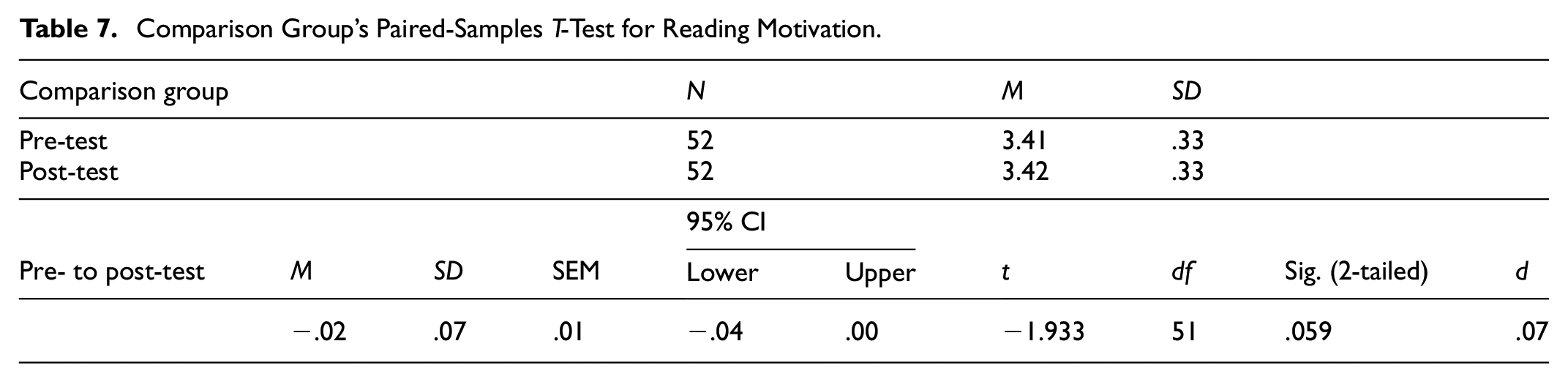
Table 7 demonstrates the results of the paired-samples t-test for the CG’s reading motivation and presents, again, evidence of a small difference between the intervened and non-intervened scores. The mean score represented a nominal change; pre-test mean 3.41 (SD = .33), and post-test 3.42 (SD = .33). The t-test values were t = −1.933, df = 51, p = .059, and a small effect size (Cohen’s d = .07). The difference in 95% confidence intervals was −.04 to .00. Even though the p-value is close to being significant, there is still an overall value above the normal alpha of .05, which demonstrates that the motivation to read variable did not change enough from the pre-test mean as constructed by the CG. To end, based on the small mean difference and small effect size, the conventional reading had little treatment effect on the CG’s motivation to read (Field, 2013).
Comparison Group’s Paired-Samples T-Test for Reading Motivation.
Qualitative data support the statistical findings, with some students indicating that external factors hindered their engagement with reading. For example, one student, identified as R4, shared, “I would love to be a good reader, but I am not effective in reading, for I have family responsibilities and pressures.” This reflection highlights the impact of personal and contextual barriers that may have limited the conventional reading instruction’s impact on motivation. Such statements point to the reality for CG participants, daily obligations and stressors overshadowed any motivational gains the program might have offered. Together, the quantitative results and student accounts suggest that the usual reading instruction was insufficient to generate a significant change in the reading motivation of the CG (Cohen, 1988).
Table 8 presents the results from a paired-samples t-test to address whether the IRA had a different effect on the RM of the EG. The RM pre-intervention mean score was an M = 3.41, SD = .37; the RM post-intervention mean score was average M = 3.81, SD = .35. The 95% confidence interval was −.48 to −.33, the t-test value was −11.226 with df = 53 and a p-value of .000. This very small p-value confirms the improvement scores were different at a statistically significant level. The improvement we found also had a large effect size, d = 1.52 and a mean difference of .41, which strengthens the impact of the intervention (Cohen, 1988; Field, 2013). These results strongly suggest the IRA significantly increased students’ motivation to read and support evidence that shows that motivational learning strategies may have a positive effect that translates into increased engagement with literacy activities.
Experimental Group’s Paired-Samples T-Test for Reading Motivation.

Qualitative data from student interviews further affirm these quantitative results. For instance, R11 shared, “In my spare time, I read texts on history, astronomy, politics, and the Gada system,” illustrating a broadening of reading interests and a deepened enthusiasm for self-selected texts. This shift reflects how the inclusive, culturally relevant, and student-centered nature of IRA fostered a more personal and passionate connection to reading. Such engagement supports Guthrie and Wigfield’s (2000) view that motivation-enhancing instruction cultivates not only reading skills but also a strong interest in reading. Furthermore, it aligns with the conclusions of Guthrie et al. (2004), who emphasize that motivationally grounded instruction improves both comprehension and lifelong literacy behaviors. The evidence points to the IRA’s capacity to empower learners, making reading a meaningful and self-driven pursuit.
Discussions
The IRA had a strong effect on students’ reading self-efficacy and motivation, particularly among the students in the experimental group. The quantitative results demonstrated that students made statistically significant gains in both areas, providing further evidence to support the hypothesis that IRA was more effective than instruction in the comparison group, particularly in improving reading outcomes (Field, 2013; Pallant, 2020). The IRA provides a clear pedagogical basis and activities that place students at the center of their learning, allowing them to build their own belief in their reading abilities. This conviction aligns with Bandura’s (1997) assertion that learners’ beliefs in their capabilities are shaped by how they are instructed, and in this case, IRA offered a supportive structure for student growth.
These improvements were not observed in the comparative group, where pre- and post-intervention comparisons showed no statistically significant difference in self-efficacy or motivation. This plain contrast highlighted the IRA’s effectiveness and reinforced the idea that self-efficacy can be cultivated through intentional pedagogical interventions (Verywell Mind, 2007). The experimental group students consistently reported feeling more confident and motivated as a result of the reading sessions. One student remarked, “I read English-language texts on Facebook to improve my skills,” which not only shows heightened motivation but also points to the flexible and personal nature of the literacy engagement fostered by the IRA.
Qualitative data drawn from student interviews provided deeper insight into the IRA’s impact on learners’ emotional and academic experiences. Students described developing a more positive relationship with reading, indicating that the IRA made reading less of a routine and more of a source of enjoyment and personal fulfillment. For instance, one student stated, “If the book is attractive, instructive, and entertaining, I can sit down and read it once for a long time.” These narratives align with Pečjak and Peklaj’s (2006) view that motivation grows when students find personal relevance and enjoyment in reading materials, which in turn fosters deeper engagement.
The IRA also helped foster a sense of reading as a communal and social experience. Through structured group work and shared reading exercises, students developed stronger interpersonal bonds and learned from one another. A student reflected, “During the reading session, we read some of the readings the teacher brings, but mostly we do group work.” This collaborative approach supported Ivey and Broaddus’ (2001) recommendation for integrating both intensive and extensive reading in a social learning context. Working with peers not only reinforced comprehension but also made reading a more enjoyable and interactive experience.
Students’ reading preferences provided additional evidence of how the IRA successfully broadened their literacy habits. Many gravitated toward fiction, poetry, and other creative genres, finding these texts both enjoyable and meaningful. These preferences suggested that reading became an outlet for emotional expression and imaginative exploration. According to Maine (2024) and Luther (2022), such genres promote cognitive empathy and identity formation, underscoring the value of allowing students to choose texts that resonate with their personal interests and emotional experiences.
Furthermore, students expressed a strong interest in culturally relevant books. During interviews, students shared books they had read about religion, history, or traditional activities such as the Gada system. These interests demonstrate that students were not reading merely to complete assignments, but were also reading as a way to connect their literacy practice with their cultural past (Adugna et al., 2023). As Vuzo (2022) contends, culturally responsive reading materials provide a way for learners to make links between their classroom experiences and their lived identities, making the IRA a culturally affirming and academically beneficial.
The IRA’s flexibility in accommodating non-traditional texts further supported student motivation. Many participants shared that they regularly read digital content, including short English texts on Facebook, comic books, and fairy tales. One student stated: “The books I read during my spare time are simple English books, intending to improve my English.”Albiladi (2019) and Maharsi et al. (2019) emphasize that such informal texts need to be integrated into the learning process because they can act as stepping stones toward more advanced literacy and instill in the learner an inclination towards regular reading.
Access to reading materials also played a critical role in supporting students’ literacy practices. Several students shared that they received books as gifts, borrowed from friends, or acquired them through school support. A particularly grateful response was, “Long live the Government! Our school gave us a pair of textbooks with peers, so I read those books.” These insights reflect the importance of institutional and familial support in building a sustainable reading culture (Guthrie et al., 2001; Krashen, 2004). Having physical access to books, whether academic or recreational, was essential in maintaining the impetus gained through the IRA (Cullinan, 2000). When students are provided with regular access to reading materials, they are more likely to develop consistent reading habits, which in turn supports sustainable motivation and literacy growth.
The emergence of bilingual literacy was another notable outcome. While the instruction was in English, students frequently read in Amharic at home, which acknowledged the existence of a bilingual reading environment. Goctu (2016) describes some of the cognitive and cultural benefits of bilingual reading, including improvements to metacognitive awareness and greater identity. Bilingual reading practices not only improved students’ comprehension but also made students feel ownership of their learning, which gave them a sense of agency as they moved between cultural and academic contexts.
Additionally, students reported correlating strong emotional rewards with good reading performance. When asked how they feel after completing reading comprehension tasks with a success rate, they reported happiness, pride, increased will to read. One student stated, “When I get home from school, I read books for three or four hours for homework, and if I have an exam, I read.” This type of response indicates a possible feedback loop, where the academic success of reading together with feelings of happiness and pride exacerbates an internal motivation, as described by Ryan and Deci (2000). These emotional reinforcements are strong motivators for ongoing literacy.
Test-related anxiety was another emotional factor that the IRA helped address. Students expressed how preparing for exams through reading helped alleviate stress and increased their sense of control. For instance, one said, “If it is for the exam, I read as much as I can for two hours or until we take the exam.” This aligns with Al Fraidan and Alnajjar’s (2024) and Al Fraidan’s (2024) findings that structured and engaging reading activities can help transform anxiety into productive effort. By providing access to materials and creating a supportive environment, the IRA indirectly contributed to emotional regulation and academic resilience.
In conclusion, the IRA proved to be a comprehensive and effective instructional approach that fostered cognitive, emotional, and social growth. It cultivated an environment where reading became an enjoyable and meaningful activity rather than a mere academic obligation. The integration of student-centered strategies, culturally responsive materials, and a variety of text formats allowed for a diverse and inclusive literacy experience. According to Wells et al., successful reading programs not only teach skills but also foster appreciation for the value of reading. The IRA achieved this dual aim, confirming its value as a model for future literacy instruction. Further research might explore its long-term impact across different age groups and educational settings to better understand its potential for wider application.
Conclusions
The study’s findings highlight the urgency of evolving reading instruction to move away from the traditional approaches in English classrooms. While the methods have long been taken as standard practice, findings of this study dispute their exclusivity by presenting strong evidence favoring the IRA, a pedagogical model that combines the strengths of ER and IR. The study reveals that IRA brings about enhancements in students’ RSE and RM and provides more meaningful and sustained engagement with reading. From this gain, the approach presents itself as an environment wherein learners develop such skills while simultaneously fostering a real passion for reading, which strongly correlates with long-term academic success. Hence, the research calls for a paradigm shift in the reading instruction and appeals to teachers, curriculum developers, and textbook writers to incorporate research-based strategies that mirror current perspectives on the best means of student acquisition of reading skills.
Implications
The implications of the results are far-reaching for those education stakeholders. To begin with, the positive effects of the IRA on students’ RSE and RM, as shown in this study, place the IRA as the pedagogy to be considered for the generation of student interest. Through the generation of learners’ confidence and interest in reading, the IRA has the potential to lead to enhanced performance in education and learner involvement in performance in the classroom.
In the classroom, teachers can integrate the IRA into classroom teaching to create a more active and student-centered learning environment. Once the students improve their reading skills, instruction can address the varying needs of learners by introducing differentiated instruction and issuing tasks that meet learning requirements. Such interactive instruction promotes establishing an interactive environment for student participation, deep thinking, as well as cooperation between learners, which are very key in keeping one motivated as well as well-educated.
At the curriculum level, educational policymakers, curriculum planners, and textbook writers should incorporate these findings to produce more engaging and well-rounded reading materials. Systematic reading programs can benefit from the depth of IR and the breadth and enjoyment associated with ER. By placing content within the context of IRA principles, developers are in a position to ensure that reading activities become not only demanding but also enjoyable and interesting to readers, thereby improving the reading process significantly.
Ultimately, the study highlights the importance of teacher training, properly attributing innovations in reading strategy, for example, the IRA. Training teachers in how to engage with numerous pedagogical approaches, including IRA outlines, will prepare them to share lifelong reading practices. Hence, there is a need for future studies to be on the longitudinal impact of the IRA in different institutions and different student populations so that it will show how different contexts affect the long-term and scalable sustainability of the impact of the IRA on literacy development.
Limitations
Due to time limits on students and logistical restrictions, a delayed post-test was not included in the study. This, however, is something the researchers feel should be included in future studies to improve the robustness of the findings. A delayed post-test is typically administered a few days or weeks after the intervention and is important in considering long-term retention and transfer of learned skills. For instance, after integrated reading instruction, students could do an immediate post-test to examine effectiveness in the short term and a delayed post-test some weeks after the intervention to examine sustained learning. Such a measure would control for maturation effects and provide a clearer picture of the long-term effect of the instructional approach. Hence, the researchers highly recommend this for future studies to enhance the internal and external validity of the findings.
Along with that, there were no post-intervention interviews conducted for the comparison group students, since most of the study was concerned with the development and progress of the students in the experimental group. However, the researchers realized that post-intervention interviewing of the comparison group would have added to a broader understanding of the impact of the intervention. Their data might also have contributed to a fuller picture that might lead to robust conclusions. Therefore, this has been considered a limitation of the present study.
Additionally, the investigators noted a methodological flaw with their choice of data analysis. They could not have used multivariate multiple linear regression in combination with the study design. Here are the predictor variables: integrated reading approach and conventional reading approach, and the outcome variables: reading self-efficacy and motivation. It would have been worthwhile to use a statistical method that can cope with the complexity arising from multiple predictors affecting multiple outcomes. Use of independent- and paired-samples t-tests has allowed an investigation of possible relationships to some extent, but those methods might not offer controls for interdependence among variables. However, multivariate multiple linear regression could have allowed the investigators to simultaneously assess the effects of the two instructional approaches on the two outcomes, controlling statistically for the influence of potential confounders. In this way, the design would have permitted a delicate analysis of the impact of the intervention, and this method is therefore highly recommended for future research.
Footnotes
Acknowledgements
We would like to express our gratitude to Asnake Shiferaw for their dedicated mentorship and data collection. We also want to thank Alemayehu Kefyalew for fostering an engaging classroom environment. Additionally, we sincerely appreciate the participating students for their valuable contributions and commitment of time.

Ethical Considerations
The study followed the ethical guidelines and methodological procedures of Hawassa University, approved by the College Ethics Review Committee, chaired by Binyam Moreda Obsu (PhD;
Author Contributions
All the three authors equally contributed to the writing of this article and its submission.
Funding
The author(s) received no financial support for the research, authorship, and/or publication of this article.
Declaration of Conflicting Interests
The author(s) declared no potential conflicts of interest with respect to the research, authorship, and/or publication of this article.
Data Availability Statement
The data supporting this study can be available from the corresponding author upon request.