




Abstract
Teachers can increase the retention of their students’ attention and lead them to be engrossed in new, different, and innovative ways using videos. In the present condition wherein, all educational institutions are implementing hybrid learning due to the COVID-19 pandemic, technologies are becoming an inseparable part of students’ life. This study was conducted to determine the effectiveness of YouTube in teaching Science Education. The researchers employed a quasi-experimental research design using 30 first-year students from the Polytechnic University of the Philippines Bataan Branch as respondents. Two groups were used in the study, the control and experimental groups, from the two sections of the same program. The study found that the performance of both groups, and students’ scores increased significantly from the pretest to the posttest. Moreover, the experimental group’s performance increased significantly compared to the traditional group. Thus, both teaching methodologies are effective in teaching science education to students. Teachers may utilize different teaching methodologies to augment the needs of the learners regardless of the situation. The main goal of the teachers is to facilitate learning and to ensure that the learners will be able to grasp all the needed information during their academic period.
Keywords
Introduction
Practices and norms in education wherein teachers are standing in front of the classroom and conduct lectures are long gone. Teachers may increase the retention of their students’ attention and lead them to be more engrossed in new, different, and innovative ways by using video. In the present condition wherein, all educational institutions are implementing hybrid learning due to the COVID-19 pandemic, technologies are becoming an inseparable part of students’ life. This scenario is very different from what was observed in the previous educational setting. Students are now growing up with various technologies while studying and socializing with others due to community quarantine and health protocols. They have new ways of processing information, far different from what their teachers are supposed or designed to teach. That is why teachers are confronted with finding and discovering innovative and effective ways to engage digital natives, such as educational videos (Pratama et al., 2020).
A long tradition in primary and higher education using educational videos to describe detailed information at different levels of education (Kearney & Levine, 2019). Nowadays, online videos are also used to teach science, technology, and society courses. Numerous educational videos on different topics are uploaded on various video platforms to teach students and the public, and one of the most common platforms is YouTube. According to Kohler and Dietrich (2021), YouTube has become one of the most common educational video instructions amongst students and has been an alternative way to supplement their learning demands. Moreover, many students nowadays are using YouTube as a basis for information on topics concerning science, technology, and society (Allgaier, 2019). Therefore, online educational videos can be influential learning material to augment students’ comprehension. YouTube, with its availability and accessibility, functions as a mode transmitter of scientific information (Pratama et al., 2020).
YouTube is now a predominantly educational platform due to its massive reach, especially this time of hybrid learning modalities and quarantine protocols in some areas. It is the second most accessed website globally (Alexa, 2020), and two billion registered people watch YouTube videos every month (Cooper, 2019). YouTube is found to be increasingly significant as a popular source of knowledge on different topics in science (Brossard & Scheufele, 2013). On an everyday basis, students or a person go online to gather information on current issues, to name, as food safety (Ma et al., 2017), the problems of climate change (Fletcher, 2016), the new technologies (Anderson et al., 2010), and up to health issues (Fox & Duggan, 2013). However, there are issues regarding the use of the internet. It is said that not all information available on YouTube is trustworthy. All kinds of misinformation proliferate in cyberspace (Wardle & Derakhshan, 2017). There is said to be misinformation associated with science, such as conspiracy theories, anti-science information, gossip, and straight-up fictitious news on science and scientists (Scheufele & Krause, 2019). Recently, YouTube has been labeled as a source of misinformation due to videos with treachery, discrimination, and pornographic substance to monetize the views (Mostrous, 2017).
Research shows that there are possibilities in utilizing videos in teaching that include positive attitudes, self-learning management, improved reading and study performance, and improvement in students’ performance and interest. However, the researchers have also found the downsides of incorporating YouTube videos in the teaching/learning methodologies such as a decline in the number of students attending the online class. Others cannot access the technology, for instance, due to the location and inaccessibility, and still prefer the traditional teaching model. (Edache-Abah & Worlu, 2019).
This study focused on the development, validation, and assessment of using YouTube on the student’s performance in selected topics in the Science, Technology, and Society Course, specifically historical antecedents in which social considerations changed the course of science and technology. Due to the implementation of hybrid teaching, students are not mandated to participate in synchronous classes. Furthermore, due to the pandemic and the economic status of families, some were forced to work in different industries. Therefore, they were not able to regularly attend the synchronous class. Most of them requested special classes and tutorials during their vacant time. However, tutorials and special classes for working students are not feasible due to schedule conflicts. Thus, recording synchronous classes and uploading them in an online platform was initiated to assist those working students. The uploaded video presentation involves discussion, clarifications from the students, and some questions posted by students who attended the online classroom instruction. This methodology offers each student the avenue to learn at their own pace independently with their style of learning.
Research Framework Formulation
When educators initiated educational videos and utilized television in their classroom instructions forty years ago, studies on the use of educational videos and television reached the same age (Choat, 1982; Forsslund, 1991). According to Choat (1982), although research has already found that these educational videos and television are compelling, they cannot replace real-life understanding. Still, it can be used as an additional instructional tool for educators and an element of the school curriculum. Kittelberger and Freisleben (1994) found that audio-visual means are essential compared to other teaching materials in terms of their function as a means, discussing that it can be considered a learning tool for effective teaching of content, especially in communication. Kittelberger and Freisleben anticipated that utilizing audio-visual media will perform a more vital function in the field of education since the creativeness of the students and teachers, process-oriented, and active learning in the classroom will increase in significance. If students are committed, active learning is visible, and cognitive load is cogitated, then it is said that audio-visuals are undeniably an effective additional instructional tool (Brame, 2016).
As a form of social media platform, YouTube can simplify the sharing of information with other social media users. With the popularity of YouTube, it has become a source of information regarding different topics that tackle science, technology, and society (Allgaier, 2019). According to Daun and Gambardella (2018), educational videos uploaded on YouTube reached the targeted groups for specific topics such as nutrition and food. Also, Godwin et al. (2017) stressed the potential of YouTube videos as an educational tool since they can be widely viewed and virally spread knowledge.
The Learning Styles Models
The assumption that learners have different learning styles has become a foremost educational concern in the past decades (Hawk & Shah, 2007). That is why other learning style models have been explained (Dağ & Geçer, 2009; Truong, 2016).
The most famous learning style is Fleming’s model, VARK. Fleming (2001) has explained the VARK learning style model, which is centered on sensory perceptual approaches. The word VARK or Visual, Aural, Read/Write, and Kinesthetic emphasizes instructional particulars as to the selected ways of gathering information, organizing ideas, and thinking on knowledge. Aural learners enjoy listening and explaining something and discussing topics with other learners. Read/Write learners choose manuscripts and records, and they take notes. Meanwhile, kinesthetic learners enjoy trying things they do not recognize, performing experimentation in laboratories, following recipes, and providing solutions to problems and proactive approaches (Hawk & Shah, 2007). Learners can have different preferences (Ocepek et al., 2013), yet the prevalent learning style is the learning mode which is selected more often (Ocepek et al., 2013).
VARK has become accepted in classroom settings and was adopted in different studies (Othman & Amiruddin, 2010). VARK is utilized to determine the success of students and their performance in class (Prithishkumar & Michael, 2014). Likewise, Li and Yang (2016) studied the effect of learning styles using mobile learning. Also, Klement (2014) investigated the ideal learning styles that could shift concerning the course offered in the school. Although some systems connected clearly to learning techniques like kinesthetic and sports education or informatics, other courses always incorporated the visual and aural for the learners. Finally, Huang (2019) examined the learning styles will affect the problem-solving creativity of the learners. He discovered that visual learners could work better for text- and image-based problems.
The Knowledge Gap Theory
The knowledge gap hypothesis states that learners with a higher socioeconomic level understand the material presented by mass media compared to those with a lower socioeconomic status. This idea is said to be the reason for the increased gap in knowledge between these two divisions of learners as a result (Hager & Cheprasov, 2022).
The knowledge gap hypothesis matches this study in finding the effects of using educational videos in classroom instruction, such as YouTube. To explain further this theory, Sesame Street, which is an American educational children’s television series, is most often used. It is also believed to be one of the first audio-visual interventions on educational topics that did not originate in a school setting (Kohler & Dietrich, 2021). The series was created to seize the differences between learners with lower knowledge and learners with higher knowledge (Kearney & Levine, 2019). It also tried to capture children’s attention with the use of formal creative means and playful ways to impart information or knowledge (Kohler & Dietrich, 2021).
Knowledge gaps rarely happen in a homogenous group, while knowledge gap theory usually happens in heterogeneous groups (Kohler & Dietrich, 2021). Different research was conducted to examine the distinctions between groups considering the knowledge gap hypothesis. According to Hwang and Jeong (2009), the adverse effects, such as continuing the knowledge gap in health issues, might affect needed preventive measures due to health inequalities. They conclude that time or varying intensities in media publicity may change the knowledge gap among people. Likewise, Tran (2013) studied a person’s socioeconomic standing that influences traditional or online news usage and information about public concerns. Moreover, Boukes and Vliegenthart (2019) examined the influence of news media sources such as television news, news on websites, and newspapers on the knowledge gap through a survey on current affairs. The receiving of news in different modalities has a positive effect on knowledge attainment; however, it is not essentially dependent on the level of education.
Figure 1 shows the paradigm of the study.

Paradigm of the study.
The proposed model assessed the effectiveness of the YouTube platform on the performance of selected students in Science, Technology, and Society Course. First, the researchers drew respondents from the population, considering their age, sex, and IQ profiles. Second, the researchers conducted a pretest on both groups to determine their prior knowledge of the topic. Third, the two (2) groups underwent classroom instructions in which the control group had the synchronous class, and the experimental group utilized YouTube as their learning tool. Lastly, after the intervention, both groups were given a posttest to determine their academic performance and compare their academic performance.
Purposes of the Study
In general, this study was conducted to determine the effectiveness of YouTube in teaching Science Education. Specifically, it aimed to answer the following questions: (1) Is there a significant difference between the pretest of the control group and the experimental group? (2) Is there a significant difference between the pretest and posttest of the control and experimental groups? (3) Is there a significant difference between the post-test of the control group and the experimental group?
Methodology
Research Design
To determine the effectiveness of YouTube in teaching Science Education, the quasi-experimental research design, which is frequently used in the setting of teaching and learning, was used in the study. For assessing the impact of educational interventions on student achievement and behavior, the quasi-experimental study design is recognized as a robust research tool (Longva & Foss, 2018).
Respondents
The study made use of 30 first-year students from the Polytechnic University of the Philippines Bataan Branch as respondents. The control and experimental groups were taken from the two sections of the same program. First, the researchers drew randomly from the population. Then matched the respondents for both groups according to age, sex, and IQ. Fifteen respondents for each group were selected. Selecting respondents involved assigning variables such as age, sex, and IQ in both groups, wherein the two groups are comparable in three aspects except the treatment application. The control group utilized synchronous discussions. Each week they were given 2 hour-synchronous discussions and 1 hour of asynchronous activity. While the experimental group - students who opted to utilize YouTube discussion due to the conflict of synchronous classes to their work. Both groups have the same formative and summative assessments.
Data Gathering Instrument
The study utilized pre-test and post-test examinations to determine their performance in Science, Technology, and Society courses. The examination was composed of 30 multiple-choice questions, and it was validated by the Subject Matter Experts and English professors at the University.
Ethical Considerations
The purpose of the study is to determine the effectiveness of using online platforms, specifically YouTube in teaching Science, Technology, and Society. The researchers gave an oral explanation to the respondents of the purpose of the research, their right to refuse to participate in the study, the understanding of the confidentiality of this study, and lastly, their right to know the results of the study if they wanted to.
Statistical Treatment
Analysis of separate items involved group comparison, using statistical treatment such as paired T-test, independent sample T-test, Kolmogorov-Smirnov Test of normality, and gain score analysis.
The results in Table 1 show that the data above does not differ significantly from that which is normally distributed.
Normality Test Using the Kolmogorov-Smirnov Test.

Results and Discussion
Table 2 shows the comparison of the pretest of both groups: the experimental and control groups.
Comparison of Pretest Mean Scores of Both Groups.

It can be gleaned from the table that with .44 significance, the performance of both groups before intervention was not significant. It only means that both groups have the same knowledge on the topic since they were matched according to their sex, gender, and IQ. Therefore, it is vital to have control groups in an experimental design. According to Allen (2017), control groups permit researchers to validate that the results of the analysis are due to the manipulation of independent variables (IVs) than unnecessary variables. Remarkably, the control groups include participants that are not subjected to the controlled IV but are considered on the study’s dependent variables (DVs).
Pithon (2013) said that the control group involves factors that present precisely the same features or characteristics of the experimental group, except for the intervention applied to both groups. This intervention allows the researchers to study one variable at a time, which is an integral part of the analysis. In a controlled experiment, two matching experiments are conducted. One of them is the treatment or the experimental group where the new intervention in teaching is applied, and in the other group, which is in the traditional group, the tested factor is not used.
Table 3 shows the comparison of the two groups on their pretest and posttest mean scores.
Comparison of Pretest and Posttest Mean Scores of Both Groups.
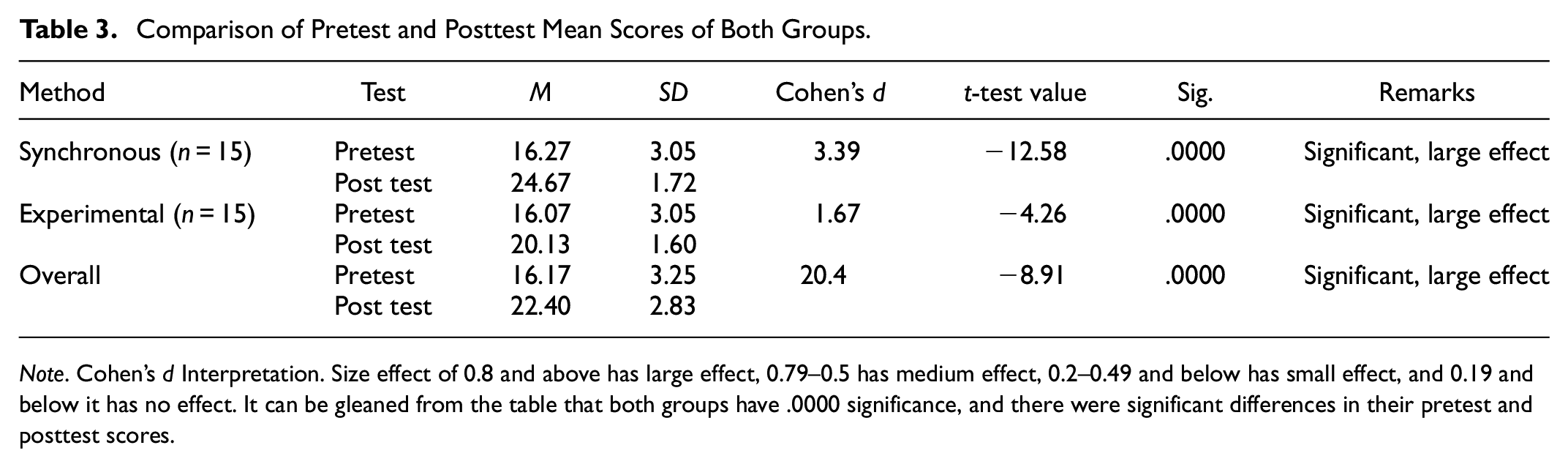
Note. Cohen’s d Interpretation. Size effect of 0.8 and above has large effect, 0.79–0.5 has medium effect, 0.2–0.49 and below has small effect, and 0.19 and below it has no effect. It can be gleaned from the table that both groups have .0000 significance, and there were significant differences in their pretest and posttest scores.
It only means that both treatments are effective as teaching methodologies. This is also shown in the large Cohen’s d effect size. Conducting synchronous classes and meeting the students may impact the learners’ feeling of association with their instructor. They were able to ask questions to their instructor, interact with their classmates, and verify vague statements. In the same way, students may be able to engage in important collaborations with the instructor and classmates to minimize transactional distance. As opined by Moore (1993), transactional distance is a pedagogical event that students feel while studying apart from their instructors and fellows, cooperating with each other and the way of their relationship. Parallel to the study, Asterhan and Schwarz (2010) uncovered that in synchronous class, instructors have the ability to call attention to and found that there was a variation regarding sufficiently emphasizing learners in synchronous learning situations. They also discovered that with respect to synchronous group discussion and effective control may differ on specialized instruments, empowering learners to communicate through textual content and pictures.
Likewise, the students are now becoming YouTube enthusiasts to increase their knowledge, foster understanding, and discover new skills. These learners are curious about a topic discussed during synchronous class and are self-motivated to learn more. They are taking advantage of accessing the uploaded video and connecting to the internet
In recent years, it has been observed that the ways people learn have evolved through several transformations (Brown & Adler, 2008). With the development of recent technologies, there are questions about the learning process and what the learners understand due to changes in social systems, traditions, and expectations. It was found that learners aggressively look for the knowledge they are interested in studying due to shifting toward online informal self-directed learning (Peters & Romero, 2019; Song & Bonk, 2016; Welbourne & Grant, 2016). These practices are evident, especially in those generations who were exposed to the internet where information is just a click away on the keyboard.
According to Abbas and Qassim (2020), teachers are utilizing YouTube as part of the educational process since it is a more beneficial and exciting teaching experience and has been an integral and supplementary part of the learning process on the part of the students. Furthermore, in utilizing YouTube, students find it enjoyable, thus, increasing their comprehension and awareness of the academic materials. Furthermore, YouTube videos were used by students to take notes, and they had ample time to study the lessons. Also, Abbas and Qassim (2020) stated that YouTube enhanced the language skills and aspects of the students, especially those videos created by native speakers. Thus, YouTube videos are essential for the educational process and are focused on improving the performance of the learners depending on the purpose.
Table 4 shows the comparison of the two groups on their post-test mean scores.
Comparison of Posttest Mean Score of Both Groups.

It can be gleaned from Table 4, with .00 significance, that the performance of both groups after the intervention had a significant difference. Therefore, the null hypothesis is rejected. It only means that the performance of the students who attended the synchronous class was higher than those who utilized YouTube as their learning modality. The findings pointed out that YouTube and other social media platforms cannot replace the discussion conducted by the teachers through synchronous. In synchronous classes, students can interact with their teachers, ask questions, clarify issues, and simultaneously interrelate with their classmates. It also shows that YouTube can function as an aid for the teachers and a component of the school curriculum (Choat, 1982) and help students who could not attend the synchronous class for personal reasons.
According to Kohler and Dietrich (2021), educational or online videos may not work for every student since each student has their own needs and demands. Thus, the one-size-fits-all strategy is not applicable to science education videos. As such, the convenience of accessing the students’ information is considered, but the qualities of each preference or need may lead to different results.
It also shows that asynchronous class is incomparable to synchronous discussions. It also demonstrates that YouTube or any educational videos are more applicable to students if they can discuss the topics or lessons with others. It is assumed that the explanation among the group will not be sufficient for this activity. Therefore, YouTube or any educational videos may only be applicable to those students who can understand and discuss the content of the video with others.
The COVID-19 pandemic and restrictions brought the massive usage of technology to deliver the topics. As a result, there is continuous stress and pressure on the teachers and administrators to implement technologies in classes. That is why teachers came up with different teaching approaches that will aid the students during the pandemic. Although several studies show the advantages of using technology in teaching, technology can never replace a teacher (Carrillo, 2012).
Conclusion
This study was conducted to determine the effectiveness of YouTube in teaching Science Education. Results reveal that there is no significant difference in the pretest scores of students who attended the synchronous class and students utilizing YouTube videos. Additionally, there is a significant difference in the pretest and posttest scores of students who attended the synchronous class and students utilizing YouTube videos. It only means that both treatments are effective as teaching methodologies. Conducting synchronous classes and meeting the students may impact the learners’ feeling of association with their instructor. Likewise, the students are now becoming YouTube enthusiasts to increase their knowledge, foster understanding, and discover new skills. And lastly, there is a significant difference in the posttest scores of students who attended the synchronous class and students utilizing YouTube videos. It only means that the performance of the students who attended the synchronous class was higher than those who utilized YouTube as their learning modality. The findings pointed out that YouTube and other social media platforms cannot replace the discussion conducted by the teachers through synchronous.
The conclusions lead to the recommendations that: (1) Online educational platforms such as YouTube may be used to deliver lessons and augment teachers’ teaching methodologies. Also, it may be used as an alternative way to deliver the topic to catch the learners’ attention; (2) Teachers may utilize other online teaching strategies to assist the learners with their learning process; and (3) Future researchers may consider other variables in conducting similar studies that may affect the student’s achievement in science education.
Footnotes
Acknowledgements
The authors were very grateful to the Polytechnic University of the Philippines for their support in conducting the research.
Declaration of Conflicting Interests
The author(s) declared no potential conflicts of interest with respect to the research, authorship, and/or publication of this article.
Funding
The author(s) received no financial support for the research, authorship, and/or publication of this article.
