




Abstract
This study aimed to research the impact of top leaders’ time urgency, as a temporal dispositional trait, on strategic entrepreneurship. It also studied the moderating effects of firm growth and the expectation gap on the above relationship. The study tests these hypotheses using matched data from the “letters to shareholders” (LTS) and “Management Discussion and Analysis” (MD&A) of 167 cases involving 81 companies across 31 industries in China from 2008 to 2020. After executing Heckman’s two-stage regression, the results show that top leaders’ time urgency fosters strategic entrepreneurship by balancing exploration versus exploitation. Furthermore, the main effect turns positive with sustained firm growth and negative with a higher expectation gap. This study contributes to the literature on the antecedents of strategic entrepreneurship from the temporal trait perspective. It provides insights into the micro-foundations of strategic entrepreneurship from organization-level factors. The findings offer innovative avenues for implementing strategic entrepreneurship in local Chinese firms and pave the way for examining the relationships between temporal traits and competitive dynamics in the future.
Plain language summary
This study focuses on the antecedent of strategic entrepreneurship from a temporal dispositional trait perspective and researches two moderators. This study applies Heckman’s two-stage regression to test three hypotheses with 167 cases involving 81 companies across 31 industries from 2008 to 2020. The matched data is from the “letters to shareholders” (LTS) and “Management Discussion and Analysis” (MD&A) of Chinese A-listed companies. The empirical findings confirmed that top leaders’ time urgency fosters strategic entrepreneurship by balancing exploration vs. exploitation. Moreover, the main effect becomes positive with sustained firm growth and negative with a higher expectation gap. This study considers temporal traits and contributes to the literature on the antecedents of strategic entrepreneurship. It provides insights into the micro-foundations of strategic entrepreneurship at the organization level. The findings offer innovative avenues for implementing strategic entrepreneurship in local Chinese firms. This study does not examine the mediation mechanism and should expand the generality of the findings using another sample. It could not test the year effect due to the limited sample size.
Keywords
Introduction
What are the antecedents of strategic entrepreneurship? Previous research has demonstrated that achieving strategic entrepreneurship requires avoiding over-exploration or over-exploitation (Kyrgidou & Hughes, 2010; Lavie et al., 2010), which entails attaining relative equality between exploration and exploitation. Strategic entrepreneurship is a process of aligning long-term exploration with short-term exploitation (Hitt et al., 2001; Ireland et al., 2003). The role of time has not been adequately addressed, although researchers have emphasized the significance of proactive management (Lavie et al., 2010) and managers’ networks (Rogan & Mors, 2014) in striking a balance of exploration versus exploitation for strategic entrepreneurship.
Time urgency, as a temporal trait, has never been examined as a predictor of strategic entrepreneurship. Researchers have explored the strategic implications of a top leader’s temporal disposition, such as time urgency (J. Chen & Nadkarni, 2017), which provides new insight into the drivers of strategic entrepreneurship. However, the connection between a top leader’s time urgency and strategic entrepreneurship has yet to be explored. Because top leaders who are chronically aware of the passage of time can significantly influence strategic decisions within a minimal time window, this study can examine the antecedents of strategic entrepreneurship from the temporal trait perspective.
The role of the most potent individual temporal disposition in strategic entrepreneurship, such as the top leader, has not been adequately addressed despite its increasing importance (Zhou & Li, 2024). To fill this gap in the literature, this study focuses on the relationship between top leaders’ time urgency and strategic entrepreneurship. Applying the trait theory of leadership (Van Fleet & Yukl, 1992) to the strategic domain involves characterizing time urgency as a temporal trait. Research has confirmed that time urgency is closely associated with task speed, time awareness, and deadline control (Conte et al., 1998; Landy et al., 1991; Mohammed & Angell, 2004). Based on this premise, this study expects top leaders’ time urgency to affect strategic entrepreneurship.
This study also examined the moderating effect of firm growth and the expectation gap. It considered how top leaders’ time urgency affects strategic decisions in the organizational context of firm growth and expectation gap, and examined how these differences influence strategic entrepreneurship. Specifically, drawing on the resource-based view (Wernerfelt, 1984), this study contends that firm growth is a vital resource that enables time-urgent top leaders to influence strategic decision-making. Simultaneously, this study investigates the moderating impact of the aspiration gap. Prospect theory (Kahneman & Tversky, 1979) highlights the influence of the aspiration gap on decision-making behavior. A more significant aspiration gap resulting from higher expected performance may lead time-urgent top leaders to impact strategic activities.
This study tested the hypotheses in the context of China. The Chinese market provides a vast landscape for studying the relationship between top leaders’ time urgency and strategic entrepreneurship. Chinese enterprises, represented by A-share listed companies, have become innovation leaders and actively meet the challenges of the global technological economy (Cheng & Wang, 2023). For example, the 2023 Performance Report of China’s Listed Companies shows that the R&D investment of A-share listed companies reached 1.82 trillion, an 8.6% increase over the previous year. These figures show their strong commitment to fostering innovation and underscore the importance of strategic entrepreneurship in driving China’s economic expansion.
This study integrates research on time urgency with the strategic entrepreneurship literature, making three significant contributions to the existing body of knowledge. First, based on the trait theory of leadership, this study establishes a connection between top leaders’ time urgency and strategic entrepreneurship, thereby expanding the understanding of the antecedents of strategic entrepreneurship to include the temporal trait. Although previous research has given some attention to the drivers of strategic entrepreneurship, the paucity of research from the perspective of an individual temporal trait is apparent. Second, drawing on the resource-based and prospect theories, this study enriches the research on contingency factors affecting strategic entrepreneurship by examining the moderating effects of firm growth and the aspiration gap. Although prior research (e.g., Briker et al., 2021) have proposed a moderating factor in the relationship between supervisors’ time urgency and autocratic leadership, few studies have explored the moderating conditions of top leaders’ time urgency affecting the critical strategic activity: strategic entrepreneurship. This study confirms the presence of two moderating variables and stimulates further research on how the interaction between individuals’ time urgency and situational conditions influences strategic entrepreneurship. Finally, in contrast to the predominant focus on CEOs in previous research, this study’s empirical section focuses on chairpersons, showing a new perspective for understanding the phenomenon of strategic entrepreneurship in local Chinese firms.
The subsequent sections of this paper are as follows. The theory development explores the theoretical framework, encompassing top leaders’ time urgency, strategic entrepreneurship, and their argued relationship with unique situational factors. Based on these theories, three hypotheses were proposed regarding the effect of top leaders’ time urgency on strategic entrepreneurship and the moderating role of the main effect. Research methodology explains the techniques employed for data collection, sample selection, variable measurement, and research method. The empirical findings in the results section demonstrate the impact of a top leader’s time urgency, firm growth, and the expectation gap on strategic entrepreneurship. Discussion and conclusion comprehensively analyze the contributions and implications and propose avenues for future investigation.
Theory Development
Time Urgency
Time urgency refers to a continuous awareness of the passage of time (Conte et al., 1998; Landy et al., 1991) and reflects how individuals perceive time (Waller et al., 2001). It is considered a temporal dispositional trait (Briker et al., 2021; Oreg & Berson, 2018). Time urgency, distinct from externally imposed time pressure constraints, represents a crucial dimension of Type A behavior patterns (Conte et al., 1995; Waller et al., 2001).
Time-urgent individuals are more alert and attentive in their performance (Najam et al., 2018). Unlike non-time-urgent individuals, they carefully schedule and accelerate their work to meet set deadlines (J. Chen & Nadkarni, 2017; Kunisch et al., 2017). Consequently, time-urgent top leaders pay special attention to decision-making speed and task scheduling (Shipp & Cole, 2015). For instance, their focus on prioritizing task completion enables them to accelerate their work pace and gain a temporal competitive advantage over their peers (Mohammed & Harrison, 2013). As a result, they often demonstrate energetic and proactive behaviors to achieve higher performance levels (Briker et al., 2021).
Strategic Entrepreneurship
Strategic entrepreneurship is the fusion of entrepreneurial and strategic knowledge (Hitt et al., 2001), referring to simultaneous opportunity-seeking and advantage-seeking activities to foster firms’ excellent performance (Ireland et al., 2003). Strategic entrepreneurship research (Ireland et al., 2003, p.983) introduced the analytical framework of “exploration-exploitation” (March, 1991), establishing exploration and exploitation as the two core components of strategic entrepreneurship (Ireland & Webb, 2007, p. 50). Thus, the union of exploration and exploitation is the nature of strategic entrepreneurship. In the entrepreneurial context, exploration emphasizes opportunity-seeking behavior through radical innovation, while in the strategic context, exploitation emphasizes advantage-seeking behavior through progressive innovation (Ireland & Webb, 2007, 2009; March, 1991; Silvestre et al., 2022; Tushman & O’Reilly, 1996). The attributes of exploration and exploitation demand different structural, cultural, and operational behaviors (Ireland & Webb, 2009). Although their foci differ, neither alone is dispensable for strategic entrepreneurship (Ireland & Webb, 2007).
Because inherent contradictions exist between exploration and exploitation (Rogan & Mors, 2014), achieving an appropriate balance by managing their tension is incredibly challenging for managers (Ketchen et al., 2007). For example, exploration is fraught with uncertainty and often fails, leading to pursuing new ideas and further exploration, which can lead to falling into the “failure trap.” Conversely, exploitation may lead to early success, reinforcing path dependence and encouraging more exploitation, resulting in the “success trap,” wherein exploration begets further exploration, and exploitation begets further exploitation (Gupta et al., 2006; Siggelkow & Levinthal, 2003).
Exploration and exploitation are two ends of a continuum (Gupta et al., 2006), indicating that strategic entrepreneurship is an outcome of their choice. As the trade-off between the two activities can alleviate organizational tension (Ireland & Webb, 2007) and enhance firm performance (He & Wong, 2004; Stettner & Lavie, 2014), the balance of exploration versus exploitation has emerged as a crucial issue in strategic entrepreneurship research (Ireland & Webb, 2009). Organizational ambidexterity theory (Cao et al., 2009; Tushman & O’Reilly, 1996) argues that strategic entrepreneurship is more pronounced when exploration versus exploitation is closer in relatively equal magnitude.
Previous studies have noted the origins of strategic entrepreneurship, such as resource management and dynamic capability (Kyrgidou & Hughes, 2010), but the antecedents still require further clarification. In contrast, the positive outcomes associated with strategic entrepreneurship, such as wealth creation (Hitt et al., 2001) and sustainable competitive advantages (Ireland & Webb, 2007), are more clearly defined. This discrepancy may stem from the complexities of researching the antecedents of strategic entrepreneurship. This study creates a chance to explore the drivers of strategic entrepreneurship from the temporal trait perspective, focusing on time urgency.
Time Urgency and Strategic Entrepreneurship
No previous study has directly argued the effects of top leaders’ time urgency on strategic entrepreneurship. However, researchers have confirmed the relationship between time urgency and strategic activities based on the trait theory of leadership (J. Chen & Nadkarni, 2017). According to the trait theory of leadership (Van Fleet & Yukl, 1992), top leaders’ traits affect firms’ behaviors. For example, Zhu and Chen (2015) argued that CEO narcissism, a notable trait of top leaders, limits directors’ influence on firm strategy (Zhu & Chen, 2015). Additionally, Zhang et al. (2017) found that the interaction between a CEO’s humility and narcissism positively relates to firm innovation (Zhang et al., 2017). Given this, this study proposed that top leaders’ time urgency is an essential driver of a strategic choice, such as strategic entrepreneurship.
Researchers have demonstrated that time urgency is closely associated with task speed, time awareness, and deadline control (Conte et al., 1998; Landy et al., 1991; Mohammed & Angell, 2004). Time-urgent individuals establish self-imposed internal deadlines (Mohammed & Harrison, 2013), persistently experience a sense of urgency (Bingham & Hailey, 1989) and ensure the timely completion of assigned tasks. Consequently, time-urgent top leaders are keenly sensitive to strategies related to time.
Strategic entrepreneurship has received considerable academic attention, and its inherent temporal nature brings time urgency to researchers. As an intrinsic and stable dispositional trait that remains relatively constant, time urgency in top leaders can predict a firm’s behavior (Oreg & Berson, 2018). For instance, since speed is crucial for gaining and sustaining an early-mover advantage, a time-urgent CEO may rapidly identify emerging technologies and exploit market opportunities, positively influencing strategic behavior (J. Chen & Nadkarni, 2017). Due to the competitive attributes of exploration and exploitation, strategic entrepreneurship has a higher time-competitive requirement than other strategies. Therefore, it tends to display the time urgency of top leaders.
The Moderating Role
The trait theory of leadership suggests that the effect of time urgency on a firm’s strategic behavior (e.g., strategic entrepreneurship) depends on the specific organizational context. This study chooses the firm growth and expectation gap as a boundary condition for understanding how top leaders’ time urgency affects strategic entrepreneurship. Specifically, drawing on the resource-based view (Wernerfelt, 1984), this study contends that firm growth is vital for top leaders to promote strategic activities. Prospect theory (Kahneman & Tversky, 1979) highlights the influence of the aspiration gap on decision-making behavior. A more significant aspiration gap resulting from higher expected performance may lead top leaders to have more inner pressure for strategies.
The knowledge, information, and R&D investments from firm growth significantly respond to the rapid initiation of responses and actions of time-urgent top leaders. The influence of firm growth on the relationship between time urgency and strategic entrepreneurship enhances understanding of the subjective perspective of time in competitive dynamics (Withers et al., 2018). Furthermore, this study acknowledges the importance of the expectation gap. It examines how the gap between actual and expected performance affects time-urgent top leaders, thereby affecting strategic entrepreneurship. When comprehensively reviewing the literature, it is clear that understanding the complex relationships between temporal traits and organizational context is crucial to uncovering the drivers of strategic entrepreneurship.
Hypotheses
Top Leaders’ Time Urgency
This study argues that top leaders’ time urgency correctly handles exploration versus exploitation for strategic entrepreneurship. The essence of the process is to avoid the time competition associated with the simultaneous implementation of exploration and exploitation.
First, time-urgent individuals consistently experience a sense of being hurried (Waller et al., 2001). By creating and implementing a worklist (Conte et al., 1998; Landy et al., 1991), time-urgent top leaders can establish a clear timeline for major strategic activities (J. Chen & Nadkarni, 2017). Since achieving a balance of exploration versus exploitation requires diverse and potentially conflicting actions, it entails organizational operational, structural, and cultural changes (Ireland & Webb, 2007). Guided by the timeline, the balanced work can still progress. Specifically, the predefined timeline provides clear milestones for tracking the process that allows timely adjustments to the activities related to exploration versus exploitation in work progress, which is a critical aspect of attaining equilibrium. As a result, time-urgent top leaders can achieve the balance of exploration versus exploitation by monitoring the timeline milestones to enhance strategic entrepreneurship.
Second, time-urgent individuals are keenly aware of the passage of time (Landy et al., 1991). Consequently, time-urgent top leaders set self-imposed deadlines in addition to external ones to apply internal pressure (Waller et al., 2001). Prior research has highlighted the significance of speed in exploration versus exploitation activities. For instance, firms must accelerate their efforts to identify upcoming opportunities and adopt novel technologies while improving products or services (Du & Chen, 2018). Additionally, time constraints always exist in the context of strategic entrepreneurship (Miletić & van Maanen, 2019). As timekeepers, time-urgent top leaders place significant emphasis on inter-deadlines and responsiveness in strategic entrepreneurship. During this process, they align their deadlines with the organization’s, expedite the work pace, and complete tasks within the designated time, promoting the balance of exploration versus exploitation.
Finally, time-urgent individuals regard time as a scarce and valuable resource (Conte et al., 2001). Consequently, time-urgent top leaders engage in multiple tasks simultaneously, aiming to excel in each task and demonstrating high achievement orientation (Waller et al., 2001). For instance, time-urgent top leaders dedicate their energy to work (Briker et al., 2021), prioritize goals, and drive significant tasks (Conte et al., 1998; Landy et al., 1991). They could effectively utilize their available time to complete tasks (Conte et al., 1995). When confronted with time-competitive activities, time-urgent top leaders continuously monitor the remaining time and strike a balance of exploration versus exploitation.
The trait theory of leadership posits that time-urgent top leaders prioritize their timelines, establish internal deadlines, and closely monitor remaining time to accomplish planned tasks. This proactive approach facilitates achieving a balance between exploration and exploitation. Based on these arguments, the following hypotheses are proposed:
The Moderating Role of Firm Growth
Firm growth is a critical resource influencing other variables (McKelvie & Wiklund, 2010). Based on the resource-based view and trait theory of leadership, this study argues that firm growth provides knowledge, information, and R&D investment for time-urgent top leaders, fostering a balance between exploration and exploitation for strategic entrepreneurship.
First, firm growth provides knowledge. Prior research has shown that growth results from integrating a firm’s short-term entrepreneurial success and long-term value creation (Hitt et al., 2001; Ireland et al., 2003). Different growth models (organic, acquisition, hybrid) enrich the breadth and depth of knowledge (Ireland & Webb, 2007; McKelvie & Wiklund, 2010), constituting a mixed learning process of exploration and exploitation (Holmqvist, 2004). The time-urgent top leader has strong time incentives to drive the sharing of the created knowledge within the firm. They accelerate the organizational members’ shared knowledge rate in mutual learning by setting internal deadlines. When the knowledge of members and organizations is homogeneous, it leads to an equilibrium between short-run and long-run activities (March, 1991), thus promoting the balance of exploration versus exploitation.
Second, firm growth provides essential information. The stages of firm growth always result from aligning the organization with its external environment (McKelvie & Wiklund, 2010). Hence, growth is a cyclical process that shifts between imbalance and balance regarding organizational structure, firm strategy, and the external environment (Phelps et al., 2007). Specifically, growth provides real-time and actual information about the configuration of structure, strategy, and environment rather than predicted information (Eisenhardt, 1989). Therefore, time-urgent top leaders carefully analyze the information within the time constraints, enhancing the balance of exploration versus exploitation.
Finally, the increased income resulting from firm growth ensures stable R&D expenditure. Sustained firm growth leads to increased sales, enabling firms to invest more in R&D (Coad & Rao, 2010). Since adjusting (increasing or decreasing) R&D expenditure may lead to a transition between exploration and exploitation (Mudambi & Swift, 2014; Swift, 2016), time-urgent top leaders can establish a clear timeline for R&D expenditure during the process, making it feasible to balance exploration versus exploitation through proactive management of R&D expenditure volatility (Mudambi & Swift, 2011).
Therefore, this study suggests that, with sustained firm growth, the time urgency of top leaders positively affects the balance of exploration versus exploitation, thereby accelerating strategic entrepreneurship.
The Moderating Role of the Expectation Gap
When expected performance exceeds actual performance, a more significant expectation gap leads decision-makers to make non-comprehensive decisions. Based on the prospect theory and trait theory of leadership, this study argues that the moderating effect of the expectation gap leads time-urgent top leaders to prioritize decision-making speed over exploration or exploitation, which hinders the balance of exploration versus exploitation.
First, the expectation gap drives time-urgent top leaders to prioritize decision-making speed over content. Prior research suggests that a significant expectation gap motivates top leaders to work harder (Lant, 1992). As a result, time-urgent top leaders may set their own deadlines to accomplish tasks as soon as possible. However, when they excessively prioritize speed, they may fall into a “speed trap” (Perlow et al., 2002, pp. 946–947). It is because when actual performance falls far below expectations, the firm faces a complex situation in which it receives a large amount of information. Time-urgent top leaders must quickly process information when making rapid decisions. However, cognitive overload incapacitates them from handling deviant information and considering alternative solutions (Siegfried et al., 1981). Therefore, an increase in the expectation gap can lead time-urgent top leaders to hinder the balance of exploration versus exploitation by excessively emphasizing speed.
Second, the expectation gap leads time-urgent top leaders to make riskier decisions and prioritize exploration. An increase in the expectation gap leads top leaders to make riskier choices consistently (Bromiley, 1991). Due to their time-driven behavior, time-urgent top leaders often enhance risk-based decision-making by developing timelines and to-do lists. For example, when performance falls short of expectations, they react swiftly and actively engage in radical innovation and strategic changes, displaying more assertive conduct. As a result, time-urgent top leaders prioritize exploration, which may hinder the exploration versus exploitation balance.
Finally, the expectation gap leads time-urgent top leaders to adopt a cautious approach and prioritize exploitation. Prior research also suggests that when the expectation gap increases, top leaders tend to be conservative and adopt inflexible actions to maintain the status quo (Palmer & Wiseman, 1999; Staw et al., 1981). Additionally, as time-urgent top leaders are conscious of time and its passing, they may harm tasks that require patience (Conte et al., 1998; Friend, 1982). When they encounter significant expectation gaps, time-urgent top leaders become more cautious and impatient with tasks that have uncertain benefits (e.g., exploration). They impose strict deadline control, carefully manage time resources, and actively engage in activities with clear benefits (e.g., exploitation). Consequently, time-urgent top leaders prioritize exploitation at the expense of balancing exploration versus exploitation.
Therefore, this study suggests that the moderating effect of the expectation gap leads the time-urgent top leaders’ time urgency to negatively affect the balance of exploration versus exploitation, thereby hindering strategic entrepreneurship.
Figure 1 shows the research model of this study. According to the model, time-urgent top leaders are good at promoting strategic entrepreneurship (H1). Firm growth (H2) positively impacts the relationship between time-urgent top leaders and strategic entrepreneurship, while the expectation gap (H3) is argued to moderate the relationship negatively. These theories examine the effects of top leaders’ time urgency, firm growth, and expectation gap on strategic entrepreneurship.
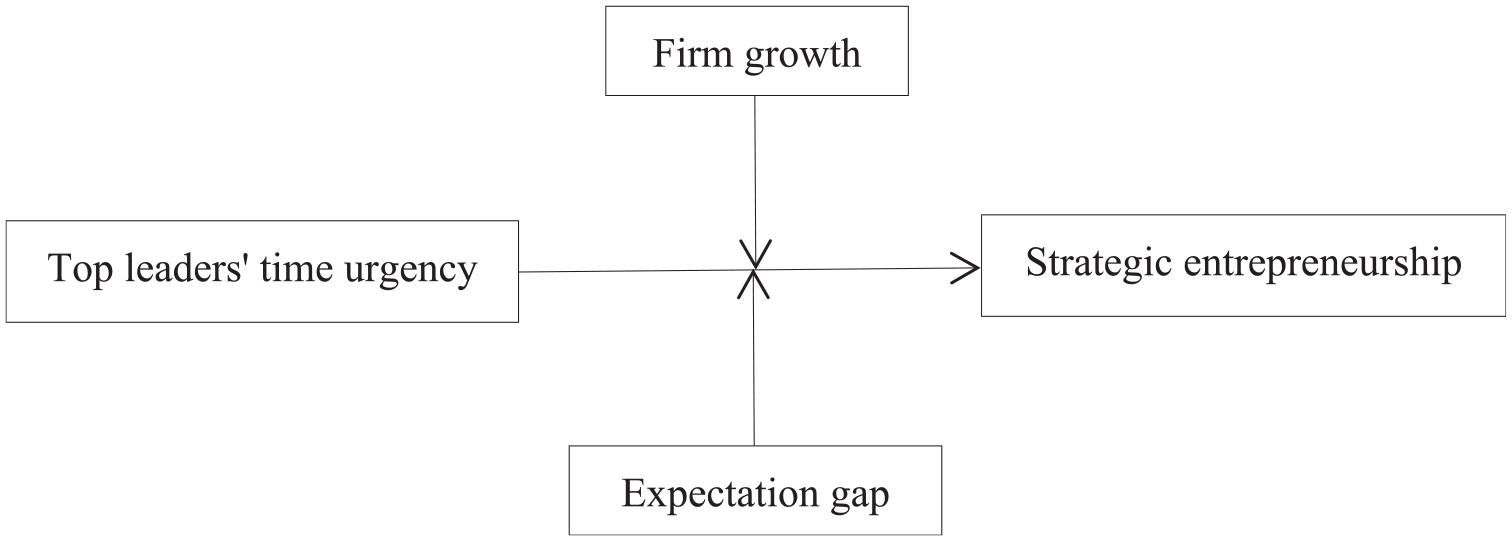
Research model.
Research Methodology
Data and Sample
The matched cases derive from the “letters to shareholders” (LTS) (from chairpersons) and “Management Discussion and Analysis” (MD&A) sections of annual reports of A-listed companies in China and the following four reasons: First, time urgency is a temporal trait, which poses a considerable challenge to obtaining the first-hand data of time-urgent top leaders (such as chairpersons). Second, the archival data represented by LTS can maintain the continuity and consistency of information disclosure, which provides an effective way to obtain information for this study. Third, besides LTS, getting other archival data on the time urgency of chairpersons and other top leaders in the local Chinese research context is not feasible. In addition, although there is a low sample size (532 cases) when obtaining data, sufficient data supports the needs of this study. This study’s data sources were the official websites of the Shanghai Stock and Shenzhen Stock Exchange, the CSMAR database, and the WIND database. After excluding missing data (365 cases of LTS did not acquire the time urgency of chairpersons), the final 167 cases were collected from 2008 to 2020, involving 81 companies across 31 industries.
Measures
Dependent Variable
The relative magnitude of exploration versus exploitation determines the balance or not, so this study draws on the mathematical expression of │x−y│/ (x+y) (Wang et al., 2012) as the degree of imbalance, and the balance is 1−│x−y│/ (x+y). Where x is exploration, y is exploitation, and vice versa. The closer the value of balance is to 1, the higher the level of strategic entrepreneurship.
After using word sets to measure exploration and exploitation (Moss et al., 2014; Uotila et al., 2009), this study applies the content analysis of MD&A sections to measure the dependent variable. First, following the previous operation pattern (March, 1991; Moss et al., 2014; Uotila et al., 2009), this study builds mutually exclusive word sets of exploration and exploitation. In contrast to exploitation, which includes terms like “improvement, transformation, refinement, optimization, efficiency, implementation, consolidation, utilization, and existing customers,” exploration is characterized by terms like “breakthrough, change, search, variation, risk-taking, experimentation, discovery, invention, innovation, and initial exploration.” Second, a qualitative data analysis tool, NVivo11, with “complete matching,” was used to obtain the total number of word frequencies of exploration and exploitation, respectively, from MD&A sections. The content analysis of the language is Chinese.
Independent Variable
Time urgency is a multidimensional construct (Conte et al., 1995; Landy et al., 1991), where the behaviorally anchored rating scale has been widely used in subsequent studies (J. Chen & Nadkarni, 2017; Mohammed & Nadkarni, 2011). The time urgency scale focuses on time cognition and time behavior, where time cognition includes the passage of time and deadline control, and time behavior includes scheduling and the behavior of chronically hurrying. Although the measurement of time urgency has remained consistent, this study still argues that the content analysis of time urgency is feasible.
This study constructs a Chinese word set for “the passage of time, deadline control, scheduling, the behavior of being chronically hurried” from the time urgency concept and the time urgency scale (Landy et al., 1991). Then, it gets the word frequency from LTS by using NVivo 11 with “synonyms matching,” which considers the usage of synonyms in the Chinese language (Hong, 2017, p. 108).
In order to address possible validity and reliability issues when identifying the accuracy of the words of time urgency, this study refers to Uotila et al. (2009) to use the method of manual analysis to manipulate the variable to examine the validity of the automated analytical method (Uotila et al., 2009). This study derived vocabulary directly from the definition of time urgency (Conte et al., 1995; Landy et al., 1991). The coding instructions of manual analysis were developed independently of the words used in automatic analysis. This study analyzes a random sample of 33 LTS of 33 companies in 2019 using manual analysis. The correlation between the manual-automated analysis operations was 0.735 (p = .001). Meanwhile, the inter-reliability of the two methods was 0.728 (p = .001) using Cohen’s kappa (Cohen, 1960). Thus, the measurement method is scientific.
Moderating Variables
Firm growth refers to the change in income or sales. Higher increments indicate sustained firm growth (McKelvie & Wiklund, 2010); this study used the 1-year time-lagged firm growth rate, measured by the percentage change in revenues from the last year to the previous year.
The expectation gap is the distance between the expected and actual performance (Chrisman & Patel, 2012). This study measured the expectations gap as the weighted average of the firm’s actual performance in period t−2 (weighted at 0.4) and period t−1 (weighted at 0.6), then compared the expected to the actual in period t. An expectation gap exists when the expected performance exceeds the actual performance. Moreover, this study applied a 1-year rate of change in return on assets (ROA) to measure firms’ performance (W. Chen, 2008) and used the 1-year time-lagged expectation gap.
Control Variables
This study rigorously manages nine essential variables at the chairperson, firm, and industry levels to address possible alternative explanations regarding the time urgency with which chairpersons engage in strategic entrepreneurship. This study added the chairperson tenure (tenure = leaving year-tenure year + 1) because executive tenure affected innovation (Barker & Mueller, 2002). Multidimensional power is structural, ownership, expertise, and prestige are central to strategy-making (Finkelstein, 1992). This study chose the chairperson duality, the chairperson with shareholding of a firm, and the chairperson being a founder of the firm as the source of the chairperson’s power. We added the above three dummy variables (where “1” means yes and “0” means no) together to represent the chairperson’s power, taking a value between [0−3]. The size of the leadership team is also an essential factor influencing strategy decisions (Haleblian & Finkelstein, 1993), so this study used the natural number of board members as a controlling factor. Research has shown that firm age was positively associated with inertial forces on organizational structure (Hannan & Freeman, 1984), affecting the tendency to strategy entrepreneurship (Lavie et al., 2010). This study used the natural logarithm of years since the establishment firm to measure firm age.
It is essential to note that balancing benefits a firm with resource constraints (Cao et al., 2009). Then, this study controlled for financial slack and human resource slack. Financial slack is the liquid assets compared to total assets (Vanacker et al., 2017), then adjusted by subtracting the mean ratio of all firms in the target industry (Mellahi & Wilkinson, 2010; Vanacker et al., 2017). Human resource slack is the number of employees compared to the firm’s sales (Vanacker et al., 2017). It adjusted them by subtracting the average sales per employee in the same industry (Mellahi & Wilkinson, 2010; Vanacker et al., 2017). Firms’ ownership properties may affect strategic entrepreneurship (Yiu et al., 2014). This study used a dummy variable, where “1” represents a state-owned business, and “0” represents a non-state-owned firm, to measure the firm’s ownership property.
Gauging industry R&D intensity is the proportion of industry R&D spending to GDP from the Communiqué on National Expenditures on Science and Technology (2002–2021) issued by the National Bureau of Statistics of China. In addition, it is necessary to consider environmental factors, meaning the balance is more likely when the existing environment is more severe (Lavie et al., 2010; Raisch & Birkinshaw, 2008). This study measured the rate of environmental change as the amount of change in industry sales from the focal year to the last year (Nadkarni & Chen, 2014).
Research Method
Method
This study adopts a rigorous research design to examine the relationship between the time urgency of top leaders and strategic entrepreneurship. To assess strategic entrepreneurship, the widely recognized matched model of exploration versus exploitation conducts content analysis on the MD&A sections of annual reports from A-listed Chinese companies. This study collects the word sets of exploration and exploitation in the context of Chinese grammar.
This study utilizes NVivo 11 to evaluate the time urgency of top leaders. It gets the word frequency from LTS by the Chinese word set to ensure cultural congruence. It shows that the method could effectively capture the time urgency of top leaders.
This commonly recognized measurement is crucial for assessing a firm’s income or sales change. The firm’s growth acknowledges the possible impact of temporal trait-related time urgency on strategic entrepreneurship. Furthermore, the controlled variables at the chairperson, firm, and industry levels ensure a comprehensive analysis and provide a solid foundation for deriving significant conclusions.
Control for Sample Selection Bias
This study selected the annual reports of A-listed companies as the sole data source, which includes both matched LTS and MD&A. Out of the 532 LTS cases, 365 lack information on chairpersons’ time urgency. Consequently, the results may be subject to endogeneity issues arising from the non-random selection of samples, which makes it challenging to ascertain the impact of chairpersons’ time urgency on strategic entrepreneurship.
In order to address this concern, this study employed Heckman’s two-stage analysis (Heckman, 1979). In the first stage, this study estimated the propensity of chairpersons’ time urgency using the Probit function, considering only cases with complete data to construct the Inverse Mill’s Ratio (IMR). Subsequently, in the second stage, this study introduced IMR as a control variable in the Ordinary Least Squares (OLS) regression model to assess the influence of chairpersons’ time urgency on strategic entrepreneurship, utilizing a dataset comprising 167 cases.
Model Setting
This study employed the Probit function in the first stage to estimate the chairpersons’ time urgency (CTU). Research showed that time urgency reflected an individual’s temporal dispositional trait (Tang et al., 2020). After the turnover of a chairperson, the successive one may show different tendencies of time urgency, which has a varying impact on strategic entrepreneurship. This study used chairperson turnover (CTr) (represented as a dummy variable, 1 = chairperson turnover; 0 = otherwise) as an instrumental variable to predict the chairpersons’ time urgency and controlled for chairperson age (CA), chairperson tenure (CTe), number of board members (NB), firm asset (FA), firm size (FS), and high technology industry (HT-industry, a dummy variable, 1 = yes, 0 = otherwise). Equation 1 is as follows,

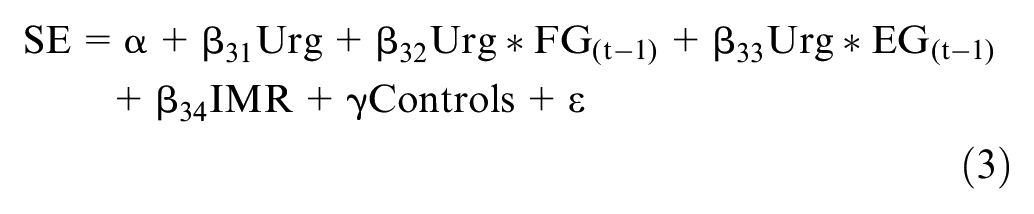
In the second stage, the obtained IMR was incorporated into Equations 2 and 3 to test three hypotheses. Equation 2 examines the influence of the chairperson’s time urgency on strategic entrepreneurship, while Equation 3 investigates the moderating effect of firm growth and the expectation gap. The data analysis employs the statistical tool STATA 18.

Results
Descriptive Statistics and Correlation Analysis
Table 1 presents the descriptive statistics for all variables. Regarding the correlation coefficient, the top leaders’ time urgency positively correlates with strategic entrepreneurship (p < .1), suggesting that the top leaders’ time urgency positively impacts strategic entrepreneurship. The finding contributes to a holistic understanding of a temporal trait in strategic decision-making. Moreover, the average value of strategic entrepreneurship is 0.742, showing that the balance is relatively high. The standard deviation is 0.192, showing that the sampled companies have a wide range of strategic activities. Which allows for a thorough analysis of how different factors affect strategic entrepreneurship.
Descriptive Statistics and Correlations.

Note. N = 167.
p < .01. **p < .05. *p < .1.
Hypothesis Testing
Heckman’s First-Stage Regression
Table 2 uses the Probit function regression to establish a quantitative framework for correcting the endogeneity issues. It shows the first-stage regression results for the chairperson’s time urgency (a dummy variable, 1 = yes, 0 = otherwise). In the first stage, the regression coefficient was significantly positive (β = .3889177, Z = 2.08), showing the chairperson turnover is a significant factor in the chairperson’s time urgency, as an increase by 1-unit in the successor’s score is associated with a 0.3889177 increase in the level of time urgency (p < .01). It is essential to improve the internal validity of the analysis by introducing control variables like chairperson characteristics and firm and industry factors.
Regression Results of Probit Function.

Note. N = 532.
p < .1. **p < .05.
Heckman’s Second-Stage Regression
This study uses the statistical software Stata for data analysis. Examination of the variance inflation factor (VIF) values reveals that all values are well below 3.94, indicating a manageable issue of multicollinearity. Several variables are statistically associated with strategic entrepreneurship across model 1 to model 6. Increasing chairperson tenure significantly impacts strategic entrepreneurship, with the strategy ranging from 0.007 to 0.009 (p < .05) of a 1-unit increase in the successor. A 1-unit increase in chairperson power leads to a significant positive association, with strategic entrepreneurship increases ranging from 0.059 to 0.065 (p < .05), indicating that the power encourages the strategy. A 1-unit increase in firm ownership property with strategic entrepreneurship increases from 0.189 to 0.213 (p < .01), suggesting that the state-owned firm advocates strategic pursuits.
This study tested the hypotheses using the stepwise hierarchical regression approach in the second stage. Step 1 entered only the controls (including IMR), step 2 added the main effects, and step 3 added the interaction effect. Model 1 of Table 3 is the control variables that influence strategic entrepreneurship. As shown in Model 1, chairperson tenure, chairperson power, and firm ownership property are positively related to strategic entrepreneurship. Model 2 adds the moderators, and Model 3 adds the independent variable, which shows the regression coefficient is .032 at p < .1. This finding demonstrates that top leaders’ time urgency positively influences strategic entrepreneurship; therefore, this study empirically supports H1. This study tests the combined interaction effects of the explanatory variables (top leaders’ time urgency) and the moderating variables (firm growth and the expectation gap) on strategic entrepreneurship (Hypotheses 2–3) in Models 4 and 5. Specifically, Model 4 adds one interaction to Model 3, while Model 5 adds another to Model 3. On the one hand, the explanatory power of Model 4 increased from Model 3, verifying the significance of interaction terms, R-squared from .145 to .164. On the other hand, the explanatory power of Model 5 also increased (R-squared is from .145 to .167). H2 and H3 suggest that the interaction affects the influence of strategic entrepreneurship differently. Models 4 and 5 show that the interaction term’s regression coefficients are .146 and −1.173, all significant at p < .1 and p < .05. As a result, empirical evidence confirms H2 and H3. Furthermore, Model 6 presents a comprehensive analysis of the moderating effect, further supporting the existence of moderating effects for H2 and H3.
OLS Regression Results of Hypotheses.

Note. N = 167.
p < .01. **p < .05. *p < .1.
Following the method commonly (Echols & Tsai, 2005), this study defined low-high firm growth levels constructed on one standard deviation below and above the mean of each firm growth variable. Figure 2(a) shows how firm growth affects the relationship between time urgency and strategic entrepreneurship. It confirms that when firm growth is high, the linear relationship between top leaders’ time urgency and strategic entrepreneurship is positive; however, when firm growth is low, the linear relationship between top leaders’ time urgency and strategic entrepreneurship is negative. It offers an observation of resource availability. As a firm continues to grow, the time-urgent top leaders utilize these resources to support strategic entrepreneurship. These leaders, who experience a sense of chronic hurriedness, have intrinsic time incentives to allocate the knowledge, information, and R&D investment for the balance of exploration versus exploitation. As a firm explores new opportunities and adapts to the existing market conditions, time urgency is best in resource-abundant situations. Fostering strategic entrepreneurship in organizations requires considering individual time urgency and resource factors.
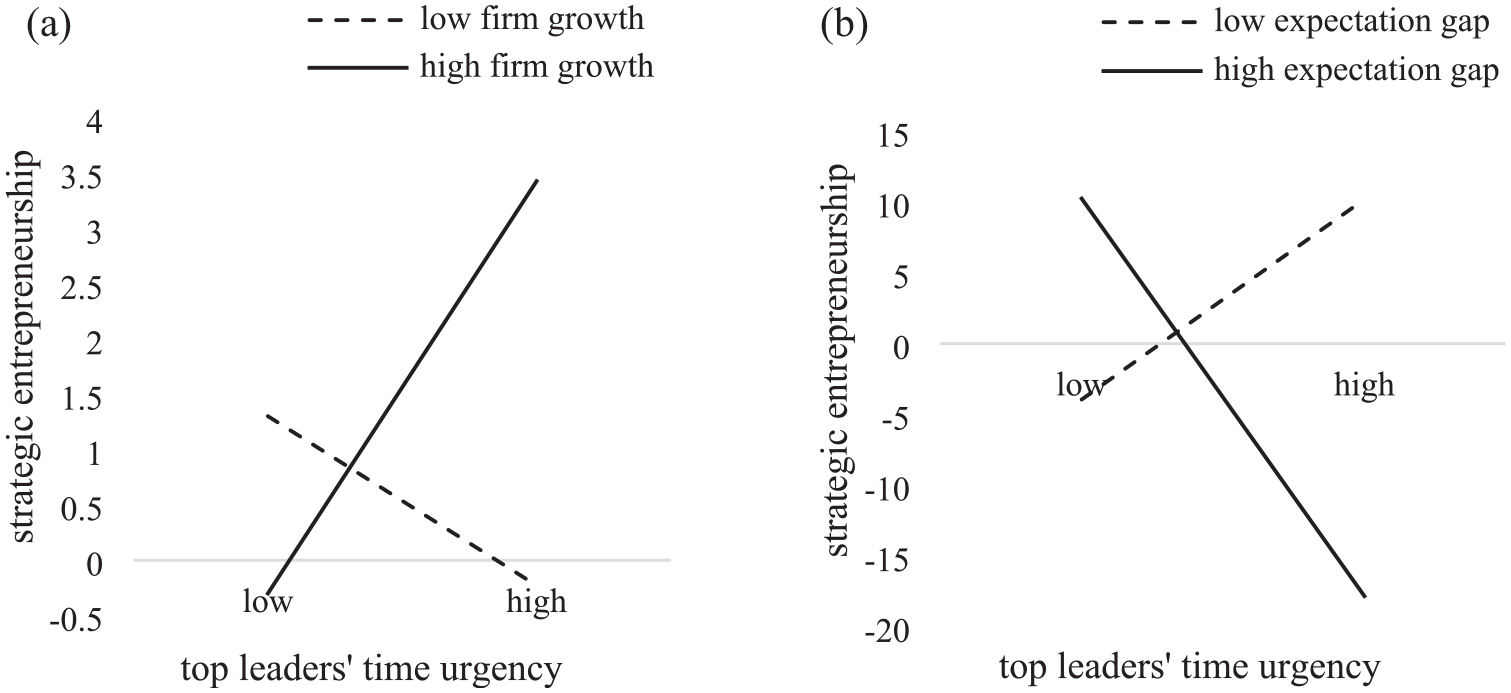
(a) H2—Moderating effect of firm growth on the relationship between top leaders’ time urgency and strategic entrepreneurship; (b) H3—Moderating effect of expectation gap on the relationship between top leaders’ time urgency and strategic entrepreneurship.
Meanwhile, Figure 2(b) examines the complex connection between the expectation gap, a top leader’s time urgency, and strategic entrepreneurship. It shows that the linear relationship between top leaders’ time urgency and strategic entrepreneurship is positive when the expectation gap is low. However, when the expectation gap is high, the linear relationship between top leaders’ time urgency and strategic entrepreneurship is negative. The finding reveals a negative moderating effect that the expectation gap improves the understanding of how a leader’s time urgency changes in their prospect. When expected performance exceeds the actual performance, the time-urgent top leaders face more significant ROA pressure. To accommodate the need for rapid adoption of solutions, time-urgent top leaders ignore different ideas and (or) make extreme decisions to jeopardize the balance of exploration versus exploitation.
Robustness Test
This study conducted a robustness test using two methods: the first was to change the measurement of the dependent variable, which is from the frequency of words of exploration and exploration to the weight of words frequency in the text of MD&A. The second was to add additional controls. For instance, access to more education means that the chairperson can adopt innovations more remarkably (Barker & Mueller, 2002); this study showed a 5-point scale of chairperson education: 1 = high school and below, 2 = junior college, 3 = undergraduate, 4 = master’s degree, and 5 = doctorate. This study also chose the natural number of the chairpersons’ age as another variable. Besides firm age, firm size also affected the tendency toward strategic entrepreneurship (Lavie et al., 2010); this study used the current year’s logarithm of the number of employees to capture firm size. By adding the firm growth rate, we considered the impact of income on the balance of exploration versus exploitation in the current year. Finally, this study joined the fixed effects of industry (1 = high technology industry, 0 = non-high technology industry). The OLS regression was applied again through the above two methods. Tables 4 and 5 present the findings and demonstrate that all key variables remained almost identical; thus, we repeatedly prove Hypotheses 1, 2, and 3.
Robustness Test 1: Transforming the Measures of the Dependent Variable.

Notes. N = 167.
p < .01. **p < .05. *p < .1.
Robustness Test 2: Adding Missing Variables.
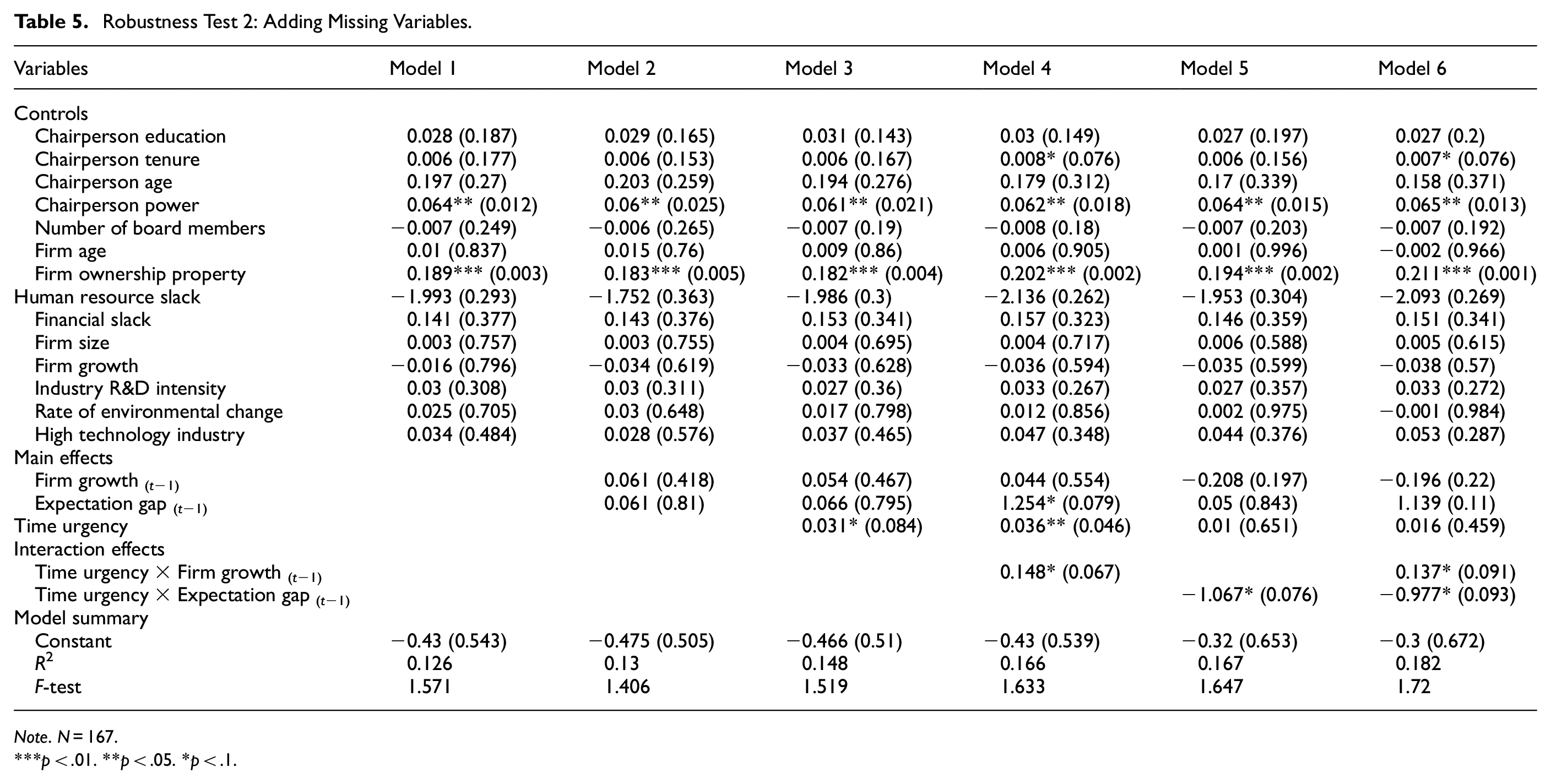
Note. N = 167.
p < .01. **p < .05. *p < .1.
Discussion and Conclusion
This study examines the complex relationship between the time-urgent top leaders, firm growth, expectation gap, and strategic entrepreneurship in Chinese A-share listed companies. It shows that the time urgency of top leaders shapes strategic entrepreneurship by balancing exploration versus exploitation. Consistent with previous studies (J. Chen & Nadkarni, 2017), the findings indicate that the time urgency by top leaders’ temporal dispositions profoundly impacts strategic entrepreneurship, supporting the traditional dichotomy of exploitation and exploration (March, 1991). Additionally, this study underscores the critical moderating role of firm growth. As firms grow, time-urgent top leaders have more resources to advocate strategic entrepreneurship. Nonetheless, more urgency does not always mean the better. The expectation gap negatively influences the relationship between time-urgent top leaders and strategic entrepreneurship, suggesting that top leaders struggle to balance exploration versus exploitation when the expectation gap widens. These findings illuminate the complicated relationship between time urgency, resources, and expectations, emphasizing the necessity of understanding these factors within the framework of strategic entrepreneurship.
Contributions
This study makes several significant contributions to critical strategic choice by broadening the understanding of temporal traits beyond the traditional perspective that only considers temporal orientation.
Theoretical Contributions
The dominant literature explored the positive effects of collaborative innovations (Ketchen et al., 2007; Tsai & Lei, 2016), knowledge (Kotha, 2010), experience, and networks (Zhao et al., 2020) on strategic entrepreneurship at the inter-organizational level. No stream has addressed the role of top leaders’ temporal trait—time urgency—in determining strategic entrepreneurship (their firms’ key strategic activities) at the organizational level. However, this study illustrated how top leaders’ temporal traits shape strategic entrepreneurship by adopting the concept of time urgency. By highlighting the importance of time urgency, this study helps to understand the strategic entrepreneurship phenomenon.
Time urgency is exceedingly scarce in firm-strategy research because observing the temporal trait of the individual leader is difficult. Nevertheless, the temporal trait of top leaders is innate and stable; it may advocate understanding how time urgency manifests in strategy choice. The inherently time-competitive nature of the exploration versus exploitation phenomenon has brought the time urgency of top leaders to the antecedent research in strategic entrepreneurship. Furthermore, this study also finds that the time urgency may be an explanation of the ability of top leaders to reconfigure time resources, reflected in a balanced exploration versus exploitation (Cao et al., 2009), which improves the explanatory power of the trait theory of leadership in the strategic entrepreneurship literature. It is noted that the automated analysis developed to assess top leaders’ time urgency using a word set in this study achieves the generalizability of temporal trait research in strategy.
Compared to the research that underlined the mediator of CEOs’ time urgency and corporate entrepreneurship (J. Chen & Nadkarni, 2017), this study casts organization-level factors as critical contingency factors, such as firm growth and the expectation gap, on the relationship between top leaders’ time urgency and strategic entrepreneurship. An important contribution of these moderation results is that not only is top leaders’ time urgency a vital force in shaping strategic entrepreneurship, but it can also not be considered in isolation from the micro features of the organization-level factors. The integration of organization-level factors and time urgency is consistent with the hypothesis. The two factors are essential boundary conditions for the relationship between top leaders’ time urgency and strategic activities. With sustained firm growth, time-urgent top leaders have more vital resources to enhance strategic entrepreneurship. It further confirms that firm growth is a given condition in the specific research (McKelvie & Wiklund, 2010). Meanwhile, this study finds that the perceiving pressure from the expectation gap does not necessarily translate into internal dynamics for time-urgent top leaders, which provides theoretical support for the search for adverse factors affecting strategic entrepreneurship.
Practical Contributions
This study brings three practical contributions. First, the findings confirm that the stronger the top leader’s time urgency, the higher the level of strategic entrepreneurship. The result suggests that when strategic entrepreneurship is a critical strategic choice, considering the time urgency of chairpersons or other top leaders may be necessary for boards of directors in the selection and (or) appointment decisions. Second, the resource constraint assumption aligns with the firm’s reality; obtaining resources from sustained growth is feasible for the time-urgent chairpersons and other top leaders. The finding offers another approach to advocating strategic entrepreneurship by balancing exploration versus exploitation. Finally, since the expectation gap is the dominant factor leading to a non-comprehensive strategy for time-urgent chairpersons and other top leaders, it may be a better option for them to follow a decision-making logic based on gains rather than losses in strategic entrepreneurship.
Implications
Examining the interplay between time urgency and contingency factors at the organizational level offers a rich avenue for exploring how top leader traits affect core strategic activities. Strategic entrepreneurship can benefit from assessing the time urgency levels of its top leaders and aligning these traits with organizational factors.
Theoretical Implications
This study contributes several profound theoretical implications to the key strategic choice by deepening the understanding of the traditional dichotomy between exploitation and exploration. There is a disruption in the conventional single strategic entrepreneurship perspective (Zhou & Li, 2024), as uncovering a nuanced contradictory effect of exploitation and exploration. The conflicting effect demonstrates that time-urgent top leaders significantly promote strategic entrepreneurship by balancing exploitation versus exploration. In light of this, the ambidexterity view of strategic entrepreneurship calls for more attention to top leaders’ time urgency.
Furthermore, the application of moderating factors—firm growth and expectation gap—demonstrates that a fuller understanding of the role of the top leaders’ time urgency requires consideration of the organizational context. These discoveries contribute to a new understanding of the primary effect model. There is a need for a new perspective on the antecedent study of strategic entrepreneurship with a non-singular focus on time urgency, as the interaction effect between time urgency, firm growth, and expectation gap underscores the necessity for such understanding. This study deepens the comprehensive approach to the effectiveness of time urgency in making strategic decisions. It paves the way for future research investigating the intricate relationships between temporal traits and competitive dynamics.
Managerial Implications
The managerial implications emphasize the significance of time urgency in making strategic choices. Organizations can improve their strategic capabilities by focusing on individual leaders’ temporal traits, which could recognize the importance of the nature of top leaders’ time urgency in making strategic entrepreneurship.
Furthermore, organizations can adjust their resource management to better support the top leaders’ time urgency. They realize that time-urgent top leaders could allocate the resources from firm growth to balance exploration versus exploitation to achieve strategic entrepreneurship. Organizations can create decision criteria that encourage the balance of exploration versus exploitation when top leaders have a nuanced understanding of the interaction between their time urgency and expectations. Organizations can achieve a competitive advantage in a changing business environment if top leaders capitalize on the strengths associated with time urgency.
Limitations and Future Directions
This study has several limitations that provide avenues for future research. First, while top leaders with time urgency influence strategic entrepreneurship, this study does not account for the mediating mechanisms in the above relationship. Future research could build on the research model of this study to explore the mechanisms through which top leaders’ time urgency promotes or hinders strategic entrepreneurship in firms with sustained growth or significant expectation gaps. Second, despite the core variables demonstrating high levels of validity and reliability, it is essential to acknowledge the biases associated with secondary data and content analysis when gauging strategic entrepreneurship and time urgency. Conducting studies based on original data could improve the accuracy of our findings. Third, using a matched sample of Chinese A-share listed companies limits the generality of the findings. Future research should retest the hypothesis in an international context. Finally, this study could not examine year effects due to the limited sample size. In the future, it hopes for larger-scale studies through questionnaires or interviews.
Conclusion
This study highlights the importance of exploring the antecedents of strategic entrepreneurship through the lens of top leaders’ time urgency in Chinese companies. Additionally, it investigates the moderators in the organization-level contexts to open up new avenues for future research on strategic entrepreneurship. The findings reveal that the temporal nature of strategic entrepreneurship, coupled with the inherent stability of top leaders’ time urgency, presents a complex yet intriguing area of investigation. By inspecting the impact of time urgency on strategic entrepreneurship, researchers and practitioners can gain valuable insights into enhancing organizational agility, innovation, and performance in dynamic environments. We hope the results of this study inspire further research into the antecedents of strategic entrepreneurship, particularly concerning the temporal traits of top leaders.
Footnotes

Author Contributions
S.Z. has contributed mainly to this work. Conceptualization, S.Z.; Formal analysis, S.Z., K.D., and R.L.; Methodology, S.Z., K.D., and R.L.; Writing-Original Draft Preparation, S.Z.; Writing-Review and Editing, S.Z., K.D., and R.L.
Funding
The author(s) received the National Social Science Found of China (21BH145) financial support for the research, authorship, and/or publication of this article.
Declaration of Conflicting Interests
The author(s) declared no potential conflicts of interest with respect to the research, authorship, and/or publication of this article.
Data Availability Statement
The data supporting the findings of this study are available from the corresponding author upon reasonable request.