




Abstract
The COVID-19 pandemic forced teachers to continue teaching their classes remotely, without prior preparation, in social isolation, and with difficulty in disconnecting digitally, in the face of high work demands and in a context of uncertainty. Given this scenario, the need arose to determine the validity of an explanatory model of job satisfaction in Peruvian teachers. We worked with a cross-sectional explanatory design of latent variables and a sample of 232 Peruvian teachers from urban areas at the basic and higher education levels, selected with a non-probabilistic sample. Stress overload was found to mediate the relationship between work-family conflict and job satisfaction in teachers who worked remotely during the pandemic. Neither work-family conflict nor self-efficacy had an indirect effect, mediated by stress overload, on teachers’ job satisfaction.
Plain Language Summary
The COVID-19 pandemic compelled teachers to continue their work but in the virtual realm, without prior training, in social isolation, and with an increased workload, all within an atmosphere of uncertainty. In response to this scenario, there arose a need to understand what factors contributed to Peruvian teachers feeling satisfied with their work during the pandemic. About 232 Peruvian teachers from urban areas at both basic and higher education levels participated. It was found that experiencing family conflicts due to work influenced teachers feeling overwhelmed by their workload, which in turn affected their job satisfaction in the virtual setting during the pandemic.
Introduction
Teachers play a fundamental role throughout their lives, from comprehensive training in basic education (Cuenca & Mendoza, 2017) to professional training (Rios González et al., 2019), which has a favorable impact on community development (Marúm-Espinosa & Reynoso-Cantú, 2014). The nature of their work has been linked to various psycho-occupational problems such as stress (Corbin et al., 2019; Jeon et al., 2019; Santa-Cruz-Espinoza, Chávez-Ventura, et al., 2022), dissatisfaction, and depression; situations that are exacerbated by precarious working conditions (Silva et al., 2005). However, the practice of the profession provides teachers with financial support and career satisfaction (Wilfried & Karl-Ingar, 2023), contribution to the education of their students, and job satisfaction (Favatto & Both, 2019).
Job satisfaction is the expression of enjoyment at work (Fritzsche & Parrish, 2005), where the person satisfies his or her social, personal, economic, or hygienic needs and aspirations. It acquires relevance in the work environment due to its link with factors associated with organizational effectiveness, job performance (Chiang & Ojeda, 2013), and turnover intention (Chen et al., 2014). At a personal level, it is related to personal well-being (Caballero & Salvador, 2004; Pujol-Cols & Dabos, 2018), which encompasses life satisfaction (Lent et al., 2011) and career development (Lent & Brown, 2006).
Traditionally, job satisfaction, from an affective dimension, is the general feeling of how much people like their jobs. However, it is often confusing, especially in measurement, with the cognitive conception based on rational judgments about working conditions (Thompson & Phua, 2012). In this regard, affective job satisfaction is studied to ensure consistency in its meaning and measurement (Thompson & Phua, 2012).
There are three approaches to the study of job satisfaction: (a) situational, which refers to the inherent characteristics of the job; (b) dispositional, which includes personal traits; and (c) interactionist, which combines the above (Pujol-Cols & Dabos, 2018). Of these, the least studied model is the interactionist model, and the best predictor of satisfaction is the dispositional model (Pujol-Cols & Dabos, 2018). In this regard, it is better to use the term personal rather than dispositional because there are other factors (cognitive, affective, and behavioral) that are not genetically determined, such as self-efficacy, which encourages personal agency and makes it possible to achieve one’s own well-being at work (Jentsch et al., 2023; Lent & Brown, 2006).
In this study, the interactionist approach was used to explain teachers’ job satisfaction in the context of the COVID-19 pandemic. This scenario has had a significant impact on different sectors worldwide. In the field of education, since 2020, as part of the measures to contain the SARS-CoV-2 contagion, decreed by the various governments, teaching has been carried out under quarantine, in the form of emergency remote work, by means of virtuality. This required teachers to acquire skills in using technological tools and specific programs immediately and on the spot. They had to adapt materials and content to capture the attention and involvement of students, design effective assessments, and take care of family needs and demands. All of this, added to the uncertainty generated by the pandemic, its consequences, and the restrictions on interpersonal contact, were sources of stress (Santa-Cruz-Espinoza, Chávez-Ventura, et al., 2022).
The pandemic had a negative impact on teaching work because it generated isolation, a sedentary lifestyle, alterations in natural biorhythms, an increased workload, and conflicts between work and private life, especially in the presence of children in the family (Carrasco-Mullins, 2021). However, even though a characteristic of remote work is temporal flexibility (Zhang et al., 2020), in the case of teachers, the timetables were not flexible. They could not control them, nor could they organize or prioritize tasks, because (in the situation of social isolation), both situations were established by the central administration.
Among the main concerns about the impact of COVID-19 on teaching is teachers’ inexperience and lack of training to teach remotely and support students (Hyseni & Hoxha, 2020). In this context, the development of digital skills in teachers was indispensable because they impacted student learning (Núñez-Canal et al., 2022), and their deficits may have caused insecurity, stress, and resistance to change in teachers. In addition, job satisfaction decreased, although teachers expressed willingness and motivation to adapt to change (Hyseni & Hoxha, 2020).
In the context of the COVID-19 pandemic, characterized by uncertainty and psychological impacts on the population’s health (Santa-Cruz-Espinoza, Domínguez-Vergara, et al., 2022), it was deemed necessary to set the objective of determining the validity of the explanatory model for teachers’ job satisfaction based on work self-efficacy, work-family conflict, stress overload, and experience in virtual teaching.
Theoretical Information and Hypotheses
The present study integrates labor demands and resources theory (Bakker & Demerouti, 2017) and social cognitive theory (Bandura, 1991, 1997b). The former argues that organizations place demands on their workers, who must exert effort, exhaust energy, and face costs (Bakker & Demerouti, 2017). While demands pose obstacles or challenges to the worker (Lepine et al., 2005), work resources allow for managing work demands and influence personal development (Schaufeli & Taris, 2014). The balance or imbalance between demands and resources is associated with motivational processes, engagement, and well-being versus burnout and health deterioration (Bakker & Demerouti, 2007; Hakanen et al., 2006).
Among the negative consequences of excessive demands and poor available resources, it has been reported: burnout, impairment of interrelationships, and work performance (Bakker & Wang, 2020), which – in turn – can generate more demands at work (Bakker & Demerouti, 2018). However, self-efficacy, based on social cognitive theory (Bandura, 1991, 1997b), is constituted as a personal resource that, by exerting influence on the working conditions and emotional states of workers (Bandura, 2009), favors commitment, satisfaction, and job performance. In addition, self-efficacy is influenced by the work context and emotional and somatic states (Bandura, 1997b).
Personal resources play a similar role to labor resources. Both contribute to achieving organizational goals, optimizing personal development, and learning. In addition, they favor reducing the costs of work demands, which can affect workers’ psychological health (Bakker & Demerouti, 2017). For the explanatory model hypothesized in this research, the resources would be virtual teaching time and work self-efficacy, while work-family conflict and overload are considered consequences of work demands and will be described below.
The model proposed in this research explains job satisfaction in teachers, a relevant construct for being a protective factor that contributes to their adaptive functioning (Padmanabhanunni & Pretorius, 2022) and has a favorable impact on the students under their care (Ekperi et al., 2019). Furthermore, this research aims to overcome the following gaps: (a) the relationship between personal resources and behavioral effects has not been established. Moreover, the involvement of third variables influencing the expected effects needs to be elucidated (Bakker & Demerouti, 2017); (b) studies of job demands and resources have focused more on health effects and less on motivational aspects (Bakker & Demerouti, 2017), which is why this study considers job satisfaction as a dependent variable; (c) research on job satisfaction in teachers during the COVID-19 pandemic is scarce. In turn, the study will guide future research and, at the same time, will constitute a contribution for practical purposes, for decisions that contribute to favoring job satisfaction through the promotion or prevention of those factors that are part of the explanatory model.
Stress Overload
Stress overload is understood as a pathogenic state whose effects are more harmful than stress and combines the demands or burdens of events and personal vulnerability, referring to depleted individual resources to cope with the demands (Amirkhan, 2018). Unlike stress, in which the person may have personal resources to cope with the challenges, overload involves feeling overwhelmed and the impossibility of overcoming adaptive demands, making it a predictor of symptoms and illnesses that occur after stressful events (Amirkhan, 2012, 2021). For example, stress overload is associated with voice impairment (Kunin et al., 2020).
One of the sources of overload experienced by teachers during the COVID-19 pandemic was the use of technology in their work and the increased effort to adapt to the new environment (Aktan & Toraman, 2022). In addition, the risks of health emergencies, the presence of anxiety and depression, and poor administrative support were added. This explains the intention to leave the teaching profession (Gillani et al., 2022) in regular basic education but not at a higher level (Chou & Chou, 2021). In this regard, it should be noted that, before the pandemic, only some careers and professional specialization courses were carried out in the virtual modality of university education.
Personal vulnerability is one of the components of stress overload (Amirkhan, 2018) and is moderated by social support in the effect that it exerts on the symptomatology of negative emotions (Mu & Duan, 2020). Peer support favors job satisfaction and is negatively associated with stress and burnout (Stang-Rabrig et al., 2022). However, in the context of remote work, direct contact with colleagues and students was restricted. Consequently, burnout from social distancing generated distress in teachers, which impacted effectiveness and job satisfaction (Procentese et al., 2023).
Overload is related to burnout (Patlán, 2013) and this, in turn, affects job satisfaction (Cortez-Silva et al., 2021; Patlán, 2013; Pikó & Mihálka, 2017). Despite this, digital literacy reduces the impact of stressors linked to technology use and burnout in teachers (Califf & Brooks, 2020). In addition, one study found that teachers with less experience are more stressed in the face of work-related problems compared to those with more experience (Chaplain, 1995). Therefore, it is inferred that the preparation of teachers in the use of technologies for online teaching, evidenced by years of previous experience teaching in virtual environments, would reduce the workload in the context of emergency remote teaching, which would favor job satisfaction. In this regard, there is evidence supporting the negative relationship between stress and job satisfaction (Chaplain, 1995; Klassen & Chiu, 2010). Based on these arguments, it is possible to formulate a hypothesis:
Work-Family Conflict
Work-family conflict is not a new phenomenon. It arises as a function of the incompatibility between the role played in the work domain that affects the family domain (CTF) or vice versa (CFT; Blanch & Aluja, 2009; Gutek et al., 1991). Conflicts can occur when: (a) the time allocated to one of the domains reduces the time available for the other domain, which affects performance (Hetrick et al., 2024). (b) The presence of stress in one of the domains generates tension that affects performance in the other domain; that is, negative affectivity overflows from one domain and is transferred to another, or the ambiguity of the work role interferes with family life (Hetrick et al., 2024). (c) The behavior expected to perform one role at work or in the family is incompatible with the behavior expected in the other domain, so conflicts are experienced by not matching behavior between role performance (Hetrick et al., 2024).
Work-family conflict and family-work conflict are related to lower job satisfaction (Jerg-Bretzke et al., 2021; Zhao & Namasivayam, 2012) and even constitute a risk factor for public health (Chandler, 2021). The consequences of work-family conflict interference can become persistent over time and affect affective rumination, burnout, and stress (Brzykcy et al., 2024). However, time-based work-family conflict decreases if self-compassion is strengthened (Nicklin et al., 2022) and has a negative relationship with the personality trait of stability.
In the context of the pandemic, work demands increased, which caused more significant work-family conflict in families who performed remote work during the pandemic (Zhang et al., 2020) and overload in teachers (Martí-González et al., 2023), who had to convert their homes into a work setting, without choice. Remote work generated guilt in women, who perceived a greater work overload combined with the need to pay attention to family demands, such as having to accompany their children in their learning process (Santa-Cruz-Espinoza et al., 2023; Walters et al., 2021).
Work-family conflict was already present in teachers before the pandemic. Chilean primary school teachers had a low level of work-family balance because their workload interfered with family time (Abarca et al., 2016), while in Malaysian secondary school teachers, work-family balance influenced their job performance (Johanim et al., 2017). Furthermore, in female teachers in Israel who worked at the primary and secondary educational levels, work-family conflict was related to teaching experience, the school level at which teaching is practiced, and the importance assigned to the roles of being a worker, a family member, or both (Cinamon & Rich, 2005).
The work-family conflict disrupts personal homeostasis and self-perception. Some reports indicate that work-family conflict is associated with symptoms of depression (Zhou et al., 2020) and influences personal satisfaction, a relationship that intensifies with increasing age (Yuan et al., 2022). The work-family conflict also positively influences the demands and challenges of professional self-efficacy in women (Alok et al., 2021) and depletes self-efficacy over time (Smoktunowicz & Cieślak, 2017). Moreover, there is evidence of the impact of work-family and family-work conflict on stress, differentiated by gender, within couples. Thus, work demands that cause conflict in women’s families are associated with work and family-related stress in men. In contrast, family demands that impact men’s work is related to family-related stress in women (Smoktunowicz & Cieślak, 2017).
Concerning the relationship between work-family balance and job satisfaction, it has been found that long working hours and role overload would prevent people from spending more time with their families, leading them to evaluate their work negatively (Aguirre & Martínez, 2006; Jiménez et al., 2009; Paterna & Martínez, 2002). The teaching profession is linked to stress because the work requires continuing to perform work-related activities at home, which causes interference with family life (Abarca et al., 2016; Lemos et al., 2019). This relationship between work-family conflict and teacher burnout is mediated by cognitive appraisal and invariance according to sex and age (Simães et al., 2021).
According to the evidence presented, work-family conflict is an adverse event associated with undesirable affective and somatic states that can have a negative impact on teachers’ self-efficacy, job satisfaction, and ability to cope with stress. Added to this is the high workload they had in virtual teaching, attending to work and family needs at the same time and space, with the additional pressure of developing digital skills to face work demands for which they were not prepared. In addition, although social support is a relevant predictor of teacher satisfaction (Martí-González et al., 2023), social interaction has been limited in the context of the pandemic, so this protective factor is not available, and psychosocial risks are added; therefore, the hypotheses are formulated:
Job Self-Efficacy
Perceived self-efficacy refers to the belief in one’s own ability in different areas of functioning (Bandura, 2019) and constitutes an explanatory factor of human behavior, self-motivation to achieve goals, and outcome expectations (Bandura, 2009). People with high self-efficacy engage in activities they consider themselves effective in, which has repercussions in the cognitive, affective, motivational, and decisional spheres (Bandura, 2019) and even in career development (Lent et al., 1994). Therefore, self-efficacy also influences job satisfaction (Gil-Flores, 2017; Judge & Bono, 2001; Lent & Brown, 2006; Perera & John, 2020) and is mediated by work commitment (Granziera & Perera, 2019) or organizational commitment, as it remains high, even under conditions where overload is high (Ríos Martínez et al., 2010). In addition, it is considered a modulator of work stress (Gil-Monte et al., 2008; Judge et al., 2001; Soria et al., 2005).
Another study also refers to cross-domain compensation, understood as the self-regulating mechanism to reduce the emotional impact of negative situations in one of the domains (work or family) by focusing on positive events in the other domain, influences personal resources through self-efficacy, and this, in turn, influences job or family satisfaction (Dishon-Berkovits, 2021). This is consistent with Bandura’s (2012) statements when he affirms that positive experiences determine self-efficacy. In addition, affectivity is relevant to teachers’ job satisfaction because it is associated with their emotional traits (Colomeischi, 2014) and high-quality teacher-student interrelationships in the classroom (Virtanen et al., 2019). Teachers with higher self-efficacy, affiliation with colleagues, and who emphasize academics in their students experience lower stress (Bottiani et al., 2019).
The author of the social cognitive theory highlighted that self-efficacy should be evaluated in specific behavior domains (Bandura, 2018). Therefore, this study assumes the construct of job self-efficacy, understood as the belief in one’s own ability that a person experiences to perform successfully in the activities of their work (Rigotti et al., 2008). Workers who have high job self-efficacy tend to suffer less stress when using technology (Chou & Chou, 2021; J. Ma et al., 2021; Rasool et al., 2022), find more satisfaction in their tasks (Bartosiewicz et al., 2022; Marcionetti & Castelli, 2023) and are more protected from suffering burnout (Bartosiewicz et al., 2022; Daniel & Van Bergen, 2023), so the protective role of self-efficacy in mental health is indisputable.
Various studies have identified the mediating role of self-efficacy in the relationship between personal and organizational variables. Thus, for example, self-efficacy for care mediates the relationship between unmet needs and health-related quality of life (Cheng et al., 2023). Also, among other studies, it has been found that self-efficacy is a mediator of the relationship between (a) violence in the work context and post-traumatic stress disorder in nurses (Lu et al., 2023); (b) challenging job demands and job commitment (Rai et al., 2022); (c) problem-solving and hope (Çam et al., 2020). In the referred studies, self-efficacy intervenes in the relationship between independent variables that pose challenges and dependent variables that receive a positive or negative impact in the emotional sphere. Therefore, based on the above, the following hypotheses are proposed:
Self-efficacy develops in its exposure to different sources, such as (a) mastery experience, referring to the performance achievements attained, which may come from the performance of guided behaviors through molding or exposure to performance; (b) vicarious experience, comprising learning through face-to-face or symbolic models; (c) social persuasion, comprising instructional learning or self-learning; and (d) physiological and affective states, such as emotional arousal and its erroneous attributions (Bandura, 1977a). In the teaching field, self-efficacy is more flexible during the first years of professional experience, and the source that has the most significant participation is the experience of mastery of different types: enactive, cognitive, professional, and that related to the supervision of teachers and experiences linked to students; followed by the source of emotional states (K. Ma et al., 2025). From the above, it is hypothesized:
Finally, the general hypothesis of the study is: The explanatory model of job satisfaction based on work-family conflict, family-work conflict, years of experience in virtual teaching, stress overload, and mediated by self-efficacy, has validity in the teaching practice exercised during the COVID-19 pandemic (Figure 1).

Hypothesized model of the explanation of job satisfaction in teachers during COVID-19 pandemic.
Method
The design used is cross-sectional explanatory with latent variables (Ato et al., 2013), whose hypothesized model is shown in Figure 1. The following were considered as: (a) independent variables: work-family conflict, family-work conflict, and years of experience in virtual teaching; (b) mediating variables: occupational self-efficacy and stress overload; (c) dependent variable: job satisfaction.
Participants
The sample consisted of Peruvian teachers from the cities of Trujillo (n = 97) and Piura (n = 135), located on the northern coast of Peru. Participants worked remotely during the first and second waves of the COVID-19 pandemic in Trujillo and Piura. The sample was selected by non-probabilistic convenience sampling and consisted of 232 teachers between 24 and 72 years of age (M = 43.79, SD = 9.65) with teaching experience between 0.5 and 44 years (M = 6.52, SD = 9.57). They belonged to different educational levels, pre-school (7.76%), primary school (31.03%), secondary school (46.12%), and higher (15.09%) from public and private institutions of the Peruvian urban context, of middle and low socioeconomic level.
Most of the participants were women, married and cohabiting, had children, and, prior to the pandemic, worked as classroom teachers. In addition, they were partially responsible for household chores and for accompanying their children in their schooling (Table 1). Most of the teachers considered that their access to the Internet was regular (44.4%) or good (43.97%) and that the functioning of their equipment – most of them – was in the good to regular levels, while they rated their own skills in the use of virtual tools as regular (56.47%).
Sociodemographic Characteristics of the Participants.

Instruments
Stress Overload Scale-Brief (SOS-S)
It was designed by Amirkhan (2018) and has 10 item (e.g., In the past week, have you felt overwhelmed by your responsibilities? [En la semana pasada, ¿se ha sentido abrumado por sus responsabilidades?]), self-report measure of the experience of overload, in two dimensions, personal vulnerability (items 1, 3, 5, 7, 9) and event burden (2, 4, 6, 8, 10). It was derived from its short version of 30 items (Amirkhan, 2012). The instructions have the previous week as the time frame, and the items are ordinal scale of five points, from Not at all to Very much. It has adequate psychometric properties that resemble the extended version (30 items), and test-retest reliability was adequate (0.71 for personal vulnerability and 0.73 for event burden; Amirkhan, 2018).
Brief Affective Job Satisfaction Scale (BIAJS)
It is a single-item measure (Taking everything into consideration, how do you feel about your job as a whole? [Tomando en consideración todo, ¿en qué grado se siente satisfecho sobre su trabajo, en conjunto?]). It was designed by Thompson and Phua (2012) based on Brayfield and Rothe’s (1951) Job Satisfaction Index. Internal consistency reliability (alpha between .81 and .83) and stability (r = .57) were adequate in Thompson and Phua’s (2012) study. In terms of convergent validity, 0.74 was found in relation to another measure of job satisfaction and criterion validity with the measures of organizational identity (0.49) and subjective well-being (0.51; Thompson & Phua, 2012).
Occupational Self-Efficacy Scale (OSS-SF)
It was designed by Rigotti et al. (2008) for use in different occupational and professional settings. It was adapted to Peru by Merino-Soto et al. (2021) for workers of different occupations and professions. It consists of 6 items (e.g., I remain calm when faced with difficulties in my work because I am confident in my abilities. [Permanezco tranquilo cuando me enfrento a dificultades en mi trabajo porque confío en mis capacidades]). Their findings confirmed the unidimensional structure of the scale, with high factor loadings of the items, adequate internal consistency, and correlation with the external variables of psychological distress and stress overload (Merino-Soto et al., 2021). Another Peruvian study in teachers, who worked remotely during the pandemic (Santa-Cruz-Espinoza et al., 2024), successfully replicated the psychometric properties of the OSS-SF, obtaining one-dimensionality, strong scalability, fit to a monotonic homogeneity model, excellent reliability (MS-rho, α = .90), and moderate convergence with job satisfaction (r = .39).
Work-Family Conflict Scale (WFCC)
The scale, in Spanish, by Blanch and Aluja (2009) measures work-family conflict, in two modalities: work interference in the family and family interference in work (e.g., After work, I get home too tired to do the things I would like to do. [Después del trabajo, llego a mi casa demasiado cansado como para hacer las cosas que me gustaría hacer]). The test is structured on a 7-point Likert scale. In the original study, an exploratory and confirmatory factor analysis was performed; an explained variance of 45% was obtained for the entire sample, a two-factor correlated structure with acceptable adjustment indexes and factorial invariance according to sex, as well as acceptable internal consistency (Blanch & Aluja, 2009).
A validation study in Peruvian teachers (Santa-Cruz-Espinoza et al., 2023), using Mokken scaling analysis, obtained good levels of scalability (Hi > 0.45), reliability (>0.70), and adequacy to a monotonic homogeneity model in both dimensions; also, the internal structure did not show differential item functioning with respect to sex and level of education.
Procedure
Ethical Aspects
The project was approved by the Ethics Committee on November 28, 2023, which included the use of data collected in the period 2021 to 2022. Participants had authorized the use of their data for subsequent research. In addition, the research was conducted under the ethical framework of the Declaration of Helsinki (World Medical Association, 2013), the Code of Conduct of the American Psychological Association (2017), and the Code of Ethics of the Colegio de Psicólogos del Perú (2024).
The researchers contacted accessible participants via WhatsApp messaging. The Google form requested informed consent, which expressed the research objective: the estimated time for applying for the tests, voluntariness for participation, confidentiality, anonymity, and information handling. The participants had the opportunity to formulate doubts through the research team’s emails or cell phones. Those who agreed to participate had access to the instruments. Those who did not agree could answer “No” to the informed consent or omit their response, without consequence.
The principle of beneficence was respected by choosing a cross-sectional and non-experimental design. Participants were not subjected to any risk, as no artificial conditions were generated, such as the induction of stress or work-family or family-work conflict, which are some of the variables in this study. Therefore, collecting information with brief self-report measures, with validity and reliability obtained in previous studies, was a means of preserving the well-being of the participants and minimizing risks. The instruments used did not include content that could generate revictimization. In addition, in the informed consent form, participants were informed of where they could go in case they wished to receive some type of psychological support. Also, in the informed consent form, participants were informed about the type of questions they would answer, and they freely decided whether or not to participate in the study.
The risk-benefit balance was positive because the knowledge obtained has practical implications of benefit for the workers, and the risks were minimal, since the information was obtained in a non-invasive manner and the ethical standards for scientific research with human beings were met.
Data Collection
Due to the context of the COVID-19 pandemic, informed consent was obtained, and the instruments were applied using Google Forms, which were distributed on different social networks and WhatsApp messaging. The sample selection was non-probabilistic by convenience (Otzen & Manterola, 2017), and recruitment was by the snowball technique. The sample size is in the range of the most frequent sizes used in different measurement studies (Fritz & Mackinnon, 2007; Rizzo et al., 2022).
Data Analysis
First, descriptive and linear correlational statistics were obtained (p values were corrected by the Holm, 1979 method) within the variables involved. Sex differences, as a proxy to estimate possible moderation, were explored with Yuen’s t-test to compare trimmed means in two independent groups (Yuen, 1974). Robust standardized differences (dr; Wilcox & Tian, 2011) were estimated, and interpretation followed the following suggestions (Lovakov & Agadullina, 2021): very small (<0.15), small (<0.36), moderate (<0.65), and large (≥0.65).
The analysis was conducted within a framework of Factor Score Path Analysis (Devlieger et al., 2016) to reduce convergence problems derived from the relatively small sample size and use the smallest possible number of estimable parameters (Devlieger & Rosseel, 2017; Devlieger et al., 2019). The modeling was carried out in three steps: first, the measurement modeling of the latent variables was done; second, factorial scores were obtained with Croon’s correction (2002); and third, structural modeling was done using the factorial scores calculated in the previous step. In this step, SEM was used to estimate (a) the effect of the predictors (WFC, FWC, Years) on the mediator (OSES) and from the mediator to the predicted variables (SOS and BIAJS). The modeling used the ML estimator. The mediation effect or indirect effect was obtained and evaluated with the product of the coefficients test approach (MacKinnon et al., 2002), calculated as the product of the coefficient from the predictor to the mediator (a) and the coefficient from the mediator to the outcome (b).
Because this product’s sampling distribution is asymmetric (Bollen & Stine, 1990; Mackinnon et al., 2004), statistical significance was evaluated using confidence intervals generated by empirical distribution simulation, Percentile nonparametric bootstrap confidence intervals (5,000 simulated samples, 95% confidence) were generated to infer the statistical significance of the estimated parameters (direct and indirect effects), standardized and non-standardized (Cheung, 2009). If the confidence interval included a value of 0, then it was concluded that there was no statistical significance.
Standardized beta effects were evaluated by taking size levels (Cohen, 1988): 0.14 (2% of the variance), 0.39 (13% of the variance), and 0.59 (26% of the variance) for small, medium, and large effect sizes, respectively. Several effect size indices were calculated for mediation studies: mediation index, calculated as the non-standardized indirect effect multiplied by the ratio of SDX over SDY (Preacher & Hayes, 2008); mediation ratio (indirect effect over total effect; Ditlevsen et al., 2005; Freedman, 2001), and the ratio of indirect effect over direct effect (Sobel, 1982).
Results
Modeling of Measurement
Stress Overload (SOS-S Score)
SOS-S was fitted to their two-dimensional model, and the results were good: WLSMV-χ2 = 58.71, df = 34, CFI = 0.999, RMSEA = 0.056 (90% CI = 0.030, 0.079), SRMR = 0.038. However, the latent correlation between the two constructs was very high (r = .937, p < .01). Therefore, a unidimensional model fit was made because of the apparent differentiation between the two constructs. This was satisfactory (WLSMV-χ2 = 79.35, df = 45, CFI = 0.998, RMSEA = 0.074, 90% CI = 0.052, 0.095; SRMR = 0.046), and a single score was obtained for the SOS-S interpretation, internal consistency was omega = 0.940 (95% CI = 0.926, 0.951).
Job Satisfaction (BIAJS Score)
The unidimensional fit was good: WLSMV-χ2 = 0.771, df = 2, CFI = 1.00, RMSEA = 0.00 (90% CI = 0.00, 0.098), SRMR = 0.010, as well as reliability, omega = 0.856 (95% CI = 0.812, 0.892).
Job Self-Efficacy (OSS-SF Score)
The fit of its unidimensional model was good: WLSMV-χ2 = 16.65, df = 9, CFI = 0.999, RMSEA = 0.060 (90% CI = 0.00, 0.105), SRMR = 0.036. Reliability was good, omega = 0.870 (95% CI = 0.831, 0.920).
Conflict: Work-Family (WFC Score) and Family-Work (FWC)
In the present study, the fit of its multidimensional was satisfactory: WLSMV-χ2 = 48.58, df = 13, CFI = 0.996, RMSEA = 0.105 (90% CI = 0.07, 0.138), SRMR = 0.060. Reliability (work-family and family-work scale, respectively), omega = 0.914 (95% CI = 0.893, 0.934) and 0.718 (95% CI = 0.654, 0.794).
Descriptive and Correlational Statistics
All observed variables were not normally distributed (AD test > 2.00, p < .01). However, the absence of normality wasn’t extreme because the skewness coefficient was less than |1.0| for all scores. In excess kurtosis, except for the OSES score, the rest were equal to or less than |1.0| (Table 2). On the other hand, sex differences in the variables were predominantly minor or minimal (dR: min = 0.15, max = 0.25, M = 0.14), according to the classification of Lovakov and Agadullina (2021).
Descriptive and Correlational Information Among the Variables.
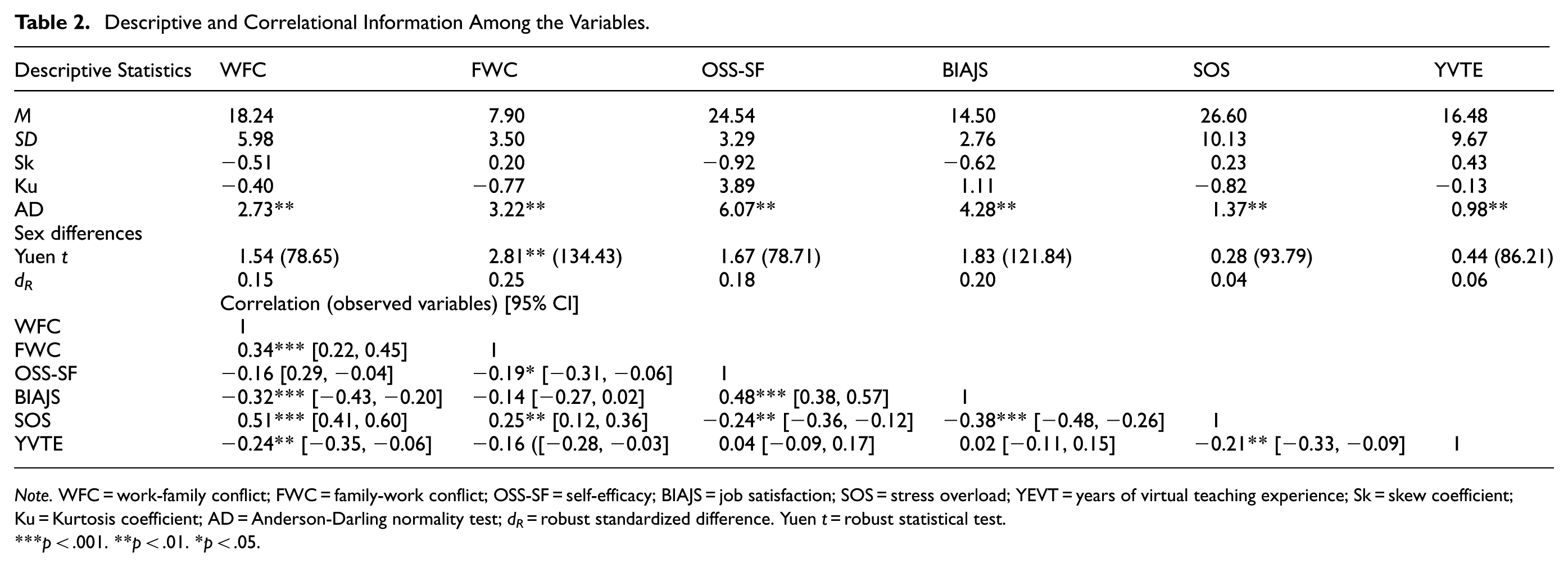
Note. WFC = work-family conflict; FWC = family-work conflict; OSS-SF = self-efficacy; BIAJS = job satisfaction; SOS = stress overload; YEVT = years of virtual teaching experience; Sk = skew coefficient; Ku = Kurtosis coefficient; AD = Anderson-Darling normality test; dR = robust standardized difference. Yuen t = robust statistical test.
p < .001. **p < .01. *p < .05.
The number of years of virtual teaching experience was the variable that consistently maintained low linear associations with the rest of the variables, and some were statistically non-significant (r < |0.17|). In contrast, SOS consistently showed statistically significant correlations and was of moderate size. The strongest association was with WFC. OSES with BIAJS showed the second comparatively strongest correlation of moderate size. Finally, FWC maintained small correlations with WFC (indicating the independence of the direction of the source of conflict between work and family) or very small (with the rest of the variables, r < | |0.26|). All correlations (positive or negative) directions were theoretically consistent (see Table 2).
Modeling of Mediation
Test of the Initial Model
The only statistically direct effects were small (WFC → SOS; WFC → BIAJS) and very small (SOS → BIAJS). These were in the theoretically consistent direction (Table 3). In indirect effects, statistically significant paths were detected (p < .05) but minimal (B and β around |0.01|) in WFC → SOS → BIAJS, FWC → OSES → BIAJS, and CF → OSES → SOS → BIAJS. The set of variables where the effects were consistently strong were WFC and SOS, whereas the rest were considered Type I errors. These variables, therefore, were used to revise the model.
Mediation Test: Standardized and Non-standardized Results.

Note. WFC = work-family conflict; FWC = family-work conflict; OSS-SF = occupational self-efficacy; BIAJS = job satisfaction; SOS = stress overload; YEVT = years of virtual teaching experience; LL = low limit; UL = upper limit.
p < .05.
Revised Model
Given the results of the first modeling, the revised model was work-family conflict and stress overload (WFC and SOS, respectively), so the new model was constructed as shown in Figure 2. In this revised and final model, ad hoc mediation indices were calculated. The results indicated a mediation effect due to SOS on the relationship between WFC and BIAJS (Table 4). Compared to the effects obtained in the first modeling (i.e., B and β), the same paths show a larger size. Additionally, the mediation index = −0.199 (95% CI = −0.289, −0.119), mediation ratio = 0.561 (0.302, 1.003), and the ratio of the indirect effect over the direct effect = 1.27 (95% CI = 0.37, 13.63) were statistically significant (confidence intervals did not include zero).

Revised mediation model.
Revised Mediation Test: Standardized and Non-standardized Outcomes.

Note. WFC = work-family conflict; BIAJS = job satisfaction; SOS = stress overload; LL = low limit; UL = upper limit.
p < .05.
Discussion
During the COVID-19 pandemic, the modality of work changed unexpectedly, and teachers faced a series of work and family demands simultaneously when working remotely from their homes. The study context was Peru, one of the countries in the Latin American region with a greater impact on the public health of the population due to COVID-19 (Mendoza-Cano et al., 2024), where teachers at different educational levels experienced greater guilt, supported by negative work behaviors (Marsollier et al., 2024). In addition, gaps in access to information technologies hindered the achievement of academic goals (Agasisti et al., 2023). In this context, this research aimed to determine the validity of an explanatory model of job satisfaction in Peruvian teachers during the pandemic. To this end, the following were considered as predictor variables: work-family conflict, family-work conflict, years of experience in virtual teaching, and mediating variables: self-efficacy and stress overload.
The findings reported that the teachers’ satisfaction was influenced by work interference in the family, mediated by stress overload, thus accepting hypothesis 2. Like previous studies, work overload and work environment were identified as work stressors in teachers during the pandemic (Santa-Cruz-Espinoza, Chávez-Ventura, et al., 2022). The COVID-19 pandemic scenario forced teachers to work remotely and unprepared, even though the use of technology was a stressor for them prior to the pandemic (Al-Fudail & Mellar, 2008).
In the Peruvian scenario, there were deficiencies in the access and use of information technologies, despite the fact that the availability of the use of technologies was associated with educational performance (Agasisti et al., 2023). There were inequalities that marked important deficits in student performance during the health emergency (Delprato & Antequera, 2025), such as inequity in access to technological equipment and difficulties in accessing the Internet (Muñoz-Espinoza et al., 2025) due to geographic or economic conditions. In students at a Peruvian university, during the pandemic, the lack of availability of quality technological resources was associated with stress, frustration, and educational dropout (Lovón Cueva & Cisneros Terrones, 2020).
The remote emergency work of teachers was characterized by an increased workload (such as: preparation of materials and evaluations applicable to virtuality), intrusion into privacy (when dealing with messages from parents, students and those responsible for educational management), instability and complexity of technological tools (such as weak internet connection; Tang & Guo, 2023). Additionally, teachers presented deficits in the digital competencies of teachers (Rojas-Osorio et al., 2024) and were confronted with the negative attitude of Peruvian students toward online education and the perception of difficulty in the use of technologies (Alania-Contreras et al., 2024). In addition, during the pandemic, there was an atmosphere of uncertainty and social distancing, as a measure to contain the spread of the virus due to the sanitary emergency. However, the presence of burnout syndrome during the pandemic was more prevalent in teachers in Chile and Argentina (Marsollier et al., 2024).
The work-family conflict was reported as a predictor of overload in the study sample. The nature of teachers’ work was already associated with stress prior to the pandemic because they commonly performed activities of their job at home, which generated interference in family life (Abarca et al., 2016; Lemos et al., 2019). In the context of the pandemic, emergency remote work required teachers to cope with simultaneous work and family demands in the home context. Even though the flexible nature of telework allows satisfying the basic psychological needs of autonomy, relationship, and competence (Brunelle & Fortin, 2021), in the case of teachers, emergency remote education was an imposed work environment, with rigidity in schedules. The participants, for the most part, were partially or totally occupied with domestic chores at home and the academic accompaniment of their children. The findings are in line with a study, during the pandemic, in Peruvian university teachers that reports high stress in heads of household (Cruz-Ausejo et al., 2023). Therefore, according to the findings, the interference of work with family life negatively impacted teachers’ overload.
The work-family conflict indirectly affects teachers’ job satisfaction, mediated by overload, and directly affects job satisfaction. This is consistent with studies that reported the negative direct effect of work-family conflict on job satisfaction (Jerg-Bretzke et al., 2021; Santa-Cruz-Espinoza, Domínguez-Vergara, et al., 2022; Zhao & Namasivayam, 2012). However, discrepancies occur about the indirect effect. One study found that cognitive appraisal mediates the relationship between work-family conflict and burnout in teachers (Simães et al., 2021), while another reported that work-family conflict mediates the relationship between overload and job satisfaction of preschool teachers (Hong & Liu, 2024). On the other hand, other research found that overload did not directly affect teachers’ job or professional satisfaction (Hong & Liu, 2024; Pathardikar et al., 2023). These findings reveal a complex interaction between work-family conflict, stress overload, and teacher job satisfaction.
Regarding the mediating role of stress overload in the relationship between family-work conflict and job satisfaction, the evidence rejects hypothesis 3 of the study because family interference in work does not directly affect overload. The findings differ from other studies, where it is reported that family-work conflict is related to less job satisfaction (Jerg-Bretzke et al., 2021; Zhao & Namasivayam, 2012). However, with the arrival of the pandemic, work demands increased, causing more significant work-family conflict in those who teleworked (Zhang et al., 2020). Added to this is the labor instability suffered in Peru during the pandemic, where labor organizations, by Peruvian State decree 038 to 2,020 (Ministerio de Trabajo y Promoción del Empleo del Perú, 2020), could send their workers to the suspension of their employment (Delgado de la Matta, 2021), in order to avoid the bankruptcy of the companies. This situation may have contributed to the fact that teachers, for fear of being fired from their jobs, prioritize the fulfillment of their work functions, compared to family functions, and, therefore, the work-family conflict does not impact on overload and, consequently, the study hypothesis is rejected.
Another finding indicates that self-efficacy does not mediate between work-family/family-work conflict and stress overload. Even though self-efficacy mediates the challenging demands of work and job commitment (Rai et al., 2022), and work-family conflict depletes self-efficacy over time (Smoktunowicz & Cieślak, 2017), the findings do not provide evidence to confirm hypotheses 4 and 5. It is likely that the duration of the work-family conflict, present at the time of evaluation, was not sufficient to generate negative impacts on self-efficacy. Self-efficacy may have played a moderating role in minimizing the impact of work-family/family-work conflict on stress overload, but this will require the development of new research.
Experience in virtual teaching before the pandemic did not indirectly affect teachers’ job satisfaction, mediated by self-efficacy. Therefore, research hypothesis 6 was rejected. Mastery experience expressed (in this study) in years of experience in virtual teaching, although theoretically it is a source that contributes to the development of self-efficacy (Bandura, 1977a), did not directly affect it. Possibly, this is explained by the fact that emergency teaching in virtual environments requires essential technological competencies and not advanced ones, so prior preparation did not impact occupational self-efficacy. The finding differs from that found in a study (Klassen & Chiu, 2010), where years of teaching experience influenced self-efficacy in a nonlinear relationship, and this in turn influenced job satisfaction. Self-efficacy increased when teachers were in the early stages of their career, as opposed to those who were finishing their career (Klassen & Chiu, 2010). Another possibility is that, according to an antecedent (Mosley et al., 2025), self-efficacy exerted an indirect -and not a direct- effect on job satisfaction, mediated by evaluations in the work environment (Mosley et al., 2025).
Teaching experience does not exert an indirect effect on job satisfaction mediated by overload, so hypothesis 1 is rejected. According to the findings, the absence of mediation can be attributed to the fact that prior experience does not reduce the impact of teaching overload, unlike previous studies that found a relationship between the two constructs (Ha et al., 2025; Klassen & Chiu, 2010). The absence of this effect can be attributed to the unique nature of emergency remote teaching, which was characterized by forced adaptation, inflexible schedules, and constant intrusion into the teacher’s privacy (by the conversion of their home into a work environment). These conditions, coupled with deficiencies in digital competencies (Rojas-Osorio et al., 2024), and the instability of technological tools (Tang & Guo, 2023), could have nullified the benefits of previous experience and self-efficacy, which is normally manifested in stable work contexts (Ha et al., 2025; Klassen & Chiu, 2010). In contrast, the negative relationship between stress/exhaustion and obtained job satisfaction confirms previous studies (Chaplain, 1995; Ha et al., 2025; Klassen & Chiu, 2010).
The complementarity of the theoretical approaches of resource and job demands theory (Bakker & Demerouti, 2017) and social cognitive theory (Bandura), obtained in this study, has already been reported in previous research (Kim & Kim, 2024; Kingsford-Smith et al., 2023; Tomas, 2021). Although we did not include the complexity of intervening variables in stress overload and job satisfaction, the factors explored in the research are relevant to explaining job satisfaction. Although the personal resource of self-efficacy did not mediate the relationship between work-family conflict and job satisfaction, overload did turn out to be a mediator of the relationship. This would represent, according to previous research (Li et al., 2023), a risk to workers’ health; however, as it was not addressed in the study and being a cross-sectional design, further research is required. In addition, having found that work interference in family roles increases stress overload, it remains to be explored how family and personal resources can moderate the impact of work-family conflict on family functioning.
One limitation of the study was that, due to the sample size obtained, it was impossible to compare the explanatory model according to the educational level at which teaching is provided. Although the participants included pre-school, primary and secondary school, and higher education teachers only from the urban sector, it does not represent the multicultural reality of Peru, which is a limitation of the study. In addition, the non-probabilistic type affected the study’s external validity. Internet connectivity in the evaluated context was possibly higher than that of teachers in rural areas, where climatic conditions usually affect connectivity. Although the availability of equipment and technological resources was not considered in the analysis, a previous report found its association with job satisfaction during the pandemic (Reynoso et al., 2020).
Another limitation is not having evaluated the quality of interactions with students, especially if the teacher shared the classroom with them during the previous semester or year. This interaction is important because it constitutes a protective factor against stress in teachers (Milatz et al., 2015) and contributes to job satisfaction (Virtanen et al., 2019). Other work resources, such as support from authorities and colleagues, as well as other personal resources, such as coping, were also not assessed. Including the study of other resources, in addition to demands, would contribute to explaining the process by which work is optimized (Bakker et al., 2023), especially in teachers, because the nature of their work is associated with stress.
An additional limitation is that the Work-Family Conflict scale reported an inadequate fit under the parameters usually considered in the RMSEA (<0.08; Jöreskog & Sörbom, 1993); however, the results may express Type I error of this index due to the number of parameters in this model study, and which often has discrepancies with other fit indices (Kenny et al., 2015; Lai & Green, 2016). Consequently, it is necessary to retest the measurement model of the Work-Family Conflict Questionnaire in larger samples of teachers who work remotely. In this line of methodological limitations, the possible shared method variance (SMV) was not detected. It is not known how prevalent SMV was in the study. However, the study’s data collection had some non-conducive aspects of high SMV, such as the use of short scales, short response time required, reasonable maintenance of motivation to respond, and reduction of careless responses (Podsakoff et al., 2024; Ward & Meade, 2023). Therefore, we could maintain the presumption of a small amount of SMV. Finally, although factor score path analysis is an efficient method for this type of analysis in relatively small samples (Devlieger et al., 2016; Devlieger & Rosseel, 2017), factor scores are observable estimates that may still yield some difference in results compared to using latent variables. A sensitivity analysis focused on methodological variation may yield more robust results.
Practical Implications
In the post-pandemic scenario, work-family conflict can be considered a risk factor for teachers, as it is linked to the nature of their work before the pandemic. By influencing job satisfaction, directly and indirectly, through overload, it constitutes a warning sign that could impact the health of education professionals and, consequently, affect the training process of future generations.
Work in remote mode has increased post-pandemic, especially in teaching at a higher education level. Even though this reality has led to the Peruvian normative regulation of telework (Law No. 31572, Congreso de la República del Perú, 2022), for the fulfillment of a work schedule, promoting job satisfaction in teachers who perform remote work involves reducing labor demands, to avoid overload and work-family conflict, such as: ensuring digital disconnection outside working hours, implementing support resources for the use of technologies, encouraging collaborative work for the achievement of goals and simplifying activities. Complementarily, it is necessary to strengthen labor resources through organizational support, participative leadership, recognition of effort, fair treatment, and providing opportunities for professional development. In addition, the promotion of personal resources, such as coping, could contribute to achieving a balance between demands and resources.
Promoting teachers’ job satisfaction, based on the suggested actions, could contribute not only to their well-being (Caballero & Salvador, 2004; Pujol-Cols & Dabos, 2018) and life satisfaction (Lent et al., 2011) but also to their job performance (Chiang & Ojeda, 2013). Consequently, promoting teachers’ job satisfaction would benefit their families, students with their families, and the educational community.
Conclusion
In the context of the first and second waves of the COVID-19 pandemic in Peru, the work-family conflict directly and negatively impacted the job satisfaction of Peruvian teachers, but also through stress overload. These findings reflected the excessive demands of a new work environment imposed with little support and support resources, with inequity in access to technological resources for students, and they represent the potential risk to teachers’ health, affecting the teaching-learning process. Therefore, further research will be necessary to link the impact on teachers’ mental health and the academic results found in students, considering a more significant amount of organizational and personal resources in the analysis.
Footnotes

Ethical Considerations
The study was conducted in accordance with the Declaration of Helsinki, and approved by the Ethics Committee, which included the use of data collected in the period 2021-2022 (November 28, 2023).
Consent to Participate
Informed consent was obtained from all subjects involved in the study.
Funding
The authors declare that they have received the following financial support for the research and publication of this article: Universidad César Vallejo provided the translation service for the manuscript, facilitated the physical space for its development, and covered the costs associated with publication. Likewise, the National Autonomous Universidad Nacional Autónoma de Mexico contributed to the translation service.
Declaration of Conflicting Interests
The authors declared no potential conflicts of interest with respect to the research, authorship, and/or publication of this article.
Declaration of Generative AI in Scientific Writing
No generative AI was used writing this text.