




Abstract
This study addresses the gap in understanding the lexico-grammatical-structural types of nouns, particularly how lexico-semantic variants gain new connotations during transposition. Drawing upon Babaytseva’s theory of transitivity phenomena and building on Mel’chuk’s text semantic theory, we identify the schemes and mechanisms of transposition relations concerning the lexical and grammatical categories of modern Russian nouns, by analyzing transposition phenomena and their semantic mechanisms in 660 Russian nouns with indefinite denotation and lexical and grammatical status. The research details all possible immigration transpositions of the lexical and grammatical categories of nouns at the minimal context level and their mechanisms. Findings reveal that approximately 27% of the examined nouns carry connotative meanings, encompassing functional-stylistic, cultural-ethnic, and emotional-evaluative facets. Additionally, the transposition of nouns can occur within or between categories. The principal mechanisms of transposition at the syntagmatic level include metaphors and metonymy. Transpositions at the lexical and semantic categories of nouns coincide with several phenomena: changes in the numerical paradigm, phraseologization, connotation, and the unveiling of the noun’s stylistic potential.
Plain language summary
This study analyzes transposition phenomena and their semantic mechanisms in a set of 660 Russian nouns. This study primarily seeks to identify the schemes and mechanisms of transposition relations regarding the lexical and grammatical categories of modern Russian nouns. Nouns with an indefinite denotation and lexical and grammatical status have been noted, and all possible immigration transpositions of the lexical and grammatical categories of nouns at the minimal context level and their mechanisms have been represented. It was discovered that the transposition of nouns can occur within or between categories. The main mechanisms of transposition at the syntagmatic level are metaphors and metonymy. Transpositions at the lexical and semantic categories of nouns are accompanied by the following phenomena: changes in the numerical paradigm, phraseologization, connotation, and disclosure of the stylistic potential of the noun.
Keywords
Introduction
Nouns, along with verbs, play a significant role in the semantic-syntactic construction of sentences and utterances. Verbs typically take a predicative position in a sentence because they express the dynamic features of an object. Hence, nouns assume key nominative subject functions through the semantic and morphological shifting of their structures.
Based on this, the transposition phenomenon as a language universal allows an infinite number of denotations to be named with a finite number of lexemes. The universality of nouns can be explained by the fact that either parts of speech or words can be transferred to nouns, at least syntactically, as can be observed for participles (Table 1).
Mechanism of Transposition and Connotation.

These sentences show the noun possesses the broadest transpositional characteristics, which is easily demonstrated at the syntactic level of transposition. Naming any object form or objectified feature, action, etc., the noun displays internal semantic and grammatical diversity, since secondary objectivity necessarily leaves an imprint on the expression of morphological and syntactic properties. Secondary objectivity refers to the phenomena where words or terms, originally possessing a primary or direct meaning, undergo semantic shifts and take on additional or secondary meanings. This process, in turn, influences how these words or terms are perceived or used in various contexts. The first marker of these properties is the grammatical category of number (nouns can be singular or plural in contemporary Russian).
To highlight the syntactic features and pragmatics of the modern noun in its polyfunctionality, the description of the possible transpositions of this part of speech in their lexical, morphological, and intermediate (lexical-grammatical categories) variants is necessary. The study aims to investigate the transposition potential of the abovementioned phenomenon. To achieve the study’s objectives, we propose the following steps:
selecting lexical and semantic variants of nouns using continuous sampling from fragments of oral speech;
tracing which lexical and grammatical changes occurred in a secondary word usage;
classifying the transition types; and
analyzing the resultant changes (connotation, number, transition mechanism, etc.).
Literature Review
Transposition, within the realms of linguistic studies, is described as the mechanism where a word or a phrase experiences a shift from one grammatical category to another without an accompanying change in its form (Hopper & Traugott, 2003). This phenomenon is not a mere isolated occurrence but is observed as a universal trait across languages. The expansive cross-linguistic studies undertaken by Haspelmath (2002) have consistently identified and underlined the prevalence of various transpositional phenomena across disparate language families, thereby testifying to its widespread nature. This universality manifests prominently in the adaptability and flexibility of nouns within language structures. Specifically, transposition facilitates diverse lexical items and even parts of speech to be syntactically recategorized as nouns. A pertinent example of this is the syntactic treatment of participles as nouns, a phenomenon that has been elaborated upon by scholars like Brinton and Traugott (2005). The study of transposition, therefore, holds paramount significance in understanding the dynamics of lexical flexibility and adaptability in languages.
Linguistic studies by Russian researchers consider the notion of transposition in its broadest meaning (transposition as a universal language; Babaytseva, 2000), and within the framework of separate lexical and grammatical phenomena (Schröder, 2006). The commonest term “transposition” refers to a mutual transition between parts of speech. In the realm of lexico-grammar, the concept of transposition is closely related to several other phenomena. First, it correlates with transonymization, which refers to the act of “re-naming” a term, giving it a new semantic value. Second, transposition often involves a change in the numerical paradigm of a term, either narrowing or expanding its scope. Additionally, homonymy and metonymy are other lexical-grammatical phenomena often associated with transposition. Homonymy deals with words that have the same form but different meanings, while metonymy involves substituting one word for another that it is closely associated with it. Each of these elements plays a role in understanding the complexities of transposition (Yakovenko, 1996). However, insufficient attention has been paid to the mutual transition of nouns within lexical and grammatical categories. In Russian and other languages, mutual transitions between common and proper nouns have been widely studied, as demonstrated by foundational works such as those by Zaliznyak (1977), Shvedova (1980), Comrie (1981), Wade (2020), etc. On the other hand, transitions between collective and singular, and concrete and abstract nouns, while potentially touched upon in works like Zaliznyak (1977) and Arutjunova (1990) have certainly not been as extensively explored.
Lieber (2015) highlighted the concept of transposition, emphasizing its broad interpretation in the context of word formation. She proposed studying transposition as a lexical-grammatical phenomenon. While English does employ morphological markers, like the plural suffix “-s” for nouns, its relatively less morphologically rich structure often allows for more straightforward category shifts, especially when compared to more morphologically complex languages. By contrast, Russian possesses sets of affixes that serve as markers and means of transpositional word usage. Lieber (2015) analyzed transposition as a phenomenon of the lexical-semantic category relevant to Germanic languages and results showed that mutual transition between a verb and a noun occurs more often in this language group.
Transpositions between abstract and concrete and between proper and common nouns (Schröder et al., 2003) have been studied in Germanic languages (Schmidt, 2012). Traditionally, proper names have been studied as onomatological objects (onomastics) and considered outside of lexical and grammatical categories. Additionally, many contemporary grammatical theories do not distinguish between lexical and grammatical categories.
Further, Lauwers (2011) examined French transpositions by creating limited models with attached semantic and functional characteristics, based on which the units were assigned a certain categorical status (Lauwers, 2011). This theory is close to the subject of our discourse, as scientists consider the primary meaning of nouns and secondary levels (slots) of a contextual or conceptual nature. By “primary meaning,” we refer to the foundational, most general or prototypical sense of a noun, which is widely accepted and understood without contextual cues. For instance, the primary meaning of the word “book” typically relates to a physical collection of written or printed pages bound together. On the other hand, “secondary levels” or “slots” encompass meanings that arise from contextual or conceptual nuances. These are interpretations that a noun acquires based on the context in which it is used or the specific conceptual lens through which it is viewed. Taking the same example, “book” in the context of “book a ticket” moves to a secondary level of meaning, indicating the act of reserving something. In recent linguistic explorations, Mel’čuk’s (2017) semantic theory has emerged as a promising framework for analyzing lexical-semantic variants, especially in understanding transpositions in different contexts. Mel’čuk’s (2017) theory, which delves into the semantic structures underlying linguistic expressions, offers a nuanced perspective on how words transition between primary and secondary meanings. While our research initially encompassed a variety of theories, it became evident, as the analysis progressed, that Mel’čuk’s (2017) theory offers significant insights into the phenomena we were observing. Vinogradov (2015) described the main categorical features of lexical and grammatical categories, such as formal semantic oppositeness, relative regularity of usage, and the blurring of boundaries between grammatical and proper semantic grading. This concept is fully consistent with our research subject, because the inter-category boundaries (derivation and semantics, vocabulary and phraseology, word usage, and syntactic position) are sometimes blurred, complicating the qualification of such word usage.
Beyond Vinogradov’s foundational contributions to the understanding of Russian noun conversions, it’s essential to recognize that lexical conversion as a phenomenon has been explored extensively across various languages. Bloomfield (1933) delved into morphological structures and their transformation, setting a precedent for future linguistic studies. Kiparsky (1982) provided insights into lexical morphology and its relevance in understanding word formation processes. Corbett has offered multiple studies on the subject, among which, a notable collaboration with Fraser in 2008, which investigated the intricate nuances of conversion. These works, among others, contribute to a holistic understanding of conversion processes and provide a rich comparative backdrop for our study.
The lexical-grammatical transposition of a noun in Russian is known to be closely related to the numerical paradigm, which narrows or expands depending on the specific lexical-semantic variant. In this regard, works arguing the hypothesis of an “innate plurality” of nouns are of particular interest (Gennaro, 1998). The latter manifests as intra- and cross-lingual pragmatics.
The research hypothesis of this study states that all lexical and grammatical categories of the Russian language can be represented in the form of oppositions. However, they also illustrate the possibility of mutual transitions between the indicated lexical and grammatical categories using ordinary or occasional examples.
Methodology
Research Methods
According to the aim and purpose of the study, several methods, such as distributive, comparative (comparison between derived lexical-semantic variants and the primary meaning), structural (constructing classification of lexical-grammatical categories), and transformational analysis, method of opposition, and stylistic analysis have been used.
Data Source: Russian National Corpus
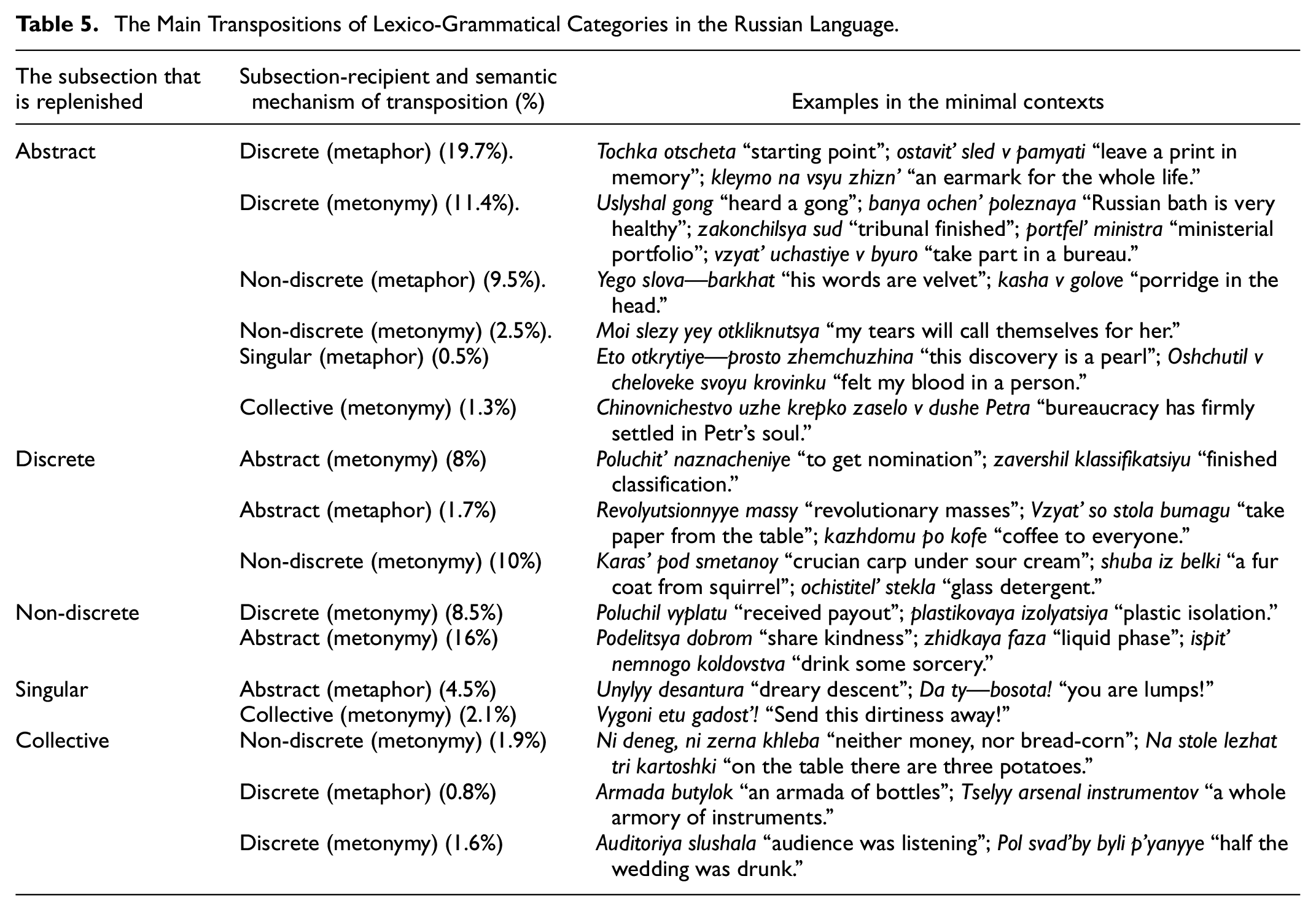
In this study, we relied on the Russian National Corpus (RNC) as our primary source of oral speech discourses. For our specific analysis, we focused on the sub-corpus containing oral speech discourses, primarily centering on colloquial style, from which 660 relevant nouns with secondary meanings and varying lexical and grammatical statuses were identified. The analysis results are presented in Table 5, along with the transition mechanisms of the nouns and their percentages.
Semantic Structure and Lexical-Grammatical Analysis
Secondary semantic structures were determined as a result of the distributive and semantic analyses of the nouns. Subsequently, these meanings were compared with the main meanings based on comparative analysis. As a result, a conclusion about the lexical-grammatical belonging of the lexical-semantic variants was made.
Transposition Mechanisms and Semantic Methods
Semantic methods allow the determination of transposition mechanisms and connotations. For instance, the basis of trait (lexicalized or fossilized) metaphors arises the colloquial (occasional) transposition between“discrete—non-discrete” with colloquial connotation (Table 2).
The Result of Determining the Mechanism of Transposition and Connotation Using Semantic Methods.
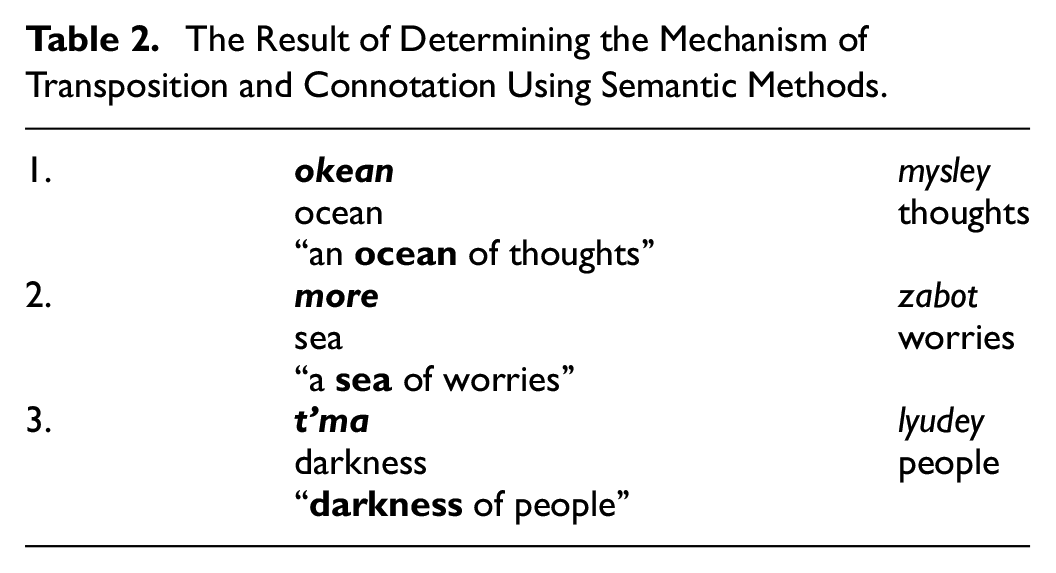
These variants were generated in the form of genetic metaphors using phraseologization. Moreover, the most productive type of transition from abstract to concrete (discrete or non-discrete) was observed in over 120 lexicosemantic variants. This transition is based on a metonymic transfer of the process of action to its results: vydeleniya “secretion,”posev “sowing,”pechat’“printing,” vyplata “payment,” and vypiska “statement.” These transpositions were determined in shapes of a minimal two-component context, that is, protsess
Transpositions Identified During the Study.

Regular transposition relationships were analyzed and are presented in Table 5 in Section “Results.”
Thus, during the process of analysis, the denotational and referential interrelation of the nouns in the initial and transposed variants was identified, which resulted in the selection of nouns with an indefinite lexical-semantic status (see Section “Conclusion”). Each analyzed noun was hypothetically matched with concordant transpositional meanings appearing in the dictionary. Thus, all the nouns were subjected to transpositional analysis.
Transpositional Meanings and Context Analysis
During the analysis of transpositional meanings, the degree of usage cohesion and independence either in the context of a phraseological unit or a syntagm or outside them was determined. As a result, we singled out units that did not require context to produce a transposed meaning.
We also distinguished connotational meanings, including emotional, expressive, evaluative, and functional-stylistic connotations. In our opinion, connotational (additional) shades of meaning need to be studied along with the denotational meaning since these meanings share content and relate to the cognitive side of the language.
Results
The results of the analysis of the minimal contexts of the manifestation of the semantics of nouns, as well as the analysis of their definitions, showed that it is appropriate to distinguish units with indefinite lexico-grammatical status: complex, system, block, aggregate, sample, and element. Such units have no out-of-context lexico-grammatical status: rock sample (concrete), behavioral sample (abstract); Buran system (discrete), calculus system (abstract). In this study, they are qualified as nouns with indefinite lexico-grammatical status.
Concrete and abstract names, in our opinion, represent a macro category, as discrete and non-discrete, singular and collective, and proper and nominative are distinguished within concrete. Here concreteness (as opposed to abstractness) refers to the possibility of perceiving the denotations of the corresponding names through the senses, rather than mentally. Oppositions between subdivisions satisfy, first, not so much grammatical as semantic criteria. For example, the opposition “singular—collective” is based on the presupposition “part of the whole as an object—the whole as an object.” The general picture of the classification of lexico-grammatical divisions of the Russian language can thus be presented in the form of the scheme shown in Table 4.
Structure and System of Oppositions of Lexico-Grammatical Categories of the Noun in the Russian Language.

Based on this, it makes no sense to point to concrete transposition, but only to specific sub-categories, such as discrete, proper, and collective. The analysis revealed that transpositions could occur not only between members of the opposition, but also between non-positive categories: abstract—non-discrete: good, excretion, participle, sideration; abstract—collective: painting, watch, wedding, export; non-discrete—abstract: bile, sediment, plaque, and so on (Table 4). Such diversity lies in both out-of-opposition transpositions and the use of different semantic mechanisms, mainly based on metaphor and metonymy.
Transpositions in the binary category “Proper nouns—common nouns” along with concrete—abstract ones are the most studied and described. This is because migrations between proper and common nouns have clear, limited mechanisms. Therefore, the transition from proper to common nouns is mainly associated with the generalization of the connection of the theonym (the place where the denotation comes from, the name of the inventor, and the character) and the derivative of the common noun, while the replenishment of proper nouns through transonymization is practically unlimited: kafe “
In connection with the above-mentioned fact, in this work, we have not focused on popular and etymologically transparent transpositions as mutual transitions between proper and common nouns (Yakovenko, 1996). We considered the least-studied immigration (replenishment) transitions as abstract, discrete, non-discrete, single, and collective transpositions.
The immigration principle of structuring the system of transpositions makes it easier to illustrate the subject of study with one template: the analysis of the immigration replenishment of subcategories. In this case, the main semantic markers are either conventional lexical-semantic variants (fixed in dictionaries) or occasional variants taken from oral speech and objectified by the context. Notably, in both cases, the transposition mechanisms were practically the same. We propose considering the entire picture in the form of a generalized table of immigration transpositions with examples, an indication of the semantic transition mechanism, and quantitative indicators as a percentage of the total number of analyzed units (Table 5).
The Main Transpositions of Lexico-Grammatical Categories in the Russian Language.
Additionally, considering the aforementioned examples of suffix semantics, many nouns can possess homonymous or polysemantic affixes. This is true for the abstract and collective suffixes: -stv (-cmв), -ur (-yp), -ot (-om). Apparent homonymy pushes speakers toward situational transposition.
The semantic structural analysis of units within a context sometimes indicates a phraseological connection of names. For example, in a synonymous row of transposed units, phraseological unity is observed:
The stylistic potential of transposition includes connotations and forms of the word image (metaphor): Zhizni moyey
Implicit comparison, the transition to abstract:
The noun in a figurative sense as a component of the predicative center, transition to abstract or concrete: Moya
The analysis of 660 usual and context-stipulated lexicosemantic variants of a Russian noun revealed that certain transposition models always import connotational semantics. For example, discrete (substance) nouns of the lexical group “non-transparent substances,” such as gryaz’ “mud,” zhelch “bile,” osadok “sediment,”mut’ “dregs,” and mul “mull” are transposed into abstract ones, but with a negative (pejorative) connotation: Nagovorili mne vsyakoy
If both evaluation-emotional and stylistic connotations are considered, the number of marked transpositions reach 76% by our calculations. Many such lexical-semantic variants have penetrated business and scientific discourses while maintaining their literary or other elevated registers:
Thus, the range of semantic, phraseological, and syntactical mechanisms of transposition within the lexical-semantic categories of Russian nouns provides some perspectives for further studies of similar and adjacent phenomena, such as semantic shifts, connotational meanings, and the expression of modality on the lexical level. This fact affords us a significant perspective for further studies on this subject. Moreover, the issue of lexical-semantic variants of a word, its qualities, and the production of transposed meanings remain important in translating and interpreting nouns to others. The first concerns non-Slavic languages. However, all the previously described phenomena help to provide relevant and vital knowledge for understanding linguacultural aspects, the standard of interpersonal communication, and the linguistic picture of the world as a verbalized system of matrixes that explicate the national vision of the world (Burdina, 2019; Trotsyuk, 2019).
Discussion
The results holistically present the lexico-grammatical-structural types of nouns. Therefore, these results expand the concept of noun connotation, because the lexico-semantic variants gain new connotations during transposition. Current research has revealed that approximately 27% of English nouns have connotational meanings, such as functional-stylistic, cultural-ethnic, and emotional-evaluative meanings (Nigmatzyanova & Stogova, 2014).
During this research, the universal nature of the transposition of parts of speech was observed, corroborating Babaytseva’s (2000) theory of transitivity phenomena in Russian grammar.
In the discussion of functional issues related to the transposition of the Leipzig Glossing Rules, the problem of translating the lexical-semantic variants of the noun should be highlighted separately, as Carpuat (2015) noted. The difficulty lies not only in the exact selection of the denotative correspondence of the word but also in the inability to convey the national connotative components of the meaning. The translation of transposed nouns requires further research.
In this context, the chief achievements in the direction of Mel’čuk’s (2017) text semantic theory cannot be omitted. It represents a multilevel model for transforming content into text (and vice versa). If we compare Mel’čuk’s (2017) theory with the scientific developments of other linguists, it should be noted that its main peculiarity stems from the use of dependency syntax. Simultaneously, Mel’čuk (2017) noted that the phenomenon of active proficiency in any language is a symbiosis of three main factors:
The ability to quickly select language units that correspond to the desired content.
Skills in the correct combination of certain linguistic units with the desired connotation or corresponding meaning.
The ability to rephrase a sentence without changing the meaning of what is said.
The latter plays a special role as a key measure of linguistic competence. The related logic is simple: the more ways one can broadcast an opinion in a foreign language, the higher the level of language proficiency. For each of these factors, the author of the semantic theory of content has provided a corresponding number of examples.
Thus, the following interchanges are correct:
Eti sluhi vyzvali paniku “These rumors caused panic.”—Eti sluhi porodili paniku “These rumors generated panic.”
Ozhog vyzyvaet silnuyu bol “A burn causes severe pain.”—Ozhog prichinyaet silnuyu bol “Burns cause severe pain.”
Eta novost vyzvala perepoloh “This news caused a stir.”—Eta novost proizvela perepoloh “This news provoked a stir.”
However, it would not be correct to say:
Rezkoe poholodanie porodilo gibel sazhencev. “A drastic cold wave generated the death of seedlings.”
Rezkoe poholodanie prichinilo gibel sazhencev. “A drastic cold wave produced the death of seedlings.”
Rezkoe poholodanie proizvelo gibel sazhencev. “A drastic cold wave created the death of seedlings.”
From the position of the developer, it follows that a description of the text interpretation process can be obtained based on the chronology of text construction. If one considers the Moscow Semantic School in this connection, it should be noted that methods based on the study of word collocation often accurately describe the subtle semantic differences of quasi-synonyms. For example, such synonyms as sadness, melancholy, and gloominess differ in increasing intensity and depth of feeling in Russian, which leads to possible combinations of light sadness, fleeting sadness, and deep sadness—and impossible forms, such as fleeting gloominess.
This method allowed us to analyze the semantic differences between synonyms of the same series. However, this study has significant limitations. Rakhilina (2008) noted one such problem, speaking of anomalies as the nonstandard semantics of such attributive constructions as a refined agronomist or a deep brochure that causes a mismatch between the communicatively distinguished components of the noun and the structure as a whole.
Indeed, the adjective, being the communicative center of the structure, acts as a semantic operator of the most communicatively significant part of the meaning of the noun. For the noun brochure, this is information about the external characteristics of the publication (normal: shabby/blue brochure), whereas the adjective deep implies an appeal to its substantive properties (deep article/deep composition; Rakhilina, 2008).
This analysis of approximately 660 conventional and context-specific lexical and semantic variants of the Russian noun showed that several transposition models constantly add to the connotation semantics. For instance, discrete (substance, veshyestvo) nouns of the lexical group “opaque substances” (neprozrachnye substantsyi), such as gryaz’“mud”; zhelch “bile”; osaddok “sediment”; mut’“dregs”; and mul “mull” transpose to abstract only with a negative connotation: Nagovorili mne vsyakoy
It is important to note that several lexical-grammatical variants can be included in professional dictionaries. Such words have specific connotations that mark them not only as stylistically colored but also as professional. According to Morozova et al. (2020), the problem of creating and lexicographically fixing uncodified vocabulary in a professional dictionary is related to its realization and use by a limited group of media in conditions of official and non-official communication.
In this study, 76% of the transpositions had evaluative-emotional and stylistic connotations. Many of these lexical-semantic variants have penetrated business and scientific discourse while retaining the connotations of bookishness, importance, or other high registers:
The functional question of transposition in the lexico-grammatical category includes the issue of interpretation noted by Carpuat (2015), which calls for denotative meaning selection while entailing the impossibility of translating the national connotative components of the meaning. Therefore, the interpretation of transposed nouns requires further research.
This work represents variants of transposition with secondary and connotative meanings in a minimal context (syntactic) that is lexicographically fixed. Perspectives of this theme consist of describing the transposition in wider connotation speech fragments, such as syntactic and conceptual (ethnic), as well as unproductive ones that “live” in situational discourses, that is, Vy
In addition, an analysis of all types of conventional and occasional transpositions and their connotations allows for the following:
completing an integral picture of the deep noun syntagma; and
improving many practical areas that require the classification of words by parts of speech, such as literary creation, machine translation, and the compilation of dictionaries.
The theoretical generalizations we obtained complement the study of so-called double semantics (Buckens, 2020; Cheng et al., 2017), the dependence of morphological-syntactic usage on group and personal characteristics (social status, gender, etc.; Steriopolo, 2018). Additionally, the doctrine of lexico-grammatical categories continues with the theory of affixes and the semantic and grammatical hybridity of language units (Sagna, 2019; Steriopolo, 2017, 2019; Wurmbrand, 2016).
The results of this study can be used in psycholinguistic research. Thus, it has already been shown that when the referent of a noun is perceived, neurons of the brain first decode the external perceptual features of the denotative and then the deep semantic features (Sudre et al., 2012). Such studies have demonstrated the importance of concrete-figurative connotative lexical-semantic variants. In didactic practice, these patterns can be used in the neuropedagogy of language teaching in individuals with an expressive left- or right-sided lateral orientation of the brain (normal or pathological; Kirby, 2006; Tsushima et al., 2019). Furthermore, in the context of psycho- and neuro-didactics, deep metaphorical connections can be used in raising and teaching children with cognitive difficulties, which correlates with studies of the perception and representation of metaphors in didactics (Sadik, 2018).
The results of this study can be used to create a holistic picture of the connotative meanings of different parts of speech. They continue to confirm the semantic and modal theory of connotative meanings, which “characterizes information based on a logical assessment of the situation, the categorical and problematic reliability of the information, its connection with the source, and emotional and expressive coloring” (Shigurov, 2016, p. 137).
It is necessary to mention that the study’s results can also be used by international students worldwide when studying Russian. According to Trotsyuk (2020a, 2020b), the current study process internationally requires contemporary resources to learn Russian. Therefore, these resources include information about lexico-semantic variants, etiology, and lexical-grammatical features, and can help students understand the language more deeply and closely than their native language (Trotsyuk, 2020a, 2020b). In this case, the current study can serve as a basis for perspective learning.
Conclusion
We analyzed 660 lexical-semantic variants of the nouns considered in the context of phraseological units and separate elements. Moreover, the transposition potential is presented as a percentage of the correlation and is dependent on the realization mechanism. Based on the above discussion, the following conclusions can be drawn.
Contextual lexical-semantic nouns were determined and analyzed using a lexicographical corpus method. Accordingly, the following conclusions have been obtained: Based on the semantic meaning of “concrete” nouns, all the lexical-grammatical forms (excluding abstract nouns) must be differentiated as subclasses of “concrete.”
Transposition of proper and common nouns most often occurs in the act of transonymization and should be studied as a separate topic.
Paired lexical-grammatical categories include transpositions within an opposition and transpositions from non-positive categories.
Metaphors and metonymy are the main semantic mechanisms of noun transposition at the word level or at its minimal context (distribution).
Transposition processes in the lexical-grammatical sphere of Russian nouns are characterized by grammatical (changes in the numerical paradigm), semantic (appearance of connotation), and stylistic (phraseologization, image construction) processes.
This study provides a notable contribution to the understanding of lexical-semantic variants of nouns in the Russian grammar framework. However, it is imperative to recognize certain limitations inherent in this research. Predominantly relying on the lexicographical corpus method, this study may not capture the multifaceted nature of language in its entirety, particularly when it comes to interpreting meanings across diverse cultural and social contexts. The chosen method of differentiating “concrete” nouns might oversimplify a domain with intrinsic complexities. Additionally, the nuanced processes of transonymization, given its profound linguistic implications, were only briefly touched upon. Future inquiries could benefit by considering a mixed-method approach, merging lexicographical analysis with more qualitative methods, such as ethnolinguistic interviews or discourse analysis. This would ensure a more holistic understanding of the subject. It would also be worthwhile to probe into the intersections of language, culture, and cognition, to comprehend how cultural nuances shape and, in turn, are shaped by noun transposition.
Footnotes

Authors Contributions
Conceptualization, S.C. and I.S.; Formal analysis, S.C. and I.S.; Methodology, S.C. and I.S.; Visualization, S.C. and I.S.; Writing – original draft, S.C.; Writing – review & editing, S.C. and I.S. All the authors have approved the submitted and the published version of the manuscript.
Declaration of Conflicting Interests
The author(s) declared no potential conflicts of interest with respect to the research, authorship, and/or publication of this article.
Funding
The author(s) received no financial support for the research, authorship, and/or publication of this article.
Data Availability Statement
Data sharing not applicable to this article as no datasets were generated or analyzed during the current study.