



Abstract
This study examined the challenges faced by 19 Chinese senior high school English as a Foreign Language (EFL) teachers in designing communication activities. By closely examining the design features of the teaching activities employed in their classrooms, it was revealed that the majority of the observed activities lacked authenticity, a crucial aspect emphasized in the extant literature on communication practices. This significant finding underscores the substantial hurdle faced by the participating teachers in creating authentic communication activities. The analysis of the semi-structured interviews suggests that the participants’ comprehension of the concept of “meaning” and its significance in language education might be contributory to the absence of authenticity in their communication activities. Furthermore, while the activities designed for moral education appeared genuinely authentic, they fell short in fostering collaboration among students, potentially leading to less negotiation of meaning. The analysis presented profound insights that can greatly enhance training in communicative language teaching.
Introduction
It is widely recognized that communication plays a crucial role in second/foreign language proficiency, resulting in a vast amount of literature on communicative language teaching (CLT). This literature is considered invaluable in highlighting key issues pertaining to CLT implementation and has largely contributed to supporting teachers in designing effective communication activities.
In this study, the focus is on “communication activities” that encourage meaningful interaction and aim to foster authentic communication in the language classroom, rather than traditional grammar-focused exercises (for a detailed discussion, see section entitled “Communication Activities for the Language Classroom”). These activities are meaning-focused, prioritizing the communication of meaning over form and encouraging authentic language use. Teachers likely have access to various resources, such as frameworks for task-based language teaching (e.g., Ellis, 2003; Nunan, 2004), models incorporating principles of CLT (e.g., Littlewood, 1981; Richards, 2007), and taxonomies of communicative functions and activity types (e.g., Littlewood, 2004; Pica et al., 1993). These resources can guide them in creating meaningful and authentic communication practice.
Despite the wealth of literature on CLT, practical implementation seems to remain challenging for many teachers. Teachers may still face difficulties in designing activities that align with the recommended features outlined in existing literature. It is in light of these challenges that the present study attempts to investigate the obstacles encountered by 19 senior high school EFL teachers in China when devising meaning-focused communication activities. The aim is to achieve a deeper understanding of the obstacles they face and possibly provide insights for overcoming these challenges. Three research questions guide this inquiry:
(1) What were the design features of the communication activities employed by the participating teachers?
(2) To what extent did their designs of communication activities align with the recommended features outlined in existing literature?
(3) Which factors influenced their design process of communication activities?
Communication and Language Learning
Since the 1970s, the field of language teaching has undergone a significant transformation known as the communicative movement (Littlewood, 1981). This movement shifted the focus away from solely emphasizing grammatical competence and towards cultivating communicative competence (Canale & Swain, 1980; Hymes, 1971; Savignon, 1972). This shift may offer a fresh perspective on language learning, emphasizing the importance of engaging learners in the comprehension and production of messages for the purpose of communication. It can be argued that language learning is most effective when learners are actively involved in the communication process.
The facilitative role of communication in language learning primarily manifests in two distinct aspects. Firstly, it is possible that communication has presented learners with invaluable opportunities to focus on linguistic form (Long, 1991). This often involves drawing learners’ attention to grammatical and structural elements through the act of communicating. This may be achieved through the reactive utilization of diverse pedagogic techniques, such as negotiation of meaning and negotiation of form (Ellis, 2003). These processes enable learners to address linguistic challenges that arise naturally within the context of communication. In this sense, communication may be considered paramount for language development, as it has the capacity to provide comprehensible input, feedback, and pushed output in ways that are deeply interconnected with internal linguistic processing and acquisition.
Secondly, adopting a communicative perspective in language learning likely extends beyond treating interaction as a mere textual exercise (Kumaravadivelu, 2006). It may encompass the social processes that continually shape and reshape language learning, which Kumaravadivelu (2006) refers to as the construction of interpersonal interactions. In this context, communication often occupies a pivotal role in successful language learning. It probably serves as the genesis of learning, where learners engage in collaborative efforts to solve linguistic challenges that arise during the process of communication. This interactional dynamic not only tends to enhance linguistic proficiency but also likely fosters a deeper understanding of cultural norms and social practices.
Building upon the communicative perspective discussed earlier, we can see that the emphasis on meaning-based communication in language teaching is crucial for fostering language acquisition. A central aspect of CLT is its focus on this meaning-centered communication. Scholars, inspired by Long’s Interaction Hypothesis (1983), have highlighted the significance of authentic communication activities that replicate real-world situations. As demonstrated by Pica et al. (1993) and further elaborated by Pica (2008), these activities encourage learners to engage in meaningful and purposeful language use. This emphasis on meaning is vital because it promotes language acquisition by motivating learners to actively participate in the communication process and construct meaning through interaction.
Communication Activities for the Language Classroom
Classroom activities have always been at the forefront of scholars’ investigations into the communicative approach to language teaching (e.g., Richards, 2007; Samuda & Bygate, 2008), leading to a substantial corpus of literature exploring the diverse types of activities suitable for communicative classrooms. In this context, “communication activities” refer to instructional activities specifically designed to promote authentic communication and interaction in the language classroom, as opposed to more traditional grammar-focused exercises.
Scholars have distinguished between various types of communication activities, such as non-communicative learning, pre-communicative language practice, communicative language practice, structured communication, and authentic communication (Littlewood, 2004). These activities can be classified based on dimensions such as interactant relationship, interaction requirement, goal orientation, and outcome options (Pica et al., 1993). Authenticity, which refers to the degree to which the communication activities mimic real-world situations, is a crucial feature that distinguishes effective from ineffective activities for teaching (Pica, 2008).
In recent years, empirical studies have played a pivotal role in advancing our understanding of CLT in practice. These studies have contributed significantly to our knowledge of teacher-related factors, pedagogical approaches, effectiveness, challenges, and opportunities associated with implementing communication activities in the classroom.
Firstly, scholars have examined teachers’ knowledge, beliefs, and attitudes towards implementing communication activities in their classrooms. This line of research explores teachers’ pedagogical understanding and their attitudes towards incorporating communicative practices into their teaching. For instance, Sato and Oyanedel (2019) investigated the beliefs of teachers regarding the integration of grammar instruction within a communicative teaching framework in an EFL context, with a particular focus on conflicting beliefs. Similarly, Sun et al. (2022) utilized the implicit association test to examine the implicit attitudes of Chinese EFL teachers towards communicative language teaching and traditional language teaching methods. These studies highlight the intricate interplay between teachers’ knowledge, beliefs, and attitudes, and their practical implementation of communication activities, emphasizing the necessity for additional support and training to bridge this gap.
Secondly, there has been a focus on effectively integrating a focus on form within communicative practice. This involves exploring ways to balance the emphasis on fluency and accuracy in language use. Gholami (2017) and Saito (2015) have contributed to this area by proposing frameworks and techniques for teachers to facilitate meaningful language learning while also attending to linguistic form.
Thirdly, researchers have assessed the impact of communication activities on student learning outcomes. These studies aim to understand how different types of communication activities may affect learners’ linguistic proficiency, communication skills, and overall language acquisition. Hirata and Thompson (2022), Newgarden and Zheng (2016), and Nguyen and Hung (2021) are among the scholars who have conducted empirical investigations in this area. Their findings highlight the positive effects of communication activities on student performance and engagement.
Lastly, scholars have also examined the challenges that arise in implementing communication activities in the classroom. These challenges can include resource constraints, teacher training needs, student anxieties, and cultural differences. Taridi et al. (2023) and Yoshihara et al. (2020) have addressed these issues by exploring the barriers to effective communication teaching and proposing strategies to overcome them.
Despite the extensive literature on communication activities in CLT, there is evidence to suggest that a notable research gap persists regarding the specific types of activities teachers tend to design for the communicative classroom. Furthermore, there appears to be a limited understanding of the challenges teachers confront in designing these activities, with less attention given to the complexities of activity design compared to implementation issues. This research gap presents an opportunity to deepen our understanding of how teachers can create effective communication activities that promote authentic language use in the classroom.
This study seeks to bridge this gap by examining the design features of communication activities in CLT classrooms and uncovering the challenges teachers encounter in the process. By revealing the difficulties teachers face in designing these activities, this study will identify areas for improvement and open up avenues for enhancing teachers’ expertise in activity design.
Theoretically, the study contributes to the existing literature by providing insights into the design features of effective communication activities. This includes an investigation into the factors that render these activities authentic and meaningful for language learners, thereby contributing to an advanced understanding of how authenticity fosters language acquisition.
Practically, the study offers invaluable information for language teachers and teacher educators. By shedding light on the difficulties teachers face in designing communication activities, the study highlights areas for improvement and unveils opportunities for enhancing teachers’ expertise in activity design. This, in turn, can lead to more effective and impactful language learning experiences for students.
Method
Participants and Setting
The participants comprised a group of 19 EFL teachers who instructed Grade 10 students from six senior high schools in Shanghai, China (see Table 1 for details). These schools represented diverse administrative levels and statuses within the educational landscape, including municipal key high schools, district key high schools, and ordinary high schools. Municipal key high schools are top-tier institutions with high admission standards and often receive more resources from the city government. District key high schools are also highly regarded but are typically less prestigious than municipal key high schools. Ordinary high schools are standard institutions that cater to a broader range of students.
Number of Participants from the Six Schools.

Among these teachers, a majority of 15 were classified as experienced, whereas a minority of 4 were considered novice. Their ages spanned from 25 to 52 years, with teaching experience ranging from 1 to 30 years. Four teachers possessed MA degrees in English, while the vast majority held bachelor’s degrees with English as their major.
The researcher initially met the 19 selected teachers during a local district’s CLT teacher-training program. A month later, the researcher invited them to participate in the study, and all agreed to take part. It is important to note that during the training program, the researcher made multiple visits to their classrooms, becoming a familiar presence to the teachers. To further ensure clarity and comfort with the observation process, the researcher formally introduced herself to the teachers before the observations and explained the purpose and procedures of the study. This step aimed at reinforcing the researcher’s non-evaluative role and addressing any questions or concerns the teachers might have, thereby encouraging natural teaching behaviors despite the researcher’s presence.
Data Collection
The data for this study primarily sourced from four key areas: lesson plans, classroom observations, classroom videos and semi-structured interviews.
The participants were instructed to utilize the communicative approach in teaching the short article, “Important Things” (see Appendix I; Greenberg, 1988). This article was chosen due to its comparable length and genre to typical textbook passages, ensuring both comparability and relevance. Additionally, the selection was based on the variety of textbooks used by the teachers. By incorporating an external text, this study created a more controlled setting where the focus remained largely on the communicative approach and the design of communication activities, uninfluenced by the specific content, structure, or activities inherent in individual textbooks.
Initially, each participant crafted a lesson plan in accordance with the requirements. These lesson plans not only served as a blueprint for their teaching but also offered initial glimpses into their thought processes, as they explicitly stated their teaching objectives. Subsequently, the researcher conducted thorough observations and recorded each class session, resulting in a collection of 19 classroom videos, each approximately 45 min long. During the classroom observations, the researcher maintained a non-participatory role, remaining as unobtrusive as possible to avoid influencing the classroom dynamics. These videos were invaluable for analysing the communication activities specifically designed by the participants for the designated teaching material, while also offering insights into the intricate design features of these activities.
However, while the lesson plans and videos provided rich contextual information, they still had limitations in fully capturing the depth and complexity of the teachers’ underlying rationale and thought processes behind their design decisions. To address this limitation, the researcher supplemented the video data with semi-structured interviews. These interviews were conducted with three teachers (T1, T2, and T3), purposefully selected to represent various administrative levels. The teachers were chosen carefully, based on their administrative roles and teaching experiences, to ensure a diverse range of perspectives and a comprehensive understanding of the challenges and thought processes involved in designing communication activities. It is important to note that this selection was not intended to be representative of the entire group of 19 teachers but rather to provide illustrative examples of the challenges and thought processes involved in designing communication activities.
The interviews were conducted on a one-on-one basis, using a semi-structured interview outline (see Appendix II) as a guiding framework to ensure a structured yet flexible flow of conversation. This approach allowed for a deeper exploration of the teachers’ thought processes, complementing the insights gained from the lesson plans and classroom videos.
To further validate and enhance the insights gained from these interviews, the researcher triangulated the interview data with observations of classroom activities and qualitative analysis of lesson plans from all 19 teachers. This multi-faceted approach, combining data from lesson plans, classroom videos, and interviews, provided a holistic understanding of the teachers’ practices, challenges, and thought processes involved in designing communication activities.
The purpose of these interviews was to gather additional information specifically related to the pedagogical objectives underlying the communication activities designed by the interviewed teachers. By exploring the rationales and objectives that informed the activity designs, the researcher aimed to gain deeper insight into the reasons behind the significant challenges faced during the design process. This analysis provided a more nuanced understanding of the key factors that potentially influenced the design decisions made, ultimately revealing the fundamental reasons for the challenges encountered in devising effective communication activities.
The semi-structured interviews were audiotaped, generating three audio-recordings, each lasting around 60 minutes. Following the interviews, these recordings were comprehensively transcribed verbatim to ensure every word and nuance of the conversation was captured accurately.
Data Analysis
The data analysis encompassed two key components: a meticulous examination of classroom video data and a thorough analysis of semi-structured interview transcripts. For the classroom video data, the analysis centred on two primary areas: firstly, the identification and categorization of the communication activities employed by the teachers; secondly, an in-depth exploration of the design features that characterized these activities, including activity type, interactant relationship, interaction requirement, goal orientation, outcome options, and authenticity.
In parallel, the transcripts of the semi-structured interviews were thoroughly analysed, serving two purposes. Firstly, they aimed to provide a deeper understanding of the obstacles faced by teachers during the design process of communication activities, exploring the underlying factors that gave rise to these challenges. Secondly, they were used to cross-verify and enhance the insights derived from the classroom observations (whether conducted on-site or through videos), thereby contributing to the reliability and validity of the collected data.
Analysis of the Data from the Classroom Videos
A three-stage data analysis process was conducted on the classroom videos. In the initial stage, an attempt was made to conduct a rigorous descriptive coding process, drawing inspiration from the methodologies described by Saldaña (2013). The researcher manually coded the data, while ATLAS.ti8 software was used to systematically organize and integrate these codes. The purpose of this software was to facilitate the categorization and analysis of the data, but the initial steps of coding and categorization were still carried out manually.
During the coding process, the researcher aimed to gain a more comprehensive understanding of the observed activities by cross-referencing the results with the lesson plans. Once a preliminary analysis of the data was completed, the researcher sought feedback from the participants to validate the interpretation of the teaching activities. This feedback was used in an attempt to reinforce the accuracy of the research findings.
To further validate the findings, inter-rater reliability was established. Three independent coders analyzed the same set of observations and reportedly achieved a high level of agreement, with Cohen’s Kappa yielding a result of .82, indicating a strong level of agreement. To ensure consistency in their approach, each coder was provided with the same coding instrument and training session. Ambiguities in the coding process were addressed through regular meetings and discussions, aiming to reach a consensus and ensure that the categorization of instructional activities was not influenced by individual interpretations.
Table 2 offers a snapshot from the analysis, providing a glimpse into the intricate details of the study.
Data Extract.

Note. Kate, Susan, and Paul are all aliases, used as pseudonyms to protect the participants’ identities. The activities enumerated in each column have been organized to reflect the precise order of their observation.
Subsequently, the identified teaching activities were categorized based on their specific content, creating a structured overview of the diverse communication activities observed in the classrooms. Among the 114 teaching activities recorded, 22 were excluded from the analysis as they primarily emphasized formal elements. The remaining 92 activities, which mainly focused on meaning, were categorized into five distinct groups. These groups are detailed as follows:
(1) Lecture background knowledge (16 times)
(2) Work on the main idea of the passage (19 times)
(3) Help Ss understand the (pre-)selected details correctly (19 times)
(4) Help Ss work out the implied meanings of the pre-selected sentences (19 times)
(5) Conduct moral education in a sharing activity (19 times)
In the second stage, the emphasis shifted towards establishing a potentially powerful classification framework for communication activities. This framework drew heavily from the classificatory system of communication tasks outlined by Pica et al. (1993) and Pica’s (2008) insightful discussion on the characteristics of effective communication activities. It was carefully crafted to ensure its credibility. Table 3 presents a detailed breakdown of this classification framework, designed to facilitate a clear and comprehensive understanding of the various categories and their defining features.
Classification Framework for Communication Activities.
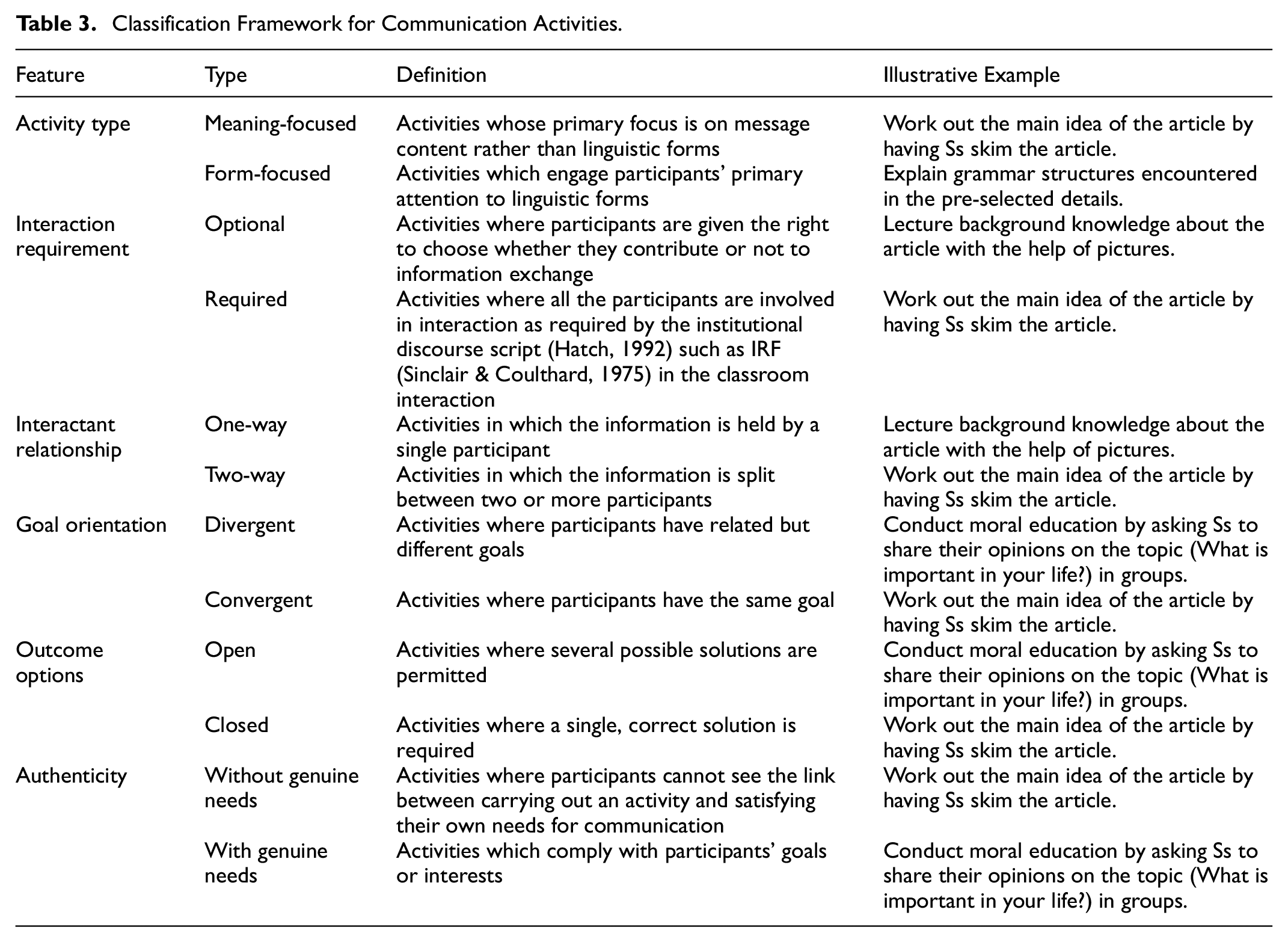
In the third stage, the primary goal moved towards attempting to elucidate the design features of the communication activities undertaken by the participants. To accomplish this objective, the five categories of activities identified in the first stage underwent protocol coding, drawing on the methodologies expounded by Saldaña (2013). The coding exercise was based on the predefined instrument outlined in Table 3. To ensure the reliability and consistency of the coding process, inter-rater reliability was re-established, with three independent coders analyzing the same set of protocol-coded data. Prior to coding, each coder underwent standardized training. Throughout the process, ambiguities and discrepancies were addressed through regular meetings and discussions, aiming for consensus and unbiased categorization. As such, the inter-rater reliability was reassessed using Cohen’s Kappa, yielding a strong level of agreement among the coders with a value of .85, confirming the accuracy of the analysis.
This rigorous inter-rater reliability process in the third stage was crucial for enhancing the clarity and reliability of the study’s findings, allowing for accurate description and comparison of the distinctive characteristics of the communication activities against the principles advocated in CLT theory.
Analysis of the Data from the Semi-Structured Interviews
Utilizing inductive content analysis, as advocated by Krippendorff (2013), the transcripts of semi-structured interviews were thoroughly processed through unitization, coding, comparison, and categorization, ultimately yielding manageable representations of the data. During the analysis, four prominent themes emerged: firstly, the underlying teaching objectives that appeared to steer the design of the activities; secondly, the rationales behind the pursuit of these teaching objectives; thirdly, the strategies employed to try to attain these objectives; and finally, the pivotal role of textbook passages in shaping the design of communication activities. To help ensure the reliability of the research findings, the researcher employed triangulation techniques, which encompassed member checking as recommended by Cohen et al. (2011), as well as the utilization of multiple sources such as classroom videos, classroom observations, and lesson plans.
Findings and Discussion
Table 4 provides an overview of the design features exhibited in the activities conducted by the participating teachers.
Overview of the Design Features.

As Table 4 demonstrates, 76 out of the 92 meaning-focused activities exhibit features of required interaction and a two-way interactant relationship. Additionally, 73 of these activities possess convergent and closed outcomes. While these activities may appear to foster communication, they offer limited opportunities for students to express their genuine communication needs. This may be because all activities, except those in category 5, were primarily designed to aid students in comprehending the reading passage. The 19 activities within category 5 stand out as exceptions, as they encourage students to personalize the discussion by sharing their perspectives on what they consider important in their lives. Evidently, the activities in category 5 align more closely with students’ communication needs. The findings are consistent with previous research by Loewen and Sato (2018) and Pica (1994), both of which have emphasized the importance of two-way interactions in promoting meaningful communication and linguistic development. However, the current study highlights a significant gap in practice, as the majority of activities still lack the authentic nature preferred in CLT theory.
The findings revealed that authenticity was notably absent in the majority of the observed meaning-focused activities, despite the participants’ apparent preference for adopting a communicative teaching approach. This suggests that designing activities that incorporate authenticity posed a significant challenge for the participants. This finding aligns with earlier studies by Ellis (2003) and Nuttall (2002), which have identified similar challenges in implementing authentic communication activities in language classrooms. These studies have noted that teachers often struggle to balance the need for authenticity with the need for structured learning.
The analysis of the semi-structured interviews with 3 of the 19 participants illuminated two pivotal factors that accounted for the absence of authenticity in the communication activities designed by the participating teachers. However, the researcher acknowledges that the insights from only three interviews may not fully capture the perspectives and experiences of the entire sample of 19 teachers. To address this limitation, she has triangulated the interview data with observations of classroom activities and qualitative analysis of lesson plans from all 19 teachers to provide a more comprehensive understanding of the issues.
Firstly, the participants’ conception of “meaning” played a significant role. They perceived “meaning” as a static entity embedded within written texts, rather than a dynamic construct. As T1 eloquently expressed, “Meaning-focused activities primarily serve to assist students in grasping the author’s intended message within the text.” Believing that “meaning” was standardized and easily accessible under teacher guidance, all three interviewees strongly advocated for the use of IRF exchanges to ensure students’ successful comprehension of textual messages. This static view of meaning is in contrast to the dynamic and interactive view presented in the literature by Long (2015) and Swain (1995), who argue that meaning is constructed through negotiation and interaction. These studies highlight the importance of active engagement and negotiation in language learning, which are often overlooked in classroom practices.
However, contrary to this view, existing literature portrays “meaning” as a social byproduct of interaction, a concept that is “negotiated and co-created by the participants in the communication process through active engagement in conversations” (Eisenchlas, 2009, p. 52). This divergence in understanding highlights the need for teachers to broaden their perspectives and incorporate a more interactive and authentic approach to meaning-making in their classroom activities. For instance, studies by Long (2015) and Swain (1995) have emphasized that interaction and negotiation of meaning are essential for enhancing linguistic competence and fostering authentic communication. The current study’s findings reinforce the need for teacher training and professional development to bridge this gap and help teachers adopt more interactive and authentic methodologies.
Secondly, by conceptualizing “meaning” as a discrete object of learning, the participating teachers facilitated students’ comprehension through textual negotiation. This approach was clearly reflected in the participants’ strong emphasis on the significance of repeated reading in deepening students’ understanding of textual meaning. For instance, T3 stated, “To achieve better comprehension, students must read the text multiple times. Initially, they read to grasp the main idea. Subsequently, they skim for specific details. Finally, they engage in reading between the lines to interpret subtleties.” This approach to repeated reading and textual negotiation is supported by research such as that by Therrien (2004), which found that repeated exposure to texts can improve reading comprehension. However, the current study’s findings suggest that this approach may not sufficiently promote the interactive and negotiative aspects of meaning-making, as emphasized by Ellis (2013) and Long (2015).
However, a comparative analysis with existing literature reveals a contrasting perspective on the role of negotiation in meaning-making. This perspective advocates for negotiation to occur between interlocutors for three purposes: firstly, to provide comprehensible input; secondly, to offer feedback; and thirdly, to encourage learners to reformulate their language (Ellis, 2003). Viewed in this light, negotiation with interlocutors is arguably more beneficial for students’ language learning than negotiation solely with texts. Research conducted by Loewen and Sato (2018) and Pica (1994) supports this, showing that negotiation between interlocutors aids students in developing more nuanced and contextually appropriate language skills. This study further underscores the need for teachers to integrate interlocutor negotiation into their activities.
The second factor impeding the participants from creating authentic activities was their belief system regarding the function of meaning-focused activities in language education. In the semi-structured interviews, a recurrent theme emerged: the participants primarily saw the exploration of text meaning as a platform for promoting moral education. Their comments reflect this viewpoint:
T1: The text is a carrier of culture and values. Through a detailed study of the text, students would have access to the writer’s attitudes, knowledge of the outside world, differences between cultures, or something like a world outlook.
T2: In the first class, we will help students comprehend the text. Only when they have a full understanding of it, can students capture the moral values in the text and have a discussion accordingly.
T3: Based on the interpretation of the text, we may design some open-ended questions, for example, a discussion on important things in our lives, to help students appreciate the moral values in the text, or raise the theme of the text to a high level.
While moral education is indeed an important aspect of education, the excessive focus on it in language classrooms can overshadow the primary goal of language learning: to develop linguistic skills and foster authentic communication. In contrast to the participants in this study, researchers such as Ellis (2003) and Long (2015) tend to envision “meaning” as the crucial conditions and avenues that facilitate the development of linguistic awareness among learners. The findings of this study were based primarily on a small sample of three interviewees but were corroborated by broader data from classroom observations and lesson plans of all 19 teachers. This broader data revealed a notable divergence between the participants’ perception of the role of “meaning” and the way it is conceptualized in existing literature. This divergence is in line with earlier findings by Garcia-Ponce and Tagg (2020), as well as Mason and Payant (2019), highlighting that teachers’ beliefs and practices significantly impact the implementation of communicative approaches. Collectively, these studies underscore the need for ongoing professional development to align teachers’ beliefs with best practices in CLT.
These insights into the authenticity of moral education activities led to further observations regarding how such practices affect student interaction and meaning negotiation. In the activities that emphasized authenticity, particularly those related to moral education within category 5, students were often encouraged to uphold their individual interpretations, rather than to converge on a singular moral value derived from the text. As aptly pointed out by T1, “Each individual interprets the text uniquely, without any definitive or standardized answers. My comprehension is distinct, and so is everyone else’s.” This viewpoint compares the activities in category 5 to a divergent opinion-gap task (Ellis, 2003), thus mitigating the necessity for students to collaborate towards a unified outcome. Consequently, this study’s findings suggest that while such activities may promote authenticity, they also result in less negotiation regarding the interpretation of meanings, a phenomenon that has not been widely explored in previous research. Studies such as those by Henry and Thorsen (2020) and Manabe et al. (2023) have examined the role of authentic activities in language learning, but the current study provides a unique perspective by highlighting the tension between authenticity and the need for negotiation in meaning-focused activities.
Building on the insights from the previous section regarding the impact of authentic moral education activities on student interaction, it becomes clear that while these activities contribute to creating genuine reasons for communication, they do not necessarily guarantee an optimal environment for collaboration among students. This highlights the importance of not only incorporating moral education into language classrooms but also ensuring that it is done in a way that fosters collaboration and meaning negotiation among students, thus promoting both linguistic development and ethical understanding. To address this gap, future research could explore strategies to combine moral education with collaborative learning activities, as suggested by emerging perspectives in the field (e.g., Richards, 2007). These strategies could help teachers create activities that are both authentic and conducive to meaningful interaction and language development.
Conclusion
The current study has revealed a significant matter: even though the meaning-focused activities examined adhered to the design features commonly advocated in the literature for communication purposes, they largely fell short of capturing students’ sense of authenticity. This underscores the persistent challenge faced by participants in crafting authentic experiences within such activities. A meticulous analysis of the semi-structured interviews further deepened our understanding of how the participants’ comprehension of the concept of “meaning” and its fundamental role in language education greatly contributed to the evident lack of authenticity in their communication activities. Furthermore, the study’s findings shed light on an intriguing aspect: while activities designed for moral education indeed exhibited authenticity, they frequently lacked a collaborative component, potentially restricting students’ opportunities to engage in meaningful negotiations and collaborative learning experiences. This suggests the need for a more balanced approach, where moral education and communicative activities are integrated in a way that promotes both authenticity and collaboration.
The findings of this study have important implications for CLT training. Firstly, teachers’ beliefs can profoundly shape their teaching perspectives and subsequently impact their practices. Therefore, it is important for teacher educators to assist their trainees in developing a deep comprehension of the fundamental concepts in CLT theory, especially the essence of “meaning” and its central role in language education. This deep understanding is crucial to ensure that activities are designed with a genuine focus on authentic communication, rather than just adhering to prescribed design features. Secondly, while moral education can enhance the authenticity of activities, it alone cannot suffice to ignite students’ passion for communication. To foster students’ motivation for communication, teachers must master the art of optimizing the interactive elements that comprise a communication activity. This includes understanding and implementing effective interactant relationships, interactional requirements, goal orientation, and outcome options. By doing so, teachers can strive to ensure that language education remains authentic and engaging for students, fostering meaningful communication and learning experiences.
Despite the limitations of the study, which was confined to a case study encompassing 19 EFL teachers instructing students of the same grade within a unified region of China, and the use of a small, purposefully selected sample for interviews, the present study offers valuable insights into the challenges faced by EFL teachers in devising communication activities. The findings, while not universally applicable to all EFL teachers, provide a solid foundation for future research to explore and understand this domain more deeply. However, it should be noted that the small and non-representative sample size necessitates cautious interpretation of the claims and insights presented in the discussion, recognizing them as preliminary findings rather than definitive conclusions.
In conclusion, this study serves as a springboard for future inquiries, sparking more extensive and diverse research into the intricacies and optimal practices for EFL teachers in creating meaningful communication activities. Future studies should consider incorporating larger and more diverse samples to enhance the generalizability of findings. Additionally, incorporating stimulated recall interviews could provide a deeper understanding of teachers’ thought processes during activity design, thus enhancing the comprehensiveness of the findings. By continuing to build upon this research, we can work towards ensuring that language education remains engaging and authentic for students, fostering meaningful communication and learning experiences.
Footnotes
Appendix I
Appendix II
Acknowledgements
I would like to express my heartfelt thanks to all the participants for their invaluable cooperation and the time they devoted to this study. Furthermore, I would like to extend our sincere appreciation to Professor Zou Weicheng of East China Normal University for his invaluable advice in conducting this research. Lastly, I am deeply grateful to the reviewers who have provided insightful and constructive comments.

Ethical Considerations
The studies involving human participants were reviewed and approved by the ethics committee of Zhejiang Sci-Tech University. Written informed consent for participation was not required for this study in accordance with the national legislation and the institutional requirements.
Funding
The author disclosed receipt of the following financial support for the research, authorship, and/or publication of this article: This work was supported by Science Foundation of Zhejiang Sci-Tech University (22112279-Y) and the Fundamental Research Funds of Zhejiang Sci-Tech University (24116131-Y).
Declaration of Conflicting Interests
The author declared no potential conflicts of interest with respect to the research, authorship, and/or publication of this article.
Data Availability Statement
The raw data supporting the conclusions of this article will be made available by the authors, without undue reservation.