




Abstract
This research study employs Critical Discourse Analysis (CDA) to examine the representation of women’s rights in Saudi news media, with a focus on the interplay between modernity and tradition in the context of Vision 2030. By analyzing 320 articles from Saudi English-language online news sources, the study investigates how media narratives reflect and shape societal perspectives on the evolving roles and rights of women in Saudi society. The findings reveal a nuanced portrayal of women’s empowerment, balancing progressive values with traditional cultural norms. The results demonstrate a shift from conservative depictions to more progressive representations of women as key contributors to societal transformation. This change is evident through the increased visibility of women in professional roles and public discussions supporting women’s rights and workforce participation. The study also highlights the underrepresentation of sexual and reproductive rights and caregiving issues in media narratives. Recommendations include fostering collaboration between policymakers and media professionals to promote positive portrayals of women, thus accelerating societal acceptance and support for gender equality initiatives and ensuring comprehensive improvements in women’s rights and roles within Saudi society.
Plain Language Summary
This research focuses on how Saudi media, written in English, portrays women’s rights, especially in light of the country’s recent push toward modernization, known as Vision 2030. The study analyzed 320 articles to understand how the media’s portrayal of women reflects and influences societal attitudes towards women’s changing roles and rights in Saudi Arabia. Historically, Saudi Arabia has been known for its conservative approach to women’s rights, largely influenced by traditional customs and strict interpretations of Islamic law. However, recent reforms, such as allowing women to drive and participate in elections, have marked a significant shift. These changes have not only improved the status of women in society but also faced challenges in being fully accepted culturally. The study found that Saudi media is increasingly portraying women in empowering roles that challenge traditional stereotypes. This shift in narrative shows women as active contributors to societal transformation and modernization, highlighting their growing visibility in professional positions. Media outlets are now discussing women’s rights and workforce involvement more openly, supporting a gradual shift towards gender equality. This change is particularly significant in a country where the media has historically been a tool for disseminating government policies and cultural norms. The study’s findings are important as they show how media representation can influence social changes related to gender equality. It demonstrates a nuanced portrayal of women’s empowerment in Saudi media, balancing traditional values with efforts towards modernization. This evolving representation of women in Saudi media is a reflection of the broader socio-political changes in the country and contributes to our understanding of the media’s role in reflecting and shaping societal.
Keywords
Introduction
Saudi Arabia, historically known for its conservative interpretation of Islamic law and adherence to traditional customs, has recently embarked on an unprecedented journey of reform and modernization. Central to this transformation is the evolving role and rights of women, a topic that has garnered significant attention both within and outside the Kingdom (Al-Rasheed, 2019; Hamdan, 2017). The advancements in women’s rights are part of a broader effort to align Saudi Arabia with international standards of gender equality and modernization (Alghamdi, 2018). Media representation of women in Saudi Arabia, particularly in the context of these rapid changes, presents a rich terrain for exploration and analysis. Both domestic and international media play a crucial role in shaping public discourse and perceptions regarding women’s rights (Kenix, 2011). Traditionally, state-controlled media in Saudi Arabia disseminated government policies and cultural norms (Alsharekh & Springborg, 2019). However, recent years have seen a shift, with media outlets increasingly portraying women in roles that challenge traditional stereotypes (Al-Saggaf & Simmons, 2015).
A key factor in this evolution is the interpretation and application of Sharia law, which significantly influences governance and societal norms in Saudi Arabia. Derived from the Quran and Hadith, Sharia law has historically shaped the legal and social status of women in the Kingdom. The Saudi government has traditionally enforced strict interpretations of Sharia, which have often restricted women’s rights and freedoms. Recent reforms under Vision 2030 aim to modernize these interpretations, allowing for greater gender equality while maintaining adherence to Islamic principles (Depuydt, 2024).
Vision 2030, spearheaded by Crown Prince Mohammed bin Salman, outlines several key objectives related to women’s empowerment, such as increasing women’s participation in the workforce from 22% to 30%, supporting women’s entrepreneurial activities, and enhancing their representation in leadership positions (Turak, 2019; Vision 2030, 2016). These goals reflect a broader societal shift toward gender equality and the modernization of cultural norms (Vision 2030, 2016).
The media in Saudi Arabia has played a crucial role in this transformative journey. Traditionally a state-controlled entity reinforcing cultural norms (Mellor, 2005), the media landscape has evolved significantly in recent years. Media outlets have increasingly begun to portray women in more diverse and progressive roles, reflecting the changing societal attitudes and government policies aimed at empowering women (Richter & Kozman, 2021). For instance, Saudi newspapers and television channels now frequently feature stories about women breaking barriers in fields such as business, sports, and academia. These representations extend beyond traditional media to digital platforms and social media, where discussions about women’s rights and achievements have gained substantial traction (Richter & Kozman, 2021). One notable example is the media coverage of the lifting of the driving ban on women in 2018, which was widely celebrated as a milestone in the journey toward gender equality (Al-Ghalib et al., 2018).
Furthermore, initiatives like the inclusion of women in the Shura Council, the appointment of women to high-ranking positions in government and private sectors, and the growing visibility of female athletes and artists in the media underscore the broader changes in societal perceptions and the media’s role in advocating for these changes (Le Renard, 2014). Such representations reflect ongoing reforms and help shape public opinion, encouraging societal acceptance of these changes (Alghamdi, 2018).
Despite significant media attention and a plethora of research focusing on the portrayal of Saudi women in the media, there remains a gap in comprehensive analysis using Critical Discourse Analysis (CDA). CDA allows for a deeper understanding of the language, narratives, and power dynamics within media texts (Fairclough, 1995). The complexity and nuance of Saudi media’s portrayal of women’s rights, particularly in balancing modernization drives with traditional values, require meticulous dissection of the language and imagery used in media narratives. This study seeks to fill this gap by applying CDA to analyze how Saudi news media represents the evolving rights of Saudi women, considering the interplay between modernity and tradition.
The primary objectives of this research are to analyze how Saudi news media portray the evolution of women’s rights within the context of modernizing reforms and traditional values and to identify the narratives and linguistic strategies used in these articles to understand their impact on public perception of women’s roles in Saudi society.
This study is significant for several reasons. Firstly, it contributes to the broader understanding of media’s role in reflecting and shaping societal changes, particularly in a context as dynamic and globally scrutinized as Saudi Arabia. Secondly, by employing CDA, the study offers nuanced insights into how language in media can subtly influence public perception and discourse around women’s rights, a critical aspect of societal transformation. The findings are particularly relevant for policymakers, media professionals, and scholars interested in gender studies, Middle Eastern studies, and media analysis. Furthermore, the findings have the potential to inform future media strategies and policy formulations in Saudi Arabia, especially those related to gender equality and women’s empowerment.
Moreover, this research also explores often-overlooked aspects of women’s rights such as sexual and reproductive rights and caregiving. These topics are crucial for a comprehensive understanding of women’s empowerment, as they directly impact women’s autonomy and socio-economic status (Folbre, 2006; U.N. Women, 2024). By incorporating these dimensions into the analysis, this study aims to provide a more holistic view of the media representation of women’s rights in Saudi Arabia, addressing gaps in the existing literature and offering a richer context for understanding the ongoing transformations in Saudi society.
Similar to previous research, this study builds on existing knowledge of examining the role of media in shaping public discourse and societal norms (Kenix, 2011), particularly within state-controlled environments (Mellor, 2005). However, there is a paucity of comprehensive studies utilizing Critical Discourse Analysis (CDA) to dissect the language and narratives used in Saudi media. By employing CDA, this study aligns with the methodological approaches advocated by Fairclough (1995) and extends them to a new cultural and political context.
While earlier studies have highlighted the portrayal of women in Saudi media, they often focus on specific events or narrow aspects of media representation (Al-Ghalib et al., 2018; Al-Saggaf & Simmons, 2015). This research provides a holistic analysis of media narratives over an extended period, capturing the evolution of women’s rights in the context of Vision 2030. It contributes to the broader discourse on gender equality and media representation by offering nuanced insights into how media can both reflect and shape societal attitudes. The findings will enhance understanding of media’s role in societal transformation, providing valuable perspectives for policymakers, media professionals, and scholars.
Literature Review
Overview of Women’s Rights in Saudi Arabia
Women’s rights in Saudi Arabia have historically faced intense scrutiny due to strict interpretations of Islamic law and customs. Recent reforms mark a significant shift in women’s status but face challenges in implementation and cultural acceptance (Human Rights Watch, 2008).
Historically, Saudi women required male guardian permission for activities like travel, education, and healthcare (Freedom House, 2019). Though somewhat relaxed, the guardianship system still influences women’s autonomy (Al-Bakr et al., 2017).
The catalyst for change is Vision 2030, led by Crown Prince Mohammed bin Salman, aiming to diversify the economy and increase women’s workforce participation from 22% to 30% by 2030 (Vision 2030, 2016).
Significant reforms include the 2018 decree lifting the ban on women driving (Wheeler, 2020) and 2019 amendments allowing women to obtain passports and travel without a male guardian (Elyas & Aljabri, 2020).
In politics, women were allowed to vote and run in municipal elections in 2015, with 20 women elected (Alsuraihi, 2019). The appointment of Princess Reema bint Bandar Al Saud as the first female ambassador to the U.S. in 2018 was a notable step (Mittal, 2023).
Legally, the number of women holding law licenses increased from 3 in the early 2000s to 102 in 2016 (Alakash, 2016), indicating improving status despite challenges in achieving full equality (Hamido, 2015).
Application of women’s rights varies across the country, with stricter segregation in some areas (Qassim, 2012). Empowerment follows two trajectories: top-down from the government and bottom-up through social media (Alqahatni, 2012).
Despite advancements, challenges remain. The guardianship system and gender segregation persist, and critics argue reforms are not yet comprehensive (Al-Bakr et al., 2017). Saudi Arabia ranks 131st out of 146 in gender equality (Insight Report, 2023), highlighting ongoing cultural and legal barriers (Galloway, 2020; Moawad, 2013).
Navigating the Tides of Change: The Evolving Media Representation of Saudi Women’s Rights
The discourse on women’s rights in media reflects evolving societal attitudes toward gender equality. This complex interplay has been a focal point of scholarly research, revealing how media represents women’s rights across cultures and political systems. Gallagher’s (1981) work unveiled widespread stereotypes and marginalization of women in global media, paving the way for further exploration.
Ross’s (2010) analysis highlighted the disparity between global progress in women’s rights and their portrayal in news media, where women continued to be underrepresented or stereotypically depicted. Mendes (2011) critiqued the media’s tendency to trivialize feminist activism, undermining the legitimacy and support for feminist movements.
In television and film, Lauzen and Dozier (2005) found women often portrayed in less empowered roles than men, affecting audience perceptions of gender roles. Clark (2016) noted that social media, despite being a platform for feminist activism, also hosts misogynistic narratives.
Non-Western media adds complexity. Rinaldo (2013) found Indonesian media framed women’s rights within cultural and religious boundaries. Similarly, Priyanka Mittal’s article “Saudi Women Activism through Media” discusses Saudi women’s rights and their media representation. Saudi women have used media platforms for activism, especially post-9/11 and the Arab uprising, with Vision 2030 positively impacting laws and women’s positions (Mittal, 2023).
Despite restrictions, Saudi women have used online platforms for activism, leading to new forms of networking. Vision 2030’s initiatives and the appointment of women in strategic roles, like Princess Reema bint Bandar Al-Saud as the U.S. ambassador, highlight the changing portrayal of Saudi women’s empowerment (Mittal, 2023).
Saudi media increasingly portrays women in diverse professional roles, challenging stereotypes and contributing to a more liberal narrative (e.g., Singh, 2021). This visibility fosters broader awareness of women’s issues and rights.
The progressive portrayal of Saudi women in media is crucial for understanding the global discourse on gender equality. The shift from marginalization to empowerment in Saudi media marks a significant stride in the global narrative of women’s rights, demonstrating the media’s power to influence and reflect societal attitudes.
By analyzing the evolving media representation of Saudi women’s rights, this study contributes to the global discourse on gender equality. It highlights the media’s potential to serve as a catalyst for social change and underscores the importance of inclusive and empowering portrayals of women. The insights gained from this research can inform international media practices and policies, promoting a more balanced and equitable representation of women worldwide.
Theoretical Framework for Media Representation of Women’s Rights in Saudi Arabia
In exploring the media representation of women’s rights in Saudi Arabia, a robust and multifaceted theoretical framework is essential for guiding the analysis and interpretation of findings. This study integrates Critical Discourse Analysis (CDA), Feminist Media Theory, and Agenda-Setting Theory to comprehensively examine how media narratives reflect and influence societal attitudes toward women’s rights.
Critical Discourse Analysis (CDA)
CDA, as conceptualized by scholars like Norman Fairclough and Teun van Dijk, provides a powerful framework for analyzing the relationship between language, power, and ideology. CDA views language as a social practice that both shapes and is shaped by power relations within society. It is particularly useful for examining media texts, as it uncovers how language can perpetuate or challenge social inequalities, including gender biases (Fairclough, 1995; van Dijk, 1993).
In the context of Saudi Arabia, CDA allows for a detailed analysis of how women’s rights are portrayed in the media, revealing the underlying ideologies and power structures that influence these representations. For instance, media narratives that depict women in traditional roles can reinforce patriarchal norms, while those that highlight women’s achievements and contributions to society can challenge these norms and promote gender equality. By applying CDA, this study aims to uncover the subtle ways in which media discourse reflects and sustains or challenges existing gender hierarchies in Saudi society.
Fairclough’s model of CDA involves examining texts at multiple levels, including the textual, discursive, and social practices. This multi-level approach helps to identify not only the explicit messages conveyed in media texts but also the implicit assumptions and societal norms that underpin these messages (Fairclough, 2001). In this study, CDA is used to analyze the language, themes, and narratives in Saudi news articles, providing insights into how media discourse both reflects and shapes societal attitudes toward women’s rights.
Feminist Media Theory
Feminist Media Theory offers a critical lens for examining how media content either perpetuates patriarchal norms or challenges gender stereotypes. Pioneered by scholars like Liesbet van Zoonen and others, this theory emphasizes the role of media in constructing and disseminating gender ideologies. It explores how media representations of women can either reinforce traditional gender roles or promote more egalitarian perspectives (van Zoonen, 1994).
In the Saudi context, Feminist Media Theory is particularly relevant given the country’s traditional gender norms and the ongoing efforts toward modernization and gender equality under Vision 2030. This theory helps to evaluate whether media portrayals of women align with or diverge from these traditional norms. For example, media stories that depict women in leadership roles or participating in traditionally male-dominated fields can be seen as challenging patriarchal norms and promoting a more progressive view of gender roles.
Moreover, Feminist Media Theory considers the impact of media representations on audiences. It suggests that media can play a significant role in shaping public perceptions and attitudes toward gender issues. By examining how women are portrayed in Saudi media, this study aims to understand the potential influence of these portrayals on societal attitudes toward women’s rights and gender equality. The application of Feminist Media Theory in this study provides a critical perspective on how media narratives can either support or hinder the progress toward gender equality in Saudi Arabia.
Agenda-Setting Theory
Agenda-Setting Theory, introduced by Maxwell McCombs and Donald Shaw, posits that the media has a significant influence on public opinion by highlighting certain issues while sidelining others. This theory suggests that the topics and issues that receive the most media attention are perceived by the public as the most important (McCombs & Shaw, 1972).
In the context of Saudi Arabia, Agenda-Setting Theory helps to understand how media coverage of women’s rights issues influences public discourse and societal priorities. By analyzing the frequency and prominence of stories related to women’s rights in Saudi news media, this study can assess the extent to which these issues are being highlighted and prioritized in public discourse. For instance, frequent coverage of women’s participation in the workforce or their achievements in various fields can elevate these issues in the public agenda, thereby influencing societal attitudes toward gender equality.
Agenda-Setting Theory also provides insights into the strategic role of media in promoting societal change. By choosing to highlight certain aspects of women’s rights and empowerment, media outlets can shape public perceptions and contribute to the broader social and political discourse. This theory underscores the importance of media in not only reflecting societal values but also in shaping them by setting the agenda for public discussion.
By integrating CDA, Feminist Media Theory, and Agenda-Setting Theory, this study adopts a comprehensive approach to analyzing the media representation of women’s rights in Saudi Arabia. CDA provides the tools to uncover the power dynamics and ideologies embedded in media texts, Feminist Media Theory offers a critical perspective on gender representations, and Agenda-Setting Theory highlights the role of media in shaping public discourse. Together, these theories enable a nuanced analysis of how media narratives reflect and influence societal attitudes toward women’s rights, providing valuable insights into the ongoing transformation of gender roles in Saudi Arabia.
Methodology
Research Design
The rationale for employing a qualitative research design in this study stems from the need to explore nuanced representations and underlying ideologies in media discourse. Qualitative methods are particularly effective for uncovering complex, context-dependent meanings embedded in textual data. When analyzing Saudi news items on women’s rights, qualitative research facilitates a deep and detailed examination of narratives, themes, and language, which are essential for understanding broader socio-cultural and political implications.
Critical Discourse Analysis (CDA) was selected as the primary analytical approach due to its robust framework for examining the relationship between language, power, and ideology. As conceptualized by Fairclough and others, CDA provides a comprehensive methodology for analyzing how media texts construct and convey social realities and power structures. This approach is particularly relevant for studying media representations of women’s rights in Saudi Arabia, where media language significantly reflects and shapes societal attitudes.
CDA aligns well with the research objectives, as the primary goal is to uncover how Saudi news media represents women’s rights and analyze the ideological underpinnings of these representations. Its focus on power dynamics and ideological processes is integral to these research goals. CDA’s in-depth analysis of media texts goes beyond surface-level content to reveal underlying power relations and ideological messages, which is crucial for understanding the interplay between media narratives and societal attitudes toward women’s rights in Saudi Arabia.
Moreover, CDA’s flexible framework can be applied to various types of texts and media formats. Given the diverse nature of the Saudi media landscape, CDA’s adaptability makes it ideal for analyzing different types of news articles and media reports on women’s rights. Additionally, the use of CDA is consistent with the theoretical framework of this study, which integrates insights from media studies and gender theory. By employing CDA, the study systematically analyzes how media discourse reflects and contributes to the construction of gender roles and power dynamics in Saudi society.
The decision to focus on online news media is driven by several key factors. First, online news media in Saudi Arabia has become increasingly influential in shaping public opinion and discourse. With rising internet penetration and growing accessibility of digital platforms, a significant portion of the population now consumes news and information online. This shift toward digital media consumption has positioned online news outlets as a primary source of information for many Saudis (Alotaibi, 2017).
Online news media offers a diverse and dynamic platform for disseminating news and opinions. Unlike traditional media, which may be subject to stricter state control and censorship, online media can provide more varied and immediate coverage of events and issues. This makes online news media a valuable site for analyzing contemporary discourses and understanding how societal attitudes toward women’s rights are being shaped and challenged in real-time.
The dynamics of online media in Saudi Arabia are characterized by active reader engagement, with readers able to comment on articles, share content, and participate in discussions on social media (Alotaibi, 2017). This interactivity adds significance to the analysis, reflecting public reactions and interactions with media portrayals of women’s rights. Examining online media outlets captures the immediacy and variability of media narratives and public discourse, providing a comprehensive understanding of evolving societal attitudes toward women’s rights in Saudi Arabia.
The selection of English-speaking media outlets for data collection is based on several considerations. English-speaking media outlets in Saudi Arabia often serve as a bridge between local events and the international community, offering a perspective accessible to a global audience. This is particularly important for understanding how Saudi Arabia’s reforms and societal changes are communicated and perceived internationally.
Furthermore, English-speaking media outlets are frequently consumed by a significant portion of the educated and professional population in Saudi Arabia, including expatriates and Saudi nationals proficient in English. This demographic is often influential in shaping public opinion and policy, making the analysis of English-speaking media particularly relevant for understanding the broader discourse on women’s rights.
While local Arabic-language media are also crucial, focusing on English-speaking outlets allows for an analysis that considers both domestic and international perspectives. Future research could expand this study by including Arabic-language media to provide a more comprehensive view of the discourse across different linguistic and cultural contexts.
Data Collection
The data for this study were collected from 320 news articles sourced from two prominent English-language media outlets in Saudi Arabia: Arab News and Saudi Gazette. These outlets were selected due to their wide readership, significant influence, and accessibility, making them key players in shaping public discourse both domestically and internationally (Afzal & Omar, 2021; Al-Ghamdi, 2021).
Arab News, founded in 1975 by Hisham and Mohammed Ali Hafiz, is recognized as the first English-language newspaper to offer a Saudi perspective on a broad spectrum of issues. Sponsored by the Saudi Research & Publishing Company (SRPC), Arab News aligns closely with the government’s Vision 2030 initiative, frequently publishing articles that support the reform agenda, particularly focusing on women’s empowerment. The newspaper enjoys a diverse readership, including both Saudi nationals and foreign residents, and is highly regarded for representing Saudi Arabia’s policies and societal developments.
The Saudi Gazette, established in 1978 and published by the Okaz Organization for Press and Publication, also plays a significant role in Saudi media. Known for its progressive views, the Saudi Gazette aligns with national development goals and emphasizes the role of women in Saudi society. It caters to diverse sections of Saudi society, disseminating a wide range of perspectives, and extends its reach beyond the nation’s borders, thus serving as a “true window” into Saudi news (Afzal & Omar, 2021).
The reason for selecting these specific media outlets lies in their broad international reach and their role in communicating Saudi Arabia’s reform initiatives to a global audience. These media outlets support the government’s vision while providing platforms for discussions on social issues, including gender equality, reflecting both state interests and evolving societal attitudes.
The articles were selected based on specific themes related to women’s rights and empowerment, aligning with the research objectives. Themes were identified through a combination of keyword searches and an examination of article titles and abstracts. Keywords such as “women’s rights,”“empowerment,”“gender equality,”“Vision 2030,”“Saudi women,” and “reforms” were used to identify relevant articles. Titles and abstracts were reviewed to ensure the articles’ relevance to the study’s focus on the media representation of women’s rights in Saudi Arabia.
Inclusion criteria were established to ensure a comprehensive and representative sample of media narratives on women’s rights in Saudi Arabia. First, only articles published between 2015 and 2023 were considered, aligning with the launch and implementation period of Vision 2030. Second, the articles needed to explicitly discuss themes such as women’s rights, empowerment, and gender equality. Finally, to maintain consistency and focus, only articles from the selected major English-language media outlets were included.
Analytical Framework
A systematic approach was employed to organize and analyze the data effectively. Articles were initially organized by date, source, and headline to facilitate systematic analysis, with each article assigned a unique identifier to ensure consistency. A preliminary reading of all articles provided an initial understanding of the content and context, during which notes were taken to identify recurring themes, key events, and notable language patterns. Based on this preliminary reading and the research questions, a coding scheme was developed.
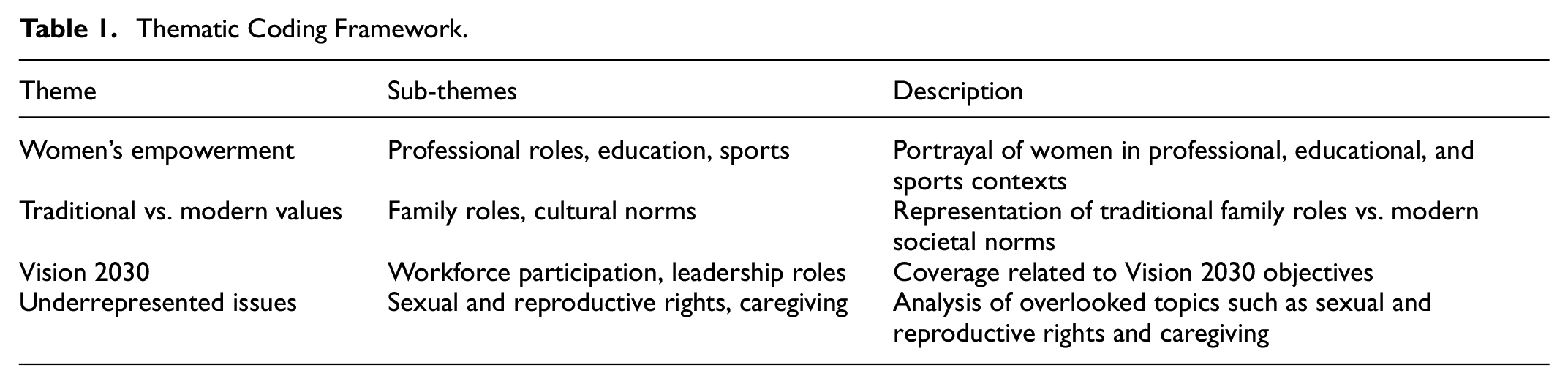
Articles were then coded using qualitative data analysis software, NVivo, which helped manage and categorize the data systematically. Codes were assigned to segments of text representing specific themes, narratives, or discursive strategies related to women’s rights and empowerment (See Table 1). The coded data were analyzed to identify major themes and subthemes, which were compared across different media outlets to uncover patterns and variations in the portrayal of women’s rights.
Thematic Coding Framework.
Employing Fairclough’s Critical Discourse Analysis (CDA) framework, the study examined the language, narratives, and ideological underpinnings of the articles, focusing on how power relations and social inequalities were reflected and reproduced in media discourse. Special attention was given to the use of language, framing of women’s empowerment, and alignment with governmental policies like Vision 2030. To enhance the validity of the findings, triangulation was used by comparing results from media outlets and cross-referencing with existing literature.
The CDA was carried out using Fairclough’s multi-level approach, examining texts at the textual, discursive, and social practice levels (See Table 2). Initially, the descriptive phase focused on the vocabulary and grammar used in the articles, identifying a prevalent use of empowering terms and active voice constructions, indicative of a shift in the portrayal of women (Fairclough, 2001). This phase also scrutinized the syntactic structures to understand the narrative around women’s roles.
CDA Analysis Framework.

Subsequently, the interpretative phase examined how the text interacted with the broader societal context, particularly noting the assertive speech acts and the use of intertextuality. This phase explored how the discourse aligned with governmental narratives, especially those related to Vision 2030. In the final explanatory phase, the focus was on situating these linguistic findings within the wider socio-political context of Saudi Arabia. This involved analyzing how gender equality is balanced with traditional cultural and religious norms. This methodological approach highlighted the relationship between language, power, and ideology in shaping public perceptions of women’s evolving roles in Saudi society, consistent with Fairclough’s (2001) view of discourse as a social practice.
Data Analysis
Description Phase
The “Description Phase” of Fairclough’s approach in this study involves a detailed analysis of language in the selected news articles on women’s rights. It covers vocabulary analysis with emphasis on wording, metaphors, and ideologically contested terms, and examines the juxtaposition of modern and traditional concepts. Additionally, the study scrutinizes grammar and syntax for insights into agency and modality and evaluates cohesion and coherence through narrative structures and discursive strategies. This phase aims to reveal how language constructs and influences societal perceptions and attitudes toward women’s rights in Saudi Arabia.
Vocabulary Analysis
Wording and Metaphor
In Saudi news articles, terms like “empowerment,”“advancement,”“progress,” and “liberation” illustrate the evolving status of women and shape readers’ perceptions. These terms suggest advancement in women’s rights, with “women’s rights” consistently used to underscore its importance. Articles emphasize gender inequality as a primary issue, providing historical context and specific statistics like gender wage gaps and women’s political representation, reinforcing narratives of progress and ongoing challenges in achieving gender equality.
Metaphorical language like “stepping forward” and “path to empowerment” frames women’s rights as evolving and dynamic, implying continuous progress toward gender equality.
Ideologically Contested Words
The omission of terms like “submission,”“dependence,” and “restriction” marks a linguistic shift toward a progressive narrative, promoting women as active, empowered participants in society, countering past portrayals of passivity or subordination.
Juxtaposition of Modern and Traditional
Articles balance modernizing terms with traditional concepts, reflecting societal context. By juxtaposing “tradition” with “innovation” they acknowledge cultural heritage while advocating progress. For instance, Arab News highlighted: “Reforms have included the opening up of education to women, placement of women in senior positions, the abolition of the 50-year driving ban, and state television broadcasting inspirational stories of women entering new fields.” (Al-Rashed, 2019).
This balance contextualizes advancements in women’s rights within Saudi culture, suggesting modernization aligns with traditional values and societal evolution. An example states: “…in December, the Kingdom officially ended gender segregation in public places, although Saudi women and men had already begun to mingle.” (Gannon, 2020).
This linguistic strategy addresses potential tensions between modernity and tradition, creating a narrative that is both forward-looking and culturally rooted. For example: “Saudi Arabia’s Ministry of Municipal and Rural Affairs ended gender segregation, allowing both sexes to attend meetings in line with Shariah regulations.” (Muhammad, 2019).
The vocabulary in these articles is critical in framing and discussing women’s rights. Empowering and progressive language, the absence of restrictive terms, and the careful juxtaposition of modern and traditional concepts create a narrative respectful of Saudi Arabia’s heritage while optimistic about women’s future roles. This approach guides public perception toward a more inclusive and progressive understanding of women’s rights within the context of modernity and tradition.
The vocabulary analysis also reveals a notable omission of terms related to sexual and reproductive rights and caregiving. Terms such as “reproductive health,”“sexual rights,”“family planning,” and “caregiving” are scarcely mentioned, if at all. This omission highlights a gap in the media discourse surrounding women’s rights, suggesting that these aspects are either marginalized or considered too sensitive to address openly. The absence of such terms in the media narratives reflects broader societal taboos and cultural sensitivities surrounding these issues in Saudi Arabia. This lack of coverage fails to provide a holistic view of women’s rights, particularly concerning their autonomy over reproductive choices and the significant role of caregiving in their lives.
Grammar and Syntax Analysis
The analysis of grammar and syntax in news articles reveals important aspects such as transitivity and agency, modality, and passive constructions.
Transitivity and Agency
The frequent use of active voice with women as grammatical subjects (e.g., “Saudi women are leading…”“Women entrepreneurs are contributing…”) places women at the center of actions and decisions. This portrays them as initiators and drivers of change, reflecting societal transformation. By positioning women as subjects who perform actions, the articles contribute to a narrative where women are seen as empowered and integral to societal advancements, countering the historically passive roles of women (Alhajri & Pierce, 2023).
Modality
Modal verbs such as “can,”“may,” and “able to” introduce a language of potential and capability, suggesting an open environment for women’s participation and success. These verbs reflect current states and future possibilities, indicating a progressive stance on women’s rights and roles by emphasizing opportunities rather than restrictions.
Passive Constructions
The use of passive voice in phrases like “rights have been granted” and “policies have been implemented” portrays advancements in women’s rights as collective societal achievements rather than attributing them to individuals. This technique universalizes progress, framing it as a shared national accomplishment and avoiding polarizing attributions to specific political figures or groups.
Linguistic Reflection of Societal Dynamics
The nuanced interplay of active and passive voices illustrates an understanding of Saudi societal dynamics. This grammatical strategy balances depicting women as agents of change with acknowledging broader societal and governmental roles. The syntax choice conveys messages about women’s evolving roles, emphasizing both individual agency and collective societal progress.
Analysis of Cohesion and Coherence
The analysis of cohesion and coherence in the articles examines how conjunctions, linking phrases, and repetitive schemata contribute to the overall narrative structure and thematic continuity.
Conjunctions and Linking Phrases
In the news articles, the use of conjunctions like “and,”“also,” and “furthermore” plays a significant role in weaving the discourse of women’s rights into broader social and economic narratives. These linguistic connectors help in linking the advancements in women’s rights not as isolated developments but as integral parts of the national agenda for progress and reform. These conjunctions and phrases ensure a smooth narrative flow, guiding the reader through the articles’ arguments and information. By doing so, they create a sense of continuity and logical progression, which is crucial in maintaining the reader’s engagement and understanding. The strategic placement of these linking phrases highlights the intersectionality of women’s rights with other societal issues. It indicates that the advancement of women’s rights is interconnected with various aspects of Saudi society, including economic growth, educational opportunities, and cultural shifts.
Repetitive Schemata and Linguistic Strategies for Coherence
The pattern of repetition in introducing and reiterating certain themes (e.g., “women empowerment,”“legislative reforms,”“social and cultural Shifts,”“Vision 2030’s role,”“international perspective,” and “challenges and resistance”) serves to reinforce key messages about women’s rights and their evolving roles in society. This repetition works as a rhetorical strategy to emphasize the importance of the discussed topics and to ensure they resonate with the readers. Through repetition, these news articles create a cohesive narrative where the recurring themes become familiar to the reader. This familiarity breeds understanding and acceptance, which are essential in shaping public opinion and societal attitudes.
Beyond the sentence level, the articles use thematic linkages to create coherence. These linkages are achieved through the consistent return to core themes, such as empowerment, modernization, and cultural balance. The analyzed articles often follow a logical progression from presenting current states or recent developments in women’s rights, tracing historical contexts, and projecting future aspirations. This structure aids in creating a coherent and comprehensive narrative that captures the journey of women’s rights in Saudi Arabia.
Analysis of Structure and Organization
Narrative Structure
News articles often use a three-part narrative structure: current state, historical perspective, and future aspirations. This structure provides a comprehensive view of women’s rights in Saudi Arabia, contextualizing present advancements within their historical journey and future trajectory. Historical perspectives highlight the significance of current progress, while future goals maintain momentum and optimism about women’s rights.
Episode Marking
Highlighting milestones or noteworthy events underscores the progressive narrative. By focusing on specific moments like new policies or women entering male-dominated fields, these articles provide tangible evidence of change. Episode marking shows continuity and development, suggesting each milestone is part of a larger effort toward gender equality.
Comparative Analysis
Comparing the current state of women’s rights with past situations highlights progress and societal transformation. This comparison showcases shifts in cultural norms, legal frameworks, and societal attitudes toward women, encouraging reflective and critical thinking about the factors driving change.
Conveying a Progressive Narrative
The structured storytelling approach in news articles, with a clear beginning (current state), middle (historical context), and end (future aspirations), effectively conveys a progressive narrative about women’s rights. This structure portrays a society actively working toward greater gender equality and shapes public perceptions to be forward-looking and supportive of continued advancements.
Analysis of Discursive Strategies
The analysis of discursive strategies in the Saudi news articles provides a deeper understanding of how framing, reframing, normalization, and government endorsement of change contribute to the overall narrative and influence the perception of women’s rights.
Framing and Reframing
The framing strategy employed in the news articles places women’s rights within the broader context of national progress and modernity, aligning the discourse of women’s empowerment with the country’s broader social, economic, and cultural goals.
Saudi Arabia is keen to do what it takes to ensure protection of women’s rights. (Saudi Gazette, March 26, 2021).
This approach strategically situates women’s rights as an integral part of the nation’s journey toward modernization and global integration, which significantly influences societal attitudes. By reframing traditional views of gender roles toward a progressive outlook and highlighting women’s achievements, these articles reshape the public narrative, fostering acceptance and support for women’s rights. The strategic use of this discursive strategy aligns with the national vision and values, suggesting that the empowerment of women reflects and contributes to the country’s aspirations, thus cultivating a national identity that is forward-looking and inclusive of women’s contributions.
Normalization of Change
The discourse in the news articles normalizes changes in women’s rights, portraying them as logical and natural progressions in a modernizing society. This normalization, crucial in integrating these changes into the collective consciousness, reduces resistance by framing advancements not as abrupt but as evolutionary and in line with societal development.
255 Saudi women complete training to join special security forces. (Saudi Gazette, January 12, 2023).
By consistently presenting changes in women’s rights as part of the social fabric, these articles help facilitate a cultural transition, balancing tradition with modernity. This strategy ensures that advancements in women’s rights are seen as customary developments, thereby countering potential resistance and positioning gender equality not as a challenge but as a complementary evolution of traditional values in a modern context. This approach promotes a vision of a society that is inclusive and progressive, fostering a societal mindset that embraces gender equality as a fundamental aspect of a modern, dynamic nation.
Government Endorsement
Several articles emphasize the support and initiatives of the Saudi government and leadership in promoting women’s rights, aligning with national policies like Vision 2030. Articles such as “1.2 million Saudi women set to take part in popular sports” (Saudi Gazette, January 26, 2020) illustrate government-backed initiatives aimed at increasing women’s participation in various fields. This approach not only supports the ongoing cultural transition toward greater gender equality but also embeds these changes within the fabric of national identity and progress.
Overlooked Topics: Sexual and Reproductive Rights and Caregiving
While the media coverage of women’s rights often focuses on economic and political empowerment, issues such as sexual and reproductive rights and caregiving are noticeably underrepresented. Sexual and reproductive rights are fundamental to women’s autonomy and health (U.N. Women, 2024), yet they receive limited attention in the analyzed articles. This lack of coverage may reflect broader societal taboos and cultural sensitivities surrounding these topics in Saudi Arabia.
Similarly, caregiving is often depicted as a traditional role for women, with limited discussion on its implications for gender equality. Caregiving responsibilities can significantly impact women’s economic opportunities and social status, reinforcing traditional gender roles and limiting women’s participation in the workforce (Folbre, 2006). The media’s limited coverage of caregiving issues suggests a need for more balanced and comprehensive narratives that address all aspects of women’s rights.
Interpretation Phase
In this phase, the study examines Saudi newspaper articles on women’s rights, revealing the intricate interplay between text and societal norms. By analyzing speech acts, coherence, and intertextuality, the research uncovers how these articles reflect and influence societal attitudes toward women’s empowerment and gender equality, particularly within the transformative context of Vision 2030.
Speech Acts
The discourse in articles about women’s empowerment and societal reforms in Saudi Arabia utilizes assertive speech acts to convey various social and political stances, particularly in relation to the transformative changes under Vision 2030. These assertive statements, often quoting women in influential positions or citing significant reforms, serve to state facts or report developments, illustrating a larger discourse of progress and modernization in the Kingdom.
For example, Reem Al-Sadoun, a young petroleum engineer, is quoted discussing her career in the context of Vision 2030’s reforms, emphasizing the growing participation and representation of women in the sciences and their significant contributions to the Saudi economy (Joudah, 2022) . Similarly, the US Embassy in Riyadh supports women’s empowerment as a goal of Vision 2030, highlighting collaborative efforts in this area (Rashid, 2023).
The year 2018 is described as a landmark year for Saudi women, marking notable advancements in their rights and participation in various sectors, such as driving, international governmental roles, and business leadership, suggesting a significant shift in societal norms and gender equality . The beginning of 2018 saw milestones like women entering sports stadiums and the military, reflecting broader reforms aimed at increasing women’s workforce participation from 22% to 30% .
Hanan Abdel Rahim Al-Ahmadi, assistant speaker of the Kingdom’s Shoura Council, was reported speaking at a symposium about women’s growing roles and participation in society and business, underscoring legislative efforts to support their empowerment . Moreover, an event hosted by the British Embassy in Riyadh celebrated Saudi women, emphasizing the importance of women’s networks in advancing their roles in the workplace and society (Arab News, March 23, 2022).
The progress in women’s economic opportunities is also highlighted, with reports indicating advancements in wage equality, the removal of employment restrictions, and increased participation in technology and decision-making . Entrepreneurship is seen as a key avenue for women’s involvement in the labor market, with initiatives like the “Elevate Program” providing data and AI skills training to women, aiming to close the gender gap in science and technology . In addition, a conference at Imam Mohammed bin Saud Islamic University aimed to discuss women’s roles and successes in light of recent reforms, focusing on how these changes enhance Saudi women’s national identity and participation in education, training, and economic development .
These articles and events collectively depict a narrative of empowerment and progress for women in Saudi Arabia, framed within the context of Vision 2030. The assertive speech acts used in these articles report factual developments and contribute to shaping a discourse of transformation, modernization, and empowerment.
The analyzed news articles contain other examples of assertive speech acts. Here are some examples:
Emily Hawthorne’s Analysis on Reforms for Saudi Women: •“2018 has indeed been a year of firsts for women in Saudi Arabia in terms of some very specific reforms.” (Bell, 2018).
This statement highlights the considerable progress made in 2018 regarding women’s rights in Saudi Arabia .
2. Kent Davis-Packard on the Progress of Saudi Women: •“Saudi women have made phenomenal progress and not just because of the recent reforms. It was the work of Saudi women over the past decades that sufficiently transformed the national consciousness of the country to be ripe for the changes made by its current leadership.” (Arab News, December 30, 2018)
This statement asserts the long-term efforts and progress of Saudi women leading up to the recent reforms .
3. Hanan Abdel Rahim Al-Ahmadi on Legislative Support for Women: •“The leadership of the Kingdom provides support for Saudi women with attention and care to raise their roles and participation in society and business.” (Arab News, March 23, 2022).
This statement from a Shoura Council member emphasizes the Kingdom’s leadership’s role in supporting women’s empowerment .
4. World Bank Group’s Report on Saudi Arabia’s Progress: •“For the second year in a row, Saudi Arabia has made notable progress in advancing women’s economic opportunities.” (Obaid, 2021).
This is a statement from an international organization acknowledging the progress made by Saudi Arabia in enhancing women’s economic opportunities .
5. Saudi Press Agency on Women Leaders’ Impact: •“[Saudi women leaders] will support the process of creativity and achieving the principles of quality and the highest standards of excellence in order to achieve the generous aspirations of the wise leadership.” (Al-Thaqafi, 2020).
This statement asserts the positive impact of women leaders on organizational performance and innovation .
These examples illustrate how assertive speech acts are used in the discourse to state facts and developments, reflecting a broader narrative of women’s empowerment and societal transformation in Saudi Arabia.
The articles largely omit assertive speech acts concerning sexual and reproductive rights and caregiving. The lack of discussion on these issues indicates a reluctance or avoidance in addressing these crucial aspects of women’s rights. The absence of assertive statements on sexual and reproductive health services, family planning, or the recognition of caregiving roles highlights a significant gap in the media discourse. This omission can perpetuate a limited understanding of women’s rights, focusing predominantly on economic and political dimensions while neglecting essential aspects of women’s health and well-being.
Coherence
The coherence of news articles is crucial in conveying women’s rights amid modernizing reforms and traditional values. These articles maintain coherence by consistently focusing on themes like economic development, cultural events, and social reforms, framing women’s rights within national development. Logical structuring aids audience understanding by presenting current situations, historical context, and future implications, contextualizing women’s rights within Saudi Arabia’s evolution.
Articles balance modern reforms with references to traditional values, maintaining coherence in a society where both coexist. Discussions on women entering the workforce or leadership roles are paired with traditional societal roles, aligning reforms with cultural continuity.
Coherence is both linguistic and ideological, reinforcing narratives of national progress, cultural pride, and societal transformation, shaping public perception of women’s roles. Linguistic strategies, like assertive speech acts and culturally relevant terminology, integrate women’s rights within Saudi society’s familiar framework. By framing women’s rights within national development and cultural pride, these narratives contribute to a positive reception of reforms.
Intertextuality
Intertextuality in Saudi articles on women’s rights appears as manifest and constitutive intertextuality (interdiscursivity). Manifest intertextuality includes direct references to laws, Vision 2030, and officials’ speeches, legitimizing the content and aligning women’s rights with national development goals. This alignment shapes public perception significantly.
Constitutive intertextuality blends political, economic, and social discourses, illustrating the complexity of societal changes regarding women’s rights. Economic discourse on women entering the workforce intertwines with social discourse on evolving gender roles, offering a comprehensive view of these rights within broader societal transformations.
The style and register of articles vary with subject matter, contributing to interdiscursivity. Business-focused articles use formal language to show economic aspects, while cultural reports adopt a narrative style to highlight social ramifications. This variation affects audience perception and engagement.
The absence of manifest intertextuality on sexual and reproductive rights and caregiving shows these topics are not integrated into the broader narrative, limiting the discourse on women’s rights.
Discourse Representation
This analysis examines the representation of women’s rights in Saudi news media, focusing on selective quotations and thematic reinforcement shaping public perception to align with national progress and cultural identity.
Selective Quotation
Saudi news articles strategically select quotes from government officials, business leaders, and cultural figures to support themes aligned with the government’s commitment to women’s empowerment and Vision 2030. This approach legitimizes the narrative around women’s rights as a state-endorsed process. Successful women in business are highlighted as contributors to the national economy, and cultural figures tie women’s roles to Saudi heritage, linking women’s rights to cultural pride.
However, this selective amplification and omission of voices offer insights into the portrayal of women’s rights and prevailing social norms. Grassroots activists and independent feminist voices offering alternative viewpoints are often underrepresented. The varied experiences of everyday women across different social strata and regions are not adequately represented, leading to gaps in understanding Saudi women’s diverse experiences. Critical or opposition voices critiquing the pace or extent of reforms are also less prominent, resulting in a unidimensional portrayal of women’s rights.
Reinforcement of Central Themes
Quotes in these articles reinforce themes like “progress,”“reform,” and “national pride,” shaping public perception and lending credibility to the narratives. For instance, government officials’ quotes about women’s increasing roles in the workforce or politics reinforce the notion that women’s rights are integral to the country’s modernization and growth.
Contextualization of Quotes
The representation and contextualization of quotes in articles portray the evolution of women’s rights and the media’s influence on public perception, balancing modernity with tradition. Government officials’ quotes are framed within national narratives like Vision 2030, integrating women’s rights within the larger story of national development. Quotes reflecting progress in employment, education, or legal reforms underscore the government’s role, presenting women’s rights as intrinsic to the country’s modernization.
Academics and cultural figures’ statements resonate with Saudi cultural identity, referencing Islamic principles or heritage, suggesting women’s rights progression is in harmony with traditional values. Economically focused articles use quotes from business leaders to highlight women’s economic empowerment, linking participation in the workforce or entrepreneurship to broader economic goals like diversification and innovation.
The choice of quotes maintains thematic consistency, ensuring article coherence. The selection and presentation of quotes balance modernity and tradition, often omitting dissenting views, shaping a positive public perception of the state’s role in advancing women’s rights.
National Pride and Cultural Identity
Quotes tying women’s achievements to national success or cultural heritage make the idea of women’s rights more palatable and aligned with traditional values. This strategy mitigates resistance to change and fosters collective pride in Saudi women’s achievements.
Selective quotations related to sexual and reproductive rights and caregiving are notably absent. Quotes from health professionals, caregivers, or advocates for reproductive rights are rarely included, suggesting a reluctance to engage with these topics publicly due to cultural sensitivities or political considerations. This omission indicates these aspects of women’s rights are not prioritized in the media narrative, limiting public exposure to a comprehensive view of women’s issues.
Explanation Phase
This phase examines shifts in Saudi society’s approach to women’s rights, within the socio-political context, especially Vision 2030. These developments have fundamentally changed gender roles, diverging from traditional practices. The analysis shows how Saudi news reflects this transition, emphasizing the evolving conversation on women’s rights and the balance between modernity and tradition. It examines the interplay of cultural norms, power dynamics, and political influences shaping discussions about women’s roles and rights in Saudi Arabia.
Cultural Norms and Values
Saudi society’s view on women’s rights and roles is transforming, driven by Vision 2030, which aims to diversify the economy and initiate social reforms, including women’s empowerment. This shift toward inclusive gender roles marks a departure from entrenched practices (Alharbi, 2017; Al-Saggaf & Williamson, 2004).
Analyzed articles highlight women’s increasing involvement in employment and education, evolving from a backdrop of stringent restrictions rooted in extreme religious interpretations and customs. These norms have historically governed women’s lives, from marriage to mobility (Doumato, 1992).
Resistance to gendered legal frameworks is significant in Saudi history. In the 1990s, forty-nine educated women challenged the driving ban, facing severe responses from religious and government authorities (Doumato, 1992). Social media has since provided a platform for advocacy, allowing women to engage in previously inaccessible discourse and activism (Alhargan, 2012; Shirky, 2011).
Key campaigns, like the 2011 drive for women’s driving rights and the 2013 movement against domestic abuse, have garnered public support and led to policy changes despite opposition and risks to activists (BBC News, 2017; King Khalid Foundation, 2013). These initiatives highlight the tension between preserving traditional values and adopting progressive changes.
Despite recent reforms by King Salman, the advocacy path remains challenging, with threats and defamation against activists (Human Rights Watch, 2017; Tønnessen, 2016). Yet, Saudi women persist, using digital platforms to express views and gather support (Alhajri & Pierce, 2023). Cultural norms and conservative interpretations of Islamic law have limited women’s public participation, reinforcing stereotypes of women as mothers and housewives, and highlighting the interplay between culture, religion, and the legal system in shaping women’s roles (Alharbi, 2017).
Power Dynamics
News articles indicate a shift in power dynamics regarding gender. Historically, Saudi women faced systemic marginalization, with limited rights in public and private life (Alhajri & Pierce, 2023).
Recent reforms mark a departure from these norms. The 2018 decision to allow women to drive symbolized a shift in societal attitudes toward women’s autonomy. Beyond mobility, driving represents economic freedom, workforce participation, and a step toward gender equality, challenging patriarchal norms (Alharethi et al., 2022).
The easing of guardianship laws, which required a male guardian’s permission for various activities, has empowered women, enabling greater public participation and fostering individual agency. This aligns with Vision 2030’s goal of increasing women’s workforce participation.
These changes reflect a cultural shift in how Saudi society views women’s roles. Media now portrays women as active agents of change, contributing to national development and modernization efforts, a shift from traditional representations.
This shift is further emphasized by the increasing visibility of women in fields previously dominated by men, such as education, healthcare, and government, challenging the gendered division of labor. This change is not just about economic development but about redefining societal norms (AlMunajjed, 2009).
Political Climate
The political climate adopts a top-down approach to societal change, with leadership, particularly Crown Prince Mohammed bin Salman, playing a significant role in enforcing reforms. This centralization aligns with the Freedom House (2019) report, suggesting tightly controlled state-led reforms to remodel Saudi Arabia’s global image and attract investment. These reforms respond to societal and systemic oppression rooted in religious and traditional beliefs governing women’s rights (Alharbi, 2017; Al-Saggaf & Williamson, 2004; Doumato, 1992).
The restricted environment for NGOs has shifted women’s rights advocacy to individual efforts, often through social media platforms (Alhargan, 2012; Shirky, 2011; Tønnessen, 2016). Social media campaigns, like the 2011 drive for women’s driving rights and the 2013 “No more abuse” campaign, demonstrate digital platforms’ influence in advocating for women’s rights (BBC News, 2017; King Khalid Foundation, 2013).
The articles’ narrative reflects a complex interplay of state-led reforms, societal resistance, and the role of social media in advocacy, aligning with the global discourse on women’s rights, navigating traditional beliefs, religious interpretations, and modernization pressures (Human Rights Watch, 2017; Pharaon, 2004).
Current “Common Sense” in the Country
The prevailing “common sense” in Saudi Arabia regarding gender roles is evolving. News articles depict a society increasingly embracing women’s empowerment and participation in various sectors. This change is seen as essential for modernization and economic diversification, aligning with observations by Le Renard (2014) in “A Society of Young Women.” The media’s role in normalizing these new ideals is crucial in reshaping societal attitudes.
Insights From CDA of Saudi News Media
This study examines how women’s rights are portrayed in Saudi news media, analyzes the ideological underpinnings of these portrayals, and understands the media’s role in shaping societal attitudes toward women’s rights in the context of Vision 2030. Using Critical Discourse Analysis (CDA), it explores the linguistic and narrative strategies in media representations to uncover how power and ideology are reflected and reproduced.
Representation of Women’s Empowerment
The analysis reveals significant positive portrayals and empowerment narratives in media coverage. Articles highlight women’s achievements in business, education, and sports, aligning with Feminist Media Theory, which examines media’s role in challenging gender stereotypes. The frequent depiction of women entering male-dominated fields, such as high-ranking positions, illustrates a shift toward gender equality. Empowering terms like “advancement,”“progress,” and “liberation” suggest improvement in women’s rights, consistent with Vision 2030’s goals to enhance women’s workforce and leadership participation.
Tension Between Tradition and Modern Values
Despite positive narratives, media coverage also reflects traditional views on women’s roles, emphasizing responsibilities within the family. This tension highlights the coexistence of modernization efforts and cultural norms. CDA uncovers underlying power dynamics and ideological struggles, revealing how media discourse both perpetuates and challenges gender hierarchies.
Influence of Vision 2030 on Media Narratives
Media narratives align closely with Vision 2030, framing women’s empowerment as integral to national development. This framing makes women’s empowerment more acceptable in a conservative society, shaping public perceptions and setting societal priorities, as explained by Agenda-Setting Theory. Media include public reactions to reforms, reflecting and shaping societal attitudes toward women’s rights.
In summary, Saudi media both support and challenge traditional gender norms. Through positive portrayals aligned with Vision 2030 and conservative representations, media narratives reflect the complex and evolving nature of women’s roles in Saudi society. Integrating CDA, Feminist Media Theory, and Agenda-Setting Theory, this study highlights the media’s role in shaping societal attitudes and promoting gender equality amid Saudi Arabia’s transformation.
Discussion
The main objectives of this study were to examine how women’s rights are portrayed in Saudi news media, analyze the ideological underpinnings of these portrayals, and understand the role of media in shaping societal attitudes toward women’s rights in the context of Vision 2030. The findings from the analysis provide a comprehensive view of how these objectives are addressed through the media narratives in Saudi Arabia.
The analysis of Saudi news articles using Fairclough’s Critical Discourse Analysis (CDA) model offers insights that align with and extend existing literature on media discourse and women’s empowerment in Saudi Arabia. The use of CDA, as advocated by Fairclough (2001), enables a deep exploration of the relationship between language, power, and ideology. The analysis revealed a significant presence of positive portrayals and empowerment narratives in the coverage of women’s rights. Articles frequently highlighted women’s achievements and contributions to various sectors, such as business, education, and sports. This aligns with Feminist Media Theory, which examines how media content can challenge gender stereotypes and promote egalitarian perspectives (van Zoonen, 1994). The frequent depiction of women breaking into traditionally male-dominated fields illustrates a progressive shift toward gender equality. These positive portrayals contribute to the broader discourse on gender equality, reflecting the goals of Vision 2030 to enhance women’s participation in the workforce and leadership positions.
However, the analysis also uncovered numerous instances where media coverage reflected traditional and conservative views on women’s roles. Articles often emphasized women’s responsibilities within the family and home, highlighting the ongoing tension between modernization efforts and traditional cultural norms. This duality in representation reflects the complex nature of societal change in Saudi Arabia, where advancements in women’s rights coexist with enduring cultural expectations. CDA helps to uncover the underlying power dynamics and ideological struggles within these media narratives (Fairclough, 1995). By analyzing the language and themes used in these articles, CDA reveals how media discourse both perpetuates and challenges existing gender hierarchies.
Moreover, the findings from this study resonate with the broader discourse analysis principles outlined by Blommaert (2005), especially in terms of how power and inequality are manifested in texts. The Saudi news articles’ portrayal of women’s empowerment echoes Blommaert’s discussion on the power of discourse in shaping societal norms and values. This aligns with Feminist Media Theory, which probes into how media content either perpetuates patriarchal norms or challenges gender stereotypes (van Zoonen, 1994). In this study, the portrayal of women in Saudi media often reflects a tension between traditional gender roles and emerging egalitarian perspectives, indicating a complex and gradual shift toward gender equality.
The study also found that many media narratives align closely with the objectives of Vision 2030. Articles frequently framed women’s rights and empowerment as integral to national development and progress. This framing strategy serves to make the narrative of women’s empowerment more acceptable in a traditionally conservative society. By frequently highlighting the importance of women’s empowerment to national development, Saudi media are shaping the national and international public perceptions and setting the agenda for societal priorities, as explained by Agenda-Setting Theory (McCombs & Shaw, 1972). The role of media in promoting societal change is further emphasized by the inclusion of public reactions to government reforms. This interaction highlights the media’s influence on public opinion, showcasing a mix of support and resistance. By including these reactions, media engage in a dialog with their audience, reflecting and shaping societal attitudes toward women’s rights.
Furthermore, the analysis provides insights into how Saudi media navigates the delicate balance between advocating for change and maintaining cultural and religious values. This is particularly evident in the discussion of women’s participation in the workforce (Parveen, 2022), where the narrative is often one of cautious progression rather than radical overhaul. The media’s portrayal of women’s empowerment contributes to the societal construction of gender roles, reflecting and shaping public perceptions. This aligns with Social Constructivism, which examines how societal norms and realities, particularly gender roles, are constructed and perpetuated through social interactions and institutional practices (Berger & Luckmann, 1966).
While the media coverage of women’s rights frequently focuses on economic and political empowerment, issues such as sexual and reproductive rights and caregiving remain significantly underrepresented. The lack of attention to sexual and reproductive rights, which are fundamental to women’s autonomy and overall well-being (U.N. Women, 2024), suggests broader societal taboos and cultural sensitivities. The absence of discussions around reproductive health services, family planning, and sexual rights in media narratives reflects an incomplete picture of women’s rights, limiting the scope of public discourse and potentially marginalizing critical aspects of women’s health and autonomy.
Similarly, caregiving, a role traditionally associated with women, receives limited media attention. The lack of coverage on caregiving responsibilities and their impact on women’s economic opportunities and social status underscores a gap in the media narratives. Caregiving is a significant aspect of gender equality, as it influences women’s participation in the workforce and their overall socio-economic standing (Folbre, 2006). By not addressing caregiving, the media fails to challenge traditional gender roles that restrict women’s economic and social advancement.
The implications of overlooking these topics in media narratives are profound. Without addressing sexual and reproductive rights, women’s autonomy and health are not fully supported or recognized, leading to incomplete empowerment. Ignoring caregiving issues perpetuates traditional gender roles and fails to advocate for necessary structural changes that support women’s full participation in society. A comprehensive approach to media coverage that includes these overlooked topics would provide a more holistic understanding of women’s rights and contribute to more effective societal transformation.
These changes are particularly significant in the context of Sharia law. Traditionally, interpretations of Sharia in Saudi Arabia have imposed strict limitations on women’s roles and rights. However, recent reforms have been framed as being consistent with Islamic principles, emphasizing interpretations that support gender equality and women’s empowerment. This approach legitimizes the reforms within the cultural and religious framework of Saudi society and facilitates broader societal acceptance.
The findings indicate that Saudi media play a dual role in both supporting and challenging traditional gender norms. Through a combination of positive portrayals aligned with Vision 2030 and conservative representations, media narratives reflect the complex and evolving nature of women’s roles in Saudi society. The integration of Critical Discourse Analysis (CDA), Feminist Media Theory, and Agenda-Setting Theory provides a comprehensive framework for understanding these dynamics.
These findings have several implications for understanding media representation of women’s rights in Saudi Arabia. First, they highlight the media’s potential to promote gender equality by challenging traditional norms and showcasing women’s contributions to society. Second, they underscore the importance of media framing in shaping public perceptions and attitudes toward women’s rights. Finally, they reveal the ongoing ideological struggles within Saudi society as it navigates the intersection of tradition and modernity.
In conclusion, the media’s portrayal of women’s rights in Saudi Arabia is a reflection of the broader societal changes taking place under Vision 2030. By analyzing these portrayals through the lenses of CDA, Feminist Media Theory, and Agenda-Setting Theory, this study provides valuable insights into the media’s role in shaping societal attitudes toward women’s rights and contributes to the ongoing discourse on gender equality in Saudi Arabia. However, the underrepresentation of sexual and reproductive rights and caregiving issues highlights the need for a more inclusive media narrative. Addressing these overlooked aspects is crucial for achieving a comprehensive understanding of women’s rights and ensuring that all facets of women’s empowerment are recognized and promoted.
Limitations
While this study provides significant insights into the representation of women’s rights in Saudi media, it is not without limitations. One primary limitation is the focus on English-language newspapers in Saudi Arabia. This choice may not fully capture the broader discourse prevalent in Arabic-language media, potentially limiting the generalizability of the findings to the entire Saudi media landscape. Future research should consider a broader spectrum of media, including Arabic-language newspapers and digital platforms, to capture a more comprehensive view of societal discourse on women’s empowerment in Saudi Arabia.
Another limitation is the reliance on Fairclough’s CDA framework, which, while robust, may overlook other analytical perspectives that could offer different insights into the media discourse on women’s rights. Incorporating other discourse analysis frameworks or methodologies could provide varied analytical perspectives and enrich the understanding of the media narratives.
Additionally, the selection of articles, based on relevance and diversity, might have introduced a bias toward more progressive narratives, potentially overlooking more conservative viewpoints prevalent in society. Longitudinal studies tracking changes in media discourse over time, especially in response to ongoing reforms and global influences, could provide deeper insights into the evolution of media narratives on women’s rights.
Finally, the study’s focus on the portrayal of women’s rights in traditional media does not fully account for the rapidly changing landscape of social media, which play a crucial role in shaping public opinion and discourse. Future research should include an analysis of social media platforms to understand their impact on the representation of women’s rights.
Despite these limitations, this study’s strengths lie in its comprehensive use of Critical Discourse Analysis, Feminist Media Theory, and Agenda-Setting Theory. These theories provide a nuanced understanding of how media narratives influence and reflect societal attitudes toward women’s rights. The integration of these theoretical frameworks offers a robust approach to analyzing media representations and their impact on public perception and societal attitudes.
Conclusion
The current study unraveled the complex narratives and linguistic subtleties within Saudi news outlets regarding women’s rights. Key findings reveal a nuanced representation of women’s empowerment, highlighting a transitional phase in Saudi society where modern reforms intertwine with traditional values. The news articles often framed women’s empowerment in the context of national progress, reflecting an alignment with broader national objectives. This study also revealed the strategic use of language in these narratives, emphasizing empowerment, progress, and integration into public life, subtly shifting the traditional portrayal of women in Saudi society.
Critical Discourse Analysis (CDA) was instrumental in uncovering how language in Saudi media reflects and sustains social inequalities, including gender biases. Through CDA, we identified the underlying power structures and ideologies that shape media narratives about women’s empowerment. The practical implication here is that media practitioners and policymakers need to be aware of these embedded power dynamics and work toward more balanced and equitable representations of women.
Feminist Media Theory provided a lens to examine whether these media representations perpetuate patriarchal norms or challenge gender stereotypes. This theory was crucial in assessing the balance between traditional gender roles and emerging egalitarian perspectives within the Saudi media. The practical implication is that media content creators should actively challenge gender stereotypes and promote egalitarian narratives to support the broader goal of gender equality.
Agenda-Setting Theory played a significant role in understanding how media coverage prioritizes women’s rights issues and influences public discourse. The findings indicated that Saudi newspapers highlight women’s empowerment within the broader context of national development, thereby shaping public perception and discourse. The practical implication is that media outlets have the power to shape public priorities and should leverage this power to highlight and promote women’s rights and empowerment.
Furthermore, the study highlighted the often-overlooked aspects of women’s rights, such as sexual and reproductive rights and caregiving. The inclusion of these topics is crucial for a comprehensive understanding of women’s empowerment, as they directly impact women’s autonomy and socio-economic status. Media narratives need to address these aspects more prominently to provide a holistic representation of women’s rights.
Based on these findings, it is recommended that policymakers and media professionals collaborate to further promote positive media portrayals of women. This collaboration can support the acceleration of societal acceptance and the implementation of gender equality initiatives in Saudi Arabia. By working together, policymakers can create supportive frameworks and media professionals can produce content that challenges stereotypes and highlights women’s contributions to society, thereby fostering a more inclusive and progressive public discourse.
In conclusion, the media’s portrayal of women’s rights in Saudi Arabia is a reflection of the broader societal changes taking place under Vision 2030. By analyzing these portrayals through the lenses of CDA, Feminist Media Theory, and Agenda-Setting Theory, this study provides valuable insights into the media’s role in shaping societal attitudes toward women’s rights and contributes to the ongoing discourse on gender equality in Saudi Arabia. The findings underscore the importance of media in both reflecting and driving social change, and they highlight the need for continued efforts to ensure that media representations of women are inclusive, balanced, and empowering.
Footnotes

Ethical Considerations
Ethical approval was obtained.
Consent for Publication
The author declared the consent for publication of the current study.
Funding
The authors disclosed receipt of the following financial support for the research, authorship, and/or publication of this article: This work was funded by the University of Jeddah, Saudi Arabia, under grant No. (UJ-24-SHR-3303-1). The authors, therefore, acknowledge with thanks the University technical and financial support.
Declaration of Conflicting Interests
The author declared no potential conflicts of interest with respect to the research, authorship, and/or publication of this article.
Data Availability Statement
The datasets generated and analyzed during the current study are available from the corresponding author on reasonable request.