




Abstract
With the implementation of the “Double Reduction” policy in China, quality-oriented off-campus training has emerged as a pivotal education format focusing on social literacy and future competencies. This study uses Python to mine learners’ review texts from Dazhong Dianping (a Chinese equivalent of Yelp), applies procedural grounded theory to identify key factors, and adopts the S-O-R model framework to elucidate key factors and theoretical logic underpinning learners’ satisfaction in quality-oriented off-campus training institutions. The research findings are as follows. First, learners’ satisfaction is significantly shaped by four categories of factors: external environment, learner characteristics, institutional attributes, and psychological perceptions. Second, each dimension within the four types of elements operates independently, allowing for individual effects on learners’ satisfaction as well as collective impact. Third, the mechanism of satisfaction generation exhibits a dynamic cyclical and promotional pattern. Fourth, the heterogeneity in training content can trigger differential factors in learners’ satisfaction generation. This study reveals that the influencing factors of learners’ satisfaction in quality-oriented off-campus institutions have a dynamic cyclical pattern from the psychological expectation stage, the training experience stage to the value judgment stage, which is conducive to deepening the understanding of learners’ satisfaction mechanism.
Plain language summary
Strauss and Corbin proposed the procedural-rooted theory coding technique in 1990 that qualitative research can thoroughly examine a variety of aspects and disclose the overall causal logic of events, which contributes to the development of new theories. We employs a data collection methodology that involves the use of Python tools to mine learners’ review texts of off-campus training institutions in Shanghai China on the website of Dazhong Dianping (a Chinese equivalent of Yelp). We utilize the qualitative research software NVivo12 to facilitate the processing analysis of the textual information, apply procedural grounded theory to identify key factors, and adopt the S-O-R model framework to elucidate key factors and theoretical logic underpinning learners’ satisfaction in quality-oriented off-campus training institutions. The analysis results indicated that the external environment, the subject, the object, and psychological perception all significantly influence on learners’ satisfaction independently or collectively, and reveals that the four influencing factors have a dynamic cyclical pattern from the psychological expectation stage, the training experience stage to the value judgment stage. There are two main contributions in our research. One contribution in this study is that it is beneficial to deepen the academic understanding of learners’ satisfaction mechanism in off-campus training institutions. The other contribution in this study is that it helps small-and-medium-sized training institutions enrich and expand the theoretical system for generating learners’ satisfaction, and devise various types of quality-oriented subjects to improve learners’ satisfaction.
Keywords
Introduction
As a semi-public good characterized by limited non-competitiveness and non-exclusivity, quality-oriented education emphasizes individual initiative, the development of personal potential, and the cultivation of a well-rounded personality. In this context, quality-oriented off-campus training institutions are established by individuals or social organizations to offer high-quality training for diverse individuals in accordance with relevant laws and regulations.
Quality-oriented education symbolizes the most advanced provision of China’s continuing, deeply reforming fundamental system in the off-campus training market. Nowadays, with the unprecedented development of the world, the competition in the market for cultivating inventive abilities grows fiercer, and there is an urgent need to compensate for the creative demand for cultivating students’ creativity and imagination. In July 2021, China issued “the Opinions on Further Easing the Burden of Excessive Homework and Off-campus Tutoring for Students Undergoing Compulsory education” (the “Double Reduction” policy), which substantially restricted the business space of exam-oriented education training institutions. Furthermore, the increasing substitutability of exam-oriented training has been accelerated by the emergence of AI-powered knowledge integration tools, such as ChatGPT, introduced in 2023. This change demonstrates the significance of the shift to quality-oriented education in off-campus training market.
Consequently, the market for quality-oriented off-campus training institutions is expanding rapidly, and China’s extracurricular education development process is undergoing accelerated transformation, with a gradual shift from exam-oriented education to quality-oriented education (K. Liang et al., 2022). Nevertheless, the off-campus training market in China has historically been plagued by disordered competition and persistent industry turbulence, which primarily takes the form of “false advertising,”“pre-mature academic instruction,”“anxiety-driven marketing,” and “price fraud.” Many small-and-medium-sized training institutions are struggling to survive as a result of these problems, which have given consumers an unfavorable impression of the unprofessionalism and weak curriculum offerings of many institutions. In light of this, addressing two key challenges—how small and medium-sized institutions can adapt to the dual pressures of the “Double Reduction” policy and AI disruption, and how they can meet increasingly explicit consumer demand for quality development through enhanced services—is essential to their long-term sustainability.
From a domestic perspective in China, previous research on quality-oriented off-campus has primarily concentrated on broadening the exam-oriented education system (Yang & Huang, 2020), as opposed to the quality-oriented education examined in this study. In addition, the majority of case studies have investigated how quality-oriented education may compensate for the inadequacies of the development of “strong intelligence and weak quality” exam-oriented education. Although certain investigators have explored the motivating factors that affect learners’ satisfaction with various learning activities, they have found that these factors mainly focus on micro-level factors such as personal, family, institutional, and teacher-related variables (Yao & Jiang, 2022), and social, cultural, and market environmental factors at the macro-level (J. Wang et al., 2021). However, these studies are fragmented and lack concentrations on the path of satisfaction generation. In fact, the development of quality-oriented education training institutions is significantly influenced by a multitude of intricate factors, including environmental and learners’ subjective factors, among others. Only by comprehensively integrating the essence of these factors and establishing a logical connection between the pivotal factors can we more meticulously explore the generation mechanism of learners’ satisfaction. Furthermore, the majority of previous investigations into the operational development of small-and-medium-sized quality-oriented training institutions have been on promoting teaching quality through external regulatory mechanisms or improving teaching management at the topic level (Huang & Liu, 2022). To some extent, the aforementioned investigations have disregarded the crucial elements of the operational development of off-campus training institutions, emphasizing quality from the “bottom-up” viewpoint of the consumer. Meanwhile, there is a paucity of qualitative research on off-campus training that is quality-oriented and begins with the premise of customer satisfaction. In particular, over the past few decades, research on the elements that contribute to the establishment of quality-oriented training facilities has mostly focused on one particular kind of subject-based learning (Q. Zhang et al., 2022). To date, few studies have examined the impact of this heterogeneity on satisfaction generation, as the diversity of educational materials in the training domain has been largely overlooked. From an international perspective, Stevenson and Baker (1992) first proposed the concept of “shadow education” for off-campus training. As a supplement to the school education system, interdisciplinary art quality education has become an important part of extracurricular education for young people (B. Zhang, 2024). Moreover, participation in extracurricular education can provide value for the long-term development of individual students (Maloshonok, 2025). From the perspective of student subjectiveness, many scholars based on the theory of self-determination, believe that quality education needs to fully mobilize the enthusiasm of participants and stimulate students’ interest in extracurricular education. The maintenance of this interest is more effective than professional skills (Abós et al., 2021; Leyton et al., 2020). From the perspective of corporate entities, with the deepening of marketization of K12 off-campus training institutions, Favaloro (2015) believes that education companies should focus on close interaction with customers in marketing to enhance customers’ trust in corporate education products, and Salem (2019) analyzing social media marketing of higher education institutions can strengthen the competitive advantages of higher education institutions. Therefore, fewer articles explore how to improve the competitiveness of institutions from the perspective of consumers. This research posits that education gained from high-quality instruction can be conceptualized as a “non-utilitarian product” that fosters intrinsic values. In contrast to conventional exam-oriented education, quality-oriented education encompasses a greater degree of content innovation, individual uniqueness, divergent thinking, and emotional interest. However, research on the phenomena of extracurricular training has placed less emphasis on how students perceive the value of such off-campus training, which has prevented it from following the general trend of high-quality instruction and training in the market for extracurricular training in the future. Consequently, from the perspective of generating consumer pleasure, academics must investigate approaches to support the survival of current small-and-medium-sized quality-oriented training institutions in a competitive market.
Given the practical challenges and theoretical gaps in the quality-oriented off-campus training market, this study investigates the following questions: First, what are the key factors influencing learners’ satisfaction in quality-oriented training institutions? Second, how do these factors exert their influence—independently or in combination? Third, does the process of satisfaction formation exhibit a dynamic and cyclical structure? This study takes some small-and-medium-sized quality-oriented training institutions in Shanghai as the research object, collects online reviews of these training institutions on Dazhong Dianping (Chinese equivalent of Yelp) as text data, and uses grounded theory coding techniques for analysis. This study takes the “stimulus-organism-response” (S-O-R) model as the theoretical framework, and decomposes the path of improving consumer satisfaction in small and medium-sized quality education and training institutions into a progressive process of external environmental stimulus (S) → learner psychological and behavioral transformation (O) → satisfaction formation (R). Under the framework of the S-O-R theoretical model, it extracts and interprets the key factors and generation logic of learners’ satisfaction in quality-oriented off-campus training. The purpose of this study is to explore how small-and-medium-sized quality-oriented training institutions can improve consumer satisfaction and how they can promote their foothold in the fiercely competitive off-campus training market. On this basis, it ascertains a certain degree of theoretical enlightenment for the successful operation of these institutions.
The contributions of this study are as follows. First, it reveals that the influencing factors of learners’ satisfaction in quality-oriented training institutions have a dynamic cycle pattern from the psychological expectation stage, the training experience stage to the value judgment stage. This finding deepens academic understanding of the satisfaction formation mechanism in off-campus training. Second, this study presents a consumer-oriented theoretical framework for the development of small-and-medium-sized quality-oriented training institutions, thereby enriching and expanding the theoretical system for generating learners’ satisfaction. Finally, given the heterogeneity of subjective content in the off-campus training industry, this research conjectures the differences in the generation of influencing factors that improve learners’ satisfaction, offering practical insights for designing diverse subject-specific quality training programs.
Literature Review
Research on Learner Satisfaction in Educational Scenarios
Characteristics of students produce significant impacts on learning experiences and outcomes such as academic performance. These include Ernest’s Institutional Impact Model (Ernest, 1985), Coleman’s exploration of the Educational Production Function (Coleman, 2010), Astin’s Student Engagement Theory (Astin & Antonio, 2012), and the “Input-Environment-Output” (I-E-O) model.
Individual Influencing Factors of Learner Satisfaction
Within the realm of training, learners’ satisfaction can be defined as an individual’s subjective assessment of their degree of satisfaction with the attainment of learning object throughout the learning process, which is affected by numerous circumstances (Jiang et al., 2017). In recent years, research on learners’ satisfaction has mainly been based on the “Customer Satisfaction Theory” in the field of management and the “Social Cognitive Theory” in the field of psychology. Research on learners’ satisfaction in the context of schools or other off-campus training institutions has dominated the majority of the literature. Nevertheless, a significant proportion of academic research on learners’ satisfaction has focused on the impact of individual or institutional factors on satisfaction. Some researchers have represented that learning satisfaction is susceptible to individual predisposed factors, including birthplace, family social and cultural capital (Yao & Jiang, 2022; C. Zhang & Wang, 2022), individual psychological factors such as achievement goal orientation and self-efficacy, and teaching factors such as teaching quality and environment, teaching reputation (Chowdhury et al., 2022; Haverila et al., 2021; Jandrić & Loretto, 2023). However, research on the progressive impact relationships of substantial variables on “how satisfaction is influenced” is still quite restricted, and the majority of studies that have been conducted to date have used traditional empirical methods to evaluate single-level factors.
External Influencing Factors of Learner Satisfaction
In more specific terms, the majority of current domestic and international research examines learners’ satisfaction in novel teaching settings while concentrating on exam-oriented education in elementary, secondary, and postsecondary education. For example, in recent years, the majority of research on the satisfaction of pupils has investigated the impact of real-world backgrounds and online learning environments on learners’ satisfaction. A considerable body of research indicates that the diversity of platform-level choices (Xuan & Zhang, 2021), interactivity of information (Conrad et al., 2022), and knowledge presentation methods (G. Wang & Fu, 2021), as well as individual-level perceived usefulness, sense of learning achievement, learning motivation, and attitude (C. Wang & Gu, 2022) have significant implications for learning satisfaction and identification.
Research on the Operation of Education and Training Institutions
Under the new era of China, the main social contradiction requires accelerating the high-quality development of all industries, while supportive policies are largely tilted toward leading enterprises in the industry. As a result, a large number of small-and-medium-sized training institutions are at a disadvantage in the competitive landscape of the quality-oriented training industry (S. Zhou, 2022), resulting in a mismatch between their stage of operation and development and the progress required by society.
The Limitation of Public Quality Education
Public off-campus quality-oriented education units, which are situated between the compulsory education system and the capitalized market for off-campus training, such as youth activity centers, rely on targeted service guarantees for family education guidance to ensure their sustainable development (J. Wang et al., 2021). Furthermore, research has demonstrated that these kinds of high-quality public education initiatives capitalize on instructors’ self-identification with their subject status (Jordhus-Lier, 2021). The radiation and leadership function of these off-campus training units, however, needs to be enhanced due to the restricted teaching dimensions and educational resources, and they struggle to adapt to the “universality” standards of quality-oriented education (Liu & Liu, 2021). Consequently, a large number of small-and-medium-sized training institutions have emerged in order to fill the sizable market gap in quality-oriented education. At the same time, studies have shown that teacher support and interactive communication have a significant impact on online learning satisfaction (Gao & Lü, 2025), and high-quality learning environment can significantly improve learning effect by improving course satisfaction and autonomous learning ability (Mu et al., 2024).
The Existing Direction of Improving the Quality Education
Amidst the backdrop of educational reform in recent years, a number of studies have examined the factors that determined the development of quality-oriented off-campus training institutions specializing in a certain field. For example, some scholars have proposed that the operation and development of quality-oriented off-campus training institutions (such as sports categories) should focus on improving the quality of innovative collaboration between inside and outside the school. This could be achieved by clarifying the multi-stakeholder regulatory model with the government as the main regulatory body, establishing unified entry standards for the off-campus training industry and coach qualification certification systems, and enhancing the professional quality and capabilities of the teacher team (Huang & Liu, 2022). Attention should also be paid to building professional brands for off-campus training (Zhang et al., 2022).
Previous research has proposed that small-and-medium-sized training institutions need national policy support at the macro level (Yang & Huang, 2020). It is essential to focus on the development of a diverse range of products, innovative marketing strategies and the establishment of a productive subject-object relationship at the micro level (Wu & Chen, 2019). At the same time, their operation and development are regulated by the coordinated relationship between the government, market, and society (J. Wang et al., 2022).
Research Review
The purpose of quality-oriented education is to nurture the creative thinking of the future generations. As a result, the growth and management of the education sector have long constituted significant areas of frontier research and application. However, as previously stated, there are still certain gaps in the existing literature about learners’ satisfaction with high-quality domestic and international off-campus training.
Previous research has largely overlooked the detailed investigation of the mechanism generating learners’ satisfaction. The majority of scholars have conducted empirical research on the individual factors impacting learning perception using regression analysis or social network analysis approaches. Moreover, the features of the influencing elements of learners’ satisfaction in qualitative research from the perspective of quality-oriented off-campus training have not been extensively studied. As a result, it is unclear whether the construction of learners’ satisfaction is governed by a critical, interconnected relationship.
While much of the existing literature addresses the systematic teaching management required for the long-term operation of educational institutions, research on learners’ satisfaction with quality-oriented off-campus training from the “consumer” perspective remains limited. Due to this, previous research data has had trouble assessing the experience essential to the growth and management of high-quality, potentially highly effective training organizations from the perspective of their students.
As a result, the majority of studies on learners’ satisfaction that are currently available concentrate primarily on a particular kind of quality-oriented training institutions. These studies additionally employ a narrow range of research objects, failing to consider the variety of subject matter that quality-oriented training offers in the market and how it influences learners’ satisfaction in different ways. Consequently, earlier research is no longer fully applicable to the current state of development of various types of quality-oriented educational institutions.
Methods and Data
Methods
At present China’s quality-oriented off-campus training market exhibits a certain degree of locality and initiality. Existing research has largely overlooked theoretical explorations of learner satisfaction within this context. However, qualitative research—through repeated coding and interpretation—can provide a nuanced understanding of this phenomenon and reveal underlying causal mechanisms. Consequently, this study primarily employs the procedural-rooted theory coding technique proposed by Corbin and Strauss (2008), utilizing the qualitative research software NVivo12 to facilitate the processing analysis of the textual information of online comments and to conduct a systematic distillation and interpretation of the key elements and logics of learners’ satisfaction. The specific research methods and processes are shown in Figure 1.

Research program flow chart.
Data
As the internet evolves in popularity and usage, traditional text data collection methods are increasingly being conducted online. Online reviews, which are frequently instantaneous and anonymous, possess a certain level of authenticity and comprehensiveness that renders them an appropriate source of data for procedural grounded theory. This study employs a data collection methodology that involves the use of Python tools to crawl online reviews of quality-oriented off-campus training institutions in Shanghai on Dazhong Dianping. To clarify, Dazhong Dianping is the equivalent of Yelp in China that is a significant business under Meituan (W(03690.HK); approximately 100 billion USD), with a substantial global presence. Additionally, small scale interviews are conducted as supplementary validation material to avoid the monotony of data information.
In order to ascertain the quality of training institutions, this study has identified seven categories of training institutions: music, art, chess, calligraphy, dance, sports, and hosting and performing arts. The top five institutions in each area with the most reviews and ratings above 4.0 have been selected for further research. To avoid the inclusion of duplicate institutions, those offering multiple courses are excluded, resulting in a total of 24 institutions with 3,657 reviews, totaling over 150,000 words. The data collection period ends in March 2023. To ensure the reliability of the collected samples, 48 learners participating in quality-oriented off-campus training at these institutions were interviewed on-site. The selection and recruitment of participants follow the process outlined below: The sampling method used is purposive stratified sampling, based on the course types (arts, science, sports, etc.) offered by small to medium-sized institutions and the age of learners (covering children aged 6–18 and their parents), ensuring that the sample covers the core business areas and key user groups of the institution; Screening criteria: Continuous participation in the course for at least 3 months (to ensure depth of experience); Both parents and learners must voluntarily participate (minors require informed consent from guardians); Gender balance (24 males, 24 females); Recruitment channels: Public recruitment, namely posting recruitment information on the institution’s bulletin board and parent communities, clearly stating the research objectives and privacy protection clauses; Snowball sampling: Early participants recommend other potential respondents to expand diversity. The final sample includes 32 students (including 16 parents responses) and 16 self-taught adolescents, with interview durations ranging from 30 to 60 min per person, all recorded and processed anonymously. Semi-structured interviews were utilized to formulate open-ended questions and record replies after confirming their willingness of participants and gathering preliminary data.
Triangulation was achieved through the utilization of this additional textual data. The triangle verification is a method commonly used in social science research, which means that researchers use a variety of data sources, methods, theoretical perspectives or researchers to cross verify the same phenomenon (Thiessen & Denzin, 1970), in order to enhance the reliability and effectiveness of research results. This study mainly uses data source triangulation, and uses data from different sources to effectively verify the research results. Therefore, the small-scale on-site interviews with 48 additional personnel, as described above, serve as the data source for this triangle verification. The specific data processing method employed in this paper still utilizes the conventional method, which involves the grounded coding process of open coding, spindle coding, selective coding, and saturation testing. The follow-up process further explains the key elements and logic of learner satisfaction in quality education and training, yielding results consistent with those of the main research. To obtain refined data, the collected raw online reviews were preprocessed, manually screened one by one, and low-quality reviews were eliminated using the search function of NVivo12 software. Through the process of data processing and analysis, a total of 3,142 valid reviews, totaling over 120,000 words, were obtained as textual data for coding. Finally, two-thirds of the 3,142 reviews were randomly selected for coding to construct the theoretical model, while the remaining one-third of the reviews were used to test the theoretical saturation of the model.
Coding Process
This study employs the procedural coding grounded theory technique, utilizing NVivo12 software to conduct open coding, axial coding, and selective coding on the text statements from online reviews by learners of quality-oriented off-campus training. In the tertiary coding process, the researcher carefully considered, compared, and summarized important and clear statements, consulted with experts, extracted concepts, formed initial categories and main categories, and ultimately constructed a theoretical model based on the relationships between the categories.
Open Coding
The initial phase of grounded coding is called “open coding,” involving the evaluation of gathered online review text assertions in accordance with objective principles. Phenomena existing in the text content are theorized to establish initial categories by sentence-by-sentence coding. Owing to the vast quantity and heterogeneous nature of internet evaluations, it is essential to organize and consolidate the summaries of phenomena derived from the open coding procedure in order to generate ideas (categories). To ensure the rigor of initial category concept extraction, this paper uses a concept relationship matrix table to horizontally compare coding paths across different cases, identifying common patterns and contradictions, providing an evidence chain for categorization. For example: Primary Conceptualization: Summarizing similar original codes into primary concepts (such as “fun teaching”+“self-selected topics”→“content appeal and autonomy”); Sub-category Generation: Through continuous comparison, merging related primary concepts to form initial categories (such as “peer interaction”+“content attraction”→“learning interest”). Only concepts that appear at least five times were retained during category formation. Subsequently, various concepts are finally grouped into 30 initial categories based on semantic relationships. Table 1 presents some of the early categories and partially developed initial thoughts due to space constraints.
Illustrative Examples of Open Coding Key Factors Influencing Learners’ Satisfaction in Quality-Oriented Off-Campus Training Institutions.

Source. Created by authors.
Spindle Coding
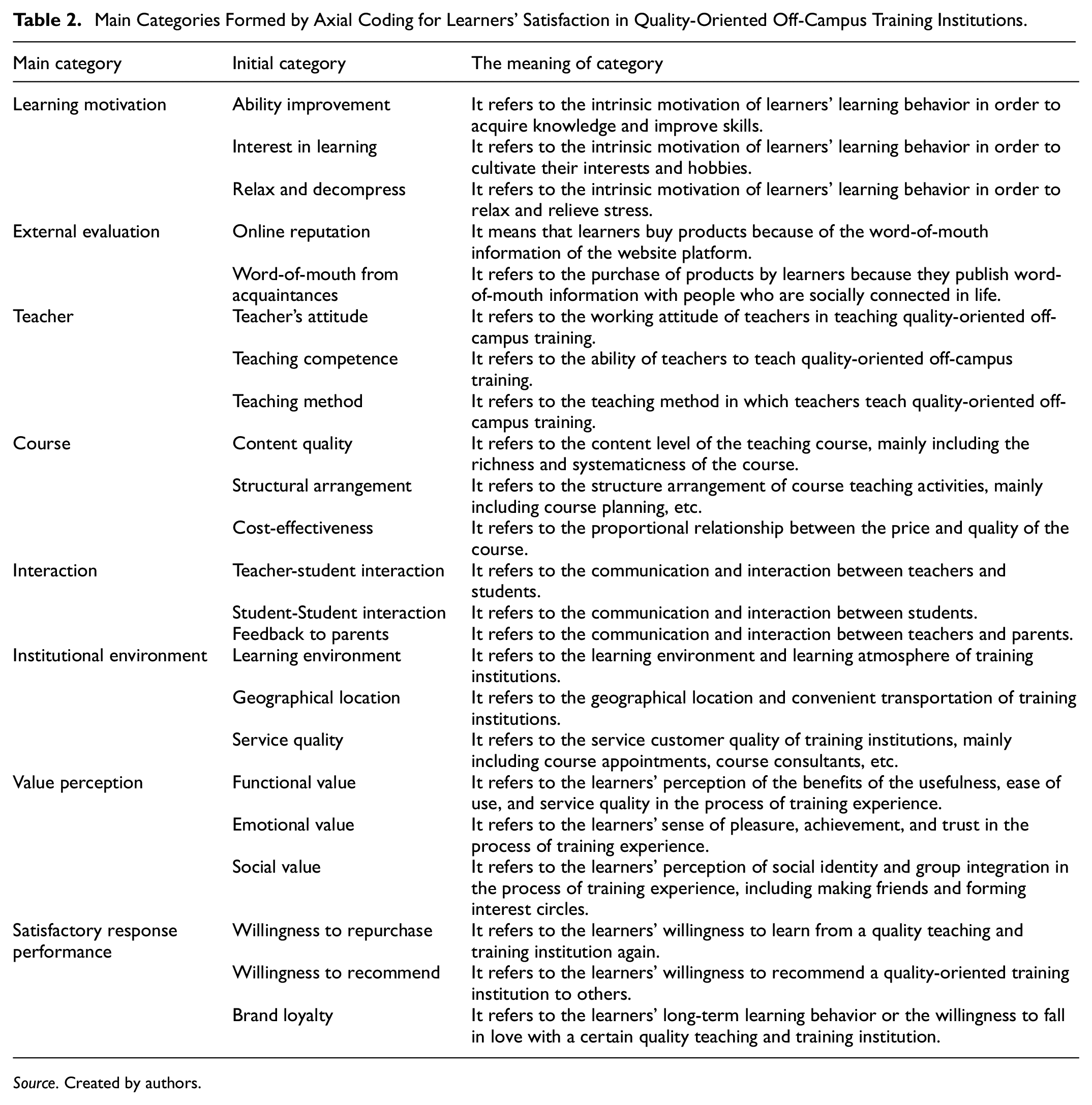
Main axis coding refers to the process of summarizing and rearranging the initial categories identified in coding, discovering, and inducing various logical relationships among these initial categories, condensing them into more systematic main categories, and forming corresponding sub-categories. During the use of NVivo12 in this study, through continuous comparison of the initial concepts, the nodes of the initial categories were clustered and merged into “tree nodes.” Ultimately, eight main categories were formed, namely: learning motivation, external evaluation, teachers, curriculum, interaction, institutional environment, value perception, and satisfaction reaction performance. The specific categories are shown in Table 2.
Main Categories Formed by Axial Coding for Learners’ Satisfaction in Quality-Oriented Off-Campus Training Institutions.
Source. Created by authors.
Selective Coding
Selective coding refers to repeatedly comparing the main categories formed by axial coding, identifying the relationships and generic commonalities among them, and searching for a more systematic core category. Through discussion and theoretical iteration, the logical storyline of the research is explored and developed into a theoretical framework. By comparing and sorting out the categories formed through the three rounds of coding, this study summarizes all phenomena under the “key factors and logical relationships of learners’ satisfaction generation in quality-oriented training institutions,” making it the core category.
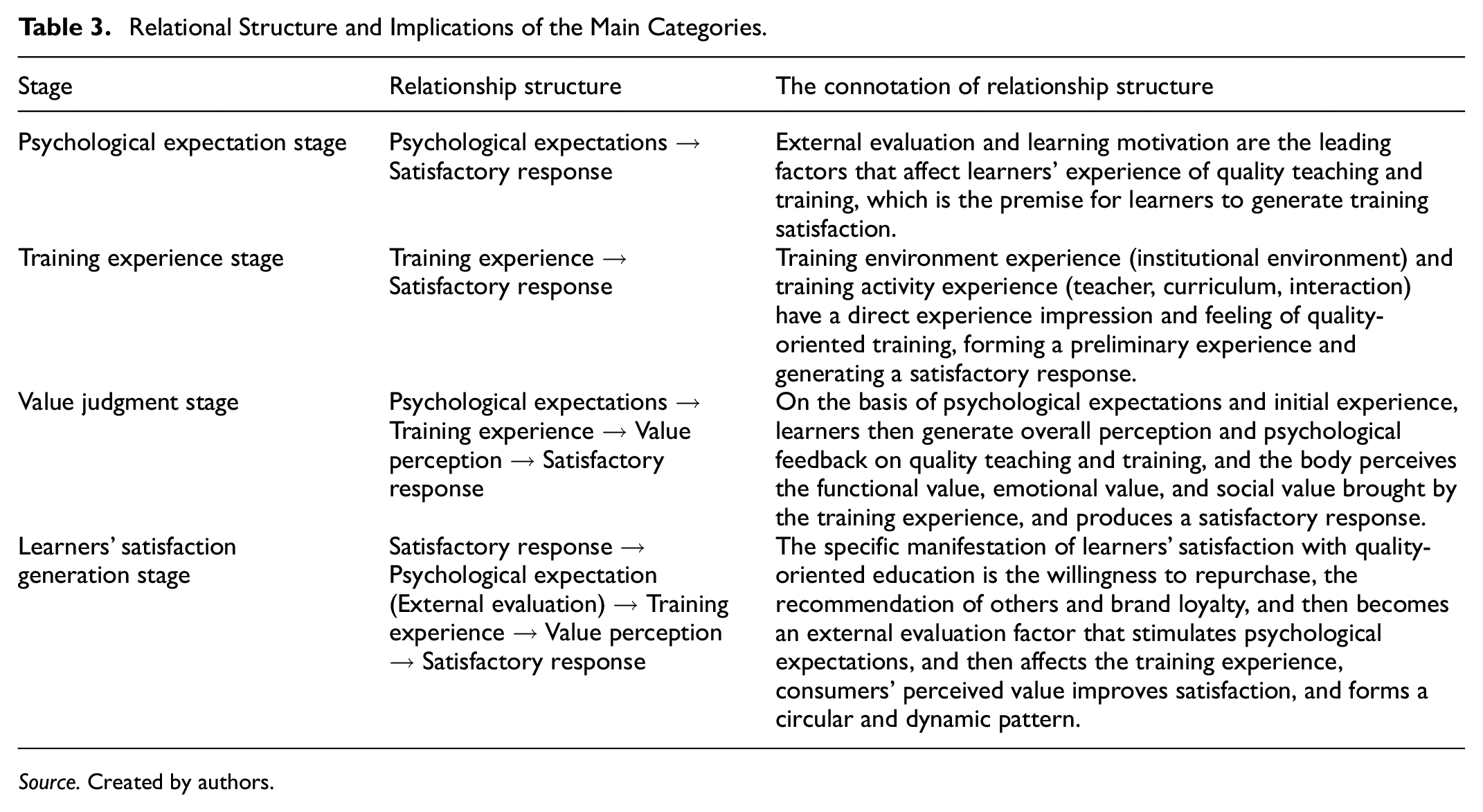
Drawing on the stimulus-response theory, this investigation has implemented a conceptual framework wherein the generation of learners’ satisfaction exhibits staged characteristics: the psychological expectation stage, the training experience stage, and the value judgment stage. These three stages occur sequentially and have a dynamic circular promotion effect.
The specific logical storyline is as follows.
In the psychological expectation stage, learners, influenced by external factors such as online reputation and word-of-mouth from acquaintances, as well as their own learning motivation, decide to purchase and form psychological expectations about the value brought by the quality-oriented training experience.
In the training experience stage, learners begin to immerse themselves in the training environment and receive stimulation from various factors, leading to direct feelings and impressions of the quality-oriented training institution, thus forming an initial experience.
In the value judgment stage, based on psychological expectations and initial experiences, learners continuously compare and accumulate their overall perceptions and psychological feedback on quality-oriented training, perceiving the functional value, emotional value, and social value brought by the training experience. This leads to a satisfactory response, reflected in brand loyalty, repurchase intention, and willingness to recommend to others. The specific influencing factors and their relationship structure are shown in Table 3.
Relational Structure and Implications of the Main Categories.
Source. Created by authors.
A theoretical model has been applied to comprehend the influencing factors of learners’ satisfaction generation in quality-oriented training institutions as suggested by the academic community. This was achieved using the previously mentioned grounded coding analysis and relational structure organization, as illustrated in Figure 2.

Multidimensional integrated model of learners’ satisfaction in quality-oriented off-campus training institutions based on grounded theory.
Saturation Test
To assess the theoretical saturation of the constructed model, one-third of the original online comments were set aside for analysis. Using NVivo12 software, a sample search was conducted on all the encoded comments. Examination revealed that the remaining comments largely aligned with the theoretical model presented in Figure 2. No new significant categories or relationships were identified, indicating that the constructed model is theoretically saturated. To illustrate this, three sample comments are showed as follows.
Text 1: “I have always heard of Qinhan Hutong Guoxue Academy, which has over 40 stores in Shanghai. Considering it’s a chain of directly-managed stores and a friend’s child attends here, I chose to enroll my child here as well (Word-of-mouth Recommendation from Acquaintances). My child is learning well.” Text 1 aligns with the path of “Psychological Expectation (External Evaluation) → Training Experience → Satisfaction Response.”
Text 2: “The feeling of painting is really healing (Stress Relief). Whenever I’m under a lot of work pressure, going to their art studio for a few hours makes me feel comfortable.” Text 2 aligns with the path of “Psychological Expectation (Learning Motivation) → Training Experience → Satisfaction Response.”
Text 3: “Kiwi teacher is very patient (Teacher Patience). She carefully records the progress of each student (Teacher Dedication) and frequently communicates with parents (Feedback to Parents). Whenever there are valuable activities, she informs us promptly. The classes are not overcrowded, with only 3 to 4 children (Small Class Teaching). The children enjoy the theme projects and get along well with their teachers and classmates (Emotional Value). We are extremely satisfied with each lesson.” Text 3 aligns with the path of “Training Experience → Value Perception → Satisfaction Response.”
Key Factors and Logical Interpretation of Learners’ Satisfaction in Quality-Oriented Off-Campus Training Institutions
Based on the theoretical model, numerous factors influence students’ satisfaction with quality-oriented training institutions. The following section further appraises the key influencing factors and the generation logic, which are examined in combination with review cases and previous literature.
External Environmental Factors
External evaluation is an important external environmental factor influencing consumers’ psychological expectations and subsequently their satisfaction. This study primarily examines online and word-of-mouth reputation as external environmental influences. Consistent with the technology acceptance theory, consumer’s purchase intentions are severely impacted by both online and word-of-mouth reputation (Y. Li et al., 2018). This influence is experienced through the perception of experiential usefulness and value, which in turn influences consumer’s purchase behavior (J. Wang et al., 2019).
Online Reputation
This refers to learners sharing various information about products or services through online channels such as forums, blogs, or video sharing. For example, “I saw a five-star review recommending this art studio on Xiaohongshu, and after attending, I found it to be excellent.”
Word-of-Mouth From Acquaintances
This refers to learners receiving verbal recommendations within their social circles. This type of word-of-mouth advertising relies on solid relationships, implying high emotional connections and trust. As a consequence, customers are not required to devote a comparable amount of energy screening products. For example, “The course is very practical. Many friends have been learning for several years consecutively. An old colleague even asked me if there are any preferential policies. I heard that his son has been learning for half a year and the effect is excellent.”
Subjective Factors
The learning motivation for quality-oriented training refers to the internal drive that prompts learners to engage in learning activities to achieve a specific goal. Through an analysis of review texts on Dazhong Dianping (a Chinese equivalent of Yelp), this study categorizes learners’ motivations into the following three types:
Ability Enhancement
Learners’ desire to gain knowledge and skills through quality-oriented training is the motivation for ability enhancement. It significantly shapes learners’ satisfaction. For example, “I want my child to be exposed to more things from a young age, not only academically but also in other areas.”
Learning Interest
Motivation theory suggests that interest in the product or object is an important factor that affects consumer’s perceived value (Hu et al., 2020). The learning interest motivation explored in this study refers to learners’ desire to satisfy their interest in a particular activity through quality-oriented training. For example, “I have always been interested in painting, so I purchased a sketch experience course at Midian Art Studio.”
Relaxation and Stress Relief
The motivation for relaxation refers to learners’ desire to achieve mental healing and relaxation through quality. For example, “The learning process is easy and helps me relieve stress.”
Based on the coding analysis, this study suggests that the subjective element of learning motivation is a significant factor influencing learners’ purchasing decisions and serves as the basis for their value judgments. The learning motivation of students receiving high-quality instruction and training eventually tends toward learning relaxation and interest.
Factors of the Object
Initiators of training behavior, teachers are professional talents who transfer knowledge of quality-oriented training. They are often referred to as the “engineers of human souls.” The study primarily examines three key elements influencing teachers: teacher attitude, teacher ability, and teaching methods.
Teacher Attitude
This refers to the work attitude of teachers toward quality-oriented training. For example, teacher’s patience and detailed responses to questions can positively impact student’s academic performance. For example, “The teacher is very patient in the one-to-one lessons and mainly provides encouragement and praise to students.”
Teacher Ability
This refers to the capacity of educators to deliver quality instruction which includes both their professional credentials and teaching skills. The stronger the teacher’s ability, the more effectively they can resolve students’ confusion while also stimulating their enthusiasm for learning. For example, “The teacher is very professional in vocal music lessons, providing practical guidance and teaching professional sound production techniques.”
Teaching Methods
In quality-oriented training, this refers to the instructional strategies that educators utilize. Instructors organize course material using individualized teaching strategies to boost student’s excitement and promote critical thinking. For example, “they use methods such as combining education with entertainment and teaching students according to their aptitudes.” For instance, “The teacher chooses songs based on each student’s characteristics and also improves their basic singing skills through vocal exercises, resulting in significant improvement.”
Courses are the direct content provided by quality-oriented training to learners. They directly constitute the learners’ experience, influencing their value judgments and satisfaction, mainly including content quality, structural arrangement, and cost-effectiveness.
Content Quality
The degree of content taught in courses, primarily to the course’s richness, systematization, and application. For instance, “The teacher’s friendly and vivid explanations and the colorful classroom content attract children.” The more systematic and rich the course content is, the broader the learners’ horizons will be, and the more new knowledge they will gain. This is an important factor in making learners satisfied.
Structural Arrangement
The instructional activities are structured in a manner that emphasizes course length, complexity, and preparation. For instance, “The teacher organizes the course logically, dedicating each lesson to developing a specific skill, thus enhancing learners’ efficiency in course planning.”
Cost-Effectiveness
This refers to the ratio of the performance value to the cost of a course. High cost-effectiveness products boost learners’ satisfaction by giving them a sense of value for their money. For instance, “Since this place is conveniently located, I opted to purchase a six-session card to give it a try. It offers good value for money, with affordable prices.”
The term “interaction” refers to the various forms of communication that takes place between students and training institutions during the teaching or learning process. This encompasses feedback from parents as well as interactions between students and teachers.
Teacher-Student Interaction
This refers to the interactive process of communication and collaborative development between teachers and students. Students’ enthusiasm and sense of exploration can be heightened during the training process by professors providing constructive criticism and encouragement. For example, “The teacher conducts lively and engaging classes, and the students eagerly participate by answering questions one after another.”
Student-Student Interaction
This refers to the mutual interaction and influence among students, including mutual discussion, mutual encouragement, mutual evaluation, mutual feedback, cooperation, and competition. In addition to exchanging information and thoughts, students also encourage and mentor one another, and group learning can alleviate feelings of loneliness in individuals. For example, “I enjoy coming here because I can often meet other children who come to learn painting like me.”
Feedback From Parents
This refers to the communication and exchange between teachers and parents, timely providing feedback on students’ school performance. With the goal to improve learners’ satisfaction, parents seek immediate information about their children’s learning status and progress. Home-school interaction might help parents gain more confidence in training institutions. For example, “After each class, timely feedback is provided on the child’s performance, and even videos taken at home are promptly evaluated by the teacher.”
Institutions of higher learning and training serve as essential conduits for knowledge transfer between instructors and students. The learning environment, location, and service quality are the three essential institutional factors that affect the training environment.
Learning Environment
This refers to the learning environment and atmosphere within training institutions. The design of the learning environment can positively influence student engagement in learning. For example, “The environment at Qinhan Hutong is also excellent, adorned in an ancient and elegant style, with many students’ calligraphy and paintings displayed.”
Geographical Location
This refers to the location of training institutions and their accessibility by transportation. The ease of access provided by these objective circumstances can greatly enhance the consumer perception of the institution. For example, “This equestrian college is directly accessible by the Metro Line 10. Although the equestrian field is not large due to its urban area, it wins in terms of convenient transportation and time saving.”
Service Quality
This refers to the quality of the teaching process and daily interaction services provided by the teaching staff, including course scheduling, course consultants, etc. Studies have shown that a high perceived service quality has a positive impact on consumer satisfaction (He et al., 2021). For example, “The teacher is very responsible and diligent, and the teaching assistants are also very proactive in communicating with children about their learning progress.”
Interpretation of Learners’ Satisfaction Through Value Perception
During the stage of value judgment, learners accumulate their feelings toward training activities when stimulated by objective factors, leading to an overall understanding and psychological feedback toward quality-oriented training, thus forming a perception of value. Based on the analysis of review text data, this study divides learners’ value perception into functional value, emotional value, and social value.
Functional Value
This refers to learners’ perception of the usefulness and ease of use during the experience of quality-oriented training, which brings benefits them. For example, “My child has made significant progress in the past year and has been taught by professional teachers. The child’s posture has changed significantly.”
Emotional Value
This refers to the pleasure, sense of achievement, and trust that learners experience during the process of experiencing quality-oriented training due to excellent service or pleasant experiences. “It’s been almost half a year now, and the child has joined the band. They are always very happy to come to class.”
Social Value
This refers to learners’ perception of value in terms of social recognition and group integration obtained during the process of engaging in quality-oriented training, including making friends and forming interest groups. For example, “It’s a combination of passion and doing what you love with compatible partners.”
In addition, through the coding analysis conducted in this study, it was found that learners tend to pay more attention to the perception of emotional value and social value.
Interpretation of Learners’ Satisfaction Manifestations
Through the comprehensive assessment of perceived value, students exhibit gratification reactions which manifest in the form of feedback promotion, thus strengthening customer loyalty and transaction reliance. The specific manifestations of satisfaction reactions studied in this research include willingness to repurchase, recommendation to others, and brand loyalty.
Willingness to Repurchase
This refers to consumer’s willingness to express desire to purchase a product again. For example, “If I have time next time, I will consider coming here again to learn music.”
Willingness to Recommend
This refers to consumer’s willingness to express their intention to recommend a certain product to others. For example, “This school has comprehensive teachers in the industry, and I strongly recommend it three times! Good things must be shared with friends.”
Brand Loyalty
This refers to consumer’s positive attitude toward a brand, leading to long-term repeated purchase behavior. Studies have shown that information quality and product interactivity have an important impact on brand loyalty. For example, “I have been learning since I was 4 years old, for nearly 4 years now. Despite experiencing the pandemic, I still trust this institution very much.”
Interpretation of the Generation Logic of Learners’ Satisfaction
Based on the grounded coding analysis of online review data, this study constructs a theoretical model of the key factors and generation logic of learners’ satisfaction in quality-oriented training, involving external environmental factors, subjective factors, and objective factors. The generation logic of learners’ satisfaction mainly proceeds through three important stages: the psychological expectation stage, the training experience stage, and the value judgment stage. The specific logical relationship is as follows:
In the psychological expectation stage, affected by external evaluations from the external environmental factors and the learning motivation of the learner as the subjective element, learners develop psychological expectations regarding the value brought by quality-oriented training experiences. During the training experience stage, the learner as the subject begins to receive stimulus from the objective factors of institutional environmental experiences and training activity experiences, leading to direct feelings and impressions of the quality-oriented training institution, thus forming an initial experience. Moreover, Learners acquire psychological feedback and an overall comprehension of quality-oriented training based on their initial experiences and psychological expectations. Their perception of the training experience functional, emotional, and social values prompts them to respond positively, as seen by their readiness to purchase, foster it to others, and indicate brand loyalty.
Additional logical linkages have been revealed based on the theoretical findings of previous research:
During the psychological expectation stage, the subject learning motivation and the external environment in which it exists can individually and directly influence learners’ satisfaction with quality-oriented training. Additionally, through layered perspectives on learners’ value, they interact with objective elements to influence learners’ satisfaction evaluation.
Major categories such as teachers, courses, interactions, and institutional environments, as objective factors, can individually influence learners’ satisfaction evaluation. They may also have an impact in conjunction with external and subject-specific environmental elements. However, the majority of them alter learners internal activities, which positively affect learners’ satisfaction assessments. For example, previous studies have demonstrated that interaction is a crucial component of the learning process and may function in conjunction with additional factors like courses and professors to affect student’s willingness to engage (H. Wang & Wu, 2015).
The formation of learners’ satisfaction based on various factors in the psychological expectation stage, the training experience stage, and the value judgment stage exhibits a dynamic and circular promotional effect. Learners’ perceptions of the functional, emotional, and social values are established by the interplay of external environmental variables, learner-specific factors, and objective factors within off-campus training institutions. The external environmental elements perceived by the subject during the psychological expectation stage will once again influence the formation of satisfaction evaluation. For example, teachers who establish a cooperative learning environment, respond promptly to student inquiries, foster trust and enjoyment among students, and enhance satisfaction levels throughout the learning process contribute to this looping and repeating pattern. This cycle encourages satisfaction responses, elicits favorable public acclaim, and stimulates prospective learning motives for subsequent groups of learners to engage in the learning experience process.
Conclusion and Practical Implication
Conclusion
This study has developed and evaluated a theoretical model of the critical factors and generative logic of learners’ satisfaction in quality-oriented off-campus training, utilizing the procedural grounded theory coding qualitative research method. Specifically, the study investigated that:
First, the four major factors of external environmental factors, subjective factors, objective factors, and psychological perception factors possess a significant influence on raising learners’ satisfaction in quality-oriented off-campus institutions. Among them, external evaluation is the external environmental element in the psychological expectation stage (online reputation, familiar reputation); learning motivation is the subject of psychological expectation stage (ability improvement, learning interest, relaxation, and decompression); teachers, courses, interactive activities, and institutional environment are mainly the objective factors in the training experience stage (teacher resources, course quality, teacher-student and parent interaction, hardware facilities); value perception is mainly the psychological perception element in the value judgment stage (functional value, emotional value, social value).
Second, the multitude of dimensions that make up the four categories of factors are independent of one another, impacting learners’ satisfaction separately and together if they partially overlap.
Third, this logical process has a dynamic and circular promotional structure since the learners’ satisfaction reactions-brand loyalty and willingness to repurchase, affect the extrinsic word-of-mouth at the psychological expectation stage.
Finally, the heterogeneity of content in quality-oriented off-campus explains the differences in the factors influencing learners’ satisfaction in different education disciplines. Moreover, the tendency of learners’ satisfaction in institutions with dynamic content in quality-oriented training is formed by the interactive factors between the subject and object in the training experience stage, while the learners’ motivating learning goals in the psychological expectation stage form the propensity of learners’ satisfaction in institutions with static content. In the middle level of quality education, satisfaction is more likely to be formed in the stage of training experience.
The specific extension results are discussed as follows:
Firstly, stimulating learners’ motivation at the psychological expectation stage is the starting point for quality-oriented off-campus institutions to satisfy learners. Motivation is an important psychological factor that affects learners’ cognitive judgments and choices, and has a significant impact on the generation of satisfaction in quality-oriented training. In addition, exam-oriented education and quality-oriented education are both vital educational modalities in the educational system, although they diverge drastically in terms of student motivation. Historically, mainstream educational institutions that prioritize exams have placed a strong emphasis on motivation to improve exam performance (Shao, 2022). Additionally, for the purpose to obtain a significant quantity of short-term discipline information infusion, both the training subjects and objects devote more consideration to the efficiency of discipline knowledge output and absorption as well as the utilitarian purposes of applying test-taking abilities. However, kicking off with the field of quality-oriented education, this study observed that learners’ expectations for engaging in quality-oriented training stem from their desire to enhance their quality abilities and interests in the early stages of genuinely participating in training experience. Specifically, students consider the incentives required to develop personal qualities like imagination, curiosity, and creativity. Therefore, by focusing on their potential interest and incentive to develop “curiosity” and “creativity,” excellent training institutions can motivate learner learning drive. In the rapidly developing quality-oriented training market in China, fully educating and guiding learners to cultivate the motivational teaching philosophy framework of “creative thinking” is conducive to broadening consumer’s horizons in the quality-oriented training market, and further promoting the sustainable and high-quality development of the quality-oriented training market.
Secondly, the stage of training experience where learners actively participate is crucial for quality-oriented off-campus institutions to enhance learners’ satisfaction. Although quality-oriented off-campus training shares some economic attributes with traditional exam-oriented off-campus institutions, market demand tilts the former more toward the educational attributes of strengthening qualities and thinking. Existing research has shown that to build a quality-oriented education system and cultivate a student group that is comprehensively developed in moral character, intelligence, physical fitness, aesthetics, and labor. During the educational process, it is crucial to concentrate on the humanistic approach and each person unique developmental features. According to this study, the four components that make up the training experience—teachers, courses, interactions, and institutional environment—can function alone. Apart from individually influencing learners’ satisfaction, these closely related factors can partially overlap, having a joint impact on learners’ satisfaction in quality-oriented education. Therefore, the combined effect of these objective factors in the stage of training experience is a critical and ongoing factor in shaping learners’ satisfaction. During this stage, it is not only necessary for training institutions to standardize and develop their teaching workforce but also crucial to implement a people-oriented educational philosophy as a fundamental cornerstone.
Finally, compared to the aspects of learner perceived worth in conventional subject-based training institutions, learners in quality-oriented training institutions place a larger premium on individual emotional and social perspective. This study also discovered that the two value perception factors had stronger effects on learners’ satisfaction. In contrast to the general public exam-oriented education, where learners’ perception of training experience tends to focus on functional value due to the singular and utilitarian motivation of achieving high scores and enrollment rate, learners in quality-oriented education institutions tend to prioritize the enhancement of social and emotional values. The above highlights the uniqueness of cultivating comprehensive and innovative talents in the modern era of quality-oriented education.
Theoretical Contributions
This study systematically reveals the logical chain among the influencing factors of learners’ satisfaction. Specifically, the model of this study is progressive and layered, exploring the interaction between the objective content of quality-oriented training institutions, the overall environment, and the learners themselves, which promotes the generation of learners’ satisfaction. It utilizes online review text data to conduct a grounded analysis of learners’ satisfaction and constructs a logical model for the generation of learners’ satisfaction in quality-oriented off-campus institutions, spanning the “psychological expectation stage,”“training experience stage,” and “value judgment stage.” Without conducting a systematic logical analysis of the relationship among learners’ satisfaction factors, the majority of existing research on the target audience of quality-oriented training focuses on specific educational dimensions, such as sports training and classroom education support. Therefore, it just lists the influencing factors of quality-oriented education development in a fragmented manner under the “double reduction” background. Moreover, this study uses grounded theory research based on online review text data to construct a logical model for the generation of learners’ satisfaction in quality-oriented off-campus institutions, taking into account the double reduction policy and the effects of artificial intelligence education. This research model is specifically progressively phased, and the interaction between the objective content, overall environment, and learners’ subjects discussed in quality-oriented off-campus institutions can generate the logic of learners’ satisfaction. This is advantageous for quality-oriented off-campus institutions since this serves to assist them more effectively meet the needs of their students and can sustain them with all-encompassing support in the face of fierce market rivalry.
This study emphasizes the critical role that social and emotional value perception plays in consumer perception in quality-oriented off-campus training. It achieves this by drawing on customer satisfaction theory and applying consumer perception theory to refine the process of key components in creating learners’ satisfaction. Therefore, it improves the research theoretical framework for sustainable business development in the quality-oriented training market. Subject-based training, which is vital conduits for the dissemination of subject information, have infrequently expanded and improved their attention to include the value perception stage of the learning process in prior study or practice. When it comes to value perception, subject-based training institutions tend to prioritize learner knowledge acceptance needs or the realization of functional value, that is, “accurately meeting their needs.” However, this study delves deeper into the multi-layered and changing needs of learners in quality-oriented training. Merely “meeting their needs” can easily lead to “tunnel vision” and “rigid thinking.” Expansion of the learner horizons, innovative thinking, and overall development are the primary object of quality-oriented education. Therefore, this study explores that the generation of learners’ satisfaction in quality-oriented training not only needs to achieve “meeting their needs” (functional value) but also needs to achieve “promoting physical and mental well-being” (emotional value) and “socializing with like-minded individuals” (social value). To summarize, this study highlights the significance of emotional and social values in learners’ satisfaction perception by extending the explanatory scenarios of consumer value perception theory. It offers theoretical direction and a point of reference for the way the highly competitive quality-oriented training industry is currently developing operationally.
The incorporation of learners’ satisfaction as the research object in this study enhances the conventional investigation characteristics of the education production function. Additionally, the theoretical logic of multidisciplinary operation and management in training institutions is strengthened by this study’s exploration of the variations in satisfaction generation brought about by the variety of subject matter in quality-oriented training. Existing research on the education production function believes that education is a cumulative process, where past investments affect students’ current academic performance. Hence, the majority of research employs academic performance of students as the primary proxy variable for educational output (B. Li & Huang, 2020). Nonetheless, in order to investigate the results of quality-oriented off-campus training institutions, this study applied learners’ satisfaction as the primary proxy variable. This is due to the fact that, in contrast to subject-based training, it is more challenging to evaluate academic accomplishments in quality-oriented education, but learners’ satisfaction accurately captures the essence of student perception of their training benefits. This study adds to the dimensionality of variables in the education production function by examining intermediary factors at the level of value perception in addition to the impact of objective and subjective environmental factors on educational outcomes, as noted in previous studies. Furthermore, this study conducts word frequency semantic analysis on online reviews classified by different industries in quality-oriented training, exploring the differences in influencing factors for learners’ satisfaction generation resulting from the heterogeneity of subjective content. Overall, this study presents advancement concepts with different focuses for improving the teaching quality of different types of quality-oriented training institutions in the new era.
This study found that there is a dynamic circular relationship among external reputation and motivation in the psychological expectation stage, the subjective and objective factors in the training experience stage, value perception in the value judgment stage, and the final learning satisfaction performance in the quality-oriented training. The above information serves a purpose in illuminating the learners’ satisfaction process mechanism from a dynamic standpoint. Currently, academic circles have discussed and studied the main factors of learners’ satisfaction based on the Structural Equation Model (SEM; Y. Zhou et al., 2018), the Customer Satisfaction Index Model (CCSI), etc. However, the process of generating satisfaction from quality-oriented training is not a single linear one in modern fast-paced information era, and the influence of its components could bring about recurring cyclical consequences. Additionally, existing research seldom deeply explores the mechanism of satisfaction formation process of quality-oriented off-campus institutions from the perspective of consumers, especially ignoring the dynamic circular relationship of all factors involved in the process of satisfaction formation, which is difficult to fully reveal the mechanism of student satisfaction generation in quality-oriented off-campus institutions. However, this study found that in the process of learners’ satisfaction generation, the learners’ satisfaction performance in the final stage will promote the generation of external environmental reputation factors in the initial stage, forming a comprehensive dynamic circular pattern, enriching the research on the process mechanism of learners’ satisfaction formation.
Practical Implications
The “double reduction” policy implementation and the quick penetration of AI into the educational system mean that, despite some prospects and opportunities, the development of quality-oriented training industries is still fraught with uncertainty and complexity. Globally, research on learner satisfaction in quality education is shifting from a single assessment of teaching quality to multi-dimensional experience optimization, encompassing technology application, cultural adaptability, and long-term outcome tracking. In the future, institutions need to continue investing in personalization, technology empowerment, and innovative evaluation to meet the evolving needs of learners. Therefore, this study puts forward the following specific suggestions for training institutions:
Capture and trigger learners’ psychological expectation and motivation, and develop various types of training services tailored to consumer characteristics. Firstly, quality-oriented training needs to accurately grasp the learning motivations of consumer groups, use big data to form personalized advertising forms, and precisely target potential consumer activities. Secondly, different learners’ characteristics should be stimulated to meet their needs for quality-oriented training. It should be noted that the learner of quality-oriented training are not only primary and secondary school students, but also university students and workers. Thirdly, there are differences in learning motivations among different groups of people. Therefore, institutions can improve the content system of quality-oriented training based on differentiated teaching concepts, offer comprehensive subject-based training services for different groups of people.
Pay attention to the generation and dissemination of brand reputation. Firstly, in the process of developing brand marketing plans, companies should intentionally strengthen the positive image of online reputation (J. Liang et al., 2021). For example, they can improve the interactive features of their social media platforms, employ highly engaging techniques to fully comprehend and investigate the emotional feedback of learners throughout the training experience process. Secondly, they should attach importance to emotional interaction, such as building various public welfare organizations to participate in activities, demonstrating social value while enhancing the warm image of the enterprise, indirectly stimulating consumers’ emotional reactions to the institution. Furthermore, by using the professionalism and interactional nature of KOL channels, they could cultivate consumer trust, support reputation dissemination, and enhance learners’ stickiness and market competitiveness.
Attach importance to the interaction of teacher-learner factors and improve the quality of teacher team construction. Teacher factors are an important link between training institutions and learners, and also the direct source of knowledge that learners acquire. Firstly, establishing a professional teaching staff, bolstering collaboration with professional venues, and using national policy guidelines as a foundation are essential components for quality-oriented off-campus institutions. Secondly, firms need an accumulation of a compound teaching team, standardizing instructors’ professional skills, enhancing quality-oriented training system, and constructing a professional teaching team that can educate students according to their aptitude.
Consider the realization of learners’ value creation, and adopt precise value orientation to set courses. The delivery of courses by quality-oriented off-campus institutions must consider students’ functional, emotional, and social values. It additionally has to increase learners’ awareness of the training experience functional value, focus on developing innovative talent in the intelligent age, and respect learners’ emotional needs. In an effort to increase students’ perceptions of social value, institutions also should implement experiential learning to facilitate conversation and expression among students.
Limitations and Prospects
This study focuses on the issue of learner satisfaction in quality-oriented education and training programs. The research conclusions will further inform the improvement and transformation of educational training institutions. However, it also has limitations and areas for future refinement:
First, this study employs the grounded theory coding method to establish a universal explanatory framework for learner satisfaction in quality-oriented education and training programs. Due to the limitations in sample selection in Shanghai, the study has a limited number of samples, which introduces geographical constraints. There is insufficient data to test all influencing factors, and no quantitative analysis has been conducted. This is a limitation of the grounded theory method. However, future research can expand case samples and data samples or broaden the geographical scope to conduct comparative studies.
Second, the primary subjects of this study are mostly real feedback from parents of students in quality-oriented education and training institutions. Further exploration of the heterogeneity among student groups under quality-oriented education and training may reveal new factors in the formation of learner satisfaction. Future research can continue to explore these areas.
Finally, although the grounded theory method used in this study helps identify new conceptual factors, it cannot completely avoid subjective interference. Subsequent research can use empirical methods to test the relationships between different constructs in the model.
Footnotes
Acknowledgements
The authors acknowledge the reviewers and editors who persevered through revisions of this paper, and help nurture it to competition.

Ethical Considerations
This work was in compliance with the human subjects research guidelines of the affiliated institutions.
Funding
The author(s) disclosed receipt of the following financial support for the research, authorship, and/or publication of this article: This study was supported from the National Social Science Fund of China (No. 23BGL319).
Declaration of Conflicting Interests
The author(s) declared no potential conflicts of interest with respect to the research, authorship, and/or publication of this article.
Data Availability Statement
Data can be provided upon request. Research data is available when contacting the corresponding author.