




Abstract
Social engagement and its relationships with other constructs are underexplored despite the especial importance for foreign language learning. Teacher support predicts academic engagement; however, the specific mechanism associating teacher support, particularly teacher academic support (TAS) with learner social engagement (SE) in the EFL learning context remains unaffirmed. Furthermore, perseverance of effort (POE) and willingness to communicate (WTC) are under the impact of teachers and can promote academic engagement. Nevertheless, how these two variables are related to social engagement needs further exploration. This study was designed to examine the relationship between the above constructs in EFL classrooms. The data for this research was collected by surveying 353 Chinese undergraduate students through a questionnaire investigation. SPSS 27.0 and AMOS 27.0 were employed to perform descriptive analysis, correlation analysis and structural equation modeling. The research findings indicated that (1) TAS, POE and WTC were direct predicators of SE; (2) TAS, mediated by POE, had an indirect impact upon SE; (3) POE was a direct predictor of WTC, through which it influenced SE indirectly; (4) TAS, through the chain mediation of POE and WTC, indirectly influenced SE. Overall, TAS, POE and WTC explained 61.00% of the variance of SE altogether. What’s more, the indirect effect of TAS on SE was larger than the direct effect; the former accounted for 54.63% of total effect of TAS and the latter 45.37%. The findings of this research may be helpful for enriching related studies and enhancing the effectiveness of EFL teaching and learning.
Plain Language Summary
This study was designed to examine the relationship between the above constructs in EFL classrooms. The data for this research was collected by surveying 353 Chinese undergraduate students through a questionnaire investigation. SPSS 27.0 and AMOS 27.0 were employed to perform descriptive analysis, correlation analysis and structural equation modeling. The research findings indicated that (1) TAS, POE and WTC were direct predicators of SE; (2) TAS, mediated by POE, had an indirect impact upon SE; (3) POE was a direct predictor of WTC, through which it influenced SE indirectly; (4) TAS, through the chain mediation of POE and WTC, indirectly influenced SE. Overall, TAS, POE and WTC explained 61.00% of the variance of SE altogether. What’s more, the indirect effect of TAS on SE was larger than the direct effect; the former accounted for 54.63% of total effect of TAS and the latter 45.37%. The findings of this research may be helpful for enriching related studies and enhancing the effectiveness of EFL teaching and learning.
Keywords
Introduction
Social engagement, one of aspects of student engagement, is the social interactions that students have functioning as one of academic instruction components (D. P. Martin & Rimm-Kaufman, 2015). Social interactions can improve students’ learning by expanding and consolidating their knowledge, enhancing their skills of thinking critically and solving problems, and creating an effective working environment (Hurst et al., 2013). A high level of social engagement may promote greater learning, while a low degree of social engagement usually hinders learning (Fin & Zimmer, 2012). Social engagement is a critically important but less well-investigated dimension of student engagement (D. P. Martin & Rimm-Kaufman, 2015) and it plays an especially significant part in language learning (Hiver et al., 2024). So far, social engagement and its relationships with other constructs are still underexplored. Moreover, classrooms are one of major contexts where Chinese students learn and use English orally. How to enhance students’ willingness to communicate in classrooms and improve their oral EFL proficiency used to be one of the fundamental issues of L2 research in China (Wen & Clément, 2003). The situation remains unchanged now. As such, it is of great necessity to identify the antecedent variables of social engagement and explore their predicting mechanism.
Environmental and individual conditions co-shape students’ learning engagement (Zhou et al., 2023). As one of environmental factors, teacher support can be crucial in promoting student engagement (Lam et al., 2012) and students’ social engagement could be increased by teacher support (D. P. Martin & Rimm-Kaufman, 2015). Moreover, teacher support is also a direct positive predictor of L2 learners’ grit consisting of perseverance of effort and consistency of interest (Hejazi & Sadoughi, 2023). EFL learners’ grit positively influences their willingness to communicate (Alrabai, 2022) and it is significantly predictive of EFL learner engagement too (Jin, 2024). Learning a second language successfully highly relies on learners’ persistent effort (Teimouri et al., 2022). Social engagement with language is unlikely to occur without willingness to engage to start with (Swain, 2013). Accordingly, perseverance of effort and willingness to communicate, as personal factors, are bound to influence learner social engagement, but this remains unverified. Therefore, the specific associations of the three constructs with social engagement need further exploring and whether they have a joint effect on learner social engagement should be clear. In short, to study the relationships among social engagement, teacher support, perseverance of effort and willingness to communicate in EFL classrooms and know more about the structural mechanism may be beneficial to narrowing the research gap and enhancing the effectiveness of EFL teaching and learning.
Review of Literature
Social Engagement
Academic engagement is defined as students’ active involvement in learning activities (Reeve, 2012), involving cognitive, emotional, behavioral and social aspects (Fredricks et al., 2004; Philp & Duchesne, 2016). Academic engagement in L2 is predicted by such environmental and individual factors as teacher support, grit and willingness to communicate (X. Liu et al., 2023; Sadoughi & Hejazi, 2023a; Yashima et al., 2004) and it deserves further empirical studies (Jin, 2024). Social dimension of academic engagement in language learning refers to learner-learner and learner-instructor interactions (Carver et al., 2021; Svalberg, 2009). Social engagement, in language learning, is especially important, playing a central role and deserving a special attention, since social interactions provide language learners with various training opportunities (Hiver et al., 2024; Philp & Duchesne, 2016). Nevertheless, only a few researchers have explored social engagement and some of them associated it with interaction engagement. J. Li et al. (2024) examined the social engagement in EFL writing course and their finding showed that social engagement was related to such factors as peer influence, task completion and leadership. According to Handelsman et al. (2005), interaction engagement is one of dimensions of academic engagement with a specific course and interaction engagement is realized through learners’ participation in class activities and teacher-learner and learner-learner interactions. Zhou et al. (2023) found EFL learner’s interaction engagement was increased by their self-efficacy and perception of teacher emotional support. The social aspect of interaction serves as a foregrounding part of student engagement in the instructed-language-learning environment (X. Liu et al., 2023; Philp & Duchesne, 2016); more attention should be paid to it.
Teacher Support
Teachers are significant others who have important impact upon learners and their learning. Teacher support is the instruction, assistance and resources that are provided by teachers to help learners to learn (A. J. Martin et al., 2024; Wong et al., 2018). As one of major dimensions of the school-based social support perceived by learners (X. Liu et al., 2023), teacher support is a kind of authoritative resource that students can obtain when facing stress and can offer them a sense of security (Ahmed et al., 2010). Teacher support could improve student engagement (Jang et al., 2010), reduce their academic burnout (X. Liu et al., 2023), enhance learning motivation (Reeve et al., 2004), and ameliorate academic achievement (Ahmed et al., 2010). The association of teacher support with learning outcomes is well known, but the mechanism behind them has not been thoroughly examined (Ma et al., 2021). Teacher support is even more important in EFL classroom settings, since enough teacher support is helpful for creating a secure and friendly ambiance to engage students in classroom activities (Hejazi et al., 2023). Teacher support has significant effect on EFL learners’ domain-specific grit (Derakhshan et al., 2024) and can enhance learners’ willingness to communicate and their communicative competence by encouraging them to make continuous efforts and building a positive classroom learning environment (Lee, 2022). The teacher support perceived by EFL learners at school consists of teacher emotional support and teacher academic support (X. Liu et al., 2023). Teacher academic support refers to the phenomenon that teachers help learners to learn by imparting knowledge, providing learning resources, and offering suggestions, while teacher emotional support means teachers’ trust, empathy, love, encouragement and care for their students (H. Liu & Li, 2023; X. Liu et al., 2023). Overall, student engagement is influenced by teacher support (D. P. Martin & Rimm-Kaufman, 2015) and some studies have also revealed that teacher emotional support positively predicted student engagement (H. Shen et al., 2024; J. Yang et al., 2025; Zhou et al., 2023). However, not much is known concerning the specific connections between teacher academic support with learner social engagement, especially in the EFL classroom settings. This research focuses on the mechanism that teacher academic support influences the learner social engagement in EFL classrooms.
Perseverance of Effort
Perseverance of effort (POE) and consistency of interest (COI) constitute girt; the former refers to the tendency of individuals to exert lasting energy over a long period of time and the latter is the consistency of passion for pursuing higher goals, even when facing challenges, obstacles or failures (Teimouri et al., 2022). Grit is one of internal motivational resources that may promote student engagement (M. Li, 2024). There are close connections between learners’ grit and learning engagement; learners with grit are more engaged in active learning (Yoon et al., 2020). Research of grit and its association with learners’ language achievement is directly related to SLA (Teimouri et al., 2022). EFL learners’ grit, on a whole, has a positive effect on student engagement (Sun et al., 2024; Tang et al., 2023; Zhang et al., 2022) and willingness to communicate (Bensalem et al., 2025). In addition, perseverance of effort stays more powerful than consistency of interest or entire grit in predicting performance (Credé et al., 2017). The effect of the general grit on l2 learning engagement is limited and compared to consistency of interest, perseverance of effort is related to language learning more closely and it significantly predicted L2 learning engagement (C. Wu et al., 2024). Saudina et al. (2021) examined the predictive validity of the two components of grit in terms of English proficiency among ESL and EFL learners and they found perseverance of effort had a significant positive impact upon proficiency in the environment of English as a foreign language, while consistency of interest exerted a significant negative effect in the context of English as a second language. Y. Wang (2024) found perseverance of effort had direct and positive effect on Chinese EFL learner engagement, and this influence was partially mediated by academic buoyancy. The primary concern about grit in this study is perseverance of effort.
Willingness to Communicate
L2 willingness to communicate (WTC) is defined as learners’ readiness to take part in discourse with a specific person at a certain time, utilizing the target language (MacIntyre et al., 1998). It reflects learners’ intention to use the second language voluntarily (Teimouri et al., 2022). The construct was originally used in the first language communication referring to the L1 learners’ intention and tendency to initiate communication (McCroskey & Baer, 1985). It was then proposed to the research field of second language communication and got more attention. The subsequent studies revealed that L2 WTC was closely related to learners’ self-perceived L2 competence, motivation, anxiety, L2 proficiency, personality, attitudes, communication confidence, and communication context and teacher support (MacIntyre & Charos,1996; McCroskey & Richmond, 1990; Peng & Woodrow, 2010; Yashima et al., 2004; Zarrinabadi, 2014). Some studies, in recent years, revealed that EFL learners’ grit is significantly correlated with their willingness to communicate (M. Wang et al., 2022) and willingness to communicate in the EFL classroom is affected by grit (Lee & Taylor, 2024). However, in terms of the components of EFL learner grit, only perseverance of effort is a positive predictor of willingness to communicate which consistency of interest was not significantly correlated with (Ebn-Abbasi et al., 2022; Lee, 2022). Given the significance of willingness to communicate for learning language successfully, it is valuable to know about its construct, the factors influencing it and possible ways to facilitate it (Zarrinabadi, 2014).
A few studies have touched on the association between willingness to communicate and student engagement in language learning. For instance, Yashima et al. (2004) claimed that L2 learners with stronger willingness to communicate were inclined to engage in communication more frequently; Han et al. (2024) maintained a learner’s willingness to communicate is a pivotal determinant of their engagement in communication. However, there have been very few empirical studies investigating how related social engagement and willingness to communicate are, let alone the connections of these two constructs with perseverance of effort and willingness to communicate as mediators in EFL classrooms.
Theorizing and Hypothesizing the Relationships Between the Variables
Several theories underpin the associations between the above variables. The links between these constructs can be explored through self-determination theory (SDT; Deci & Ryan, 2012). Based on SDT, individuals are more engaged in activities which satisfy their needs for relatedness, autonomy and competence. L2 teacher support can satisfy learners’ needs for relatedness by fostering positive teacher-learner relationships (Derakhshan et al., 2025) and for competence by facilitating the learning process (J. Yang et al., 2025). L2 learners’ perseverance of effort and willingness to communicate are closely related to their autonomy, and social engagement reflects their communicative competence. Moreover, from the perspective of social cognitive theory (Bandura, 2001), human behavior is shaped by reciprocal interplays among personal factors, environmental factors, and behavior itself (Derakhshan et al., 2025). In terms of L2 learning, environmental factors like teacher support, internal factors like grit and willingness to communicate, and behaviors like social engagement interact in a dynamic way. According to the person-environment fit theory, engagement and achievement are the reflections of the interaction between students and their environment and students are likely to show lower social engagement because of poor person-environment fit (Eccles et al., 1991; D. P. Martin & Rimm-Kaufman, 2015). Teachers are significant others in EFL learning and are pivotal environmental factor leading to student engagement. Social engagement differs from other dimensions of engagement given its relational nature and purpose of interacting with and support of others (Hiver et al., 2024). Teacher support perceived by students can increase their social engagement (D. P. Martin & Rimm-Kaufman, 2015).
Based on above mentioned studies and analysis, we proposed a hypothesized relationship model to reveal the connections between teacher academic support, perseverance of effort, willingness to communicate and social engagement in EFL Classrooms. The specific model and hypotheses are as follows:
Research Design
Research Participants
The researchers of this study conducted a questionnaire survey to collect the data for this research. Convenience sampling was adopted to recruit the participants from several universities in China. A total of 353 undergraduate students from 4 grades (110 freshmen, 149 sophomores, 44 juniors, and 51 seniors) took part in this research. They consisted of 195 male students and 158 female students and their ages ranged from 17.00 to 26.00 years (mean = 19.67, SD = 1.53). The participants of this study majored in law, computer science, mechanics, math, physics, management, economics and finance etc. They took the compulsory course of English as a foreign language. Additionally, the sample size of 353 participants is larger than both the minimum sample size of 160 suggested according to the inverse square root method by Kock and Hadaya (2018) and the typical medium sample size of 200 cases in SEM studies summarized by M. M. Wu (2016, p. 5). Thus, it is relatively suitable for the present study.
Research Instruments
A questionnaire survey was conducted to gather the data used in this research. The questionnaire was mainly comprised of four scales. Teacher academic support scale was adopted from X. Liu et al. (2020). It is a 6-point Likert scale (from 1 = “completely not true of me” to 6 = “completely true of me”) consisting of 5 items (e.g., The English teacher recommends some English leaning methods or strategies for us). Participants’ perseverance of effort was measured with a one-dimension scale. It is a subscale of the L2 grit scale adopted from Teimouri et al. (2022). It is a 5-point Likert scale (varying from 1 = “not like me at all” to 5 = “very much like me”) containing 5 items (e.g., I am a diligent English language learner). Willingness to communicate was assessed also with one-dimension scale adopted from Guo (2015). It is a 5-point Likert scale (varying from 1 = “completely not true of me” to 5 = “completely true of me”) containing 5 items (e.g., I’m willing to participate in group discussions in English classrooms). Social engagement scale was adopted from Zhou et al. (2023). It is a 6-point Likert scale (varying from 1 = “completely not true of me” to 6 = “completely true of me”) comprising 4 items (e.g., I actively participate in the group discussions during English classes).
Data Collection and Analysis
The questionnaires were distributed and administered via the Questionnaire Star, an online survey tool. All the participants were assured in advance that the collected data would be merely used for academic purpose, and their privacy security was guaranteed. SPSS 27.0 and AMOS 27.0 were employed to conduct the statistical analyses. Item analysis was first used to check the normality of the items. Descriptive analysis displayed that both the kurtosis and skewness coefficients of all items in the four scales were below the cutoff value ±2. Correlation analysis indicated items in each scale were significantly correlated with each other and correlations between each item and the scale were significant as well. The p value equal to or smaller than .05 was taken as the significance standard in this study. Internal consistence reliability (Cronbach’s alpha) and composite reliability (CR) were used to test the measurement reliability. All the Cronbach’s alpha and CR values ranged between .924 and .973 which surpassed the threshold of 0.70 (M. M. Wu, 2016, p. 63), suggesting the scales were reliable. Then convergent validity and discriminant validity were also evaluated. The former was measured based on the average variance extracted (AVE) and the latter was checked according to the square roots of the AVE. The AVE values of the four constructs in Table 1 ranged between 0.709 and 0.893, larger than 0.50 recommended by Hair et al. (2017), indicating good convergent validities of the scales. Furthermore, the square root of the AVE of each variable was calculated to examine the discriminant validity. The findings showed all the square roots of the AVE were larger than the correlation values between these variables, demonstrating satisfactory discriminant validities of the scales.
Reliabilities and Validities of Scales.

Note. TAS = teacher academic support; POE = perseverance of effort; WTC = willingness to communicate; SE = social engagement.
To examine the construct validity of the four scales, confirmatory factor analyses (CFA) were implemented. In the light of the specifications proposed by M. M. Wu (2016, p. 24), such values as χ2/df < 3.00, RMSEA < 0.08, SRMR < 0.08, GFI > 0.90, NFI ≥ 0.90, IFI ≥ 0.90, TLI ≥ 0.90 and CFI ≥ 0.90, demonstrate good fit for model goodness-of-fit. The CFA results indicated good fit between the models and data. The specific fit indexes were presented in Table 2.
Model Fit Indexes of Scales.
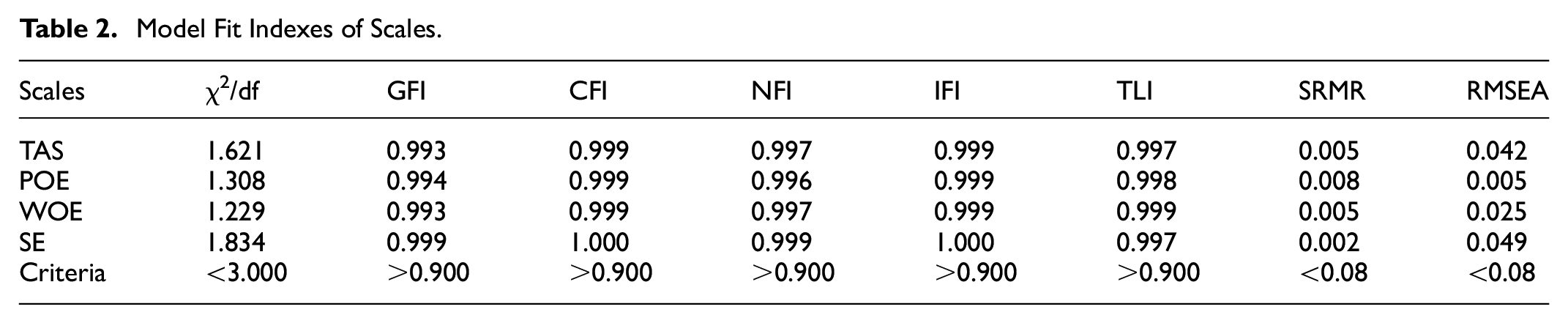
Finally, normality of perceived teacher academic support, perseverance of effort, willingness to communicate and social engagement was tested with descriptive analysis. Correlation analysis was run to explore the correlations among these variables (Table 3). The structural equation modeling was performed to reveal the structural relationships among the four constructs.
Overall Distributions and Correlations.
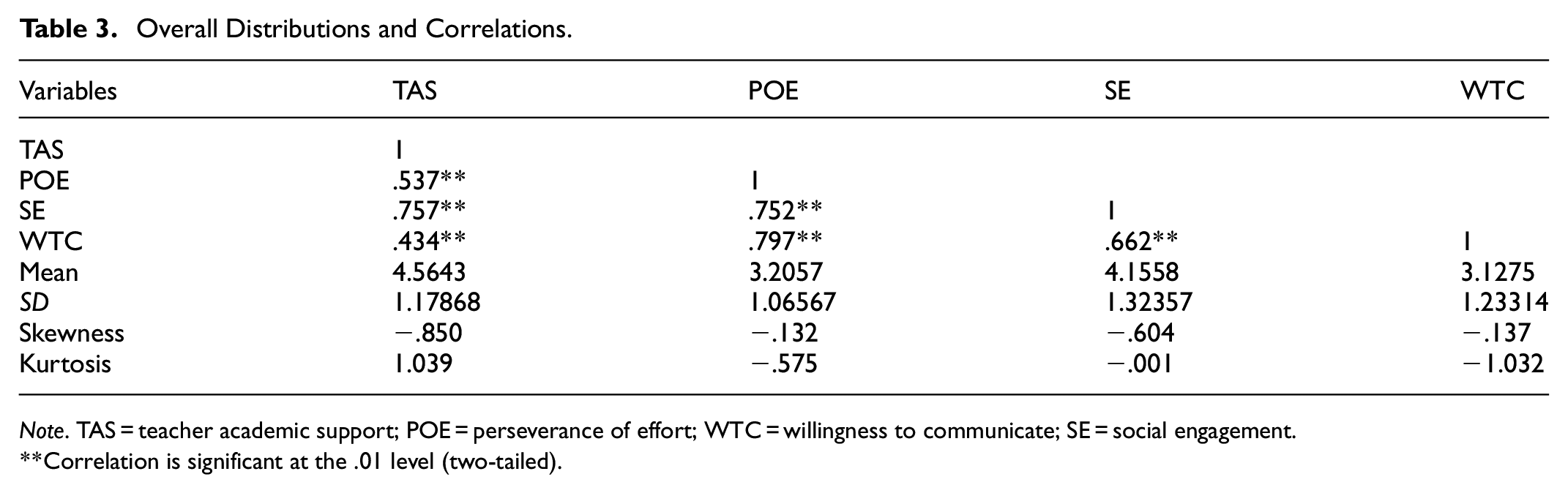
Note. TAS = teacher academic support; POE = perseverance of effort; WTC = willingness to communicate; SE = social engagement.
Correlation is significant at the .01 level (two-tailed).
Results
Descriptive and Correlation Analysis
Descriptive analysis showed that skewness and kurtosis coefficients of the variables were within the satisfactory range of ±2.0, meaning they were not in the severely non-normal distributions and were good for further statistical analysis.
Correlation analysis results manifested that teacher academic support, perseverance of effort, willingness to communicate and social engagement had very significant correlations with one another (p < .01). The findings laid a foundation for the structural equation modeling below.
Structural Equation Modeling
To verify the hypothesized relationships among teacher academic support, social engagement perseverance of effort and willingness to communicate, structural equation modeling was performed. According to the modification indices provided in the AMOS system, we revised the model and the path from teacher academic support to willingness to communicate (TAS → WTC) in Figure 1 was removed for the former did not significantly predict the latter based on the significance level of .05. The major fit indices of the modified model were better than acceptable: χ2/df = 2.220, GFI = 0.903, CFI = 0.977, NFI = 0.959, IFI = 0.977, TLI = 0.973, SMRM = 0.034 and RMSEA = 0.062, suggesting the model has a good fit with the data.
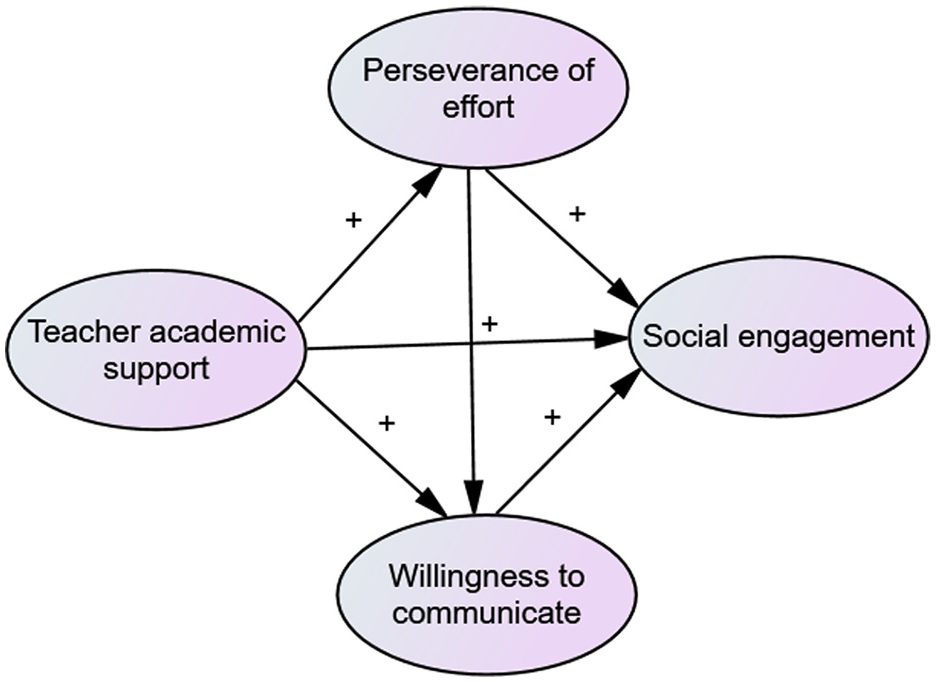
Hypothesized relationship model.
Figure 2 indicates that social engagement in EFL classrooms was predicted by teacher academic support (β = .25, p < .001), perseverance of effort (β = .41,p < .001) and willingness to communicate (β = .25,p < .001), which supported first three hypotheses. Moreover, teacher academic support positively predicted perseverance of effort directly (β = .49, p < .001) and perseverance of effort positively predicted willingness to communicate directly (β = .82, p < .001). Regarding the mediation effects, it was found that teacher academic support mediated by perseverance of effort and through the chain mediation of perseverance of effort and willingness to communicate, had indirect effects upon social engagement through two paths respectively (TAS → POE → SE and TAS → POE → WTC → SE). Thus, Hypothesis 4 and Hypothesis 6 were also supported. Besides, Perseverance of effort, mediated by willingness to communicate, also influenced social engagement indirectly. However, in this model, teacher academic support did not influence willingness to communicate directly whereby teacher academic support did not predicted social engagement through mediation of willingness to communicate indirectly. Hypothesis 5 was rejected. Figure 2 also shows that the combined effect of teacher academic support, perseverance of effort and willingness to communicate on social engagement was 0.61, indicating that 61.00% of social engagement variance was jointly explained by them.

Structural model of teacher academic support, social engagement, willingness to communicate and perseverance of effort.
Bootstrapping method was utilized to estimate the predicting effect of teacher academic support on social engagement for better understanding about relationship between these two constructs. As can be seen in Table 4, no matter for the direct effect, the total indirect effect or for the total effect, the bootstrap 95% confidence intervals did not contain zeros, and the p values were .001 smaller than .05, suggesting significance for all the effects. Whereby, teacher academic support significantly predicted social engagement directly and indirectly. Besides, the total indirect effect was 0.301 larger than the direct effect of 0.25; the former accounted for 54.63% of total effect of teacher academic support on social engagement and the latter 45.37%.
Predicting Effects of Teacher Academic Support on Social Engagement.

Note. LLCI = lower-level confidence interval; ULCI = upper-level confidence interval.
Discussions
This study explored the associations among teacher academic support, perseverance of effort, willingness to communicate and social engagement in EFL classrooms. The results indicated that learner social engagement in EFL classrooms was directly predicted by the other variables involved in this study. In addition, it was also influenced by teacher academic support indirectly through the mediating effects of perseverance of effort and willingness to communicate. Teacher academic support, perseverance of effort, willingness to communicate altogether explained 61% of the variance of social engagement. What’s more, the indirect effect of teacher academic support on social engagement was larger than the direct effect; the former accounted for 54.63% of total effect of teacher academic support and the latter 45.37%. The findings revealed a mechanism that perceived teacher academic support influences EFL learners’ social engagement in classrooms.
Direct Effects of TAS, POE and WTC on SE
The finding of teacher academic support predicting social engagement echoed, to a certain extent, the finding that EFL teacher support explained student engagement directly and positively (Sadoughi & Hejazi, 2023b). And it is similar with the research by Zhou et al. (2023). Zhou and her colleagues found that teacher emotional support was a positive predictor of EFL learners’ interaction engagement. Teacher support perceived by students can increase their social engagement, and students stay less engaged with less teacher support and show higher levels of engagement when teacher support is highly available in classrooms (D. P. Martin & Rimm-Kaufman, 2015). The results of this study also demonstrated that both perseverance of effort and willingness to communicate predicted social engagement directly, which were roughly consistent with previous studies. For example, Y. Wang (2024) found perseverance of effort had direct and positive effect on Chinese EFL learner engagement; Gao et al. (2025) proved that willingness to communicate directly predicted classroom engagement. L2 learning engagement was significantly predicted by learners’ perseverance of effort (C. Wu et al., 2024). Learners’ willingness to communicate is a pivotal determinant of their engagement in communication (Han et al., 2024). Therefore, it is understandable that teacher academic support, perseverance of effort and willingness to communicate were all direct predictors of social engagement, a major component of learning engagement.
Teacher academic support and willingness to communicate were correlated with each other very significantly and the former predicted the latter indirectly via the mediating role of perseverance of effort. Thus, the mediation of willingness to communicate in the relationship between teacher academic support and social engagement did not occur. This basically aligned with some previous studies. Yin et al. (2024) found teacher support, as a whole, did not directly influence willingness to communicate, but teacher academic support, mediated by the growth language mindset and enjoyment, indirectly predicted it. Y. Yang et al. (2024) found teacher support indirectly influenced willingness to communicate with the full mediation of foreign language enjoyment.
The greater the value that individuals attach to the involvement in an activity, the more highly motivated they will get to engage in it (Williams & Burden, 1997, p. 125). Sometimes Chinese students are not willing to speak up in EFL classrooms despite various teacher supports (Y. Yang et al., 2024); one of the reasons is that quite a few of them are used to the teacher-centered EFL teaching style and even take EFL learning mainly as written test-oriented. In addition, learning-facilitating interactions are still insufficient in college English teaching in China (Hu & Xu, 2022). Some students do not think certain oral activities practically useful enough and are unwilling to participate in classroom interactions proactively, even if their teachers support them academically and emotionally. Therefore, it is necessary to arouse learners’ curiosity and interest and make tasks and activities personally relevant to the learners with regard to future utility (Williams & Burden, 1997, p. 139).This finding confirmed the assertion that EFL teachers can enhance students’ willingness to communicate by encouraging continuous efforts to launch English communication and constructing a positive classroom context (Lee, 2022).
Mediating Effects of POE and WTC in the Relationship Between TAS and SE
This study also found that EFL learners’ perseverance of effort mediated the relationship between teacher academic support and social engagement. This resonated with Hejazi and Sadoughi’s (2023) finding that L2 grit played a mediating role between perceived teacher support and academic engagement. The influence mechanism of EFL teacher academic support, mediated by perseverance of effort and willingness to communicate, on students’ social engagement in classrooms found in this study was roughly consistent with Sadoughi and Hejazi’s finding (2023b). They found that learning experience and motivated learning behavior played mediating roles between EFL teacher support and student engagement.
The process and outcome of language learning result from learners’ internal and external factors. The learners’ internal factors are subject to the impact of their external factors (Williams & Burden, 1997, p. 139). Teacher academic support is one of the external factors, perseverance of Effort and willingness to communicate are the internal factors and social engagement is the learning behavior. Therefore, along with perseverance of Effort and willingness to communicate, teacher academic support can not only predict social engagement directly, but also indirectly affect it through them. Based on self-determination theory (SDT; Deci & Ryan, 2012) and social cognitive theory (Bandura, 2001), teacher support can satisfy learners’ need for relatedness and help them become more adapted to educational contexts. In addition, teacher support can improve learners’ motivational beliefs and academic emotions (Ahmed et al., 2010) and is highly influential in increasing EFL learner grit (Y. Shen & Guo, 2022). Perseverance of effort, one of two dimensions of grit, is a positive predictor of willingness to communicate (Lee, 2022), which is one of the affective and social variables determining L2 learners’ engagement in oral tasks (Dörnyei & Kormos, 2000). Hence, EFL learners can, with the teacher support, gain more confidence in performing learning tasks and have more experience of positive emotions (Xie & Guo, 2023) and they tend to become more adapted, motivated and gritter. Teachers and peers are the interlocutors of EFL learners in classrooms. With teacher academic support, EFL learners can learn more effective skills or strategies to deal with problems or difficulties they may encounter and get more willing to interact with their peers and teachers in classrooms. Motivated learning behavior is the intended effort learners are willing to exert to learn the target language (Pawlak & Csizér, 2022). Gritty students with sustained efforts are more inclined to communicate in a foreign language (M. Wang et al., 2022). It is plausible that learners showing perseverance of effort may be more willing to communicate and interact with peers and teachers in classrooms. When it comes to this study, teacher academic support not only directly predicted learners’ social engagement, their social interactions with other people in classrooms, but also influenced it indirectly with the chain mediation of perseverance of effort and willingness to communicate.
Conclusion
This study attempted to investigate the relationship among teacher academic support, perseverance of effort, willingness to communicate and social engagement in EFL classrooms. The results indicated that learner social engagement in EFL classrooms was directly predicted by the other three constructs. Moreover, teacher academic support, partially mediated by perseverance of effort and willingness to communicate, influenced EFL learners’ social engagement directly and indirectly. In addition, the indirect effect of teacher academic support on social engagement was larger than the direct effect.
As far as we know, this is the first study examining the mediating effects of perseverance of effort and willingness to communicate in the association between teacher academic support and EFL learners’ social engagement in classrooms. This study has some implications. Firstly, it increases the understanding about how teacher academic support and social engagement are related in EFL classrooms, enriching the studies on teacher support, academic engagement, willingness to communicate and grit. Secondly, the findings of this study reveal that teacher academic support is not only a direct positive predictor of social engagement, but it can contribute more by activating such learners’ personal factor as perseverance of effort and willingness to communicate beneficial to social engagement in EFL classroom. Thirdly, the findings of this study, particularly the mechanism that teacher academic predicted EFL learners’ social engagement in classroom setting, may function as a reference on how to enhance the effectiveness and efficiency of second language teaching and learning.
Learner’s social engagement, the social interactions they have in EFL classrooms, cannot be overemphasized. Considering the value of social engagement and its research status quo, more studies should be conducted. Given the limitations of this research, future studies can employ a longitudinal approach and such research instruments as interviews and observations can be utilized along with quantitative measurement instruments. In addition, school-based social support mainly involves both teacher support and peer support, hence, future studies can pay close attention to peer support. In the end, social engagement in EFL classrooms is a kind of communicative behavior in form; learners’ adaptability to classroom teaching and curiosity about communication may be related to it and deserve examining.
Footnotes

Ethical Considerations
This study was approved by Academic Committee of School of Foreign Languages, Hangzhou Dianzi University.
Funding
The author(s) received no financial support for the research, authorship, and/or publication of this article.
Declaration of Conflicting Interests
The author(s) declared no potential conflicts of interest with respect to the research, authorship, and/or publication of this article.
Data Availability Statement
Data sharing not applicable to this article as no datasets were generated or analyzed during the current study.