




Abstract
The study explores whether vicarious animosity and altruism account for consumers’ willingness to buy products made in Ukraine (perceived victim) and reluctance to buy products made in Russia (perceived aggressor). The proposed Research Model comprises six constructs (susceptibility to normative influence, altruism, animosity beliefs, vicarious animosity, willingness to buy Russian products, and willingness to buy Ukrainian products). Data for the current investigation was collected from a convenience sample of American and German consumers (282 and 199, respectively) between March 15th and June 15th, 2022, via an online survey using self-reported questionnaires. Findings show that altruism correlates more strongly with reluctance to buy Russian-made products than willingness to buy products made in Ukraine. Altruism mediates the relationship between subjective normative influence and willingness to buy Russian products. Animosity beliefs mediate the relationship between subjective normative influence and vicarious animosity. Finally, vicarious animosity mediates the relationship between animosity beliefs and willingness to buy Russian products. Previous consumer behavior research has largely neglected how intergroup conflict may impact the attitudes and responses of uninvolved parties. By focusing on altruism, our study extends the literature on consumer animosity. Furthermore, we identify the differential role of altruism on consumer behavior concerning the parties involved in a conflict.
Plain language summary
People that side with Ukraine in the Russian-Ukrainian war will be angry toward Russia. The study tests if people that like to help others without expecting personal benefits will refuse to buy Russian products and instead buy Ukrainian products. We only surveyed people who live neither in Ukraine nor Russia. We checked for their willingness to purchase Russian or Ukrainian products. The results show that people that like to help will not buy Russian products. It also shows that disliking Russia will not change buying patterns for Ukrainian or Russian products.
Introduction
Consumer animosity (henceforth referred to as CA) was introduced to the consumer behavior stream of research in the late 1990s. CA is “anger related to previous or ongoing political, military, economic, or diplomatic events” (Klein et al., 1998, p. 90). CA is conceptualized as a first-order construct comprised of several second-order constructs, such as political animosity (Latif et al., 2019), economic animosity (Ang et al., 2004; De Nisco et al., 2020), and war animosity (Antonetti et al., 2019; Klein et al., 1998) depending on the research context. A growing body of research documents the antecedents, for example, political values (Abraham & Poria, 2020), external attribution, perceived external control (Leong et al., 2008), patriotism (Fernández-Ferrín et al., 2015), susceptibility to normative influence (henceforth referred to as SNI), cosmopolitanism, consumer ethnocentrism (J. E. Park & Yoon, 2017), authoritarianism (Shoham & Gavish, 2016), personal economic hardship (Huang et al., 2010), past travel experience (Bahaee & Pisani, 2009), and consequences of CA, such as boycott motivation and participation (Ali, 2021), boycott intention (Yang et al., 2015), reluctance to buy, perceived betrayal (Lee et al., 2020), the judgment of product quality (Shoham & Gavish, 2016), and foreign country entry-mode (Fong et al., 2014).
The present study was conducted in the context of the Russian-Ukrainian war. The setting was selected for several reasons. First, the Russian-Ukrainian war is the most significant ongoing war and political conflict since WWII. While the study is conducted in a quite extraordinary context, findings may be extrapolated to other lower-key and less severe contexts, as past research suggests that low animosity is sufficient to have far-reaching consequences (Abraham et al., 2021). Political disputes between two parties or entities abound globally, resulting in citizens of third-party countries siding with the party or entity deemed the victim and boycotting the offending party or entity. For example, Spaniards expressed their lack of support for Turkey over its conflict with the Kurds (the largest ethnic minority in Turkey) and accusations of the Armenian genocide (Alvarez & Korzay, 2008).
Second, few studies explored consumer motivation to side with either one of the parties embroiled in conflict and the mechanisms through which this may impact attitudes and behavioral intentions concerning the party toward which they may harbor animosity (Zdravkovic et al., 2021). This type of animosity is referred to as vicarious animosity (henceforth referred to as VA). It is defined as “anger toward a country based on a conflict in which the focal person does not have a direct relation to any of the parties involved in the conflict” (Zdravkovic et al., 2021, p. 75). Testing the animosity phenomenon under such circumstances is worthy of investigation due to its potential theoretical and practical contributions.
Finally, most previous research focuses on animosity associated with war-related events that occurred several decades ago (Cui et al., 2012), and ongoing political disputes with historical roots, such as the Israeli-Palestinian conflict (Shoham et al., 2006; Zdravkovic et al., 2021), and few focus on the consequences of current political disputes (Ettenson & Gabrielle Klein, 2005). Nevertheless, ongoing conflicts will likely provoke more potent emotional effects than historical events (Nawijn et al., 2018; Podoshen, 2017).
Except for Akthar et al. (2024) few studies were conducted to explore the repercussions of the Russian-Ukrainian war on consumer behavior. Still, interesting findings have emerged from research conducted to date. For example, a study designed to explore the antecedents and consequences of place solidarity with Ukraine suggests that place solidarity is associated with willingness to visit Ukraine, willingness to visit countries supporting Ukraine, willingness to pay more for an airline that does not use Russian oil, hospitality toward both Ukrainian and Russian tourists, and actual behaviors, for example, spreading positive word-of-mouth about Ukraine, purchase of Ukrainian products, monetary donation to support Ukraine, etc. (Josiassen et al., 2022). Another study conducted by Josiassen et al. (2023) among a sample of American subjects suggests that while tourism animosity and affinity are associated with country solidarity (i.e., Ukraine), affinity is more strongly related to place solidarity. The authors also observed that country solidarity, in turn, is associated with a willingness to engage in philantourism and reluctance to stay in a hotel hosting Russian guests.
The concepts of affinity and animosity also emerged in a study conducted by Farmaki et al. (2025). The investigation included interviews with 33 Cypriot residents. The study findings suggest mixed attitudes toward Russian tourists. While most subjects seem to harbor animosity toward Russian tourists over Russia’s invasion of Ukraine, some residents expressed affinity toward tourists based on political or social motives (i.e., shared sociocultural values and regular interaction between residents and Russian tourists).
The present study attempts to contribute to the literature by proposing a Hypothesized model to elucidate the mechanisms under which an ongoing conflict between two parties may influence the behavioral intentions of consumers not directly involved. The Hypothesized model is based on The Animosity Model of Foreign Product Purchase (Klein et al., 1998), the most prevalent theoretical framework employed to account for the effect of negative emotion on consumer behavior in international trade. The paper expands on the CA conceptualization [based on the theories of social identity and realistic group conflict (Fong et al., 2021; Huang et al., 2010)] by integrating the concept of altruism (also based on realistic group conflict theory).
Conceptual Framework
Social identity theory (Tajfel, 1982; Tajfel & Turner, 1986) proposes that individuals aim to develop and enhance their self-image and self-esteem through a process of self-categorization, classifying themselves and others into “in-groups” and “out-groups” (Turner, 1987). Individuals compare their in-groups with relevant out-groups and strive to maintain intergroup distinctiveness by favoring the former and discriminating against the latter (Hewstone et al., 2002; Verlegh, 1999, 2007). In the current study context, the in-group is formed by German and USA consumers, citizens of countries strongly supporting Ukraine’s right to self-defense (European Council, 2023). The outgroups are Ukraine and Russia. According to social identity theory, in-group members favor their group products without necessarily avoiding out-group products. While German and USA consumers would not be expected to avoid Ukrainian products, it is reasonable to assume that they will likely avoid Russian products. How animosity manifests with the purchase of the products of one country but not another in a single study was overlooked. Hence, to account for the differential effects expected on third-party consumer behavior, both willingness to buy Russian and Ukrainian products are employed as the dependent variables.
According to realistic group conflict theory, discrimination and prejudice toward out-groups often result from perceived threats to the in-groups’ survival (Bobo, 1983; LeVine & Campbell, 1972). Real or fake out-group threats reinforce feelings of group membership, shared identity, solidarity, and cohesiveness within the in-group (Campbell, 1965; Thomas & Chrobot-Mason, 2004). These threats lead to ethnocentrism and altruistic sacrifices for the sake of the ingroup (Campbell, 1965). Past research also suggests that a history of war and conflict will likely heighten in-group identification and result in negative attitudes toward out-groups (Abdelwahab et al., 2022). Furthermore, Realistic Group Theory holds that threats (e.g., Russia’s attack on Ukraine) will likely increase a group’s (Ukrainian population) cohesiveness (Campbell, 1965; Thomas & Chrobot-Mason, 2004). Consequently, we argue that altruism will decrease willingness to buy Russian products.
Klein’s Animosity Model of Foreign Product Purchase builds on these theories and explains that apart from ethnocentrism and altruism to protect the in-group, consumers can also develop specific negative emotions (i.e., animosity) toward certain countries and avoid their products (Klein et al., 1998). According to Klein et al., animosity toward a country reduces willingness to buy products associated with an outgroup, whereas ethnocentrism increases willingness to buy products related to an in-group. Animosity, in stark contrast to ethnocentrism, influences willingness to buy independently from judgments about product quality. Previous research expanded Klein et al.’s model by integrating antecedents, such as SNI and animosity beliefs, henceforth referred to as AB (Antonetti et al., 2019; Huang et al., 2010). Consumer animosity is a three-dimensional construct comprising cognitive, emotional, and attitudinal components (Riefler and Diamantopoulos (2007). AB refers to the cognitive component of consumer animosity. Figure 1 depicts the hypothesized relationships described in the ensuing paragraphs.
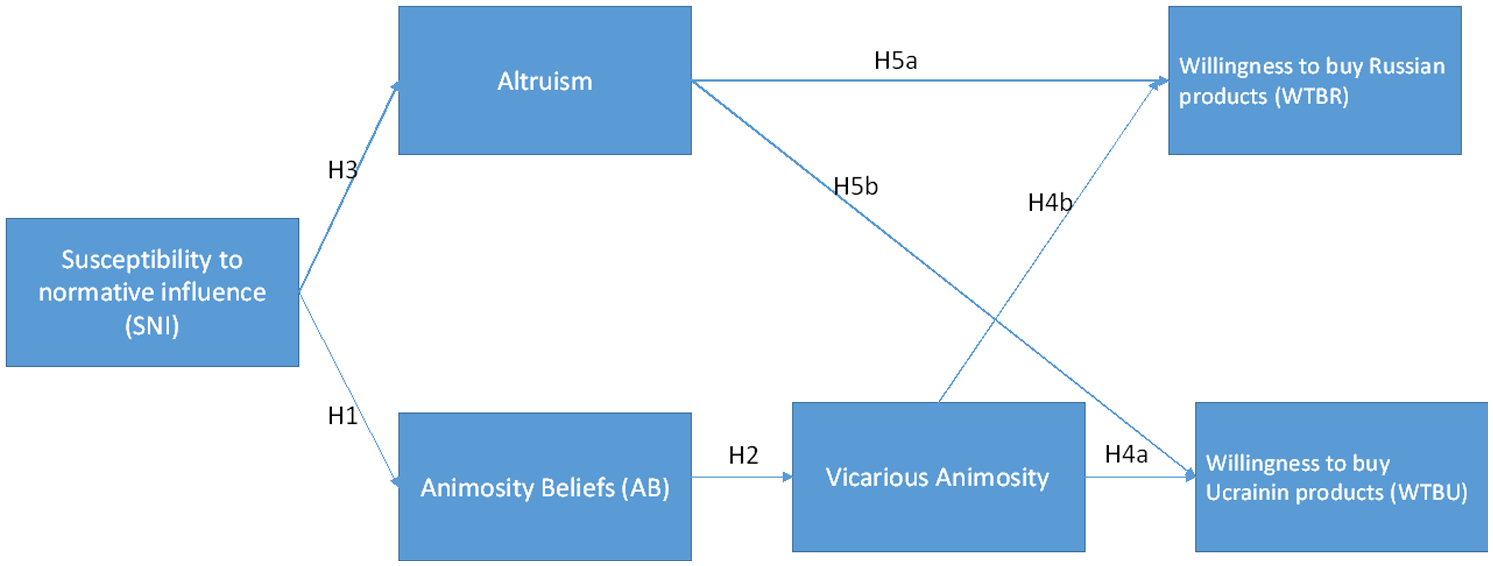
Proposed Research Model.
The conceptualization of realistic group theory accounts for ethnocentrism and altruism (Campbell, 1965). However, past CA research mainly focuses on ethnocentrism, largely overlooking altruism. While ethnocentrism is pronounced in consumers’ preference for domestic (i.e., ingroup) products (Trivedi et al., 2024), altruism manifests in the consumption of both domestic (Skallerud & Wien, 2019) and foreign products (Halimi et al., 2017). Thus, our paper omits ethnocentrism (a central concept in Klein et al.’s Model) and proposes a novel approach by including SNI as an antecedent of animosity beliefs and altruism.
Literature Review
SNI and AB
The concept of SNI is a multidimensional construct operationalized by Bearden et al. (1989). They define it “as the need to identify or enhance one’s image with significant others through the acquisition and use of products and brands, the willingness to conform to the expectations of others regarding purchase decisions, and/or the tendency to learn about products and services by observing others and/or seeking information from others” (p. 474).
Consistent with Realistic Group Theory, we argue that a real threat (Russia’s attack on Ukraine) and susceptibility to normative influence will likely increase emotional reactions (i.e., AB). While few studies investigated this relationship, past research indicates a possible association between the two constructs. Past research suggests that individuals influenced by the opinion of others (i.e., high SNI) harbor higher animosity toward a country their peers dislike (Huang et al., 2010). A study by L. Wang et al. (2021), for example, suggests that subjective norms are significantly associated with the formation of hostile beliefs. Maher and Mady (2010) and J. E. Park and Yoon (2017) report similar findings. Hence,
H1: SNI will be positively associated with AB
The Relationship Between AB and CA
According to Smith et al. (1993), cognitive appraisal is the “most proximal antecedent of emotion” (p. 913). Cognitive appraisal of an event that violates one’s expectations frequently results in assessments of misdeeds or threats, generating negative emotions (Lazarus, 1991). In CA research, cognitive appraisal refers to consumers’ AB about the extent of damage and potential future threat attributable to an offending country (Harmeling et al., 2015). Past research suggests that AB is an antecedent of animosity and refers to holding unfavorable or antagonistic views toward other groups, often arising from past political or economic disputes (Abraham & Poria, 2020). These emotions stem from emotions, among others, fear, disgust, or anger (Antonetti et al., 2019).
CA, a negative emotion theorized to be a consequence of AB, is negatively associated with willingness to buy products originating in a country targeted by the emotion (S. Wang et al., 2023). A study conducted in the context of the historical animosity between China and Japan, for example, Antonetti et al. (2019) demonstrate that AB (e.g., “Japan and China are enemies,”“Japan is a threat to China's national security”) are significantly associated with both extreme (contempt, disgust) and threat emotions (anger, fear).
However, the animosity that third-country nationals harbored toward either of the two countries embroiled in conflict was mostly overlooked in previous research (Zdravkovic et al., 2021). VA and was introduced to the literature by Zdravkovic et al. VA is “anger toward a country based on a conflict in which the focal person does not have a direct relation to any of the parties involved in the conflict” (Zdravkovic et al., 2021, p. 75). Hence, we argue that AB concerning Russia due to its invasion of Ukraine will result in VA emotions toward the former. Hence,
H2: AB will be associated with VA.
SNI and Altruism
Altruism, as defined by Bhardwaj et al. (2023), is a social behavior aimed at achieving positive outcomes for others, driven by a moral obligation to assist those in need. Social norms often reinforce this intrinsic motivation, which dictates acceptable behaviors within a community (Cebeci & Şıngır, 2022). Research indicates that individuals more susceptible to normative influences are likely to engage in altruistic behaviors, particularly when such behaviors are perceived as socially desirable.
For instance, Cebeci and Şıngır (2022) found that university students who participated in social responsibility projects exhibited significantly higher levels of altruism compared to those who did not engage in such activities. This suggests that participation in socially normative behaviors enhances altruistic tendencies, supporting the idea that SNI fosters altruism by aligning individual actions with group expectations. Furthermore, Piff et al. (2010) highlighted that social class influences prosocial behavior, with individuals from lower socioeconomic backgrounds often displaying higher levels of altruism, potentially improving their social standing within a group. This dynamic illustrates how normative pressures can shape altruistic behaviors, particularly among those more susceptible to social influence generated by social media platforms and electronic word of mouth (Mahat et al., 2021).
Additionally, the work of Kawamura and Kusumi (2018) emphasizes that social norms can moderate the relationship between rejection avoidance and altruism, indicating that individuals who fear social rejection are more likely to engage in altruistic acts when such behaviors are perceived as normative (Kawamura & Kusumi, 2018). This aligns with the findings of Curry and Dunbar (2011), which suggest that social connections can enhance altruistic behavior, as individuals may be motivated to conform to altruistic expectations within their networks (Curry & Dunbar, 2011).
Moreover, the concept of social integration further supports the proposed hypothesis. Brañas-Garza et al. (2010) demonstrated that more socially integrated individuals tend to exhibit greater altruism, as their connections within a social network enhance their responsiveness to social norms. This connection between social integration and altruism underscores the role of SNI in fostering prosocial behavior, as individuals are motivated to conform to the altruistic norms prevalent within their social circles (Panasiti et al., 2020). Therefore, several studies suggest a robust link between SNI and altruism, where susceptibility to normative influences encourages individuals to act altruistically and reinforces the moral imperatives that drive such behaviors. Thus,
H3: SNI will be positively associated with altruism.
Vicarious Animosity and Consumer Behavior
Animosity is characterized as a hostile attitude aimed at national out-groups. Hostility comprises cognitive and emotional components—the cognitive manifests in cynical beliefs and mistrust of others. The emotional component, however, comprises negative emotions such as anger, contempt, and disgust (Jung et al., 2002). Research suggests that consumer animosity may stem from various factors, including past and ongoing political tensions between countries, wars, and trade discords (Ettenson & Gabrielle Klein, 2005; Klein et al., 1998). Consumer animosity was observed to be associated with willingness to buy (WTB) products made in a country perceived as the offender (Khan et al., 2019; J. E. Park & Yoon, 2017; S. Wang et al., 2023) or brands associated with an offending country (Akhtar et al., 2024; Han et al., 2020; Mandler et al., 2023).
However, few studies explored the relationship between VA, a specific form of CA, and behavioral intentions and actual behaviors (Zdravkovic et al., 2021). Consumers’ siding with a conflicting party may manifest their VA through purchase decisions (Zdravkovic et al., 2021). Zdravkovic et al.’s study, conducted in the context of the Israeli-Palestinian conflict, suggests that Croatian consumers who side with the Palestinian side in the conflict are likely to avoid purchasing products made in Jewish settlements. In contrast, Croatian consumers who side with the Israeli side are more likely to prefer products made in Jewish settlements. Based on previous research (Cui et al., 2012; Zdravkovic et al., 2021), we argue that VA harbored toward the offending party will be associated with (1) a lowered willingness to buy products made in the offending country; (2) a greater willingness to buy products made in the country toward which consumers do not harbor animosity. Hence,
H4a: VA will be positively associated with the willingness to buy Ukrainian (WTBU) products.
H4b: VA will be negatively associated with willingness to buy Russian products (WTBR).
Altruism and Willingness to Buy
Altruistic consumer behavior refers to purchase decisions that involve self-sacrifice for the benefit of others or society (Small & Cryder, 2016). Specifically, it encompasses consumption choices aimed at helping vulnerable groups or supporting social causes, even if they come at a personal cost to the consumer (Xin et al., 2022). Research has identified multiple motivations driving altruistic consumer behavior (Say et al., 2021; Xin et al., 2022): the desire to help a specific group in need (benefit group motivation); acting in alignment with one’s moral values (benefit morality motivation); responding to explicit requests for help (benefit demander motivation); supporting organizations that provide aid (benefit supplier motivation); and deriving satisfaction from benefiting others or society (social utility).
Altruistic behavior is the subject of a large body of consumer behavior research. The phenomenon was examined in various contexts, including the intention to purchase green products (Panda et al., 2020; Reimers et al., 2017), ethical products (Oh & Yoon, 2014), electric vehicles (He & Zhan, 2018), and recycling (Culiberg & Bajde, 2013), etc. Altruistic behavior stems from pro-social motivations and benefits others without expecting personal rewards (J. Park & Ha, 2014).
According to Realistic Group Conflict Theory, altruistic individuals are motivated to help due to moral obligation. Consequently, it may be argued that altruistic citizens of third-party countries are likely to buy Ukrainian products but are unlikely to buy products made in Russia out of a felt moral obligation. Thus,
H5a: Altruism will be negatively associated with WTB products made in Russia.
H5b: Altruism will be positively associated with WTB products made in Ukraine.
Research Method
The Study Context
The present study was conducted in the context of Russia’s invasion of Ukraine on February 24th, 2022. From the day of the invasion to September 10th, 2023, the invasion had taken inconceivable social, financial, and structural damage across Ukraine: 9,614 civilians were killed and 17,535 injured (Statista, 2023). The number of service members who have lost their lives or were injured is estimated at 315,000 on the Russian side (Landay, 2023). Roughly 80,000 Ukrainian servicemen have lost their lives (Pancevski, 2024). The economic toll of the war is formidable for Ukraine and the global economy, with roughly 7 million more Ukrainians now living in poverty (World Bank, 2023).
Country Selection
Germany and the USA were selected for several reasons. First, while the former heavily relied on gas supplied by Russia, the latter was not. Hence, we argue that the animosity toward Russia will be dissimilar among the study samples. Second, previous research suggests that consumer behavior is affected by cultural factors (de Mooij, 2017). Germany and the USA represent cultures that vary in various dimensions (Hofstede, 2001). The German culture is substantially more individualistic (79) than the American culture (60). Furthermore, Germans are more risk-averse than Americans. This phenomenon is manifest in the uncertainty avoidance dimension. Germany scores significantly higher on the dimension (65) than the USA (46). Another dimension where significant differences are observed between the two cultures is indulgence. The US culture is substantially more indulgent than German (68 and 40, respectively).
Sample and Data Collection Procedures
Data for the current investigation was collected from a convenience sample of American and German consumers (282 and 199, respectively) between March 15th and June 15th, 2022, via an online survey using self-reported questionnaires. Following an explanation of the aim of the study, respondents of different age groups, genders, and various socio-economic backgrounds from the two countries were solicited for participation in the study (see Table 1). The instruments consisted of three main parts and included two screening questions (Were you born in Russia? Do you have Russian relatives living in or out of Russia?). If a respondent provided an affirmative response to any of the two screening questions, he/she was thanked for participating in the study, and the survey ended. The research instrument was translated from English to German and back-translated using a technique suggested by Douglas and Craig (1983). A total of 481 usable questionnaires were collected. Only complete questionnaires were included in the data analysis. Data can be accessed at https://doi.org/10.6084/m9.figshare.25426165.v1.
Sample Profile.

Measures
Seven-point Likert scales (1 = strongly disagree; 7 = strongly agree) adapted from previous research were employed to measure the constructs used in the Hypothesized model. AB was measured using five items adapted from Harmeling et al. (2015). VA was measured with four items adapted from Klein et al. (1998) and Zdravkovic et al. (2021). SNI was measured with four items adapted from (Carfora et al., 2019). Altruism was measured with five items adapted from Di Giulio and Defila (2021). Participants’ willingness to buy products made in Ukraine and Russia was measured with items adapted from Harmeling et al. (2015) and Klein et al. (1998).
Analyses and Results
Reliability and Validity
Data was analyzed with SPSS AMOS 28.
Common Method Variance
Common method bias (henceforth referred to as CMB) is one of the sources of measurement error. It relates to the variance from the measurement method rather than the perceptual measures. Because CMB can affect the validities and reliabilities of measured constructs and inflates the correlation between latent constructs (Podsakoff et al., 2012), it poses a potential threat to the validity of findings vis-à-vis the association between measures (Podsakoff et al., 2003). In an attempt to mitigate the potentially detrimental effects of CMB in the research instrument design, consistent with Podsakoff et al. (2003), we have taken the following proactive measures:
(1) Communicated to subjects that the survey was anonymous;
(2) Reduced subjects’ apprehension over their responses by informing them that there are no correct or incorrect responses;
(3) Kept the survey instrument as simple as possible and avoided complex syntax;
(4) Avoided “double-barreled” questions.
Podsakoff et al. (2003) recommend additional measures, such as attaining independent and dependent measures from separate sources, which were not plausible in our study due to the difficulty of reaching a larger sample size. Hence, we conducted post hoc tests to test whether CMB may have contaminated the Empirical Model. Harman’s single factor is a common technique employed to test CMB post-doc in various research disciplines, including consumer behavior (C. C. Teng et al., 2020; Wu et al., 2023). However, the technique is under increased criticism as it is argued to be simple (Aguinis & Vandenberg, 2014) yet an ineffective technique (Aguirre-Urreta & Hu, 2019). As such, we opted to test for CMB post-hoc by examining variance inflation factor values (henceforth referred to as VIF). Consistent with Graham (2003), the VIF values in the inner model are below the three cutoff (see Table 2). Hence, the Empirical Model is not affected by common method bias.
VIF Values.

Validation of the Empirical Model Using CFA
Before analyzing the data, all relevant items were reversed-scored. As can be seen from Table 3, all items loaded significantly on their respective constructs (p < .001). Factor loadings ranged from 0.67 to 0.85, thus suggesting unidimensionality.
Confirmatory Factor Analysis.

Note. r = reversed-scored items.
Convergent validity was assessed by estimating composite reliability and average variance extracted. Internal consistency was examined by evaluating Cronbach’s α and composite reliability values. Cronbach’s α values were at or above the .7 cutoff recommended by Fornell and Larcker (1981), and all latent variables’ composite reliability values were at or above the recommended threshold of 0.6 (Fornell, 1992). Discriminant validity was estimated by assessing AVE along the lines suggested by Fornell and Larcker (1981). AVE scores of all constructs included in the Empirical Model are above the 0.5 cutoff. The square root of AVE (shown diagonally in boldface) is higher than the intercorrelations between the constructs comprising the Empirical Model (see Table 4).
Latent Correlation Matrix.

Note. Correlations significant at p ≤ .01 (two-tailed). The square root of AVE appears on the diagonal of each matrix in italics; inter-construct correlations appear off the diagonal. WTB = willingness to buy; SNI = subjective norm influence; VA = vicarious animosity.
Structural Model
Testing for Measurement and Structural Invariance
Using SPSS AMOS 28, we conducted a multigroup structural equation modeling analysis to test for configural invariance. The model (Model A) tested in this step is a multigroup representation of the baseline model. No equality constraints were enforced on any parameters of the model. The fit of this configural model provides the baseline value, which can later be compared with follow-up (i.e., constrained) models (Byrne, 2010). Multigroup model testing for configural equivalence resulted in the following goodness-of-fit statistics: χ2 = 813.400, degrees of freedom (df) = 313, chi-squared mean/degrees of freedom (CMIN/df) = 2.599, comparative fit index (CFI) = 0.910, and root mean square error of approximation (RMSEA) = 0.058. The observed χ2/df ratio is below the cutoff (≤3) suggested by Kline (1998). In all, 20 observed items are retained in the hypothesized model. The cutoff sets recommended for latent factor models having between 12 and 30 observed items are at least 0.92 for the comparative fit index (CFI) and no more than 0.07 for the root-mean-squared error of approximation (RMSEA; J. Hair et al., 2006). Hence, all fit indices point to goodness-of-fit.
Next, measurement and structural invariance tests were conducted to assess if the parameters in the measurement and structural components of the model were invariant across the two samples. In the metric model (Model B), factor loadings were constrained to be equal across the two samples. Findings point to goodness-of-fit (χ2 = 818, df = 326, CMIN/df = 2.509, RMSEA = 0.056, CFI = 0.912). We, therefore, assessed the structural model. The assessment was carried out by initially constraining factor loadings and variances across the two samples (Model C). Model C was compared to Model B.
Finally, with factor loadings and factor variances constrained to equality, we also constrained covariances to equality (Model D) and the model was run. Once again, the total change in the value of goodness-of-fit indices was checked to conclude whether groups are equivalent in terms of variance and covariance structures. While assessing the invariance of factor loading (i.e., measurement invariance), Model A, a configured baseline model free from any constraints, was compared with Model B, in which only factor loading was constrained to be equal. The difference between χ2 and DF between the models is insignificant (Δχ2 = 4.6, Δdf = 13, p > .05), thus pointing to invariability between Model A (unconstrained model) and Model B (constrained model).
Next, we assessed structural equivalence across the two samples by evaluating the variance and covariance structures. The variance structures were assessed by constraining variances to be equal (Model C). We then compared Model B to Model C. The difference in χ2 and df between the models is insignificant (Δχ2 = 25.8, Δdf = 20, p > .05). Hence, the two models are invariant. Finally, we assessed the covariance structures by constraining the covariances to be equal (Model D). The difference in χ2 and df between the models is significant (Δχ2 = 46.301, Δdf = 14, p < .001). However, because the χ2 difference test is sensitive to sample size (Teo & Liu, 2007; Whisman & Judd, 2016) and to the complexity of the model, differences in CFI, TLI, and RMSEA were taken into consideration as an alternative criterion. Chen (2007) recommended using CFI, TLI, and RMSEA to assess measurement and structural invariance. According to Chen (2007), a change of 0.01 or more in CFI and TLI, and a change of 0.015 or more in RMSEA, indicates variance across groups. The CFI difference between Model C and Model D is 0.006. The change in the value of TLI was 0.003, and the change in RMSEA was 0.01; hence, despite the observed significant differences in χ2 and df between the two models, the changes in the value of CFI, TLI, and RMSEA suggest that the factor loadings are the same for the two samples.
Testing for the Invariance of a Causal Structure
An assessment of the invariance of a causal structure was conducted to test if the strength of relationships among model constructs holds across two segments. An unconstrained model, Model A, was initially estimated without imposing any constraints on any model parameters. Goodness-of-fit statistics of unconstrained Model A (CFI = 0.951, TLI = 0.936, and RMSEA = 0.064) are above the recommended thresholds. Later, the constrained model, Model B, was estimated by imposing equality constraint on all causal paths across the two segments (Bollen, 1989). Goodness-of-fit statistics of constrained Model B (CFI = 0.953, TLI = 0.938, and RMSEA = 0.063) are above the recommended thresholds and imply that the current structural model applies well across all segments. The difference in CFI between the constrained and unconstrained model is 0.002 (i.e., less than 0.01). Hence, it can be inferred that the causal path structure is the same across the samples.
Model Fit
An assessment of the hypothesized model using AMOS 28 indicates a good fit (χ2 = 817.876, df = 318, p = .000, CFI = 0.92, RMSEA = 0.057). The observed χ2/df ratio (2.572) is below the cutoff (≤3) suggested by Kline (1998). The obtained RMSEA value is below the stringent upper limit of 0.07 Steiger (2007) recommended. The observed value of 0.928 for the Tucker-Lewis Index (TLI), Bollen’s Incremental Fit Index (IFI) value of 0.921, and Bentler’s Comparative Fit Index (CFI) value of 0.922 are consistent with the cutoff suggested by Hu and Bentler (1999). Hence, all fit indices point to goodness-of-fit.
Hypotheses Testing
Table 5 provides standardized path estimates and hypotheses testing. The Empirical Model accounts for 49% of the variance in altruism, 24% in AB, 85% in VA, 46% in WTB products made in Ukraine, and 57% in WTB Russian products. Bootstrapping using a sample of 5,000 was performed to calculate the t-statistic and strength of the relationships between the endogenous and exogenous constructs in the Hypothesized model (J. F. Hair et al., 2017).
Standardized Path Estimates.

Note. AB = animosity beliefs; SN = subjective norms; ALT = altruism; VA = vicarious animosity; WTBU = willingness to buy Ukrainian products; WTBR = willingness to buy Russian products.
The Relationship Between SNI and AB
Consistent with H1, the study findings suggest that SNI is associated with AB (β = .492, t = 8.968, p < .001). Interestingly, a stronger association was observed between the constructs in the USA sample (β = .608, t = 6.615, p < .001) than the German one (β = .423, t = 6.296, p < .001).
The Association Between AB and VA
According to H2, AB will be positively associated with VA. The data supports this hypothesis (β = .914, t = 14.962, p < .001). Noteworthy is that a slightly stronger association was observed in the USA sample (β = .923, t = 8.668, p < .001) than in the German one (β = .911, t = 12.219, p < .001).
The Relationship Between SNI and Altruism
Consistent with the expectations of H3, a significant relationship was observed between SNI and altruism (β = .701, t = 11.502, p < .001). A substantially stronger association was found in the USA sample (β = .782, t = 7.482, p < .001) than in the German sample (β = .660, t = 8.493, p < .001). Hence, H3 is supported.
The Association Between VA and WTBU
Overall, a significant relationship was found between VA and WTB Ukrainian products (β = .299, t = 6.984, p < .001). However, a significant association was observed between the constructs in the German sample (β = .405, t = 7.129, p > .05) but not in the USA sample (β = .07, t = 1.024, p > .05). Hence, H4a is partially supported.
The Association Between VA and WTBR
A significant association was also observed between VA and WTB Russian products (β = −.452, t = −9.659 p < .001). A significant association was observed between the constructs in both the German (β = −.55, t = −8.926, p < .001) and the USA samples (β = −.226, t = −3.072, p < .05). Thus, H4b is supported.
The Relationship Between Altruism and WTBR
Consistent with H5a, a significant relationship was found between altruism and WTB Russian products (β = −.483, t = −9.464 p < .001). Consistent with previously tested hypotheses, a substantially stronger association was found in the USA sample (β = −.744, t = −7.010, p < .001) than in the German sample (β = −.349, t = −5.815, p < .001).
The Relationship Between Altruism and WTBU
Finally, according to H5b, altruism will be associated with WTB Ukrainian products. This is supported by the data (β = .521, t = 10.422, p < .001). However, a stronger association was found in the USA sample (β = .734, t = 7.954, p < .001) than in the German sample (β = .388, t = 6.373, p < .001).
The authors of the present study also tested cultural differences regarding the hypothesized paths. Multi-group analysis revealed significant differences between the samples in the hypothesized relationships (see Table 5), which suggests the Hypothesized model’s cross-cultural validity.
Past research points to the possible role of altruism in accounting for consumer behavior (Li & Lin, 2023). However, the consumer animosity research stream overlooked its role in accounting for consumer behavior or its mediating role in consumer behavior. Therefore, the present study’s authors could not generate any hypothesis about any possible mediating role of altruism. Hence, a post-hoc exploratory analysis was conducted using SNI as a mediating construct to explore the role of altruism in the context of animosity. Results suggest that altruism mediates the relationship between SNI and WTB Russian products (95% CI = −0.659 to −0.436) and the relationship between SNI and WTB Ukrainian products (95% CI = 0.418–0.622). In other words, the more consumers are susceptible to subjective norms, the more likely they are to be altruistic and, in turn, less likely to buy Russian products but more likely to purchase Ukrainian products.
Previous research suggests that AB is associated with consumer animosity (Antonetti et al., 2019). However, past studies have overlooked the possible mediating role of AB in accounting for the development of consumer animosity. Hence, we conducted exploratory post-hoc analysis to explore the possibility that AB may play a mediation role. Interestingly, AB was observed to mediate the relationship between SNI and VA (95% CI = 0.547–0.004). That is to say, the more consumers are susceptible to SNI, the more likely they are to harbor AB, and, in turn, VA toward Russia.
Discussion & Conclusions
The present investigation delves into uncharted territory, exploring the association between altruism as a personality trait and VA as an emotion with the willingness to buy Russian and Ukrainian products. To demonstrate the external validity of the Hypothesized model, consumers from two countries (i.e., Germany and the USA) representing two distinct cultures were sampled.
Surprisingly, no significant differences in the two samples concerning any of the hypothesized relationships were found. This may be accounted for by relatively small differences in averages on the VA scale between the two samples. While the mean score on the animosity scale among the USA sample was 5.14, the mean score among the German sample was 5.29.
Post-hoc analysis suggests that altruism mediates the relationship between SNI and WTB Russian products and WTB Ukrainian products. The possible mediating role of altruism was previously unexplored in the context of consumer behavior. The observed mediating role of altruism in the present study suggests that altruism may be triggered by social norms. Altruism, in turn, is responsible for the development of emotions toward an object (in the case of the present study, a country).
Furthermore, AB was observed to mediate the relationship between SNI and VA. Previous research overlooked AB’s possible mediating role. The present study’s finding that SNI is associated with AB, which, in turn, is related to VA, is in line with previous research suggesting that our belief systems are influenced by social norms (J. E. Park & Yoon, 2017; L. Wang et al., 2021). However, the findings emerging from the current investigation starkly contrast with previous research suggesting that SNI is directly associated with emotion (i.e., consumer animosity), as Maher and Mady (2010) suggested. The results of the present study indicate that social norms, rather than directly influencing our emotions, affect our belief systems, and these, in turn, trigger emotions.
Two noteworthy differences were observed between the two samples. Overall, a significant relationship was observed between VA toward Russia and WTB Ukrainian and Russian products (positive and negative, respectively). While a significant association was observed between VA toward Russia and WTB Ukrainian products in the German sample, no significant relationship between the constructs was observed in the USA sample. Concerning WTB Russian products, a significant association was observed between the constructs in both samples. The USA sample’s reluctance to buy Russian can be accounted for by place solidarity with Ukraine observed in previous research (Josiassen et al., 2023).
Before the war between Russia and Ukraine, Germany relied heavily on Russian energy exports. Both countries are connected by two natural gas pipelines, one more passing the Baltic Sea under construction. Russia is considered the offending country in Germany, and the government did everything to reduce dependence on Russian products. During the first winter after the Russian aggression, Germans had to cut energy consumption because insufficient energy reached the country without Russian gas. This might have caused a mindset among Germans: blaming Russia for having to freeze in the winter and suffering from Europe’s highest energy prices and, consequently, avoiding Russian-manufactured products.
Consistent with previous research, the present research suggests that AB is a precursor to animosity emotion (Antonetti et al., 2019). Furthermore, in line with prior research, our study suggests that VA is associated with behavioral intentions (Zdravkovic et al., 2021). However, in contrast to previous research, findings point to a significant relationship between VA and WTB Ukrainian products but no significant relationship between VA and WTB Russian products. Hence, in the case of VA, the negative emotion is not directed toward boycotting the offending country but buying from the country perceived as the victim. This finding may be accounted for by previous research suggesting that the motivation to boycott the offending country’s products stems from empathy toward the attacked country’s citizens rather than any animosity harbored toward the offending country (Halimi et al., 2017).
Theoretical Implications
Several theoretical implications emerge from the present investigation, with significant practical implications for consumer behavior and international relations. First, the present study proposed a model based on the Animosity Model of Foreign Product Purchase (Klein et al., 1998) by integrating altruism, a trait critical to conceptualizing consumer behavior yet overlooked in international contexts, particularly intergroup conflicts. Furthermore, we replace general animosity, a well-researched construct in international research, with VA, a form of animosity recently introduced to the literature. While altruism was associated with less willingness to buy Russian products on the one hand and more willingness to buy Ukrainian products on the other hand, the effect on the latter was substantially higher. Thus, the present study’s findings contribute to theory development by demonstrating that altruism is a behavioral motivator and a behavioral demotivator, particularly in the context of VA.
The results of the present study point to the importance of including emotion (i.e., VA) and personality traits such as altruism in the conceptualization of animosity in general and VA in particular. While previous research explored the relationship between personality and animosity (Leonidou et al., 2019), to the best of the present study’s authors’ knowledge, past research overlooked the possible role of altruism in conceptualizing CA. The finding contributes to theory development by suggesting that the effects of animosity may be better understood if assessed in conjunction with personality traits. A growing body of research points to the significance of personality traits in consumer choice and behavior (Besser et al., 2024).
Finally, post-hoc exploratory analysis points to the role of altruism in mediating the relationship between SNI and behavioral intentions. This finding contrasts with previous studies suggesting that SNI and altruism independently affect attitudes and behavioral intentions in consumption-related contexts (Y.-M. Teng et al., 2015) and points to the significance and extent of social norms’ influence on the formation and role of altruism in consumer behavior. Hence, while the present study demonstrates that altruism may play a decisive role in consumer behavior in the context of animosity harbored toward a third party, it is critical to account for the role of social norm in the conceptualization of consumer animosity in general and vicarious animosity in particular.
Post-hoc exploratory analysis also suggests that animosity beliefs mediate the relationship between SNI and VA. This finding contributes to theory development by demonstrating that animosity beliefs, rather than animosity emotions (Antonetti et al., 2019), may be triggered by social norms. Animosity beliefs, in turn, are responsible for developing emotions toward an object (in the case of the present study, a country).
Practical Implications
The present research findings suggest marketing managers may benefit from emphasizing their companies’ CSR agenda by launching campaigns to raise funds to support the victimized party. Dedicating a certain percentage of each sale toward the cause may be one option. Marketing managers working for firms in or perceived to be associated with Russia face a formidable challenge due to governments’ and consumers’ global boycotts of Russian products. Several renowned brands (e.g., Stolichnaya) are not manufactured in Russia, but consumers associate them with the country. In the latter’s case, a viable short-term and long-term solution may be to execute marketing and advertising campaigns designed to express the origin of the brand clearly. Given sufficient time to accomplish this ultimate objective, properly executed campaigns using the correct copy will guard these companies against the effects of the Russian invasion of Ukraine.
Directions for Future Research
Including additional independent variables in the Hypothesized model may be a valuable venue for future research. For instance, previous research suggests that cultural similarity affects consumer behavior (Kim et al., 2018). More recently, perceived cultural dissimilarity was positively associated with political animosity (Abraham et al., 2021). As such, including perceived cultural similarity or dissimilarity in the model proposed in the current investigation may be a worthwhile avenue for further research.
Second, the invasion and bombardment of Ukraine were primarily focused on specific regions of the country, thus having a variable impact on the population. In some regions, especially those occupied, the population directly experienced the harsh actions of the Russian military. Still, in other areas, such as the city of Odessa, life continued relatively uninterrupted until recently. The present study focused on respondents’ WTB Ukrainian products in general, thus possibly skewing the results. Altruistic consumers may be more inclined to support certain regions but others less. Hence, future research may benefit from replicating the study of the Hypothesized model by focusing on WTB Ukrainian products sourced from various cities or regions rather than Ukraine in general.
Third, to test for the external validity of the model, replication of the study in other less extreme contexts, such as the Indian-Pakistani conflict, the conflict between Armenia and Azerbaijan, and the India-China border disputes, is worthy of investigation. The theoretical framework adapted for the present investigation is the Animosity Model of Foreign Product Purchase. Initially tested in a high animosity-evoking context, later replications and expansions of the model consistently demonstrated that the model is also valid in less extreme settings.
Finally, previous research points to gaps between consumers’ attitudes to consumption and actual behaviors due to lack of access or availability (Oke et al., 2020). While few consumer products of Ukrainian origin are available in international markets, consumers have found ways to practice ethical consumption in the backdrop of Russia’s invasion of Ukraine. Since the beginning of the invasion, private individuals have supported Ukrainians by booking Airbnb apartments in the country even though they did not intend to stay in them (Mellor, 2022). Thus, it may be argued that consumers motivated to support Ukraine, due to ethical considerations, find creative ways to do so. Hence, including ethical motives in the Hypothesized model is worthy of further investigation.
Footnotes

Ethical Considerations
Not applicable.
Funding
The author(s) received no financial support for the research, authorship, and/or publication of this article.
Declaration of Conflicting Interests
The author(s) declared no potential conflicts of interest with respect to the research, authorship, and/or publication of this article.