




Abstract
With the rapid development of information technology, telecommunication network fraud poses a serious threat to college students. Urgent action is needed to enhance their awareness of fraud prevention through effective educational methods. This study constructed a behavioral willingness model to use an anti-fraud educational game among university students by extending the Technology Acceptance Model (TAM). A questionnaire survey was administered to 374 university students to assess the effects of interface design, fun, and information quality on their willingness to use the game. Results indicated that these factors significantly influenced students’ perceived ease of use and perceived usefulness, further enhancing their willingness to engage with the game. These findings, design strategies for the anti-fraud educational game are proposed to improve educational effectiveness. This study validates the applicability of TAM in educational games and introduces it into anti-telecommunication network fraud education, providing new empirical support for educational game design.
Introduction
The telecom network fraud increasingly disrupts people’s lives. While the widespread application of the internet has enhanced work efficiency, it has also created new avenues for illegal activities. Cybercrime and online fraud are increasingly severe phenomena in computer-mediated communication. In 2015, the Internet Crime Complaint Center (IC3) registered over 288,000 complaints; 127,145 individuals reported an average loss of $3,718 (Zingerle & Kronman, 2018). Unlike traditional fraud methods, modern telecom network fraud involves the use of the internet or telecom networks, utilizing various means such as phone calls, text messages, and emails. The extensive use of social networking services, credit applications, and the surge in ransomware have increased the likelihood of fraudsters contacting potential victims (Bregant & Bregant, 2014).
Scholars conducted a survey on the age distribution of victims of telecommunications and Internet fraud and found that, 41% are aged 20 to 29, and 18% are under 20. The college student group falls precisely within this age range, making universities hotspots for telecom network fraud incidents, impacting students’ personal property and even life safety (Yang & Chen, 2023). College students aged 20 to 29 are particularly vulnerable to fraud due to their youth and lack of experience. They often lack awareness of fraud techniques and are easily influenced by highly tempting information. For example, fraud targeting college students includes false scholarship applications, impersonation of school administrative staff, and fake part-time job offers. These tactics exploit students’ desire for financial support and work experience, resulting in a higher success rate for fraud. These tactics exploit students’ desire for financial support and work experience, resulting in a higher success rate for fraud. The relatively narrow social circles of college students and their high level of online activity make them high-risk targets for telecom network fraud. Therefore, researching effective ways to enhance college students’ awareness of network fraud prevention is of urgent importance.
At present, the training and education carrier in mainland China is relatively narrow, passive education dominates. Anti-fraud publicity and education in colleges and universities is mainly based on the first class in college, including safety education courses and anti-fraud knowledge lectures, and it is difficult to arouse students’ interest in the one-way instillation of teaching content. Research has found that through gamification, it can increase students’ interest in receiving information and the effectiveness of information delivery in the teaching process, help them learn and change their behavior (Sun, 2024; L. Wang, 2021). In the first half of 2023, the total number of gaming users in China reached 668 million, a year-on-year increase of 0.35% (Gao & Wang, 2023). Among them, players aged 20 to 30 accounted for the highest proportion, reaching 32.8% (Yun, 2023). This data demonstrates the rapid growth of the gaming market in China, which shows the great potential of gamification in education and prevention. Therefore, it is an innovative exploration to introduce the form of educational games in cybersecurity education, and to conduct anti-fraud propaganda and education by balancing gameplay and education.
The Technology Acceptance Model (TAM) has been widely used to study users’ acceptance and usage behavior of information technology. The TAM helps understand the process of technology acceptance by analyzing the impact of perceived usefulness (PU) and perceived ease of use (PEOU) on behavioral intention (BI). Despite the growing interest in gamification and its potential in educational contexts, the application of the Technology Acceptance Model (TAM) in anti-telecommunication network fraud educational games remains underexplored. Previous studies on TAM primarily focus on technology adoption and user behavior, but they have not adequately addressed how TAM can be applied to enhance the effectiveness of educational games, specifically those aimed at preventing telecom fraud. This gap in the literature underscores the need for this study, which extends the TAM to explore how factors such as interface design, fun, and information quality affect students’ willingness to engage with anti-fraud educational games.
This study aims to evaluate the impact of interface design, fun, and information quality as external variables on college students’ willingness to use anti-telecom network fraud educational games by extending the TAM. Through questionnaires and focus group interviews, data was collected from college students and analyzed using structural equation modeling to test the research hypotheses. Specifically, this study focuses on the following key questions:
How do Interface Design, Fun and Information Quality of educational games affect users’Perceived Ease of Use and Perceived Usefulness?
How do Interface Design, Fun and Information Quality of educational games affect users’Behavioral Intention?
Do Perceived Ease of Use and Perceived Usefulness mediate the relationship between external variables and Behavioral Intention?
Literature Review
Anti-Telecom Network Fraud
Telecom fraud is a continuously evolving and significant issue affecting the telecommunications industry. Existing definitions of telecom fraud typically focus on obtaining free telecommunication services and financial gains (Hoath, 2008). It is relatively easy to commit fraud within telecom networks, as most attacks can be executed remotely without major equipment or high levels of technical expertise, and financial gains are often readily achievable (Hoath, 1998). Scholar Huang identifies six main causes of telecom fraud: distorted social values during periods of social transition, severe infringement on personal information, lack of responsibility from telecom and banking sectors, widespread weak preventive awareness among the public, inefficient publicity by relevant departments, and lack of severe punishment for telecom fraud criminals (Huang, 2017).
Research has detailed the development of telecom crime in recent years, noting that telecom fraud cases are characterized by being transnational, precise, organized, professional, and covert. Researchers have proposed a management measure based on a multi-party collaborative governance mechanism, aiming to tackle telecom fraud at its source through multi-department cooperation (K. Wei, 2023). Hu et al. (2023) have designed a Bayesian network-based risk warning and intervention model for telecom fraud, integrating various heterogeneous data to propose a telecom fraud analysis and warning framework. This model can effectively identify vulnerable groups and environments, providing decision support for police and communities. Fraud is often hidden within large volumes of traffic and a wide range of services, making it difficult to identify, detect, and prevent.
According to feedback from field research conducted by public security agencies, the current case-solving rate for telecom fraud types in China is less than 10%. As telecom fraud is a preventable crime, publicity and prevention are crucial for reducing incidents. While existing anti-fraud measures have achieved some success, there is still room for improvement in publicity methods (X. Wang, 2023). In recent years, major universities in China have initiated anti-fraud and anti-scam education campaigns, but issues such as incomplete preventive education systems, insufficient teaching staff, monotonous formats, low student interest, and ineffective educational outcomes persist (Xiang, 2024). Existing research highlights the urgency of enhancing individual preventive awareness and improving public education and information protection awareness. It also points out that traditional publicity methods are often monotonous and fail to capture the interest and attention of college students, such as safety education courses and anti-fraud knowledge lectures. Most college students resist these passive educational forms, resulting in poor improvement in preventive awareness.
Digital Educational Games
Educational games combine knowledge and gaming, creating realistic problem scenarios for learners, motivating them, and effectively promoting learning (Zeng et al., 2020). In the mid-1960s, researchers discovered the educational value of video games. By the 1980s, some scholars began exploring the use of educational games to motivate learners and their application in classroom teaching (Gros, 2007). The development of educational games has gone through an initial phase (mid-1960s to late 1980s) and a development phase (1990s). With the rapid advancement of technology in the 21st century, video games have reached unprecedented levels of variety, quality, performance, and social penetration. Trends in educational research indicate increasing interest in how games impact learning (Kebritchi et al., 2008; Wu et al., 2012). The cross-border integration of education and gaming has attracted extensive attention across various fields such as education and technology, leading to a prosperous period of educational game research (Zeng et al., 2020). Researchers have verified the learning effects of educational games, proving that they can stimulate intrinsic motivation, improve learning outcomes, enhance knowledge retention, promote higher-order thinking, and foster emotions (Calvo-Ferrer, 2017).
Fabricatore (2000) proposed the “Edugaming” design method, emphasizing the seamless integration of learning tasks and gaming contexts, suggesting that learning is instinctive, and the challenging gaming process is an exploratory learning process. He also pointed out that when designing games for educational purposes, developers should create learning principles and outcomes related to the game. Applications should facilitate learning tasks and at least ensure that: (1) the game provides an incentivizing environment that makes it easier for players to learn; (2) wherever possible, the game should provide some form of assistance to users facing cognitive tasks or provide positive or negative reinforcement to enhance the effectiveness of the learning process; (3) the game should not interfere with cognitive tasks. In recent years, the popularity of educational games has only increased, with a growing number of studies indicating broad prospects for the application and development of educational games. In China, educational game app-related literature is relatively scarce, especially in higher education, and some theories and practical operations are still immature (Feng et al., 2023).
With the increase of people’s attention to education, many educational companies have established cooperative relationships with colleges and universities to seek a new mode of educational game application. Therefore, the application market of educational games is promising and worth exploring. Through gamified education, we aim to provide innovative solutions to the problems mentioned in these reasons, especially in terms of raising awareness of prevention and education efficiency, as well as helping players to establish correct social values and self-protection abilities through in-game simulation and education.
Technology Acceptance Model (TAM)
In 1989, Davis proposed the Technology Acceptance Model (TAM) to explain and predict computer usage behavior in the workplace (Serenko & Bontis, 2004). The TAM provides a theoretical foundation for understanding how external factors influence users’ internal psychological factors, such as beliefs, attitudes, and intentions, which in turn affect their technology usage behavior.
The TAM was developed based on the Theory of Reasoned Action (Ajzen, 1980) and the Theory of Planned Behavior (Ajzen, 1985). Davis and colleagues suggested in 1992 that the reasons influencing users to adopt a system could be distinguished into extrinsic motivation and intrinsic motivation (Davis et al., 1992). Perceived usefulness (PU) and perceived ease of use (PEOU) are the two core variables of TAM that determine users’ behavioral intention to use, while PU and PEOU are influenced by external variables. Since the introduction of TAM, it has been adapted, replicated, and validated in various research fields, such as e-commerce (Alves & Luís Reis, 2020; C. Wang et al., 2023), e-government (Alkraiji, 2021; Mensah & Adams, 2020), e-learning (Al-Fraihat et al., 2020; Tawafak et al., 2020), and e-health and m-health (Dahleez et al., 2021; Klingberg et al., 2020).
In the gaming field, Lou et al. (2000) analyzed the factors influencing the use of online communities based on PU and PEOU in TAM. Hsu and Lu (2004) were the first to use TAM as a theoretical framework to examine the factors influencing online game usage intention. Their results showed that PU and PEOU indirectly predicted online game usage intention through attitudes toward online games. T. Wei and Li (2011) also used TAM to validate the positive impact of game characteristics on PU and PEOU. They summarized the positive effects of factors such as game interface, technical aspects, interactivity, and entertainment on gaming behavior intentions. Park et al. (2018) constructed and validated a model for students’ acceptance of educational games. This model combined TAM with perceived playfulness and found that PU and PEOU not only directly influenced students’ attitudes toward educational games but also indirectly influenced them through perceived playfulness.
Since the introduction of TAM, it has been validated and extended in various research fields. In the context of educational games, studies have found that game characteristics (such as interface design, fun, and information quality) significantly influence users’ PU and PEOU, which in turn affect their behavioral intention to use the games. However, the application of TAM in the context of anti-telecom fraud educational games is relatively rare. Therefore, this study incorporates the game characteristics of anti-fraud educational games—interface design, fun, and information quality—as external factors into the TAM to further examine their impact on players’ intention to engage with educational games.
Research Design
Theory Model and Research Hypothesis
Perceived Usefulness, Perceived Ease of Use and Behavior Intention
Perceived usefulness (PU) refers to the degree to which a user believes that using a particular technology will be helpful in their work or life, and perceived ease of use (PEOU) refers to the degree to which a user believes that using a particular technology will be easy (Davis, 1989). PU and PEOU are the two core variables of TAM that determine users’ intention to use. Previous research has already demonstrated the positive relationship between perceived ease of use and perceived usefulness (To & Trinh, 2021). Behavioral intention (BI) is defined as the degree to which a person has a favorable or unfavorable evaluation or appraisal of the behavior in question and is the best predictor of actual behavior (Fishbein & Ajzen, 1975). Bhattacherjee (2001) posits that an individual’s intention to use a specific technology is influenced by their perceived usefulness and perceived ease of use. If the positive attitude toward the intention to play games persists due to the perceived enjoyment and ease of use of mobile games, students are likely to continue playing mobile games in the future (Chinomona, 2013). TAM describes how individuals’ beliefs (PU and PEOU) influence their behavioral intention to use (BI). Therefore, we hypothesize:
Hypothesis 1 (H1): Perceived ease of use has a significant positive impact on players’ intention to use anti-fraud educational games.
Hypothesis 2 (H2): Perceived usefulness has a significant positive impact on players’ intention to use anti-fraud educational games.
Interface Style
Esthetic design is described as any design that immediately increases an object’s attractiveness to observers (e.g., websites, interactive systems, etc.; Thielsch & Niesenhaus, 2017). An interactive interface, also known as a user interface, is the channel through which users exchange information and data with a computer (Hou, 2021). Research on human-computer interaction (HCI) applies esthetic design to digital interfaces, considering it an essential component of user experience (Desmet & Hekkert, 2007). Interface style (IS) refers to the visual design and esthetic appeal of the game’s user interface. It is selected as a variable because many studies have shown that good interface design can significantly influence users’ first impressions and usage experiences (Moshagen & Thielsch, 2010). Users’ perception of the esthetic appeal of a system’s interface not only affects their intention to use but also enhances their acceptance of the technology (Tractinsky et al., 2000). Esthetic design of interfaces significantly impacts students’ learning interest and motivation. Interfaces with high visual appeal are more likely to attract students’ attention and maintain their interest in using them (Ruf et al., 2022). Therefore, we hypothesize:
Hypothesis 3 (H3): Interface style has a significant positive impact on perceived ease of use.
Hypothesis 4 (H4): Interface style has a significant positive impact on perceived usefulness.
Hypothesis 5 (H5): Interface style has a significant positive impact on players’ intention to use anti-fraud educational games.
Fun
Fun refers to the entertainment and appeal of the game. Fun is chosen as a variable because the main purpose of games is entertainment, and fun directly affects user engagement and persistence. While the goal of educational games is to provide functional benefits rather than entertain players, enjoyment is an essential component of games because enjoyable educational games lead to better functional outcomes and higher replay value (Nagle et al., 2014). Studies have shown that fun elements in games, such as interaction and challenges, can enhance users’ intrinsic motivation, making them more engaged in the learning and usage process (H. Wang & Wang, 2008). Chinomona’s (2013) study on the continuous use intention of mobile games investigated the impact of perceived fun and ease of use of mobile games on students’ continued intention to play. The study found that users’ perceived fun and the convenience of the game are important predictors of continuous intention. Based on existing research, we hypothesize:
Hypothesis 6 (H6): Fun has a significant positive impact on perceived ease of use.
Hypothesis 7 (H7): Fun has a significant positive impact on perceived usefulness.
Hypothesis 8 (H8): Fun has a significant positive impact on players’ intention to use anti-fraud educational games.
Information Quality
Information quality (IQ) measures the quality of information produced by information systems, including accuracy, timeliness, completeness, etc. (DeLone & McLean, 2003). In the Technology Acceptance Model (TAM), information quality, as an important external factor, has a significant impact on users’ perceived ease of use (PEOU) and perceived usefulness (PU; Almahamid et al., 2010). High-quality information can not only enhance users’ trust and satisfaction with the system but also strengthen their intention to use and actual usage behavior (Wixom & Todd, 2005). High-quality information can improve users’ perceived usefulness, thereby increasing their intention to use (Lee et al., 2003). When designing anti-fraud educational games, ensuring the accuracy and relevance of the information is crucial. Therefore, we hypothesize:
Hypothesis 9 (H9): Information quality has a significant positive impact on perceived ease of use.
Hypothesis 10 (H10): Information quality has a significant positive impact on perceived usefulness.
Hypothesis 11 (H11): Information quality has a significant positive impact on players’ intention to use anti-fraud educational games.
Based on the literature review, this study extends the Technology Acceptance Model as a theoretical framework and establishes a model of factors influencing the behavioral intention of participants in anti-fraud educational games (as shown in Figure 1). This model aims to study the relationships between game characteristics, including interface style, fun, and information quality, and perceived usefulness, perceived ease of use, and intention to use the game. The research hypotheses are as follows:

Research concept model.
Research Design
This study collected data on the design requirements for anti-fraud games using a mixed-methods combining with quantitative surveys and focus groups. This mixed approach allowed researchers to have a comprehensive understanding of the factors influencing students’ intention to use the anti-fraud educational game from the quantitative data, also the qualitative information allowed researchers to gain the details of user experiences and design preferences about the game design.
Questionnaire
Based on the research hypotheses, the study designed 18 measurement indicators for six variables: “interface style,”“fun,”“information quality,”“perceived usefulness,”“perceived ease of use,” and “intention to use.” All measurement items employed a five-point Likert scale, ranging from “strongly disagree = 1” to “strongly agree = 5,” where a higher score indicates stronger agreement with the item, and a lower score indicates less agreement. The sources of these measurement indicators are shown in Table 1.
Questionnaire and Question Reference.

The questionnaire survey targeted the university student population, including both undergraduate and graduate students. A random sampling method was used to ensure that every eligible student had an equal chance of being selected. During the implementation, potential participants were identified through school administrative systems, student organizations, and university forums. Participants were randomly selected using a random number generator, and the questionnaire was distributed via online survey platforms such as Wenjuanxing and Google Forms.
The online questionnaire link was disseminated through internal email systems, student WeChat groups, QQ groups, and the university website. A total of 400 questionnaires were distributed. During data collection, anonymity and voluntary participation were ensured to increase response rates and data quality.
Focus Group
After completing the questionnaire, this study organized focus groups to facilitate the collection of relevant insights from stakeholders (Hammarberg et al., 2016). The purpose of the focus group was to validate the questionnaire results and obtained deeper and more specific suggestions regarding game design. Purposeful sampling was used to select 10 university students who had shown a high willingness to participate in the questionnaire survey as participants. The sample characteristics of the participants were as follows: (1) aged between 16 and 34; (2) current undergraduate and graduate students at higher education institutions; (3) had a certain interest and understanding of video games and cybersecurity topics. All participants were required to sign an informed consent form before participating in the study, clarifying that their participation is voluntary and that they can withdraw from the study at any time. To protect participants’ privacy, all data will be anonymized and kept strictly confidential.
Data Analysis
Questionnaire
A total of 400 questionnaires are collected, with 374 valid questionnaires, resulting in an overall validity rate of 93.5%. The questionnaire data is first subjected to descriptive statistical analysis using SPSS to analyze the basic data, followed by reliability and validity analysis of the questionnaire. This tool was chosen for its robust capabilities in conducting descriptive statistics, reliability analysis, and regression analysis, all of which were necessary to validate the research hypotheses and ensure the accuracy of the findings. Subsequently, regression analysis, path analysis, and mediation effect testing were used to verify the research model hypotheses.
Descriptive
The basic characteristics of the sample are shown in Table 2, and the descriptive statistical analysis results of each dimension of the scale are shown in Table 3. The small standard deviations indicate that most results are concentrated around the mean, showing high consistency in responses. The skewness and kurtosis values are close to 0, and the standard error is 0.126, indicating that the distribution of answers is relatively normal. “Interest” scored the highest overall, with the highest mean as well. The next highest means were for “Interface Style” and “Information Quality,” among others.
Sampling Basic Characteristic.

Descriptive Analysis.

Reliability
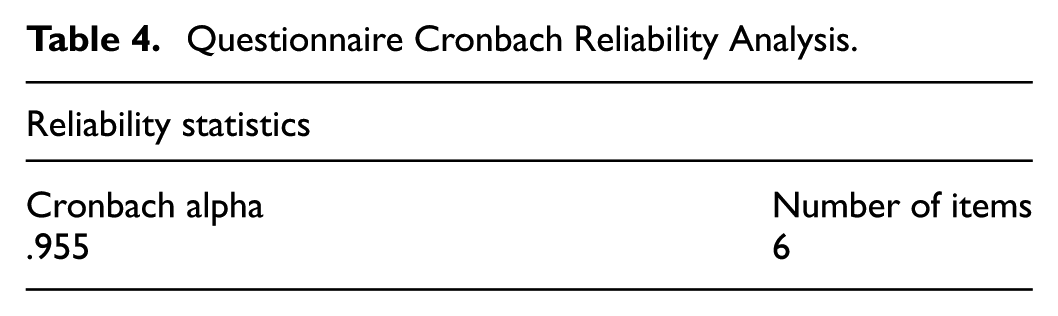
This study obtains the reliability index values of each of the six research variables in the survey. The specific reliability analysis results are shown in Tables 4 and 5. The Cronbach alpha is .955, and each variable is much greater than 0.7, indicating that the scale design has a high degree of reliability. In summary, the reliability indicators of each variable in this study meet the corresponding standards, indicating that the reliability of this research scale is stable and suitable for further analysis.
Questionnaire Cronbach Reliability Analysis.
Cronbach Reliability Analysis of Each Variable in the Questionnaire (N = 374).

Validity
The KMO value test and Bartlett’s sphericity test are used to verify whether the items in the scale of this study can be factor analyzed. The validity test results are shown in Table 6. The KMO value is 0.92, indicating that there are differences between the items, the scale items are reasonably designed, and do not need to be modified.
KMO and Bartlett’s Test.

Regression
Regression analysis is performed on the data. The model summary is shown in Table 7. The R-square is 61.5%. It can be seen that the independent variables explain the dependent variable to a high degree. The Durbin-Watson value is close to 2, indicating that there is no autocorrelation in the variables. The variance analysis table is shown in Table 8. It can be seen that the model passed the F test, indicating that the regression model is effective. The model coefficient table is shown in Table 9. It can be seen that the significance values of the regression coefficient t test are all less than .05, so the respective variables have a significant impact on the dependent variable. Among them, the meaning of the regression coefficient of .153 is that when other variables remain unchanged and the independent variable interface design changes by 1 unit, the dependent variable will increase by 0.153 units on average. In addition, the VIF values are all much less than 10, indicating that there is no multi-collinearity among the independent variables. Regression analysis shows that in this research model, interface style, fun and information quality have a significant impact on players’ willingness to use, and H5, H8, and H11 are verified.
Model Summary.

Predictor variables: (constant), information quality, interface design, fun.
Dependent variable: intention to use.
Variance Analysis Table.

Dependent variable: intention to use.
Predictor variables: (constant), information quality, interface design, fun.
Model Coefficient Table.

Dependent variable: Player’s willingness to use.
Path Inspection
Table 10 is the model regression coefficient table between each path. The significance p value of each path is less than .05. If it is significant at the horizontal level, the null hypothesis is rejected. Therefore, each path is valid, and the path coefficients are the standardized coefficients. The model fitting indicators are shown in Table 11. It can be concluded that the model fits well. The path test shows that in this research model, interface style, fun and information quality have a significant impact on perceived ease of use and perceived usefulness, and H3, H4, H5, H6, H9, and H10 are verified.
Model Regression Coefficient Table.

Note.***Represent the significance levels of 1%,?5%,?10%, respectively.
Model Fitting Index.

Represent the significance levels of 1% respectively.
It was concluded from the quantitative study that all hypotheses hold true. Interface style, fun and information quality all have a significant positive impact on perceived ease of use and perceived usefulness. Perceived ease of use and perceived usefulness also have a significant positive impact on players’ intention to use. Perceived ease of use and Perceived usefulness plays a mediating role in this model, and the model results are shown in Figure 2.
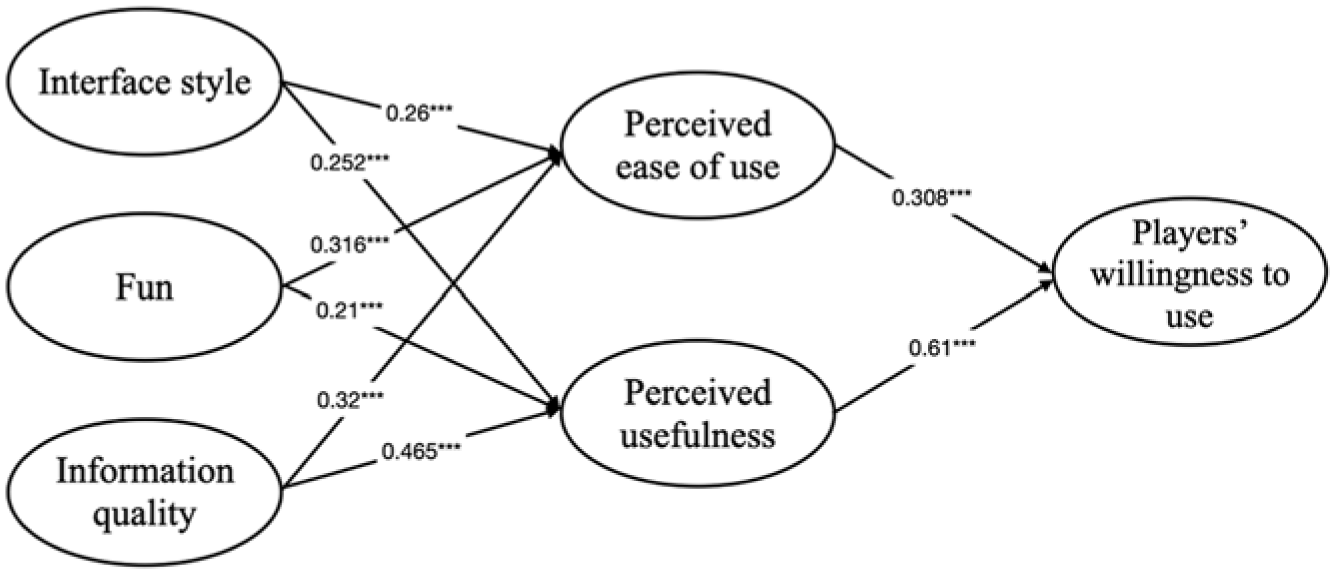
Research model analysis results.
Focus Group
Through focus group discussions, we had gained an in-depth understanding of the needs and expectations of college students for the design of anti-telecom fraud themed games. The study found that most college students are not interested in the current anti-telecom fraud propaganda methods. Even if anti-telecom fraud propaganda in the form of games is provided, they still felt disgusted with games that focus on anti-telecom fraud propaganda. However, if the game is “edutainment,” which is both entertaining and incorporates educational content such as real case analysis and simulated fraud scenarios, they would become more willing to participate. Focus group members said that games need to be fun and learn anti-fraud knowledge. Players preferred a highly interesting game supported by real cases. They hoped that the game is both interesting and can trigger a real sense of crisis about telecom fraud, and at the same time they were disgusted with monotonous and direct propaganda methods. The members hoped that the game will contain role-playing elements, real case analysis and simulated fraud scenarios, which were both interesting and educational. Participants emphasized that games should focus on innovation and closeness to real life, and should be more covert and emotional when promoting anti-fraud content to enhance players’ interest and experience and avoid straightforward and boring propaganda methods (Table 12).
Focus Group Summary.

Anti-Fraud Game Design Strategies
Combining the above questionnaires and focus group interview results, we extracted the key points and sorted out the following design priorities and corresponding criteria for anti-fraud game design, as shown in Figure 3:

Anti-fraud game design strategy.
Interface Style
The interviews showed that interface style is a key driver of players’ willingness to use the game. Players expressed a strong preference for clear and intuitive interfaces, indicating that the quality of interface design directly affects their initial impression of the game and their motivation to continue using the game. The following three standards must be upheld.
Clarity: Create an intuitive, user-friendly interface to ensure that players can easily navigate and understand the game process.
Readability: Text games require excellent text display, ensuring that the font size, color contrast, and typography layout make it easy for players to read.
Esthetics: Although it is a text game, it is still necessary to pay attention to visual esthetics and use graphics and animations that attract players to enrich the interface.
Fun
Interview participants generally believe that even for educational games, the fun of the game should not be ignored. The appeal of a game depends largely on the fun and excitement it can inspire. There are three directions to enhance the fun.
Storyline: Write an engaging story and situation simulation to allow players to experience fraud situations in the game, enhance their memory and learning.
Interactivity: Design variety of plots and choices so that every decision made by the player can affect the development of the story.
Game elements: Integrating elements such as role-playing and puzzle solving to increase the interactivity and challenge of the game.
Information Quality
Information quality is also an important factor affecting players’ willingness to use. Players tend to prefer games that provide accurate, real-life and practical anti-fraud information. Some participants emphasized that if they think the game can improve their anti-fraud awareness or skills, they are more likely to play and recommend the game.
Content accuracy: Ensure that the educational content in the game is accurate and consistent with the latest anti-fraud knowledge and strategies.
Practicality: Provide practical anti-fraud skills that players can apply in real life.
Participatory: Design to allow players to participate in the storyline, such as simulating real fraud cases for re-enactment.
Perceive Usefulness
Perceived usefulness has a positive effect on players’ willingness to use. The game content must have practical educational value so that players can learn useful anti-fraud knowledge during the game.
Educational meaning: Clearly demonstrate the value of the game in raising anti-fraud awareness and let players understand the purpose and benefits of playing games.
Skill improvement: The tasks and activities in the game should be aimed at improving players’ anti-fraud ability.
Perceive Ease of Use
Perceived ease of use also has a positive effect on players’ willingness to use the game. Easy-to-understand game tutorials and intuitive user interfaces make it easier for players to accept and immerse themselves in the game experience.
Easy to learn and understand: Design simple and clear game rules and operation instructions to ensure that new players can quickly get started.
Smooth operation: Ensure that the game’s operation feedback is timely and accurate, and avoid complicated operation processes.
Discussion
This study constructed a behavioral willingness model for school college students to use anti-fraud educational games by extending the Technology Acceptance Model (TAM). The effects of interface style, interestingness and information quality on college students’ willingness to use anti-fraud educational games were explored. The results show that these external variables significantly affect college students’ behavioral intentions by influencing perceived ease of use and perceived usefulness. This result is consistent with the underlying assumption of the TAM that perceived ease of use and perceived usefulness are key determinants of users’ technology acceptance (Davis, 1989). The results of this study further validate the applicability of the TAM model in the field of educational games, extend the scope of application of the TAM, and introduce it into anti-telecommunication network fraud education for the first time.
Interface style has a significant effect on perceived ease of use in this study. According to Human-Computer Interaction (HCI) theory, the first thing that users encounter when using any technological product is the interface visual and interaction design, which directly affects their judgment of the system’s ease of use (Nielsen, 1993). In educational games, intuitive and esthetically pleasing interface design can significantly reduce the complexity of operation for learners, thus increasing their willingness to use the game, which is consistent with the theory of “beauty is use” (Tractinsky et al., 2000). Students are more likely to use visually appealing educational games, which is highly compatible with their esthetic needs and usage habits. This phenomenon is particularly evident in the digital age, where the younger generation is accustomed to accessing information through high-quality visual content. It is worth mentioning that the direct effect of interface style on perceived usefulness and behavioral intention is more limited, a result that can also be explained by the core assumption of the TAM: perceived ease of use is an antecedent factor that influences perceived usefulness and behavioral intention, but in some contexts (e.g., educational games), its influence may be overridden by other, more content-valued factors.
Fun had a significant effect on both perceived ease of use and perceived usefulness, but a relatively weak direct effect on behavioral intention. This phenomenon may be due to the fact that while the fun of educational games can enhance students’ engagement and motivation to learn, this effect is more on perceived ease of use and perceived usefulness than on directly driving behavioral intentions. This indirect mechanism of influence is also supported by educational psychology, with gamified learning theory suggesting that fun can enhance learning by increasing learners’ intrinsic motivation (Hamari et al., 2014) and Self-Determination Theory (SDT; Deci & Ryan, 1985) suggesting that when individuals perceive intrinsic motivation in an activity, they are more likely to pursue activity-related goals driven by this motivation, and ultimately behavioral intentions are more driven by perceived usefulness.
Information quality proved to be the most important factor influencing behavioral intentions in this study, a result that can be attributed to the high importance users place on the validity of learning content. As an educational tool against telecommunication network fraud, students are most concerned about the practical and accurate fraud prevention knowledge they can gain through the game. According to information processing theory, users tend to prioritize information that is perceived to be of high quality and credible when they receive it, as this information is effective in reducing cognitive load and enhancing understanding of the task (Miller, 1956). Expectation Confirmation Theory also supports the result that users’ perceived usefulness is significantly enhanced when using a technology or service if the results obtained meet or exceed their expectations (Bhattacherjee, 2001). Overall, high-quality information not only meets students’ learning expectations, but also enhances their perceived usefulness of the game, which leads to a substantial increase in behavioral intentions.
Conclusion
The results show that:
Interface style, fun, and information quality, as external variables, have a significant positive impact on perceived ease of use and perceived usefulness.
Perceived ease of use and perceived usefulness significantly affect players’ behavioral intention.
Perceived ease of use and perceived usefulness mediate between external variables and behavioral intention.
Contribution to Theory
This study integrates interface design, fun and information quality into the TAM, enriches the application of the TAM model in the field of educational games, and verifies the significant impact of these external variables on perceived ease of use and perceived usefulness. It provides theoretical support for educational game design, emphasizes the importance of game elements in improving learning effects and user acceptance, expands the research perspective on educational games, and provides specific quantitative and qualitative data support. This study applies the TAM model to an anti-telecom network fraud educational game, providing a reference for future related research.
Practical Implications
This study provides practical recommendations for anti-fraud game developers, educators, and policymakers. For developers, prioritizing interface design, fun elements, and information quality will enhance user engagement and improve learning outcomes. Educators can integrate anti-fraud games into their teaching strategies, balancing educational content with interactive elements to boost student motivation and retention. Policymakers can support the development of high-quality educational games by providing funding and incorporating game-based learning into curricula, particularly for high-risk groups such as college students. These games can be tailored to different demographic groups, ensuring that various age ranges and learning styles benefit from fraud prevention education.
Limitation
This study has several limitations. First, the research samples are mainly from college students and may not fully represent the situation of other groups. Second, the data of this study are mainly collected through questionnaires and focus group interviews, which is a cross-sectional study. Cross-sectional studies cannot evaluate the changes of variables over time. Future studies should conduct longitudinal studies to evaluate the actual effects of educational games and changes in players’ behavior through long-term tracking. Finally, this study mainly focuses on a specific type of anti-telecom fraud educational game. Future research will focus on exploring more diverse game types and educational content to meet the needs of different groups.
Future Work
Future research can be further deepened and expanded in terms of expanding the scope of research samples, conducting long-term effect evaluation, exploring diverse game types and educational content, dynamically updating game content, and conducting cross-cultural research. Specifically, it includes: covering players of different age groups and social backgrounds to improve the universality of research results; conducting longitudinal research to evaluate the actual effects of educational games and changes in players’ behavior through long-term tracking; combining virtual reality (VR) and augmented reality (AR) technology to develop more immersive and interactive educational games; paying close attention to the development trend of telecom fraud methods, updating game content in a timely manner, ensuring that educational games are closely integrated with the actual situation, and improving the effectiveness of anti-fraud education; examining the acceptance of educational games by players under different cultural backgrounds, studying the impact of cultural factors on willingness to use, and providing cross-cultural educational game design suggestions. Through further research in these areas, researchers can more comprehensively understand and improve the effects of anti-telecom fraud educational games and promote the widespread application of educational games in safety education.
Footnotes

Ethical Considerations
This paper does not contain any studies with human participants or animals performed by any of the authors.
Consent to Participate
Informed consent was obtained from all subjects involved in the study.
Author Contributions
Bin Hu and Yingyi Zhang conceived of the presented idea. Kairong Li carried out the experiment and data curation. Kairong Li and Yingyi Zhang analyzed the data. Kairong Li and Yingyi Zhang prepared original draft with support from Bin Hu. Kairong Li and Yingyi Zhang reviewed and edited manuscript. All authors have read and agreed to the published version of the manuscript.
Funding
The authors disclosed receipt of the following financial support for the research, authorship, and/or publication of this article: This work was supported by the Macau University of Science and Technology [grant number FRG-25-008-FA].
Declaration of Conflicting Interests
The author(s) declared no potential conflicts of interest with respect to the research, authorship, and/or publication of this article.
Data Availability Statement
Data will be made available on request.