



Abstract
This research evaluates the representation of Korean cultural values and ideologies in Korean language textbooks published in Korea and utilised by Thai universities, as well as Thai students’ reactions to these portrayals. Through in-depth textual and visual analysis employing critical discourse analysis (CDA) and visual image analysis (VIA), prevalent themes, including morality, etiquette, and food culture, were identified. The results indicate that these textbooks frequently idealise and oversimplify Korean culture, cultivating a favourable perspective consistent with cultural imperialism. To complement the discourse and visual analysis, semi-structured interviews with Thai university students were conducted to explore their interpretations and reactions. Findings from these interviews reveal that Thai students critically evaluated these portrayals, informed by their own cultural backgrounds and exposure to external media. This study highlights the necessity for textbooks to represent cultural diversity accurately, avoid stereotypes, and incorporate both source and target cultural perspectives. The results demonstrate that cultural understanding can develop independently through media and other resources, independent of formal instruction. Recommendations are offered for more inclusive textbook design and supplemental resources to address these issues.
Plain language summary
This study analyses how Korean culture is portrayed in language textbooks published in Korea and used in Thai universities. It examines cultural values such as morality, etiquette, and food traditions and explores how Thai students perceive and respond to these representations. The findings reveal that Korean textbooks often depict an idealised version of Korean culture, emphasising values like neighbourly affection, volunteerism, and holiday traditions. For instance, practices such as briquette donations and communal aid are highlighted as key aspects of Korean identity. Food-related practices are similarly framed around traditional festive meals, underscoring their cultural significance. Thai students critically engage with these portrayals, comparing them to their own cultural experiences and external media. For example, students connect Korean traditions, like briquette donations, to Thai practices such as Songkran or Loy Krathong, providing a unique intercultural perspective. The study calls for more balanced cultural representation in textbooks. An overemphasis on idealised traditions risks reinforcing stereotypes and neglecting the complexities of modern culture. Incorporating both Korean and Thai cultural elements could foster a more inclusive and accurate educational experience. The research underscores the importance of educators in guiding students to critically engage with textbook content, using external resources to interpret cultural messages. Addressing these issues can help Korean language textbooks promote cultural sensitivity and prepare learners for meaningful intercultural interactions. This study contributes to discussions on cultural representation in education and offers recommendations for creating inclusive teaching materials that reflect the diversity of contemporary societies.
Keywords
Introduction
Foreign language (FL) teaching often conveys the culture of the target language countries. Such practices and processes often exhibit language imperialism—for instance, the propagation of UK/US-centric values and cultural perspectives in the English Language Teaching (ELT) curriculum (Pennycook, 2017, p. 47). Such tendencies appear in Mandarin textbooks in China, where the cultural richness of minority ethnic groups is frequently marginalised (D. B. Lee & Wang, 2023). However, while the Korean language, once considered less commonly studied, has recently grown in popularity across Asian countries such as Thailand, it has gained comparatively limited attention in the global academic community.
The study of Korean at Thai universities has grown significantly since its introduction as a university major in 1999. By 2023, Korean language and studies programmes were available at 15 Thai universities: Prince of Songkla University Pattani Campus, Burapha University, Silpakorn University, Srinakharinwirot University, Mahasarakham University, Chiang Mai Rajabhat University, Naresuan University, Prince of Songkla University Phuket Campus, University of the Thai Chamber of Commerce, Uttaradit Rajabhat University, Chiang Rai Rajabhat University, Thammasat University, Chulalongkorn University, Rangsit University and Khon Kaen University (listed in the order of programme establishment). This growth has also reached secondary schools, where the number of Thai students studying Korean increased from 3,000 in 2010 to over 49,443 in 2023 (Korean Education Centre in Thailand, n.d.). Notwithstanding the quantitative growth, research on the integration of Korean culture into Korean language textbooks utilised in Thailand remains limited (K. Y. Choi, 2023 Language and culture are closely related (Byram, 1997, 2012; Kramsch, 1993, 1995), shaping both human behaviour and thought (Altarriba & Basnight-Brown, 2022 Textbooks are central to school curricula (Apple, 1999; Curdt-Christiansen & Weninger, 2015; D. Lee, 2000; Luke, 1999), transmitting cultural norms, values, and ideologies in addition to academic material (Curdt-Christiansen, 2019). Prior research on Korean textbooks in Thailand—including studies by An (2017, 2019), Chutima (2014), Ha (2019), Intrarat, 2016; Jung, 2003; Noh, 2009), Sripitukkieat (2014), Tabsai (2019), and Tothan (2017)—has primarily focussed on structural elements such as grammar and thematic organisation, neglecting the cultural knowledge conveyed through text and imagery. While K. Y. Choi and Lee (2024) assessed portrayals of Korean culture in Korean language textbooks employed in Thailand, their research was restricted to textbooks developed in Thailand, even though Korean universities primarily utilise textbooks published in Korea (K. Y. Choi, 2023 Therefore, this study analysed the cultural representations and values present in Korean textbooks published in Korea and utilised in Thailand, specifically in Thai universities. We also explored Thai students’ understanding of and responses to the cultural values and knowledge presented in these textbooks.
Literature Review: Culture and Language Textbooks
What is Culture?
In his work, Tylor (1871, p. 1) first defined culture as ‘the complex whole which includes knowledge, belief, art, morals, law, custom, and any other capabilities and habits acquired by man as a member of society’. Hall (1959, p. 43) further characterised culture as ‘the way of life of a people’, emphasising its often-unacknowledged social dimension.
Several scholars have classified culture based on its inherent characteristics. Pfister and Borzilleri (1977), for instance, developed the concept of ‘surface culture’, concentrating on readily apparent features such as family structures, governance, and religious practices. Moreau and Pfister (1978) described ‘deep culture’, including cultural values such as individualism, hierarchical social structures, and intellectuality. Tomalin and Stempleski (1993) distinguished between ‘big C’ culture (formal bodies of knowledge such as history, geography, and the arts) and ‘small c’ culture (daily beliefs and actions moulded by cultural norms). Paige et al. (1999) reiterated this division, describing Big ‘C’ as established cultural facts and small ‘c’ as the lived experiences of daily life. From a different perspective, Cortazzi and Jin (1999), in the field of English language teaching (EFL), introduced the notions of ‘source culture’, ‘target culture’, and ‘international target cultures’. Source culture denotes the learners’ native culture, target culture signifies the culture associated with the language under study, and international target cultures represent the worldwide settings in which the language is used. Building on this framework, Chao (2011) incorporated the concepts of intercultural exchange and cultural universals, highlighting the significance of effective intercultural communication.
Culture in Language Textbooks
Language and culture are closely related (Halliday, 1978). Therefore, incorporating culture into language teaching has become a cornerstone of contemporary pedagogical practice. Kramsch (1993) contended that culture is not merely an optional addition but rather an integral aspect of language acquisition. She proposed the notion of a ‘third space’, a conceptual area where learners negotiate and reconcile the meanings in their source culture and the target culture, thus cultivating a ‘hybrid culture’. This cultivates intercultural communicative competence by allowing learners to mediate between cultures and critically evaluate their own cultural background in relation to the target language.
This relationship between language and culture is also apparent in the transmission of cultural messages in classroom interactions. Cultural messages are frequently communicated implicitly through choices such as teachers’ feedback on students’ language production (Cook, 1999), instructional strategies, or the ‘hidden curriculum’ (Cunningsworth, 1995). According to Giroux and Penna (1979, p. 22), ‘hidden curriculum’ refers to ‘the unstated norms, values and beliefs that are transmitted to students through the underlying structure of meaning in both the formal content as well as the social relations of school and classroom life’. In addition, Byram (2021) asserted that teaching a language divorced from its cultural context restricts learners’ capacity to employ the language effectively and understand its subtleties, considering that language not only transmits information but also reflects the values, beliefs, and social conventions of its speakers. Kramsch (1995) further maintained that language education should cultivate cultural sensitivity, empowering learners to critically appraise a range of cultural viewpoints. Accordingly, cultural sensitivity strengthens learners’ communicative competence, facilitating their successful engagement in diverse cultural environments.
Textbooks function both as instruments for structured learning and as vehicles for transmitting cultural values and norms, often reflecting dominant ideologies and influencing learners’ perspectives (Apple, 2017; Curdt-Christiansen & Weninger, 2015). In this study, we refer to Chiapello and Fairclough’s (2002) definition of ideology: ‘a system of ideas, values and beliefs oriented to explaining a given political order, legitimising existing hierarchies and power relations and preserving group identities’ (p. 187). These values, shaped by political, educational, and economic forces, significantly affect learners’ social attitudes (D. B. Lee, 2021; Luke, 1999). Critical analyses, exemplified by D. B. Lee’s (1996) analysis of Korean textbooks, have demonstrated the absence of important social issues, an omission that can lead to a superficial understanding of culture and strengthen stereotypes.
On a global scale, cultural imperialism in textbooks and media promotes dominant ideologies (Tomlinson, 2002). As Canale (2016) observed, this includes both the inclusion of homogenised cultural perspectives, which perpetuates stereotypes, and the exclusion of specific cultural groups altogether. Therefore, a critical analysis of textbook content is crucial to counteract biases, add inclusiveness, and cultivate critical thinking skills necessary for addressing the complex challenges of international cultural settings.
Canale (2016, p. 226) further contended that representations require negotiation of meaning between producers and interpreters. He hypothesised that readers do not simply decode static meanings; rather, they actively reinforce, adapt, or contest the cultural representations presented in textbooks. Assessing the responses of textbook users may explain whether this specific feature is arising in the textbooks analysed in this study.
In this background, we seek to analyse how Korean textbooks utilised in Thailand depict culture by posing the following research questions:
What cultures and whose interests do the Korean textbooks published in Korea and utilised in Thailand promote, and how are these portrayed in the texts and images in the textbooks?
How do the learners perceive the cultures embedded in the textbooks, and how do they respond to them?
By interviewing students using these textbooks, we assessed their perceptions of the cultural values and ideologies embedded within the textbooks.
Methodology
Critical Discourse Analysis
This research employs critical discourse analysis (CDA) as a textual analysis tool. CDA combines linguistic analysis with a societal theory of how language works in social, cultural, political, and ideological contexts (Kress & Hodge, 1979). Therefore, CDA offers a means of assessing how power is exerted and manipulated to benefit dominant groups and how unequal social relations are obscured, enabling individuals to negotiate these imbalances through language, social interaction, and political action (D. Lee, 2006, p. 409). This renders CDA a productive approach for understanding how texts form cultural values and social identities, along with identifying the ideological objectives that discourses and texts attempt to achieve (D. Lee, 2000).
Our analytical methodology incorporated both lexical and grammatical analysis. First, lexical analysis attends to how words convey particular meanings, concentrating on word choice and the rationale underlying the author’s selection from a range of possibilities. Second, we scrutinised sentence construction and the grammatical features present in the texts or language under analysis. These grammatical selections indicate semantic decisions made by an author, shaped by their social context (Halliday & Matthiessen, 2014). Accordingly, analysing sentence structure and grammar offers a useful method for indicating the deeper meanings in texts and language (Cho, 2020; Halliday & Matthiessen, 2014; H. S. Kim, 2019; D. Lee, 2000; Liu, 2003; Machin & Mayr, 2012).
Specifically, we employed transitivity and nominalisation. Transitivity examines how actions are constructed in language—who does what to whom and how—revealing how social roles and power are embedded in discourse (Cho, 2020; Machin & Mayr, 2012). It highlights who is emphasised or marginalised in a clause (H. S. Kim, 2019). Nominalisation, one of the features of transitivity, converts actions into noun forms (D. Lee, 2000), allowing processes to appear abstract or impersonal (Fairclough, 2013). This can obscure agency, time, and responsibility, limiting the reader’s understanding of events (Cho, 2020). Used strategically, it shifts focus away from actors and accountability, supporting ideological messaging (Fairclough, 2013). Such grammatical choices are not neutral; they play a role in shaping meanings, identities, and social relations (K. Y. Choi, 2023).
Visual Image Analysis
Visual images, much akin to written texts, originate as semiotic signs, communicating meanings and values and therefore demanding rigorous analysis. Kress and van Leeuwen (2021) outline a system for the analysis of visual images, including ideational, interpersonal, and textual metafunctions.
The ideational metafunction concerns the representation of reality through depicted participants, objects, and their relationships, influenced by semiotic modes and socio-cultural factors. This metafunction comprises both ‘narrative processes’, illustrating actions and events, and ‘conceptual processes’, which communicate static relationships such as classifications and symbolic characteristics (Kress & van Leeuwen, 2021). Narrative processes, which portray actions as they develop, are of particular importance to this study.
The interpersonal metafunction explores the relationships constructed between elements in the image (represented participants) and the viewers (interactive participants), focussing on elements such as gaze, framing, angles, and modality (e.g., colour, brightness, and representation of detail). These interactions contribute to the establishment of social connections and communicative goals (Kress & van Leeuwen, 2021).
The textual metafunction organises representational and interactive components into coherent visual statements, concentrating on compositional strategies. Central to this metafunction is systems of ‘information value’, which allocates significance through spatial arrangement, and ‘salience’, which emphasises elements through features such as size, colour, and contrast (Kress & van Leeuwen, 2021). This research utilises these metafunctions to interpret image meaning comprehensively.
Interviews
To appraise student perspectives on the Korean language textbooks, we interviewed 20 Thai university students pursuing Korean as their major. These students, enrolled in their third or fourth year at four Thai universities, were recruited through faculty collaboration and social media outreach. All students had familiarity with the subject textbooks. The interviews were conducted with ethics approval from the Humanities and Social Sciences Low and Negligible Risk (HASS LNR) Ethics Committee at the University of Queensland, Australia (Approval Number 2021/HE000039), with informed consent obtained from each participant. The participant information sheet and consent forms were provided electronically, and consent was obtained in digital format prior to the commencement of interviews to ensure ethical compliance and credibility for all participants.
To minimise the risk of harm, participants engaged voluntarily and were informed of their right to withdraw at any stage without penalty. Interviews were scheduled flexibly and conducted online via the online meeting platform Zoom to reduce inconvenience. The interviews were conducted individually, and each interview lasted approximately 30 min.
Despite the risks, the potential benefits are significant. This study helps address a research gap by examining how learners actually perceive and interpret the cultural values and ideologies embedded in textbooks—an aspect that may be overlooked in studies limited to textbook analysis alone. It empowers students to engage critically with learning materials and informs educators and policymakers towards more inclusive curricular practices.
To ensure anonymity and encourage candid responses, all personal information was removed, and participants were identified by assigned serial numbers. Participant details are presented in Table 1 below.
The List of Interview Participants.
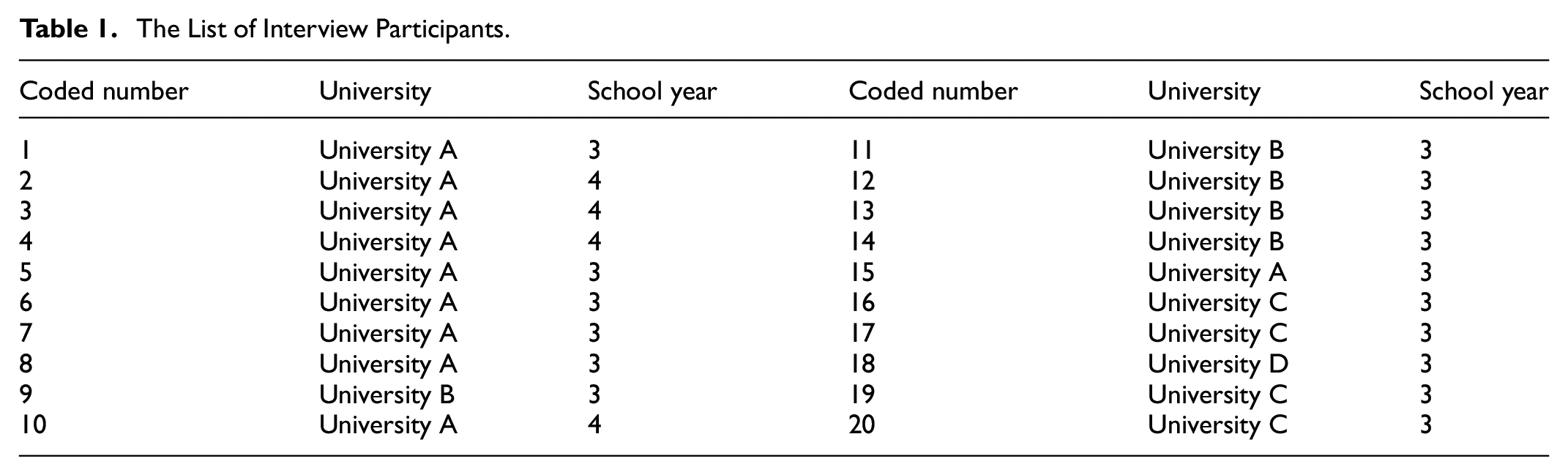
The interviews began with open-ended questions exploring student opinions on the textbooks’ strengths and weaknesses. Then, participants were presented with excerpts of text and images from the textbooks, chosen based on the frequency of their appearance and representative of select cultural themes. Students were then asked to identify any underlying cultural messages in these excerpts and describe their reactions. Detailed participant responses, accompanied by the corresponding texts and images, are presented in the analysis section of this study.
Data Collection and Coding
To compile a list of textbooks, we contacted 13 of the 15 Thai universities offering Korean-related programmes, including those in Korean language, Korean language education, and Korean studies. The 2 un-contacted universities started the programmes after we had finished the textbook analysis, so we contacted 13 universities. Our study indicated that, as of June 2021, 104 different Korean-developed textbooks were in use. From this list, we selected two frequently utilised textbook series adopted by a significant number of universities: the Ewha Korean series and the Fun! Fun! Korean series. These 2 series comprised 11 textbooks in total, with the Ewha Korean series utilised by 5 universities and the Fun! Fun! Korean series by four. Table 2 below lists the titles of the textbooks analysed in this study.
List of Analysed Korean Textbooks Developed in Korea and Used in Thailand.

Following the collection of textbook lists and the textbooks themselves, we analysed the textual and visual content in these materials, identifying recurrent themes and their respective frequencies. For this assessment, we developed a comprehensive list of 61 themes applicable to the textbooks. This thematic framework was constructed by synthesising the 10 primary message systems proposed by Hall (1959), the concepts of surface culture (Pfister & Borzilleri, 1977) and deep culture (Moreau & Pfister, 1978), the categorisation of ‘big C’ and ‘small c’ culture (Tomalin & Stempleski, 1993; van Den Hoven, 2006), as well as Lee’s (2007) cultural theme taxonomy, originally designed for learners studying Korean at an Australian university. The resulting theme list encompasses a wide array of topics, including culinary culture, economy, education/school life, geography, history, manners, mass media, morality, nationalism, notable figures, political culture, religion/beliefs and superstitions, science/technology, societal phenomena, tourism/leisure, and traditional culture. This thematic categorisation and frequency analysis was verified by both authors, each with expertise in critical textbook analysis. Drawing on this framework, we examined the extent to which these themes appear in the textbooks. The results are presented in Table 3 below.
Frequency of Themes in Korean Textbooks Developed in Korea and Utilised in Thai Universities.

As Table 3 demonstrates, the most frequent theme among the 11 textbooks analysed in this study was Korean morality. Considering the research constraints, a comprehensive analysis of all themes, textual elements, and visual components is challenging (Liu, 2003). Accordingly, our analysis focussed on the three most frequently occurring themes, each appearing more than 20 times. Moreover, since not all textual and visual components represent themes in depth, we selected passages that corresponded to our research questions and offered sufficient material for detailed discussion. Specifically, we chose textual excerpts of at least one paragraph in length and excluded images that occupied less than one-third of a page.
To facilitate understanding for readers unfamiliar with Korean and Thai, the textbook passages were translated into English. We approached translation as an ‘interpretive process’, conveying not only the literal meaning but also the underlying cultural subtleties and ideologies in the source text (D. Lee, 2000, pp. 116–117). Therefore, throughout the translation process, we sought to accurately preserve the implicit meanings of the original texts in the translated versions. In addition, a Thai university student, acting as a research assistant, proofread the Thai-to-English translations to ensure their faithfulness.
Results
Analysis of Korean Morality
First, the theme of Korean morality, with 25 occurrences, comprises descriptions of neighbourly affection, approaches to personal appearance, time management, general life philosophy, craftsmanship, workplace ethics, the ethical use of language, filial piety, frugality, mutual aid, integrity, perseverance and diligence for study and the future, the promotion of virtue and the condemnation of vice, community sacrifice, student comportment, volunteerism, and wise responses to crises and challenging situations.
Volunteer work, specifically, is significantly depicted in a large image on the lower half of the textbook page, as presented in Figure 1. Volunteering contributes to moral development and addresses societal challenges (Lv et al., 2024; Ozawa, 2010). In addition, volunteer work is an integral aspect of Korean morality, cultivating civic values such as altruism and cooperation (Seung, 2008) while also cultivating ethical growth and a sense of social responsibility (K. Y. Choi, 2023). Accordingly, the Korean government actively promotes citizen engagement in volunteer work, and students who participate receive additional credit towards their academic records (N. H. Kim, 2020; D. B. Lee, 2023). This particular page demonstrates content specifically related to volunteering and supporting neighbours, exemplified by the practice of donating briquettes.
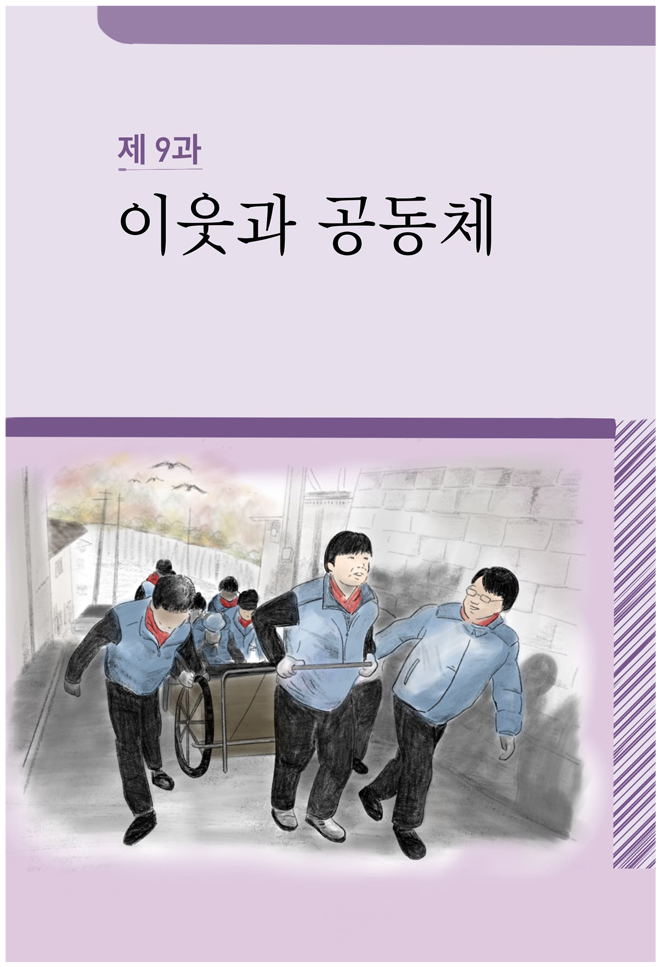
Neighbours and community.
This page consists of a chapter title written in Korean, ‘Neighbours and Community’, positioned to occupy the upper half, followed by an image. The image displays a narrative structure concerning its ideational metafunction: eight or nine participants, collaboratively pushing and pulling a handcart to ascend a hill, create a vector directed towards the right. In addition, regarding the interpersonal metafunction, the gazes of the participants are not oriented towards viewers, signifying a lack of interaction with viewers in the ‘offer’ structure. The oblique angle of the participants in the image additionally indicates that these represented participants do not belong to the shared world of the producer and viewers; instead, they exist separately in their own detached and isolated world. Therefore, the producer and viewers are not involved with the represented participants (Kress & van Leeuwen, 2021, p. 136). In particular, the upper section of this image demonstrates a higher degree of brightness compared to the bottom section, resulting in the top right portion also exhibiting increased brightness. Kress and van Leeuwen (2021, p. 186) contend that the right side of an image constitutes the crucial element of a message; therefore, this brightness, towards which the vector of the participants’ movement is also directed, implies a bright future that can be achieved through the collective action of these participants.
This photograph portrays a group of individuals transporting briquettes in a cart (K. Y. Choi, 2023). The image was chosen to represent the act of caring for neighbours and contributing to the community, as briquettes are a primary heating source for those facing economic hardship in Korea (Y. Choi, 2019). Accordingly, as winter approaches, numerous companies and individuals volunteer to help the vulnerable with briquettes. In this manner, offering briquettes has evolved into a symbol of assisting those struggling financially in Korea. Delivering briquettes during the winter season has, therefore, become synonymous with performing good deeds, which clarifies the rationale underlying its inclusion in the textbook.
A significant aspect of this photograph is reflected by its ready recognition among Koreans as a depiction of the volunteer activity of delivering briquettes, even when the briquettes themselves are not directly visible. The image purposefully emphasises the individuals pulling and pushing the cart rather than the intended recipients of the briquettes. Regarding the Thai students’ responses to this image, it is worth noting that they, too, understood its representation of volunteer work, even though the image does not explicitly portray individuals receiving assistance. When asked about their perception of the cart’s contents, Student 4 readily identified briquettes, explaining that they had frequently observed similar imagery in television programmes. Student 10 similarly suggested that the cart likely contained items such as food or briquettes intended for individuals in need. This inference stemmed from their prior exposure to scenes in Korean television variety programmes, where idols were shown delivering briquettes and assisting community members. In the same vein, Student 14 also identified the cart’s contents as briquettes, noting that they had previously encountered similar representations of volunteer work in news broadcasts, during classroom lessons, and through YouTube. Student 18 likewise interpreted the contents of the cart as briquettes, citing the wintry setting depicted in the image and reasoning that such fuel is essential for staying warm during the colder months. They further explained that, in Thailand, as in Korea, people living in mountainous regions also rely on briquettes, and that they had seen similar imagery on social media platforms, particularly Instagram. Student 18 also recalled encountering such representations in Korean dramas.
Notably, although Students 6 and 7 did not explicitly identify the cart’s contents as briquettes, their interpretations were nevertheless informed by media representations. Both students recognised the scene as one of volunteer activity, drawing upon imagery they had previously encountered. Student 6 suggested that the cart might be carrying construction materials such as bricks or cement, referencing media depictions in which community members come together to build roads or schools as part of collective efforts. Student 7, while unsure of what exactly the cart contained, also recognised the scene as one of community service, noting that they had seen similar imagery in Korean dramas.
This observation suggests that Korean mass media plays a significant role in broadening learners’ understanding of content related to Korean culture. Moreover, the responses of Students 4, 10, 14, and 18 indicate that learners actively consider how to express beliefs originating from different cultural backgrounds and presented in textbook contexts. Specifically, these students stated that if they were tasked with depicting volunteer work as the textbook author, their principal approach would involve illustrating a group of individuals gathering and collaborating on a specific activity. To summarise the findings from the interview with students, it can be concluded that students actively engage in self-directed learning, utilising a wide range of learning materials, and seeking to interpret these materials through the perspective of their own cultural backgrounds.
From this perspective, Figure 1 appears to intentionally obscure the recipient of the help. The image focuses solely on those offering assistance and does not depict the recipient’s poverty. Accordingly, the image conveys respect for the recipient’s dignity, contrasting with traditional forms of volunteerism that often seek to fundraise by displaying unfiltered images of hardship (Lissner, 1981).
Analysis of Korean Manners
The topic of Korean manners appeared 22 times in the analysed textbooks. This theme comprised dining etiquette, dress codes for various places and occasions, drinking etiquette, etiquette for public spaces and public transportation, greeting etiquette, language etiquette based on age, gender, and title, as well as etiquette for the home and for visits.
The manners of a society are invariably associated with its prevailing values and cultural norms (K. P. Lee, 1997, p. 126). In East Asia, Confucianism has endured as a fundamental social and political value system for over a millennium. In Korea, it served as the official philosophy of the Joseon Dynasty for five centuries (Yum, 1988, p. 376). Moreover, the values of Confucianism were institutionalised and propagated through the formal curriculum of the educational system and through the selection process of government officials (Ahn, 2017, p. 413). As such, Confucianism has shaped Korean social philosophy, norms, values, and manners, cultivating harmonious relationships through adherence to hierarchical order, communal responsibility, and ethical standards while establishing moral disciplines (Ahn, 2017, pp. 413–414), as well as influencing Korean manners (K. P. Lee, 1997).
However, J. W. Lee (1999) argued that Korean etiquette must adapt to the demands of the modern world, advancing beyond the established customs of both Eastern and Western cultures in an increasingly globalised society. Moreover, he maintained that Korean etiquette should prioritise the well-being of the community over individual concerns, according to principles of equality and departing from its former androcentric foundations. He further stressed the need for a globally relevant etiquette that respects cultural diversity while aligning with international standards.
In this respect, the textbooks analysed present a dual adherence to both traditional and contemporary perspectives on Korean etiquette. An example is drawn from Ewha Korean 2-1.
Figure 2 presents three scenarios related to Korean manners, each illustrating individuals in particular settings. From an ideational metafunction perspective, the leftmost image employs a narrative process, with vectors indicating the direction of movement for both participants. The male participant functions as a carrier, while the handbag on his arm plays a role as a symbolic attribute, subtly indicating a sense of obligation towards women, male support for women, and expected male courtesy in male-female relationships in Korean culture. Crucially, these are rendered as cartoon images. Concerning the modality of visual images, Kress and van Leeuwen (2021, p. 43) hypothesise that realism in visual modes conveys truth: ‘the more we think that what we see in an image resembles what we might see in reality, the greater the visual truth’. Accordingly, these cartoons, with low modality in terms of realism, do not depict actual contexts but rather possible and probable scenarios intended to communicate specific social norms and beliefs endorsed by the producer: men should offer assistance and protection to women. Moreover, the images are accompanied by the prompt: ‘What do you think of the following situations? Please say what you think’. The first image portrays the respectful and attentive behaviour of men towards women during courtship, exemplified by the man carrying the woman’s bag, and frames this conduct as a demonstration of ideal Korean manners.

What do you think of the following situations? Please say what you think.
This first image reflects a Korean cultural ideal in which men are seen as virtuous when they support, assist, and protect women. It also conveys the notion that, in Korean society, women are deserving of such treatment, and that this expectation is both commonplace and readily accepted by women. However, during the Joseon Dynasty—the precursor to the modern Republic of Korea (ROK), established approximately a century ago—women occupied a subordinate social position to men. This hierarchical structure arose from Joseon’s adherence to Confucian principles and its dominant patriarchal culture (Wang, 2021). Therefore, due to this historical context, gendered social conventions in Korea were often enforced upon women, requiring their deference to men. However, in contrast to these traditional practices, the image depicts a significant shift in contemporary Korean social interactions, reflected by an emphasis on supporting women (Ma et al., 2018). Moreover, the image’s placement on the left highlights its prominence (Kress & van Leeuwen, 2021, p. 211). In this way, this representation portrays a change in Korean manners regarding genders.
In contrast to the representation presented in the textbook, Thai students hold a differing perspective on the societal expectations of women: women do not merely expect services or protection from men; instead, they form an independent and self-directed demeanour. In the interview, Student 1 remarked that although carrying a woman’s bag is not something men are obliged to do, doing so makes them appear gentlemanly. The student further noted that if a man is willing, it is acceptable for him to assist a woman in this way. However, in advocating for women’s self-reliance, Student 1 also stated that while the cultural norm of men assisting women exists in Thailand, it is generally contingent upon a woman’s request for assistance. Student 5 described a hybrid situation, explaining that Thai women possess a strong character while simultaneously retaining a traditional female aspect, which is to be subordinate. Student 5 stated that men’s assistance towards women represents kindness and is perceived as a positive cultural trait. Furthermore, they suggested that the man’s support for the woman in the image may stem from his affection for her. However, Student 5 asserted that it is desirable for women to embrace independent attitudes, finding such qualities more attractive. Also, they noted that, traditionally, Thai society favours submissive women, but the younger generation (including themself) prefers women who are independent and empowered. In addition, Student 18 expressed a favourable view of the practice of men carrying women’s bags; however, this perspective did not appear to be based on gender stereotypes. Student 18 explained that while a woman can carry her own bag when it is not heavy, it is helpful and considerate for a man to assist when the bag is heavy. They also commented that receiving help—whether due to physical illness or mental exhaustion—is something to be appreciated. This response appeared to reflect not an awareness of culturally imposed gender stereotypes but rather an understanding based on the physical differences between men and women, or more broadly, the idea that one human being helping another in a neutral, interpersonal context is inherently beneficial. An important point to consider is that, when comparing the Thai students’ perceptions of women with the ideas conveyed by the images in the textbook, both exhibit a change in perceptions about women, but the contexts are different: the textbook images depict women being protected, supported, and served by men as a desirable result of the increase in women’s societal standing. In contrast, the Thai students viewed the characteristics of independence, resilience, and leadership in women as valuable indicators of their increased societal status.
In summary, Korean culture includes a variety of approaches to etiquette. As etiquette comprises social and ethical conventions governing interpersonal interactions, its expression varies considerably depending on the specific relationships and circumstances. Accordingly, textbook authors, when addressing etiquette, must carefully select the relationships and associated behaviours to include. In this regard, the depictions of etiquette in Korean textbooks represent deliberate authorial choices, conveyed through both textual and visual representations. Specifically, this textbook appears to selectively depict the established Korean cultural tradition of caring for the socially vulnerable (Y. K. Kim, 2015) alongside the contemporary practice of supporting women through the expansion of women’s rights in Korea. However, a difference also surfaced between the textbooks’ portrayal and Thai students’ perceptions of appropriate conduct towards women, considering women’s increasing social standing. This suggests that the students critically evaluated the textbook content, accepting certain aspects while rejecting others.
Analysis of Korean Culinary Culture
The theme of Korean culinary culture appeared 20 times in the analysed textbooks, including topics such as a Korean food-related folktale, food pairings, culinary tourism in Korea, holiday cuisine, Korean cooking methods, depictions of Korean food and restaurants, Korean food and well-being, seasonal dishes, the flavour profile of Korean food, traditional Korean food preservation methods, and diverse examples of Korean cuisine.
Significantly, the portrayals of Korean culinary culture in the textbooks relate to types of food associated with specific holidays. The content, therefore, helps learners understand the cultural aspects of Korean food and its deep meaning in Korean society. First, the examples below concerning holiday foods were taken from Ewha Korean 2-1.
The page, titled ‘Learn about culture: Holidays (representative festival) and food’, introduces its content with two images of Korean dishes: Tteokguk (beef soup with slices of rice cake) on the top and Songpyeon (rice cake made with the year’s new crop of rice, beans, and sesame seeds) at the bottom. In particular, the accompanying explanation, positioned to the right and below the images and offered first in Korean and then in English, connects Tteokguk and Songpyeon to the Korean festivals of Seollal and Chuseok, respectively, explaining the significance of both these culinary traditions and the holidays on which they are consumed. Moreover, the text discussed elements of Korean folklore. Moreover, on the page presented in Figure 3, a description of Korean culture is first provided in Korean at the top, followed by the same content in English below. Notably, even in the English text, the terms Seollal and Chuseok are written in their original Korean orthography as ‘ ’ and ‘
 ’, respectively.

Learn about culture: Holidays (representative festivals) and food.
First, concerning transitivity, the text connects ‘Seollal and Chuseok’ to ‘the most representative Korean national holidays’ through the copulative verb ‘are’. This use of nominalisation presents the description as an established truth without indicating the source of this recognition. This framing presumes the statement’s status as general knowledge, precluding discussion and selectively positioning Seollal and Chuseok as typical national holidays.
The generalisation of Seollal and Chuseok as Korea’s representative holidays raises questions. Considerable social and cultural transformations have led to contemporary observances that often deviate from traditional practices. While officially designated as 3-day holidays, Seollal and Chuseok can extend to 5 days with weekends, a period many now utilise for personal travel. However, observance of these holidays has declined due to economic and social changes, including urbanisation, shifting family structures, movements towards gender equality, and a growing prioritisation of leisure (Y.-K. Kim & Park, 2020). Traditional rituals, once central to these holidays, now often create conflicts between genders and generations, prompting some to forgo these celebrations altogether, raising concerns of their long-term viability. Reports of ‘holiday stress’ or ‘holiday syndrome’, once largely confined to women, now affect men and younger generations (M.-D. Kim & Kim, 2018), further highlighting this shift. This shifting relationship with tradition is also apparent in a 4.5-fold rise in international travel during Seollal and Chuseok between 2011 and 2017 (D. Y. Lee, 2017). Therefore, these holidays originate from social realities that are overlooked in simplified textbook descriptions.
Second, the text characterises Chuseok as ‘a day of thanksgiving to our ancestors when the harvest is over in the fall’, utilising nominalisation to connect thanksgiving with ancestral reverence. Chuseok celebrations traditionally centre on commemorating a plentiful harvest through rituals and offerings, a practice according to Korea’s agricultural history (The Academy of Korean Studies, n.d.). While Western thanksgiving traditions originate in Christianity, the author draws parallels between the two holidays by emphasising the shared theme of gratitude, thus creating points of connection for readers acquainted with North American culture.
Besides, the text exemplifies traditional Korean beliefs connected to Songpyeon with phrases such as, ‘… hoping that the half-moon-shaped Songpyeon will grow akin to the full moon’, which expresses a customary Korean aspiration, and ‘you will give birth to a pretty daughter if you shape your Songpyeon well’, which presents a traditional Korean belief concerning progeny. While traditionally, Chuseok festivities included dancing, games, and singing (D. B. Lee, 2021, p. 32), the text emphasises the ritualistic and religious aspects of Chuseok. By framing these cultural practices in this method, the author incorporates traditional Korean values while cultivating relatability through intercultural comparisons.
To study how Thai students perceived these Korean holidays, we posed specific questions during interviews. These indicated that individual characteristics, such as religious affiliation, influenced their understanding of Korean culture. Student 2, identifying as Christian, stated that they recognised Christmas as a representative Korean holiday. They added that much of the Thai population, despite primarily practising Buddhism, also acknowledges Christmas as a global celebration—a sentiment they believed Koreans shared. Accordingly, Student 2 viewed a relatively recent adoption of Western culture as a defining characteristic of Korea, equating it with traditional Korean culture due to their religious background. This perspective affected their broader understanding of Korean culture.
Thai students described the meaning of Korean holidays by drawing connections with their own. Student 5 explained their understanding of Seollal and Chuseok as occasions for family gatherings and ancestor veneration, similar to the traditions observed during Songkran, the traditional Thai New Year. Student 8 highlighted Loy Krathong, a festival celebrated on the full moon of the 12th lunar month (November). ‘Loy’ translates to ‘to float’, while a ‘krathong’ refers to a small, hand-decorated bowl typically made from banana leaves and trunks. On Loy Krathong Day, Thais place candles in these bowls and release them onto rivers (Thadaniti, 2014). According to Student 8, the purpose of Loy Krathong is solely to express gratitude to the river god. In addition, Student 12 noted that Chinese-Thai individuals place greater emphasis on celebrating Chinese New Year and Chinese Thanksgiving than ethnic Thais. As such, Thai students had a tendency to accept the Korean holidays and their meaning by comparing them with their culture.
An additional consideration is the Korean cultural value placed on physical appearance. As stated in the final sentence of the description in Figure 3, ‘It is also said that you will give birth to a pretty daughter if you shape your Songpyeon well’, the reward for crafting Songpyeon being tied to aesthetic appearance is worthy of note. This observation necessitates a discussion of lookism in Korean society. J.-H. Kim et al. (2022) hypothesised that appearance is often equated with competence in contemporary society, significantly influencing the development of positive impressions in social interactions and contributing to enhanced self-esteem. These researchers, however, expressed concern regarding the increasing tendency to perceive appearance as a measure of personal success or failure, prioritising it over individual personality and capabilities (J.-H. Kim et al., 2022, p. 304). Hong (2010, p. 266) characterised lookism as a social and psychological issue prevalent in modern Korean society. In this respect, an overemphasis on appearance could be a problematic social phenomenon in Korea, which was not reflected in this text about traditional Korean culture.
Concerning this societal trend, Student 8 remarked on the significant emphasis Korean culture places on physical appearance, citing examples such as the desirability of large eyes, the prevalence of heavy makeup, and the careful attention paid to external adornment. The student expressed disapproval of this phenomenon, stating:
I don’t feel good about this because no matter what we are, we have to love ourselves as we are. Don’t we? But in Korea, other people won’t like me if I am not pretty. Then, I don’t want to be their friend either.
The student attributed this cultural emphasis to the effect of Korean celebrities, contending that it is both created and maintained by their active promotion of an appearance-cantered perspective. Contrasting this with Thai culture, the student observed that while appearance is a consideration in Thailand, it is considerably less significant, with a greater value placed on individuals who exhibit vibrant and engaging personalities.
Discussion
To address our initial research question—what cultures and whose interests the Korean textbooks published in Korea and utilised in Thailand promote, and how these are portrayed in the texts and images in the textbooks—we analysed the thematic frequency in these educational materials. Our findings indicate a primary focus on Korean morality, manners, and culinary culture, all working to advance Korea’s own interests.
Analysis of the textbooks demonstrates a primary promotion of Korean culture and interests, highlighting key concerns related to cultural imperialism and the reinforcement of cultural stereotypes. As Tomlinson (2002) describes, cultural dominance takes place when one culture exerts influence over others through media and cultural products. This is apparent in the textbooks’ depictions of volunteer work, gender roles, and culinary customs, which frequently reduce cultural differences into fixed stereotypes and overlook cultural richness and contemporary complexities (Canale, 2016).
Korean media narratives shape the depiction of volunteerism, often accentuating the contributions of volunteers while minimising the hardships faced by recipients in an effort to maintain their respect. This differs from conventional understandings of volunteerism, which frequently emphasise the socioeconomic burdens borne by those receiving assistance (Lissner, 1981). Moreover, the textbooks’ presentation of gender roles propagates the notion that men are obligated to protect and assist women, a departure from established Confucian gender expectations in Korea and a simplification of societal mores.
Regarding Korean culinary traditions, the textbooks romanticise customary holiday observances, such as Seollal and Chuseok, yet overlook the actualities of contemporary celebrations, the customs of minority groups, and the lived experiences of Koreans living abroad. The veneration of ancestors and the traditional significance of Chuseok are accompanied by efforts to establish similarities with the North American holiday of Thanksgiving, indicating a reframing of Korean culture through a Western perspective. This curated depiction promotes a monolithic understanding of Korean culture, favouring idealised traditions over the changing practices of modern Korean society.
Korean language textbooks primarily present traditional Korean culture as the normative standard, even for international learners, thereby perpetuating cultural imperialism and stereotypical portrayals. This homogenising approach overlooks the complex nature of Korean society and marginalises the experiences of the Korean diaspora, finally strengthening static and exclusionary cultural narratives.
The second research question explored how learners perceive the cultures embedded in the textbooks and how they respond to them. Interviews with Thai university students demonstrated that they actively engaged with and reinterpreted cultural representations, rather than passively absorbing them. This active engagement resonates with Canale’s (2016) argument that readers negotiate cultural representations, actively choosing to reinforce, adapt, or contest them. In this process, Thai students drew upon both Korean mass media and their own Thai cultural background. For instance, the textbook’s depiction of volunteer work prompted associations with briquette delivery, a common theme in Korean media. Similarly, comparisons with Thai cultural norms influenced their understanding of Korean etiquette and food customs, emphasising the effect of the learners’ source culture on their learning process.
This observation supports Kramsch’s (1993), Kramsch’s (1995) work and contributes a further dimension to understanding the role of cultural awareness in language education. While Kramsch emphasised the importance of structured language instruction in developing critical cultural awareness, this research indicates that students can independently cultivate this awareness through external resources, such as media, without direct teacher intervention. This suggests that media can work as a powerful tool for facilitating critical reflection on both one’s own and others’ cultural perspectives.
In addition, this research raises crucial questions regarding the types of native cultural elements that should be integrated into language textbooks. Textbooks that incorporate students’ native cultures can help learners develop a rich sense of cultural identity, which is crucial for effective intercultural communication and understanding the demands of a globalised world (Chao, 2011). However, the textbooks analysed in this study exhibited a clear bias towards the target Korean culture. This necessitates a reconsideration of Korean language textbook development to promote a more equitable representation of both the learners’ source cultures and the target culture.
Conclusion
This study evaluated portrayals of Korean culture in Korean-published textbooks utilised by Thai university students, analysing student responses through interviews. The findings identified three themes: Korean morality, manners, and culinary culture, presenting an idealised image of Korean culture through the promotion of values such as volunteer work, established gender roles, and holiday observances. The textbooks also compared Korean Chuseok with North American Thanksgiving to emphasise the importance of thankfulness and connect Korean traditions with Western learners. Subtle aspects of lookism were subtly embedded, and students critically assessed the material, supplementing their learning with outside information.
This study argues for the significant effect of textbooks on students’ cultural understanding while also warning of their capacity to strengthen existing prejudices. An excessive focus on a single culture, evident in the analysed Korean textbooks, can lead to the perpetuation of stereotypes and the exclusion of contemporary cultural complexities. To address this, textbook developers should incorporate both traditional and modern cultural components alongside global perspectives, thus cultivating a more comprehensive portrayal.
Thai educators, often working with limited resources, can supplement textbooks with curated media, presenting varied cultural narratives to address omissions. As students actively evaluate textbook material by comparing it with media, teachers should give balanced resources that acknowledge biases and promote analytical thinking. This approach strengthens cultural sensitivity, allowing learners to interact with and value the relationships among target, source, and global cultures in a sophisticated manner.
While this study offers significant findings, it is not without certain limitations. Our analysis focussed primarily on the textbook content and student responses, neglecting the viewpoints of a wider group, such as lecturers. Lecturers are instrumental in mediating and explaining cultural content in the classroom. Therefore, assessing classroom interactions and understanding how lecturers transmit culture and ideology during lessons presents a worthwhile topic for further research.
This research also lacked a comparative analysis of textbooks created in Thailand versus those produced in Korea. Such comparisons could clarify crucial differences in cultural depiction and ideological focus. Attending to these limitations in future research could lead to a more optimised understanding of cultural education in Thai universities, contributing to the creation of more balanced and effective teaching materials. Furthermore, if future studies were to explore how learners from different source cultures, using the same textbook, perceive and respond to the culture and ideologies embedded within it in relation to their own cultural backgrounds, this could contribute to verifying the notion that cultural background may influence learners’ interpretation of textbook content and its embedded ideologies.
Footnotes
Acknowledgements
The authors appreciate the Thai lecturers for their cooperation in sharing their precious textbooks and the Thai students for their participation in the interviews.

Ethical Considerations
This project received ethical approval from the Humanities and Social Sciences Low and Negligible Risk (HASS LNR) Human Research Ethics Committee at the University of Queensland, Australia, in accordance with the National Statement on Ethical Conduct in Human Research (2007, current version). The ethics approval number is 2021/HE000039.
Funding
The author(s) disclosed receipt of the following financial support for the research, authorship, and/or publication of this article: This work was supported by the Core University Programme for Korean Studies of the Ministry of Education of the Republic of Korea and the Korean Studies Promotion Service at the Academy of Korean Studies (AKS-2021-OLU-2250002).
Declaration of Conflicting Interests
The author(s) declared no potential conflicts of interest with respect to the research, authorship, and/or publication of this article.
Data Availability Statement
The datasets generated during and/or analysed during the current study are not publicly available due to the need to protect the confidentiality and privacy of interview participants but are available from the corresponding author on reasonable request.
References
