



Abstract
This article examines how Chinese language textbooks, produced for ethnic Koreans by ethnic Koreans in China, portray environmental issues in China. Critical Discourse Analysis (CDA) and Visual Image Analysis (VIA) are used to investigate what environmental content is integrated and what ideologies these textbooks construct. Chinese language textbooks published in 2012 and 2022 were chosen as they are the most recently published versions for primary school students of Korean ethnic background. The analytical findings show that the textbooks defer responsibility for environmental problems to the global community rather than portraying them as China’s problem and responsibility to solve. The causes and nature of these problems are simplified—only dumping and deforestation are addressed. It is found that the textbooks analyzed in this paper serve the interests of the owners of domestic and multinational companies and of the government officials and agents who collaborate with them, while ignoring the needs of the citizens and students who are suffering the effects of serious pollution. Thus, educators using these textbooks should strongly consider introducing more real and specific Chinese pollution data to raise awareness of the reality of global environmental problems, and introduce critical perspectives, in order to develop environmentally-aware students.
Keywords
Introduction
China’s economic growth has been achieved at the cost of severe environmental damage (Jiang, 2013; Kirulak et al., 2011; Lee, 2015). According to Du et al. (2020, p. 4), China is the second-largest emitter of greenhouse gases, and its air and water pollution affects other countries. Surprisingly, cutting-edge technologies in advanced renewables are easily found in China, including electric city buses, and solar panels even in remote rural areas. Despite these initiatives, the nation is still a massive polluter (Witoszek, 2018, p. 832). In recent years, The PRC government has worked toward reducing pollution by implementing new regulations to offset environmental problems (Xu, 2021). Formal education is acknowledged as one of the most powerful tools for conveying environmental knowledge and affecting students’ behaviors and attitudes toward environmental protection and conservation (Curdt-Christiansen, 2020, p. 2), and China has been highlighting the importance of environmental education (EE; Xu, 2021). The government also mandates that formal school curricula should include environmental education in primary and secondary schools (Ministry of Education of the People’s Republic of China [MEPRC], 2003). Successful implementation of China’s EE could significantly improve the global environment and that of neighboring countries, yet curricula and textbooks often project the ideologies of the government and elite groups of the state (Apple, 1996; Lee, 2021; Y. Liu, 2005). There is often adiscrepancy between this policy and its implementation in the school curriculum, and this is reflected in classroom textbooks (Lee, 2000). Thus, this project will investigate how Chinese language textbooks integrate environmental issues into the school curriculum.
So far, little attention has been paid to the environmental content in current Chinese language textbooks being used by ethnic minorities in China. As school curriculum and textbooks significantly affect students’ beliefs and behaviors (Lee, 2000; Y. Liu, 2005), it is important to investigate how textbooks portray environmental issues in order to highlight the gaps or biases in the curriculum, before we are able to address and ameliorate environmental education for the identified student cohorts. This project will investigate environmental topics as included in the content of the Chinese language textbooks developed for cháo xiǎn zú (ethnic Korean Chinese) in Jilin province; currently, about 2 million ethnic Koreans live in the north-eastern provinces of China. Although these textbooks are produced for ethnic Koreans, they must still follow the national guidelines set by the Ministry of Education of the PRC (MEPRC, 2003). A close analysis of these textbooks aims to show how China implements environmental education in the Chinese language textbooks for ethnic Koreans and what ideologies are embedded in the content.
Environmental Education in Language Textbooks and Chinese Language Textbook in China
There has been a long-lasting global consensus that environmentally sustainable development (ESD) should be integrated into the whole curriculum not just as a separate subject (UNESCO, 2017, p. 17). English language teaching (ELT) and national language education also integrate environmental issues. As English is a lingua franca, ELT textbooks also integrate environmental issues. Brown (1991) and Zahoor and Janjua (2020) insisted that identifying environmental issues is mandatory in the ELT curricula as it is one of the most serious issues humans face. After conducting a content analysis of ELT textbooks in Iran, Al-Jamal and Al-Omari (2014) pointed out the scarcity of global environmental themes. Using eco-linguistic analysis, Xiong (2014) and Stibbe (2004) investigated the shallow/deep environmentalism in English as a foreign language (EFL) textbooks in Japan and China. Stibbe (2004) found that EFL textbooks in Japan present shallow environmental problems such as acid rain, and depletion of the ozone layer, and suggested technical solutions to environmental problems. Yet he found that the textbooks fail to depict the cultural values which lie at the heart of environmental crises, arguing that shallow environmentalism has deep roots in the dominant social values of exploiting ecology to magnify human desires and interests. Similarly, Xiong (2014) conducted research on EFL textbooks in China and discovered that only 4% of the content of the five popular series of EFL textbooks depicted environmental issues, and further, Xiong found that shallow environmentalism based on anthropocentrism was predominant. Xiong’s study revealed that textbook developers treated students as observers rather than encouraging them as real and active participants in environmental action. He found that textbook developers silence the human agents who are destroying the environment, and stress individual and technological solutions whilst representing the government’s role in intervening in ecological problems. However, Xiong’s research has not revealed the underlying ideologies which are embedded in the text and images despite conducting a content analysis of 11 excerpts of short text.
On the other hand, national language textbooks also depict environmental issues, portraying positive aspects of the state and often embedding ruling ideologies. The Ministry of Education of the PRC (MEPRC, 2003) issued guidelines for environmental education for primary and secondary schools to be integrated into the national language curriculum (p. 3). Scholars such as G. Liu (2005), Liu and Wang (2008), Tao et al. (2009), and Curdt-Christiansen (2020) have conducted research into the ways that environmental problems are presented in Chinese language textbooks. Y. Liu’s (2005) research discovered that textbook writers did not depict environmental issues such as air pollution, and water shortage caused by recent industrialization, rather, the texts implied that knowledge of science and technology can solve environmental pollution. This implication legitimizes the interests of the PRC government which drives economic development to the detriment of environmental protection. Liu’s analysis, however, focused mainly on cultural knowledge rather than covering the representation of environmentalism in these texts.
Liu and Wang (2008, p. 12) conducted their research on the representation of environmental problems in Chinese language textbooks and insisted that the protection of special species or plants was important, while further suggesting introducing knowledge of environmental protection at the beginning of language education by adding it into the basic educational skills of reading, writing, and speaking. They suggested that educators must increase awareness of environmental problems, reinforce students’ feelings regarding the environment, and provide accurate linguistic descriptions, coupled with data and visual images. Though they raised the importance of the affective domain of environmental literacy, they overlooked the integration of China’s specific environmental problems.
Tao et al. (2009, pp. 51–55) further elaborated that the textbooks depicted environmental issues in terms of the human experience of these issues, stressing the need for harmonious co-existence of the natural environment and human beings. They portrayed environmental problems as something that all human beings must acknowledge and deal with, globally. Yet their research did not find any China-specific environmental problems either, and no suggestions for environmental improvement for China were proffered. Curdt-Christiansen (2020) has analyzed environmental literacy in the Chinese primary language textbooks in China, finding a gap between environmental knowledge and the consequences for the ecosystem and wildlife, and inconsistencies between attitudes and behaviors, with limited content on cognitive skills in the textbooks. She suggested adding more cognitive knowledge about the environment, yet she did not pay attention to the fact that the inclusion of other domains, such as the affective domain, or awareness of nature in the textbooks can be incorrectly portrayed or distorted and not realistic for children in China. Although Curdt-Christiansen did comment on the presence of ideologies in the textbooks, this was not significantly explored in her paper. While ruling ideologies are embedded in texts and images in the textbooks, by decree of the PRC government documents (MEPRC, 2003), there is a dearth of scholarship into the explicit investigation of the ideologies embedded in the environmental content including text and images in Chinese language textbooks. Moreover, there is no explicit study into those textbooks used by the 56 minority groups in China, thus highlighting a gap in the research which this paper aims to address.
This project will therefore investigate the Chinese language textbooks which are used by one minority group, ethnic Koreans, to answer the following question:
How do environmental topics in Chinese textbooks construct and convey ideologies?
The table of contents in the textbooks usually includes environmental issues, but these exist in delimited sections and thereby obscuring the conflicts of rising environmental issues (Biström & Lundström, 2021, p. 290). Textbooks usually convey government ruling ideologies (Lee, 2021), thus, the textbook writers follow their national guidelines and policies for the textbooks to pass screening processes. In such processes, certain ideologies are selected, and integrated into the books, while opposing ones are rejected (Lee, 2021). This research question critically analyses Chinese language textbooks published under the guidelines of the national language curriculum for the use of ethnic Korean primary school students.
Methodology
Critical Discourse Analysis (CDA) combines a critique of discourse, and explanation of how it figures within, and contributes to, the existing social reality (Fairclough, 2015, p. 6). CDA uncovers the hidden and revealed structural relationships in texts, including dominance, discrimination, power, and control (Lee, 2000). This methodology also allows us to investigate how social power and domination are executed and reproduced through language use (Wodak & Meyer, 2009), while revealing how language can legitimize the relations of organized power (Wodak & Meyer, 2009). It can also deconstruct the “taken-for-grantedness” of ideological input (Lee, 2000). Therefore, CDA can disclose official dominant discourse, and illuminate how that discourse serves the interests of classes and people. CDA analytic framework also looks at underlying causal relations and can reveal the social and political meanings expressed in a discourse (Fairclough, 1995).
Fairclough (2003, 2013, 2015) illustrated three dimensions of critical discourse analysis: linguistic description of texts, interpretation (analysis of the processes of production and reception), and social analysis (explanation) which looks into the links between the discourse, and the social, cultural, and political realities. Each of the dimensions mentioned above applies for to different analytical approaches (Macro, Meso, Micro) (Fairclough, 2013). The Macro level of analysis examines discourse, genre, and style (Fairclough, 2003). The Meso level analysis investigates intertextuality in the discursive element of the produced texts, using interdiscursive analysis of discourse, genre, and style. Through this, power relations can be identified by inferencing other texts (Hodges, 2015). The Micro level of analysis examines linguistic features such as vocabulary, grammar, transitivity, modality, nominalization, metaphors, and lexical choices.
When analyzing the chosen texts, I examine lexical choices, pronominalization, nominalization, transitivity, modality, personification, and metaphor. For lexical choice, I look at why textbook developers use generic nouns such as human, and the phenomenon of overwording. Pronominalization refers to using pronouns such as “we” and “you” in texts. By using the homogenizing term, “we,” a text is often attempting to deliberately include the reader and convey the ideological message as if the whole group concurs with the given statement in the text. Contrastingly, using “we” can also be “exclusive” as it excludes other groups of people by only mentioning a particular collective “we” (Fairclough, 2015, pp. 143–144).
Nominalization transforms processes and actions into types of pseudo-entities and can even deliberately be used for the purpose of obscuring the agents of action while delivering an ideological message (Fairclough, 2013). Likewise, by using passive voice, text producers omit the agents and obscure causal factors and responsibility. In this analysis, I will investigate these omitted agents and the impact this has on the messages about environment issues received by the reader.
Further, I will investigate for what purpose the authors use personifications and personified animal characters. By personifying inanimate or animal characters, texts assign human characteristics, intentions, motivations, and emotions to non-human objects (Cohen, 2013, p. 8). They often carry ideological messages, and the use of personification will be examined to ascertain how this might impact al after environment the messages being delivered to readers about environmental issues.
In addition, the use of “modality” will be examined. Modality can indicate what commitments are being made to a statement or idea; further, modality is frequently used to construct an individual’s personal and social identity and engagement (Fairclough, 2003, 2013; Halliday, 1994). To analyze modality, I will look into modal auxiliary verbs such as “may,”“can,”“must,” and “should,” grammatical tense (e.g., present tense refers to canonical truth), and modal adverbs such as “possibly” and “probably” (Fairclough, 1992, p. 159; Machin & Mayr, 2013).
Machin and Mayr (2013) affirm that in order to reveal ideology and power, we need to examine not only language but also other semiotic modes, like visual images (p. 25). Images with that accompany the written text can convey important messages, and promote readers’ emotions such as involvement, intimacy, and separation, and can rouse unfamiliar feelings. Thus, I use visual image analysis (VIA) developed by Kress and Van Leeuwen (2006). Visual image analysis falls into three main categories or functions: the ideational metafunction, interpersonal metafunction, and the textual metafunction (Kress & Van Leeuwen, 2006). The ideational metafunction focuses on the representation of the characters including objects and people. The interpersonal metafunction describes the relationship between the “represented characters” such as the person, place, or thing in an image, and the “interactive participants” which refers to the readers. There are three types of interactions: contact, social distance, and attitude. The contact interaction, the characters directly looking at the readers, indicates a “demand.” The distance between the readers and the characters represents the degree of intimacy depending on where they are positioned. A “close shot” implies that the characters are closer to the readers, which implies an intimate social relationship, while a “long shot,” shows that the characters maintain a certain distance from the readers, which implies distant social relationships (Kress & Van Leeuwen, 2006). If the characters in the image are looking directly at the readers, that invites the readers to be involved or to become acquainted with them and are therefore shown as “part of our world” (Kress & Van Leeuwen, 2006). An obliquely drawn image can be interpreted as a position of “detachment.” The textual metafunction will examine the meaning of composition (top or bottom), left (old information), right (new and important information), and center or margin (Kress & Van Leeuwen, 2006).
Textual analysis focusing on just the text without the images dismisses the importance of the messages that the images can convey. The approach of CDA combined with VIA provides a stronger analysis of the entire message being conveyed to the readers, as visual analysis will capture the textbook authors’ intentions embedded in the images. This project will disclose whose ideologies, for whose interests, and what assumptions and beliefs regarding environmental issues are embedded in the selected Chinese textbooks.
Data Analysis
I analyzed 24 Chinese textbooks which were published in 2012 and 2022. Each grade has two textbooks (semesters 1 and 2). The major topics of the textbooks comprised of: Patriotism and national heroes 11%, descriptions of nature including the environment, and natural sciences such as animals and seasons 35%, scientific knowledge 4%, school life 13%, moralities 7%, filial duties 5%, celebrities 12%, wisdom 5%, and others 27%. If one unit had two elements, I included it in both topics.
This study used thematic analysis. To identify the themes, following Saldana (2016) and Zaini (2018), my research assistant and I categorized similar topics and conducted a cross-analysis to identify the themes. To ensure the validity and reliability of this project and to define these categories and themes we first grouped the environmental topics separately, and then we cross-checked them together. Finally, we grouped categories and the number of coding references, and then I identified the four major themes.
Seven Hanomadang [meaning Chinese language] textbooks published in 2012, at levels 5-1, 4-2, 4-1, 2-2, 2-1, 1-2, and 1-1 (5-1 means Grade 5 and Semester 1), contained 21 sections addressing environmental issues. These were categorized into four major sub-themes: environmental pollution is a problem for the Earth (4 sections); causes of environmental problems (6 sections); solutions for environmental problems (10 sections); and others (1 section). On the other hand, five Hano textbooks published in 2022 (1-2, 2-1, 3-2, 6-1, and 6-2) contain 24 sections addressing environmental issues (the series Hanomadang was renamed Hano in 2022–both mean Chinese language). These were divided into four major sub-themes: environmental pollution is a problem of the Earth and protect ecological problems (6 sections); causes of environmental pollution (5 sections); solutions for environmental problems (11 sections); and others (2 sections). The choice for analysis was based on the number of coding references, that is at least 4 sections. Significant parts of the 2012 textbooks reappeared in the 2022 textbooks, yet trash cans, garbage classification, and action to save energy or resources are added in the 2022 textbooks.
I found that 12 textbooks integrated environmental content. The content related to environmental issues is shown in Tables 1 and 2.
Environmental Content (Shen et al., 2022a, 2022b, 2022c, 2022d, 2022e).
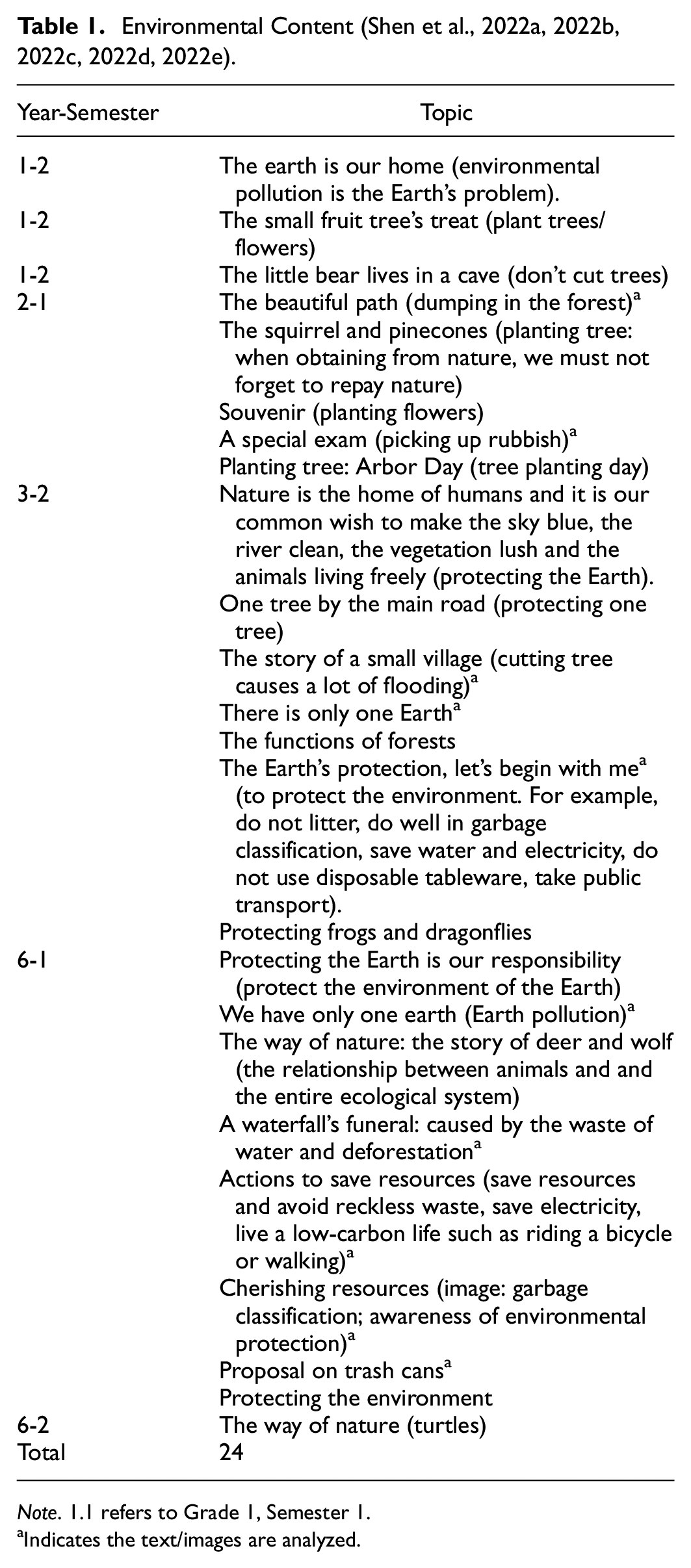
Note. 1.1 refers to Grade 1, Semester 1.
Indicates the text/images are analyzed.
Environmental Content (Piao et al., 2012a, 2012b, 2012c, 2012d, 2012e, 2012f, 2012g).
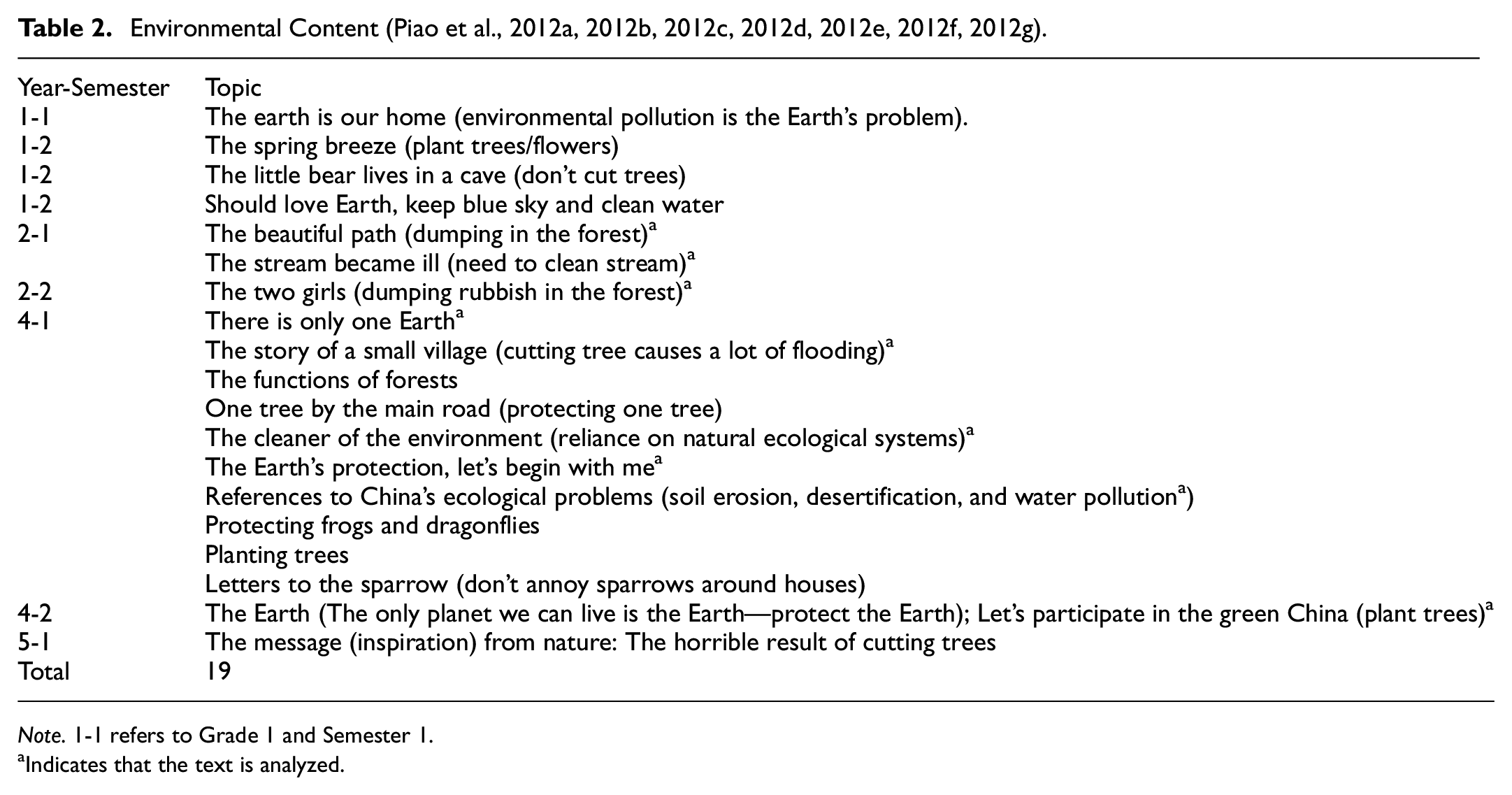
Note. 1-1 refers to Grade 1 and Semester 1.
Indicates that the text is analyzed.
The following is the data coding of textbooks which shows the categories under each theme, and the coding reference numbers (shown in brackets). The first number refers to the environmental issues from the 2022 textbooks whilst the last number indicates those from the 2012 textbooks [e.g., (4:6)].
Data Coding of Textbooks
Theme 1: Environmental pollution is a problem for the earth • Significance of protecting earth (6:4)
Theme 2: Causes of environmental problems • Dumping rubbish in the forest/ creek (1:3) • Cutting trees (2:3) • Garbage bins (2:0)
Theme 3: Solutions for environmental problems • The need to plant trees and/or flowers (4:3) • Don’t cut trees/ preserve trees (4:2) • Cleaning rubbish (3:2) • More trash cans/ garbage classification (2:0) • Actions to save resources (2:0) • Protecting animals (respecting their ecological order (turtles, wolves, and deer) (3:2) • Reliance on natural ecological systems (0:1) • Others (2:1)
For translating the Chinese texts into English and analysis of the data in the textbooks, two Chinese speakers cross-checked the translation of the data. Both Chinese speakers have a MA and BA and worked as summer research scholars under my supervision at the university. They both translated the selected texts and compared and negotiated for a better translation. For example, some issues relating to the translation are described in the following sections.
Firstly, description is used when there is no corresponding word in English. In doing so, the meaning of the source text is unpacked, and the message will be conveyed to target readers to achieve dynamic equivalence. Also, idioms are widely used in Chinese and there aren’t many corresponding idioms in English. In order to achieve dynamic equivalence, the translators chose to describe the meaning of the Chinese idioms in English.
Secondly, word choice was often changed to avoid ambiguity. Instead of translating words literally, we took contexts into account and chose words that convey meanings more clearly. For example, when translating the color of clean water, the original Chinese text uses “green,” which indicates “clean” in China’s context. However, it might be understood as “polluted water” by target readers. Thus, we decided to use “clean” instead of “green.” Also, when translating the sentence when a crow said it eats the dirty insects to clean the earth, the Chinese character “
Analysis and Discussion
Three of the major themes mentioned above will be analyzed in this section. Only three out of the four themes are analyzed as the choice for analysis was based on the number of coding references, that is at least 4 sections. Moreover, the following section discusses the major themes based on the analytical findings that are found by incorporating CDA and VIA in analyzing the texts and images.
Theme 1: Environmental Pollution Is a Problem for the Earth (i.e., Not China’s Problem)
“The Earth’s protection, let’s begin with me” from Hanomadang (Chinese language) 4-1 (Piao et al., 2012e, p. 125) presents the seriousness of environmental pollution of the Earth.
For us, the Earth is the only home for humankind,
If we destroy her, we find that there is no place for us to go.
However, currently, the only home for humankind is being destroyed by its own people, and its whole body has become wounded and is suffering in pain.
Let’s listen closely to her desperate cry, and let’s altogether protect Earth.
This story depicts the severity of environmental pollution caused by humans on earth and urges humans to protect the Earth. The writer uses the words “whole body is wounded,”“suffering in pain,” and “her desperate cry” to personify the Earth and its environmental issues, expressing the seriousness of Earth’s environmental problems. “The only home for mankind is being destroyed by its own people,” in Line 3, implies foolish actions by human beings and, by using the present progressive form, that pollution is an ongoing process. Most of China’s environmental pollution is caused by the products of industrialization, such as exhaust fumes, factory waste, heating fuel, and vehicle emissions (Zhou et al., 2017). China is the second largest emitter of greenhouse gases, and its air and water pollution affects other countries significantly (Du et al., 2020, p. 4).
There are agents, such as factory owners and their collaborators (bureaucrats) who destroy the environment, yet without describing such causes and agents in detail, the text blames humans on Earth using the generic noun “its own people” in Line 3. Using the passive voice, and locating Earth as the subject: “the victim Earth is stressed,” avoids mentioning the actors (culprits) of environmental destruction. However, the authors of this textbook stress the responsibilities of the students using “we” and “us” to care for the environment: “Let’s listen closely to her desperate cry, and let’s altogether protect Earth.” Using the inclusive homogenizing pronoun “us” four times, and “we” twice, as well as “together,” the authors suggest the shared nature of the responsibilities and the need for taking collective action. Although the text neglects to identify the agents who are destroying the environment, it stresses that responsibility lies with all human beings, including the readers. Additionally, in Lines 2 and 4, the Earth is twice described with personification, as “her”; here, “her” is chosen because it is describing the Earth as a mother.
This kind of personification is also found in “There is only one Earth” from Hanomadang 4-1 (Piao et al., 2012e, pp. 106–107). The sentence “there is only one mother, there is only one Earth, and the Earth is everyone’s mother” is used to identify the Earth as a mother. Here, Earth is the target domain while mother is the source domain (Machin & Mayr, 2012), which we can take to mean that this metaphor indicates that the Earth provides for all the needs of humans, and thus her role is vital to our existence. Ideland (2018, p. 123) identified that the metaphor of Mother Earth in ecology stresses that the Earth is our common world, therefore, everyone has a responsibility to care for it and appreciate it. By using the personification “her,” the writers have attempted to bestow “a more lifelike quality and intimacy on environmental issues, so students might have more feelings of relatedness, and hence empathy, to the Earth” (Long, 2009, p. 191). The writer is trying to make the reader aware of the seriousness of environmental pollution, like feeling a mother’s pain. Also, in order to stress that this responsibility belongs to each individual in all of humankind, not just the Chinese people, the inclusive pronoun “we” is used twice in Line 2, and “us” (or “let’s”) is used four times in Lines 1, 2, and 4, with a similar generic noun “humankind” in Lines 1 and 3.
The following story: “We have only one Earth” excerpted from Hano [Chinese] 6-1 (Shen et al., 2022d, pp. 67–69), depicts ecological destruction more specifically.
The natural resources on Earth are limited … The Earth is selfless, it generously provides humans with mineral resources. However, overexploitation of mineral resources will definitely accelerate the depletion of the mineral resources on Earth.
The resources needed for human life, such as water, land, and biological resources are all renewable and should be able to contribute to humans in the long run. But humans destroyed these natural resources carelessly and overused chemical products without thinking about the consequences. As a result, not only have these resources become non-renewable, but they have also caused a series of ecological disasters with that bring serious threats to humans’ survival.
We have only one Earth. If it is destroyed, we have nowhere to go. If all the various resources on Earth are exhausted, it would be really difficult to replenish them elsewhere. We should protect the Earth and its ecological environment carefully.
This story provides more detail about the ecological destruction of the Earth. Line 1 points to the overexploitation of limited mineral resources by humans. Using the nominalization “overexploitation” in Line 1, and passive voice, such as “is destroyed” and “are exhausted” in Line 3, the story obscures the agents such as mining companies who overexploit and exhaust natural resources and are destroying Earth’s environment, as claimed by Magidi and Hlungwani (2023). Instead, Line 2 clearly blames all humans, using the generic term “Humans,” coupled with the active voice:
Humans destroyed these natural resources carelessly
Humans overused chemical products without thinking about the consequences.
This story overall reflects the economic development-oriented views, not sustainable development views. Overexploitation of mineral resources mostly happens more often in developing countries than in advanced countries (Modak, 2017, p. 11). China is one of the leading countries in terms of destroying its natural environment by pursuing economic development and exploiting natural resources (Lee, 2015), yet the story points only to the generic term “humans” as the agents destroying the natural environment. This is “suppression” which is the removal of the real agents in China (Fairclough, 2003; Machin & Mayr, 2012).
Line 2 lists the careless destruction of natural resources and the overuse of chemical products by humans. This has caused the exhaustion of water, land, and biological resources and has given rise to serious ecological disasters and threats to human survival. Liu and Raven (2010) point out that more than 400 million people are affected by environmental problems in China. Yet the text above refers only to “humans,” as if all humans are culprits of pollution problems. Four of the world’s 20 most polluted cities are in China. They are Beijing, Chengdu, Shenyang, and Wuhan (World Air Quality Index (WAQI) Ranking, 2021). Line 3 explains that “we” have the responsibility to protect the national environment. By using obligation, “should,” the text stresses that “we” (meaning all global citizens) should protect the Earth and its ecological environment carefully, thus deferring responsibility for China’s pollution problem to the global community rather than its own citizens and industries.
Theme 2: Causes of Environmental Problems
The authors of the textbooks present the MEPRC’s version of the causes of environmental problems and their solutions. Firstly, people having misconceptions about the environment (and selfish attitudes) are pointed out in Hanomadang 4-1 (Piao et al., 2012e, p. 110), in “The Earth’s protection, let’s begin with me,” which emphasizes the concept of protecting the Earth. “People are always considering their surrounding environment like free merchandise; they waste it and don’t value it.” Here, the attitudes of the people destroying the Earth’s environment are being criticized. Their destruction of the Earth’s environment arises from reckless waste without valuing it; positing that since they consider the Earth’s environment to be freely available, they can waste it instead of protecting it. In reality, the expense of complying with environmental protection regulations could be prohibitive, and factory owners prioritize profit over increasing their costs (Lee, 2015). However, the authors have omitted this reality in order to comply with the MEPRC agenda guidelines.
Additionally, the Chinese language textbooks point out that the causes of environmental pollution are the disposal of garbage, overuse of water and water resources, and reckless deforestation. In “The stream becomes ill” in Hanomadang 2-1 (Piao et al., 2012c, pp. 128–129), the focus is on garbage dumping as the sole cause of water pollution.
The stream was clear and clean.
The rabbit threw the piece of paper; the monkey threw the fruit peel, and the baby pig threw the garbage into the stream …
A few days passed and the stream changed. The stream became black and gave off a horrible smell.
The small animals urgently said “The stream has become ill. We have to call for the doctor quickly.”
Then the small bird said, “You yourselves are truly the doctor.”
As soon as they heard this, everyone thought carefully about it and felt sorry.
The rabbit no longer threw away the piece of paper into the stream, the monkey no longer threw away the fruit peel and the piglet (baby pig) no longer threw away the garbage …
Then another few days passed, and the stream got better. The stream once again became clear and clean …
The above text misrepresents environmental pollution, as it reduces the issue down to littering. In Line 1, the stream is initially depicted as “clear” and “clean” and blue in color on page 128, describing the state of the stream before it is polluted. In Line 2, the culprits behind this environmental destruction are shown to be small animals—“the rabbit,”“the monkey,” and “the baby pig.” The pictorial image on page 128 depicts the three little animals as the culprits behind the pollution, as they naively throw garbage into the stream whilst playing. In particular, the baby pig on the right side dumping a garbage bucket of contaminants into the river is the focal point of the image. This carries a new and important message (Kress & Van Leeuwen, 2006). Writers of the textbook highlight that intentional garbage dumping rather than accidental littering, is the main cause of water pollution. Since, in reality, animals do not dump buckets of garbage into the water, the little animals can be read as representing people. The representation of little animals here implies little children. The readers of this textbook, young children, are therefore being shown as the culprits behind environmental pollution. This depiction was also found in Hanomadang 4-1 (Piao et al., 2012e, p. 126). On the pictorial image of page 126, the boy is looking toward the reader in a frontal angle, indicating that the represented boy is part of our world, and implying that the readers are polluting the water.
The outcome of the characters’ actions is shown in Line 3, where it states that “a few days passed” and “the stream became black and gave off a horrible smell.” Using terms such as “a few days,”“black,” and “horrible,” the writer is exaggerating how much and how quickly the stream has become polluted due to garbage disposal.
Data show that the amount of waste thrown away by the public and by industry in China reaches approximately 35 billion tons each year, and 80% of this penetrates underground through rivers and streams without passing through any kind of disposal process (Wan, 2012, p. 70). Through China’s long-term industrialization—due to the opening of its closed economy and the subsequent attraction of overseas factories—multinational and domestic companies have accelerated the rate of water pollution in China, from increased agrichemical waste, fertilizers, detergents, and other chemical waste (Lee, 2015). Nevertheless, the story “The stream becomes ill” portrays children, not factories, as the culprits behind water pollution, due to their act of throwing away the garbage.
The text further emphasizes the children’s responsibility for this. In Line 4, it states that “the small animals urgently said ‘the stream has become ill. We have to call for the doctor quickly’”. The writer uses the adverbs “urgently” and “quickly” in order to heighten awareness of the seriousness of environmental pollution and to emphasize that this problem needs immediate attention. The “small bird” in Line 5 states that the only ones who could treat (care for) the stream are “you yourselves.” The writer in Line 5 uses the terms “you yourselves” and “truly” which clearly states that the readers are the ones responsible for solving environmental problems. By using animal characters (“small animals” in Line 4 and “small bird” in Line 5), the writers of this textbook provide the message that it is children (the readers of this story) who need to solve environmental problems, even though they are unable to do so. The textbooks hide these complex environmental problems and choose to portray the issue of dumping garbage and encourage the children to solve it.
The MEPRC guidelines for implementing environmental education in primary and secondary schools specified: Education on the environment plays a major part in guiding the students to view the whole environmental issue; it raises their social responsibility and ability to solve the real problem and has great influence on developing and directing their knowledge with of the environment. (MEPRC, 2003, p. 4).
However, the story in the textbook is withholding China’s overall environmental situation from the children. Although it stresses the students’ responsibility to solve environmental problems, the students actually have no ability to solve this issue, which arises from the actions of adults, factories, and thermo-electric power plants. Yet Lines 5 to 6 show that everyone consented and obeyed as soon as they heard without any objection or question. Everyone is persuaded to consent to the government’s official discourse, which is that children can solve pollution problems by not throwing away the garbage.
The textbook writer uses “closed text” and does not allow the use of “open text” discourse, which is different to from the official discourse of the Chinese government. This restricts the children from asking critical questions about how waste problems occur and who is causing this pollution. As Chinese students participate in school environmental campaigns (e.g., picking up garbage and not littering) (Lee, 2015), the children would certainly understand that the stream will not become clean purely by ceasing to litter. Nevertheless, asking critical questions or debating such problems is not permitted. In Lines 7 to 8, the text states that as soon as the animals stopped throwing away the pieces of paper, fruit peel, and garbage, the stream became clear and clean, after only a few days. Realistically, water pollution cannot be solved within a few days.
“The two girls” in Hanomadang 2-2 (Piao et al., 2012d, pp. 131–132) shows two contrasting attitudes to, and perspectives on, the environment as shown in Table 3.
Two Contrasting Attitudes.

Here, Oria displays an action and attitude which should not be conducted, whilst Linda is presenting an action that should be pursued. On the pictorial image of page 131, the textbook depicts Oria, who throws garbage in the forest, on the right-hand side, the focal point of the image, which indicates a new and important message (Kress & Van Leeuwen, 2006). Again, by depicting the image in the frontal angle, writers of the textbook indicate that the represented characters are shown as “part of children’s world” (Kress & van Leeuwen, 2006). This implies that the readers (children) are causing environmental problems. We can surmise that by using Western names and figures, the authors seem to avoid any direct criticism of Chinese citizens. The textbook’s author provides a didactic lesson—that whether anyone is watching or not, garbage should not be thrown away anywhere, and one should take their own garbage away with them. The story also stresses that dumping waste is an irresponsible and shameful action. However, even in this section, the concept of environmental destruction is restricted to only the act of dumping waste, and again, places responsibility onto children.
In Hanomadang 2-2, “The beautiful path” (Piao et al., 2012c, pp. 116–117) shows that dumping garbage is the cause of forests, including beautiful paths, being polluted. When animal characters (a rabbit, a deer, and a duck) cleaned with a broom and watered the plants, the beautiful path reappeared. Again, the textbook depicts environmental problems as easy to solve by watering and cleaning up.
Pages 42 to 43 in Hano [Chinese] 2-1 (Shen et al., 2022b) also stress picking up rubbish as a key solution to environmental issues. When the three animals applied for a position in the animal TV station, the little white rabbit was selected because it picked up a peel on the ground, while the little monkey and the little fox ignored it and passed it by, and were not rewarded with employment. Here, the text excerpted from the 2022 textbook still highlights rubbish as the major cause of environmental problems.
On the other hand, on page 126 from Hanomadang 4-1 (Piao et al., 2012e), the text claims that the issues of deforestation and soil degradation cause various environmental problems. Soil degradation occurs mostly from soil acidification, salinification, and desertification. Currently, more than 40% of the arable land within China is classed as degraded (Delang, 2018, p. 92), and 27.2% of China’s land (261 million ha of soil) is classified as undergoing desertification, affecting 400 million people in 18 provinces (Delang, 2018, p. 95). However, no comparable data from other countries are provided, so it is hard for students to place environmental pollution in China within global standards.
In Hanomadang 4-1, “The story of the small village” (Piao et al., 2012e, pp. 111–112) informs students of the risks of deforestation caused by urbanization and industrialization. People in the village used a sharp axe to cut down trees so they could make furniture, tools and houses, and their lives became luxurious as a result. But when “it rained heavily for five days, the village got swept away by the flood, including all of the things that were made from the axe.” This story warns children of the dangers that environmental problems, specifically deforestation, pose to human beings in the future.
“A waterfall’s funeral,” from Hano 6-1 (Shen et al., 2022d, pp. 80–81) depicts the disappearance of a waterfall, Salto del Guaira.
It turned out that Salto del Guaira was once the largest waterfall in the world. The turbulent river roared down from the cliff and gushed for thousands of miles.
Especially in the flood season every year, Salto del Guaira was even more magnificent, attracting many tourists from all over the world. People lingered in front of the huge water curtain falling from the sky and did not want to leave.
However, this magnificent landscape left without saying goodbye. Many factories around it use water uncontrollably, wasting a lot of water resources.
The forests on both sides of the river had been cut down indiscriminately, resulting in a large amount of soil erosion. Therefore, the water volume of the waterfall decreased year by year.
Line 1 depicts the magnificence of the Salto del Guaira waterfall before its disappearance, using hyperbole—“gushed for thousands of miles”). The beauty and excellence of the scenery were shown in Line 2: “attracting many tourists from all over the world,”“people lingered in the front of the huge water curtain and did not want to leave.” Here the text uses the evocative terms “water curtain,” and “lingered” to evoke feelings of awe in the readership. Yet this fall disappeared “without saying goodbye.”“Without saying goodbye,” textbook writers attempt to convey the feeling of a broken relationship with the environment through emotionally-laden wording. The culprit of this disappearance is named as “many factories around it” in Line 3. These factories wasted too much water “uncontrollably.” The story uses “hedge” (Machin & Mayr, 2012) to just gloss over the lack of concrete evidence. Here the textbook writers obscured the culprits using “many factories” without identifying the names or types of factories involved. Line 4 also omits the culprits who cut down trees and caused soil erosion by using the passive voice.
Theme 3: Solutions for Environmental Problems
As illustrated in previous sections, the authors of the textbooks suggested several ways to solve pollution problems. For example, the textbooks stress the need for reafforestation to solve environmental problems, as shown in Hanomadang 4-1 (Piao et al., 2012e, p. 129). This volume elaborates on the children’s responsibility for environmental protection:
Flowers and green plants have an effect in cleaning the environment.
Flowers and green plants have beautiful names including “oxygen production factory,”“organic vacuum cleaner,”“temperature controller,”“bad gas cleaner,”“organic sound-proof walls,” and “natural preventor of diseases.”
According to research, globally, people who have a long lifespan all live in areas with a beautiful environment and which have been planted with many trees and green plants.
Our young children actively participate in reforestation by planting trees, planting green plants, and planting flowers and must without fail establish the spirit of “considering it an honor caring for planting trees and thinking it shameful destroying the plants.”
Line 1 mentions how valuable flora is to our environment, and how plants have an effect in cleaning the environment. Line 3 states that people who live in areas that have a beautiful environment that is well forested with trees and plants have a longer lifespan. Using the word “all” and the present tense “live” which carries canonical truth (Fairclough, 1995), the text gives the message that only those who live in a good environment will live a long life. In order to demonstrate the importance of environmental protection and to add a tone of authority, Line 3 uses the phrase “according to research.” However, the term “research” is anonymized and it does not mention the source or nature of this research. Yet, using the lexicon “globally” and “all” together, the authors make their logic seem credible, positing that it is a canonical truth that the environment needs to be good if people are to live longer. The writer stresses three tasks (Line 4) that the children have to take on to help clean the environment: “planting trees for reforestation, planting green plants, and planting flowers.” These are acts that governments and communities in other countries, such as Indonesia (Anita, 2015) have conducted, yet this text emphasizes that the responsibilities lie with the children engaging with this textbook.
Using binary opposition, the story states that caring for flowers and plants is an honor, whilst destroying flowers and plants is shameful. According to this logic, the organizations and owners running the factories producing timber products are destroying the environment and should feel ashamed. However, direct criticism of the true destroyers of the environment is omitted and this message is applied only to students, which can be read as duplicitous. Additionally, in Line 4, the expression “one must” is used in order to strongly emphasize to the students that caring for the flowers and plants is a mandatory action from which they cannot escape. Although the text is stressing the idea of “the greener, the better,” mention of the actual agents behind the destruction is omitted.
One solution to environmental problems is presented as reliance on natural ecological systems. The story “The cleaner of the environment” in Hanomadang 4-1 (Piao et al., 2012e, pp. 121–123), features an elderly man who has no role in the ecosystem, but rather is just being thankful that the fauna and flora are doing the environmental cleaning.
The seagull said, “I am an environmental protector above the sea. The sea can become cleaner as I eat the dead fishes that float about in the sea and the leftover food which was thrown away by people in boats. So wouldn’t I be a protector of the environment?”
A crow said, “Although I am ugly, I only eat the dirty insects on land, the fly maggots, and things like larvae. Wouldn’t I be a protector of the environment, since I eat all the dirty insects and make the land clean?”
A dung beetle said, “Even though every day I come into contact with cow dung, and I consider horse manure and cow dung as snacks, if I wasn’t here, the grassland would be covered in waste and the farm would be very dirty. So wouldn’t I be a protector of the environment?”
The elm tree said, “I absorb the dust and harmful gases of the air and make the air on the surface of the Earth clean and fresh.”
The elderly man from Earth laughed out loud and said, “I am so thankful that all of you are doing the cleaning work for me!”
The writers of this textbook list some environmental problems, such as dead fish, dirty insects, horse manure, cow dung, and harmful gases in the air, yet they do not portray the most significant destroyers of the environment, like factory waste and exhaust smoke, heating fuel, using coal for power generation, and vehicle smoke, a clear omission in the discourse on environmentalism Furthermore, the term “dirty” in the “dirty insects” is not defined clearly or related directly to environmental problems. In Line 5, the elderly man from Earth appreciates their role saying “I am so thankful that all of you are doing the cleaning work for me!” However, this induces a hypothetical question—why does China then still have environmental pollution problems? Although this story is a cute way to depict the respective contributions from various agents in the ecological system, the story does not effectively portray the real environmental problems of China, and focuses on global problems rather than China’s specific problems, using an elderly man “from Earth,” not from China. In order to educate students about the problems of environmental pollution in China, the story needs to go further than the old man being happy with Nature’s role.
However, “Letter to uncles and aunts of the Municipal Environmental Protection Bureau”Hanomadang 6-1 (Shen et al., 2022d, pp. 92–93) shows a different solution.
Design issues: We think we should try to set up dumpable trash cans. Nowadays, many trash cans are fixed. When cleaning garbage, cleaners can only pick up the garbage on the surface but cannot clean the bottom. In the long run, garbage will stink, pollute the air, and affect the appearance of the city.
Classification problem: We think we should write the basic types of “recyclables” and “non-recyclable” on trash cans. Nowadays, although classified trash cans are in place, because they are not clearly marked, people still do not classify garbage, which does not meet the goal of setting classified trash cans.
Distribution problem: In densely populated areas such as business centers, schools, hospitals, and other places, more trash cans should be set up. Most of the time, people will throw rubbish at random because they cannot see the trash can nearby.
Line 1 stresses the need for setting up “dumpable trash cans.” This is because the rotten trash that remains on the bottom of bins can smell bad, pollute the air, and damage the city environment. Line 2 illustrates the importance of classifying rubbish into recycable or non-recycable, with more clear markings on bins. Line 3 stresses the distribution of more garbage bins in more-populated areas. These are more advanced concepts than those in the textbooks published in 2012, yet the text still focuses on garbage, ascribing air pollution to garbage bin problems. However, most of the air pollution in China comes from automobiles, coal consumption (e.g., for thermal energy production), and industry (Zhou et al., 2017).
In addition, Hano 3-2 (Shen et al., 2022c, p. 102) depicts the ways to improve the environment, such as: do not litter, do well in garbage classification, save water and electricity, do not use disposable tableware, and take public transport. Further, Hano 6-1 (Shen et al., 2022d, p. 89) also depicts some ideas for taking action after discussion in the classroom. These are: to save resources, avoid reckless waste, save electricity (such as turning off lights, and unplug the computer while not in use), and practise a low-carbon life (such as riding a bicycle or walking).
Discussion
This paper has answered the research question: “How do environmental topics in Chinese textbooks construct and convey ideologies?”
The environmental topics covered collectively depict that those environmental problems are not China’s problems, but global problems. All humans are presented as the agents which are destroying the environment and engendering water and air pollution, and deforestation, yet the textbook authors have avoided describing the real agents of environmental devastation—the owners of companies who are polluting the environment in China, and their associates, such as the high-ranking officials and agents who collaborate with them—and describing China’s real environmental problems. Although the authors present some issues relating to the use of chemical products and the overexploitation of natural resources, the true agents are absent from the text. The stories and illustrations divert criticism to all humans, illustrating that all humans globally have a responsibility to solve environmental problems. In this way, the environmental topics in the textbooks convey the PRC government's ideologies of seeking economic development first at the cost of the environment.
By simplifying the environmental problems down to common and visible issues such as garbage dumping, littering, and deforestation, the textbooks also portray child characters as the culprits of littering and stream pollution. The depicted places are also not identified as specifically Chinese locations. The textbook authors also selectively depict non-Chinese culprits such as foreign companies, for example, embedding the Salto del Guaira waterfall case, where the overuse of water destroyed the world’s largest waterfall, and depicted one white Western girl littering in a forest (Piao et al., 2012d, pp. 131–132). In doing this, the textbooks perpetuate the impression to its readers that citizens in China do not pollute the environment and people in other countries do pollute the environment. As the environmental topics in the textbooks distort and over-simplify the issues, the suggested solutions for these problems were reduced to planting trees, green plants, and flowers, and relying on natural ecological processes. Some limited information was added in the 2022 textbooks, such as the need for setting up dumpable garbage cans, classifying rubbish into recycable or non-recycable, better distribution of garbage bins, not using disposable tableware, practising a low-carbon life (taking public transport or walking), and saving electricity.
To convey PRC government economic development ideologies (not pro-environmental ideology), the textbook authors relied upon omissions. China experiences serious pollution of air, water, and soil, and this is largely caused by factories, thermal energy generation plants, transport emissions, multinational organizations, and agri-chemicals (Zhou et al., 2017), and the serious environmental issues are omitted from the books. For these omissions, the textbook writers clearly removed the agents polluting the environment in China, by using nominalization (e.g., overexploitation), generic nouns (e.g., people, humans), and the passive voice (e.g., is destroyed). By describing “people,”“humankind,” and “humans” as the agents destroying the environment and using the homogenizing pronoun “we,” the textbook authors indicate that the responsibility to care for the global environment lies with all global citizens, not the Chinese people.
While the authors of the textbooks seem to follow the guidelines of the national language curriculum in China, which stress that they need to “pay attention to the possible solutions of the environmental problems that surround them” (MEPRC, 2003, p. 21), the environmental topics in the textbooks do not construct pro-environmentalism, rather, pro-economic developmental ideologies, which align with factory owners’ interests. In comparison to the previous findings in the literature review, textbooks still carry economic development ideologies (not pro-environmentalism) as Y. Liu (2005) pointed out. The research’s findings also mirror Tao et al.’s (2009) statement regarding the omission of China’s specific environmental problems and blaming all human beings as culprits. Furthermore, the analysis described in this paper reveals that textbooks also blame children as culprits of environmental pollution and identify children as the agents who can solve environmental problems.
Liu and Wang (2008, p. 12) suggested that Chinese textbooks needed to be improved by providing accurate linguistic descriptions of environmental problems, while Curdt-Christiansen (2020) found limited environmental content in the textbooks. My analysis shows that mis-portrayed environmental content as well as limited content, of environmental issues are presented. The 2012 textbooks focused on garbage dumping and deforestation, while the 2022 textbooks included more diverse issues, but to a minimal degree. Curdt-Christiansen (2020) suggested more cognitive knowledge of the environment needs to be integrated, yet this study found that the environmental knowledge itself in the textbooks is ideologically distorted and mis-portrayed. For example, depicting the cause of water pollution as being the result of children dumping trash, Brazilian companies overusing water caused disappearance of a waterfall, and air pollution being caused by dirty garbage containers.
This outcome gives rise to some implications for language teaching and learning. The way the environmental problems of China are currently represented in language textbooks makes it arguably difficult for young readers to become aware of global environmental issues, and China’s issues specifically, including their role in the remediation of the situation, and their path to becoming environmentally friendly citizens. Such distorted and mis-portrayed information on environmental problems as we have seen in this research would arguably restrict a student’s ability to understand the real problems of the environment, with such omissions and mis-portrayals doing nothing to enhance the students’ critical awareness of these issues. One way to ameliorate these problems in the texts is for teachers to introduce real environmental problems happening in China or within the students’ provinces using visual resources or by visiting the polluting sites in the region. This will help students to recognize the differences between the descriptions given in the textbooks and the real problems. Furthermore, teachers can also introduce meaningful classroom activities for students, such as writing letters to those responsible for environmental pollution. By doing so, children will gain ownership of such environmental problems and grow into being environmentally friendly citizens. There is a need for textbook developers to realistically describe environmental issues, including the real causes and solutions.
Conclusion
The findings show that the textbooks present environmental problems as global problems, not specifically as Chinese problems. In addition, the causes and nature of these problems are simplified—mostly dumping and deforestation are addressed. Thus, the solution is simply depicted as “stop littering”, “plant trees,” and “rely on the natural ecological system.”
China’s specific environmental problems and the culprits of pollution are all omitted from the texts researched. These textbooks portray children, foreign companies, and a foreigner as culprits of environmental pollution. Furthermore, the environmental content in the textbooks analyzed is inaccurate, distorted, and mis-portrayed. Hungerford and Volk (1990, p. 267) stated that, if we are to raise active and responsible citizens, children should hold ownership and have a proper understanding of environmental issues. The earlier they are educated about authentic ecological issues, the better environmentally responsible children they become (Ideland, 2018, pp. 64–65).
This study focused solely on Chinese language textbooks produced for use by ethnic Koreans in China. These textbooks differ from the Chinese national language textbooks, which are used by mainstream Chinese students. Thus, generalizing these findings to the mainstream Chinese textbooks is a limitation of this study. In addition, environmental knowledge is embedded in most school subjects. For further generalization, future research should investigate the Chinese language textbooks published for use by mainstream Chinese students in China and should look at other diverse subjects, such as social sciences and ethics, as well as into analyze textbooks used in junior middle and high schools.
Footnotes
Appendix: Textbooks analyzed
Piao, H., Liang, C., & Zhang, H. (2012a).
Piao, H., Liang, C., & Zhang, H. (2012b).
Piao, H., Liang, C., & Zhang, H. (2012c).
Piao, H., Liang, C., & Zhang, H. (2012d).
Piao, H., Liang, C., & Zhang, H. (2012e).
Piao, H., Liang, C., & Zhang, H. (2012f).
Piao, H., Liang, C., & Zhang, H. (2012g).
Shen, A., Zhang, H., Li, H., & Cui, M. (2022a).
Shen, A., Zhang, H., Li, H., & Cui, M. (2022b).
Shen, A., Zhang, H., Li, H., & Cui, M. (2022c).
Shen, A., Zhang, H., Li, H., & Cui, M. (2022d).
Shen, A., Zhang, H., Li, H., & Cui, M. (2022e).
Declaration of Conflicting Interests
The author declared no potential conflicts of interest with respect to the research, authorship, and/or publication of this article.
Funding
The author disclosed receipt of the following financial support for the research, authorship, and/or publication of this article: This work was supported by the Core University Program for Korean Studies of the Ministry of Education of the Republic of Korea and the Korean Studies Promotion Service at the Academy of Korean Studies (AKS-2021-OLU-2250002)
