



Abstract
The implementation of technological advancements, including big data and predictive analytics (BDPA), signifies a significant paradigm shift in the field of organizational supply chain management. Literature indicates that BDPA can enhance the efficacy of an organization. However, there is a scarcity of literature concerning the adoption of BDPA in the supply chain management of organizations, as perceived by employees. Our objective is to determine how the adoption of BDPA affects social, economic, and environmental performance, all of which are components of sustainable development from an employee perspective. Our findings, based on 226 valid responses from industries in Vietnam’s Northern and Southern Provinces, indicate that organizational culture, management skill, and learning are crucial for the successful adoption of BDPA in the context of supply chain management. Furthermore, the correlation between BDPA and social, economic, and environmental performance was validated by the study. This article enhances the comprehension of the data BDPA adoption process within an organization as well as from the standpoint of its employees. Our research assists supply chain managers in formulating strategies to facilitate technology adoption and oversee organizational transformation.
Plain Language Summary
This study aims to explore the impact of Big Data and Predictive Analytics (BDPA) adoption on sustainable development within organizational supply chain management, specifically focusing on the perspectives of employees. The research seeks to fill a gap in the existing literature by investigating how the adoption of BDPA influences social, economic, and environmental performance in the context of sustainable development. The research design involves collecting and analyzing data from 226 valid responses gathered from industries in Vietnam’s Northern and Southern Provinces. The study employs quantitative methods to assess the perceptions of employees regarding BDPA adoption in supply chain management. The study reveals crucial insights into the BDPA adoption process within organizations. Key findings indicate that organizational culture, management skills, and organizational learning play pivotal roles in the successful integration of BDPA in supply chain management. Additionally, the research validates a significant correlation between BDPA adoption and improvements in social, economic, and environmental performance. For supply chain managers, this research provides valuable practical implications. The study emphasizes the importance of fostering a conducive organizational culture, developing effective management skills, and promoting continuous organizational learning to facilitate the successful adoption of BDPA. These insights assist managers in formulating strategies to navigate technology adoption and oversee transformative changes within their organizations. The research contributes to the theoretical understanding of BDPA adoption in organizational supply chain management. By highlighting the significance of organizational culture, management skills, and organizational learning, the study enriches existing theories related to technology adoption and implementation. The findings offer a nuanced perspective on the factors influencing the success of BDPA.
Introduction
The modern business landscape is dynamic and interconnected, resulting in challenges in supply chain management (SCM) and increased complexity (Dwivedi et al., 2023). Big data (BD) and predictive analytics (PA) have emerged as effective instruments for enhancing business performance, augmenting operational efficiency, accommodating varied customer preferences, and securing competitive advantage in supply chain operations (Nilashi et al., 2023). Nonetheless, the incorporation and efficient application of these technologies to attain sustainability objectives remain insufficiently investigated. Big Data signifies vast, intricate, and real-time information that requires the utilization of advanced analytical techniques (Muchenje & Seppänen, 2023). The aim of predictive analytics models is to extract significant predictions from the analysis of existing data (Wang et al., 2016). BDPA includes analytical methodologies for the retrieval, storage, visualization, analysis, and management of vast amounts of complex data, facilitated by appropriate systems and tools (Albqowr et al., 2024). BDPA gathers data from diverse sources, such as audiovisual materials, remote surveillance technologies, and real-time systems (Ma et al., 2021). The data are subsequently filtered, manipulated, and possibly disseminated offline or online (Agrawal et al., 2023). BD storage requires a significant infrastructure, where efficient storage strategies are essential to ensure optimal data utilization. Subsequently, significant information is derived through the utilization of data analytics methodologies, encompassing machine learning, computational intelligence, and data mining. The extracted data and displayed visualizations offer end-users insights and information about future developments, without necessitating specific skills or qualifications. Organizations encounter considerable obstacles in developing the requisite infrastructure and converting intricate data into actionable insights for supply chain management.
BDPA can improve performance forecasting, manufacturing quality, and decision-making processes across various industries (Ji et al., 2024). Researchers have developed an interest in BDPA to analyze the operations, management, and performance of industries (Ma et al., 2021), along with critical issues such as climate change (Dwivedi et al., 2022). Previous research indicates that BDPA is an essential organizational capability that enables the analysis of business data and delivers business-driven insights, thereby conferring a competitive advantage (Agrawal et al., 2023). Although BD analytics is considered an emerging field, the statistical literature and associated scientific applications have thoroughly investigated data-driven analytics within the context of business and industry (Younis et al., 2022). The application of Big Data (BD) and Predictive Analytics (PA) in supply chain management is essential for promoting sustainable development (Bag et al., 2021). BD’s capacity to analyze extensive datasets facilitates accurate demand forecasting by recognizing historical trends and consumer behavior. Integrating this with PA enables businesses to predict demand fluctuations, thus optimizing inventory management and reducing waste (Del Giudice et al., 2020). Predictive modeling enables proactive management of potential disruptions, improving operational efficiency and minimizing negative environmental impacts. Analyzing traffic patterns, weather conditions, and transportation routes to forecast potential delays can enhance the energy efficiency and environmental sustainability of logistics (Albqowr et al., 2024). BDPA are essential elements in aligning supply chain management with the Sustainable Development Goals (SDGs). BDPA enhances resource efficiency, minimizes waste, and advocates for sustainable consumption and production through the analysis of extensive datasets (SDG 8; Gao et al., 2023). Furthermore, it can bolster economic growth by delivering market intelligence, enhancing supply chain processes, and facilitating financial decision-making for sustainable and inclusive development. Moreover, PDPA can enhance responsible consumption and production by streamlining supply chain processes, minimizing waste, and advocating for sustainable practices; both BD and PA facilitate the attainment of SDG 12 (Dias Lopes et al., 2023), which signifies environmental performance. Big Data enhances compliance with SDG 5 by fostering equitable labor practices and guaranteeing gender-neutral employment opportunities; supply chain analytics can advance gender equality in the workforce, thereby reflecting social performance (Bag et al., 2023). Data-driven methodologies empower supply chain managers to significantly advance sustainable development goals. Notwithstanding these benefits, obstacles remain in incorporating BDPA insights into decision-making frameworks, especially in creating user-friendly tools that enable supply chain managers without necessitating specialized expertise. Consequently, additional research is required to investigate how organizations can efficiently utilize BDPA to tackle supply chain complexities and promote sustainable development.
When examining the enhancement of organizational performance, the adoption of BD brings noteworthy advantages to entities, as highlighted by Bag et al. (2023) and Qi et al. (2023). The adoption of Big Data and Predictive Analytics (BDPA) has garnered increasing attention at the organizational level due to the anticipated benefits, offering a competitive edge in the business landscape (Nilashi et al., 2023; Ocelík et al., 2023). Despite the expected advantages associated with BD adoption, the literature suggests that organizations encounter various barriers to successful implementation (Albqowr et al., 2024). Notably, businesses face a high risk of failure in BD adoption if not accompanied by appropriate strategic goals, with an estimated 80% failure rate (Shafique et al., 2024). Consequently, many organizations exhibit a hesitancy toward BD adoption, with only a limited number experiencing the envisaged benefits (Bag et al., 2023; Nilashi et al., 2023). Despite the growing interest in deployment and evaluation approaches (Younis et al., 2022), there is a paucity of research focusing on the evaluation of BDPA from employees’ perspectives. In the field of supply chain management, research on the deployment of BDPA remains underexplored due to limited resources and a lack of awareness regarding the fundamental impediments to BD usage and adoption (Albqowr et al., 2024; Ocelík et al., 2023). Moreover, as stakeholders, policymakers, and governments increasingly emphasize sustainable development in the industry (Albqowr et al., 2024; Qi et al., 2023), there is a pressing call to implement innovative and contemporary models to facilitate this transformative shift. To bridge the research gaps, this study proposed model based on resource-based view theory (Barney, 1991), organizational learning theory (Chiva et al., 2014; Putnam, 1999), and organizational culture (Detert et al., 2011) to examine how BDPA adoption impacts environmental, economic, and social performance in term of sustainable development. Additionally, BDPA research examines adoption at both individual and organizational levels, with individual levels being somewhat neglected, highlighting the importance of studying the elements that impact employee behavior. Conventional models cannot detect complex correlations among employees with sophisticated structures, stable connections to their external surroundings, and varied goals for using BDPA tools (Randolph-Seng et al., 2024). However, the literature rarely discusses the implementation of BDPA in supply chain management through an investigation of employee-level influential variables (Huynh et al., 2023). This study employs a combination of theoretical frameworks to examine the potential influence of organizational learning, tangible resources, technical skills, management skills, and organizational culture on BDPA adoption. Subsequently, it assesses the manner in which BDPA adoption impacts environmental, economic, and social performance, all of which contribute to sustainable development. This study concludes by addressing the following inquiry: which variables impact the adoption of BDPA and, consequently, the sustainable development of an organization’s supply chain?
The remainder of this paper is organized as follows. The literature review, theoretical foundation, and formulation of the hypotheses for this study are detailed in Section “Literature Review, Theoretical Foundation, and Hypotheses Development.” The survey-based methodology is described in Section “Methodology,” and the results and data analysis are presented in Section “Data Analysis and Results.” Finally, the discussion and conclusions are presented in Section “Discussions and Conclusions.”
Literature Review, Theoretical Foundation, and Hypotheses Development
Literature Review
This study examines the effects of BDPA implementation on sustainable performance, focusing on supply chain management concerning environmental, economic, and social dimensions. Consequently, we perform a thorough assessment of the research and address several issues. Initially, we examine BDPA research within a specific business domain, focusing on performance perspectives. Moreover, as this research focuses on BDPA adoption, it is imperative to analyze studies that address this subject and the factors explored in previous academic literature. Sustainable development may refer to internal sustainability within an organization, emphasizing improvements in operational efficiency, resource optimization, and employee welfare (Dias Lopes et al., 2023). This encompasses minimizing waste, improving energy efficiency, and promoting equitable labor practices to guarantee enduring organizational sustainability. Conversely, it may also include the company’s extensive influence on society, emphasizing environmental stewardship, social responsibility, and economic contributions (Choon et al., 2022; Prahalad & Hart, 1999). This viewpoint encompasses minimizing carbon footprints, advocating for ethical practices throughout the supply chain, and endorsing societal objectives such as gender equality and economic development (SDGs 5, 8, and 12). The research would provide a substantial contribution by integrating both dimensions, thereby presenting a comprehensive framework for utilizing BDPA to promote sustainability within and beyond the organization. The BDPA supply chain management is presented in Figure 1.

Diagram of SCM with the BDPA adoption.
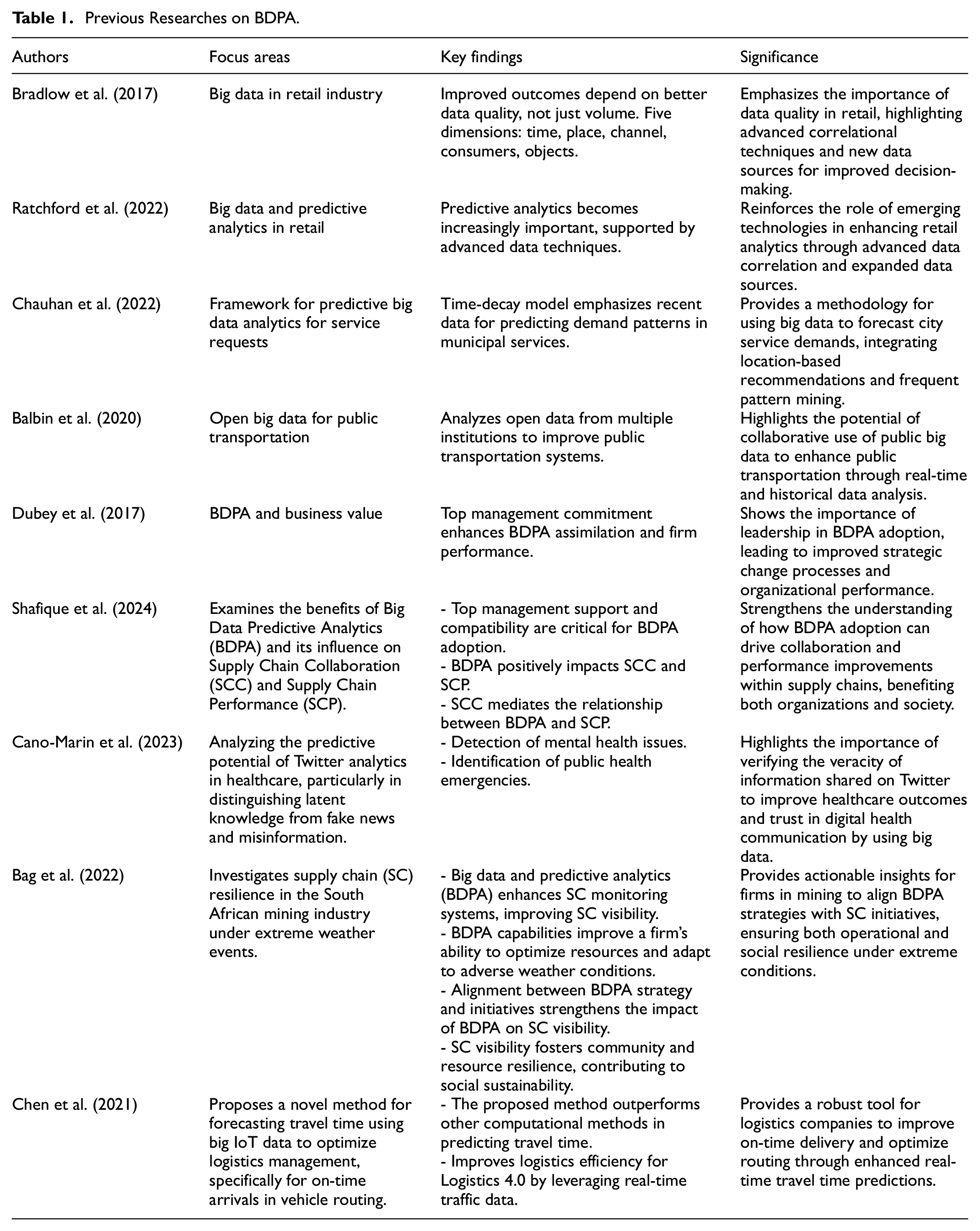
In reviewing the BDPA literature, Bradlow et al. (2017) analyzed the function and potential of big data in the retail industry and demonstrated that improved outcomes are driven by enhanced data quality (“better” data) rather than simply an increase in data volumes. This study focuses on five main data dimensions: time, place, channel, consumers, and objects. Big data and predictive analytics will become more significant in retail, supported by advanced correlational techniques and new data sources (Ratchford et al., 2022). Chauhan et al. (2022) presented a framework for predictive big data analytics regarding service requests. The integration of location-based recommendations and frequent pattern mining is not a trivial task within this framework. It mines and analyzes open big data to identify recurring patterns, such as most-requested city services. To uncover recent patterns in the demand for municipal services, our framework applies mining using a time-decay model, wherein more emphasis is placed on current data than on historical data. The patterns uncovered in recent data aid in forecasting future service requests (e.g., forecasts based on the season). Furthermore, Balbin et al. (2020) conducted a study on open big data for public transportation, as it is a crucial necessity for many individuals. During the age of big data, a significant amount of valuable information is being produced quickly, with different levels of accuracy. Extensive data sets from scientific, governmental, and charity institutions are increasingly becoming available to the public. This accessibility is designed to facilitate collaborative study and analysis. Dubey et al. (2017) recognize the significance of big data and predictive analytics (BDPA) in enhancing business value and firm performance. It highlights the role of top management commitment in influencing the effects of resources such as connectivity and information sharing on big data assimilation, strategic change process (SCP), and organizational performance (OP). The study shows that top management commitment, connection, and information sharing have a positive influence on BDPA acceptance. This, in turn, is linked to BDPA assimilation through the mediation of BDPA reutilization and is also positively associated with SCP and OP. Shafique et al. (2024) examines the benefits of BDPA and its influence on Supply Chain Collaboration and Supply Chain Performance. Cano-Marin et al. (2023) analyzes the predictive potential of Twitter analytics in healthcare, particularly in distinguishing latent knowledge from fake news and misinformation. Chen et al. (2021) proposes a novel method for forecasting travel time using big IoT data to optimize logistics management, specifically for on-time arrivals in vehicle routing. Previous researches have been listed in Table 1.
Previous Researches on BDPA.
Limited research investigates specific facets of BDPA, including but not limited to social media, predictive, visual, and in-memory analytics software. Multiple research studies have employed traditional adoption models to investigate the factors that influence BDPA adoption. These studies have identified and validated the influence of compatibility, relative advantage, complexity, security and privacy, ease of use, perceived benefits, data quality, security and privacy, and observability on the adoption process (Andrews et al., 2021; Shafique et al., 2024; Younis et al., 2022). A variety of methodologies are employed to investigate these factors, with interviews and surveys serving as the prevailing data collection techniques (Lei et al., 2021). Furthermore, BDPA research focuses on both the individual and organizational levels of adoption (Korayim et al., 2024), with individual levels receiving less attention; this increases the need for a greater emphasis on investigating the variables that influence employee behavior. Traditional models are incapable of identifying correlations within employee that possess intricate structures, consistent relationships with their external environment, and diverse objectives for implementing BDPA tools (Randolph-Seng et al., 2024). On the other hand, BDPA adoption in the context of supply chain management, as determined by an analysis of employee-level influential variables, is seldom addressed in the literature (Huynh et al., 2023).
Theoretical Foundation
Resource Based View (RBV)
The resource-based approach suggests that organizations create strategic combinations of resources and competencies to gain a competitive advantage (Barney, 1991). The degree of a company’s exceptional performance is influenced by its possession of valuable, unusual, imperfectly imitable, and well-organized resources at the same time (Barney et al., 2001). The resources can be classified as physical capital, human capital, technological capital, and reputational capital. They can be categorized as either “intangible” (e.g., information or knowledge sharing) or “tangible” (e.g., infrastructure; Nason & Wiklund, 2015). Both intangible and tangible resources exhibit specific characteristics within an organizational context. The RBV offers a robust theoretical framework for investigating the adoption of Big Data Predictive Analysis (BDPA) from an employee perspective. RBV emphasizes the strategic significance of organizational resources in gaining a sustainable competitive advantage (Nason & Wiklund, 2015). In the context of BDPA adoption, human capital, technological infrastructure, and data analytics expertise represent critical resources. Employees play a pivotal role in harnessing these resources, as their skills, knowledge, and attitudes toward BDPA significantly influence its successful integration within an organization (Nilashi et al., 2023). RBV encourages researchers to explore how firms leverage their internal capabilities, such as employee skills and knowledge, to effectively implement BDPA (Shafique et al., 2024). By applying RBV, this study can delve into the unique resource configurations that enable organizations to gain a competitive edge in the rapidly evolving landscape of predictive analytics, shedding light on the intricate relationship between human resources and technological capabilities in the context of BDPA adoption.
Organizational Culture
Understanding and expressing the concept of organizational culture can be challenging (De Long & Fahey, 2000). There is no consensus on a definitive definition of organizational culture, despite various definitions put out by management researchers over the years (Straub et al., 2002). Organizational culture is believed by some to influence all aspects of a corporation, while others see it as the unifying force that binds a company together (Baek et al., 2019). Previous studies (Haffar et al., 2023; Islam et al., 2015; J. C. Lee et al., 2016) have connected organizational culture to sustained corporate success. Current big data research suggests that organizational culture significantly influences the effectiveness of a company’s big data initiatives (Korayim et al., 2024). Justy et al. (2023) suggests that an organization’s culture can either facilitate or hinder its ability to benefit from big data. Research on big data indicates that despite organizations in various industries collecting vast volumes of data, only a small number of them have actually benefited from their investments in BDPA (Ross et al., 2013). Most firms make important judgments, known as the highest-paid person’s view, based on the prior experience and intuition of their top executives (V. H. Lee et al., 2024). According to Azam (2015) and V. H. Lee et al. (2024), a data-driven culture is characterized by the extent to which individuals inside an organization, from top-level executives to lower-level employees, base their decisions on data-derived insights. This is crucial as it enables companies to maximize the value of the data they possess. A corporation that relies on the job titles of some workers to make choices is unlikely to benefit from its significant investments in big data (Abu Bakar & Connaughton, 2019). Therefore, the attempts to gather extensive data, obtain technology, and develop technical and managerial expertise will be futile. It is important to spread the culture of data-driven decision-making throughout all levels of an organization so that all members, regardless of their job titles, can make informed decisions based on tangible evidence from data (Albqowr et al., 2024).
Organizational Learning
Despite much research on the subject, there is still no universally accepted theory or description of organizational learning. According to Chiva et al. (2014), organizational learning involves acquiring information from experiences and using that knowledge to inform the organization’s decisions. The external environment is subject to fluctuations due to changes in the political, economic, social, technological, environmental, or legal factors (Dibrell et al., 2014). Multiple external factors impact the availability and quality of data, as well as the efficacy of predictive models. Market developments, customer behavior, economic situations, and regulatory changes might affect the precision and significance of predictive analytics results (Tao et al., 2017). Organizations need to collect and incorporate pertinent external data sources like market research reports, social media data, and economic indicators into their analytics models to improve the precision and strength of predictions (Huynh et al., 2023). Organizations can monitor and adjust to external environmental changes to maintain the relevance and effectiveness of their predictive analytics models. Organizations can improve their predictive analytics strategy by incorporating external environmental factors to gain a deeper understanding of market dynamics, identify emerging trends, and make informed decisions to boost their supply chain operations. Many competitive firms acknowledge the significance of continuous learning inside their organization. They regularly allocate resources to provide training for their personnel (Randolph-Seng et al., 2024). In order to stay ahead in competition, a firm need to focus on learning faster than its competitors and adjust to changes in its external environment.
Hypotheses Development
Tangible Resources (TR)
Tangible resources (TR) are defined as physical and measurable assets held by an organization (Ployhart, 2021). These can include financial resources, technological infrastructure, physical facilities, and equipment. Dubey et al. (2019) confirmed the positive relationship between tangible resources and adoption of BDPA in manufacturing industry. Organizations with substantial financial capabilities may find it easier to acquire state-of-the-art predictive analytics tools and hire experts in the field. Well-funded and technologically equipped organizations are better positioned to overcome initial implementation barriers and provide the necessary support for employees to engage with BDPA tools and methodologies (Wamba et al., 2017). Therefore, it is imperative that employees are provided with suitable financial and technological resources to resolve their concerns, enable them to confront uncertainties, and better understand the potential benefits. Therefore, the following hypothesis is proposed:
H1: Tangible resources (TR) positively relate to BDPA adoption
Technical Skills (TS) and Management Skills (MS)
Technical skills represent a critical aspect of an organization’s human capital, specifically referring to the expertise and proficiency of employees in utilizing advanced technologies and tools (Nason & Wiklund, 2015). Proficiency in programming, data science, statistics, and machine learning is critical for the efficient deployment of predictive analytics techniques on enormous datasets (M. Gupta & George, 2016). Along with technical skills, management skills pertain to the capabilities and competencies of an organization’s leadership and managerial team (Huynh et al., 2023). Organizations perceive a dearth of technical expertise and experience as a critical obstacle to technology adoption. Complex applications may be required by the BDPA, which employees with limited knowledge or experience may perceive as complex (Maroufkhani et al., 2020). Therefore, it is imperative that employees are furnished with suitable training and courses that effectively address their concerns, empower them to confront uncertainties, and enhance their understanding of the potential benefits toward BDPA at hand. Consequently, this study hypothesized the following:
H2: Technical skills (TS) positively relate to BDPA adoption
H3: Management skills (MS) positively relate to BDPA adoption
Organizational Culture (OC)
Organizational culture refers to the shared values, beliefs, norms, and practices that shape the behavior and interactions of individuals within an organization (Haffar et al., 2022). It represents the unique identity and character of an organization, influencing how employees perceive their work environment, make decisions, and collaborate with one another (Justy et al., 2023). A culture that encourages innovation and risk-taking fosters an environment conducive to experimenting with new technologies and methodologies associated with predictive analytics (Haffar et al., 2023). Additionally, a strong emphasis on data-driven decision-making within the organizational culture creates receptivity among employees to incorporate predictive analytics into their workflows (Dubey et al., 2019). The collaborative nature of BDPA adoption, involving diverse departments and skill sets, is facilitated by a culture that promotes teamwork and cross-functional communication. To this end, this study suggest that increase collaborative effort in applying new technology in employees’ daily work will raise adoption of BDPA. The preceding discussion led to the following hypothesis:
H4: Organizational culture (OC) positively relates to BDPA adoption
Organizational Learning (OL)
Organizational learning (OL) comprises all phases of the procedure by which organizations acquire, generate, retain, share, and implement knowledge and insights with the intention of boosting their performance, adjusting to evolving circumstances, and fostering ongoing improvement (Guaita Martínez et al., 2022). Organizational learning is a component that addresses the internal and external dimensions of the company (Haffar et al., 2023). Organizations transform themselves in accordance with the demands of the external environment through the processing of information gleaned from the external environment during the learning process (Chiva et al., 2014). BDPA requires a specific set of technical skills related to data analysis, machine learning, and statistical modeling. An organization that fosters a learning culture invests in training programs and skill development initiatives, ensuring that employees acquire the necessary competencies to effectively engage with BDPA tools and techniques (Inthavong et al., 2023). To that end, this study suggests that boosting flexibility to technology changes, facilitating skill development, and encouraging knowledge sharing will increase BDPA acceptance. The above discussion generated the following hypothesis:
H5: Organizational learning (OL) positively relates to BDPA adoption
Economic (ECP), Environmental (ENP), and Social Performance (SOP)
Previous research indicates that BDPA and its business values have a considerable impact on financial and economic success (Akter et al., 2016; S. Gupta et al., 2020). BDPA approaches can boost a firm’s ROI (Akter et al., 2016) and improve e-commerce buying processes leading to increased sales and income (Lutfi et al., 2023). According to Maroufkhani et al. (2020), BDA solutions or apps lead to significant economic and market benefits. Nilashi et al. (2023) discovered a positive correlation between BDPA adoption and a firm’s environmental and economic performance. BDPA can optimize supply chain processes by forecasting demand, identifying potential disruptions, and improving inventory management. This leads to increased operational efficiency, cost savings, and overall economic performance improvement which in line with SDG8. Additionally, BDPA can be employed to optimize waste management processes by identifying patterns in waste generation, promoting recycling initiatives, and minimizing environmental impact (Dwivedi et al., 2022). Nasrollahi et al. (2021) studied the impact of BDPA on SMEs’ performance and identified measures to expand adoption in developing economies for better results which including economic, social, and operational performance. BDPA can be applied to optimize the allocation of social services, ensuring that resources are directed toward areas of greatest need and vulnerable populations, thereby enhancing social performance which in line with SDG5 and SDG 12. This study expands on empirical studies on PBDA adoption, assuming that economic, environmental, and social performance to embrace PBDA. The study hypothesized the following:
H6: BDPA positively relates to environmental performance (EP)
H7: BDPA positively relates to social performance (SP)
H8: BDPA positively relates to economic performance (EC)
The present study derives research model from the above hypotheses development; the corresponding model is provided in Figure 2.

Proposed research model.
Methodology
In this study, empirical data were used to acquire and analyze data, formulate a hypothesis, and determine the outcomes of quantitative research. The present study employed a quantitative methodology in accordance with a positivist paradigm. As it enables the researcher to investigate and validate the objectives and research assumptions using research questions followed by a hypothesis and explains the characteristics of a larger population through the provision of sample data, the quantitative research approach is more valuable and efficient for testing the set hypothesis.
The widespread application of PLS-SEM for evaluating complex cause-effect paths involving latent factors (Dang et al., 2023; Hai et al., 2023; L.-T. Nguyen, Duc, et al., 2023). While several researchers argue that conducting covariance-based structural equation modeling (CB-SEM) analysis with tools such as Mplus, LISREL, EQS, and Amos is comparable to SEM analysis, PLS-SEM provides SEM with a distinctive characteristic. PLS-SEM examines the variance of the dependent factors as opposed to CB-SEM. Primarily, PLS-SEM involves the construction of a theoretical research model grounded in theory, which is subsequently assessed after the data-collection process (L.-T. Nguyen, Duc, et al., 2023). The quantity of data gathered is contingent on the complexity of the research model and the number of research factors it comprises. To ensure that the research model is appropriate, it is necessary to conduct two distinct categories of analysis: structural and measurement models (Aw et al., 2023). The measurement model is concerned with the dependability of indicators, internal consistency, convergent validity, and discriminant validity. In contrast, the structural model is concerned with the evaluation of hypotheses and the R2, f2, and Q2 tests.
Population and Sampling
To gather data for this study, we focused on companies located in the northern and southern regions of Vietnam, two key economic hubs representing diverse industries and supply chain practices. The data were collected through a structured survey administered to participants who had undergone supply chain management (SCM) training. Invitations to participate in the survey were sent via formal emails and social media platforms starting from September 20, 2023. After filtering out incomplete or invalid responses, a total of 226 valid responses were obtained. This sample size exceeds the minimum requirement of 98 responses, as determined by G*Power analysis, ensuring sufficient statistical power (Dang, Duc et al., 2025; Duc et al., 2024). The parameters for this calculation were: seven predictors, an alpha level of .05, and an effect size of 0.15. Only participants with prior knowledge or experience related to Big Data and Predictive Analytics (BDPA) were included in the study.
The demographic data collected included gender, job position, educational attainment, industry experience, and occupation. These characteristics ensured a diverse sample, representative of various organizational roles and industries (Dang, Nguyen et al., 2025; L.-T. Nguyen et al., 2025; T.-T. C. Phan et al., 2025). The generalizability of the study’s findings is supported by several factors. The northern and southern regions of Vietnam, as key economic hubs, host diverse industries ranging from manufacturing and logistics to services and retail, making them crucial for understanding supply chain management (SCM) practices. The inclusion of participants from various organizational levels and industries ensures diverse perspectives on SCM and BDPA adoption. Additionally, the robust sample size exceeds statistical requirements, enhancing the reliability of the results (Binh et al., 2024; L.-G. N. Phan et al., 2025). Lastly, the data collected from individuals who underwent SCM training reflects current practices and challenges, adding relevance to the study’s findings.
Data Collection
We investigated tangible resources, technical skills, management skills, organizational learning, and organizational culture as determinants of BDPA adoption. Except for the BDPA adoption factor, which was evaluated using five indicators, each factor was assessed using three and four indicators. The operationalization of tangible resource factors is described by Wixom and Watson (2008). M. Gupta and George (2016) were consulted to assess technical and management skills. Organizational learning was demonstrated through a study by Inthavong et al. (2023). To evaluate organizational culture, we utilize the metrics proposed by Ertosun and Adiguzel (2018). The BDPA adoption factor was evaluated with the assistance of the B.-H. T. Nguyen et al. (2023). To assess economic and environmental performance, three indicators from Nilashi et al. (2023) were applied to each indicator. Finally, social performance was evaluated using three items adopted from Dubey et al. (2016). While we draw inspiration from these studies to develop the indicators, we modify them to align with the specific circumstances of each study (B.-H. T. Nguyen et al., 2023). Additionally, we consulted specialists regarding the survey and modified its components in accordance with their insights. Prior to the survey distribution, we conducted a content validity assessment of the survey constructs and indicators in collaboration with three information systems specialists (Lynn, 1986). This ensures that the indicators accurately measure the constructs that they are intended to represent. Appendix A presents the measurement items.
This study involved human participants through the administration of a structured survey to employees across various organizations in Vietnam. To limit any potential risk of harm to participants, the study design ensured that all questions were non-invasive, did not involve sensitive personal or financial data, and strictly adhered to principles of anonymity and confidentiality. Participation was entirely voluntary, and respondents were informed that they could withdraw at any time without any consequence. The potential benefits of this research outweighed any minimal risks involved. The study contributes to organizational development by identifying enablers of Big Data and Predictive Analytics (BDPA) adoption, which can lead to improved firm performance. Participants themselves may benefit indirectly through improved organizational strategies informed by the study’s findings. Informed verbal consent was obtained from all participants prior to data collection. Participants were briefed on the purpose of the study, their right to withdraw at any time, and assurances of anonymity and confidentiality. Participation was entirely voluntary, and no personally identifiable information was collected. Additionally, this research was conducted in accordance with ethical standards and received ethics approval the Ethics Review Board of the university (Approval No: 19/ESSG).
As shown in Table 2, 54% of the respondents are male. The majority of respondents fall within the experience groups of 1 to 5 years (41.2%) and 6 to 10 years (24.8%). A total of 48.2% of the respondents are postgraduates, while approximately 38.5% are in the position of marketing sales.
Profile of Respondents.

Common Method Bias
The circumstantial collection of both independent and dependent variables raises the possibility that common method bias (CMB) could affect the study. A dual strategy is implemented to address this issue by integrating both procedural and statistical methodologies (Podsakoff et al., 2003). Prior to commencing the survey, the participants were apprised that there would be no correct or incorrect response. Furthermore, the participants were duly apprised that their privacy would be protected and that they would afford complete anonymity. To identify the potential hazard posed by CMB, Harman’s single-factor test was implemented, as referenced in L.-T. Nguyen et al. (2022). The findings indicated that the solitary component accounted for 27.3% of the total variation. Given that the result was less than 50%, the CMB issue in the dataset was improbable.
Data Analysis and Results
Assessing the Outer Measurement Model
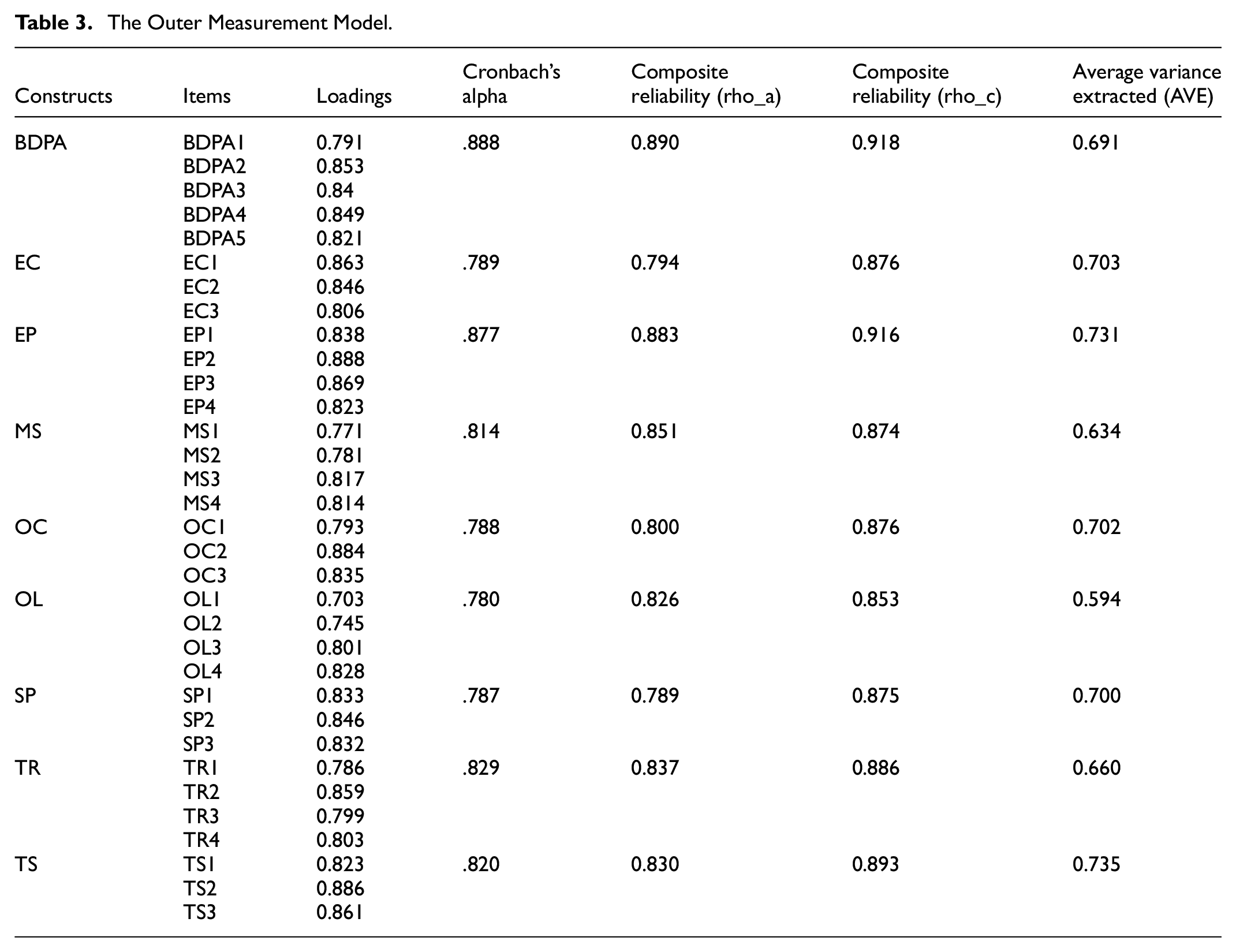
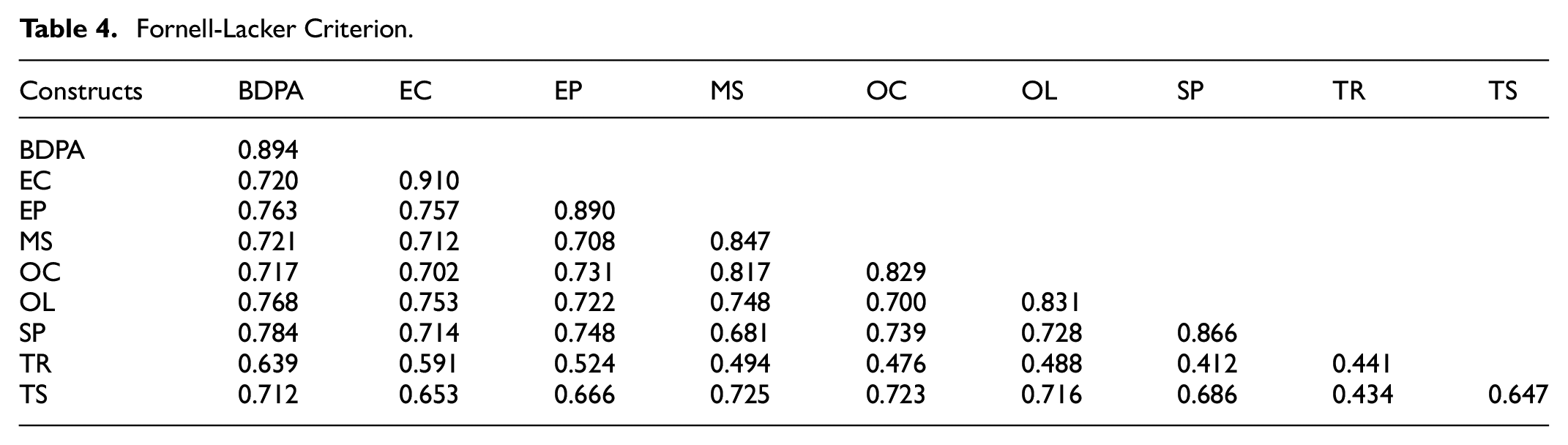
As stated by Hair et al. (2010), it is crucial to ascertain and validate the reliability and validity of the variables throughout the assessment phase of the measurement model. In the initial stages, composite reliability (CR) and Dijkstra-rho Henseler’s (rho A) were employed to assess construct reliability. A previous investigation found that CR and rho A values exceeding 0.7 were indicative of a significant level of dependability (B.-H. T. Nguyen et al., 2023). The CR value exceeded the minimum criterion of 0.7, as shown in Table 3. In order to assess convergent validity, the research investigated item factor loading (FL) and average variance extracted (AVE). As a general principle, it is recommended that factor loadings exceed 0.7, while AVE should not fall below 0.5. All factor loadings exceeded 0.7, and AVE values surpassed the 0.5 thresholds, as shown in Table 2. The convergent validity of the variables was thus deemed adequate. Using Fornell-Lacker criterion to assess discriminant validity, the variance of its own indicator should be more adequately explained by a latent construct than the variance of other latent constructs (Ab Hamid et al., 2017; L.-T. Nguyen et al., 2024). In Table 4, the square root of the AVE for each latent construct is greater than the correlations between that construct and the other latent constructs. This indicates that the proposed variables possess sufficient discriminant validity, as they are statistically distinct from one another.
The Outer Measurement Model.
Fornell-Lacker Criterion.
Inspecting the Inner Structural Model
After the construct measurements’ validity and reliability were verified, the model fitness of both the estimated and saturated models was assessed using the Standardized Root Mean Square Residual (SRMR). The reported SRMR values of 0.043 and 0.051, respectively, were both below 0.08, suggesting that the model fit was satisfactory (Duc et al., 2024; B.-H. T. Nguyen et al., 2024; L.-T. Nguyen et al., 2024). Before conducting an analysis of the inner structural model, the collinearity test was employed to ascertain the existence of closely coupled components. The variance inflation factors (VIF) for all constructs ranged from 1.000 to 3.210, which was below the threshold value of 5.0 (Aw et al., 2023). This suggests that the risk of multicollinearity was not as significant of a concern. As shown in Figure 3 and Table 5, six of the eight hypotheses were confirmed. TR and TS had a negligible impact on BDPA, contrary to initial expectations; thus, H1 and H2a were largely unsupported.

Structural model testing.
Results of Hypotheses Testing.

<.05. **<.01. ***<.001.
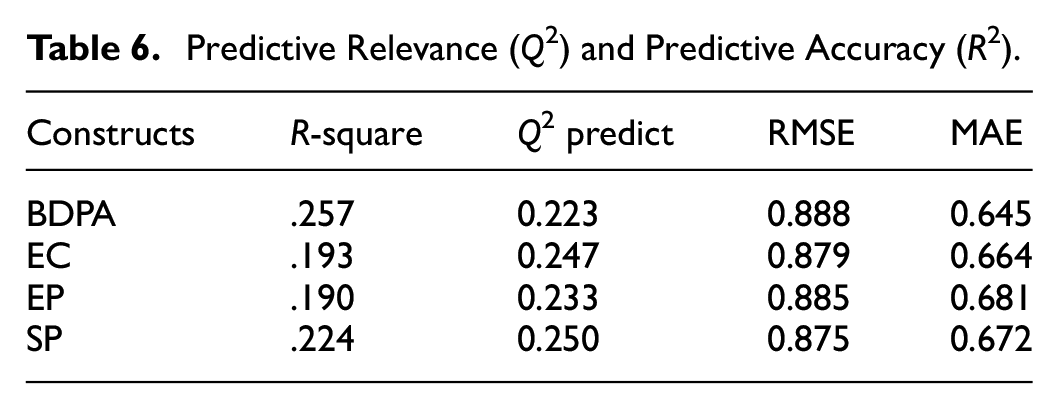
The findings indicated that MS, OC, and OL have significant effects on BDPA, providing support for hypotheses H3, H4, and H5. In conclusion, the outcomes demonstrate that BDPA exerts favorable effects on EP, SP, and EC; thus, H6, H7, and H8 are validated. The fact that each of the Q2 values for BDPA to EP, SP, and EC in Table 6 was greater than 0 indicates that the model was adequately predictive. The model exhibited a strong predictive capability, as evidenced by the fact that none of the root mean squared error (RMSE) indices in the PLS-SEM model surpassed those in the linear model benchmark.
Predictive Relevance (Q2) and Predictive Accuracy (R2).
Predictive Relevance and Effect Size
In order to assess the predictive capability of the structural model, Stone-Q Geisser’s value was computed. When the values exceed zero, the model is considered to be possess predictive relevance in both directions. Column Q2 (1-SSE/SSO) in Table 6 presents the ultimate value of Q2 for cross-validated redundancy, which is greater than zero. Consequently, this demonstrates that the model possesses predictive relevance. Furthermore, the effect sizes (f2) for each of the exogenous constructs are computed in Table 7. The impact of an external latent construct on the R2 value of an endogenous construct is quantified by the effect size. The threshold values for small, medium, and large effect sizes, as defined by Gefen (2000), are 0.02, 0.15, and 0.35, respectively. When the value is below 0.02, the exogenous construct remains insignificant. As shown in Table 8, BDPA had a moderate effect on EP, SP, and EC.
PLS Predict.

Effect Size (f2).

Discussions and Conclusions
Discussions
The interpretation of research outcomes that support the adoption of the majority of research paths occurs in this section. Management skills, organizational culture, and organizational learning are crucial determinants in assessing the adoption of BDPA by employee toward supply chain management, as indicated by the research findings. Nevertheless, H1 and H2 are denied on the grounds that the p-values required for each hypothesis to have a significant impact are less than .05. The findings indicate that Tangible Resources and Technical Skills do not exert a statistically significant influence on employees’ engagement in BDPA (Big Data and Predictive Analytics) adoption. This result diverges from prior studies, such as Dubey et al. (2019) and Wamba et al. (2017), which emphasized these elements as critical enablers of big data initiatives. One possible explanation for this discrepancy in the Vietnamese context lies in the absence of strategic alignment and coherent planning for BDPA implementation. Many organizations may possess the necessary infrastructure and technical capabilities, yet lack clearly defined objectives, cross-functional coordination, and digital transformation roadmaps—key components that facilitate effective resource utilization. Moreover, without a strong internal communication strategy and comprehensive training programs, employees may remain unaware of BDPA’s potential benefits or lack the skills to leverage available tools (Coombs & Laufer, 2018). For instance, while some Vietnamese firms have invested heavily in analytics platforms, they often fail to integrate these systems with departmental goals or provide adequate upskilling opportunities. This misalignment leads to underutilization of both technological assets and human capital. Consequently, the perceived utility of technical competencies and tangible resources diminishes in the eyes of employees, thereby weakening their role as drivers of BDPA adoption. These findings suggest that organizational readiness, not merely the presence of resources, is essential for translating capabilities into meaningful digital engagement—posing a challenge to traditional RBV assumptions and pointing toward the need to incorporate dynamic capability or orchestration perspectives in future research. Second, organizational learning, management skills, and organizational culture have positive effects on the adoption of BDPA. The results are in line with previous studies (Haffar et al., 2023; Huynh et al., 2023; Inthavong et al., 2023). An organization that prioritizes continuous learning adapts more readily to the changes associated with BDPA, fostering a dynamic environment where new skills and knowledge are embraced (Younis et al., 2022). Effective management skills, including visionary leadership and adept change management, guide the organization through the complexities of BDPA implementation (Agrawal et al., 2023). A forward-thinking organizational culture that values innovation and collaboration is essential, creating a fertile ground for the integration of data-driven decision-making processes (Ganjare et al., 2024). In such an environment, BDPA becomes not just a technological addition but an integral part of the organizational fabric, empowering teams to leverage data for strategic insights and enhancing overall business performance. Finally, hypotheses H6, H7, and H8 are supported by statistical findings that validate research conclusions (Maroufkhani et al., 2020; Nilashi et al., 2023). It confirmed that BDPA adoption helps organizations to minimize their environmental footprint through sustainable logistics, reduced emissions, and optimized transportation routes. Moreover, companies who use BDPA can either ensure fair labor, and contributing to societal goals like gender equality (SDG 5) and responsible consumption (SDG 12) or support inclusive growth and driving sustainable market practices, in line with SDG 8. By leveraging organizational resources in accordance with BDPA, supply chain managers can increase the sustainable productivity of businesses and, consequently, maintain their market position. Maintaining a delicate equilibrium between the efficient utilization of BDPA, a critical asset within the organization, and the factors that influence its adoption in order to facilitate effective supply chain management and, consequently, the overall prosperity of the organization, is of utmost significance.
Theoretical Implications
The theoretical feedback loop can serve to emphasize the theoretical contributions when the theory is implemented in novel contexts. This suggests that scholars require further comprehension of novel facets of the theory within a recently embraced framework (Whetten, 1989). It is emphasized that prior analogies must be modified in order to challenge established rationales while endorsing accepted theories when they are applied to a new context. This provides a comprehensive examination of established perspectives on the conceptualization of theories, taking into account organizational resources, contextual factors, and human capabilities. Thus, the research contributions of this study are demonstrated by the value contributed to the adopted theories and prior literature, as well as by providing an overview of the supply chain management industry.
To begin with, this study employs the RBV theory to examine the influence of BDPA on the achievement of sustainable objectives. This research proposes non-traditional theoretical frameworks for examining the effects of BDPA implementation on organizational performance. As an alternative to formulating business sustainability on the basis of a collection of practices, the RBV theory is applied to a collection of capabilities. Expanding upon the RBV framework, BDPA can provide a sustainable competitive advantage in supply chain management if implemented strategically. This viewpoint complements current theoretical literature that is based on organizational research and employee perspectives. As it employs an insider’s perspective, the RBV theory typically places greater emphasis on the internal structure of organizations and places less emphasis on employee-related factors. By investigating organizational culture and incorporating the organizational learning factor in addition to the RBV theory’s factors, our research is able to surmount this limitation. The findings of this research underscore the importance of aligning organizational learning with BDPA capabilities, organizational resources, and culture.
Furthermore, by applying the contingency RBV theory to the examination of the effects of BDPA adoption on sustainable performance, this research has the potential to advance current knowledge. This research paper contributes to the body of knowledge on dynamic RBV by defining and examining three distinct types of business performance—economic, social, and environmental—in the context of supply chain management.
Finally, the research model is implemented in a developing environment, Vietnam, in an effort to attain a sustainable development. The Digital Transformation Agenda (DTA) of the Vietnamese government is propelling the country toward Industry 4.0 by utilizing digital technologies to stimulate economic growth, enhance governance, and advance social development. Promoting digital transformation as the means to attain the nation’s two principal development objectives—net-zero carbons emissions by 2050 and high-income status by 2045—is the prevailing strategy (Open Development Vietnam, 2023). The proposed vision incorporates the extensive resources of the BDPA infrastructure into the strategies employed by private and public entities in order to achieve their objectives. Therefore, investigating the implementation of BDPA in this context yields significant knowledge regarding the influence of various elements on the supply chain management of businesses.
Managerial Implications
The investigation of BDPA adoption holds profound managerial implications across economic, social, and environmental dimensions. Economically, BDPA can drive operational efficiency, provide a competitive edge through informed decision-making, and contribute to revenue growth by identifying new opportunities. Socially, managers must prioritize employee skill development for effective BDPA utilization, communicate transparently with stakeholders, and address ethical considerations surrounding data privacy and biases. Environmentally, BDPA adoption can optimize resource usage, enhance supply chain sustainability, and contribute to reducing an organization’s carbon footprint. A comprehensive managerial approach is necessary, encompassing economic benefits, social responsibility, and environmental sustainability, to ensure the ethical and sustainable integration of BDPA into organizational practices.
Limitation and Future Research Directions
This study provides valuable insights into the role of Big Data and Predictive Analytics (BDPA) in enhancing organizational performance. However, several limitations should be acknowledged, which offer avenues for future research. First, while this study examined the effects of BDPA on economic, social, and environmental performance, it did not consider the potential interaction with other strategic initiatives such as green innovations and AI applications. These technologies could complement or amplify the impact of BDPA on sustainability outcomes (AlNuaimi et al., 2021; Sabando-Vera et al., 2025). Future research should explore how the integration of BDPA with green and AI-driven innovations contributes to holistic organizational performance across the triple bottom line. Second, although organizational culture was identified as a significant enabler of BDPA adoption, this study did not explore the influence of leadership—particularly the mindset and strategic vision of top management or business owners—on cultivating a data-driven culture. Given that leadership styles can significantly shape employee attitudes, resource allocation, and the pace of technology adoption (Eliyana et al., 2019; Singh et al., 2020), future research could investigate the mediating or moderating role of leadership in BDPA implementation. Third, the study did not account for employee-level variations such as job roles, departmental affiliations, and digital readiness, which may significantly influence how individuals engage with BDPA initiatives. Future research should consider collecting stratified or multi-group data to capture these nuances and assess how different employee segments perceive and adopt BDPA technologies. Fourth, the use of a cross-sectional research design limits the ability to assess the long-term effects and dynamic evolution of BDPA adoption. Longitudinal studies would offer deeper insights into how BDPA influences organizational learning, adaptability, and sustained performance—particularly in fast-changing markets like Vietnam. Finally, the study’s geographic concentration in the Northern and Southern regions of Vietnam may constrain the generalizability of the results. Future research could adopt a comparative or multi-country approach to investigate how institutional, cultural, and policy contexts shape BDPA adoption and outcomes.
Conclusion
This research investigates the potential impact of organizational learning, tangible resources, technical skills, management skills, and organizational culture on BDPA adoption by employing a combination of theoretical frameworks. The study reflects sustainable development by emphasizing the role of Big Data and Predictive Analytics (BDPA) in optimizing resource utilization and reducing waste, which aligns with SDG 12: Responsible Consumption and Production. By enabling efficient demand forecasting and inventory management, BDPA helps minimize excess production, thereby reducing the environmental footprint. Economically, the research highlights how BDPA improves supply chain performance (SCP), contributing to cost savings, enhanced competitiveness, and better resource allocation, supporting sustainable economic development. Social sustainability is also addressed through improved community resilience, as BDPA enhances supply chain visibility and enables companies to anticipate and respond effectively to extreme weather events, ensuring continuity in critical industries like healthcare and food supply. These capabilities correspond with various Sustainable Development Goals, including SDG 8 (Decent Work and Economic Growth), SDG 9 (Industry, Innovation, and Infrastructure), and SDG 13 (Climate Action). The study highlights how BDPA facilitates sustainable development by enhancing environmental, economic, and social resilience within organizations and their wider societal influence.
Footnotes
Appendix A

Ethical Considerations
Ethical approval for this study was obtained from the Ethics Review Board of the Scientific Group at HUFLIT (Ho Chi Minh City University of Foreign Languages-Information Technology), Approval No: 19/ESSG.
Consent to Participate
Informed verbal consent was obtained from all participants prior to data collection, in accordance with the Declaration of Helsinki.
Funding
The author(s) received no financial support for the research, authorship, and/or publication of this article.
Declaration of Conflicting Interests
The author(s) declared no potential conflicts of interest with respect to the research, authorship, and/or publication of this article.
Data Availability Statement
The datasets generated during and/or analyzed during the current study are available from the corresponding author on reasonable request.