




Abstract
Teachers’ subjective well-being can be regarded as an indicator of their healthy functioning at work. This implies that positive organizational factors like principal instructional leadership, the climate of trust, work autonomy, and collaboration can potentially create healthy work environments for teachers. The current study examined the relationship between principal instructional leadership and teachers’ subjective well-being. The mediating roles of the climate of trust, teachers’ work autonomy, and teacher collaboration in this relationship were also examined. The geographical region was included as a control variable to check the effects of macro-cultural differences among jurisdictions that participated in the Programme for International Student Assessment (PISA) 2022. This cross-sectional study employed a multinational dataset of PISA 2022. Participants included 52,823 teachers working in 17 jurisdictions in countries that participated in PISA 2022. Structural equation modeling was used to analyze the data. Findings indicated that principal instructional leadership positively influenced teachers’ subjective well-being directly and indirectly through the climate of trust, teachers’ work autonomy, and teacher collaboration. Furthermore, the geographical region was found to significantly influence teachers’ well-being, the climate of trust, teachers’ work autonomy, and teacher collaboration. Based on the study findings, establishing team structures, building an instructional coaching system, implementing co-teaching strategies, and establishing feedback systems to provide constructive, supportive, and positive feedback to teachers were among the recommended points.
Keywords
Introduction
Subjective well-being has frequently been used to measure teachers’ attitudes toward their professions. Teachers’ subjective well-being can be regarded as an indicator of “healthy and successful functioning at work” (Renshaw et al., 2015). Teaching has generally been portrayed as a stressful profession (e.g., Nwoko et al., 2023). For instance, the Teaching and Learning International Survey (TALIS) 2018 results put forward that 18% of lower secondary teachers from the Organization for Economic Co-operation and Development (OECD) countries experienced stress a lot in their workplaces. Similarly, 15% of upper secondary teachers who participated in TALIS 2018 reported experiencing a lot of stress. What is worse, 7% of these participants reported that their profession negatively influenced their mental health while 6% reported it negatively influenced their physical health. The participants who reported experiencing stress a lot were relatively more inclined to leave the profession within the following 5 years (OECD, 2020, 2021).
Socioeconomic status and relatively low financial income were found to cause stress among teachers (Katsantonis, 2020). Likewise, high-stakes testing and strict accountability policies forcing teachers to produce uniform student outcomes amplify stress and weaken teachers’ well-being (Chong & McArthur, 2023). The main threat to teachers’ subjective well-being is, however, workplace stress caused by organizational factors (Renshaw et al., 2015) like lack of support from school leadership, distrust among school members, work-related changes or student-related problems decreasing teachers’ control over their work and colleagues unwilling to cooperate in such issues (Castro Silva et al., 2024).
To illustrate, during the COVID-19 outbreak teachers worldwide abandoned traditional face-to-face education and abruptly shifted to distance education. Teachers experienced extreme isolation at the beginning of the outbreak. They predominantly felt weak and anxious while shifting to uncertain and restricted modes of teaching through digital platforms. The interaction between teachers and other school members was minimized (Katsarou et al., 2023). Teachers were largely deprived of support from school administrators and cooperation with their colleagues during the adaptation process (Koç & Fidan, 2022). The outbreak aggravated stressful conditions for teachers worldwide as they had to fulfill their traditional tasks and meet accountability requirements in a highly volatile environment providing a minimum level of human interactions (Katsarou et al., 2023). These conditions call for large-scale international studies focusing on teachers’ subjective well-being (Blair et al., 2024). Moreover, the OECD (2021) highlighted the importance of organizational factors in decreasing workplace stress and enhancing teachers’ subjective well-being, which suggests the necessity of examining organizational factors potentially influential on teachers’ subjective well-being in addition to the phenomenon itself.
The relevant literature identified organizational factors that positively influence teachers’ subjective well-being. For instance, instructional leadership (Karaferye & Bellibaş, 2025), the climate of trust (L. Liu et al., 2024), work autonomy (Nwoko et al., 2023), and collaboration (Turner et al., 2022) were identified as organizational factors potentially enhancing teachers’ subjective well-being. At this point, Cheng et al. (2016) recommend using multinational datasets in subjective well-being studies since individuals (sharing the same personality traits) from different countries tend to respond to organizational factors similarly when making self-assessments about their well-being. Studies regarding such factors have been emerging, yet relevant literature still lacks studies on the effects of instructional leadership on teachers’ subjective well-being in a multinational context.
Furthermore, instructional leadership was previously found to positively influence the climate of trust, work autonomy, and collaboration (Hallinger, 2018; Karaferye & Bellibaş, 2025), implying possible mediation effects of these constructs. However, the literature particularly lacks studies on the mediating roles of the climate of trust, teacher autonomy, and teacher collaboration in the relationship between instructional leadership and teachers’ subjective well-being. To address the gaps in the literature, this study examined the relationships between principal instructional leadership and teachers’ subjective well-being, and the mediation roles of climate of trust, teacher autonomy, and teacher collaboration in this relationship in a multinational context.
Finally, macro-cultural differences between geographical regions can potentially lead to differences in levels of subjective well-being across countries. Individualistic societies attach more importance to freedom of choice and agency than collectivist societies, influencing individuals’ evaluations regarding subjective well-being and workplace relationships (Cheng et al., 2016). Accordingly, this study included the geographical region as a control variable to reveal whether participants’ reports differ in terms of cultural differences between jurisdictions that participated in the Programme for International Student Assessment (PISA) 2022.
Theoretical Underpinnings
This section presents the theoretical underpinnings of the study. The first theoretical basis of the study was the Human Flourishing Theory (Keyes, 2002). According to this theory, mental health does not refer to an absence of mental illness. Mental health can be defined by taking “symptoms of positive feelings and positive functioning in life” into consideration (Keyes, 2002). Individuals are expected to have high levels of subjective well-being when they perceive themselves as flourishing in personal and work lives. The combination of emotional, psychological, and social wellness gives rise to such perceptions. A high level of positive feelings and a low level of negative feelings can be regarded as an indicator of emotional wellness. Emotionally healthy individuals are happy, calm, and in good spirits. Individuals’ control over their environment, sense of autonomy, and high-quality positive relationships with others can lead to high psychological wellness. In other words, collaboration, trust-based relationships with others, and individuals’ autonomy in making their own decisions in private and work lives can foster subjective well-being. Social wellness includes individuals’ seeing themselves as thriving in their community. This implies that subjective well-being can be achieved in a community in which people care about each other’s problems and feel close to each other. Put differently, social support can enhance the subjective well-being of individuals (Keyes, 2002).
Briefly, teachers’ subjective well-being cannot be solely portrayed as an intrinsic construct like a state of mind free from any mental illness. It also involves extrinsic factors influencing teachers’ positive feelings and positive functioning in life (Keyes et al., 2002), such as principal instructional leadership, the climate of trust, work autonomy, and collaboration among colleagues (Karaferye & Bellibaş, 2025). These factors can create a flourishing work environment for teachers where they can access assistance when they need it, they can apply appropriate teaching methods to address the needs of students, and they can enjoy positive feelings after overcoming their problems in their work and private lives (Bardach et al., 2022).
The second theoretical basis of the study is the Instructional Leadership Theory (Hallinger, 2018). According to this theory, school principals are not only administrators who solely focus on the daily running of schools but also instructional leaders who contribute to the quality of teaching and learning. Principals can positively influence teachers’ subjective well-being directly by practicing instructional leadership (Karaferye & Bellibaş, 2025). They can directly support teachers about instructional matters like collaborating with them to solve classroom management issues. They can also provide teachers feedback about the effectiveness of instruction, and encourage them to engage in continuous professional development. Furthermore, school principals can indirectly influence teachers’ subjective well-being by establishing a climate of trust, supporting teachers’ work autonomy, and encouraging collaboration among them (Karaferye & Bellibaş, 2025). In other words, they can contribute to creating favorable conditions to alleviate workplace stress and support teachers’ professional development. School principals can promote trust-based relationships in a school, encourage teachers to collaborate to solve instructional problems, and give them the autonomy necessary to make their own decisions about classroom practices (Hallinger, 2018).
The third theoretical basis of the study is the Knowledge-Based Trust Theory (Shapiro et al., 1992). This theory implies that school principals can contribute to establishing a climate of trust in a school (Shapiro et al., 1992). The climate of trust, in turn, can positively influence teachers’ subjective well-being, work autonomy, and collaboration (M. K, Chan et al., 2021; Lockton, 2019).
The basis of trust is predictability. Employees trust others when they can predict their actions. Such predictability can only be achieved through intense interactions between employees. Regular and intense communication among an organization’s members is the first prerequisite for building a climate of trust. It enables individuals to grasp each other’s work-related expectations and ideas. The second prerequisite is high-quality relationships among the organization’s members. Such relationships provide individuals with knowledge of each other’s personality and emotional conditions. As the interaction intensifies, employees can accumulate the knowledge required to predict their co-workers’ actions and learn when and how to rely on them (Shapiro et al., 1992). Organizational leaders like school principals can contribute to constructing a climate of trust by encouraging interactions among employees. The climate of trust, as a means of coping with uncertainty and enhancing predictability, can equip employees with the social support they need to overcome the negative effects of workplace stress. The climate of trust can create favorable conditions for collaboration by highlighting regular communication and high-quality relationships in an organization. It can also encourage employees to rely on their co-workers’ ability to perform tasks and make decisions autonomously (Jiang et al., 2017).
Put differently, the climate of trust creates a flourishing environment for teachers. In such a climate, teachers enjoy relative autonomy while solving their in-classroom problems as they can ask for the assistance of administrators and other teachers without the fear of humiliation (Thien & Lee, 2023). Trust-based school climates can encourage teachers to engage in professional learning to enhance their professional skills and establish a favorable environment fueling teachers’ positive feelings and functioning (P. Liu et al., 2024).
The intersection of these theories has led to the development of a conceptual framework. These theories posit that school principals can positively influence teachers’ subjective well-being by providing support in instructional matters. They can also influence teachers’ subjective well-being by creating a climate of trust and encouraging teacher autonomy and collaboration among teachers (Hallinger, 2018).
Conceptual Framework
The conceptual framework of the study is presented in Figure 1. This figure shows the relationships between variables tested in this study. The study variables were teachers’ subjective well-being (Renshaw et al., 2015), principal instructional leadership (Neumerski, 2013), the climate of trust (L. Liu et al., 2024), work autonomy (Nwoko et al., 2023), and collaboration (Turner at al., 2022). Principal instructional leadership was employed as an independent variable since school principals were depicted in the relevant literature as the top administrators of schools (Hallinger, 2018). They have sufficient formal authority to directly influence teachers’ work-related attitudes and indirectly influence their mental health by creating favorable work conditions (Neumerski, 2013). The climate of trust, work autonomy, and collaboration were preferred as mediator variables as these variables were theoretically and empirically portrayed as components of a flourishing work environment supporting teachers’ subjective well-being (Karaferye & Bellibaş, 2025; Thien & Lee, 2023). These variables were also theoretically identified as school climate components which can be shaped by the interventions of school principals (Hallinger, 2018). I included the influences of the geographical region into the conceptual framework to check whether participants’ reports regarding study variables differ in terms of the geographical region where the participants’ jurisdictions are located. The following sections will introduce definitions of the study variables and hypotheses of the study.

Conceptual framework.
Teachers’ Subjective Well-Being
Subjective well-being has been regarded as one of the indicators of the quality of life. Unlike objective indicators like income, health status, or educational attainment, subjective well-being is based on individuals’ subjective assessment of the quality of their lives (Thien & Lee, 2023). These assessments are the outcomes of individuals’ reflective cognitive judgments about their current status in a workplace or society. They manifest themselves as emotional responses to ongoing events in terms of positive versus negative emotions (Katsarou et al., 2023). For instance, when individuals engage in such a reflection and make judgments on their work, they compare their current work-life standards with good work-life standards in their minds. Such a reflection usually includes individuals’ appraisals about several work-related factors like the general satisfaction in personal and work lives, the meaning they attribute to their work, the beliefs regarding their job skills, the expectations from work, the thriving opportunities they have at work, the quality of relationships, the amount of support they receive and the feelings they experience at the workplace. Individuals usually experience positive and pleasant emotions when they assess workplace events as desirable (Diener et al., 2018). In short, subjective well-being does not refer to just being free of stress, illness, or pain. Instead, it implies having positive emotions and functioning as a result of the appraisal of individuals on to what extent see themselves as flourishing in personal and work lives (L. Liu et al., 2024).
It would be fair to argue herein that there is a tendency in the relevant literature to define teachers’ subjective well-being by using the flourishing perspective. For instance, Aelterman et al. (2007) define teachers’ subjective well-being as “a positive emotional state, which is the result of harmony between the sum of specific environmental factors on the one hand, and the personal needs and expectations of teachers on the other hand.” Likewise, Renshaw et al. (2015) portray teachers’ subjective well-being as “teachers’ self-perceptions of healthy and successful functioning at work.” Teachers make these assessments by considering complex interactions of organizational and individual factors resulting in teachers’ having positive emotions and functioning. These definitions posit that teachers first reflect on the demands of their work environment, and their capabilities and expectations to respond to these demands (Bardach et al., 2022). Social resources like high-quality relationships and support from co-workers, and cognitive resources like effective teaching skills can help teachers to perceive themselves as flourishing at work. Such an evaluation of the affective, cognitive, psychological, and social aspects of teaching is highly likely to evoke positive emotions in teachers regarding their functioning at work (Vo et al., 2024).
Teachers’ subjective well-being involves teachers’ evaluations of work and private life conditions, and affective reactions to their work and private life experiences (Mérida-López et al., 2022). Put differently, it arises from teachers’ responses to their working conditions. This also underlines the importance of organizational factors in enhancing teachers’ subjective well-being (Thien & Lee, 2023). For instance, instructional leadership could positively influence teachers’ mental states since teachers perceive such leadership as social support (Shaked, 2024). The following section will elaborate on the effect of principal instructional leadership on teachers’ subjective well-being.
The Influence of Principal Instructional Leadership on Teachers’ Subjective Well-Being
School principalship is usually the highest level of administrative position in a school worldwide (Neumerski, 2013). School principals are mainly administrators responsible for the daily running of the schools. They are responsible for implementing legislation regulating student enrollment, graduation, conduct, and misconduct. The maintenance of school buildings and equipment, the supervision of teachers and other school staff, and the communication with superior educational organizations, and governmental and non-governmental organizations are usually among principals’ administrative duties (Park & Ham, 2016).
School principals are also the main leader candidates for teachers. Their bureaucratic positions and formal authority turn them into leaders in the eyes of teachers and students. More precisely, principals are seen as instructional leaders of their schools. Instructional leadership refers to a leadership perspective that stresses the principal’s responsibility for improving the quality of teaching and learning (Shaked, 2024). The fact that no weak leadership was found in effective schools gave rise to the notion of instructional leadership (Neumerski, 2013). Instructional leadership involves all leadership practices that indirectly influence student learning. Instructional leaders define their schools’ missions and communicate school goals to school members in a persistent manner. They place great importance on supervising instruction, coordinating curriculum, and monitoring student progress. They strongly promote a productive and supportive school climate highlighting trust, the empowerment of teachers, and collaboration (Hallinger, 2018).
Instructional leadership entails school principals directly interacting with teachers. They are expected to collaborate with teachers and provide feedback about their strengths and weaknesses (Neumerski, 2013). Identifying the professional development needs of teachers and facilitating their access to professional development activities are usually regarded as instructional leadership practices (Karaferye & Bellibaş, 2025). Furthermore, they must assist teachers in overcoming obstacles like classroom management problems and low academic achievement (Hallinger, 2018). Teachers predominantly perceive these practices as principals’ sincere attempts to increase teachers’ motivation, health, and professional growth. Hascher and Waber (2021) and Liebowitz and Porter (2019) identified instructional leadership as one of the most frequently studied predictors of teachers’ subjective well-being in their systematic literature review studies. At this point, Dilekçi and Limon (2020) found a significant and positive relationship between instructional leadership and teachers’ subjective well-being in the Turkish context. Similarly, P. Liu et al. (2024) revealed, in their study with Chinese primary and secondary school teachers, that instructional leadership positively influenced teachers’ subjective well-being. Based on these discussions, I developed the following hypothesis.
H1: Principal instructional leadership positively influences teachers’ subjective well-being.
The Mediating Roles of Climate of Trust, Teachers’ Work Autonomy, and Teacher Collaboration
The climate of trust is the first mediator variable of the study. The climate of trust is an indicator of the quality of the relationships in a school. It is a shared psychological state of school members. In schools with a climate of trust, administrators, and teachers do not hesitate to reveal their vulnerable aspects to others and keep their positive beliefs regarding others’ intentions and readiness to provide support when necessary (M. K. Chan et al., 2021). Positive experiences from previous social interactions enhance interpersonal trust by decreasing the uncertainty about when school members feel secure about revealing their strengths and weaknesses, how they build relationships, and what they expect from these relationships (Tschannen-Moran, 2001). The climate of trust is usually associated with other positive organizational factors like the increased work autonomy of teachers and collaboration among school members (Kilag & Sasan, 2023). To illustrate, M. K. Chan et al. (2021) identified the climate of trust in a school as an antecedent of teachers’ work autonomy. Trust-based relationships positively influence teachers’ control over their work, particularly in crises like the COVID-19 outbreak (M. K. Chan et al., 2021). Similarly, Tschannen-Moran (2001) detected the climate of trust as a prerequisite for collaboration among school members. It nurtures collaborative efforts to overcome barriers to student achievement (Lockton, 2019; Tschannen-Moran, 2001).
Teachers’ work autonomy is the second mediator variable of the study. Teaching is viewed as an autonomous work predominantly undertaken independently by teachers in isolated classroom settings. However, teaching tasks, contents of teaching materials, and working conditions are usually shaped by the expectations of political and social pressure groups. This may limit teachers’ decision-making authority (Worth & Van den Brande, 2020). Put differently, teachers’ control over their work determines their work autonomy. Teachers’ work autonomy refers to the extent teachers have control over the teaching materials they use, teaching goals they follow, teaching methods they employ in the classroom, and strategies they develop to overcome student-related problems (Jerrim et al., 2023). Teachers’ work autonomy is frequently associated with positive organizational behaviors like increased motivation, job satisfaction, and retention (Worth & Van den Brande, 2020).
Teacher collaboration is the third mediator variable of the study. Teacher collaboration covers different levels of teacher interactions in a school. Low-density interactions take place in the form of storytelling or scanning through informal conversations among teachers (Webb et al., 2009). Moderate-density interactions feature help and assistance. Teachers frequently exchange criticism, feedback, and strategies in this type of interaction. High-density interaction involves teachers’ cooperation to solve an instructional problem, undertake standard assessments, or address the learning needs of specific students. Teacher collaboration is a voluntary, equalitarian, and mutually shaped endeavor of teachers to share resources, the responsibility for decision-making, and the accountability for the results (Park & Ham, 2016). Teacher collaboration is associated with positive individual and organizational outcomes like instructional quality and teachers’ subjective well-being (Webb et al., 2009).
H2: The climate of trust positively influences teachers’ work autonomy.
H3: The climate of trust positively influences teacher collaboration.
There is a rich body of literature on the organizational effects of instructional leadership (Hallinger, 2018). Instructional leadership is predominantly theorized on the assumption that principals influence student achievement indirectly by contributing to organizational factors like the climate of trust, teachers’ work autonomy, and teacher collaboration (Hallinger, 2018; Kouhsari et al., 2023). At this point, M. K. Chan et al. (2021) conclude that the quality of the principal leadership strongly influences the construction of trust-based relationships. Similarly, Raczynski et al. (2022) unearthed that effective instructional leadership could facilitate the establishment of a climate of trust in a school. Instructional leadership was also found to be positively associated with teacher autonomy (Akgöz et al., 2024). Effective instructional leaders can balance between teachers’ autonomy needs to deal with specific problems in their classrooms, and their need for alignment with administrators and colleagues necessary for coordination and collaboration (Worth & Van den Brande, 2020). Moreover, Park and Ham (2016) found that teachers more likely tended to establish collegial relationships and engage in collaborative interactions when they perceive principals’ instructional leadership as effective. Likewise, Meyer et al. (2022) put forward that instructional leadership positively influenced teacher collaboration. Based on these discussions, I developed the following hypotheses.
H4: Principal instructional leadership positively influences the climate of trust.
H5: Principal instructional leadership positively influences teachers’ work autonomy.
H6: Principal instructional leadership positively influences teacher collaboration.
The climate of trust (Tschannen-Moran, 2001), work autonomy (Worth & Van den Brande, 2020), and teacher collaboration (Park & Ham, 2016) are positive organizational factors that are supposed to alleviate workplace stress and create favorable working conditions for teachers (Castro Silva et al., 2024; Yu & Chen, 2023). Teachers usually respond positively to such factors as they feel psychologically safe enough to expose their vulnerabilities and courageous enough to ask for help when they need it without the fear of humiliation (Vo et al., 2024). Thanks to these factors, they can enjoy the freedom to implement their methods and strategies to overcome problems specific to their classrooms. Also, they can access the support of administrators and their colleagues through collaborative networks in their schools (Keyes, 2002; Worth & Van den Brande, 2020). In support of these arguments, L. Liu et al. (2024) found that the climate of trust positively influenced teachers’ subjective well-being. Thien and Lee (2023) also revealed that teachers’ subjective well-being was relatively higher in schools featuring trust-based relationships between school members. Likewise, Hascher and Waber (2021) and Nwoko et al. (2023) identified work autonomy as one of the organizational factors enhancing teachers’ subjective well-being. Finally, collaborative practices among teachers were found to enhance subjective well-being by diminishing loneliness and isolation and providing social support to teachers (Turner et al., 2022). Besides, Vo et al. (2024) reported that teachers regarded collaboration as one of the components of a working environment nurturing subjective well-being. Based on these discussions, I developed the following hypotheses.
H7: The climate of trust positively influences teachers’ subjective well-being.
H8: Teachers’ work autonomy positively influences teachers’ subjective well-being.
H9: Teacher collaboration positively influences teachers’ subjective well-being.
H10: The climate of trust, teachers’ work autonomy, and teacher collaboration mediate the influence of principal instructional leadership on teachers’ subjective well-being.
Geographical Region as a Control Variable
Countries’ cultural and political contexts can influence teachers’ well-being perceptions and evaluations regarding their working conditions (Cheng et al., 2016). In well-being studies, countries are frequently grouped into larger geographical and cultural regions, such as Latin America, Europe, Middle East & Africa, and East Asia (Wang et al., 2021). For instance, subjective well-being evaluations of East Asian, Middle Eastern, European, and Latin American teachers were previously reported to be significantly different due to the influences of cultural individualism/collectivism. Particularly, the stress levels of teachers from highly collectivist East Asian countries (like South Korea and Hong Kong) were found to be higher than those of teachers from Europe and the Middle East (Katsantonis, 2020). This is because, strict accountability and high-stakes testing policies are getting widespread in East Asia and teachers are expected to meet the high-performance criteria of societies (Chong & McArthur, 2023; Ro, 2018; Sasiwuttiwat & Tangkitvanich, 2019). Teachers’ evaluations of instructional leadership may also differ across these regions. Teachers in East Asian and Middle Eastern countries with collectivist cultures tend to rate the effectiveness of instructional leadership higher than their peers in European countries with individualistic cultures (Çoğaltay & Boz, 2023).
Studies, in the relevant literature, on climate of trust, teachers’ work autonomy, and teacher collaboration frequently reported significant differences in teachers’ ratings in terms of geographical and cultural differences. For instance, people in East Asian countries were found to be relatively more sensitive to trust issues and attach relatively more importance to distributive justice (Jiang et al., 2017). Similarly, teachers in individualistic Western countries were reported to enjoy more work autonomy than their peers in collectivist East Asian countries (Lin & Gao, 2023). East Asian teachers may choose to follow prescribed ways of teaching (like textbook-governed instruction and the acknowledgment of the authority of teachers in classrooms) instead of engaging in collaboration with other teachers more frequently than teachers from other regions of the world (K. T. Chan, 2021; S. N. Liu & Feng, 2015). Accordingly, I developed the following hypotheses.
H11a: The geographical region of participants significantly influences their reports on teachers’ subjective well-being.
H11b: The geographical region of participants significantly influences their reports on principal instructional leadership.
H11c: The geographical region of participants significantly influences their reports on the climate of trust.
H11d: The geographical region of participants significantly influences their reports on teachers’ work autonomy.
H11e: The geographical region of participants significantly influences their reports on teacher collaboration.
Methodology
Data Source and Sample
In this cross-sectional study, I used the data from the PISA 2022 teacher questionnaire dataset to test my hypotheses. The administration of PISA 2022 questionnaires coincided with the COVID-19 outbreak and, therefore, it provided teachers’ self-reports regarding their working conditions during the involuntary transition to distance education and gave cues about the impacts of the outbreak (OECD, 2022a). This study used the open-access dataset and does not contain any procedures with human participants conducted by the author. It posed no risk to participants as the author did not personally contact them and did not conduct repetitive and complementary data collection procedures. Ethical procedures such as ethical approval and informed consent were officially performed by the OECD.
Eighty jurisdictions from 79 countries participated in PISA 2022. Of them, 18 jurisdictions administered the teacher questionnaire of PISA 2022 (OECD, 2022a). A total of 68,054 teachers teaching 15-year-old students participated in this questionnaire. As 11,397 teachers from Australia were not administered items regarding the variables of this study, they were excluded from this study. In addition, participants who did not fill in any of the questionnaires used in this study were excluded (OECD, 2022b). As a result, the data obtained from 52,823 teachers working in 17 jurisdictions were used to test this study’s hypotheses. Descriptive statistics of the sample are presented in Table 1.
Descriptive Statistics of the Sample.

Table 1 indicates that the highest number of teachers participating in PISA 2022 was from the United Arab Emirates. Following the studies in the relevant literature (e.g., Katsantonis, 2020; Wang et al., 2021), I grouped the jurisdictions that participated in the teacher questionnaire of PISA 2022 into four regions to compare them: Latin America, Middle East & Africa, Europe, and East Asia. The majority of teachers were female and had bachelor’s degrees or below-level education. Their average age was 43.50 and their average teaching experience was 16.80 years.
Variables and Measures
The measurement model of this study involves four scales: subjective well-being, principal instructional leadership, the climate of trust, teachers’ work autonomy, and teacher collaboration. This section explains the measures and variables used in the study.
Teachers’ subjective well-being was the dependent variable of this study. The items TC238Q01JA, TC238Q02JA, TC238Q03JA, TC238Q04JA, and TC238Q05JA on the Teacher Questionnaire for PISA 2022 were used to measure teachers’ subjective well-being (OECD, 2022a). Teachers were asked how often they had felt the following way during the school day in the past 2 weeks. Teachers rated each item on a four-point Likert-type scale ranging from “never” (1) to “always” (4). Items used to measure teachers’ subjective well-being are presented below.
TC238Q01JA. I felt cheerful and in good spirits.
TC238Q02JA. I felt calm and relaxed.
TC238Q03JA. I felt active and vigorous.
TC238Q04JA. I started the school day feeling fresh and rested.
TC238Q05JA. I was interested and engaged in my daily activities.
Principal instructional leadership was the independent variable of the study. The items TC253Q03JA, TC253Q04JA, TC253Q05JA, TC253Q06JA, and TC253Q07JA on the Teacher Questionnaire for PISA 2022 were used to measure teachers’ perceptions regarding principals’ instructional leadership practices. These items particularly involve principals’ instructional tasks. Teachers were asked how frequently their principals engaged in the following things during the last 12 months. Teachers rated each item on a four-point Likert-type scale ranging from “never or rarely” (1) to “very often” (4). Items used to measure principal instructional leadership are presented below.
TC253Q03JA. My principal provided feedback to teachers based on his/her observations.
TC253Q04JA. My principal took action to support cooperation among teachers to develop new teaching practices.
TC253Q05JA. My principal took action to ensure that teachers take responsibility for improving their teaching skills.
TC253Q06JA. My principal took action to ensure that teachers feel responsible for their students’ learning outcomes.
TC253Q07JA. My principal organizes people and activities in a way that facilitates the teachers’ work.
The climate of trust is the first mediator of the study. The items TC241Q01JA, TC241Q02JA, TC241Q04JA, and TC241Q05JA on the Teacher Questionnaire for PISA 2022 were used to measure teachers’ perceptions of the climate of trust. These items involve expressions regarding trust-based relationships among school members. Teachers were asked to what extent they agreed or disagreed with the following statements about what happens in their schools. Teachers rated each item on a four-point Likert-type scale ranging from “strongly disagree” (1) to “strongly agree” (4). Items used to measure the climate of trust are presented below.
TC241Q01JA. Teachers can rely on the school’s management for professional support.
TC241Q02JA. The principal has confidence in the expertise of the teachers.
TC241Q04JA. Teachers can rely on each other.
TC241Q05JA. I feel that I can trust my colleagues.
Teachers’ work autonomy is the second mediator of the study. The items TC246Q02JA, TC246Q03JA, TC246Q04JA, and TC246Q05JA on the Teacher Questionnaire for PISA 2022 were used to measure teachers’ perceptions of work autonomy. These items involve expressions about teachers’ control over their work. Teachers were asked how much control they have in the following areas at their current schools. Teachers rated each item on a four-point Likert-type scale ranging from “no control” (1) to “full control” (4). Items used to measure teachers’ work autonomy are presented below.
TC246Q02JA. Selecting teaching methods
TC246Q03JA. Assessing students’ learning
TC246Q04JA. Disciplining students
TC246Q05JA. Determining the amount of homework to be assigned
Teacher collaboration is the third mediator of the study. The items TC046Q04NA, TC046Q05NA, TC046Q06NA, and TC046Q07NA on the Teacher Questionnaire for PISA 2022 were used to measure teachers’ perceptions of collaboration among teachers. These items involve expressions about domains of collaboration among teachers. Teachers were asked how often they do the following in their schools. Teachers rated each item on a four-point Likert-type scale ranging from “never” (1) to “once a week or more” (6). Items used to measure teacher collaboration are presented below.
TC046Q04NA. Exchange teaching materials with colleagues
TC046Q05NA. Engage in discussions about the learning development of specific students
TC046Q06NA. Work with other teachers in my school to ensure common standards in evaluations for assessing student progress
TC046Q07NA. Attend team conferences
Geographical region is the control variable of this study. As shown in Table 1, jurisdictions were grouped into four regions. In order to make comparisons between these regions, they were coded as Latin America = 1, Middle East & Africa = 0, Europe = −1, and East Asia = −2. While positive coefficients indicated a significant difference in favor of Latin America and Middle East & Africa, negative ones were regarded as a significant difference in favor of East Asia and Europe.
Analytical Strategy
This study adopted a cross-sectional design to test the hypotheses. Data on study variables were collected within a certain period in certain locations. Table 2 outlines methods used during data analysis.
Analytical Strategy.

Table 2 shows that this study adopted a three-staged analytical strategy. The first stage was the preliminary analysis stage. In this stage, validity and reliability tests were performed and descriptive statistics were calculated. Skewness and kurtosis coefficients were also calculated in this stage.
In the second stage, the model fit of the hypothesized model was assessed and a structural equation modeling (SEM) analysis was conducted to test the hypotheses. Hair et al. (2014) state that using as large a sample as possible in SEM analysis increases the generalizability and representativeness of findings. I did not report the normed chi-square (χ2/df) while conducting SEM analysis. Hair et al. (2014) do not suggest using the normed chi-square as a goodness-of-fit indicator for large datasets since this index is sensitive to sample size and the number of observed variables. Root Mean Square Error of Approximation (RMSEA) is recommended in large samples instead of the normed chi-square. In addition, Standardized Root Mean Square Residual (SRMR), Comparative Fit Index (CFI), Incremental Fit Index (IFI), Tucker-Lewis Index (TLI), and Goodness-of-Fit Index (GFI) are less sensitive to sample size (Hair et al., 2014). Following the recommendations of Hair et al. (2014), I used RMSEA, SRMR, CFI, IFI, TLI, and GFI indices in this study. RMSEA less than or equal to 0.07, SRMR less than or equal to 0.08, and IFI, TLI, and CFI greater than or equal to 0.92, and GFI greater than or equal to 0.90 indicate that the model is acceptable due to the sample size and the number of observed variables. In this stage, I tested hypotheses 1, 2, 3, 4, 5, 6, 7, 8, 9, 11a, 11b, 11c, 11d, and 11e.
In the third stage, mediating tests were performed by using bootstrapping analysis. As I hypothesized the relationships between mediator variables, I conducted parallel and serial mediation analyses to test the mediating roles of the climate of trust, teachers’ work autonomy, and teacher collaboration through different paths. Bootstrapping was conducted with 5,000 resamples. In this stage, I tested hypothesis 10.
Hair et al. (2014) suggest using smaller significance levels (e.g., .01 or .001) in multivariate data analysis (like SEM analysis) while working on relatively large datasets, as such levels of significance indicate more demanding tests and smaller chances of errors. Accordingly, I reported my results at .05, .01, and .001 levels at all stages as a precaution against type 1 error.
Results
The results of the study are presented in this section. The following section presents preliminary analyses.
Preliminary Analysis
This section provides the results of validity and reliability tests and descriptive statistics. Table 3 showed factor loadings, skewness and kurtosis coefficients, composite reliability (CR), average variance extracted (AVE), and Cronbach’s Alpha values of the scales.
Factor Loadings, the Results of Reliability Tests, and Skewness and Kurtosis Coefficients.

Note. CR = Composite Reliability; AVE = Average Variance Extracted; α = Cronbach’s Alpha.
Table 3 showed that CR and Cronbach’s Alpha values were found above .70 and AVE values above 0.50. Fornell and Larcker (1981) recommended that researchers should adopt CR and Cronbach’s Alpha values above .70, and AVE values above 0.50. Skewness and kurtosis coefficients of items varied between −1.08 and +1.01, which suggested a normally distributed dataset. Moreover, I conducted boxplot analysis to identify outliers, yet no outlier questionnaire necessary to be removed from the dataset was detected. As factor loadings above 0.50 imply that more than 50% of the variance in the observed variable is due to the construct (Fornell & Larcker, 1981), I removed items with factor loadings less than 0.50 from the scales. I removed the items TC253Q01JA and TC253Q03JA from the Principal Instructional Leadership scale. The item TC241Q03JA was removed from the Climate of Trust scale, and the items TC246Q01JA, TC246Q06JA, and TC246Q07JA were removed from the Teachers’ Work Autonomy scale. Table 4 presents the fit statistics of the scales.
Fit Statistics of the Scales.

CFA results in Table 4 indicated that all the scales I used in this study had strong structures. Results presented in Tables 3 and 4 implied that the scales employed in this study were valid and reliable. Table 5 presents the Heterotrait-Monotrait ratio of correlations (HTMT).
The Heterotrait-Monotrait (HTMT) Ratio of Correlations.
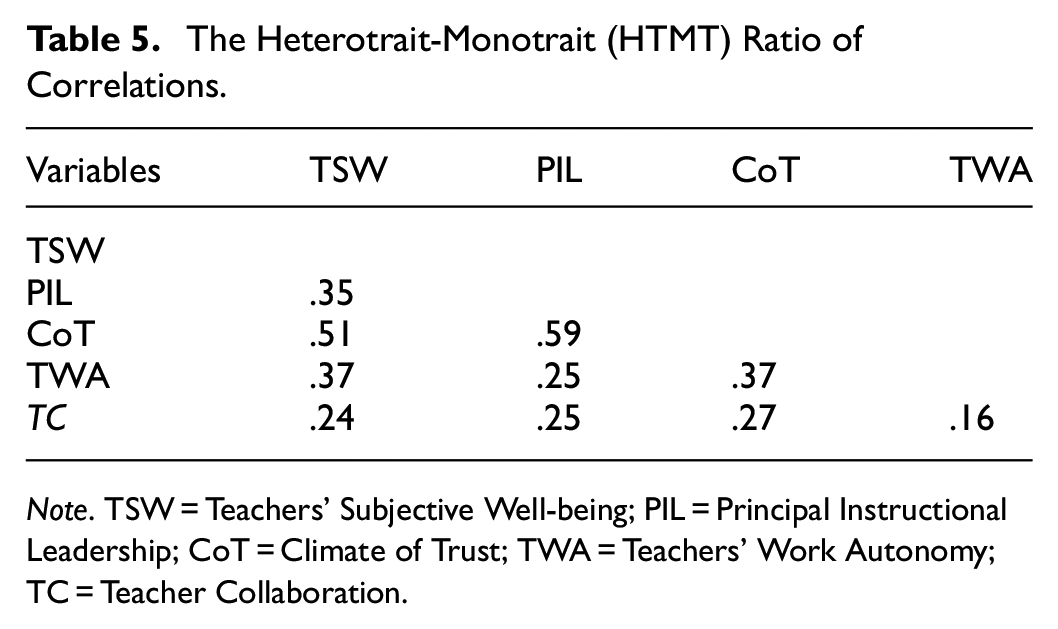
Note. TSW = Teachers’ Subjective Well-being; PIL = Principal Instructional Leadership; CoT = Climate of Trust; TWA = Teachers’ Work Autonomy; TC = Teacher Collaboration.
Table 5 demonstrated that HTMT values were below the cutoff value of .90 (Henseler et al., 2015). The findings confirmed the discriminant validity of the first-order constructs. Table 6 presents descriptive statistics and correlations.
Descriptive Statistics, Reliability Values, and Correlations Among Variables.

Note.
p < .001.
Table 6 indicated that teacher collaboration had the highest mean score while principal instructional leadership had the lowest one. The finding that the highest correlation coefficient was .52 implied no multicollinearity problem. All the correlations were found significant and positive at low and moderate levels. The correlations were calculated in the same direction as the hypothesized relationships of the study. Table 7 presents the means and standard deviations of the variables according to the geographical region.
Means and Standard Deviations of the Variables According to the Geographical Region of the Participant Jurisdictions.

Note.
Table 7 showed that participants from East Asian jurisdictions had the lowest mean scores on every study variable. Participants from Latin American jurisdictions had the highest mean scores on teachers’ subjective well-being, teachers’ work autonomy, and teacher collaboration while participants from Middle Eastern & African jurisdictions had the highest mean scores on principal instructional leadership and the climate of trust. Standard deviations of the study variables demonstrated that the variability among jurisdictions for each variable could be deemed relatively low. The following section presents the analysis regarding model fit and hypotheses testing.
Model Fit and Hypotheses Testing
In this section, I, first, conducted a CFA to test the adequacy of the goodness of fit of the hypothesized model. CFA results indicated that the hypothesized model provided an acceptable fit to the data (RMSEA = 0.05; SRMR = 0.06; CFI = 0.95; IFI = 0.95; TLI = 0.94; GFI = 0.95) since goodness-of-fit indices were found within acceptable ranges (RMSEA ≤ 0.07; SRMR ≤ 0.08; CFI ≥ 0.92; IFI ≥ 0.92; TLI ≥ 0.92; GFI ≥ 0.90). According to the CFA results, the measurement model was validated. Then, I conducted a SEM analysis to test the hypotheses. The SEM results are presented in Figure 2.

SEM results.
Figure 2 disclosed that principal instructional leadership had a significant positive influence on teachers’ subjective well-being (β = .13, p < .001). This implied that hypothesis 1 was supported. The significant positive influences of the climate of trust on teachers’ work autonomy (β = .26, p < .001) and teacher collaboration (β = .18, p < .001) suggested that hypotheses 2 and 3 were supported. The significant positive influences of principal instructional leadership on the climate of trust (β = .46, p < .001), teachers’ work autonomy (β = .13, p < .001) and teacher collaboration (β = .18, p < .001) indicated that hypotheses 4, 5, and 6 were supported. SEM results also revealed that the climate of trust (β = .30, p < .001), teachers’ work autonomy (β = .22, p < .001), and teacher collaboration (β = .10, p < .001) significantly and positively influenced teachers’ subjective well-being. These results suggested that hypotheses 7, 8, and 9 were supported. The significant positive influences of the geographical region on teachers’ subjective well-being (β = .17, p < .001), teachers’ work autonomy (β = .12, p < .001), and teacher collaboration (β = .10, p < .001) demonstrated that hypotheses 11a, 11c, 11d, and 11e were supported. The geographical region had no significant influence on principal instructional leadership (β = .00, p > .05). These findings signaled that Latin American and Middle Eastern & African participants reported more positively on teachers’ subjective well-being, the climate of trust, teachers’ work autonomy, and teacher collaboration particularly in comparison to East Asian participants.
Mediation Tests
This section provides the results of the mediation tests. Bootstrapping was conducted to test the indirect effects of principal instructional leadership on teachers’ well-being. Table 8 presents the bootstrapping results.
Bootstrapping Results.

Note. Based on 5,000 bootstrapped samples. SE = standard error; CI = confidence interval; PIL = Principal Instructional Leadership; TSW = Subjective Well-being; CoT = Climate of Trust; TWA = Teachers’ Work Autonomy; TC = Teacher Collaboration.
Table 8 indicated that three parallel mediation paths and two serial mediation paths were found significant. The indirect effect of principal instructional leadership was predominantly carried by the climate of trust. These results suggested that hypothesis 10 was supported. Mediator variables partially mediated the relationship between principal instructional leadership and teachers’ subjective well-being. I presented the summary of the hypotheses testing in Figure 3.
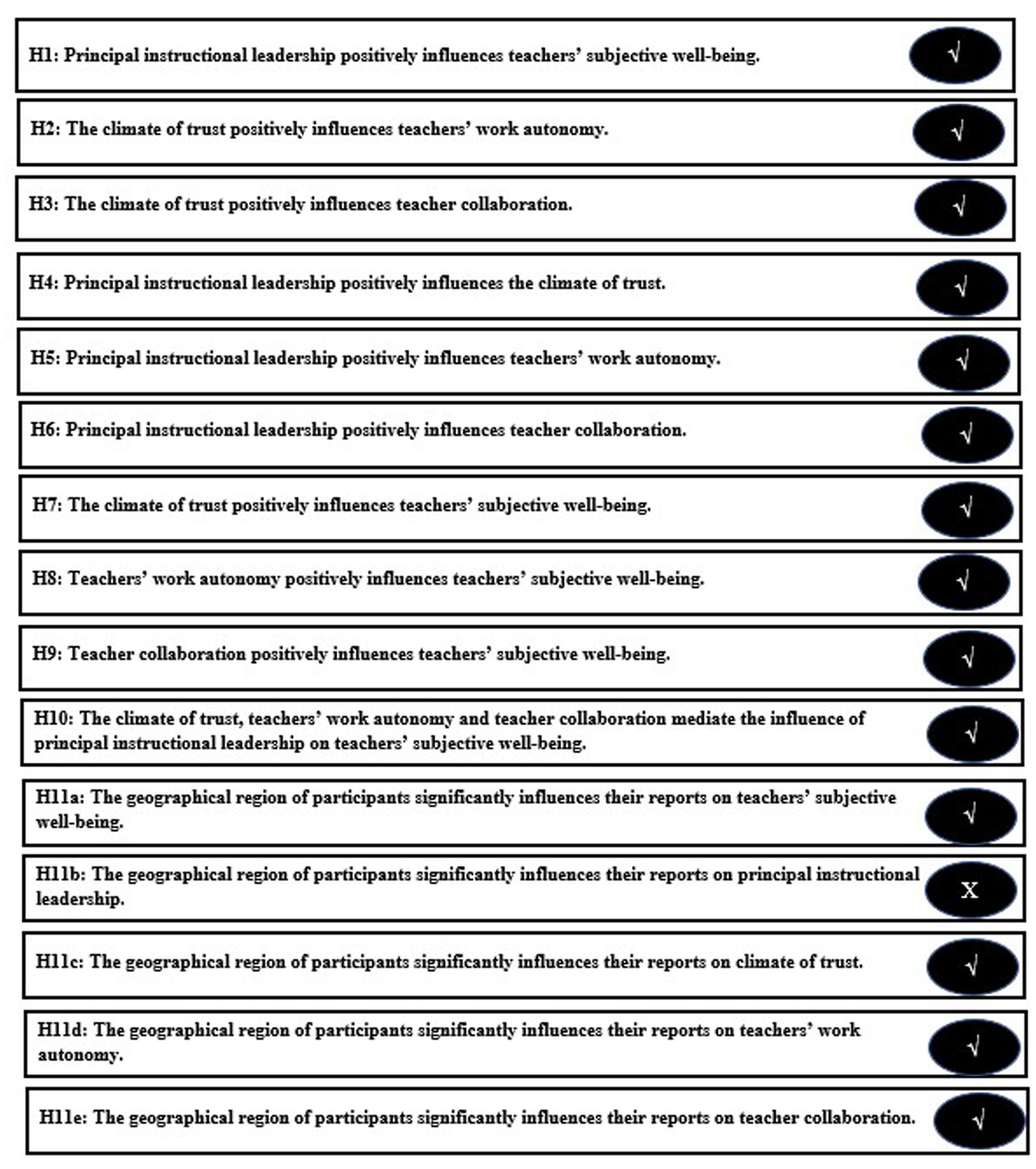
The summary of the hypotheses testing.
Figure 3 signified that principal instructional leadership positively influenced teachers’ subjective well-being both directly and indirectly through the climate of trust, work autonomy, and teacher collaboration. Furthermore, the climate of trust was found to positively influence teachers’ work autonomy and teacher collaboration. The geographical region was found to significantly influence teachers’ subjective well-being, the climate of trust, teachers’ work autonomy, and teacher collaboration while it did not significantly influence principal instructional leadership.
Discussion and Conclusion
This study tested direct and indirect organizational determinants of teachers’ subjective well-being. Firstly, it was found that principal instructional leadership positively influenced the climate of trust, teachers’ work autonomy, and teacher collaboration. These findings are consistent with those of previous studies in the literature (e.g., Akgöz et al., 2024; Keddie et al., 2024). Principals’ support and guidance in instructional issues were frequently identified in the relevant literature (e.g., Raczynski et al., 2022) as factors strengthening trust-based high-quality relationships in a school. Similarly, instructional leadership was previously unearthed as an organizational factor enhancing teachers’ work autonomy (Worth & Van den Brande, 2020) and teacher collaboration (Park & Ham, 2016).
This study also revealed that the climate of trust, along with principal instructional leadership, could enhance teachers’ work autonomy and collaboration. This finding is also consistent with previous studies in relevant literature. The climate of trust was previously identified as an influential factor in enhancing teachers’ work autonomy (Kilag & Sasan, 2023; Tschannen-Moran, 2001) and teacher collaboration (M. K. Chan et al., 2021; Park & Ham, 2016). At this point, Lockton (2019) concluded that school administrators frequently took advantage of existing trust-based relationships in a school to empower teachers to implement their creative ideas on instructional matters to meet student needs and to promote collaboration among school members (Lockton, 2019).
Secondly, this study detected that the climate of trust, teachers’ work autonomy, and teacher collaboration positively influenced teachers’ subjective well-being. These findings were also consistent with previous studies in the relevant literature (e.g., Hascher & Waber, 2021; L. Liu et al., 2024; Nwoko et al., 2023; Thien & Lee, 2023; Vo et al., 2024). For instance, Yu and Chen (2023) found that the climate of trust in schools could positively influence emotional well-being. Likewise, Castro Silva et al. (2024) found that work autonomy could enhance teachers’ social and emotional well-being. Furthermore, strong collaboration among school members was found to be linked to enhanced teacher subjective well-being (Blair et al., 2024; Turner et al., 2022).
These findings highlighted the effects of the climate of trust, work autonomy, and teacher collaboration in creating healthy conditions in which teachers could flourish. Teachers could flourish when they feel safe enough to expose their vulnerabilities and have enough psychological and social resources to overcome these vulnerabilities (Keyes, 2002; Thien & Lee, 2023). The predictability of events and the reliability of relationships in a school give cues to teachers about what kind of problems they may face in the future, what kind of skills they need to acquire, and what kind of social support they can get from their co-workers (L. Liu et al., 2024). The empowerment of teachers to the extent they can apply creative ideas for modifying or adapting instructional strategies to meet the student needs can be perceived as a sign of trust from administrators and colleagues in teachers’ professional capabilities. This can also give teachers the space to act autonomously to deal with problems specific to their classrooms like students with special needs (Nwoko et al., 2023). Teachers usually receive social support in school settings through collaboration with administrators and colleagues. When teachers believe they are cared for and not isolated in the face of stress sources like overwhelming workload, potential conflicts with parents, or accountability requirements, they tend to act more concentrated and show positive emotions (Turner et al., 2022).
Thirdly, this study revealed that school principals positively influenced teachers’ subjective well-being directly through engaging in instructional leadership practices and indirectly through promoting the climate of trust, teachers’ work autonomy, and teacher collaboration. This finding is consistent with the results of the previous studies. For instance, Dilekçi and Limon (2020), Kouhsari et al. (2023), and P. Liu et al. (2024b) recorded that school principals could influence teachers’ subjective well-being directly through instructional leadership practices and indirectly through shaping organizational factors like school climate. Likewise, Hascher and Waber (2021) and Liebowitz and Porter (2019) concluded that instructional leadership practices could directly and positively influence teachers’ subjective well-being. In addition, the positive indirect influence of these practices on teachers through increased organizational health is greater (Liebowitz & Porter, 2019). In other words, school principals can positively influence teachers’ subjective well-being both through providing support in instructional issues (Karaferye & Bellibaş, 2025) and through creating a predictable and safe working environment for teachers, fostering trust-based relationships, empowering teachers for the efficiency of teaching practices, and promoting collaboration among administrators and teachers (Thien & Lee, 2023).
Finally, this study unearthed that participants’ reports regarding teachers’ subjective well-being, climate of trust, teachers’ work autonomy, and teacher collaboration were significantly different in terms of geographical region. While East Asian participants had the lowest mean scores on these variables, Latin American and Middle Eastern & African participants’ mean scores were higher than the mean scores of the participants from the rest of the world. These findings implied that particularly East Asian participants felt the negative effects of the COVID-19 outbreak more severely than their colleagues in other parts of the world. Similarly, East Asian teachers were reported in other studies to experience high levels of stress, intensification of work, and exhaustion during the COVID-19 outbreak due to a sense of loneliness, isolation, and helplessness (e.g., Lau et al., 2022). However, Katsarou et al. (2023) emphasized in their systematic review study that teachers worldwide experienced the same negative influences of the outbreak. Teachers worldwide experienced high stress during the COVID-19 outbreak (Katsarou et al., 2023). They had to acquire new technological and pedagogical skills to adapt to distance education and find individual remedies to cope with declining student engagement and attendance (Koç & Fidan, 2022). What is worse, especially during the transition to distance education, they were deprived of the direct support of school administrators and other teachers (Mérida-López et al., 2022).
I, therefore, argue that governmental policies and cultural values of countries influenced how participants responded to outbreak conditions and how they reported on study variables. Strict accountability policies prescribing the production of uniform student outcomes and high-stakes testing policies requiring teachers to attain high-performance goals were previously identified as among primary stress sources for East Asian teachers (Chong & McArthur, 2023; Ro, 2018; Sasiwuttiwat & Tangkitvanich, 2019). Meeting policy requirements in challenging outbreak conditions exerted extra pressure on teachers and amplified their stress sources (Tan, 2022). Furthermore, due to national cultures highlighting collectivism, and the strict adherence to traditional teacher roles, rules, and performance expectations, teachers from East Asian countries tend to have relatively more stress in the face of challenges like the COVID-19 outbreak (Çoğaltay & Boz, 2023; Katsantonis, 2020), and be relatively more sensitive to incidents (like abusive supervision, unfair application of procedures and regulations, and unjust decisions regarding the punishment and reward) potentially spoiling school climates (Jiang et al., 2017; Lin & Gao, 2023). Moreover, they were reported to prefer following predetermined methods prescribed by governmental agencies while overcoming obstacles (K. T. Chan, 2021) to applying individually developed action plans or collaborating with their peers (S. N. Liu & Feng, 2015).
Theoretical and Practical Implications
The present study contributed to the theory development regarding teachers’ subjective well-being in two ways. First, it confirmed that basic assumptions of Human Flourishing Theory can also be valid for teachers. Instructional support from principals and other positive organizational factors like the climate of trust, work autonomy, and collaboration could altogether construct a healthy workplace for teachers. These factors could alleviate workplace stress and create favorable conditions in which teachers feel they are improving their work and private lives (Keyes, 2002). This study, however, revealed that national cultures and educational policies of countries could influence how teachers evaluate their well-being and experience organizational factors. Teachers might react differently to the same stress sources (like outbreaks) depending on the prevailing societal cultures and educational policies of governments. Second, this study confirmed the power of instructional leadership in creating healthy work environments for teachers. Either directly or indirectly, school principals could apply interventions to reduce teachers’ workplace stress and fuel their positive emotions (Hallinger, 2018; Karaferye & Bellibaş, 2025).
In this section, I developed recommendations for practitioners and policymakers. First, the study data were collected during the COVID-19 outbreak. Teachers experienced stress due to the abrupt transition to distance education and isolation. Instructional leadership, the climate of trust, work autonomy, and collaboration have been revealed as critical resources for teachers to overcome crises like the COVID-19 outbreak (M. K. Chan et al., 2021). Previous studies reported that teachers felt supported when they had access to professional support in instructional matters and professional development means to acquire competence in distance education (Katsarou et al., 2023). Furthermore, high-quality social relationships and connections were identified as integral parts of subjective well-being in times of crisis (Durrani et al., 2024). Emotional support from school principals and collaboration with colleagues decreased teachers’ isolation and contributed to constructing trust-based relationships (Blair et al., 2024). Increased work autonomy and time flexibility enabled teachers to address student needs effectively during distance education (M. K. Chan et al., 2021).
Second, school principals should employ interpersonal strategies to create a flourishing environment to support teachers’ well-being. In this context, they should regularly make classroom visits and observe teachers’ work to provide feedback. They should also empower teachers to take responsibility for learning outcomes and take necessary measures to deal with students with special needs. Establishing predictable and stable work procedures and promoting open and two-way communication among school members could construct appropriate conditions for creating a climate of trust.
Third, establishing effective team structures (e.g., grade-level, leadership, and other school teams) that facilitate open communication and decision-making based on team functioning could facilitate collaboration among teachers and enable them to share the burden of meeting performance criteria prescribed by accountability policies. Furthermore, implementing co-teaching strategies among teachers and providing designated time for grade-level teams to plan the instruction collaboratively are recommended to build a climate of trust in schools and promote teacher collaboration. Ministries of education or other governing agencies, particularly in East Asian jurisdictions in this study, should amend legal regulations to promote joint work among teachers and shared decision-making on instructional matters.
Fourth, establishing an instructional coaching system based on identified needs, requests, and input from educators is recommended as a support mechanism for teachers who struggle with addressing students’ individual special needs and meeting high-performance requirements for all students at the same time. Establishing such a system requires amendments in legal regulations and political support. As revealed by this study, particularly ministries of education or other governing agencies in East Asian jurisdictions in this study should spare resources to build such systems to support their teachers in the face of strict accountability requirements.
Fifth, attaining high-performance goals by implementing strict accountability policies in exchange for low teacher well-being (as this study implied) is not sustainable for education systems because it may cause high teacher burnout and turnover rates (Fox et al., 2023). Instead, particularly in East Asian jurisdictions with relatively low teacher well-being in this study, the implementation of feedback and evaluation systems utilizing various resources to provide constructive, supportive, and positive feedback on instruction and teacher evaluation is recommended. These systems should focus on meeting individual student needs and enhancing general student learning while providing feedback in the areas teachers need support.
Limitations and Further Research Implications
The current study has several limitations that future research should address. Firstly, it is a non-experimental cross-sectional study. The study used a multinational dataset. Teachers who participated in PISA 2022 were teaching only 15-year-old students. Furthermore, data were collected within a certain period from teachers working in certain jurisdictions in countries that participated in PISA 2022. Therefore, the results may not be generalizable to teachers teaching students at other age groups, teachers working in jurisdictions not included in the samples of the participant countries, and to teachers working in nonparticipant countries. Prospective studies should also consider selecting samples from teachers teaching at all K12 level student groups. Studies selecting samples from teachers working in jurisdictions not included in the samples of PISA 2022 participant countries or non-participant countries should also be conducted. As this study employed a cross-sectional dataset, the associations among variables cannot suggest the existence of causal relationships among Variables. Conducting longitudinal studies or quasi-experimental and experimental studies are needed to answer this limitation.
Secondly, the study used questionnaires developed by the OECD. The development of questionnaire items is likely influenced by how the OECD defined the relevant constructs. OECD determined the definitions and scopes of constructs used in this study. The definitions and scopes of the same constructs may vary in other studies. Future studies should consider employing the constructs both as defined by the OECD and as defined by other theoretical and empirical studies.
Thirdly, this study followed OECD recommendations on international datasets for data analysis. This suggests that every jurisdiction in the dataset has the same weight regardless of the number of participants from each jurisdiction, which poses the risk of over-representing some jurisdictions with relatively larger samples like Brazil and the United Arab Emirates. Determining the number of participants from each jurisdiction by considering their populations could be recommended in future studies.
Lastly, the study targeted certain organizational variables. Future studies may examine the influences of other organizational variables, such as perceived organizational support, the quality of teacher-student relationships, parental involvement, and leadership styles other than instructional leadership. Furthermore, the influences of individual factors like professional experience, gender, self-efficacy, self-confidence, stress management skills, and political skills can also be investigated.
Footnotes

Ethical Considerations
Ethical approval was not required as this article used the data published by OECD. The ethical approval for all individual participants in each country/economy in PISA 2022 was officially completed by the OECD.
Consent to Participate
The informed consent for all individual participants in each country/economy in PISA 2022 was officially completed by the OECD.
Author Contributions
All authors whose names appear on the submission made substantial contributions to the conception or design of the work; or the analysis, or interpretation of data; or the creation of new software used in the work; drafted the work or revised it critically for important intellectual content; approved the version to be published; and agree to be accountable for all aspects of the work in ensuring that questions related to the accuracy or integrity of any part of the work are appropriately investigated and resolved.
Funding
The author received no financial support for the research, authorship, and/or publication of this article.
Declaration of Conflicting Interests
The author declared no potential conflicts of interest with respect to the research, authorship, and/or publication of this article.
Data Availability Statement
The data that support the findings of this study are available on the OECD website (Programme for International Student Assessment [PISA] dataset 2022).