




Abstract
Adaptive performance of employees is a crucial determinant of successful change, fostering innovation and resilience in the dynamic business environment. This research presents a multilevel framework which explores the sequential mediating role of team learning orientation and individual entrepreneurial orientation in the impact of team goal clarity on employee’s adaptive performance. Conducted in the scenario of small and medium enterprises (SMEs) in Pakistan, the study employees a time-lagged survey design to gather data. Mplus was used for multilevel modelling in which team goal clarity and team learning orientation were group level variables and entrepreneurial orientation and adaptive performance were individual level. The results highlighted that team learning orientation plays a pivotal role in enhancing the entrepreneurial orientation of individual employees, subsequently enhancing adaptive performance. The research responds to various calls in existing literature to investigate the group level antecedents and underlying multilevel mechanism leading to adaptive performance. The study contributes to the broader perspective in understanding team dynamics, learning orientations, and entrepreneurial behaviors within SMEs.
Keywords
Introduction
In the present rapidly changing corporate world, where competitions are on its surge and change is continuous, the things that can maintain the firm’s success are the adaptive performance of employees. AP is an employee’s capability to self-motivated, self-directed effort to perform effectively amidst fluctuating job demands, particularly in context characterized by change, uncertainty, and vagueness (Pulakos et al., 2000). Building on the work of Allworth and Hesketh (1999), it encompasses a multifaceted ability to navigate a swiftly evolving work environment, incorporating facets such as learning new skills, physical adaptability, cultural acumen, problem-solving aptitude, dealing with uncertainty, and interpersonal proficiency (Pulakos et al., 2000, 2002). The proactive responsiveness of employees engaged in adaptive performance is underscored by their enthusiastic commitment to attaining organizational goals (Huntsman et al., 2021; Junça-Silva & Caetano, 2024; Jundt et al., 2015). This nuanced understanding of adaptive performance positions it as a proactive and comprehensive response to dynamic work condition, encapsulating a wide spectrum of skills and attitudes essential for individual success in a rapidly changing professional landscape (Charbonnier-Voirin & Roussel, 2012; Luo et al., 2022; Park & Park, 2021).
In SMEs, adaptive performance is particularly critical due to the dynamic nature of these businesses. SMEs often operate in highly uncertain environments and require rapid adaptation to changes in technology, market demands, and competitive pressures. As such, the capability of employees to adapt and perform effectively in the presence of these challenges is vital for the sustainability and growth of SMEs. Park and Park (2019) recommended that the researchers focus on employees’ individual AP as a broader concept of conventional performance, reflecting the requirement of contemporary business modification.
Despite its importance, there is a dearth of literature that has examined the antecedents of AP, with very limited focus on the contextual factors (Jundt et al., 2015; Park & Park, 2019; Zeng et al., 2020). Previous research has primarily examined the impact of leadership and personality traits on adaptive performance (Kaltiainen & Hakanen, 2022; Marques-Quinteiro et al., 2019; Qurrahtulain et al., 2022; Ramos-Villagrasa et al., 2020). However, there is a need to explore the underlying mechanisms of how team motivational processes, such as team goal clarity (TGC), impact individual adaptive performance in the workplace.
The present research examines the top-down effect of a domino from team to individual levels in a multilevel research approach. This paper focuses on how motivational processes within teams, such as team goal clarity, impact individual levels of adaptive performance. Performance or accomplishment is closely related to team motivational processes because such processes drive individuals to involve themselves in organizational processes for optimal output. This further investigates the underlying aspects of the influence of team dynamic variables, such as TGC and team learning orientation, on individual entrepreneurial orientation and AP (Charbonnier-Voirin et al., 2010; Prewett et al., 2018; Wang et al., 2013). This study contributes to the literature by emphasizing the connotation between team goal clarity and individual AP, adopting a multilevel approach to comprehend team dynamics influence at an individual level, and developing a sequential multilevel mediation model in order to extensively comprehend how team goal clarity is associated with individual adaptive performance. This study demonstrates the where and how of the multilevel modeling in respect to the relationship between team goal clarity and individual adaptive performance, hence providing valuable understanding to SMEs in pursuit of enhancing employees AP.
Literature Review
Team goal clarity refers to the degree at which team goals and vision are undoubtedly articulated, shared, and recognized by its members. This encompasses both the cognitive state and motivational state of team members regarding team goals. There are studies showing that goal clarity is a team-level construct that a high degree of goal clarity signifies that the team members understand as a collective unit or entity their sub-goals and how individually their work contributes to the team’s goals in general (A. Bilal et al., 2021; Hu & Liden, 2011). Effective task fulfillment requires an elaborate understanding of one’s subgoals, strategies toward the achievement of these subgoals, and how one’s job relates to the jobs of others. Kahn et al. (1964) add that clarity in team goals and roles highly influences the performance of individual employees since it reinforces a better understanding of task objectives and strategies and interrelationships in teams. Clearly set goals enable effective communication and coordination among team members by making them realize a shared perception about the individual and team goals as well as the necessary processes for the accomplishing of tasks. The theory of goal setting explains that clearly set goals ensure better performance because they focus the attention of the team members and make them persistent in their efforts. It therefore means that shared team goals can be reduced to sub-goals for each member, which again heighten the potential for reaching the overall target of the team. Teams with common objectives benefit from engaging in learning processes (Coetzer et al., 2020; Mitchell & Manzo, 2018). Clear goals are related to increased team effectiveness due to an increase in cooperation and open communication (Estacio et al., 2017; Hu & Liden, 2011), which in turn develop a learning orientation in a team.
We suggest that TGC is associated with TLO for two motives. First, an unambiguous comprehension of a goal improves proactive learning and competency development among the team members by channeling effort toward the achievement of that goal (Crossley et al., 2013). Clarity of team goals is essential for effective team motivation, as a lack of understanding regarding these goals hinders the team’s ability to focus magnitude and persistence on achieving them. Secondly, clarity of team goals enables teams to collaboratively establish a distinct vision regarding the impact of their learning and behaviors on organizational performance, while also elucidating which goals are prioritized by the organization (Hu & Liden, 2011). This results in enhanced performance via team learning orientation (Hu & Liden, 2011).
Current research highlights the significance of a team learning orientation climate, which arises when employees recognize that their organization genuinely values proactive learning and competency development, invests in human capital, and prioritizes the development of employees’ skills, knowledge, and abilities (Harvey et al., 2019). Team learning orientation is defined by an environment that fosters proactive learning and skill growth among team members. A TLO climate fosters behaviors conducive to team learning, including error discussion, result reflection, and feedback solicitation (Edmondson, 1999). Team learning orientation climates facilitate enhanced observation, imitation, and modeling among members, enabling them to comprehend the specific skills available for development.
Schneider et al. (2013) assert that employee behaviors are significantly shaped by the organizational climate, which aids employees in comprehending the workplace and enhancing their adaptive abilities. We contend that TLO climate is directly associated with adaptive performance. A high level of TLO enables team members to develop a shared cognitive understanding that employees are valued and permitted to work autonomously. Consequently, these personnel will be encouraged to engage in proactive learning and skill enhancement. The TLO climate fosters a belief among employees that they can and do exert control over their work activities, while also ensuring that their knowledge and viewpoints are directly applied to work-related matters. Employees consequently engage in adaptive behavior to attain their objectives.
When team goals are clearly defined, members have a unified understanding of what needs to be achieved. This clarity encourages the team to engage in collective learning behaviors, such as knowledge sharing, problem-solving, and continuous improvement, to meet these objectives. A team that emphasizes learning provides a supportive environment where individuals are motivated to improve new skills, experiment with different approaches, and adapt to new challenges. This learning culture enhances an individual’s ability to adapt to changing circumstances. When the team is focused on learning, individuals are better equipped to handle dynamic and uncertain situations, translating goal clarity into improved adaptive performance.
Team Goal Clarity, Team Learning Orientation, and Individual Entrepreneurial Orientation
Individual entrepreneurial orientation refers to a strategic way that incorporates methods, processes, and also activities that individuals employ resulting in the creation of value by independent commercial undertakings (Clark et al., 2025). It summarizes attitudes and values relative to proactivity, risk-taking, and innovation (Wu & Yu, 2024). According to Kollmann et al. (2020), IEO refers to the characteristics of individuals rather than organizations and includes five key dimensions: autonomy, innovation, risk-taking, proactivity, and competitive aggressiveness. However, we propose that the means by which team goal clarity affects individual EO is through TLO. Clear goals stimulate the sharing of information and expertise; thus, the trust members have in the competencies of the team and success rises. Goal clarity impacts the team’s learning orientation by improving collective interactions (Hirst et al., 2009). Team members with a deep insightfulness of their responsibilities and the interdependencies between their activities and overall objectives are more likely to achieve efficient cooperation, reducing process loss (Steiner, 1974). Effective coordination promotes social cohesion within the team and raises members’ confidence in the team’s capability to succeed in various tasks and contexts. Clear goals also lead to effective communication and conflict prevention, contributing to a strong inclination toward team learning. Learning orientation beliefs motivate individuals to collaborate persistently toward shared goals despite challenges, leading to elevated levels of (Bandura & Wessels, 1997; Huang & Wang, 2011) IEO. Team members’ beliefs in learning orientation increase their awareness of their efficacy, driving them to actively participate in individual EO (Huang & Wang, 2011).
Individual entrepreneurial orientation as encompassing cognitive qualities associated with entrepreneurship, including proactivity, risk-taking, and innovativeness, (Bolton & Lane, 2012) characterize. IEO underscores the importance of people’ initiative in employing these talents for business decision-making. The capacity for proactivity, innovation and risk-taking is expressively associated with entrepreneurial success (Covin et al., 2020). Moreover, IEO constitutes a behavioral element of entrepreneurship in the context of entrepreneurial endeavors (Bolton & Lane, 2012).
Innovation is a fundamental trait of a succeeded entrepreneur. Innovation denotes the manifestation of novel concepts, distinctive creativity, and creative enhancement of present products or services, as well as the production of new goods. Innovation entails enhancing existing concepts to develop superior enterprises. Innovation is an essential element for business enterprises to attain entrepreneurial success. Innovation is linked to novel concepts, products, and technologies.
Team learning orientation refers to the acknowledgment of the learning process within a team (Rhee et al., 2010). In simple words, it refers to the inclination of a team to generate and utilize knowledge collaboratively (Nguyen & Barrett, 2006). Moreover, alongside enhancing opportunities for individuals to learn from one another, the proliferation of learning across the organization, coupled with an augmented capacity for executing ideas, processes, or novel products, can foster an innovative capacity within the organization through a team learning orientation (Verona, 1999). Consequently, some persons recognize that a learning orientation is essential for enhancing innovation capabilities within organizations (Verona, 1999). Numerous research demonstrates a robust connection between learning orientation and innovation (Alegre & Chiva, 2008). The innovation process generally involves the collection, development, and implementation of new information (Verona, 1999), which are three criteria indicating of the strong link between innovation and learning orientation (Calantone et al., 2002).
Proactivity
Proactivity includes foreseeing or anticipating and addressing future demands (McCormick et al., 2019). Proactivity denotes a forward-thinking approach and an opportunity-identifying mindset that involves the preemptive development of new goods and services prior to competitors, as well as acting in anticipation of upcoming demands to effectuate change in the corporate setting. The concept of proactivity as an element of individual entrepreneurial orientation has been extensively examined in entrepreneurship research (Clark et al., 2025; Wach et al., 2023). Proactiveness in entrepreneurship entails the anticipation of future trends and the subsequent action on identified opportunities. A team that prioritizes learning engages in regular knowledge-sharing, allowing members to remain updated on market shifts and new developments. This may encourage proactive behaviors among individuals.
Team learning environments foster a culture in which risk-taking is regarded as a potential for development. Team members may cultivate the confidence to undertake calculated risks, an essential aspect of individual entrepreneurial orientation, as failures are regarded as opportunities for learning.
Team Learning Orientation and Individual Entrepreneurial Orientation: A Sequential Mechanism Linking Team Goal Clarity With Individual Adaptive Performance
Team goal clarity relates to employee adaptive performance through TLO and IEO in a domino effect. Motivational theories, including goal-setting theory (Locke & Latham, 1990), and social cognitive theory (Bandura, 2009), elucidate how goals direct self-regulatory action. Goal-Setting Theory posits that clear team goals offer an organized direction for teams, motivating them to collaboratively acquire and implement knowledge to attain those objectives. When team members comprehend their goals, they are more predisposed to exchange knowledge, engage in collaborative learning, and pursue innovative methods to enhance performance. This cultivates a robust learning orientation. Social Cognitive Theory posits that when a team prioritizes learning, individuals experience entrepreneurial practices, including risk-taking, creativity, and proactivity, via interactions with others. The collaborative learning environment allows individuals to imitate these behaviors, enhancing their individual entrepreneurial orientation. A learning-oriented team promotes individual initiative and entrepreneurial endeavors to devise innovative solutions to challenges. Moreover, those exhibiting a pronounced individual entrepreneurial orientation demonstrate greater adaptability. Their propensity for inventiveness and proactivity enhances their ability to adapt to change and uncertainty. The entrepreneurial characteristics cultivated by the learning climate (e.g., risk-taking, proactiveness, innovativeness) significantly enhance adaptive performance, since these individuals are more adept at adjusting to changing roles, technologies, and work problems. Consequently, we propose the hypothesis (see Figure 1).

Research framework.
Method
This research aims to examine the multilevel relationship of team goal clarity with adaptive performance through TLO and individual entrepreneurial orientation (as sequential mediators) in SMEs operating in Pakistan. The targeted population SMEs are related to the informational technology (IT) sector specifically the software houses located in the big cities of Pakistan like Lahore, Islamabad and Faisalabad. The IT sector in Pakistan is approximately 1% of total country GDP. Almost more than 600,000 professionals are working in IT sectors in Pakistan. In Pakistan, SME are categorized into medium enterprises (i.e., less than 250 employees) and small enterprises (i.e., less than 50 employees). Software houses are team-based organizations where each team is involved in different projects, supervised by a team leader who is accountable for the project’s success. Software houses were targeted because of the factors including rapidly changing technology and more innovation in terms of employees’ learning, creativity, and adaptive behavior is required in this sector. Multilevel time lag predictive research design was used to gather data from first line manager and their respective supervisor. The data was gathered in three waves to minimize the common method bias (CMB). Podsakoff et al. (2012) suggested that the dependent variable be measured separately from the independent variable, and the mediating variable must be measured between dependent and independent variable.
Data were gathered three times, with a 3-week gap between each, as the same was applied in earlier studies (e.g., M. Bilal et al., 2021; Shahid et al., 2022). Both team and individual level data were collected from employees and team level data were aggregated at the team level as the same was applied in earlier studies (Chaudhry et al., 2021). In the first wave, out of 620 we received 547 responses related to an independent variable like team goal clarity and demographic variables. After 3 weeks, the mediator’s (TLO and IEO) data were collected from the same respondent who filled the questionnaire in the first wave. In the second wave, we collected back 501 responses. Similarly, in the third wave, we gathered data connected to the dependent variable (adaptive performance) from the same respondent who filled the data in the second wave with the same difference 3 weeks apart. In the third and last wave, we received 437 responses. Thirteen incomplete questionnaires were discarded. Nine responses were further removed to ensure the normality of the data. Consequently, 415 employees with 83 teams were considered for further analysis. Out of these 415 employees, 73% were male, and 27% were female. 34% have experienced more than 5 years. 74% of employees have aged less than 35 years, which indicates most respondents were young. Furthermore, 83.4% individuals have 16 years and 15.9% have 18-year education.
The survey team follows the criteria for defining and identifying the team as developed by Kozlowski and Bell (2003). First, we ensured that the selected team members must perform the same tasks and have the same work processes and collective goals. Second, each team was distinct from others and had unique identification. Third, there was an interactional relationship among the team members to encourage functional relationships among themselves. Finally, team members had task interdependence among themselves as they had to cooperate in executing their tasks and achieving team objectives.
Measures
Validated measurement scales from previous research were applied to gage the study’s variables from the targeted respondents of the research. In addition, all measurement scale data were collected from first level managers and their respective supervisor.
Team Goal Clarity
TGC was assessed in the first wave, utilizing the four-item scale developed by Kivimaki and Elovainio (1999). Sample item consists of “How far are you in agreement with your team objectives?.”
Team Learning Orientation
TLO was evaluated using a five-item scale established by Vandewalle (1997) and later adapted by Bunderson and Sutcliffe (2003). Sample item is “We often seek opportunities to establish new knowledge and skills.”
Individual Entrepreneurial Orientation
IEO was assessed with the nine-item scale established by Covin et al. (2020). Example items include “1 I have very little problems with renewal and change.” The employees’ responses will be recorded on a five-point Likert scale from 1 = strongly disagree to 5 = strongly agree. TGC and TLO responses were also assessed on the same scale.
Adaptive Performance
AP was measured by Marques-Quinteiro et al. (2015) eight items measurement scale created on Pulakos and associated categorization of adaptive behaviors. This scale was suggested by Ramos-Villagrasa et al. (2020) because it signifies a process vision according to our research method. Sample item is “My subordinate use creative ideas to manage incoming events.” All items were scored on a 5-point Likert scale (ranging from 1-totally ineffective to 5-totally effective). Supervisor rated the adaptive performance of their subordinate.
Control Variable
Earlier researchers have recommended that individual demographics (i.e., team tenure, education, age, and gender) were related to employees’ creativity (Carmeli & Schaubroeck, 2007). Team tenure, education, and age may describe association among team members (Hirst et al., 2009). Therefore, we have incorporated these elements as control variables: gender was implicit as 0 = female, 1 = male, education was distributed into three levels (1 = graduate degree, 2 = post graduate degree, and 3 = PhD doctorate degree) and age and organizational tenure were self-rated in the number of years.
Analysis
To investigate the uniqueness and individuality of study variables (team goal clarity, team learning orientation, individual entrepreneurial orientation, and adaptive performance) confirmatory factor analysis was performed at the individual level before testing the hypothesis.
Individual employee data were used to measure all the study constructs, and TGC and TLO were engaged at the team level. Considering this issue, we conducted within-team agreement of these constructs through within-group interrater agreement index (rwg(j); James et al., 1984, 1993) and Average Deviation Index (ADI; Burke et al., 1999). Hence, rwg(j) and ADI value offer corresponding evidence to validate team-level score aggregation.
Multilevel structural equation modeling (MSEM) was applied to investigate the proposed model and study hypothesis. We applied Muthén and Muthén (2010) software Mplus version 7 to estimate the maximum-likelihood parameter (MLR). According to model classification, the model we tested was demonstrated as a 2-2-1-1 model (Zhang et al., 2009). To examine the model fit, we assess various indices of fit: the comparative fit index (CFI), the standardized root mean square residual (SRMR), the Tucker-Lewis index (TLI), the root mean square error of approximation (RMSEA) and chi-square. Values of CFI and TLI greater than 0.90 are considered acceptable. SRMR and RMSEA acceptable value is between 0.05 and 0.10. To compare alternative model, it has been recommended that for RMSEA (ΔRMSEA; Chen, 2007), a variance greater than 0.015 and for TLI (ΔTLI; Widaman, 1985), a variance greater than 0.01 are represented relevant variance.
Lastly, the proposed model was examined as the indirect effects were evaluated. Since in the model, three indirect effects were recognized: a) the indirect impact of TGC on employee adaptive performance through TLO; the indirect impact of TGC on individual entrepreneurial orientation through TLO; and the indirect influence of TGC on adaptive performance via TLO and individual entrepreneurial orientation in a multilevel sequential manner.
Results
Preliminary Analysis
We examined the four-factor model as theorized in our study model, and furthermore, we examined two-nested comparing models with 3-factor model: (1) a three-factor structure where TGC and TLO items were integrated into a one factor; and (2) a three-factor structure where individual entrepreneurial orientation and adaptive performance items were integrated into one factor. The reason to test two comparing models is to validate the discriminant validity of the construct further. As theorized in the study, the result of the four-factor model showed that the data is very well fitted for further analysis. On the contrary, the two-factor model and single factor model “2” and “3” displayed a worse fit. These results confirmed the discriminant validity of the measures.
We focused on numerous indices to evaluate model fitness (Kline, 2023). An adequate model’s fitness can be determined when the Tucker-Lewis Index (TLI), comparative fit index (CFI) values are above 0.90, standardized root mean residual (SRMR) are less than or equal to 0.08, the value of root mean square error of approximation (RMSEA) value fall between 0.05 and 0.08 and the χ2/df ratio between 3.00 and 5.00 (Browne & Cudeck, 1992). The Hypothesized four-factor model fit the data well (chi-square = 923.33, df = 293, p < .0001; RMSEA = 0.07; SRMR = 0.05; CFI = 0.91; TLI = 0.90), on the contrary two-factor model-2 (chi-square = 2843.57, df = 298, p < .0001; RMSEA = 0.14; SRMR = 0.17; CFI = 0.58; TLI = 0.54) where TGC and TLO; and IEO and AP were merged and single -factor model-3 (chi-square = 3591.00, df = 299, p < .0001; RMSEA = 0.16; SRMR = 0.18; TLI = 0.42; CFI = 0.47) where all variables were merged, exhibit adverse fit. The change in chi-square between 4-factor model and two-factor model-2 (TGC and TLO; and IEO and AP were merged) and between four-factor model and single-factor model-3 (all variables were merged) were significant statistically. The discriminant validity of the measures is supported.
As stated earlier, in intending to rationalize the accumulation of the team level responses, rwg(j) and ADI values were added up. The mean ADI value for TGC (ADI = 0.38, SD = 0.26) and TLO (ADI = 0.36, SD = 0.27) were less than 0.83 as recommended by Burke and Dunlap (2002). Moreover, 0.70 or above the value of rwg(j) is deemed adequate proof to validate aggregation. The rwg(j) index for TGC (ICC1 = 0.88, ICC2 = 0.85, rwg(j) = 0.88) and TLO (ICC1 = 0.76, ICC2 = 0.85, rwg(j) = 0.81) justify measure aggregation as rwg(j) values are more than 0.70. For good interrater agreement, the finding was larger than 0.70, the threshold value. Conclusively, all these findings jointly permit us to suppose accumulation of individual employee scores to the team level, hence extending logical reasons for aggregation of individual level (TGC and TLO) data at the team level.
The descriptive statistics like correlation, mean, reliabilities, and standard deviation are shown in Table 1. The correlation between the study variables was positive and significant. The correlation of TGC with individual entrepreneurial orientation (r = .36), adaptive performance (r = .40), and TLO (r = .60) was significant and positive. Cronbach alpha values confirmed the reliability of the constructs, all the measures have high reliability, which extends from .80 to .91.
Descriptive Statistics and Correlation.

Note. n = 415. Reliability coefficients are demonstrated in parentheses. Education (Edu), experience (Exp), gender (Gen), individual entrepreneurial orientation (IEO), adaptive performance (AP), team goal clarity (TGC), and TLO (TLO).
p < .05. **p < .01.
Multilevel SEM Analysis
The presented multilevel model was statistically fit as depicted in Table 2 model 1. The result of the directional hypothesis proved the direction and significance of the model. The model fit indices (chi-square = 762.36, df = 232, TLI = 0.81, CFI = 0.83, RMSEA = 0.07, SRMR = 0.06), and indirect effect (b = 0.69, SE = 0.15, p < .01, LLCI = 0.40, ULCI = 0.98) of TGC on adaptive performance through TLO was statistically significant and positive as shown in Table 3. These results statistically prove hypothesis 1 that TLO partially mediates the association between TGC and AP.
Measurement Model Comparison.
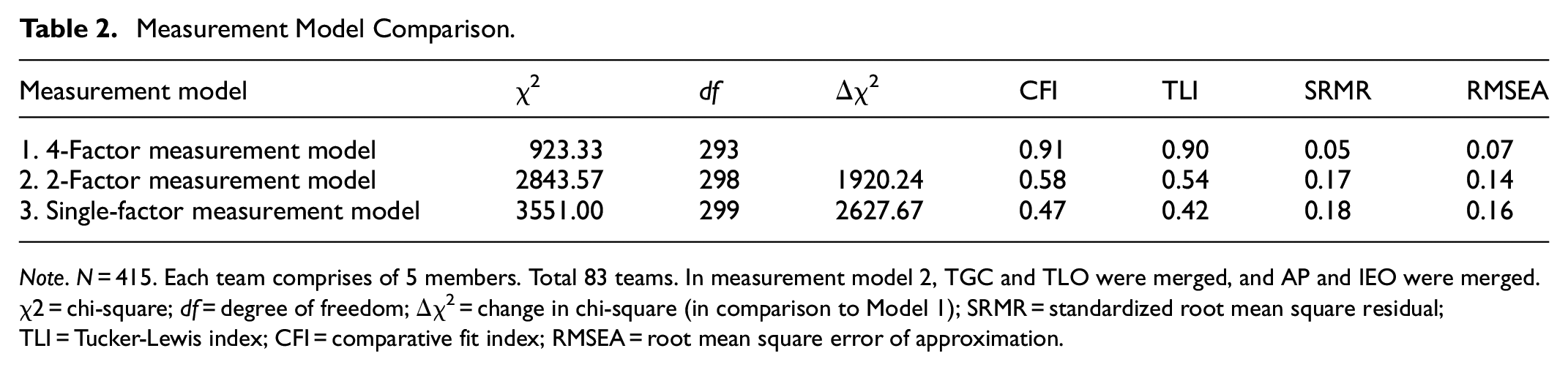
Note. N = 415. Each team comprises of 5 members. Total 83 teams. In measurement model 2, TGC and TLO were merged, and AP and IEO were merged. χ2 = chi-square; df = degree of freedom; Δχ2 = change in chi-square (in comparison to Model 1); SRMR = standardized root mean square residual; TLI = Tucker-Lewis index; CFI = comparative fit index; RMSEA = root mean square error of approximation.
Summary of Direct and Indirect Effect.

TGC = team goal clarity; TLO = team learning orientation; AP = adaptive performance; IEO = individual entrepreneurial orientation.
p < .05. **p < .01. ***p < .001.
Furthermore, the model fit indices (chi-square = 638.36, df = 263, TLI = 0.88, CFI = 0.89, RMSEA = 0.06, SRMR = 0.07) of the indirect effect (b = 0.36, SE = 0.15, p < .05, LLCI = 0.06, ULCI = 0.65) and TGC on individual entrepreneurial orientation through TLO was statistically significant and positive as shown in Table 3 and Figure 2. These results statistically prove hypothesis 2 that TLO partially mediates the relationship between TGC and IEO.

Hypothesized model results.
Additionally, the model fit indices (chi-square = 762.36, df = 232, TLI = 0.81, CFI = 0.83, RMSEA = 0.07, SRMR = 0.06), and indirect effect (b = 0.42, SE = 0.10, p < .01, LLCI = 0.23, ULCI = 0.61) of TGC on adaptive performance through TLO and individual entrepreneurial orientation in a sequential model was statistically significant and proved hypothesis 3.
Discussion
Team goal clarity was proposed as an antecedent of adaptive performance. Which would be associated with inducing adaptive performance through TLO and individual entrepreneurial orientation in a sequential mediation model. More precisely, we proposed that TLO and individual entrepreneurial orientation would sequentially mediate the association between TGC and adaptive performance. All three-study hypotheses were supported as TLO and individual entrepreneurial orientation mediated the relationship between TGC and adaptive performance.
This study adds to the existing knowledge in multiple ways. Firstly, it focuses the call for more investigation on the antecedents of adaptive performance, an important component of a business success in current dynamic organizational environment (Baard et al., 2014; Jundt & Shoss, 2023; Park & Park, 2019; Shoss et al., 2012). By identifying TGC as a key antecedent, our study provides valuable insights into how team dynamics influence individual adaptive performance.
Secondly, our research is first of its kind in exploring the sequential mediation role of TLO and IEO between TGC and individual AP. This sequential process has been suggested to induce positive outcomes such as AP in the workplace (Porter et al., 2010; Santos et al., 2016). Our empirical evidence supports this notion, highlighting the significance of nuturing a learning-oriented and entrepreneurial culture within teams to improve individual AP.
Thirdly, our study encompasses the theoretical framework of TLO antecedents by demonstrating that TGC can significantly influence TLO within a team. This finding reciprocate to recent calls for research on the antecedents of TLO (Chiu et al., 2021) and adds to the literature on the influence of TGC on team performance (Park & Choi, 2020).
Furthermore, our results indicate that TGC has a top-down influence on individual behaviors, impacting both AP and IEO. This finding extends previous research by illustrating the cross-level effects of TGC on individual outcomes, thus broadening our understanding of the role of team dynamics in shaping individual performance.
This investigation offers practical implications for team leaders in dynamic business environments. Firstly, developing TLO in conjunction with IEO can significantly enhance individual AP. Therefore, leaders should prioritize fostering a learning-oriented and entrepreneurial culture within their teams. Secondly, as TGC is closely related to team behavior, organizations should focus on establishing clear team goals to create a conducive environment for TLO and, subsequently, individual AP.
Limitations and Future Research
Since our research provides valuable understandings, it is not without limitations. The data were gathered from multiple sources to minimize CMB, and a time-lagged predictive research design was employed. Future research could explore these relationships in different cultural contexts and employ longitudinal designs for more comprehensive insights.
Additionally, our findings suggest that leadership-related contextual factors, such as entrepreneurial leadership, may further enhance adaptive performance. Future studies should investigate the role of leadership in the association between TGC, TLO, IEO, and AP.
In conclusion, our research enriches the literature on team dynamics and individual adaptive performance by elucidating the sequential mediation role of TLO and IEO between TGC and individual AP. These results underscore the significance of clear team goals, a learning-oriented culture, and individual entrepreneurial orientation in fostering individual adaptive performance in SMEs.
Footnotes

Funding
The author(s) received no financial support for the research, authorship, and/or publication of this article.
Declaration of Conflicting Interests
The author(s) declared no potential conflicts of interest with respect to the research, authorship, and/or publication of this article.
Data Availability Statement
Data is available on request.