




Abstract
Aging has increasingly become a significant societal concern, with impacts extending beyond the medical domain. Despite extensive research on aging’s multifaceted effects, there remains a need for a comprehensive review that summarizes current research on its societal implications from a non-medical perspective. This study aims to fill this gap by conducting a bibliometric analysis of 986 documents from the Web of Science database, covering the period from 1970 to 2023. Using performance analysis and science mapping techniques, the study identifies key authors, journals, countries, articles, keywords, and trends within this research domain. Findings reveal a predominant focus on geriatrics, gerontology, and business economics, with a notable increase in publication volume over time. The keyword and trend analyses indicate a shift from a primarily medical focus to broader societal issues, such as economic growth, labor markets, consumer behavior, sustainable development, and healthy aging. This shift is accompanied by an evolving emphasis from research predominantly centered in the United States to a growing focus on China, reflecting heightened global and regional interest in the impacts of aging. The study underscores the need for further cross-disciplinary research that integrates insights from economics, sociology, and environmental sciences to better understand aging’s multifaceted effects and inform policy development.
Introduction
Aging represents a significant and pervasive challenge confronting global societies, with its multifaceted impacts progressively manifesting. According to the United Nations’ (UN) definition, as delineated by Cox (1956), aging is characterized by an increasing proportion of the population aged 65 and above, transitioning into aging, deep aging, and super-aging societies at thresholds of 7%, 14%, and 20%, respectively. Aging transcends mere demographic shifts, representing a complex, multi-dimensional societal phenomenon (Botwinick, 2013). With declining global fertility rates and advancements in medical technology, the proportion of the elderly population is steadily increasing, catalyzing significant societal transformations.
Previous research has demonstrated that the progression of aging significantly influences a nation’s economic growth (e.g., Q. Chen et al., 2022; Futagami & Nakajima, 2001). In its 2015 World Aging and Health Report, the World Health Organization (WHO) underscored the substantial societal and healthcare system pressures emerging from aging. These include the escalating demand for medical and long-term care services among the elderly, the sustainability of social security and pension systems, adjustments in labor markets and retirement policies, and other related factors (World Health Organization [WHO], 2015). Beyond macro-level impacts, the consequences of aging at the micro-level extend beyond traditional considerations of physiological health and disease (Zheng et al., 2024a, 2024b). Elderly individuals grapple with challenges such as decreased income post-retirement (Ghilarducci, 2010), cognitive decline (Bettio et al., 2017), mental health issues (Segal et al., 2018), and social isolation (Courtin & Knapp, 2017). Conversely, non-elderly individuals face issues such as difficulties in family caregiving due to caregivers shortages (Grossman & Webb, 2016), escalating medical expenses (J. Chen et al., 2023), delayed retirement caused by labor shortages (Berkman & Truesdale, 2023), and the burden of dependency (Skirbekk et al., 2022). Therefore, aging is not solely a health issue but a comprehensive societal concern involving social support systems, welfare policies, psychological cognition, and behavioral decision-making (Botwinick, 2013; Zheng et al., 2024a). The rapid growth of this phenomenon has made aging a global challenge, profoundly affecting societies, organizations, and individuals. As a result, it becomes imperative for policymakers, scholars, and professionals to focus on addressing the societal impacts and challenges posed by aging.
In current bibliometric analyses of aging, the majority of studies focus on health and medicine-related topics, including physical activity (Müller et al., 2016), healthy aging (Gu et al., 2019), cognitive abilities (Othman et al., 2022), and specific diseases (Zhang et al., 2023). A smaller number of articles from non-medical perspectives address the impact of aging on specific aspects, such as aging policies (Nan et al., 2020), aging in place (Seo & Lee, 2023), subjective well-being (Dominko & Verbič, 2019), and elderly workers (Lee & Kang, 2024). While reviews from geriatrics and gerontology (Neto et al., 2023; Shen et al., 2019) exist, comprehensive examinations of aging’s broader societal impacts, particularly from non-medical perspectives, are lacking. Notably, Mahmood and Dhakal (2023) conducted a similar review, but their narrow focus on social relationships and limited time frame constrained their analysis. In contrast, this research broadens the scope to include broader societal impacts, such as consumer behaviors, providing a more comprehensive perspective and identifying new research directions.
This study aims to conduct a bibliometric analysis to comprehensively explore the societal impacts of aging from a non-medical perspective. The objective involves systematically reviewing existing research findings to identify current hotspots and trends concerning the societal impacts of aging (including influential authors, countries, journals, and publications), and reveal the multi-dimensional characteristics of the societal impacts of aging. This research endeavors to offer novel perspectives and a theoretical foundation for the development of effective policies and the pursuit of future targeted research on the societal impacts of aging. Specifically, the study addresses three research questions: (1) What are the overall research characteristics and publication trends in studying the societal impacts of aging? (2) Which are the influential authors, journals, countries, and articles in such research? (3) What are the popular keywords and research trends in such research?
Methods
Research Design
Bibliometrics has assumed an increasingly pivotal role in research. By qualitatively analyzing academic literature, including citations, author relationships, and keywords, bibliometric analysis reveals trends, associations, and influences within a discipline’s development (Donthu et al., 2021). Recently, advancements in internet and big data technologies, along with continual iterations and enhancements of visualization analysis tools, have spurred rapid development in bibliometric methods. These advancements not only facilitate deeper insights into specific research domains but also broaden bibliometrics’ applicability across diverse fields, including economics (Bonilla et al., 2015), management science (Merigó & Yang, 2017), consumer behavior (Cruz-Cárdenas et al., 2021), and supply chain finance (Xu et al., 2018). Accordingly, this study utilizes bibliometric analysis methods to explore and delineate the current research landscape regarding the societal impacts of aging, adhering to the four-step bibliometric analysis process outlined by Donthu et al. (2021).
Bibliometric Techniques
According to Donthu et al. (2021), selecting bibliometric analysis techniques that align with the research objectives and scope is a critical first step before data collection. This ensures that data collection is aligned with the chosen methodologies, thereby avoiding premature data gathering, which may limit the analytical approaches available to scholars (Donthu et al., 2021).
This study utilizes two primary bibliometric techniques: performance analysis and science mapping. Performance analysis, a descriptive statistical method, identifies key elements within a research field by assessing metrics such as the number of publications, which indicates productivity, and citation counts, which reflect scholarly influence (Cobo et al., 2011; Donthu et al., 2021). In contrast, science mapping focuses on visualizing relationships among research components, such as journals, authors, countries, and documents, to highlight influential elements within the field (Baker et al., 2021; Cobo et al., 2011).
The science mapping approach in this study encompasses five analytical methods: citation analysis, co-citation analysis, co-authorship analysis, bibliographic coupling, and co-word analysis. Citation analysis identifies the most influential documents in the network, while co-authorship analysis reveals collaborative relationships among authors or institutions (Donthu et al., 2021). Co-citation analysis uncovers the knowledge structure of the field by analyzing shared citations among documents, whereas bibliographic coupling highlights recent advancements by linking documents that cite common sources (Donthu et al., 2021). Co-word analysis, in contrast, identifies prevalent keywords and research trends based on the frequency of keyword occurrence in documents (Donthu et al., 2021).
The analytical tools employed in this study include Excel, Publish or Perish 8 (POP; Harzing, 2010), and VOSviewer software. VOSviewer is a visualization tool for science mapping, while Excel and POP are utilized for descriptive statistical analysis.
Search Strategy and Data Collection
Data were obtained on December 12, 2023, from the well-known Web of Science (WOS) database. The selection of the WOS database was driven by several factors, including its comprehensive coverage and the reliability and high quality of its data (Pranckutė, 2021). Moreover, following the advice on database selection for bibliometric analysis provided by Donthu et al. (2021), opting for a single database eliminates the need for data merging and cleaning, thereby reducing the risk of errors resulting from manual operations.
Given the focal point of this study is the societal impact of aging, the search strategy encompasses three categories of keywords: aging, societal, and impact, each including their respective synonyms. To comprehensively gather literature relevant to the topic, the search was conducted without restricting time or research areas. However, to ensure the quality of the academic literature, only document types classified as “articles” were chosen, and the publication language was limited to English. Thus, employing a carefully designed search strategy along with database filtering criteria, this study ultimately gathered 986 documents for inclusion in the bibliometric analysis. Specifically, the complete search strategy is as follows: ((TI=("aging" OR "ageing")) AND TI=("social" OR "societal" OR "public" OR "community" OR "economic*" OR "population" OR "citizen")) AND TI=("impact" OR "influence*" OR "effect*" OR "implication*" OR "consequence*" OR "outcome*" OR "significance*" OR "ramification*" OR "change*") and Article (Document Types) and English (Languages)
The detailed workflow for the bibliometric analysis in this study is illustrated in Figure 1. Significantly, since this research involves quantitative analysis of publicly available published literature and does not entail empirical data, ethical approval or any form of consent is unnecessary.
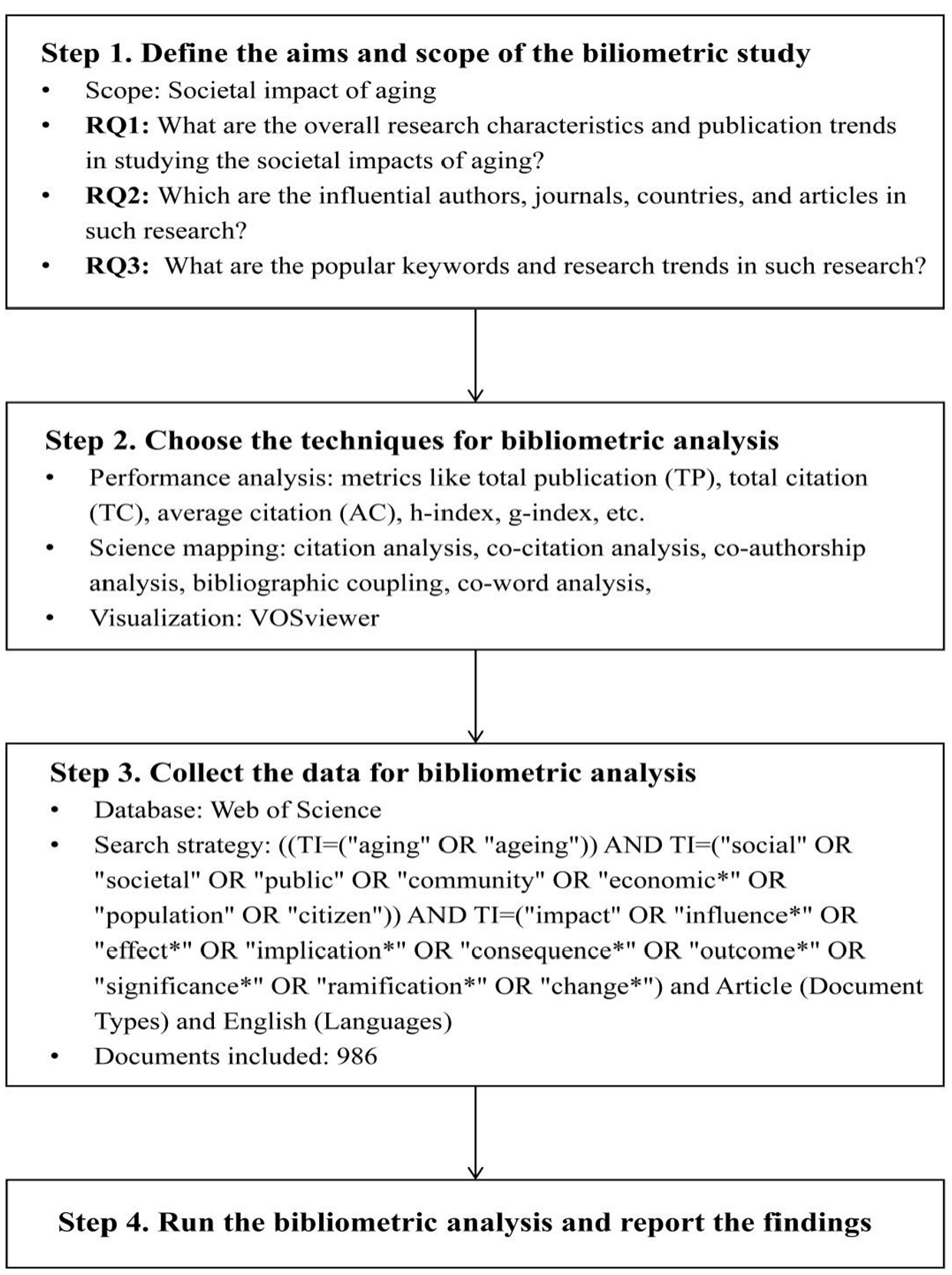
Bibliometric workflow as per Donthu et al. (2021).
Results and Discussion
Holistic Features and Publication Trends
To comprehend the holistic features of research on the societal impact of aging, this study conducted a descriptive performance analysis of the 986 included documents using Excel and POP. As depicted in Table 1, the temporal scope of these 986 documents spans from 1970 to 2023, encompassing 53 years. During this period, the total citations amounted to 23,583, with an average annual citation of 444.96, and an average per-document citation of 23.92. The mean number of authors per document was 3.91, with respective h-index and g-index values of 69 and 125. Further analysis, excluding articles with zero citations, revealed that 850 articles received citations, constituting 86.2% of the total. This suggests a generally high quality of literature in this domain. Among the 850 cited articles, in comparison to the metrics of the initial 986 articles, there was an increase in the average per-document citations to 27.74 and a marginal rise in the average number of authors per document to 3.93. This can be attributed to the unchanged total citations, coupled with a reduction in the number of articles. The slight increase in the average number of authors implies that collaboration may contribute to an enhancement in the quality of the articles.
Citation Metrics of Documents as Per POP.

As for the research domains, Table 2 illustrates the top 10 research fields within these studies. Those comprising over 10% include Geriatrics Gerontology (215, 21.8%) and Business Economics (148, 15.0%). The top ranking of Geriatrics Gerontology is understandable, as the most direct impact of aging on individuals pertains to age-related diseases, making it challenging to exclude such studies through keyword searches. The second position occupied by Business Economics is also anticipated since the primary focus of this study is the non-medical societal impacts of aging, falling within the domain of business economics. Several other fields that have entered the top 10 also potentially address the societal impacts of aging, including Public Environmental Occupational Health, Psychology, Demography, Social Work, Health Care Sciences Services, and Science Technology Other Topics. This underscores the effectiveness of the search strategy.
Top 10 Research Domains (n = 986).

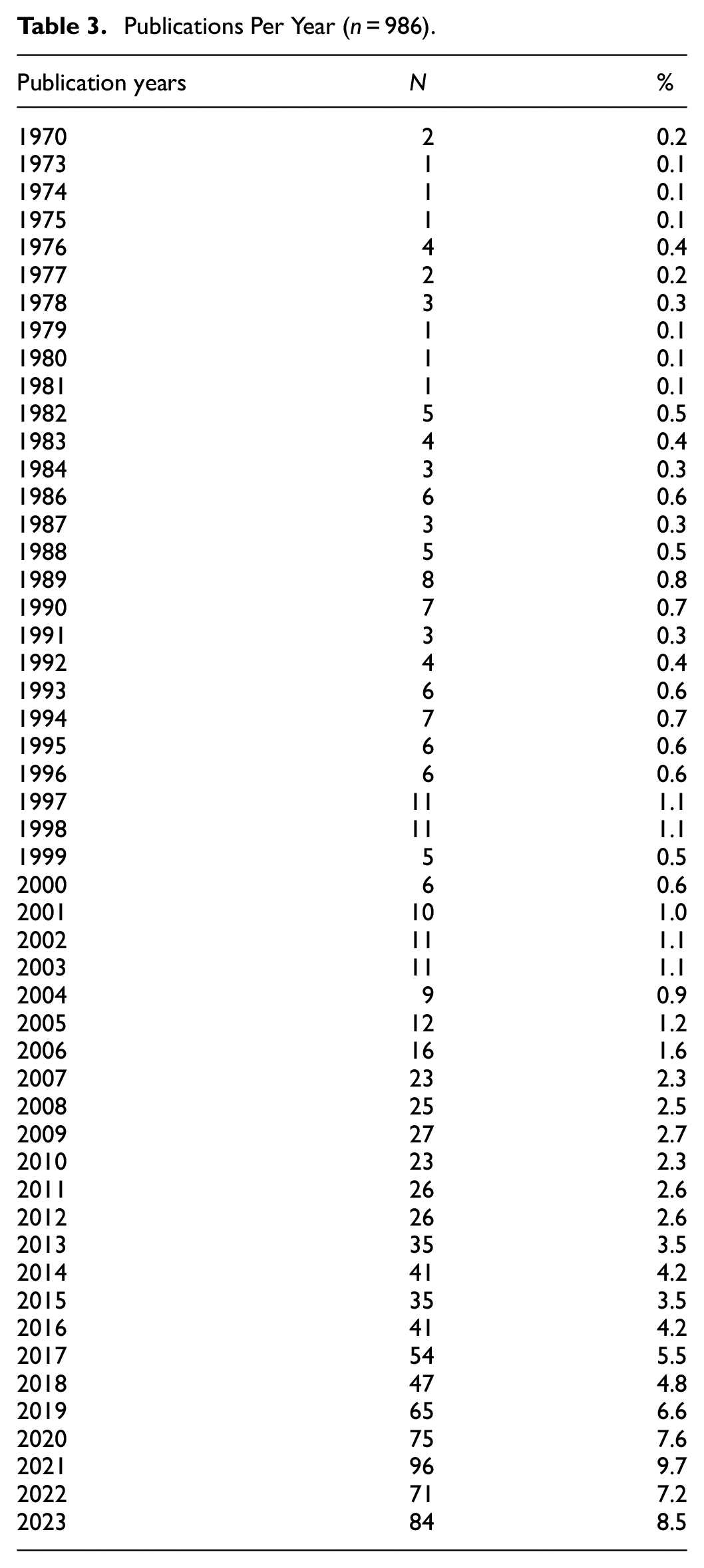
For the publications per year (Table 3 and Figure 2), an exponential growth trend is evident. Initially, before the year 2000, the growth was quite gradual, with an annual publication generally below 10. From 2001 to 2013, there was a fluctuating increase, with the annual publication gradually exceeding 10 and 20. Subsequently, post-2013 marked a phase of rapid growth, with the annual publication consistently surpassing 40, 60, and reaching a peak of 96 in 2021. This trend can be explained by global aging data. According to UN data (2023), around 2001, the proportion of the world’s population aged 65 and above exceeded 7%, surpassing the threshold for an aging society. This prompted a swift increase in global scholarly attention, which previously may have been limited to scholars in individual aging countries. Around 2013, there has been a substantial acceleration in the growth rate of this proportion (United Nations [UN], 2023). This is attributed to the fact that major countries worldwide have collectively confronted significant aging challenges, resulting in a marked surge in the publication volume on this topic. The peak in 2021 might be influenced by the heightened focus on elderly individuals and health issues due to the impact of the COVID-19 pandemic. Given the time lag in the publication of articles, it explains the current trend.
Publications Per Year (n = 986).

Publication trends on the societal impact of aging.
Influential Authors
Table 4 presents the top 20 authors ranked by publication and citation counts. Among them, Park EC, Lee Y, and Vance DE secure the top three positions with 7, 6, and 6 publications, respectively. In terms of citation counts, Andrieu S, representing 16 authors, holds the first position with 1,288 citations each. Following closely are Newman AB (905), Avolio A (803), Chen S (803), and Li M (803). Simultaneously considering publication and citation counts, Newman AB stands out as the sole author within the top 20 rankings in both categories, with five documents and 1,288 citations. These descriptive metrics reflect the prominence of these authors in the field.
Top 20 Authors as Per Documents and Citations.

To further identify influential authors, this study employed co-authorship analysis. Figure 3 illustrates the co-authorship network among authors, segmented into four clusters based on co-authored articles. These clusters include the yellow cluster represented by Forman et al. (2017), the green cluster represented by Friedmann et al. (2020), the blue cluster represented by Wright et al. (2009), and the red cluster represented by Houston et al. (2008). It is evident that Newman AB, Simonsick EM, and Boudreau R serve as core authors within the co-authorship network, collaborating with all four clusters. Moreover, the yellow and blue clusters are relatively close to the core, with authors from these clusters having collaborative connections with all four clusters through the aforementioned three core authors. Additionally, the authors within each cluster have comparable citations, suggesting the likelihood of maintaining stable collaborative relationships.

Influential authors in co-authorship network.
Influential Countries
Regarding the distribution of authors’ nationalities, Table 5 presents the top 10 countries ranked by publication and citation counts. Additionally, Figure 4 illustrates the co-authorship network among countries based on co-authorship analysis. It is observed that the USA tops both the publication and citation counts with 302 publications and 10,626 citations. Mainland China (131) and England (83) secure the second and third positions in publication counts, while the second and third positions in citation counts are held by the Netherlands (3,423) and England (2,742). Upon cross-referencing the two rankings, the USA, Mainland China, England, Australia, Canada, Germany, Italy, and the Netherlands all consistently appear in the top 10. This underscores the high impact of these countries in the field of the societal impact of aging. Notably, the Netherlands, ranked 10th in publication counts (38), ascends to the second position in citation counts (3,423), with an average of 90.08 citations per article, reflecting the high quality and impact of its research. Similarly, Mainland China ranks second in publication counts (131) but fourth in citation counts (2,569), with an average of 19.61 citations per article, indicating that despite substantial attention from Chinese scholars on the topic, the impact of their research is yet to be fully realized. Figure 4 further supports the results from Table 5, as prominently featured nodes in the network correspond to countries consistently ranked high in both publication and citation counts, reaffirming their influential status on a global scale.
Top 10 Countries as Per Documents and Citations.


Influential countries in co-authorship network.
The heightened emphasis on the topic of the societal impact of aging by authors from these countries can be attributed to the elevated levels of aging within their respective populations. Based on the UN classification criteria for aging societies (Cox, 1956), as of 2022, the percentage of the population aged 65 and above in the United States is 17%, Mainland China is at 14%, England at 19%, Australia at 17%, Canada at 19%, Germany at 22%, Italy at 24%, and the Netherlands at 20% (United Nations [UN], 2023). All of these percentages meet the criteria for being classified as deep aging societies, with Germany, Italy, and the Netherlands even reaching the status of super-aging societies.
Influential Journals
Similarly, Table 6 lists the top 10 journals based on publications and citations. PLOS ONE and SUSTAINABILITY (14 each) share the first position for the number of publications, followed closely by the INTERNATIONAL JOURNAL OF ENVIRONMENTAL RESEARCH AND PUBLIC HEALTH (13). BMC GERIATRICS, JOURNAL OF GERONTOLOGICAL SOCIAL WORK, and JOURNALS OF GERONTOLOGY SERIES B PSYCHOLOGICAL SCIENCES AND SOCIAL SCIENCES (12 each) occupy the third position. In terms of citations, the top three journals are JOURNAL OF THE AMERICAN GERIATRICS SOCIETY (380), JOURNALS OF GERONTOLOGY SERIES B PSYCHOLOGICAL SCIENCES AND SOCIAL SCIENCES (349), and LANCET (348). Notably, PLOS ONE, JOURNALS OF GERONTOLOGY SERIES B PSYCHOLOGICAL SCIENCES AND SOCIAL SCIENCES, and SOCIAL SCIENCE & MEDICINE consistently rank in the top 10 for both publications and citations, reflecting their significant impact on research concerning the societal impact of aging.
Top 10 Journals as Per Documents and Citations.

This study also conducted a source-based co-citation analysis to identify the knowledge structure and thematic categories (Donthu et al., 2021). Given the high citation counts of journals in such studies, a threshold of 100 citations per journal was set. Out of 14,824 journals, 29 met this criteria, as illustrated in Figure 5. These 29 journals are categorized into four thematic clusters. The blue cluster, comprising seven journals, includes JOURNALS OF GERONTOLOGY SERIES B PSYCHOLOGICAL SCIENCES AND SOCIAL SCIENCES, GERONTOLOGIST, and PSYCHOLOGY AND AGING, representing the intersection of social sciences and psychology. The red cluster, comprising eight journals, includes JOURNAL OF THE AMERICAN GERIATRICS SOCIETY, LANCET, and JOURNALS OF GERONTOLOGY SERIES A BIOLOGICAL SCIENCES AND MEDICAL SCIENCES, representing the biomedical field. The green cluster, also comprising eight journals, includes PLOS ONE, AMERICAN ECONOMIC REVIEW, and HEALTH AFFAIRS, covering broader social science fields such as economics, population studies, and public health policy. The yellow cluster, comprising six journals, includes SOCIAL SCIENCE MEDICINE, AMERICAN JOURNAL OF EPIDEMIOLOGY, and JOURNALS OF GERONTOLOGY, representing the intersection of social sciences and medicine.

Influential journals in co-citation network.
In terms of distribution, the yellow cluster is situated at the core of the network, bridging multiple disciplines, with the blue cluster above, emphasizing psychology, the red cluster below, leaning toward medicine, and the green cluster to the right, emphasizing social sciences. Furthermore, the three high-impact journals identified in Table 6—PLOS ONE, JOURNALS OF GERONTOLOGY SERIES B PSYCHOLOGICAL SCIENCES AND SOCIAL SCIENCES, and SOCIAL SCIENCE & MEDICINE—belong to the green, blue, and yellow clusters, respectively. This underscores the focus of this study on exploring the societal impact of aging from a non-medical perspective.
Influential Articles
The analysis of article performance can be conducted through indicators such as total citations and average annual citations, facilitating the identification of influential articles in the current field (Donthu et al., 2021). Tables 7 and 8 present the results of the performance analysis. Based on the total citation ranking, Abellan Van Kan et al. (2009) secured the top position with 1288 citations, followed by Avolio et al. (1983; 803) and Houston et al. (2008; 802). As total citations require time to accumulate, articles published later may be at a disadvantage in such rankings. Hence, the average annual citation metric serves as a valuable tool for assessing the potential impact of an article, mitigating the bias introduced by the temporal factor (Donthu et al., 2021). Abellan Van Kan et al. (2009), Wang et al. (2023), and Houston et al. (2008) ranked first, second, and third, with annual average citation counts of 92, 56, and 53.47, respectively. Comparing the two rankings, it is apparent that Abellan Van Kan et al. (2009) hold the top position in both, underscoring its absolute influence in the field of the societal impact of aging. Houston et al. (2008) simultaneously rank third in both lists, and Bloom et al. (2015) appear in the top 10 of both rankings, indicating these articles’ high impact in the field. Moreover, to visualize the results of the performance analysis, this study conducted a citation analysis. The citation network in Figure 6 corroborates the findings presented in Tables 7 and 8. Most of the top-ten articles in the tables are associated with prominent nodes in Figure 6, such as Abellan Van Kan et al. (2009), Etzioni et al. (2003), and Bloom et al. (2015).
Top 10 Articles as Per Total Citations.

Top 10 Articles as Per Citations Per Year.

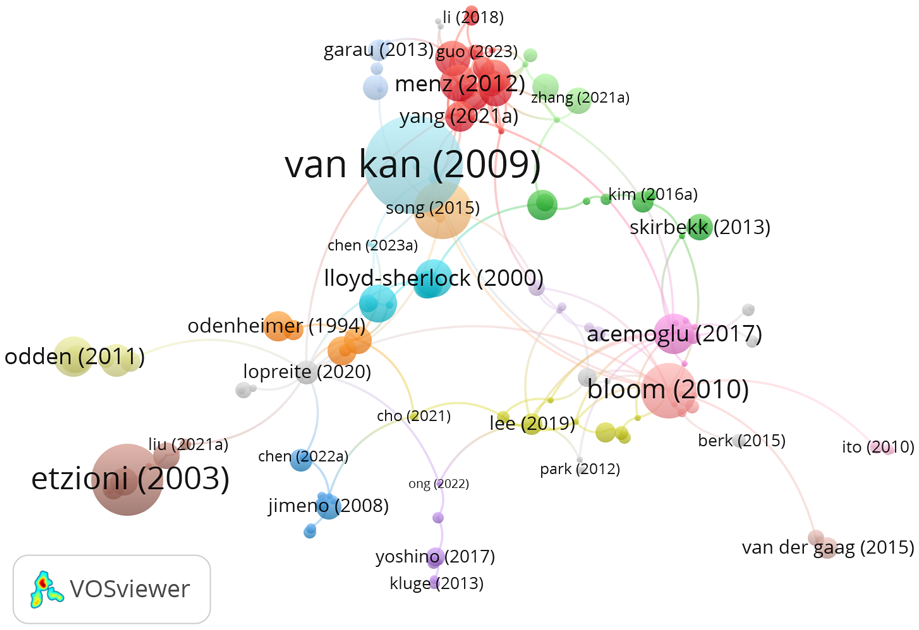
Influential articles in citation network.
These influential articles address a multitude of aspects, briefly summarized as follows. Abellan Van Kan et al. (2009) evaluated gait speed as a single-item tool, finding it predictive for adverse outcomes in community-dwelling older individuals, supporting its potential as a quick, safe, and reliable assessment instrument. Avolio et al. (1983) measured pulse wave velocity (PWV) in a diverse group of 480 subjects in Beijing, China, finding age-associated increases in PWV and blood pressure. Houston et al. (2008) found higher protein intake associated with less lean mass loss in older adults, suggesting dietary protein as a modifiable risk factor for sarcopenia. Moreover, Wang et al. (2023) found income inequality hinders carbon emission efficiency, showing a U-shaped relation with aging and an inverted U-shaped relation with economic growth across 139 countries (1998–2018). Furthermore, Etzioni et al. (2003) forecasted a substantial increase in surgical workload across specialties, driven by the aging US population, emphasizing the need for strategic management to maintain care quality, while Bloom et al. (2015) investigated the rapid global trend of population aging, underscoring the imperative to address disparities, economic challenges, and implement strategic policy responses. In conclusion, these articles involve several aspects of aging’s impact, such as elderly gait predicts outcomes (Abellan Van Kan et al., 2009), age-related cardiovascular dynamics (Avolio et al., 1983), protein mitigates aging lean mass (Houston et al., 2008), aging affects carbon emission efficiency (Wang et al., 2023), aging drives surgical workload increase (Etzioni et al., 2003), and global challenges in aging trends (Bloom et al., 2015). The first three themes are closely tied to the field of medicine, while the subsequent three articles predominantly emphasize the societal implications of aging, which constitute the focus of this research.
To further discern the current landscape of non-medical perspectives on the societal impacts of aging, and to identify thematic classifications and recent developments (Donthu et al., 2021), this study conducted a bibliographic coupling analysis. Setting a citation threshold of 30, out of 986 documents, 183 articles met the criteria. As presented in Figure 7, 15 clusters (represented by distinct colors) were identified, each indicative of different thematic collections. Upon analysis, eight clusters were determined to fall within the non-medical perspective. These included the deep purple cluster (aging and cognitive abilities), represented by Rockwood et al. (2004) and Wright et al. (2009); the light purple cluster (aging and mental health and beliefs), featuring Kidd and Witten (2013) and Vance et al. (2008); the orange cluster (aging and social environment), typified by Greenberg et al. (1997) and Seeman and Crimmins (2001); the deep blue cluster (aging and social interactions), exemplified by Ingersoll-Dayton et al. (1997) and Gurung et al. (2003); the pink cluster (aging and urban communities), with Bowling and Stafford (2007) and Versey (2018) as representatives; the dark green cluster (aging and health economics and medical expenditures), represented by Bloom et al. (2015) and Howdon and Rice (2018); the light blue cluster (aging and sustainable development), featuring Wang et al. (2023) and Yang et al. (2021); and the deep yellow cluster (aging and the labor market), highlighted by Bijak et al. (2007 and 2008). These findings illuminate the current state and directions of recent thematic developments in non-medical perspectives on the societal impacts of aging.

Influential articles in bibliographic coupling network.
Keywords and Trend Analysis
This study also conducted a co-word analysis to identify hot keywords and their thematic clusters in the current field. The analysis was configured with a minimum keyword occurrence threshold of 10 times to mitigate the interference of low-frequency keywords. Ultimately, out of 4,239 keywords, 110 were included in the network (Figure 8). Table 9 presents the top 10 keywords in each cluster, ranked by frequency of occurrences. Among the identified keywords, “aging,”“population aging,” and “impact” are expected to be highly prevalent due to their inclusion in the search strategy. Other notable keywords with high frequencies include terms related to economic and social aspects, such as “economic growth,”“social support,” and “community.” This reflects the broad scope of research themes associated with aging, which spans beyond just health and disease to encompass economic implications and social interactions.
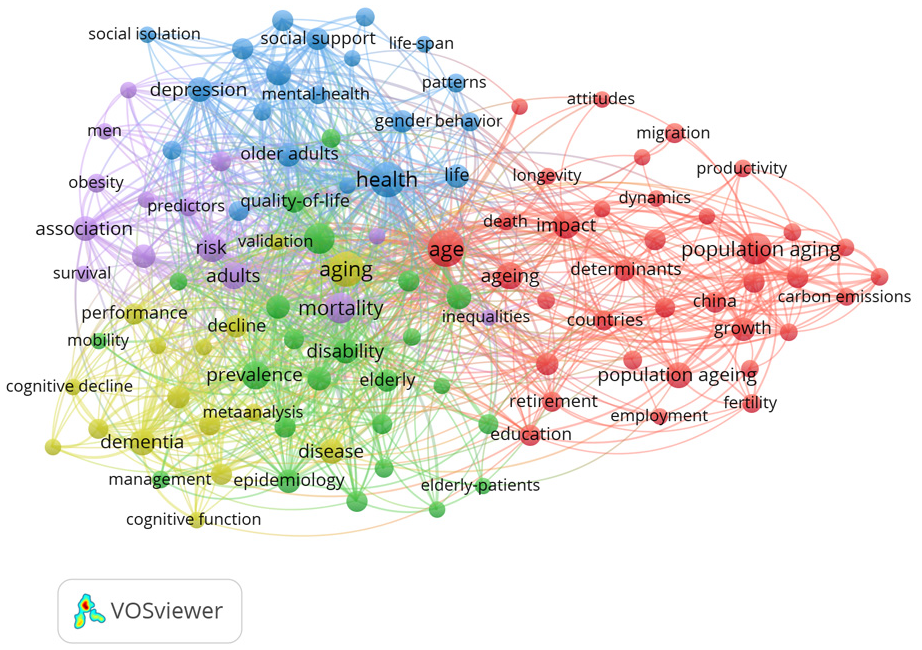
Keywords co-occurrence network.
Top 10 Keywords in Each Cluster as Per Frequency.
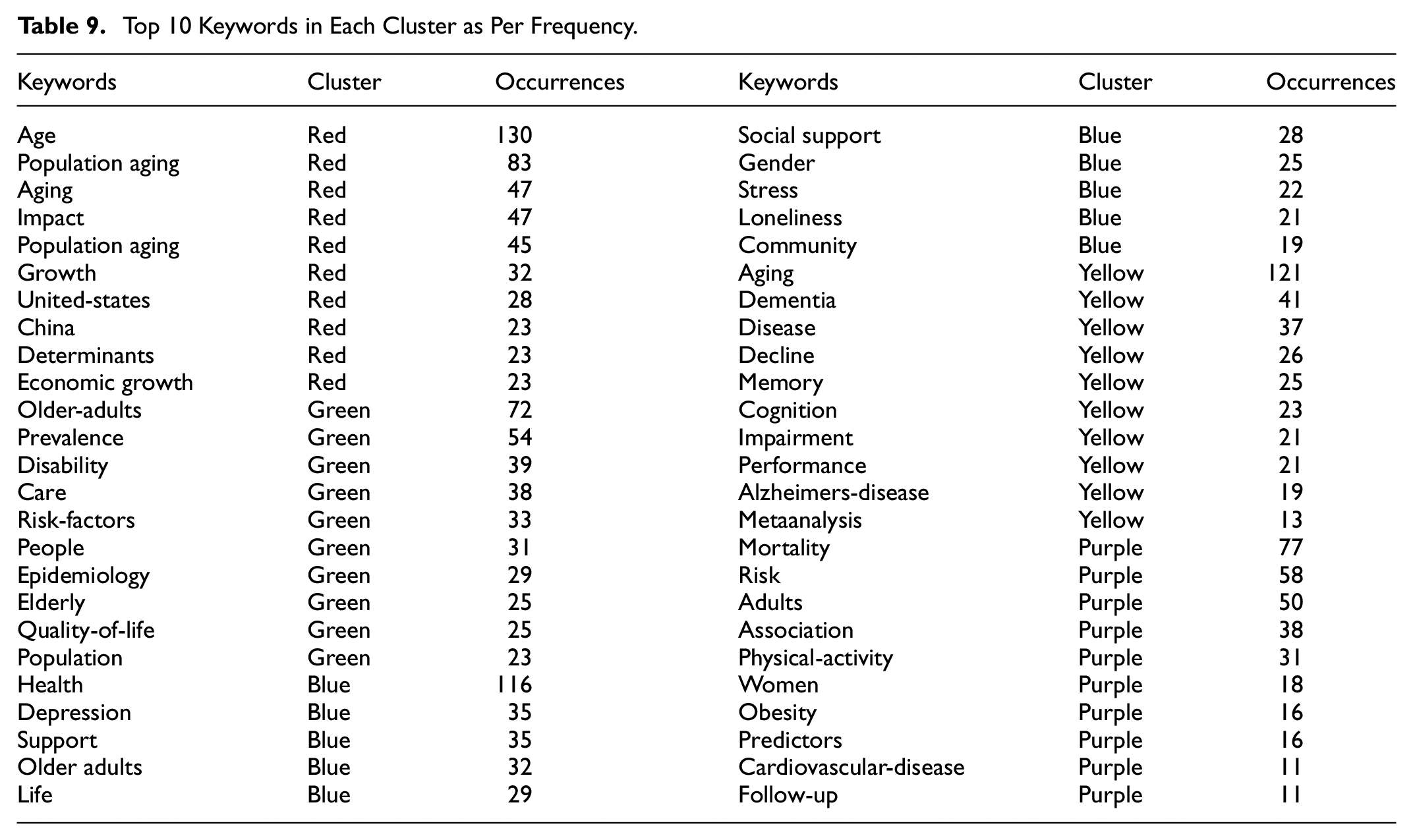
From the perspective of thematic clusters, these high-frequency keywords have been categorized into five classes. As depicted in Figure 8 and Table 9, the green cluster pertains to themes associated with the elderly population and disease, the yellow cluster is related to cognitive and memory themes, the purple cluster is linked to health risks in adults, and the blue cluster encompasses themes related to the mental health and social support of older adults. Significantly, the red cluster is associated with the societal impacts of aging in a narrow sense, which includes keywords such as economic growth, demographic change, carbon emissions, consumption, life expectancy, retirement, labor force, and education, among others. The red cluster, comprising 36 keywords, represents the highest proportion among the five classifications, highlighting its significance as a prominent direction for in-depth research into the current societal impacts of aging. Notably, the red cluster also includes keywords for two countries, China (23) and the United States (28), indicating that they lead in this domain, consistent with the findings from the previous analysis of influential countries.
Building upon Figure 8, the incorporation of a temporal dimension in Figure 9 facilitates the identification of evolving trends in the development of prominent themes within the field. The colors in Figure 9 are assigned based on the temporal prevalence of keywords, with darker colors representing earlier occurrences and lighter colors indicating more recent trends. Significantly, the keywords that emerged as prominent post-2020 (illustrated as yellow nodes) include carbon emissions, energy consumption, economic growth, public health, loneliness, consumption, healthy aging, income, China, and various countries. Conversely, the keywords prevalent around 2012 (depicted as darker nodes) encompass the United States, disabilities, follow-up depression, epidemiology, cognitive impairment, among others. Comparative analysis elucidates a noticeable transition in research trends, moving from predominantly medical-related themes to a broader spectrum of disciplines after 2020. Moreover, there is a transition of research focus from the United States to other countries, notably represented by China. This shift may be attributed to an increased awareness of the multifaceted impacts of aging, prompting a progression from an initial emphasis on medical domains to broader investigations across the social sciences.

Keywords co-occurrence overlay visualization.
Conclusions and Future Research
This study conducted a comprehensive bibliometric analysis of 986 documents on the societal impact of aging, sourced from the WOS database, following the four-step methodology by Donthu et al. (2021). The descriptive analysis revealed a predominant focus on Geriatrics, Gerontology, and Business Economics, along with a steady rise in publication activity. Performance analysis and science mapping identified key contributors, including authors such as Newman AB, Simonsick EM, and Boudreau R, leading countries like the United States, the United Kingdom, and China, and influential journals such as PLOS ONE, JOURNALS OF GERONTOLOGY SERIES B, and SOCIAL SCIENCE & MEDICINE. Notable articles, including those by Abellan Van Kan et al. (2009), Bloom et al. (2015), and Wang et al. (2023), were also highlighted for their impact. The thematic analysis underscored the growing interest in non-medical perspectives on aging, spanning labor markets, sustainable development, health economics, medical costs, mental health, and social environments. Keyword and trend analyses further indicated a shift from medical-focused research in the U.S. to broader social science investigations, particularly in China.
Based on the keyword and trend analysis, future research should further investigate the intersection of aging with economic and social effects at both international and regional levels. The prominence of themes related to economic growth, carbon emissions, and social impacts of aging, particularly in the red cluster, underscores the need for cross-disciplinary investigations that integrate perspectives from economics, sociology, and environmental sciences. For instance, future studies could explore how aging influences labor productivity, consumer spending, and public infrastructure demands, particularly in rapidly aging economies. Research could also examine the feedback loop between aging populations and environmental sustainability, focusing on the implications for resource consumption, energy demands, and carbon emissions.
Moreover, recent trends indicate a shift from medical-focused research to broader societal concerns post-2020, highlighting the importance of addressing regional disparities in aging-related challenges. Comparative studies should be conducted to assess how different countries, such as the United States, China, and European nations, implement policy responses to aging. This could include analyzing the effectiveness of retirement policies, caregiver support systems, and age-friendly urban planning initiatives. Additionally, as emerging economies face distinct demographic transitions, research should investigate adaptive strategies that balance economic growth with aging-related welfare demands. By pursuing these research avenues, future studies can provide a more holistic understanding of aging’s multifaceted impacts and contribute to the design of evidence-based, context-specific policies and interventions that address both global trends and localized needs.
This study acknowledges certain limitations. Despite efforts to filter articles from a non-medical perspective, the strong association between aging research and medicine resulted in the inclusion of medical-related studies. Future research could address this by employing systematic reviews with rigorous manual screening to ensure a non-medical focus. Additionally, as this study relied on a single database with language restrictions, expanding the data sources and removing language limitations could enhance the diversity and comprehensiveness of the literature. Given the thematic shifts observed since 2012, future studies could also narrow their focus to the most recent 10 years to better capture emerging research trends and identify knowledge gaps.
Footnotes
Acknowledgements
The authors extend their heartfelt thanks to the editor and anonymous peer reviewers for their discerning and constructive critiques. These contributions have been essential in the refinement and fortification of this manuscript’s content.

Ethical Considerations
This research did not collect empirical data so ethical approval was not required.
Author Contributions
Each author has made substantial contributions to the research: this includes conceptualization and methodology design, development of the search strategy, data curation, results presentation (visualization), and discussion. The drafting of the original manuscript was primarily undertaken by Zhangwei Zheng and Qin Lingda Tan, while Hafizuddin-Syah B.A.M. and Hafizah Omar Zaki provided critical review and editing. All authors have reviewed and approved the final version of this article.
Funding
The author(s) received no financial support for the research, authorship, and/or publication of this article.
Declaration of Conflicting Interests
The author(s) declared no potential conflicts of interest with respect to the research, authorship, and/or publication of this article.
Data Availability Statement
Data sharing is not applicable to this review article since there was no generation or analysis of new data in the study.