




Abstract
Both positive psychology and pro-environmental behavior are highly associated with individuals’ well-being. While previous studies have investigated the drivers of sustainable behavior, very few pieces have examined the influence of perceived social support on pro-environmental behavior. Drawing on social exchange theory, the study aims to explore the relationship between perceived social support and pro-environmental behavior. The current study recruited 605 participants, and empirically examined the relationship between perceived social support and individuals’ pro-environmental behavior, and underlying mechanism utilizing hierarchical regression and bootstrapping method. The regression coefficient of perceived social support and pro-environmental behavior is 0.511 (SE = 0.034, p < 0.001). The indirect effects of empathy and gratitude are 0.259 (SE = 0.040) and 0.185 (SE = 0.044), with 95% confidential interval [0.182, 0.339] and [0.099, 0.272], respectively. Perceived social support is positively related to individuals’ pro-environmental behavior, indicating that individuals who perceive a higher level of social support are more inclined to engage in pro-environmental behavior compared to those who perceive a lower level of social support. Additionally, the relationship between perceived social support and pro-environmental behavior is parallel mediated by individuals’ empathy and gratitude, with empathy playing a more significant role than gratitude. This implies that individuals who experience a greater sense of social support tend to exhibit higher degrees of empathy and gratitude, which in turn helps amplify their engagement in pro-environmental behavior.
Plain language summary
Perceived social support is positively related to individuals’ pro-environmental behavior, indicating that individuals who perceive a higher level of social support are more inclined to engage in pro-environmental behavior compared to those who perceive a lower level of social support. Additionally, the relationship between perceived social support and pro-environmental behavior is parallel mediated by individuals’ empathy and gratitude, with empathy playing a more significant role than gratitude.
Introduction
The resource-intensive lifestyles of residents have caused severe environmental issues, posing severe challenges to the sustainability of human development (Kaur & Luchs, 2022). An effective approach to mitigating environmental problems involves transitioning from conventional product consumption toward eco-friendly alternatives, that is, pro-environmental behavior (Griskevicius et al., 2010; Haws et al., 2014). Pro-environmental behavior refers to any behavior which is good for the environment or minimizes harm to the environment (Steg & Vlek, 2009). Hence, the prompt of pro-environmental behavior is a critical component in advancing sustainable development and addressing environmental challenges (Lange & Dewitte, 2019). Meanwhile, the extant studies have proved that positive psychology could significantly prompt individuals’ pro-environmental behavior (Bissing-Olson et al., 2013; Guan & Geng, 2024). Perceived social support refers how people feel supported by their significant surrounding people, that is, family members, friends, other vital persons (Zimet et al., 1988), which is very common and could easily be stimulated in our daily life. Therefore, in this context, we identify perceived social support, a typical positive psychology, as a novel influencing element that affects individuals’ pro-environmental behavior based on social exchange theory. We will examine the mediating effects of gratitude and empathy among the above relationship through a questionnaire survey and the bootstrapping method. Specifically, gratitude is regarded as an individual’s general tendency to acknowledge and respond appreciatively to the positive experiences and outcomes they receive as a result of others’ kindness (McCullough et al., 2002), and empathy is a vicarious emotional response to others (Stotland, 1969) and contains the core content that perceiving and acknowledging how other individuals feel or think (Feshbach, 1975; Zaki & Ochsner, 2012).
The study sets forth three significant academic objectives. Firstly, this study introduces a novel approach to prompt individuals’ pro-environmental behavior. While numerous studies have scrutinized various antecedents of pro-environmental behavior, few have explored the topic from the perspective of perceived social support. Our hypothesis suggests that perceived social support will significantly enhance individuals’ pro-environmental behavior. Secondly, our aim is to discern the mediators that explain the influence of perceived social support on individuals’ pro-environmental behavior, and to validate its mediating effect through bootstrap analysis. Lastly, we will develop a comprehensive model, consisted of perceived social support, pro-environmental behavior, gratitude and empathy, which could exhibit how perceived social support influences individuals’ pro-environmental behavior. The rest of this paper is organized as follows. Section “Literature review and hypotheses development” offers a comprehensive overview of the predominant variables, namely, perceived social support, pro-environmental behavior, empathy, and gratitude. This section also formulates the principal hypothesis based on the extant literature and social exchange theory. Section “Methods” delves into the details of participants, variable measurement, key variable scales, and procedures. Section “Results and Discussion” presents the results of the measurement of all variables, the outcomes of the hypotheses tests, and an in-depth discussion of these results. Finally, the concluding section includes the conclusions, theoretical and practical implications, limitations, and avenues for future research.
Literature Review and Hypotheses Development
Pro-environmental Behavior
Pro-environmental behavior is an effective way to power sustainability. With increasing concerns regarding environmental problems such as environmental pollution, climate change, and depletion of natural resources, more and more individuals have become aware of the significance of pro-environmental behavior (Tudor et al., 2008). Pro-environmental behavior refers to any behavior which is good for the environment or minimizes harm to the environment (Steg & Vlek, 2009). The prior literature classifies pro-environmental behaviors into various categories. Stern, for example, initially proposes four dimensions: non-activist behavior in the public sphere, private-sphere environmentalism, environmental activism, and other environmental behaviors (Stern, 2000). From the perspective of the time when the behavior takes effect, pro-environmental behaviors are classified as direct pro-environmental behavior and indirect pro-environmental behavior (Homburg & Stolberg, 2006). Furthermore, some scholars have developed another classification with two categories: task-related pro-environmental behavior and proactive pro-environmental behavior (Bissing et al., 2013). Building on Stern’s four dimensions, pro-environmental behaviors are classified as private-sphere pro-environmental behavior and public-sphere pro-environmental behavior (Mi et al., 2020). Additionally, the bulk of research aims at fostering pro-environmental behaviors utilizing the theory of planned behavior and the norm activation model (Chi et al., 2023; Qin & Hsu, 2022). These two theories align with self-interest and altruistic motivations, respectively. Other studies have leveraged the social exchange theory (Nord, 1969), stimulus-organism-response framework (Donovan & Rossiter, 1982) and broaden-and-built theory (Fredrickson, 1998) to explain and predict individual’s pro-environmental behavior. These theories could help explain how individuals’ pro-environmental behavior are influenced and formed. The current study leverages social exchange theory to investigate the relationship between perceived social support and pro-environmental behavior, and further examine the underlying mechanism of gratitude and empathy. The literature review of these pivotal constructs, including perceived social support, gratitude and empathy, is systematically outlined in the subsequent sections.
Perceived Social Support
Social support, essential in everyday life and work, is a topic that attracts significant attention within scholarly circles. Two facets of social support have been identified: enacted social support and perceived social support. The former pertains to tangible supportive actions that arise from a tangible social network, whereas the latter reflects an individual’s subjective experience and emotional interpretation of support (Lakey et al., 2010; Lonnqvist & Deters, 2016; Moyer & Salovey, 1999). Generally, perceived social support is viewed as a psychological construct linked to other variables, while enacted social support is typically perceived as a situational factor or stimulus variable (Holt-Lunstad et al., 2010; Wethington & Kessler, 1986). Although there is some connection between perceived social support and enacted social support, perceived social support is potentially more influenced by psychological factors, such as personality variables (e.g., personal initiative, interpersonal responsibility, interpersonal flexibility, agreeableness, extraversion) and interpersonal traits (e.g., interpersonal self-support) (Asendorpf & van Aken, 2003; J. Liu & Xia, 2018; Oudsten et al., 2010; Xia et al., 2012). Given that the prevalence of perceived social support in our work and life, and perceived social support is strongly linked to psychological variables and can be fostered or manipulated more economically and easily compared to enacted social support, this study will primarily focus on perceived social support.
Perceived social support, characterized as a positive cognitive emotion within the realm of positive psychology (McCullough et al., 2002), has been shown to reliably predict numerous positive outcomes while being negatively associated with a variety of negative factors. Perceived social support refers to the sense of being emotionally supported by significant others in one’s immediate environment, such as family members, friends, and other key individuals (Zimet et al., 1988). Consequently, when an individual perceives greater support from their family, friends, or other significant figures, their level of perceived social support increases. Previous studies have demonstrated that perceived support from teammates positively affects subjective well-being, particularly through the mediating role of positive emotion (Cho et al., 2020). Perceived social support has also been established as a fundamental aspect of positive psychology, effectively guarding against emotional distress following events like cardiac arrest (Presciutti et al., 2023). Furthermore, empirical evidence suggests that perceived social support contributes positively to post-traumatic growth in the aftermath of events such as earthquakes (A. Y. Liu et al., 2021) and warfare (Bhat & Rangaiah, 2015). It also positively impacts school engagement (Fernandez-Lasarte et al., 2019), and creative behavior (S. S. Kim, 2019). Conversely, this type of support is found to be inversely associated with perceived stress (Zhao et al., 2021), loneliness (Zhang et al., 2022), depressive symptoms (Leonard et al., 2020), social anxiety (Yang et al., 2021), and pathological internet use (S. T. Wang & Zhang, 2020). Due to its universal relevance and positive implications, the concept of perceived social support has been employed extensively in both theoretical and practical contexts.
Gratitude
Gratitude, a kind of positive emotion, is characterized as an individual’s general tendency to acknowledge and respond appreciatively to the positive experiences and outcomes they receive as a result of others’ kindness (McCullough et al., 2002). This emotion and trait, fundamental to human experience, is universally recognized and implemented across languages and religions (R. A. Emmons & Crumpler, 2000; McCullough et al., 2001). The conceptualization of gratitude encompasses four primary dimensions: density, frequency, intensity, and span (McCullough et al., 2002), indicating that those in high level (vs. low level) of gratitude tend to perceive an abundance of goodness in their lives, derive pleasure from simple acquisitions, recognize the societal and environmental contributions of others, and appreciate the profound importance of gratitude itself (Watkins et al., 2003). The extant literature divides gratitude into two types: trait gratitude and state gratitude. Trait gratitude, which is cultivated over a lifetime, is a stable tendency to reciprocate others’ kindness. It is intrinsically linked to an individual’s values, life experiences, and social environment (McCullough et al., 2002). Conversely, state gratitude is an episodic feeling of gratitude triggered by an external event that has been beneficial to the individual (R. Emmons & Mccoullough, 2004). Evidently, gratitude interventions and gratitude exercise, aiming to enhancing individual positive psychology, mainly focus on increasing individual state gratitude, having been examined to be effective in clinical therapy and work circumstance (Jackowska et al., 2016; Layous et al., 2023).
The Moral Affect Theory of Gratitude posits three primary roles of gratitude (McCullough et al., 2001). First, gratitude acts as a distinctive acknowledgment of others’ ethical actions through a positive response. Second, gratitude could elicit individual’s moral motivation toward the benefactor. Finally, gratitude is capable of encouraging and reinforcing future moral behavior of benefactor. The prior studies have examined the positive causal relationship between perceived social support and gratitude (Alfieri et al., 2018), and gratitude is a powerful antecedent of pro-environmental behavior. Both gratitude to nature (K.-P. Tam, 2022; Zelenski & Desrochers, 2021) and gratitude to human beings (Liang & Guo, 2021; Sun et al., 2023) could significantly prompt individuals’ pro-environmental behavior. Meanwhile, social exchange theory suggests that social exchange is a form of mutually beneficial behavior, whereby one party offers assistance, support, and other forms of contribution, and the other party should reciprocate accordingly (Nord, 1969). For example, inclusive leadership could increase employees’ innovative work behaviors, because inclusive leadership creates a healthy and safe working atmosphere that could benefits the employees, which in turn fostering employees’ hard work and innovative work (Umrani et al., 2024). Additionally, social exchange theory has been extensively utilized in prior studies investigating pro-environmental behavior (Chua et al., 2024; Darvishmotevali & Altinay, 2022; Elshaer et al., 2024; T. Karatepe et al., 2022; Zafar & Suseno, 2024). Therefore, the study infers that when an individual perceives social support from society and the environment, they will develop a sense of gratitude toward society and the environment, which will in turn lead to reciprocal behavior that benefits society and the environment, for example, pro-environmental behavior. To illustrate this in a real-life example, consider a community where neighbors encourage each other to recycle and use sustainable practices. This mutual support fosters a sense of gratitude, which can lead individuals to adopt more sustainable behaviors, ultimately contributing to a cleaner and healthier environment. That is to say, perceived social support can prompt individual gratitude, which in turn could foster an individuals’ pro-environmental behavior, and gratitude mediates the effect of perceived social support on individuals’ pro-environmental behavior. Consequently, we propose the following hypotheses.
H1: Perceived social support is positively related to individuals’ pro-environmental behavior.
H2: Gratitude mediates the effect of perceived social support on pro-environmental behavior.
Empathy
Empathy is an ordinary cognitive emotion and serves a significant role in shaping individual social behavior (Vossen et al., 2015). Researchers focused on empathy’s affective attribute at its opening stage and define empathy as a vicarious emotional response to others (Stotland, 1969). As time went by, scholars acknowledged that empathy is multifaceted and cognitive attribute is taken into consideration as well as affective attribute (Hoffman & Martin, 2000; Hollan, 2012), and most of the definition contained the core content that perceiving and acknowledging how other individuals feel or think (Feshbach, 1975; Zaki & Ochsner, 2012). Empathy is a kind of positive psychology and is regarded as universally good. Besides the application in our daily life, empathy has been widely advocated in business, religion and politics (Escalas & Stern, 2003; Schumann et al., 2014; Wallace & Shapiro, 2006). Overall, empathy is a type of absolute virtue and definitely improved social relation for a better world (Y. A. Wang & Todd, 2021).
According to the social exchange theory, social exchange represents a mutually beneficial behavior wherein one provides help, support, and various contributions, and the other one is expected to respond with corresponding reciprocity (Nord, 1969). It is inferred that when individuals acquire perceived social support, they could prompt their gratitude level and empathy level, and conduct some pro-environmental behavior which is good for the society and the environment. Meanwhile, the extant research has established a positive causal relationship between perceived social support and empathy (Oh & Roh, 2022), and empathy could enhance pro-environmental behavior (Ienna et al., 2022; Pickering et al., 2022; L. T. Wang et al., 2023; L. Xu et al., 2022). Therefore, we suggest that perceived social support can enhance individuals’ empathy, which in turn could promote pro-environmental behavior, and empathy serves as a mediator between perceived social support and pro-environmental behavior. Formally stated:
H3: Empathy mediates the effect of perceived social support on individuals’ pro-environmental behavior.
Based on all the hypotheses, we develop the following model for this study (see Figure 1).
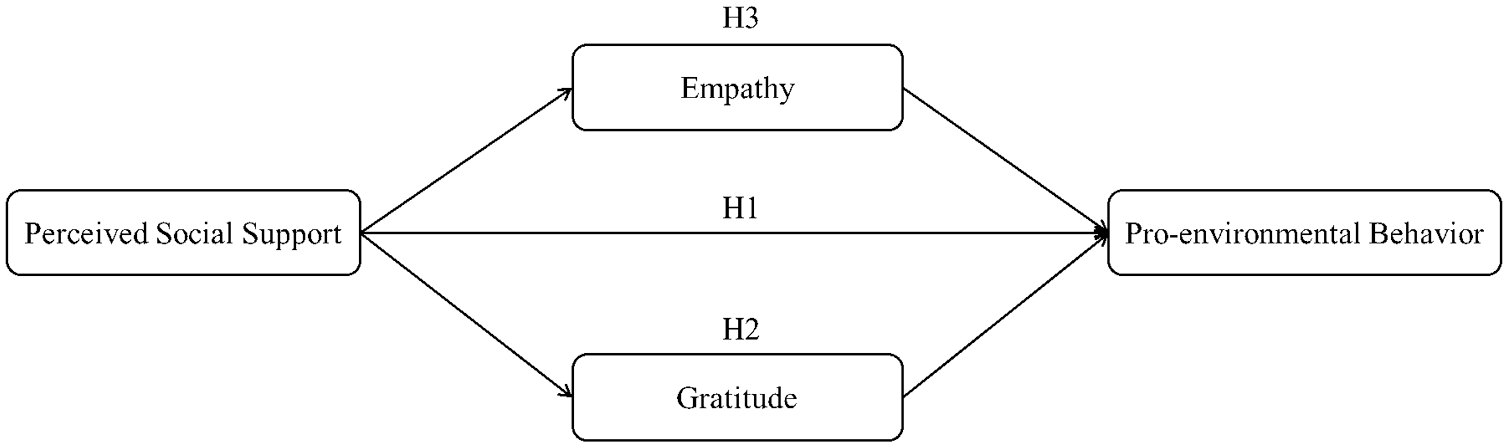
The model of the study.
Methods
Participants
To ensure appropriate power for statistical analysis, the number of participants should be at least 250 (Schonbrodt & Perugini, 2013). We surpassed this goal by recruiting 618 participants. The sample population for this study consisted of undergraduate students from a normal university situated in the Southwest region of China. This group was chosen for its representativeness, high level of engagement and ease of accessibility, the criteria that were frequently applied in psychological and environmental research (Ahn et al., 2023; Woo et al., 2022). A convenience sampling technique was employed to recruit participants, specifically targeting undergraduate students. The choice of this sampling method was justified by the ease of access to this population, which facilitated a higher response rate and allowed us to achieve the desired sample size for statistical power. Specifically, participants were told that: (a) the survey was about their general ideas and behaviors of Perceived Social Support and Environmental Protection Behaviors. (b) There was no right and wrong on their answers, and they simply need to choose the genuine thoughts and behaviors that reflect their daily lives. (c) When filling out the questionnaire, please complete it with utmost seriousness and avoid engaging in any other activities that may cause distractions and interfere with the process. (d) All personal information will be strictly confidential and all survey content will only be used for academic research purposes and not for any commercial use. Participation was entirely voluntary, with participants having the freedom to withdraw from the survey at any point. The study collected 618 questionnaires from the participants, and excluded five participants from the study because they didn’t take the questionnaire seriously. Additionally, eight participants were excluded due to their responses exceeding three times the standard deviation, leaving final 605 participants for our analysis. All their demographic information can be found in Table 1.
The Profile of the Participants.

As presented in Table 1, the percentage of males is 24.298%, with a total of 605 participants. It is worth noting that there were more female participants than male participants, which aligns with the actual situation in Chinese normal universities where female undergraduates outnumber male undergraduates. Furthermore, the age of participants ranged from 16 to 25, with a median value of 20. Regarding the participants’ monthly living expenses, the rate of those falling in the [0, 1000] zone was 42.479%, while 45.620% fell in the [1001, 1500] zone. This indicates that 88.099% of the participants had monthly living expenses equal to or below 1500 ¥. Only two participants reported monthly living expenses over 2500 ¥, and the mean value of the monthly living expense was 1271 ¥. These findings suggest that all participants had lower monthly living expenses compared to undergraduates from developed cities like Beijing, Shanghai, and Guangzhou. This is consistent with the reality of the university where the questionnaire survey was conducted, located in a southwestern province of China. It is worth mentioning that all the participants in this study were undergraduates who could understand the content and implications of the survey. Therefore, the quality of the participants met the necessary standards.
Variable Measurement
We utilized a comprehensive questionnaire, based on existing research, to examine all the hypotheses. This questionnaire was translated into Chinese to ensure that all participants could thoroughly understand the contents and the implications. The questionnaire is consisted of five sections: perceived social support, pro-environmental behavior, empathy, gratitude, and demographic information.
First, perceived social support scale was directly adopted from Zimet et al.’s research (Zimet et al., 1988). The scale includes vital information of perceived social support from family, friends and significant others. There are twelve items for the scale, for example, “There is a special person who is around when I am in need.” All items used a seven-point Likert scale, ranging from “1 = strongly disagree” to “7 = strongly agree.” Cronbach’s alpha coefficient of the scale was 0.955 for the current sample.
Second, we utilized the existed scale to test participants’ levels of empathy and gratitude. The measure of empathy referred to Kim and Cooke’s research (S. C. Kim & Cooke, 2021), which is consisted of three items, for example, “How moved do you feel for the future of the environment.” Meanwhile, the study adopted Tam’s scale to assess participants’ gratitude level (K. P. Tam, 2022), which included eight items, for example, “I want to give thanks to nature for its support to my life.” All items used a seven-point Likert scale, ranging from “1 = strongly disagree” to “7 = strongly agree.” Cronbach’s alpha coefficients of empathy and gratitude scale were 0.889 and 0.847, respectively.
Third, we directly employed the pro-environmental behavior scale from a previous study (Fielding & Head, 2012). This scale assessed participants’ frequency of engagement in eight specific behaviors, namely saving energy at home, conserving water, planting trees, reducing meat consumption, purchasing products with minimal throw-away packaging, recycling, writing letters or signing petitions related to environmental protection, and utilizing public transportation whenever feasible. All items used a seven-point Likert scale, ranging from “1 = never” to “7 = always.” Finally, the demographic information section collected data on participants’ gender, age, and monthly living expense. Cronbach’s alpha coefficient of the scale was 0.966.
Once the participants agreed to take part in the survey in exchange for a monetary reward, they were tasked with completing a questionnaire titled “A Survey of Perceived Social Support and Pro-Environmental Behaviors.” They were informed that they could withdraw from the process at any point, with the understanding that their data would be omitted from the final analysis. The majority of participants completed the survey in less than four minutes, suggesting that they were fully attentive and able to respond to the questions instinctively. After they finished the survey, they received their promised financial rewards. The collected data underwent preliminary processing before we carried out descriptive statistics, regression analysis, and bootstrapping analysis.
Results and Discussion
Reliability and Validity of the Scales
To ensure the reliability and validity of all scales, we computed key statistical measures utilizing SPSS 22.0, including Cronbach’s alpha (α), composite reliability (CR), average variance extracted (AVE), and correlation coefficient. Additionally, we utilized the variance inflation factor (VIF) by SPSS 22.0, using pro-environmental behavior as the dependent variable and the remaining primary variables as independent variables, to eliminate multi-collinearity issue among the main constructs. The results of these calculations are detailed in Table 2.
The Parameters of Indexes Concerning Reliability and Validity.

Note. PSS = perceived social support, PEB = pro-environmental behavior.
The left side of the table presents Cronbach’s alpha (α), composite reliability (CR), and average variance extracted (AVE) values. The right side of the table displays the results of the Fornell-Larcker criterion analysis, employed to evaluate the discriminant validity among the constructs. In this section, diagonal elements represent the AVE square root values, and the elements below the diagonal line contain Pearson correlation coefficients between the variables.
p < 0.05. **p < 0.01. ***p < 0.001.
Specifically, the Cronbach’s alpha coefficients for perceived social support, pro-environmental behavior, empathy, and gratitude were above 0.8, thus ensuring the validation of internal consistency for these constructs. Additionally, all the composite reliability (CR) values exceeded 0.7. In summary, our scales met the basic standard for reliability.
The validity of the study can be established through assessing the average variance extracted (AVE) and correlation values. All AVE values surpassed the threshold of 0.5, indicating satisfactory convergent validity as per the guidelines provided by Fornell & Larcker (Fornell & Larcker, 1981). Furthermore, a comparison was conducted between the square root of the AVE and the correlation coefficients, with the outcomes revealing that all AVE square root values were greater than their respective correlation coefficients (see the right side of Table 2). This provides strong evidence for the satisfactory discriminant validity of the utilized scales. Finally, by using pro-environmental behavior as the dependent variable and the remaining key variables as independent variables, we obtained the final variance inflation factor (VIF) values for perceived social support, empathy, and gratitude as 2.120, 2.652, and 2.284, respectively, which is less than the threshold of 10. These values supported the conclusion that there were no multi-collinearity issues among the key variables (O’Brien, 2007).
Hypotheses Testing
We employed SPSS 22.0 to run the analysis of the main effect and the mediating effect. The main results can be found in Tables 3 and 4, and Figure 2.
The Results of the Main Effect.

Note. PSS = perceived social support, MLE = monthly living expense.
The values in parentheses are standard errors of the corresponding variables. 0 < λ < 0.001.
p < 0.05. **p < 0.01. ***p < 0.001.
Direct, Indirect, and Total Effects of Bootstrapping Analysis.

Note. PSS = perceived social support, PEB = pro-environmental behavior, SE = standard error.

The regression coefficient of mediating effect.
The Main Effect: The Effect of Perceived Social Support on Pro-environmental Behavior
The study employed hierarchical regression to test main effect with SPSS 22.0 The primary hypothesis of this investigation, which posited that perceived social support had a positive correlation with pro-environmental behavior, was substantiated by the empirical results. Specifically, Model 1 of Table 3 revealed a statistically significant positive relationship between perceived social support and pro-environmental behavior (β = 0.511, p < 0.001). Even after controlling for variables such as sex, age, and monthly living expenses, this relationship remained significant (β = 0.524, p < 0.001, presented in Model 2). This result implied that for every 1-unit elevation in perceived social support, the probability of an individual partaking in pro-environmental behavior enhances by 0.524, thereby validating Hypothesis 1. Finally, even we take empathy and gratitude into consideration, the regression coefficient of Model 3 still kept statistically significant at the 0.05 level.
The verification of H1 reveals that individuals with a high level (vs. low level) of perceived social support are more likely to engage in pro-environmental behaviors. This is a pivotal finding of our study, which serves as the foundation for subsequent tests examining the mediating effects.
The Mediating Effect: The Test of Empathy & Gratitude as Parallel Mediators
The mediating effect encompasses two primary hypotheses, H2 and H3. To explore the mediating roles of empathy and gratitude in the connection between perceived social support and pro-environmental behavior, we utilized the PROCESS tool of SPSS 22.0 to conduct a bootstrapping analysis (Model 4) with 5000 samples and a 95% confidence interval (Hayes, 2013). The bootstrapping results, using perceived social support as independent variable, empathy and gratitude as mediators, and pro-environmental behavior as dependent behavior, support the hypothetical mediating effects of empathy and gratitude (see Table 4).
As showed in Table 4, the direct effect regression coefficient of PSS → PEB path was 0.067, as the inclusion of zero for 95% confidential interval [−0.015, 0.150]. While the indirect effect regression coefficient of PSS → Empathy → PEB path was 0.259, and zero didn’t fall into the 95% confidential interval [0.182, 0.339]. Similarly, the indirect effect of gratitude was statistically significant too, with a regression coefficient 0.185 and a 95% confidential interval [0.099, 0.272] that did not include zero. The rates of direct effect and indirect effect were 13.112% and 86.888%, respectively. These results indicated that empathy and gratitude fully mediated the relationship between perceived social support and pro-environmental behavior. Specifically, the indirect effect of empathy (β = 0.259, p < 0.05) and the indirect effect of gratitude (β = 0.185, p < 0.01) were both statistically significant. By comparing the indirect effect size of empathy and gratitude, it could be concluded that the effect of empathy was greater than the effect of gratitude on the main effect, with the effect size 0.259 versus 0.185 and the effect rates 50.685% versus 36.204% of the total effect. Using gratitude’s indirect effect size, 0.185, as the benchmark value, the indirect effect of empathy, 0.259, is 40% higher than that of gratitude. Hence, empathy played a more significant role than gratitude on the effect of perceived social support on individuals’ pro-environmental behavior. All the above results supported Hypothesis 2 & Hypothesis 3. After controlling sex, age and monthly living expense, the mediating effects of empathy and gratitude on the main effect were still statistically significant. Therefore, perceived social support influences individuals’ pro-environmental behavior through two distinct pathways. Firstly, it directly positively affects pro-environmental behavior, although the effect is not statistically significant. Moreover, it has a positive impact on pro-environmental behavior indirectly, via the mediating effects of gratitude and empathy. Furthermore, it can be concluded that empathy plays a more significant and influential role than gratitude in mediating the relationship between perceived social support and individuals’ pro-environmental behavior.
Finally, the study utilized structural equation modeling (SEM) to thoroughly examine the goodness of fit of the proposed model. The statistical results revealed that the Root Mean Square Residual (RMR) was 0.037 (less than 0.05), and the Goodness of Fit Index (GFI) was 0.902 (greater than 0.900), suggesting an excellent fit of the data to the developed model.
In conclusion, this study demonstrates a significant positive correlation between perceived social support and pro-environmental behavior, with empathy and gratitude playing a crucial mediating role. These findings provide new insights into the psychological mechanisms underlying pro-environmental behavior. Figure 2 presented the coefficients of all routines.
Discussion
The extant study proved that pro-environmental behavior is positively related to individuals’ well-being (Prati et al., 2017), and obviously, positive psychology could promote individuals’ mental psychology. To this end, both positive psychology and pro-environmental behavior are highly associated with individuals’ mental health. The prior study suggested that being relaxed, content, at rest, and calm, could positively predict individuals’ pro-environmental behavior (Bissing et al., 2013). Considering that perceived social support is a typical positive cognitive emotion, the current study proposes that perceived social support is positively associated with pro-environmental behavior from the perspective of positive psychology, and examines the underlying mechanism of the relationship between perceived social support and individuals’ pro-environmental behavior.
The Main Effect: The Effect of Perceived Social Support on Pro-environmental Behavior
The successful testing of hypothesis 1 via hierarchical regression provided support for the positive predication of pro-environmental behavior by perceived social support. This suggests that individuals who perceive a higher level of social support are more inclined to engage in pro-environmental behavior compared to those who perceive a lower level of social support. Empirical evidence has shown that positive emotions, psychologies and statuses, such as feeling relaxed, content, at rest, and calm, have been proved could positively predict individuals’ pro-environmental behavior (Bissing et al., 2013). Perceived social support can derive from family members, friends, or significant others (Zimet et al., 1988). When individuals perceived social support from others, they are less likely to feel lonely and more likely to experience positivity, which is a vital determinant of mental health. Interpersonal relationships have the ability to influence individuals’ pro-environmental behavior (Lengieza et al., 2023; L. Xu et al., 2022), and positive interpersonal relationships are an essential source of perceived social support. For instance, the extant literature demonstrates that parent-child relationship can impact a child’s green consumption values. In particular, parents’ environmentally responsible consumption behavior was significantly associated with early adolescents’ green consumption values when there was a close parent–child relationship (indicating that the children are more likely to perceive social support from their parents), but this association was not significant when there was a distant parent–child relationship (Gong et al., 2022). Furthermore, interpersonal harmony in working place, positively related to perceived social support, has been found to promote individuals’ pro-environmental behavior (Wu et al., 2019), while job insecurity, negatively related to perceived social support, can decrease employees’ pro-environmental behavior (O. M. Karatepe et al., 2023). The current study empirically confirms the positive relationship between perceived social support and individuals’ pro-environmental behavior, indicating that individuals who perceive a higher level of social support are more likely to engage in pro-environmental behavior compared to those who perceive a lower level of social support.
The Mediating Effect: The Parallel Mediating Effects of Empathy & Gratitude
Additionally, the results of the bootstrap analysis revealed that empathy and gratitude played parallel mediating roles in the relationship between perceived social support and individuals’ pro-environmental behavior. Specifically, perceived social support was found to be positively associated with empathy and gratitude, and this, in turn, led to an increase in pro-environmental behaviors. This finding is consistent with social exchange theory (Nord, 1969), which suggests that individuals who perceive social support are more likely to experience higher levels of gratitude and empathy, and subsequently engage in behaviors that benefit both society and the environment. Previous research has already established a positive causal relationship between perceived social support and empathy (Oh & Roh, 2022), as well as demonstrated that perceived social support is a predictor of gratitude (Alfieri et al., 2018). Moreover, the positive relationship between empathy and pro-environmental behavior (L. T. Wang et al., 2023), and the positive relationship between gratitude and pro-environmental behavior (Liang & Guo, 2021) have also been established. All the above studies theoretically supported the mediating effects of gratitude and empathy on the effect of perceived social support on individuals’ pro-environmental behaviors, and the current study contributes to the existing literature by empirically testing these mediating effects using collected data.
Further analysis and comparison of the results demonstrated that both empathy and gratitude served as full parallel mediators in the relationship between perceived social support and individuals’ pro-environmental behavior. However, it is important to acknowledge that there was a notable difference in the size of the effects between empathy and gratitude. The indirect effect size of empathy was found to be substantially greater, with a value of 0.259, compared to the indirect effect size of gratitude, which was 0.185. This suggests that empathy plays a more significant and influential role than gratitude in mediating the relationship between perceived social support and individuals’ pro-environmental behavior. Based on the scales of empathy and gratitude mentioned in section “Variable Measurement,” it can be inferred that empathy is a general emotion related to environmental concern, for example, “How compassionate do you feel for the environment?” (S. C. Kim & Cooke, 2021), while gratitude is a specific emotion tied to environmental things, for example, “Whenever I eat something delicious, I feel grateful toward the natural world for its provisions” (K. P. Tam, 2022). Empathy encompasses a wider range of environmental concerns than gratitude, and therefore, has a greater impact on individuals’ pro-environmental behavior. The point is supported by the results of Figure 2. As presented in Figure 2, the effects of perceived social support on empathy and gratitude are almost equal, with the values of .642 (p < 0.001) and .701 (p < 0.001). However, the effect of empathy on pro-environmental behavior (β = 0.403, p < 0.001) is much bigger than that of gratitude (β = 0.264, p < 0.001). Consequently, it can be concluded that empathy plays a more significant and influential role than gratitude in mediating the relationship between perceived social support and individuals’ pro-environmental behavior.
Conclusions, Implications and Future Work
Conclusions
The present study utilized a scientific survey methodology to rigorously validate the theoretical framework and empirically support the positive relationship between perceived social support and pro-environmental behavior. Drawing on the social exchange theory, this study introduces perceived social support as a novel antecedent to pro-environmental behavior. Furthermore, it proposes that empathy and gratitude serve as significant parallel mediators in this relationship. To ensure the robustness of the findings, a total sample of 605 participants were recruited from a Chinese normal university and administered a comprehensive questionnaire. The empirical analysis of the collected data yielded successful results, corroborating all of our hypotheses. From these results, we achieve the following conclusions. Firstly, perceived social support has a positive correlation with pro-environmental behavior. This suggests that individuals with a high level (vs. low level) of perceived social support are more inclined to engage in pro-environmental behavior. Secondly, empathy and gratitude parallel mediate the relationship between perceived social support and pro-environmental behavior. This implies that those with high level (vs. low level) of perceived social support are more prone to experiencing high levels of empathy and gratitude for their surroundings, and are thus more likely to perform pro-environmental behavior.
Implications
Theoretical Implications
The contribution of this study can be expounded as follows. Academically, our study enriches the mainstream of literature pertaining to sustainability (pro-environmental behavior), and positive psychology (i.e., empathy, gratitude, perceived social support). We investigated a new theoretical antecedent of pro-environmental behavior and demonstrated the positive influence of perceived social support on individuals’ pro-environmental behavior. Furthermore, by exploring the mediating role of empathy and gratitude, the study expands the scholarly application of positive psychology to sustainable behavior. Additionally, the study extends the theoretical application of social exchange theory to the fields of positive psychology and environmental behavior. Finally, a theoretical model, which is consisted of perceived social support, pro-environmental behavior, empathy and gratitude, was developed to explain the effect of perceived social support on individuals’ pro-environmental behavior.
Practical Implications
In light of the practical implications of this study, we propose the following specific measures closely related to social support, gratitude, and empathy to prompt pro-environmental behavior: firstly, for policymakers, it is recommended to consider not only economic incentives but also to build community support networks when crafting environmental policies. This could include establishing neighborhood environmental groups to promote mutual aid and resource sharing among residents. Meanwhile, public participation projects can be initiated to enhance empathy for environmental policies among the populace, thereby increasing policy acceptance and enforcement. Additionally, marketers can foster empathy and social support by showcasing how products contribute to community environmental projects and enhance consumers’ identification with sustainable living. By expressing gratitude for consumers’ choices and highlighting the positive environmental impact of their purchases, they can cultivate a sense of gratitude, thereby strengthening the emotional connection between consumers and the brand. Furthermore, in educational programs, it is worth exploring to design curricula and activities that specifically teach the importance of empathy and gratitude, and how to apply these qualities to environmental protection. For instance, through role-playing and team collaboration activities, students can learn to exhibit empathy when facing environmental challenges and to express gratitude for others’ efforts and achievements. Lastly, for companies and organizations, we should think about cultivating a culture of empathy and gratitude by establishing employee support networks and implementing gratitude programs. For example, regular team-building activities and employee recognition ceremonies can strengthen social support among team members and encourage employees to appreciate each other’s environmental behaviors.
Limitation and Future Work
Based on social exchange theory, we have proposed three vital hypotheses concerning the effect of perceived social support and individuals’ pro-environmental behavior. Our empirical investigation of these hypotheses has offered both theoretical underpinnings and practical evidence backing our results. Nonetheless, it is crucial to recognize our study’s limitations and propose directions for future enhancement. One limitation is that all our participants were from a Chinese normal university, which could confine the applicability of our results. Future studies should strive to incorporate participants from diverse countries and cultural contexts to bolster the study’s external validity. Also, our research exclusively depended on data collected through questionnaires. Future investigations might contemplate using experimental methods to further substantiate our conclusions. Besides, while we examined the causal relationship of perceived social support and underlying mechanism in our research, we did not consider the potential moderators like egoistic values, altruistic values, socio-economic status, monthly income, cultural background, self-esteem, and materialism. Future studies could concentrate on investigating the effects of these additional moderators on the relationship between perceived social support and pro-environmental behavior. Finally, future research could also focus on the individuals’ welfare and subjective well-being resulting from perceived social support from the perspective of positive psychology.
Footnotes
Acknowledgements
Thanks all the participants for participating in the study, thanks for Guijuan Zhang’s suggestions during the whole process, and we appreciate the editors’ and reviewers’ efforts for our manuscript.

Ethical Considerations
This study was conducted in accordance with the Declaration of Helsinki and approved by the Institutional Review Board (IRB) of the Ethics Committee of the Academic Committee, Chuxiong Normal University, China (Approval Number 2025–0018).
Author Contributions
Conceptualization, Yong Zhu, Xiaotong Jin, Xiao Yang & Han Zhang. Methodology, Yong Zhu. Software, Yong Zhu. Validation, Yong Zhu. Formal analysis, Yong Zhu. Investigation, Yong Zhu. Data process, Yong Zhu. Original Writing, Yong Zhu. Rewriting, Xiaotong Jin. Visualization, Yong Zhu. Project, Xiaotong Jin, Yong Zhu, Xiao Yang & Han Zhang. All authors have read and agreed to the published version of the manuscript.
Funding
The authors disclosed receipt of the following financial support for the research, authorship, and/or publication of this article: This research was supported by National Natural Science Foundation of China (Grant Number: 71872070, 72372053, 72202084, 71902069, 72302097); The Special Basic Cooperative Research Programs of Yunnan Provincial Undergraduate Universities’Association (Grant Number: 202401BA070001-140); Scientific Research Fund Project of Yunnan Provincial Education Department (Grant Number: 2024J0992, 2023J1056).
Declaration of Conflicting Interests
The authors declared no potential conflicts of interest with respect to the research, authorship, and/or publication of this article.
Data Availability Statement
Data and materials will be made available from the corresponding author upon request.