




Abstract
The community group-buying industry in China has undergone significant expansion since 2019, primarily attributed to the centralized quarantine policies for epidemic prevention and control during the COVID-19 pandemic. Despite this growth, our comprehension of how consumers make decisions in scenarios with similar offerings remains limited. The study integrates flow theory into an S-O-R framework to investigate these dynamics. The conceptual model assessed whether two stimuli (i.e., consumer satisfaction and community engagement) influence the flow experience of consumers, potentially mediating their state of organisms through three categories of consumer inertia and leading to two specific responses (i.e., store preference and consumer commitment). The study demonstrates that flow experience can trigger consumer inertia as a heuristic shortcut, as maintaining store preference and consumer commitment involves consistently reinforcing positive satisfaction and encouraging active consumer participation. However, consumer satisfaction and lower community engagement merely sustain store preference and consumer commitment through consumer inertia. In contrast, a higher level of community engagement can directly influence store preference and consumer commitment. Consequently, community engagement is more critical than consumer satisfaction in cultivating community group buying. Additionally, affective-based inertia does not exhibit a significant association with store preference. Therefore, marketers need to make sympathetic connections to counter the proliferation of similar options. This study enriches the marketing literature on community group buying by exploring consumers’ flow experience and decision-making in complex scenarios.
Plain Language Summary
Consumers tend to rely on a heuristic shortcut called inertia in complex situations. We investigate this phenomenon using a combined S-O-R/flow theory model in the context of community group buying in China. The study reveals that community engagement is more pivotal than satisfaction in shaping store preference and consumer commitment.
Introduction
Community group buying is rapidly emerging as an innovative e-commerce model. The centralized quarantine measures implemented during China’s COVID-19 pandemic (2020–2022) necessitated community group purchasing as ã the primary mechanismã for household procurement. Through this policy, reducing people’s outings and face-to-face interactions played a crucial role in lowering the risk of viral transmission, especially during the early stages of the pandemic (J. J. Zhang et al., 2022). This e-commerce model first appeared in China in September 2002; where customers can receive discounts through this shopping platform based on high order volumes, and retailers will also pay commissions to the “community leaders” who organize the group purchases (J. Li et al., 2022). Unlike traditional retail systems, this e-commerce model streamlines distribution channels by leveraging community leaders as intermediaries. By February 2025, the market size of community group buying in China is projected to exceed 3.5 trillion yuan, representing a growth of over 50% compared to 2023, making it the fastest-growing sector within the retail industry (SOHU, 2025).
It is noteworthy that the COVID-19 pandemic has had a profound impact not only on physical health but also on mental well-being (Bahal et al., 2023). Factors such as government-imposed lockdowns, misinformation circulating online, supply shortages, and other uncertainties have collectively contributed to heightened levels of anxiety and fear among the population (Hager et al., 2022). Previous studies have highlighted the key factors determining effective service quality communication and concluded that consumer trust, satisfaction, and engagement play crucial roles in consumer behavior. Additionally, social interactions play a pivotal role in fostering the development of virtual communities by ensuring that customers have a positive experience (Hongsuchon & Li, 2022; C. Li et al., 2025). Nonetheless, within the novel e-commerce framework, acquiring orders remains a substantial challenge for merchants due to fierce competition, particularly before establishing customer trust relationships (Huang et al., 2025).
Recent studies have pointed out that consumers are inclined to adopt a heuristic shortcut using inertia in such complex scenarios (e.g., Shiu, 2021; Shiu & Tzeng, 2018); however, the efficacy of this risk-reduction strategy requires further validation (Shiu, Wei, & Chang, 2023). Consequently, the present study developed an integrated model for a community group-buying setting that encompasses three types of consumer inertia (cognitive-, affective-, behavioral-based) to assess their mediating effects between antecedents (i.e., consumer satisfaction and community engagement) and consequences (i.e., store preference and consumer commitment) during the COVID-19 lockdowns in China.
Theory and Hypotheses
S-O-R Framework and Flow Theory
Research in environmental psychology indicates that human behavior is significantly influenced by one’s surroundings. This finding extends to consumer purchase behavior in retail settings, where shopping experiences emerge as a pivotal predictor of buying habits (Easterby, 1976). A key theory elucidating the impact of the environment on in-store consumer behavior is the Stimulus-Organism-Response (SOR) model. The SOR framework posits that various environmental stimuli surrounding an individual shape their psychological state, ultimately triggering a behavioral response (Jiang & Lyu, 2024). In simpler terms, the external environment stimulates the individual (organism), who then responds in a particular way (Gupta et al., 2023).
Moreover, it’s important to consider the interplay between the SOR model and Flow theory. Developed by Mihaly Csikszentmihalyi, Flow theory emphasizes the optimal experience of being fully immersed and engaged in an activity. In the context of e-commerce, Flow can occur when the environmental stimuli (as per the S-O-R framework) align perfectly with a consumer’s preferences, skills, and challenges, leading to a seamless and enjoyable shopping experience (Yin et al., 2023). While the S-O-R framework focuses on the environmental triggers and subsequent individual responses, Flow theory complements this by highlighting the psychological state of optimal engagement that arises from a harmonious integration of these environmental stimuli. Both kinds of frameworks collectively enhance our understanding of how external factors and internal states interact to influence consumer behavior in retail environments.
Three Types of Consumer Inertia
Excellent user experience is crucial for long-term customer retention (Molinillo et al., 2022). Previous research backgrounds on consumer inertia have predominantly focused on its role within the context of individual shopping behavior. However, this study takes a broader perspective by examining the community group-buying platform, a new business model that necessitates greater consumer involvement. In this business model, individuals not only make decisions based on their own pre-experience but are also influenced by the consumer engagement and community interaction. Recent research indicate that memories of experiences exert a stronger influence on user behavior than the actual events. Satisfactory experiences guide future purchase decisions through positive memory cues, leading to behavioral inertia without the need for reassessment (Yuan et al., 2024) Moreover, different from previous studies, which have not thoroughly examined whether three distinct types of inertia—cognitive, affective, and behavioral—carry equal weight in their influence, this research will elaborate on these three types of consumer inertia detailedly. Cognitive inertia refers to the tendency of consumers to stick with their previous purchase decisions despite the availability of superior alternatives. This phenomenon is impacted by factors such as inattention and search/switching costs, which minimize the effort involved in decision-making. Interestingly, this phenomenon explains why dissatisfied customers often remain loyal to service providers, even in the face of anticipated product or service changes (Ito et al., 2020). Moreover, consumers might struggle to discover alternatives due to the proliferation of similar options; this abundance of choices can lead to feelings of stress and discomfort (Cui et al., 2021; Wen & Lurie, 2019). Consumers frequently rely on stored knowledge as a reference point when making decisions (Shiu, 2017). Cognitive inertia serves as a helpful tool to streamline decision-making, especially in stressful situations (Shiu, 2021; Shiu & Tzeng, 2018).
On the other hand, affective inertia pertains to the emotional resistance individuals encounter over time. It arises when people develop an attachment to their current emotional states, habits, or preferences, even when more advantageous options are at their disposal (Sullivan et al., 2024). In essence, affective inertia reflects the inclination to maintain familiar emotional patterns or choices, regardless of their optimality. This phenomenon also impacts various aspects of decision-making and loyalty, where the ongoing positive/negative emotions that affect purchase behavior are accumulated from previous experiences.
Behavioral inertia is defined as consumers’ unconscious decision-making behaviors driven by prior cognitive or emotional experiences, without deep thought or consideration (K. Zhang et al., 2024). When considered alongside the other two types of inertia, it collectively illustrates consumers’ inclination to adhere to habits or actions—whether rational or irrational—in a steadfast manner.
From the preceding literature review, despite the importance of excellent user experience for long-term customer retention is widely acknowledged, there remains a significant gap in research exploring the role of consumer inertia, including cognitive, affective, and behavioral inertia, in shaping continued usage behavior within the rapidly growing context of community group buying, where the influence of memories, attachment to habits, and emotional resistance to change has been underexplored. A recent systematic review on consumer inertia highlights that little work had been carried out related to the decision-making pressure (Kuo et al., 2024). Additionally, a widely cited critical review of consumer inertia literature has found a lack of the impact of shopping environments (Mathew, 2024). Above all, it is crucial to examine the impact of three distinct types of inertia on consumers within the specific group shopping model of community group buying, yet such an analysis has not been conducted separately for each type of inertia. Therefore, this study considers the three types of inertia as mediating variables to understand how consumer satisfaction and engagement affect consumer intentions, particularly in terms of store preference and consumer commitment.
Consumer Inertia Between Consumer Satisfaction and Store Preference
Consumer satisfaction measures the degree to which customers’ expectations regarding product performance or related services are fulfilled. During the shopping process, consumers feel satisfied when the products or services meet their expectations (Schiebler et al., 2025). Furthermore, with the evolution of business models, consumer satisfaction is no longer limited to the quality of the product and services; it also considers experiential aspects and hedonic elements such as overall ambiance, convenience, personalized service, and interaction methods (Escandon-Barbosa et al., 2025; Shin et al., 2021). Therefore, customer satisfaction represents the synthesis of online shoppers’ evaluations of an e-retailer’s key features and functionality.
On the other hand, store preference refers to a consumer’s attitude toward stores after the purchase. When customers are satisfied, they become more dependent on the specific e-retailer. This preference significantly influences repeat purchase decisions, and more preference increases consumers’ likelihood of sticking with a familiar brand for subsequent orders (Wisnicki, 2022). During the COVID-19 pandemic lockdowns, the internet emerged as the primary—often the sole—channel for individuals to access information and communicate with the outside world. A vibrant virtual community played a pivotal role in enhancing customer experience during this time. The positive social interactions fostered within these communities significantly bolstered shoppers’ trust and loyalty toward group-buying platforms, potentially contributing to the development of consumer inertia (He et al., 2024; Polites & Karahanna, 2012). Accordingly, three types of consumer inertia as heuristic shortcuts were proposed to predict the transitions from consumer satisfaction to store preference in community group buying:
H1: Three types of consumer inertia (H1a: cognitive inertia, H1b: affective inertia, H1c: behavioral inertia) can predict the transition from consumer satisfaction to store preference in community group buying.
Consumer Inertia Between Consumer Satisfaction and Consumer Commitment
Consumer commitment refers to the mutual bond between consumers and brands, forming a psychological contract that sustains their enduring relationship, gaining increasing attention in contemporary relationship marketing (Soren & Chakraborty, 2024). Upon examining the complex nature of customer experience, the most prominent attributes contributing to a positive customer experience are those that enhance satisfaction, thereby increasing the likelihood of continued commitment (Keiningham et al., 2017; Khan et al., 2020). Notably, consumer commitment manifests in three forms: affective commitment, which arises from consumers’ emotional attachment to a brand through liking and approval; calculated commitment, which is rooted in switching costs and serves as a pragmatic barrier preventing consumers from switching to alternative brands; and normative commitment, which is rooted in personal values or societal norms, fostering a sense of obligation driven by personal values or societal norms (Fullerton, 2005; Pandit & Vilches-Montero, 2016; Shukla et al., 2016). These three forms of commitment contribute to the intricate dynamics between consumers and brands. Based on the discussion above, these commitment forms are closely linked to three types of consumer inertia: the tendency to adhere to rational or irrational habits and actions; it is believed that a favorable relationship between consumer satisfaction and commitment is facilitated through the development of inertia (Wang et al., 2019). Thus, we proposed hypothesis 2:
H2: Three categories of consumer inertia (H2a: cognitive inertia, H2b: affective inertia, H2c: behavioral inertia) can predict the transition from consumer satisfaction to consumer commitment.
Consumer Inertia Between Community Engagement and Store Preference
The relationships among community leaders, e-shoppers, and other members extend beyond mere buyer-seller interactions, encompassing diverse social networks akin to those of neighbors or friends. These networks serve as a robust credibility-boosting mechanism, distinguishing their relationships from conventional e-commerce (Shiu, Liao, & Tzeng, 2023. Studies reveal that community group buying’s unique features, like high-quality information/platforms and virtual interactivity, foster consumer engagement and positive platform perceptions (Busalim et al., 2019). Consequently, these perceptions influence consumer store preferences, fostering a sense of inertia that reinforces their commitment to particular stores (Hsu et al., 2018).
Decision-making research acknowledges that individuals’ ability to process information in the real world is often constrained by their cognitive abilities and the complexity of available options (Shiu, 2017; Wen & Lurie, 2019). When confronted with complex decisions, individuals rely on prior experiences to aid in their decision-making process, in order to navigate away from such uncomfortable situations (Lee & Workman, 2023; Qi et al., 2024; Shiu, 2021; Shiu, Liao, & Tzeng, 2023; Shiu & Tzeng, 2018). Community group buying platforms establish consumers’ cognition and emotions toward the platform and merchants by encouraging greater participation from them (Botwina et al., 2025). Consequently, brand engagement has emerged as a pivotal strategy for marketers to establish consumer dependency on the platform and predict consumers’ preferences for their favorite stores (Wisnicki, 2022). In this context, it’s noteworthy that avid participants in community group buying platforms frequently demonstrate persistent repurchasing behavior, underscoring the phenomenon of consumer inertia that exists between community engagement and store preference. Thus, we proposed hypothesis 3:
H3: Three types of consumer inertia (H3a: cognitive inertia, H3b: affective inertia, H3c: behavioral inertia) can predict the transition from community engagement to store preference.
Consumer Inertia Between Community Engagement and Consumer Commitment
Furthermore, social media-powered brand communities foster deep consumer engagement, where brands and consumers actively interact, share stories, and build strong connections (Lai Cheung et al., 2024). Previous research has concluded that consumer commitment is an essential outcome of consumers’ community engagement (e.g., Breidbach et al., 2014; Hollebeek, 2019) due to social influence processes (i.e., compliance, internalization, and identification; Cheung & Lee, 2010). Consumers can obtain the information they need during community participation and potentially increase their connections with the brand community (Akhoondnejad et al., 2024; Dai et al., 2024). A favorable relationship between community engagement and consumer commitment is believed to be mediated by the formation of inertia due to ongoing interactive relationships (Vafeas & Hughes, 2021). This inertia arises because consumers often develop emotional attachments and loyalty to the brand community through continuous engagement, making them reluctant to leave. Studies such as those by Hollebeek (2019) have provided evidence supporting the existence of consumer inertia, highlighting the importance of maintaining consumer engagement to foster long-term commitment. Thereby, we proposed hypothesis 4:
H4: Three types of consumer inertia (H4a: cognitive inertia, H4b: affective inertia, H4c: behavioral inertia) can predict the transition from community engagement to consumer commitment.
Research Model
Figure 1 illustrates the research model developed to investigate consumer behavior in community group shopping. The S-O-R framework explained through flow theory, describes how individuals respond to and process stimuli, resulting in intrinsically rewarding experiences (Csikszentmihalyi, 2020; Shiu, Liao, & Tzeng, 2023; Shiu, Wei, & Chang, 2023). The study investigated whether stimuli—specifically consumer satisfaction and community engagement—affect the flow experience, potentially influencing an organism’s state (consumer inertia) and leading to responses such as store preference and consumer commitment. Consumer inertia is further categorized into cognitive, affective, and behavioral types, serving as heuristic shortcuts or risk-reduction strategies to explain these transitions (Shiu, 2021).

Hypothesized model. Three consumer inertia types predict the transitions from consumer satisfaction and community engagement to store preference and consumer engagement.
Methods
Sample and Data Collection
This study surveyed Chinese consumers using convenience sampling via an online questionnaire. The scale items underwent the pre-test phase to allow for significant revision and purification of the scale items before conducting the formal survey. Participants were recruited from shoppers with experience in community group buying in China between 2019 and 2020. A total of 54 pre-test questionnaires were collected to modify and create the final questionnaire for the formal survey. Ultimately, 302 valid questionnaires were obtained out of 356 received (approximately 90.1%). This number was greater than the minimum 5-to-1 sample-to-item ratio (5 × 32 = 160) recommended for exploratory factor analysis (Suhr, 2006) or the preferred 20-to-1 sample-to-variable ratio (20 × 5 = 100) recommended for hierarchical or multiple regression analysis (Hair et al., 2010, 2018). Also, it exceeded the recommended minimum requirement of a sample size of 200 for later confirmatory factor analysis (CFA) and structural equation modeling (SEM; Kline 2011; Shiu, Wei, & Chang, 2023; see the Research methodology diagram in Figure 2).
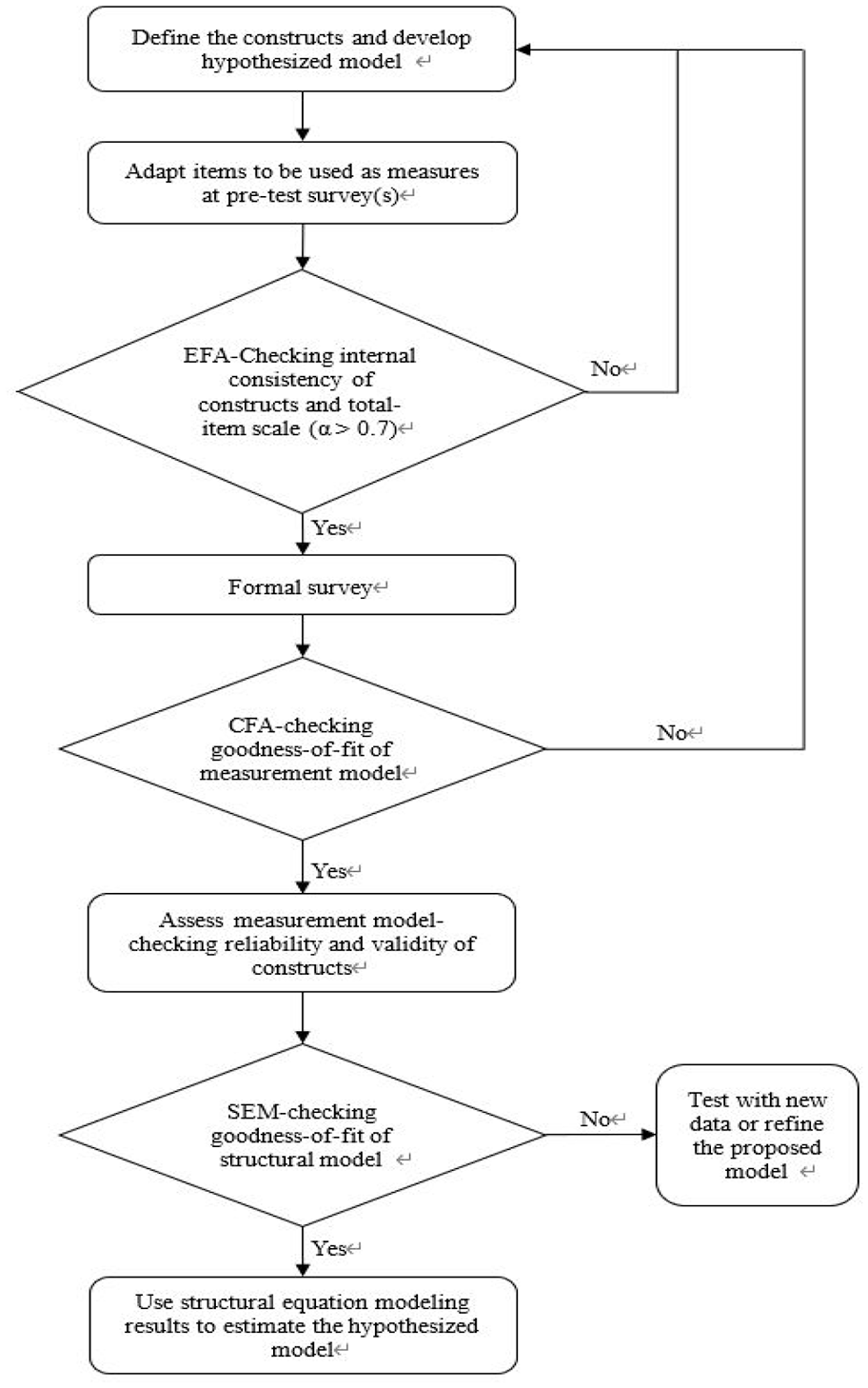
Research methodology diagram.
Table 1 presents an overview of the respondents’ profiles. Among them, 54.0% were male, and 46.0% were female. 57.0% were aged up to 45, 53.3% had at least a bachelor’s degree and 76.2% had a monthly income below US$2,400. The sample profile effectively represents the typical shopper involved in community group buying in China, as it captures the essential characteristics of the studied population. Moreover, this biased sample from an online voluntary sampling survey can still be a reasonable estimate because all participants have purchase experiences in community group buying, and most demographics are not missing out on sampling (Couper, 2000; Dillman, 2000; Hair et al., 2018; Hewson et al., 2003).
Sample Profile.

Note. n = 302.
Measures
The measures were adopted from relevant literature. The questionnaire comprised seven components with a 5-point Likert scale, and the hypotheses were tested with a structural equation model using the AMOS 24.0 program. Consumer satisfaction, community engagement, three categories of consumer inertia (i.e., cognitive, affective, and behavioral types), store preference, and customer commitment (see measures and alpha values in Table 2). Consumer satisfaction with quality (CSQ) contains three dimensions of quality: information quality (IQ), product quality (PQ), and service quality (SQ). Nine items were adapted from Cheng (2014), Gök et al. (2019), and Parasuraman et al. (2005), respectively. The consumer satisfaction with quality (CSQ) measure contains three items adapted from Fitzsimons (2000). Consumer inertia included cognitive inertia (CI), affective inertia (AI), and behavioral inertia (BI); three items each were adapted from Polites and Karahanna (2012). Three items to measure community engagement (CE) were adapted from Hollebeek (2019). The store preference (SP) measured by three items was adapted from Tripsas (2008). Finally, the customer commitment (CC) measure contains three items adapted from Fullerton (2005). The internal consistency coefficients for the individual constructs had α values from .78 to .94, while the 27-item scale showed a Cronbach α value of .97. All α values meet the acceptable threshold recommended by Hair et al. (2018).
Internal Consistency and Composite Reliability.

Note. α value of the 27-item scale is .969.
Results
CFA-Reliability and Validity
The formal survey followed a two-stage analytical approach: CFA for the measurement model and SEM for the hypothesized model (Shiu, Wei, & Chang, 2023). The measurement reliability and validity assessment involved calculating the standardized factor loadings (SFLs) to evaluate the composite reliability (CR) and the average variance extracted (AVE). Table 2 shows that the construct of consumer satisfaction with quality (CSQ) had a CR value of 0.89; community engagement (CE), 0.88; cognitive inertia (CI), 0.84; affective inertia (AI), 0.77; behavioral inertia (BI), 0.90; store preference (SP), 0.87; consumer commitment (CC), 0.88. All CR values exceeding 0.70 suggest the measures are reliable (Hair et al., 2018).
This study utilized Harman’s single-factor test as a diagnostic tool to address common method bias, which can occur when a single data collection method is used. According to Podsakoff et al. (2003), common method bias is indicated if the first common factor explains over 40% of the cumulative variance. The analysis showed that the variance explained by the first common factor was 29.50%, well below the 40% threshold. Moreover, the total cumulative variance explained through principal component analysis was 67.71%, with the first common factor contributing 29.35%. Since this proportion is less than 50% of the total cumulative variance (29.35% < 33.86%), it demonstrates that the data collected is free from common method bias (Hair et al., 2018). Confirmatory factor analysis (CFA) was also employed to detect and manage any common method variance.
In Table 3, the assessment of convergent and discriminant validity of constructs is satisfactory because all AVE values surpass 0.50, and the square roots of AVE exceed the inter-construct correlations (Hair et al., 2018). Table 3 also highlights the interrelationships among these constructs in the study. The correlation coefficients (r) range from .29 to .72 at p < .05.
CFA-validities.

p < .05. **p < .01 (two-tailed).
Model Fit
We analyzed the second data set (n = 302) from the formal survey using CFA and SEM to assess the model fit. A model is considered favorable or acceptable when χ2/df. Ratio falls within the 1 to 3 or 3 to 5 range. Additionally, the GFI should exceed 0.90 or 0.80, while the CFI and IFI should be above 0.95 or 0.90. Furthermore, SRMR and RMSEA should be below 0.05 or 0.08, as recommended by Hair et al. (2018). Table 4’s goodness-of-fit indices indicate that the measurement and structural models demonstrate satisfactory fit. These indices serve as valuable indicators to assess the validity and alignment of the models with the data.
Model Fit.

Path Analysis
The study employed SEM to examine mediating effects in the hypothesized model by introducing three categories of consumer inertia. In Table 5, the simultaneous regression paths indicate that consumer satisfaction with quality (CSQ) significantly contributes to cognitive inertia (CI; β = .63, p < .001), affective inertia (AI; β = .57, p < .001), and behavioral inertia (BI; β = .53, p < .001). Conversely, cognitive inertia (CI; β = .33, p < .001) and behavioral inertia (BI; β = .36, p < .001) predict store preference (SP), while affective inertia (AI) does not exhibit a significant association with SP (β = .08, p > .05). Given the insignificant association between CSQ and SP (β = .05, p > .05), CI and BI, therefore, fully mediate the CSQ–SP relationship (H1a and H1c supported); in contrast, AI does not mediate the CSQ–SP relationship (H1b unsupported). Moreover, CI (β = .37, p < .001), AI (β = .12, p < .05), and BI (β = .33, p < .001) also contribute to consumer commitment (CC). Interestingly, the association between CSQ and CC is insignificant (β = .05, p > .05). Consequently, all varieties of consumer inertia fully mediate the transition between CSQ and CC (H2a, H2b, and H2c are supported).
Path Analysis.
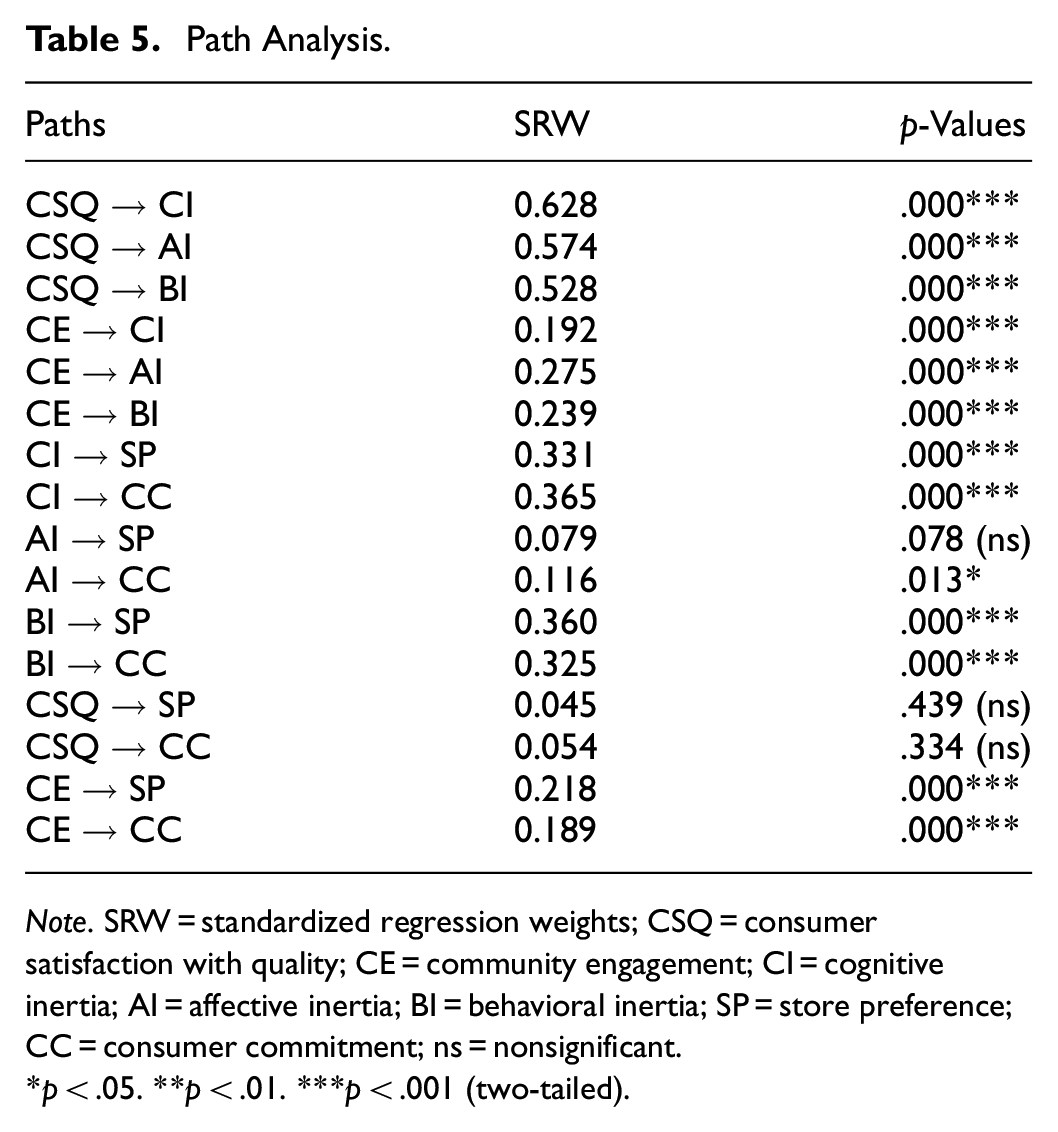
Note. SRW = standardized regression weights; CSQ = consumer satisfaction with quality; CE = community engagement; CI = cognitive inertia; AI = affective inertia; BI = behavioral inertia; SP = store preference; CC = consumer commitment; ns = nonsignificant.
p < .05. **p < .01. ***p < .001 (two-tailed).
In a similar vein, community engagement (CE) exhibits associations with CI (β = .19, p < .001), AI (β = .28, p < .001), and BI (β = .24, p < .001). Notably, the significant link between CE and SP (β = .22, p < .001) indicates that CI and BI partially mediate the CE–SP relationship (H3a and H3c are partially supported). In contrast, AI does not mediate the CE–SP relationship (H3b is unsupported). Furthermore, the significant association between CE and CC is also (β = .19, p < .001). Consequently, all three categories of consumer inertia partially mediate the shift from CE to CC (H4a, H4b, and H4c are partially supported).
Model Power
According to Cohen et al. (2013), the squared multiple correlations (R2) of .01, .09, and .25 are benchmarks for demonstrating the model’s nomological validity. In our proposed model, all R2 values of endogenous variables exceed .25: CI = 0.58, AI = 0.60, BI = 0.49, SP = 0.74, and CC = 0.76. These findings suggest that the structural model effectively captures substantial impacts on endogenous variables. The hypothesized model explains over 50% of store preference and consumer commitment variances, respectively (refer to Figure 3).

SEM results.
Discussion
This research investigates how consumer satisfaction with quality (CSQ) and community engagement (CE) influence store preference (SP) and consumer commitment (CC) within the context of homogeneous competition in China’s community group-buying setting post-COVID-19 outbreak. The empirical results reveal that only cognitive and behavioral inertia can explain the transitions from CSQ and CE to SP (fully mediation for CSQ–SP and partially for CE–SP); contrary to our expectations, affective inertia did not mediate the relationships. In addition, all three types of inertia can predict the transitions from CSQ and CE to CC (fully mediation for CSQ–CC and partially for CE–CC).
Theoretical and Managerial Implications
Our theoretical and managerial implications focus on the complexities associated with homogeneous competition. This research contributes to the marketing literature by deepening our understanding of community group buying and offering valuable insights for marketers seeking to engage their customers effectively through this online platform in China.
This research enhances the existing literature by thoroughly exploring how consumer inertia mediates the transition from consumer satisfaction and community engagement to store preference and consumer commitment. The results above demonstrated at least three theoretical implications for understanding consumers’ flow experience within a community group-buying setting. Firstly, the findings indicate that maintaining store preference and fostering consumer commitment necessitates consistently reinforcing positive satisfaction alongside encouraging active consumer participation, thereby nurturing a robust brand-consumer relationship. In essence, it is not sufficient for long-term loyalty, while consumer satisfaction with lower levels of community engagement may only serve to maintain store preference and commitment through inertia. Secondly, elevated levels of community engagement can directly influence store preference and consumer commitment. These two theoretical implications suggest higher community engagement is more crucial than consumer satisfaction in cultivating community group buying. Lastly, our study proposes that affective inertia does not mediate the relationships between consumer satisfaction, consumer engagement, and business preference. This is because affective inertia primarily reflects a tendency to maintain current emotional states rather than directly evaluating consumer experiences. Instead, consumer satisfaction, based on comparing expectations and actual experiences, and consumer engagement, involving deep cognitive and emotional involvement, are the more direct and critical factors influencing business preference. Therefore, affective inertia is essential for establishing effective connections and countering the proliferation of similar options.
Moreover, the study’s findings offer valuable insights for marketers, enhancing their understanding of the significance of consumer inertia. These insights inform the effective management of community group buying practices in China, leading to two vital managerial implications. First, platforms must invest efforts to strengthen consumers’ emotional connection with brand platforms by fostering a sense of belonging, respect, and self-actualization in response to the increasing availability of similar options. Secondly, strong community engagement is more pivotal in cultivating community group buying. In contrast, consumers who are satisfied but rarely engage in community activities may rely on inertia from their prior experiences as a reference for decision-making, believing that this can effectively reduce decision-making risks (Waqas et al., 2024).
Furthermore, when consumers participate in these platforms, they not only benefit from discounts but also engage in meaningful social interactions with fellow buyers. These interactions build a sense of community, creating a positive experience for the consumers. As a result, consumers develop a stronger preference and commitment to the stores they purchase from through the platform, as they feel a deeper connection and a sense of belonging among the community members.
In light of these managerial implications, this study presents several recommendations for managers to establish effective links with consumers by encouraging community engagement besides merely improving product and service quality. These suggestions include: (1) the implementation of customer care programs that include holiday gifts, (2) the provision of discounts and special treatment for repeat customers who demonstrate loyalty over time, (3) incentives such as discounts or rebates offered when existing customers refer new clients, (4) personalized and customized products tailored for both old and new customers, and (5) endorsements from celebrities renowned for their exemplary character, strong work ethic, and commitment. Such initiatives can cultivate affective empathy and inertia to retain existing customers and attract new users, giving them a competitive advantage in a market replete with similar products or competing channels (Anninou & Foxall, 2019).
Limitations and Future Research
This study contributes to understanding consumers’ flow experience within a community group-buying setting during the COVID-19 pandemic emergency. However, it is important to acknowledge two significant limitations that could inform future research. First, enhancing the applicability of this study’s findings necessitates comparisons with results derived from diverse cultural contexts. Cross-cultural comparisons are crucial due to variations in pandemic policies across countries and differing demand levels for community group purchasing. Second, community group buying has emerged as a global shopping phenomenon in response to the COVID-19 lockdown. Consumers’ anxiety and uncertainty about the infections could amplify risk perception and trigger an impulse purchase for “better safe than sorry.” Therefore, assessing the current research model in a post-pandemic era is essential to revisit the mediating impact of the three types of inertia during transitions.
Footnotes

Ethical Considerations
This study was granted complete ethical standards of Macau University of Science and Technology regulations. The pre-test and formal survey followed relevant guidelines and rules as per the Declaration of Helsinki.
Funding
The author(s) disclosed receipt of the following financial support for the research, authorship, and/or publication of this article: This work was supported by the Macau University of Science and Technology Foundation [FRG-21-010-MSB] to the first author during 2021 to 2022.
Declaration of Conflicting Interests
The author(s) declared no potential conflicts of interest with respect to the research, authorship, and/or publication of this article.
Data Availability Statement
The data supporting this study s findings are available from the corresponding author upon reasonable request.